

I never really thought much about AUM fees.
That's it, if someone else manages my money, there's bound to be a fee. I was done with it then.
But lately, I've been looking at the direction of DeFAI, especially @OpenLedger and I've been rethinking that aspect.
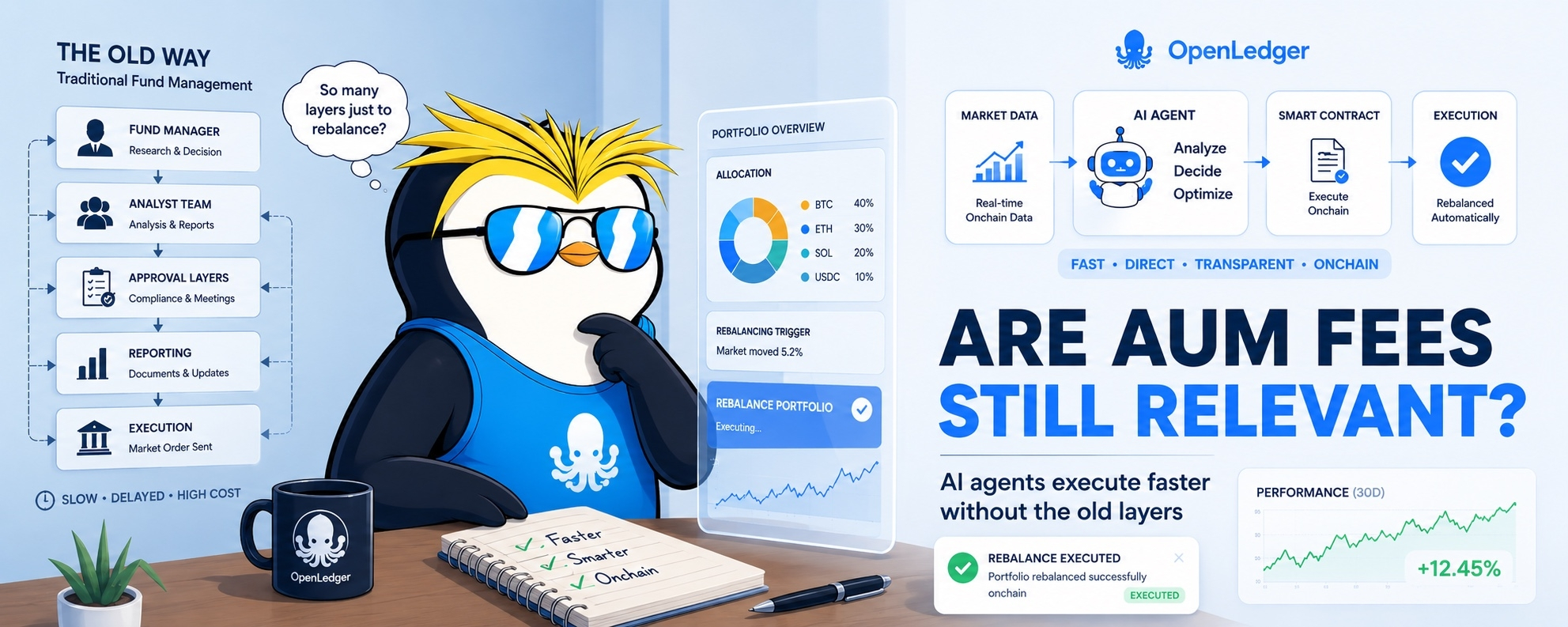
TradFi turns out to have so many layers. Fund managers, analysts, approvals, reports, everything. The results then reach us. And all of that has a cost, through the AUM fee.
I saw a small example, regarding portfolio rebalancing.
In the old system, there was a sense of waiting. It wasn't instant. Sometimes the market would change, but execution would still be delayed.
From what I understand about #OpenLedger they're pushing a different model.
AI agents that run on top of smart contracts. So they can read conditions, follow the rules, and then execute onchain themselves. There's no need for a lot of middle ground.
That's when I started to think, if it's like that, what are the AUM fees really being paid for?
The reason is that the function that used to generate fees has now been taken over by the system.
And what I'm experiencing isn't just about fees.
It's more about everything is faster, more direct, and more visible because it's onchain.
$OPEN seems to be moving in that direction.
It's not just AI to assist with analysis, but it's slowly shifting the old way we view fund management, including AUM fees that once seemed very reasonable.