
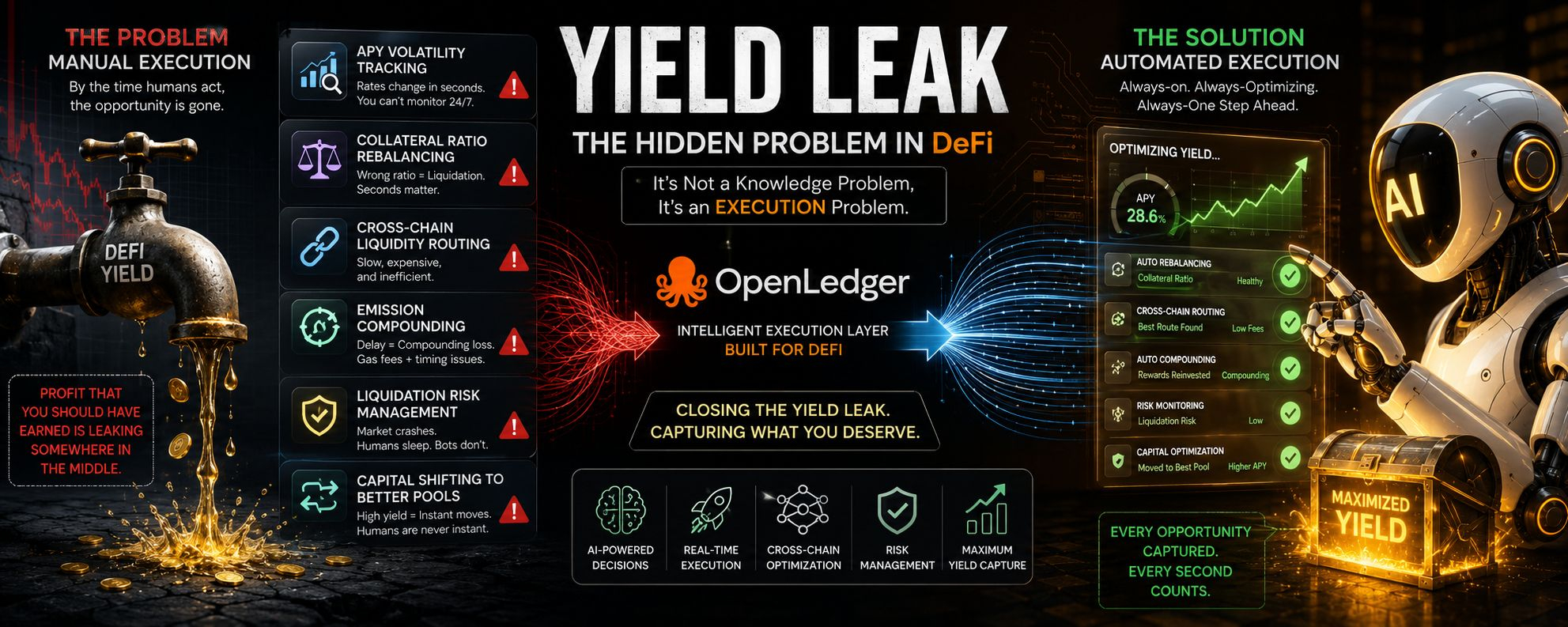

Whenever I explore @OpenLedger , I keep coming back to one thought…
Maybe the problem in DeFi is much deeper than it looks from the outside.
I started digging into one idea they keep hinting at — “Yield Leak.”
And honestly… it sounds simple at first, but it’s actually a very serious problem.
In simple words, yield leak means people are losing profits somewhere in the middle. Not because they don’t understand DeFi… but because they simply cannot execute fast enough.
That part really made me stop and think.
Because in DeFi, knowledge is everywhere now.
Everyone already knows:
• where APY is high
• which pools are better
• which chains have opportunities
The real problem is execution.
DeFi markets move 24/7. Rates change in seconds. Liquidity shifts instantly.
No human can realistically sit and monitor everything all day.
And that’s exactly where the “yield leak” begins.
— — — — — —
The more I looked into OpenLedger’s narrative, the more I felt they’re trying to expose all the places where humans naturally fall behind.
Here’s how I personally see it:
1. APY volatility tracking
Yields constantly change across protocols. By the time you notice a better opportunity, the market may already have moved.
2. Collateral ratio rebalancing
This one is brutal. If your loan position isn’t adjusted in time, liquidation can happen fast. Seconds matter.
3. Cross-chain liquidity routing
Moving capital between chains sounds easy in theory… but in reality it’s slow, expensive, and messy.
4. Emission compounding
Reward tokens need continuous reinvestment for maximum compounding. Humans can’t realistically optimize this every hour.
5. Liquidation risk management
Markets crash suddenly. Bots react instantly. Humans sleep.
6. Capital rotation into better pools
The highest yields often require immediate action. But “instant execution” and “human behavior” rarely work together.
— — — — — —
And this is where OpenLedger’s bigger idea starts becoming visible.
It feels like they are quietly pushing DeFi toward something bigger:
A shift from manual execution → automated intelligent execution.
Basically an execution layer that thinks, reacts, reallocates, and optimizes automatically in the background.
Almost like AI-driven infrastructure for DeFi capital.
And honestly… this is where things become interesting.
Because if this actually works at scale, then DeFi changes completely.
The advantage will no longer belong only to people who “know” things…
It will belong to systems that can execute faster than humans.
But at the same time, this is also where hype and reality separate.
Because building a seamless execution layer sounds amazing conceptually…
yet extremely difficult practically.
One thing I noticed though:
OpenLedger isn’t marketing this as “earning more yield.”
They’re framing it as:
“closing the yield leak.”
That’s smart.
People respond much faster to recovering lost value than chasing imaginary new profits.
And honestly, the problem they’re pointing at is real.
So right now, I’m somewhere in the middle.
The idea feels strong.
The logic makes sense.
The problem definitely exists.
But execution is everything.
If the automation layer isn’t truly seamless, this remains just another beautiful DeFi theory.
But if it works…
Then one of the most boring infrastructure problems in DeFi could quietly become one of the biggest opportunities.
Still observing.
Not fully convinced.
But definitely not ignoring it either.
Because in DeFi, the most dangerous thing is not hype…
It’s overconfidence 🚀
