


Most AI systems today are built on invisible inputs.
Data is collected, processed, and absorbed into models that generate massive commercial value. But for the people who originally contributed that data, there is usually no trace, no acknowledgment, and no compensation mechanism that follows through in a transparent way.
This is the gap OpenLedger is trying to address.
OpenLedger is positioning itself as an AI blockchain infrastructure focused on attributing and tracking contributions across data, models, and autonomous agents. Instead of treating training data and model interactions as a closed internal process, it moves activity into a verifiable ledger where contributions can be recorded and linked to outcomes.

A key part of this direction is OctoClaw, a desktop-based AI agent system that allows users to build and execute AI workflows directly on-chain. Rather than relying on multiple external tools and opaque execution layers, workflows are structured so that model usage and agent activity can be tracked in real time.
The core idea is straightforward: if data or model behavior contributes to output, that contribution should not disappear into an untraceable system.
In traditional AI pipelines, attribution is extremely limited. Data sources are aggregated, cleaned, and embedded into models where individual contributions become statistically indistinguishable. The economic benefit concentrates at the application layer, not at the input layer.
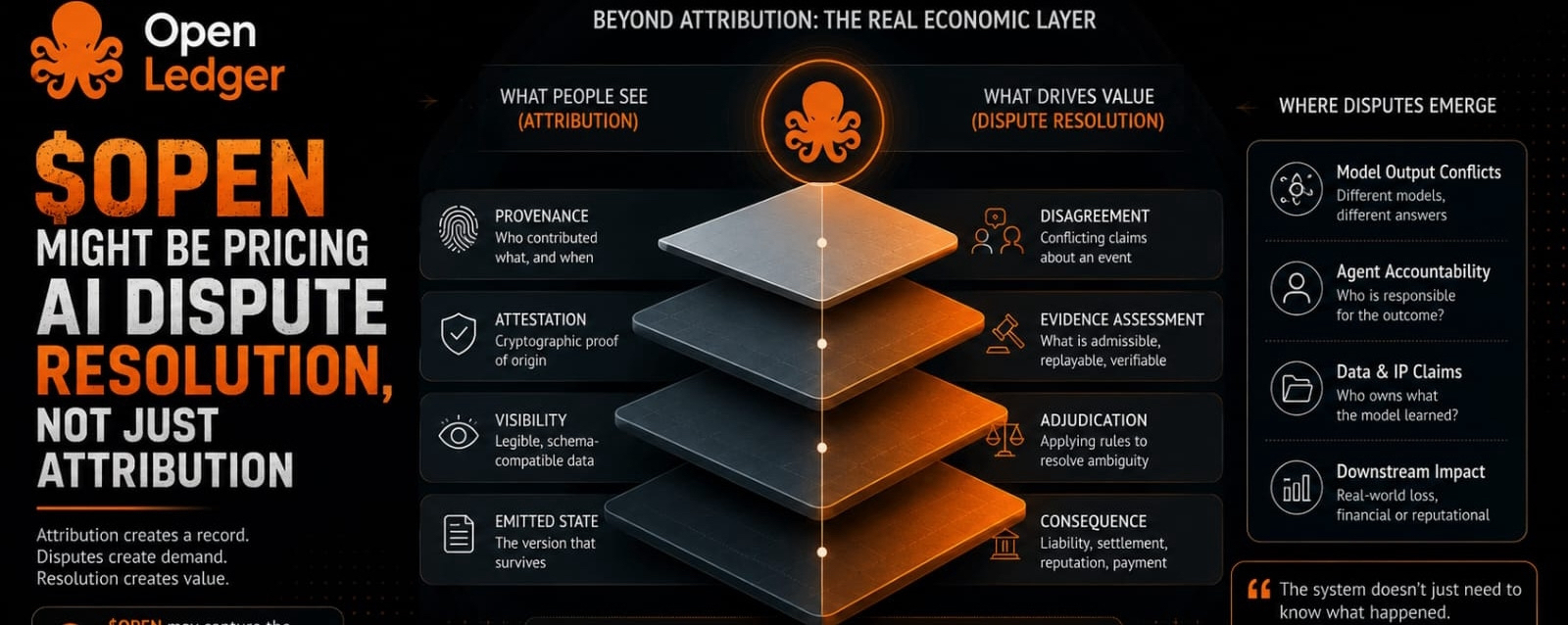
OpenLedger proposes a different structure. Contributions across datasets, model updates, and agent actions are recorded on-chain, enabling traceability from input to output. In theory, this allows value distribution to be tied directly to participation rather than absorbed entirely by platform operators.
There is also a broader positioning around incentives. If attribution becomes reliable and programmable, it opens the possibility of automated compensation systems for data contributors, model builders, and agent developers. That shifts AI infrastructure from purely extractive pipelines into systems where participation can be measured and potentially rewarded.
At the same time, execution risk remains central. Many infrastructure-heavy crypto AI projects have struggled to move beyond early narratives into sustained adoption. Technical complexity, user onboarding friction, and unclear demand for on-chain computation are all unresolved challenges in the sector.
OpenLedger has already shipped mainnet components and deployed OctoClaw, but the long-term outcome depends less on product launches and more on whether developers and enterprises actually choose to build within an on-chain attribution framework instead of conventional AI infrastructure.
There is also a broader question that remains open: whether attribution in AI becomes a market-driven standard or whether it only becomes meaningful if reinforced by regulation and compliance requirements.
If AI continues scaling into critical infrastructure, the demand for transparency around training data and model behavior will likely increase. Whether that demand translates into on-chain systems or remains within traditional audit frameworks is still unresolved.
For now, OpenLedger represents a specific bet: that AI value creation can be made traceable, and that traceability can eventually become a foundation for compensation.
Whether that model becomes widely adopted will depend less on the narrative and more on whether the ecosystem actually finds it useful enough to build on.