
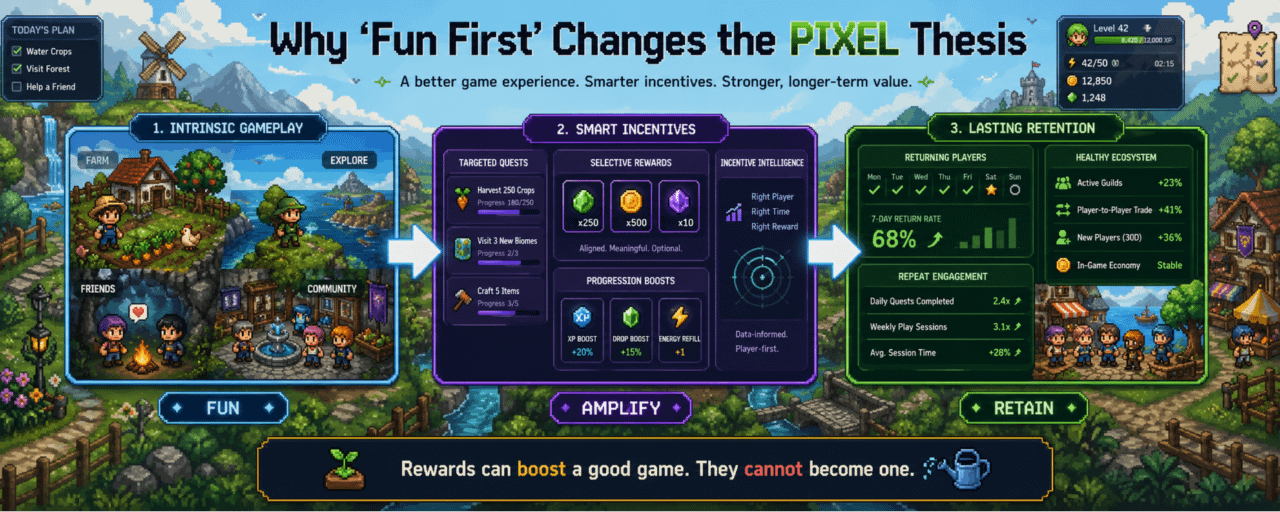

The easiest mistake in Web3 gaming is to assume rewards can substitute for game quality.
They usually cannot.
That is why Pixels becomes more interesting once you look at the order of its thesis. In the litepaper, the project puts Fun First alongside Smart Reward Targeting and the Publishing Flywheel as three connected pillars. The wording is direct: games need an intrinsic motivator, and for games that means they need to be fun.
That changes how the rest of the model should be interpreted.
If fun comes first, then incentives are no longer carrying the full burden of retention. They are not supposed to create the entire reason to return. They are supposed to amplify an experience that already has its own pull. The same litepaper frames reward targeting as a data-driven system for directing rewards toward actions that create long-term value, while the flywheel is designed to connect better games, richer data, and more precise targeting over time.
That is a much healthier order than the usual “pay first, design later” approach.

A reward-heavy system can always manufacture activity for a while. It can create sessions, clicks, claims, and short-term motion. But if the world itself is weak, those metrics tend to collapse the moment incentives become less attractive. Pixels appears to be trying to avoid that trap by treating gameplay quality as the base layer and incentive design as the optimization layer on top of it. That reading also fits the main site, which presents Pixels as a free-to-play social world built around adventure, friends, communities, land, and play itself.
The distinction matters because “fun” and “rewards” solve different problems.
Fun creates intrinsic demand.
Rewards shape behavior inside that demand.
If people genuinely enjoy exploring, farming, building, and playing with friends, then selective incentives can deepen those loops. They can accelerate progression, sharpen return behavior, and reinforce higher-value actions. But if the underlying experience is not worth revisiting, rewards usually do not fix the system. They just rent attention a little longer. Pixels’ whitepaper language around intrinsic motivation and smart targeting strongly supports that interpretation.
This also makes the growth side of the thesis easier to understand.
The litepaper does not describe growth as a simple matter of buying more activity. It describes a publishing flywheel where better games generate richer data, richer data improves targeting, and lower UA costs help attract more high-quality games. In that framework, “Fun First” is not separate from growth. It is one of the prerequisites for healthier growth. Better rewards alone do not make the flywheel stronger if the product layer underneath them is weak.
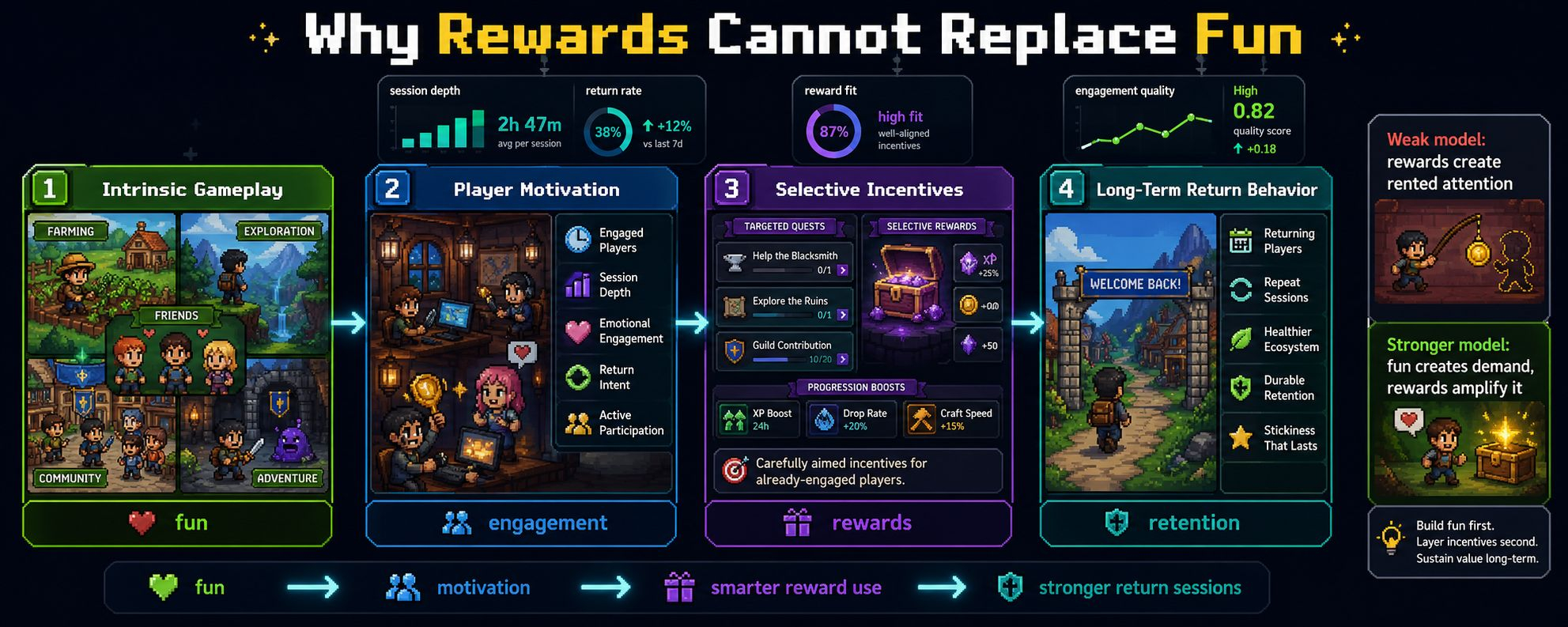
That is why this pillar is more important than it sounds.
It is not just a design slogan.
It is a constraint on the rest of the economy.
It says the game should be enjoyable enough that rewards behave like an amplifier, not a prosthetic. And once you read PIXEL that way, the whole system makes more sense: gameplay builds demand, targeting refines incentives, and the flywheel tries to compound what already works instead of endlessly subsidizing what does not.
So the stronger way to read PIXEL may be this:
not as a project asking how much it can pay players,
but as a project asking whether good gameplay and smart incentives can reinforce each other inside one system.
That is a harder thesis to execute.
But it is also a much stronger one than treating rewards as the product itself.