

Scale is the easiest growth metric to celebrate.
It is also the easiest one to misunderstand.
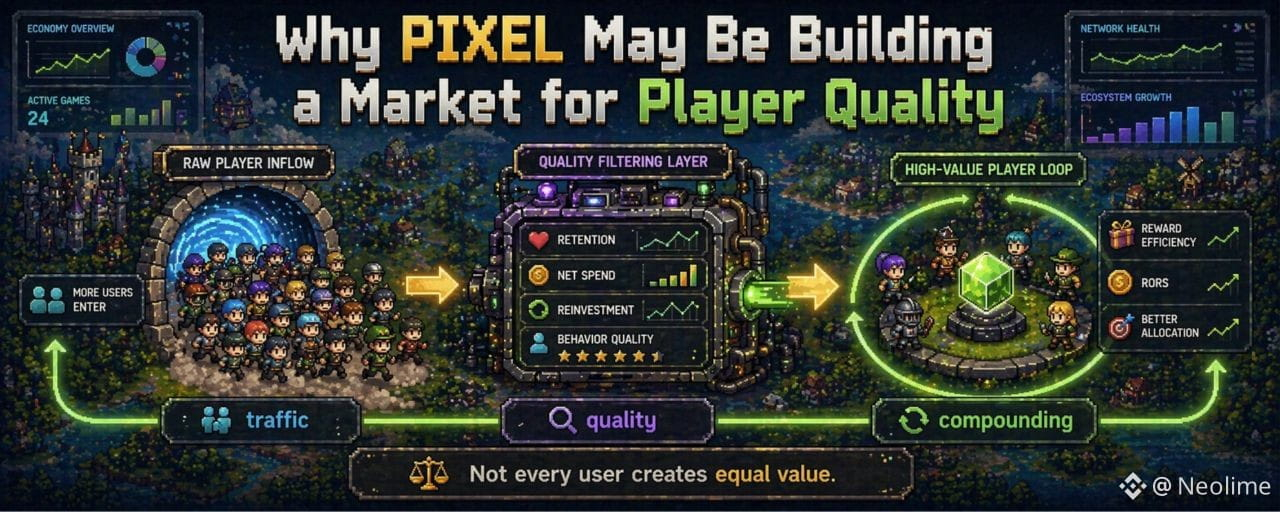
That is why Pixels starts to look more interesting once you stop reading it as a project chasing the biggest possible top line and start reading it as a system trying to sort users by economic quality. In the revised vision, the team explicitly says it is prioritizing high-quality DAU over raw quantity, while also moving toward data-backed incentives and a more measurable growth model built around RORS.
That shift changes the whole story.
A normal game economy wants more users.
A smarter economy wants better users.
Those are not the same objective.
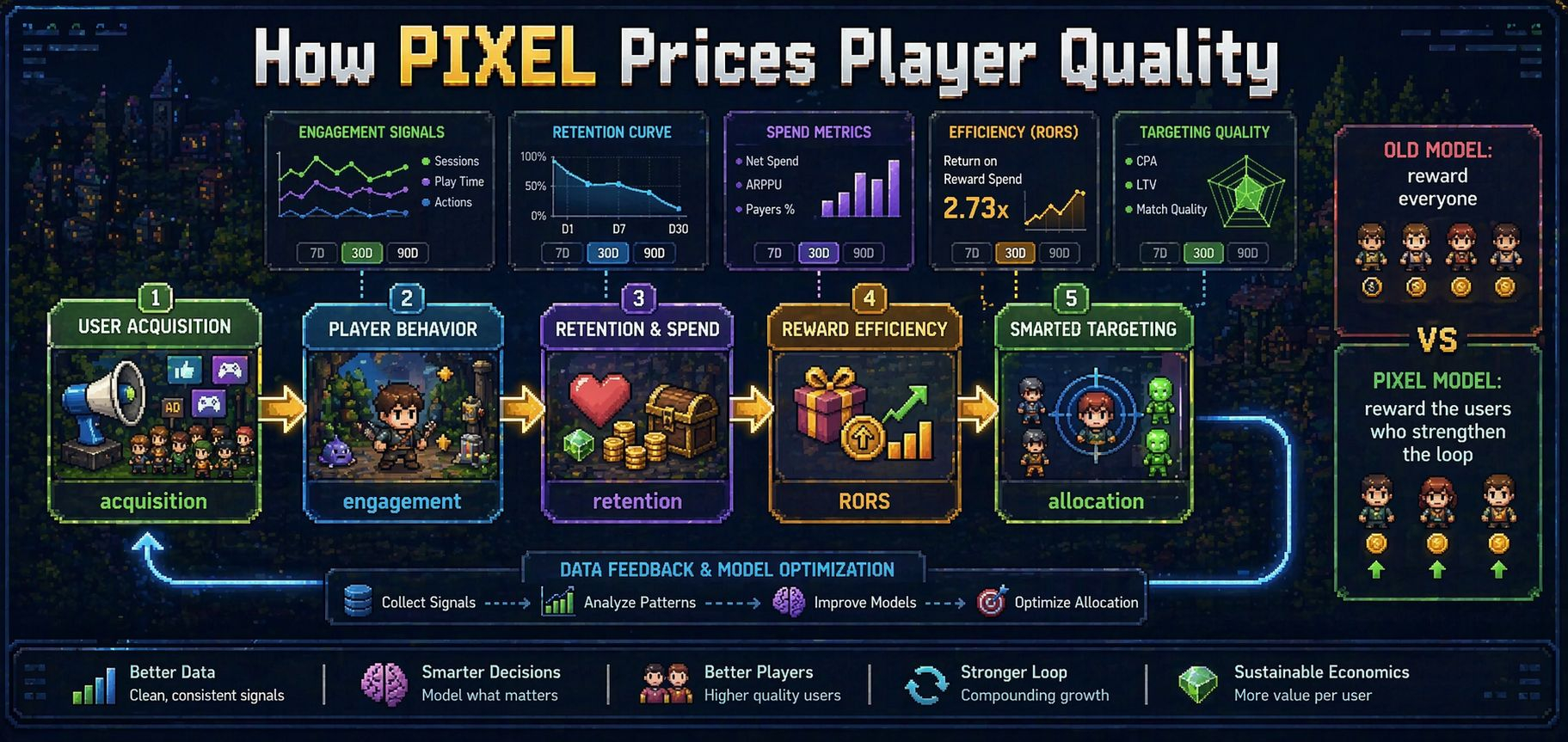
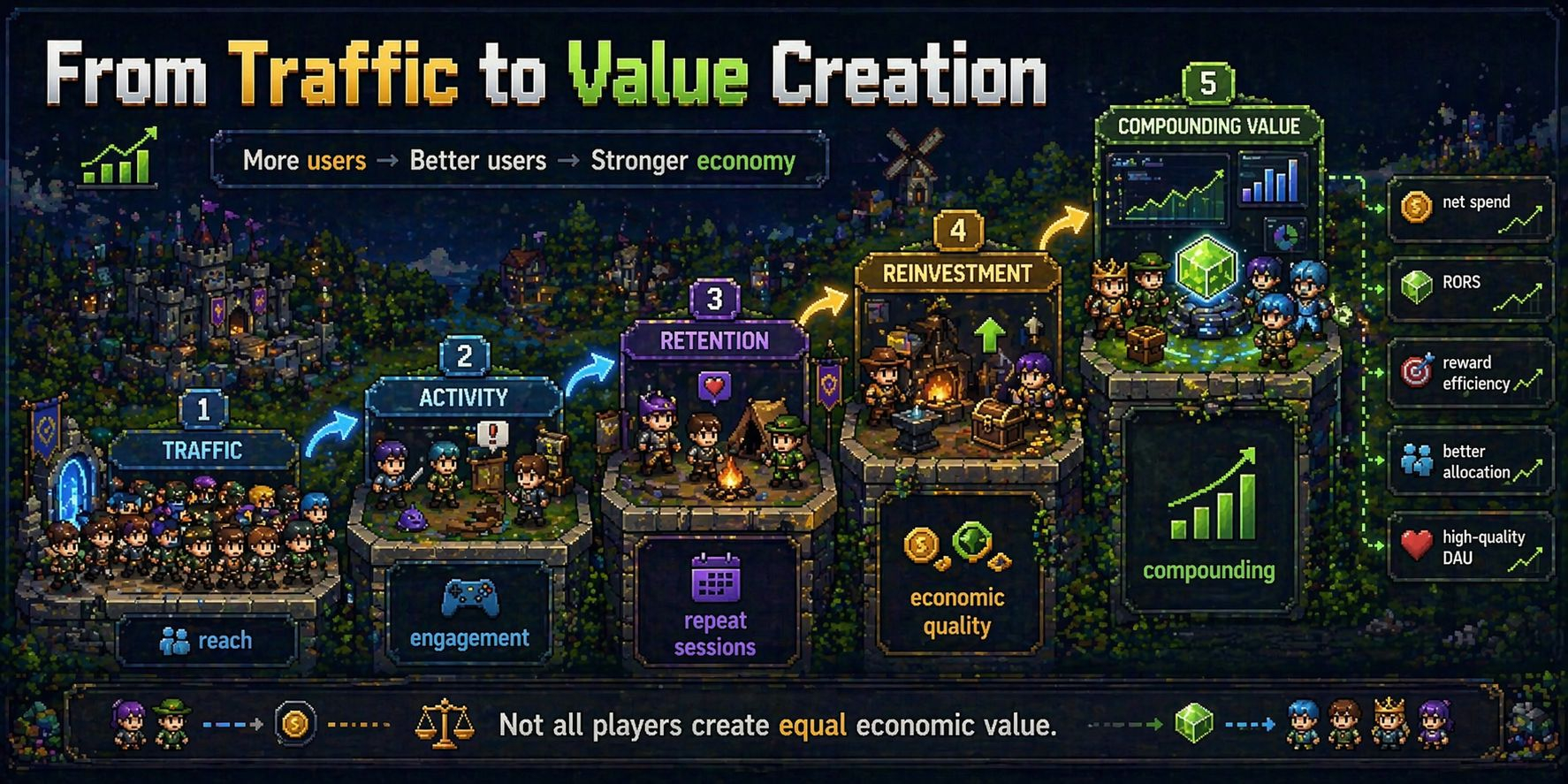
More users can inflate activity without improving retention, spending, or reinvestment. Better users create stronger loops because they stay longer, spend more productively, and generate cleaner data for the next round of allocation. That logic sits directly inside the Pixels thesis: the whitepaper ties user quality to better targeting, smarter incentives, sustainable ecosystem growth, and a stronger return on reward spend.
Once you see that, Pixels starts to read less like a rewards machine and more like a filtering system.
Not a filter in the sense of blocking access.
A filter in the sense of learning where capital should go.
The main site still presents Pixels as a free-to-play, social ecosystem with a large player base, community features, and staking at the center of the economy. But the revised docs suggest that scale by itself is no longer enough. The more important question is which players actually reinforce the ecosystem once they arrive.
That is where the acquisition layer becomes more important than it first appears.
Pixels does not describe growth as a one-way funnel where rewards bring in traffic and the story ends there. The project’s revised vision says it wants to become something closer to decentralized AppsFlyer or AppLovin rails for games, while the staking and token mechanics frame sustainable growth around better data, game competition, and smarter ecosystem incentives.
That matters because acquisition stops being just a marketing function.
It becomes an allocation function.
Who gets targeted?
Which games deserve support?
Which rewards produce reinvestment instead of extraction?
Which players create durable value instead of temporary activity?
Those are much harder questions than “how many people showed up.”
But they are also the questions that decide whether a game economy compounds or leaks.
The staking design reinforces that same logic from the game side. The litepaper says players choose games to stake into, influencing which games receive ecosystem incentives, while games compete for support by improving retention, increasing net in-game spend, and using ecosystem tools effectively. In other words, games are not just chasing users. They are competing to prove they can attract the right kind of users.
That makes the PIXEL model feel unusually selective.
Not in a closed way.
In a performance-aware way.
A weak system distributes incentives broadly and hopes activity follows.
A stronger system tries to direct incentives toward users and games that make the next cycle better than the last one. That is exactly the direction Pixels describes when it talks about data-backed incentives, higher-quality DAU, and improving RORS as a north-star metric.
This is also why the project’s social and ecosystem language matters more than generic “millions of players” messaging. The main site emphasizes friends, communities, building, staking, and a universe players can shape, while the revised thesis emphasizes quality, reinvestment, and healthier economics. Put together, that suggests Pixels wants user count to become less of a vanity metric and more of a base layer for identifying who actually strengthens the network.
So the more compelling way to read PIXEL may be this:
not as a token that rises if the game gets bigger,
but as part of a system trying to make growth more discriminate, more measurable, and more efficient.
That is a much harder thing to build than a simple reward loop.
But it is also a much stronger long-term narrative.
Because the projects that last usually are not the ones that attract the most users at any cost.
They are the ones that learn which users are actually worth keeping.