

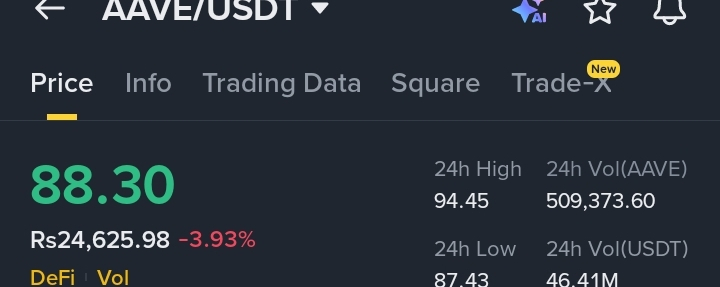

The recent price surge in $AAVE ’s USDT market is tied to a mix of broader crypto momentum and protocol-specific demand shifts. First, Aave benefits heavily when overall liquidity in decentralized finance expands, and that’s exactly what’s happening right now. As traders rotate capital back into DeFi, borrowing activity spikes—especially for stablecoins like Tether (USDT), which are widely used for leverage and arbitrage. When more users want to borrow USDT on Aave, utilization rates rise, and that pushes interest rates higher. Higher rates attract more lenders seeking yield, increasing demand for Aave’s pools and, indirectly, boosting the protocol’s total value locked (TVL). On top of that, whale wallets and institutional players appear to be positioning themselves for short-term opportunities, borrowing USDT to deploy into other trades such as ETH or altcoin breakouts. This kind of activity creates a feedback loop: more borrowing → higher rates → more deposits → stronger protocol metrics → positive sentiment around Aave. At the same time, broader macro sentiment in crypto has turned bullish, with Bitcoin and Ethereum showing strength, which typically lifts DeFi tokens like AAVE as investors move further out on the risk curve. Social media hype and trading volume spikes also amplify the move, as retail traders jump in once they see strong price action.
Another key factor behind the USDT-related pump on $AAVE is liquidity dynamics across exchanges and DeFi platforms. When centralized exchanges experience tighter USDT liquidity or when funding rates shift, traders often turn to DeFi protocols like Aave to source stablecoins quickly. This increases borrowing demand sharply in a short period, which can make it look like a “pump” tied specifically to USDT activity. Additionally, recent governance discussions and upgrades within the $AAVE ecosystem have improved confidence in the protocol’s long-term sustainability, encouraging more capital inflow. Even subtle changes—like adjustments to collateral factors or risk parameters—can significantly impact how much USDT is borrowed or supplied. There’s also the influence of cross-chain activity, as Aave deployments on networks like Polygon and other Layer 2 solutions make borrowing cheaper and faster, attracting new users. However, it’s important to stay grounded: these pumps are often cyclical and driven by short-term leverage demand rather than fundamental changes in USDT itself. If borrowing demand cools or market sentiment shifts, rates and activity can drop just as quickly, leading to a pullback. So while the current surge reflects strong DeFi engagement and liquidity demand, it’s not necessarily a permanent trend—more a signal of active market conditions than a guaranteed long-term rally.