
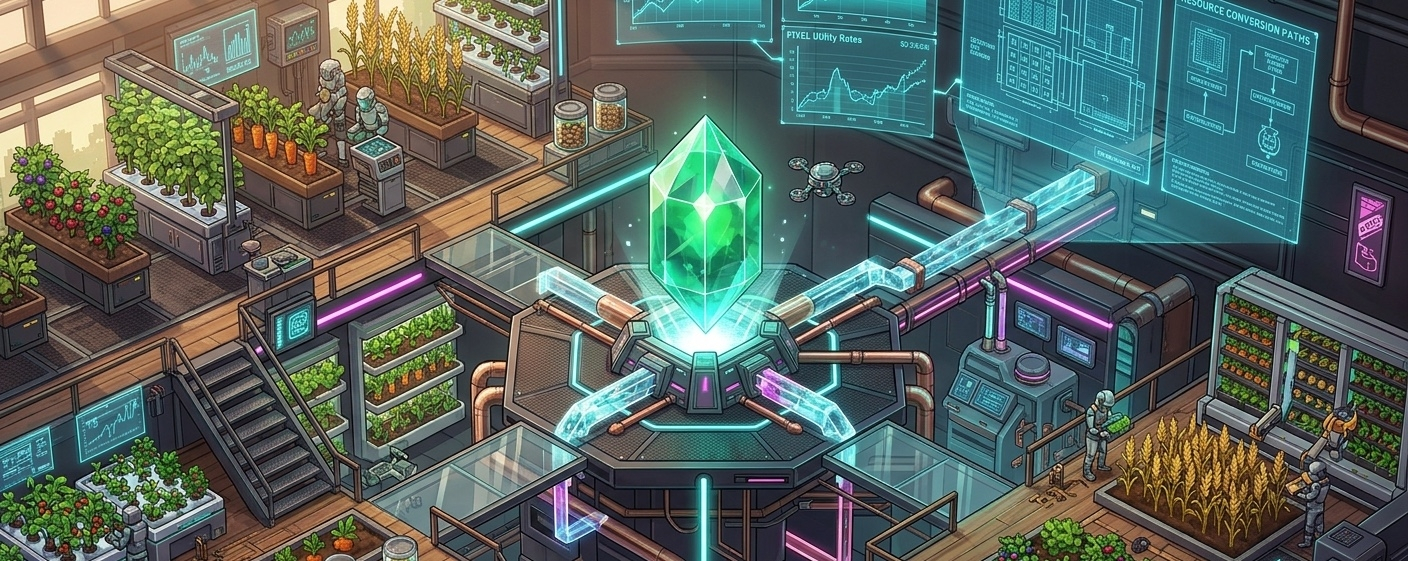
Most users still try to read Pixels through one old template:
A 2D farm game where you click crops to extract tokens.
I think that misses the architecture completely.
The Pixels litepaper describes the network not just as "Play-to-Earn," but as a complex ecosystem built around three pillars: finite resources, social hierarchy, and reputation. The core idea is not "infinite rewards." It is to create a sustainable economy where every action—from planting a seed to crafting a tool—is constrained by Energy.
That shifts the question from “how much can I earn?” to something much more useful:
How does a game survive the transition from inflationary rewards to sustainable utility?
In practical terms, Pixels is built for the "Play-and-Earn" era. The docs explicitly move away from the BERRY-era hyper-inflation. $PIXEL is framed as a "Hard Currency"—a premium resource used for crafting, speed-ups, and guild participation. It isn't just something you receive; it’s something you must strategically spend to stay competitive.
That already makes Pixels different from the usual "farm-and-dump" narrative.
But the architecture gets more interesting when you look at the Energy layer.
On most chains, the bottleneck is gas fees. In Pixels, the bottleneck is Energy. It is the lifeblood of the economy. Since Energy is limited, every player becomes a micro-manager of efficiency. $PIXEL allows users to manipulate these constraints—buying time, increasing yield, and bypassing friction.
This matters because Pixels is not just tokenizing items.
It is tokenizing social status and logistical priority.
On most Web3 games, the token is a byproduct of play. Pixels tries to flip this. The official documentation highlights that Land NFT owners aren't just landlords; they are infrastructure providers. They provide the "machines" (industries) that other players use, creating a symbiotic relationship between landowners and laborers.
That is a much more serious design choice than it first appears.
Because if Web3 gaming is to become permanent, then economic design matters as much as the "fun" factor.
There is another layer here that developers and investors should notice: Interoperability. Pixels supports over 50 NFT collections, allowing users to use their Bored Apes or Pudgy Penguins as in-game avatars. This turns the game into a social infrastructure—a neutral ground where different digital identities can interact.
Pixels isn't just selling a game. They are selling a stack:
• $PIXEL for premium utility and governance.
• Energy as a primary economic constraint.
• Reputation as a shield against botting and bad actors.
• Land as a productive asset within a social network.
So when I look at $PIXEL, I do not see "just another gaming token."
I see a network trying to make three things work at once: sustainable rewards, massive social interoperability, and a controlled resource economy.
That is much harder than launching a farm.