


The long-running tension between traditional banking institutions and the crypto industry has reached a new level in Washington. On Tuesday, U.S. President Donald Trump publicly aligned himself with the digital asset sector, accusing major banks of attempting to weaken legislation that could shape the future of crypto regulation in the United States.
Posting on Truth Social, Trump urged lawmakers to accelerate progress on the Clarity Act, a proposed framework designed to define how digital assets are regulated in the U.S. His message was blunt: if Washington fails to act quickly, crypto innovation could migrate overseas.
According to Trump, American banks are already reporting record profits while simultaneously trying to obstruct policies that could support the growth of the crypto economy. In his view, delaying or undermining crypto-friendly regulation risks pushing businesses and innovation toward competing nations, particularly China.
He also criticized banking lobbyists for targeting current stablecoin legislation, arguing that their actions threaten the broader digital asset agenda his administration has supported.
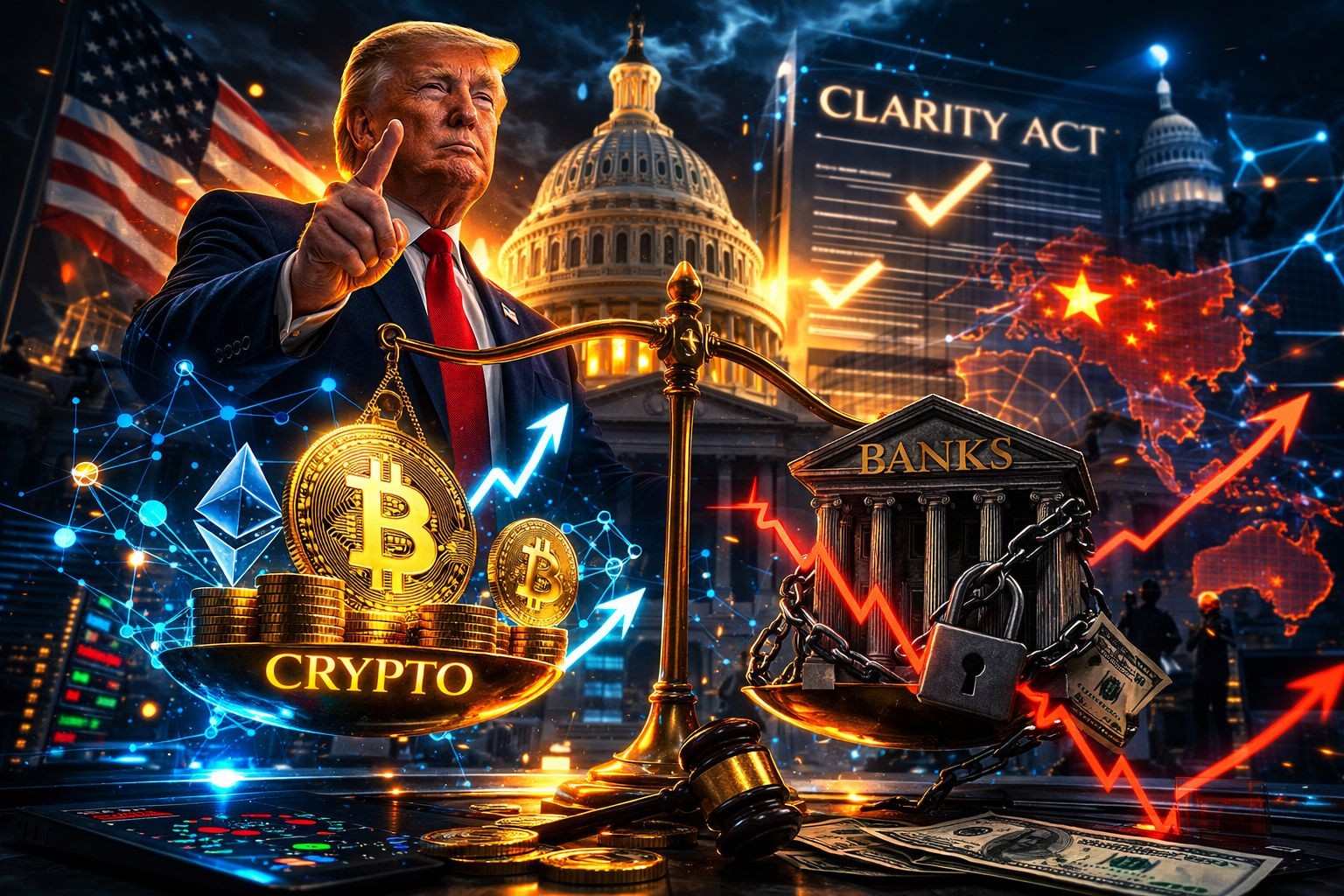
The Clarity Act: A Bill Stuck in Legislative Limbo
At the center of the dispute is the Clarity Act, a market structure bill for digital assets that successfully passed the U.S. House of Representatives last year. The proposal aims to establish clearer rules governing cryptocurrencies and related businesses, something the industry has been requesting for years.
However, progress in the Senate has stalled.
One of the main sticking points involves stablecoin yield programs. Stablecoins are digital tokens designed to maintain a fixed value, typically pegged to the U.S. dollar so that one token equals one dollar. Because of their price stability, they are widely used for trading, payments, and decentralized finance.
Some crypto platforms, including major exchanges, offer reward programs that allow users to earn returns simply by holding stablecoins. The concept resembles the interest paid on a traditional savings account.
Banks have pushed for the Clarity Act to explicitly prohibit these yield programs. Crypto companies argue the opposite, saying users should be able to earn returns on their digital dollar holdings without additional restrictions.
The disagreement has slowed the legislative process. A Senate Banking Committee markup session scheduled earlier this year was postponed after Coinbase withdrew support for a draft version of the bill, and lawmakers have yet to reconcile competing proposals.
Understanding the GENIUS Act
To fully grasp the current conflict, it’s important to look at the GENIUS Act, a law signed by Trump in July 2024 that established the first comprehensive U.S. regulatory framework for dollar-backed stablecoins.
The legislation requires stablecoin issuers to maintain one-to-one backing with U.S. dollars or similarly liquid assets. This rule was designed to strengthen confidence in stablecoins and reduce systemic risks.
However, the law specifically prevents issuers themselves from paying yield to token holders. What it does not address is whether exchanges or other intermediaries can offer such rewards.
That regulatory gap has become the focal point of today’s debate.
Why Banks Are Concerned
Traditional financial institutions worry that yield-bearing stablecoins could draw deposits away from banks.
If consumers begin moving large portions of their savings to crypto platforms in pursuit of higher returns, banks could lose a critical source of funding. Deposits form the backbone of bank lending activity, enabling institutions to provide loans to businesses and households.
A large-scale shift toward stablecoins, bankers argue, could therefore weaken the traditional lending system.
Adding another layer to the discussion, the Office of the Comptroller of the Currency recently proposed rules requiring stablecoin issuers to clearly define the roles and responsibilities of third-party partners involved in their ecosystems. While the proposal focuses on transparency in contractual relationships, it stops short of banning yield programs outright.
Trump’s Personal and Political Links to Crypto
Trump’s strong defense of the crypto industry also carries personal and political dimensions.
A company co-founded by the president, World Liberty Financial, introduced its own stablecoin, USD1, last year. Members of the Trump family are also involved in Bitcoin mining and other digital asset ventures.
Family representatives have previously said they experienced difficulties accessing traditional banking services, which they claim pushed them toward crypto alternatives.
The industry itself has also been a major financial supporter of Trump’s political campaigns. Contributions from crypto-aligned donors played a noticeable role in the 2024 election cycle and may continue to influence political dynamics heading into the 2026 midterms.
What Comes Next for the Clarity Act?
Negotiations between the banking sector and crypto companies are still underway. White House crypto adviser Patrick Witt has reportedly been facilitating discussions between both sides in hopes of finding a compromise.
Despite those efforts, a previously discussed informal deadline in early March passed without an agreement. Draft legislative language continues to circulate among lawmakers, but the Senate Banking Committee has yet to schedule a new markup session.
Time may also become a limiting factor. Congress faces a summer recess, and the approaching 2026 election cycle will further reduce the available legislative window.
With the House already approving its version of the Clarity Act, the Senate remains the key battleground. Yet without a compromise that addresses concerns around stablecoin yields, the bill currently lacks the votes required to advance.
A Defining Moment for U.S. Crypto Policy
Trump’s latest remarks signal a clear stance: he views the growth of the crypto sector as a matter of economic competition and national strategy.
By siding openly with the industry, he has drawn a sharp line between the interests of traditional banks and those of the emerging digital asset ecosystem. Whether that pressure is enough to move negotiations forward in the Senate remains uncertain.
What is clear, however, is that the outcome of this legislative battle could shape the future of crypto innovation in the United States. With political timelines tightening and both industries defending their positions, the standoff between banks and crypto firms shows little sign of fading anytime soon.