The first time it felt wrong, it didn’t feel dramatic. It felt like a spreadsheet. A small mismatch between what the product deck promised and what the logs were quietly recording. The kind of mismatch that looks like nothing until you zoom out and realize it’s a pattern. We were in one of those conference rooms that always smells faintly of dry-erase markers and old air. Someone had brought pastries as if sugar could soften governance. Risk was there. Legal was there. Security was there. Everyone looked awake in the way people look awake when they know they’re being watched.
The agenda said “Sponsored Gas: UX Enablement.” The subtext said “Who is going to be blamed when this goes sideways.”
At 2 a.m., the system had fewer opinions. It just reported what happened. A slow rise in sponsored spend. Not a spike. Spikes are easy. Spikes get attention. This was a slope. Clean. Persistent. It looked like someone learning the shape of the fence by walking the perimeter, patiently, like it wasn’t a fence at all but a suggestion. The on-call engineer didn’t say much. They just sat forward, closer to the glow of the monitors, and started doing the unromantic work: tracing calls, correlating wallets, looking for symmetry in the noise.
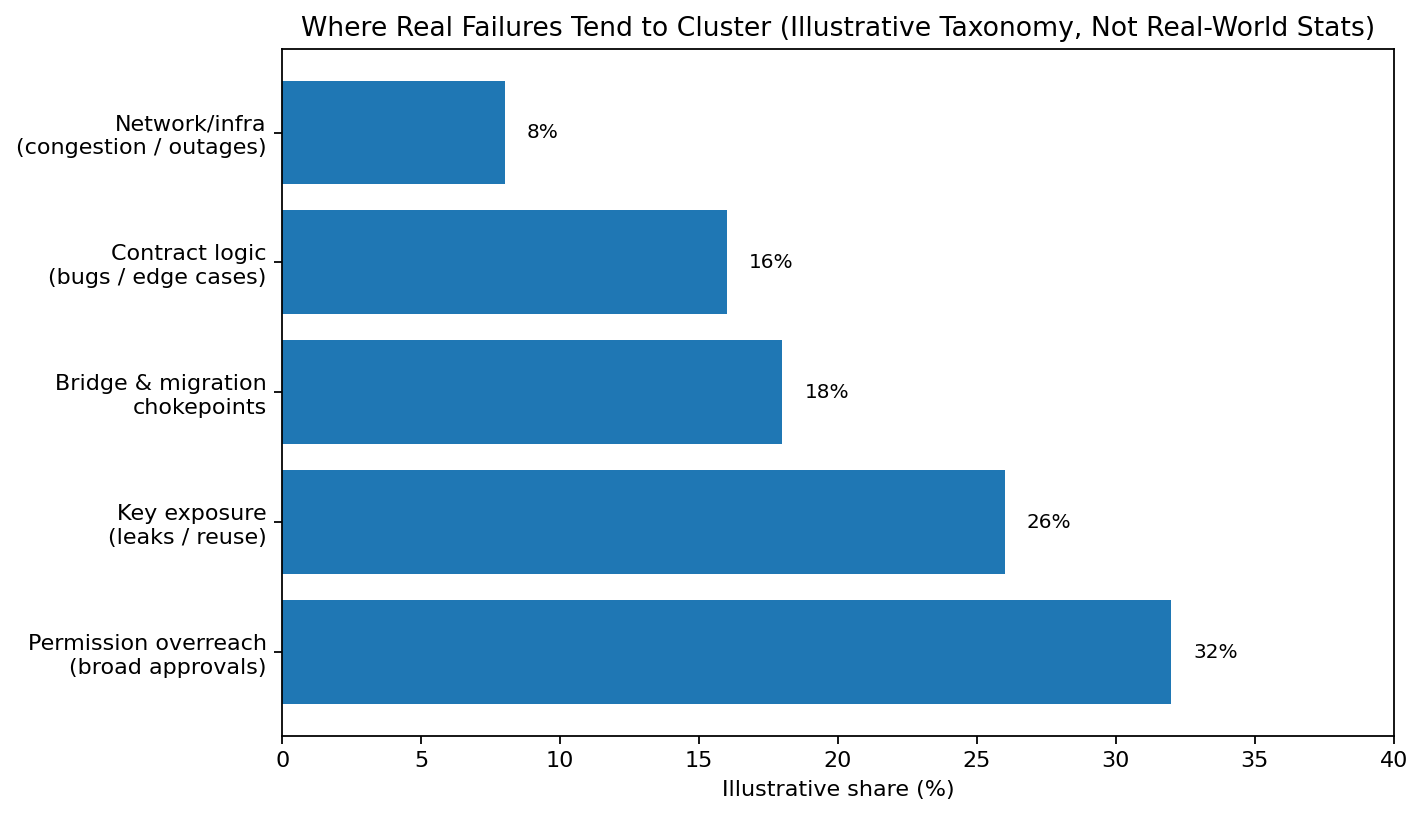
There’s a whole industry trained to believe that the only real failure is being slow. That if your blocks are fast enough, everything else will take care of itself. That if you can brag about TPS, you can stop thinking about the messy human layer where most disasters actually begin. But the painful truth, the one that shows up in incident rooms and audit notes, is that the ledger almost never breaks first. People do. Permissions do. Key management does. Someone signs something broad because they’re tired, or because the UI made it look normal, or because they’ve been trained to click “Approve” the way they click “Accept Cookies.” And then, later, everyone pretends it was a technical failure and not a design choice.
That night’s issue had nothing to do with slow blocks. The chain was humming. Execution was smooth. The failure mode was quieter: a set of actions that were allowed to happen, because the permissions said they could. Sponsored gas was paying for it. The user was “approved.” The sponsor was “responsible.” The network was innocent in the way machines are innocent when they follow instructions perfectly.
This is where Fogo’s posture matters, and where the conversation gets less shiny and more grown-up.
Fogo is a high-performance L1 built on the Solana Virtual Machine, with Firedancer roots and the temperament that comes with that lineage: speed, yes, but not speed without guardrails. Not speed that turns into a moral excuse. Not speed that allows a team to ignore the boring parts until the boring parts demand attention by breaking something expensive. Fogo’s center of gravity isn’t “Look how fast we can say yes.” It’s “How precisely can we say no when it counts.”
Because the real enemy of high-speed DeFi is not latency. It’s overreach.
The most common on-chain UX failure isn’t a slow confirmation. It’s the moment a user realizes they gave away more than they intended, and no one can put it back. It’s approvals that are too broad. Delegations that don’t expire. Keys that sit in the wrong place for too long. Teams build slick flows, reduce signatures, remove friction, and then accidentally remove the last moment where the user could have noticed something was wrong.
The meetings about signatures always look silly from the outside. People arguing about pop-ups and prompts like it’s a philosophical debate. But inside the room it’s serious, because signatures are not just clicks. Each signature is a security event in disguise. It’s a moment where intent is captured and then enforced by a machine that does not understand regret.
That’s why Fogo Sessions land like something adults designed.
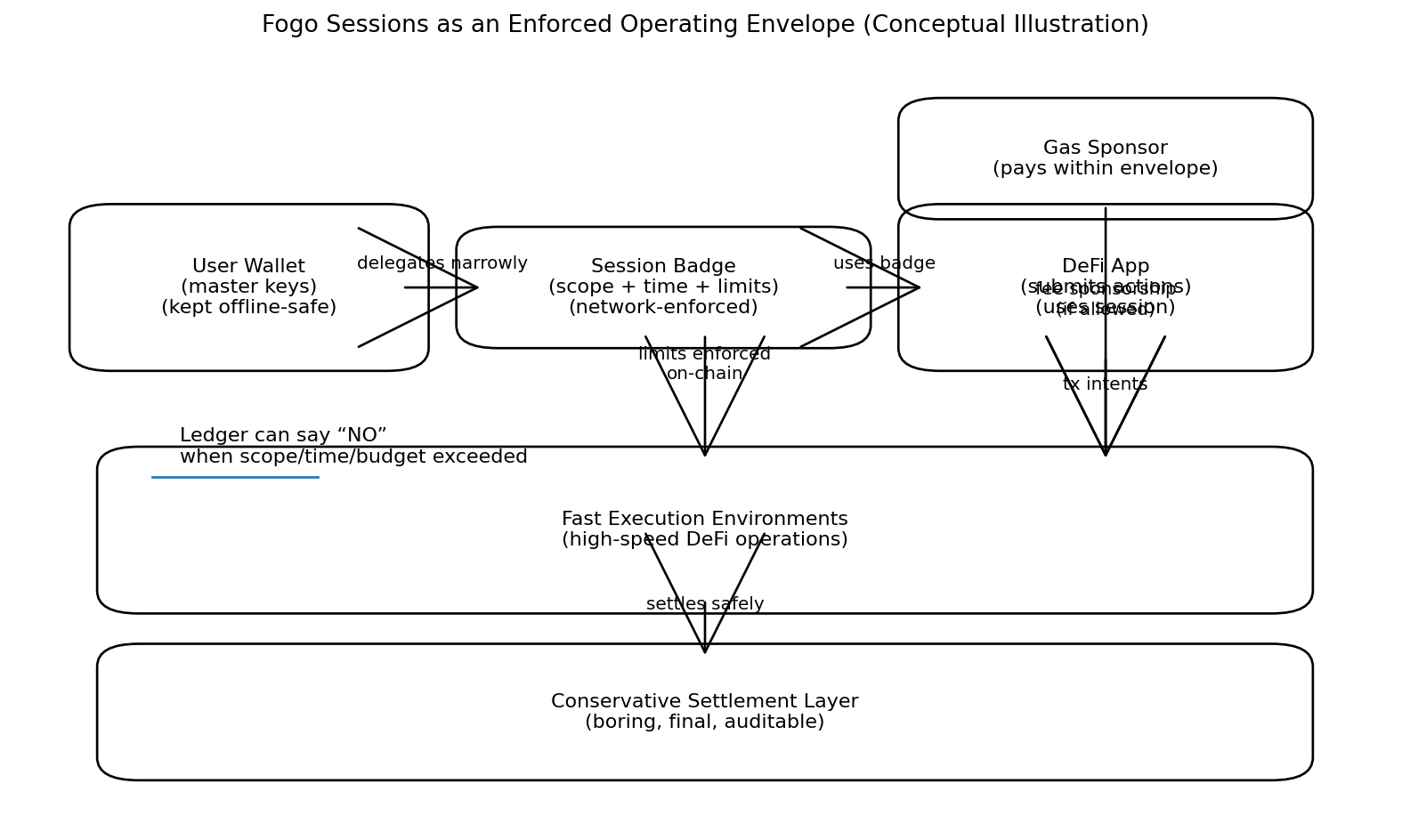
Fogo Sessions are enforced, time-bound, scope-bound delegation. Not a vibe. Not a “trust me.” A real, network-enforced operating envelope. Like a visitor badge that lets you into the lobby and the conference room, but not the server closet. Like a pre-approved corridor where you can do what you came to do, with limits that don’t rely on the app behaving nicely. Limits that don’t disappear because a front-end got compromised or a plugin got clever.
It’s not about making users sign more. It’s about making the signatures mean less in the dangerous way and more in the honest way. The user shouldn’t have to keep proving they are themselves every few minutes just to move through a product. But the user also shouldn’t have to hand over full wallet control to avoid being annoyed. That trade is not innovation. It’s a hostage negotiation in slow motion.
“Scoped delegation + fewer signatures is the next wave of on-chain UX.”
Not as a slogan. As a statement of what we’ve learned the hard way. The future isn’t endless approvals. It isn’t blank checks disguised as convenience. It’s the ability to authorize narrowly, temporarily, with the chain itself enforcing the boundary.
This is where sponsored gas becomes something other than a growth hack.
When you sponsor gas, you’re not just paying a fee. You’re taking a position in the user’s behavior. You’re becoming the party that can be drained, griefed, or forced into subsidizing nonsense. You can cap budgets and rate-limit spend, but if the underlying permission model is sloppy, the economics don’t matter. The attacker doesn’t need to be clever. They just need time and a surface area. And surface area is what broad approvals create.
In Fogo’s framing, sponsored gas should live inside Sessions. Sponsorship becomes a bounded agreement: within this scope, within this time window, within these ceilings, pay for the actions that the user genuinely intended to allow. Not forever. Not everywhere. Not in a way that turns the sponsor into an ATM or turns the user into collateral.
Underneath that, the architecture should read less like a pitch and more like a set of safety rails drawn on a map.
Modular execution environments on top of a conservative, boring settlement layer. That boring part matters. Settlement is where you don’t want surprises. Settlement is where you want the lowest possible drama. You want the part that remains standing even when everything above it is changing, shipping, optimizing, arguing. Then you let execution move fast where it can, in lanes that are well-defined, observable, and—most importantly—containable.
EVM compatibility fits into this story as simple friction reduction. Tooling. Familiar workflows. Solidity muscle memory. Audit processes people already trust. It’s not about pretending to be everything to everyone. It’s about not making teams throw away years of hard-earned safety habits just to get started. If you can lower the barrier to building correctly, you do it. Not for vanity. For fewer mistakes.
And still, the adult version of the story has to admit where the danger concentrates.
Bridges and migrations are chokepoints. They are where systems stop being pure and start being operational. They are where humans run playbooks at odd hours. Where a single misconfigured parameter can become a week of damage control. Where audits help but do not eliminate the risk of misunderstanding, missed assumptions, or plain fatigue. This is where “high performance” can actually make things worse: a small error can become a large loss faster than anyone can react.
“Trust doesn’t degrade politely—it snaps.”
That sentence isn’t dramatic. It’s a memory. The moment a community stops believing you, it rarely happens gradually. It happens on a Thursday, after a small incident, after a confusing response, after someone realizes the system allowed something that should never have been allowed. Then people stop reading your threads and start withdrawing.
Token economics only matter when they reflect maturity, not when they try to compensate for immaturity. The native token, $FOGO, should be treated as security fuel. Staking is responsibility, skin in the game, a willingness to carry weight—not a promise of yield. Long-horizon emissions signal patience. The kind of patience that says: we are not optimizing for applause. We are optimizing for surviving.
By the time the incident room empties, the real work begins. You rewrite policies into enforcement. You turn “should” into “cannot.” You tighten delegation until it reflects human intent rather than hopeful assumptions. You accept that some users will complain when the system says no, and you decide to be okay with that, because the alternative is letting the system say yes to the wrong thing at the wrong time.
A ledger that moves fast is useful. A ledger that moves fast and can refuse precisely is trustworthy. And trust is the only thing DeFi can’t outsource, can’t rebrand, can’t buy back once it breaks.
A fast ledger that can say “no” at the right moments isn’t limiting freedom; it’s preventing predictable failure.