

Fogo Network Architecture Deep Dive: Building Crypto Infrastructure That Actually Scales
Introduction — Why This Matters
The promise of blockchain technology has been persistent for years—a new, decentralized backbone for digital value, trustless applications, and open finance. Yet, despite the hype, most blockchains remain stuck in the starting blocks when it comes to mass adoption. The reality is that when user activity surges, most networks grind to a halt. Transaction fees spike uncontrollably, confirmation times lag, and user experience suffers. For builders, this means constantly designing around limitations rather than possibilities. So the fundamental question stands: Can Web3 evolve into a backbone for mainstream applications—payments, trading, social platforms, and beyond—or will its technical constraints keep it a playground for speculation?
Fogo is stepping up with a bold answer. Rather than being just another competitor in the crowded blockchain landscape, Fogo positions itself as a foundational infrastructure layer—prioritizing not only high throughput and speed but also system reliability, flexibility, and predictable performance, all of which are crucial for supporting real-world economies and applications.
What Makes Fogo Unique
Fogo’s philosophy is that scalability must be approached as a holistic challenge. It’s not enough to make one component, like consensus or execution, incrementally faster. True scalability requires a unified design that harmonizes networking, settlement, and data layers as a single, coordinated stack. This integrated approach means that improvements aren’t isolated—they enhance the entire system’s performance and resilience.
By focusing on tightly integrated layers, Fogo aims to move beyond the endless cycle of patchwork upgrades. The project’s ambition is to build a blockchain foundation robust enough to support complex, on-chain economies—where DeFi, gaming, payments, and other high-demand sectors can flourish without running up against technical ceilings or unpredictable bottlenecks.
The Real Problems
Today’s blockchain infrastructure faces several hard-to-solve issues:
- Throughput bottlenecks: When user demand spikes, transaction queues grow, fees skyrocket, and the network slows to a crawl. This makes it nearly impossible to run high-volume applications reliably.
- Fragmented liquidity: With assets and users spread across an ever-growing web of Layer-1s, Layer-2s, and rollups, liquidity becomes fragmented. This fragmentation complicates trading, increases slippage, and creates UX headaches.
- Volatile fees: Unpredictable transaction fees erode user confidence and make building sustainable business models challenging.
Layer-2 solutions and rollups have made progress, but they introduce new tradeoffs—bridging risks, inconsistencies between states, and additional security complexities. Developers are often forced to choose between simplicity and the ability to scale. Fogo’s vision is to eliminate this forced tradeoff, enabling scalable architectures that remain simple for users and developers alike.
How Fogo Does It — The Tech Stack
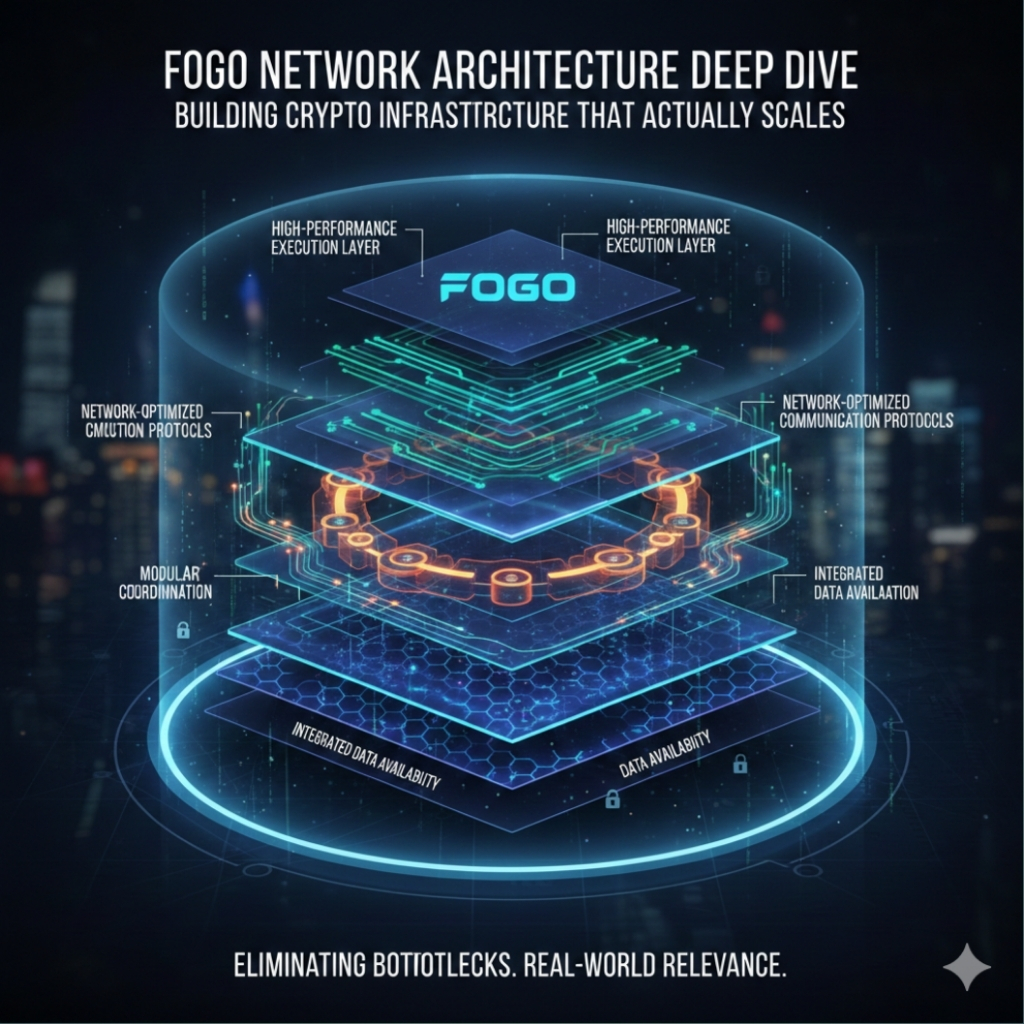
1. High-Performance Execution Layer
Fogo leverages parallel transaction execution and strict state management. By enabling transactions to be processed simultaneously, rather than sequentially, the network can handle sudden demand spikes with ease. This architectural choice supports low-latency confirmations and smooth dApp user experiences, even under heavy loads. For developers, it means the ability to design apps that can scale organically as user adoption grows, without worrying about the system grinding to a halt.
2. Modular Consensus Coordination
Fogo decouples consensus from execution, allowing each component to evolve independently. This separation means that the network can undergo upgrades, implement new features, and patch vulnerabilities without triggering disruptive hard forks or network splits. As a result, Fogo can adapt to new security requirements, regulatory demands, or technological innovations with minimal friction, ensuring both system stability and rapid innovation.
3. Integrated Data Availability
Data availability is often an overlooked bottleneck. Fogo addresses this by distributing transaction data across a specialized set of nodes. This approach dramatically reduces the storage burden on individual nodes, making it feasible for a broad range of participants to run validators. Lowering the hardware and bandwidth requirements democratizes network participation, strengthening decentralization while preserving data integrity and auditability.
4. Network-Optimized Communication
At the heart of Fogo’s architecture are custom networking protocols, designed specifically to maximize transaction propagation speed and block finalization. This reduces network latency and the occurrence of orphaned blocks, which is critical for high-frequency use cases such as trading platforms, payment networks, and real-time games. The overall effect is a more responsive, reliable network that feels seamless to end users.
Tackling Security Head-On
Performance and scalability are meaningless if the underlying system is vulnerable. Fogo embeds security into every layer of its architecture:
- Distributed validator sets eliminate single points of failure, making coordinated attacks much harder.
- Rigorous, transparent audits of core components and regular security reviews ensure that vulnerabilities are identified and addressed before they can be exploited.
- Modular upgrade pathways allow the network to adapt its security posture as threats evolve, without requiring disruptive reboots or hard forks.
- The design principle is resilience: if a single component fails, the rest of the system continues operating, minimizing the blast radius of any attack or bug.
How Fogo Plans to Grow
Beyond technical innovation, Fogo is focused on driving real adoption. The team is actively forming partnerships with major DeFi infrastructure providers to ensure seamless integration and liquidity. They’re developing robust tools and SDKs that lower the barrier for developers to launch their own dApps, making the ecosystem accessible to both Web3 veterans and newcomers.
Fogo is targeting use cases that truly stress blockchain infrastructure: high-frequency trading platforms, payment rails that require instant finality, and applications where transaction throughput and reliability are non-negotiable. By proving its capabilities in these demanding sectors, Fogo aims to establish itself as the go-to platform for serious builders.
The Backstory
Fogo’s origins lie in a recognition of the limits of incrementalism. Early attempts to scale blockchains often revolved around increasing block sizes or layering on short-term fixes. The Fogo team realized that these approaches could only take the technology so far. Instead, they committed to a full-system redesign—prioritizing network coordination and modularity over ad hoc optimizations. This foundational rethink is what sets Fogo apart and gives it the potential to address challenges that have stymied previous generations of blockchain infrastructure.
The Big Realization
The biggest insight driving Fogo is that scalability isn’t a single metric or a box to check off. It’s an organizing principle that must permeate every aspect of system design. Only by treating scalability as a guiding framework—from protocol to networking to data—can blockchain truly become infrastructure for the next wave of digital applications.
What to Watch (Next 3–6 Months)
Fogo’s progress can be tracked through several concrete milestones:
- Results from extensive testnets and stress-testing, providing real data on performance under load.
- Growth in validator onboarding, signaling increased decentralization and trust in the network’s security.
- The rollout of new developer tools and integrations, expanding the ecosystem’s reach.
- Early dApps that push transaction volumes and showcase Fogo’s real-world capabilities—demonstrating that the system holds up beyond the laboratory.
These indicators will reveal whether Fogo’s bold architectural choices translate into practical, usable blockchain infrastructure.
Fogo’s approach signals a broader maturation in the blockchain industry: scalability needs to be engineered for predictability, not just raw performance on testnets. By aligning the execution, networking, and data layers, Fogo aims to provide a platform on which developers can innovate freely—unburdened by the infrastructure limitations that have long held the space back.
If Fogo’s vision pans out, its true value will be measured not by eye-popping TPS numbers, but by the diversity and scale of applications its infrastructure enables. It’s about empowering builders to realize ambitious ideas, confident that the foundation won’t crumble beneath them.
The best way to understand Fogo’s architectural innovations is to engage directly. Dive into the technical documentation, spin up a node on the testnet, or join the developer community to see firsthand how Fogo is reimagining blockchain infrastructure for the real world.
