
Vanar is easiest to understand when you stop looking at it like a typical crypto network and start looking at it the way a global brand would: as infrastructure that has to behave reliably, feel simple for normal users, and remain cost-predictable even when the market is chaotic. Most blockchains can demonstrate speed on a good day, and many can show impressive benchmarks in perfect conditions, but enterprises are not buying a demo and they are not building for a Telegram audience; they are building for millions of everyday customers who do not want to learn new habits just to claim a reward, unlock a digital collectible, or enter a branded experience. Vanar’s whole posture makes more sense once you treat mainstream adoption as the core design constraint rather than a marketing goal.
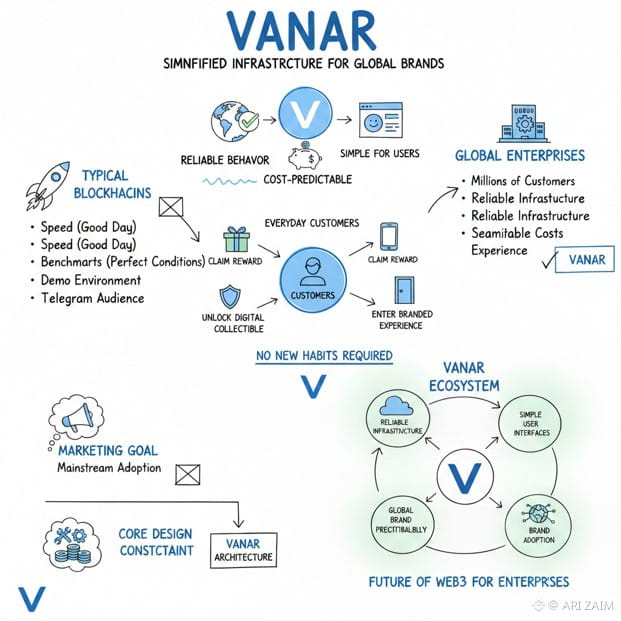
What tends to break enterprise adoption in Web3 is not a lack of interest, because brands clearly understand the upside of digital ownership and interactive customer experiences, but the operational friction that surrounds most chains. A mainstream user journey collapses quickly when wallets feel intimidating, when gas costs are unpredictable, when confirmations take long enough to feel like something is “stuck,” or when the experience demands that the user becomes a part-time crypto expert. In a brand context, every extra step in onboarding is lost revenue, every confusing signing prompt becomes a support ticket, and every unpredictable cost spike becomes a budgeting problem that the finance team will not tolerate. Vanar positions itself against those predictable pain points by treating user experience and cost stability as foundational, because a chain that feels enterprise-ready on paper still fails if the first interaction feels like friction.
One of the strongest signals of Vanar’s enterprise angle is the insistence on predictable transaction costs. Enterprise products are designed around forecasts, unit economics, and campaign planning, which means the chain can’t behave like surge pricing at a concert whenever activity rises. Vanar’s fixed-fee approach is meant to make costs stable and understandable, so a brand can estimate what it will spend to onboard users, run a loyalty program, or support high-volume interactions without fearing that an unrelated market event will suddenly make the experience too expensive to operate at scale. When that predictability exists, it changes how product teams plan, because they can design recurring engagement loops—claims, redemptions, upgrades, transfers—without constantly worrying about whether the cost model will betray them at the worst time.
Speed and responsiveness matter too, but not as a bragging metric; they matter because consumer experiences are judged emotionally, not technically. If an action feels instant, users trust the experience and keep going, but if the system hesitates, users assume something failed and abandon the flow. Vanar emphasizes a fast block time and the kind of throughput posture that is meant to keep everyday interactions feeling normal, which is important when the onchain action is tied to a brand moment that is supposed to feel polished, whether that moment is a reward unlock, a collectible claim, or a game-linked asset interaction. When a chain is intended to support mainstream use, the standard is not “it eventually confirmed,” the standard is “it felt like a real product.”
Another practical, enterprise-friendly choice is Vanar’s alignment with the Ethereum Virtual Machine. Enterprise development teams do not want to rebuild entire engineering practices around unfamiliar tooling unless there is an overwhelming reason to do so, and even then it takes time, training, and risk. EVM compatibility means existing developer knowledge, familiar audit patterns, and a broader base of tooling can be leveraged rather than reinvented. That decision may sound unexciting compared to flashy narratives, but enterprise adoption is usually pulled forward by pragmatic decisions that reduce risk and shorten time-to-market, and Vanar’s approach reads like it was designed to meet builders where they already are.
The onboarding experience is where all of these technical decisions either become real or remain theoretical, and that is why Vanar’s emphasis on account abstraction matters in an enterprise context. The truth is that mainstream users don’t want to manage seed phrases or understand network settings, and brands cannot afford an experience where account loss becomes a permanent customer support nightmare. Account abstraction is the kind of infrastructure that can make onboarding feel more like a familiar app flow while still preserving the core idea of user-controlled ownership, and if it is implemented cleanly it gives brands room to design journeys that feel effortless rather than fragile. That is the difference between Web3 as a novelty and Web3 as a real layer inside a consumer product: the user should be able to participate without feeling like they entered a different universe with different rules.
Vanar’s broader ecosystem strategy also becomes clearer when you view it through the enterprise adoption lens, because consumer onboarding rarely happens through infrastructure alone. Users don’t wake up wanting a blockchain; they wake up wanting an experience, and the blockchain becomes the invisible layer that makes ownership, transferability, and programmable rewards possible. Vanar’s positioning across gaming and metaverse-style consumer channels supports that reality, because experiences are how mainstream users discover value, and experiences are how brands convert attention into repeat engagement. When an ecosystem can deliver environments where ownership and interaction feel natural, it becomes an onboarding engine that can pull new users in without forcing them to “learn crypto” first.
The enterprise story becomes even more interesting when you notice how Vanar is not only talking about transactions but also about building a richer infrastructure stack that can support data-heavy and AI-aware applications. Brands increasingly want systems that can remember context, personalize experiences, and enforce rules that feel consistent across journeys, which is difficult to achieve cleanly if everything lives in disconnected offchain databases with fragmented trust assumptions. Vanar’s emphasis on semantic memory and reasoning layers signals an intention to make onchain systems more capable and context-aware, and while that direction is ambitious, it aligns with where enterprise products are moving: toward intelligent, responsive experiences that rely on reliable state and auditable logic rather than opaque black boxes.
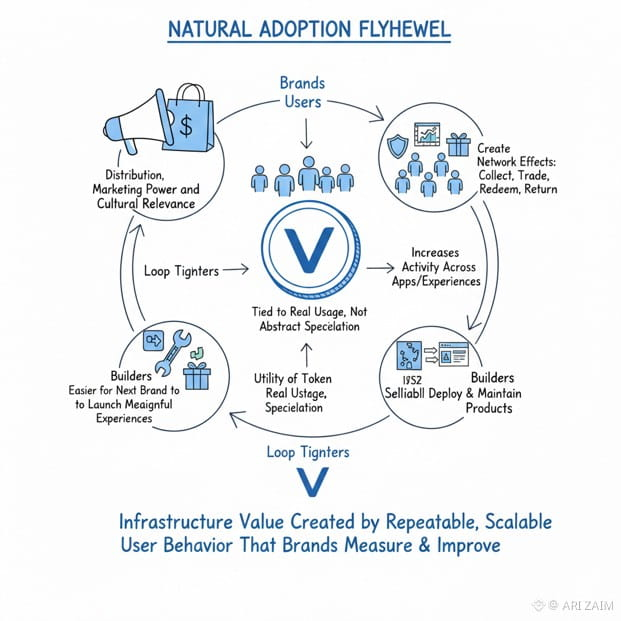
When you connect these pieces, a natural adoption flywheel appears. Brands bring users because brands have distribution, marketing power, and cultural relevance. Users create network effects when they collect, trade, redeem, and return, which increases activity across apps and experiences. That activity strengthens the ecosystem and increases the utility of the network’s token because the token becomes tied to real usage rather than abstract speculation. As utility grows, builders have more reason to deploy and maintain products on the network, which makes it easier for the next brand to launch something meaningful, and the loop tightens. In that model, infrastructure value is not created by hype; it is created by repeatable, scalable user behavior that brands can measure and improve over time.
Vanar On the “what’s happening right now” side, the most honest way to talk about recent movement without drifting into noise is to focus on what updates continuously: network and market telemetry. VANRY’s 24-hour market stats naturally change as trading activity shifts, and the chain’s public network counters continue to reflect ongoing activity as blocks and transactions accumulate. Those signals are not “announcements,” but they are still useful because they show that the ecosystem is alive and moving in real time rather than dormant. Separately, Vanar’s public positioning continues to reinforce the same enterprise direction—predictability, usability, and a stack that supports richer applications—so even when there is no single headline, the strategic intention remains consistent and visible.
