

Plasma is built around a feeling most people don’t talk about until they’ve suffered it, which is the quiet panic of having digital dollars in your wallet but still feeling blocked by friction, extra tokens, and slow confirmation rituals, and I’m focusing on Plasma because it tries to remove that panic by designing the entire chain as stablecoin infrastructure first instead of treating stablecoins like a side feature. In Plasma’s own words, it is a high performance Layer 1 built for USD₮ payments at global scale, with instant transfers, low fees, and full EVM compatibility, and that combination matters because it means the project is trying to speak to two worlds at the same time, where users want stablecoins to move like normal money and developers want the comfort of Ethereum style tooling without sacrificing speed or reliability.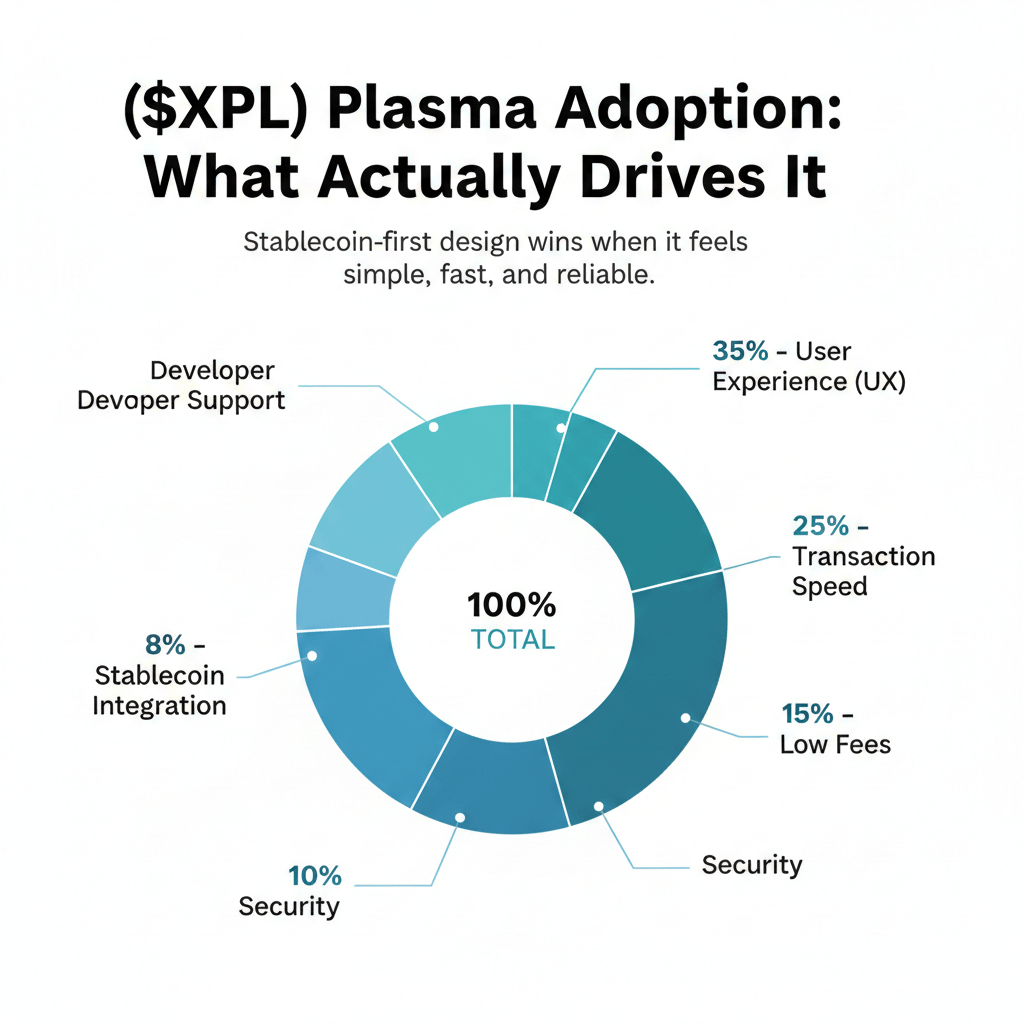
What makes Plasma’s approach feel different is not one isolated trick, because it is the way the pieces connect into one consistent philosophy, and that philosophy is simple enough to feel human: stablecoins are what people actually use, so the chain should be engineered so stablecoin movement feels natural, predictable, and fast. This is why Plasma keeps emphasizing EVM compatibility alongside a purpose built consensus layer, because the project is betting that adoption comes when builders can deploy familiar contracts without rewriting their entire codebase, while everyday users can send value without learning a new set of rituals. I’m not saying this is easy, but I am saying the direction is clear, because Plasma is trying to take the most common stablecoin pain points and delete them at the protocol level rather than asking every wallet and every app to solve them alone.
On the technical side, Plasma’s security and speed story is anchored in its consensus mechanism, PlasmaBFT, which Plasma documents as a high performance implementation of Fast HotStuff written in Rust, with modular design and tight integration with a Reth based execution layer. The words can sound heavy, but the human meaning is straightforward: the chain wants deterministic finality with low latency, so that when a payment happens it feels final quickly instead of forcing you to wait and wonder, because for payments, waiting is not just a time cost, it is a stress cost. Plasma’s documentation explains that PlasmaBFT uses a pipelined approach that parallelizes stages that traditional designs process sequentially, and the point of that pipeline is to increase throughput while reducing time to finality, so the system can keep moving even when it is busy, and that is exactly what stablecoin rails are supposed to do.
The stablecoin first identity becomes most real when you look at the features Plasma chooses to elevate, because it doesn’t lead with abstract promises, it leads with the friction people actually feel. Plasma documents a zero fee USD₮ transfer flow using an API managed relayer system that sponsors only direct USD₮ transfers, and it explicitly describes identity aware controls designed to prevent abuse, which matters because “gasless” systems are magnets for attackers and the only way to protect a clean user experience is to build guardrails that can survive real adversarial pressure. If you have ever watched someone receive stablecoins for the first time and then freeze because they don’t have the fee token needed to move them, then you understand why this feature is emotionally powerful, because it aims to remove that humiliating moment where a person has money but cannot use it. It becomes a bridge from crypto curiosity to real payment behavior, and We’re seeing Plasma treat that bridge as core infrastructure rather than an optional add on.
Stablecoin first gas is the other half of the same story, because people naturally want to pay costs in the same unit they are already holding, and Plasma’s stablecoin native contract direction is framed around letting approved tokens cover fees so the user can stay inside the currency they already understand. They’re trying to replace the old mental model where you must hold a separate volatile asset just to keep your wallet functional, with a calmer model where stablecoin usage is not interrupted by “go buy gas” friction, and that may sound like a small usability tweak, but in payments, small usability tweaks decide whether a system becomes daily habit or stays a niche tool. If this mechanism is implemented and maintained carefully, It becomes one of the cleanest onboarding experiences for stablecoin heavy applications, because the first interaction becomes sending and receiving, not studying fee mechanics.
Plasma also tries to strengthen its long horizon trust story through its Bitcoin bridge architecture, which Plasma documents as a design where users can deposit BTC and receive a representation inside the EVM environment, and then withdraw by burning that representation on Plasma while a verifier network validates the burn and collectively produces a threshold signature to release BTC back on Bitcoin using MPC or threshold signature schemes so no single verifier holds the full key. This matters because it signals that Plasma is thinking in layers of confidence, where fast finality helps daily payments feel immediate, while a serious bridging and verification approach is meant to reduce single point of failure risk as more value moves through the system. I’m not romanticizing bridges, because bridges are where the industry has historically been punished for sloppy assumptions, but I am recognizing that Plasma is explicitly describing a trust model that tries to avoid a single custodian style choke point, and that is at least the right kind of intent for a project that wants to carry meaningful settlement volume.
If you want to judge Plasma using metrics that reveal real truth rather than temporary excitement, you focus on consistency under stress, because payment infrastructure is loved not when it is fast on quiet days but when it stays calm on loud days. Finality distribution matters more than a single best case number, because users remember the moments they had to wait, and merchants remember the moments they felt uncertain, so the real question is whether finality remains reliably fast when the network is busy and when validators churn. Transaction failure rate for normal stablecoin flows matters more than theoretical throughput, because a chain can brag about capacity while still delivering a frustrating experience if transactions fail, stall, or become unpredictable during spikes. Fee predictability also becomes a core trust metric, because stablecoin users often choose stablecoins precisely to escape surprise, and they will not tolerate a payments rail that introduces new kinds of surprise through sudden congestion costs or inconsistent sponsorship availability. If Plasma can keep those metrics steady, then the system starts to feel like infrastructure rather than experimentation, and that feeling is what turns occasional usage into real habit.
But any honest breakdown must talk about failure modes, because stablecoin centered design does not magically remove risk, it simply changes where the pressure lands. Gas sponsorship creates direct adversarial incentives, and anyone building gasless experiences must assume that people will try to drain the system, spam it, or industrialize it into a farming strategy, which is why Plasma’s documentation emphasizes tight scope and identity aware controls, yet the long term challenge is always balance, because if the controls become too strict the experience stops feeling open, and if the controls are too loose the system becomes unstable. If the project succeeds at first, that success itself becomes a new risk, because attention brings attackers, and higher value at risk brings more sophisticated strategies, so Plasma’s credibility will be measured by how it evolves protections without breaking the smoothness it promises.
There is also the broader risk that stablecoin payment rails live close to real world constraints, where liquidity behavior, integration standards, and compliance expectations shape what is actually possible at scale. Plasma positions itself as purpose built stablecoin infrastructure, and its docs and materials talk in that direction, but the real test will be whether the chain can support serious integrators without losing its simple user promise, because payment networks often fail not from a single hack but from accumulating friction across many small operational edges. If It becomes a widely used route for stablecoin settlement, then reliability, incident response maturity, and transparent communication practices will matter as much as any technical design, because when money moves, silence creates fear, and fear pushes users away faster than any competitor.
The far future Plasma is pointing toward is not a world where people brag about using Plasma, because the most powerful future is one where nobody has to think about it. We’re seeing the outline of a chain that wants stablecoins to behave like everyday digital money, where the first time someone receives USD₮ they can send it again immediately, where merchants can trust settlement quickly, where developers can build with familiar EVM tools, and where the network stays calm when the world gets noisy. If that future arrives, It becomes a quiet upgrade to human life, because it reduces the friction tax people pay just to move value, and that friction tax is often hardest on the people who can least afford wasted time, wasted fees, and wasted confidence.
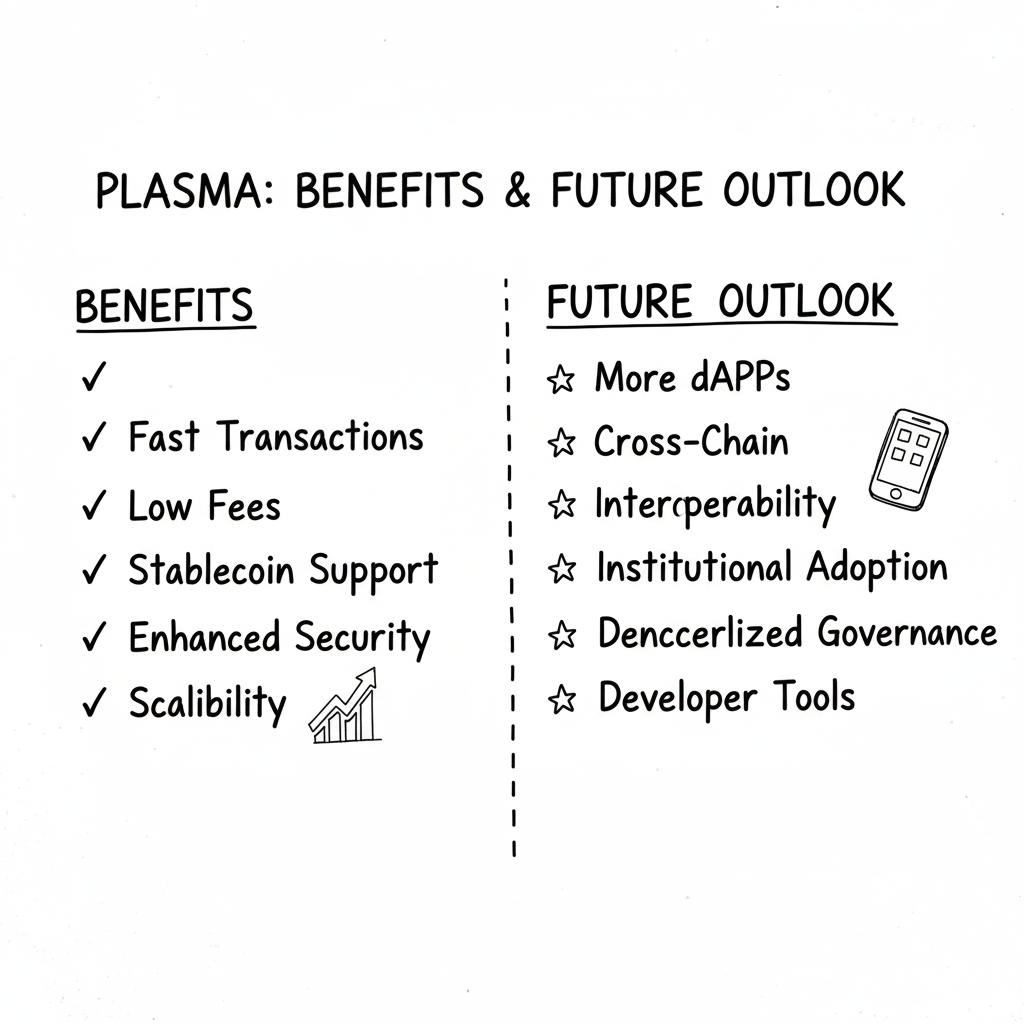
I’m ending with the part that matters most, because technology is only worth celebrating when it changes what people feel in their real lives. Plasma is trying to take stablecoin payments out of the category of stressful crypto activity and place it into the category of normal daily movement, and If the team keeps building with discipline, keeps hardening the system against abuse without destroying usability, and keeps delivering finality that feels like certainty rather than suspense, then this project can grow into something quietly powerful. They’re not just chasing speed, they’re chasing relief, and I’m hopeful that the best outcome is the simplest one, where a person sends stable value, sees it finalize, feels safe, and moves forward with a lighter heart because money finally moved the way it always should have.

