
Dusk Network feels like one of those projects that only makes full sense when you stop looking at it as “another L1” and start looking at it as an attempt to rebuild financial infrastructure in a way that respects how finance actually works in the real world, because real markets do not run on radical transparency where every balance, position, and counterpart can be inspected by anyone with a block explorer, and yet those same markets still need strong guarantees that rules are being followed, settlements are final, and records can be audited when they need to be.
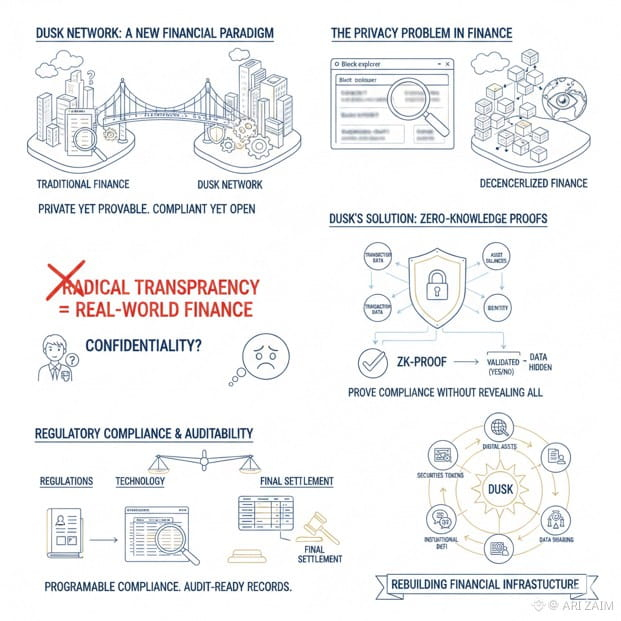
The whole story Dusk is trying to tell is basically this: modern blockchains are excellent at being verifiable, but they are not naturally good at being confidential, and the moment you move from retail crypto into regulated assets and institutional workflows, confidentiality stops being a preference and becomes a requirement, because firms cannot operate if strategy and exposure are permanently public, issuers cannot manage sensitive shareholder structures if everything is broadcast, and regulated environments cannot accept “trust me” compliance when what they actually require is provable compliance that can be verified without leaking the underlying private data.
That is why Dusk leans into a concept that is easy to misunderstand at first: it is not chasing privacy for the sake of hiding everything, it is chasing privacy that can still be audited, which is a very different design goal from anonymous money systems, because the point is not to make activity invisible, the point is to make activity selectively provable so that the network can support real financial instruments where some information must remain confidential while some facts must remain verifiable.
From that perspective, the pieces you mentioned begin to connect into a single direction rather than sounding like isolated buzzwords, because Phoenix is presented as the transaction model built to make confidentiality a native feature rather than a bolt-on, and Zedger is framed as a model designed for asset behavior that resembles regulated instruments, where you need the chain to support richer lifecycle and compliance logic without forcing every detail to become public by default, and XSC, the Confidential Security Contract concept, is essentially Dusk’s attempt to define how security-token-like assets should behave in a system where confidentiality and auditability must coexist instead of one destroying the other.
The Dusk Foundation angle matters here too, not as a branding detail, but as a clue about the target audience and pacing, because a project that aims at regulated markets is naturally pulled toward longer cycles, heavier emphasis on correctness, and a deeper focus on infrastructure work that is not always exciting on social media, such as building reliable node software, producing operational tooling, maintaining upgrade paths, and shipping the kind of technical changes that make settlement networks stable under pressure.
What I find most telling about Dusk is that the “behind the scenes” work tends to look like infrastructure rather than spectacle, which is exactly what you would expect if the real goal is to become a credible base layer for financial applications, because the projects that survive in that role are the ones that treat upgrades, node operations, security surfaces, and network reliability as first-class priorities instead of afterthoughts, and in practice that is where the line between a narrative and a network becomes visible.
The token story also fits cleanly inside that framework if you read it as a network asset rather than a trading ticker, because DUSK is designed to be the economic glue that supports participation and security, and it also has that common early-ecosystem shape where representations exist on other chains while the network matures, and then the center of gravity gradually shifts toward native activity as the chain becomes more functional and more used, which is why the ERC-20 contract you linked is important historically and for liquidity discovery, but the long-term meaning of the token is tied to native usage, staking dynamics, fees, and the broader demand for blockspace and on-chain financial workflows that actually choose to live on Dusk rather than merely trade around it.
Where Dusk becomes especially interesting is in what it signals about “what’s next,” because any chain that wants to be a home for builders eventually runs into the same adoption reality: developers follow familiar environments, composable tooling, and low switching costs, and that is why ecosystem directions like EVM compatibility or EVM-adjacent strategies tend to show up whenever a project wants to widen its funnel beyond its existing community, and if Dusk is serious about growing application density while keeping its privacy-and-auditability thesis intact, then making it easier for mainstream developers to build there becomes a practical step rather than a philosophical one.
At the same time, the project’s risk profile is shaped by the parts that touch the outside world, because bridging and cross-chain plumbing are where many ecosystems get tested in uncomfortable ways, and any mature investor or operator watching Dusk should treat bridge operations, migration flows, and security practices as a continuous area of scrutiny, not because problems are guaranteed, but because the industry has repeatedly shown that the connective tissue between networks is where complexity and risk stack up fastest.
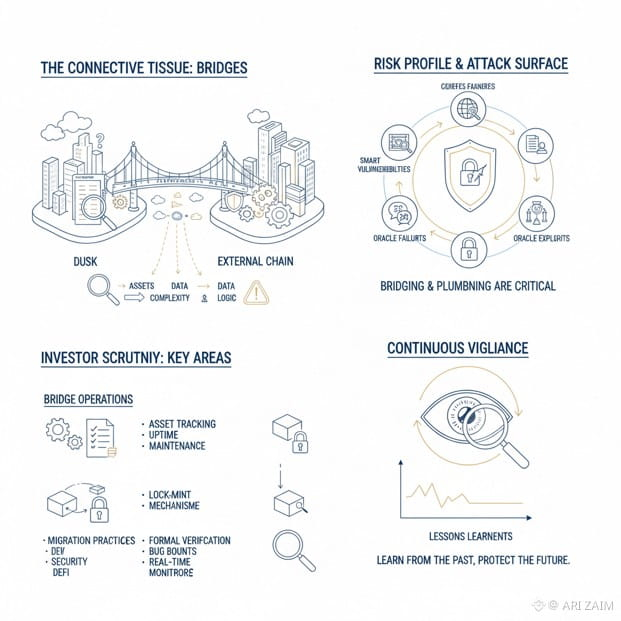
If I had to summarize the project’s core bet in a single flowing idea, it would be that Dusk wants to make a public blockchain behave like credible market infrastructure by offering confidentiality that does not sacrifice provability, and by providing standards and models that can support regulated asset logic without turning every sensitive detail into permanent public data, which is a narrow lane compared with “general purpose L1 for everyone,” but it is also a lane where success could mean becoming quietly essential rather than loudly trendy.
