

#bitcoinetf
bitcoinetf
1.9M Aufrufe
5,247 Kommentare
Hot
Zuletzt

·
--
Übersetzung ansehen
Can an Australian Investor Actually Buy IBIT, the World's Biggest Bitcoin ETF?$BTC | Not easily, and that gap is the real story behind the IBIT-GBTC swing most takes skip over. Australian retail brokers mostly keep IBIT off their approved product list, not because the fund is risky, but because of ASIC's design and distribution obligations on unapproved foreign products. SatoshiMacro's ETF-flow tracker shows why the US fee war barely changes what most Australians can actually buy.
## Why Can't I Just Buy IBIT From My Australian Broker?
Most mainstream Australian trading platforms will not list BlackRock's iShares Bitcoin Trust (IBIT), Fidelity's FBTC, or Grayscale's GBTC on their standard order screen. This is not a ban on Bitcoin exposure. It is a disclosure problem. Under ASIC's design and distribution obligations, an AFSL holder generally needs a target market determination before actively offering a product to retail clients, and US ETF issuers do not produce one for the Australian market. Some brokers with genuine US market access can still get you an execution-only trade in IBIT through a nominee account, but that comes with US withholding tax on distributions, currency conversion both ways, and estate-law complications most investors never price in. None of that makes IBIT a bad fund. It makes it the wrong default comparison for an Australian reader.
## What Is The IBIT vs GBTC Swing, And Why Does It Matter?
Since the three main US spot Bitcoin ETFs launched together on 11 January 2024, SatoshiMacro's tracker shows IBIT has pulled in cumulative net inflows above USD 60 billion, the fastest any ETF has reached that level. GBTC, the converted legacy trust, has shed roughly USD 20 to 23 billion over the same stretch. Put the two together and you get a swing of over USD 80 billion moving from one wrapper to the other while the underlying Bitcoin exposure barely changes. That is not new money entering the asset class. It is existing money switching the box it sits in, chasing a lower fee.
## Why Has GBTC Kept Bleeding Assets Two Years Later?
The fee gap explains most of it. GBTC still charges a 1.50 percent expense ratio against 0.25 percent for IBIT and FBTC, and even Grayscale's own cheaper BTC Mini Trust only came in at 0.15 percent, launched mid-2024 as a direct answer to the bleed. The slower part of the story is behavioural. GBTC's pre-conversion holders often sit on large unrealised gains from the trust's closed-end days, and some hold through institutional mandates that have not been rewritten since the ETF conversion. On the desk, this is a familiar pattern. The investors who move fastest out of an expensive legacy wrapper are the ones with the smallest tax or mandate friction holding them in place, and the slowest movers set the long tail of the outflow curve.
## Does FBTC's Smaller Share Tell You Anything Useful?
FBTC runs at roughly 20 to 25 percent of IBIT's flow magnitude, and the two funds' daily flows correlate at about 0.85, which tells you they are mostly drawing from the same pool of demand rather than competing head to head. The gap between them comes down to distribution, not product quality. BlackRock's wider institutional and advisor network outpaces Fidelity's narrower but still meaningful foothold in the RIA and 401(k) channels. Neither number changes what an Australian retail investor can access through a standard local platform.
## So What Is The Actual Comparison For An Australian Investor?
It is not IBIT versus GBTC. It is the ASX-listed spot Bitcoin ETFs against each other, because those are the funds most Australian brokers will actually let you buy on market. VBTC and QBTC both charge 0.45 percent, and BTXX sits at 0.49 percent, all well above the 0.25 percent IBIT and FBTC charge in the US. Run the numbers on a $50,000 holding over five years and the 0.20 percentage point gap between an ASX fund and IBIT compounds to roughly $500 to $600 in extra fee drag at current Bitcoin prices, before you even account for the US fund's inaccessibility to most AU retail accounts in the first place. That is the real price of staying inside the Australian-compliant product set: a known, bounded fee premium instead of an uncertain cross-border access project.
## My Read
If you already hold Bitcoin directly and just want a lower-maintenance wrapper inside a super fund or a standard brokerage account, the ASX products do the job the compliance system was built for, and the fee premium is the cost of that convenience, not a rip-off. If you are chasing the headline IBIT flow numbers specifically, you are probably solving the wrong problem. The flow war between IBIT and GBTC is a US distribution story. It is informative about where institutional conviction is landing, but it is not a shopping list for an Australian account.
## One Honest Limitation
SatoshiMacro's ETF-flow tracker pulls its numbers from Farside Investors' daily issuer-level flow table and keeps a last-known-good snapshot if that feed goes dark on any given day, so a single day's reading can lag the headline. It is a flow tracker, not a product-access guide, and none of this is personal advice on which wrapper suits your own tax position or super structure. Check your own platform's approved product list and get specific tax advice before acting on anything here.
Full breakdown, including the live cumulative chart, sits on SatoshiMacro's IBIT vs FBTC vs GBTC page.
https://satoshimacro.com/tools/crypto/etf-flows/ibit-vs-fbtc-vs-gbtc/?utm_source=binance_square&utm_medium=social&utm_campaign=autopilot_article
#SatoshiMacro #BitcoinETF #IBIT #Bitcoin
Can an Australian Investor Actually Buy IBIT, the World's Biggest Bitcoin ETF?
$BTC | Not easily, and that gap is the real story behind the IBIT-GBTC swing most takes skip over. Australian retail brokers mostly keep IBIT off their approved product list, not because the fund is risky, but because of ASIC's design and distribution obligations on unapproved foreign products. SatoshiMacro's ETF-flow tracker shows why the US fee war barely changes what most Australians can actually buy.
## Why Can't I Just Buy IBIT From My Australian Broker?
Most mainstream Australian trading platforms will not list BlackRock's iShares Bitcoin Trust (IBIT), Fidelity's FBTC, or Grayscale's GBTC on their standard order screen. This is not a ban on Bitcoin exposure. It is a disclosure problem. Under ASIC's design and distribution obligations, an AFSL holder generally needs a target market determination before actively offering a product to retail clients, and US ETF issuers do not produce one for the Australian market. Some brokers with genuine US market access can still get you an execution-only trade in IBIT through a nominee account, but that comes with US withholding tax on distributions, currency conversion both ways, and estate-law complications most investors never price in. None of that makes IBIT a bad fund. It makes it the wrong default comparison for an Australian reader.
## What Is The IBIT vs GBTC Swing, And Why Does It Matter?
Since the three main US spot Bitcoin ETFs launched together on 11 January 2024, SatoshiMacro's tracker shows IBIT has pulled in cumulative net inflows above USD 60 billion, the fastest any ETF has reached that level. GBTC, the converted legacy trust, has shed roughly USD 20 to 23 billion over the same stretch. Put the two together and you get a swing of over USD 80 billion moving from one wrapper to the other while the underlying Bitcoin exposure barely changes. That is not new money entering the asset class. It is existing money switching the box it sits in, chasing a lower fee.
## Why Has GBTC Kept Bleeding Assets Two Years Later?
The fee gap explains most of it. GBTC still charges a 1.50 percent expense ratio against 0.25 percent for IBIT and FBTC, and even Grayscale's own cheaper BTC Mini Trust only came in at 0.15 percent, launched mid-2024 as a direct answer to the bleed. The slower part of the story is behavioural. GBTC's pre-conversion holders often sit on large unrealised gains from the trust's closed-end days, and some hold through institutional mandates that have not been rewritten since the ETF conversion. On the desk, this is a familiar pattern. The investors who move fastest out of an expensive legacy wrapper are the ones with the smallest tax or mandate friction holding them in place, and the slowest movers set the long tail of the outflow curve.
## Does FBTC's Smaller Share Tell You Anything Useful?
FBTC runs at roughly 20 to 25 percent of IBIT's flow magnitude, and the two funds' daily flows correlate at about 0.85, which tells you they are mostly drawing from the same pool of demand rather than competing head to head. The gap between them comes down to distribution, not product quality. BlackRock's wider institutional and advisor network outpaces Fidelity's narrower but still meaningful foothold in the RIA and 401(k) channels. Neither number changes what an Australian retail investor can access through a standard local platform.
## So What Is The Actual Comparison For An Australian Investor?
It is not IBIT versus GBTC. It is the ASX-listed spot Bitcoin ETFs against each other, because those are the funds most Australian brokers will actually let you buy on market. VBTC and QBTC both charge 0.45 percent, and BTXX sits at 0.49 percent, all well above the 0.25 percent IBIT and FBTC charge in the US. Run the numbers on a $50,000 holding over five years and the 0.20 percentage point gap between an ASX fund and IBIT compounds to roughly $500 to $600 in extra fee drag at current Bitcoin prices, before you even account for the US fund's inaccessibility to most AU retail accounts in the first place. That is the real price of staying inside the Australian-compliant product set: a known, bounded fee premium instead of an uncertain cross-border access project.
## My Read
If you already hold Bitcoin directly and just want a lower-maintenance wrapper inside a super fund or a standard brokerage account, the ASX products do the job the compliance system was built for, and the fee premium is the cost of that convenience, not a rip-off. If you are chasing the headline IBIT flow numbers specifically, you are probably solving the wrong problem. The flow war between IBIT and GBTC is a US distribution story. It is informative about where institutional conviction is landing, but it is not a shopping list for an Australian account.
## One Honest Limitation
SatoshiMacro's ETF-flow tracker pulls its numbers from Farside Investors' daily issuer-level flow table and keeps a last-known-good snapshot if that feed goes dark on any given day, so a single day's reading can lag the headline. It is a flow tracker, not a product-access guide, and none of this is personal advice on which wrapper suits your own tax position or super structure. Check your own platform's approved product list and get specific tax advice before acting on anything here.
Full breakdown, including the live cumulative chart, sits on SatoshiMacro's IBIT vs FBTC vs GBTC page.
https://satoshimacro.com/tools/crypto/etf-flows/ibit-vs-fbtc-vs-gbtc/?utm_source=binance_square&utm_medium=social&utm_campaign=autopilot_article
#SatoshiMacro #BitcoinETF #IBIT #Bitcoin
99

·
--
【US-Ostküste, 9:27 Uhr: Gründe für den Abverkauf vor Handelsbeginn bei BTC-ETFs|On-Chain-Perspektive】
Am Wochenende fiel BTC zunächst auf rund 79.100, und am Montag folgten die ETFs vor Handelsbeginn direkt.
Der entscheidende Punkt ist nicht, dass plötzlich jemand Spot-BTC auf den Markt geworfen hat, sondern dass die großen Rücknahmen der vergangenen zwei Tage bereits on-chain abgewickelt wurden:
• 22. Oktober: Nettoabflüsse bei ETFs von rund 636 Millionen US-Dollar
• 23. Oktober: weitere Abflüsse von rund 138 Millionen US-Dollar
• Entsprechend wurden rund 6.998 BTC aus den Verwahrungs-Wallets der ETFs transferiert
Rücknahmen → APs verkaufen → Spotmarkt gerät unter Druck. Zusammen mit der sinkenden Risikobereitschaft infolge des Ölpreisanstiegs am Wochenende (Störungen im Zusammenhang mit der Straße von Hormus trieben Brent in die Nähe von 114) und den Einstandskosten der ETF-Anleger von rund 81.500 kam es direkt bei Handelsbeginn vorbörslich zu einer geballten Neubewertung.
Das ist ein typischer Fall von „On-Chain zuerst, dann der Nachholrückgang vor Handelsbeginn“ – keine plötzlich aufgetretene schlechte Nachricht.
Was meint ihr? Ist der Rücknahmedruck noch nicht vorbei, oder ist die Lücke vom Wochenende bereits geschlossen?
$BTC #BitcoinETF #OnChainDaten
95

·
--
Bullisch
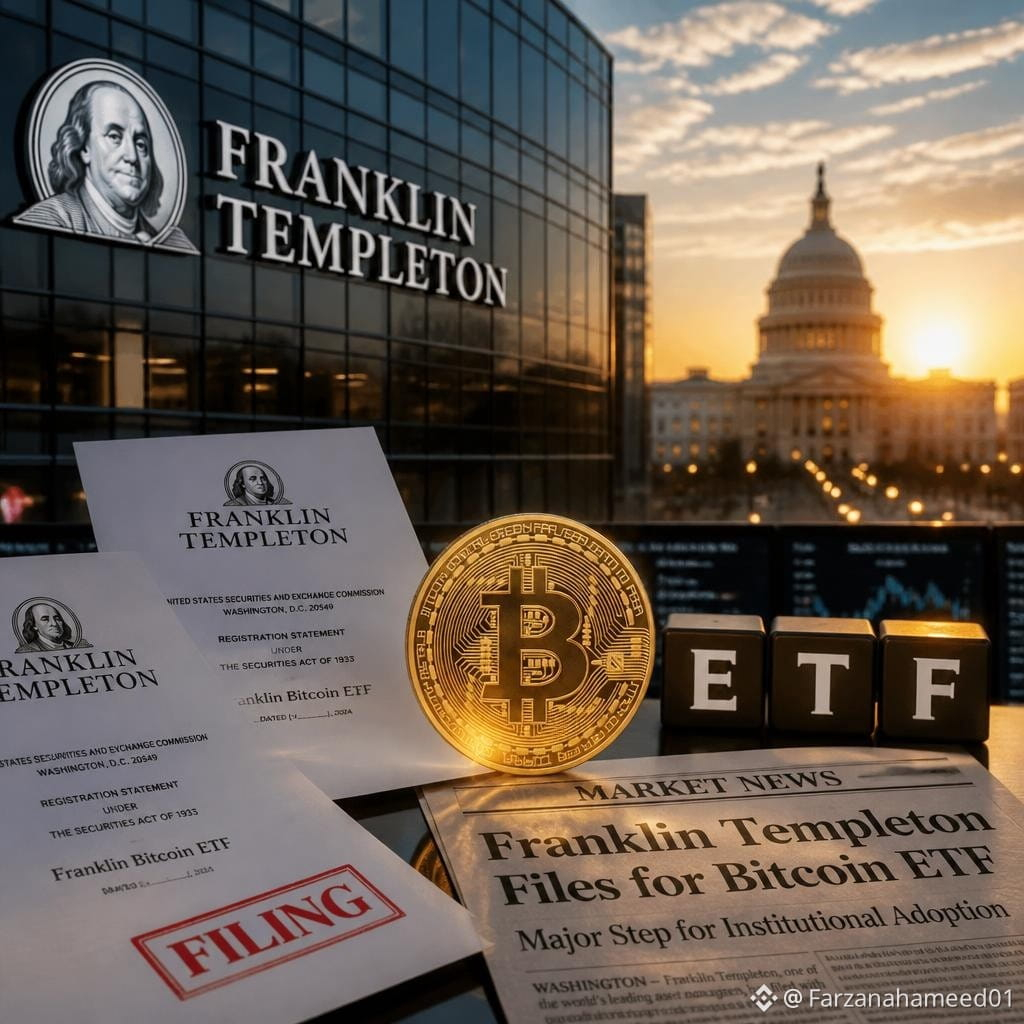
#franklintempletonfilestwodividendbitcoinetfs 🚨 Franklin Templetons Bitcoin-ETF-Vorstoß verdient Aufmerksamkeit
Das sollte man im Auge behalten – auch als Krypto-Trader.
HARTE FAKTEN:
Eine SEC-Einreichung vom 22. Oktober 2026 zeigt, dass Franklin Templeton zwei neue ETFs registriert hat: den Franklin US Equity Bitcoin DRIP Index ETF und den Franklin US Innovation Bitcoin DRIP Index ETF. Der Vermögensverwalter mit einem Anlagevermögen von 1,8 Billionen US-Dollar plant eine Allokation von 95 % in US-Aktien und 5 % in Bitcoin, notiert an der Nasdaq. Sämtliche Aktiendividenden sollen automatisch in ein Bitcoin-Engagement fließen.
$BTC
WARUM IST DAS WICHTIG?
Warum sollten sich Krypto-Trader dafür interessieren? Das ist nicht einfach nur ein weiterer ETF. Es ist ein neuer Mechanismus für Kapitalzuflüsse. Jedes Mal, wenn diese Portfoliounternehmen Dividenden zahlen, wird dieses Geld zu zusätzlichem Kaufdruck bei BTC. Sollte der ETF zugelassen werden, entsteht dadurch ein passiver, regelbasierter Nachfragesog, der traditionelle Aktienerträge direkt in Bitcoin lenkt.
$BTC
AUSGEWOGENE BETRACHTUNG:
Auch die andere Seite ist wichtig: Risiken gibt es ebenfalls. 1) Es handelt sich bislang nur um eine Einreichung, nicht um eine Zulassung. 2) BTC ist auf einen kleinen Anteil des Portfolios begrenzt. Die Auswirkungen hängen also davon ab, wie groß diese ETFs tatsächlich werden. 3) Wenn die Aktienmärkte fallen und Dividenden gekürzt werden, verlangsamt sich auch der Bitcoin-Kaufmechanismus. In einem Bärenmarkt könnte diese Struktur zudem schlechter abschneiden.
FAZIT:
Das Fazit: Betrachte dies als Signal für die institutionelle Akzeptanz, nicht als Auslöser für einen Trade. Große Vermögensverwalter entwickeln jetzt Produkte, die Aktienerträge in ein Krypto-Engagement umwandeln.
#BitcoinETF #FranklinTempleton #CryptoNews
2
40

🚨 WALL STREET TRIFFT AUF BITCOIN! FRANKLIN TEMPLETON GEHT EINEN NEUEN SCHRITT ₿
Große Neuigkeiten für den Kryptomarkt! 👀 Franklin Templeton kommt dem Ziel näher, Bitcoin-Exposure in traditionelle Aktienanlagestrategien einzubinden.
Das macht die beiden vorgeschlagenen ETFs interessant:
📊 95 % Aktien + 5 % Bitcoin: Beide Fonds starten mit dieser Zielallokation.
💰 Dividenden in Bitcoin: Statt Aktiendividenden wieder in Aktien anzulegen, sieht die Strategie vor, diese Dividenden für ein Bitcoin-Engagement zu nutzen.
🏦 Zwei verschiedene Strategien:
🔹 FBEQ — Konzentriert sich auf US-Aktien mit hoher Marktkapitalisierung.
🔹 FIBT — Konzentriert sich auf innovationsorientierte US-Unternehmen.
📈 Warum das wichtig ist: Diese Struktur könnte traditionellen Anlegern einen weiteren Weg eröffnen, indirekt in Bitcoin zu investieren, ohne selbst BTC direkt zu kaufen.
⚠️ Wichtiger Hinweis: Aus den jüngsten Einreichungen geht der 27. Oktober als Datum des Inkrafttretens hervor. Das bedeutet jedoch nicht automatisch, dass der Handel bereits begonnen hat. Die Fonds sind außerdem mit Anlagerisiken verbunden, und ihre Bitcoin-Allokation unterliegt Rebalancing-Regeln.
🧠 Meine Einschätzung: Die größere Geschichte ist, wie die traditionelle Finanzwelt weiterhin neue Wege erkundet, Aktienanlagen mit Bitcoin zu verbinden. Das könnte den Zugang zu einem Bitcoin-Engagement erweitern, garantiert aber keine steigenden Kurse.
💬 Was denkt ihr? Könnte ein durch Dividenden finanziertes Bitcoin-Engagement zu einer beliebten Anlagestrategie werden?
👇 Teilt eure Gedanken!
$BTC
#Bitcoin #CryptoNews #BitcoinETF
1
67

·
--
Übersetzung ansehen
#FranklinTempletonFilesForTwoDividendToBitcoinETFs BITCOIN IS GETTING ANOTHER WALL STREET CONNECTION — ARE YOU READY?
Franklin Templeton has filed for two proposed ETFs designed to connect stock dividend income with Bitcoin exposure.
Both target an initial 5% BTC allocation, potentially creating another bridge between traditional finance and crypto.
If adoption grows, could this become a long-term catalyst for $BTC?
Smart traders watch the news, plan their entries, and manage risk. Don't chase pumps — trade with a strategy.
My 3 Target Support Zones for BTC:
Zone 1: $80K–$81K Zone 2: $78K–$79K Zone 3: $75K–$76K
I AM DCA BUYING MY FAVORITE COINS FOR THE LONG TERM: 👉 $BNB | $ETH | $BTC
My strategy is simple: Buy gradually, stay patient, and hold for the long term.
YOUR MOVE: BUY BTC, HOLD, OR WAIT FOR A DIP?
Share your strategy in the comments.
buy and hold in spot long terM 👇
{spot}(SOLUSDT)
{spot}(SUIUSDT)
{spot}(BTCUSDT)
#bitcoin #BTC #BitcoinETF #CryptoNews
#FranklinTempletonFilesForTwoDividendToBitcoinETFs BITCOIN IS GETTING ANOTHER WALL STREET CONNECTION — ARE YOU READY?
Franklin Templeton has filed for two proposed ETFs designed to connect stock dividend income with Bitcoin exposure.
Both target an initial 5% BTC allocation, potentially creating another bridge between traditional finance and crypto.
If adoption grows, could this become a long-term catalyst for $BTC ?
Smart traders watch the news, plan their entries, and manage risk. Don't chase pumps — trade with a strategy.
My 3 Target Support Zones for BTC:
Zone 1: $80K–$81K Zone 2: $78K–$79K Zone 3: $75K–$76K
I AM DCA BUYING MY FAVORITE COINS FOR THE LONG TERM: 👉 $BNB | $ETH | $BTC
My strategy is simple: Buy gradually, stay patient, and hold for the long term.
YOUR MOVE: BUY BTC, HOLD, OR WAIT FOR A DIP?
Share your strategy in the comments.
buy and hold in spot long terM 👇
#bitcoin #BTC #BitcoinETF #CryptoNews
1
1
157

·
--
#FranklinTempletonBeantragtZweiETFsFürBitcoinAusDividenden
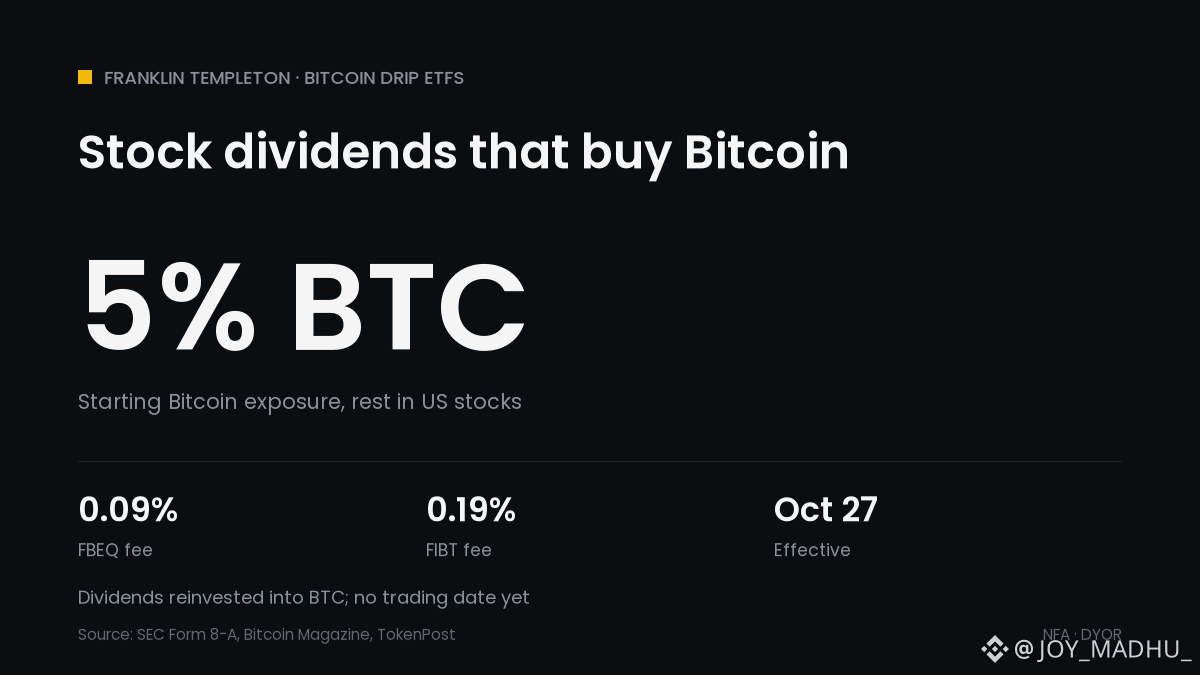
🏦 Franklin Templeton will, dass Aktiendividenden Bitcoin kaufen
📄 22. Okt.: Franklin beantragte die Notierung von zwei „Bitcoin-DRIP“-ETFs an der Nasdaq
📊 FBEQ bildet 500 große US-Unternehmen ab (Gebühr: 0,09 %); FIBT bildet 100 innovative Unternehmen ab (0,19 %)
⚖️ Jeder Index startet mit 95 % Aktien und 5 % Bitcoin-Anteil
🔁 Jede Dividende, ob regulär oder Sonderdividende, wird am Tag nach dem Ex-Tag in Bitcoin reinvestiert
⚠️ Obergrenzen: Liegt der BTC-Anteil über 5 %, wird er jedes Quartal auf 4,5 % gekürzt und steigt nie über 20 %
📅 Die Prospekte treten am 27. Okt. in Kraft, ein Handelsstart wurde jedoch noch nicht angekündigt
Was das für Bitcoin bedeutet: Ein Vermögensverwalter mit 1,8 Bio. $ baut eine langsame, automatische BTC-Nachfrage in gewöhnliche Aktienfonds ein. Es ist ein kleiner Anteil, kein Spot-ETF. BTC liegt bei fast 80,4 Tsd. $ und ist innerhalb von 24 Stunden um etwa 0,3 % gestiegen.
Würdest du Dividenden lieber in bar oder in Bitcoin erhalten? 👇
$BTC
#CryptoNews #BitcoinETF #FranklinTempleton #FranklinTempletonBeantragtZweiETFsFürBitcoinAusDividenden
16

·
--
Übersetzung ansehen
Chào cộng đồng Crypto! Hôm nay, một tin tức cực kỳ quan trọng đã xuất hiện, khiến nhiều nhà đầu tư phải nhìn lại thị trường Bitcoin ETF sau chuỗi ngày ảm đạm.
### ĐỘT PHÁ! Sau 2 tuần "tháo chạy", Bitcoin ETF bất ngờ HÚT 301 TRIỆU ĐÔ! Chuyện gì đang xảy ra?
Sau giai đoạn "chảy máu" liên tục, các quỹ Bitcoin ETF giao ngay tại Mỹ vừa có một màn "comeback" ngoạn mục, thu hút hàng trăm triệu USD. Liệu đây có phải là tín hiệu đảo chiều mà chúng ta chờ đợi?
**Điểm tin chính:**
* **Phá vỡ chuỗi rút ròng:** Các quỹ Bitcoin ETF giao ngay tại Mỹ đã chính thức phá vỡ chuỗi 2 tuần liên tiếp ghi nhận dòng tiền rút ròng, mang lại hy vọng mới cho thị trường.
* **Dòng tiền ròng ấn tượng:** Tổng dòng tiền ròng đổ vào các quỹ này đã đạt mức 301 triệu USD ấn tượng chỉ trong tuần vừa qua.
* **Biến động nội tại:** Đáng chú ý, dòng tiền trong tuần chứng kiến khởi đầu tích cực trong ba ngày đầu, sau đó là những đợt rút vốn mạnh, nhưng cuối cùng vẫn kết thúc với con số dương đáng kể.
**Góc nhìn cá nhân:**
Dòng tiền 301 triệu USD trở lại các quỹ Bitcoin ETF là một tín hiệu *phục hồi* đáng mừng, chấm dứt giai đoạn "ngủ đông" kéo dài hai tuần. Nó cho thấy *áp lực bán từ các nhà đầu tư tổ chức đang giảm bớt* và có thể đang có sự *tái định vị vốn*. Tuy nhiên, việc dòng tiền biến động mạnh trong tuần (khởi đầu tốt nhưng sau đó bị rút) cũng cảnh báo rằng tâm lý thị trường vẫn *rất mong manh*. Đừng vội "FOMO" mà hãy nhìn vào đây như một *dấu hiệu ban đầu của sự ổn định*. Chúng ta cần theo dõi thêm các tuần tiếp theo để xác nhận liệu xu hướng này có bền vững hay không, nhưng rõ ràng, đây là một *điểm sáng* quan trọng sau chuỗi ngày ảm đạm.
**Ý kiến của bạn thì sao?**
Bạn nghĩ sao về đợt phục hồi dòng tiền này? Đây là dấu hiệu của sự đảo chiều hay chỉ là một cú "lướt sóng" ngắn hạn?
Hãy để lại bình luận phía dưới và đừng quên **BẤM THEO DÕI** kênh của tôi để cập nhật những phân tích chuyên sâu và tin tức nóng hổi nhất về thị trường Crypto nhé!
#CryptoNews #TrendingNews #BTC #BitcoinETF
78

·
--
🚨 BITCOIN-ETFs BEENDEN MIT EINEM COMEBACK VON 301 MIO. $ IHRE 2-WÖCHIGE ABFLUSSSERIE! 🔥
US-Spot-Bitcoin-ETFs verzeichneten Nettozuflüsse von rund 301 Millionen Dollar und beendeten damit zwei aufeinanderfolgende Wochen mit Abflüssen.
📊 DIE WICHTIGSTEN MARKTENTWICKLUNGEN:
💰 301 Mio. $ — Wöchentliche Nettozuflüsse in Bitcoin-ETFs.
🏦 1,08 Mrd. $ — Zuflüsse von Montag bis Mittwoch.
⚠️ 774 Mio. $ — Abflüsse am Donnerstag und Freitag, als BTC wieder in Richtung 80.000 $ fiel.
📉 Bitcoin fiel von einem Wochenhoch bei 84.777 $ auf rund 80.025 $.
🐻 Währenddessen verzeichneten US-Spot-Ethereum-ETFs weitere wöchentliche Abflüsse von 221 Millionen Dollar. Ihre Verlustserie verlängerte sich damit auf vier Wochen.
WIE GEHT ES MIT BITCOIN WEITER? 👀
Die ETF-Zuflüsse sind wieder positiv, doch die starken Abflüsse gegen Ende der Woche deuten darauf hin, dass die Unsicherheit am Markt anhält.
Die große Frage ist, ob die institutionelle Nachfrage stark genug zurückkehren kann, um die nächste BTC-Rallye zu stützen.
#BTC #BitcoinETF #BinancePick
{spot}(BTCUSDT)
🚨 BITCOIN-ETFs BEENDEN MIT EINEM COMEBACK VON 301 MIO. $ IHRE 2-WÖCHIGE ABFLUSSSERIE! 🔥
US-Spot-Bitcoin-ETFs verzeichneten Nettozuflüsse von rund 301 Millionen Dollar und beendeten damit zwei aufeinanderfolgende Wochen mit Abflüssen.
📊 DIE WICHTIGSTEN MARKTENTWICKLUNGEN:
💰 301 Mio. $ — Wöchentliche Nettozuflüsse in Bitcoin-ETFs.
🏦 1,08 Mrd. $ — Zuflüsse von Montag bis Mittwoch.
⚠️ 774 Mio. $ — Abflüsse am Donnerstag und Freitag, als BTC wieder in Richtung 80.000 $ fiel.
📉 Bitcoin fiel von einem Wochenhoch bei 84.777 $ auf rund 80.025 $.
🐻 Währenddessen verzeichneten US-Spot-Ethereum-ETFs weitere wöchentliche Abflüsse von 221 Millionen Dollar. Ihre Verlustserie verlängerte sich damit auf vier Wochen.
WIE GEHT ES MIT BITCOIN WEITER? 👀
Die ETF-Zuflüsse sind wieder positiv, doch die starken Abflüsse gegen Ende der Woche deuten darauf hin, dass die Unsicherheit am Markt anhält.
Die große Frage ist, ob die institutionelle Nachfrage stark genug zurückkehren kann, um die nächste BTC-Rallye zu stützen.
#BTC #BitcoinETF #BinancePick
1
65

🔥 Spot-Bitcoin-ETFs sind nicht nur eine Schlagzeile, sondern ein Wendepunkt, der den Markt verändern könnte.
📈 Am Montag flossen zum dritten Tag in Folge 532 Millionen US-Dollar in US-amerikanische Spot-Bitcoin-ETFs, angeführt von BlackRock und Fidelity. BTC pendelt bei 80.345 US-Dollar, der RSI signalisiert mit 42,6 eine bärische Tendenz, und ein Open Interest bei Futures von 7,55 Milliarden US-Dollar stützt eine moderate Funding-Rate von +0,0080 %. #BitcoinETF #InstitutionalMoney
🌐 Dieser Zustrom regulierten Kapitals signalisiert die nächste Phase des #CryptoCycle – institutionelles Vertrauen geht der „Price-Discovery“-Welle, die einen mehrjährigen Bullenmarkt in Gang setzt, oft voraus. Das erinnert an den Anstieg Anfang 2021, als On-Chain-Wallets von Smart Money begannen, ihre Bestände aufzustocken. #LongTermThesis
💡 Praktischer Schritt: Halte eine moderate Position in BTC oder einem Spot-ETF, beobachte den Wochenchart auf einen Ausbruch über die mittlere Bollinger-Band-Linie bei 33,4 % und halte Bargeld bereit, um bei einem Rücksetzer einzusteigen, falls der RSI unter 35 fällt.
❓ Wie positionierst du dich gerade – kaufst du den Dip, wartest du auf einen Ausbruch oder bleibst du an der Seitenlinie?
58

·
--
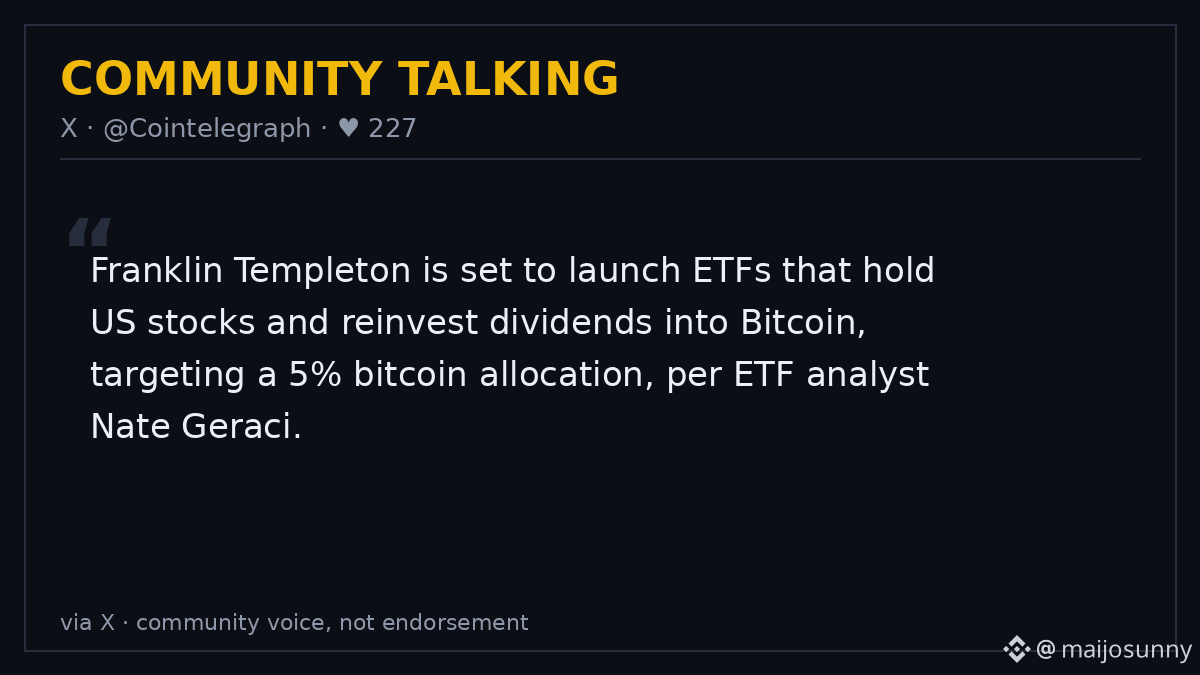
👀 „Franklin Templeton plant die Einführung von ETFs, die US-Aktien halten und Dividenden in Bitcoin reinvestieren.“
Das schreibt Cointelegraph heute auf X und beruft sich dabei auf den ETF-Analysten Nate Geraci. Die Details darunter sind interessanter als die Schlagzeile.
Zwei Fonds, FBEQ und FIBT, starten mit einem Anteil von 95 % US-Aktien und 5 % Bitcoin. Jede Dividende dieser Aktien, ob regulär oder Sonderdividende, wird zum Handelsstart am nächsten Tag in Bitcoin reinvestiert, statt weitere Aktien zu kaufen. Die Registrierung wird am 27. Okt. wirksam, die Gebühren beginnen bei 0,09 %. Ein Handelsstart wurde noch nicht angekündigt.
Meine Einschätzung: Das ist eine Innovation im Hintergrund, keine Bitcoin-Kaufrausch. Die Fonds halten BTC nicht direkt. Das Engagement entsteht über Bitcoin-ETPs, Futures und Optionen. Liegt der Bitcoin-Anteil bei einer vierteljährlichen Neugewichtung über 5 %, wird er wieder auf 4,5 % gesenkt.
Und hier ist die Zahl, die alle falsch verstehen werden: 1,8 Billionen US-Dollar sind das gesamte verwaltete Vermögen von Franklin Templeton. Das ist KEIN Geld, das in Bitcoin fließt. Tatsächlich werden nur die Dividenden aus dem Aktienanteil zum Kauf von BTC verwendet – eine bewusst langsame und stetige Zuflussquelle.
Warum das wichtig ist: Wenn dieses Modell funktioniert, sorgt jede Dividendensaison für eine kleine, automatische Nachfrage nach $BTC – und andere Vermögensverwalter werden es kopieren. Die Genehmigung allein garantiert keinen einzigen Dollar an Zuflüssen. Der Test ist also einfach: Beobachte, ob FBEQ und FIBT nach dem Handelsstart tatsächlich Vermögen einsammeln.
🟢 Bull-Case: Das DRIP-Modell verbreitet sich, und Dividenden werden zu einer stetigen Nachfragequelle für Bitcoin.
🔴 Bear-Case: Anleger ignorieren es und der Fonds reiht sich in die lange Liste cleverer ETFs ohne Zuflüsse ein.
Worauf du achten solltest:
- 27. Okt.: Registrierung wird wirksam
- Erster Handelstag, noch nicht angekündigt
- Frühe Zuflüsse, nachdem am 22. Okt. 635 Mio. US-Dollar aus US-Spot-BTC-ETFs abgeflossen sind
Unterdessen $BTC liegt bei 80.154 US-Dollar, 0,9 % weniger in 24 Stunden, und hält sich knapp über 80.000 US-Dollar.
Würdest du deine Dividenden für dich in Bitcoin investieren lassen oder das Geld lieber behalten? 👇
Keine Finanzberatung. DYOR.
#BitcoinETF #crypto
67

·
--
🚨🔥 BITCOIN UNTER DRUCK — ABER KOMMT DAS GROSSE GELD ZURÜCK? 🐋📊
💥 DER KRYPTOMARKT SENDT GEMISCHTE SIGNALE!
📉 Berichten zufolge beliefen sich die Abflüsse aus Bitcoin-ETFs am 22. Oktober an nur einem Tag auf rund 635 MILLIONEN DOLLAR. Das wirft erneut Fragen zur institutionellen Nachfrage auf. Gleichzeitig beobachten Anleger, ob Bitcoin sich nahe der Marke von 80.000 Dollar halten kann. 👀 <Cite refs={["turn525380search3","turn525380search5"]}/>
⚡ DARAUF KOMMT ES AN:
🔴 ETF-Abflüsse könnten kurzfristig auf Vorsicht hindeuten.
🟢 Die institutionelle Nachfrage könnte zurückkehren, wenn sich die Marktstimmung verbessert.
🐋 Die Bewegungen der Wale und globale Wirtschaftsnachrichten bleiben wichtige Signale.
🔥 Der nächste Schritt könnte die Marktstimmung verändern!
💬 DIE GROSSE FRAGE: Bereitet sich BTC auf eine Erholung vor, oder steht noch mehr Volatilität bevor?
👇 Schreib deine Einschätzung in die Kommentare: BULLISCH 🐂 oder BÄRISCH 🐻?
⚠️ Kryptowährungen sind sehr volatil. Dieser Beitrag dient der Diskussion und ist keine Finanzberatung.
#Bitcoin #BTC #Binance #CryptoNews #CryptoMarket #BitcoinETF #CryptoCommunity
$SOL $BTC

126
·
--
Übersetzung ansehen
$BTC
{spot}(BTCUSDT)
🚨 BITCOIN ETF's RECORD $301 MILLION IN WEEKLY INFLOWS!
US spot Bitcoin ETFs ended the week with approximately $301.2 million in net inflows, breaking a two-week streak of outflows totaling around $910 million.
📊 KEY HIGHLIGHTS:
💰 $301.2M — Total weekly net inflows.
🏦 $565.7M — BlackRock's IBIT weekly inflows, making it the biggest contributor.
📈 Monday and Wednesday saw strong inflows, bringing in over $1 billion combined.
⚠️ However, Thursday and Friday recorded significant outflows totaling $773.5 million.
🐋 Despite late-week selling pressure, IBIT remained the strongest contributor overall.
WHAT DOES THIS MEAN FOR BTC?
ETF inflows may signal renewed institutional demand, but the heavy late-week outflows show that investor sentiment remains mixed.
👀 Will institutional money push Bitcoin higher, or are we heading for another correction?
Drop your thoughts below! 👇🔥
#Bitcoin #BitcoinETF #CryptoNews #CryptoNewss
$BTC
🚨 BITCOIN ETF's RECORD $301 MILLION IN WEEKLY INFLOWS!
US spot Bitcoin ETFs ended the week with approximately $301.2 million in net inflows, breaking a two-week streak of outflows totaling around $910 million.
📊 KEY HIGHLIGHTS:
💰 $301.2M — Total weekly net inflows.
🏦 $565.7M — BlackRock's IBIT weekly inflows, making it the biggest contributor.
📈 Monday and Wednesday saw strong inflows, bringing in over $1 billion combined.
⚠️ However, Thursday and Friday recorded significant outflows totaling $773.5 million.
🐋 Despite late-week selling pressure, IBIT remained the strongest contributor overall.
WHAT DOES THIS MEAN FOR BTC?
ETF inflows may signal renewed institutional demand, but the heavy late-week outflows show that investor sentiment remains mixed.
👀 Will institutional money push Bitcoin higher, or are we heading for another correction?
Drop your thoughts below! 👇🔥
#Bitcoin #BitcoinETF #CryptoNews #CryptoNewss
1
53

·
--
Spot-Bitcoin-ETFs verzeichnen Zuflüsse von 301 Mio. $ und beenden damit eine zweiwöchige Abflussserie.
Die Zuflüsse signalisieren ein erneutes Interesse der Anleger, obwohl die jüngsten Abflüsse den Oktober bislang ins Minus gedrückt haben.
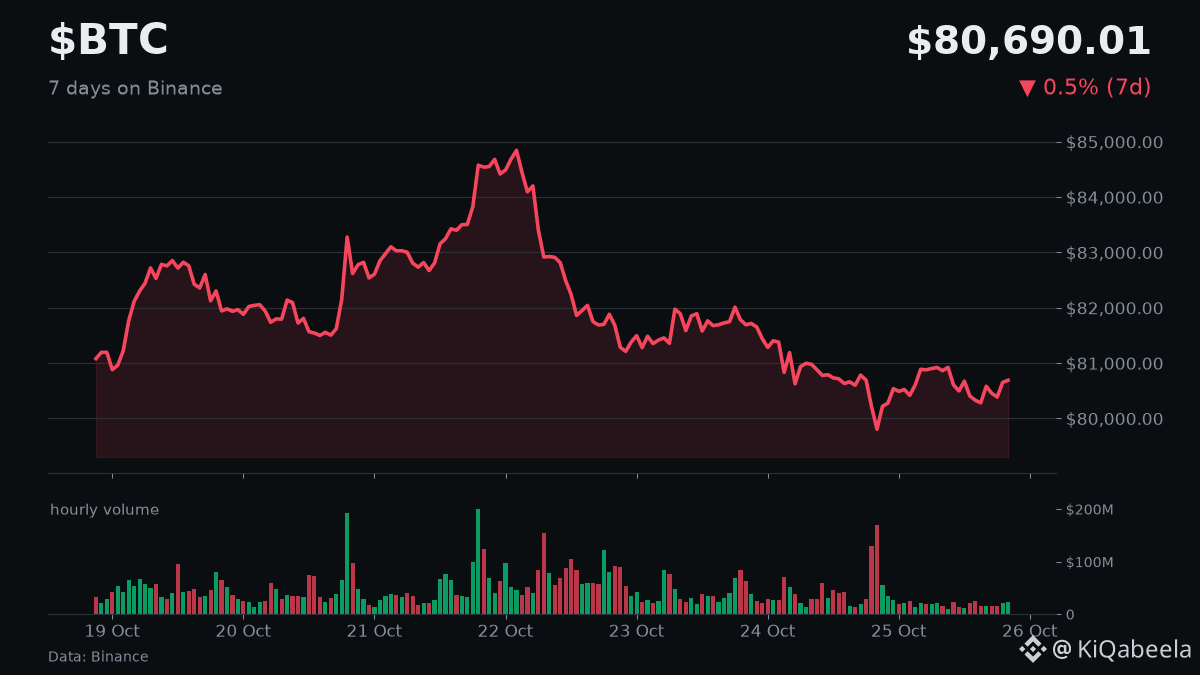
$BTC liegt 0,2 % im Plus bei 80.375 $, doch das 24-Stunden-Handelsvolumen beträgt nur die Hälfte des Wochendurchschnitts – ein Hinweis auf eine verhaltene Handelsdynamik. Die Funding-Rate liegt bei +0,008 %, Long-Positionen zahlen also an Short-Positionen. Das Open Interest sank um 2 % auf 7,5 Mrd. $, und das Verhältnis der Long- zu Short-Konten liegt bei 2,07 zu 1.
Meine Einschätzung: Der moderate Kursanstieg bei geringem Volumen deutet darauf hin, dass die ETF-Zuflüsse eher mit einer Neugewichtung von Portfolios als mit neuer Kaufkraft zu tun haben könnten.
💬 Bullisch, bärisch oder abwartend? Ein Wort.
#BitcoinETF #SpotETF
2

Spot-Bitcoin-ETFs konnten ihre zweiwöchige Verlustserie beenden und verzeichneten in dieser Woche Nettozuflüsse von 301 Millionen US-Dollar. Trotz eines Rückgangs zum Ende der Woche, durch den der Oktober ins Minus rutschte, deutet der positive Nettowert darauf hin, dass die zugrunde liegende Nachfrage weiterhin robust ist. Händler sollten beobachten, ob sich diese Dynamik bis zum Monatsende hält oder ob die Abflüsse zurückkehren.
#BitcoinETF #SpotBitcoin ⠀
#BitcoinETF #SpotBitcoin ⠀
4

Bitcoin-ETF-Zuflüsse folgen dem Kurs, sagen ihn aber nicht zuverlässig voraus
- Eine DWF-Studie zu ETF-Zuflüssen wirft die Frage auf, ob sich die Kurse anhand der gesamten täglichen Zuflüsse vorhersagen lassen. - Bitcoin-ETF-Zuflüsse hinken den Marktpreisen oft hinterher und spiegeln nicht unbedingt den tatsächlichen Trend wider.
#BitcoinETF #CryptoNews #DWF #BTC #ETH
$btc
vlikevn Titanbot
Quelle: NewsBTC
122

·
--
🚨 Eine Milliarde Dollar fließt in Bitcoin … und wenige Tage später fließen Millionen wieder ab!
Stell dir ein Restaurant vor, vor dem die Leute Schlange stehen, um hineinzukommen. Drei Tage später siehst du, wie eine große Gruppe auf einmal wieder geht!
Ist das Essen plötzlich schlecht geworden? Oder haben sich einige Gäste aus anderen Gründen zum Gehen entschieden?
So ähnlich läuft es gerade bei den in den USA gehandelten Bitcoin-ETFs.
📈 In drei Handelssitzungen verzeichneten die Fonds Nettozuflüsse von mehr als einer Milliarde Dollar.
📉 Dann kam die Sitzung am Donnerstag, dem 22. Oktober: Die Nettoabflüsse beliefen sich auf rund 635,6 Millionen Dollar!
Die Frage ist: Haben die Institutionen Bitcoin so schnell den Rücken gekehrt?
Nicht unbedingt!
Denn die Mittelströme können durch Gewinnmitnahmen, eine Neugewichtung der Portfolios, eine veränderte Risikobereitschaft und sogar durch die Lage an den traditionellen Märkten beeinflusst werden.
💡 Die wichtigste Erkenntnis:
Eine Milliarde Dollar Zuflüsse bedeutet nicht, dass der Kurs weiter steigen wird. Und Abflüsse in Höhe von Hunderten Millionen bedeuten nicht, dass Bitcoin am Ende ist.
Der Markt bewegt sich nicht nur in eine Richtung, und dieselben Institutionen können heute kaufen und morgen verkaufen.
🎯 Wenn du diese Zahlen beobachtest: Was gewichtest du stärker – die täglichen institutionellen Mittelströme oder den langfristigen Trend von Bitcoin?
#BTC #BitcoinETF #ETFFlows
⚠️ Bildungsinhalt, keine Finanzberatung.
4
313

·
--
Artikel
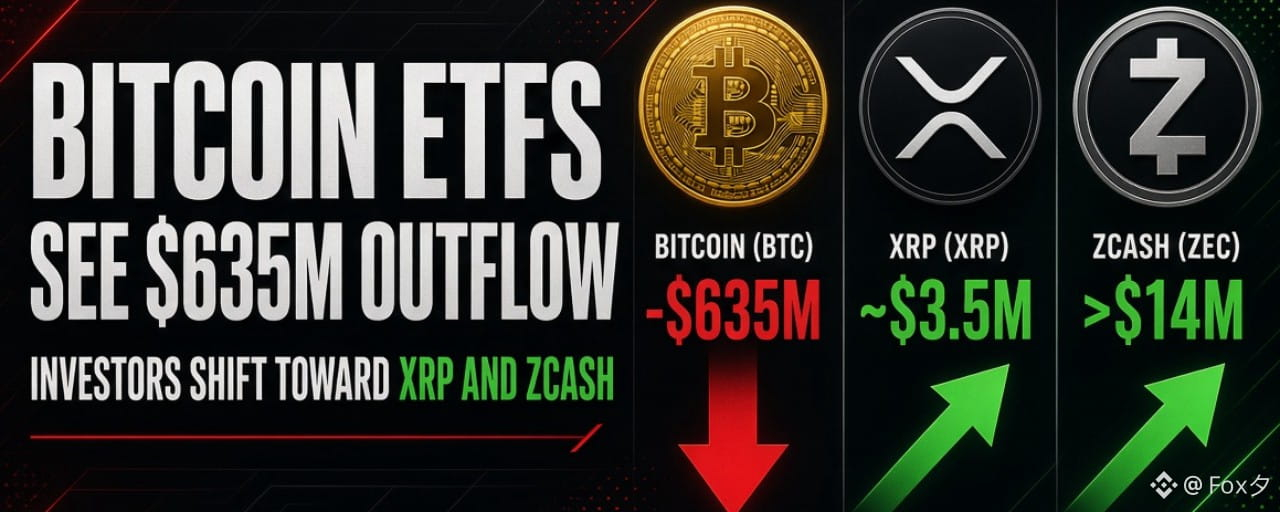
Bitcoin-ETFs verzeichnen Abflüsse von 635 Millionen US-Dollar, während Anleger sich XRP und Zcash zuwendenUS-Spot-Bitcoin-ETFs verzeichneten am 22. Oktober Nettoabflüsse von rund 635 Millionen US-Dollar. Damit war es der größte Tagesabfluss seit Juni und machte einen Großteil der jüngsten Zuflüsse wieder zunichte. Auf große Fonds wie IBIT von BlackRock und FBTC von Fidelity entfielen mehr als 70 % der Abflüsse. Das zeigt, wie schnell sich die institutionelle Stimmung gegenüber Bitcoin angesichts zunehmender Marktunsicherheit ändern kann. Trotz der Abflüsse blieb das verwaltete Gesamtvermögen aller Bitcoin-ETFs bei über 100 Milliarden US-Dollar. $XRP
Bitcoin-ETFs verzeichnen Abflüsse von 635 Millionen US-Dollar, während Anleger sich XRP und Zcash zuwenden
US-Spot-Bitcoin-ETFs verzeichneten am 22. Oktober Nettoabflüsse von rund 635 Millionen US-Dollar. Damit war es der größte Tagesabfluss seit Juni und machte einen Großteil der jüngsten Zuflüsse wieder zunichte. Auf große Fonds wie IBIT von BlackRock und FBTC von Fidelity entfielen mehr als 70 % der Abflüsse. Das zeigt, wie schnell sich die institutionelle Stimmung gegenüber Bitcoin angesichts zunehmender Marktunsicherheit ändern kann. Trotz der Abflüsse blieb das verwaltete Gesamtvermögen aller Bitcoin-ETFs bei über 100 Milliarden US-Dollar. $XRP
Kain_Morrie P90FN:
senyumu ra penakì cak
4
16
6.8k

·
--
Bullisch
🚨 BITCOIN-ETFs VERLOREN $BTC 773 Mio. $ IN ZWEI TAGEN — ABER DIE WOCHE IST IMMER NOCH IM PLUS
US-Spot-Bitcoin-ETFs haben gerade eine deutliche Kehrtwende hingelegt
📊 Farside-Flow-Daten
• 21. Okt.: +524,8 Mio. $
• 22. Okt.: −635,6 Mio. $
• 23. Okt.: bisher gemeldet: −137,9 Mio. $
{future}(BTCUSDT)
Dennoch liegt der Nettozufluss der Woche weiterhin bei etwa +301 Mio. $
Genau dieser Widerspruch ist es wert, beobachtet zu werden
Die institutionelle Nachfrage ist nicht verschwunden
Doch die Käufe, die Bitcoin zu Beginn dieser Woche gestützt haben, können den Verkaufsdruck nicht mehr so stark auffangen
$BTC pendelt um die 80,8 Tsd. $
Und Folgendes ist wichtiger als eine einzelne negative ETF-Schlagzeile 👀
ETF-Zuflüsse garantieren keine steigenden Kurse
Genauso wenig beweisen Abflüsse, dass alle institutionellen Anleger Bitcoin den Rücken kehren
{spot}(BTCUSDT)
⚠️ Meine Einschätzung
Wenn BTC weiter schwächelt, während die ETF-Zuflüsse der Woche positiv bleiben, zeigt uns das, dass die Nachfrage nicht stark genug ist, um den breiteren Verkaufsdruck aufzufangen
Sollten die Zuflüsse dauerhaft negativ werden, schwächt sich die Erholungsthese weiter ab
Die US-ETFs sind am Wochenende geschlossen
Die eigentliche Bewährungsprobe kommt, wenn der institutionelle Handel wieder aufgenommen wird
{etf_us}(BTCC.ETF)
$BTC #bitcoin #BitcoinETF
🚨 BITCOIN-ETFs VERLOREN $BTC 773 Mio. $ IN ZWEI TAGEN — ABER DIE WOCHE IST IMMER NOCH IM PLUS
US-Spot-Bitcoin-ETFs haben gerade eine deutliche Kehrtwende hingelegt
📊 Farside-Flow-Daten
• 21. Okt.: +524,8 Mio. $
• 22. Okt.: −635,6 Mio. $
• 23. Okt.: bisher gemeldet: −137,9 Mio. $
Dennoch liegt der Nettozufluss der Woche weiterhin bei etwa +301 Mio. $
Genau dieser Widerspruch ist es wert, beobachtet zu werden
Die institutionelle Nachfrage ist nicht verschwunden
Doch die Käufe, die Bitcoin zu Beginn dieser Woche gestützt haben, können den Verkaufsdruck nicht mehr so stark auffangen
$BTC pendelt um die 80,8 Tsd. $
Und Folgendes ist wichtiger als eine einzelne negative ETF-Schlagzeile 👀
ETF-Zuflüsse garantieren keine steigenden Kurse
Genauso wenig beweisen Abflüsse, dass alle institutionellen Anleger Bitcoin den Rücken kehren
⚠️ Meine Einschätzung
Wenn BTC weiter schwächelt, während die ETF-Zuflüsse der Woche positiv bleiben, zeigt uns das, dass die Nachfrage nicht stark genug ist, um den breiteren Verkaufsdruck aufzufangen
Sollten die Zuflüsse dauerhaft negativ werden, schwächt sich die Erholungsthese weiter ab
Die US-ETFs sind am Wochenende geschlossen
Die eigentliche Bewährungsprobe kommt, wenn der institutionelle Handel wieder aufgenommen wird
$BTC #bitcoin #BitcoinETF
113

·
--
🚨 EILMELDUNG: BlackRocks Bitcoin-ETF verkauft BTC im Wert von 115 Millionen Dollar
Berichten zufolge hat BlackRocks Bitcoin-ETF Bitcoin im Wert von 115 Millionen Dollar verkauft und damit die Aufmerksamkeit auf die Aktivitäten institutioneller Anleger am Kryptomarkt gelenkt.
Der Schritt erfolgt, während Anleger die ETF-Zuflüsse genau beobachten, um Anzeichen für eine veränderte Stimmung unter institutionellen Akteuren zu erkennen.
Ein einzelner gemeldeter Verkauf muss jedoch nicht zwangsläufig auf einen umfassenderen Abwärtstrend hindeuten. Die Nettozuflüsse der ETFs und die anschließenden Handelsaktivitäten werden entscheidend sein, um das Gesamtbild zu verstehen.
👀 Verringern Institutionen ihr Engagement, oder handelt es sich nur um eine kurzfristige Neupositionierung?
#Bitcoin #BTC #BlackRock #BitcoinETF #Crypto $IRYS $BIRB $BTC
{future}(BTCUSDT)
{future}(BIRBUSDT)
{future}(IRYSUSDT)
🚨 EILMELDUNG: BlackRocks Bitcoin-ETF verkauft BTC im Wert von 115 Millionen Dollar
Berichten zufolge hat BlackRocks Bitcoin-ETF Bitcoin im Wert von 115 Millionen Dollar verkauft und damit die Aufmerksamkeit auf die Aktivitäten institutioneller Anleger am Kryptomarkt gelenkt.
Der Schritt erfolgt, während Anleger die ETF-Zuflüsse genau beobachten, um Anzeichen für eine veränderte Stimmung unter institutionellen Akteuren zu erkennen.
Ein einzelner gemeldeter Verkauf muss jedoch nicht zwangsläufig auf einen umfassenderen Abwärtstrend hindeuten. Die Nettozuflüsse der ETFs und die anschließenden Handelsaktivitäten werden entscheidend sein, um das Gesamtbild zu verstehen.
👀 Verringern Institutionen ihr Engagement, oder handelt es sich nur um eine kurzfristige Neupositionierung?
#Bitcoin #BTC #BlackRock #BitcoinETF #Crypto $IRYS $BIRB $BTC
94

·
--
🚨 REKORDABFLÜSSE BEI ETFs: US-Spot-Bitcoin-ETFs verzeichneten am Donnerstag Abflüsse in Höhe von 635,6 Mio. $ – der größte Tagesabfluss seit Juni.
BlackRocks IBIT führte die Abflüsse an (-254 Mio. $), gefolgt von Fidelitys FBTC (-218 Mio. $) und ARKB (-109 Mio. $). Der Ausverkauf an einem Tag machte fast 60 % der dreitägigen Zuflussserie von 1,08 Mrd. $ zunichte und drückte die Oktober-Zuflüsse wieder ins Minus.
BTC fiel auf etwa 81.500 $, während gehebelte Positionen im Wert von 440 Mio. $ liquidiert wurden. Auch bei ETH- und SOL-ETFs gab es Abflüsse; nur XRP-ETFs verzeichneten Zuflüsse.
Zieht sich smartes Geld zurück oder ist das nur Vorsicht vor dem FOMC-Treffen der Fed am 27.–28. Oktober? 👀
Das Risiko im Blick: Die Wochenbilanz liegt weiterhin bei +443 Mio. $ – ein roter Tag ist noch kein Trend. Ein zweiter Tag mit Abflüssen würde die Lage jedoch verändern.
📌 Hier werden ausschließlich persönliche Meinungen geteilt, keine Finanzberatung und keine Empfehlung zum Kauf oder Verkauf. Kryptowährungen sind mit hohen Risiken verbunden; informiere dich selbst und trägst allein die Verantwortung. Keine Bewerbung von Coins.
$BTC #Bitcoin #BitcoinETF #BlackRock #Crypto #Binance
641
Anmelden und weiter Inhalte entdecken
Krypto-Nutzer weltweit auf Binance Square kennenlernen
⚡️ Bleib in Sachen Krypto stets am Puls.
💬 Die weltgrößte Kryptobörse vertraut darauf.
👍 Erhalte verlässliche Einblicke von verifizierten Creators.
E-Mail-Adresse/Telefonnummer
Trendthemen
1
#BinancePick
3.2M Aufrufe
158,104 Kommentare
2
#EarningsSeason
5.4M Aufrufe
26,295 Kommentare
3
#BitmineAdds10452ETH
56 Aufrufe
19 Kommentare
4
#SouthKoreaConsidersEducationTaxOnCryptoExchanges
251 Aufrufe
36 Kommentare
5
#OCCUrgesCommunityBanksToEnterStablecoinPayments
109 Aufrufe
25 Kommentare
6
#RippleWinsFullApprovalAsNationalTrustBank
116 Aufrufe
26 Kommentare
7
#AkashSelectsSolanaAsMigrationTarget
37 Aufrufe
6 Kommentare
8
#OndoToOpenSubscriptionsForOpenAIPreIPOTokenizedNotes
22 Aufrufe
3 Kommentare
9
#AnthropicTTMRevenueGrewAbout1200%
43,674 Aufrufe
512 Kommentare
10
#AnthropicS1ExpectedToday
35,666 Aufrufe
402 Kommentare