Binance Square
#bestindicator

bestindicator

13 Aufrufe
2 Kommentare
Digital Molvi
·
--
Artikel
Übersetzung ansehen
Best Trading IndicatorsTrading indicators are tools that help traders understand market direction, momentum, trend strength, and possible entry or exit points. They do not guarantee profit, but they can help traders make better decisions when used correctly. Many beginners think indicators can predict the market perfectly. That is not true. Indicators are not magic signals. They are simply tools based on price, volume, and market behavior. The best traders do not rely on one indicator alone. They combine indicators with market structure, risk management, and patience. What Are Trading Indicators? Trading indicators are calculations or visual tools placed on a chart to help traders analyze price action. Some indicators show whether the market is trending, while others show whether momentum is strong or weak. Some help identify overbought or oversold conditions, and others focus on volume or volatility. Indicators are useful because they help remove some emotional decision-making. Instead of guessing, traders can use data-based signals to support their analysis. Why Indicators Matter Markets move fast, and emotions can easily affect decisions. Fear and greed often cause traders to enter too late, exit too early, or hold losing positions too long. Indicators help create a more structured approach. They can help traders answer questions like: ​Is the market in an uptrend or downtrend? ​Is momentum getting stronger or weaker? ​Is the asset overbought or oversold? ​Is volatility increasing? ​Is volume supporting the move? These questions are important because good trading is not just about finding entries. It is also about understanding the quality of the move. 1. Moving Averages Moving averages are among the most popular trading indicators. They smooth out price data and help traders identify the overall trend. The two most common types are: ​Simple Moving Average (SMA) ​Exponential Moving Average (EMA) A moving average helps traders see whether price is generally moving up or down. For example, if price is above a key moving average, the market may be in an uptrend. If price is below it, the market may be weak. Many traders use combinations like: ​20 EMA for short-term trend ​50 MA for medium-term trend ​200 MA for long-term trend Moving averages are especially useful in trending markets, but they can give false signals in sideways conditions. 2. Relative Strength Index (RSI) RSI is a momentum indicator that measures the speed and strength of price movements. It usually moves between 0 and 100. Common interpretations are: ​Above 70 = overbought ​Below 30 = oversold But traders should be careful. Overbought does not always mean price must fall immediately, and oversold does not always mean price must rise. In strong trends, RSI can stay overbought or oversold for a long time. RSI is most useful when combined with trend analysis. It can also help spot divergence, where price makes a new high or low but RSI does not. This may suggest weakening momentum. 3. MACD MACD stands for Moving Average Convergence Divergence. It is used to measure momentum and trend direction. MACD has three main parts: ​MACD line ​Signal line ​Histogram When the MACD line crosses above the signal line, it may suggest bullish momentum. When it crosses below, it may suggest bearish momentum. Traders like MACD because it helps show whether momentum is building or fading. It works well in trending markets, but like many indicators, it can produce weak signals in choppy conditions. 4. Volume Volume is one of the most important indicators, even though many beginners ignore it. Volume shows how much buying and selling activity is happening. A price move with strong volume is usually more reliable than a move with weak volume. For example: ​Breakout + high volume = stronger confirmation ​Breakout + low volume = higher chance of fake move Volume helps traders judge whether market participants truly support the move. It is often used with support/resistance and breakout trading. 5. Bollinger Bands Bollinger Bands measure volatility. They consist of: ​A middle moving average ​An upper band ​A lower band When the bands expand, volatility is increasing. When the bands contract, volatility is decreasing. Traders use Bollinger Bands to identify: ​Potential overextended price moves ​Volatility squeezes before expansion ​Mean reversion opportunities However, touching the upper band does not automatically mean sell, and touching the lower band does not automatically mean buy. In strong trends, price can ride the bands for a long time. 6. Support and Resistance Some traders may not call support and resistance a traditional indicator, but it is one of the most powerful tools in trading. Support is an area where price may find buying interest. Resistance is an area where price may face selling pressure. These levels matter because traders often make decisions around them. A breakout above resistance or a breakdown below support can create strong moves, especially if confirmed by volume. Many traders combine support/resistance with RSI, MACD, or moving averages for better timing. 7. Stochastic Oscillator The stochastic oscillator is another momentum indicator used to identify overbought and oversold conditions. Like RSI, it can help traders spot possible reversals or momentum shifts. It is often used in range-bound markets and can be useful for short-term traders. But in strong trends, it can also stay in extreme zones for longer than expected. 8. Average True Range (ATR) ATR measures volatility. It does not tell direction, but it tells how much an asset is moving on average. This is very useful for: ​Setting stop-loss levels ​Understanding market volatility ​Avoiding stops that are too tight For example, if ATR is high, the market is moving aggressively, and traders may need wider stops. If ATR is low, the market is calmer. ATR is a practical indicator because risk management is just as important as finding entries. Which Indicator Is Best? There is no single best indicator for every market and every trader. The best indicator depends on: ​Trading style ​Timeframe ​Market condition ​Risk tolerance For example: ​Trend traders often prefer moving averages and MACD ​Momentum traders may use RSI and volume ​Range traders may use RSI, stochastic, and Bollinger Bands ​Risk-focused traders often use ATR The real edge comes from using indicators in combination, not isolation. Best Indicator Combinations Here are some common combinations traders use: 1. Moving Average + RSI This helps traders identify trend direction and check whether momentum supports the move. 2. MACD + Volume This helps confirm whether momentum shifts are supported by real participation. 3. Support/Resistance + RSI + Volume This is useful for spotting breakouts, reversals, and fake moves. 4. ATR + Market Structure This helps traders place smarter stop-losses and manage risk better. Common Mistakes Traders Make Many traders misuse indicators. Some common mistakes include: ​Using too many indicators at once ​Taking every signal without context ​Ignoring trend direction ​Forgetting volume confirmation ​Relying on indicators without risk management Too many indicators can create confusion. This is called analysis paralysis. A clean chart with a few useful tools is often better than a chart full of signals. Final Thoughts Trading indicators are helpful tools, but they are not perfect. They work best when combined with price action, support/resistance, volume, and strong risk management. A smart trader does not ask, “Which indicator gives guaranteed profit?” A smart trader asks, “Which indicator helps me understand the market better?” That mindset makes a big difference. The best trading indicators are the ones you understand well and use with discipline. Even a simple setup can be powerful if applied consistently. In trading, success does not come from finding a magic indicator. It comes from managing risk, staying patient, and following a clear system. #digitalmolvi #bestindicator #BinanceSquare $BTC {spot}(BTCUSDT)

Best Trading Indicators

Trading indicators are tools that help traders understand market direction, momentum, trend strength, and possible entry or exit points. They do not guarantee profit, but they can help traders make better decisions when used correctly.
Many beginners think indicators can predict the market perfectly. That is not true. Indicators are not magic signals. They are simply tools based on price, volume, and market behavior. The best traders do not rely on one indicator alone. They combine indicators with market structure, risk management, and patience.
What Are Trading Indicators?
Trading indicators are calculations or visual tools placed on a chart to help traders analyze price action. Some indicators show whether the market is trending, while others show whether momentum is strong or weak. Some help identify overbought or oversold conditions, and others focus on volume or volatility.
Indicators are useful because they help remove some emotional decision-making. Instead of guessing, traders can use data-based signals to support their analysis.
Why Indicators Matter
Markets move fast, and emotions can easily affect decisions. Fear and greed often cause traders to enter too late, exit too early, or hold losing positions too long. Indicators help create a more structured approach.
They can help traders answer questions like:
​Is the market in an uptrend or downtrend?
​Is momentum getting stronger or weaker?
​Is the asset overbought or oversold?
​Is volatility increasing?
​Is volume supporting the move?
These questions are important because good trading is not just about finding entries. It is also about understanding the quality of the move.
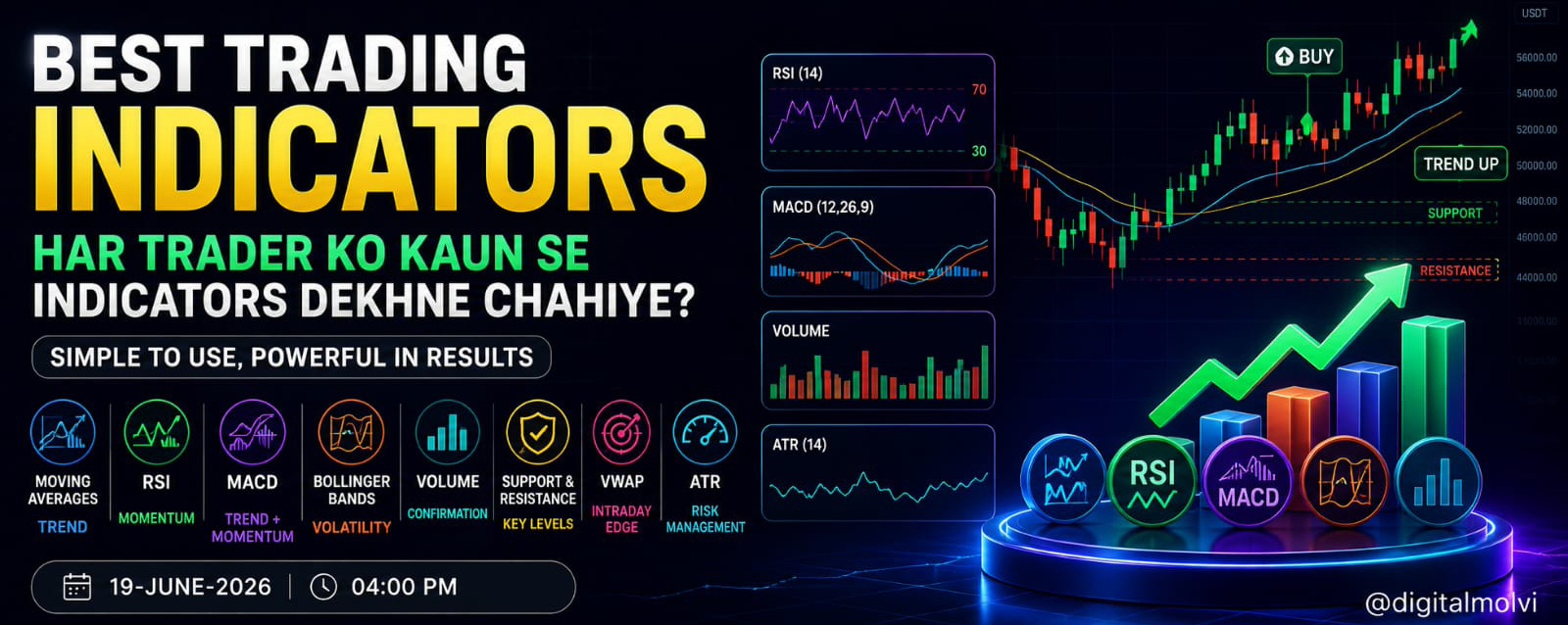
1. Moving Averages
Moving averages are among the most popular trading indicators. They smooth out price data and help traders identify the overall trend.
The two most common types are:
​Simple Moving Average (SMA)
​Exponential Moving Average (EMA)
A moving average helps traders see whether price is generally moving up or down. For example, if price is above a key moving average, the market may be in an uptrend. If price is below it, the market may be weak.
Many traders use combinations like:
​20 EMA for short-term trend
​50 MA for medium-term trend
​200 MA for long-term trend
Moving averages are especially useful in trending markets, but they can give false signals in sideways conditions.
2. Relative Strength Index (RSI)
RSI is a momentum indicator that measures the speed and strength of price movements. It usually moves between 0 and 100.
Common interpretations are:
​Above 70 = overbought
​Below 30 = oversold
But traders should be careful. Overbought does not always mean price must fall immediately, and oversold does not always mean price must rise. In strong trends, RSI can stay overbought or oversold for a long time.
RSI is most useful when combined with trend analysis. It can also help spot divergence, where price makes a new high or low but RSI does not. This may suggest weakening momentum.
3. MACD
MACD stands for Moving Average Convergence Divergence. It is used to measure momentum and trend direction.
MACD has three main parts:
​MACD line
​Signal line
​Histogram
When the MACD line crosses above the signal line, it may suggest bullish momentum. When it crosses below, it may suggest bearish momentum.
Traders like MACD because it helps show whether momentum is building or fading. It works well in trending markets, but like many indicators, it can produce weak signals in choppy conditions.
4. Volume
Volume is one of the most important indicators, even though many beginners ignore it. Volume shows how much buying and selling activity is happening.
A price move with strong volume is usually more reliable than a move with weak volume. For example:
​Breakout + high volume = stronger confirmation
​Breakout + low volume = higher chance of fake move
Volume helps traders judge whether market participants truly support the move. It is often used with support/resistance and breakout trading.
5. Bollinger Bands
Bollinger Bands measure volatility. They consist of:
​A middle moving average
​An upper band
​A lower band
When the bands expand, volatility is increasing. When the bands contract, volatility is decreasing.
Traders use Bollinger Bands to identify:
​Potential overextended price moves
​Volatility squeezes before expansion
​Mean reversion opportunities
However, touching the upper band does not automatically mean sell, and touching the lower band does not automatically mean buy. In strong trends, price can ride the bands for a long time.
6. Support and Resistance
Some traders may not call support and resistance a traditional indicator, but it is one of the most powerful tools in trading.
Support is an area where price may find buying interest. Resistance is an area where price may face selling pressure.
These levels matter because traders often make decisions around them. A breakout above resistance or a breakdown below support can create strong moves, especially if confirmed by volume.
Many traders combine support/resistance with RSI, MACD, or moving averages for better timing.
7. Stochastic Oscillator
The stochastic oscillator is another momentum indicator used to identify overbought and oversold conditions. Like RSI, it can help traders spot possible reversals or momentum shifts.
It is often used in range-bound markets and can be useful for short-term traders. But in strong trends, it can also stay in extreme zones for longer than expected.
8. Average True Range (ATR)
ATR measures volatility. It does not tell direction, but it tells how much an asset is moving on average.
This is very useful for:
​Setting stop-loss levels
​Understanding market volatility
​Avoiding stops that are too tight
For example, if ATR is high, the market is moving aggressively, and traders may need wider stops. If ATR is low, the market is calmer.
ATR is a practical indicator because risk management is just as important as finding entries.
Which Indicator Is Best?
There is no single best indicator for every market and every trader. The best indicator depends on:
​Trading style
​Timeframe
​Market condition
​Risk tolerance
For example:
​Trend traders often prefer moving averages and MACD
​Momentum traders may use RSI and volume
​Range traders may use RSI, stochastic, and Bollinger Bands
​Risk-focused traders often use ATR
The real edge comes from using indicators in combination, not isolation.
Best Indicator Combinations
Here are some common combinations traders use:
1. Moving Average + RSI
This helps traders identify trend direction and check whether momentum supports the move.
2. MACD + Volume
This helps confirm whether momentum shifts are supported by real participation.
3. Support/Resistance + RSI + Volume
This is useful for spotting breakouts, reversals, and fake moves.
4. ATR + Market Structure
This helps traders place smarter stop-losses and manage risk better.
Common Mistakes Traders Make
Many traders misuse indicators. Some common mistakes include:
​Using too many indicators at once
​Taking every signal without context
​Ignoring trend direction
​Forgetting volume confirmation
​Relying on indicators without risk management
Too many indicators can create confusion. This is called analysis paralysis. A clean chart with a few useful tools is often better than a chart full of signals.
Final Thoughts
Trading indicators are helpful tools, but they are not perfect. They work best when combined with price action, support/resistance, volume, and strong risk management.
A smart trader does not ask, “Which indicator gives guaranteed profit?” A smart trader asks, “Which indicator helps me understand the market better?”
That mindset makes a big difference.
The best trading indicators are the ones you understand well and use with discipline. Even a simple setup can be powerful if applied consistently.
In trading, success does not come from finding a magic indicator. It comes from managing risk, staying patient, and following a clear system.
#digitalmolvi #bestindicator #BinanceSquare
$BTC
Anmelden und weiter Inhalte entdecken
Krypto-Nutzer weltweit auf Binance Square kennenlernen
⚡️ Bleib in Sachen Krypto stets am Puls.
💬 Die weltgrößte Kryptobörse vertraut darauf.
👍 Erhalte verlässliche Einblicke von verifizierten Creators.
E-Mail-Adresse/Telefonnummer