
Zoya_BNB
12.8k Posts

Zoya_BNB
Report
Block User
Open Trade
High-Frequency Trader
11.2 Months
622 Following
25.2K+ Followers
11.1K+ Liked
Posts
Portfolio
All
Quotes
Live
·
--
all guy's follow the @SmartBoy_007 and claim
all guy's follow the @Ethan_Blake and claim


Ethan_Blake
·
--
Bullish🎁 RED PACKET GIVEAWAY! 🚀🔥
I’m dropping a Red Packet for my community! ❤️
Want to be part of it? 👀
✅ Follow me
❤️ Like this post
💬 Comment DONE
Stay active and stay tuned — more surprises are coming! 🔥
Let’s grow together! 🚀📈
$BULLA
#RedPacket #Giveaway #Binance #CryptoCommunity #Followers
$MARSCOIN $AKE
I’m dropping a Red Packet for my community! ❤️
Want to be part of it? 👀
✅ Follow me
❤️ Like this post
💬 Comment DONE
Stay active and stay tuned — more surprises are coming! 🔥
Let’s grow together! 🚀📈
$BULLA
#RedPacket #Giveaway #Binance #CryptoCommunity #Followers
$MARSCOIN $AKE

1
2
38
·
--
Bullish
Guy's today gainers coins King 👑👑
$BULLA $0.060614
{future}(BULLAUSDT)
$4 $0.025942
{future}(4USDT)
$AKE $0.019397
{future}(AKEUSDT)
Guy's today gainers coins King 👑👑
$BULLA $0.060614
$4 $0.025942
$AKE $0.019397
$BULLA $0.060614
$4 $0.025942
$AKE $0.019397
bullish
59%
bearish
41%
34 votes • Voting closed
3
2.6k
·
--
Bullish
today gainers coins guy's what do you think 🤔💬
$AKE
{future}(AKEUSDT)
$T
{future}(TUSDT)
$BULLA
{future}(BULLAUSDT)
today gainers coins guy's what do you think 🤔💬
$AKE
$T
$BULLA
$AKE
$T
$BULLA
$bulla
16%
$T
29%
$ake
55%
51 votes • Voting closed
3
1.7k
·
--
Bullish
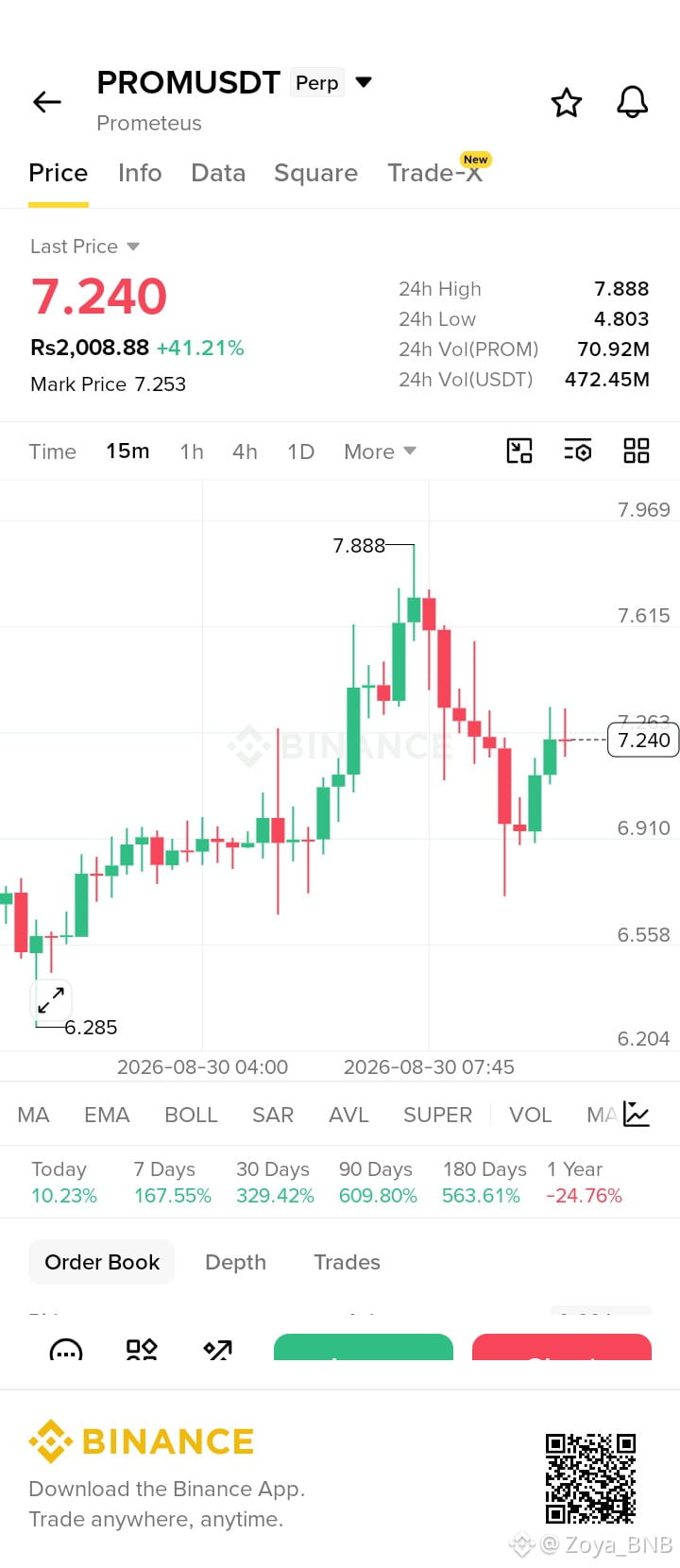
PROMUSDT – LONG (BREAKOUT PLAY)
🚀 $PROM is showing MASSIVE bullish momentum with a STUNNING +41.21% gain! Buyers remain in full control with volume surging to 472.45M USDT. Structure remains constructive with liquidity resting around $7.888.
EP: $7.20 – $7.25
TP1: $7.45
TP2: $7.65
TP3: $7.888
SL: $6.90
Liquidity was swept near $4.803 before a strong buyer reaction. Structure remains constructive above $6.90, with liquidity resting around $7.888. 24h volume is massive at 70.92M PROM, confirming strong institutional interest. The 30-day gain of 329.42% and 90-day gain of 609.80% show this rally has serious legs!
Let's go $PROM 🚀
PROMUSDT – LONG (BREAKOUT PLAY)
🚀 $PROM is showing MASSIVE bullish momentum with a STUNNING +41.21% gain! Buyers remain in full control with volume surging to 472.45M USDT. Structure remains constructive with liquidity resting around $7.888.
EP: $7.20 – $7.25
TP1: $7.45
TP2: $7.65
TP3: $7.888
SL: $6.90
Liquidity was swept near $4.803 before a strong buyer reaction. Structure remains constructive above $6.90, with liquidity resting around $7.888. 24h volume is massive at 70.92M PROM, confirming strong institutional interest. The 30-day gain of 329.42% and 90-day gain of 609.80% show this rally has serious legs!
Let's go $PROM 🚀
🚀 $PROM is showing MASSIVE bullish momentum with a STUNNING +41.21% gain! Buyers remain in full control with volume surging to 472.45M USDT. Structure remains constructive with liquidity resting around $7.888.
EP: $7.20 – $7.25
TP1: $7.45
TP2: $7.65
TP3: $7.888
SL: $6.90
Liquidity was swept near $4.803 before a strong buyer reaction. Structure remains constructive above $6.90, with liquidity resting around $7.888. 24h volume is massive at 70.92M PROM, confirming strong institutional interest. The 30-day gain of 329.42% and 90-day gain of 609.80% show this rally has serious legs!
Let's go $PROM 🚀
1
3
102
·
--
Bullish
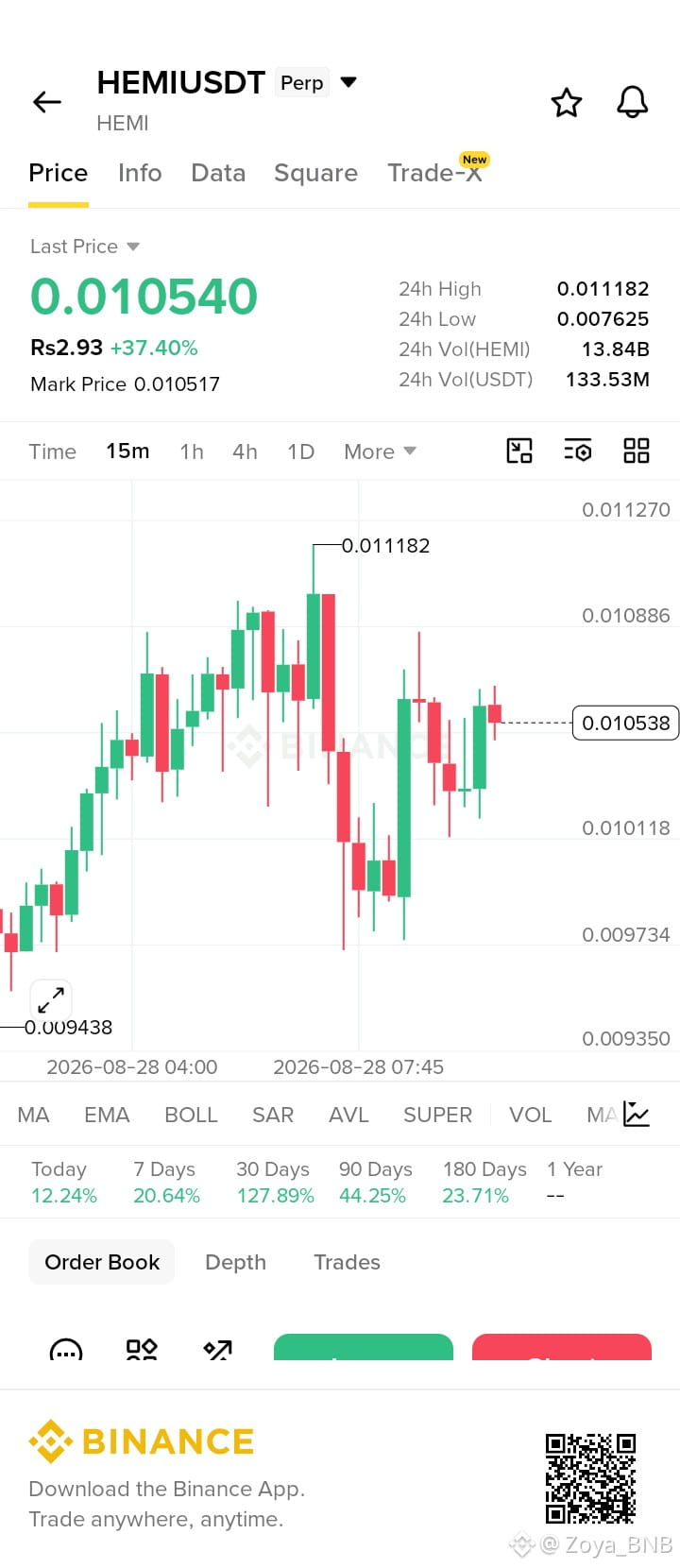
HEMIUSDT – LONG (BREAKOUT PLAY)
🚀 $HEMI is showing massive bullish momentum with a stunning +37.40% gain! Buyers remain in full control with volume surging to 133.53M USDT. Structure remains constructive with liquidity resting around $0.011182.
EP: $0.01050 – $0.01055
TP1: $0.01080
TP2: $0.01100
TP3: $0.011182
SL: $0.01020
Liquidity was swept near $0.007625 before a strong buyer reaction. Structure remains constructive above $0.01020, with liquidity resting around $0.011182. 24h volume is massive at 13.84B HEMI, confirming strong institutional interest. The 30-day gain of 127.89% shows this rally has serious legs!
Let's go $HEMI
{future}(HEMIUSDT)
HEMIUSDT – LONG (BREAKOUT PLAY)
🚀 $HEMI is showing massive bullish momentum with a stunning +37.40% gain! Buyers remain in full control with volume surging to 133.53M USDT. Structure remains constructive with liquidity resting around $0.011182.
EP: $0.01050 – $0.01055
TP1: $0.01080
TP2: $0.01100
TP3: $0.011182
SL: $0.01020
Liquidity was swept near $0.007625 before a strong buyer reaction. Structure remains constructive above $0.01020, with liquidity resting around $0.011182. 24h volume is massive at 13.84B HEMI, confirming strong institutional interest. The 30-day gain of 127.89% shows this rally has serious legs!
Let's go $HEMI
🚀 $HEMI is showing massive bullish momentum with a stunning +37.40% gain! Buyers remain in full control with volume surging to 133.53M USDT. Structure remains constructive with liquidity resting around $0.011182.
EP: $0.01050 – $0.01055
TP1: $0.01080
TP2: $0.01100
TP3: $0.011182
SL: $0.01020
Liquidity was swept near $0.007625 before a strong buyer reaction. Structure remains constructive above $0.01020, with liquidity resting around $0.011182. 24h volume is massive at 13.84B HEMI, confirming strong institutional interest. The 30-day gain of 127.89% shows this rally has serious legs!
Let's go $HEMI
2
121
·
--
last night i was staring at a banking app thinking about how much financial data we casually expose just to move money.
then it hit me — institutions have the opposite problem.
they want privacy.
but they also need proof.
That’s where Dusk gets interesting.
A regulated institution can’t simply say, “trust me, this transaction is compliant.” A regulator may need proof that the investor is eligible, the transfer obeyed limits, and the asset followed its restrictions — without seeing every balance, identity, or trading detail.
That’s the promise of ZK.
Prove the rule.
Hide the underlying data.
But tbh, the hard part isn’t the math.
It’s the circuit.
A ZK proof can be perfectly valid while proving the wrong thing if the compliance logic is incomplete. Add eligibility rules, jurisdiction checks, holding periods, transfer restrictions, credentials, audits, and forced actions — suddenly privacy becomes a serious engineering problem.
And there’s another friction point: metadata, wallet behavior, liquidity flows, and disclosure infrastructure can still leak information.
Dusk doesn’t need maximum privacy.
It needs minimum disclosure + maximum verifiability.
That’s the institutional battle.
@Dusk_Foundation #dusk $DUSK
last night i was staring at a banking app thinking about how much financial data we casually expose just to move money.
then it hit me — institutions have the opposite problem.
they want privacy.
but they also need proof.
That’s where Dusk gets interesting.
A regulated institution can’t simply say, “trust me, this transaction is compliant.” A regulator may need proof that the investor is eligible, the transfer obeyed limits, and the asset followed its restrictions — without seeing every balance, identity, or trading detail.
That’s the promise of ZK.
Prove the rule.
Hide the underlying data.
But tbh, the hard part isn’t the math.
It’s the circuit.
A ZK proof can be perfectly valid while proving the wrong thing if the compliance logic is incomplete. Add eligibility rules, jurisdiction checks, holding periods, transfer restrictions, credentials, audits, and forced actions — suddenly privacy becomes a serious engineering problem.
And there’s another friction point: metadata, wallet behavior, liquidity flows, and disclosure infrastructure can still leak information.
Dusk doesn’t need maximum privacy.
It needs minimum disclosure + maximum verifiability.
That’s the institutional battle.
@Dusk #dusk $DUSK
then it hit me — institutions have the opposite problem.
they want privacy.
but they also need proof.
That’s where Dusk gets interesting.
A regulated institution can’t simply say, “trust me, this transaction is compliant.” A regulator may need proof that the investor is eligible, the transfer obeyed limits, and the asset followed its restrictions — without seeing every balance, identity, or trading detail.
That’s the promise of ZK.
Prove the rule.
Hide the underlying data.
But tbh, the hard part isn’t the math.
It’s the circuit.
A ZK proof can be perfectly valid while proving the wrong thing if the compliance logic is incomplete. Add eligibility rules, jurisdiction checks, holding periods, transfer restrictions, credentials, audits, and forced actions — suddenly privacy becomes a serious engineering problem.
And there’s another friction point: metadata, wallet behavior, liquidity flows, and disclosure infrastructure can still leak information.
Dusk doesn’t need maximum privacy.
It needs minimum disclosure + maximum verifiability.
That’s the institutional battle.
@Dusk #dusk $DUSK
3
156
·
--
Bullish
Verified
🚨 The Next Generation of Financial Infrastructure Has Arrived
Dusk Network is an AI-optimized Layer-1 blockchain engineered explicitly for institutional-grade confidential finance.
⚡ Confidential Smart Contracts: Execute complex financial logic with zero-knowledge cryptographic privacy.
🔐 Zero-Knowledge Privacy: Secure proprietary enterprise data without compromising regulatory oversight.
📜 XSC Standard Compliance: Native framework built to support legal compliance and automated asset issuance.
🏦 Institutional-Scale Architecture: Bridging traditional capital markets with decentralized liquidity.
While traditional public blockchains expose transaction telemetry by default, Dusk Network provides full confidentiality for state-transitions and account balances.
Confidentiality is not an add-on.
It is foundational protocol architecture.
Welcome to the future of institutional decentralized finance. 🌐
{spot}(DUSKUSDT)
#dusk $DUSK @Dusk_Foundation
🚨 The Next Generation of Financial Infrastructure Has Arrived
Dusk Network is an AI-optimized Layer-1 blockchain engineered explicitly for institutional-grade confidential finance.
⚡ Confidential Smart Contracts: Execute complex financial logic with zero-knowledge cryptographic privacy.
🔐 Zero-Knowledge Privacy: Secure proprietary enterprise data without compromising regulatory oversight.
📜 XSC Standard Compliance: Native framework built to support legal compliance and automated asset issuance.
🏦 Institutional-Scale Architecture: Bridging traditional capital markets with decentralized liquidity.
While traditional public blockchains expose transaction telemetry by default, Dusk Network provides full confidentiality for state-transitions and account balances.
Confidentiality is not an add-on.
It is foundational protocol architecture.
Welcome to the future of institutional decentralized finance. 🌐
#dusk $DUSK @Dusk
Dusk Network is an AI-optimized Layer-1 blockchain engineered explicitly for institutional-grade confidential finance.
⚡ Confidential Smart Contracts: Execute complex financial logic with zero-knowledge cryptographic privacy.
🔐 Zero-Knowledge Privacy: Secure proprietary enterprise data without compromising regulatory oversight.
📜 XSC Standard Compliance: Native framework built to support legal compliance and automated asset issuance.
🏦 Institutional-Scale Architecture: Bridging traditional capital markets with decentralized liquidity.
While traditional public blockchains expose transaction telemetry by default, Dusk Network provides full confidentiality for state-transitions and account balances.
Confidentiality is not an add-on.
It is foundational protocol architecture.
Welcome to the future of institutional decentralized finance. 🌐
#dusk $DUSK @Dusk
1
2
107
·
--
Bullish
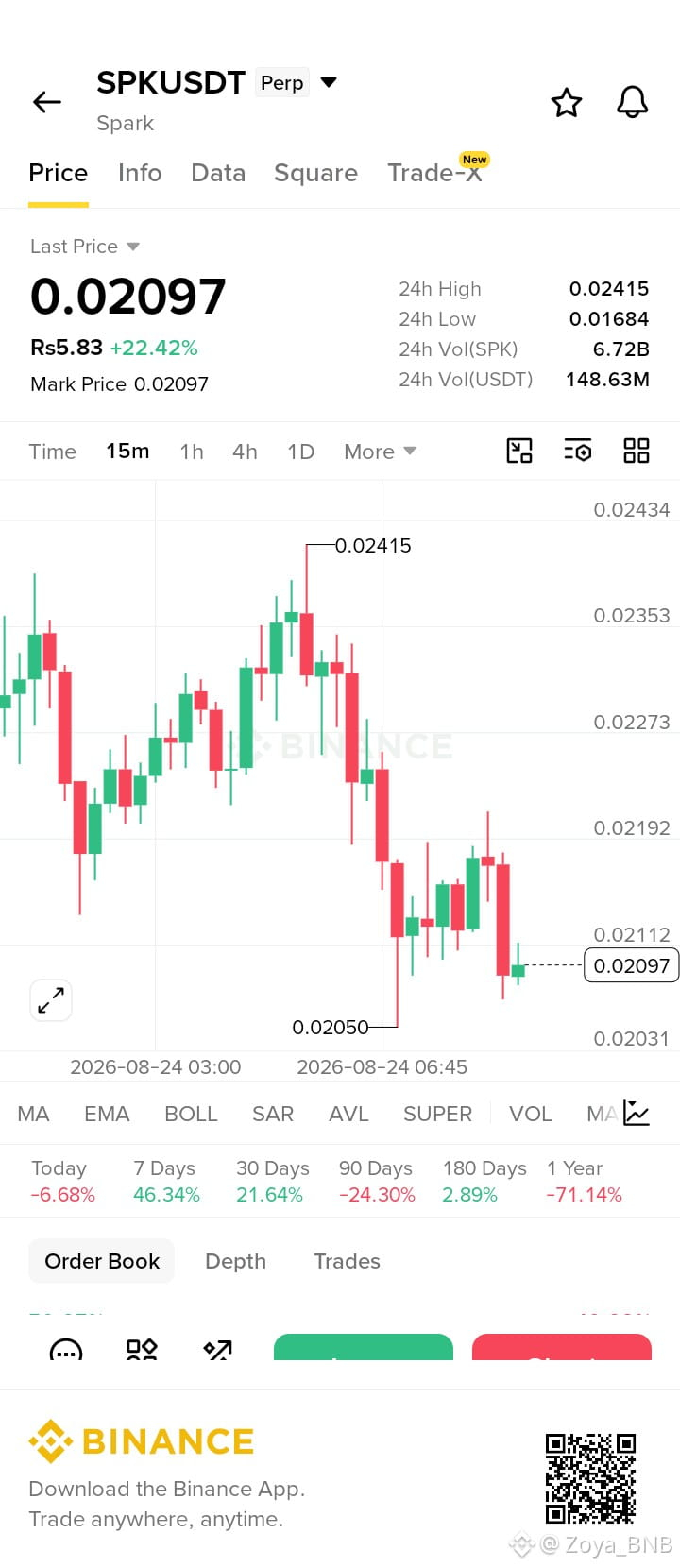
SPKUSDT – LONG (BREAKOUT PLAY)
🚀 is showing strong bullish momentum after a massive +22.42% rally! Buyers remain in control with volume surging to 148.63M USDT. Structure remains constructive with liquidity resting around $0.02415.
EP: $0.02090 – $0.02100
TP1: $0.02200
TP2: $0.02300
TP3: $0.02415
SL: $0.02000
Liquidity was swept near $0.01684 before a strong buyer reaction. Structure remains constructive above $0.02000, with liquidity resting around $0.02415. 24h volume is massive at 6.72B SPK, confirming strong institutional interest. The 7-day gain of 46.34% shows this rally has serious legs!
Let's go $SPK 🚀
{future}(SPKUSDT)
SPKUSDT – LONG (BREAKOUT PLAY)
🚀 is showing strong bullish momentum after a massive +22.42% rally! Buyers remain in control with volume surging to 148.63M USDT. Structure remains constructive with liquidity resting around $0.02415.
EP: $0.02090 – $0.02100
TP1: $0.02200
TP2: $0.02300
TP3: $0.02415
SL: $0.02000
Liquidity was swept near $0.01684 before a strong buyer reaction. Structure remains constructive above $0.02000, with liquidity resting around $0.02415. 24h volume is massive at 6.72B SPK, confirming strong institutional interest. The 7-day gain of 46.34% shows this rally has serious legs!
Let's go $SPK 🚀
🚀 is showing strong bullish momentum after a massive +22.42% rally! Buyers remain in control with volume surging to 148.63M USDT. Structure remains constructive with liquidity resting around $0.02415.
EP: $0.02090 – $0.02100
TP1: $0.02200
TP2: $0.02300
TP3: $0.02415
SL: $0.02000
Liquidity was swept near $0.01684 before a strong buyer reaction. Structure remains constructive above $0.02000, with liquidity resting around $0.02415. 24h volume is massive at 6.72B SPK, confirming strong institutional interest. The 7-day gain of 46.34% shows this rally has serious legs!
Let's go $SPK 🚀
2
150
·
--
Verified
Dusk Network Is Built for the Privacy That Regulated Assets Actually Need
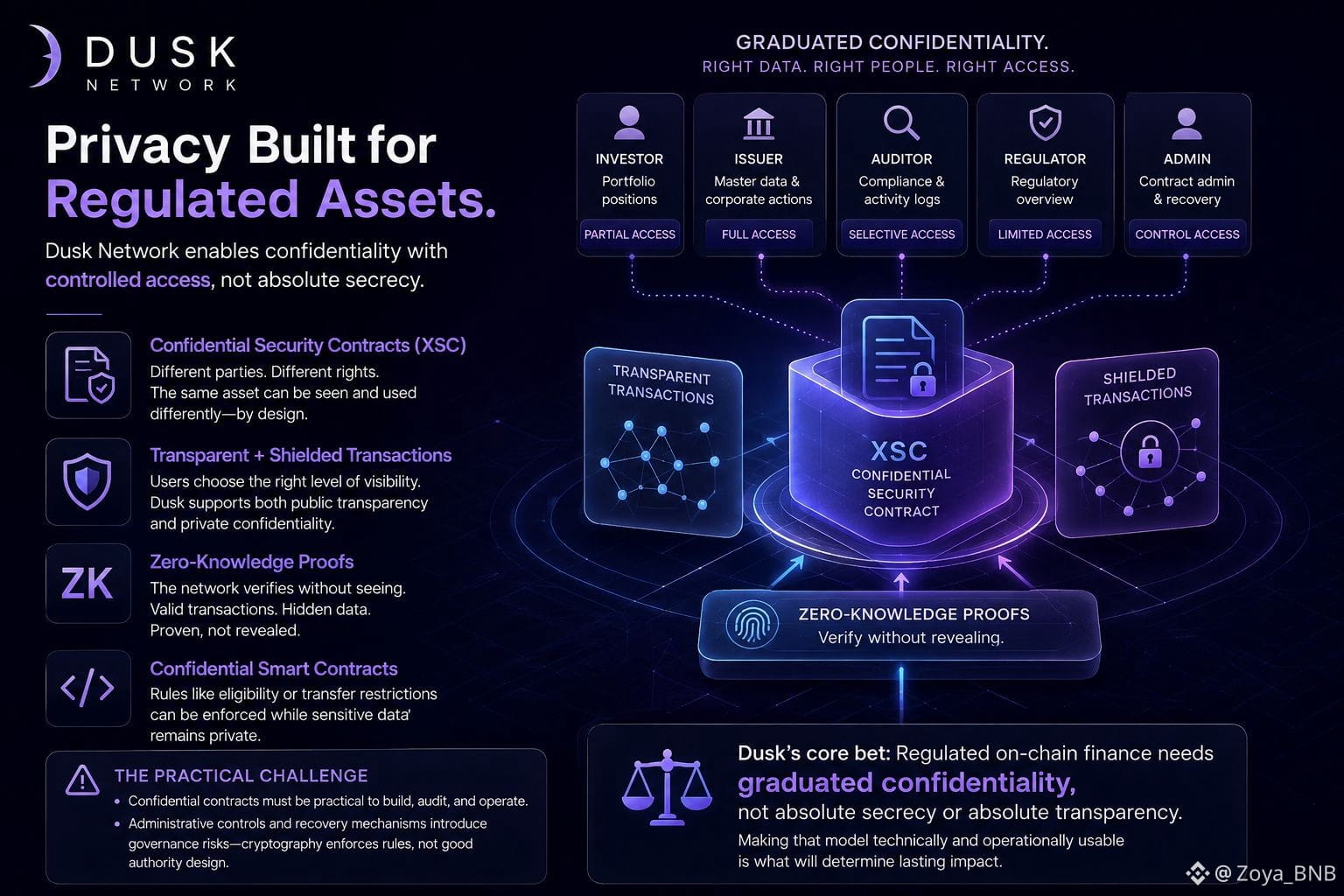
Dusk Network's most distinctive idea is not simply hiding financial data. It is trying to make confidentiality compatible with the uneven levels of access and control that regulated assets require.
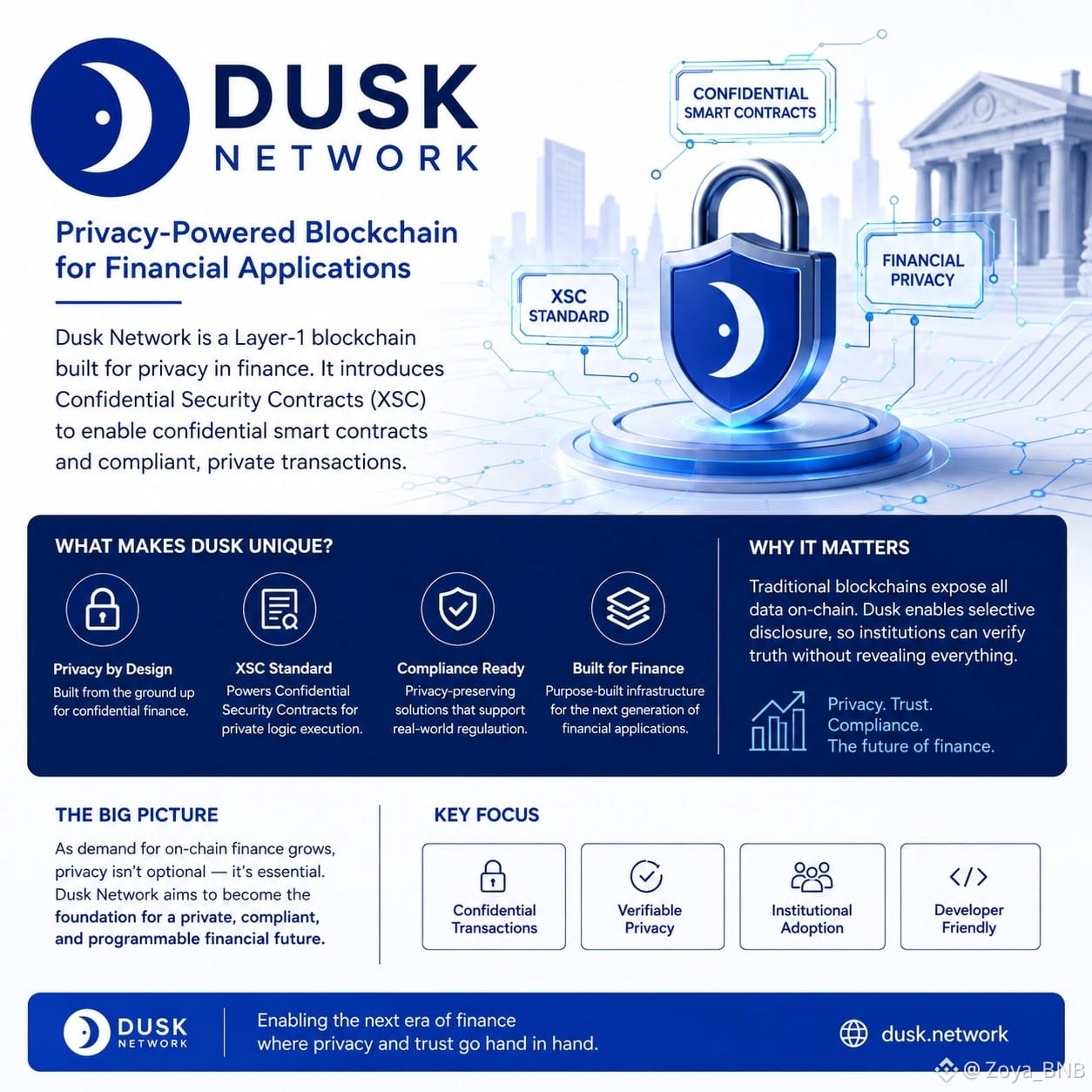
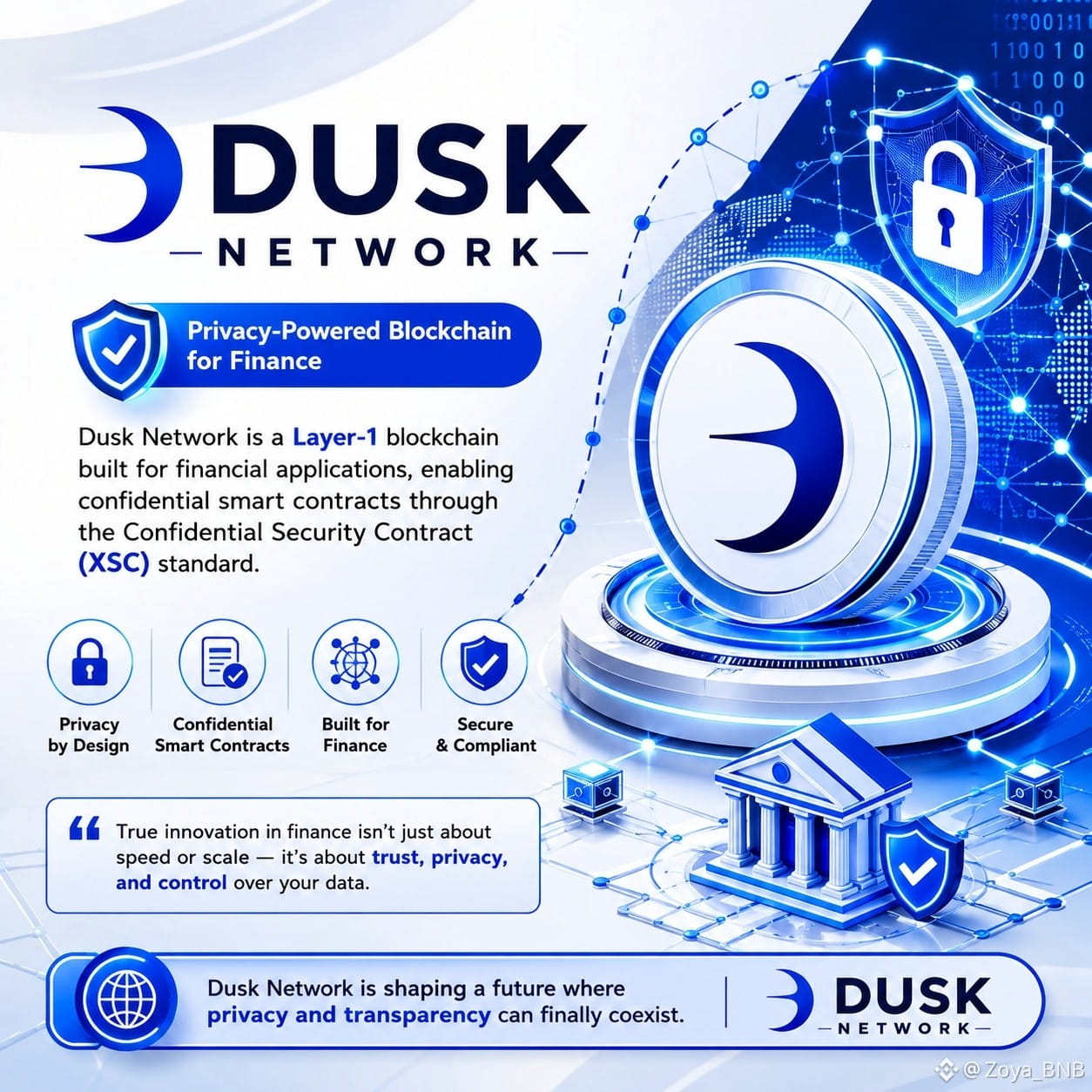
That is the logic behind its Confidential Security Contract standard, XSC. An investor, issuer, auditor, or other authorized party may need different rights around the same asset. Dusk aims to support that without putting every position and transaction detail on a fully transparent ledger.
Its architecture combines transparent and shielded transaction models, with zero-knowledge proofs allowing the network to validate private activity without exposing the underlying data. The harder step is extending that idea into smart contracts, where rules such as eligibility or transfer restrictions may need to be enforced while sensitive information remains hidden.
This creates Dusk's biggest practical challenge. Privacy infrastructure is only useful if confidential contracts remain practical to build, audit, and operate. Administrative controls and recovery mechanisms also introduce governance questions: cryptography can enforce the rules, but it cannot make poorly designed authority structures safe.
Dusk's core bet is that regulated on-chain finance needs graduated confidentiality, not absolute secrecy or absolute transparency. Making that model technically and operationally usable is what will determine whether its architecture has real staying power.
#dusk $DUSK @Dusk_Foundation
Dusk Network Is Built for the Privacy That Regulated Assets Actually Need
Dusk Network's most distinctive idea is not simply hiding financial data. It is trying to make confidentiality compatible with the uneven levels of access and control that regulated assets require.
That is the logic behind its Confidential Security Contract standard, XSC. An investor, issuer, auditor, or other authorized party may need different rights around the same asset. Dusk aims to support that without putting every position and transaction detail on a fully transparent ledger.
Its architecture combines transparent and shielded transaction models, with zero-knowledge proofs allowing the network to validate private activity without exposing the underlying data. The harder step is extending that idea into smart contracts, where rules such as eligibility or transfer restrictions may need to be enforced while sensitive information remains hidden.
This creates Dusk's biggest practical challenge. Privacy infrastructure is only useful if confidential contracts remain practical to build, audit, and operate. Administrative controls and recovery mechanisms also introduce governance questions: cryptography can enforce the rules, but it cannot make poorly designed authority structures safe.
Dusk's core bet is that regulated on-chain finance needs graduated confidentiality, not absolute secrecy or absolute transparency. Making that model technically and operationally usable is what will determine whether its architecture has real staying power.
#dusk $DUSK @Dusk
Dusk Network's most distinctive idea is not simply hiding financial data. It is trying to make confidentiality compatible with the uneven levels of access and control that regulated assets require.
That is the logic behind its Confidential Security Contract standard, XSC. An investor, issuer, auditor, or other authorized party may need different rights around the same asset. Dusk aims to support that without putting every position and transaction detail on a fully transparent ledger.
Its architecture combines transparent and shielded transaction models, with zero-knowledge proofs allowing the network to validate private activity without exposing the underlying data. The harder step is extending that idea into smart contracts, where rules such as eligibility or transfer restrictions may need to be enforced while sensitive information remains hidden.
This creates Dusk's biggest practical challenge. Privacy infrastructure is only useful if confidential contracts remain practical to build, audit, and operate. Administrative controls and recovery mechanisms also introduce governance questions: cryptography can enforce the rules, but it cannot make poorly designed authority structures safe.
Dusk's core bet is that regulated on-chain finance needs graduated confidentiality, not absolute secrecy or absolute transparency. Making that model technically and operationally usable is what will determine whether its architecture has real staying power.
#dusk $DUSK @Dusk
1
4
125
·
--
Bullish
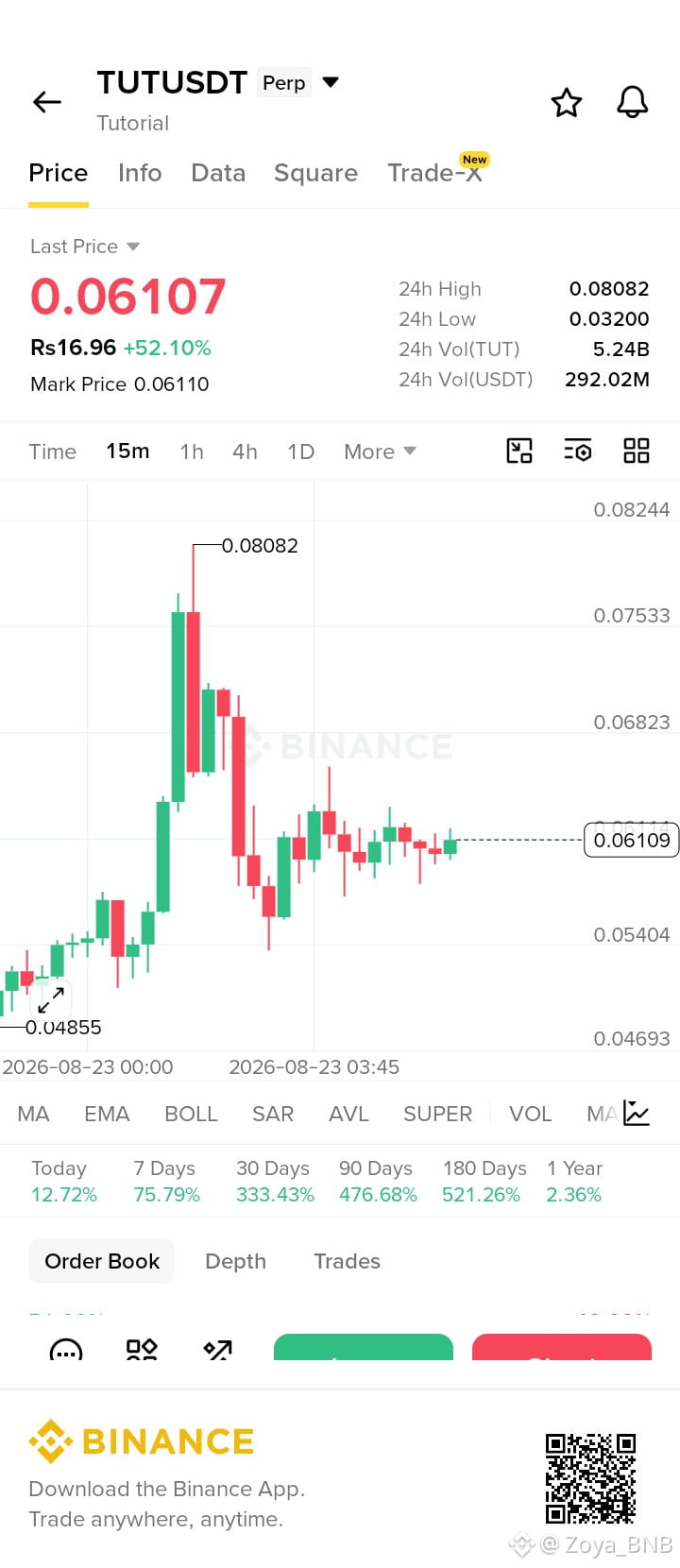
TUTUSDT – LONG
🚀 $TUT is showing massive bullish momentum after an explosive rally from $0.03200! Buyers remain in full control with volume surging to 292.02M USDT. Structure remains constructive with liquidity resting around $0.08082.
EP: $0.06050 – $0.06150
TP1: $0.06500
TP2: $0.07000
TP3: $0.08082
SL: $0.05500
Liquidity was swept near $0.03200 before a strong buyer reaction. Structure remains constructive above $0.05500, with liquidity resting around $0.08082. 24h volume is massive at 5.24B TUT, confirming strong institutional interest. The 7-day gain of 75.79% and 30-day gain of 333.43% show this rally has serious legs. With the 24h high at $0.08082, we could see a retest of this level very soon. The trend is your friend – and right now, the trend is undeniably up!
Let's go $TUT
{future}(TUTUSDT)
TUTUSDT – LONG
🚀 $TUT is showing massive bullish momentum after an explosive rally from $0.03200! Buyers remain in full control with volume surging to 292.02M USDT. Structure remains constructive with liquidity resting around $0.08082.
EP: $0.06050 – $0.06150
TP1: $0.06500
TP2: $0.07000
TP3: $0.08082
SL: $0.05500
Liquidity was swept near $0.03200 before a strong buyer reaction. Structure remains constructive above $0.05500, with liquidity resting around $0.08082. 24h volume is massive at 5.24B TUT, confirming strong institutional interest. The 7-day gain of 75.79% and 30-day gain of 333.43% show this rally has serious legs. With the 24h high at $0.08082, we could see a retest of this level very soon. The trend is your friend – and right now, the trend is undeniably up!
Let's go $TUT
🚀 $TUT is showing massive bullish momentum after an explosive rally from $0.03200! Buyers remain in full control with volume surging to 292.02M USDT. Structure remains constructive with liquidity resting around $0.08082.
EP: $0.06050 – $0.06150
TP1: $0.06500
TP2: $0.07000
TP3: $0.08082
SL: $0.05500
Liquidity was swept near $0.03200 before a strong buyer reaction. Structure remains constructive above $0.05500, with liquidity resting around $0.08082. 24h volume is massive at 5.24B TUT, confirming strong institutional interest. The 7-day gain of 75.79% and 30-day gain of 333.43% show this rally has serious legs. With the 24h high at $0.08082, we could see a retest of this level very soon. The trend is your friend – and right now, the trend is undeniably up!
Let's go $TUT
1
280
·
--
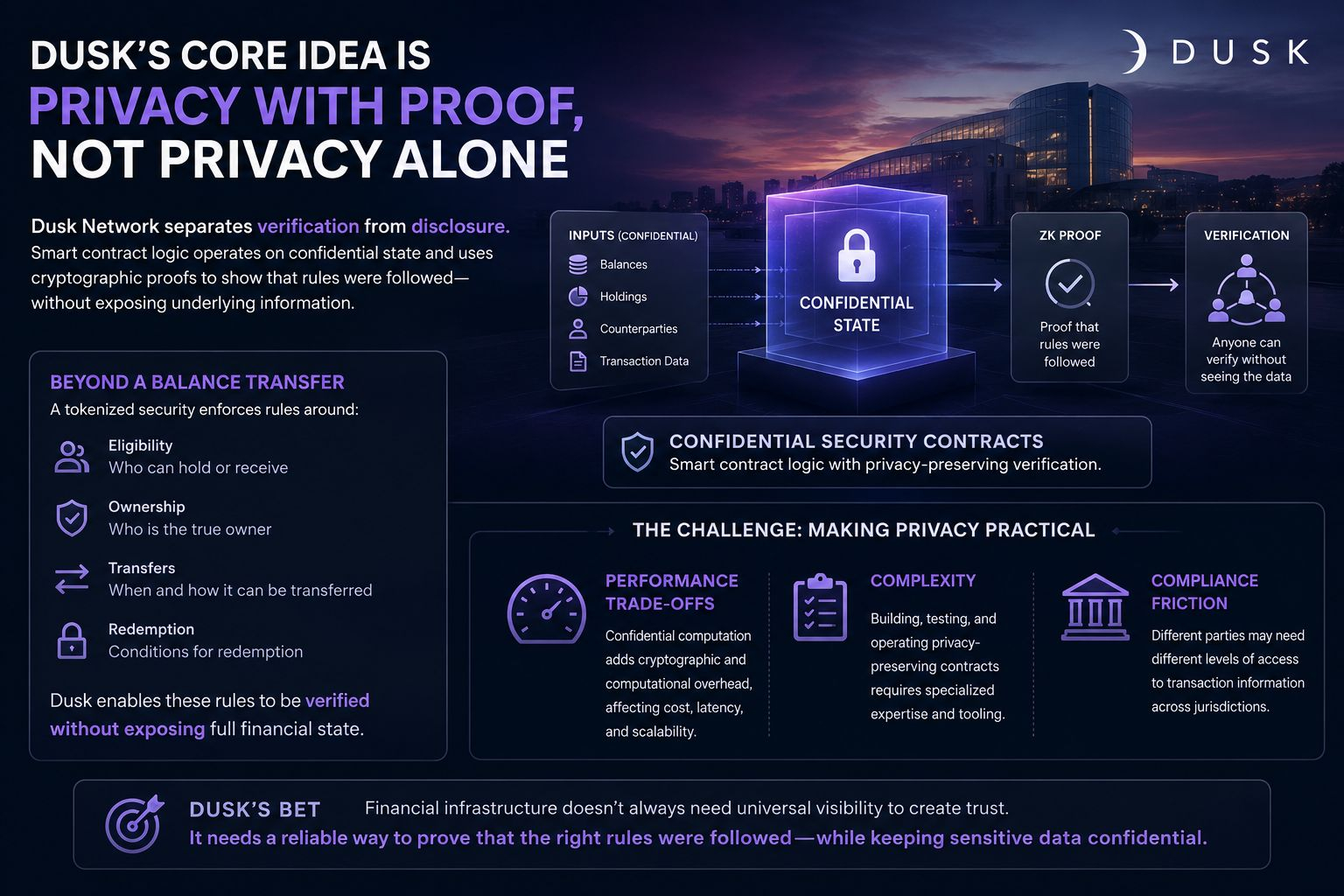
Dusk’s Core Idea Is Privacy With Proof, Not Privacy Alone
Dusk Network’s most important idea is not simply making blockchain activity private. It is separating verification from disclosure.
Its Confidential Security Contract standard allows smart contract logic to operate on confidential state, using cryptographic proofs to show that rules were followed without exposing all of the underlying information. That distinction matters for financial assets, where transaction data, holdings, and counterparties can be commercially sensitive, but ownership and transfer rules still need to be enforced.
A tokenized security, for example, is more than a balance moving between addresses. It may have restrictions around eligibility, ownership, transfers, or redemption. Dusk’s approach is designed to let those rules be verified without making the full financial state visible to every participant.
The challenge is making this practical. Confidential computation adds cryptographic and computational overhead, which can affect cost, latency, and operational complexity. Compliance also creates friction because different parties may need different levels of access to transaction information.
That is Dusk’s actual bet: financial infrastructure does not always need universal visibility to create trust. It needs a reliable way to prove that the right rules were followed while keeping sensitive data confidential.
#dusk
$DUSK @Dusk_Foundation
Dusk’s Core Idea Is Privacy With Proof, Not Privacy Alone
Dusk Network’s most important idea is not simply making blockchain activity private. It is separating verification from disclosure.
Its Confidential Security Contract standard allows smart contract logic to operate on confidential state, using cryptographic proofs to show that rules were followed without exposing all of the underlying information. That distinction matters for financial assets, where transaction data, holdings, and counterparties can be commercially sensitive, but ownership and transfer rules still need to be enforced.
A tokenized security, for example, is more than a balance moving between addresses. It may have restrictions around eligibility, ownership, transfers, or redemption. Dusk’s approach is designed to let those rules be verified without making the full financial state visible to every participant.
The challenge is making this practical. Confidential computation adds cryptographic and computational overhead, which can affect cost, latency, and operational complexity. Compliance also creates friction because different parties may need different levels of access to transaction information.
That is Dusk’s actual bet: financial infrastructure does not always need universal visibility to create trust. It needs a reliable way to prove that the right rules were followed while keeping sensitive data confidential.
#dusk
$DUSK @Dusk
Dusk Network’s most important idea is not simply making blockchain activity private. It is separating verification from disclosure.
Its Confidential Security Contract standard allows smart contract logic to operate on confidential state, using cryptographic proofs to show that rules were followed without exposing all of the underlying information. That distinction matters for financial assets, where transaction data, holdings, and counterparties can be commercially sensitive, but ownership and transfer rules still need to be enforced.
A tokenized security, for example, is more than a balance moving between addresses. It may have restrictions around eligibility, ownership, transfers, or redemption. Dusk’s approach is designed to let those rules be verified without making the full financial state visible to every participant.
The challenge is making this practical. Confidential computation adds cryptographic and computational overhead, which can affect cost, latency, and operational complexity. Compliance also creates friction because different parties may need different levels of access to transaction information.
That is Dusk’s actual bet: financial infrastructure does not always need universal visibility to create trust. It needs a reliable way to prove that the right rules were followed while keeping sensitive data confidential.
#dusk
$DUSK @Dusk
2
4
120
·
--
Verified
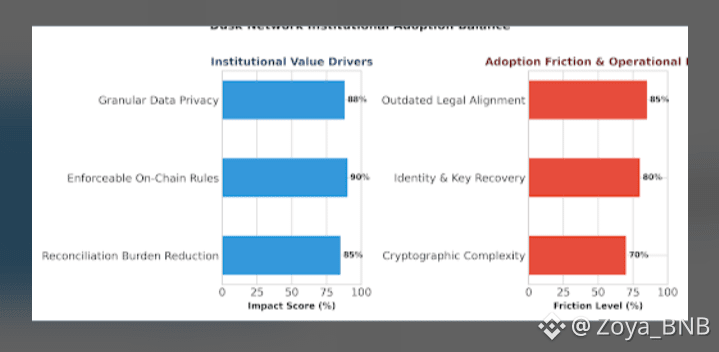
#dusk Dusk’s Core Mechanism Is Programmable Confidentiality
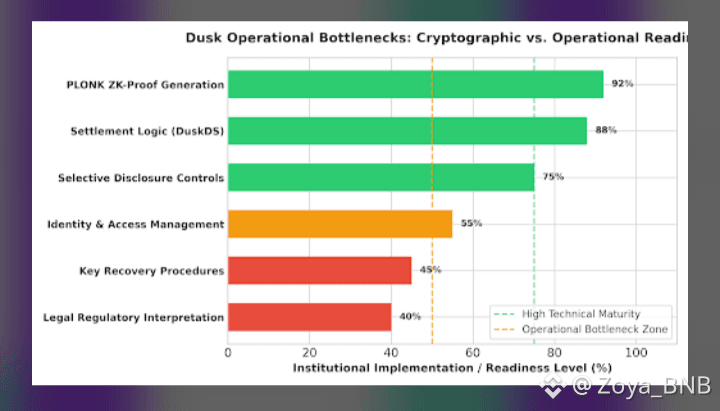
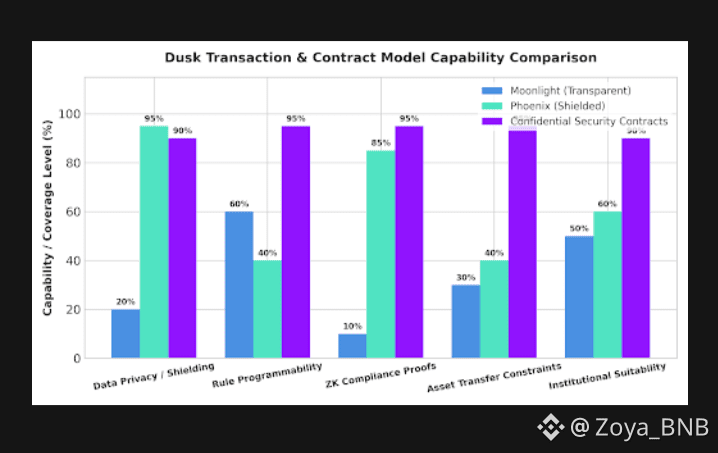
Dusk Network’s most important structural feature is not privacy in isolation, but the ability to combine confidential execution with enforceable financial rules. Its architecture separates settlement through DuskDS from execution, while supporting transparent Moonlight transactions and shielded Phoenix transactions. The Confidential Security Contract standard extends this model to regulated assets by embedding transfer, eligibility and ownership constraints into contract logic without requiring every underlying data point to become public. Zero-knowledge proofs, supported by PLONK-based proving and the network’s cryptographic stack, are central to this design because compliance can be demonstrated without exposing the full transaction state.
The execution bottleneck is operational rather than purely cryptographic. Efficient proofs do not solve identity management, key recovery, selective disclosure or the legal interpretation of programmable restrictions. Institutions also need reliable reporting and clear procedures for determining who can access confidential information. A contract can enforce a rule precisely while still reflecting an outdated or incorrectly interpreted regulatory requirement.
That creates Dusk’s real institutional test. Adoption depends on whether confidential on-chain workflows reduce the reconciliation and data-sharing burden of existing financial infrastructure without introducing a new layer of cryptographic and operational complexity. The protocol’s value lies in making the boundary between disclosure and confidentiality programmable, but that boundary must also work within custody, compliance and legal systems that blockchain code does not control.
$DUSK @Dusk_Foundation
#dusk Dusk’s Core Mechanism Is Programmable Confidentiality
Dusk Network’s most important structural feature is not privacy in isolation, but the ability to combine confidential execution with enforceable financial rules. Its architecture separates settlement through DuskDS from execution, while supporting transparent Moonlight transactions and shielded Phoenix transactions. The Confidential Security Contract standard extends this model to regulated assets by embedding transfer, eligibility and ownership constraints into contract logic without requiring every underlying data point to become public. Zero-knowledge proofs, supported by PLONK-based proving and the network’s cryptographic stack, are central to this design because compliance can be demonstrated without exposing the full transaction state.
The execution bottleneck is operational rather than purely cryptographic. Efficient proofs do not solve identity management, key recovery, selective disclosure or the legal interpretation of programmable restrictions. Institutions also need reliable reporting and clear procedures for determining who can access confidential information. A contract can enforce a rule precisely while still reflecting an outdated or incorrectly interpreted regulatory requirement.
That creates Dusk’s real institutional test. Adoption depends on whether confidential on-chain workflows reduce the reconciliation and data-sharing burden of existing financial infrastructure without introducing a new layer of cryptographic and operational complexity. The protocol’s value lies in making the boundary between disclosure and confidentiality programmable, but that boundary must also work within custody, compliance and legal systems that blockchain code does not control.
$DUSK @Dusk
Dusk Network’s most important structural feature is not privacy in isolation, but the ability to combine confidential execution with enforceable financial rules. Its architecture separates settlement through DuskDS from execution, while supporting transparent Moonlight transactions and shielded Phoenix transactions. The Confidential Security Contract standard extends this model to regulated assets by embedding transfer, eligibility and ownership constraints into contract logic without requiring every underlying data point to become public. Zero-knowledge proofs, supported by PLONK-based proving and the network’s cryptographic stack, are central to this design because compliance can be demonstrated without exposing the full transaction state.
The execution bottleneck is operational rather than purely cryptographic. Efficient proofs do not solve identity management, key recovery, selective disclosure or the legal interpretation of programmable restrictions. Institutions also need reliable reporting and clear procedures for determining who can access confidential information. A contract can enforce a rule precisely while still reflecting an outdated or incorrectly interpreted regulatory requirement.
That creates Dusk’s real institutional test. Adoption depends on whether confidential on-chain workflows reduce the reconciliation and data-sharing burden of existing financial infrastructure without introducing a new layer of cryptographic and operational complexity. The protocol’s value lies in making the boundary between disclosure and confidentiality programmable, but that boundary must also work within custody, compliance and legal systems that blockchain code does not control.
$DUSK @Dusk
7
8
143
·
--
Bullish
$ONG USDT – LONG (+129.90%)
🚀 GUYS, I'M GOING LONG – STRONG SETUP, MASSIVE BREAKOUT!
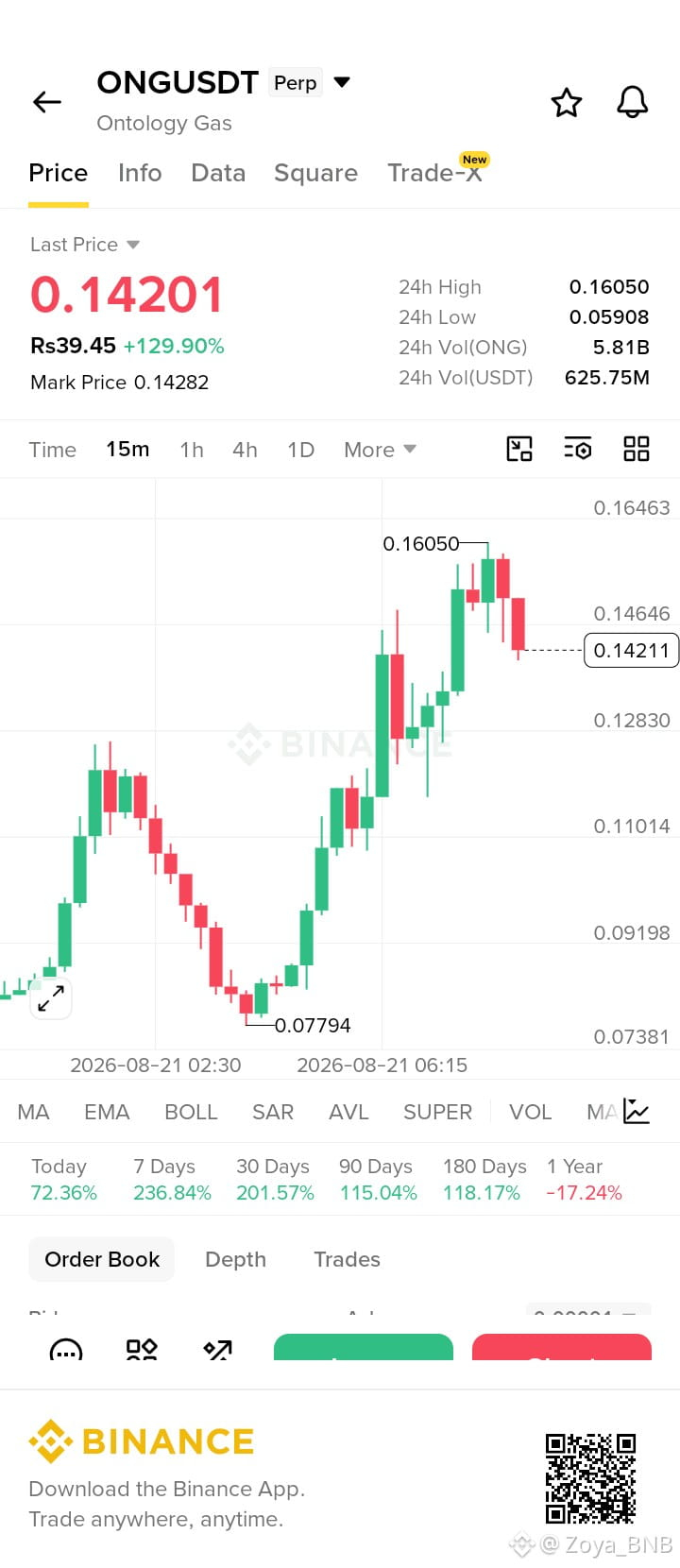
ONG is absolutely exploding with a mind-blowing 129.90% gain! This isn't just a pump – this is a full-blown breakout from a multi-month accumulation zone. The volume is astronomical at 625.75M USDT, confirming that institutional money is pouring in. The bulls have completely taken over, and this rally is showing no signs of stopping!
Entry: $0.1400 – $0.1420
SL: $0.1300
TP1: $0.1550
TP2: $0.1650
TP3: $0.1800
The 24h high is $0.16050, and we're seeing a clean breakout above resistance. The RSI is showing strong momentum, and the MACD is signaling a massive bullish continuation. Today's gain is 72.36%, 7-day gain is 236.84%, and 30-day gain is 201.57% – the trend is undeniably bullish!
This is a high-probability long setup with a great risk-to-reward ratio. Don't miss this rocket – ONG is trending harder than anything else in the market right now. Ride the wave up with confidence, secure your profits at targets, and let the momentum carry you to massive gains!$ONG
{future}(ONGUSDT)
$ONG USDT – LONG (+129.90%)
🚀 GUYS, I'M GOING LONG – STRONG SETUP, MASSIVE BREAKOUT!
ONG is absolutely exploding with a mind-blowing 129.90% gain! This isn't just a pump – this is a full-blown breakout from a multi-month accumulation zone. The volume is astronomical at 625.75M USDT, confirming that institutional money is pouring in. The bulls have completely taken over, and this rally is showing no signs of stopping!
Entry: $0.1400 – $0.1420
SL: $0.1300
TP1: $0.1550
TP2: $0.1650
TP3: $0.1800
The 24h high is $0.16050, and we're seeing a clean breakout above resistance. The RSI is showing strong momentum, and the MACD is signaling a massive bullish continuation. Today's gain is 72.36%, 7-day gain is 236.84%, and 30-day gain is 201.57% – the trend is undeniably bullish!
This is a high-probability long setup with a great risk-to-reward ratio. Don't miss this rocket – ONG is trending harder than anything else in the market right now. Ride the wave up with confidence, secure your profits at targets, and let the momentum carry you to massive gains!$ONG
🚀 GUYS, I'M GOING LONG – STRONG SETUP, MASSIVE BREAKOUT!
ONG is absolutely exploding with a mind-blowing 129.90% gain! This isn't just a pump – this is a full-blown breakout from a multi-month accumulation zone. The volume is astronomical at 625.75M USDT, confirming that institutional money is pouring in. The bulls have completely taken over, and this rally is showing no signs of stopping!
Entry: $0.1400 – $0.1420
SL: $0.1300
TP1: $0.1550
TP2: $0.1650
TP3: $0.1800
The 24h high is $0.16050, and we're seeing a clean breakout above resistance. The RSI is showing strong momentum, and the MACD is signaling a massive bullish continuation. Today's gain is 72.36%, 7-day gain is 236.84%, and 30-day gain is 201.57% – the trend is undeniably bullish!
This is a high-probability long setup with a great risk-to-reward ratio. Don't miss this rocket – ONG is trending harder than anything else in the market right now. Ride the wave up with confidence, secure your profits at targets, and let the momentum carry you to massive gains!$ONG
4
204
·
--
Bullish
$BOME /USDC PERP – MARKET UPDATE
Current Price: $0.0012705 | +69.38% Today | 24h Vol: 14.26B BOME
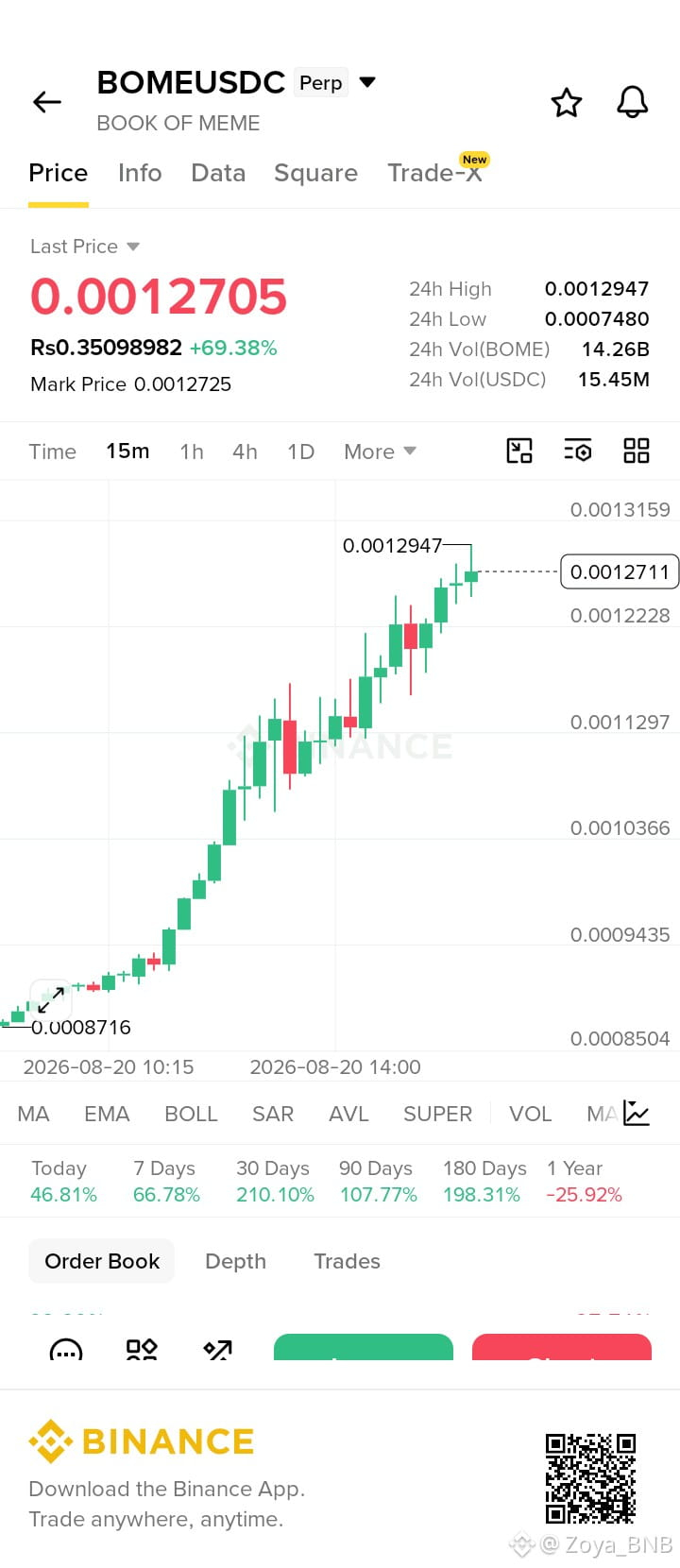
$BOME is experiencing a massive breakout, surging nearly 70% from its 24-hour low of $0.0007480. The volume spike of 14.26 billion tokens indicates strong institutional interest rather than retail speculation. The mark price sits at $0.0012725, very close to the last traded price, confirming market stability despite the sharp move.
Support Levels:
Immediate support rests at $0.0012228, with stronger backing at $0.0011297. A breakdown below these levels would signal exhaustion.
Resistance Levels:
The immediate ceiling is at $0.00131459. A clean breakout above this could trigger significant upside momentum.
Targets:
Target 1: $0.0014000
Target 2: $0.0016000
Extended Target: $0.0020000
Stop Loss:
Conservative stop: $0.0012200
Wider stop: $0.0011800
Next Move:
The 4-hour chart shows a bullish continuation pattern with sustained volume. Indicators suggest we test the $0.00131459 resistance within the next few hours. Breakout above this level could trigger aggressive buying, while rejection may lead to a retest of $0.0012228 support before the next leg higher.
The 30-day return of 210% and 180-day return of 198% confirm a strong uptrend. While the 1-year return shows -25.92%, the current move suggests we have reversed that downtrend completely.
Risk management is crucial here. This is a high-volatility meme coin, so position sizing and stop losses are essential. The bias remains strongly bullish on dips.
{future}(BOMEUSDT)
$BOME /USDC PERP – MARKET UPDATE
Current Price: $0.0012705 | +69.38% Today | 24h Vol: 14.26B BOME
$BOME is experiencing a massive breakout, surging nearly 70% from its 24-hour low of $0.0007480. The volume spike of 14.26 billion tokens indicates strong institutional interest rather than retail speculation. The mark price sits at $0.0012725, very close to the last traded price, confirming market stability despite the sharp move.
Support Levels:
Immediate support rests at $0.0012228, with stronger backing at $0.0011297. A breakdown below these levels would signal exhaustion.
Resistance Levels:
The immediate ceiling is at $0.00131459. A clean breakout above this could trigger significant upside momentum.
Targets:
Target 1: $0.0014000
Target 2: $0.0016000
Extended Target: $0.0020000
Stop Loss:
Conservative stop: $0.0012200
Wider stop: $0.0011800
Next Move:
The 4-hour chart shows a bullish continuation pattern with sustained volume. Indicators suggest we test the $0.00131459 resistance within the next few hours. Breakout above this level could trigger aggressive buying, while rejection may lead to a retest of $0.0012228 support before the next leg higher.
The 30-day return of 210% and 180-day return of 198% confirm a strong uptrend. While the 1-year return shows -25.92%, the current move suggests we have reversed that downtrend completely.
Risk management is crucial here. This is a high-volatility meme coin, so position sizing and stop losses are essential. The bias remains strongly bullish on dips.
Current Price: $0.0012705 | +69.38% Today | 24h Vol: 14.26B BOME
$BOME is experiencing a massive breakout, surging nearly 70% from its 24-hour low of $0.0007480. The volume spike of 14.26 billion tokens indicates strong institutional interest rather than retail speculation. The mark price sits at $0.0012725, very close to the last traded price, confirming market stability despite the sharp move.
Support Levels:
Immediate support rests at $0.0012228, with stronger backing at $0.0011297. A breakdown below these levels would signal exhaustion.
Resistance Levels:
The immediate ceiling is at $0.00131459. A clean breakout above this could trigger significant upside momentum.
Targets:
Target 1: $0.0014000
Target 2: $0.0016000
Extended Target: $0.0020000
Stop Loss:
Conservative stop: $0.0012200
Wider stop: $0.0011800
Next Move:
The 4-hour chart shows a bullish continuation pattern with sustained volume. Indicators suggest we test the $0.00131459 resistance within the next few hours. Breakout above this level could trigger aggressive buying, while rejection may lead to a retest of $0.0012228 support before the next leg higher.
The 30-day return of 210% and 180-day return of 198% confirm a strong uptrend. While the 1-year return shows -25.92%, the current move suggests we have reversed that downtrend completely.
Risk management is crucial here. This is a high-volatility meme coin, so position sizing and stop losses are essential. The bias remains strongly bullish on dips.
4
240
·
--
Bullish
#dusk I've been thinking about one problem in blockchain that gets discussed constantly but rarely solved properly: privacy. We want financial systems that are open and verifiable, but do we really want every financial action to become permanently visible?
I used to think transparency was almost always a feature. Over time, I realized that was incomplete. In real finance, not every detail needs to be public for a system to remain trustworthy.
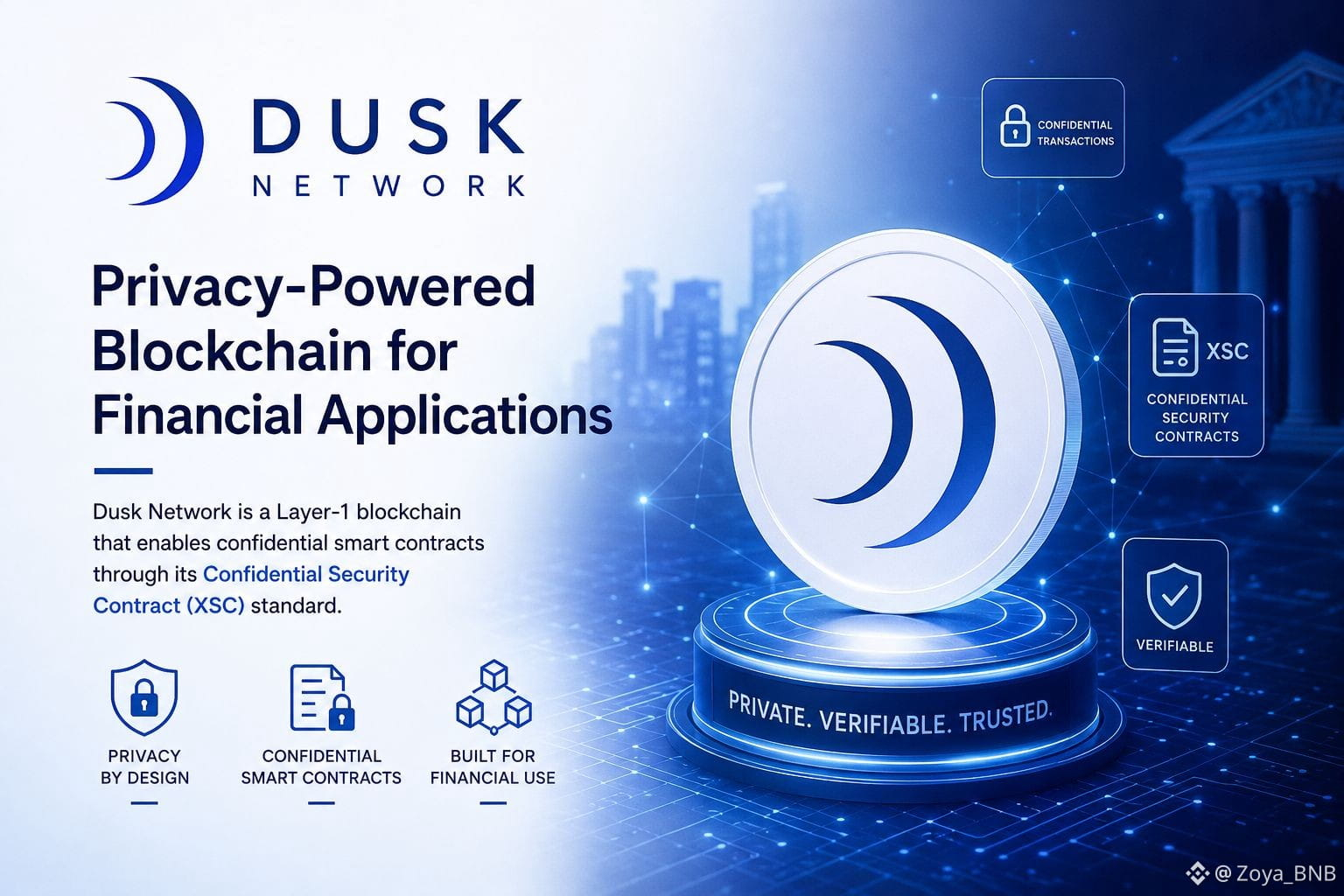
That tension is what made $DUSK Network catch my attention. It is a Layer-1 blockchain focused on financial applications, with privacy built around its Confidential Security Contract (XSC) standard and confidential smart contracts.
The idea is simple enough: can blockchain preserve verification and programmability without exposing everything?
That question matters as tokenized assets, regulated finance, and on-chain markets grow. But the hard part isn't the concept. Can developers actually build useful applications on it? Can institutions trust the infrastructure? Can privacy coexist with compliance and practical adoption?
$DUSK doesn't need more hype. It needs real usage, reliable execution, and developers willing to build.
For me, the bigger question is whether the future of finance can be both verifiable and private.:::
@Dusk_Foundation #dusk. $DUSK
{future}(DUSKUSDT)
#dusk I've been thinking about one problem in blockchain that gets discussed constantly but rarely solved properly: privacy. We want financial systems that are open and verifiable, but do we really want every financial action to become permanently visible?
I used to think transparency was almost always a feature. Over time, I realized that was incomplete. In real finance, not every detail needs to be public for a system to remain trustworthy.
That tension is what made $DUSK Network catch my attention. It is a Layer-1 blockchain focused on financial applications, with privacy built around its Confidential Security Contract (XSC) standard and confidential smart contracts.
The idea is simple enough: can blockchain preserve verification and programmability without exposing everything?
That question matters as tokenized assets, regulated finance, and on-chain markets grow. But the hard part isn't the concept. Can developers actually build useful applications on it? Can institutions trust the infrastructure? Can privacy coexist with compliance and practical adoption?
$DUSK doesn't need more hype. It needs real usage, reliable execution, and developers willing to build.
For me, the bigger question is whether the future of finance can be both verifiable and private.:::
@Dusk #dusk. $DUSK
I used to think transparency was almost always a feature. Over time, I realized that was incomplete. In real finance, not every detail needs to be public for a system to remain trustworthy.
That tension is what made $DUSK Network catch my attention. It is a Layer-1 blockchain focused on financial applications, with privacy built around its Confidential Security Contract (XSC) standard and confidential smart contracts.
The idea is simple enough: can blockchain preserve verification and programmability without exposing everything?
That question matters as tokenized assets, regulated finance, and on-chain markets grow. But the hard part isn't the concept. Can developers actually build useful applications on it? Can institutions trust the infrastructure? Can privacy coexist with compliance and practical adoption?
$DUSK doesn't need more hype. It needs real usage, reliable execution, and developers willing to build.
For me, the bigger question is whether the future of finance can be both verifiable and private.:::
@Dusk #dusk. $DUSK
7
6
154
·
--
Bearish
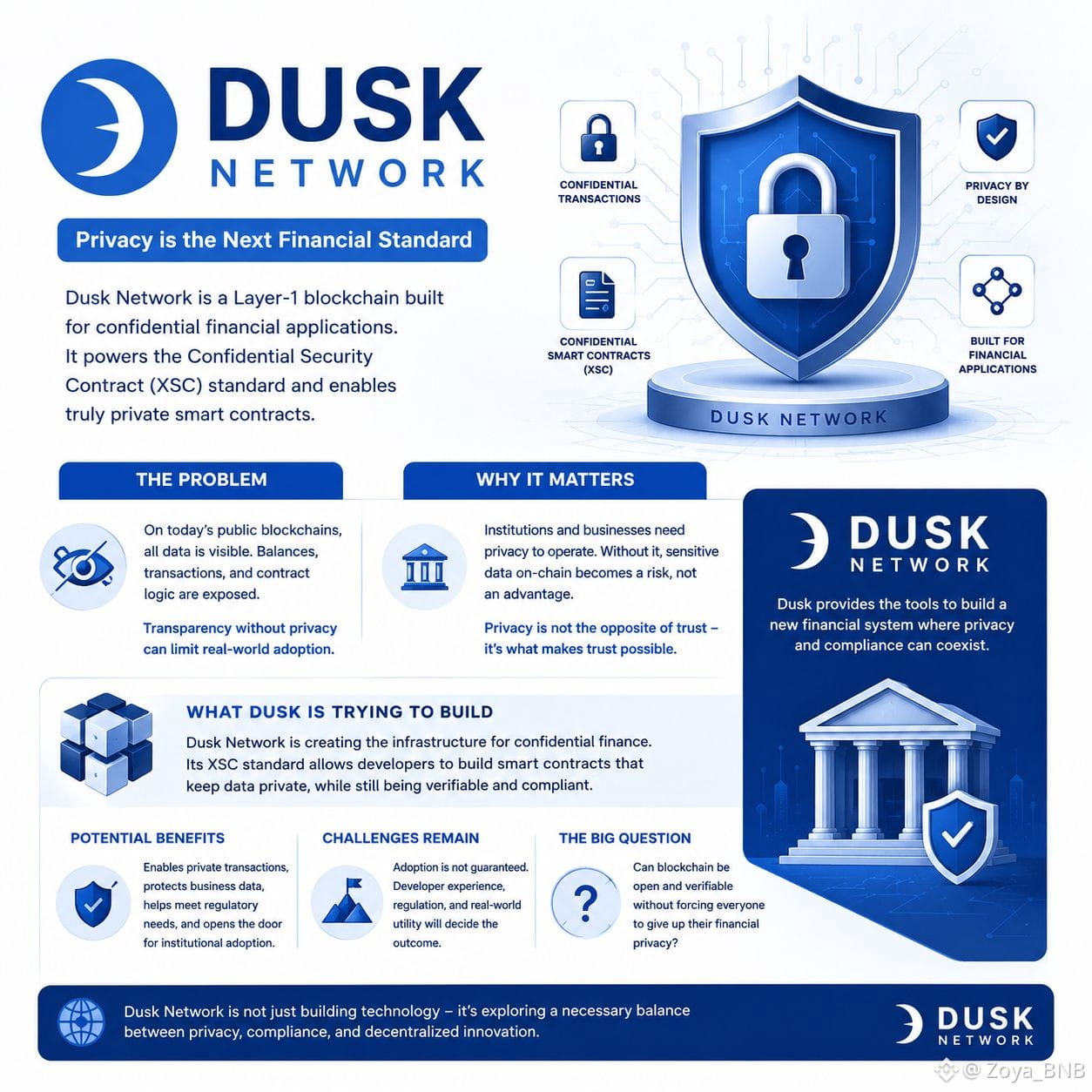
#dusk I've been thinking about a problem crypto often talks about but rarely solves well: transparency is useful, but complete transparency can become a weakness. We want financial systems to be open and verifiable, yet should every transaction, balance, or business detail really be visible to everyone?
I used to think transparency was almost always the answer. But that view feels incomplete now. Real financial systems need privacy too. Without it, institutions may hesitate to use public blockchains for sensitive activity.
This is where Dusk Network caught my attention. Rather than treating privacy as an optional feature, it is building a Layer-1 focused on financial applications, including confidential smart contracts through its XSC standard.
But the difficult question remains: can privacy actually become useful infrastructure rather than another crypto narrative?
The potential is meaningful. Confidential transactions could help bring regulated finance and blockchain closer together without exposing everything publicly. Yet technology alone isn't enough. Adoption, compliance, developer experience, security, and real-world demand will decide whether the idea matters.
For me, Dusk raises a bigger question: Can blockchain become genuinely open and verifiable without forcing everyone to sacrifice financial privacy?
@Dusk_Foundation #dusk. $DUSK
{future}(DUSKUSDT)
$ST
{alpha}(560x70be40667385500c5da7f108a022e21b606045dd)
$AA
{alpha}(560x01bf3d77cd08b19bf3f2309972123a2cca0f6936)
#dusk I've been thinking about a problem crypto often talks about but rarely solves well: transparency is useful, but complete transparency can become a weakness. We want financial systems to be open and verifiable, yet should every transaction, balance, or business detail really be visible to everyone?
I used to think transparency was almost always the answer. But that view feels incomplete now. Real financial systems need privacy too. Without it, institutions may hesitate to use public blockchains for sensitive activity.
This is where Dusk Network caught my attention. Rather than treating privacy as an optional feature, it is building a Layer-1 focused on financial applications, including confidential smart contracts through its XSC standard.
But the difficult question remains: can privacy actually become useful infrastructure rather than another crypto narrative?
The potential is meaningful. Confidential transactions could help bring regulated finance and blockchain closer together without exposing everything publicly. Yet technology alone isn't enough. Adoption, compliance, developer experience, security, and real-world demand will decide whether the idea matters.
For me, Dusk raises a bigger question: Can blockchain become genuinely open and verifiable without forcing everyone to sacrifice financial privacy?
@Dusk #dusk. $DUSK
$ST
$AA
I used to think transparency was almost always the answer. But that view feels incomplete now. Real financial systems need privacy too. Without it, institutions may hesitate to use public blockchains for sensitive activity.
This is where Dusk Network caught my attention. Rather than treating privacy as an optional feature, it is building a Layer-1 focused on financial applications, including confidential smart contracts through its XSC standard.
But the difficult question remains: can privacy actually become useful infrastructure rather than another crypto narrative?
The potential is meaningful. Confidential transactions could help bring regulated finance and blockchain closer together without exposing everything publicly. Yet technology alone isn't enough. Adoption, compliance, developer experience, security, and real-world demand will decide whether the idea matters.
For me, Dusk raises a bigger question: Can blockchain become genuinely open and verifiable without forcing everyone to sacrifice financial privacy?
@Dusk #dusk. $DUSK
$ST
$AA
11
12
117
·
--
Bearish
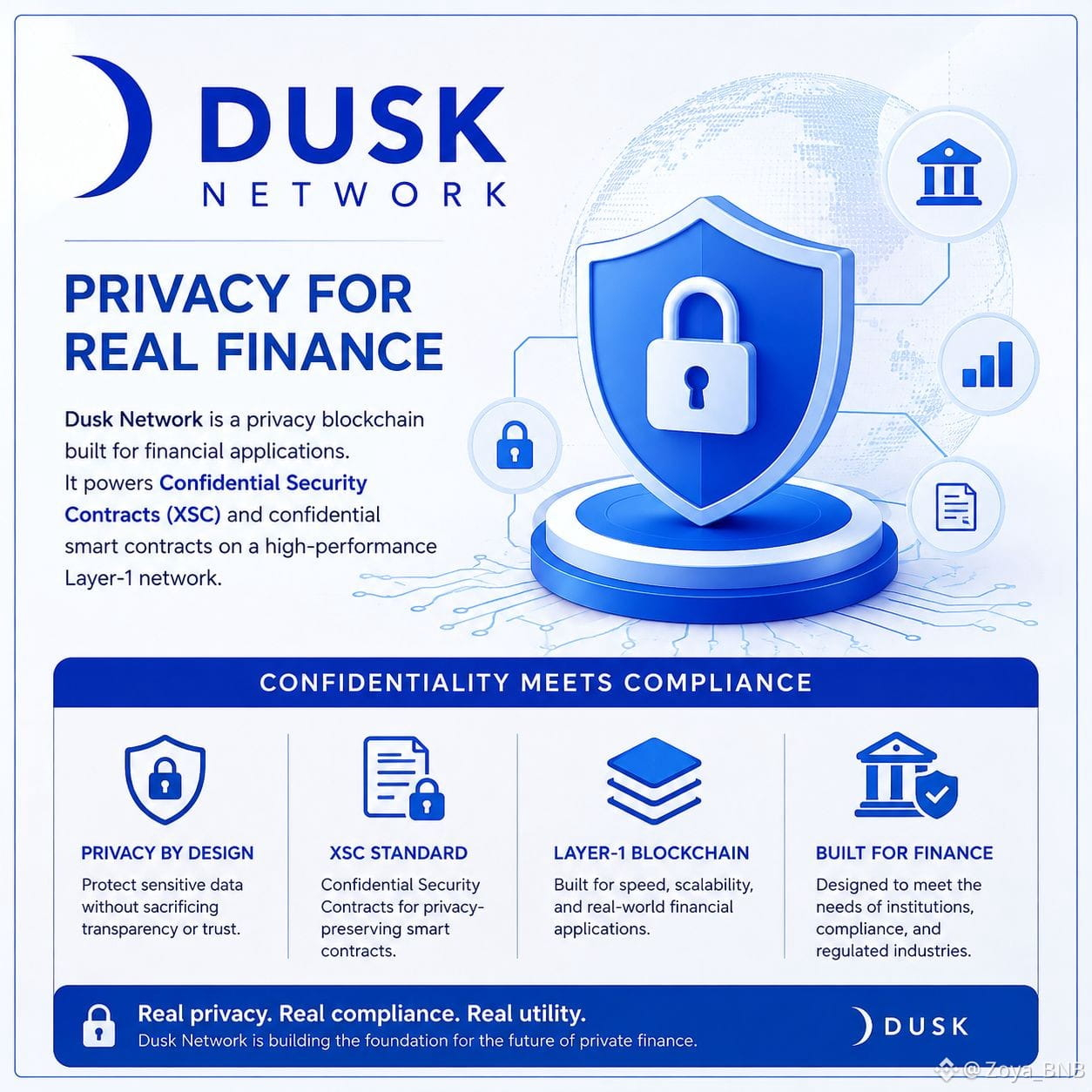
#dusk I've been thinking about blockchain and finance, and one problem keeps getting overlooked: transparency can be useful, but complete transparency isn't always practical. Financial activity often involves sensitive information, yet many blockchain systems treat openness as the default solution.
I used to think putting everything on a public ledger was automatically better. More visibility meant more trust, right? But that view now feels incomplete. What happens when businesses need privacy without giving up verifiability?
This is where Dusk Network caught my attention. Rather than simply adding another chain to the crowded blockchain landscape, it is focused on privacy for financial applications, using its Layer-1 infrastructure and Confidential Security Contract (XSC) standard.
The idea is straightforward: can financial applications remain compliant and verifiable while keeping sensitive information confidential?
That question matters as blockchain moves beyond speculation toward real financial infrastructure. But the difficult part isn't the concept. Can developers actually build with it? Will institutions adopt it? Can privacy, usability, compliance, and scalability coexist?
I've learned that infrastructure only matters when people use it. Dusk's bigger challenge is proving that confidential blockchain finance can become practical, not just technically interesting.
Ultimately, the question isn't whether privacy sounds valuable. It's whether blockchain can make privacy a usable part of financial infrastructure without sacrificing trust.
@Dusk_Foundation #dusk . $DUSK
{future}(DUSKUSDT)
$BAY
{alpha}(560xa7bef5abd9265ab97ee43d2fc4a56e0ba25aca25)
$NVDAB
{spot}(NVDABUSDT)
#dusk I've been thinking about blockchain and finance, and one problem keeps getting overlooked: transparency can be useful, but complete transparency isn't always practical. Financial activity often involves sensitive information, yet many blockchain systems treat openness as the default solution.
I used to think putting everything on a public ledger was automatically better. More visibility meant more trust, right? But that view now feels incomplete. What happens when businesses need privacy without giving up verifiability?
This is where Dusk Network caught my attention. Rather than simply adding another chain to the crowded blockchain landscape, it is focused on privacy for financial applications, using its Layer-1 infrastructure and Confidential Security Contract (XSC) standard.
The idea is straightforward: can financial applications remain compliant and verifiable while keeping sensitive information confidential?
That question matters as blockchain moves beyond speculation toward real financial infrastructure. But the difficult part isn't the concept. Can developers actually build with it? Will institutions adopt it? Can privacy, usability, compliance, and scalability coexist?
I've learned that infrastructure only matters when people use it. Dusk's bigger challenge is proving that confidential blockchain finance can become practical, not just technically interesting.
Ultimately, the question isn't whether privacy sounds valuable. It's whether blockchain can make privacy a usable part of financial infrastructure without sacrificing trust.
@Dusk #dusk . $DUSK
$BAY
$NVDAB
I used to think putting everything on a public ledger was automatically better. More visibility meant more trust, right? But that view now feels incomplete. What happens when businesses need privacy without giving up verifiability?
This is where Dusk Network caught my attention. Rather than simply adding another chain to the crowded blockchain landscape, it is focused on privacy for financial applications, using its Layer-1 infrastructure and Confidential Security Contract (XSC) standard.
The idea is straightforward: can financial applications remain compliant and verifiable while keeping sensitive information confidential?
That question matters as blockchain moves beyond speculation toward real financial infrastructure. But the difficult part isn't the concept. Can developers actually build with it? Will institutions adopt it? Can privacy, usability, compliance, and scalability coexist?
I've learned that infrastructure only matters when people use it. Dusk's bigger challenge is proving that confidential blockchain finance can become practical, not just technically interesting.
Ultimately, the question isn't whether privacy sounds valuable. It's whether blockchain can make privacy a usable part of financial infrastructure without sacrificing trust.
@Dusk #dusk . $DUSK
$BAY
$NVDAB
6
11
109
·
--
Bullish
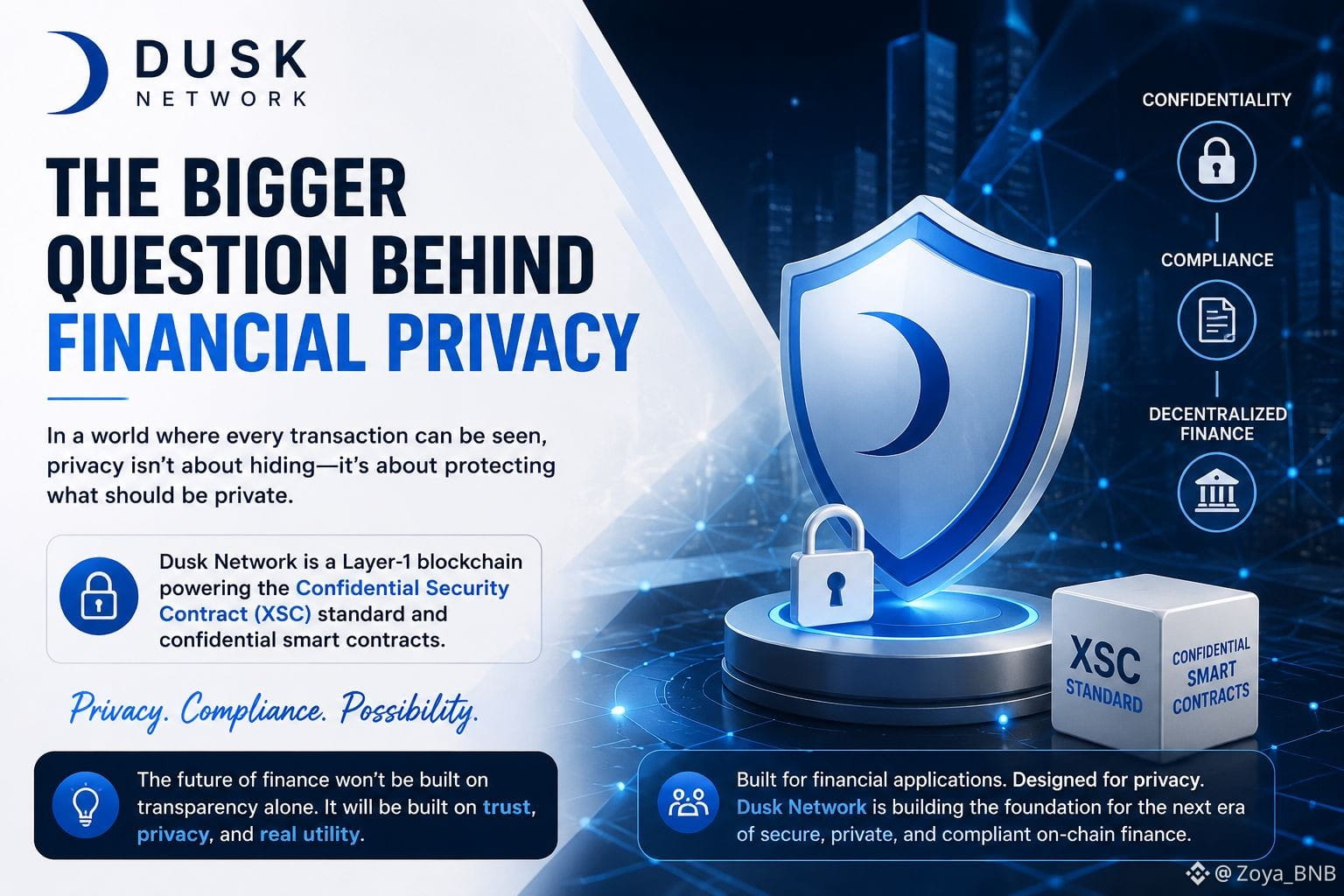
#dusk Dusk Network: The Bigger Question Behind Financial PrivacyI've been thinking about one problem crypto still hasn't solved well: privacy. We can move value globally, but financial activity often becomes permanently visible. For businesses and institutions, that isn't just uncomfortable—it can make public blockchains difficult to use.
I used to think transparency was always the better answer. More visibility meant more trust, right? But that view now feels incomplete. Financial systems need accountability, but they also need confidentiality. Why should every transaction reveal information that competitors could exploit?
This is where Network caught my attention. It isn't simply trying to make blockchain activity invisible. Its focus is building a Layer-1 environment for financial applications where sensitive logic and data can remain confidential through its Confidential Security Contract (XSC) standard and confidential smart contracts.
That idea matters because the next stage of blockchain adoption may depend less on speculation and more on whether real businesses can actually use these networks.
Still, the hard questions remain. Can developers build easily? Can institutions trust the infrastructure? Can privacy coexist with regulation and compliance?
For me, represents a bigger question: can blockchain deliver transparency where it matters, while preserving privacy where it is necessary? The answer will depend on execution, adoption, and real utility—not promises.
@Dusk_Foundation #Dusk. $DUSK
{future}(DUSKUSDT)
$SVRA.US
{stock_us}(SVRA.US)
$HST.US
{stock_us}(HST.US)
#dusk Dusk Network: The Bigger Question Behind Financial PrivacyI've been thinking about one problem crypto still hasn't solved well: privacy. We can move value globally, but financial activity often becomes permanently visible. For businesses and institutions, that isn't just uncomfortable—it can make public blockchains difficult to use.
I used to think transparency was always the better answer. More visibility meant more trust, right? But that view now feels incomplete. Financial systems need accountability, but they also need confidentiality. Why should every transaction reveal information that competitors could exploit?
This is where Network caught my attention. It isn't simply trying to make blockchain activity invisible. Its focus is building a Layer-1 environment for financial applications where sensitive logic and data can remain confidential through its Confidential Security Contract (XSC) standard and confidential smart contracts.
That idea matters because the next stage of blockchain adoption may depend less on speculation and more on whether real businesses can actually use these networks.
Still, the hard questions remain. Can developers build easily? Can institutions trust the infrastructure? Can privacy coexist with regulation and compliance?
For me, represents a bigger question: can blockchain deliver transparency where it matters, while preserving privacy where it is necessary? The answer will depend on execution, adoption, and real utility—not promises.
@Dusk #Dusk. $DUSK
$SVRA.US
$HST.US
I used to think transparency was always the better answer. More visibility meant more trust, right? But that view now feels incomplete. Financial systems need accountability, but they also need confidentiality. Why should every transaction reveal information that competitors could exploit?
This is where Network caught my attention. It isn't simply trying to make blockchain activity invisible. Its focus is building a Layer-1 environment for financial applications where sensitive logic and data can remain confidential through its Confidential Security Contract (XSC) standard and confidential smart contracts.
That idea matters because the next stage of blockchain adoption may depend less on speculation and more on whether real businesses can actually use these networks.
Still, the hard questions remain. Can developers build easily? Can institutions trust the infrastructure? Can privacy coexist with regulation and compliance?
For me, represents a bigger question: can blockchain deliver transparency where it matters, while preserving privacy where it is necessary? The answer will depend on execution, adoption, and real utility—not promises.
@Dusk #Dusk. $DUSK
$SVRA.US
$HST.US
6
9
127
·
--
Bearish
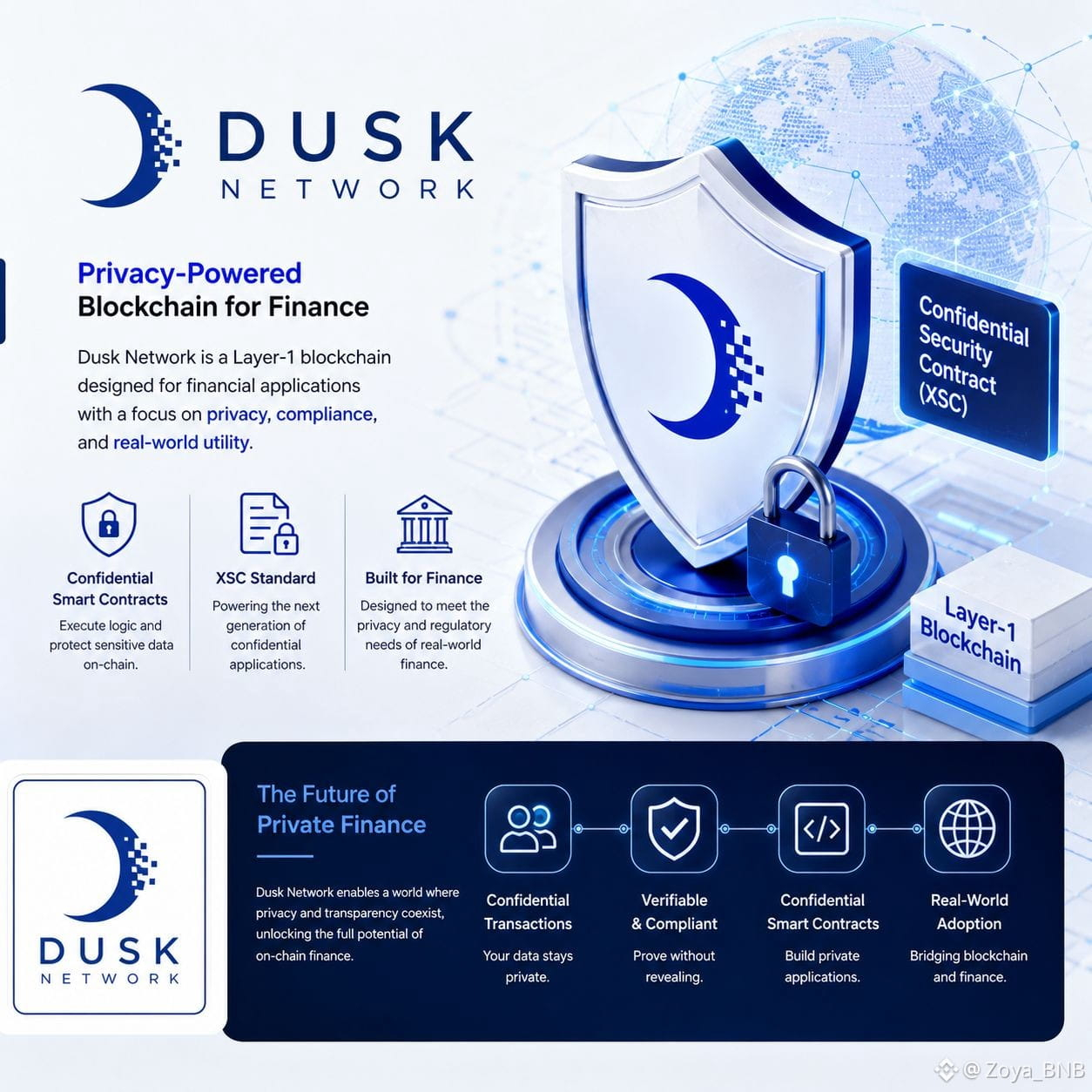
#dusk Dusk Network: The Privacy Problem We Keep UnderestimatingI've been thinking about how much of blockchain infrastructure was built around transparency, yet finance often depends on the opposite. Businesses need privacy, institutions need confidentiality, and users don't necessarily want every transaction or financial detail exposed forever. So where does that leave public blockchains?
I used to think transparency was almost always an advantage. But that view feels incomplete now. Transparency can create trust, yet unlimited visibility can also become a barrier to real-world adoption.
That's where $DUSK Network caught my attention. Instead of treating privacy as an optional feature, it is building a Layer-1 focused on financial applications, with confidential smart contracts and its Confidential Security Contract standard.
The idea is simple: can financial activity remain verifiable without exposing everything publicly?
That question matters because future blockchain adoption may depend less on speculation and more on whether sensitive assets and financial processes can actually operate on-chain.
But the hard part isn't the concept. Can $DUSK deliver reliable infrastructure, attract developers, satisfy real financial requirements, and make privacy practical without creating unnecessary complexity?
I've learned that good architecture means little without adoption. Dusk's bigger question isn't whether privacy sounds valuable. It's whether blockchain can become useful for finance without forcing confidentiality to disappear.
@Dusk_Foundation #dusk. $DUSK
{future}(DUSKUSDT)
#dusk Dusk Network: The Privacy Problem We Keep UnderestimatingI've been thinking about how much of blockchain infrastructure was built around transparency, yet finance often depends on the opposite. Businesses need privacy, institutions need confidentiality, and users don't necessarily want every transaction or financial detail exposed forever. So where does that leave public blockchains?
I used to think transparency was almost always an advantage. But that view feels incomplete now. Transparency can create trust, yet unlimited visibility can also become a barrier to real-world adoption.
That's where $DUSK Network caught my attention. Instead of treating privacy as an optional feature, it is building a Layer-1 focused on financial applications, with confidential smart contracts and its Confidential Security Contract standard.
The idea is simple: can financial activity remain verifiable without exposing everything publicly?
That question matters because future blockchain adoption may depend less on speculation and more on whether sensitive assets and financial processes can actually operate on-chain.
But the hard part isn't the concept. Can $DUSK deliver reliable infrastructure, attract developers, satisfy real financial requirements, and make privacy practical without creating unnecessary complexity?
I've learned that good architecture means little without adoption. Dusk's bigger question isn't whether privacy sounds valuable. It's whether blockchain can become useful for finance without forcing confidentiality to disappear.
@Dusk #dusk. $DUSK
I used to think transparency was almost always an advantage. But that view feels incomplete now. Transparency can create trust, yet unlimited visibility can also become a barrier to real-world adoption.
That's where $DUSK Network caught my attention. Instead of treating privacy as an optional feature, it is building a Layer-1 focused on financial applications, with confidential smart contracts and its Confidential Security Contract standard.
The idea is simple: can financial activity remain verifiable without exposing everything publicly?
That question matters because future blockchain adoption may depend less on speculation and more on whether sensitive assets and financial processes can actually operate on-chain.
But the hard part isn't the concept. Can $DUSK deliver reliable infrastructure, attract developers, satisfy real financial requirements, and make privacy practical without creating unnecessary complexity?
I've learned that good architecture means little without adoption. Dusk's bigger question isn't whether privacy sounds valuable. It's whether blockchain can become useful for finance without forcing confidentiality to disappear.
@Dusk #dusk. $DUSK
3
10
151
·
--
Bullish
#dusk
Dusk Network: The Bigger Problem Behind Private FinanceI've been thinking about something the blockchain industry often avoids: financial data is becoming increasingly digital, but privacy still feels like an afterthought. We want transparency, yet do we really want every financial action permanently visible?
I used to think transparency was always the answer. More data meant more trust, or so I assumed. But that view now feels incomplete. Financial institutions need verification without necessarily exposing sensitive information to everyone.
That is what made $DUSK Network interesting to me. Rather than treating privacy as a feature added later, it is building a Layer-1 focused on financial applications, with confidential smart contracts and its Confidential Security Contract standard.
The idea is simple: can blockchain provide trustworthy financial infrastructure without forcing sensitive information into the open?
The potential is meaningful, but the hard part is execution. Will developers actually build on it? Will institutions trust the infrastructure? Can privacy coexist with compliance and real-world regulation?
These questions matter more than any narrative around the project. $DUSK Network fits into a larger shift toward programmable, compliant, privacy-aware finance. But ultimately, its success depends on whether it can turn that idea into useful infrastructure people genuinely adopt.
The bigger question isn't about hype or price. It's whether financial transparency and financial privacy can finally coexist.
@Dusk_Foundation #Dusk. $DUSK
{future}(DUSKUSDT)
#dusk
Dusk Network: The Bigger Problem Behind Private FinanceI've been thinking about something the blockchain industry often avoids: financial data is becoming increasingly digital, but privacy still feels like an afterthought. We want transparency, yet do we really want every financial action permanently visible?
I used to think transparency was always the answer. More data meant more trust, or so I assumed. But that view now feels incomplete. Financial institutions need verification without necessarily exposing sensitive information to everyone.
That is what made $DUSK Network interesting to me. Rather than treating privacy as a feature added later, it is building a Layer-1 focused on financial applications, with confidential smart contracts and its Confidential Security Contract standard.
The idea is simple: can blockchain provide trustworthy financial infrastructure without forcing sensitive information into the open?
The potential is meaningful, but the hard part is execution. Will developers actually build on it? Will institutions trust the infrastructure? Can privacy coexist with compliance and real-world regulation?
These questions matter more than any narrative around the project. $DUSK Network fits into a larger shift toward programmable, compliant, privacy-aware finance. But ultimately, its success depends on whether it can turn that idea into useful infrastructure people genuinely adopt.
The bigger question isn't about hype or price. It's whether financial transparency and financial privacy can finally coexist.
@Dusk #Dusk. $DUSK
Dusk Network: The Bigger Problem Behind Private FinanceI've been thinking about something the blockchain industry often avoids: financial data is becoming increasingly digital, but privacy still feels like an afterthought. We want transparency, yet do we really want every financial action permanently visible?
I used to think transparency was always the answer. More data meant more trust, or so I assumed. But that view now feels incomplete. Financial institutions need verification without necessarily exposing sensitive information to everyone.
That is what made $DUSK Network interesting to me. Rather than treating privacy as a feature added later, it is building a Layer-1 focused on financial applications, with confidential smart contracts and its Confidential Security Contract standard.
The idea is simple: can blockchain provide trustworthy financial infrastructure without forcing sensitive information into the open?
The potential is meaningful, but the hard part is execution. Will developers actually build on it? Will institutions trust the infrastructure? Can privacy coexist with compliance and real-world regulation?
These questions matter more than any narrative around the project. $DUSK Network fits into a larger shift toward programmable, compliant, privacy-aware finance. But ultimately, its success depends on whether it can turn that idea into useful infrastructure people genuinely adopt.
The bigger question isn't about hype or price. It's whether financial transparency and financial privacy can finally coexist.
@Dusk #Dusk. $DUSK
7
10
158
Log in to explore more content
Join global crypto users on Binance Square
⚡️ Get latest and useful information about crypto.
💬 Trusted by the world’s largest crypto exchange.
👍 Discover real insights from verified creators.
Email / Phone number
Trending Topics
AppleDebutsFoldablePhone
0 views
9 Discussing
#AppleDebutsFoldablePhone
🍎 Apple just unfolded a new chapter. 📱🔥
Foldable phones aren’t new…
But when Apple enters the game, the entire market starts watching. 👀
This isn’t just another iPhone launch —
it’s a signal that foldables could be the next major smartphone battleground. ⚡
Now I’m curious…
Will Apple redefine foldables, or simply join the race? 🤔
$AAPL.US $ZEC $BULLA
#Apple #iPhone #Tech #Innovation
Shourov Saha-01
·1 Likes
·22 views
US10YTreasuryYieldHitsHighestSinceNov2023
2,292 views
93 Discussing
USTreasuryToBuyBackUpTo$6BLongDatedDebt
8,205 views
124 Discussing