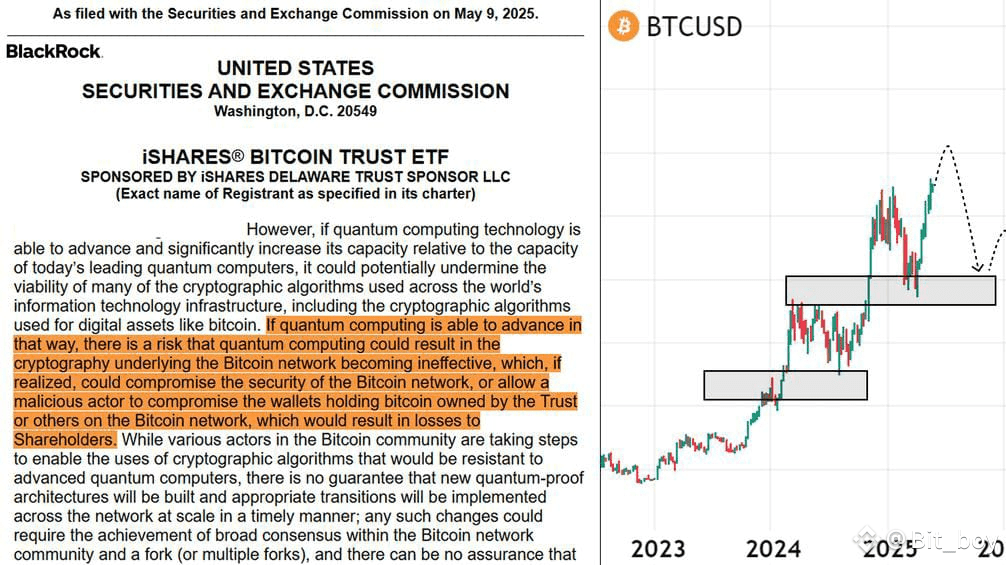
🚨BlackRock: BTC will be compromised and dumped to $40k!
Development of quantum computing might kill the Bitcoin network I researched all the data and learn everything about it. /➮ Recently, BlackRock warned us about potential risks to the Bitcoin network 🕷 All due to the rapid progress in the field of quantum computing. 🕷 I’ll add their report at the end - but for now, let’s break down what this actually means. /➮ Bitcoin's security relies on cryptographic algorithms, mainly ECDSA 🕷 It safeguards private keys and ensures transaction integrity 🕷 Quantum computers, leveraging algorithms like Shor's algorithm, could potentially break ECDSA /➮ How? By efficiently solving complex mathematical problems that are currently infeasible for classical computers 🕷 This will would allow malicious actors to derive private keys from public keys Compromising wallet security and transaction authenticity /➮ So BlackRock warns that such a development might enable attackers to compromise wallets and transactions 🕷 Which would lead to potential losses for investors 🕷 But when will this happen and how can we protect ourselves? /➮ Quantum computers capable of breaking Bitcoin's cryptography are not yet operational 🕷 Experts estimate that such capabilities could emerge within 5-7 yeards 🕷 Currently, 25% of BTC is stored in addresses that are vulnerable to quantum attacks /➮ But it's not all bad - the Bitcoin community and the broader cryptocurrency ecosystem are already exploring several strategies: - Post-Quantum Cryptography - Wallet Security Enhancements - Network Upgrades /➮ However, if a solution is not found in time, it could seriously undermine trust in digital assets 🕷 Which in turn could reduce demand for BTC and crypto in general 🕷 And the current outlook isn't too optimistic - here's why: /➮ Google has stated that breaking RSA encryption (tech also used to secure crypto wallets) 🕷 Would require 20x fewer quantum resources than previously expected 🕷 That means we may simply not have enough time to solve the problem before it becomes critical /➮ For now, I believe the most effective step is encouraging users to transfer funds to addresses with enhanced security, 🕷 Such as Pay-to-Public-Key-Hash (P2PKH) addresses, which do not expose public keys until a transaction is made 🕷 Don’t rush to sell all your BTC or move it off wallets - there is still time 🕷 But it's important to keep an eye on this issue and the progress on solutions Report: sec.gov/Archives/edgar… ➮ Give some love and support 🕷 Follow for even more excitement! 🕷 Remember to like, retweet, and drop a comment. #TrumpMediaBitcoinTreasury #Bitcoin2025 $BTC
Mastering Candlestick Patterns: A Key to Unlocking $1000 a Month in Trading_
Candlestick patterns are a powerful tool in technical analysis, offering insights into market sentiment and potential price movements. By recognizing and interpreting these patterns, traders can make informed decisions and increase their chances of success. In this article, we'll explore 20 essential candlestick patterns, providing a comprehensive guide to help you enhance your trading strategy and potentially earn $1000 a month. Understanding Candlestick Patterns Before diving into the patterns, it's essential to understand the basics of candlestick charts. Each candle represents a specific time frame, displaying the open, high, low, and close prices. The body of the candle shows the price movement, while the wicks indicate the high and low prices. The 20 Candlestick Patterns 1. Doji: A candle with a small body and long wicks, indicating indecision and potential reversal. 2. Hammer: A bullish reversal pattern with a small body at the top and a long lower wick. 3. Hanging Man: A bearish reversal pattern with a small body at the bottom and a long upper wick. 4. Engulfing Pattern: A two-candle pattern where the second candle engulfs the first, indicating a potential reversal. 5. Piercing Line: A bullish reversal pattern where the second candle opens below the first and closes above its midpoint. 6. Dark Cloud Cover: A bearish reversal pattern where the second candle opens above the first and closes below its midpoint. 7. Morning Star: A three-candle pattern indicating a bullish reversal. 8. Evening Star: A three-candle pattern indicating a bearish reversal. 9. Shooting Star: A bearish reversal pattern with a small body at the bottom and a long upper wick. 10. Inverted Hammer: A bullish reversal pattern with a small body at the top and a long lower wick. 11. Bullish Harami: A two-candle pattern indicating a potential bullish reversal. 12. Bearish Harami: A two-candle pattern indicating a potential bearish reversal. 13. Tweezer Top: A two-candle pattern indicating a potential bearish reversal. 14. Tweezer Bottom: A two-candle pattern indicating a potential bullish reversal. 15. Three White Soldiers: A bullish reversal pattern with three consecutive long-bodied candles. 16. Three Black Crows: A bearish reversal pattern with three consecutive long-bodied candles. 17. Rising Three Methods: A continuation pattern indicating a bullish trend. 18. Falling Three Methods: A continuation pattern indicating a bearish trend. 19. Marubozu: A candle with no wicks and a full-bodied appearance, indicating strong market momentum. 20. Belt Hold Line: A single candle pattern indicating a potential reversal or continuation. Applying Candlestick Patterns in Trading To effectively use these patterns, it's essential to: - Understand the context in which they appear - Combine them with other technical analysis tools - Practice and backtest to develop a deep understanding By mastering these 20 candlestick patterns, you'll be well on your way to enhancing your trading strategy and potentially earning $1000 a month. Remember to stay disciplined, patient, and informed to achieve success in the markets. #CandleStickPatterns #tradingStrategy #TechnicalAnalysis #DayTradingTips #tradingforbeginners
How Plasma Is Rethinking Stablecoins as Everyday Money
When I look at Plasma, I don’t really see it as “another Layer 1.” It makes more sense to me if I think of it as payment infrastructure that just happens to be a blockchain. The whole design feels like it starts from one simple reality: stablecoins are already being used as money, but the networks they run on were never built for everyday payments. Fees fluctuate, blocks get congested, and users are forced to hold a separate gas token just to move what is supposed to be digital dollars. At that point, it stops feeling like money and starts feeling like a workaround. Plasma tries to reverse that logic. It treats stablecoin settlement as the default use case and then builds everything else around it. Yes, it’s EVM compatible and uses a Reth-based execution client, so builders don’t have to relearn their entire stack. But what stands out to me is that Plasma doesn’t stop at compatibility. It looks directly at the annoying, boring parts of payments and actually redesigns them instead of pushing them onto wallets or third-party tools. The fee model is a good example. Instead of telling every new user to first buy XPL just to send USD₮, Plasma documents a way to make stablecoin transfers gasless through a relayer and paymaster system. In practice, that means a user can send USD₮ without holding XPL, because the transaction is sponsored at the protocol level. What I like is that it’s not framed as some unlimited giveaway. It’s clearly scoped to direct USD₮ transfers, comes with controls and rate limits, and the gas is covered upfront when the sponsorship happens. That turns “gasless transfers” into a designed feature, not a temporary growth trick. This matters a lot once you imagine real usage. If I’m running a shop, paying staff, or sending money to family, I don’t want to manage an extra asset just to cover fees. I just want the value to move, quickly and predictably. Plasma’s approach feels closer to how payment rails are supposed to work, where the user experience revolves around the currency being sent, not the mechanics underneath it. Speed and finality are the other big pieces. Plasma doesn’t just say “fast blocks” and move on. It talks openly about PlasmaBFT, a Rust-based, pipelined implementation of Fast HotStuff. The point isn’t marketing jargon, it’s deterministic finality. For payments, knowing that a transaction is final, and knowing it quickly, is everything. You don’t want to wait around hoping a payment won’t get reversed. Plasma is clearly trying to make fast, reliable settlement the normal state, even when the network is busy. Liquidity is where I’ve seen a lot of payment-focused chains fall apart, and Plasma seems very aware of that risk. A payments rail without deep liquidity just feels empty and expensive to use. Plasma’s messaging around launch has been centered on avoiding that trap, with expectations of large amounts of stablecoins active from the start and partnerships aimed at making the network usable immediately. Whether someone cares about DeFi labels or not, the underlying idea makes sense to me: a settlement network should feel alive on day one, not like a ghost town waiting for adoption. Another part that stands out is that Plasma doesn’t act like its job ends at “chain plus token.” Payments in the real world are messy. They involve licenses, compliance, and integration with existing systems. Plasma has openly talked about acquiring licensed entities, expanding compliance operations, and preparing for regulatory frameworks like MiCA. That stuff isn’t exciting, but it’s often what decides whether a payments system can actually scale beyond crypto-native users. If I had to describe Plasma in one line, I’d say it’s an EVM Layer 1 that wants stablecoin transfers to be the product, not just one application among many. When you build from that mindset, you naturally start optimizing for things like predictable costs, fast finality, stablecoin-native fees, and a smoother path for users who just want to move money. Even the way XPL is described fits that picture. The documentation around validator rewards and inflation reads more like a phased plan than a hype pitch. Inflation starts higher, decreases over time, and only activates fully when external validators and delegation go live. Locked allocations don’t earn unlocked rewards. To me, that signals an attempt to be honest about how the network evolves instead of pretending everything is perfectly decentralized from day one. What comes next feels like a continuation of the same priorities: refining the stablecoin-native features, keeping the paymaster model usable without letting it be abused, expanding validator participation, and deepening real-world payment integrations through licensing. Plasma doesn’t need to win every narrative in crypto. If it succeeds at one simple thing, making stablecoins move quickly and cheaply in real life, over and over again, at scale, that’s enough. Even looking at short term activity, the chain behavior lines up with that goal. High transaction counts, steady block production, and consistent usage are exactly the kind of signals you want from something positioning itself as a payments rail. Whether someone cares about the token price or not, the more important question for me is simple: does the network behave like money infrastructure? Plasma looks like it’s at least trying to answer that honestly. @Plasma #Plasma $XPL
Hard to ignore what @Plasma is doing with stablecoin-native UX. We’ve all been there—trying to send USDT but realizing you don’t have the native gas token to pay for the transfer.
$XPL fixing this with gasless transfers and the ability to pay fees directly in stables is a massive win for actual retail adoption.
Plus, sub-second finality makes it feel like a real payment rail, not just another slow ledger. Definitely keeping this on my radar for high volume payments.
Dusk Protocol and the Case for Privacy by Default in a Regulated World
When I look at Dusk Protocol, I keep thinking about how much of blockchain’s “transparency” problem is actually self-inflicted. For years we’ve treated total openness as a virtue in itself, without asking who it really serves. On most chains, every transaction is a live broadcast. Anyone can trace balances, histories, and relationships just by following addresses. That might sound fine in theory, but in practice it’s a nightmare for real businesses and institutions. If I’m a company, I don’t want competitors mapping my treasury. If I’m being audited, I don’t want every single transaction I’ve ever made exposed to the entire internet. And if I’m an individual, I don’t think financial privacy should be treated as suspicious by default. This is one of the main reasons so many enterprises quietly stayed away from public blockchains, even while praising the tech. What Dusk does differently is refuse to accept that privacy and compliance are opposites. It builds privacy in by default using zero-knowledge proofs, so transactions can be validated without revealing who sent what to whom. The system still knows the rules were followed, but it doesn’t force everyone to expose their entire financial life just to participate. That alone already feels more aligned with how finance works in the real world. Where it gets interesting is the compliance side. Instead of making everything public “just in case,” Dusk uses view keys. If I need to prove something to a regulator, an auditor, or another authorized party, I can selectively reveal the necessary details. Not more, not less. Privacy stays intact, but compliance is available on demand. That shift in control matters. It turns regulation into a deliberate act, not a permanent leak. This isn’t just a whitepaper idea either. Seeing NPEX tokenize hundreds of millions of euros in securities on Dusk tells me there’s real institutional demand for this model. These are not teams chasing narratives. They’re solving practical problems around confidentiality, audits, and legal responsibility. To me, the bigger takeaway is what this says about where blockchain is heading. Early on, we acted like full transparency was morally superior and privacy was something you had to justify. But as the technology grows up, that mindset starts to break. Businesses need confidentiality. People deserve financial privacy. And regulators still need oversight. Pretending one of these doesn’t matter just slows adoption. Whether Dusk ends up being the dominant player or not, the approach feels like a sign of maturity. It shows that the choice was never really transparency or compliance, privacy or regulation. That was a false dilemma. The projects that figure out how to balance all of it, instead of shouting about one extreme, are probably the ones that will carry blockchain into its next phase. @Dusk #dusk #Dusk $DUSK
Mainnet launches are usually the finish line for hype, but for $DUSK , it feels like the actual starting gun.
After years of being an "idea," it’s now a production chain where the only thing that matters is: Is anyone actually building on it?
I’m noticing a shift away from the flashy announcements toward things like dev tooling and compliance documentation.
It’s not the most "exciting" stuff to talk about on a timeline, but in a post-MiCA world, seeing them focus on "boring" ecosystem stability is actually a huge green flag for survival.
When I look at Vanar, it doesn’t feel like a chain that’s trying to win attention by being flashy. It feels like a chain that’s deliberately aiming at a boring but very real problem: how do you make Web3 stable and predictable enough that real products can actually live on it? That difference is usually what separates chains that stay inside crypto culture from ones that quietly end up powering consumer apps. What stands out to me is how clearly Vanar positions itself around real-world teams, especially gaming studios, entertainment companies, and brands that already ship products to millions of users. On the surface, that sounds like standard “mainstream adoption” talk. But when you dig into the design choices they keep emphasizing, it starts to feel more concrete. Predictable fees, familiar tooling, and a focus on making data and logic genuinely useful on-chain instead of dumping everything into off-chain systems are not exciting features, but they’re the ones that make or break real products. I also notice that Vanar doesn’t present the chain as the end product. They talk about it as the base of a broader intelligent stack. The idea seems to be that the blockchain handles settlement and state, while higher layers deal with memory, reasoning, and automation. That resonates with me, because most real applications don’t fail due to slow transactions. They fail because data gets fragmented, workflows become impossible to maintain, compliance logic lives in spreadsheets, and everything turns into glue code. Vanar’s approach feels like an attempt to make those missing layers native instead of improvised. The fee model is a good example of that mindset. Vanar talks openly about anchoring fees to USD value rather than letting users experience wild swings just because the gas token price moved. From what they describe, the foundation calculates the token’s market price using multiple data sources and feeds that into the protocol so fees stay relatively consistent. That may not sound revolutionary, but if you’ve ever tried to run a consumer app on a chain with volatile fees, you know how important predictability really is. The more interesting shift, at least to me, is Vanar’s push toward an AI-native stack. They describe multiple layers, starting with the chain itself, then moving into semantic memory, reasoning, automation, and eventually industry-specific flows. Neutron, their semantic memory layer, is positioned as a way to turn raw files into compressed, verifiable on-chain “Seeds.” The ambition is clear: data shouldn’t just be stored, it should be understandable, searchable, and usable by applications and agents. Whether that works perfectly at scale is still something to prove, but the direction is very intentional. On top of that, Kayon is described as the reasoning layer that can query those data objects using natural language and apply logic and compliance-style rules. I don’t read this as “AI hype” so much as an attempt to close a gap that’s always existed on-chain. Ledgers are good at recording events, but terrible at understanding context. Vanar seems to be trying to bring meaning and decision-making closer to the chain itself. When I put it all together, it feels like Vanar is aiming for a world where data, meaning, and logic live in the same system. That’s exactly what you need if you’re serious about things like payment workflows, tokenized real-world assets, or enterprise use cases. Those systems don’t just need transactions. They need documents, conditions, audits, and rules that can be enforced without everything breaking down into off-chain chaos. Even the way VANRY is described in the whitepaper feels unusually structured. The max supply, long emission schedule, and emphasis on validator rewards over decades reads like a plan for sustainability rather than a short-term token story. The choice to start with a more controlled validator setup and gradually expand participation also signals a preference for stability over ideology, at least in the early phases. If I had to sum up where Vanar sits, I’d say it’s competing in a crowded L1 space by focusing on something most chains avoid explaining: how real workflows actually run. Documents, logic, compliance, automation, and predictable costs are not glamorous topics, but they’re the ones that decide whether a chain becomes infrastructure or just another experiment. Looking at the recent market data, VANRY is clearly having an active trading period with some short-term pressure. That’s normal, and honestly not the most interesting signal to me. What matters more is whether the stack they’re building keeps moving from diagrams to usable systems. If Vanar executes on even part of this vision, it won’t need to shout. It will just sit underneath products people use every day, quietly doing its job. @Vanarchain #vanar $VANRY
While everyone is chasing the next narrative, $VANRY is quietly shipping a full AI-native stack.
We’ve moved past the "announcement" phase—products like myNeutron are live, and the V23 protocol upgrade just solidified the network for scale.
The cross-chain expansion to Base is a smart move for liquidity, but the real alpha is how they’re positioning for "PayFi." Imagine AI agents transacting globally, settling on-chain, and reasoning through compliance rules automatically. That’s a huge leap from where we were a year ago.
Walrus and the Case for Treating Data Availability as Real Infrastructure
I keep coming back to the same conclusion when I look at Walrus: in real products, data is still the product. Once you build anything that real users actually touch, you learn a harsh rule very fast. People can forgive bugs. They do not forgive missing history. A dApp can settle transactions perfectly and still feel broken if images don’t load, charts disappear, receipts can’t be fetched, or a proof link suddenly returns a 404. That isn’t a blockspace issue. It’s a retention issue. Walrus seems to start exactly from that failure mode. Users don’t leave because a chain ran out of throughput. They leave because the app stops being reliable. What’s interesting is that Walrus doesn’t try to be “just a file server for a base chain.” Heavy data lives as blobs in its own storage network, while Sui is used as a coordination layer that records the moment Walrus officially accepts responsibility for a blob. That moment, the Point of Availability, is not a promise or a vibe. It’s an onchain event the app can point to. Before that point, the client is responsible. After it, the protocol is. That boundary matters more than people think. Data only feels permanent in real systems when custody is clear. Without custody, storage is just hope. Walrus makes that custody explicit, and observable, instead of hand-waving it away. Another thing I like is that Walrus is honest about time. Storage isn’t sold as “forever.” It’s purchased over a defined number of epochs. On mainnet, epochs are two weeks long, and there’s a visible limit to how long storage can be extended. That might look like a constraint, but it actually forces the system to surface the real cost of duration and renewal. Long-term liabilities aren’t hidden behind the word permanent. That’s how infrastructure stays credible over years, not months. The financial design follows the same logic. PoA isn’t just a certificate for users, it’s the start of an ongoing obligation for storage nodes. Nodes have to stake WAL, and rewards are tied to correct behavior over time, not just showing up once. The goal is simple: make it irrational for providers to take the money and quietly disappear. Availability becomes a matter of alignment, not goodwill. When I think about Walrus, I don’t see “blob storage” as the feature. The real feature is that an app can treat data availability as a reliable primitive. Builders don’t want inspirational decentralization. They want fewer ways their product can silently fail. Walrus is trying to remove one of the most common and least visible failure modes: data that exists until, one day, it doesn’t, because some offchain dependency changed its policy, pricing, or uptime. There are risks, and they’re not hidden. Retention systems don’t usually fail loudly. Node participation, renewal behavior, and the boring consistency of PoA-based custody over time are the things that actually matter. There’s also shared coordination risk with Sui, since PoA and lifecycle visibility live there. If the control plane degrades, the storage network can keep running, but enforcing guarantees becomes messier. None of that breaks the model. It just tells you what to watch. In the end, I don’t think the real bet Walrus is making is that people want decentralized storage. The bet is that builders are tired of losing users because information disappears. If Walrus holds up when conditions get stressful, it fades into the background. And that’s the point. The best infrastructure isn’t loud. It’s invisible. @Walrus 🦭/acc #walrus $WAL
Think about the sheer scale of 250 terabytes. That’s years of Team Liquid’s history—match clips, raw footage, and brand archives—now sitting on @Walrus 🦭/acc
Moving away from physical silos and "dusty" servers into a decentralized, on-chain archive isn't just a tech flex; it’s about making that data actually usable and global.
Seeing a major esports org lead the charge on decentralized storage shows that $WAL is ready for the heavy lifting. The era of static files is ending—the era of programmable assets is here.
Why Dusk’s Native Bridge Isn’t Just Infrastructure, it’s the Protocol
When people hear “native bridge,” they often think of it as just another nice-to-have feature. I used to think that too, but on Dusk it’s absolutely central. The bridge isn’t optional; it’s part of the protocol’s backbone. The idea is simple: one asset, one security model, one economic system across all three layers. There’s no wrapping, no custodians, no synthetic tokens pretending to be neutral. Wrapped assets are convenient in theory, but in reality, they create risk. Custodial exposure, legal ambiguity, extra attack surfaces—these problems only become obvious when something goes wrong. Dusk avoids all of that. The DUSK you stake on DuskDS is the same DUSK you use on DuskEVM or DuskVM. The bridge doesn’t lock your tokens and mint IOUs elsewhere. Value moves directly inside the protocol. That matters because most bridge exploits happen when wrapping is involved. Remove the wrapping, and you remove a whole class of failure points. The bridge is validator-run and built into the protocol itself. It’s not outsourced, there’s no multisig committee, no “temporary admin keys” left around forever. If you trust the chain, you trust the bridge. If the chain fails, everything fails together. That symmetry isn’t a bug—it’s intentional. What I really like is how this keeps things simple for users. DUSK does different jobs across layers without fragmenting the economy. On DuskDS, it secures the network through staking and governance. On DuskEVM, it’s gas for contracts and exchanges. On DuskVM, it pays for privacy-preserving computations. Different roles, one token, one supply. No internal competition, no dilution. From my experience, the complexity stays inside the protocol, not on me as a user. I don’t have to rebalance or migrate manually. My balances stay the same, but I get access to new layers automatically. Even migration from ERC-20 and BEP-20 DUSK into the native environment is seamless—it’s cleanup, not a growth hack. Bridges have historically been the most exploited component in crypto. That’s because they sit between systems with different rules and ask users to trust the glue code. Dusk removes that problem entirely. If you’re building regulated markets, custody-compliant systems, or privacy-sensitive apps, wrapped assets and external bridges aren’t acceptable. Institutions won’t tolerate them, and regulators won’t approve them. This native bridge isn’t flashy or trendy. It’s boring, conservative, and correct. And honestly, those are the kinds of infrastructure decisions that only get fully appreciated after the flashy alternatives fail. @Dusk #Dusk $DUSK #dusk
Most blockchains try to solve everything in one layer and then wonder why everything ends up slow, expensive, or broken. I like what Dusk did instead. They split the protocol into three layers—not to look fancy, but because regulated finance doesn’t tolerate shortcuts. This three layer setup isn’t decoration. It’s how Dusk keeps integration costs low, scales safely, and stays compliant without duct tape. DuskDS is where finality actually happens. It’s the base layer, doing the boring but critical work: consensus, staking, data availability, native bridging, settlement. This is where the network decides what’s final and what isn’t. Unlike optimistic rollups that make you wait days and hope nobody challenges the state, DuskDS verifies everything upfront. A pre-verifier powered by MIPS checks validity before anything is written. Once something settles here, it’s really settled. Traders, institutions, and regulated markets need that certainty. To keep nodes accessible, DuskDS doesn’t store heavy execution state, it keeps compact validity proofs and lets execution happen higher up. DUSK is used here for staking, governance, and settlement. This is where security lives. DuskEVM is where developers actually show up. Let’s be honest, Ethereum tooling dominates. Fighting that reality is pointless. DuskEVM lets developers deploy standard Solidity contracts with tools like Hardhat and MetaMask. That makes life easier and avoids the “empty ecosystem” problem many chains face. But it’s not just a copy of Ethereum. DuskEVM integrates Hedger, which adds auditable confidentiality directly into execution using zero-knowledge proofs and homomorphic encryption. That enables things normal EVM chains can’t do: obfuscated order books, confidential transactions, private strategies, all while staying auditable. Institutions can use familiar contracts without exposing sensitive data. Here, DUSK is used as gas—real usage driving real demand. DuskVM is where privacy goes all the way. This layer isn’t familiar to most people, but it’s where applications that cannot compromise live. While DuskEVM adds privacy in an account-based model, DuskVM is full privacy by design. It uses a UTXO-based Phoenix transaction model optimized for anonymity and a virtual machine called Piecrust. Piecrust already exists inside DuskDS, but separating it makes deep privacy logic more efficient. This is where advanced cryptographic applications live—not DeFi clones, but systems that need strong privacy by default. DUSK is used as gas here too, so all economic activity flows in the same system. All three layers are connected by a trustless native bridge. DUSK moves between them without wrapping or custodians, which removes a huge class of risk and legal ambiguity. One token flows across the whole stack, unifying security, governance, and economic activity instead of fragmenting value. It’s not flashy, but it’s clean, and that matters over the long term. From the outside, this setup might look slow or heavy. That’s true. But regulated systems can’t afford shortcuts. Each layer solves a specific problem without interfering with the others. Most chains collapse because everything is tangled together—break one part and the whole thing breaks. Dusk avoids that. I think this is exactly why Dusk feels slow but also why it might last. It’s not overengineering—it’s defensive engineering. Every layer exists because something breaks without it. Most crypto stacks are built to look simple. Dusk is built to behave correctly under real-world pressure. People will keep calling it complex until simple systems fail in real markets, and then suddenly this design will feel obvious. @Dusk #dusk #Dusk $DUSK
How Dusk Makes Privacy and Compliance Work Together Without Compromise
Most crypto projects love to pretend you have to choose: privacy or regulation, freedom or law, anonymity or adoption. I’ve seen it play out too many times—projects pick a side loudly, then act surprised when the other side blocks them forever. Dusk doesn’t play that game. They treat privacy and compliance as engineering problems, not ideological battles. And that’s exactly why it feels different. It doesn’t try to please the maximalists on either side, which is usually where serious infrastructure actually lives. Dusk handles privacy through math, not secrecy. Most systems just hide everything and hope nobody asks questions. That breaks the moment serious money shows up. Dusk uses zero-knowledge proofs so transactions can be verified without revealing sensitive data. Balances, fees, and ownership are checked mathematically without putting identities or amounts on a public ledger. Inside the EVM layer, Hedger combines zero-knowledge proofs with homomorphic encryption. Smart contracts can operate on encrypted data—update balances, execute logic, enforce rules—without ever seeing the raw values. It’s expensive, complex, and slow to build, which is why most chains don’t bother. What I find really smart is selective auditability. Dusk separates public transparency from regulatory verification. Regulators can verify compliance with cryptographic attestations without ever getting raw data dumps. The public sees nothing sensitive, competitors see nothing sensitive, but compliance still exists. Compliance is enforced by math, not by paperwork. Rules like transfer restrictions, KYC checks, or eligibility conditions are built directly into smart contracts. If a transaction breaks the rules, it simply doesn’t execute—no discretion, no human override. Dusk also doesn’t force everything into one transaction model. It runs dual systems depending on what the application needs. Phoenix is the private model, UTXO-based and optimized for confidentiality—perfect for institutional settlement and private trading. Moonlight is transparent, account-based, similar to Ethereum, for public tokens and simple transfers. Developers can pick the right tool for their use case, and the protocol doesn’t pretend one size fits all. That flexibility matters more than people realize. They also solve institutional problems most chains ignore. Obfuscated order books, for example, hide intent and exposure so institutions can operate safely without front-running risks. Dusk built the Confidential Security Contract standard for tokenized securities, allowing dividends, governance, and asset management in a private, compliant environment. This isn’t DeFi experimentation—it’s real market infrastructure. Through partnerships like NPEX, Dusk enables one-time KYC across the network. Users verify themselves once and operate without repeated intrusions. That’s huge for UX and data protection. Constant KYC is frustrating and leaks information; cryptographically enforced, one-time verification works the way institutions actually need it. Dusk isn’t Monero or Zcash. It’s not trying to escape oversight. It’s making oversight compatible with privacy. That difference is massive. Privacy here is functional, not ideological. It protects commercial secrets, personal data, and market integrity while still respecting the law. It’s boring, yes, but it works in the real world. I think Dusk is doing the kind of privacy that nobody cheers for until it becomes unavoidable. This isn’t rebellious privacy. It’s professional privacy—the kind institutions demand and regulators tolerate. Most privacy projects will never build that bridge. Dusk already did it, quietly and deliberately. If on-chain finance grows up, this approach is the one that actually lasts—not fast, not flashy, but permanent.
The tension between privacy and regulation has always been a hurdle for DeFi, but @Dusk hybrid approach is a massive step forward.
By running the Phoenix model for total confidentiality alongside Moonlight for auditable transparency, they’ve built a system where privacy isn't an obstacle to compliance.
It’s exactly the kind of nuanced tech needed to bring traditional financial ecosystems on-chain.
Zero-knowledge tech is the secret sauce for @Dusk 🤫 Their framework lets you verify ownership and compliance without actually revealing the underlying data.
It's basically "trust, but don't show"—which is exactly what regulated finance needs to finally go mainstream.
I like that Walrus doesn’t cut corners on consistency. By relying on quorums of storage nodes, it ensures data operations aren’t dependent on any single point of failure.
This lets the network remain resilient, resist attacks, and stay online even during partial outages or reconfigurations.
Moving large amounts of encoded data is no small feat, but Walrus carefully preserves availability and performance while doing it.
That’s the kind of engineering that inspires confidence.
I appreciate Walrus because it’s practical. It doesn’t insist on total privacy or total openness.
It understands that real systems operate in balance: some information must be visible, some must remain protected. Using privacy as a tool, Walrus ensures data integrity and availability without pretending it has to be perfect. That’s how trust is earned, in my view.
The choice to build on Sui makes sense here. Sui emphasizes performance and predictable behavior, and Walrus extends that to storage. Large files are stored using blobs and erasure coding, keeping the system resilient and reliable.
What I like about WAL is how it ties economic identity to technical responsibility.
Staking the token isn’t just a passive action—it helps secure the network, gives a say in governance, and determines which nodes manage the data.
Those who stay active and reliable are rewarded, which makes the network stronger while aligning incentives with actual performance. That feels like a system built for sustainability, not just hype.