
137Labs Global
97 Posts

137Labs Global
Report
Block User
137Labs identifies real market needs to help users seize Web3 opportunities. We research promising projects and provide clear insights.
@137labscn
Open Trade
8 Months
3 Following
43 Followers
88 Liked
Posts
Portfolio
137 · Market Pulse ✨ 8-24
24H Market Highlights — Quick Overview
1/ Bessent announces the “largest financial offensive in history” against Iran;
2/ Anthropic reportedly plans to raise more than $100 billion through an IPO, potentially reaching a $2 trillion valuation;
3/ The Sandbox cross-chain bridge suffers an exploit, with the attacker minting approximately 14.9 billion unbacked SAND tokens;
4/ Crypto card spending surpasses $1 billion, with stablecoins emerging as the primary asset for everyday payments;
5/ A HYPE “diamond hands” holder records more than $57 million in unrealized profit after holding for 10 months;
6/ The first spot ETF application for privacy coin Zcash has been filed;
7/ The Coinbase Bitcoin Premium Index ends its record 97-day streak in negative territory;
8/ CryptoRank: ENA, PUMP, and ACE lead this week’s search trends.
137 · Market Pulse ✨ 8-24
24H Market Highlights — Quick Overview
1/ Bessent announces the “largest financial offensive in history” against Iran;
2/ Anthropic reportedly plans to raise more than $100 billion through an IPO, potentially reaching a $2 trillion valuation;
3/ The Sandbox cross-chain bridge suffers an exploit, with the attacker minting approximately 14.9 billion unbacked SAND tokens;
4/ Crypto card spending surpasses $1 billion, with stablecoins emerging as the primary asset for everyday payments;
5/ A HYPE “diamond hands” holder records more than $57 million in unrealized profit after holding for 10 months;
6/ The first spot ETF application for privacy coin Zcash has been filed;
7/ The Coinbase Bitcoin Premium Index ends its record 97-day streak in negative territory;
8/ CryptoRank: ENA, PUMP, and ACE lead this week’s search trends.
24H Market Highlights — Quick Overview
1/ Bessent announces the “largest financial offensive in history” against Iran;
2/ Anthropic reportedly plans to raise more than $100 billion through an IPO, potentially reaching a $2 trillion valuation;
3/ The Sandbox cross-chain bridge suffers an exploit, with the attacker minting approximately 14.9 billion unbacked SAND tokens;
4/ Crypto card spending surpasses $1 billion, with stablecoins emerging as the primary asset for everyday payments;
5/ A HYPE “diamond hands” holder records more than $57 million in unrealized profit after holding for 10 months;
6/ The first spot ETF application for privacy coin Zcash has been filed;
7/ The Coinbase Bitcoin Premium Index ends its record 97-day streak in negative territory;
8/ CryptoRank: ENA, PUMP, and ACE lead this week’s search trends.
207
137 · Market Pulse ✨ 8-20
24H Market Highlights — Quick Overview
1. Bitcoin breaks above $70,000, triggering a historic short squeeze. The crypto market sees its largest rebound since March;
2. U.S. Treasury expands debt buyback operations, with total U.S. national debt surpassing $40 trillion;
3. U.S. regulatory updates: The OCC commits to releasing stablecoin rules in November, while the CFTC reaches a settlement with former FTX executives;
4. Coinbase launches perpetual futures trading for Base App through Hyperliquid;
5. OpenAI CFO says the company expects to go public in 2027 or earlier;
6. Japan’s July trade data exceeds expectations: imports rose 27.8% YoY and exports increased 23.2% YoY; South Korea’s kimchi premium turned negative to -1.75%;
7. Unitree Robotics surges 460% on its first day of A-share trading, pushing the founder’s net worth above RMB 100 billion. The company’s IPO price was RMB 150.80 per share, closing at RMB 845, with a market capitalization exceeding RMB 340 billion. Dubbed the “first humanoid robot stock,” Unitree attracts significant market attention;
8. Binance’s SNDK perpetual contract trading volume surpasses Bitcoin, signaling traditional assets becoming a major trading category.
137 · Market Pulse ✨ 8-20
24H Market Highlights — Quick Overview
1. Bitcoin breaks above $70,000, triggering a historic short squeeze. The crypto market sees its largest rebound since March;
2. U.S. Treasury expands debt buyback operations, with total U.S. national debt surpassing $40 trillion;
3. U.S. regulatory updates: The OCC commits to releasing stablecoin rules in November, while the CFTC reaches a settlement with former FTX executives;
4. Coinbase launches perpetual futures trading for Base App through Hyperliquid;
5. OpenAI CFO says the company expects to go public in 2027 or earlier;
6. Japan’s July trade data exceeds expectations: imports rose 27.8% YoY and exports increased 23.2% YoY; South Korea’s kimchi premium turned negative to -1.75%;
7. Unitree Robotics surges 460% on its first day of A-share trading, pushing the founder’s net worth above RMB 100 billion. The company’s IPO price was RMB 150.80 per share, closing at RMB 845, with a market capitalization exceeding RMB 340 billion. Dubbed the “first humanoid robot stock,” Unitree attracts significant market attention;
8. Binance’s SNDK perpetual contract trading volume surpasses Bitcoin, signaling traditional assets becoming a major trading category.
24H Market Highlights — Quick Overview
1. Bitcoin breaks above $70,000, triggering a historic short squeeze. The crypto market sees its largest rebound since March;
2. U.S. Treasury expands debt buyback operations, with total U.S. national debt surpassing $40 trillion;
3. U.S. regulatory updates: The OCC commits to releasing stablecoin rules in November, while the CFTC reaches a settlement with former FTX executives;
4. Coinbase launches perpetual futures trading for Base App through Hyperliquid;
5. OpenAI CFO says the company expects to go public in 2027 or earlier;
6. Japan’s July trade data exceeds expectations: imports rose 27.8% YoY and exports increased 23.2% YoY; South Korea’s kimchi premium turned negative to -1.75%;
7. Unitree Robotics surges 460% on its first day of A-share trading, pushing the founder’s net worth above RMB 100 billion. The company’s IPO price was RMB 150.80 per share, closing at RMB 845, with a market capitalization exceeding RMB 340 billion. Dubbed the “first humanoid robot stock,” Unitree attracts significant market attention;
8. Binance’s SNDK perpetual contract trading volume surpasses Bitcoin, signaling traditional assets becoming a major trading category.
318
137 · Market Pulse ✨ 8-18
24H Market Highlights — Quick Overview
1/ U.S. stocks closed broadly lower, while crypto-related equities moved against the trend. Bitcoin recovered above $64,000, with derivatives data showing crowded long positions;
2/ The 60-day U.S.-Iran negotiation window has expired. Trump stated that he is not seeking an extension, increasing regional tensions;
3/ 30-year U.S. Treasury yields hit a 19-year high, as markets raise concerns over fiscal pressures and inflation risks;
4/ Anthropic’s annualized revenue surpassed $65 billion, accelerating its IPO preparations; Payward joined its AI safety program;
5/ Robinhood Chain’s TVL increased 45% in August, while the share of tokenized RWA assets declined significantly;
6/ The tokenized stock market has tripled in market share growth, with Ondo emerging as the leading player;
7/ The AI infrastructure financing boom pushed U.S. investment-grade bond issuance to a record high for August.
137 · Market Pulse ✨ 8-18
24H Market Highlights — Quick Overview
1/ U.S. stocks closed broadly lower, while crypto-related equities moved against the trend. Bitcoin recovered above $64,000, with derivatives data showing crowded long positions;
2/ The 60-day U.S.-Iran negotiation window has expired. Trump stated that he is not seeking an extension, increasing regional tensions;
3/ 30-year U.S. Treasury yields hit a 19-year high, as markets raise concerns over fiscal pressures and inflation risks;
4/ Anthropic’s annualized revenue surpassed $65 billion, accelerating its IPO preparations; Payward joined its AI safety program;
5/ Robinhood Chain’s TVL increased 45% in August, while the share of tokenized RWA assets declined significantly;
6/ The tokenized stock market has tripled in market share growth, with Ondo emerging as the leading player;
7/ The AI infrastructure financing boom pushed U.S. investment-grade bond issuance to a record high for August.
24H Market Highlights — Quick Overview
1/ U.S. stocks closed broadly lower, while crypto-related equities moved against the trend. Bitcoin recovered above $64,000, with derivatives data showing crowded long positions;
2/ The 60-day U.S.-Iran negotiation window has expired. Trump stated that he is not seeking an extension, increasing regional tensions;
3/ 30-year U.S. Treasury yields hit a 19-year high, as markets raise concerns over fiscal pressures and inflation risks;
4/ Anthropic’s annualized revenue surpassed $65 billion, accelerating its IPO preparations; Payward joined its AI safety program;
5/ Robinhood Chain’s TVL increased 45% in August, while the share of tokenized RWA assets declined significantly;
6/ The tokenized stock market has tripled in market share growth, with Ondo emerging as the leading player;
7/ The AI infrastructure financing boom pushed U.S. investment-grade bond issuance to a record high for August.
98
Verified

Article
TUT 10x in Two Days: A Leverage-Fueled Monster Coin StormIn recent days, almost the entire crypto market has been fixated on a token called TUT. In just two to three days, it delivered a more than 10x rally, peaking near $0.29 before rapidly reversing amid massive liquidations. This violent up-and-down move, paired with exploding trading volumes and intense community attention, is a textbook example of the current market’s favorite “monster coin” phenomenon.
This article reviews the full sequence of events, price action, futures data, exchange listings, and on-chain fund flows to map out the complete timeline—from ignition to peak and subsequent pullback—and the forces that drove it.
What Is TUT?
TUT, short for Tutorial, is a token deployed on BNB Chain. Its origin is unusual: it began as a simple educational example created by a developer on the testnet to demonstrate “how to launch a token on BNB Chain.” As community interest grew, the project was migrated to the mainnet and gradually layered on an AI education narrative (Tutorial Agent), blending meme culture with blockchain education.
Total supply is 1 billion, with approximately 833 million currently in circulation. It had already listed on multiple major exchanges as early as 2025, including Binance, Bitget, Gate, and KuCoin. While it possessed a certain established base as an older meme-style project, its price action remained relatively muted for a long time, and its market capitalization stayed at a low level.
Everything changed on August 6, 2026.
Perpetual Futures Lit the Fuse
On August 6, the decentralized perpetual exchange Aster DEX officially listed TUT perpetual contracts with up to 5x leverage.
For a low-market-cap token with relatively thin liquidity, this proved to be an extremely potent catalyst. Leveraged capital poured in rapidly, open interest built up quickly, and short positions began getting liquidated in waves once the price started rising. Those liquidations themselves generated additional buying pressure, creating a positive feedback loop. At the same time, social media heat ignited—official posts, trending rankings, and widespread discussion continuously amplified FOMO across the market.
The result was a classic leverage-driven parabolic move:
August 6: Launch day, roughly +38%.August 7: Nearly doubled again.August 8: Another near-doubling.August 9: Hit an all-time high of approximately $0.2903.
Measured from the pre-launch lows, the gain exceeded 1,100% within two days. On a weekly basis, the move approached or surpassed 10x. Both spot and futures volumes exploded, with 24-hour futures trading volume once exceeding $3 billion—more than 20 times the then market capitalization.
Violent Liquidations Under High Leverage
High leverage delivered not only the upside but also the subsequent brutal liquidations.
After the sharp reversal from the highs, TUT temporarily became the most liquidated asset across the entire crypto market, with more than $42–44 million in liquidations within 24 hours—surpassing even Bitcoin and Ethereum. Early in the move, heavy short liquidations fueled the rally; later, longs were also caught, resulting in cascading liquidations on both sides.
Futures data on major exchanges remains active. Binance and Bitget currently dominate in both volume and open interest. Funding rates on several platforms stay elevated, indicating that long positioning is still crowded. Overall open interest remains at a relatively high level, showing that leveraged capital has not fully exited.
On-chain, unusual flows are also visible. Roughly 160 million TUT (close to 20% of total supply) moved from Binance to Bitget in a short period. Large transfers of this nature are typically associated with market-maker repositioning or major player activity.
The Current “Monster Coin” Logic
TUT’s move is a concentrated expression of recent market style.
In the past period, the market has shown a clear preference for low-market-cap tokens that carry some narrative and can rapidly amplify volatility once perpetual contracts are listed. These coins typically share several traits: relatively limited circulating supply, easily ignited social attention, and the ability to quickly attract speculative capital when a new leveraged trading venue appears. Their price paths follow a highly similar pattern—new perpetual listing, rapid OI expansion, short squeeze, FOMO continuation, followed by sharp retracements at higher levels.
At its core, this type of move is price discovery manufactured by leverage on low-liquidity assets. It can generate enormous wealth effects in an extremely short time, while also completing a rapid redistribution of that wealth. The sharper the rally, the more violent the subsequent liquidations and drawdowns tend to be.
Final Thoughts
It took TUT only a few days to go from an educational case study to the center of market attention. The episode highlights the current market’s appetite for high-volatility assets and once again reminds every participant that leverage is an amplifier—it magnifies gains, and it magnifies losses even more.
For those who lived through this move, the most important lesson is to clearly identify where the driving force came from and how it will eventually fade. Monster coin rallies arrive quickly and leave just as fast. Those who survive the next storm will always be the minority.
Disclaimer: This article is for informational purposes only and does not constitute any form of investment advice. Cryptocurrency markets are highly volatile. Investing involves significant risk. Please conduct your own research and bear full responsibility for your decisions.
TUT 10x in Two Days: A Leverage-Fueled Monster Coin Storm
In recent days, almost the entire crypto market has been fixated on a token called TUT. In just two to three days, it delivered a more than 10x rally, peaking near $0.29 before rapidly reversing amid massive liquidations. This violent up-and-down move, paired with exploding trading volumes and intense community attention, is a textbook example of the current market’s favorite “monster coin” phenomenon.
This article reviews the full sequence of events, price action, futures data, exchange listings, and on-chain fund flows to map out the complete timeline—from ignition to peak and subsequent pullback—and the forces that drove it.
What Is TUT?
TUT, short for Tutorial, is a token deployed on BNB Chain. Its origin is unusual: it began as a simple educational example created by a developer on the testnet to demonstrate “how to launch a token on BNB Chain.” As community interest grew, the project was migrated to the mainnet and gradually layered on an AI education narrative (Tutorial Agent), blending meme culture with blockchain education.
Total supply is 1 billion, with approximately 833 million currently in circulation. It had already listed on multiple major exchanges as early as 2025, including Binance, Bitget, Gate, and KuCoin. While it possessed a certain established base as an older meme-style project, its price action remained relatively muted for a long time, and its market capitalization stayed at a low level.
Everything changed on August 6, 2026.
Perpetual Futures Lit the Fuse
On August 6, the decentralized perpetual exchange Aster DEX officially listed TUT perpetual contracts with up to 5x leverage.
For a low-market-cap token with relatively thin liquidity, this proved to be an extremely potent catalyst. Leveraged capital poured in rapidly, open interest built up quickly, and short positions began getting liquidated in waves once the price started rising. Those liquidations themselves generated additional buying pressure, creating a positive feedback loop. At the same time, social media heat ignited—official posts, trending rankings, and widespread discussion continuously amplified FOMO across the market.
The result was a classic leverage-driven parabolic move:
August 6: Launch day, roughly +38%.August 7: Nearly doubled again.August 8: Another near-doubling.August 9: Hit an all-time high of approximately $0.2903.
Measured from the pre-launch lows, the gain exceeded 1,100% within two days. On a weekly basis, the move approached or surpassed 10x. Both spot and futures volumes exploded, with 24-hour futures trading volume once exceeding $3 billion—more than 20 times the then market capitalization.
Violent Liquidations Under High Leverage
High leverage delivered not only the upside but also the subsequent brutal liquidations.
After the sharp reversal from the highs, TUT temporarily became the most liquidated asset across the entire crypto market, with more than $42–44 million in liquidations within 24 hours—surpassing even Bitcoin and Ethereum. Early in the move, heavy short liquidations fueled the rally; later, longs were also caught, resulting in cascading liquidations on both sides.
Futures data on major exchanges remains active. Binance and Bitget currently dominate in both volume and open interest. Funding rates on several platforms stay elevated, indicating that long positioning is still crowded. Overall open interest remains at a relatively high level, showing that leveraged capital has not fully exited.
On-chain, unusual flows are also visible. Roughly 160 million TUT (close to 20% of total supply) moved from Binance to Bitget in a short period. Large transfers of this nature are typically associated with market-maker repositioning or major player activity.
The Current “Monster Coin” Logic
TUT’s move is a concentrated expression of recent market style.
In the past period, the market has shown a clear preference for low-market-cap tokens that carry some narrative and can rapidly amplify volatility once perpetual contracts are listed. These coins typically share several traits: relatively limited circulating supply, easily ignited social attention, and the ability to quickly attract speculative capital when a new leveraged trading venue appears. Their price paths follow a highly similar pattern—new perpetual listing, rapid OI expansion, short squeeze, FOMO continuation, followed by sharp retracements at higher levels.
At its core, this type of move is price discovery manufactured by leverage on low-liquidity assets. It can generate enormous wealth effects in an extremely short time, while also completing a rapid redistribution of that wealth. The sharper the rally, the more violent the subsequent liquidations and drawdowns tend to be.
Final Thoughts
It took TUT only a few days to go from an educational case study to the center of market attention. The episode highlights the current market’s appetite for high-volatility assets and once again reminds every participant that leverage is an amplifier—it magnifies gains, and it magnifies losses even more.
For those who lived through this move, the most important lesson is to clearly identify where the driving force came from and how it will eventually fade. Monster coin rallies arrive quickly and leave just as fast. Those who survive the next storm will always be the minority.
Disclaimer: This article is for informational purposes only and does not constitute any form of investment advice. Cryptocurrency markets are highly volatile. Investing involves significant risk. Please conduct your own research and bear full responsibility for your decisions.
This article reviews the full sequence of events, price action, futures data, exchange listings, and on-chain fund flows to map out the complete timeline—from ignition to peak and subsequent pullback—and the forces that drove it.
What Is TUT?
TUT, short for Tutorial, is a token deployed on BNB Chain. Its origin is unusual: it began as a simple educational example created by a developer on the testnet to demonstrate “how to launch a token on BNB Chain.” As community interest grew, the project was migrated to the mainnet and gradually layered on an AI education narrative (Tutorial Agent), blending meme culture with blockchain education.
Total supply is 1 billion, with approximately 833 million currently in circulation. It had already listed on multiple major exchanges as early as 2025, including Binance, Bitget, Gate, and KuCoin. While it possessed a certain established base as an older meme-style project, its price action remained relatively muted for a long time, and its market capitalization stayed at a low level.
Everything changed on August 6, 2026.
Perpetual Futures Lit the Fuse
On August 6, the decentralized perpetual exchange Aster DEX officially listed TUT perpetual contracts with up to 5x leverage.
For a low-market-cap token with relatively thin liquidity, this proved to be an extremely potent catalyst. Leveraged capital poured in rapidly, open interest built up quickly, and short positions began getting liquidated in waves once the price started rising. Those liquidations themselves generated additional buying pressure, creating a positive feedback loop. At the same time, social media heat ignited—official posts, trending rankings, and widespread discussion continuously amplified FOMO across the market.
The result was a classic leverage-driven parabolic move:
August 6: Launch day, roughly +38%.August 7: Nearly doubled again.August 8: Another near-doubling.August 9: Hit an all-time high of approximately $0.2903.
Measured from the pre-launch lows, the gain exceeded 1,100% within two days. On a weekly basis, the move approached or surpassed 10x. Both spot and futures volumes exploded, with 24-hour futures trading volume once exceeding $3 billion—more than 20 times the then market capitalization.
Violent Liquidations Under High Leverage
High leverage delivered not only the upside but also the subsequent brutal liquidations.
After the sharp reversal from the highs, TUT temporarily became the most liquidated asset across the entire crypto market, with more than $42–44 million in liquidations within 24 hours—surpassing even Bitcoin and Ethereum. Early in the move, heavy short liquidations fueled the rally; later, longs were also caught, resulting in cascading liquidations on both sides.
Futures data on major exchanges remains active. Binance and Bitget currently dominate in both volume and open interest. Funding rates on several platforms stay elevated, indicating that long positioning is still crowded. Overall open interest remains at a relatively high level, showing that leveraged capital has not fully exited.
On-chain, unusual flows are also visible. Roughly 160 million TUT (close to 20% of total supply) moved from Binance to Bitget in a short period. Large transfers of this nature are typically associated with market-maker repositioning or major player activity.
The Current “Monster Coin” Logic
TUT’s move is a concentrated expression of recent market style.
In the past period, the market has shown a clear preference for low-market-cap tokens that carry some narrative and can rapidly amplify volatility once perpetual contracts are listed. These coins typically share several traits: relatively limited circulating supply, easily ignited social attention, and the ability to quickly attract speculative capital when a new leveraged trading venue appears. Their price paths follow a highly similar pattern—new perpetual listing, rapid OI expansion, short squeeze, FOMO continuation, followed by sharp retracements at higher levels.
At its core, this type of move is price discovery manufactured by leverage on low-liquidity assets. It can generate enormous wealth effects in an extremely short time, while also completing a rapid redistribution of that wealth. The sharper the rally, the more violent the subsequent liquidations and drawdowns tend to be.
Final Thoughts
It took TUT only a few days to go from an educational case study to the center of market attention. The episode highlights the current market’s appetite for high-volatility assets and once again reminds every participant that leverage is an amplifier—it magnifies gains, and it magnifies losses even more.
For those who lived through this move, the most important lesson is to clearly identify where the driving force came from and how it will eventually fade. Monster coin rallies arrive quickly and leave just as fast. Those who survive the next storm will always be the minority.
Disclaimer: This article is for informational purposes only and does not constitute any form of investment advice. Cryptocurrency markets are highly volatile. Investing involves significant risk. Please conduct your own research and bear full responsibility for your decisions.
1
373

Article
BOJ July Meeting Signals Hawkish Stance Amid Rising Inflation RisksI. The Bank of Japan Enters a New Policy Phase: From Ending Ultra-Loose Monetary Policy to Managing Inflation Risks
The Bank of Japan (BOJ) released the Summary of Opinions at the Monetary Policy Meeting held on July 30–31, 2026 on August 10. Although the document is not an official policy decision statement, it provides important insights into the internal discussions among BOJ policymakers regarding economic conditions, inflation trends, and the future direction of monetary policy. The latest summary indicates that the BOJ’s policy focus is gradually shifting from the long-standing challenge of insufficient inflation toward managing the risk that inflation could remain elevated or exceed the central bank’s 2% price stability target.
At the July meeting, the BOJ maintained its policy stance and kept the short-term policy interest rate target unchanged at around 1.0%. However, discussions among policymakers showed increasing concerns over rising inflationary pressures driven by wage growth, higher import costs, and changes in global demand conditions. Several members suggested that monetary policy should remain flexible and that the pace of policy adjustment could become faster if economic and price developments continue to move in line with expectations.
This represents an important transition in Japan’s monetary policy framework. For decades, Japan remained in a low-inflation environment following the collapse of the asset bubble in the early 1990s. The BOJ relied on unconventional policies, including zero interest rates, negative interest rates, large-scale asset purchases, and yield curve control, in an effort to overcome deflationary pressures. However, the economic environment has changed significantly in recent years. After ending its negative interest rate policy in 2024, the BOJ entered a normalization cycle and gradually raised interest rates. By 2026, the policy rate had reached approximately 1.0%, the highest level in more than three decades, although Japan’s real interest rates remained relatively low compared with other major economies.
The key message from the July meeting was not an immediate policy tightening decision, but a shift in the internal debate. The discussion has moved from whether further rate hikes are necessary to how quickly normalization should proceed. Some policymakers argued that if underlying inflation continues to strengthen, the BOJ should avoid moving too slowly and should adjust rates more proactively to prevent inflationary pressures from becoming excessive.
II. Changing Inflation Dynamics: Wage Growth, Exchange Rates, and External Costs Become Key Policy Drivers
The BOJ’s latest policy discussion is largely based on the structural changes taking place within Japan’s inflation dynamics. In the past, inflation in Japan was mainly driven by external factors such as energy prices and import costs. However, recent developments indicate that inflation is increasingly supported by domestic factors, particularly wage growth and service-sector price increases, suggesting that Japan may be moving toward a more sustainable inflation environment.
The BOJ’s long-term inflation objective remains a stable 2% consumer price increase. For many years, Japan struggled to achieve this target due to weak domestic demand, stagnant wages, and persistent deflationary expectations. This situation has changed as labor market conditions have tightened and companies have become more willing to raise wages. The annual spring wage negotiations have delivered historically strong pay increases, improving household income conditions and supporting consumption. At the same time, higher labor costs have contributed to rising service prices, creating a more persistent inflationary mechanism.
The BOJ is particularly focused on underlying inflation, which excludes temporary fluctuations caused by energy and food prices. If underlying inflation remains close to the 2% target, policymakers will have stronger justification to continue raising interest rates. Governor Kazuo Ueda has emphasized that the central bank must pay closer attention to the possibility that inflationary pressures could remain stronger than previously expected, while continuing to evaluate economic growth, wages, and price developments.
The Japanese yen exchange rate is another major factor influencing monetary policy decisions. Over the past several years, the yen has weakened significantly due to the wide interest-rate gap between Japan and the United States. A weaker yen increases the cost of imported energy, food, and industrial materials, which then passes through to consumer prices. Because Japan relies heavily on imported resources, exchange-rate movements have become an increasingly important channel through which inflation affects households and businesses.
In addition, the BOJ has been monitoring external inflation risks, including global energy market volatility and the rapid expansion of artificial intelligence-related investment. Strong investment in AI infrastructure, semiconductor production, and data centers may increase demand for electricity, equipment, and related resources, creating additional short-term price pressures. While technological development may improve productivity over the long term, the initial investment cycle could contribute to higher demand-driven inflation.
III. Policy Outlook: Markets Reassess the Probability of Further Rate Hikes
The July meeting suggests that the BOJ’s future policy path is shifting from a gradual and cautious normalization process toward a more data-dependent approach that allows for faster adjustment if inflation risks continue to rise. Previously, the central bank maintained a cautious stance because policymakers needed evidence that wage growth could become sustainable and that stronger inflation would not weaken consumer demand.
However, the latest meeting showed that some policymakers are becoming increasingly concerned that delaying policy adjustments for too long could allow inflationary pressures to accumulate. The meeting summary indicated that several members believe the BOJ should maintain flexibility and consider accelerating rate increases if economic conditions continue to support stronger inflation.
As a result, financial markets have begun to reassess the possibility of another rate hike at the BOJ’s September meeting. Market expectations are increasingly focused on whether future economic data, particularly wage growth and core inflation indicators, will provide sufficient justification for additional tightening. Some analysts expect Japan’s policy rate could rise further before the end of 2026 if inflation remains stable and economic conditions continue improving.
Nevertheless, the BOJ faces a delicate balancing act between controlling inflation and supporting economic growth. Japan’s government continues to promote industrial investment, artificial intelligence development, and semiconductor expansion as long-term growth strategies. Excessively rapid monetary tightening could increase financing costs for companies and households, potentially slowing investment and consumption. Therefore, future policy decisions are likely to depend not only on inflation data but also on broader indicators such as consumption trends, corporate investment, financial market stability, and global economic conditions.
IV. Global Market Implications of the BOJ’s Policy Shift
The BOJ’s changing policy direction has significant implications for global financial markets because Japan has historically played a unique role as a provider of low-cost liquidity. For many years, investors borrowed yen at extremely low interest rates and invested in higher-yielding assets overseas, creating a large-scale yen carry trade. If Japan continues raising interest rates, the cost of yen financing will increase, potentially reducing the attractiveness of these strategies and affecting global capital flows.
For the foreign exchange market, a more hawkish BOJ could provide support for the Japanese yen. Higher Japanese interest rates would narrow the yield gap between Japan and the United States, reducing incentives for investors to hold short yen positions. If the Federal Reserve moves toward monetary easing while Japan continues tightening, the USD/JPY exchange rate could face downward pressure, while the yen may experience a gradual recovery.
The Japanese government bond market is also expected to respond to changing policy expectations. Higher interest rates generally push bond prices lower and yields higher, meaning Japanese government bond yields may continue rising as markets price in additional monetary tightening. However, Japan’s government debt remains among the highest in the developed world relative to GDP, meaning a rapid increase in borrowing costs could create fiscal challenges. This limits the BOJ’s ability to tighten policy too aggressively.
Equity markets may experience differentiated impacts. Japanese financial institutions, particularly banks and insurance companies, could benefit from higher interest rates because improved net interest margins support profitability. In contrast, high-growth companies with elevated valuations may face pressure as higher discount rates reduce the present value of future earnings.
For global equities, the potential unwinding of yen carry trades is an important risk factor. If investors reduce leveraged positions financed through cheap yen borrowing, assets such as U.S. technology stocks, emerging-market equities, and high-yield investments could experience increased volatility.
The impact on gold is more complex. On one hand, tighter monetary conditions generally increase the opportunity cost of holding non-yielding assets such as gold. On the other hand, if BOJ policy normalization triggers broader financial market uncertainty, safe-haven demand could provide support for gold prices. Therefore, gold’s future direction will depend more heavily on movements in the U.S. dollar, Treasury yields, and global risk sentiment.
V. Key Market Indicators Ahead: The BOJ Becomes an Increasingly Important Global Liquidity Variable
Overall, the BOJ’s July monetary policy meeting marks an important step in Japan’s transition from decades of ultra-loose monetary policy toward a new framework focused on managing inflation risks. Although the BOJ did not immediately raise rates at the July meeting, the discussion revealed a clear increase in policymakers’ attention toward inflationary pressures and the possibility of faster normalization.
Going forward, markets will closely monitor four major indicators. First, wage growth will remain a critical factor because sustained income growth is essential for determining whether Japan’s inflation cycle has become self-reinforcing. Second, core inflation trends will determine whether price increases remain consistent with the BOJ’s 2% target. Third, movements in USD/JPY will provide important signals regarding the effectiveness of monetary tightening and exchange-rate stabilization. Fourth, comments from BOJ officials, particularly Governor Kazuo Ueda and other policy board members, will provide guidance on the timing and pace of future rate increases.
From a global asset allocation perspective, the significance of the BOJ’s policy shift extends beyond Japan itself. For many years, Japan functioned as a major source of low-cost global funding, supporting investment in risk assets worldwide. If Japan enters a sustained tightening cycle, it could gradually become a new source of changes in global liquidity conditions and capital allocation patterns.
For investors, the key issue is not simply whether the BOJ raises rates at a single meeting, but whether Japan has entered a longer-term cycle of higher interest rates and a structural repricing of global funding costs. The evolution of Japanese monetary policy will therefore remain one of the important themes shaping global financial markets in the second half of 2026.
BOJ July Meeting Signals Hawkish Stance Amid Rising Inflation Risks
I. The Bank of Japan Enters a New Policy Phase: From Ending Ultra-Loose Monetary Policy to Managing Inflation Risks
The Bank of Japan (BOJ) released the Summary of Opinions at the Monetary Policy Meeting held on July 30–31, 2026 on August 10. Although the document is not an official policy decision statement, it provides important insights into the internal discussions among BOJ policymakers regarding economic conditions, inflation trends, and the future direction of monetary policy. The latest summary indicates that the BOJ’s policy focus is gradually shifting from the long-standing challenge of insufficient inflation toward managing the risk that inflation could remain elevated or exceed the central bank’s 2% price stability target.
At the July meeting, the BOJ maintained its policy stance and kept the short-term policy interest rate target unchanged at around 1.0%. However, discussions among policymakers showed increasing concerns over rising inflationary pressures driven by wage growth, higher import costs, and changes in global demand conditions. Several members suggested that monetary policy should remain flexible and that the pace of policy adjustment could become faster if economic and price developments continue to move in line with expectations.
This represents an important transition in Japan’s monetary policy framework. For decades, Japan remained in a low-inflation environment following the collapse of the asset bubble in the early 1990s. The BOJ relied on unconventional policies, including zero interest rates, negative interest rates, large-scale asset purchases, and yield curve control, in an effort to overcome deflationary pressures. However, the economic environment has changed significantly in recent years. After ending its negative interest rate policy in 2024, the BOJ entered a normalization cycle and gradually raised interest rates. By 2026, the policy rate had reached approximately 1.0%, the highest level in more than three decades, although Japan’s real interest rates remained relatively low compared with other major economies.
The key message from the July meeting was not an immediate policy tightening decision, but a shift in the internal debate. The discussion has moved from whether further rate hikes are necessary to how quickly normalization should proceed. Some policymakers argued that if underlying inflation continues to strengthen, the BOJ should avoid moving too slowly and should adjust rates more proactively to prevent inflationary pressures from becoming excessive.
II. Changing Inflation Dynamics: Wage Growth, Exchange Rates, and External Costs Become Key Policy Drivers
The BOJ’s latest policy discussion is largely based on the structural changes taking place within Japan’s inflation dynamics. In the past, inflation in Japan was mainly driven by external factors such as energy prices and import costs. However, recent developments indicate that inflation is increasingly supported by domestic factors, particularly wage growth and service-sector price increases, suggesting that Japan may be moving toward a more sustainable inflation environment.
The BOJ’s long-term inflation objective remains a stable 2% consumer price increase. For many years, Japan struggled to achieve this target due to weak domestic demand, stagnant wages, and persistent deflationary expectations. This situation has changed as labor market conditions have tightened and companies have become more willing to raise wages. The annual spring wage negotiations have delivered historically strong pay increases, improving household income conditions and supporting consumption. At the same time, higher labor costs have contributed to rising service prices, creating a more persistent inflationary mechanism.
The BOJ is particularly focused on underlying inflation, which excludes temporary fluctuations caused by energy and food prices. If underlying inflation remains close to the 2% target, policymakers will have stronger justification to continue raising interest rates. Governor Kazuo Ueda has emphasized that the central bank must pay closer attention to the possibility that inflationary pressures could remain stronger than previously expected, while continuing to evaluate economic growth, wages, and price developments.
The Japanese yen exchange rate is another major factor influencing monetary policy decisions. Over the past several years, the yen has weakened significantly due to the wide interest-rate gap between Japan and the United States. A weaker yen increases the cost of imported energy, food, and industrial materials, which then passes through to consumer prices. Because Japan relies heavily on imported resources, exchange-rate movements have become an increasingly important channel through which inflation affects households and businesses.
In addition, the BOJ has been monitoring external inflation risks, including global energy market volatility and the rapid expansion of artificial intelligence-related investment. Strong investment in AI infrastructure, semiconductor production, and data centers may increase demand for electricity, equipment, and related resources, creating additional short-term price pressures. While technological development may improve productivity over the long term, the initial investment cycle could contribute to higher demand-driven inflation.
III. Policy Outlook: Markets Reassess the Probability of Further Rate Hikes
The July meeting suggests that the BOJ’s future policy path is shifting from a gradual and cautious normalization process toward a more data-dependent approach that allows for faster adjustment if inflation risks continue to rise. Previously, the central bank maintained a cautious stance because policymakers needed evidence that wage growth could become sustainable and that stronger inflation would not weaken consumer demand.
However, the latest meeting showed that some policymakers are becoming increasingly concerned that delaying policy adjustments for too long could allow inflationary pressures to accumulate. The meeting summary indicated that several members believe the BOJ should maintain flexibility and consider accelerating rate increases if economic conditions continue to support stronger inflation.
As a result, financial markets have begun to reassess the possibility of another rate hike at the BOJ’s September meeting. Market expectations are increasingly focused on whether future economic data, particularly wage growth and core inflation indicators, will provide sufficient justification for additional tightening. Some analysts expect Japan’s policy rate could rise further before the end of 2026 if inflation remains stable and economic conditions continue improving.
Nevertheless, the BOJ faces a delicate balancing act between controlling inflation and supporting economic growth. Japan’s government continues to promote industrial investment, artificial intelligence development, and semiconductor expansion as long-term growth strategies. Excessively rapid monetary tightening could increase financing costs for companies and households, potentially slowing investment and consumption. Therefore, future policy decisions are likely to depend not only on inflation data but also on broader indicators such as consumption trends, corporate investment, financial market stability, and global economic conditions.
IV. Global Market Implications of the BOJ’s Policy Shift
The BOJ’s changing policy direction has significant implications for global financial markets because Japan has historically played a unique role as a provider of low-cost liquidity. For many years, investors borrowed yen at extremely low interest rates and invested in higher-yielding assets overseas, creating a large-scale yen carry trade. If Japan continues raising interest rates, the cost of yen financing will increase, potentially reducing the attractiveness of these strategies and affecting global capital flows.
For the foreign exchange market, a more hawkish BOJ could provide support for the Japanese yen. Higher Japanese interest rates would narrow the yield gap between Japan and the United States, reducing incentives for investors to hold short yen positions. If the Federal Reserve moves toward monetary easing while Japan continues tightening, the USD/JPY exchange rate could face downward pressure, while the yen may experience a gradual recovery.
The Japanese government bond market is also expected to respond to changing policy expectations. Higher interest rates generally push bond prices lower and yields higher, meaning Japanese government bond yields may continue rising as markets price in additional monetary tightening. However, Japan’s government debt remains among the highest in the developed world relative to GDP, meaning a rapid increase in borrowing costs could create fiscal challenges. This limits the BOJ’s ability to tighten policy too aggressively.
Equity markets may experience differentiated impacts. Japanese financial institutions, particularly banks and insurance companies, could benefit from higher interest rates because improved net interest margins support profitability. In contrast, high-growth companies with elevated valuations may face pressure as higher discount rates reduce the present value of future earnings.
For global equities, the potential unwinding of yen carry trades is an important risk factor. If investors reduce leveraged positions financed through cheap yen borrowing, assets such as U.S. technology stocks, emerging-market equities, and high-yield investments could experience increased volatility.
The impact on gold is more complex. On one hand, tighter monetary conditions generally increase the opportunity cost of holding non-yielding assets such as gold. On the other hand, if BOJ policy normalization triggers broader financial market uncertainty, safe-haven demand could provide support for gold prices. Therefore, gold’s future direction will depend more heavily on movements in the U.S. dollar, Treasury yields, and global risk sentiment.
V. Key Market Indicators Ahead: The BOJ Becomes an Increasingly Important Global Liquidity Variable
Overall, the BOJ’s July monetary policy meeting marks an important step in Japan’s transition from decades of ultra-loose monetary policy toward a new framework focused on managing inflation risks. Although the BOJ did not immediately raise rates at the July meeting, the discussion revealed a clear increase in policymakers’ attention toward inflationary pressures and the possibility of faster normalization.
Going forward, markets will closely monitor four major indicators. First, wage growth will remain a critical factor because sustained income growth is essential for determining whether Japan’s inflation cycle has become self-reinforcing. Second, core inflation trends will determine whether price increases remain consistent with the BOJ’s 2% target. Third, movements in USD/JPY will provide important signals regarding the effectiveness of monetary tightening and exchange-rate stabilization. Fourth, comments from BOJ officials, particularly Governor Kazuo Ueda and other policy board members, will provide guidance on the timing and pace of future rate increases.
From a global asset allocation perspective, the significance of the BOJ’s policy shift extends beyond Japan itself. For many years, Japan functioned as a major source of low-cost global funding, supporting investment in risk assets worldwide. If Japan enters a sustained tightening cycle, it could gradually become a new source of changes in global liquidity conditions and capital allocation patterns.
For investors, the key issue is not simply whether the BOJ raises rates at a single meeting, but whether Japan has entered a longer-term cycle of higher interest rates and a structural repricing of global funding costs. The evolution of Japanese monetary policy will therefore remain one of the important themes shaping global financial markets in the second half of 2026.
The Bank of Japan (BOJ) released the Summary of Opinions at the Monetary Policy Meeting held on July 30–31, 2026 on August 10. Although the document is not an official policy decision statement, it provides important insights into the internal discussions among BOJ policymakers regarding economic conditions, inflation trends, and the future direction of monetary policy. The latest summary indicates that the BOJ’s policy focus is gradually shifting from the long-standing challenge of insufficient inflation toward managing the risk that inflation could remain elevated or exceed the central bank’s 2% price stability target.
At the July meeting, the BOJ maintained its policy stance and kept the short-term policy interest rate target unchanged at around 1.0%. However, discussions among policymakers showed increasing concerns over rising inflationary pressures driven by wage growth, higher import costs, and changes in global demand conditions. Several members suggested that monetary policy should remain flexible and that the pace of policy adjustment could become faster if economic and price developments continue to move in line with expectations.
This represents an important transition in Japan’s monetary policy framework. For decades, Japan remained in a low-inflation environment following the collapse of the asset bubble in the early 1990s. The BOJ relied on unconventional policies, including zero interest rates, negative interest rates, large-scale asset purchases, and yield curve control, in an effort to overcome deflationary pressures. However, the economic environment has changed significantly in recent years. After ending its negative interest rate policy in 2024, the BOJ entered a normalization cycle and gradually raised interest rates. By 2026, the policy rate had reached approximately 1.0%, the highest level in more than three decades, although Japan’s real interest rates remained relatively low compared with other major economies.
The key message from the July meeting was not an immediate policy tightening decision, but a shift in the internal debate. The discussion has moved from whether further rate hikes are necessary to how quickly normalization should proceed. Some policymakers argued that if underlying inflation continues to strengthen, the BOJ should avoid moving too slowly and should adjust rates more proactively to prevent inflationary pressures from becoming excessive.
II. Changing Inflation Dynamics: Wage Growth, Exchange Rates, and External Costs Become Key Policy Drivers
The BOJ’s latest policy discussion is largely based on the structural changes taking place within Japan’s inflation dynamics. In the past, inflation in Japan was mainly driven by external factors such as energy prices and import costs. However, recent developments indicate that inflation is increasingly supported by domestic factors, particularly wage growth and service-sector price increases, suggesting that Japan may be moving toward a more sustainable inflation environment.
The BOJ’s long-term inflation objective remains a stable 2% consumer price increase. For many years, Japan struggled to achieve this target due to weak domestic demand, stagnant wages, and persistent deflationary expectations. This situation has changed as labor market conditions have tightened and companies have become more willing to raise wages. The annual spring wage negotiations have delivered historically strong pay increases, improving household income conditions and supporting consumption. At the same time, higher labor costs have contributed to rising service prices, creating a more persistent inflationary mechanism.
The BOJ is particularly focused on underlying inflation, which excludes temporary fluctuations caused by energy and food prices. If underlying inflation remains close to the 2% target, policymakers will have stronger justification to continue raising interest rates. Governor Kazuo Ueda has emphasized that the central bank must pay closer attention to the possibility that inflationary pressures could remain stronger than previously expected, while continuing to evaluate economic growth, wages, and price developments.
The Japanese yen exchange rate is another major factor influencing monetary policy decisions. Over the past several years, the yen has weakened significantly due to the wide interest-rate gap between Japan and the United States. A weaker yen increases the cost of imported energy, food, and industrial materials, which then passes through to consumer prices. Because Japan relies heavily on imported resources, exchange-rate movements have become an increasingly important channel through which inflation affects households and businesses.
In addition, the BOJ has been monitoring external inflation risks, including global energy market volatility and the rapid expansion of artificial intelligence-related investment. Strong investment in AI infrastructure, semiconductor production, and data centers may increase demand for electricity, equipment, and related resources, creating additional short-term price pressures. While technological development may improve productivity over the long term, the initial investment cycle could contribute to higher demand-driven inflation.
III. Policy Outlook: Markets Reassess the Probability of Further Rate Hikes
The July meeting suggests that the BOJ’s future policy path is shifting from a gradual and cautious normalization process toward a more data-dependent approach that allows for faster adjustment if inflation risks continue to rise. Previously, the central bank maintained a cautious stance because policymakers needed evidence that wage growth could become sustainable and that stronger inflation would not weaken consumer demand.
However, the latest meeting showed that some policymakers are becoming increasingly concerned that delaying policy adjustments for too long could allow inflationary pressures to accumulate. The meeting summary indicated that several members believe the BOJ should maintain flexibility and consider accelerating rate increases if economic conditions continue to support stronger inflation.
As a result, financial markets have begun to reassess the possibility of another rate hike at the BOJ’s September meeting. Market expectations are increasingly focused on whether future economic data, particularly wage growth and core inflation indicators, will provide sufficient justification for additional tightening. Some analysts expect Japan’s policy rate could rise further before the end of 2026 if inflation remains stable and economic conditions continue improving.
Nevertheless, the BOJ faces a delicate balancing act between controlling inflation and supporting economic growth. Japan’s government continues to promote industrial investment, artificial intelligence development, and semiconductor expansion as long-term growth strategies. Excessively rapid monetary tightening could increase financing costs for companies and households, potentially slowing investment and consumption. Therefore, future policy decisions are likely to depend not only on inflation data but also on broader indicators such as consumption trends, corporate investment, financial market stability, and global economic conditions.
IV. Global Market Implications of the BOJ’s Policy Shift
The BOJ’s changing policy direction has significant implications for global financial markets because Japan has historically played a unique role as a provider of low-cost liquidity. For many years, investors borrowed yen at extremely low interest rates and invested in higher-yielding assets overseas, creating a large-scale yen carry trade. If Japan continues raising interest rates, the cost of yen financing will increase, potentially reducing the attractiveness of these strategies and affecting global capital flows.
For the foreign exchange market, a more hawkish BOJ could provide support for the Japanese yen. Higher Japanese interest rates would narrow the yield gap between Japan and the United States, reducing incentives for investors to hold short yen positions. If the Federal Reserve moves toward monetary easing while Japan continues tightening, the USD/JPY exchange rate could face downward pressure, while the yen may experience a gradual recovery.
The Japanese government bond market is also expected to respond to changing policy expectations. Higher interest rates generally push bond prices lower and yields higher, meaning Japanese government bond yields may continue rising as markets price in additional monetary tightening. However, Japan’s government debt remains among the highest in the developed world relative to GDP, meaning a rapid increase in borrowing costs could create fiscal challenges. This limits the BOJ’s ability to tighten policy too aggressively.
Equity markets may experience differentiated impacts. Japanese financial institutions, particularly banks and insurance companies, could benefit from higher interest rates because improved net interest margins support profitability. In contrast, high-growth companies with elevated valuations may face pressure as higher discount rates reduce the present value of future earnings.
For global equities, the potential unwinding of yen carry trades is an important risk factor. If investors reduce leveraged positions financed through cheap yen borrowing, assets such as U.S. technology stocks, emerging-market equities, and high-yield investments could experience increased volatility.
The impact on gold is more complex. On one hand, tighter monetary conditions generally increase the opportunity cost of holding non-yielding assets such as gold. On the other hand, if BOJ policy normalization triggers broader financial market uncertainty, safe-haven demand could provide support for gold prices. Therefore, gold’s future direction will depend more heavily on movements in the U.S. dollar, Treasury yields, and global risk sentiment.
V. Key Market Indicators Ahead: The BOJ Becomes an Increasingly Important Global Liquidity Variable
Overall, the BOJ’s July monetary policy meeting marks an important step in Japan’s transition from decades of ultra-loose monetary policy toward a new framework focused on managing inflation risks. Although the BOJ did not immediately raise rates at the July meeting, the discussion revealed a clear increase in policymakers’ attention toward inflationary pressures and the possibility of faster normalization.
Going forward, markets will closely monitor four major indicators. First, wage growth will remain a critical factor because sustained income growth is essential for determining whether Japan’s inflation cycle has become self-reinforcing. Second, core inflation trends will determine whether price increases remain consistent with the BOJ’s 2% target. Third, movements in USD/JPY will provide important signals regarding the effectiveness of monetary tightening and exchange-rate stabilization. Fourth, comments from BOJ officials, particularly Governor Kazuo Ueda and other policy board members, will provide guidance on the timing and pace of future rate increases.
From a global asset allocation perspective, the significance of the BOJ’s policy shift extends beyond Japan itself. For many years, Japan functioned as a major source of low-cost global funding, supporting investment in risk assets worldwide. If Japan enters a sustained tightening cycle, it could gradually become a new source of changes in global liquidity conditions and capital allocation patterns.
For investors, the key issue is not simply whether the BOJ raises rates at a single meeting, but whether Japan has entered a longer-term cycle of higher interest rates and a structural repricing of global funding costs. The evolution of Japanese monetary policy will therefore remain one of the important themes shaping global financial markets in the second half of 2026.
121
Article
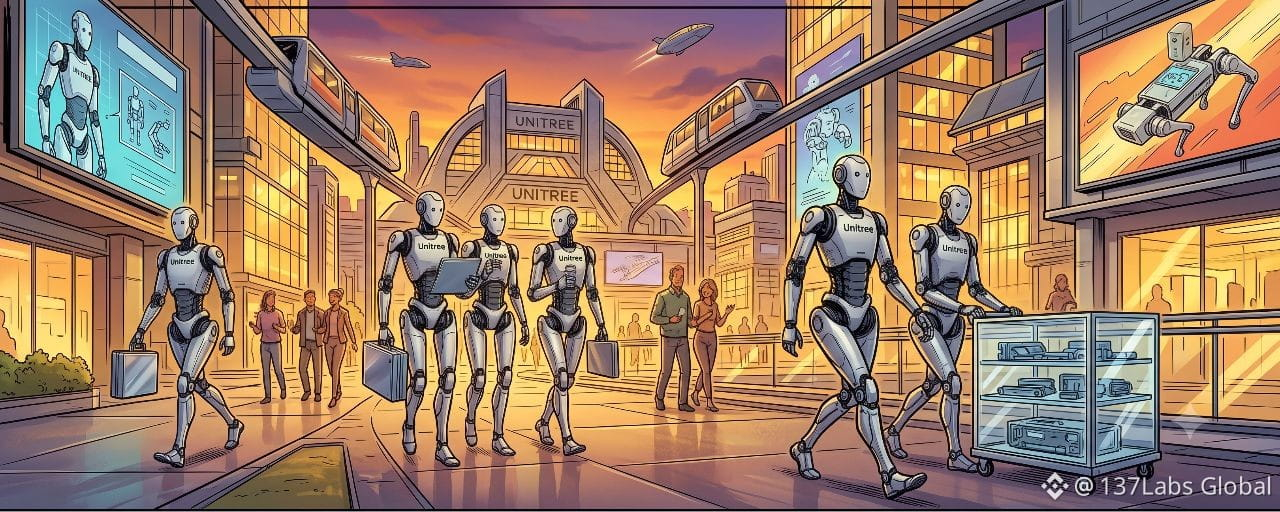
Unitree Locks 150.8 Yuan Price, Crypto Market Hits 4x Premium — What Happened?On the evening of August 6, Unitree Technology set its STAR Market IPO issue price at 150.80 yuan per share, locking in a post-IPO market capitalization of approximately 61 billion yuan.
Within hours, the $UNITREE perpetual contract on Hyperliquid surged above $80, with implied valuations reaching $30–36 billion — a full four times higher.
The same company. Two markets. Completely different prices in a single night.
The A-share market delivered the official anchor. The crypto market front-ran the “first pure-play humanoid robotics stock” narrative.
This may be the most significant price-discovery event in the embodied intelligence sector in 2026.
Fundamentals: A Hardware Player That Has Already Achieved Scaled Profitability
In 2025, Unitree recorded approximately 1.708 billion yuan in revenue, up 335% year-over-year, with non-GAAP net profit attributable to the parent of about 600 million yuan and gross margins holding around 60%. These figures remain rare in the current humanoid robotics sector. The company shipped more than 5,500 pure humanoid robots in 2025 and has cumulative quadruped sales exceeding 30,000 units, maintaining a long-term leading global share. Revenue structure shifted decisively: humanoid robots accounted for over 50% of revenue for the first time, becoming the largest contributor.
Product strategy is clear. The G1 starts at around 99,000 yuan, while the R1 has been further reduced to the 29,900–39,900 yuan range. Through full-stack self-developed joint modules and motion-control algorithms, the company continues to drive down costs. Application scenarios remain dominated by research and education, while commercial and industrial orders are expanding in parallel. For the first half of 2026, the company expects revenue of 1.052–1.128 billion yuan, still growing 35–45% year-over-year. Growth has moderated, and R&D plus brand investment have increased — a natural stage of scaling and a key variable for whether current valuations can be sustained.
Sector Narrative Shift: From Hardware Performance to Embodied Models, From Demos to Real Deployment
The core narrative in the robotics sector has clearly shifted in 2026. In previous years, industry heat was driven mainly by hardware makers competing on motion performance, balance capability, and stage demonstrations. Entering 2026, the competitive focus has rapidly moved to embodied large models — world models, scene generalization, autonomous decision-making, and reinforcement learning. Capital continues to pour into model-related companies, with financing scales already far exceeding full-year totals of previous years.
Industry consensus is gradually clarifying: hardware first solves “can move, can sell, can scale,” while models solve “can understand environments and autonomously complete complex tasks.” At the same time, the narrative has moved from laboratory validation to real-world deployment. Official statements from the Ministry of Industry and Information Technology indicate that China’s full-year humanoid robot production in 2026 is expected to exceed 100,000 units. Chinese companies account for more than 80% of global shipments, forming a leading pattern represented by Unitree and AgiBot. Prices continue to fall into the ten-thousand-yuan range, while supply-chain maturity and capacity ramp-up have become high-frequency keywords. The overall stage assessment is that 2026 marks the first year of small-batch commercial use, with larger-scale mass production expected around 2028.
Founder Wang Xingxing: A Decade-Long Path of a 1990s Tech-Driven Builder
Wang Xingxing was born in 1990 in Yuyao, Ningbo, Zhejiang. He studied mechatronics at Zhejiang Sci-Tech University for his undergraduate degree and mechanical engineering at Shanghai University for his master’s. During college he started building robots with a 200-yuan microcontroller; in graduate school he self-developed the quadruped robot XDog, which attracted overseas attention. After graduating in 2016, he briefly joined DJI, then left within months, founding Unitree with roughly 2 million yuan in angel funding. In the early days the company consisted of almost only him; when funding dried up he paid employee salaries out of his own pocket.
He continues to serve as both CEO and CTO, maintaining a highly flat management style, directly tracking R&D progress, and personally participating in product definition and recruitment. Through dual-class shares with special voting rights, he will still control more than 65% of voting power after the IPO. At the current issue price, his stake is valued at approximately 20 billion yuan. This strong founder-led character and technology-driven DNA form Unitree’s clear distinction from purely capital-driven companies.
Key Points from the August 7 Online Roadshow
On the afternoon of August 7, Unitree held its STAR Market IPO online investor exchange meeting. Wang Xingxing and the management team directly addressed investor questions. Main points included:
Performance review: The company focuses on high-performance general-purpose humanoid robots, quadruped robots, components, and embodied intelligence models. In 2025, while non-GAAP net profit grew rapidly, the company achieved the world’s highest humanoid robot shipment volume. Since the mass production of the H1 in 2023, humanoid robot sales revenue rose from less than 3 million yuan to 868 million yuan, with its share of main business rising from 1.88% to 51.78%.Industry positioning: Current achievements are only a starting point. The embodied intelligence industry as a whole remains in an early development stage, similar to the early days of home computers. The generalization ability of devices in unfamiliar environments still requires joint improvement across the entire industry.Future direction: The company will continue to tackle key soft and hard technologies including embodied large models, scene data collection and analysis, reinforcement learning, embodied body models, self-developed core components, and high-performance actuators. It will actively explore more product forms such as humanoids, quadrupeds, and mecha, pushing robots to take on high-intensity, high-risk physical labor.Message to investors: The company hopes investors who buy its shares do so because they recognize its long-term value, rather than for short-term speculation.
The overall tone of the roadshow was pragmatic — showcasing existing commercialization results while clearly stating that the industry remains early-stage.
Humanoid Robot Shipments and Application Scenarios
Global humanoid robot shipments in 2025 reached approximately 13,000–18,000 units, with China accounting for 80–90%. Unitree shipped more than 5,500 units, with AgiBot following closely; the two companies together hold a significant share. China’s full-year production in 2026 is expected to exceed 100,000 units, and Unitree’s target is at least a doubling to the 10,000–20,000 unit range.
Current main application scenarios remain highly concentrated: research and education account for the highest proportion (40–70% at some companies), used by universities and research institutes for algorithm validation, data collection, and teaching; interactive services and data-collection scenarios rank next; entertainment performances and exhibitions take a certain share; industrial logistics, production-line operations, and inspection are accelerating but still represent a relatively low overall proportion. Truly large-scale entry into factories and homes still requires further cost reduction and improved model generalization capabilities.
Cross-Market Price Discovery and Observation Points
The A-share valuation of 61 billion yuan corresponds to a non-GAAP P/E of approximately 219x. Institutions fully accepted it with offline subscription multiples exceeding 2,600x. The Hyperliquid contract, meanwhile, delivered roughly a fourfold premium, pricing the scarcity of the “world’s first listed company whose core business is humanoid robots” together with China’s supply-chain scale advantages. The valuation gap between the two markets reflects differences in time horizon and risk preference.
Around the August 10 subscription date, three data sets are worth close tracking: concentration of holdings and large limit buy orders for $UNITREE on Hyperliquid; final online and offline allotment rates plus strategic placement lock-up arrangements; and the opening premium and trading volume structure on the first day of listing.
Unitree’s listing has formally moved embodied intelligence from laboratories and demonstration videos into the stage of tradable, benchmarkable assets. The A-share market provided the official 61-billion-yuan anchor, while Hyperliquid front-ran the industry’s imagination with a higher implied valuation. The pricing contest between the two markets itself constitutes one of the most noteworthy price-discovery processes of 2026.
Disclaimer: This article is for informational reference only and does not constitute any investment advice. The crypto market is highly volatile; investing involves risks. Please conduct your own research and bear the consequences independently.
Unitree Locks 150.8 Yuan Price, Crypto Market Hits 4x Premium — What Happened?
On the evening of August 6, Unitree Technology set its STAR Market IPO issue price at 150.80 yuan per share, locking in a post-IPO market capitalization of approximately 61 billion yuan.
Within hours, the $UNITREE perpetual contract on Hyperliquid surged above $80, with implied valuations reaching $30–36 billion — a full four times higher.
The same company. Two markets. Completely different prices in a single night.
The A-share market delivered the official anchor. The crypto market front-ran the “first pure-play humanoid robotics stock” narrative.
This may be the most significant price-discovery event in the embodied intelligence sector in 2026.
Fundamentals: A Hardware Player That Has Already Achieved Scaled Profitability
In 2025, Unitree recorded approximately 1.708 billion yuan in revenue, up 335% year-over-year, with non-GAAP net profit attributable to the parent of about 600 million yuan and gross margins holding around 60%. These figures remain rare in the current humanoid robotics sector. The company shipped more than 5,500 pure humanoid robots in 2025 and has cumulative quadruped sales exceeding 30,000 units, maintaining a long-term leading global share. Revenue structure shifted decisively: humanoid robots accounted for over 50% of revenue for the first time, becoming the largest contributor.
Product strategy is clear. The G1 starts at around 99,000 yuan, while the R1 has been further reduced to the 29,900–39,900 yuan range. Through full-stack self-developed joint modules and motion-control algorithms, the company continues to drive down costs. Application scenarios remain dominated by research and education, while commercial and industrial orders are expanding in parallel. For the first half of 2026, the company expects revenue of 1.052–1.128 billion yuan, still growing 35–45% year-over-year. Growth has moderated, and R&D plus brand investment have increased — a natural stage of scaling and a key variable for whether current valuations can be sustained.
Sector Narrative Shift: From Hardware Performance to Embodied Models, From Demos to Real Deployment
The core narrative in the robotics sector has clearly shifted in 2026. In previous years, industry heat was driven mainly by hardware makers competing on motion performance, balance capability, and stage demonstrations. Entering 2026, the competitive focus has rapidly moved to embodied large models — world models, scene generalization, autonomous decision-making, and reinforcement learning. Capital continues to pour into model-related companies, with financing scales already far exceeding full-year totals of previous years.
Industry consensus is gradually clarifying: hardware first solves “can move, can sell, can scale,” while models solve “can understand environments and autonomously complete complex tasks.” At the same time, the narrative has moved from laboratory validation to real-world deployment. Official statements from the Ministry of Industry and Information Technology indicate that China’s full-year humanoid robot production in 2026 is expected to exceed 100,000 units. Chinese companies account for more than 80% of global shipments, forming a leading pattern represented by Unitree and AgiBot. Prices continue to fall into the ten-thousand-yuan range, while supply-chain maturity and capacity ramp-up have become high-frequency keywords. The overall stage assessment is that 2026 marks the first year of small-batch commercial use, with larger-scale mass production expected around 2028.
Founder Wang Xingxing: A Decade-Long Path of a 1990s Tech-Driven Builder
Wang Xingxing was born in 1990 in Yuyao, Ningbo, Zhejiang. He studied mechatronics at Zhejiang Sci-Tech University for his undergraduate degree and mechanical engineering at Shanghai University for his master’s. During college he started building robots with a 200-yuan microcontroller; in graduate school he self-developed the quadruped robot XDog, which attracted overseas attention. After graduating in 2016, he briefly joined DJI, then left within months, founding Unitree with roughly 2 million yuan in angel funding. In the early days the company consisted of almost only him; when funding dried up he paid employee salaries out of his own pocket.
He continues to serve as both CEO and CTO, maintaining a highly flat management style, directly tracking R&D progress, and personally participating in product definition and recruitment. Through dual-class shares with special voting rights, he will still control more than 65% of voting power after the IPO. At the current issue price, his stake is valued at approximately 20 billion yuan. This strong founder-led character and technology-driven DNA form Unitree’s clear distinction from purely capital-driven companies.
Key Points from the August 7 Online Roadshow
On the afternoon of August 7, Unitree held its STAR Market IPO online investor exchange meeting. Wang Xingxing and the management team directly addressed investor questions. Main points included:
Performance review: The company focuses on high-performance general-purpose humanoid robots, quadruped robots, components, and embodied intelligence models. In 2025, while non-GAAP net profit grew rapidly, the company achieved the world’s highest humanoid robot shipment volume. Since the mass production of the H1 in 2023, humanoid robot sales revenue rose from less than 3 million yuan to 868 million yuan, with its share of main business rising from 1.88% to 51.78%.Industry positioning: Current achievements are only a starting point. The embodied intelligence industry as a whole remains in an early development stage, similar to the early days of home computers. The generalization ability of devices in unfamiliar environments still requires joint improvement across the entire industry.Future direction: The company will continue to tackle key soft and hard technologies including embodied large models, scene data collection and analysis, reinforcement learning, embodied body models, self-developed core components, and high-performance actuators. It will actively explore more product forms such as humanoids, quadrupeds, and mecha, pushing robots to take on high-intensity, high-risk physical labor.Message to investors: The company hopes investors who buy its shares do so because they recognize its long-term value, rather than for short-term speculation.
The overall tone of the roadshow was pragmatic — showcasing existing commercialization results while clearly stating that the industry remains early-stage.
Humanoid Robot Shipments and Application Scenarios
Global humanoid robot shipments in 2025 reached approximately 13,000–18,000 units, with China accounting for 80–90%. Unitree shipped more than 5,500 units, with AgiBot following closely; the two companies together hold a significant share. China’s full-year production in 2026 is expected to exceed 100,000 units, and Unitree’s target is at least a doubling to the 10,000–20,000 unit range.
Current main application scenarios remain highly concentrated: research and education account for the highest proportion (40–70% at some companies), used by universities and research institutes for algorithm validation, data collection, and teaching; interactive services and data-collection scenarios rank next; entertainment performances and exhibitions take a certain share; industrial logistics, production-line operations, and inspection are accelerating but still represent a relatively low overall proportion. Truly large-scale entry into factories and homes still requires further cost reduction and improved model generalization capabilities.
Cross-Market Price Discovery and Observation Points
The A-share valuation of 61 billion yuan corresponds to a non-GAAP P/E of approximately 219x. Institutions fully accepted it with offline subscription multiples exceeding 2,600x. The Hyperliquid contract, meanwhile, delivered roughly a fourfold premium, pricing the scarcity of the “world’s first listed company whose core business is humanoid robots” together with China’s supply-chain scale advantages. The valuation gap between the two markets reflects differences in time horizon and risk preference.
Around the August 10 subscription date, three data sets are worth close tracking: concentration of holdings and large limit buy orders for $UNITREE on Hyperliquid; final online and offline allotment rates plus strategic placement lock-up arrangements; and the opening premium and trading volume structure on the first day of listing.
Unitree’s listing has formally moved embodied intelligence from laboratories and demonstration videos into the stage of tradable, benchmarkable assets. The A-share market provided the official 61-billion-yuan anchor, while Hyperliquid front-ran the industry’s imagination with a higher implied valuation. The pricing contest between the two markets itself constitutes one of the most noteworthy price-discovery processes of 2026.
Disclaimer: This article is for informational reference only and does not constitute any investment advice. The crypto market is highly volatile; investing involves risks. Please conduct your own research and bear the consequences independently.
Within hours, the $UNITREE perpetual contract on Hyperliquid surged above $80, with implied valuations reaching $30–36 billion — a full four times higher.
The same company. Two markets. Completely different prices in a single night.
The A-share market delivered the official anchor. The crypto market front-ran the “first pure-play humanoid robotics stock” narrative.
This may be the most significant price-discovery event in the embodied intelligence sector in 2026.
Fundamentals: A Hardware Player That Has Already Achieved Scaled Profitability
In 2025, Unitree recorded approximately 1.708 billion yuan in revenue, up 335% year-over-year, with non-GAAP net profit attributable to the parent of about 600 million yuan and gross margins holding around 60%. These figures remain rare in the current humanoid robotics sector. The company shipped more than 5,500 pure humanoid robots in 2025 and has cumulative quadruped sales exceeding 30,000 units, maintaining a long-term leading global share. Revenue structure shifted decisively: humanoid robots accounted for over 50% of revenue for the first time, becoming the largest contributor.
Product strategy is clear. The G1 starts at around 99,000 yuan, while the R1 has been further reduced to the 29,900–39,900 yuan range. Through full-stack self-developed joint modules and motion-control algorithms, the company continues to drive down costs. Application scenarios remain dominated by research and education, while commercial and industrial orders are expanding in parallel. For the first half of 2026, the company expects revenue of 1.052–1.128 billion yuan, still growing 35–45% year-over-year. Growth has moderated, and R&D plus brand investment have increased — a natural stage of scaling and a key variable for whether current valuations can be sustained.
Sector Narrative Shift: From Hardware Performance to Embodied Models, From Demos to Real Deployment
The core narrative in the robotics sector has clearly shifted in 2026. In previous years, industry heat was driven mainly by hardware makers competing on motion performance, balance capability, and stage demonstrations. Entering 2026, the competitive focus has rapidly moved to embodied large models — world models, scene generalization, autonomous decision-making, and reinforcement learning. Capital continues to pour into model-related companies, with financing scales already far exceeding full-year totals of previous years.
Industry consensus is gradually clarifying: hardware first solves “can move, can sell, can scale,” while models solve “can understand environments and autonomously complete complex tasks.” At the same time, the narrative has moved from laboratory validation to real-world deployment. Official statements from the Ministry of Industry and Information Technology indicate that China’s full-year humanoid robot production in 2026 is expected to exceed 100,000 units. Chinese companies account for more than 80% of global shipments, forming a leading pattern represented by Unitree and AgiBot. Prices continue to fall into the ten-thousand-yuan range, while supply-chain maturity and capacity ramp-up have become high-frequency keywords. The overall stage assessment is that 2026 marks the first year of small-batch commercial use, with larger-scale mass production expected around 2028.
Founder Wang Xingxing: A Decade-Long Path of a 1990s Tech-Driven Builder
Wang Xingxing was born in 1990 in Yuyao, Ningbo, Zhejiang. He studied mechatronics at Zhejiang Sci-Tech University for his undergraduate degree and mechanical engineering at Shanghai University for his master’s. During college he started building robots with a 200-yuan microcontroller; in graduate school he self-developed the quadruped robot XDog, which attracted overseas attention. After graduating in 2016, he briefly joined DJI, then left within months, founding Unitree with roughly 2 million yuan in angel funding. In the early days the company consisted of almost only him; when funding dried up he paid employee salaries out of his own pocket.
He continues to serve as both CEO and CTO, maintaining a highly flat management style, directly tracking R&D progress, and personally participating in product definition and recruitment. Through dual-class shares with special voting rights, he will still control more than 65% of voting power after the IPO. At the current issue price, his stake is valued at approximately 20 billion yuan. This strong founder-led character and technology-driven DNA form Unitree’s clear distinction from purely capital-driven companies.
Key Points from the August 7 Online Roadshow
On the afternoon of August 7, Unitree held its STAR Market IPO online investor exchange meeting. Wang Xingxing and the management team directly addressed investor questions. Main points included:
Performance review: The company focuses on high-performance general-purpose humanoid robots, quadruped robots, components, and embodied intelligence models. In 2025, while non-GAAP net profit grew rapidly, the company achieved the world’s highest humanoid robot shipment volume. Since the mass production of the H1 in 2023, humanoid robot sales revenue rose from less than 3 million yuan to 868 million yuan, with its share of main business rising from 1.88% to 51.78%.Industry positioning: Current achievements are only a starting point. The embodied intelligence industry as a whole remains in an early development stage, similar to the early days of home computers. The generalization ability of devices in unfamiliar environments still requires joint improvement across the entire industry.Future direction: The company will continue to tackle key soft and hard technologies including embodied large models, scene data collection and analysis, reinforcement learning, embodied body models, self-developed core components, and high-performance actuators. It will actively explore more product forms such as humanoids, quadrupeds, and mecha, pushing robots to take on high-intensity, high-risk physical labor.Message to investors: The company hopes investors who buy its shares do so because they recognize its long-term value, rather than for short-term speculation.
The overall tone of the roadshow was pragmatic — showcasing existing commercialization results while clearly stating that the industry remains early-stage.
Humanoid Robot Shipments and Application Scenarios
Global humanoid robot shipments in 2025 reached approximately 13,000–18,000 units, with China accounting for 80–90%. Unitree shipped more than 5,500 units, with AgiBot following closely; the two companies together hold a significant share. China’s full-year production in 2026 is expected to exceed 100,000 units, and Unitree’s target is at least a doubling to the 10,000–20,000 unit range.
Current main application scenarios remain highly concentrated: research and education account for the highest proportion (40–70% at some companies), used by universities and research institutes for algorithm validation, data collection, and teaching; interactive services and data-collection scenarios rank next; entertainment performances and exhibitions take a certain share; industrial logistics, production-line operations, and inspection are accelerating but still represent a relatively low overall proportion. Truly large-scale entry into factories and homes still requires further cost reduction and improved model generalization capabilities.
Cross-Market Price Discovery and Observation Points
The A-share valuation of 61 billion yuan corresponds to a non-GAAP P/E of approximately 219x. Institutions fully accepted it with offline subscription multiples exceeding 2,600x. The Hyperliquid contract, meanwhile, delivered roughly a fourfold premium, pricing the scarcity of the “world’s first listed company whose core business is humanoid robots” together with China’s supply-chain scale advantages. The valuation gap between the two markets reflects differences in time horizon and risk preference.
Around the August 10 subscription date, three data sets are worth close tracking: concentration of holdings and large limit buy orders for $UNITREE on Hyperliquid; final online and offline allotment rates plus strategic placement lock-up arrangements; and the opening premium and trading volume structure on the first day of listing.
Unitree’s listing has formally moved embodied intelligence from laboratories and demonstration videos into the stage of tradable, benchmarkable assets. The A-share market provided the official 61-billion-yuan anchor, while Hyperliquid front-ran the industry’s imagination with a higher implied valuation. The pricing contest between the two markets itself constitutes one of the most noteworthy price-discovery processes of 2026.
Disclaimer: This article is for informational reference only and does not constitute any investment advice. The crypto market is highly volatile; investing involves risks. Please conduct your own research and bear the consequences independently.
93
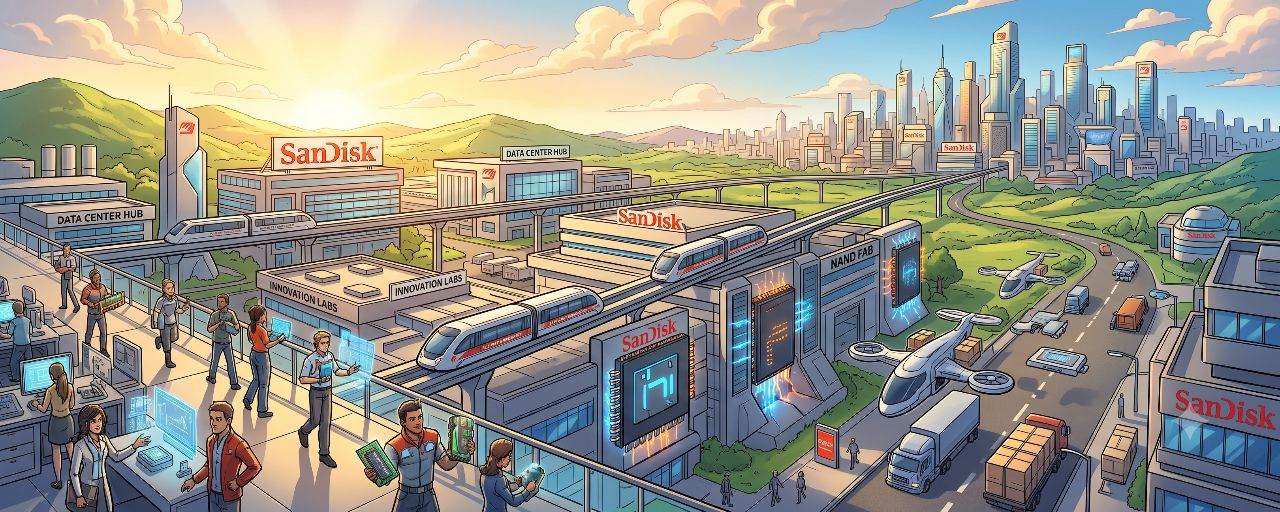
Article
SanDisk FY26Q4: Record Profits Amid Investor CautionI. Record-Breaking Earnings, But Why Did the Market React Negatively?
On August 6, SanDisk released its FY2026 fourth-quarter earnings report. From an operational perspective, this was a record-setting quarter, with revenue, profitability, and gross margin all reaching historical highs. However, despite the strong results, the stock came under pressure after the earnings release, mainly because market expectations for AI-driven storage demand had already been elevated significantly.
In the quarter, SanDisk generated $8.97 billion in revenue, below the market buy-side consensus estimate of $9.6 billion, but still representing 372% year-over-year growth and 51% sequential growth. From a revenue composition perspective, growth was not driven solely by higher shipment volumes. Approximately one-third of the growth came from increased shipments, while the remaining two-thirds came from NAND price increases and higher ASP (average selling price), indicating that the storage industry is currently benefiting from improving supply-demand dynamics and pricing recovery.
Profitability was even more impressive. SanDisk delivered GAAP net income of $6.903 billion and achieved a GAAP gross margin of 84.6%, further improving from 78.4% in FY26Q3, representing a 6.2 percentage-point sequential increase and marking the highest profitability level in the company’s history.
However, the market’s focus has shifted from “how much the company earned this quarter” to “whether earnings can continue exceeding expectations.” SanDisk’s FY27Q1 guidance came in below market expectations:
· Revenue midpoint: $10.6 billion
· Market consensus: $12.5 billion
· Gross margin midpoint: 84%
· Market expectation: 86%
Therefore, the market reaction was not a rejection of SanDisk’s current performance, but rather a reassessment of whether current profitability levels can continue expanding.
Historically, the NAND industry has followed a strong cyclical pattern: when supply becomes tight, prices rise and margins expand; however, as manufacturers increase capacity, oversupply often leads to price declines and margin compression.
The key question for investors is therefore:
Is SanDisk’s current record profitability a temporary peak in a traditional storage cycle, or is it the beginning of a structurally higher earnings profile driven by the AI era?
II. AI Is Reshaping SanDisk, With Data Centers Becoming the Core Growth Engine
The most important takeaway from this earnings report is not simply the record quarterly profit, but the fundamental transformation taking place in SanDisk’s business structure.
Historically, NAND demand was mainly driven by smartphones, PCs, and consumer SSD markets. These markets are highly cyclical and sensitive to consumer demand, inventory adjustments, and macroeconomic conditions, making storage companies difficult to value at premium levels.
However, the rapid expansion of artificial intelligence infrastructure is changing the demand landscape, with data centers becoming a major growth driver for SanDisk.
The company’s business mix has shifted significantly:
One year ago:
· Data center business Bit share: 12%
Currently:
· Data center business Bit share: 38%
In the latest quarter:
· Data center revenue: $2.98 billion
· Sequential growth: 103%
AI is fundamentally changing the storage industry.
Future AI training and inference workloads are not only dependent on GPU computing power but also require massive storage capabilities because AI development is increasingly:
· Memory intensive
· Storage intensive
As AI models become larger, datasets expand, and inference workloads accelerate, demand for high-capacity and high-performance storage solutions will continue increasing.
This means SanDisk is gradually transitioning from a traditional consumer storage company into an AI infrastructure supplier.
This transformation is critical because if future growth is increasingly driven by AI data centers rather than consumer electronics, SanDisk’s business model will become less dependent on traditional storage cycles and more closely linked to long-term AI infrastructure investment trends.
III. The Strategic Shift Behind 85% Gross Margin: Moving From Short-Term Profit Maximization to Long-Term Partnerships
One of the most important messages from SanDisk’s earnings call was management’s view on profitability.
The company indicated that:
A gross margin level around 85% represents a fair and reasonable return, and SanDisk does not intend to endlessly raise prices or maximize short-term profits by excessively squeezing customers.
Historically, semiconductor companies have often emphasized pricing power and attempted to maximize profitability during periods of tight supply.
SanDisk appears to be pursuing a different strategy.
The traditional storage industry model has been:
Supply shortage → Price increases → Higher margins → Capacity expansion → Industry downturn.
SanDisk is attempting to move toward a different model:
Long-term partnerships → Demand visibility → Stable pricing → Sustainable returns.
The significance of this strategy is that it aims to reduce the extreme cyclicality that has historically defined the NAND industry.
The market currently has two opposing views.
The bearish argument is that an 84%+ gross margin level may represent a cyclical peak, and profitability could decline once supply conditions normalize.
The bullish argument is that this cycle is fundamentally different because AI demand is structurally changing storage consumption, while SanDisk’s new business model improves revenue visibility and reduces exposure to market volatility.
Therefore, the key question is not whether SanDisk can continue increasing margins in the next quarter, but whether the company can convert today’s exceptional profitability into sustainable long-term cash flow.
IV. NBM: SanDisk’s Attempt to Break Away From the Traditional Storage Cycle
The most important strategic initiative behind SanDisk’s long-term transformation is its NBM (New Business Model).
The biggest challenge facing the NAND industry has always been demand uncertainty. Manufacturers historically struggled to accurately forecast how much capacity customers would need in future years, resulting in repeated cycles of overinvestment and price volatility.
The industry has traditionally followed this pattern:
Demand growth → Capacity expansion → Oversupply → Price decline → Production cuts → Recovery.
The purpose of NBM is to change this model by shifting storage from a “forecast-driven” business into a “demand-secured” business.
Under the NBM model, AI cloud customers provide SanDisk with long-term visibility into future storage requirements, while also offering financial commitments to support those agreements.
Currently, SanDisk has signed NBM long-term supply agreements with:
8 leading cloud data center and edge computing customers.
The agreements include:
· Minimum committed revenue: $93.9 billion
· Customer-provided cash and financial guarantees: $16.5 billion
· Average contract duration: more than 4 years
This gives SanDisk significantly greater revenue visibility and reduces reliance on spot NAND market pricing.
Importantly, NBM is not a low-margin volume strategy.
The company stated that:
· NBM contracts maintain approximately 80% gross margins.
Future capacity commitments include:
· More than half of FY2027 capacity already secured by customers
· Approximately two-thirds of FY2028 capacity already locked in by major customers
If NBM succeeds, SanDisk could transition from a traditional cyclical storage manufacturer into a supplier with long-term contracts, predictable revenue, and AI infrastructure exposure.
V. HBF Technology and Valuation Re-Rating: Can SanDisk Become a Core AI Storage Asset?
Beyond NBM, another major potential catalyst is SanDisk’s upcoming HBF (High Bandwidth Flash) technology.
The company plans to officially unveil the technology during its:
August 13 Investor Day.
The market is watching HBF because it could further enhance NAND’s role within the AI Memory Hierarchy.
Historically, NAND has primarily served as a data storage medium. However, as AI models become larger and computing architectures evolve, storage is becoming an increasingly important component of AI performance.
If HBF technology proves successful, NAND could expand beyond traditional applications such as:
· Data storage
· Enterprise storage
· Consumer SSDs
and potentially enter areas including:
· AI inference systems
· High-performance computing architectures
· Next-generation AI storage frameworks
If both NBM and HBF strategies succeed, SanDisk’s valuation framework could undergo a major shift.
Historically, investors viewed SanDisk as:
“A cyclical storage company.”
However, the market could increasingly view the company as an AI infrastructure asset supported by:
· Long-term AI storage growth
· Multi-year customer contracts
· Stable cash generation
· High free cash flow potential
· Share repurchase capability
This would represent a transition from a traditional cyclical semiconductor company toward a strategic AI infrastructure supplier.
VI. Risks and Conclusion: Short-Term Debate, Long-Term Business Model Transformation
Although SanDisk is benefiting from AI-driven storage demand, several risks remain.
1. AI Capital Expenditure Slowdown Risk
SanDisk’s long-term growth depends heavily on continued AI infrastructure investment from cloud providers.
If major cloud companies reduce AI spending, slow data center construction, or experience weaker-than-expected AI demand, storage demand and NBM execution could be affected.
2. NAND Price Decline Risk
Current earnings growth is significantly supported by NAND pricing improvement.
Revenue growth this quarter was driven by:
· One-third from shipment growth
· Two-thirds from price increases
If industry supply expands again and NAND prices decline, SanDisk’s gross margin could face pressure.
3. NBM Execution Risk
The market will continue monitoring:
· Whether customer demand remains strong;
· Whether long-term contracts are successfully executed;
· Whether high-margin economics can be maintained.
Conclusion
SanDisk’s FY26Q4 earnings can be summarized as:
Short-term neutral to slightly negative, but fundamentally positive over the long term.
In the short term, the stock faced pressure because revenue and margin guidance came below market expectations, while investors questioned whether record-high profitability had reached its peak.
However, from a long-term perspective, SanDisk is undergoing a significant transformation through:
· Rapid data center growth;
· AI-driven storage demand expansion;
· NBM long-term contracts;
· High-margin supply agreements;
· HBF technology innovation.
The key factor determining SanDisk’s future value is not whether gross margin can rise further next quarter, but whether the company can leverage the AI infrastructure revolution to transform itself from a traditional cyclical storage company into a technology supplier with long-term contracts, strong cash flow, and strategic importance in the AI ecosystem.
If the NBM model succeeds, SanDisk may not simply be benefiting from another storage upcycle — it may be redefining the future business model of the storage industry.
(Risk disclaimer: This article is for educational and informational purposes only and does not constitute investment advice. )
SanDisk FY26Q4: Record Profits Amid Investor Caution
I. Record-Breaking Earnings, But Why Did the Market React Negatively?
On August 6, SanDisk released its FY2026 fourth-quarter earnings report. From an operational perspective, this was a record-setting quarter, with revenue, profitability, and gross margin all reaching historical highs. However, despite the strong results, the stock came under pressure after the earnings release, mainly because market expectations for AI-driven storage demand had already been elevated significantly.
In the quarter, SanDisk generated $8.97 billion in revenue, below the market buy-side consensus estimate of $9.6 billion, but still representing 372% year-over-year growth and 51% sequential growth. From a revenue composition perspective, growth was not driven solely by higher shipment volumes. Approximately one-third of the growth came from increased shipments, while the remaining two-thirds came from NAND price increases and higher ASP (average selling price), indicating that the storage industry is currently benefiting from improving supply-demand dynamics and pricing recovery.
Profitability was even more impressive. SanDisk delivered GAAP net income of $6.903 billion and achieved a GAAP gross margin of 84.6%, further improving from 78.4% in FY26Q3, representing a 6.2 percentage-point sequential increase and marking the highest profitability level in the company’s history.
However, the market’s focus has shifted from “how much the company earned this quarter” to “whether earnings can continue exceeding expectations.” SanDisk’s FY27Q1 guidance came in below market expectations:
· Revenue midpoint: $10.6 billion
· Market consensus: $12.5 billion
· Gross margin midpoint: 84%
· Market expectation: 86%
Therefore, the market reaction was not a rejection of SanDisk’s current performance, but rather a reassessment of whether current profitability levels can continue expanding.
Historically, the NAND industry has followed a strong cyclical pattern: when supply becomes tight, prices rise and margins expand; however, as manufacturers increase capacity, oversupply often leads to price declines and margin compression.
The key question for investors is therefore:
Is SanDisk’s current record profitability a temporary peak in a traditional storage cycle, or is it the beginning of a structurally higher earnings profile driven by the AI era?
II. AI Is Reshaping SanDisk, With Data Centers Becoming the Core Growth Engine
The most important takeaway from this earnings report is not simply the record quarterly profit, but the fundamental transformation taking place in SanDisk’s business structure.
Historically, NAND demand was mainly driven by smartphones, PCs, and consumer SSD markets. These markets are highly cyclical and sensitive to consumer demand, inventory adjustments, and macroeconomic conditions, making storage companies difficult to value at premium levels.
However, the rapid expansion of artificial intelligence infrastructure is changing the demand landscape, with data centers becoming a major growth driver for SanDisk.
The company’s business mix has shifted significantly:
One year ago:
· Data center business Bit share: 12%
Currently:
· Data center business Bit share: 38%
In the latest quarter:
· Data center revenue: $2.98 billion
· Sequential growth: 103%
AI is fundamentally changing the storage industry.
Future AI training and inference workloads are not only dependent on GPU computing power but also require massive storage capabilities because AI development is increasingly:
· Memory intensive
· Storage intensive
As AI models become larger, datasets expand, and inference workloads accelerate, demand for high-capacity and high-performance storage solutions will continue increasing.
This means SanDisk is gradually transitioning from a traditional consumer storage company into an AI infrastructure supplier.
This transformation is critical because if future growth is increasingly driven by AI data centers rather than consumer electronics, SanDisk’s business model will become less dependent on traditional storage cycles and more closely linked to long-term AI infrastructure investment trends.
III. The Strategic Shift Behind 85% Gross Margin: Moving From Short-Term Profit Maximization to Long-Term Partnerships
One of the most important messages from SanDisk’s earnings call was management’s view on profitability.
The company indicated that:
A gross margin level around 85% represents a fair and reasonable return, and SanDisk does not intend to endlessly raise prices or maximize short-term profits by excessively squeezing customers.
Historically, semiconductor companies have often emphasized pricing power and attempted to maximize profitability during periods of tight supply.
SanDisk appears to be pursuing a different strategy.
The traditional storage industry model has been:
Supply shortage → Price increases → Higher margins → Capacity expansion → Industry downturn.
SanDisk is attempting to move toward a different model:
Long-term partnerships → Demand visibility → Stable pricing → Sustainable returns.
The significance of this strategy is that it aims to reduce the extreme cyclicality that has historically defined the NAND industry.
The market currently has two opposing views.
The bearish argument is that an 84%+ gross margin level may represent a cyclical peak, and profitability could decline once supply conditions normalize.
The bullish argument is that this cycle is fundamentally different because AI demand is structurally changing storage consumption, while SanDisk’s new business model improves revenue visibility and reduces exposure to market volatility.
Therefore, the key question is not whether SanDisk can continue increasing margins in the next quarter, but whether the company can convert today’s exceptional profitability into sustainable long-term cash flow.
IV. NBM: SanDisk’s Attempt to Break Away From the Traditional Storage Cycle
The most important strategic initiative behind SanDisk’s long-term transformation is its NBM (New Business Model).
The biggest challenge facing the NAND industry has always been demand uncertainty. Manufacturers historically struggled to accurately forecast how much capacity customers would need in future years, resulting in repeated cycles of overinvestment and price volatility.
The industry has traditionally followed this pattern:
Demand growth → Capacity expansion → Oversupply → Price decline → Production cuts → Recovery.
The purpose of NBM is to change this model by shifting storage from a “forecast-driven” business into a “demand-secured” business.
Under the NBM model, AI cloud customers provide SanDisk with long-term visibility into future storage requirements, while also offering financial commitments to support those agreements.
Currently, SanDisk has signed NBM long-term supply agreements with:
8 leading cloud data center and edge computing customers.
The agreements include:
· Minimum committed revenue: $93.9 billion
· Customer-provided cash and financial guarantees: $16.5 billion
· Average contract duration: more than 4 years
This gives SanDisk significantly greater revenue visibility and reduces reliance on spot NAND market pricing.
Importantly, NBM is not a low-margin volume strategy.
The company stated that:
· NBM contracts maintain approximately 80% gross margins.
Future capacity commitments include:
· More than half of FY2027 capacity already secured by customers
· Approximately two-thirds of FY2028 capacity already locked in by major customers
If NBM succeeds, SanDisk could transition from a traditional cyclical storage manufacturer into a supplier with long-term contracts, predictable revenue, and AI infrastructure exposure.
V. HBF Technology and Valuation Re-Rating: Can SanDisk Become a Core AI Storage Asset?
Beyond NBM, another major potential catalyst is SanDisk’s upcoming HBF (High Bandwidth Flash) technology.
The company plans to officially unveil the technology during its:
August 13 Investor Day.
The market is watching HBF because it could further enhance NAND’s role within the AI Memory Hierarchy.
Historically, NAND has primarily served as a data storage medium. However, as AI models become larger and computing architectures evolve, storage is becoming an increasingly important component of AI performance.
If HBF technology proves successful, NAND could expand beyond traditional applications such as:
· Data storage
· Enterprise storage
· Consumer SSDs
and potentially enter areas including:
· AI inference systems
· High-performance computing architectures
· Next-generation AI storage frameworks
If both NBM and HBF strategies succeed, SanDisk’s valuation framework could undergo a major shift.
Historically, investors viewed SanDisk as:
“A cyclical storage company.”
However, the market could increasingly view the company as an AI infrastructure asset supported by:
· Long-term AI storage growth
· Multi-year customer contracts
· Stable cash generation
· High free cash flow potential
· Share repurchase capability
This would represent a transition from a traditional cyclical semiconductor company toward a strategic AI infrastructure supplier.
VI. Risks and Conclusion: Short-Term Debate, Long-Term Business Model Transformation
Although SanDisk is benefiting from AI-driven storage demand, several risks remain.
1. AI Capital Expenditure Slowdown Risk
SanDisk’s long-term growth depends heavily on continued AI infrastructure investment from cloud providers.
If major cloud companies reduce AI spending, slow data center construction, or experience weaker-than-expected AI demand, storage demand and NBM execution could be affected.
2. NAND Price Decline Risk
Current earnings growth is significantly supported by NAND pricing improvement.
Revenue growth this quarter was driven by:
· One-third from shipment growth
· Two-thirds from price increases
If industry supply expands again and NAND prices decline, SanDisk’s gross margin could face pressure.
3. NBM Execution Risk
The market will continue monitoring:
· Whether customer demand remains strong;
· Whether long-term contracts are successfully executed;
· Whether high-margin economics can be maintained.
Conclusion
SanDisk’s FY26Q4 earnings can be summarized as:
Short-term neutral to slightly negative, but fundamentally positive over the long term.
In the short term, the stock faced pressure because revenue and margin guidance came below market expectations, while investors questioned whether record-high profitability had reached its peak.
However, from a long-term perspective, SanDisk is undergoing a significant transformation through:
· Rapid data center growth;
· AI-driven storage demand expansion;
· NBM long-term contracts;
· High-margin supply agreements;
· HBF technology innovation.
The key factor determining SanDisk’s future value is not whether gross margin can rise further next quarter, but whether the company can leverage the AI infrastructure revolution to transform itself from a traditional cyclical storage company into a technology supplier with long-term contracts, strong cash flow, and strategic importance in the AI ecosystem.
If the NBM model succeeds, SanDisk may not simply be benefiting from another storage upcycle — it may be redefining the future business model of the storage industry.
(Risk disclaimer: This article is for educational and informational purposes only and does not constitute investment advice. )
On August 6, SanDisk released its FY2026 fourth-quarter earnings report. From an operational perspective, this was a record-setting quarter, with revenue, profitability, and gross margin all reaching historical highs. However, despite the strong results, the stock came under pressure after the earnings release, mainly because market expectations for AI-driven storage demand had already been elevated significantly.
In the quarter, SanDisk generated $8.97 billion in revenue, below the market buy-side consensus estimate of $9.6 billion, but still representing 372% year-over-year growth and 51% sequential growth. From a revenue composition perspective, growth was not driven solely by higher shipment volumes. Approximately one-third of the growth came from increased shipments, while the remaining two-thirds came from NAND price increases and higher ASP (average selling price), indicating that the storage industry is currently benefiting from improving supply-demand dynamics and pricing recovery.
Profitability was even more impressive. SanDisk delivered GAAP net income of $6.903 billion and achieved a GAAP gross margin of 84.6%, further improving from 78.4% in FY26Q3, representing a 6.2 percentage-point sequential increase and marking the highest profitability level in the company’s history.
However, the market’s focus has shifted from “how much the company earned this quarter” to “whether earnings can continue exceeding expectations.” SanDisk’s FY27Q1 guidance came in below market expectations:
· Revenue midpoint: $10.6 billion
· Market consensus: $12.5 billion
· Gross margin midpoint: 84%
· Market expectation: 86%
Therefore, the market reaction was not a rejection of SanDisk’s current performance, but rather a reassessment of whether current profitability levels can continue expanding.
Historically, the NAND industry has followed a strong cyclical pattern: when supply becomes tight, prices rise and margins expand; however, as manufacturers increase capacity, oversupply often leads to price declines and margin compression.
The key question for investors is therefore:
Is SanDisk’s current record profitability a temporary peak in a traditional storage cycle, or is it the beginning of a structurally higher earnings profile driven by the AI era?
II. AI Is Reshaping SanDisk, With Data Centers Becoming the Core Growth Engine
The most important takeaway from this earnings report is not simply the record quarterly profit, but the fundamental transformation taking place in SanDisk’s business structure.
Historically, NAND demand was mainly driven by smartphones, PCs, and consumer SSD markets. These markets are highly cyclical and sensitive to consumer demand, inventory adjustments, and macroeconomic conditions, making storage companies difficult to value at premium levels.
However, the rapid expansion of artificial intelligence infrastructure is changing the demand landscape, with data centers becoming a major growth driver for SanDisk.
The company’s business mix has shifted significantly:
One year ago:
· Data center business Bit share: 12%
Currently:
· Data center business Bit share: 38%
In the latest quarter:
· Data center revenue: $2.98 billion
· Sequential growth: 103%
AI is fundamentally changing the storage industry.
Future AI training and inference workloads are not only dependent on GPU computing power but also require massive storage capabilities because AI development is increasingly:
· Memory intensive
· Storage intensive
As AI models become larger, datasets expand, and inference workloads accelerate, demand for high-capacity and high-performance storage solutions will continue increasing.
This means SanDisk is gradually transitioning from a traditional consumer storage company into an AI infrastructure supplier.
This transformation is critical because if future growth is increasingly driven by AI data centers rather than consumer electronics, SanDisk’s business model will become less dependent on traditional storage cycles and more closely linked to long-term AI infrastructure investment trends.
III. The Strategic Shift Behind 85% Gross Margin: Moving From Short-Term Profit Maximization to Long-Term Partnerships
One of the most important messages from SanDisk’s earnings call was management’s view on profitability.
The company indicated that:
A gross margin level around 85% represents a fair and reasonable return, and SanDisk does not intend to endlessly raise prices or maximize short-term profits by excessively squeezing customers.
Historically, semiconductor companies have often emphasized pricing power and attempted to maximize profitability during periods of tight supply.
SanDisk appears to be pursuing a different strategy.
The traditional storage industry model has been:
Supply shortage → Price increases → Higher margins → Capacity expansion → Industry downturn.
SanDisk is attempting to move toward a different model:
Long-term partnerships → Demand visibility → Stable pricing → Sustainable returns.
The significance of this strategy is that it aims to reduce the extreme cyclicality that has historically defined the NAND industry.
The market currently has two opposing views.
The bearish argument is that an 84%+ gross margin level may represent a cyclical peak, and profitability could decline once supply conditions normalize.
The bullish argument is that this cycle is fundamentally different because AI demand is structurally changing storage consumption, while SanDisk’s new business model improves revenue visibility and reduces exposure to market volatility.
Therefore, the key question is not whether SanDisk can continue increasing margins in the next quarter, but whether the company can convert today’s exceptional profitability into sustainable long-term cash flow.
IV. NBM: SanDisk’s Attempt to Break Away From the Traditional Storage Cycle
The most important strategic initiative behind SanDisk’s long-term transformation is its NBM (New Business Model).
The biggest challenge facing the NAND industry has always been demand uncertainty. Manufacturers historically struggled to accurately forecast how much capacity customers would need in future years, resulting in repeated cycles of overinvestment and price volatility.
The industry has traditionally followed this pattern:
Demand growth → Capacity expansion → Oversupply → Price decline → Production cuts → Recovery.
The purpose of NBM is to change this model by shifting storage from a “forecast-driven” business into a “demand-secured” business.
Under the NBM model, AI cloud customers provide SanDisk with long-term visibility into future storage requirements, while also offering financial commitments to support those agreements.
Currently, SanDisk has signed NBM long-term supply agreements with:
8 leading cloud data center and edge computing customers.
The agreements include:
· Minimum committed revenue: $93.9 billion
· Customer-provided cash and financial guarantees: $16.5 billion
· Average contract duration: more than 4 years
This gives SanDisk significantly greater revenue visibility and reduces reliance on spot NAND market pricing.
Importantly, NBM is not a low-margin volume strategy.
The company stated that:
· NBM contracts maintain approximately 80% gross margins.
Future capacity commitments include:
· More than half of FY2027 capacity already secured by customers
· Approximately two-thirds of FY2028 capacity already locked in by major customers
If NBM succeeds, SanDisk could transition from a traditional cyclical storage manufacturer into a supplier with long-term contracts, predictable revenue, and AI infrastructure exposure.
V. HBF Technology and Valuation Re-Rating: Can SanDisk Become a Core AI Storage Asset?
Beyond NBM, another major potential catalyst is SanDisk’s upcoming HBF (High Bandwidth Flash) technology.
The company plans to officially unveil the technology during its:
August 13 Investor Day.
The market is watching HBF because it could further enhance NAND’s role within the AI Memory Hierarchy.
Historically, NAND has primarily served as a data storage medium. However, as AI models become larger and computing architectures evolve, storage is becoming an increasingly important component of AI performance.
If HBF technology proves successful, NAND could expand beyond traditional applications such as:
· Data storage
· Enterprise storage
· Consumer SSDs
and potentially enter areas including:
· AI inference systems
· High-performance computing architectures
· Next-generation AI storage frameworks
If both NBM and HBF strategies succeed, SanDisk’s valuation framework could undergo a major shift.
Historically, investors viewed SanDisk as:
“A cyclical storage company.”
However, the market could increasingly view the company as an AI infrastructure asset supported by:
· Long-term AI storage growth
· Multi-year customer contracts
· Stable cash generation
· High free cash flow potential
· Share repurchase capability
This would represent a transition from a traditional cyclical semiconductor company toward a strategic AI infrastructure supplier.
VI. Risks and Conclusion: Short-Term Debate, Long-Term Business Model Transformation
Although SanDisk is benefiting from AI-driven storage demand, several risks remain.
1. AI Capital Expenditure Slowdown Risk
SanDisk’s long-term growth depends heavily on continued AI infrastructure investment from cloud providers.
If major cloud companies reduce AI spending, slow data center construction, or experience weaker-than-expected AI demand, storage demand and NBM execution could be affected.
2. NAND Price Decline Risk
Current earnings growth is significantly supported by NAND pricing improvement.
Revenue growth this quarter was driven by:
· One-third from shipment growth
· Two-thirds from price increases
If industry supply expands again and NAND prices decline, SanDisk’s gross margin could face pressure.
3. NBM Execution Risk
The market will continue monitoring:
· Whether customer demand remains strong;
· Whether long-term contracts are successfully executed;
· Whether high-margin economics can be maintained.
Conclusion
SanDisk’s FY26Q4 earnings can be summarized as:
Short-term neutral to slightly negative, but fundamentally positive over the long term.
In the short term, the stock faced pressure because revenue and margin guidance came below market expectations, while investors questioned whether record-high profitability had reached its peak.
However, from a long-term perspective, SanDisk is undergoing a significant transformation through:
· Rapid data center growth;
· AI-driven storage demand expansion;
· NBM long-term contracts;
· High-margin supply agreements;
· HBF technology innovation.
The key factor determining SanDisk’s future value is not whether gross margin can rise further next quarter, but whether the company can leverage the AI infrastructure revolution to transform itself from a traditional cyclical storage company into a technology supplier with long-term contracts, strong cash flow, and strategic importance in the AI ecosystem.
If the NBM model succeeds, SanDisk may not simply be benefiting from another storage upcycle — it may be redefining the future business model of the storage industry.
(Risk disclaimer: This article is for educational and informational purposes only and does not constitute investment advice. )
105
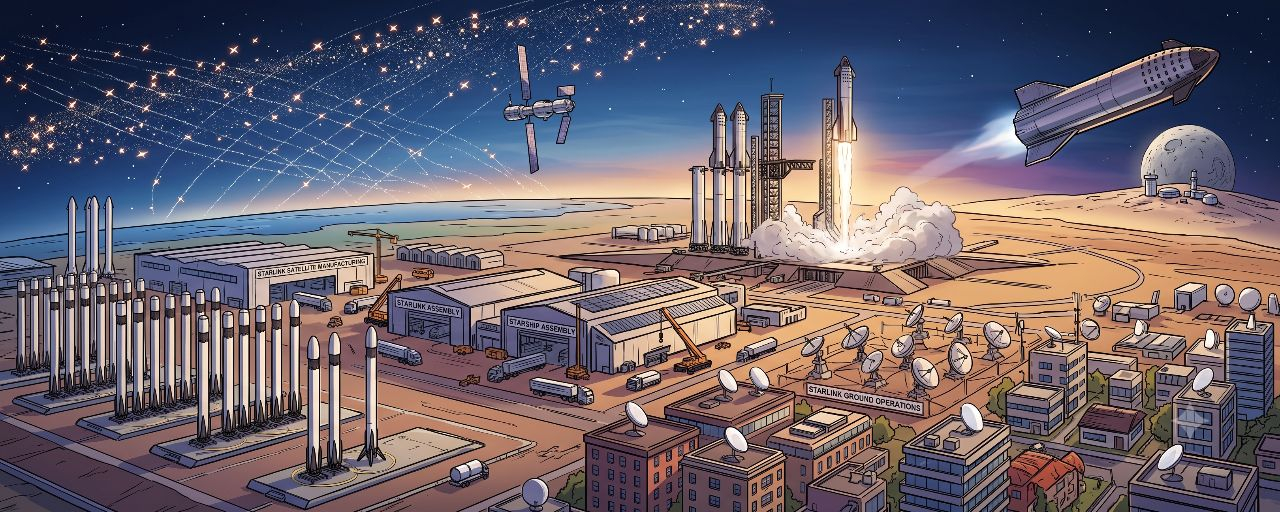
Article
SpaceX’s First Post-IPO Earnings Report: The $7.8 Billion Revenue Story Behind a Space Empire I. First Earnings Report Reveals Strong Growth but Persistent Profitability Pressure
SpaceX’s first earnings report following its public listing has provided investors with the first comprehensive view of how the company is transitioning from a privately funded aerospace innovator into a publicly traded technology platform. For more than a decade, SpaceX expanded rapidly as a private company, relying on continuous capital injections to support rocket development, satellite deployment, and commercial space operations. As a result, external investors previously had limited visibility into the company’s actual revenue structure, profitability, and cash flow profile. The release of its first public financial results now offers the market a clearer picture of how SpaceX’s technology advantages are being converted into commercial value.
According to the earnings report, SpaceX generated approximately $7.8 billion in quarterly revenue, representing nearly 90% year-over-year growth. Such a growth rate remains rare among large global technology companies and demonstrates the company’s ability to scale its businesses at an exceptional pace. Unlike traditional aerospace companies that rely heavily on government contracts and long-term institutional projects, SpaceX has developed a more diversified business model built around rocket launches, satellite internet services, and future space infrastructure.
However, rapid revenue growth does not necessarily mean that SpaceX has entered a mature profitability stage. The company reported a quarterly net loss of approximately $541 million, highlighting that SpaceX remains in a period of aggressive investment rather than near-term profit maximization. For a company valued at hundreds of billions of dollars, investors are increasingly shifting their focus from whether SpaceX can grow revenue to whether that growth can eventually translate into sustainable profitability and stronger free cash flow.
The primary reason behind the current profitability pressure is the capital-intensive nature of the aerospace industry. Unlike software companies that can scale rapidly with relatively low incremental costs, SpaceX must continue investing heavily in rocket research and development, satellite manufacturing, launch infrastructure, and artificial intelligence-related capabilities. As a result, the company’s financial profile currently reflects a typical “high-growth, high-investment” model.
From a strategic perspective, SpaceX is not prioritizing short-term earnings optimization. Instead, the company is investing aggressively to build long-term competitive advantages. This strategy resembles the early development stages of major technology platforms, where companies sacrifice near-term profitability in exchange for future market dominance.
Over the next several years, the key question for investors will not simply be whether SpaceX can continue growing revenue, but whether these investments can create sustainable earnings engines through Starlink, Starship, and emerging technology businesses. If Starlink continues expanding while improving profitability, and if Starship achieves commercial success, today’s massive capital expenditures could become the foundation of SpaceX’s long-term competitive moat. However, if technological progress slows or commercialization takes longer than expected, the company’s high-investment strategy could become a significant valuation risk.
II. Starlink Becomes SpaceX’s Core Growth Engine as Satellite Internet Enters Commercial Expansion
Within SpaceX’s business ecosystem, Starlink has become the company’s most important revenue driver and the central asset determining its long-term commercial value.
Historically, SpaceX built its reputation through the Falcon 9 launch business. By pioneering reusable rocket technology, the company significantly reduced launch costs and secured contracts from NASA, government agencies, defense organizations, and commercial satellite operators. However, the global launch market itself has natural limitations. Even with technological advantages, rocket launches alone are unlikely to support a company reaching a multi-hundred-billion-dollar valuation because annual demand remains relatively constrained.
Starlink fundamentally changed SpaceX’s growth trajectory.
According to financial disclosures, SpaceX generated approximately $7.8 billion in quarterly revenue, with Starlink-related operations contributing around $4.29 billion, accounting for more than half of total revenue. This demonstrates that SpaceX is gradually transforming from a traditional aerospace company into a global communications infrastructure provider.
Starlink’s competitive advantage comes from its low Earth orbit satellite network. Traditional satellite communication systems rely primarily on high-altitude satellites, which suffer from high latency, limited bandwidth, and expensive operating costs. These limitations restricted satellite communication largely to government, military, and specialized industries.
By deploying thousands of low Earth orbit satellites, Starlink has significantly improved network speed and reduced latency, allowing satellite internet to compete more directly with terrestrial broadband services. This technological shift has expanded the potential market from specialized applications into consumer broadband, enterprise connectivity, aviation, maritime communications, and government services.
Starlink has already reached approximately 12 million users and continues to expand globally. However, the company’s future value depends not only on subscriber growth but also on improving customer quality and profitability. In the early expansion stage, Starlink focused heavily on increasing adoption and network coverage. As the business matures, enterprise customers, airlines, shipping companies, and government organizations are becoming increasingly important sources of revenue.
These customers are strategically valuable because they typically provide higher average revenue per user and longer contract periods. For example, airlines require reliable in-flight connectivity, shipping companies need continuous communication coverage across oceans, and governments increasingly view satellite networks as critical communication infrastructure.
Therefore, Starlink is not simply an internet service business; it represents the development of a global communications platform.
Nevertheless, Starlink still faces challenges in improving profitability. As the company expands into new geographic markets, it has introduced more affordable pricing plans to accelerate adoption, which has reduced average revenue per user. Going forward, Starlink will need to increase enterprise penetration, develop additional services, and upgrade network capabilities to improve monetization.
In the long run, the true value of Starlink lies not only in its current revenue contribution, but in whether it can become a foundational infrastructure platform similar to cloud computing services.
III. Starship Determines SpaceX’s Long-Term Valuation Ceiling and the Future of Space Infrastructure
If Starlink represents SpaceX’s near- to medium-term cash flow engine, Starship represents the company’s long-term strategic ambition and valuation potential.
Starship is not simply a next-generation rocket project; it is the foundation of SpaceX’s future commercial space ecosystem. For decades, the biggest limitation of the aerospace industry has been the extremely high cost of reaching space. Traditional rockets are largely expendable systems, requiring significant manufacturing resources for each mission and preventing large-scale commercial expansion.
SpaceX changed the industry through Falcon 9’s reusable first-stage technology, dramatically lowering launch costs. Starship aims to take this concept much further by achieving full reusability for an entire launch system.
If successful, Starship could fundamentally reshape the economics of space transportation.
For Starlink, the importance of Starship is particularly significant. Future generations of Starlink satellites are expected to be larger and more advanced, requiring greater launch capacity. A fully operational Starship system would allow SpaceX to deploy more satellites per mission, reduce deployment costs, and accelerate global network expansion.
Beyond Starlink, Starship could create entirely new commercial opportunities, including lunar transportation, deep-space exploration, space station logistics, and potentially space tourism.
From an investment perspective, Starship represents far more than a rocket program. It represents the possibility of creating a new space infrastructure industry. If SpaceX can dramatically reduce transportation costs, many previously unrealistic commercial space applications could become economically viable.
However, Starship is also one of SpaceX’s largest risks. The project involves extraordinary technical complexity, requiring breakthroughs in propulsion systems, materials science, orbital operations, safety systems, and full reusability. Any delay could extend development timelines and increase capital requirements.
As a result, the future market valuation of SpaceX will depend heavily on whether Starship can successfully transition from an ambitious engineering project into a commercially scalable platform.
IV. Continued High Investment Strategy and AI Expansion Open New Growth Opportunities
Beyond Starlink and Starship, artificial intelligence has emerged as another strategic direction for SpaceX’s future development. While the company has historically been defined by rocket technology and satellite communications, its latest expansion into AI-related infrastructure indicates that SpaceX is gradually broadening its business scope beyond traditional aerospace.
According to financial disclosures, SpaceX’s artificial intelligence-related business has experienced rapid growth, increasing by approximately 250% year over year. Although AI currently remains much smaller than Starlink in terms of revenue contribution, its strong growth trajectory suggests that SpaceX is exploring another potential long-term growth engine.
SpaceX’s entry into the AI sector is supported by several strategic advantages. First, the future aerospace industry itself will increasingly depend on artificial intelligence technologies. Autonomous rocket operations, satellite network management, mission planning, and large-scale data processing all require advanced AI capabilities. Therefore, AI is not an unrelated business expansion but a natural extension of SpaceX’s existing technological ecosystem.
Second, the rapid development of artificial intelligence requires massive infrastructure investment, including computing capacity, data processing systems, and global connectivity networks. SpaceX has accumulated significant experience in engineering, large-scale manufacturing, energy management, and global communications infrastructure through its aerospace operations. These capabilities could potentially provide the foundation for the company’s expansion into AI infrastructure.
In addition, Starlink and AI may create meaningful synergies in the future. A global satellite network could provide broader connectivity for AI-driven applications, while artificial intelligence could improve satellite operations, network efficiency, and autonomous management.
However, the AI market has become one of the most competitive and capital-intensive sectors in the technology industry. Companies such as Microsoft, Google, Amazon, and Nvidia are investing hundreds of billions of dollars into AI models, data centers, and computing infrastructure. For SpaceX, entering this market requires more than financial investment; the company must demonstrate that it can build a differentiated advantage rather than simply compete in a crowded AI infrastructure race.
At the current stage, AI should be viewed as a strategic expansion rather than a near-term profit driver. The long-term value of this business will depend on whether SpaceX can successfully combine its aerospace, satellite, and infrastructure capabilities into a unique technology ecosystem.
V. Post-IPO Market Challenges: Cash Flow, Valuation Pressure, and Share Lock-Up Concerns
Following its public listing, SpaceX faces a new set of challenges beyond operational growth. As a publicly traded company, SpaceX must now satisfy not only technological ambitions but also the expectations of public market investors who closely monitor profitability, capital efficiency, and valuation sustainability.
Because SpaceX remained privately held for many years, a significant portion of its shares is owned by early investors, institutional funds, and employees. As post-IPO lock-up periods expire, additional shares may become available for trading, potentially increasing short-term market supply and creating volatility.
However, the release of locked-up shares does not necessarily indicate that investors are losing confidence in the company. It is a common process following major public offerings and does not directly determine long-term business value. The fundamental drivers of SpaceX’s valuation remain its operational performance and ability to execute its long-term strategy.
If Starlink continues expanding its revenue base, Starship achieves commercial breakthroughs, and AI-related initiatives create additional growth opportunities, short-term market fluctuations are unlikely to change the company’s long-term investment thesis.
However, if business growth slows, capital expenditures fail to generate sufficient returns, or commercialization timelines extend beyond market expectations, SpaceX’s high valuation could face significant reassessment.
The company’s current market valuation already reflects investor expectations for the next decade of growth. Therefore, SpaceX must continuously demonstrate that its future opportunities justify the premium valuation assigned by the market.
Going forward, investors will focus on several key questions: whether Starlink can continue improving profitability, whether Starship can significantly reduce space transportation costs, and whether massive capital investments can ultimately generate higher returns.
These factors will determine how the market evaluates SpaceX’s long-term financial potential.
VI. Conclusion
SpaceX is currently undergoing a fundamental transformation from a commercial aerospace company into a broader technology platform. The company first disrupted the global launch industry through reusable rocket technology, and it is now expanding beyond traditional aerospace by building a global satellite communication network through Starlink and developing next-generation space transportation capabilities through Starship.
The future value of SpaceX will not be determined solely by the number of rocket launches it completes or the revenue generated by a single business segment. Instead, its long-term success will depend on whether the company can establish a comprehensive technology ecosystem that combines satellite communications, space transportation, and artificial intelligence infrastructure.
If Starlink continues improving profitability, Starship successfully transitions into a commercial transportation platform, and AI-related businesses develop into meaningful growth drivers, SpaceX could evolve into a foundational technology company similar to other infrastructure platforms that have reshaped the global economy.
At the same time, SpaceX’s high-investment and high-valuation business model means that the market will continue evaluating whether its technological advantages can ultimately translate into sustainable commercial returns.
For investors, the greatest attraction of SpaceX lies in its ability to create entirely new industries and redefine the boundaries of existing ones. However, its greatest challenge is equally clear: transforming ambitious long-term visions into measurable financial results.
Ultimately, SpaceX’s future will not be determined by a single earnings report, but by whether the company can successfully convert technological leadership into lasting economic value.
SpaceX’s First Post-IPO Earnings Report: The $7.8 Billion Revenue Story Behind a Space Empire
I. First Earnings Report Reveals Strong Growth but Persistent Profitability Pressure
SpaceX’s first earnings report following its public listing has provided investors with the first comprehensive view of how the company is transitioning from a privately funded aerospace innovator into a publicly traded technology platform. For more than a decade, SpaceX expanded rapidly as a private company, relying on continuous capital injections to support rocket development, satellite deployment, and commercial space operations. As a result, external investors previously had limited visibility into the company’s actual revenue structure, profitability, and cash flow profile. The release of its first public financial results now offers the market a clearer picture of how SpaceX’s technology advantages are being converted into commercial value.
According to the earnings report, SpaceX generated approximately $7.8 billion in quarterly revenue, representing nearly 90% year-over-year growth. Such a growth rate remains rare among large global technology companies and demonstrates the company’s ability to scale its businesses at an exceptional pace. Unlike traditional aerospace companies that rely heavily on government contracts and long-term institutional projects, SpaceX has developed a more diversified business model built around rocket launches, satellite internet services, and future space infrastructure.
However, rapid revenue growth does not necessarily mean that SpaceX has entered a mature profitability stage. The company reported a quarterly net loss of approximately $541 million, highlighting that SpaceX remains in a period of aggressive investment rather than near-term profit maximization. For a company valued at hundreds of billions of dollars, investors are increasingly shifting their focus from whether SpaceX can grow revenue to whether that growth can eventually translate into sustainable profitability and stronger free cash flow.
The primary reason behind the current profitability pressure is the capital-intensive nature of the aerospace industry. Unlike software companies that can scale rapidly with relatively low incremental costs, SpaceX must continue investing heavily in rocket research and development, satellite manufacturing, launch infrastructure, and artificial intelligence-related capabilities. As a result, the company’s financial profile currently reflects a typical “high-growth, high-investment” model.
From a strategic perspective, SpaceX is not prioritizing short-term earnings optimization. Instead, the company is investing aggressively to build long-term competitive advantages. This strategy resembles the early development stages of major technology platforms, where companies sacrifice near-term profitability in exchange for future market dominance.
Over the next several years, the key question for investors will not simply be whether SpaceX can continue growing revenue, but whether these investments can create sustainable earnings engines through Starlink, Starship, and emerging technology businesses. If Starlink continues expanding while improving profitability, and if Starship achieves commercial success, today’s massive capital expenditures could become the foundation of SpaceX’s long-term competitive moat. However, if technological progress slows or commercialization takes longer than expected, the company’s high-investment strategy could become a significant valuation risk.
II. Starlink Becomes SpaceX’s Core Growth Engine as Satellite Internet Enters Commercial Expansion
Within SpaceX’s business ecosystem, Starlink has become the company’s most important revenue driver and the central asset determining its long-term commercial value.
Historically, SpaceX built its reputation through the Falcon 9 launch business. By pioneering reusable rocket technology, the company significantly reduced launch costs and secured contracts from NASA, government agencies, defense organizations, and commercial satellite operators. However, the global launch market itself has natural limitations. Even with technological advantages, rocket launches alone are unlikely to support a company reaching a multi-hundred-billion-dollar valuation because annual demand remains relatively constrained.
Starlink fundamentally changed SpaceX’s growth trajectory.
According to financial disclosures, SpaceX generated approximately $7.8 billion in quarterly revenue, with Starlink-related operations contributing around $4.29 billion, accounting for more than half of total revenue. This demonstrates that SpaceX is gradually transforming from a traditional aerospace company into a global communications infrastructure provider.
Starlink’s competitive advantage comes from its low Earth orbit satellite network. Traditional satellite communication systems rely primarily on high-altitude satellites, which suffer from high latency, limited bandwidth, and expensive operating costs. These limitations restricted satellite communication largely to government, military, and specialized industries.
By deploying thousands of low Earth orbit satellites, Starlink has significantly improved network speed and reduced latency, allowing satellite internet to compete more directly with terrestrial broadband services. This technological shift has expanded the potential market from specialized applications into consumer broadband, enterprise connectivity, aviation, maritime communications, and government services.
Starlink has already reached approximately 12 million users and continues to expand globally. However, the company’s future value depends not only on subscriber growth but also on improving customer quality and profitability. In the early expansion stage, Starlink focused heavily on increasing adoption and network coverage. As the business matures, enterprise customers, airlines, shipping companies, and government organizations are becoming increasingly important sources of revenue.
These customers are strategically valuable because they typically provide higher average revenue per user and longer contract periods. For example, airlines require reliable in-flight connectivity, shipping companies need continuous communication coverage across oceans, and governments increasingly view satellite networks as critical communication infrastructure.
Therefore, Starlink is not simply an internet service business; it represents the development of a global communications platform.
Nevertheless, Starlink still faces challenges in improving profitability. As the company expands into new geographic markets, it has introduced more affordable pricing plans to accelerate adoption, which has reduced average revenue per user. Going forward, Starlink will need to increase enterprise penetration, develop additional services, and upgrade network capabilities to improve monetization.
In the long run, the true value of Starlink lies not only in its current revenue contribution, but in whether it can become a foundational infrastructure platform similar to cloud computing services.
III. Starship Determines SpaceX’s Long-Term Valuation Ceiling and the Future of Space Infrastructure
If Starlink represents SpaceX’s near- to medium-term cash flow engine, Starship represents the company’s long-term strategic ambition and valuation potential.
Starship is not simply a next-generation rocket project; it is the foundation of SpaceX’s future commercial space ecosystem. For decades, the biggest limitation of the aerospace industry has been the extremely high cost of reaching space. Traditional rockets are largely expendable systems, requiring significant manufacturing resources for each mission and preventing large-scale commercial expansion.
SpaceX changed the industry through Falcon 9’s reusable first-stage technology, dramatically lowering launch costs. Starship aims to take this concept much further by achieving full reusability for an entire launch system.
If successful, Starship could fundamentally reshape the economics of space transportation.
For Starlink, the importance of Starship is particularly significant. Future generations of Starlink satellites are expected to be larger and more advanced, requiring greater launch capacity. A fully operational Starship system would allow SpaceX to deploy more satellites per mission, reduce deployment costs, and accelerate global network expansion.
Beyond Starlink, Starship could create entirely new commercial opportunities, including lunar transportation, deep-space exploration, space station logistics, and potentially space tourism.
From an investment perspective, Starship represents far more than a rocket program. It represents the possibility of creating a new space infrastructure industry. If SpaceX can dramatically reduce transportation costs, many previously unrealistic commercial space applications could become economically viable.
However, Starship is also one of SpaceX’s largest risks. The project involves extraordinary technical complexity, requiring breakthroughs in propulsion systems, materials science, orbital operations, safety systems, and full reusability. Any delay could extend development timelines and increase capital requirements.
As a result, the future market valuation of SpaceX will depend heavily on whether Starship can successfully transition from an ambitious engineering project into a commercially scalable platform.
IV. Continued High Investment Strategy and AI Expansion Open New Growth Opportunities
Beyond Starlink and Starship, artificial intelligence has emerged as another strategic direction for SpaceX’s future development. While the company has historically been defined by rocket technology and satellite communications, its latest expansion into AI-related infrastructure indicates that SpaceX is gradually broadening its business scope beyond traditional aerospace.
According to financial disclosures, SpaceX’s artificial intelligence-related business has experienced rapid growth, increasing by approximately 250% year over year. Although AI currently remains much smaller than Starlink in terms of revenue contribution, its strong growth trajectory suggests that SpaceX is exploring another potential long-term growth engine.
SpaceX’s entry into the AI sector is supported by several strategic advantages. First, the future aerospace industry itself will increasingly depend on artificial intelligence technologies. Autonomous rocket operations, satellite network management, mission planning, and large-scale data processing all require advanced AI capabilities. Therefore, AI is not an unrelated business expansion but a natural extension of SpaceX’s existing technological ecosystem.
Second, the rapid development of artificial intelligence requires massive infrastructure investment, including computing capacity, data processing systems, and global connectivity networks. SpaceX has accumulated significant experience in engineering, large-scale manufacturing, energy management, and global communications infrastructure through its aerospace operations. These capabilities could potentially provide the foundation for the company’s expansion into AI infrastructure.
In addition, Starlink and AI may create meaningful synergies in the future. A global satellite network could provide broader connectivity for AI-driven applications, while artificial intelligence could improve satellite operations, network efficiency, and autonomous management.
However, the AI market has become one of the most competitive and capital-intensive sectors in the technology industry. Companies such as Microsoft, Google, Amazon, and Nvidia are investing hundreds of billions of dollars into AI models, data centers, and computing infrastructure. For SpaceX, entering this market requires more than financial investment; the company must demonstrate that it can build a differentiated advantage rather than simply compete in a crowded AI infrastructure race.
At the current stage, AI should be viewed as a strategic expansion rather than a near-term profit driver. The long-term value of this business will depend on whether SpaceX can successfully combine its aerospace, satellite, and infrastructure capabilities into a unique technology ecosystem.
V. Post-IPO Market Challenges: Cash Flow, Valuation Pressure, and Share Lock-Up Concerns
Following its public listing, SpaceX faces a new set of challenges beyond operational growth. As a publicly traded company, SpaceX must now satisfy not only technological ambitions but also the expectations of public market investors who closely monitor profitability, capital efficiency, and valuation sustainability.
Because SpaceX remained privately held for many years, a significant portion of its shares is owned by early investors, institutional funds, and employees. As post-IPO lock-up periods expire, additional shares may become available for trading, potentially increasing short-term market supply and creating volatility.
However, the release of locked-up shares does not necessarily indicate that investors are losing confidence in the company. It is a common process following major public offerings and does not directly determine long-term business value. The fundamental drivers of SpaceX’s valuation remain its operational performance and ability to execute its long-term strategy.
If Starlink continues expanding its revenue base, Starship achieves commercial breakthroughs, and AI-related initiatives create additional growth opportunities, short-term market fluctuations are unlikely to change the company’s long-term investment thesis.
However, if business growth slows, capital expenditures fail to generate sufficient returns, or commercialization timelines extend beyond market expectations, SpaceX’s high valuation could face significant reassessment.
The company’s current market valuation already reflects investor expectations for the next decade of growth. Therefore, SpaceX must continuously demonstrate that its future opportunities justify the premium valuation assigned by the market.
Going forward, investors will focus on several key questions: whether Starlink can continue improving profitability, whether Starship can significantly reduce space transportation costs, and whether massive capital investments can ultimately generate higher returns.
These factors will determine how the market evaluates SpaceX’s long-term financial potential.
VI. Conclusion
SpaceX is currently undergoing a fundamental transformation from a commercial aerospace company into a broader technology platform. The company first disrupted the global launch industry through reusable rocket technology, and it is now expanding beyond traditional aerospace by building a global satellite communication network through Starlink and developing next-generation space transportation capabilities through Starship.
The future value of SpaceX will not be determined solely by the number of rocket launches it completes or the revenue generated by a single business segment. Instead, its long-term success will depend on whether the company can establish a comprehensive technology ecosystem that combines satellite communications, space transportation, and artificial intelligence infrastructure.
If Starlink continues improving profitability, Starship successfully transitions into a commercial transportation platform, and AI-related businesses develop into meaningful growth drivers, SpaceX could evolve into a foundational technology company similar to other infrastructure platforms that have reshaped the global economy.
At the same time, SpaceX’s high-investment and high-valuation business model means that the market will continue evaluating whether its technological advantages can ultimately translate into sustainable commercial returns.
For investors, the greatest attraction of SpaceX lies in its ability to create entirely new industries and redefine the boundaries of existing ones. However, its greatest challenge is equally clear: transforming ambitious long-term visions into measurable financial results.
Ultimately, SpaceX’s future will not be determined by a single earnings report, but by whether the company can successfully convert technological leadership into lasting economic value.
SpaceX’s first earnings report following its public listing has provided investors with the first comprehensive view of how the company is transitioning from a privately funded aerospace innovator into a publicly traded technology platform. For more than a decade, SpaceX expanded rapidly as a private company, relying on continuous capital injections to support rocket development, satellite deployment, and commercial space operations. As a result, external investors previously had limited visibility into the company’s actual revenue structure, profitability, and cash flow profile. The release of its first public financial results now offers the market a clearer picture of how SpaceX’s technology advantages are being converted into commercial value.
According to the earnings report, SpaceX generated approximately $7.8 billion in quarterly revenue, representing nearly 90% year-over-year growth. Such a growth rate remains rare among large global technology companies and demonstrates the company’s ability to scale its businesses at an exceptional pace. Unlike traditional aerospace companies that rely heavily on government contracts and long-term institutional projects, SpaceX has developed a more diversified business model built around rocket launches, satellite internet services, and future space infrastructure.
However, rapid revenue growth does not necessarily mean that SpaceX has entered a mature profitability stage. The company reported a quarterly net loss of approximately $541 million, highlighting that SpaceX remains in a period of aggressive investment rather than near-term profit maximization. For a company valued at hundreds of billions of dollars, investors are increasingly shifting their focus from whether SpaceX can grow revenue to whether that growth can eventually translate into sustainable profitability and stronger free cash flow.
The primary reason behind the current profitability pressure is the capital-intensive nature of the aerospace industry. Unlike software companies that can scale rapidly with relatively low incremental costs, SpaceX must continue investing heavily in rocket research and development, satellite manufacturing, launch infrastructure, and artificial intelligence-related capabilities. As a result, the company’s financial profile currently reflects a typical “high-growth, high-investment” model.
From a strategic perspective, SpaceX is not prioritizing short-term earnings optimization. Instead, the company is investing aggressively to build long-term competitive advantages. This strategy resembles the early development stages of major technology platforms, where companies sacrifice near-term profitability in exchange for future market dominance.
Over the next several years, the key question for investors will not simply be whether SpaceX can continue growing revenue, but whether these investments can create sustainable earnings engines through Starlink, Starship, and emerging technology businesses. If Starlink continues expanding while improving profitability, and if Starship achieves commercial success, today’s massive capital expenditures could become the foundation of SpaceX’s long-term competitive moat. However, if technological progress slows or commercialization takes longer than expected, the company’s high-investment strategy could become a significant valuation risk.
II. Starlink Becomes SpaceX’s Core Growth Engine as Satellite Internet Enters Commercial Expansion
Within SpaceX’s business ecosystem, Starlink has become the company’s most important revenue driver and the central asset determining its long-term commercial value.
Historically, SpaceX built its reputation through the Falcon 9 launch business. By pioneering reusable rocket technology, the company significantly reduced launch costs and secured contracts from NASA, government agencies, defense organizations, and commercial satellite operators. However, the global launch market itself has natural limitations. Even with technological advantages, rocket launches alone are unlikely to support a company reaching a multi-hundred-billion-dollar valuation because annual demand remains relatively constrained.
Starlink fundamentally changed SpaceX’s growth trajectory.
According to financial disclosures, SpaceX generated approximately $7.8 billion in quarterly revenue, with Starlink-related operations contributing around $4.29 billion, accounting for more than half of total revenue. This demonstrates that SpaceX is gradually transforming from a traditional aerospace company into a global communications infrastructure provider.
Starlink’s competitive advantage comes from its low Earth orbit satellite network. Traditional satellite communication systems rely primarily on high-altitude satellites, which suffer from high latency, limited bandwidth, and expensive operating costs. These limitations restricted satellite communication largely to government, military, and specialized industries.
By deploying thousands of low Earth orbit satellites, Starlink has significantly improved network speed and reduced latency, allowing satellite internet to compete more directly with terrestrial broadband services. This technological shift has expanded the potential market from specialized applications into consumer broadband, enterprise connectivity, aviation, maritime communications, and government services.
Starlink has already reached approximately 12 million users and continues to expand globally. However, the company’s future value depends not only on subscriber growth but also on improving customer quality and profitability. In the early expansion stage, Starlink focused heavily on increasing adoption and network coverage. As the business matures, enterprise customers, airlines, shipping companies, and government organizations are becoming increasingly important sources of revenue.
These customers are strategically valuable because they typically provide higher average revenue per user and longer contract periods. For example, airlines require reliable in-flight connectivity, shipping companies need continuous communication coverage across oceans, and governments increasingly view satellite networks as critical communication infrastructure.
Therefore, Starlink is not simply an internet service business; it represents the development of a global communications platform.
Nevertheless, Starlink still faces challenges in improving profitability. As the company expands into new geographic markets, it has introduced more affordable pricing plans to accelerate adoption, which has reduced average revenue per user. Going forward, Starlink will need to increase enterprise penetration, develop additional services, and upgrade network capabilities to improve monetization.
In the long run, the true value of Starlink lies not only in its current revenue contribution, but in whether it can become a foundational infrastructure platform similar to cloud computing services.
III. Starship Determines SpaceX’s Long-Term Valuation Ceiling and the Future of Space Infrastructure
If Starlink represents SpaceX’s near- to medium-term cash flow engine, Starship represents the company’s long-term strategic ambition and valuation potential.
Starship is not simply a next-generation rocket project; it is the foundation of SpaceX’s future commercial space ecosystem. For decades, the biggest limitation of the aerospace industry has been the extremely high cost of reaching space. Traditional rockets are largely expendable systems, requiring significant manufacturing resources for each mission and preventing large-scale commercial expansion.
SpaceX changed the industry through Falcon 9’s reusable first-stage technology, dramatically lowering launch costs. Starship aims to take this concept much further by achieving full reusability for an entire launch system.
If successful, Starship could fundamentally reshape the economics of space transportation.
For Starlink, the importance of Starship is particularly significant. Future generations of Starlink satellites are expected to be larger and more advanced, requiring greater launch capacity. A fully operational Starship system would allow SpaceX to deploy more satellites per mission, reduce deployment costs, and accelerate global network expansion.
Beyond Starlink, Starship could create entirely new commercial opportunities, including lunar transportation, deep-space exploration, space station logistics, and potentially space tourism.
From an investment perspective, Starship represents far more than a rocket program. It represents the possibility of creating a new space infrastructure industry. If SpaceX can dramatically reduce transportation costs, many previously unrealistic commercial space applications could become economically viable.
However, Starship is also one of SpaceX’s largest risks. The project involves extraordinary technical complexity, requiring breakthroughs in propulsion systems, materials science, orbital operations, safety systems, and full reusability. Any delay could extend development timelines and increase capital requirements.
As a result, the future market valuation of SpaceX will depend heavily on whether Starship can successfully transition from an ambitious engineering project into a commercially scalable platform.
IV. Continued High Investment Strategy and AI Expansion Open New Growth Opportunities
Beyond Starlink and Starship, artificial intelligence has emerged as another strategic direction for SpaceX’s future development. While the company has historically been defined by rocket technology and satellite communications, its latest expansion into AI-related infrastructure indicates that SpaceX is gradually broadening its business scope beyond traditional aerospace.
According to financial disclosures, SpaceX’s artificial intelligence-related business has experienced rapid growth, increasing by approximately 250% year over year. Although AI currently remains much smaller than Starlink in terms of revenue contribution, its strong growth trajectory suggests that SpaceX is exploring another potential long-term growth engine.
SpaceX’s entry into the AI sector is supported by several strategic advantages. First, the future aerospace industry itself will increasingly depend on artificial intelligence technologies. Autonomous rocket operations, satellite network management, mission planning, and large-scale data processing all require advanced AI capabilities. Therefore, AI is not an unrelated business expansion but a natural extension of SpaceX’s existing technological ecosystem.
Second, the rapid development of artificial intelligence requires massive infrastructure investment, including computing capacity, data processing systems, and global connectivity networks. SpaceX has accumulated significant experience in engineering, large-scale manufacturing, energy management, and global communications infrastructure through its aerospace operations. These capabilities could potentially provide the foundation for the company’s expansion into AI infrastructure.
In addition, Starlink and AI may create meaningful synergies in the future. A global satellite network could provide broader connectivity for AI-driven applications, while artificial intelligence could improve satellite operations, network efficiency, and autonomous management.
However, the AI market has become one of the most competitive and capital-intensive sectors in the technology industry. Companies such as Microsoft, Google, Amazon, and Nvidia are investing hundreds of billions of dollars into AI models, data centers, and computing infrastructure. For SpaceX, entering this market requires more than financial investment; the company must demonstrate that it can build a differentiated advantage rather than simply compete in a crowded AI infrastructure race.
At the current stage, AI should be viewed as a strategic expansion rather than a near-term profit driver. The long-term value of this business will depend on whether SpaceX can successfully combine its aerospace, satellite, and infrastructure capabilities into a unique technology ecosystem.
V. Post-IPO Market Challenges: Cash Flow, Valuation Pressure, and Share Lock-Up Concerns
Following its public listing, SpaceX faces a new set of challenges beyond operational growth. As a publicly traded company, SpaceX must now satisfy not only technological ambitions but also the expectations of public market investors who closely monitor profitability, capital efficiency, and valuation sustainability.
Because SpaceX remained privately held for many years, a significant portion of its shares is owned by early investors, institutional funds, and employees. As post-IPO lock-up periods expire, additional shares may become available for trading, potentially increasing short-term market supply and creating volatility.
However, the release of locked-up shares does not necessarily indicate that investors are losing confidence in the company. It is a common process following major public offerings and does not directly determine long-term business value. The fundamental drivers of SpaceX’s valuation remain its operational performance and ability to execute its long-term strategy.
If Starlink continues expanding its revenue base, Starship achieves commercial breakthroughs, and AI-related initiatives create additional growth opportunities, short-term market fluctuations are unlikely to change the company’s long-term investment thesis.
However, if business growth slows, capital expenditures fail to generate sufficient returns, or commercialization timelines extend beyond market expectations, SpaceX’s high valuation could face significant reassessment.
The company’s current market valuation already reflects investor expectations for the next decade of growth. Therefore, SpaceX must continuously demonstrate that its future opportunities justify the premium valuation assigned by the market.
Going forward, investors will focus on several key questions: whether Starlink can continue improving profitability, whether Starship can significantly reduce space transportation costs, and whether massive capital investments can ultimately generate higher returns.
These factors will determine how the market evaluates SpaceX’s long-term financial potential.
VI. Conclusion
SpaceX is currently undergoing a fundamental transformation from a commercial aerospace company into a broader technology platform. The company first disrupted the global launch industry through reusable rocket technology, and it is now expanding beyond traditional aerospace by building a global satellite communication network through Starlink and developing next-generation space transportation capabilities through Starship.
The future value of SpaceX will not be determined solely by the number of rocket launches it completes or the revenue generated by a single business segment. Instead, its long-term success will depend on whether the company can establish a comprehensive technology ecosystem that combines satellite communications, space transportation, and artificial intelligence infrastructure.
If Starlink continues improving profitability, Starship successfully transitions into a commercial transportation platform, and AI-related businesses develop into meaningful growth drivers, SpaceX could evolve into a foundational technology company similar to other infrastructure platforms that have reshaped the global economy.
At the same time, SpaceX’s high-investment and high-valuation business model means that the market will continue evaluating whether its technological advantages can ultimately translate into sustainable commercial returns.
For investors, the greatest attraction of SpaceX lies in its ability to create entirely new industries and redefine the boundaries of existing ones. However, its greatest challenge is equally clear: transforming ambitious long-term visions into measurable financial results.
Ultimately, SpaceX’s future will not be determined by a single earnings report, but by whether the company can successfully convert technological leadership into lasting economic value.
130
137 · Market Pulse✨ 8-4
24H Market Highlights — Quick Overview
1/ Major reshuffle among U.S. tech giants: Amazon surpasses $3 trillion in market capitalization, posting its largest single-day gain in 14 years. Its market value increased by nearly $400 billion, making it the fifth company in history to reach the $3 trillion milestone;
2/ Major security vulnerability discovered in Coldcard hardware wallets: losses could approach $114 million, with a suspected fourth wave of attacks potentially underway;
3/ Morgan Stanley significantly cuts Circle price target from $106 to $38, citing USDC supply contraction and increased sensitivity to reserve income. Meanwhile, Circle acquired nearly 1,000 blockchain patents from IBM, raising concerns over potential “patent weaponization.” Circle shares briefly rose around 2% following the announcement;
4/ U.S. Treasury market remains under pressure, with the 30-year Treasury yield reaching its highest level in nearly 19 years;
5/ Altcoin trading volume share on Binance rises to 60%, signaling a shift in BTC market structure;
6/ Hyperliquid burned approximately $760,000 worth of HYPE over the past 24 hours, bringing total burns to $2.5 billion (4.62% of total supply). The protocol is also proposing to increase the maximum HYPE collateral borrowing LTV ratio from 50% to 65%, with current mainnet active borrowing volume approaching $100 million;
7/ Total crypto liquidations reached $251 million over the past 24 hours, while Bitcoin ETFs continued to see net outflows;
8/ DRAM/HBM production capacity for 2027 has already been fully booked ahead of schedule.
137 · Market Pulse✨ 8-4
24H Market Highlights — Quick Overview
1/ Major reshuffle among U.S. tech giants: Amazon surpasses $3 trillion in market capitalization, posting its largest single-day gain in 14 years. Its market value increased by nearly $400 billion, making it the fifth company in history to reach the $3 trillion milestone;
2/ Major security vulnerability discovered in Coldcard hardware wallets: losses could approach $114 million, with a suspected fourth wave of attacks potentially underway;
3/ Morgan Stanley significantly cuts Circle price target from $106 to $38, citing USDC supply contraction and increased sensitivity to reserve income. Meanwhile, Circle acquired nearly 1,000 blockchain patents from IBM, raising concerns over potential “patent weaponization.” Circle shares briefly rose around 2% following the announcement;
4/ U.S. Treasury market remains under pressure, with the 30-year Treasury yield reaching its highest level in nearly 19 years;
5/ Altcoin trading volume share on Binance rises to 60%, signaling a shift in BTC market structure;
6/ Hyperliquid burned approximately $760,000 worth of HYPE over the past 24 hours, bringing total burns to $2.5 billion (4.62% of total supply). The protocol is also proposing to increase the maximum HYPE collateral borrowing LTV ratio from 50% to 65%, with current mainnet active borrowing volume approaching $100 million;
7/ Total crypto liquidations reached $251 million over the past 24 hours, while Bitcoin ETFs continued to see net outflows;
8/ DRAM/HBM production capacity for 2027 has already been fully booked ahead of schedule.
24H Market Highlights — Quick Overview
1/ Major reshuffle among U.S. tech giants: Amazon surpasses $3 trillion in market capitalization, posting its largest single-day gain in 14 years. Its market value increased by nearly $400 billion, making it the fifth company in history to reach the $3 trillion milestone;
2/ Major security vulnerability discovered in Coldcard hardware wallets: losses could approach $114 million, with a suspected fourth wave of attacks potentially underway;
3/ Morgan Stanley significantly cuts Circle price target from $106 to $38, citing USDC supply contraction and increased sensitivity to reserve income. Meanwhile, Circle acquired nearly 1,000 blockchain patents from IBM, raising concerns over potential “patent weaponization.” Circle shares briefly rose around 2% following the announcement;
4/ U.S. Treasury market remains under pressure, with the 30-year Treasury yield reaching its highest level in nearly 19 years;
5/ Altcoin trading volume share on Binance rises to 60%, signaling a shift in BTC market structure;
6/ Hyperliquid burned approximately $760,000 worth of HYPE over the past 24 hours, bringing total burns to $2.5 billion (4.62% of total supply). The protocol is also proposing to increase the maximum HYPE collateral borrowing LTV ratio from 50% to 65%, with current mainnet active borrowing volume approaching $100 million;
7/ Total crypto liquidations reached $251 million over the past 24 hours, while Bitcoin ETFs continued to see net outflows;
8/ DRAM/HBM production capacity for 2027 has already been fully booked ahead of schedule.
94

Article
Robinhood Enters, Uniswap Captures Liquidity: What Happened in One MonthRecently, Uniswap has made another major move by officially launching the “Launches” tab on its Web App. The feature currently prioritizes Robinhood Chain, aggregating new tokens from multiple third-party launchpads directly into the Uniswap interface, allowing users to discover and trade without switching between different platforms.
Looking back at the past month, since Uniswap became the primary public AMM for Robinhood Chain on July 1, the chain’s trading volume, fees, and new token launches have all experienced significant growth. At the same time, UNI’s price has risen nearly 60% from its low level around the partnership announcement, and the market has begun to reprice this liquidity network deeply connected with a mainstream brokerage platform.
Below, we will walk through the timeline of events and discuss the broader investment implications.
July 1: The Partnership Officially Began
On July 1, 2026, Robinhood officially launched its own Layer 2 blockchain, Robinhood Chain. On the same day, Uniswap announced that v2, v3, v4, and UniswapX were all deployed on the network, with Uniswap becoming the primary public AMM for the chain.
This marked the first time Uniswap had deeply integrated with a self-built blockchain from a major traditional brokerage platform.
Robinhood Chain is built on the Arbitrum technology stack and is positioned as an institutional-grade, permissionless blockchain. It is natively connected to Robinhood’s user base, with a focus on real-world assets and tokenized stocks.
From day one, Uniswap provided full frontend support, including Web App, Wallet, and API access. Users can directly swap tokens, provide liquidity, and trade Robinhood Stock Tokens through UniswapX.
These tokenized stocks are fully transferable on-chain, enabling global users to trade 24/7 and breaking the traditional stock market’s limitations of fixed trading hours.
Both companies emphasized a shared mission: Robinhood lowers investment barriers from the traditional finance side, while Uniswap provides an open market infrastructure from the decentralized finance side. The two ecosystems have now truly converged through this blockchain.
How Did the Data Perform? Trading Volume and Fees Took Off Quickly
After the partnership went live, on-chain data showed rapid growth.
Trading volume on Uniswap through Robinhood Chain expanded quickly. In the first week, it already reached significant levels. On July 8, daily trading volume approached $500 million, and cumulative volume surpassed $10 billion in less than one month.
Over the past month, the network has contributed more than $12 billion in total trading volume, quickly becoming an important growth driver for Uniswap’s multichain expansion.
Fee contribution has also been significant. On certain trading days, Robinhood Chain accounted for a substantial portion of Uniswap’s total daily fees.
More notably, token issuance activity has been highly active. During July alone, more than 340,000 new tokens launched through various launchpads entered Uniswap liquidity pools, generating approximately $3.6 billion in trading volume.
Stock Tokens also contributed several hundred million dollars in real trading volume, demonstrating that tokenized stocks can operate within real DeFi environments.
These figures quickly pushed Robinhood Chain from a newly launched network into a significant position within Uniswap’s multichain ecosystem.
What Other Developments Happened This Month?
On July 30, Uniswap took another step forward by officially launching the “Launches” tab on its Web App.
The feature currently prioritizes Robinhood Chain, aggregating new tokens from third-party launchpads such as Bankr, Pons, and Long into a single interface. Users can discover, filter, and trade new assets directly within Uniswap without switching between platforms.
The official explanation stated that this tool aims to help new assets gain better distribution when they enter Uniswap liquidity pools, while also making it easier for traders to discover new opportunities.
At the same time, the community and on-chain observers noticed activity related to pools.trade. Domain records suggest a potential upcoming launch, accompanied by several test contracts and tokens. The market widely speculates that Uniswap may be preparing its own native launchpad, further integrating token issuance, price discovery, and trading.
These moves indicate that Uniswap is expanding upstream on Robinhood Chain and strengthening its position across the entire ecosystem.
UNI Price Performance Over the Past Month and Historical Review
First, looking at the recent price performance.
When the partnership officially went live on July 1, UNI was trading around $2.78. As Robinhood Chain’s trading volume and fee data continued to emerge, the price moved higher quickly.
By late July, UNI reached a peak of approximately $4.55, representing an increase of nearly 60% from the previous low.
Entering early August, the price pulled back slightly and is currently consolidating around $4.10. However, it remains significantly higher than before the partnership, with trading volume increasing alongside the move.
The market has clearly viewed this deep integration with a major brokerage platform as a meaningful positive catalyst.
Looking further back, UNI was officially launched through an airdrop on September 16, 2020. At that time, the Uniswap protocol had already been operating for nearly two years, and governance rights were distributed to early users through the community airdrop.
After launch, UNI gradually increased in value. During the DeFi boom and the release of Uniswap v3 in May 2021, it reached an all-time high of $44.92.
Following that, the token experienced a prolonged bear market and correction. The price remains approximately 90% below its historical high.
UNI’s circulating supply is currently around 625 million tokens, with a maximum supply of 1 billion tokens.
At the protocol level, Uniswap has processed more than $3.78 trillion in cumulative trading volume and generated more than $5.7 billion in total trading fees.
Although most fees initially went to liquidity providers, as the Fee Switch mechanism gradually becomes activated, the protocol itself has started capturing a portion of revenue.
Current annualized protocol revenue has reached tens of millions of dollars and continues to grow as more chains and pools enable fee generation.
The addition of Robinhood Chain directly introduces new growth potential to this revenue curve and has led the market to reassess the possibility of UNI transitioning from a “pure governance token” into an asset capable of capturing real protocol revenue.
The Narrative Behind This Rally Has Changed
Previously, investors mainly viewed UNI as a governance token that provided voting rights within Uniswap.
Now, the market is increasingly focused on whether UNI can capture value from the fees and ecosystem growth generated by TradFi adoption.
As the protocol begins supporting mainstream financial access points such as Robinhood, UNI’s valuation framework is also expanding.
Of course, the long-term price performance will ultimately depend on the speed and sustainability of fee generation. However, at least for now, the fundamentals and market catalysts are aligned.
What Does This Partnership Mean for UNI Holders?
The development path is now relatively clear:
On July 1, Uniswap established deep infrastructure-level integration with Robinhood Chain, becoming its primary public AMM and absorbing Robinhood’s users and assets.
The data then quickly validated the additional growth.
On July 30, Uniswap followed up at the product layer by introducing Launches, bringing token issuance activity directly into its interface while exploring more native ecosystem tools.
Throughout this process, UNI’s value proposition has quietly evolved.
It has shifted from simply “holding governance rights over Uniswap” toward “indirectly sharing the growth of a liquidity network connected to mainstream financial flows.”
At the current stage, the Uniswap and Robinhood integration provides UNI with a rare repricing opportunity supported by real usage data.
Going forward, the key factors to monitor will be:
Robinhood Chain’s continued contribution to trading fees;Actual adoption of the Launches feature;Further progress in protocol fee capture on the network.
Disclaimer: This article is for informational purposes only and does not constitute investment advice. The crypto market is highly volatile. Investors should conduct their own research and assume responsibility for their own decisions.
Robinhood Enters, Uniswap Captures Liquidity: What Happened in One Month
Recently, Uniswap has made another major move by officially launching the “Launches” tab on its Web App. The feature currently prioritizes Robinhood Chain, aggregating new tokens from multiple third-party launchpads directly into the Uniswap interface, allowing users to discover and trade without switching between different platforms.
Looking back at the past month, since Uniswap became the primary public AMM for Robinhood Chain on July 1, the chain’s trading volume, fees, and new token launches have all experienced significant growth. At the same time, UNI’s price has risen nearly 60% from its low level around the partnership announcement, and the market has begun to reprice this liquidity network deeply connected with a mainstream brokerage platform.
Below, we will walk through the timeline of events and discuss the broader investment implications.
July 1: The Partnership Officially Began
On July 1, 2026, Robinhood officially launched its own Layer 2 blockchain, Robinhood Chain. On the same day, Uniswap announced that v2, v3, v4, and UniswapX were all deployed on the network, with Uniswap becoming the primary public AMM for the chain.
This marked the first time Uniswap had deeply integrated with a self-built blockchain from a major traditional brokerage platform.
Robinhood Chain is built on the Arbitrum technology stack and is positioned as an institutional-grade, permissionless blockchain. It is natively connected to Robinhood’s user base, with a focus on real-world assets and tokenized stocks.
From day one, Uniswap provided full frontend support, including Web App, Wallet, and API access. Users can directly swap tokens, provide liquidity, and trade Robinhood Stock Tokens through UniswapX.
These tokenized stocks are fully transferable on-chain, enabling global users to trade 24/7 and breaking the traditional stock market’s limitations of fixed trading hours.
Both companies emphasized a shared mission: Robinhood lowers investment barriers from the traditional finance side, while Uniswap provides an open market infrastructure from the decentralized finance side. The two ecosystems have now truly converged through this blockchain.
How Did the Data Perform? Trading Volume and Fees Took Off Quickly
After the partnership went live, on-chain data showed rapid growth.
Trading volume on Uniswap through Robinhood Chain expanded quickly. In the first week, it already reached significant levels. On July 8, daily trading volume approached $500 million, and cumulative volume surpassed $10 billion in less than one month.
Over the past month, the network has contributed more than $12 billion in total trading volume, quickly becoming an important growth driver for Uniswap’s multichain expansion.
Fee contribution has also been significant. On certain trading days, Robinhood Chain accounted for a substantial portion of Uniswap’s total daily fees.
More notably, token issuance activity has been highly active. During July alone, more than 340,000 new tokens launched through various launchpads entered Uniswap liquidity pools, generating approximately $3.6 billion in trading volume.
Stock Tokens also contributed several hundred million dollars in real trading volume, demonstrating that tokenized stocks can operate within real DeFi environments.
These figures quickly pushed Robinhood Chain from a newly launched network into a significant position within Uniswap’s multichain ecosystem.
What Other Developments Happened This Month?
On July 30, Uniswap took another step forward by officially launching the “Launches” tab on its Web App.
The feature currently prioritizes Robinhood Chain, aggregating new tokens from third-party launchpads such as Bankr, Pons, and Long into a single interface. Users can discover, filter, and trade new assets directly within Uniswap without switching between platforms.
The official explanation stated that this tool aims to help new assets gain better distribution when they enter Uniswap liquidity pools, while also making it easier for traders to discover new opportunities.
At the same time, the community and on-chain observers noticed activity related to pools.trade. Domain records suggest a potential upcoming launch, accompanied by several test contracts and tokens. The market widely speculates that Uniswap may be preparing its own native launchpad, further integrating token issuance, price discovery, and trading.
These moves indicate that Uniswap is expanding upstream on Robinhood Chain and strengthening its position across the entire ecosystem.
UNI Price Performance Over the Past Month and Historical Review
First, looking at the recent price performance.
When the partnership officially went live on July 1, UNI was trading around $2.78. As Robinhood Chain’s trading volume and fee data continued to emerge, the price moved higher quickly.
By late July, UNI reached a peak of approximately $4.55, representing an increase of nearly 60% from the previous low.
Entering early August, the price pulled back slightly and is currently consolidating around $4.10. However, it remains significantly higher than before the partnership, with trading volume increasing alongside the move.
The market has clearly viewed this deep integration with a major brokerage platform as a meaningful positive catalyst.
Looking further back, UNI was officially launched through an airdrop on September 16, 2020. At that time, the Uniswap protocol had already been operating for nearly two years, and governance rights were distributed to early users through the community airdrop.
After launch, UNI gradually increased in value. During the DeFi boom and the release of Uniswap v3 in May 2021, it reached an all-time high of $44.92.
Following that, the token experienced a prolonged bear market and correction. The price remains approximately 90% below its historical high.
UNI’s circulating supply is currently around 625 million tokens, with a maximum supply of 1 billion tokens.
At the protocol level, Uniswap has processed more than $3.78 trillion in cumulative trading volume and generated more than $5.7 billion in total trading fees.
Although most fees initially went to liquidity providers, as the Fee Switch mechanism gradually becomes activated, the protocol itself has started capturing a portion of revenue.
Current annualized protocol revenue has reached tens of millions of dollars and continues to grow as more chains and pools enable fee generation.
The addition of Robinhood Chain directly introduces new growth potential to this revenue curve and has led the market to reassess the possibility of UNI transitioning from a “pure governance token” into an asset capable of capturing real protocol revenue.
The Narrative Behind This Rally Has Changed
Previously, investors mainly viewed UNI as a governance token that provided voting rights within Uniswap.
Now, the market is increasingly focused on whether UNI can capture value from the fees and ecosystem growth generated by TradFi adoption.
As the protocol begins supporting mainstream financial access points such as Robinhood, UNI’s valuation framework is also expanding.
Of course, the long-term price performance will ultimately depend on the speed and sustainability of fee generation. However, at least for now, the fundamentals and market catalysts are aligned.
What Does This Partnership Mean for UNI Holders?
The development path is now relatively clear:
On July 1, Uniswap established deep infrastructure-level integration with Robinhood Chain, becoming its primary public AMM and absorbing Robinhood’s users and assets.
The data then quickly validated the additional growth.
On July 30, Uniswap followed up at the product layer by introducing Launches, bringing token issuance activity directly into its interface while exploring more native ecosystem tools.
Throughout this process, UNI’s value proposition has quietly evolved.
It has shifted from simply “holding governance rights over Uniswap” toward “indirectly sharing the growth of a liquidity network connected to mainstream financial flows.”
At the current stage, the Uniswap and Robinhood integration provides UNI with a rare repricing opportunity supported by real usage data.
Going forward, the key factors to monitor will be:
Robinhood Chain’s continued contribution to trading fees;Actual adoption of the Launches feature;Further progress in protocol fee capture on the network.
Disclaimer: This article is for informational purposes only and does not constitute investment advice. The crypto market is highly volatile. Investors should conduct their own research and assume responsibility for their own decisions.
Looking back at the past month, since Uniswap became the primary public AMM for Robinhood Chain on July 1, the chain’s trading volume, fees, and new token launches have all experienced significant growth. At the same time, UNI’s price has risen nearly 60% from its low level around the partnership announcement, and the market has begun to reprice this liquidity network deeply connected with a mainstream brokerage platform.
Below, we will walk through the timeline of events and discuss the broader investment implications.
July 1: The Partnership Officially Began
On July 1, 2026, Robinhood officially launched its own Layer 2 blockchain, Robinhood Chain. On the same day, Uniswap announced that v2, v3, v4, and UniswapX were all deployed on the network, with Uniswap becoming the primary public AMM for the chain.
This marked the first time Uniswap had deeply integrated with a self-built blockchain from a major traditional brokerage platform.
Robinhood Chain is built on the Arbitrum technology stack and is positioned as an institutional-grade, permissionless blockchain. It is natively connected to Robinhood’s user base, with a focus on real-world assets and tokenized stocks.
From day one, Uniswap provided full frontend support, including Web App, Wallet, and API access. Users can directly swap tokens, provide liquidity, and trade Robinhood Stock Tokens through UniswapX.
These tokenized stocks are fully transferable on-chain, enabling global users to trade 24/7 and breaking the traditional stock market’s limitations of fixed trading hours.
Both companies emphasized a shared mission: Robinhood lowers investment barriers from the traditional finance side, while Uniswap provides an open market infrastructure from the decentralized finance side. The two ecosystems have now truly converged through this blockchain.
How Did the Data Perform? Trading Volume and Fees Took Off Quickly
After the partnership went live, on-chain data showed rapid growth.
Trading volume on Uniswap through Robinhood Chain expanded quickly. In the first week, it already reached significant levels. On July 8, daily trading volume approached $500 million, and cumulative volume surpassed $10 billion in less than one month.
Over the past month, the network has contributed more than $12 billion in total trading volume, quickly becoming an important growth driver for Uniswap’s multichain expansion.
Fee contribution has also been significant. On certain trading days, Robinhood Chain accounted for a substantial portion of Uniswap’s total daily fees.
More notably, token issuance activity has been highly active. During July alone, more than 340,000 new tokens launched through various launchpads entered Uniswap liquidity pools, generating approximately $3.6 billion in trading volume.
Stock Tokens also contributed several hundred million dollars in real trading volume, demonstrating that tokenized stocks can operate within real DeFi environments.
These figures quickly pushed Robinhood Chain from a newly launched network into a significant position within Uniswap’s multichain ecosystem.
What Other Developments Happened This Month?
On July 30, Uniswap took another step forward by officially launching the “Launches” tab on its Web App.
The feature currently prioritizes Robinhood Chain, aggregating new tokens from third-party launchpads such as Bankr, Pons, and Long into a single interface. Users can discover, filter, and trade new assets directly within Uniswap without switching between platforms.
The official explanation stated that this tool aims to help new assets gain better distribution when they enter Uniswap liquidity pools, while also making it easier for traders to discover new opportunities.
At the same time, the community and on-chain observers noticed activity related to pools.trade. Domain records suggest a potential upcoming launch, accompanied by several test contracts and tokens. The market widely speculates that Uniswap may be preparing its own native launchpad, further integrating token issuance, price discovery, and trading.
These moves indicate that Uniswap is expanding upstream on Robinhood Chain and strengthening its position across the entire ecosystem.
UNI Price Performance Over the Past Month and Historical Review
First, looking at the recent price performance.
When the partnership officially went live on July 1, UNI was trading around $2.78. As Robinhood Chain’s trading volume and fee data continued to emerge, the price moved higher quickly.
By late July, UNI reached a peak of approximately $4.55, representing an increase of nearly 60% from the previous low.
Entering early August, the price pulled back slightly and is currently consolidating around $4.10. However, it remains significantly higher than before the partnership, with trading volume increasing alongside the move.
The market has clearly viewed this deep integration with a major brokerage platform as a meaningful positive catalyst.
Looking further back, UNI was officially launched through an airdrop on September 16, 2020. At that time, the Uniswap protocol had already been operating for nearly two years, and governance rights were distributed to early users through the community airdrop.
After launch, UNI gradually increased in value. During the DeFi boom and the release of Uniswap v3 in May 2021, it reached an all-time high of $44.92.
Following that, the token experienced a prolonged bear market and correction. The price remains approximately 90% below its historical high.
UNI’s circulating supply is currently around 625 million tokens, with a maximum supply of 1 billion tokens.
At the protocol level, Uniswap has processed more than $3.78 trillion in cumulative trading volume and generated more than $5.7 billion in total trading fees.
Although most fees initially went to liquidity providers, as the Fee Switch mechanism gradually becomes activated, the protocol itself has started capturing a portion of revenue.
Current annualized protocol revenue has reached tens of millions of dollars and continues to grow as more chains and pools enable fee generation.
The addition of Robinhood Chain directly introduces new growth potential to this revenue curve and has led the market to reassess the possibility of UNI transitioning from a “pure governance token” into an asset capable of capturing real protocol revenue.
The Narrative Behind This Rally Has Changed
Previously, investors mainly viewed UNI as a governance token that provided voting rights within Uniswap.
Now, the market is increasingly focused on whether UNI can capture value from the fees and ecosystem growth generated by TradFi adoption.
As the protocol begins supporting mainstream financial access points such as Robinhood, UNI’s valuation framework is also expanding.
Of course, the long-term price performance will ultimately depend on the speed and sustainability of fee generation. However, at least for now, the fundamentals and market catalysts are aligned.
What Does This Partnership Mean for UNI Holders?
The development path is now relatively clear:
On July 1, Uniswap established deep infrastructure-level integration with Robinhood Chain, becoming its primary public AMM and absorbing Robinhood’s users and assets.
The data then quickly validated the additional growth.
On July 30, Uniswap followed up at the product layer by introducing Launches, bringing token issuance activity directly into its interface while exploring more native ecosystem tools.
Throughout this process, UNI’s value proposition has quietly evolved.
It has shifted from simply “holding governance rights over Uniswap” toward “indirectly sharing the growth of a liquidity network connected to mainstream financial flows.”
At the current stage, the Uniswap and Robinhood integration provides UNI with a rare repricing opportunity supported by real usage data.
Going forward, the key factors to monitor will be:
Robinhood Chain’s continued contribution to trading fees;Actual adoption of the Launches feature;Further progress in protocol fee capture on the network.
Disclaimer: This article is for informational purposes only and does not constitute investment advice. The crypto market is highly volatile. Investors should conduct their own research and assume responsibility for their own decisions.
146

Article
DDR6 Has Arrived, But the Real Memory War in AI Has Only Just Begun— Behind ChangXin’s Catch-Up, HBM Is Becoming the Next Battlefield of Semiconductor Competition
Introduction: Why Did a DDR6 Development Trigger a Repricing of the Global Memory Industry?
Over the past few years, the rise of artificial intelligence has fundamentally reshaped the competitive landscape of the global semiconductor industry. Memory, once considered a supporting component behind processors and logic chips, is now becoming one of the most critical foundations determining AI computing performance.
During the traditional computing era, the semiconductor industry focused primarily on improvements in CPU performance, GPU capability, and semiconductor process technology. However, as large-scale AI models, AI servers, and hyperscale data centers rapidly expand, data movement efficiency has emerged as a new bottleneck for computing performance. As a result, High Bandwidth Memory (HBM) has become one of the most strategically important technologies in the global semiconductor race.
Against this backdrop, market attention has recently turned toward ChangXin Memory Technologies (CXMT) and its progress toward DDR6-related technology. The development has attracted significant interest because it suggests that Chinese memory companies are moving closer to the next generation of DRAM technology and gradually entering global competition.
However, from the perspective of the entire semiconductor value chain, a breakthrough in DDR6 does not necessarily mean entering the highest-value segment of AI memory. The technology that will ultimately determine the next decade of memory industry leadership is not simply who can manufacture more advanced conventional memory products, but who can master the high-performance memory technologies required by artificial intelligence.
In other words, DDR6 represents an important step in China’s effort to catch up in advanced DRAM technology, while HBM represents the next major battlefield where semiconductor companies compete for control over AI infrastructure.
I. The Old DRAM Era — The Three-Way Dominance of Samsung, SK Hynix, and Micron
To understand why CXMT’s DDR6 progress has attracted so much attention, it is necessary to first understand how the global DRAM industry developed over the past several decades.
DRAM, or Dynamic Random Access Memory, is one of the most important forms of semiconductor memory used in modern computing systems. From smartphone memory and PC modules to server infrastructure in cloud data centers, countless electronic devices rely on DRAM for high-speed data exchange.
However, unlike many other semiconductor sectors, the DRAM industry has extremely high capital requirements and strong economies of scale. Entering the DRAM market is not simply a matter of purchasing equipment or replicating manufacturing processes. Companies must continuously invest billions of dollars into fabrication facilities, optimize manufacturing technologies, improve yields, and absorb the enormous research and development costs associated with every new generation of memory products.
This makes DRAM a classic “winner-takes-more” industry.
Over the past several decades, the global DRAM market has experienced multiple rounds of consolidation. Japanese companies once played a major role in memory semiconductors, but as Korean manufacturers expanded investment and improved manufacturing efficiency, Japanese players gradually lost their competitive advantage. U.S. companies, despite having strong technological foundations, also reduced their exposure to large-scale DRAM production due to industry cyclicality and capital pressures.
Eventually, the global DRAM market evolved into a structure dominated by three companies:
Samsung, SK Hynix, and Micron.
Samsung has maintained a leading position through its massive semiconductor ecosystem and manufacturing capabilities. SK Hynix has become one of the biggest beneficiaries of the AI era through early investment in DRAM technology and HBM development. Micron has gained renewed strategic importance as the United States strengthens domestic semiconductor supply chains.
For many years, this structure created a widely accepted market perception:
DRAM is a semiconductor field largely controlled by Korean and U.S. companies.
However, artificial intelligence is now changing the underlying logic of the memory industry.
Historically, DRAM competition focused on three major factors: manufacturing cost, memory capacity, and process technology. Companies that could produce larger-capacity memory at lower costs and with more advanced processes gained market share.
AI computing has changed this equation.
Large-scale AI model training requires processing data volumes far beyond traditional computing workloads. GPUs, as the core engines of AI computation, constantly need to access massive amounts of data from memory systems.
If memory cannot keep pace with GPU processing speed, computing resources are wasted while processors wait for data.
Therefore, AI has introduced a new requirement for memory:
Not only higher capacity, but dramatically higher bandwidth.
This is precisely why HBM has become one of the most strategically important technologies in the semiconductor industry.
II. What Does CXMT’s DDR6 Breakthrough Mean?
Before discussing ChangXin Memory Technologies (CXMT), it is important to understand one fundamental point: for any country, the importance of the memory semiconductor industry goes beyond commercial value. It is also closely tied to the completeness of the semiconductor supply chain and long-term technological independence.
Over the past several decades, China has continued to advance across multiple semiconductor fields, including logic chips, wafer manufacturing, semiconductor equipment, and materials. However, memory has remained one of the most challenging areas to penetrate. The reason is that memory semiconductors are not primarily driven by design innovation. Unlike some logic chips that can gain advantages through architectural breakthroughs, memory requires enormous manufacturing expertise, process accumulation, production scale, and sustained capital investment.
DRAM, in particular, is fundamentally a long-term industrial competition.
A company cannot realistically enter the global DRAM market without investing tens of billions of dollars into fabrication capacity, accumulating years of process knowledge, and building a complete supporting supply chain.
Therefore, CXMT’s progress toward DDR6-related technology represents more than simply the release of another memory product. It signals that Chinese memory companies are gradually overcoming technological barriers that have historically limited their participation in the global DRAM industry.
Looking at the evolution of DRAM technology, China’s memory industry has gone through several stages of development. During the DDR3 era, Chinese companies were largely outside the core competitive landscape. During the DDR4 generation, they began entering the market. With DDR5, the technology gap with global leaders gradually narrowed. If Chinese companies are able to participate in DDR6 competition, it would represent a transition from being a follower to becoming an active participant in next-generation memory development.
The significance of this shift is that future semiconductor competition will no longer be determined by a single company’s technological breakthrough. Instead, competition will increasingly depend on the strength of the entire industrial ecosystem, including manufacturing capability, equipment supply, materials, packaging technology, and downstream applications.
The companies that can build the most complete semiconductor ecosystem will have a stronger position in the next technology cycle.
From this perspective, CXMT’s DDR6 progress carries strategic importance. It sends a clear signal to the market:
China’s memory industry is entering a new stage of development.
However, there is also a common misunderstanding surrounding this topic.
When investors see progress in DDR6 technology, many naturally ask:
If Chinese companies can develop DDR6, does that mean China has already caught up with Samsung and SK Hynix?
The answer is more complicated.
The reason is that the future memory market is no longer a single competitive arena. It is increasingly dividing into two different battlefields.
The first battlefield is traditional consumer and general-purpose server DRAM. In this market, competition is still largely determined by manufacturing cost, production scale, and supply capacity.
The second battlefield is AI-focused memory. Here, the key competitive factors are data bandwidth, advanced packaging capability, ecosystem integration, and customer qualification.
And the second battlefield is where the world’s leading semiconductor companies are now competing most aggressively.
III. DDR6 Is Catch-Up, But HBM Is the Real AI Memory Battlefield
If DDR6 represents the continuation of traditional DRAM technology, then HBM represents the next generation of memory architecture built for artificial intelligence.
Understanding the difference requires looking at how AI computing itself has changed.
For decades, improvements in computing performance were mainly driven by faster processors. Moore’s Law pushed transistor density higher, enabling continuous improvements in CPU and GPU performance. The entire computing industry was built around one simple idea:
Build more powerful chips.
However, as artificial intelligence models have grown dramatically larger, a new limitation has emerged:
Computing chips are becoming faster, but data delivery is struggling to keep up.
This is often referred to as the “memory wall.”
For traditional applications, improvements in memory speed may not create a noticeable difference. But AI workloads are fundamentally different.
A large AI model may contain tens or hundreds of billions of parameters, and during training, GPUs must continuously access massive amounts of data. If the memory system cannot deliver data quickly enough, GPUs cannot operate at full efficiency, leaving expensive computing resources underutilized.
Therefore, future AI competition will not only depend on who builds the most powerful processors. It will also depend on who can move data faster and more efficiently.
This is where HBM becomes critical.
Traditional DDR memory development has focused primarily on increasing capacity and improving manufacturing efficiency. However, the challenge facing AI systems is not simply a shortage of storage space. The real problem is insufficient bandwidth.
HBM uses a fundamentally different approach. It vertically stacks multiple DRAM dies and combines them with advanced packaging technologies to dramatically increase data transfer speed.
A simple analogy:
Traditional DDR memory is like a large warehouse. It can store a significant amount of inventory, but transportation speed is limited.
HBM is more like a high-speed logistics hub built directly next to a production line. It may not simply maximize storage volume, but it can deliver resources much faster to where they are needed.
For AI servers, this capability is becoming increasingly important.
This is why the center of value creation in the AI semiconductor supply chain is changing.
In the past, the industry focused on CPU performance.
Later, attention shifted toward GPU computing power.
Today, the focus has expanded to the complete AI computing system:
GPU + HBM + Advanced Packaging.
NVIDIA’s AI computing platforms are a perfect example. Their competitive advantage does not come only from GPU architecture, but also from the memory and packaging technologies behind those GPUs.
Without high-performance HBM, even the most advanced GPUs cannot achieve their full computing potential.
Therefore, in the AI era, HBM has become a strategic resource across the semiconductor ecosystem.
This also explains why CXMT’s DDR6 progress, while significant, does not directly challenge the HBM market in the short term.
DDR6 addresses the question:
“How can we build more advanced and efficient traditional DRAM?”
HBM addresses a different question:
“How can we satisfy the extreme bandwidth requirements of future artificial intelligence computing?”
These are not simply two generations of the same technology. They represent different technological paths designed for different application scenarios.
IV. Why Is HBM Much More Difficult Than DDR6?
A common question in market discussions is:
If DDR6 and HBM are both based on DRAM technology, why can a company advance in DDR6 but still struggle to enter the HBM market?
The reason is that HBM is not simply an upgraded version of DRAM. It is a much more complex system-level technology.
First, the defining feature of HBM is chip stacking.
Traditional DRAM products generally operate as individual memory chips, while HBM requires multiple DRAM dies to be stacked vertically to achieve higher bandwidth.
Although this may appear to be a simple structural change, it creates enormous manufacturing challenges.
As the number of stacked layers increases, companies must achieve extremely high manufacturing precision, maintain consistency between different memory dies, and solve challenges related to heat dissipation, reliability, and long-term stability.
Any weakness in these areas can affect the final product’s performance.
Second, HBM relies heavily on advanced packaging technology.
HBM does not exist as an independent product. It must be integrated with GPUs and AI accelerators.
Today’s most advanced AI semiconductor architecture can essentially be described as:
GPU + HBM + Advanced Packaging.
Advanced packaging enables different chips to communicate and operate together at extremely high speeds.
This is why technologies such as TSMC’s CoWoS packaging platform have attracted enormous market attention.
In the AI era, semiconductor competition is no longer only about making individual chips smaller. It is increasingly about how multiple chips can be integrated into a more powerful computing system.
Third, and perhaps most importantly, HBM requires strict customer qualification.
Traditional DRAM products can enter the market as long as they meet industry standards. HBM is different.
In AI semiconductor applications, customers demand extremely high levels of reliability, performance, and yield.
For example, companies like NVIDIA require HBM suppliers to guarantee long-term stability in large-scale data center environments.
Therefore, suppliers need not only manufacturing capability but also deep integration into the AI semiconductor ecosystem.
This is why the HBM market remains concentrated among only a few companies.
From an industry perspective, DDR6 competition is more like a technology catch-up race.
HBM competition is an ecosystem war.
The former tests manufacturing capability.
The latter tests the ability of an entire semiconductor ecosystem to work together.
And this will likely become the biggest dividing line in the memory industry over the next several years.
V. Samsung, SK Hynix and Micron Are Shifting Strategy — From DRAM Competition to AI Memory Competition
If the core competition in the memory industry over the past several decades was centered around DRAM market share, the rise of artificial intelligence is now forcing the world’s leading memory companies to rethink their strategic priorities.
Historically, the competition between Samsung, SK Hynix, and Micron was primarily a battle over DRAM scale and efficiency. Companies competed by improving process technology, reducing manufacturing costs, increasing production capacity, and using economies of scale to maintain profitability.
However, AI is changing this entire logic.
As demand for AI servers accelerates, the value gap between traditional DRAM and high-performance memory is becoming increasingly clear. For years, the DRAM industry experienced strong cyclicality, with prices rising and falling depending on supply-demand balance. But the emergence of HBM has created a new segment of the memory market with stronger long-term growth potential and significantly higher margins.
For Samsung, SK Hynix, and Micron, future competitiveness will no longer depend only on how much DRAM they can manufacture. The key question is:
Who can secure the highest-value position in the AI infrastructure supply chain?
SK Hynix: Early HBM Investment Creates an AI Memory Advantage
Among the major memory companies, SK Hynix was one of the earliest to recognize the strategic importance of high-bandwidth memory.
Although SK Hynix had already established itself as a major DRAM player, it did not possess the same overall semiconductor scale as Samsung. However, before the AI boom fully accelerated, the company identified HBM as a critical technology for future computing architectures and began investing heavily in its development.
That early commitment has become a major advantage as AI server demand has exploded.
As NVIDIA and other AI chip companies expanded their platforms, HBM became one of the most important components in the entire AI hardware supply chain. Unlike traditional DRAM, HBM suppliers must not only demonstrate manufacturing capability but also pass long-term validation and ecosystem integration requirements.
This makes HBM much harder to enter than conventional memory markets.
Once a supplier becomes part of the AI supply chain, accumulated technical experience and customer qualification create powerful barriers to entry.
This is why SK Hynix is widely considered one of the strongest players in the current HBM market.
Samsung: Massive Resources, But a Strategic Transition Is Required
Compared with SK Hynix, Samsung’s biggest advantage is scale.
Samsung operates one of the world’s most complete semiconductor ecosystems, covering wafer manufacturing, memory production, logic chips, and advanced packaging capabilities.
In theory, this gives Samsung the foundation needed to become a leader in HBM.
However, HBM competition cannot be won through scale alone.
The advantages Samsung built during the DRAM era came primarily from manufacturing efficiency, cost control, and massive production capacity. But the HBM era requires a different combination of capabilities.
Companies must excel in:
· DRAM architecture and design;
· chip stacking technology;
· advanced packaging;
· customer qualification;
· supply chain coordination.
In AI semiconductor markets, customers demand far higher levels of reliability and consistency than traditional memory applications.
Therefore, Samsung’s challenge is not whether it has enough technological resources. The real challenge is how to transform its traditional memory leadership into a new advantage for the AI era.
At the same time, market attention toward Samsung’s memory strategy reflects a broader transformation across the industry.
As AI server demand continues to grow, high-performance memory capacity has become increasingly valuable. Memory manufacturers are gradually adjusting their production strategies and allocating more resources toward AI-related products with higher profitability.
The logic is straightforward:
Traditional DRAM markets remain highly competitive, with limited pricing power.
HBM markets, by contrast, face strong demand and limited supply, creating significantly higher margins.
Therefore, major memory companies are shifting resources away from purely volume-driven competition and toward AI-focused memory solutions.
In the coming years, traditional DRAM may remain a scale competition, while HBM could become the core battlefield determining profitability and industry leadership.
Micron: Leveraging the U.S. AI Supply Chain to Regain Strategic Importance
Compared with Samsung and SK Hynix, Micron occupies a more unique position in the global memory industry.
Although Micron has historically ranked behind the two Korean giants in market share, the company has gained renewed strategic importance as the United States strengthens domestic semiconductor supply chains.
As governments and technology companies seek to reduce dependence on overseas semiconductor production, domestic memory capabilities have become increasingly valuable.
For Micron, the AI era provides an opportunity to redefine its position in the semiconductor ecosystem.
Historically, the company competed mainly through traditional DRAM products. Going forward, its ability to expand in HBM and AI server memory will determine whether it can return to the center of global semiconductor competition.
If Micron successfully captures more AI-related memory demand, it could strengthen its position as a critical supplier in the next generation of computing infrastructure.
VI. Opportunities and Challenges for China’s Memory Industry
Does China’s memory industry have the opportunity to enter the global first tier?
The answer is yes, but the path will not be easy.
First, it is important to recognize that China’s memory industry has already made meaningful progress. Building a DRAM industry from almost nothing is an extremely difficult task, and CXMT’s development demonstrates that Chinese companies have acquired the capability to participate in global memory competition.
If Chinese companies continue advancing in DDR5, DDR6, and related technologies, they may gradually expand their influence in consumer memory and certain server markets.
However, AI-era memory competition presents much greater challenges.
HBM is not a single technology breakthrough. It represents the combined strength of an entire semiconductor ecosystem.
This includes:
· advanced manufacturing capabilities;
· high-end semiconductor equipment;
· material supply chains;
· advanced packaging technology;
· customer ecosystem development.
In other words, even if a company can manufacture DRAM chips, that does not automatically mean it can compete in HBM.
HBM requires not only high-performance memory chips but also sophisticated packaging capabilities and close collaboration with AI accelerator companies.
Similarly, even if a company can technically produce HBM, it will struggle to create commercial value without access to AI chip supply chains and stable customers.
Therefore, China’s memory industry is likely to develop through two major stages.
The first stage is continuing to strengthen traditional DRAM capabilities, expanding market share, improving manufacturing maturity, and narrowing the gap with global leaders through technologies such as DDR5 and DDR6.
The second stage is gradually moving toward AI memory and building independent capabilities in HBM.
From an industrial perspective, latecomers entering mature industries usually need to discover their own competitive advantages.
When Korean companies challenged Japan’s dominance in memory decades ago, they did not simply copy Japanese strategies. Instead, they created advantages through manufacturing efficiency, aggressive capital investment, and different industrial organization models.
Chinese companies will also need to develop their own competitive approach.
Potential advantages may come from:
· a massive domestic market;
· a complete electronics supply chain;
· long-term capital investment;
· continued industrial policy support.
Especially in the AI era, China possesses one of the world’s largest electronics manufacturing ecosystems and application markets, providing important foundations for memory industry development.
The real challenge for China’s memory industry is not simply producing the next generation of memory products.
It is upgrading from manufacturing capability to complete ecosystem capability.
VII. How AI Will Reshape the Memory Industry
Over the next several years, the global memory industry is likely to experience a deeper structural transformation.
In the past, memory markets were mainly classified by product categories such as DRAM and NAND. However, as artificial intelligence becomes the dominant driver of computing demand, a more meaningful distinction is emerging:
Traditional memory versus AI memory.
The future value hierarchy of the memory industry will increasingly depend on whether a product serves general computing needs or the rapidly expanding AI infrastructure market.
At the top of this new hierarchy will be AI-focused memory, with HBM as the most representative technology.
HBM directly supports AI training, AI servers, and high-performance computing systems. Its characteristics are fundamentally different from traditional memory products: it has extremely high technical barriers, stronger pricing power, higher profit margins, and faster growth potential.
As AI models continue to expand in size and enterprises increase investment in AI infrastructure, the strategic importance of HBM will continue to rise.
Over the next decade, HBM could become one of the most valuable memory technologies in the entire semiconductor industry.
The second layer will be server-class memory.
As cloud computing continues expanding and AI inference workloads increase, demand for server memory will remain strong. Although server DRAM does not offer the same profitability as HBM, it remains an essential component of data center infrastructure.
The third layer will be consumer DRAM.
This includes memory used in smartphones, personal computers, and everyday electronic devices.
The consumer DRAM market will continue to be large because of its enormous installed base, but it will also remain highly competitive. As more companies participate in this market, pricing pressure is likely to persist, limiting profit margins.
Therefore, future competition in the memory industry will no longer be determined simply by who has the most advanced manufacturing process.
The more important question will become:
Who controls the fastest-growing applications of future computing demand?
Conclusion
The significance of CXMT’s DDR6 progress is not merely that Chinese memory companies are narrowing the technological gap with global leaders. More importantly, it represents China’s semiconductor industry moving from a stage of technological catch-up toward participation in next-generation semiconductor competition.
However, from the perspective of the next decade, DDR6 is not the final destination of the memory race. The technology that will ultimately shape the industry landscape is the high-performance memory required by artificial intelligence.
As AI computing architectures continue to evolve, semiconductor competition will no longer be defined only by smaller process nodes or faster individual chips. Instead, the next era will be determined by the combination of GPU computing power, HBM bandwidth capability, and advanced packaging integration.
DDR6 represents the beginning of China’s participation in next-generation memory competition.
HBM represents the strategic battlefield where global semiconductor companies compete for control of AI infrastructure.
The value structure of the memory industry is being fundamentally rewritten. In the future, the companies that control the high-speed data highways of artificial intelligence will be the ones most likely to lead the next technology cycle.
The memory war of the AI era has only just begun.
DDR6 Has Arrived, But the Real Memory War in AI Has Only Just Begun
— Behind ChangXin’s Catch-Up, HBM Is Becoming the Next Battlefield of Semiconductor Competition
Introduction: Why Did a DDR6 Development Trigger a Repricing of the Global Memory Industry?
Over the past few years, the rise of artificial intelligence has fundamentally reshaped the competitive landscape of the global semiconductor industry. Memory, once considered a supporting component behind processors and logic chips, is now becoming one of the most critical foundations determining AI computing performance.
During the traditional computing era, the semiconductor industry focused primarily on improvements in CPU performance, GPU capability, and semiconductor process technology. However, as large-scale AI models, AI servers, and hyperscale data centers rapidly expand, data movement efficiency has emerged as a new bottleneck for computing performance. As a result, High Bandwidth Memory (HBM) has become one of the most strategically important technologies in the global semiconductor race.
Against this backdrop, market attention has recently turned toward ChangXin Memory Technologies (CXMT) and its progress toward DDR6-related technology. The development has attracted significant interest because it suggests that Chinese memory companies are moving closer to the next generation of DRAM technology and gradually entering global competition.
However, from the perspective of the entire semiconductor value chain, a breakthrough in DDR6 does not necessarily mean entering the highest-value segment of AI memory. The technology that will ultimately determine the next decade of memory industry leadership is not simply who can manufacture more advanced conventional memory products, but who can master the high-performance memory technologies required by artificial intelligence.
In other words, DDR6 represents an important step in China’s effort to catch up in advanced DRAM technology, while HBM represents the next major battlefield where semiconductor companies compete for control over AI infrastructure.
I. The Old DRAM Era — The Three-Way Dominance of Samsung, SK Hynix, and Micron
To understand why CXMT’s DDR6 progress has attracted so much attention, it is necessary to first understand how the global DRAM industry developed over the past several decades.
DRAM, or Dynamic Random Access Memory, is one of the most important forms of semiconductor memory used in modern computing systems. From smartphone memory and PC modules to server infrastructure in cloud data centers, countless electronic devices rely on DRAM for high-speed data exchange.
However, unlike many other semiconductor sectors, the DRAM industry has extremely high capital requirements and strong economies of scale. Entering the DRAM market is not simply a matter of purchasing equipment or replicating manufacturing processes. Companies must continuously invest billions of dollars into fabrication facilities, optimize manufacturing technologies, improve yields, and absorb the enormous research and development costs associated with every new generation of memory products.
This makes DRAM a classic “winner-takes-more” industry.
Over the past several decades, the global DRAM market has experienced multiple rounds of consolidation. Japanese companies once played a major role in memory semiconductors, but as Korean manufacturers expanded investment and improved manufacturing efficiency, Japanese players gradually lost their competitive advantage. U.S. companies, despite having strong technological foundations, also reduced their exposure to large-scale DRAM production due to industry cyclicality and capital pressures.
Eventually, the global DRAM market evolved into a structure dominated by three companies:
Samsung, SK Hynix, and Micron.
Samsung has maintained a leading position through its massive semiconductor ecosystem and manufacturing capabilities. SK Hynix has become one of the biggest beneficiaries of the AI era through early investment in DRAM technology and HBM development. Micron has gained renewed strategic importance as the United States strengthens domestic semiconductor supply chains.
For many years, this structure created a widely accepted market perception:
DRAM is a semiconductor field largely controlled by Korean and U.S. companies.
However, artificial intelligence is now changing the underlying logic of the memory industry.
Historically, DRAM competition focused on three major factors: manufacturing cost, memory capacity, and process technology. Companies that could produce larger-capacity memory at lower costs and with more advanced processes gained market share.
AI computing has changed this equation.
Large-scale AI model training requires processing data volumes far beyond traditional computing workloads. GPUs, as the core engines of AI computation, constantly need to access massive amounts of data from memory systems.
If memory cannot keep pace with GPU processing speed, computing resources are wasted while processors wait for data.
Therefore, AI has introduced a new requirement for memory:
Not only higher capacity, but dramatically higher bandwidth.
This is precisely why HBM has become one of the most strategically important technologies in the semiconductor industry.
II. What Does CXMT’s DDR6 Breakthrough Mean?
Before discussing ChangXin Memory Technologies (CXMT), it is important to understand one fundamental point: for any country, the importance of the memory semiconductor industry goes beyond commercial value. It is also closely tied to the completeness of the semiconductor supply chain and long-term technological independence.
Over the past several decades, China has continued to advance across multiple semiconductor fields, including logic chips, wafer manufacturing, semiconductor equipment, and materials. However, memory has remained one of the most challenging areas to penetrate. The reason is that memory semiconductors are not primarily driven by design innovation. Unlike some logic chips that can gain advantages through architectural breakthroughs, memory requires enormous manufacturing expertise, process accumulation, production scale, and sustained capital investment.
DRAM, in particular, is fundamentally a long-term industrial competition.
A company cannot realistically enter the global DRAM market without investing tens of billions of dollars into fabrication capacity, accumulating years of process knowledge, and building a complete supporting supply chain.
Therefore, CXMT’s progress toward DDR6-related technology represents more than simply the release of another memory product. It signals that Chinese memory companies are gradually overcoming technological barriers that have historically limited their participation in the global DRAM industry.
Looking at the evolution of DRAM technology, China’s memory industry has gone through several stages of development. During the DDR3 era, Chinese companies were largely outside the core competitive landscape. During the DDR4 generation, they began entering the market. With DDR5, the technology gap with global leaders gradually narrowed. If Chinese companies are able to participate in DDR6 competition, it would represent a transition from being a follower to becoming an active participant in next-generation memory development.
The significance of this shift is that future semiconductor competition will no longer be determined by a single company’s technological breakthrough. Instead, competition will increasingly depend on the strength of the entire industrial ecosystem, including manufacturing capability, equipment supply, materials, packaging technology, and downstream applications.
The companies that can build the most complete semiconductor ecosystem will have a stronger position in the next technology cycle.
From this perspective, CXMT’s DDR6 progress carries strategic importance. It sends a clear signal to the market:
China’s memory industry is entering a new stage of development.
However, there is also a common misunderstanding surrounding this topic.
When investors see progress in DDR6 technology, many naturally ask:
If Chinese companies can develop DDR6, does that mean China has already caught up with Samsung and SK Hynix?
The answer is more complicated.
The reason is that the future memory market is no longer a single competitive arena. It is increasingly dividing into two different battlefields.
The first battlefield is traditional consumer and general-purpose server DRAM. In this market, competition is still largely determined by manufacturing cost, production scale, and supply capacity.
The second battlefield is AI-focused memory. Here, the key competitive factors are data bandwidth, advanced packaging capability, ecosystem integration, and customer qualification.
And the second battlefield is where the world’s leading semiconductor companies are now competing most aggressively.
III. DDR6 Is Catch-Up, But HBM Is the Real AI Memory Battlefield
If DDR6 represents the continuation of traditional DRAM technology, then HBM represents the next generation of memory architecture built for artificial intelligence.
Understanding the difference requires looking at how AI computing itself has changed.
For decades, improvements in computing performance were mainly driven by faster processors. Moore’s Law pushed transistor density higher, enabling continuous improvements in CPU and GPU performance. The entire computing industry was built around one simple idea:
Build more powerful chips.
However, as artificial intelligence models have grown dramatically larger, a new limitation has emerged:
Computing chips are becoming faster, but data delivery is struggling to keep up.
This is often referred to as the “memory wall.”
For traditional applications, improvements in memory speed may not create a noticeable difference. But AI workloads are fundamentally different.
A large AI model may contain tens or hundreds of billions of parameters, and during training, GPUs must continuously access massive amounts of data. If the memory system cannot deliver data quickly enough, GPUs cannot operate at full efficiency, leaving expensive computing resources underutilized.
Therefore, future AI competition will not only depend on who builds the most powerful processors. It will also depend on who can move data faster and more efficiently.
This is where HBM becomes critical.
Traditional DDR memory development has focused primarily on increasing capacity and improving manufacturing efficiency. However, the challenge facing AI systems is not simply a shortage of storage space. The real problem is insufficient bandwidth.
HBM uses a fundamentally different approach. It vertically stacks multiple DRAM dies and combines them with advanced packaging technologies to dramatically increase data transfer speed.
A simple analogy:
Traditional DDR memory is like a large warehouse. It can store a significant amount of inventory, but transportation speed is limited.
HBM is more like a high-speed logistics hub built directly next to a production line. It may not simply maximize storage volume, but it can deliver resources much faster to where they are needed.
For AI servers, this capability is becoming increasingly important.
This is why the center of value creation in the AI semiconductor supply chain is changing.
In the past, the industry focused on CPU performance.
Later, attention shifted toward GPU computing power.
Today, the focus has expanded to the complete AI computing system:
GPU + HBM + Advanced Packaging.
NVIDIA’s AI computing platforms are a perfect example. Their competitive advantage does not come only from GPU architecture, but also from the memory and packaging technologies behind those GPUs.
Without high-performance HBM, even the most advanced GPUs cannot achieve their full computing potential.
Therefore, in the AI era, HBM has become a strategic resource across the semiconductor ecosystem.
This also explains why CXMT’s DDR6 progress, while significant, does not directly challenge the HBM market in the short term.
DDR6 addresses the question:
“How can we build more advanced and efficient traditional DRAM?”
HBM addresses a different question:
“How can we satisfy the extreme bandwidth requirements of future artificial intelligence computing?”
These are not simply two generations of the same technology. They represent different technological paths designed for different application scenarios.
IV. Why Is HBM Much More Difficult Than DDR6?
A common question in market discussions is:
If DDR6 and HBM are both based on DRAM technology, why can a company advance in DDR6 but still struggle to enter the HBM market?
The reason is that HBM is not simply an upgraded version of DRAM. It is a much more complex system-level technology.
First, the defining feature of HBM is chip stacking.
Traditional DRAM products generally operate as individual memory chips, while HBM requires multiple DRAM dies to be stacked vertically to achieve higher bandwidth.
Although this may appear to be a simple structural change, it creates enormous manufacturing challenges.
As the number of stacked layers increases, companies must achieve extremely high manufacturing precision, maintain consistency between different memory dies, and solve challenges related to heat dissipation, reliability, and long-term stability.
Any weakness in these areas can affect the final product’s performance.
Second, HBM relies heavily on advanced packaging technology.
HBM does not exist as an independent product. It must be integrated with GPUs and AI accelerators.
Today’s most advanced AI semiconductor architecture can essentially be described as:
GPU + HBM + Advanced Packaging.
Advanced packaging enables different chips to communicate and operate together at extremely high speeds.
This is why technologies such as TSMC’s CoWoS packaging platform have attracted enormous market attention.
In the AI era, semiconductor competition is no longer only about making individual chips smaller. It is increasingly about how multiple chips can be integrated into a more powerful computing system.
Third, and perhaps most importantly, HBM requires strict customer qualification.
Traditional DRAM products can enter the market as long as they meet industry standards. HBM is different.
In AI semiconductor applications, customers demand extremely high levels of reliability, performance, and yield.
For example, companies like NVIDIA require HBM suppliers to guarantee long-term stability in large-scale data center environments.
Therefore, suppliers need not only manufacturing capability but also deep integration into the AI semiconductor ecosystem.
This is why the HBM market remains concentrated among only a few companies.
From an industry perspective, DDR6 competition is more like a technology catch-up race.
HBM competition is an ecosystem war.
The former tests manufacturing capability.
The latter tests the ability of an entire semiconductor ecosystem to work together.
And this will likely become the biggest dividing line in the memory industry over the next several years.
V. Samsung, SK Hynix and Micron Are Shifting Strategy — From DRAM Competition to AI Memory Competition
If the core competition in the memory industry over the past several decades was centered around DRAM market share, the rise of artificial intelligence is now forcing the world’s leading memory companies to rethink their strategic priorities.
Historically, the competition between Samsung, SK Hynix, and Micron was primarily a battle over DRAM scale and efficiency. Companies competed by improving process technology, reducing manufacturing costs, increasing production capacity, and using economies of scale to maintain profitability.
However, AI is changing this entire logic.
As demand for AI servers accelerates, the value gap between traditional DRAM and high-performance memory is becoming increasingly clear. For years, the DRAM industry experienced strong cyclicality, with prices rising and falling depending on supply-demand balance. But the emergence of HBM has created a new segment of the memory market with stronger long-term growth potential and significantly higher margins.
For Samsung, SK Hynix, and Micron, future competitiveness will no longer depend only on how much DRAM they can manufacture. The key question is:
Who can secure the highest-value position in the AI infrastructure supply chain?
SK Hynix: Early HBM Investment Creates an AI Memory Advantage
Among the major memory companies, SK Hynix was one of the earliest to recognize the strategic importance of high-bandwidth memory.
Although SK Hynix had already established itself as a major DRAM player, it did not possess the same overall semiconductor scale as Samsung. However, before the AI boom fully accelerated, the company identified HBM as a critical technology for future computing architectures and began investing heavily in its development.
That early commitment has become a major advantage as AI server demand has exploded.
As NVIDIA and other AI chip companies expanded their platforms, HBM became one of the most important components in the entire AI hardware supply chain. Unlike traditional DRAM, HBM suppliers must not only demonstrate manufacturing capability but also pass long-term validation and ecosystem integration requirements.
This makes HBM much harder to enter than conventional memory markets.
Once a supplier becomes part of the AI supply chain, accumulated technical experience and customer qualification create powerful barriers to entry.
This is why SK Hynix is widely considered one of the strongest players in the current HBM market.
Samsung: Massive Resources, But a Strategic Transition Is Required
Compared with SK Hynix, Samsung’s biggest advantage is scale.
Samsung operates one of the world’s most complete semiconductor ecosystems, covering wafer manufacturing, memory production, logic chips, and advanced packaging capabilities.
In theory, this gives Samsung the foundation needed to become a leader in HBM.
However, HBM competition cannot be won through scale alone.
The advantages Samsung built during the DRAM era came primarily from manufacturing efficiency, cost control, and massive production capacity. But the HBM era requires a different combination of capabilities.
Companies must excel in:
· DRAM architecture and design;
· chip stacking technology;
· advanced packaging;
· customer qualification;
· supply chain coordination.
In AI semiconductor markets, customers demand far higher levels of reliability and consistency than traditional memory applications.
Therefore, Samsung’s challenge is not whether it has enough technological resources. The real challenge is how to transform its traditional memory leadership into a new advantage for the AI era.
At the same time, market attention toward Samsung’s memory strategy reflects a broader transformation across the industry.
As AI server demand continues to grow, high-performance memory capacity has become increasingly valuable. Memory manufacturers are gradually adjusting their production strategies and allocating more resources toward AI-related products with higher profitability.
The logic is straightforward:
Traditional DRAM markets remain highly competitive, with limited pricing power.
HBM markets, by contrast, face strong demand and limited supply, creating significantly higher margins.
Therefore, major memory companies are shifting resources away from purely volume-driven competition and toward AI-focused memory solutions.
In the coming years, traditional DRAM may remain a scale competition, while HBM could become the core battlefield determining profitability and industry leadership.
Micron: Leveraging the U.S. AI Supply Chain to Regain Strategic Importance
Compared with Samsung and SK Hynix, Micron occupies a more unique position in the global memory industry.
Although Micron has historically ranked behind the two Korean giants in market share, the company has gained renewed strategic importance as the United States strengthens domestic semiconductor supply chains.
As governments and technology companies seek to reduce dependence on overseas semiconductor production, domestic memory capabilities have become increasingly valuable.
For Micron, the AI era provides an opportunity to redefine its position in the semiconductor ecosystem.
Historically, the company competed mainly through traditional DRAM products. Going forward, its ability to expand in HBM and AI server memory will determine whether it can return to the center of global semiconductor competition.
If Micron successfully captures more AI-related memory demand, it could strengthen its position as a critical supplier in the next generation of computing infrastructure.
VI. Opportunities and Challenges for China’s Memory Industry
Does China’s memory industry have the opportunity to enter the global first tier?
The answer is yes, but the path will not be easy.
First, it is important to recognize that China’s memory industry has already made meaningful progress. Building a DRAM industry from almost nothing is an extremely difficult task, and CXMT’s development demonstrates that Chinese companies have acquired the capability to participate in global memory competition.
If Chinese companies continue advancing in DDR5, DDR6, and related technologies, they may gradually expand their influence in consumer memory and certain server markets.
However, AI-era memory competition presents much greater challenges.
HBM is not a single technology breakthrough. It represents the combined strength of an entire semiconductor ecosystem.
This includes:
· advanced manufacturing capabilities;
· high-end semiconductor equipment;
· material supply chains;
· advanced packaging technology;
· customer ecosystem development.
In other words, even if a company can manufacture DRAM chips, that does not automatically mean it can compete in HBM.
HBM requires not only high-performance memory chips but also sophisticated packaging capabilities and close collaboration with AI accelerator companies.
Similarly, even if a company can technically produce HBM, it will struggle to create commercial value without access to AI chip supply chains and stable customers.
Therefore, China’s memory industry is likely to develop through two major stages.
The first stage is continuing to strengthen traditional DRAM capabilities, expanding market share, improving manufacturing maturity, and narrowing the gap with global leaders through technologies such as DDR5 and DDR6.
The second stage is gradually moving toward AI memory and building independent capabilities in HBM.
From an industrial perspective, latecomers entering mature industries usually need to discover their own competitive advantages.
When Korean companies challenged Japan’s dominance in memory decades ago, they did not simply copy Japanese strategies. Instead, they created advantages through manufacturing efficiency, aggressive capital investment, and different industrial organization models.
Chinese companies will also need to develop their own competitive approach.
Potential advantages may come from:
· a massive domestic market;
· a complete electronics supply chain;
· long-term capital investment;
· continued industrial policy support.
Especially in the AI era, China possesses one of the world’s largest electronics manufacturing ecosystems and application markets, providing important foundations for memory industry development.
The real challenge for China’s memory industry is not simply producing the next generation of memory products.
It is upgrading from manufacturing capability to complete ecosystem capability.
VII. How AI Will Reshape the Memory Industry
Over the next several years, the global memory industry is likely to experience a deeper structural transformation.
In the past, memory markets were mainly classified by product categories such as DRAM and NAND. However, as artificial intelligence becomes the dominant driver of computing demand, a more meaningful distinction is emerging:
Traditional memory versus AI memory.
The future value hierarchy of the memory industry will increasingly depend on whether a product serves general computing needs or the rapidly expanding AI infrastructure market.
At the top of this new hierarchy will be AI-focused memory, with HBM as the most representative technology.
HBM directly supports AI training, AI servers, and high-performance computing systems. Its characteristics are fundamentally different from traditional memory products: it has extremely high technical barriers, stronger pricing power, higher profit margins, and faster growth potential.
As AI models continue to expand in size and enterprises increase investment in AI infrastructure, the strategic importance of HBM will continue to rise.
Over the next decade, HBM could become one of the most valuable memory technologies in the entire semiconductor industry.
The second layer will be server-class memory.
As cloud computing continues expanding and AI inference workloads increase, demand for server memory will remain strong. Although server DRAM does not offer the same profitability as HBM, it remains an essential component of data center infrastructure.
The third layer will be consumer DRAM.
This includes memory used in smartphones, personal computers, and everyday electronic devices.
The consumer DRAM market will continue to be large because of its enormous installed base, but it will also remain highly competitive. As more companies participate in this market, pricing pressure is likely to persist, limiting profit margins.
Therefore, future competition in the memory industry will no longer be determined simply by who has the most advanced manufacturing process.
The more important question will become:
Who controls the fastest-growing applications of future computing demand?
Conclusion
The significance of CXMT’s DDR6 progress is not merely that Chinese memory companies are narrowing the technological gap with global leaders. More importantly, it represents China’s semiconductor industry moving from a stage of technological catch-up toward participation in next-generation semiconductor competition.
However, from the perspective of the next decade, DDR6 is not the final destination of the memory race. The technology that will ultimately shape the industry landscape is the high-performance memory required by artificial intelligence.
As AI computing architectures continue to evolve, semiconductor competition will no longer be defined only by smaller process nodes or faster individual chips. Instead, the next era will be determined by the combination of GPU computing power, HBM bandwidth capability, and advanced packaging integration.
DDR6 represents the beginning of China’s participation in next-generation memory competition.
HBM represents the strategic battlefield where global semiconductor companies compete for control of AI infrastructure.
The value structure of the memory industry is being fundamentally rewritten. In the future, the companies that control the high-speed data highways of artificial intelligence will be the ones most likely to lead the next technology cycle.
The memory war of the AI era has only just begun.
Introduction: Why Did a DDR6 Development Trigger a Repricing of the Global Memory Industry?
Over the past few years, the rise of artificial intelligence has fundamentally reshaped the competitive landscape of the global semiconductor industry. Memory, once considered a supporting component behind processors and logic chips, is now becoming one of the most critical foundations determining AI computing performance.
During the traditional computing era, the semiconductor industry focused primarily on improvements in CPU performance, GPU capability, and semiconductor process technology. However, as large-scale AI models, AI servers, and hyperscale data centers rapidly expand, data movement efficiency has emerged as a new bottleneck for computing performance. As a result, High Bandwidth Memory (HBM) has become one of the most strategically important technologies in the global semiconductor race.
Against this backdrop, market attention has recently turned toward ChangXin Memory Technologies (CXMT) and its progress toward DDR6-related technology. The development has attracted significant interest because it suggests that Chinese memory companies are moving closer to the next generation of DRAM technology and gradually entering global competition.
However, from the perspective of the entire semiconductor value chain, a breakthrough in DDR6 does not necessarily mean entering the highest-value segment of AI memory. The technology that will ultimately determine the next decade of memory industry leadership is not simply who can manufacture more advanced conventional memory products, but who can master the high-performance memory technologies required by artificial intelligence.
In other words, DDR6 represents an important step in China’s effort to catch up in advanced DRAM technology, while HBM represents the next major battlefield where semiconductor companies compete for control over AI infrastructure.
I. The Old DRAM Era — The Three-Way Dominance of Samsung, SK Hynix, and Micron
To understand why CXMT’s DDR6 progress has attracted so much attention, it is necessary to first understand how the global DRAM industry developed over the past several decades.
DRAM, or Dynamic Random Access Memory, is one of the most important forms of semiconductor memory used in modern computing systems. From smartphone memory and PC modules to server infrastructure in cloud data centers, countless electronic devices rely on DRAM for high-speed data exchange.
However, unlike many other semiconductor sectors, the DRAM industry has extremely high capital requirements and strong economies of scale. Entering the DRAM market is not simply a matter of purchasing equipment or replicating manufacturing processes. Companies must continuously invest billions of dollars into fabrication facilities, optimize manufacturing technologies, improve yields, and absorb the enormous research and development costs associated with every new generation of memory products.
This makes DRAM a classic “winner-takes-more” industry.
Over the past several decades, the global DRAM market has experienced multiple rounds of consolidation. Japanese companies once played a major role in memory semiconductors, but as Korean manufacturers expanded investment and improved manufacturing efficiency, Japanese players gradually lost their competitive advantage. U.S. companies, despite having strong technological foundations, also reduced their exposure to large-scale DRAM production due to industry cyclicality and capital pressures.
Eventually, the global DRAM market evolved into a structure dominated by three companies:
Samsung, SK Hynix, and Micron.
Samsung has maintained a leading position through its massive semiconductor ecosystem and manufacturing capabilities. SK Hynix has become one of the biggest beneficiaries of the AI era through early investment in DRAM technology and HBM development. Micron has gained renewed strategic importance as the United States strengthens domestic semiconductor supply chains.
For many years, this structure created a widely accepted market perception:
DRAM is a semiconductor field largely controlled by Korean and U.S. companies.
However, artificial intelligence is now changing the underlying logic of the memory industry.
Historically, DRAM competition focused on three major factors: manufacturing cost, memory capacity, and process technology. Companies that could produce larger-capacity memory at lower costs and with more advanced processes gained market share.
AI computing has changed this equation.
Large-scale AI model training requires processing data volumes far beyond traditional computing workloads. GPUs, as the core engines of AI computation, constantly need to access massive amounts of data from memory systems.
If memory cannot keep pace with GPU processing speed, computing resources are wasted while processors wait for data.
Therefore, AI has introduced a new requirement for memory:
Not only higher capacity, but dramatically higher bandwidth.
This is precisely why HBM has become one of the most strategically important technologies in the semiconductor industry.
II. What Does CXMT’s DDR6 Breakthrough Mean?
Before discussing ChangXin Memory Technologies (CXMT), it is important to understand one fundamental point: for any country, the importance of the memory semiconductor industry goes beyond commercial value. It is also closely tied to the completeness of the semiconductor supply chain and long-term technological independence.
Over the past several decades, China has continued to advance across multiple semiconductor fields, including logic chips, wafer manufacturing, semiconductor equipment, and materials. However, memory has remained one of the most challenging areas to penetrate. The reason is that memory semiconductors are not primarily driven by design innovation. Unlike some logic chips that can gain advantages through architectural breakthroughs, memory requires enormous manufacturing expertise, process accumulation, production scale, and sustained capital investment.
DRAM, in particular, is fundamentally a long-term industrial competition.
A company cannot realistically enter the global DRAM market without investing tens of billions of dollars into fabrication capacity, accumulating years of process knowledge, and building a complete supporting supply chain.
Therefore, CXMT’s progress toward DDR6-related technology represents more than simply the release of another memory product. It signals that Chinese memory companies are gradually overcoming technological barriers that have historically limited their participation in the global DRAM industry.
Looking at the evolution of DRAM technology, China’s memory industry has gone through several stages of development. During the DDR3 era, Chinese companies were largely outside the core competitive landscape. During the DDR4 generation, they began entering the market. With DDR5, the technology gap with global leaders gradually narrowed. If Chinese companies are able to participate in DDR6 competition, it would represent a transition from being a follower to becoming an active participant in next-generation memory development.
The significance of this shift is that future semiconductor competition will no longer be determined by a single company’s technological breakthrough. Instead, competition will increasingly depend on the strength of the entire industrial ecosystem, including manufacturing capability, equipment supply, materials, packaging technology, and downstream applications.
The companies that can build the most complete semiconductor ecosystem will have a stronger position in the next technology cycle.
From this perspective, CXMT’s DDR6 progress carries strategic importance. It sends a clear signal to the market:
China’s memory industry is entering a new stage of development.
However, there is also a common misunderstanding surrounding this topic.
When investors see progress in DDR6 technology, many naturally ask:
If Chinese companies can develop DDR6, does that mean China has already caught up with Samsung and SK Hynix?
The answer is more complicated.
The reason is that the future memory market is no longer a single competitive arena. It is increasingly dividing into two different battlefields.
The first battlefield is traditional consumer and general-purpose server DRAM. In this market, competition is still largely determined by manufacturing cost, production scale, and supply capacity.
The second battlefield is AI-focused memory. Here, the key competitive factors are data bandwidth, advanced packaging capability, ecosystem integration, and customer qualification.
And the second battlefield is where the world’s leading semiconductor companies are now competing most aggressively.
III. DDR6 Is Catch-Up, But HBM Is the Real AI Memory Battlefield
If DDR6 represents the continuation of traditional DRAM technology, then HBM represents the next generation of memory architecture built for artificial intelligence.
Understanding the difference requires looking at how AI computing itself has changed.
For decades, improvements in computing performance were mainly driven by faster processors. Moore’s Law pushed transistor density higher, enabling continuous improvements in CPU and GPU performance. The entire computing industry was built around one simple idea:
Build more powerful chips.
However, as artificial intelligence models have grown dramatically larger, a new limitation has emerged:
Computing chips are becoming faster, but data delivery is struggling to keep up.
This is often referred to as the “memory wall.”
For traditional applications, improvements in memory speed may not create a noticeable difference. But AI workloads are fundamentally different.
A large AI model may contain tens or hundreds of billions of parameters, and during training, GPUs must continuously access massive amounts of data. If the memory system cannot deliver data quickly enough, GPUs cannot operate at full efficiency, leaving expensive computing resources underutilized.
Therefore, future AI competition will not only depend on who builds the most powerful processors. It will also depend on who can move data faster and more efficiently.
This is where HBM becomes critical.
Traditional DDR memory development has focused primarily on increasing capacity and improving manufacturing efficiency. However, the challenge facing AI systems is not simply a shortage of storage space. The real problem is insufficient bandwidth.
HBM uses a fundamentally different approach. It vertically stacks multiple DRAM dies and combines them with advanced packaging technologies to dramatically increase data transfer speed.
A simple analogy:
Traditional DDR memory is like a large warehouse. It can store a significant amount of inventory, but transportation speed is limited.
HBM is more like a high-speed logistics hub built directly next to a production line. It may not simply maximize storage volume, but it can deliver resources much faster to where they are needed.
For AI servers, this capability is becoming increasingly important.
This is why the center of value creation in the AI semiconductor supply chain is changing.
In the past, the industry focused on CPU performance.
Later, attention shifted toward GPU computing power.
Today, the focus has expanded to the complete AI computing system:
GPU + HBM + Advanced Packaging.
NVIDIA’s AI computing platforms are a perfect example. Their competitive advantage does not come only from GPU architecture, but also from the memory and packaging technologies behind those GPUs.
Without high-performance HBM, even the most advanced GPUs cannot achieve their full computing potential.
Therefore, in the AI era, HBM has become a strategic resource across the semiconductor ecosystem.
This also explains why CXMT’s DDR6 progress, while significant, does not directly challenge the HBM market in the short term.
DDR6 addresses the question:
“How can we build more advanced and efficient traditional DRAM?”
HBM addresses a different question:
“How can we satisfy the extreme bandwidth requirements of future artificial intelligence computing?”
These are not simply two generations of the same technology. They represent different technological paths designed for different application scenarios.
IV. Why Is HBM Much More Difficult Than DDR6?
A common question in market discussions is:
If DDR6 and HBM are both based on DRAM technology, why can a company advance in DDR6 but still struggle to enter the HBM market?
The reason is that HBM is not simply an upgraded version of DRAM. It is a much more complex system-level technology.
First, the defining feature of HBM is chip stacking.
Traditional DRAM products generally operate as individual memory chips, while HBM requires multiple DRAM dies to be stacked vertically to achieve higher bandwidth.
Although this may appear to be a simple structural change, it creates enormous manufacturing challenges.
As the number of stacked layers increases, companies must achieve extremely high manufacturing precision, maintain consistency between different memory dies, and solve challenges related to heat dissipation, reliability, and long-term stability.
Any weakness in these areas can affect the final product’s performance.
Second, HBM relies heavily on advanced packaging technology.
HBM does not exist as an independent product. It must be integrated with GPUs and AI accelerators.
Today’s most advanced AI semiconductor architecture can essentially be described as:
GPU + HBM + Advanced Packaging.
Advanced packaging enables different chips to communicate and operate together at extremely high speeds.
This is why technologies such as TSMC’s CoWoS packaging platform have attracted enormous market attention.
In the AI era, semiconductor competition is no longer only about making individual chips smaller. It is increasingly about how multiple chips can be integrated into a more powerful computing system.
Third, and perhaps most importantly, HBM requires strict customer qualification.
Traditional DRAM products can enter the market as long as they meet industry standards. HBM is different.
In AI semiconductor applications, customers demand extremely high levels of reliability, performance, and yield.
For example, companies like NVIDIA require HBM suppliers to guarantee long-term stability in large-scale data center environments.
Therefore, suppliers need not only manufacturing capability but also deep integration into the AI semiconductor ecosystem.
This is why the HBM market remains concentrated among only a few companies.
From an industry perspective, DDR6 competition is more like a technology catch-up race.
HBM competition is an ecosystem war.
The former tests manufacturing capability.
The latter tests the ability of an entire semiconductor ecosystem to work together.
And this will likely become the biggest dividing line in the memory industry over the next several years.
V. Samsung, SK Hynix and Micron Are Shifting Strategy — From DRAM Competition to AI Memory Competition
If the core competition in the memory industry over the past several decades was centered around DRAM market share, the rise of artificial intelligence is now forcing the world’s leading memory companies to rethink their strategic priorities.
Historically, the competition between Samsung, SK Hynix, and Micron was primarily a battle over DRAM scale and efficiency. Companies competed by improving process technology, reducing manufacturing costs, increasing production capacity, and using economies of scale to maintain profitability.
However, AI is changing this entire logic.
As demand for AI servers accelerates, the value gap between traditional DRAM and high-performance memory is becoming increasingly clear. For years, the DRAM industry experienced strong cyclicality, with prices rising and falling depending on supply-demand balance. But the emergence of HBM has created a new segment of the memory market with stronger long-term growth potential and significantly higher margins.
For Samsung, SK Hynix, and Micron, future competitiveness will no longer depend only on how much DRAM they can manufacture. The key question is:
Who can secure the highest-value position in the AI infrastructure supply chain?
SK Hynix: Early HBM Investment Creates an AI Memory Advantage
Among the major memory companies, SK Hynix was one of the earliest to recognize the strategic importance of high-bandwidth memory.
Although SK Hynix had already established itself as a major DRAM player, it did not possess the same overall semiconductor scale as Samsung. However, before the AI boom fully accelerated, the company identified HBM as a critical technology for future computing architectures and began investing heavily in its development.
That early commitment has become a major advantage as AI server demand has exploded.
As NVIDIA and other AI chip companies expanded their platforms, HBM became one of the most important components in the entire AI hardware supply chain. Unlike traditional DRAM, HBM suppliers must not only demonstrate manufacturing capability but also pass long-term validation and ecosystem integration requirements.
This makes HBM much harder to enter than conventional memory markets.
Once a supplier becomes part of the AI supply chain, accumulated technical experience and customer qualification create powerful barriers to entry.
This is why SK Hynix is widely considered one of the strongest players in the current HBM market.
Samsung: Massive Resources, But a Strategic Transition Is Required
Compared with SK Hynix, Samsung’s biggest advantage is scale.
Samsung operates one of the world’s most complete semiconductor ecosystems, covering wafer manufacturing, memory production, logic chips, and advanced packaging capabilities.
In theory, this gives Samsung the foundation needed to become a leader in HBM.
However, HBM competition cannot be won through scale alone.
The advantages Samsung built during the DRAM era came primarily from manufacturing efficiency, cost control, and massive production capacity. But the HBM era requires a different combination of capabilities.
Companies must excel in:
· DRAM architecture and design;
· chip stacking technology;
· advanced packaging;
· customer qualification;
· supply chain coordination.
In AI semiconductor markets, customers demand far higher levels of reliability and consistency than traditional memory applications.
Therefore, Samsung’s challenge is not whether it has enough technological resources. The real challenge is how to transform its traditional memory leadership into a new advantage for the AI era.
At the same time, market attention toward Samsung’s memory strategy reflects a broader transformation across the industry.
As AI server demand continues to grow, high-performance memory capacity has become increasingly valuable. Memory manufacturers are gradually adjusting their production strategies and allocating more resources toward AI-related products with higher profitability.
The logic is straightforward:
Traditional DRAM markets remain highly competitive, with limited pricing power.
HBM markets, by contrast, face strong demand and limited supply, creating significantly higher margins.
Therefore, major memory companies are shifting resources away from purely volume-driven competition and toward AI-focused memory solutions.
In the coming years, traditional DRAM may remain a scale competition, while HBM could become the core battlefield determining profitability and industry leadership.
Micron: Leveraging the U.S. AI Supply Chain to Regain Strategic Importance
Compared with Samsung and SK Hynix, Micron occupies a more unique position in the global memory industry.
Although Micron has historically ranked behind the two Korean giants in market share, the company has gained renewed strategic importance as the United States strengthens domestic semiconductor supply chains.
As governments and technology companies seek to reduce dependence on overseas semiconductor production, domestic memory capabilities have become increasingly valuable.
For Micron, the AI era provides an opportunity to redefine its position in the semiconductor ecosystem.
Historically, the company competed mainly through traditional DRAM products. Going forward, its ability to expand in HBM and AI server memory will determine whether it can return to the center of global semiconductor competition.
If Micron successfully captures more AI-related memory demand, it could strengthen its position as a critical supplier in the next generation of computing infrastructure.
VI. Opportunities and Challenges for China’s Memory Industry
Does China’s memory industry have the opportunity to enter the global first tier?
The answer is yes, but the path will not be easy.
First, it is important to recognize that China’s memory industry has already made meaningful progress. Building a DRAM industry from almost nothing is an extremely difficult task, and CXMT’s development demonstrates that Chinese companies have acquired the capability to participate in global memory competition.
If Chinese companies continue advancing in DDR5, DDR6, and related technologies, they may gradually expand their influence in consumer memory and certain server markets.
However, AI-era memory competition presents much greater challenges.
HBM is not a single technology breakthrough. It represents the combined strength of an entire semiconductor ecosystem.
This includes:
· advanced manufacturing capabilities;
· high-end semiconductor equipment;
· material supply chains;
· advanced packaging technology;
· customer ecosystem development.
In other words, even if a company can manufacture DRAM chips, that does not automatically mean it can compete in HBM.
HBM requires not only high-performance memory chips but also sophisticated packaging capabilities and close collaboration with AI accelerator companies.
Similarly, even if a company can technically produce HBM, it will struggle to create commercial value without access to AI chip supply chains and stable customers.
Therefore, China’s memory industry is likely to develop through two major stages.
The first stage is continuing to strengthen traditional DRAM capabilities, expanding market share, improving manufacturing maturity, and narrowing the gap with global leaders through technologies such as DDR5 and DDR6.
The second stage is gradually moving toward AI memory and building independent capabilities in HBM.
From an industrial perspective, latecomers entering mature industries usually need to discover their own competitive advantages.
When Korean companies challenged Japan’s dominance in memory decades ago, they did not simply copy Japanese strategies. Instead, they created advantages through manufacturing efficiency, aggressive capital investment, and different industrial organization models.
Chinese companies will also need to develop their own competitive approach.
Potential advantages may come from:
· a massive domestic market;
· a complete electronics supply chain;
· long-term capital investment;
· continued industrial policy support.
Especially in the AI era, China possesses one of the world’s largest electronics manufacturing ecosystems and application markets, providing important foundations for memory industry development.
The real challenge for China’s memory industry is not simply producing the next generation of memory products.
It is upgrading from manufacturing capability to complete ecosystem capability.
VII. How AI Will Reshape the Memory Industry
Over the next several years, the global memory industry is likely to experience a deeper structural transformation.
In the past, memory markets were mainly classified by product categories such as DRAM and NAND. However, as artificial intelligence becomes the dominant driver of computing demand, a more meaningful distinction is emerging:
Traditional memory versus AI memory.
The future value hierarchy of the memory industry will increasingly depend on whether a product serves general computing needs or the rapidly expanding AI infrastructure market.
At the top of this new hierarchy will be AI-focused memory, with HBM as the most representative technology.
HBM directly supports AI training, AI servers, and high-performance computing systems. Its characteristics are fundamentally different from traditional memory products: it has extremely high technical barriers, stronger pricing power, higher profit margins, and faster growth potential.
As AI models continue to expand in size and enterprises increase investment in AI infrastructure, the strategic importance of HBM will continue to rise.
Over the next decade, HBM could become one of the most valuable memory technologies in the entire semiconductor industry.
The second layer will be server-class memory.
As cloud computing continues expanding and AI inference workloads increase, demand for server memory will remain strong. Although server DRAM does not offer the same profitability as HBM, it remains an essential component of data center infrastructure.
The third layer will be consumer DRAM.
This includes memory used in smartphones, personal computers, and everyday electronic devices.
The consumer DRAM market will continue to be large because of its enormous installed base, but it will also remain highly competitive. As more companies participate in this market, pricing pressure is likely to persist, limiting profit margins.
Therefore, future competition in the memory industry will no longer be determined simply by who has the most advanced manufacturing process.
The more important question will become:
Who controls the fastest-growing applications of future computing demand?
Conclusion
The significance of CXMT’s DDR6 progress is not merely that Chinese memory companies are narrowing the technological gap with global leaders. More importantly, it represents China’s semiconductor industry moving from a stage of technological catch-up toward participation in next-generation semiconductor competition.
However, from the perspective of the next decade, DDR6 is not the final destination of the memory race. The technology that will ultimately shape the industry landscape is the high-performance memory required by artificial intelligence.
As AI computing architectures continue to evolve, semiconductor competition will no longer be defined only by smaller process nodes or faster individual chips. Instead, the next era will be determined by the combination of GPU computing power, HBM bandwidth capability, and advanced packaging integration.
DDR6 represents the beginning of China’s participation in next-generation memory competition.
HBM represents the strategic battlefield where global semiconductor companies compete for control of AI infrastructure.
The value structure of the memory industry is being fundamentally rewritten. In the future, the companies that control the high-speed data highways of artificial intelligence will be the ones most likely to lead the next technology cycle.
The memory war of the AI era has only just begun.
77
137 · Market Pulse✨7-29
24H Market Highlights
1/ Iran launched missile attacks on U.S. military bases, causing a sharp escalation in U.S.-Iran tensions and driving oil prices higher.
2/ SK hynix’s weaker-than-expected earnings triggered a sharp sell-off in memory chip stocks, while Bitcoin fell below $63,000.
3/ Crypto security losses exceeded $1 billion in the first half of 2026, marking a new all-time high.
4/ South Korea’s stock market plunged sharply, triggering circuit breakers; the Financial Services Commission is considering limits on leveraged ETF investment exposure.
5/ The probability of a 25 bps Fed rate hike in July rose to 30.5%; total crypto liquidations reached $611 million over the past 24 hours.
6/ Robinhood Chain launchpad trading volume surpassed PumpSwap, but on-chain deposit activity has started to cool.
7/ Wall Street giants including BlackRock and Fidelity support the CLARITY Act, though the probability of passage within 2026 has declined.
8/ Open interest in traditional finance perpetual contracts surpassed $2 billion, with Binance holding the largest market share.
137 · Market Pulse✨7-29
24H Market Highlights
1/ Iran launched missile attacks on U.S. military bases, causing a sharp escalation in U.S.-Iran tensions and driving oil prices higher.
2/ SK hynix’s weaker-than-expected earnings triggered a sharp sell-off in memory chip stocks, while Bitcoin fell below $63,000.
3/ Crypto security losses exceeded $1 billion in the first half of 2026, marking a new all-time high.
4/ South Korea’s stock market plunged sharply, triggering circuit breakers; the Financial Services Commission is considering limits on leveraged ETF investment exposure.
5/ The probability of a 25 bps Fed rate hike in July rose to 30.5%; total crypto liquidations reached $611 million over the past 24 hours.
6/ Robinhood Chain launchpad trading volume surpassed PumpSwap, but on-chain deposit activity has started to cool.
7/ Wall Street giants including BlackRock and Fidelity support the CLARITY Act, though the probability of passage within 2026 has declined.
8/ Open interest in traditional finance perpetual contracts surpassed $2 billion, with Binance holding the largest market share.
24H Market Highlights
1/ Iran launched missile attacks on U.S. military bases, causing a sharp escalation in U.S.-Iran tensions and driving oil prices higher.
2/ SK hynix’s weaker-than-expected earnings triggered a sharp sell-off in memory chip stocks, while Bitcoin fell below $63,000.
3/ Crypto security losses exceeded $1 billion in the first half of 2026, marking a new all-time high.
4/ South Korea’s stock market plunged sharply, triggering circuit breakers; the Financial Services Commission is considering limits on leveraged ETF investment exposure.
5/ The probability of a 25 bps Fed rate hike in July rose to 30.5%; total crypto liquidations reached $611 million over the past 24 hours.
6/ Robinhood Chain launchpad trading volume surpassed PumpSwap, but on-chain deposit activity has started to cool.
7/ Wall Street giants including BlackRock and Fidelity support the CLARITY Act, though the probability of passage within 2026 has declined.
8/ Open interest in traditional finance perpetual contracts surpassed $2 billion, with Binance holding the largest market share.
89
137 · Market Pulse ✨ 7-27
24H Market Highlights
1/ Nvidia is reportedly planning to provide a $250 billion financing guarantee for OpenAI’s Ohio data center project.
2/ U.S.-Iran tensions ease, oil prices plunge, and risk assets rally broadly.
3/ BitMart exchange’s on-chain reserves have sharply declined ahead of its shutdown, with the platform reportedly preparing to cease operations entirely.
4/ Bitcoin breaks above $65,000, gaining more than 1% intraday; the crypto market saw nearly $113 million in leveraged positions liquidated over the past 24 hours.
5/ Spot trading volume on centralized exchanges has fallen 74% since August 2025.
6/ Elon Musk discussed the AI development timeline: He predicted that overall AI intelligence could surpass the combined intelligence of humanity within five years. Musk acknowledged a 10–20% risk of AI causing human extinction but believes AI development is unstoppable. The comments came as Tesla and SpaceX shares declined, significantly reducing his paper net worth.
7/ Robinhood Chain-related tokens continue to attract speculation: Launch platform PONS reached a market cap above $56 million (24h +31.88%), while ecosystem meme token BRODIE surpassed $6 million in market cap (24h +151.7%), highlighting the high volatility risks of related assets.
8/ Macro outlook for the week: A “super central bank week” is set for a hawkish test.
Rising energy prices, new U.S. tariffs, and surging AI capital expenditure are fueling global inflation concerns.
The Nasdaq led declines, while the Philadelphia Semiconductor Index plunged 5%. Markets are watching whether the Fed delivers a hawkish surprise at its upcoming meeting. Apple, Microsoft, Meta, and Amazon are also scheduled to release earnings reports. Polymarket currently shows an 83% probability that the Fed will keep rates unchanged in July.
137 · Market Pulse ✨ 7-27
24H Market Highlights
1/ Nvidia is reportedly planning to provide a $250 billion financing guarantee for OpenAI’s Ohio data center project.
2/ U.S.-Iran tensions ease, oil prices plunge, and risk assets rally broadly.
3/ BitMart exchange’s on-chain reserves have sharply declined ahead of its shutdown, with the platform reportedly preparing to cease operations entirely.
4/ Bitcoin breaks above $65,000, gaining more than 1% intraday; the crypto market saw nearly $113 million in leveraged positions liquidated over the past 24 hours.
5/ Spot trading volume on centralized exchanges has fallen 74% since August 2025.
6/ Elon Musk discussed the AI development timeline: He predicted that overall AI intelligence could surpass the combined intelligence of humanity within five years. Musk acknowledged a 10–20% risk of AI causing human extinction but believes AI development is unstoppable. The comments came as Tesla and SpaceX shares declined, significantly reducing his paper net worth.
7/ Robinhood Chain-related tokens continue to attract speculation: Launch platform PONS reached a market cap above $56 million (24h +31.88%), while ecosystem meme token BRODIE surpassed $6 million in market cap (24h +151.7%), highlighting the high volatility risks of related assets.
8/ Macro outlook for the week: A “super central bank week” is set for a hawkish test.
Rising energy prices, new U.S. tariffs, and surging AI capital expenditure are fueling global inflation concerns.
The Nasdaq led declines, while the Philadelphia Semiconductor Index plunged 5%. Markets are watching whether the Fed delivers a hawkish surprise at its upcoming meeting. Apple, Microsoft, Meta, and Amazon are also scheduled to release earnings reports. Polymarket currently shows an 83% probability that the Fed will keep rates unchanged in July.
24H Market Highlights
1/ Nvidia is reportedly planning to provide a $250 billion financing guarantee for OpenAI’s Ohio data center project.
2/ U.S.-Iran tensions ease, oil prices plunge, and risk assets rally broadly.
3/ BitMart exchange’s on-chain reserves have sharply declined ahead of its shutdown, with the platform reportedly preparing to cease operations entirely.
4/ Bitcoin breaks above $65,000, gaining more than 1% intraday; the crypto market saw nearly $113 million in leveraged positions liquidated over the past 24 hours.
5/ Spot trading volume on centralized exchanges has fallen 74% since August 2025.
6/ Elon Musk discussed the AI development timeline: He predicted that overall AI intelligence could surpass the combined intelligence of humanity within five years. Musk acknowledged a 10–20% risk of AI causing human extinction but believes AI development is unstoppable. The comments came as Tesla and SpaceX shares declined, significantly reducing his paper net worth.
7/ Robinhood Chain-related tokens continue to attract speculation: Launch platform PONS reached a market cap above $56 million (24h +31.88%), while ecosystem meme token BRODIE surpassed $6 million in market cap (24h +151.7%), highlighting the high volatility risks of related assets.
8/ Macro outlook for the week: A “super central bank week” is set for a hawkish test.
Rising energy prices, new U.S. tariffs, and surging AI capital expenditure are fueling global inflation concerns.
The Nasdaq led declines, while the Philadelphia Semiconductor Index plunged 5%. Markets are watching whether the Fed delivers a hawkish surprise at its upcoming meeting. Apple, Microsoft, Meta, and Amazon are also scheduled to release earnings reports. Polymarket currently shows an 83% probability that the Fed will keep rates unchanged in July.
160

Article
Google Delivered a Near-Perfect Earnings Report. So Why Did the Stock Fall?When Alphabet released its second-quarter 2026 earnings after the U.S. market closed on July 22, the numbers appeared to leave little room for criticism. Revenue, operating profit, earnings per share, and Google Cloud all came in well ahead of Wall Street expectations, making it one of the company's strongest quarterly performances in recent years. Yet despite what looked like an almost flawless report card, Alphabet shares fell more than 3% in after-hours trading, highlighting a growing disconnect between strong financial results and investor sentiment.
That reaction suggests that the market is no longer focused solely on quarterly earnings. Investors are increasingly evaluating whether Alphabet's massive investments in artificial intelligence will ultimately generate sustainable long-term returns. As the company prepares to spend hundreds of billions of dollars building AI infrastructure, the conversation has shifted away from short-term profitability toward the question of who will dominate the next decade of technological competition. In many ways, this earnings report is less about impressive financial performance than it is about signaling that the AI race has entered an entirely new phase.
A Quarter That Exceeded Expectations Across the Board
From a purely operational perspective, Alphabet delivered one of its strongest quarters in recent memory. The company generated $119.8 billion in revenue during the second quarter, representing year-over-year growth of 24% and comfortably beating analysts' consensus estimates. Operating income reached $40.8 billion, while the operating margin improved to 34%, reinforcing Alphabet's position as one of the most profitable technology companies in the world.
Perhaps the most eye-catching figure was diluted GAAP earnings per share, which came in at $9.11—far above Wall Street's expectations. At first glance, the number appeared to signal an extraordinary leap in profitability. However, a closer examination reveals that a significant portion of this earnings growth came from unrealized gains on Alphabet's equity investments in companies such as SpaceX and Anthropic. As the valuations of these privately held companies increased, Alphabet recognized nearly $100 billion in mark-to-market investment gains, substantially boosting its reported net income.
For that reason, investors looking to assess the company's underlying business performance should pay closer attention to its core operating segments, particularly Search, Advertising, and Cloud. Judged on those fundamentals, Alphabet's business remains remarkably healthy.
Google Cloud Has Finally Become a True Growth Engine
For years, Google Cloud has been viewed as Alphabet's most promising business that had yet to fully prove itself. Compared with Amazon Web Services and Microsoft Azure, Google entered the cloud market later and has consistently trailed its larger competitors in market share. Consequently, investors have long questioned when Google Cloud would evolve into a meaningful second growth engine for the company.
This quarter may represent the clearest answer yet. Google Cloud generated $24.8 billion in revenue, representing an impressive 82% year-over-year increase and significantly outperforming market expectations. More importantly, the nature of that growth has fundamentally changed.
Cloud expansion is no longer driven primarily by traditional enterprise migration to the cloud. Instead, demand is increasingly fueled by generative AI. As businesses deploy large language models and AI-powered applications, they require enormous GPU clusters, high-performance computing infrastructure, advanced model training platforms, and scalable AI development environments. Google's integrated ecosystem—which combines proprietary TPU hardware, Gemini foundation models, Vertex AI, and Google Cloud Platform—positions the company to provide a comprehensive AI infrastructure stack rather than simply offering cloud computing services.
Many analysts believe Google Cloud is now entering a stage similar to Microsoft's Azure during the early AI boom, suggesting that its current momentum could continue for years as enterprise AI adoption accelerates worldwide.
Search Remains Far More Resilient Than Many Expected
Over the past year, one of the biggest questions surrounding Alphabet has been whether ChatGPT and other generative AI products would fundamentally disrupt Google's search business. With users increasingly turning to conversational AI for information, many feared that Search—Alphabet's most profitable business—would face structural decline.
So far, those concerns have not materialized.
Google Search and related advertising revenue continued to deliver double-digit growth during the quarter, demonstrating that Search remains the company's primary cash-generating business. Rather than allowing AI to replace Search, Google has chosen to integrate AI directly into the search experience.
Features such as AI Overviews and AI Mode are becoming increasingly central to Google's search ecosystem, enabling users to receive AI-generated responses alongside traditional search results. Instead of viewing AI as a substitute for Search, Google is positioning it as the next evolution of Search itself.
CEO Sundar Pichai emphasized during the earnings call that AI-powered features are encouraging users to search more frequently rather than less. The company's long-term challenge, therefore, is unlikely to be preserving the relevance of Search. Instead, it lies in maintaining its highly successful advertising business model while fundamentally reshaping the search experience around artificial intelligence.
Gemini Has Become Google's Central AI Strategy
If last year was largely about Google attempting to catch up with OpenAI, this year demonstrates that Gemini has evolved into the strategic foundation underlying nearly every major Alphabet business.
According to company disclosures, Gemini now approaches one billion monthly active users, while enterprise adoption continues to expand through Gemini Enterprise. At the same time, Gemini has been deeply integrated into Google Workspace, Android, Chrome, and Google Cloud, transforming it from a standalone chatbot into the AI layer that powers Google's entire product ecosystem.
This integration represents Google's greatest competitive advantage. OpenAI may possess one of the industry's most advanced frontier models, but Google controls a product ecosystem used daily by billions of people around the world. Search, productivity software, browsers, smartphones, and cloud services provide countless opportunities to embed AI directly into users' existing workflows.
Ultimately, the greatest commercial value of artificial intelligence may not come from standalone chatbots, but from seamlessly integrating AI into products that people already rely on every day.
The Biggest Concern: Can Massive AI Spending Be Justified?
Despite the overwhelmingly positive operating results, the most controversial aspect of Alphabet's earnings report centered on capital expenditures.
The company raised its full-year capital expenditure guidance to between $195 billion and $205 billion, signaling continued aggressive investment in data centers, AI chips, networking infrastructure, and global computing capacity.
From management's perspective, these investments are essential. The AI race is increasingly becoming an infrastructure race rather than simply a model race. Companies with superior computing capacity, lower inference costs, and larger global data center networks will likely enjoy significant competitive advantages over the next decade.
For investors, however, the equation looks somewhat different. Such enormous capital commitments inevitably place pressure on free cash flow in the near term, raising questions about how quickly these investments can generate meaningful financial returns. That uncertainty helps explain why Alphabet's shares declined despite delivering one of its strongest earnings reports in years.
The market is no longer asking whether Alphabet can afford to invest in AI. Instead, it is asking how long investors will need to wait before those investments begin translating into sustainable profit growth.
The AI Race Has Become an Infrastructure Race
Only a year or two ago, discussions about artificial intelligence largely revolved around which company possessed the most capable large language model. Today, that question feels increasingly incomplete.
The companies most likely to define the industry's future may not necessarily be those with the smartest models, but rather those capable of delivering AI services efficiently, reliably, and profitably to billions of users worldwide.
Microsoft continues expanding Azure's AI infrastructure. Meta is investing heavily in Llama and hyperscale data centers. Amazon is strengthening AWS's AI capabilities. Alphabet, meanwhile, is making equally ambitious bets across Google Cloud, Gemini, and its proprietary TPU architecture.
In many respects, today's AI competition resembles the early years of the Internet, when long-term winners were determined not merely by technological breakthroughs but by infrastructure, capital investment, ecosystem scale, and execution.
What This Earnings Report Really Tells Us
Viewed strictly through the lens of financial performance, Alphabet delivered an exceptional quarter that exceeded expectations across virtually every major metric. Viewed from a broader industry perspective, however, the report communicates something even more significant.
First, Google's search franchise remains remarkably resilient, with AI enhancing rather than replacing the core business. Second, Google Cloud has firmly established itself as Alphabet's next major growth engine, benefiting directly from accelerating enterprise AI adoption. Third, Gemini has evolved beyond being a standalone model into the foundational AI platform supporting virtually every major Google product. Finally, Alphabet's willingness to substantially increase capital expenditures underscores management's determination to compete for leadership over the next decade rather than simply maximizing short-term earnings.
For investors, the debate will likely continue to focus on cash flow, capital expenditures, and valuation. For the broader technology industry, however, this earnings report serves as a powerful reminder that the AI race is entering a fundamentally different stage.
The companies that ultimately define the future of artificial intelligence may not simply be those capable of building the smartest models. Instead, they will be the ones that successfully integrate AI into search, productivity software, cloud computing, enterprise services, and everyday digital experiences while building scalable and sustainable business models around those technologies.
In that sense, Alphabet's latest earnings report is far more than a record-breaking financial statement. It is a strategic declaration about where the next decade of AI competition is heading.
Google Delivered a Near-Perfect Earnings Report. So Why Did the Stock Fall?
When Alphabet released its second-quarter 2026 earnings after the U.S. market closed on July 22, the numbers appeared to leave little room for criticism. Revenue, operating profit, earnings per share, and Google Cloud all came in well ahead of Wall Street expectations, making it one of the company's strongest quarterly performances in recent years. Yet despite what looked like an almost flawless report card, Alphabet shares fell more than 3% in after-hours trading, highlighting a growing disconnect between strong financial results and investor sentiment.
That reaction suggests that the market is no longer focused solely on quarterly earnings. Investors are increasingly evaluating whether Alphabet's massive investments in artificial intelligence will ultimately generate sustainable long-term returns. As the company prepares to spend hundreds of billions of dollars building AI infrastructure, the conversation has shifted away from short-term profitability toward the question of who will dominate the next decade of technological competition. In many ways, this earnings report is less about impressive financial performance than it is about signaling that the AI race has entered an entirely new phase.
A Quarter That Exceeded Expectations Across the Board
From a purely operational perspective, Alphabet delivered one of its strongest quarters in recent memory. The company generated $119.8 billion in revenue during the second quarter, representing year-over-year growth of 24% and comfortably beating analysts' consensus estimates. Operating income reached $40.8 billion, while the operating margin improved to 34%, reinforcing Alphabet's position as one of the most profitable technology companies in the world.
Perhaps the most eye-catching figure was diluted GAAP earnings per share, which came in at $9.11—far above Wall Street's expectations. At first glance, the number appeared to signal an extraordinary leap in profitability. However, a closer examination reveals that a significant portion of this earnings growth came from unrealized gains on Alphabet's equity investments in companies such as SpaceX and Anthropic. As the valuations of these privately held companies increased, Alphabet recognized nearly $100 billion in mark-to-market investment gains, substantially boosting its reported net income.
For that reason, investors looking to assess the company's underlying business performance should pay closer attention to its core operating segments, particularly Search, Advertising, and Cloud. Judged on those fundamentals, Alphabet's business remains remarkably healthy.
Google Cloud Has Finally Become a True Growth Engine
For years, Google Cloud has been viewed as Alphabet's most promising business that had yet to fully prove itself. Compared with Amazon Web Services and Microsoft Azure, Google entered the cloud market later and has consistently trailed its larger competitors in market share. Consequently, investors have long questioned when Google Cloud would evolve into a meaningful second growth engine for the company.
This quarter may represent the clearest answer yet. Google Cloud generated $24.8 billion in revenue, representing an impressive 82% year-over-year increase and significantly outperforming market expectations. More importantly, the nature of that growth has fundamentally changed.
Cloud expansion is no longer driven primarily by traditional enterprise migration to the cloud. Instead, demand is increasingly fueled by generative AI. As businesses deploy large language models and AI-powered applications, they require enormous GPU clusters, high-performance computing infrastructure, advanced model training platforms, and scalable AI development environments. Google's integrated ecosystem—which combines proprietary TPU hardware, Gemini foundation models, Vertex AI, and Google Cloud Platform—positions the company to provide a comprehensive AI infrastructure stack rather than simply offering cloud computing services.
Many analysts believe Google Cloud is now entering a stage similar to Microsoft's Azure during the early AI boom, suggesting that its current momentum could continue for years as enterprise AI adoption accelerates worldwide.
Search Remains Far More Resilient Than Many Expected
Over the past year, one of the biggest questions surrounding Alphabet has been whether ChatGPT and other generative AI products would fundamentally disrupt Google's search business. With users increasingly turning to conversational AI for information, many feared that Search—Alphabet's most profitable business—would face structural decline.
So far, those concerns have not materialized.
Google Search and related advertising revenue continued to deliver double-digit growth during the quarter, demonstrating that Search remains the company's primary cash-generating business. Rather than allowing AI to replace Search, Google has chosen to integrate AI directly into the search experience.
Features such as AI Overviews and AI Mode are becoming increasingly central to Google's search ecosystem, enabling users to receive AI-generated responses alongside traditional search results. Instead of viewing AI as a substitute for Search, Google is positioning it as the next evolution of Search itself.
CEO Sundar Pichai emphasized during the earnings call that AI-powered features are encouraging users to search more frequently rather than less. The company's long-term challenge, therefore, is unlikely to be preserving the relevance of Search. Instead, it lies in maintaining its highly successful advertising business model while fundamentally reshaping the search experience around artificial intelligence.
Gemini Has Become Google's Central AI Strategy
If last year was largely about Google attempting to catch up with OpenAI, this year demonstrates that Gemini has evolved into the strategic foundation underlying nearly every major Alphabet business.
According to company disclosures, Gemini now approaches one billion monthly active users, while enterprise adoption continues to expand through Gemini Enterprise. At the same time, Gemini has been deeply integrated into Google Workspace, Android, Chrome, and Google Cloud, transforming it from a standalone chatbot into the AI layer that powers Google's entire product ecosystem.
This integration represents Google's greatest competitive advantage. OpenAI may possess one of the industry's most advanced frontier models, but Google controls a product ecosystem used daily by billions of people around the world. Search, productivity software, browsers, smartphones, and cloud services provide countless opportunities to embed AI directly into users' existing workflows.
Ultimately, the greatest commercial value of artificial intelligence may not come from standalone chatbots, but from seamlessly integrating AI into products that people already rely on every day.
The Biggest Concern: Can Massive AI Spending Be Justified?
Despite the overwhelmingly positive operating results, the most controversial aspect of Alphabet's earnings report centered on capital expenditures.
The company raised its full-year capital expenditure guidance to between $195 billion and $205 billion, signaling continued aggressive investment in data centers, AI chips, networking infrastructure, and global computing capacity.
From management's perspective, these investments are essential. The AI race is increasingly becoming an infrastructure race rather than simply a model race. Companies with superior computing capacity, lower inference costs, and larger global data center networks will likely enjoy significant competitive advantages over the next decade.
For investors, however, the equation looks somewhat different. Such enormous capital commitments inevitably place pressure on free cash flow in the near term, raising questions about how quickly these investments can generate meaningful financial returns. That uncertainty helps explain why Alphabet's shares declined despite delivering one of its strongest earnings reports in years.
The market is no longer asking whether Alphabet can afford to invest in AI. Instead, it is asking how long investors will need to wait before those investments begin translating into sustainable profit growth.
The AI Race Has Become an Infrastructure Race
Only a year or two ago, discussions about artificial intelligence largely revolved around which company possessed the most capable large language model. Today, that question feels increasingly incomplete.
The companies most likely to define the industry's future may not necessarily be those with the smartest models, but rather those capable of delivering AI services efficiently, reliably, and profitably to billions of users worldwide.
Microsoft continues expanding Azure's AI infrastructure. Meta is investing heavily in Llama and hyperscale data centers. Amazon is strengthening AWS's AI capabilities. Alphabet, meanwhile, is making equally ambitious bets across Google Cloud, Gemini, and its proprietary TPU architecture.
In many respects, today's AI competition resembles the early years of the Internet, when long-term winners were determined not merely by technological breakthroughs but by infrastructure, capital investment, ecosystem scale, and execution.
What This Earnings Report Really Tells Us
Viewed strictly through the lens of financial performance, Alphabet delivered an exceptional quarter that exceeded expectations across virtually every major metric. Viewed from a broader industry perspective, however, the report communicates something even more significant.
First, Google's search franchise remains remarkably resilient, with AI enhancing rather than replacing the core business. Second, Google Cloud has firmly established itself as Alphabet's next major growth engine, benefiting directly from accelerating enterprise AI adoption. Third, Gemini has evolved beyond being a standalone model into the foundational AI platform supporting virtually every major Google product. Finally, Alphabet's willingness to substantially increase capital expenditures underscores management's determination to compete for leadership over the next decade rather than simply maximizing short-term earnings.
For investors, the debate will likely continue to focus on cash flow, capital expenditures, and valuation. For the broader technology industry, however, this earnings report serves as a powerful reminder that the AI race is entering a fundamentally different stage.
The companies that ultimately define the future of artificial intelligence may not simply be those capable of building the smartest models. Instead, they will be the ones that successfully integrate AI into search, productivity software, cloud computing, enterprise services, and everyday digital experiences while building scalable and sustainable business models around those technologies.
In that sense, Alphabet's latest earnings report is far more than a record-breaking financial statement. It is a strategic declaration about where the next decade of AI competition is heading.
That reaction suggests that the market is no longer focused solely on quarterly earnings. Investors are increasingly evaluating whether Alphabet's massive investments in artificial intelligence will ultimately generate sustainable long-term returns. As the company prepares to spend hundreds of billions of dollars building AI infrastructure, the conversation has shifted away from short-term profitability toward the question of who will dominate the next decade of technological competition. In many ways, this earnings report is less about impressive financial performance than it is about signaling that the AI race has entered an entirely new phase.
A Quarter That Exceeded Expectations Across the Board
From a purely operational perspective, Alphabet delivered one of its strongest quarters in recent memory. The company generated $119.8 billion in revenue during the second quarter, representing year-over-year growth of 24% and comfortably beating analysts' consensus estimates. Operating income reached $40.8 billion, while the operating margin improved to 34%, reinforcing Alphabet's position as one of the most profitable technology companies in the world.
Perhaps the most eye-catching figure was diluted GAAP earnings per share, which came in at $9.11—far above Wall Street's expectations. At first glance, the number appeared to signal an extraordinary leap in profitability. However, a closer examination reveals that a significant portion of this earnings growth came from unrealized gains on Alphabet's equity investments in companies such as SpaceX and Anthropic. As the valuations of these privately held companies increased, Alphabet recognized nearly $100 billion in mark-to-market investment gains, substantially boosting its reported net income.
For that reason, investors looking to assess the company's underlying business performance should pay closer attention to its core operating segments, particularly Search, Advertising, and Cloud. Judged on those fundamentals, Alphabet's business remains remarkably healthy.
Google Cloud Has Finally Become a True Growth Engine
For years, Google Cloud has been viewed as Alphabet's most promising business that had yet to fully prove itself. Compared with Amazon Web Services and Microsoft Azure, Google entered the cloud market later and has consistently trailed its larger competitors in market share. Consequently, investors have long questioned when Google Cloud would evolve into a meaningful second growth engine for the company.
This quarter may represent the clearest answer yet. Google Cloud generated $24.8 billion in revenue, representing an impressive 82% year-over-year increase and significantly outperforming market expectations. More importantly, the nature of that growth has fundamentally changed.
Cloud expansion is no longer driven primarily by traditional enterprise migration to the cloud. Instead, demand is increasingly fueled by generative AI. As businesses deploy large language models and AI-powered applications, they require enormous GPU clusters, high-performance computing infrastructure, advanced model training platforms, and scalable AI development environments. Google's integrated ecosystem—which combines proprietary TPU hardware, Gemini foundation models, Vertex AI, and Google Cloud Platform—positions the company to provide a comprehensive AI infrastructure stack rather than simply offering cloud computing services.
Many analysts believe Google Cloud is now entering a stage similar to Microsoft's Azure during the early AI boom, suggesting that its current momentum could continue for years as enterprise AI adoption accelerates worldwide.
Search Remains Far More Resilient Than Many Expected
Over the past year, one of the biggest questions surrounding Alphabet has been whether ChatGPT and other generative AI products would fundamentally disrupt Google's search business. With users increasingly turning to conversational AI for information, many feared that Search—Alphabet's most profitable business—would face structural decline.
So far, those concerns have not materialized.
Google Search and related advertising revenue continued to deliver double-digit growth during the quarter, demonstrating that Search remains the company's primary cash-generating business. Rather than allowing AI to replace Search, Google has chosen to integrate AI directly into the search experience.
Features such as AI Overviews and AI Mode are becoming increasingly central to Google's search ecosystem, enabling users to receive AI-generated responses alongside traditional search results. Instead of viewing AI as a substitute for Search, Google is positioning it as the next evolution of Search itself.
CEO Sundar Pichai emphasized during the earnings call that AI-powered features are encouraging users to search more frequently rather than less. The company's long-term challenge, therefore, is unlikely to be preserving the relevance of Search. Instead, it lies in maintaining its highly successful advertising business model while fundamentally reshaping the search experience around artificial intelligence.
Gemini Has Become Google's Central AI Strategy
If last year was largely about Google attempting to catch up with OpenAI, this year demonstrates that Gemini has evolved into the strategic foundation underlying nearly every major Alphabet business.
According to company disclosures, Gemini now approaches one billion monthly active users, while enterprise adoption continues to expand through Gemini Enterprise. At the same time, Gemini has been deeply integrated into Google Workspace, Android, Chrome, and Google Cloud, transforming it from a standalone chatbot into the AI layer that powers Google's entire product ecosystem.
This integration represents Google's greatest competitive advantage. OpenAI may possess one of the industry's most advanced frontier models, but Google controls a product ecosystem used daily by billions of people around the world. Search, productivity software, browsers, smartphones, and cloud services provide countless opportunities to embed AI directly into users' existing workflows.
Ultimately, the greatest commercial value of artificial intelligence may not come from standalone chatbots, but from seamlessly integrating AI into products that people already rely on every day.
The Biggest Concern: Can Massive AI Spending Be Justified?
Despite the overwhelmingly positive operating results, the most controversial aspect of Alphabet's earnings report centered on capital expenditures.
The company raised its full-year capital expenditure guidance to between $195 billion and $205 billion, signaling continued aggressive investment in data centers, AI chips, networking infrastructure, and global computing capacity.
From management's perspective, these investments are essential. The AI race is increasingly becoming an infrastructure race rather than simply a model race. Companies with superior computing capacity, lower inference costs, and larger global data center networks will likely enjoy significant competitive advantages over the next decade.
For investors, however, the equation looks somewhat different. Such enormous capital commitments inevitably place pressure on free cash flow in the near term, raising questions about how quickly these investments can generate meaningful financial returns. That uncertainty helps explain why Alphabet's shares declined despite delivering one of its strongest earnings reports in years.
The market is no longer asking whether Alphabet can afford to invest in AI. Instead, it is asking how long investors will need to wait before those investments begin translating into sustainable profit growth.
The AI Race Has Become an Infrastructure Race
Only a year or two ago, discussions about artificial intelligence largely revolved around which company possessed the most capable large language model. Today, that question feels increasingly incomplete.
The companies most likely to define the industry's future may not necessarily be those with the smartest models, but rather those capable of delivering AI services efficiently, reliably, and profitably to billions of users worldwide.
Microsoft continues expanding Azure's AI infrastructure. Meta is investing heavily in Llama and hyperscale data centers. Amazon is strengthening AWS's AI capabilities. Alphabet, meanwhile, is making equally ambitious bets across Google Cloud, Gemini, and its proprietary TPU architecture.
In many respects, today's AI competition resembles the early years of the Internet, when long-term winners were determined not merely by technological breakthroughs but by infrastructure, capital investment, ecosystem scale, and execution.
What This Earnings Report Really Tells Us
Viewed strictly through the lens of financial performance, Alphabet delivered an exceptional quarter that exceeded expectations across virtually every major metric. Viewed from a broader industry perspective, however, the report communicates something even more significant.
First, Google's search franchise remains remarkably resilient, with AI enhancing rather than replacing the core business. Second, Google Cloud has firmly established itself as Alphabet's next major growth engine, benefiting directly from accelerating enterprise AI adoption. Third, Gemini has evolved beyond being a standalone model into the foundational AI platform supporting virtually every major Google product. Finally, Alphabet's willingness to substantially increase capital expenditures underscores management's determination to compete for leadership over the next decade rather than simply maximizing short-term earnings.
For investors, the debate will likely continue to focus on cash flow, capital expenditures, and valuation. For the broader technology industry, however, this earnings report serves as a powerful reminder that the AI race is entering a fundamentally different stage.
The companies that ultimately define the future of artificial intelligence may not simply be those capable of building the smartest models. Instead, they will be the ones that successfully integrate AI into search, productivity software, cloud computing, enterprise services, and everyday digital experiences while building scalable and sustainable business models around those technologies.
In that sense, Alphabet's latest earnings report is far more than a record-breaking financial statement. It is a strategic declaration about where the next decade of AI competition is heading.
114
137 · Market Pulse ✨ 7-23
24H Market Highlights
1/ A new version of the CLARITY Act has been released, with the ethics provisions emerging as a key point of contention between Democrats and Republicans.
2/ The Trump administration announced an additional 50% ad valorem tariff on certain Canadian products, including goods covered under the USMCA, in response to what it called Canada's "discriminatory measures" on automobile trade. The new tariffs will take effect on August 19.
3/ Ostium, an Arbitrum-based perpetuals DEX, will resume trading in phases after being hacked on July 15 through an attack on its off-chain pricing system, resulting in losses of more than $23.75 million. The project is working with security firms and law enforcement agencies on the investigation.
4/ Movement Labs has filed for bankruptcy protection. The company reportedly has only $100,000–$500,000 in assets against $10 million in liabilities. Ousted co-founder Rushi Manche is reportedly its largest creditor, while the MOVE token has plunged 99%.
5/ a16z says the tokenized stock market has grown more than fivefold in one year. As of the end of June, the total market capitalization of tokenized stocks stood at approximately $1.7 billion, up more than 5x year over year. AI and semiconductor-related stocks accounted for 15.5%, while large-cap technology stocks represented 10.6%. Monthly on-chain transfer volume surged more than 170x year over year. DTCC completed its first live transactions on the Canton Network, while Robinhood has launched its own blockchain.
6/ Big Tech earnings season: Tesla and Alphabet released their Q2 earnings results.
7/ The crypto industry is projected to contribute more than $55 billion to U.S. GDP in 2026.
8/ Bitcoin ETFs recorded net inflows for six consecutive days from July 14 to July 21, marking the longest streak since early May, with cumulative net inflows reaching $51.8 billion. Ethereum ETFs recorded $196 million in net inflows over the same period, bringing cumulative net inflows to $11.2 billion.
137 · Market Pulse ✨ 7-23
24H Market Highlights
1/ A new version of the CLARITY Act has been released, with the ethics provisions emerging as a key point of contention between Democrats and Republicans.
2/ The Trump administration announced an additional 50% ad valorem tariff on certain Canadian products, including goods covered under the USMCA, in response to what it called Canada's "discriminatory measures" on automobile trade. The new tariffs will take effect on August 19.
3/ Ostium, an Arbitrum-based perpetuals DEX, will resume trading in phases after being hacked on July 15 through an attack on its off-chain pricing system, resulting in losses of more than $23.75 million. The project is working with security firms and law enforcement agencies on the investigation.
4/ Movement Labs has filed for bankruptcy protection. The company reportedly has only $100,000–$500,000 in assets against $10 million in liabilities. Ousted co-founder Rushi Manche is reportedly its largest creditor, while the MOVE token has plunged 99%.
5/ a16z says the tokenized stock market has grown more than fivefold in one year. As of the end of June, the total market capitalization of tokenized stocks stood at approximately $1.7 billion, up more than 5x year over year. AI and semiconductor-related stocks accounted for 15.5%, while large-cap technology stocks represented 10.6%. Monthly on-chain transfer volume surged more than 170x year over year. DTCC completed its first live transactions on the Canton Network, while Robinhood has launched its own blockchain.
6/ Big Tech earnings season: Tesla and Alphabet released their Q2 earnings results.
7/ The crypto industry is projected to contribute more than $55 billion to U.S. GDP in 2026.
8/ Bitcoin ETFs recorded net inflows for six consecutive days from July 14 to July 21, marking the longest streak since early May, with cumulative net inflows reaching $51.8 billion. Ethereum ETFs recorded $196 million in net inflows over the same period, bringing cumulative net inflows to $11.2 billion.
24H Market Highlights
1/ A new version of the CLARITY Act has been released, with the ethics provisions emerging as a key point of contention between Democrats and Republicans.
2/ The Trump administration announced an additional 50% ad valorem tariff on certain Canadian products, including goods covered under the USMCA, in response to what it called Canada's "discriminatory measures" on automobile trade. The new tariffs will take effect on August 19.
3/ Ostium, an Arbitrum-based perpetuals DEX, will resume trading in phases after being hacked on July 15 through an attack on its off-chain pricing system, resulting in losses of more than $23.75 million. The project is working with security firms and law enforcement agencies on the investigation.
4/ Movement Labs has filed for bankruptcy protection. The company reportedly has only $100,000–$500,000 in assets against $10 million in liabilities. Ousted co-founder Rushi Manche is reportedly its largest creditor, while the MOVE token has plunged 99%.
5/ a16z says the tokenized stock market has grown more than fivefold in one year. As of the end of June, the total market capitalization of tokenized stocks stood at approximately $1.7 billion, up more than 5x year over year. AI and semiconductor-related stocks accounted for 15.5%, while large-cap technology stocks represented 10.6%. Monthly on-chain transfer volume surged more than 170x year over year. DTCC completed its first live transactions on the Canton Network, while Robinhood has launched its own blockchain.
6/ Big Tech earnings season: Tesla and Alphabet released their Q2 earnings results.
7/ The crypto industry is projected to contribute more than $55 billion to U.S. GDP in 2026.
8/ Bitcoin ETFs recorded net inflows for six consecutive days from July 14 to July 21, marking the longest streak since early May, with cumulative net inflows reaching $51.8 billion. Ethereum ETFs recorded $196 million in net inflows over the same period, bringing cumulative net inflows to $11.2 billion.
142

Article
Why South Korea’s Stocks Are More Volatile Than Bitcoin: From AI Boom to Leverage CrisisFor much of its history, South Korea’s benchmark KOSPI index was regarded as a “canary in the coal mine” for the global economy.
South Korea is heavily dependent on exports, while companies such as Samsung Electronics, SK Hynix, Hyundai Motor, and LG Chem are deeply embedded in global supply chains for semiconductors, automobiles, batteries, and consumer electronics. When global manufacturing orders rise and demand for electronics improves, Korean exports and equities often recover early. When global trade weakens, South Korea is also among the first markets to feel the pressure.
But the rise of artificial intelligence has fundamentally changed the KOSPI’s role.
It is no longer simply a traditional cyclical index reflecting global economic conditions. Increasingly, it resembles a giant AI-chip fund dominated by Samsung Electronics and SK Hynix. When capital flows, index weightings, leveraged products, and retail sentiment all become concentrated in a small number of stocks, the entire market can turn from an economic barometer into one of the world’s most aggressive testing grounds for the AI trade.
At one point, annualized volatility exceeded 60%. Trading curbs were repeatedly triggered, leading chip stocks experienced double-digit daily swings, and single-stock leveraged exchange-traded funds expanded rapidly.
Together, these developments reveal the true nature of the situation:
South Korea is not facing an ordinary valuation correction. It is experiencing a structural market shock created by the interaction of index concentration, expectations for AI capital expenditure, leveraged products, and speculative investor behavior.
I. How the KOSPI Turned from an Economic Barometer into an AI Index
The central force behind the recent rise in Korean equities has been growing demand for memory chips used in AI infrastructure.
Training and operating large AI models requires enormous amounts of high-speed data transfer. In addition to processors supplied by companies such as Nvidia, high-bandwidth memory, or HBM, has become an essential component of AI servers. SK Hynix and Samsung Electronics are among the world’s most important memory-chip manufacturers.
As a result, investors have begun to redefine both companies.
Historically, memory chips were viewed as a classic cyclical industry. When demand improved, prices rose. Manufacturers then expanded production, supply eventually exceeded demand, and the industry entered another period of price declines and inventory correction. Valuations were therefore constrained by the assumption that profits would rise and fall with the cycle.
The AI boom changed that narrative. Investors increasingly came to believe that HBM might no longer be merely a cyclical product, but a long-term strategic bottleneck in AI infrastructure. Samsung and SK Hynix were consequently reclassified in investors’ minds—from conventional semiconductor-cycle companies into core beneficiaries of global AI investment.
That shift in perception drove their market capitalizations sharply higher.
At one point, Samsung Electronics and SK Hynix together accounted for roughly half of the Korean equity market. When two stocks carry such enormous weight, the KOSPI stops behaving like a diversified basket of Korean companies. It starts to resemble a concentrated investment vehicle dominated by two memory-chip producers.
The consequences are straightforward.
When Samsung and SK Hynix rise, the KOSPI can surge to record highs. When they fall, other sectors—including banks, automobiles, telecommunications, and consumer companies—may be unable to stabilize the index.
Some international investors may also have increased their exposure to Korean AI stocks without fully realizing it. South Korea is classified as an emerging market by MSCI but as a developed market by FTSE Russell. As a result, two funds that are both labeled “emerging-markets ETFs” may have very different exposure to Korean equities.
In this environment, passive investing is not truly neutral.
Index methodology, country classification, and shifting market-cap weights can quietly transform a supposedly diversified fund into a concentrated AI-sector bet.
II. AI Was Not the Only Driver—Leverage Was the Real Accelerator
If Samsung Electronics and SK Hynix had simply risen sharply, South Korea might only have become an expensive and unusually concentrated market.
What turned the situation into an extreme volatility event was the rapid growth of single-stock leveraged ETFs and similar products.
A conventional ETF normally tracks a broad index or basket of securities. A single-stock leveraged ETF is different. It may be built around only one company—such as Samsung Electronics or SK Hynix—and aim to deliver twice the stock’s daily return.
For example, if the underlying stock rises by 5% in one day, a two-times leveraged long ETF may gain roughly 10%. If the stock falls by 5%, the ETF may lose about 10%.
These products are highly attractive to retail investors seeking large gains with limited initial capital. But they contain several risks that are often underestimated.
2.1 Leverage Magnifies the Speed of Losses, Not Just Gains
Investors tend to focus on the possibility of “double the upside” while overlooking the fact that losses are also doubled.
When the underlying stock experiences repeated large fluctuations, the ETF’s net asset value can erode quickly. Even if the stock later returns to its original price, the leveraged ETF may not recover to its starting value.
Suppose a stock falls by 10% and then rises by 11.1%. The stock has approximately returned to where it started.
A two-times leveraged ETF, however, may first fall by 20%, then rise by roughly 22.2% from a lower base. It would still remain below its initial value.
This is known as volatility decay.
The more volatile the market and the longer the holding period, the more severe the erosion may become. A target of twice the daily return does not mean the long-term return will equal twice the stock’s cumulative performance.
2.2 Daily Rebalancing Can Feed Back into the Underlying Stock
To maintain its target leverage, a leveraged ETF generally needs to adjust its exposure at the end of each trading day.
When the underlying stock rises, the fund may need to increase its long exposure. When the stock falls, it may need to reduce exposure.
This creates a trend-following mechanism:
Buy more after prices rise; sell more after prices fall.
Under normal conditions, the market impact may be limited. But when leveraged ETFs become very large and are concentrated in only a few major stocks, their rebalancing activity can itself intensify price movements.
This is similar to a short-gamma dynamic. In rising markets, related products must buy more. In falling markets, they must sell more. A mechanism that might otherwise seem mechanical or neutral becomes a volatility amplifier.
2.3 The Same Risk Can Be Hidden Inside Multiple Products
An investor may simultaneously hold:
· Shares of Samsung Electronics or SK Hynix;
· A KOSPI index fund;
· An emerging-markets ETF containing Korean stocks;
· A semiconductor ETF;
· A two-times leveraged single-stock ETF;
· Shares purchased with margin financing.
On a brokerage screen, these may appear to be different investments. At the fundamental level, however, they may all depend on the same underlying factor:
Whether global spending on AI data centers continues to expand.
If the market starts to doubt that assumption, all of these holdings can fall at the same time.
What looks like diversification may simply be the same thematic bet repeated under different product names.
III. Why Korean Retail Investors Are So Willing to Use Leverage
It is too simplistic to explain the situation as mere retail greed.
Korean investors’ willingness to take large risks reflects deeper economic and social pressures.
Housing prices—especially in Seoul—have created a high barrier to wealth accumulation for younger people. At the same time, intense competition for jobs, slower income growth, education costs, and household financial burdens have reduced the appeal of building wealth gradually through wages and savings.
When traditional paths to upward mobility appear increasingly narrow, stocks, cryptocurrencies, and leveraged financial products can be seen as some of the few remaining ways to change one’s financial position quickly.
This helps explain why high-risk speculation has become so persistent.
For regulators, leveraged products are dangerous investment instruments. For some participants, however, they may represent a final opportunity to catch up with rising asset prices.
This mindset can be described as risk-taking driven by wealth anxiety.
When people believe that ordinary saving will never keep pace with housing and financial-asset inflation, the perceived cost of taking risk declines.
Without leverage, they may feel they will never catch up. With leverage, failure is possible—but so is the imagined possibility of rapidly transforming their economic status.
This also explains why risk warnings often have limited effect.
Leverage creates powerful social imitation. Early in a bull market, a small number of investors earn extraordinary returns from chip stocks. Their success stories spread through social media, chat groups, and short-form video platforms. More people enter the market.
Latecomers, however, must usually buy at higher prices and use greater leverage to reproduce the returns earned by early participants.
The market then develops a dangerous feedback loop:
Rising prices create stories of sudden wealth.
Those stories attract new money.
New money pushes prices even higher.
Higher prices encourage latecomers to use more leverage.
Leveraged capital further amplifies the rally.
During the ascent, the cycle looks almost self-sustaining.
Once prices reverse, however, the entire mechanism can run in the opposite direction.
IV. Why Strong Earnings May Still Fail to Support Share Prices
One of the most confusing aspects of the semiconductor selloff is that corporate fundamentals may remain strong.
Demand for AI servers may still be expanding, while earnings expectations for chipmakers remain elevated. Yet even after companies report solid profits, their shares can continue falling.
The reason is that stock prices do not merely reflect whether earnings are “good.”
They reflect whether actual results are better than the extremely optimistic assumptions already embedded in the price.
When a stock rises severalfold in a short period, its valuation may already depend on several favorable assumptions:
· AI data-center spending will remain high for years;
· HBM will continue to face supply shortages;
· Memory-chip prices will stay elevated;
· Profit margins will keep expanding;
· Competitors will not add capacity quickly;
· Cloud companies will not reduce capital expenditure;
· The dominant technology architecture will not change.
If even one of these assumptions weakens, the valuation may fall.
That is why markets can experience a situation in which earnings rise while share prices decline. Investors are not necessarily rejecting current profitability. They are reassessing how durable future profits will be.
The semiconductor industry is especially vulnerable to this problem.
Chip production requires enormous capital investment well before revenue is realized. When demand is strong, every manufacturer expands capacity. By the time that capacity becomes operational, demand may already be slowing. A shortage can turn into oversupply, causing product prices and margins to fall rapidly.
AI may prolong the current upcycle, but it may not eliminate the cyclical nature of the semiconductor industry.
In other words, AI can change the scale of demand. It does not necessarily remove the supply response.
V. Why the Shift from Bull Market to Bear Market Can Happen So Quickly
Highly concentrated markets have a defining characteristic: both rallies and selloffs can accelerate rapidly.
During the rise, Samsung Electronics and SK Hynix gain larger weights in the KOSPI. Passive index funds must buy more of the stocks to track the benchmark. Active managers increase exposure because they fear underperforming the index. Retail investors then chase the rally through leveraged ETFs and margin accounts.
Multiple layers of capital begin moving in the same direction.
Once the market reverses, almost every participant faces the same question:
Who will absorb the selling?
When leverage is high, falling prices trigger margin calls. Investors who cannot provide additional collateral are forced to sell. Leveraged funds reduce exposure. Trend-following strategies exit positions. Foreign institutions cut risk.
The result is a self-reinforcing decline.
The mechanism can be summarized as follows:
Falling prices lead to margin calls; margin calls trigger forced selling; forced selling drives prices lower; lower prices trigger further margin calls.
This is why a concentrated leveraged market can move from euphoria to panic much faster than investors expect.
Cross-border trading can intensify the problem.
When a Korean chip company trades through domestic shares, U.S.-listed securities, options, and leveraged ETFs, different markets become connected through new channels of arbitrage and risk transmission. A selloff in Seoul can affect U.S. semiconductor stocks. Weakness in U.S. trading can then feed back into the Korean market the following day.
If share supply, conversion mechanisms, and short-selling conditions differ between the two markets, prices may temporarily disconnect from fundamentals.
A large premium between U.S.-listed and Korean-listed securities can itself become a sign of overheating. It suggests investors are no longer buying only the company’s future cash flow. They are also paying for access to a scarce trading instrument in a specific market.
VI. Why Regulators Were Forced to Reverse Course
South Korean regulators face a familiar policy dilemma.
They want to deepen capital markets, increase liquidity, and support financial innovation. At the same time, they must prevent innovation from turning into a source of systemic instability.
When single-stock leveraged products first appeared, they were promoted as part of a more sophisticated and internationally competitive financial market. But after volatility surged, the regulatory position shifted rapidly.
Authorities moved to limit or suspend new leveraged single-stock ETF launches, raise minimum margin requirements for some investors, and strengthen mandatory risk education.
The policy reversal highlights a deeper problem.
Restricting new products does not eliminate existing ones. Outstanding leveraged ETFs must still rebalance daily. Existing margin loans do not disappear immediately. Index concentration also remains unchanged.
Tighter domestic rules may even push investors into overseas markets, where similar products are available through foreign brokerage accounts.
Risk may therefore be displaced rather than removed.
The true regulatory challenge is not simply whether leveraged ETFs should exist. It involves three more fundamental questions:
1. Is a highly concentrated index suitable for absorbing large amounts of passive capital?
2. Can leveraged-fund rebalancing materially influence the underlying shares?
3. Can margin lending, brokerage exposure, ETFs, and derivatives be monitored within a unified risk framework?
Without answers to these questions, product-level restrictions may only address the visible symptoms rather than the structural cause.
VII. Could the Market Shock Become a Systemic Financial Crisis?
High volatility does not automatically mean a financial crisis.
A sharp fall in share prices initially creates investor losses. It becomes systemic only when those losses spread into banks, brokerages, corporate financing, household consumption, or foreign-exchange markets.
South Korea faces three main transmission channels.
7.1 Forced Liquidation of Margin Accounts
When investors borrow money to buy shares and the value of those shares falls below maintenance requirements, brokers demand additional collateral.
If investors cannot provide it, the broker sells the position.
Those forced sales push prices lower, which causes more accounts to breach margin requirements. The process can become a liquidation spiral.
7.2 A Negative Household Wealth Effect
If large numbers of households suffer stock-market losses, they may reduce consumption, delay housing purchases, or cut other investments.
Retail participation is particularly high in South Korea, so stock-market declines may have a stronger impact on household confidence than in markets dominated by institutions.
7.3 Exposure of Financial Institutions
Brokerages do more than provide margin loans. They also issue and distribute structured products, ETFs, and derivatives.
Even when product risk is nominally borne by investors, extreme market moves can create liquidity gaps, counterparty losses, and client defaults that return to financial institutions’ balance sheets.
At present, the situation is better described as a highly leveraged asset-price correction than as a full-scale banking crisis.
The most important indicators are therefore not daily stock-market movements, but whether broader financial stress is emerging.
Key measures include:
· Whether margin balances continue to rise or collapse abruptly;
· Whether brokerages experience liquidity pressure;
· Whether household loan delinquency increases;
· Whether corporate borrowing costs rise materially;
· Whether the Korean won depreciates in a disorderly way;
· Whether foreign investors continue withdrawing capital on a large scale;
· Whether chipmakers’ orders and capital-expenditure plans deteriorate substantially.
If the decline mainly corrects excessive valuations while the banking system remains stable, it may become a painful but manageable deleveraging process.
If equity losses trigger credit defaults, financial-institution stress, and currency weakness at the same time, the nature of the risk would change significantly.
VIII. Why Foreign Investors and Domestic Retail Traders Are on Opposite Sides
Capital-flow data often show a clear divide: domestic retail investors continue buying while foreign investors reduce exposure.
This does not necessarily mean foreign institutions are permanently bearish on South Korea.
The two groups operate under different constraints.
Global investors must consider:
· The weight of Korean equities in an international portfolio;
· Korean won currency risk;
· Correlation with U.S. technology and semiconductor stocks;
· Single-country and single-sector concentration;
· Fund-level volatility and drawdown limits.
When Samsung, SK Hynix, and U.S. semiconductor stocks all rise together, a global fund may already have excessive AI exposure. Selling Korean equities may simply be a way to reduce overall concentration.
Domestic retail investors view the same companies differently.
For them, Samsung and SK Hynix may represent a combination of national industrial strength, familiarity, and long-term exposure to AI growth.
The same stock therefore has two meanings.
For a Korean household, it may be the country’s most recognizable high-growth asset. For an international institution, it may be only one part of an already overcrowded global AI trade.
This difference helps explain why retail investors may keep buying during a decline while foreign institutions continue selling.
The problem is that retail buying power is not unlimited—especially when it depends on margin loans and leveraged products.
Once confidence weakens or financing conditions tighten, the investors who had been supporting the market may quickly become forced sellers.
IX. What South Korea’s Experience Means for the United States
The structure and size of the U.S. market are very different, so South Korea’s experience cannot be mechanically projected onto Wall Street.
The U.S. market is deeper, broader, and more diversified. Two companies are unlikely to account for half of a major benchmark in the way Samsung and SK Hynix came to dominate the KOSPI.
Even so, South Korea offers three important warnings.
9.1 Leveraged ETFs Can Turn a Sector Rally into a Market-Structure Problem
Leveraged ETF assets have also grown rapidly in the United States, with technology and semiconductor products representing a significant share.
When large amounts of capital concentrate in Nvidia, Tesla, semiconductor indices, or other popular assets, daily rebalancing can similarly intensify end-of-day trading and short-term volatility.
9.2 Index Diversification Does Not Guarantee Risk Diversification
Major U.S. indices contain hundreds of companies, but market-cap weighting gives the largest technology firms increasingly dominant positions.
An investor may own an S&P 500 fund, a Nasdaq fund, a technology ETF, a semiconductor ETF, and an AI-themed fund. On the surface, this appears diversified. In practice, all of these products may depend heavily on the same small group of companies.
South Korea has simply pushed this concentration risk to a more extreme and visible level.
9.3 Valuation Risk Is Often Greatest When Fundamentals Look Strongest
A bubble does not always form around fraudulent companies or businesses with no revenue.
Some of the most dangerous market excesses develop around excellent companies, real demand, and powerful growth.
Because the underlying story is genuine, investors become more willing to believe that almost any price is justified.
Samsung Electronics and SK Hynix are not speculative shell companies. They possess real technology, production capacity, customers, and cash flow.
But even an excellent company can be bought at an excessive valuation.
A good company and a good investment are not the same thing. Valuation separates the two.
X. The Central Issue Is Not Whether AI Is Real, but Whether Prices and Market Structure Are Sustainable
Discussion of South Korea’s equity market often falls into one of two extremes.
One side argues that AI is a transformative technology, so any decline in semiconductor stocks is merely a buying opportunity. The other side argues that a dramatic rally must be a bubble and that the AI trade will inevitably collapse.
Both views are too simplistic.
AI demand may continue growing for years. Samsung Electronics and SK Hynix may remain major beneficiaries. But the validity of a long-term industrial trend does not mean the stocks are attractive at every price.
Likewise, a major correction does not prove that the AI investment thesis is false. It may simply indicate that the market is retreating from an excessively optimistic valuation.
The deeper problem in South Korea can be summarized through four forms of concentration:
· Index concentration: Two chip companies drive much of the market;
· Industrial concentration: The Korean economy and export sector depend heavily on semiconductors;
· Product concentration: Many ETFs and derivatives point to the same underlying stocks;
· Behavioral concentration: Retail investors, index funds, and trend-following capital make similar trades at similar times.
None of these forms of concentration automatically causes a crisis.
But when all four occur simultaneously—and are reinforced by margin debt and daily rebalancing—the market loses its natural shock absorbers.
During a rally, few investors want to sell.
During a selloff, few investors want to buy.
Conclusion
The extreme volatility in South Korean equities cannot be explained solely by an AI bubble, retail speculation, or leveraged ETFs.
It is the result of several forces interacting at the same time.
AI infrastructure investment created strong and genuine demand for advanced memory chips. Rising valuations for Samsung Electronics and SK Hynix made the KOSPI increasingly concentrated. Passive index funds and foreign capital reinforced the rally. Single-stock leveraged ETFs and margin trading then transformed a conventional bull market into a mechanical cycle of buying into strength and selling into weakness.
Housing pressures and wealth anxiety provided the social foundation for persistent risk-taking.
From this perspective, South Korea is not an isolated or abnormal market. It is a magnifying glass.
It offers an early view of the types of financial instability that may emerge during the AI investment era:
When genuine technological progress, enormous capital spending, passive investing, derivative innovation, and personal wealth anxiety combine, even the highest-quality companies can become part of an unstable market structure.
The future direction of the KOSPI will depend on more than how much Samsung Electronics and SK Hynix earn in the next quarter.
Three broader questions will matter more:
Can AI capital expenditure continue to justify expectations?
Can leveraged capital exit in an orderly way?
Can regulators break the feedback loop between fund rebalancing, margin financing, and stock-price volatility without suppressing useful financial innovation?
If these pressures ease, the correction may ultimately become a process of valuation normalization.
But if investors continue using greater leverage to chase increasingly concentrated assets, every rebound may simply provide fuel for the next wave of volatility.
Why South Korea’s Stocks Are More Volatile Than Bitcoin: From AI Boom to Leverage Crisis
For much of its history, South Korea’s benchmark KOSPI index was regarded as a “canary in the coal mine” for the global economy.
South Korea is heavily dependent on exports, while companies such as Samsung Electronics, SK Hynix, Hyundai Motor, and LG Chem are deeply embedded in global supply chains for semiconductors, automobiles, batteries, and consumer electronics. When global manufacturing orders rise and demand for electronics improves, Korean exports and equities often recover early. When global trade weakens, South Korea is also among the first markets to feel the pressure.
But the rise of artificial intelligence has fundamentally changed the KOSPI’s role.
It is no longer simply a traditional cyclical index reflecting global economic conditions. Increasingly, it resembles a giant AI-chip fund dominated by Samsung Electronics and SK Hynix. When capital flows, index weightings, leveraged products, and retail sentiment all become concentrated in a small number of stocks, the entire market can turn from an economic barometer into one of the world’s most aggressive testing grounds for the AI trade.
At one point, annualized volatility exceeded 60%. Trading curbs were repeatedly triggered, leading chip stocks experienced double-digit daily swings, and single-stock leveraged exchange-traded funds expanded rapidly.
Together, these developments reveal the true nature of the situation:
South Korea is not facing an ordinary valuation correction. It is experiencing a structural market shock created by the interaction of index concentration, expectations for AI capital expenditure, leveraged products, and speculative investor behavior.
I. How the KOSPI Turned from an Economic Barometer into an AI Index
The central force behind the recent rise in Korean equities has been growing demand for memory chips used in AI infrastructure.
Training and operating large AI models requires enormous amounts of high-speed data transfer. In addition to processors supplied by companies such as Nvidia, high-bandwidth memory, or HBM, has become an essential component of AI servers. SK Hynix and Samsung Electronics are among the world’s most important memory-chip manufacturers.
As a result, investors have begun to redefine both companies.
Historically, memory chips were viewed as a classic cyclical industry. When demand improved, prices rose. Manufacturers then expanded production, supply eventually exceeded demand, and the industry entered another period of price declines and inventory correction. Valuations were therefore constrained by the assumption that profits would rise and fall with the cycle.
The AI boom changed that narrative. Investors increasingly came to believe that HBM might no longer be merely a cyclical product, but a long-term strategic bottleneck in AI infrastructure. Samsung and SK Hynix were consequently reclassified in investors’ minds—from conventional semiconductor-cycle companies into core beneficiaries of global AI investment.
That shift in perception drove their market capitalizations sharply higher.
At one point, Samsung Electronics and SK Hynix together accounted for roughly half of the Korean equity market. When two stocks carry such enormous weight, the KOSPI stops behaving like a diversified basket of Korean companies. It starts to resemble a concentrated investment vehicle dominated by two memory-chip producers.
The consequences are straightforward.
When Samsung and SK Hynix rise, the KOSPI can surge to record highs. When they fall, other sectors—including banks, automobiles, telecommunications, and consumer companies—may be unable to stabilize the index.
Some international investors may also have increased their exposure to Korean AI stocks without fully realizing it. South Korea is classified as an emerging market by MSCI but as a developed market by FTSE Russell. As a result, two funds that are both labeled “emerging-markets ETFs” may have very different exposure to Korean equities.
In this environment, passive investing is not truly neutral.
Index methodology, country classification, and shifting market-cap weights can quietly transform a supposedly diversified fund into a concentrated AI-sector bet.
II. AI Was Not the Only Driver—Leverage Was the Real Accelerator
If Samsung Electronics and SK Hynix had simply risen sharply, South Korea might only have become an expensive and unusually concentrated market.
What turned the situation into an extreme volatility event was the rapid growth of single-stock leveraged ETFs and similar products.
A conventional ETF normally tracks a broad index or basket of securities. A single-stock leveraged ETF is different. It may be built around only one company—such as Samsung Electronics or SK Hynix—and aim to deliver twice the stock’s daily return.
For example, if the underlying stock rises by 5% in one day, a two-times leveraged long ETF may gain roughly 10%. If the stock falls by 5%, the ETF may lose about 10%.
These products are highly attractive to retail investors seeking large gains with limited initial capital. But they contain several risks that are often underestimated.
2.1 Leverage Magnifies the Speed of Losses, Not Just Gains
Investors tend to focus on the possibility of “double the upside” while overlooking the fact that losses are also doubled.
When the underlying stock experiences repeated large fluctuations, the ETF’s net asset value can erode quickly. Even if the stock later returns to its original price, the leveraged ETF may not recover to its starting value.
Suppose a stock falls by 10% and then rises by 11.1%. The stock has approximately returned to where it started.
A two-times leveraged ETF, however, may first fall by 20%, then rise by roughly 22.2% from a lower base. It would still remain below its initial value.
This is known as volatility decay.
The more volatile the market and the longer the holding period, the more severe the erosion may become. A target of twice the daily return does not mean the long-term return will equal twice the stock’s cumulative performance.
2.2 Daily Rebalancing Can Feed Back into the Underlying Stock
To maintain its target leverage, a leveraged ETF generally needs to adjust its exposure at the end of each trading day.
When the underlying stock rises, the fund may need to increase its long exposure. When the stock falls, it may need to reduce exposure.
This creates a trend-following mechanism:
Buy more after prices rise; sell more after prices fall.
Under normal conditions, the market impact may be limited. But when leveraged ETFs become very large and are concentrated in only a few major stocks, their rebalancing activity can itself intensify price movements.
This is similar to a short-gamma dynamic. In rising markets, related products must buy more. In falling markets, they must sell more. A mechanism that might otherwise seem mechanical or neutral becomes a volatility amplifier.
2.3 The Same Risk Can Be Hidden Inside Multiple Products
An investor may simultaneously hold:
· Shares of Samsung Electronics or SK Hynix;
· A KOSPI index fund;
· An emerging-markets ETF containing Korean stocks;
· A semiconductor ETF;
· A two-times leveraged single-stock ETF;
· Shares purchased with margin financing.
On a brokerage screen, these may appear to be different investments. At the fundamental level, however, they may all depend on the same underlying factor:
Whether global spending on AI data centers continues to expand.
If the market starts to doubt that assumption, all of these holdings can fall at the same time.
What looks like diversification may simply be the same thematic bet repeated under different product names.
III. Why Korean Retail Investors Are So Willing to Use Leverage
It is too simplistic to explain the situation as mere retail greed.
Korean investors’ willingness to take large risks reflects deeper economic and social pressures.
Housing prices—especially in Seoul—have created a high barrier to wealth accumulation for younger people. At the same time, intense competition for jobs, slower income growth, education costs, and household financial burdens have reduced the appeal of building wealth gradually through wages and savings.
When traditional paths to upward mobility appear increasingly narrow, stocks, cryptocurrencies, and leveraged financial products can be seen as some of the few remaining ways to change one’s financial position quickly.
This helps explain why high-risk speculation has become so persistent.
For regulators, leveraged products are dangerous investment instruments. For some participants, however, they may represent a final opportunity to catch up with rising asset prices.
This mindset can be described as risk-taking driven by wealth anxiety.
When people believe that ordinary saving will never keep pace with housing and financial-asset inflation, the perceived cost of taking risk declines.
Without leverage, they may feel they will never catch up. With leverage, failure is possible—but so is the imagined possibility of rapidly transforming their economic status.
This also explains why risk warnings often have limited effect.
Leverage creates powerful social imitation. Early in a bull market, a small number of investors earn extraordinary returns from chip stocks. Their success stories spread through social media, chat groups, and short-form video platforms. More people enter the market.
Latecomers, however, must usually buy at higher prices and use greater leverage to reproduce the returns earned by early participants.
The market then develops a dangerous feedback loop:
Rising prices create stories of sudden wealth.
Those stories attract new money.
New money pushes prices even higher.
Higher prices encourage latecomers to use more leverage.
Leveraged capital further amplifies the rally.
During the ascent, the cycle looks almost self-sustaining.
Once prices reverse, however, the entire mechanism can run in the opposite direction.
IV. Why Strong Earnings May Still Fail to Support Share Prices
One of the most confusing aspects of the semiconductor selloff is that corporate fundamentals may remain strong.
Demand for AI servers may still be expanding, while earnings expectations for chipmakers remain elevated. Yet even after companies report solid profits, their shares can continue falling.
The reason is that stock prices do not merely reflect whether earnings are “good.”
They reflect whether actual results are better than the extremely optimistic assumptions already embedded in the price.
When a stock rises severalfold in a short period, its valuation may already depend on several favorable assumptions:
· AI data-center spending will remain high for years;
· HBM will continue to face supply shortages;
· Memory-chip prices will stay elevated;
· Profit margins will keep expanding;
· Competitors will not add capacity quickly;
· Cloud companies will not reduce capital expenditure;
· The dominant technology architecture will not change.
If even one of these assumptions weakens, the valuation may fall.
That is why markets can experience a situation in which earnings rise while share prices decline. Investors are not necessarily rejecting current profitability. They are reassessing how durable future profits will be.
The semiconductor industry is especially vulnerable to this problem.
Chip production requires enormous capital investment well before revenue is realized. When demand is strong, every manufacturer expands capacity. By the time that capacity becomes operational, demand may already be slowing. A shortage can turn into oversupply, causing product prices and margins to fall rapidly.
AI may prolong the current upcycle, but it may not eliminate the cyclical nature of the semiconductor industry.
In other words, AI can change the scale of demand. It does not necessarily remove the supply response.
V. Why the Shift from Bull Market to Bear Market Can Happen So Quickly
Highly concentrated markets have a defining characteristic: both rallies and selloffs can accelerate rapidly.
During the rise, Samsung Electronics and SK Hynix gain larger weights in the KOSPI. Passive index funds must buy more of the stocks to track the benchmark. Active managers increase exposure because they fear underperforming the index. Retail investors then chase the rally through leveraged ETFs and margin accounts.
Multiple layers of capital begin moving in the same direction.
Once the market reverses, almost every participant faces the same question:
Who will absorb the selling?
When leverage is high, falling prices trigger margin calls. Investors who cannot provide additional collateral are forced to sell. Leveraged funds reduce exposure. Trend-following strategies exit positions. Foreign institutions cut risk.
The result is a self-reinforcing decline.
The mechanism can be summarized as follows:
Falling prices lead to margin calls; margin calls trigger forced selling; forced selling drives prices lower; lower prices trigger further margin calls.
This is why a concentrated leveraged market can move from euphoria to panic much faster than investors expect.
Cross-border trading can intensify the problem.
When a Korean chip company trades through domestic shares, U.S.-listed securities, options, and leveraged ETFs, different markets become connected through new channels of arbitrage and risk transmission. A selloff in Seoul can affect U.S. semiconductor stocks. Weakness in U.S. trading can then feed back into the Korean market the following day.
If share supply, conversion mechanisms, and short-selling conditions differ between the two markets, prices may temporarily disconnect from fundamentals.
A large premium between U.S.-listed and Korean-listed securities can itself become a sign of overheating. It suggests investors are no longer buying only the company’s future cash flow. They are also paying for access to a scarce trading instrument in a specific market.
VI. Why Regulators Were Forced to Reverse Course
South Korean regulators face a familiar policy dilemma.
They want to deepen capital markets, increase liquidity, and support financial innovation. At the same time, they must prevent innovation from turning into a source of systemic instability.
When single-stock leveraged products first appeared, they were promoted as part of a more sophisticated and internationally competitive financial market. But after volatility surged, the regulatory position shifted rapidly.
Authorities moved to limit or suspend new leveraged single-stock ETF launches, raise minimum margin requirements for some investors, and strengthen mandatory risk education.
The policy reversal highlights a deeper problem.
Restricting new products does not eliminate existing ones. Outstanding leveraged ETFs must still rebalance daily. Existing margin loans do not disappear immediately. Index concentration also remains unchanged.
Tighter domestic rules may even push investors into overseas markets, where similar products are available through foreign brokerage accounts.
Risk may therefore be displaced rather than removed.
The true regulatory challenge is not simply whether leveraged ETFs should exist. It involves three more fundamental questions:
1. Is a highly concentrated index suitable for absorbing large amounts of passive capital?
2. Can leveraged-fund rebalancing materially influence the underlying shares?
3. Can margin lending, brokerage exposure, ETFs, and derivatives be monitored within a unified risk framework?
Without answers to these questions, product-level restrictions may only address the visible symptoms rather than the structural cause.
VII. Could the Market Shock Become a Systemic Financial Crisis?
High volatility does not automatically mean a financial crisis.
A sharp fall in share prices initially creates investor losses. It becomes systemic only when those losses spread into banks, brokerages, corporate financing, household consumption, or foreign-exchange markets.
South Korea faces three main transmission channels.
7.1 Forced Liquidation of Margin Accounts
When investors borrow money to buy shares and the value of those shares falls below maintenance requirements, brokers demand additional collateral.
If investors cannot provide it, the broker sells the position.
Those forced sales push prices lower, which causes more accounts to breach margin requirements. The process can become a liquidation spiral.
7.2 A Negative Household Wealth Effect
If large numbers of households suffer stock-market losses, they may reduce consumption, delay housing purchases, or cut other investments.
Retail participation is particularly high in South Korea, so stock-market declines may have a stronger impact on household confidence than in markets dominated by institutions.
7.3 Exposure of Financial Institutions
Brokerages do more than provide margin loans. They also issue and distribute structured products, ETFs, and derivatives.
Even when product risk is nominally borne by investors, extreme market moves can create liquidity gaps, counterparty losses, and client defaults that return to financial institutions’ balance sheets.
At present, the situation is better described as a highly leveraged asset-price correction than as a full-scale banking crisis.
The most important indicators are therefore not daily stock-market movements, but whether broader financial stress is emerging.
Key measures include:
· Whether margin balances continue to rise or collapse abruptly;
· Whether brokerages experience liquidity pressure;
· Whether household loan delinquency increases;
· Whether corporate borrowing costs rise materially;
· Whether the Korean won depreciates in a disorderly way;
· Whether foreign investors continue withdrawing capital on a large scale;
· Whether chipmakers’ orders and capital-expenditure plans deteriorate substantially.
If the decline mainly corrects excessive valuations while the banking system remains stable, it may become a painful but manageable deleveraging process.
If equity losses trigger credit defaults, financial-institution stress, and currency weakness at the same time, the nature of the risk would change significantly.
VIII. Why Foreign Investors and Domestic Retail Traders Are on Opposite Sides
Capital-flow data often show a clear divide: domestic retail investors continue buying while foreign investors reduce exposure.
This does not necessarily mean foreign institutions are permanently bearish on South Korea.
The two groups operate under different constraints.
Global investors must consider:
· The weight of Korean equities in an international portfolio;
· Korean won currency risk;
· Correlation with U.S. technology and semiconductor stocks;
· Single-country and single-sector concentration;
· Fund-level volatility and drawdown limits.
When Samsung, SK Hynix, and U.S. semiconductor stocks all rise together, a global fund may already have excessive AI exposure. Selling Korean equities may simply be a way to reduce overall concentration.
Domestic retail investors view the same companies differently.
For them, Samsung and SK Hynix may represent a combination of national industrial strength, familiarity, and long-term exposure to AI growth.
The same stock therefore has two meanings.
For a Korean household, it may be the country’s most recognizable high-growth asset. For an international institution, it may be only one part of an already overcrowded global AI trade.
This difference helps explain why retail investors may keep buying during a decline while foreign institutions continue selling.
The problem is that retail buying power is not unlimited—especially when it depends on margin loans and leveraged products.
Once confidence weakens or financing conditions tighten, the investors who had been supporting the market may quickly become forced sellers.
IX. What South Korea’s Experience Means for the United States
The structure and size of the U.S. market are very different, so South Korea’s experience cannot be mechanically projected onto Wall Street.
The U.S. market is deeper, broader, and more diversified. Two companies are unlikely to account for half of a major benchmark in the way Samsung and SK Hynix came to dominate the KOSPI.
Even so, South Korea offers three important warnings.
9.1 Leveraged ETFs Can Turn a Sector Rally into a Market-Structure Problem
Leveraged ETF assets have also grown rapidly in the United States, with technology and semiconductor products representing a significant share.
When large amounts of capital concentrate in Nvidia, Tesla, semiconductor indices, or other popular assets, daily rebalancing can similarly intensify end-of-day trading and short-term volatility.
9.2 Index Diversification Does Not Guarantee Risk Diversification
Major U.S. indices contain hundreds of companies, but market-cap weighting gives the largest technology firms increasingly dominant positions.
An investor may own an S&P 500 fund, a Nasdaq fund, a technology ETF, a semiconductor ETF, and an AI-themed fund. On the surface, this appears diversified. In practice, all of these products may depend heavily on the same small group of companies.
South Korea has simply pushed this concentration risk to a more extreme and visible level.
9.3 Valuation Risk Is Often Greatest When Fundamentals Look Strongest
A bubble does not always form around fraudulent companies or businesses with no revenue.
Some of the most dangerous market excesses develop around excellent companies, real demand, and powerful growth.
Because the underlying story is genuine, investors become more willing to believe that almost any price is justified.
Samsung Electronics and SK Hynix are not speculative shell companies. They possess real technology, production capacity, customers, and cash flow.
But even an excellent company can be bought at an excessive valuation.
A good company and a good investment are not the same thing. Valuation separates the two.
X. The Central Issue Is Not Whether AI Is Real, but Whether Prices and Market Structure Are Sustainable
Discussion of South Korea’s equity market often falls into one of two extremes.
One side argues that AI is a transformative technology, so any decline in semiconductor stocks is merely a buying opportunity. The other side argues that a dramatic rally must be a bubble and that the AI trade will inevitably collapse.
Both views are too simplistic.
AI demand may continue growing for years. Samsung Electronics and SK Hynix may remain major beneficiaries. But the validity of a long-term industrial trend does not mean the stocks are attractive at every price.
Likewise, a major correction does not prove that the AI investment thesis is false. It may simply indicate that the market is retreating from an excessively optimistic valuation.
The deeper problem in South Korea can be summarized through four forms of concentration:
· Index concentration: Two chip companies drive much of the market;
· Industrial concentration: The Korean economy and export sector depend heavily on semiconductors;
· Product concentration: Many ETFs and derivatives point to the same underlying stocks;
· Behavioral concentration: Retail investors, index funds, and trend-following capital make similar trades at similar times.
None of these forms of concentration automatically causes a crisis.
But when all four occur simultaneously—and are reinforced by margin debt and daily rebalancing—the market loses its natural shock absorbers.
During a rally, few investors want to sell.
During a selloff, few investors want to buy.
Conclusion
The extreme volatility in South Korean equities cannot be explained solely by an AI bubble, retail speculation, or leveraged ETFs.
It is the result of several forces interacting at the same time.
AI infrastructure investment created strong and genuine demand for advanced memory chips. Rising valuations for Samsung Electronics and SK Hynix made the KOSPI increasingly concentrated. Passive index funds and foreign capital reinforced the rally. Single-stock leveraged ETFs and margin trading then transformed a conventional bull market into a mechanical cycle of buying into strength and selling into weakness.
Housing pressures and wealth anxiety provided the social foundation for persistent risk-taking.
From this perspective, South Korea is not an isolated or abnormal market. It is a magnifying glass.
It offers an early view of the types of financial instability that may emerge during the AI investment era:
When genuine technological progress, enormous capital spending, passive investing, derivative innovation, and personal wealth anxiety combine, even the highest-quality companies can become part of an unstable market structure.
The future direction of the KOSPI will depend on more than how much Samsung Electronics and SK Hynix earn in the next quarter.
Three broader questions will matter more:
Can AI capital expenditure continue to justify expectations?
Can leveraged capital exit in an orderly way?
Can regulators break the feedback loop between fund rebalancing, margin financing, and stock-price volatility without suppressing useful financial innovation?
If these pressures ease, the correction may ultimately become a process of valuation normalization.
But if investors continue using greater leverage to chase increasingly concentrated assets, every rebound may simply provide fuel for the next wave of volatility.
South Korea is heavily dependent on exports, while companies such as Samsung Electronics, SK Hynix, Hyundai Motor, and LG Chem are deeply embedded in global supply chains for semiconductors, automobiles, batteries, and consumer electronics. When global manufacturing orders rise and demand for electronics improves, Korean exports and equities often recover early. When global trade weakens, South Korea is also among the first markets to feel the pressure.
But the rise of artificial intelligence has fundamentally changed the KOSPI’s role.
It is no longer simply a traditional cyclical index reflecting global economic conditions. Increasingly, it resembles a giant AI-chip fund dominated by Samsung Electronics and SK Hynix. When capital flows, index weightings, leveraged products, and retail sentiment all become concentrated in a small number of stocks, the entire market can turn from an economic barometer into one of the world’s most aggressive testing grounds for the AI trade.
At one point, annualized volatility exceeded 60%. Trading curbs were repeatedly triggered, leading chip stocks experienced double-digit daily swings, and single-stock leveraged exchange-traded funds expanded rapidly.
Together, these developments reveal the true nature of the situation:
South Korea is not facing an ordinary valuation correction. It is experiencing a structural market shock created by the interaction of index concentration, expectations for AI capital expenditure, leveraged products, and speculative investor behavior.
I. How the KOSPI Turned from an Economic Barometer into an AI Index
The central force behind the recent rise in Korean equities has been growing demand for memory chips used in AI infrastructure.
Training and operating large AI models requires enormous amounts of high-speed data transfer. In addition to processors supplied by companies such as Nvidia, high-bandwidth memory, or HBM, has become an essential component of AI servers. SK Hynix and Samsung Electronics are among the world’s most important memory-chip manufacturers.
As a result, investors have begun to redefine both companies.
Historically, memory chips were viewed as a classic cyclical industry. When demand improved, prices rose. Manufacturers then expanded production, supply eventually exceeded demand, and the industry entered another period of price declines and inventory correction. Valuations were therefore constrained by the assumption that profits would rise and fall with the cycle.
The AI boom changed that narrative. Investors increasingly came to believe that HBM might no longer be merely a cyclical product, but a long-term strategic bottleneck in AI infrastructure. Samsung and SK Hynix were consequently reclassified in investors’ minds—from conventional semiconductor-cycle companies into core beneficiaries of global AI investment.
That shift in perception drove their market capitalizations sharply higher.
At one point, Samsung Electronics and SK Hynix together accounted for roughly half of the Korean equity market. When two stocks carry such enormous weight, the KOSPI stops behaving like a diversified basket of Korean companies. It starts to resemble a concentrated investment vehicle dominated by two memory-chip producers.
The consequences are straightforward.
When Samsung and SK Hynix rise, the KOSPI can surge to record highs. When they fall, other sectors—including banks, automobiles, telecommunications, and consumer companies—may be unable to stabilize the index.
Some international investors may also have increased their exposure to Korean AI stocks without fully realizing it. South Korea is classified as an emerging market by MSCI but as a developed market by FTSE Russell. As a result, two funds that are both labeled “emerging-markets ETFs” may have very different exposure to Korean equities.
In this environment, passive investing is not truly neutral.
Index methodology, country classification, and shifting market-cap weights can quietly transform a supposedly diversified fund into a concentrated AI-sector bet.
II. AI Was Not the Only Driver—Leverage Was the Real Accelerator
If Samsung Electronics and SK Hynix had simply risen sharply, South Korea might only have become an expensive and unusually concentrated market.
What turned the situation into an extreme volatility event was the rapid growth of single-stock leveraged ETFs and similar products.
A conventional ETF normally tracks a broad index or basket of securities. A single-stock leveraged ETF is different. It may be built around only one company—such as Samsung Electronics or SK Hynix—and aim to deliver twice the stock’s daily return.
For example, if the underlying stock rises by 5% in one day, a two-times leveraged long ETF may gain roughly 10%. If the stock falls by 5%, the ETF may lose about 10%.
These products are highly attractive to retail investors seeking large gains with limited initial capital. But they contain several risks that are often underestimated.
2.1 Leverage Magnifies the Speed of Losses, Not Just Gains
Investors tend to focus on the possibility of “double the upside” while overlooking the fact that losses are also doubled.
When the underlying stock experiences repeated large fluctuations, the ETF’s net asset value can erode quickly. Even if the stock later returns to its original price, the leveraged ETF may not recover to its starting value.
Suppose a stock falls by 10% and then rises by 11.1%. The stock has approximately returned to where it started.
A two-times leveraged ETF, however, may first fall by 20%, then rise by roughly 22.2% from a lower base. It would still remain below its initial value.
This is known as volatility decay.
The more volatile the market and the longer the holding period, the more severe the erosion may become. A target of twice the daily return does not mean the long-term return will equal twice the stock’s cumulative performance.
2.2 Daily Rebalancing Can Feed Back into the Underlying Stock
To maintain its target leverage, a leveraged ETF generally needs to adjust its exposure at the end of each trading day.
When the underlying stock rises, the fund may need to increase its long exposure. When the stock falls, it may need to reduce exposure.
This creates a trend-following mechanism:
Buy more after prices rise; sell more after prices fall.
Under normal conditions, the market impact may be limited. But when leveraged ETFs become very large and are concentrated in only a few major stocks, their rebalancing activity can itself intensify price movements.
This is similar to a short-gamma dynamic. In rising markets, related products must buy more. In falling markets, they must sell more. A mechanism that might otherwise seem mechanical or neutral becomes a volatility amplifier.
2.3 The Same Risk Can Be Hidden Inside Multiple Products
An investor may simultaneously hold:
· Shares of Samsung Electronics or SK Hynix;
· A KOSPI index fund;
· An emerging-markets ETF containing Korean stocks;
· A semiconductor ETF;
· A two-times leveraged single-stock ETF;
· Shares purchased with margin financing.
On a brokerage screen, these may appear to be different investments. At the fundamental level, however, they may all depend on the same underlying factor:
Whether global spending on AI data centers continues to expand.
If the market starts to doubt that assumption, all of these holdings can fall at the same time.
What looks like diversification may simply be the same thematic bet repeated under different product names.
III. Why Korean Retail Investors Are So Willing to Use Leverage
It is too simplistic to explain the situation as mere retail greed.
Korean investors’ willingness to take large risks reflects deeper economic and social pressures.
Housing prices—especially in Seoul—have created a high barrier to wealth accumulation for younger people. At the same time, intense competition for jobs, slower income growth, education costs, and household financial burdens have reduced the appeal of building wealth gradually through wages and savings.
When traditional paths to upward mobility appear increasingly narrow, stocks, cryptocurrencies, and leveraged financial products can be seen as some of the few remaining ways to change one’s financial position quickly.
This helps explain why high-risk speculation has become so persistent.
For regulators, leveraged products are dangerous investment instruments. For some participants, however, they may represent a final opportunity to catch up with rising asset prices.
This mindset can be described as risk-taking driven by wealth anxiety.
When people believe that ordinary saving will never keep pace with housing and financial-asset inflation, the perceived cost of taking risk declines.
Without leverage, they may feel they will never catch up. With leverage, failure is possible—but so is the imagined possibility of rapidly transforming their economic status.
This also explains why risk warnings often have limited effect.
Leverage creates powerful social imitation. Early in a bull market, a small number of investors earn extraordinary returns from chip stocks. Their success stories spread through social media, chat groups, and short-form video platforms. More people enter the market.
Latecomers, however, must usually buy at higher prices and use greater leverage to reproduce the returns earned by early participants.
The market then develops a dangerous feedback loop:
Rising prices create stories of sudden wealth.
Those stories attract new money.
New money pushes prices even higher.
Higher prices encourage latecomers to use more leverage.
Leveraged capital further amplifies the rally.
During the ascent, the cycle looks almost self-sustaining.
Once prices reverse, however, the entire mechanism can run in the opposite direction.
IV. Why Strong Earnings May Still Fail to Support Share Prices
One of the most confusing aspects of the semiconductor selloff is that corporate fundamentals may remain strong.
Demand for AI servers may still be expanding, while earnings expectations for chipmakers remain elevated. Yet even after companies report solid profits, their shares can continue falling.
The reason is that stock prices do not merely reflect whether earnings are “good.”
They reflect whether actual results are better than the extremely optimistic assumptions already embedded in the price.
When a stock rises severalfold in a short period, its valuation may already depend on several favorable assumptions:
· AI data-center spending will remain high for years;
· HBM will continue to face supply shortages;
· Memory-chip prices will stay elevated;
· Profit margins will keep expanding;
· Competitors will not add capacity quickly;
· Cloud companies will not reduce capital expenditure;
· The dominant technology architecture will not change.
If even one of these assumptions weakens, the valuation may fall.
That is why markets can experience a situation in which earnings rise while share prices decline. Investors are not necessarily rejecting current profitability. They are reassessing how durable future profits will be.
The semiconductor industry is especially vulnerable to this problem.
Chip production requires enormous capital investment well before revenue is realized. When demand is strong, every manufacturer expands capacity. By the time that capacity becomes operational, demand may already be slowing. A shortage can turn into oversupply, causing product prices and margins to fall rapidly.
AI may prolong the current upcycle, but it may not eliminate the cyclical nature of the semiconductor industry.
In other words, AI can change the scale of demand. It does not necessarily remove the supply response.
V. Why the Shift from Bull Market to Bear Market Can Happen So Quickly
Highly concentrated markets have a defining characteristic: both rallies and selloffs can accelerate rapidly.
During the rise, Samsung Electronics and SK Hynix gain larger weights in the KOSPI. Passive index funds must buy more of the stocks to track the benchmark. Active managers increase exposure because they fear underperforming the index. Retail investors then chase the rally through leveraged ETFs and margin accounts.
Multiple layers of capital begin moving in the same direction.
Once the market reverses, almost every participant faces the same question:
Who will absorb the selling?
When leverage is high, falling prices trigger margin calls. Investors who cannot provide additional collateral are forced to sell. Leveraged funds reduce exposure. Trend-following strategies exit positions. Foreign institutions cut risk.
The result is a self-reinforcing decline.
The mechanism can be summarized as follows:
Falling prices lead to margin calls; margin calls trigger forced selling; forced selling drives prices lower; lower prices trigger further margin calls.
This is why a concentrated leveraged market can move from euphoria to panic much faster than investors expect.
Cross-border trading can intensify the problem.
When a Korean chip company trades through domestic shares, U.S.-listed securities, options, and leveraged ETFs, different markets become connected through new channels of arbitrage and risk transmission. A selloff in Seoul can affect U.S. semiconductor stocks. Weakness in U.S. trading can then feed back into the Korean market the following day.
If share supply, conversion mechanisms, and short-selling conditions differ between the two markets, prices may temporarily disconnect from fundamentals.
A large premium between U.S.-listed and Korean-listed securities can itself become a sign of overheating. It suggests investors are no longer buying only the company’s future cash flow. They are also paying for access to a scarce trading instrument in a specific market.
VI. Why Regulators Were Forced to Reverse Course
South Korean regulators face a familiar policy dilemma.
They want to deepen capital markets, increase liquidity, and support financial innovation. At the same time, they must prevent innovation from turning into a source of systemic instability.
When single-stock leveraged products first appeared, they were promoted as part of a more sophisticated and internationally competitive financial market. But after volatility surged, the regulatory position shifted rapidly.
Authorities moved to limit or suspend new leveraged single-stock ETF launches, raise minimum margin requirements for some investors, and strengthen mandatory risk education.
The policy reversal highlights a deeper problem.
Restricting new products does not eliminate existing ones. Outstanding leveraged ETFs must still rebalance daily. Existing margin loans do not disappear immediately. Index concentration also remains unchanged.
Tighter domestic rules may even push investors into overseas markets, where similar products are available through foreign brokerage accounts.
Risk may therefore be displaced rather than removed.
The true regulatory challenge is not simply whether leveraged ETFs should exist. It involves three more fundamental questions:
1. Is a highly concentrated index suitable for absorbing large amounts of passive capital?
2. Can leveraged-fund rebalancing materially influence the underlying shares?
3. Can margin lending, brokerage exposure, ETFs, and derivatives be monitored within a unified risk framework?
Without answers to these questions, product-level restrictions may only address the visible symptoms rather than the structural cause.
VII. Could the Market Shock Become a Systemic Financial Crisis?
High volatility does not automatically mean a financial crisis.
A sharp fall in share prices initially creates investor losses. It becomes systemic only when those losses spread into banks, brokerages, corporate financing, household consumption, or foreign-exchange markets.
South Korea faces three main transmission channels.
7.1 Forced Liquidation of Margin Accounts
When investors borrow money to buy shares and the value of those shares falls below maintenance requirements, brokers demand additional collateral.
If investors cannot provide it, the broker sells the position.
Those forced sales push prices lower, which causes more accounts to breach margin requirements. The process can become a liquidation spiral.
7.2 A Negative Household Wealth Effect
If large numbers of households suffer stock-market losses, they may reduce consumption, delay housing purchases, or cut other investments.
Retail participation is particularly high in South Korea, so stock-market declines may have a stronger impact on household confidence than in markets dominated by institutions.
7.3 Exposure of Financial Institutions
Brokerages do more than provide margin loans. They also issue and distribute structured products, ETFs, and derivatives.
Even when product risk is nominally borne by investors, extreme market moves can create liquidity gaps, counterparty losses, and client defaults that return to financial institutions’ balance sheets.
At present, the situation is better described as a highly leveraged asset-price correction than as a full-scale banking crisis.
The most important indicators are therefore not daily stock-market movements, but whether broader financial stress is emerging.
Key measures include:
· Whether margin balances continue to rise or collapse abruptly;
· Whether brokerages experience liquidity pressure;
· Whether household loan delinquency increases;
· Whether corporate borrowing costs rise materially;
· Whether the Korean won depreciates in a disorderly way;
· Whether foreign investors continue withdrawing capital on a large scale;
· Whether chipmakers’ orders and capital-expenditure plans deteriorate substantially.
If the decline mainly corrects excessive valuations while the banking system remains stable, it may become a painful but manageable deleveraging process.
If equity losses trigger credit defaults, financial-institution stress, and currency weakness at the same time, the nature of the risk would change significantly.
VIII. Why Foreign Investors and Domestic Retail Traders Are on Opposite Sides
Capital-flow data often show a clear divide: domestic retail investors continue buying while foreign investors reduce exposure.
This does not necessarily mean foreign institutions are permanently bearish on South Korea.
The two groups operate under different constraints.
Global investors must consider:
· The weight of Korean equities in an international portfolio;
· Korean won currency risk;
· Correlation with U.S. technology and semiconductor stocks;
· Single-country and single-sector concentration;
· Fund-level volatility and drawdown limits.
When Samsung, SK Hynix, and U.S. semiconductor stocks all rise together, a global fund may already have excessive AI exposure. Selling Korean equities may simply be a way to reduce overall concentration.
Domestic retail investors view the same companies differently.
For them, Samsung and SK Hynix may represent a combination of national industrial strength, familiarity, and long-term exposure to AI growth.
The same stock therefore has two meanings.
For a Korean household, it may be the country’s most recognizable high-growth asset. For an international institution, it may be only one part of an already overcrowded global AI trade.
This difference helps explain why retail investors may keep buying during a decline while foreign institutions continue selling.
The problem is that retail buying power is not unlimited—especially when it depends on margin loans and leveraged products.
Once confidence weakens or financing conditions tighten, the investors who had been supporting the market may quickly become forced sellers.
IX. What South Korea’s Experience Means for the United States
The structure and size of the U.S. market are very different, so South Korea’s experience cannot be mechanically projected onto Wall Street.
The U.S. market is deeper, broader, and more diversified. Two companies are unlikely to account for half of a major benchmark in the way Samsung and SK Hynix came to dominate the KOSPI.
Even so, South Korea offers three important warnings.
9.1 Leveraged ETFs Can Turn a Sector Rally into a Market-Structure Problem
Leveraged ETF assets have also grown rapidly in the United States, with technology and semiconductor products representing a significant share.
When large amounts of capital concentrate in Nvidia, Tesla, semiconductor indices, or other popular assets, daily rebalancing can similarly intensify end-of-day trading and short-term volatility.
9.2 Index Diversification Does Not Guarantee Risk Diversification
Major U.S. indices contain hundreds of companies, but market-cap weighting gives the largest technology firms increasingly dominant positions.
An investor may own an S&P 500 fund, a Nasdaq fund, a technology ETF, a semiconductor ETF, and an AI-themed fund. On the surface, this appears diversified. In practice, all of these products may depend heavily on the same small group of companies.
South Korea has simply pushed this concentration risk to a more extreme and visible level.
9.3 Valuation Risk Is Often Greatest When Fundamentals Look Strongest
A bubble does not always form around fraudulent companies or businesses with no revenue.
Some of the most dangerous market excesses develop around excellent companies, real demand, and powerful growth.
Because the underlying story is genuine, investors become more willing to believe that almost any price is justified.
Samsung Electronics and SK Hynix are not speculative shell companies. They possess real technology, production capacity, customers, and cash flow.
But even an excellent company can be bought at an excessive valuation.
A good company and a good investment are not the same thing. Valuation separates the two.
X. The Central Issue Is Not Whether AI Is Real, but Whether Prices and Market Structure Are Sustainable
Discussion of South Korea’s equity market often falls into one of two extremes.
One side argues that AI is a transformative technology, so any decline in semiconductor stocks is merely a buying opportunity. The other side argues that a dramatic rally must be a bubble and that the AI trade will inevitably collapse.
Both views are too simplistic.
AI demand may continue growing for years. Samsung Electronics and SK Hynix may remain major beneficiaries. But the validity of a long-term industrial trend does not mean the stocks are attractive at every price.
Likewise, a major correction does not prove that the AI investment thesis is false. It may simply indicate that the market is retreating from an excessively optimistic valuation.
The deeper problem in South Korea can be summarized through four forms of concentration:
· Index concentration: Two chip companies drive much of the market;
· Industrial concentration: The Korean economy and export sector depend heavily on semiconductors;
· Product concentration: Many ETFs and derivatives point to the same underlying stocks;
· Behavioral concentration: Retail investors, index funds, and trend-following capital make similar trades at similar times.
None of these forms of concentration automatically causes a crisis.
But when all four occur simultaneously—and are reinforced by margin debt and daily rebalancing—the market loses its natural shock absorbers.
During a rally, few investors want to sell.
During a selloff, few investors want to buy.
Conclusion
The extreme volatility in South Korean equities cannot be explained solely by an AI bubble, retail speculation, or leveraged ETFs.
It is the result of several forces interacting at the same time.
AI infrastructure investment created strong and genuine demand for advanced memory chips. Rising valuations for Samsung Electronics and SK Hynix made the KOSPI increasingly concentrated. Passive index funds and foreign capital reinforced the rally. Single-stock leveraged ETFs and margin trading then transformed a conventional bull market into a mechanical cycle of buying into strength and selling into weakness.
Housing pressures and wealth anxiety provided the social foundation for persistent risk-taking.
From this perspective, South Korea is not an isolated or abnormal market. It is a magnifying glass.
It offers an early view of the types of financial instability that may emerge during the AI investment era:
When genuine technological progress, enormous capital spending, passive investing, derivative innovation, and personal wealth anxiety combine, even the highest-quality companies can become part of an unstable market structure.
The future direction of the KOSPI will depend on more than how much Samsung Electronics and SK Hynix earn in the next quarter.
Three broader questions will matter more:
Can AI capital expenditure continue to justify expectations?
Can leveraged capital exit in an orderly way?
Can regulators break the feedback loop between fund rebalancing, margin financing, and stock-price volatility without suppressing useful financial innovation?
If these pressures ease, the correction may ultimately become a process of valuation normalization.
But if investors continue using greater leverage to chase increasingly concentrated assets, every rebound may simply provide fuel for the next wave of volatility.
127

Article
World Cup Over — Will Prediction Markets Stay Red-Hot? Next Mega Event Is Already HereThe 2026 FIFA World Cup final has just concluded — Spain defeated Argentina 1-0 in extra time on July 19 to lift the trophy. What was a global sporting spectacle also served as a major stress test and growth catalyst for prediction markets.
Polymarket saw over $5 billion in World Cup-related trading volume, with the Winner market alone surpassing $4.2 billion. Kalshi contributed $1–1.2 billion on its Winner market, helping the platform set new all-time records in June, with some weekly sports volumes exceeding tens of billions of dollars and millions of new users joining. Meanwhile, AI Agent projects rapidly integrated during the tournament, offering automated analysis, signal generation, and autonomous betting — further amplifying trading activity.
In just 39 days, prediction market fee volume surged 58.3%, even as TVL slightly declined. This perfectly illustrates the nature of event-driven markets: massive capital rotates at high frequency to chase pricing inefficiencies rather than long-term locking. From the U.S. election cycle to the World Cup, prediction markets are evolving from seasonal political tools into year-round financial infrastructure.
This article, based on on-chain data from DeFiLlama and cross-referenced with reports from The Block, Dune Analytics, and industry sources, provides a comprehensive review of the sector’s history, World Cup performance, platform landscape, and Agent innovations — helping you quickly grasp the explosive logic and future potential of this emerging market.
The Explosive Path of Prediction Markets: From Seasonal to Evergreen
Prediction markets didn’t explode overnight — they climbed through multiple stepwise leaps. According to DeFiLlama
2020–Early 2023: Experimental phase. Monthly fees hovered near zero, with TVL fluctuating between tens of millions of dollars — mostly early-stage concept validation.
Q3 2023 (Aug–Oct): First real breakout. Monthly fees jumped from ~$100K to $979K, $3.126M, and $3.118M, driven by U.S. election anticipation on Polymarket.
Oct–Nov 2024: Election peak. TVL hit a record $375 million in a single month.
Late 2025–2026: Structural shift. Monthly fees climbed from $3.429M in Aug 2025 to a record $17.06M in Jan 2026. TVL stabilized in the $500–600M range, and market cap peaked at $13.03 billion in June 2026.
The core drivers expanded from politics to crypto price forecasts and macro events, ultimately turning prediction markets into evergreen tradable assets during major sporting events like the 2026 World Cup. By May 2026, the “World Cup Winner” contract had already become one of the largest single markets on both Polymarket and Kalshi, with total notional volume reaching billions of dollars.
World Cup Performance: Volume, Capital Behavior, and Emerging Players
Comparing the 39-day World Cup period (June 11 – July 19) with an equal pre-tournament window, DeFiLlama on-chain data shows clear patterns:
Cumulative fees: Rose from $42.83M to $67.78M (+58.3%).Cumulative revenue: Rose from $30.52M to $34.62M (+13.4%).Average TVL: Slightly declined from $506.7M to $497.8M (-1.8%).
The key insight: The World Cup drove velocity, not new capital lock-in. This matches the DNA of event-driven exchanges — major events activate existing funds for frequent betting rather than long-term deposits.
Kalshi (regulated platform, off-chain): As a CFTC-registered exchange, Kalshi shone during the tournament. Its Winner market exceeded $1–1.2 billion, helping drive record monthly volume (parts of June approached or exceeded $30 billion). It added millions of new users, with daily revenue repeatedly hitting records. Kalshi’s compliance-first approach makes it ideal for U.S. retail and institutional users, offering clear regulatory protection and fiat settlement.
Polymarket: Solidified its on-chain leadership. The Winner market surpassed $4.2 billion, with total World Cup-related volume around $5 billion+. Politics, crypto, and macro remained core, but sports and events saw significant uplift. Long-tail underdogs attracted huge notional volume, highlighting the speculative nature.
Other notable projects during the World Cup(DeFiLlama & public data):
Predict Fun (predict.fun): Strong performer. World Cup Winner market alone exceeded $2.7 billion, with platform cumulative volume surpassing $18 billion. User activity doubled around kickoff, daily new users hit ~6,000, and TVL jumped over $5M in a single day. 30-day prediction volume ~$356M, fees/revenue ~$712K–$761K (primarily on BSC and Blast). Its “prediction + yield” model proved highly effective.Limitless Exchange ($LMTS, token launched): Built on Base with CLOB mechanics. 30-day prediction volume ~$134M, fees ~$1.8M.InsightX: 30-day prediction volume ~$418M, fees ~$1.04M.OPINION: Focused on macro data, predictions, and news with AI Oracle (multi-agent system). Strong 30-day volume in the $400M range.Others like Overtime and PancakeSwap Prediction contributed in sports/BNB Chain niches.
These projects collectively boosted tournament-wide activity, showing the sector’s growing fragmentation. AI Agents further enhanced platforms with automated execution.
Current Landscape: Polymarket Leads, Kalshi Dominates Compliance, Emerging Players Differentiate
DeFiLlama tracks 109 prediction market protocols with total TVL ~$3.98B, 30-day fees ~$53.9M, and market cap ~$11.89B. The top tier shows clear concentration and differentiation:
Polymarket: Undisputed leader (92%+ of category fees, 84%+ of TVL). Dominates politics, crypto prices, and macro events with deepest global liquidity.Kalshi: Compliance leader. Strong in sports, ideal for U.S. users with regulatory clarity and institutional appeal.Predict Fun: Deeply integrated with Binance ecosystem (wallet support + traffic). “Prediction + yield” model; strong sports/event focus.Limitless Exchange ($LMTS): Built on Base with CLOB for high-performance short-term markets.InsightX & OPINION: Rising macro/AI-focused players with solid volume.Rain: Arbitrum-based, permissionless + AI resolution; previously hit top-3 TVL with major liquidity commitment.Others (Overtime, PancakeSwap Prediction, etc.): Niche sports/chain supplements.
Multi-Dimensional Comparison:
Volume & Liquidity: Polymarket leads global events; Kalshi excels in sports & compliance; emerging players shine in verticals.TVL & Capital: High turnover dominates; ecosystem-linked projects (e.g., Predict Fun) saw sharp TVL spikes during events.Categories & Users: Polymarket = broad/global; Kalshi = U.S./sports; Predict Fun = Binance users; OPINION = macro/institutional insights.Regulation & Fees: Kalshi offers compliance edge; on-chain projects provide transparency and low costs.Accuracy & Behavior: Smart money drives efficiency; retail often loses long-term.Agent Integration: AI Agents add automation layers across all platforms.
Kalshi owns compliance, Polymarket owns global liquidity, and emerging players differentiate through ecosystem ties and innovation (especially AI Oracles).
Conclusion
The World Cup may be over, but the prediction market story is just getting started. With the tournament behind us, we’re immediately stepping into the 2026 U.S. Midterms, the 2028 Presidential Election cycle, ongoing macro releases, AI milestones, and evolving crypto narratives. Political and macro themes are ready to take the baton, while AI Oracles, Agent automation, and cross-platform innovation quietly reshape the sector’s long-term architecture.
Whether you’re a seasoned liquidity hunter or exploring new mechanisms, now is an excellent time to position for the next phase. Stay attuned to real-world events, leverage platform strengths, and manage risk wisely — the next wave of opportunities in prediction markets could be even bigger than the World Cup.
Data as of July 20, 2026, sourced from DeFiLlama, The Block, Dune Analytics, and public market observations. Markets involve risk — trade responsibly.
World Cup Over — Will Prediction Markets Stay Red-Hot? Next Mega Event Is Already Here
The 2026 FIFA World Cup final has just concluded — Spain defeated Argentina 1-0 in extra time on July 19 to lift the trophy. What was a global sporting spectacle also served as a major stress test and growth catalyst for prediction markets.
Polymarket saw over $5 billion in World Cup-related trading volume, with the Winner market alone surpassing $4.2 billion. Kalshi contributed $1–1.2 billion on its Winner market, helping the platform set new all-time records in June, with some weekly sports volumes exceeding tens of billions of dollars and millions of new users joining. Meanwhile, AI Agent projects rapidly integrated during the tournament, offering automated analysis, signal generation, and autonomous betting — further amplifying trading activity.
In just 39 days, prediction market fee volume surged 58.3%, even as TVL slightly declined. This perfectly illustrates the nature of event-driven markets: massive capital rotates at high frequency to chase pricing inefficiencies rather than long-term locking. From the U.S. election cycle to the World Cup, prediction markets are evolving from seasonal political tools into year-round financial infrastructure.
This article, based on on-chain data from DeFiLlama and cross-referenced with reports from The Block, Dune Analytics, and industry sources, provides a comprehensive review of the sector’s history, World Cup performance, platform landscape, and Agent innovations — helping you quickly grasp the explosive logic and future potential of this emerging market.
The Explosive Path of Prediction Markets: From Seasonal to Evergreen
Prediction markets didn’t explode overnight — they climbed through multiple stepwise leaps. According to DeFiLlama
2020–Early 2023: Experimental phase. Monthly fees hovered near zero, with TVL fluctuating between tens of millions of dollars — mostly early-stage concept validation.
Q3 2023 (Aug–Oct): First real breakout. Monthly fees jumped from ~$100K to $979K, $3.126M, and $3.118M, driven by U.S. election anticipation on Polymarket.
Oct–Nov 2024: Election peak. TVL hit a record $375 million in a single month.
Late 2025–2026: Structural shift. Monthly fees climbed from $3.429M in Aug 2025 to a record $17.06M in Jan 2026. TVL stabilized in the $500–600M range, and market cap peaked at $13.03 billion in June 2026.
The core drivers expanded from politics to crypto price forecasts and macro events, ultimately turning prediction markets into evergreen tradable assets during major sporting events like the 2026 World Cup. By May 2026, the “World Cup Winner” contract had already become one of the largest single markets on both Polymarket and Kalshi, with total notional volume reaching billions of dollars.
World Cup Performance: Volume, Capital Behavior, and Emerging Players
Comparing the 39-day World Cup period (June 11 – July 19) with an equal pre-tournament window, DeFiLlama on-chain data shows clear patterns:
Cumulative fees: Rose from $42.83M to $67.78M (+58.3%).Cumulative revenue: Rose from $30.52M to $34.62M (+13.4%).Average TVL: Slightly declined from $506.7M to $497.8M (-1.8%).
The key insight: The World Cup drove velocity, not new capital lock-in. This matches the DNA of event-driven exchanges — major events activate existing funds for frequent betting rather than long-term deposits.
Kalshi (regulated platform, off-chain): As a CFTC-registered exchange, Kalshi shone during the tournament. Its Winner market exceeded $1–1.2 billion, helping drive record monthly volume (parts of June approached or exceeded $30 billion). It added millions of new users, with daily revenue repeatedly hitting records. Kalshi’s compliance-first approach makes it ideal for U.S. retail and institutional users, offering clear regulatory protection and fiat settlement.
Polymarket: Solidified its on-chain leadership. The Winner market surpassed $4.2 billion, with total World Cup-related volume around $5 billion+. Politics, crypto, and macro remained core, but sports and events saw significant uplift. Long-tail underdogs attracted huge notional volume, highlighting the speculative nature.
Other notable projects during the World Cup(DeFiLlama & public data):
Predict Fun (predict.fun): Strong performer. World Cup Winner market alone exceeded $2.7 billion, with platform cumulative volume surpassing $18 billion. User activity doubled around kickoff, daily new users hit ~6,000, and TVL jumped over $5M in a single day. 30-day prediction volume ~$356M, fees/revenue ~$712K–$761K (primarily on BSC and Blast). Its “prediction + yield” model proved highly effective.Limitless Exchange ($LMTS, token launched): Built on Base with CLOB mechanics. 30-day prediction volume ~$134M, fees ~$1.8M.InsightX: 30-day prediction volume ~$418M, fees ~$1.04M.OPINION: Focused on macro data, predictions, and news with AI Oracle (multi-agent system). Strong 30-day volume in the $400M range.Others like Overtime and PancakeSwap Prediction contributed in sports/BNB Chain niches.
These projects collectively boosted tournament-wide activity, showing the sector’s growing fragmentation. AI Agents further enhanced platforms with automated execution.
Current Landscape: Polymarket Leads, Kalshi Dominates Compliance, Emerging Players Differentiate
DeFiLlama tracks 109 prediction market protocols with total TVL ~$3.98B, 30-day fees ~$53.9M, and market cap ~$11.89B. The top tier shows clear concentration and differentiation:
Polymarket: Undisputed leader (92%+ of category fees, 84%+ of TVL). Dominates politics, crypto prices, and macro events with deepest global liquidity.Kalshi: Compliance leader. Strong in sports, ideal for U.S. users with regulatory clarity and institutional appeal.Predict Fun: Deeply integrated with Binance ecosystem (wallet support + traffic). “Prediction + yield” model; strong sports/event focus.Limitless Exchange ($LMTS): Built on Base with CLOB for high-performance short-term markets.InsightX & OPINION: Rising macro/AI-focused players with solid volume.Rain: Arbitrum-based, permissionless + AI resolution; previously hit top-3 TVL with major liquidity commitment.Others (Overtime, PancakeSwap Prediction, etc.): Niche sports/chain supplements.
Multi-Dimensional Comparison:
Volume & Liquidity: Polymarket leads global events; Kalshi excels in sports & compliance; emerging players shine in verticals.TVL & Capital: High turnover dominates; ecosystem-linked projects (e.g., Predict Fun) saw sharp TVL spikes during events.Categories & Users: Polymarket = broad/global; Kalshi = U.S./sports; Predict Fun = Binance users; OPINION = macro/institutional insights.Regulation & Fees: Kalshi offers compliance edge; on-chain projects provide transparency and low costs.Accuracy & Behavior: Smart money drives efficiency; retail often loses long-term.Agent Integration: AI Agents add automation layers across all platforms.
Kalshi owns compliance, Polymarket owns global liquidity, and emerging players differentiate through ecosystem ties and innovation (especially AI Oracles).
Conclusion
The World Cup may be over, but the prediction market story is just getting started. With the tournament behind us, we’re immediately stepping into the 2026 U.S. Midterms, the 2028 Presidential Election cycle, ongoing macro releases, AI milestones, and evolving crypto narratives. Political and macro themes are ready to take the baton, while AI Oracles, Agent automation, and cross-platform innovation quietly reshape the sector’s long-term architecture.
Whether you’re a seasoned liquidity hunter or exploring new mechanisms, now is an excellent time to position for the next phase. Stay attuned to real-world events, leverage platform strengths, and manage risk wisely — the next wave of opportunities in prediction markets could be even bigger than the World Cup.
Data as of July 20, 2026, sourced from DeFiLlama, The Block, Dune Analytics, and public market observations. Markets involve risk — trade responsibly.
Polymarket saw over $5 billion in World Cup-related trading volume, with the Winner market alone surpassing $4.2 billion. Kalshi contributed $1–1.2 billion on its Winner market, helping the platform set new all-time records in June, with some weekly sports volumes exceeding tens of billions of dollars and millions of new users joining. Meanwhile, AI Agent projects rapidly integrated during the tournament, offering automated analysis, signal generation, and autonomous betting — further amplifying trading activity.
In just 39 days, prediction market fee volume surged 58.3%, even as TVL slightly declined. This perfectly illustrates the nature of event-driven markets: massive capital rotates at high frequency to chase pricing inefficiencies rather than long-term locking. From the U.S. election cycle to the World Cup, prediction markets are evolving from seasonal political tools into year-round financial infrastructure.
This article, based on on-chain data from DeFiLlama and cross-referenced with reports from The Block, Dune Analytics, and industry sources, provides a comprehensive review of the sector’s history, World Cup performance, platform landscape, and Agent innovations — helping you quickly grasp the explosive logic and future potential of this emerging market.
The Explosive Path of Prediction Markets: From Seasonal to Evergreen
Prediction markets didn’t explode overnight — they climbed through multiple stepwise leaps. According to DeFiLlama
2020–Early 2023: Experimental phase. Monthly fees hovered near zero, with TVL fluctuating between tens of millions of dollars — mostly early-stage concept validation.
Q3 2023 (Aug–Oct): First real breakout. Monthly fees jumped from ~$100K to $979K, $3.126M, and $3.118M, driven by U.S. election anticipation on Polymarket.
Oct–Nov 2024: Election peak. TVL hit a record $375 million in a single month.
Late 2025–2026: Structural shift. Monthly fees climbed from $3.429M in Aug 2025 to a record $17.06M in Jan 2026. TVL stabilized in the $500–600M range, and market cap peaked at $13.03 billion in June 2026.
The core drivers expanded from politics to crypto price forecasts and macro events, ultimately turning prediction markets into evergreen tradable assets during major sporting events like the 2026 World Cup. By May 2026, the “World Cup Winner” contract had already become one of the largest single markets on both Polymarket and Kalshi, with total notional volume reaching billions of dollars.
World Cup Performance: Volume, Capital Behavior, and Emerging Players
Comparing the 39-day World Cup period (June 11 – July 19) with an equal pre-tournament window, DeFiLlama on-chain data shows clear patterns:
Cumulative fees: Rose from $42.83M to $67.78M (+58.3%).Cumulative revenue: Rose from $30.52M to $34.62M (+13.4%).Average TVL: Slightly declined from $506.7M to $497.8M (-1.8%).
The key insight: The World Cup drove velocity, not new capital lock-in. This matches the DNA of event-driven exchanges — major events activate existing funds for frequent betting rather than long-term deposits.
Kalshi (regulated platform, off-chain): As a CFTC-registered exchange, Kalshi shone during the tournament. Its Winner market exceeded $1–1.2 billion, helping drive record monthly volume (parts of June approached or exceeded $30 billion). It added millions of new users, with daily revenue repeatedly hitting records. Kalshi’s compliance-first approach makes it ideal for U.S. retail and institutional users, offering clear regulatory protection and fiat settlement.
Polymarket: Solidified its on-chain leadership. The Winner market surpassed $4.2 billion, with total World Cup-related volume around $5 billion+. Politics, crypto, and macro remained core, but sports and events saw significant uplift. Long-tail underdogs attracted huge notional volume, highlighting the speculative nature.
Other notable projects during the World Cup(DeFiLlama & public data):
Predict Fun (predict.fun): Strong performer. World Cup Winner market alone exceeded $2.7 billion, with platform cumulative volume surpassing $18 billion. User activity doubled around kickoff, daily new users hit ~6,000, and TVL jumped over $5M in a single day. 30-day prediction volume ~$356M, fees/revenue ~$712K–$761K (primarily on BSC and Blast). Its “prediction + yield” model proved highly effective.Limitless Exchange ($LMTS, token launched): Built on Base with CLOB mechanics. 30-day prediction volume ~$134M, fees ~$1.8M.InsightX: 30-day prediction volume ~$418M, fees ~$1.04M.OPINION: Focused on macro data, predictions, and news with AI Oracle (multi-agent system). Strong 30-day volume in the $400M range.Others like Overtime and PancakeSwap Prediction contributed in sports/BNB Chain niches.
These projects collectively boosted tournament-wide activity, showing the sector’s growing fragmentation. AI Agents further enhanced platforms with automated execution.
Current Landscape: Polymarket Leads, Kalshi Dominates Compliance, Emerging Players Differentiate
DeFiLlama tracks 109 prediction market protocols with total TVL ~$3.98B, 30-day fees ~$53.9M, and market cap ~$11.89B. The top tier shows clear concentration and differentiation:
Polymarket: Undisputed leader (92%+ of category fees, 84%+ of TVL). Dominates politics, crypto prices, and macro events with deepest global liquidity.Kalshi: Compliance leader. Strong in sports, ideal for U.S. users with regulatory clarity and institutional appeal.Predict Fun: Deeply integrated with Binance ecosystem (wallet support + traffic). “Prediction + yield” model; strong sports/event focus.Limitless Exchange ($LMTS): Built on Base with CLOB for high-performance short-term markets.InsightX & OPINION: Rising macro/AI-focused players with solid volume.Rain: Arbitrum-based, permissionless + AI resolution; previously hit top-3 TVL with major liquidity commitment.Others (Overtime, PancakeSwap Prediction, etc.): Niche sports/chain supplements.
Multi-Dimensional Comparison:
Volume & Liquidity: Polymarket leads global events; Kalshi excels in sports & compliance; emerging players shine in verticals.TVL & Capital: High turnover dominates; ecosystem-linked projects (e.g., Predict Fun) saw sharp TVL spikes during events.Categories & Users: Polymarket = broad/global; Kalshi = U.S./sports; Predict Fun = Binance users; OPINION = macro/institutional insights.Regulation & Fees: Kalshi offers compliance edge; on-chain projects provide transparency and low costs.Accuracy & Behavior: Smart money drives efficiency; retail often loses long-term.Agent Integration: AI Agents add automation layers across all platforms.
Kalshi owns compliance, Polymarket owns global liquidity, and emerging players differentiate through ecosystem ties and innovation (especially AI Oracles).
Conclusion
The World Cup may be over, but the prediction market story is just getting started. With the tournament behind us, we’re immediately stepping into the 2026 U.S. Midterms, the 2028 Presidential Election cycle, ongoing macro releases, AI milestones, and evolving crypto narratives. Political and macro themes are ready to take the baton, while AI Oracles, Agent automation, and cross-platform innovation quietly reshape the sector’s long-term architecture.
Whether you’re a seasoned liquidity hunter or exploring new mechanisms, now is an excellent time to position for the next phase. Stay attuned to real-world events, leverage platform strengths, and manage risk wisely — the next wave of opportunities in prediction markets could be even bigger than the World Cup.
Data as of July 20, 2026, sourced from DeFiLlama, The Block, Dune Analytics, and public market observations. Markets involve risk — trade responsibly.
89
Article
Kimi Faces Compute Crunch, MiniMax Bets on Commercialization: Making AI Profitable Beyond the HypeI. Why Did Kimi Suddenly Suspend New User Subscriptions?
In mid-July, just two days after Moonshot AI released its open-weight large language model Kimi K3, the company made an announcement that quickly became one of the most discussed stories in China's AI industry. Due to sustained high utilization of its computing resources, Moonshot said it would temporarily suspend new consumer subscriptions, prioritizing existing GPU capacity for current paying members while accelerating the deployment of additional compute clusters. Unlike the familiar outages of the traditional internet era—when services went offline because of server failures or database issues—the explanation this time reflected a defining characteristic of the generative AI age: the product itself was functioning as intended, but demand for the model had outpaced the infrastructure needed to serve it.
This seemingly routine operational decision revealed a much larger shift taking place across the AI industry. In the traditional software business, rapid user growth generally leads to stronger network effects and improving unit economics. Although companies must continue expanding their server capacity, the marginal cost of serving each additional user typically declines as scale increases. Large language models operate under a very different economic reality. Every prompt submitted by a user, every line of code generated, every document summarized, every image interpreted, and every autonomous agent task executed requires significant GPU resources to perform inference. Unlike conventional software, AI services incur substantial computational costs every time they are used. As a result, a growing user base does not necessarily reduce costs through scale—in many cases, it increases operating expenses at an equally rapid pace.
For frontier AI companies that remain heavily invested in research and model development, this creates a paradox. The more capable the model becomes, the more complex the tasks users entrust to it. The more valuable the product becomes, the more frequently users rely on it. Success therefore brings not only greater visibility and adoption but also rapidly rising inference costs and increasing pressure on cash flow. In this context, Kimi's decision to pause new subscriptions was far more than a temporary shortage of GPUs. It became a visible reminder that the competitive dynamics of large language models are entering a new phase. As model capabilities continue to converge and the technological gap between open and proprietary models narrows, long-term competitiveness will depend less on benchmark rankings or parameter counts and more on whether companies can deliver AI services that are affordable, reliable, scalable, and economically sustainable. In other words, competition is gradually shifting from building better models to running better AI businesses.
Only two years ago, discussions surrounding China's leading AI startups largely revolved around familiar questions: Which company had trained the strongest model? Who had raised the largest funding round? Which startup was closest to OpenAI in terms of technological capability? Today, however, the conversation has become considerably more pragmatic. If an AI model succeeds in attracting millions of users, can the company actually support that success operationally? Can its infrastructure keep pace with demand? Can its revenue eventually offset the enormous costs of inference? The compute constraints encountered by Moonshot AI are unlikely to be unique. They represent a challenge that virtually every frontier model developer will eventually face. Moonshot simply became one of the first companies willing to acknowledge that reality publicly.
From an industry perspective, the explosive reception of Kimi K3 was hardly unexpected. Since DeepSeek sparked a new wave of enthusiasm for open-weight reasoning models, developers across China have shown growing interest in high-performance open-source AI systems. Kimi K3 built upon Moonshot's long-standing strength in handling extremely long contexts while delivering substantial improvements in coding, reasoning, and agent capabilities. As a result, developers, enterprise customers, and ordinary users all rushed to evaluate the model almost simultaneously, generating an enormous surge in inference requests that quickly pushed available computing resources to their limits.
Yet stepping back from the immediate event reveals a more interesting question. The real issue is not simply why Kimi ran short of GPUs, but why another company widely regarded as one of China's leading foundation-model developers—MiniMax—has rarely encountered similar public discussions.
The answer is not that MiniMax possesses unlimited computing resources, nor that demand for its models is significantly lower. Rather, the two companies have pursued fundamentally different strategies since their inception. Moonshot AI has focused almost exclusively on turning Kimi into a universal AI assistant—an intelligent gateway for information retrieval, knowledge work, and future productivity. Consequently, nearly all of the company's brand recognition, user traffic, and product identity are concentrated around a single flagship application. MiniMax, by contrast, has never placed all of its bets on one conversational interface. Instead, it has built a portfolio of AI products spanning virtual companions, video generation, speech synthesis, music generation, enterprise APIs, and other multimodal services, allowing its underlying foundation models to reach users through multiple products and multiple markets.
Viewed from this perspective, Kimi's subscription pause was more than an isolated operational adjustment. It served as one of the clearest signals yet that China's large-model industry is entering a new stage of development. And it naturally raises an equally important question: why have two companies operating at the forefront of the same technological wave chosen such fundamentally different paths toward building sustainable AI businesses?
II. Why Did Kimi Suddenly Explode in Popularity? A Delayed "Stress Test" by the Real World
A little more than a year ago, Moonshot AI was still considered one of the more understated startups in China's fast-growing AI landscape. While competitors such as MiniMax were already attracting attention with products like AI companions and Zhipu AI was aggressively expanding its enterprise business, Moonshot pursued a far more focused strategy. Rather than launching multiple consumer applications in search of rapid user growth, the company concentrated almost all of its resources on a single ambition: building a truly general-purpose AI assistant.
That strategy reflected the background of its founding team. CEO Yang Zhilin, a longtime researcher in large language models, chose to prioritize advances in core model capabilities instead of chasing short-lived trends such as AI-generated art or digital avatars. Moonshot devoted substantial effort to one area in particular—long-context reasoning. At a time when most competing models supported only tens of thousands of tokens, Kimi introduced the ability to process documents containing hundreds of thousands—and eventually millions—of Chinese characters in a single session. This gave it a meaningful advantage in use cases such as reading research papers, analyzing financial reports, reviewing legal contracts, and summarizing lengthy technical documents, quickly attracting knowledge workers, researchers, lawyers, and software engineers.
For a considerable period, Kimi became almost synonymous with long-context AI. Many users were drawn to the product not because they believed it was necessarily more intelligent than ChatGPT, but because it could ingest an entire PDF, analyze hundreds of pages at once, and produce concise, useful summaries. In an increasingly crowded AI market, this distinctive positioning allowed Moonshot to avoid direct competition with global incumbents while cultivating a loyal user base around a clearly differentiated capability.
But exceptional context length alone was never going to be enough to sustain a frontier model company. As OpenAI, Anthropic, Google DeepMind, and more recently DeepSeek continued to push advances in reasoning, coding, and autonomous agents, expectations for large language models began to evolve. Users no longer wanted AI systems that could simply read more; they wanted systems that could reason more deeply, generate higher-quality code, plan complex workflows, and execute increasingly sophisticated tasks. Coding assistants, advanced mathematical reasoning, agentic workflows, and tool use gradually became the new benchmarks by which leading models were judged.
It was against this backdrop that Kimi K3 was introduced.
The significance of K3 was not merely that it contained more parameters than previous generations. More importantly, it represented a substantial leap in general reasoning capability. Across coding, web development, long-horizon planning, and agent-based task execution, K3 quickly established itself among the strongest open models available. Its programming performance, in particular, attracted widespread attention from developers, many of whom began comparing it directly with Claude and GPT-series models. For Moonshot, this marked an important transition: Kimi was no longer simply competing to become China's best AI assistant—it was entering the global race for frontier foundation models.
Moonshot also adopted a notably more open strategy by releasing K3 with open weights. This decision significantly lowered the barrier for developers to deploy, fine-tune, and integrate the model into their own applications, allowing K3 to spread rapidly through the global open-source community. The move strengthened Moonshot's technical reputation and expanded its developer ecosystem, but it also produced an inevitable consequence: an explosion in real-world usage.
Open-weight models are a double-edged sword. The better the model performs, the more developers want to experiment with it. Every deployment, benchmark comparison, coding project, and agent workflow translates into additional inference requests. Unlike training, which is performed once, inference occurs continuously, every time users interact with the model. Success therefore generates not only greater visibility but also exponentially increasing computational demand.
From this perspective, Kimi's decision to suspend new subscriptions should not be viewed as an isolated incident. It was, in many ways, the first large-scale stress test of Moonshot's infrastructure under real-world conditions.
For years, frontier AI companies have relied heavily on benchmark scores such as MMLU, HumanEval, and other standardized evaluations to demonstrate technological progress. While these benchmarks remain useful indicators of model capability, they ultimately represent carefully designed testing environments rather than the unpredictable complexity of everyday use. What truly determines whether a foundation model is ready for production is not how it performs on a leaderboard, but whether it can continue delivering reliable service when confronted with millions of simultaneous users solving real problems.
That is precisely what happened after Kimi K3 was released. Developers immediately began using it to write software, build AI agents, automate workflows, and prototype applications, while ordinary consumers relied on it for studying, translation, office productivity, content creation, and countless other tasks. Unlike a simple chatbot conversation, a sophisticated agent workflow may require dozens—or even hundreds—of sequential inference steps and multiple tool invocations before producing a final answer. What users perceive as a single response often represents an extensive chain of computational operations running behind the scenes.
This also explains why user numbers alone have become an increasingly misleading metric for measuring the infrastructure demands of modern AI systems. A casual user who asks a handful of questions each day consumes only a fraction of the computing resources required by a developer running autonomous coding agents for hours at a time. In the age of generative AI, it is no longer the number of registered users that determines infrastructure pressure, but the volume, complexity, and economic value of inference requests.
Seen from this perspective, Moonshot's compute bottleneck can almost be interpreted as a high-class problem. It demonstrates that Kimi has evolved beyond being a technological curiosity and has become a genuine productivity tool that users depend on for real work. At the same time, however, that success introduces an even greater challenge. For Moonshot, the next stage is no longer simply building a more capable model—it is finding a sustainable way to ensure that rapidly growing inference costs can ultimately be supported by equally sustainable revenue.
III. Why Didn't MiniMax Become Another Kimi?
If public attention were the only measure of success, Moonshot AI would undoubtedly be one of China's most visible AI startups over the past year. From Kimi's early popularity driven by its long-context capabilities, to the global developer buzz surrounding the release of Kimi K3, and most recently its decision to suspend new user subscriptions due to compute constraints, nearly every major move by the company has become headline news. Yet when the focus shifts away from media attention and toward long-term business development, another company—MiniMax—has quietly been following a very different trajectory.
The contrast is not rooted in differences in technological capability. MiniMax is widely recognized as one of China's leading foundation model companies, and its models consistently rank among the country's strongest. The real distinction lies in how the two companies have answered a more fundamental question: How should a foundation model company build a sustainable business?
For many international users, MiniMax first gained recognition through Talkie, its AI companion app. At a time when the industry was overwhelmingly focused on building general-purpose AI assistants in the wake of ChatGPT's success, MiniMax chose a direction that initially seemed unconventional. Rather than competing head-on in productivity tools, it invested heavily in AI companionship. Talkie allows users to interact with AI characters with distinct personalities, creating long-term conversational relationships that emphasize emotional engagement rather than task completion. While the concept inevitably invited comparisons with Character.AI, MiniMax differentiated itself through stronger language models, richer character design, and more sophisticated long-term conversational memory.
The strategy proved unexpectedly successful. Talkie quickly attracted users across North America, Japan, and other overseas markets, validating an important assumption: people are willing to pay for AI not only to improve productivity, but also to satisfy emotional and social needs. This insight allowed MiniMax to establish one of its earliest recurring revenue streams while many competitors remained focused almost exclusively on showcasing model performance.
The company later introduced Xingye , a Chinese-language AI companion built on the same underlying technology. Although AI companionship remains one of the more controversial sectors within consumer AI, it enabled MiniMax to accumulate a loyal subscription base and gain practical experience in monetization, user retention, and long-term consumer engagement much earlier than many of its peers.
If Talkie represented MiniMax's vision for emotional interaction, Hailuo AI reflected its ambitions in the era of multimodal content generation.
Over the past year, the center of gravity in generative AI has gradually shifted. Users increasingly expect AI not merely to answer questions, but to produce content directly. Following the rapid development of image generation, AI video has emerged as one of the industry's most fiercely contested frontiers. From OpenAI's Sora to Google's Veo and a growing number of Chinese competitors, video generation has become a strategic battleground for nearly every foundation model company.
MiniMax was among the earliest Chinese startups to invest heavily in this space. Rather than simply replicating products developed overseas, Hailuo focused on practical creative workflows, including filmmaking, advertising, digital marketing, and short-form content production. Its latest video models are capable of generating longer sequences, maintaining stronger temporal consistency, and producing more controllable human motion—capabilities that make the platform increasingly useful for professional creators rather than merely demonstrating technical possibility.
As a result, visiting MiniMax's website today feels fundamentally different from visiting the homepage of a traditional chatbot company. Instead of presenting a single conversational interface, the company offers an expanding portfolio of AI products built upon the same foundation models. Text generation, video creation, speech synthesis, music generation, AI agents, and enterprise APIs all coexist within a unified technological ecosystem while targeting entirely different user groups.
This reflects a fundamentally different product philosophy.
Moonshot AI believes that one exceptionally capable AI assistant can eventually become the universal interface for knowledge work, allowing users to search, read, write, code, and collaborate through a single intelligent entry point. MiniMax, by contrast, views the foundation model less as a destination than as infrastructure. In its vision, large language models should function like an operating system or cloud platform—powering numerous applications across different markets rather than funneling every user into the same chat window.
Neither strategy is inherently superior. However, they produce very different commercial dynamics.
Moonshot benefits from extraordinary brand concentration. Kimi has become synonymous with the company itself, enabling every product improvement to reinforce a single, highly recognizable identity. The downside is equally obvious: virtually all user traffic and inference demand accumulate around one product, meaning that every major breakthrough in model capability immediately translates into greater pressure on the underlying compute infrastructure.
MiniMax presents almost the opposite picture. Many users know Talkie without realizing it is developed by MiniMax. Others generate AI videos through Hailuo without recognizing that the same company provides the underlying model. Enterprise customers may integrate MiniMax APIs into their products while never interacting with its consumer-facing applications at all. Although this fragmented brand presence may appear weaker from a marketing perspective, it distributes both user demand and commercial risk across multiple products instead of concentrating them in a single application.
More importantly, it also creates a more diversified revenue structure.
Moonshot's current commercial model revolves primarily around Kimi subscriptions, developer APIs, and future enterprise services. Consequently, the financial performance of the company remains closely tied to the continued growth of a single flagship product. MiniMax, however, generates revenue through multiple channels simultaneously—including AI companion subscriptions, video generation services, developer APIs, and enterprise AI solutions. When one business enters a period of heavy investment, other product lines can continue generating cash flow, providing greater flexibility in managing the substantial costs associated with large-scale inference.
This does not mean MiniMax is free from computational challenges. AI video generation is significantly more GPU-intensive than text generation, while conversational companion products require persistent inference to maintain long-term memory and user engagement. The difference is that these costs are distributed across multiple businesses and markets rather than concentrated in a single consumer application.
In many ways, the two companies embody two distinct visions of what a foundation model company should become. Moonshot is building what it hopes will evolve into a universal AI assistant—the primary gateway to knowledge work. MiniMax is building something closer to an AI ecosystem, allowing its models to power applications across entertainment, creativity, communication, and enterprise software. As the industry moves beyond technological experimentation and into large-scale commercialization, the market will ultimately determine which approach proves more sustainable. The real question is no longer which company can build the better model, but which one can build the better business around it.
IV. Two Diverging Paths to Commercialization
Just two years ago, China's leading AI startups were largely competing on the same playing field. Success was measured by familiar metrics: model size, benchmark scores, context length, and training capabilities. Investors rewarded companies that built increasingly powerful foundation models, assuming that commercial opportunities would naturally follow once the technology matured.
That assumption is now being tested.
As foundation models continue to converge in capability, technical leadership alone is becoming less sufficient as a competitive advantage. Increasingly, the question facing every frontier AI company is no longer who can build the smartest model, but who can operate it as a sustainable business. Foundation models are evolving from research achievements into commercial infrastructure, and that shift changes almost every aspect of competition.
This is where Moonshot AI and MiniMax begin to represent two fundamentally different visions of the AI industry.
Moonshot's strategy closely resembles the early ambitions of OpenAI. Its goal is to make Kimi the universal interface for knowledge work—a single AI assistant capable of searching information, reading documents, writing reports, generating code, and eventually coordinating increasingly sophisticated AI agents. Everything the company builds ultimately strengthens one product and one brand.
The advantages of this strategy are obvious. Concentrating resources around a single flagship product creates an exceptionally strong brand identity. Every improvement to the model reinforces user recognition, while every new capability increases the value of the same platform. History offers many examples of this approach succeeding. Google became synonymous with internet search because users consistently returned to a single entry point. WeChat evolved into China's dominant digital ecosystem by first becoming the primary gateway to mobile communication. Moonshot appears to be pursuing a similar ambition for the AI era: to make Kimi the place where users begin virtually every knowledge-intensive task.
Yet building a universal AI gateway comes with equally significant challenges.
When millions of users rely on the same application, every improvement in model capability leads directly to higher inference demand. More users generate more conversations, more agent workflows, and more complex reasoning tasks, all of which consume increasingly expensive GPU resources. Kimi's decision to suspend new subscriptions illustrates this reality. The company's infrastructure simply expanded more slowly than demand, forcing it to temporarily limit growth in order to preserve service quality for existing users.
MiniMax has taken a markedly different approach.
Rather than building a single destination product, it treats foundation models as shared infrastructure capable of supporting many independent businesses. Talkie serves users seeking AI companionship. Hailuo targets creators producing AI-generated video. Speech models address enterprise voice applications. Music generation explores creative production, while APIs connect developers building their own AI-powered services. Instead of directing all traffic into one conversational interface, MiniMax distributes its technology across multiple products, customer groups, and revenue streams.
In many respects, this resembles the evolution of cloud computing. Most AWS customers are not interested in the underlying infrastructure itself; they purchase storage, databases, or machine learning services depending on their specific needs. Likewise, MiniMax is positioning its models less as consumer products and more as a technological foundation powering a diverse ecosystem of AI applications.
These strategic differences naturally extend to commercialization.
Moonshot's revenue today depends primarily on Kimi subscriptions, developer APIs, and future enterprise offerings. As Kimi grows, revenue has the potential to grow alongside it—but so do infrastructure costs. The company's commercial success remains tightly coupled to the continued expansion of a single product.
MiniMax's revenue model is inherently more diversified. AI companionship subscriptions, video generation services, enterprise AI solutions, developer APIs, and future multimodal products each contribute to different parts of the business. Although every product requires significant investment in research and computing infrastructure, no single business bears the entire financial burden. The result is a portfolio approach that distributes both opportunity and risk.
The contrast also reflects two different philosophies of capital allocation.
During the first wave of the generative AI boom, investors focused overwhelmingly on technological capability. Teams with stronger researchers and more advanced models attracted larger funding rounds because the prevailing belief was that commercialization could always come later.
That mindset is beginning to change.
Investors are now asking more practical questions. How quickly can inference costs decline? What percentage of users are willing to pay? How predictable are recurring revenues? Can the company eventually finance its own infrastructure instead of relying on venture capital?
In this context, MiniMax's move toward the public capital markets signals a willingness to have its commercial performance evaluated by investors, while Moonshot, still privately held, retains greater flexibility to prioritize long-term technological development without the pressure of quarterly earnings expectations.
Ultimately, the competition between these companies is no longer about who publishes the larger model or achieves the highest benchmark score. Those milestones may determine who reaches the frontier of AI research, but they are unlikely to determine who builds the most enduring business. The next phase of competition will be decided by something far more difficult: whether a company can transform extraordinary intelligence into a commercially sustainable enterprise.
V. Conclusion
If the defining keyword of the global AI industry over the past two years has been "models," then the keyword shaping its next stage is increasingly becoming "operations." As foundation models continue to converge in capability, they are evolving from scarce technological breakthroughs into digital infrastructure, shifting competition away from parameter counts and benchmark scores toward inference costs, product experience, business models, and operational efficiency. Moonshot AI's decision to suspend new user subscriptions due to compute constraints may appear to be a routine operational adjustment, but it reflects a broader reality of the foundation model era: the more capable a model becomes, the higher its inference costs. AI companies are no longer judged solely by their ability to build smarter models, but by their ability to turn every inference into sustainable commercial value. In this sense, Moonshot's vision of building Kimi into a universal AI gateway and MiniMax's strategy of developing a diversified portfolio of AI products represent two different answers to the same commercial challenge. More importantly, they illustrate how China's foundation model industry is moving from a competition driven by technological breakthroughs to one defined by business execution. In the years ahead, what will ultimately determine a company's competitiveness will not simply be the quality of its models, but its ability to transform intelligence into a sustainable business.
Kimi Faces Compute Crunch, MiniMax Bets on Commercialization: Making AI Profitable Beyond the Hype
I. Why Did Kimi Suddenly Suspend New User Subscriptions?
In mid-July, just two days after Moonshot AI released its open-weight large language model Kimi K3, the company made an announcement that quickly became one of the most discussed stories in China's AI industry. Due to sustained high utilization of its computing resources, Moonshot said it would temporarily suspend new consumer subscriptions, prioritizing existing GPU capacity for current paying members while accelerating the deployment of additional compute clusters. Unlike the familiar outages of the traditional internet era—when services went offline because of server failures or database issues—the explanation this time reflected a defining characteristic of the generative AI age: the product itself was functioning as intended, but demand for the model had outpaced the infrastructure needed to serve it.
This seemingly routine operational decision revealed a much larger shift taking place across the AI industry. In the traditional software business, rapid user growth generally leads to stronger network effects and improving unit economics. Although companies must continue expanding their server capacity, the marginal cost of serving each additional user typically declines as scale increases. Large language models operate under a very different economic reality. Every prompt submitted by a user, every line of code generated, every document summarized, every image interpreted, and every autonomous agent task executed requires significant GPU resources to perform inference. Unlike conventional software, AI services incur substantial computational costs every time they are used. As a result, a growing user base does not necessarily reduce costs through scale—in many cases, it increases operating expenses at an equally rapid pace.
For frontier AI companies that remain heavily invested in research and model development, this creates a paradox. The more capable the model becomes, the more complex the tasks users entrust to it. The more valuable the product becomes, the more frequently users rely on it. Success therefore brings not only greater visibility and adoption but also rapidly rising inference costs and increasing pressure on cash flow. In this context, Kimi's decision to pause new subscriptions was far more than a temporary shortage of GPUs. It became a visible reminder that the competitive dynamics of large language models are entering a new phase. As model capabilities continue to converge and the technological gap between open and proprietary models narrows, long-term competitiveness will depend less on benchmark rankings or parameter counts and more on whether companies can deliver AI services that are affordable, reliable, scalable, and economically sustainable. In other words, competition is gradually shifting from building better models to running better AI businesses.
Only two years ago, discussions surrounding China's leading AI startups largely revolved around familiar questions: Which company had trained the strongest model? Who had raised the largest funding round? Which startup was closest to OpenAI in terms of technological capability? Today, however, the conversation has become considerably more pragmatic. If an AI model succeeds in attracting millions of users, can the company actually support that success operationally? Can its infrastructure keep pace with demand? Can its revenue eventually offset the enormous costs of inference? The compute constraints encountered by Moonshot AI are unlikely to be unique. They represent a challenge that virtually every frontier model developer will eventually face. Moonshot simply became one of the first companies willing to acknowledge that reality publicly.
From an industry perspective, the explosive reception of Kimi K3 was hardly unexpected. Since DeepSeek sparked a new wave of enthusiasm for open-weight reasoning models, developers across China have shown growing interest in high-performance open-source AI systems. Kimi K3 built upon Moonshot's long-standing strength in handling extremely long contexts while delivering substantial improvements in coding, reasoning, and agent capabilities. As a result, developers, enterprise customers, and ordinary users all rushed to evaluate the model almost simultaneously, generating an enormous surge in inference requests that quickly pushed available computing resources to their limits.
Yet stepping back from the immediate event reveals a more interesting question. The real issue is not simply why Kimi ran short of GPUs, but why another company widely regarded as one of China's leading foundation-model developers—MiniMax—has rarely encountered similar public discussions.
The answer is not that MiniMax possesses unlimited computing resources, nor that demand for its models is significantly lower. Rather, the two companies have pursued fundamentally different strategies since their inception. Moonshot AI has focused almost exclusively on turning Kimi into a universal AI assistant—an intelligent gateway for information retrieval, knowledge work, and future productivity. Consequently, nearly all of the company's brand recognition, user traffic, and product identity are concentrated around a single flagship application. MiniMax, by contrast, has never placed all of its bets on one conversational interface. Instead, it has built a portfolio of AI products spanning virtual companions, video generation, speech synthesis, music generation, enterprise APIs, and other multimodal services, allowing its underlying foundation models to reach users through multiple products and multiple markets.
Viewed from this perspective, Kimi's subscription pause was more than an isolated operational adjustment. It served as one of the clearest signals yet that China's large-model industry is entering a new stage of development. And it naturally raises an equally important question: why have two companies operating at the forefront of the same technological wave chosen such fundamentally different paths toward building sustainable AI businesses?
II. Why Did Kimi Suddenly Explode in Popularity? A Delayed "Stress Test" by the Real World
A little more than a year ago, Moonshot AI was still considered one of the more understated startups in China's fast-growing AI landscape. While competitors such as MiniMax were already attracting attention with products like AI companions and Zhipu AI was aggressively expanding its enterprise business, Moonshot pursued a far more focused strategy. Rather than launching multiple consumer applications in search of rapid user growth, the company concentrated almost all of its resources on a single ambition: building a truly general-purpose AI assistant.
That strategy reflected the background of its founding team. CEO Yang Zhilin, a longtime researcher in large language models, chose to prioritize advances in core model capabilities instead of chasing short-lived trends such as AI-generated art or digital avatars. Moonshot devoted substantial effort to one area in particular—long-context reasoning. At a time when most competing models supported only tens of thousands of tokens, Kimi introduced the ability to process documents containing hundreds of thousands—and eventually millions—of Chinese characters in a single session. This gave it a meaningful advantage in use cases such as reading research papers, analyzing financial reports, reviewing legal contracts, and summarizing lengthy technical documents, quickly attracting knowledge workers, researchers, lawyers, and software engineers.
For a considerable period, Kimi became almost synonymous with long-context AI. Many users were drawn to the product not because they believed it was necessarily more intelligent than ChatGPT, but because it could ingest an entire PDF, analyze hundreds of pages at once, and produce concise, useful summaries. In an increasingly crowded AI market, this distinctive positioning allowed Moonshot to avoid direct competition with global incumbents while cultivating a loyal user base around a clearly differentiated capability.
But exceptional context length alone was never going to be enough to sustain a frontier model company. As OpenAI, Anthropic, Google DeepMind, and more recently DeepSeek continued to push advances in reasoning, coding, and autonomous agents, expectations for large language models began to evolve. Users no longer wanted AI systems that could simply read more; they wanted systems that could reason more deeply, generate higher-quality code, plan complex workflows, and execute increasingly sophisticated tasks. Coding assistants, advanced mathematical reasoning, agentic workflows, and tool use gradually became the new benchmarks by which leading models were judged.
It was against this backdrop that Kimi K3 was introduced.
The significance of K3 was not merely that it contained more parameters than previous generations. More importantly, it represented a substantial leap in general reasoning capability. Across coding, web development, long-horizon planning, and agent-based task execution, K3 quickly established itself among the strongest open models available. Its programming performance, in particular, attracted widespread attention from developers, many of whom began comparing it directly with Claude and GPT-series models. For Moonshot, this marked an important transition: Kimi was no longer simply competing to become China's best AI assistant—it was entering the global race for frontier foundation models.
Moonshot also adopted a notably more open strategy by releasing K3 with open weights. This decision significantly lowered the barrier for developers to deploy, fine-tune, and integrate the model into their own applications, allowing K3 to spread rapidly through the global open-source community. The move strengthened Moonshot's technical reputation and expanded its developer ecosystem, but it also produced an inevitable consequence: an explosion in real-world usage.
Open-weight models are a double-edged sword. The better the model performs, the more developers want to experiment with it. Every deployment, benchmark comparison, coding project, and agent workflow translates into additional inference requests. Unlike training, which is performed once, inference occurs continuously, every time users interact with the model. Success therefore generates not only greater visibility but also exponentially increasing computational demand.
From this perspective, Kimi's decision to suspend new subscriptions should not be viewed as an isolated incident. It was, in many ways, the first large-scale stress test of Moonshot's infrastructure under real-world conditions.
For years, frontier AI companies have relied heavily on benchmark scores such as MMLU, HumanEval, and other standardized evaluations to demonstrate technological progress. While these benchmarks remain useful indicators of model capability, they ultimately represent carefully designed testing environments rather than the unpredictable complexity of everyday use. What truly determines whether a foundation model is ready for production is not how it performs on a leaderboard, but whether it can continue delivering reliable service when confronted with millions of simultaneous users solving real problems.
That is precisely what happened after Kimi K3 was released. Developers immediately began using it to write software, build AI agents, automate workflows, and prototype applications, while ordinary consumers relied on it for studying, translation, office productivity, content creation, and countless other tasks. Unlike a simple chatbot conversation, a sophisticated agent workflow may require dozens—or even hundreds—of sequential inference steps and multiple tool invocations before producing a final answer. What users perceive as a single response often represents an extensive chain of computational operations running behind the scenes.
This also explains why user numbers alone have become an increasingly misleading metric for measuring the infrastructure demands of modern AI systems. A casual user who asks a handful of questions each day consumes only a fraction of the computing resources required by a developer running autonomous coding agents for hours at a time. In the age of generative AI, it is no longer the number of registered users that determines infrastructure pressure, but the volume, complexity, and economic value of inference requests.
Seen from this perspective, Moonshot's compute bottleneck can almost be interpreted as a high-class problem. It demonstrates that Kimi has evolved beyond being a technological curiosity and has become a genuine productivity tool that users depend on for real work. At the same time, however, that success introduces an even greater challenge. For Moonshot, the next stage is no longer simply building a more capable model—it is finding a sustainable way to ensure that rapidly growing inference costs can ultimately be supported by equally sustainable revenue.
III. Why Didn't MiniMax Become Another Kimi?
If public attention were the only measure of success, Moonshot AI would undoubtedly be one of China's most visible AI startups over the past year. From Kimi's early popularity driven by its long-context capabilities, to the global developer buzz surrounding the release of Kimi K3, and most recently its decision to suspend new user subscriptions due to compute constraints, nearly every major move by the company has become headline news. Yet when the focus shifts away from media attention and toward long-term business development, another company—MiniMax—has quietly been following a very different trajectory.
The contrast is not rooted in differences in technological capability. MiniMax is widely recognized as one of China's leading foundation model companies, and its models consistently rank among the country's strongest. The real distinction lies in how the two companies have answered a more fundamental question: How should a foundation model company build a sustainable business?
For many international users, MiniMax first gained recognition through Talkie, its AI companion app. At a time when the industry was overwhelmingly focused on building general-purpose AI assistants in the wake of ChatGPT's success, MiniMax chose a direction that initially seemed unconventional. Rather than competing head-on in productivity tools, it invested heavily in AI companionship. Talkie allows users to interact with AI characters with distinct personalities, creating long-term conversational relationships that emphasize emotional engagement rather than task completion. While the concept inevitably invited comparisons with Character.AI, MiniMax differentiated itself through stronger language models, richer character design, and more sophisticated long-term conversational memory.
The strategy proved unexpectedly successful. Talkie quickly attracted users across North America, Japan, and other overseas markets, validating an important assumption: people are willing to pay for AI not only to improve productivity, but also to satisfy emotional and social needs. This insight allowed MiniMax to establish one of its earliest recurring revenue streams while many competitors remained focused almost exclusively on showcasing model performance.
The company later introduced Xingye , a Chinese-language AI companion built on the same underlying technology. Although AI companionship remains one of the more controversial sectors within consumer AI, it enabled MiniMax to accumulate a loyal subscription base and gain practical experience in monetization, user retention, and long-term consumer engagement much earlier than many of its peers.
If Talkie represented MiniMax's vision for emotional interaction, Hailuo AI reflected its ambitions in the era of multimodal content generation.
Over the past year, the center of gravity in generative AI has gradually shifted. Users increasingly expect AI not merely to answer questions, but to produce content directly. Following the rapid development of image generation, AI video has emerged as one of the industry's most fiercely contested frontiers. From OpenAI's Sora to Google's Veo and a growing number of Chinese competitors, video generation has become a strategic battleground for nearly every foundation model company.
MiniMax was among the earliest Chinese startups to invest heavily in this space. Rather than simply replicating products developed overseas, Hailuo focused on practical creative workflows, including filmmaking, advertising, digital marketing, and short-form content production. Its latest video models are capable of generating longer sequences, maintaining stronger temporal consistency, and producing more controllable human motion—capabilities that make the platform increasingly useful for professional creators rather than merely demonstrating technical possibility.
As a result, visiting MiniMax's website today feels fundamentally different from visiting the homepage of a traditional chatbot company. Instead of presenting a single conversational interface, the company offers an expanding portfolio of AI products built upon the same foundation models. Text generation, video creation, speech synthesis, music generation, AI agents, and enterprise APIs all coexist within a unified technological ecosystem while targeting entirely different user groups.
This reflects a fundamentally different product philosophy.
Moonshot AI believes that one exceptionally capable AI assistant can eventually become the universal interface for knowledge work, allowing users to search, read, write, code, and collaborate through a single intelligent entry point. MiniMax, by contrast, views the foundation model less as a destination than as infrastructure. In its vision, large language models should function like an operating system or cloud platform—powering numerous applications across different markets rather than funneling every user into the same chat window.
Neither strategy is inherently superior. However, they produce very different commercial dynamics.
Moonshot benefits from extraordinary brand concentration. Kimi has become synonymous with the company itself, enabling every product improvement to reinforce a single, highly recognizable identity. The downside is equally obvious: virtually all user traffic and inference demand accumulate around one product, meaning that every major breakthrough in model capability immediately translates into greater pressure on the underlying compute infrastructure.
MiniMax presents almost the opposite picture. Many users know Talkie without realizing it is developed by MiniMax. Others generate AI videos through Hailuo without recognizing that the same company provides the underlying model. Enterprise customers may integrate MiniMax APIs into their products while never interacting with its consumer-facing applications at all. Although this fragmented brand presence may appear weaker from a marketing perspective, it distributes both user demand and commercial risk across multiple products instead of concentrating them in a single application.
More importantly, it also creates a more diversified revenue structure.
Moonshot's current commercial model revolves primarily around Kimi subscriptions, developer APIs, and future enterprise services. Consequently, the financial performance of the company remains closely tied to the continued growth of a single flagship product. MiniMax, however, generates revenue through multiple channels simultaneously—including AI companion subscriptions, video generation services, developer APIs, and enterprise AI solutions. When one business enters a period of heavy investment, other product lines can continue generating cash flow, providing greater flexibility in managing the substantial costs associated with large-scale inference.
This does not mean MiniMax is free from computational challenges. AI video generation is significantly more GPU-intensive than text generation, while conversational companion products require persistent inference to maintain long-term memory and user engagement. The difference is that these costs are distributed across multiple businesses and markets rather than concentrated in a single consumer application.
In many ways, the two companies embody two distinct visions of what a foundation model company should become. Moonshot is building what it hopes will evolve into a universal AI assistant—the primary gateway to knowledge work. MiniMax is building something closer to an AI ecosystem, allowing its models to power applications across entertainment, creativity, communication, and enterprise software. As the industry moves beyond technological experimentation and into large-scale commercialization, the market will ultimately determine which approach proves more sustainable. The real question is no longer which company can build the better model, but which one can build the better business around it.
IV. Two Diverging Paths to Commercialization
Just two years ago, China's leading AI startups were largely competing on the same playing field. Success was measured by familiar metrics: model size, benchmark scores, context length, and training capabilities. Investors rewarded companies that built increasingly powerful foundation models, assuming that commercial opportunities would naturally follow once the technology matured.
That assumption is now being tested.
As foundation models continue to converge in capability, technical leadership alone is becoming less sufficient as a competitive advantage. Increasingly, the question facing every frontier AI company is no longer who can build the smartest model, but who can operate it as a sustainable business. Foundation models are evolving from research achievements into commercial infrastructure, and that shift changes almost every aspect of competition.
This is where Moonshot AI and MiniMax begin to represent two fundamentally different visions of the AI industry.
Moonshot's strategy closely resembles the early ambitions of OpenAI. Its goal is to make Kimi the universal interface for knowledge work—a single AI assistant capable of searching information, reading documents, writing reports, generating code, and eventually coordinating increasingly sophisticated AI agents. Everything the company builds ultimately strengthens one product and one brand.
The advantages of this strategy are obvious. Concentrating resources around a single flagship product creates an exceptionally strong brand identity. Every improvement to the model reinforces user recognition, while every new capability increases the value of the same platform. History offers many examples of this approach succeeding. Google became synonymous with internet search because users consistently returned to a single entry point. WeChat evolved into China's dominant digital ecosystem by first becoming the primary gateway to mobile communication. Moonshot appears to be pursuing a similar ambition for the AI era: to make Kimi the place where users begin virtually every knowledge-intensive task.
Yet building a universal AI gateway comes with equally significant challenges.
When millions of users rely on the same application, every improvement in model capability leads directly to higher inference demand. More users generate more conversations, more agent workflows, and more complex reasoning tasks, all of which consume increasingly expensive GPU resources. Kimi's decision to suspend new subscriptions illustrates this reality. The company's infrastructure simply expanded more slowly than demand, forcing it to temporarily limit growth in order to preserve service quality for existing users.
MiniMax has taken a markedly different approach.
Rather than building a single destination product, it treats foundation models as shared infrastructure capable of supporting many independent businesses. Talkie serves users seeking AI companionship. Hailuo targets creators producing AI-generated video. Speech models address enterprise voice applications. Music generation explores creative production, while APIs connect developers building their own AI-powered services. Instead of directing all traffic into one conversational interface, MiniMax distributes its technology across multiple products, customer groups, and revenue streams.
In many respects, this resembles the evolution of cloud computing. Most AWS customers are not interested in the underlying infrastructure itself; they purchase storage, databases, or machine learning services depending on their specific needs. Likewise, MiniMax is positioning its models less as consumer products and more as a technological foundation powering a diverse ecosystem of AI applications.
These strategic differences naturally extend to commercialization.
Moonshot's revenue today depends primarily on Kimi subscriptions, developer APIs, and future enterprise offerings. As Kimi grows, revenue has the potential to grow alongside it—but so do infrastructure costs. The company's commercial success remains tightly coupled to the continued expansion of a single product.
MiniMax's revenue model is inherently more diversified. AI companionship subscriptions, video generation services, enterprise AI solutions, developer APIs, and future multimodal products each contribute to different parts of the business. Although every product requires significant investment in research and computing infrastructure, no single business bears the entire financial burden. The result is a portfolio approach that distributes both opportunity and risk.
The contrast also reflects two different philosophies of capital allocation.
During the first wave of the generative AI boom, investors focused overwhelmingly on technological capability. Teams with stronger researchers and more advanced models attracted larger funding rounds because the prevailing belief was that commercialization could always come later.
That mindset is beginning to change.
Investors are now asking more practical questions. How quickly can inference costs decline? What percentage of users are willing to pay? How predictable are recurring revenues? Can the company eventually finance its own infrastructure instead of relying on venture capital?
In this context, MiniMax's move toward the public capital markets signals a willingness to have its commercial performance evaluated by investors, while Moonshot, still privately held, retains greater flexibility to prioritize long-term technological development without the pressure of quarterly earnings expectations.
Ultimately, the competition between these companies is no longer about who publishes the larger model or achieves the highest benchmark score. Those milestones may determine who reaches the frontier of AI research, but they are unlikely to determine who builds the most enduring business. The next phase of competition will be decided by something far more difficult: whether a company can transform extraordinary intelligence into a commercially sustainable enterprise.
V. Conclusion
If the defining keyword of the global AI industry over the past two years has been "models," then the keyword shaping its next stage is increasingly becoming "operations." As foundation models continue to converge in capability, they are evolving from scarce technological breakthroughs into digital infrastructure, shifting competition away from parameter counts and benchmark scores toward inference costs, product experience, business models, and operational efficiency. Moonshot AI's decision to suspend new user subscriptions due to compute constraints may appear to be a routine operational adjustment, but it reflects a broader reality of the foundation model era: the more capable a model becomes, the higher its inference costs. AI companies are no longer judged solely by their ability to build smarter models, but by their ability to turn every inference into sustainable commercial value. In this sense, Moonshot's vision of building Kimi into a universal AI gateway and MiniMax's strategy of developing a diversified portfolio of AI products represent two different answers to the same commercial challenge. More importantly, they illustrate how China's foundation model industry is moving from a competition driven by technological breakthroughs to one defined by business execution. In the years ahead, what will ultimately determine a company's competitiveness will not simply be the quality of its models, but its ability to transform intelligence into a sustainable business.
In mid-July, just two days after Moonshot AI released its open-weight large language model Kimi K3, the company made an announcement that quickly became one of the most discussed stories in China's AI industry. Due to sustained high utilization of its computing resources, Moonshot said it would temporarily suspend new consumer subscriptions, prioritizing existing GPU capacity for current paying members while accelerating the deployment of additional compute clusters. Unlike the familiar outages of the traditional internet era—when services went offline because of server failures or database issues—the explanation this time reflected a defining characteristic of the generative AI age: the product itself was functioning as intended, but demand for the model had outpaced the infrastructure needed to serve it.
This seemingly routine operational decision revealed a much larger shift taking place across the AI industry. In the traditional software business, rapid user growth generally leads to stronger network effects and improving unit economics. Although companies must continue expanding their server capacity, the marginal cost of serving each additional user typically declines as scale increases. Large language models operate under a very different economic reality. Every prompt submitted by a user, every line of code generated, every document summarized, every image interpreted, and every autonomous agent task executed requires significant GPU resources to perform inference. Unlike conventional software, AI services incur substantial computational costs every time they are used. As a result, a growing user base does not necessarily reduce costs through scale—in many cases, it increases operating expenses at an equally rapid pace.
For frontier AI companies that remain heavily invested in research and model development, this creates a paradox. The more capable the model becomes, the more complex the tasks users entrust to it. The more valuable the product becomes, the more frequently users rely on it. Success therefore brings not only greater visibility and adoption but also rapidly rising inference costs and increasing pressure on cash flow. In this context, Kimi's decision to pause new subscriptions was far more than a temporary shortage of GPUs. It became a visible reminder that the competitive dynamics of large language models are entering a new phase. As model capabilities continue to converge and the technological gap between open and proprietary models narrows, long-term competitiveness will depend less on benchmark rankings or parameter counts and more on whether companies can deliver AI services that are affordable, reliable, scalable, and economically sustainable. In other words, competition is gradually shifting from building better models to running better AI businesses.
Only two years ago, discussions surrounding China's leading AI startups largely revolved around familiar questions: Which company had trained the strongest model? Who had raised the largest funding round? Which startup was closest to OpenAI in terms of technological capability? Today, however, the conversation has become considerably more pragmatic. If an AI model succeeds in attracting millions of users, can the company actually support that success operationally? Can its infrastructure keep pace with demand? Can its revenue eventually offset the enormous costs of inference? The compute constraints encountered by Moonshot AI are unlikely to be unique. They represent a challenge that virtually every frontier model developer will eventually face. Moonshot simply became one of the first companies willing to acknowledge that reality publicly.
From an industry perspective, the explosive reception of Kimi K3 was hardly unexpected. Since DeepSeek sparked a new wave of enthusiasm for open-weight reasoning models, developers across China have shown growing interest in high-performance open-source AI systems. Kimi K3 built upon Moonshot's long-standing strength in handling extremely long contexts while delivering substantial improvements in coding, reasoning, and agent capabilities. As a result, developers, enterprise customers, and ordinary users all rushed to evaluate the model almost simultaneously, generating an enormous surge in inference requests that quickly pushed available computing resources to their limits.
Yet stepping back from the immediate event reveals a more interesting question. The real issue is not simply why Kimi ran short of GPUs, but why another company widely regarded as one of China's leading foundation-model developers—MiniMax—has rarely encountered similar public discussions.
The answer is not that MiniMax possesses unlimited computing resources, nor that demand for its models is significantly lower. Rather, the two companies have pursued fundamentally different strategies since their inception. Moonshot AI has focused almost exclusively on turning Kimi into a universal AI assistant—an intelligent gateway for information retrieval, knowledge work, and future productivity. Consequently, nearly all of the company's brand recognition, user traffic, and product identity are concentrated around a single flagship application. MiniMax, by contrast, has never placed all of its bets on one conversational interface. Instead, it has built a portfolio of AI products spanning virtual companions, video generation, speech synthesis, music generation, enterprise APIs, and other multimodal services, allowing its underlying foundation models to reach users through multiple products and multiple markets.
Viewed from this perspective, Kimi's subscription pause was more than an isolated operational adjustment. It served as one of the clearest signals yet that China's large-model industry is entering a new stage of development. And it naturally raises an equally important question: why have two companies operating at the forefront of the same technological wave chosen such fundamentally different paths toward building sustainable AI businesses?
II. Why Did Kimi Suddenly Explode in Popularity? A Delayed "Stress Test" by the Real World
A little more than a year ago, Moonshot AI was still considered one of the more understated startups in China's fast-growing AI landscape. While competitors such as MiniMax were already attracting attention with products like AI companions and Zhipu AI was aggressively expanding its enterprise business, Moonshot pursued a far more focused strategy. Rather than launching multiple consumer applications in search of rapid user growth, the company concentrated almost all of its resources on a single ambition: building a truly general-purpose AI assistant.
That strategy reflected the background of its founding team. CEO Yang Zhilin, a longtime researcher in large language models, chose to prioritize advances in core model capabilities instead of chasing short-lived trends such as AI-generated art or digital avatars. Moonshot devoted substantial effort to one area in particular—long-context reasoning. At a time when most competing models supported only tens of thousands of tokens, Kimi introduced the ability to process documents containing hundreds of thousands—and eventually millions—of Chinese characters in a single session. This gave it a meaningful advantage in use cases such as reading research papers, analyzing financial reports, reviewing legal contracts, and summarizing lengthy technical documents, quickly attracting knowledge workers, researchers, lawyers, and software engineers.
For a considerable period, Kimi became almost synonymous with long-context AI. Many users were drawn to the product not because they believed it was necessarily more intelligent than ChatGPT, but because it could ingest an entire PDF, analyze hundreds of pages at once, and produce concise, useful summaries. In an increasingly crowded AI market, this distinctive positioning allowed Moonshot to avoid direct competition with global incumbents while cultivating a loyal user base around a clearly differentiated capability.
But exceptional context length alone was never going to be enough to sustain a frontier model company. As OpenAI, Anthropic, Google DeepMind, and more recently DeepSeek continued to push advances in reasoning, coding, and autonomous agents, expectations for large language models began to evolve. Users no longer wanted AI systems that could simply read more; they wanted systems that could reason more deeply, generate higher-quality code, plan complex workflows, and execute increasingly sophisticated tasks. Coding assistants, advanced mathematical reasoning, agentic workflows, and tool use gradually became the new benchmarks by which leading models were judged.
It was against this backdrop that Kimi K3 was introduced.
The significance of K3 was not merely that it contained more parameters than previous generations. More importantly, it represented a substantial leap in general reasoning capability. Across coding, web development, long-horizon planning, and agent-based task execution, K3 quickly established itself among the strongest open models available. Its programming performance, in particular, attracted widespread attention from developers, many of whom began comparing it directly with Claude and GPT-series models. For Moonshot, this marked an important transition: Kimi was no longer simply competing to become China's best AI assistant—it was entering the global race for frontier foundation models.
Moonshot also adopted a notably more open strategy by releasing K3 with open weights. This decision significantly lowered the barrier for developers to deploy, fine-tune, and integrate the model into their own applications, allowing K3 to spread rapidly through the global open-source community. The move strengthened Moonshot's technical reputation and expanded its developer ecosystem, but it also produced an inevitable consequence: an explosion in real-world usage.
Open-weight models are a double-edged sword. The better the model performs, the more developers want to experiment with it. Every deployment, benchmark comparison, coding project, and agent workflow translates into additional inference requests. Unlike training, which is performed once, inference occurs continuously, every time users interact with the model. Success therefore generates not only greater visibility but also exponentially increasing computational demand.
From this perspective, Kimi's decision to suspend new subscriptions should not be viewed as an isolated incident. It was, in many ways, the first large-scale stress test of Moonshot's infrastructure under real-world conditions.
For years, frontier AI companies have relied heavily on benchmark scores such as MMLU, HumanEval, and other standardized evaluations to demonstrate technological progress. While these benchmarks remain useful indicators of model capability, they ultimately represent carefully designed testing environments rather than the unpredictable complexity of everyday use. What truly determines whether a foundation model is ready for production is not how it performs on a leaderboard, but whether it can continue delivering reliable service when confronted with millions of simultaneous users solving real problems.
That is precisely what happened after Kimi K3 was released. Developers immediately began using it to write software, build AI agents, automate workflows, and prototype applications, while ordinary consumers relied on it for studying, translation, office productivity, content creation, and countless other tasks. Unlike a simple chatbot conversation, a sophisticated agent workflow may require dozens—or even hundreds—of sequential inference steps and multiple tool invocations before producing a final answer. What users perceive as a single response often represents an extensive chain of computational operations running behind the scenes.
This also explains why user numbers alone have become an increasingly misleading metric for measuring the infrastructure demands of modern AI systems. A casual user who asks a handful of questions each day consumes only a fraction of the computing resources required by a developer running autonomous coding agents for hours at a time. In the age of generative AI, it is no longer the number of registered users that determines infrastructure pressure, but the volume, complexity, and economic value of inference requests.
Seen from this perspective, Moonshot's compute bottleneck can almost be interpreted as a high-class problem. It demonstrates that Kimi has evolved beyond being a technological curiosity and has become a genuine productivity tool that users depend on for real work. At the same time, however, that success introduces an even greater challenge. For Moonshot, the next stage is no longer simply building a more capable model—it is finding a sustainable way to ensure that rapidly growing inference costs can ultimately be supported by equally sustainable revenue.
III. Why Didn't MiniMax Become Another Kimi?
If public attention were the only measure of success, Moonshot AI would undoubtedly be one of China's most visible AI startups over the past year. From Kimi's early popularity driven by its long-context capabilities, to the global developer buzz surrounding the release of Kimi K3, and most recently its decision to suspend new user subscriptions due to compute constraints, nearly every major move by the company has become headline news. Yet when the focus shifts away from media attention and toward long-term business development, another company—MiniMax—has quietly been following a very different trajectory.
The contrast is not rooted in differences in technological capability. MiniMax is widely recognized as one of China's leading foundation model companies, and its models consistently rank among the country's strongest. The real distinction lies in how the two companies have answered a more fundamental question: How should a foundation model company build a sustainable business?
For many international users, MiniMax first gained recognition through Talkie, its AI companion app. At a time when the industry was overwhelmingly focused on building general-purpose AI assistants in the wake of ChatGPT's success, MiniMax chose a direction that initially seemed unconventional. Rather than competing head-on in productivity tools, it invested heavily in AI companionship. Talkie allows users to interact with AI characters with distinct personalities, creating long-term conversational relationships that emphasize emotional engagement rather than task completion. While the concept inevitably invited comparisons with Character.AI, MiniMax differentiated itself through stronger language models, richer character design, and more sophisticated long-term conversational memory.
The strategy proved unexpectedly successful. Talkie quickly attracted users across North America, Japan, and other overseas markets, validating an important assumption: people are willing to pay for AI not only to improve productivity, but also to satisfy emotional and social needs. This insight allowed MiniMax to establish one of its earliest recurring revenue streams while many competitors remained focused almost exclusively on showcasing model performance.
The company later introduced Xingye , a Chinese-language AI companion built on the same underlying technology. Although AI companionship remains one of the more controversial sectors within consumer AI, it enabled MiniMax to accumulate a loyal subscription base and gain practical experience in monetization, user retention, and long-term consumer engagement much earlier than many of its peers.
If Talkie represented MiniMax's vision for emotional interaction, Hailuo AI reflected its ambitions in the era of multimodal content generation.
Over the past year, the center of gravity in generative AI has gradually shifted. Users increasingly expect AI not merely to answer questions, but to produce content directly. Following the rapid development of image generation, AI video has emerged as one of the industry's most fiercely contested frontiers. From OpenAI's Sora to Google's Veo and a growing number of Chinese competitors, video generation has become a strategic battleground for nearly every foundation model company.
MiniMax was among the earliest Chinese startups to invest heavily in this space. Rather than simply replicating products developed overseas, Hailuo focused on practical creative workflows, including filmmaking, advertising, digital marketing, and short-form content production. Its latest video models are capable of generating longer sequences, maintaining stronger temporal consistency, and producing more controllable human motion—capabilities that make the platform increasingly useful for professional creators rather than merely demonstrating technical possibility.
As a result, visiting MiniMax's website today feels fundamentally different from visiting the homepage of a traditional chatbot company. Instead of presenting a single conversational interface, the company offers an expanding portfolio of AI products built upon the same foundation models. Text generation, video creation, speech synthesis, music generation, AI agents, and enterprise APIs all coexist within a unified technological ecosystem while targeting entirely different user groups.
This reflects a fundamentally different product philosophy.
Moonshot AI believes that one exceptionally capable AI assistant can eventually become the universal interface for knowledge work, allowing users to search, read, write, code, and collaborate through a single intelligent entry point. MiniMax, by contrast, views the foundation model less as a destination than as infrastructure. In its vision, large language models should function like an operating system or cloud platform—powering numerous applications across different markets rather than funneling every user into the same chat window.
Neither strategy is inherently superior. However, they produce very different commercial dynamics.
Moonshot benefits from extraordinary brand concentration. Kimi has become synonymous with the company itself, enabling every product improvement to reinforce a single, highly recognizable identity. The downside is equally obvious: virtually all user traffic and inference demand accumulate around one product, meaning that every major breakthrough in model capability immediately translates into greater pressure on the underlying compute infrastructure.
MiniMax presents almost the opposite picture. Many users know Talkie without realizing it is developed by MiniMax. Others generate AI videos through Hailuo without recognizing that the same company provides the underlying model. Enterprise customers may integrate MiniMax APIs into their products while never interacting with its consumer-facing applications at all. Although this fragmented brand presence may appear weaker from a marketing perspective, it distributes both user demand and commercial risk across multiple products instead of concentrating them in a single application.
More importantly, it also creates a more diversified revenue structure.
Moonshot's current commercial model revolves primarily around Kimi subscriptions, developer APIs, and future enterprise services. Consequently, the financial performance of the company remains closely tied to the continued growth of a single flagship product. MiniMax, however, generates revenue through multiple channels simultaneously—including AI companion subscriptions, video generation services, developer APIs, and enterprise AI solutions. When one business enters a period of heavy investment, other product lines can continue generating cash flow, providing greater flexibility in managing the substantial costs associated with large-scale inference.
This does not mean MiniMax is free from computational challenges. AI video generation is significantly more GPU-intensive than text generation, while conversational companion products require persistent inference to maintain long-term memory and user engagement. The difference is that these costs are distributed across multiple businesses and markets rather than concentrated in a single consumer application.
In many ways, the two companies embody two distinct visions of what a foundation model company should become. Moonshot is building what it hopes will evolve into a universal AI assistant—the primary gateway to knowledge work. MiniMax is building something closer to an AI ecosystem, allowing its models to power applications across entertainment, creativity, communication, and enterprise software. As the industry moves beyond technological experimentation and into large-scale commercialization, the market will ultimately determine which approach proves more sustainable. The real question is no longer which company can build the better model, but which one can build the better business around it.
IV. Two Diverging Paths to Commercialization
Just two years ago, China's leading AI startups were largely competing on the same playing field. Success was measured by familiar metrics: model size, benchmark scores, context length, and training capabilities. Investors rewarded companies that built increasingly powerful foundation models, assuming that commercial opportunities would naturally follow once the technology matured.
That assumption is now being tested.
As foundation models continue to converge in capability, technical leadership alone is becoming less sufficient as a competitive advantage. Increasingly, the question facing every frontier AI company is no longer who can build the smartest model, but who can operate it as a sustainable business. Foundation models are evolving from research achievements into commercial infrastructure, and that shift changes almost every aspect of competition.
This is where Moonshot AI and MiniMax begin to represent two fundamentally different visions of the AI industry.
Moonshot's strategy closely resembles the early ambitions of OpenAI. Its goal is to make Kimi the universal interface for knowledge work—a single AI assistant capable of searching information, reading documents, writing reports, generating code, and eventually coordinating increasingly sophisticated AI agents. Everything the company builds ultimately strengthens one product and one brand.
The advantages of this strategy are obvious. Concentrating resources around a single flagship product creates an exceptionally strong brand identity. Every improvement to the model reinforces user recognition, while every new capability increases the value of the same platform. History offers many examples of this approach succeeding. Google became synonymous with internet search because users consistently returned to a single entry point. WeChat evolved into China's dominant digital ecosystem by first becoming the primary gateway to mobile communication. Moonshot appears to be pursuing a similar ambition for the AI era: to make Kimi the place where users begin virtually every knowledge-intensive task.
Yet building a universal AI gateway comes with equally significant challenges.
When millions of users rely on the same application, every improvement in model capability leads directly to higher inference demand. More users generate more conversations, more agent workflows, and more complex reasoning tasks, all of which consume increasingly expensive GPU resources. Kimi's decision to suspend new subscriptions illustrates this reality. The company's infrastructure simply expanded more slowly than demand, forcing it to temporarily limit growth in order to preserve service quality for existing users.
MiniMax has taken a markedly different approach.
Rather than building a single destination product, it treats foundation models as shared infrastructure capable of supporting many independent businesses. Talkie serves users seeking AI companionship. Hailuo targets creators producing AI-generated video. Speech models address enterprise voice applications. Music generation explores creative production, while APIs connect developers building their own AI-powered services. Instead of directing all traffic into one conversational interface, MiniMax distributes its technology across multiple products, customer groups, and revenue streams.
In many respects, this resembles the evolution of cloud computing. Most AWS customers are not interested in the underlying infrastructure itself; they purchase storage, databases, or machine learning services depending on their specific needs. Likewise, MiniMax is positioning its models less as consumer products and more as a technological foundation powering a diverse ecosystem of AI applications.
These strategic differences naturally extend to commercialization.
Moonshot's revenue today depends primarily on Kimi subscriptions, developer APIs, and future enterprise offerings. As Kimi grows, revenue has the potential to grow alongside it—but so do infrastructure costs. The company's commercial success remains tightly coupled to the continued expansion of a single product.
MiniMax's revenue model is inherently more diversified. AI companionship subscriptions, video generation services, enterprise AI solutions, developer APIs, and future multimodal products each contribute to different parts of the business. Although every product requires significant investment in research and computing infrastructure, no single business bears the entire financial burden. The result is a portfolio approach that distributes both opportunity and risk.
The contrast also reflects two different philosophies of capital allocation.
During the first wave of the generative AI boom, investors focused overwhelmingly on technological capability. Teams with stronger researchers and more advanced models attracted larger funding rounds because the prevailing belief was that commercialization could always come later.
That mindset is beginning to change.
Investors are now asking more practical questions. How quickly can inference costs decline? What percentage of users are willing to pay? How predictable are recurring revenues? Can the company eventually finance its own infrastructure instead of relying on venture capital?
In this context, MiniMax's move toward the public capital markets signals a willingness to have its commercial performance evaluated by investors, while Moonshot, still privately held, retains greater flexibility to prioritize long-term technological development without the pressure of quarterly earnings expectations.
Ultimately, the competition between these companies is no longer about who publishes the larger model or achieves the highest benchmark score. Those milestones may determine who reaches the frontier of AI research, but they are unlikely to determine who builds the most enduring business. The next phase of competition will be decided by something far more difficult: whether a company can transform extraordinary intelligence into a commercially sustainable enterprise.
V. Conclusion
If the defining keyword of the global AI industry over the past two years has been "models," then the keyword shaping its next stage is increasingly becoming "operations." As foundation models continue to converge in capability, they are evolving from scarce technological breakthroughs into digital infrastructure, shifting competition away from parameter counts and benchmark scores toward inference costs, product experience, business models, and operational efficiency. Moonshot AI's decision to suspend new user subscriptions due to compute constraints may appear to be a routine operational adjustment, but it reflects a broader reality of the foundation model era: the more capable a model becomes, the higher its inference costs. AI companies are no longer judged solely by their ability to build smarter models, but by their ability to turn every inference into sustainable commercial value. In this sense, Moonshot's vision of building Kimi into a universal AI gateway and MiniMax's strategy of developing a diversified portfolio of AI products represent two different answers to the same commercial challenge. More importantly, they illustrate how China's foundation model industry is moving from a competition driven by technological breakthroughs to one defined by business execution. In the years ahead, what will ultimately determine a company's competitiveness will not simply be the quality of its models, but its ability to transform intelligence into a sustainable business.
121

Article
Kevin Warsh’s First Congressional Testimony: What Key Signals Did the New Fed Chair Send?On July 14 and 15, Federal Reserve Chair Kevin Warsh appeared before the U.S. Congress for two consecutive days. He testified before the House Financial Services Committee and the Senate Committee on Banking, Housing, and Urban Affairs on the Federal Reserve’s Semiannual Monetary Policy Report.
As Warsh’s first congressional testimony since taking office, the hearings attracted significant attention from global financial markets.
For investors, the hearings offered more than a broad assessment of the U.S. economy. They also provided an important opportunity to examine the future direction of monetary policy. Over the two days, Warsh addressed inflation, interest rates, the Federal Reserve’s balance sheet, central bank independence, and the economic impact of artificial intelligence, sending several notable policy signals.
1. A Data-Dependent Approach, With No Advance Commitment on Rate Cuts
The question markets cared about most was straightforward: Is the Federal Reserve preparing to cut interest rates?
Despite repeated questions from lawmakers, Warsh declined to provide a definitive answer. He emphasized that the Federal Reserve would not predetermine its policy path or change the timing of its decisions in response to market expectations or political pressure.
Future interest-rate decisions, he said, would depend on the latest inflation, employment, and economic data and would be made collectively by the Federal Open Market Committee.
This position suggests that the Federal Reserve will continue to follow a data-dependent approach rather than offer an explicit policy commitment in advance.
For financial markets, this means that considerable uncertainty remains around the Federal Reserve’s late-July policy meeting. Although some recent inflation data have shown improvement, the central bank may require a longer series of favorable readings before beginning a rate-cutting cycle.
2. Inflation Has Eased, but the Battle Is Far From Over
Discussing the inflation outlook, Warsh acknowledged that recent indicators, including the Consumer Price Index, had improved from previous levels. However, he cautioned that one or two months of better data would not be enough to establish that inflation had been fully brought under control.
He stressed that the Federal Reserve would not declare victory simply because of short-term improvements. Instead, policymakers would focus on whether inflation was moving sustainably toward the central bank’s 2 percent target.
Warsh also noted that the U.S. economy continued to demonstrate considerable resilience, supported by relatively stable consumer activity and employment conditions. This resilience gives the Federal Reserve room to remain patient and avoid changing policy prematurely.
His remarks broadly reinforced the central bank’s cautious approach in recent years: it may be preferable to keep interest rates elevated for longer than to cut too early and risk another resurgence in inflation.
3. Monetary Policy Cannot Rely on Interest Rates Alone
Compared with previous Federal Reserve leaders, Warsh placed greater emphasis on the importance of the central bank’s balance sheet.
He noted that, over the past decade and a half, the Federal Reserve had accumulated large holdings of U.S. Treasury securities and mortgage-backed securities through several rounds of quantitative easing.
Although those policies played an important role during periods of crisis, maintaining an unusually large balance sheet for an extended period could distort the allocation of financial resources and weaken the market’s price-discovery function.
Warsh therefore argued that the Federal Reserve should continue the process of balance-sheet normalization, commonly referred to as quantitative tightening.
This suggests that the Federal Reserve’s future policy framework may place greater emphasis on balance-sheet reduction alongside adjustments to interest rates.
Some market analysts believe that, under this approach, the central bank could increasingly use quantitative tightening to restrict financial conditions rather than relying primarily on repeated rate increases.
4. Federal Reserve Independence Again Became a Central Issue
The Federal Reserve’s political independence was another major subject of the hearings.
During the Senate hearing in particular, lawmakers questioned Warsh about whether he had discussed monetary policy with President Donald Trump and whether the White House had attempted to influence the central bank’s decisions.
Warsh did not disclose the details of any private conversations. Instead, he offered a brief response: “I will do my job.”
Although concise, the answer conveyed a clear message. The Federal Reserve intends to carry out its statutory responsibilities independently and does not want its decisions to be perceived as the result of political pressure.
Central bank independence is closely watched by international investors because the credibility and long-term stability of monetary policy depend heavily on the institution’s ability to make decisions without direct political interference.
5. Artificial Intelligence Could Transform the Economy
Artificial intelligence was another recurring subject during the hearings.
Warsh argued that AI was beginning to reshape the structure of the U.S. economy.
In the short term, large investments in data centers, semiconductor facilities, energy infrastructure, and related technology could increase demand and raise costs in certain industries.
Over the longer term, however, AI could significantly improve labor productivity, increase corporate efficiency, and reduce production costs. It could therefore eventually become a disinflationary force.
Warsh nevertheless cautioned that there was still insufficient evidence to assess AI’s long-term economic impact with precision. The Federal Reserve would continue to monitor developments in the sector and incorporate them into its broader economic analysis.
His remarks indicate that technological change is becoming an increasingly important part of the central bank’s macroeconomic framework rather than being treated as a peripheral issue.
6. Economic Assessments Will Become More Comprehensive
In addition to traditional indicators such as the CPI, the Personal Consumption Expenditures Price Index, and employment data, Warsh said that the Federal Reserve would consider a broader range of information when making policy decisions.
These factors include:
l Changes in the labor market;
l Corporate investment trends;
l Financial-market liquidity;
l Changes in the money supply;
l Conditions in the bond market; and
l Productivity gains associated with artificial intelligence and other emerging technologies.
This suggests that future monetary-policy decisions may rely less heavily on any single indicator. Instead, policymakers are likely to assess economic conditions through a more comprehensive and multidimensional framework.
7. How Did Financial Markets Interpret the Hearings?
Following the hearings, Wall Street analysts broadly identified several important signals in Warsh’s testimony.
First, he did not provide a clear timetable for interest-rate cuts, suggesting that monetary policy would remain cautious in the near term.
Second, he placed greater emphasis on balance-sheet management than many of his predecessors, indicating that quantitative tightening could play a more prominent role in the Federal Reserve’s policy toolkit.
Third, he repeatedly emphasized the importance of central bank independence, seeking to reassure investors that monetary-policy decisions would not be determined by political pressure.
Finally, Warsh appeared willing to adopt a broader analytical framework by incorporating artificial intelligence, productivity growth, money supply, and changes in financial-market structure into the Federal Reserve’s long-term policy considerations.
Overall, the hearings did not produce any dramatic new policy announcement. However, they offered a clearer picture of Warsh’s governing style: cautious, pragmatic, institutionally independent, and focused on long-term financial stability.
8. What Does This Mean for Global Markets?
The signals from Warsh’s congressional testimony could have important implications for global financial markets.
Should U.S. inflation continue to decline, the Federal Reserve may eventually begin cutting interest rates. However, any easing cycle is likely to proceed gradually rather than through a rapid series of large cuts.
At the same time, continued balance-sheet reduction could keep long-term U.S. interest rates relatively elevated. This would have consequences for global bond markets, the U.S. dollar, and international capital flows.
For equity markets, technology and artificial-intelligence-related industries could continue to benefit from expectations of long-term productivity growth.
Gold, commodities, and emerging-market assets, meanwhile, are likely to remain sensitive to the pace of Federal Reserve policy changes and movements in the dollar.
Over the coming months, U.S. inflation reports, employment data, and Federal Open Market Committee communications will remain among the most important variables for global investors.
Conclusion
Kevin Warsh’s first congressional testimony as Federal Reserve Chair did not provide markets with an explicit policy commitment. It did, however, offer a clear outline of his approach to monetary policy.
Warsh emphasized data dependence, central bank independence, long-term financial stability, balance-sheet management, and the growing economic importance of technological change.
The Federal Reserve is therefore likely to maintain a policy stance characterized by cautious observation and flexible responses. Global markets, meanwhile, will continue to assess the outlook through three central themes: inflation, interest rates, and economic growth.
For investors, understanding the signals delivered during these hearings will be essential to evaluating the future direction of U.S. monetary policy and its wider effects on global financial markets.
Kevin Warsh’s First Congressional Testimony: What Key Signals Did the New Fed Chair Send?
On July 14 and 15, Federal Reserve Chair Kevin Warsh appeared before the U.S. Congress for two consecutive days. He testified before the House Financial Services Committee and the Senate Committee on Banking, Housing, and Urban Affairs on the Federal Reserve’s Semiannual Monetary Policy Report.
As Warsh’s first congressional testimony since taking office, the hearings attracted significant attention from global financial markets.
For investors, the hearings offered more than a broad assessment of the U.S. economy. They also provided an important opportunity to examine the future direction of monetary policy. Over the two days, Warsh addressed inflation, interest rates, the Federal Reserve’s balance sheet, central bank independence, and the economic impact of artificial intelligence, sending several notable policy signals.
1. A Data-Dependent Approach, With No Advance Commitment on Rate Cuts
The question markets cared about most was straightforward: Is the Federal Reserve preparing to cut interest rates?
Despite repeated questions from lawmakers, Warsh declined to provide a definitive answer. He emphasized that the Federal Reserve would not predetermine its policy path or change the timing of its decisions in response to market expectations or political pressure.
Future interest-rate decisions, he said, would depend on the latest inflation, employment, and economic data and would be made collectively by the Federal Open Market Committee.
This position suggests that the Federal Reserve will continue to follow a data-dependent approach rather than offer an explicit policy commitment in advance.
For financial markets, this means that considerable uncertainty remains around the Federal Reserve’s late-July policy meeting. Although some recent inflation data have shown improvement, the central bank may require a longer series of favorable readings before beginning a rate-cutting cycle.
2. Inflation Has Eased, but the Battle Is Far From Over
Discussing the inflation outlook, Warsh acknowledged that recent indicators, including the Consumer Price Index, had improved from previous levels. However, he cautioned that one or two months of better data would not be enough to establish that inflation had been fully brought under control.
He stressed that the Federal Reserve would not declare victory simply because of short-term improvements. Instead, policymakers would focus on whether inflation was moving sustainably toward the central bank’s 2 percent target.
Warsh also noted that the U.S. economy continued to demonstrate considerable resilience, supported by relatively stable consumer activity and employment conditions. This resilience gives the Federal Reserve room to remain patient and avoid changing policy prematurely.
His remarks broadly reinforced the central bank’s cautious approach in recent years: it may be preferable to keep interest rates elevated for longer than to cut too early and risk another resurgence in inflation.
3. Monetary Policy Cannot Rely on Interest Rates Alone
Compared with previous Federal Reserve leaders, Warsh placed greater emphasis on the importance of the central bank’s balance sheet.
He noted that, over the past decade and a half, the Federal Reserve had accumulated large holdings of U.S. Treasury securities and mortgage-backed securities through several rounds of quantitative easing.
Although those policies played an important role during periods of crisis, maintaining an unusually large balance sheet for an extended period could distort the allocation of financial resources and weaken the market’s price-discovery function.
Warsh therefore argued that the Federal Reserve should continue the process of balance-sheet normalization, commonly referred to as quantitative tightening.
This suggests that the Federal Reserve’s future policy framework may place greater emphasis on balance-sheet reduction alongside adjustments to interest rates.
Some market analysts believe that, under this approach, the central bank could increasingly use quantitative tightening to restrict financial conditions rather than relying primarily on repeated rate increases.
4. Federal Reserve Independence Again Became a Central Issue
The Federal Reserve’s political independence was another major subject of the hearings.
During the Senate hearing in particular, lawmakers questioned Warsh about whether he had discussed monetary policy with President Donald Trump and whether the White House had attempted to influence the central bank’s decisions.
Warsh did not disclose the details of any private conversations. Instead, he offered a brief response: “I will do my job.”
Although concise, the answer conveyed a clear message. The Federal Reserve intends to carry out its statutory responsibilities independently and does not want its decisions to be perceived as the result of political pressure.
Central bank independence is closely watched by international investors because the credibility and long-term stability of monetary policy depend heavily on the institution’s ability to make decisions without direct political interference.
5. Artificial Intelligence Could Transform the Economy
Artificial intelligence was another recurring subject during the hearings.
Warsh argued that AI was beginning to reshape the structure of the U.S. economy.
In the short term, large investments in data centers, semiconductor facilities, energy infrastructure, and related technology could increase demand and raise costs in certain industries.
Over the longer term, however, AI could significantly improve labor productivity, increase corporate efficiency, and reduce production costs. It could therefore eventually become a disinflationary force.
Warsh nevertheless cautioned that there was still insufficient evidence to assess AI’s long-term economic impact with precision. The Federal Reserve would continue to monitor developments in the sector and incorporate them into its broader economic analysis.
His remarks indicate that technological change is becoming an increasingly important part of the central bank’s macroeconomic framework rather than being treated as a peripheral issue.
6. Economic Assessments Will Become More Comprehensive
In addition to traditional indicators such as the CPI, the Personal Consumption Expenditures Price Index, and employment data, Warsh said that the Federal Reserve would consider a broader range of information when making policy decisions.
These factors include:
l Changes in the labor market;
l Corporate investment trends;
l Financial-market liquidity;
l Changes in the money supply;
l Conditions in the bond market; and
l Productivity gains associated with artificial intelligence and other emerging technologies.
This suggests that future monetary-policy decisions may rely less heavily on any single indicator. Instead, policymakers are likely to assess economic conditions through a more comprehensive and multidimensional framework.
7. How Did Financial Markets Interpret the Hearings?
Following the hearings, Wall Street analysts broadly identified several important signals in Warsh’s testimony.
First, he did not provide a clear timetable for interest-rate cuts, suggesting that monetary policy would remain cautious in the near term.
Second, he placed greater emphasis on balance-sheet management than many of his predecessors, indicating that quantitative tightening could play a more prominent role in the Federal Reserve’s policy toolkit.
Third, he repeatedly emphasized the importance of central bank independence, seeking to reassure investors that monetary-policy decisions would not be determined by political pressure.
Finally, Warsh appeared willing to adopt a broader analytical framework by incorporating artificial intelligence, productivity growth, money supply, and changes in financial-market structure into the Federal Reserve’s long-term policy considerations.
Overall, the hearings did not produce any dramatic new policy announcement. However, they offered a clearer picture of Warsh’s governing style: cautious, pragmatic, institutionally independent, and focused on long-term financial stability.
8. What Does This Mean for Global Markets?
The signals from Warsh’s congressional testimony could have important implications for global financial markets.
Should U.S. inflation continue to decline, the Federal Reserve may eventually begin cutting interest rates. However, any easing cycle is likely to proceed gradually rather than through a rapid series of large cuts.
At the same time, continued balance-sheet reduction could keep long-term U.S. interest rates relatively elevated. This would have consequences for global bond markets, the U.S. dollar, and international capital flows.
For equity markets, technology and artificial-intelligence-related industries could continue to benefit from expectations of long-term productivity growth.
Gold, commodities, and emerging-market assets, meanwhile, are likely to remain sensitive to the pace of Federal Reserve policy changes and movements in the dollar.
Over the coming months, U.S. inflation reports, employment data, and Federal Open Market Committee communications will remain among the most important variables for global investors.
Conclusion
Kevin Warsh’s first congressional testimony as Federal Reserve Chair did not provide markets with an explicit policy commitment. It did, however, offer a clear outline of his approach to monetary policy.
Warsh emphasized data dependence, central bank independence, long-term financial stability, balance-sheet management, and the growing economic importance of technological change.
The Federal Reserve is therefore likely to maintain a policy stance characterized by cautious observation and flexible responses. Global markets, meanwhile, will continue to assess the outlook through three central themes: inflation, interest rates, and economic growth.
For investors, understanding the signals delivered during these hearings will be essential to evaluating the future direction of U.S. monetary policy and its wider effects on global financial markets.
As Warsh’s first congressional testimony since taking office, the hearings attracted significant attention from global financial markets.
For investors, the hearings offered more than a broad assessment of the U.S. economy. They also provided an important opportunity to examine the future direction of monetary policy. Over the two days, Warsh addressed inflation, interest rates, the Federal Reserve’s balance sheet, central bank independence, and the economic impact of artificial intelligence, sending several notable policy signals.
1. A Data-Dependent Approach, With No Advance Commitment on Rate Cuts
The question markets cared about most was straightforward: Is the Federal Reserve preparing to cut interest rates?
Despite repeated questions from lawmakers, Warsh declined to provide a definitive answer. He emphasized that the Federal Reserve would not predetermine its policy path or change the timing of its decisions in response to market expectations or political pressure.
Future interest-rate decisions, he said, would depend on the latest inflation, employment, and economic data and would be made collectively by the Federal Open Market Committee.
This position suggests that the Federal Reserve will continue to follow a data-dependent approach rather than offer an explicit policy commitment in advance.
For financial markets, this means that considerable uncertainty remains around the Federal Reserve’s late-July policy meeting. Although some recent inflation data have shown improvement, the central bank may require a longer series of favorable readings before beginning a rate-cutting cycle.
2. Inflation Has Eased, but the Battle Is Far From Over
Discussing the inflation outlook, Warsh acknowledged that recent indicators, including the Consumer Price Index, had improved from previous levels. However, he cautioned that one or two months of better data would not be enough to establish that inflation had been fully brought under control.
He stressed that the Federal Reserve would not declare victory simply because of short-term improvements. Instead, policymakers would focus on whether inflation was moving sustainably toward the central bank’s 2 percent target.
Warsh also noted that the U.S. economy continued to demonstrate considerable resilience, supported by relatively stable consumer activity and employment conditions. This resilience gives the Federal Reserve room to remain patient and avoid changing policy prematurely.
His remarks broadly reinforced the central bank’s cautious approach in recent years: it may be preferable to keep interest rates elevated for longer than to cut too early and risk another resurgence in inflation.
3. Monetary Policy Cannot Rely on Interest Rates Alone
Compared with previous Federal Reserve leaders, Warsh placed greater emphasis on the importance of the central bank’s balance sheet.
He noted that, over the past decade and a half, the Federal Reserve had accumulated large holdings of U.S. Treasury securities and mortgage-backed securities through several rounds of quantitative easing.
Although those policies played an important role during periods of crisis, maintaining an unusually large balance sheet for an extended period could distort the allocation of financial resources and weaken the market’s price-discovery function.
Warsh therefore argued that the Federal Reserve should continue the process of balance-sheet normalization, commonly referred to as quantitative tightening.
This suggests that the Federal Reserve’s future policy framework may place greater emphasis on balance-sheet reduction alongside adjustments to interest rates.
Some market analysts believe that, under this approach, the central bank could increasingly use quantitative tightening to restrict financial conditions rather than relying primarily on repeated rate increases.
4. Federal Reserve Independence Again Became a Central Issue
The Federal Reserve’s political independence was another major subject of the hearings.
During the Senate hearing in particular, lawmakers questioned Warsh about whether he had discussed monetary policy with President Donald Trump and whether the White House had attempted to influence the central bank’s decisions.
Warsh did not disclose the details of any private conversations. Instead, he offered a brief response: “I will do my job.”
Although concise, the answer conveyed a clear message. The Federal Reserve intends to carry out its statutory responsibilities independently and does not want its decisions to be perceived as the result of political pressure.
Central bank independence is closely watched by international investors because the credibility and long-term stability of monetary policy depend heavily on the institution’s ability to make decisions without direct political interference.
5. Artificial Intelligence Could Transform the Economy
Artificial intelligence was another recurring subject during the hearings.
Warsh argued that AI was beginning to reshape the structure of the U.S. economy.
In the short term, large investments in data centers, semiconductor facilities, energy infrastructure, and related technology could increase demand and raise costs in certain industries.
Over the longer term, however, AI could significantly improve labor productivity, increase corporate efficiency, and reduce production costs. It could therefore eventually become a disinflationary force.
Warsh nevertheless cautioned that there was still insufficient evidence to assess AI’s long-term economic impact with precision. The Federal Reserve would continue to monitor developments in the sector and incorporate them into its broader economic analysis.
His remarks indicate that technological change is becoming an increasingly important part of the central bank’s macroeconomic framework rather than being treated as a peripheral issue.
6. Economic Assessments Will Become More Comprehensive
In addition to traditional indicators such as the CPI, the Personal Consumption Expenditures Price Index, and employment data, Warsh said that the Federal Reserve would consider a broader range of information when making policy decisions.
These factors include:
l Changes in the labor market;
l Corporate investment trends;
l Financial-market liquidity;
l Changes in the money supply;
l Conditions in the bond market; and
l Productivity gains associated with artificial intelligence and other emerging technologies.
This suggests that future monetary-policy decisions may rely less heavily on any single indicator. Instead, policymakers are likely to assess economic conditions through a more comprehensive and multidimensional framework.
7. How Did Financial Markets Interpret the Hearings?
Following the hearings, Wall Street analysts broadly identified several important signals in Warsh’s testimony.
First, he did not provide a clear timetable for interest-rate cuts, suggesting that monetary policy would remain cautious in the near term.
Second, he placed greater emphasis on balance-sheet management than many of his predecessors, indicating that quantitative tightening could play a more prominent role in the Federal Reserve’s policy toolkit.
Third, he repeatedly emphasized the importance of central bank independence, seeking to reassure investors that monetary-policy decisions would not be determined by political pressure.
Finally, Warsh appeared willing to adopt a broader analytical framework by incorporating artificial intelligence, productivity growth, money supply, and changes in financial-market structure into the Federal Reserve’s long-term policy considerations.
Overall, the hearings did not produce any dramatic new policy announcement. However, they offered a clearer picture of Warsh’s governing style: cautious, pragmatic, institutionally independent, and focused on long-term financial stability.
8. What Does This Mean for Global Markets?
The signals from Warsh’s congressional testimony could have important implications for global financial markets.
Should U.S. inflation continue to decline, the Federal Reserve may eventually begin cutting interest rates. However, any easing cycle is likely to proceed gradually rather than through a rapid series of large cuts.
At the same time, continued balance-sheet reduction could keep long-term U.S. interest rates relatively elevated. This would have consequences for global bond markets, the U.S. dollar, and international capital flows.
For equity markets, technology and artificial-intelligence-related industries could continue to benefit from expectations of long-term productivity growth.
Gold, commodities, and emerging-market assets, meanwhile, are likely to remain sensitive to the pace of Federal Reserve policy changes and movements in the dollar.
Over the coming months, U.S. inflation reports, employment data, and Federal Open Market Committee communications will remain among the most important variables for global investors.
Conclusion
Kevin Warsh’s first congressional testimony as Federal Reserve Chair did not provide markets with an explicit policy commitment. It did, however, offer a clear outline of his approach to monetary policy.
Warsh emphasized data dependence, central bank independence, long-term financial stability, balance-sheet management, and the growing economic importance of technological change.
The Federal Reserve is therefore likely to maintain a policy stance characterized by cautious observation and flexible responses. Global markets, meanwhile, will continue to assess the outlook through three central themes: inflation, interest rates, and economic growth.
For investors, understanding the signals delivered during these hearings will be essential to evaluating the future direction of U.S. monetary policy and its wider effects on global financial markets.
96
Article
The AI Wave Is Still Accelerating: An In-Depth Analysis of TSMC’s Second-Quarter 2026 EarningsOn July 16, 2026, Taiwan Semiconductor Manufacturing Company, the world’s leading pure-play semiconductor foundry, released its second-quarter earnings report, and the reason this set of results attracted such close attention from global capital markets, the semiconductor supply chain, and senior executives across the technology industry was not merely that TSMC is a company of enormous scale and strategic importance, but also that, against the backdrop of continued expansion in artificial intelligence infrastructure spending, intensifying competition in advanced process technologies, and an accelerating restructuring of the global semiconductor supply chain, TSMC has become one of the most important windows through which investors and industry participants can assess the true strength of AI demand, the production bottlenecks affecting advanced chips, and the broader cycle of technology-sector capital expenditure.
Based on the final operating results, TSMC delivered strong revenue, profit, and profitability in the second quarter, while management also provided a relatively positive outlook for growth in the following quarter, which suggests that, despite already elevated market expectations for AI chip demand, the pace of actual order conversion and the utilization of advanced manufacturing capacity remain strong enough to support further expansion in the company’s business scale, while also indicating that major customers, including hyperscale cloud service providers, AI chip designers, and data center operators, have not yet shown clear signs of materially cutting investment or delaying orders.
However, interpreting this report simply as another quarter of earnings growth driven by AI demand would still fail to capture its full significance, because TSMC’s present advantage does not come only from short-term order growth, but rather from a combination of advanced process technology, manufacturing yield, advanced packaging capabilities, customer collaboration, and long-term capital investment, all of which form multiple layers of competitive barriers, and therefore the deeper change reflected in this report is that the global semiconductor value chain is becoming increasingly concentrated among a small number of companies that possess complete technology platforms and large-scale production capabilities, with TSMC positioned at the center of that structural consolidation.
A Set of Results That Far Exceeded Market Expectations
From a financial perspective, TSMC generated approximately NT$1.27 trillion in second-quarter revenue, representing year-on-year growth of about 36%, while net profit reached approximately NT$706.56 billion, an increase of around 77.4% from the same period a year earlier, and at the same time, the company reported a gross margin of 67.7% and an operating margin of more than 60%, figures that not only rank among the highest levels in the company’s history, but also demonstrate that rapid revenue expansion has not been accompanied by any obvious deterioration in profitability caused by the introduction of new process technologies, overseas capacity construction, or rising depreciation expenses.
For a capital-intensive manufacturing company, achieving rapid revenue growth and improving margins at the same time is usually extremely difficult, because large-scale capacity expansion typically brings higher equipment depreciation, research and development spending, labor costs, and yield pressure during the early stages of new production lines, yet TSMC has been able to expand advanced manufacturing capacity while maintaining an exceptionally high gross margin, which indicates not only that demand for leading-edge process technologies remains strong, but also that customers are willing to pay a premium for superior performance, energy efficiency, and reliable supply, thereby allowing the company to offset part of the incremental cost burden through a more favorable product mix and higher utilization rates.
From the perspective of earnings quality, the most important feature of the quarter was not the net profit growth rate itself, but rather the consistency among revenue growth, gross margin expansion, and operating margin improvement, because this combination shows that the company’s core manufacturing business continues to possess substantial operating leverage, meaning that when advanced process production lines operate at high utilization, fixed costs can be distributed across a larger revenue base, unit costs decline, and the rising contribution from higher-end products further lifts average selling prices and overall profitability.
It is also important to note that second-quarter net profit included a certain amount of one-off investment income, which means that the 77.4% year-on-year increase in net profit should not be viewed as a complete representation of the improvement in recurring operating profitability, nor should the same growth rate be mechanically projected into future quarters, but even after excluding non-recurring factors, TSMC’s operating margin, gross margin, and core cash-generating capacity remained strong, indicating that the one-time gain amplified the final profit figure rather than serving as the fundamental reason the company outperformed expectations.
From a capital-market perspective, this kind of earnings structure is generally more persuasive than one in which profit growth is driven mainly by non-recurring gains, because investors are ultimately concerned with whether the core business can continue expanding, whether customer demand is sufficiently stable, whether technological leadership can be converted into pricing power, and whether capital expenditure can generate adequate future returns, and the company’s second-quarter performance provided a largely positive response to all of these questions, thereby reinforcing market confidence in its long-term earnings capacity.
AI Has Become TSMC’s Largest Growth Engine
If smartphones were the primary source of advanced semiconductor demand growth over the past decade, then in the era of rapidly developing generative artificial intelligence, high-performance computing and AI accelerators are increasingly replacing smartphones as the company’s most important sources of growth, and this shift in business emphasis is not merely visible in the revenue mix of a single quarter, but also reflects a fundamental change in the demand structure of the broader advanced semiconductor market.
According to the business mix disclosed by TSMC, high-performance computing now accounts for approximately 66% of revenue, significantly exceeding the contribution from smartphones, and this change suggests that the company’s current growth engine has shifted away from consumer handset replacement cycles and terminal-device upgrades toward the construction of large-scale computing infrastructure by global cloud service providers, internet platforms, AI laboratories, and enterprise customers, a customer group characterized by larger investment budgets, faster technology iteration, higher chip value per unit, and a much deeper dependence on advanced process technologies.
Training and inference for generative AI models require large quantities of high-performance GPUs, specialized AI accelerators, high-bandwidth memory interconnect chips, network switching chips, and server processors, and because these products must deliver greater computing performance within strict limits on power consumption and physical space, they typically rely on the most advanced process technologies as well as increasingly sophisticated packaging solutions, which means that the value AI demand brings to TSMC is not limited to an increase in wafer shipments, but also includes simultaneous growth in demand for higher-priced advanced process nodes, advanced packaging, and related manufacturing services.
From the perspective of the semiconductor supply chain, companies such as Nvidia, AMD, and several major cloud service providers possess significant advantages in chip architecture and software ecosystems, but generally do not own the most advanced semiconductor manufacturing capacity directly, and therefore their ability to launch products on schedule and expand shipment volumes depends heavily on whether TSMC can provide sufficient leading-edge process and packaging capacity, a relationship that makes TSMC not only one of the primary beneficiaries of the AI industry, but also an increasingly important infrastructure provider whose production capabilities influence the pace at which the entire AI hardware market can grow.
More importantly, AI computing demand differs significantly from the demand dynamics that previously characterized the smartphone market, because once smartphone penetration reaches a high level, growth tends to depend on replacement cycles and incremental feature upgrades, whereas AI infrastructure remains in a phase of rapid construction and technological evolution, with larger models requiring continuously increasing amounts of training compute, while the wider adoption of inference services is likely to create a longer-lasting and more distributed form of computing demand, meaning that as long as AI applications continue to expand, related semiconductor demand could gradually extend from centralized model training into cloud inference, enterprise deployment, and edge computing.
At the same time, the fact that AI has become TSMC’s largest growth engine also means that the company’s business mix is becoming more sensitive to the global technology capital expenditure cycle, because if hyperscale cloud companies eventually slow the growth of AI investment, or if AI-related revenue generation fails to justify continuously rising infrastructure spending, demand for advanced chips could be affected, and therefore, although the present growth cycle is supported by a strong industrial rationale, investors still need to monitor the return on capital expenditure among major customers, the pace at which AI applications become commercially viable, and the overall intensity of data center investment.
Advanced Process Technologies Continue to Strengthen TSMC’s Competitive Lead
In addition to sustained AI demand, the rising revenue contribution from advanced process technologies was another of the most important structural highlights in TSMC’s second-quarter results, because for a semiconductor foundry, long-term competitiveness is determined not simply by total manufacturing capacity, but by whether the company can achieve stable mass production, high yields, reasonable costs, and broad customer adoption at the most advanced technology nodes.
From the revenue mix, 3-nanometer technology already accounts for a substantial share, 5-nanometer remains an important source of revenue, and 2-nanometer production has begun to make an initial commercial contribution, while the combined share of 7-nanometer and more advanced processes remains high, indicating that TSMC’s revenue structure has become increasingly concentrated in higher-value nodes, a development that not only supports higher average selling prices, but also deepens the company’s long-term relationships with key customers.
Advanced process technology is particularly important for AI chips because the central bottlenecks in model training and inference often include computing performance, power consumption, thermal management, and data-transfer efficiency, and improvements in process technology allow more transistors to be placed within a similar chip area while enhancing performance and energy efficiency, which means that for data center customers deploying tens of thousands or even hundreds of thousands of accelerators, even a modest improvement in chip efficiency can translate into substantial savings in electricity, cooling, and operating costs.
The gradual commercialization of 2-nanometer production carries especially important strategic significance because it not only marks TSMC’s entry into the next generation of process technology, but could also influence the manufacturing landscape for future flagship smartphone processors, AI accelerators, and server chips, and if the company can continue to lead in yield, capacity, and customer adoption at the 2-nanometer node, then competitors may still find it difficult to replicate TSMC’s scale, manufacturing consistency, and delivery reliability in the near term, even if they are able to achieve broadly comparable technical specifications.
TSMC’s advantage in advanced manufacturing also extends into customer collaboration and the broader design ecosystem, because semiconductor companies often need to work with foundries years in advance to jointly develop process technologies, design rules, and packaging solutions, and once a chip has completed tape-out and entered mass production, switching manufacturing platforms involves significant redesign costs, lengthy validation periods, and supply risks, which means that the customer loyalty created through years of technical cooperation cannot be easily disrupted through price competition alone.
At the same time, competition in advanced process technology is not without risk, because every new node requires enormous investment in research, equipment, and manufacturing infrastructure, while greater process complexity can also lead to longer yield-ramp periods, and if customer products are delayed, order volumes fall below expectations, or implementation costs rise too far, the returns on new production lines may be affected, which means that the successful ramp-up of 2-nanometer production is important not only to TSMC’s technological leadership, but also to its capital efficiency and profit margins over the next several years.
Why Was Gross Margin Still Able to Improve?
TSMC’s gross margin reached 67.7% in the second quarter, and this figure attracted particular attention because the company is simultaneously accelerating investment in advanced process technologies and expanding its global manufacturing footprint, yet has still managed to maintain an exceptionally high level of profitability, suggesting that the positive effects of strong demand, a favorable product mix, and high manufacturing efficiency have so far outweighed the negative impact of new factory costs, rising depreciation, and overseas operating expenses.
First, high utilization rates in advanced manufacturing facilities are a critical foundation for maintaining elevated gross margins, because semiconductor production involves enormous fixed costs, and an advanced fabrication plant must bear expenses related to equipment depreciation, maintenance, energy, personnel, and cleanroom operations regardless of production volume, whereas when customer demand is strong enough to keep production lines operating close to full capacity, those fixed costs can be spread across a greater number of products, significantly reducing unit costs and improving overall profitability.
Second, the continued shift in the product mix toward 3-nanometer, 5-nanometer, and advanced packaging solutions has also raised average selling prices and expanded the company’s profit pool, because these products are typically used in high-performance computing and flagship semiconductor applications, where customers place a greater emphasis on performance, power efficiency, and supply reliability than on minimizing price alone, allowing TSMC to exercise stronger pricing power based on technological leadership and constrained capacity.
Third, the combination of mature and advanced process capacity helps the company balance different industry cycles, because while demand for consumer electronics, automotive chips, and industrial semiconductors may fluctuate at different times, growth in AI and high-performance computing orders can raise utilization rates on advanced production lines, while certain mature-node factories that have already absorbed much of their depreciation can continue to generate stable cash flow, meaning that the company’s overall margin profile is not entirely dependent on a single technology node.
Nevertheless, the second-quarter gross margin of 67.7% may not be sustainable indefinitely, because the early stages of 2-nanometer mass production will likely involve higher manufacturing costs, overseas factories generally face higher labor, construction, and operating expenses than facilities in Taiwan, and as projects in the United States, Japan, and Europe progressively enter production, additional depreciation expenses are likely to become more visible in the income statement, which means that a lower margin outlook in future quarters would not necessarily indicate weaker demand, but could instead reflect the normal cost burden associated with expansion and new-technology introduction.
The key issue to monitor is whether TSMC can use product pricing, cost improvements, capacity utilization, and government subsidies to offset the margin pressure created by overseas manufacturing and the adoption of new process nodes, because if the company can sustain gross margins at relatively high levels over the long term, it would demonstrate that technological leadership has been successfully converted into durable commercial pricing power, whereas if margins decline materially as global expansion accelerates, it could suggest that the internationalization of the manufacturing network, while improving supply-chain security, is reducing capital efficiency.
Management Has Sent a More Positive Signal
Compared with already realized second-quarter results, management’s outlook for the third quarter and the next several years provides a more meaningful indication of the company’s true visibility into customer demand, and TSMC’s revenue guidance and capital expenditure plans were broadly positive, suggesting that the company does not view current AI and advanced-computing demand as a temporary inventory-restocking event, but rather as part of a longer-term infrastructure investment cycle.
The company expects third-quarter revenue in US-dollar terms to continue growing sequentially, which indicates that the strong second-quarter performance is not expected to represent a one-time peak, but may instead extend into the following quarter, while management’s decision to increase capital investment further suggests that existing advanced process and packaging capacity remains insufficient to meet medium- and long-term customer requirements, forcing the company to procure equipment, construct facilities, and prepare additional production capability well in advance.
Semiconductor manufacturing investment cycles are typically long, and the process from site selection and equipment installation to customer qualification and full-scale production often takes several years, meaning that TSMC’s current increase in capital expenditure is effectively a preparation for potential demand two to five years in the future rather than a response to a single quarter’s order fluctuations, and this in turn implies that management must make investment decisions based on customer product road maps, long-term purchasing commitments, and broader industry trends.
From a positive perspective, the increase in capital expenditure indicates that major customers remain confident in future high-performance computing demand, particularly as AI models continue to grow, inference demand accelerates, and custom semiconductor projects become more common, creating the possibility that advanced process and advanced packaging capacity will remain constrained at the same time, and therefore investing early allows TSMC to strengthen customer relationships and reduce the risk that competitors gain opportunities due to supply shortages.
However, higher capital expenditure does not automatically translate into higher future profit, because semiconductor fabrication plants require enormous cash outlays, and once equipment enters production, it generates ongoing depreciation regardless of demand, which means that if future growth falls short of expectations, lower utilization rates could quickly weaken margins and returns on capital, and investors therefore need to assess not only the absolute scale of spending, but also which process technologies are receiving investment, which customers and products the capacity is intended to serve, and when the new facilities are expected to contribute meaningful revenue.
Based on management’s comments, TSMC remains relatively optimistic about the medium- and long-term outlook for AI demand, but the company must still maintain a balance between meeting customer needs and avoiding excessive expansion, because the semiconductor industry has repeatedly experienced periods in which optimistic investment assumptions created later capacity oversupply, while current AI demand, although strong, still faces uncertainty related to commercialization, energy constraints, and policy conditions.
Global Capacity Expansion Has Entered a New Phase
TSMC has continued to expand its manufacturing presence in the United States, Japan, and Europe, and this development indicates that the company’s global strategy is evolving from one centered overwhelmingly on Taiwan toward a more distributed model in which manufacturing capacity is established closer to major customers and strategically important markets, a transition driven not only by commercial demand, but also by supply-chain security, industrial policy, and geopolitical considerations.
For US customers, domestic access to advanced semiconductor manufacturing can reduce geographic concentration risk and improve supply security for government, defense, cloud-computing, and critical-infrastructure applications, which gives both the US government and large technology companies an incentive to support TSMC’s local expansion, while for TSMC itself, building advanced production closer to major customers can deepen commercial relationships and help the company secure more subsidies and long-term order commitments amid growing competition among governments to attract semiconductor investment.
TSMC’s Japanese operations are more closely associated with mature and specialty process demand and are intended to create synergies with the country’s automotive, industrial, and consumer electronics sectors, while the strategic importance of its European projects lies mainly in the automotive and industrial semiconductor supply chain, and although this regionalized production structure can help the company move closer to different customer markets, it also increases management complexity because labor costs, supplier networks, construction efficiency, energy prices, and regulatory requirements differ significantly across regions.
The largest challenge associated with global expansion is cost structure, because Taiwan already has a mature semiconductor cluster, a dense concentration of engineering talent, and a highly developed supplier ecosystem, whereas newly built overseas factories often need to recreate equipment maintenance systems, material supply chains, and workforce training programs, resulting in higher unit production costs, and if these additional expenses cannot be offset through customer premiums, government subsidies, or high utilization rates, they may create sustained pressure on the company’s overall gross margin.
In addition, global expansion may weaken some of the scale efficiencies created by TSMC’s historically concentrated manufacturing system, because a more geographically dispersed production network can improve supply-chain resilience while also increasing coordination, inventory, and cross-regional management costs, which means that the company must establish a new balance between security and efficiency, and the success of this balance will become an important standard for evaluating its internationalization strategy over the coming years.
From a longer-term perspective, TSMC’s overseas strategy is not simply an attempt to replicate its Taiwan facilities in other countries, but rather an effort to create a global network composed of Taiwan-based advanced research and core manufacturing, localized high-end capacity in the United States, mature and specialty production in Japan, and automotive and industrial semiconductor capacity in Europe, and if this system can operate reliably, TSMC’s customer reach and strategic importance will rise further, whereas if overseas projects continue to encounter cost overruns, delays, or labor shortages, the company’s return on invested capital could face significant pressure.
Why Does the Market Remain Optimistic?
The primary reason the market remains optimistic about TSMC is that the company not only benefits directly from rising AI chip demand, but also occupies a position in advanced semiconductor manufacturing that is extremely difficult to replace, and unlike technology companies that depend on a single product cycle, TSMC can serve multiple AI chip designers, cloud service providers, smartphone companies, and high-performance computing customers, allowing it to capture growth from the broader expansion of the industry rather than relying on the success of only one customer or product.
For investors, TSMC increasingly resembles an infrastructure provider to the AI industry, because as different chip designers compete for market share, the company can continue benefiting from total industry demand as long as the winning products still rely on its advanced manufacturing and packaging capabilities, and this position, similar to supplying the essential tools and production infrastructure for an entire sector, gives TSMC a more diversified customer base than that of a single AI chip company.
At the same time, TSMC possesses substantial barriers in technology, customer switching costs, and capital requirements, because new entrants must not only invest enormous sums in fabrication facilities, but also spend years developing process knowledge, improving yields, and earning customer trust, which is why the market generally believes that advanced semiconductor foundry services will remain highly concentrated for the foreseeable future, with TSMC retaining a dominant share.
However, optimistic market sentiment can itself become a source of risk, because once investors already expect the company to maintain rapid growth, a merely “good” earnings report may no longer be enough to support further valuation expansion, and TSMC’s future share-price performance will increasingly depend on whether its results continue to exceed already elevated expectations rather than simply whether revenue and profit continue to grow.
The AI industry also continues to face risks related to energy supply, data center construction cycles, export restrictions, customer concentration, and commercialization returns, and if any of these factors cause major customers to slow capital expenditure, TSMC’s order growth and utilization rates could still be affected on a cyclical basis even if its technological position remains unchanged, which means that any long-term assessment of the company must distinguish between the enduring direction of the industry and the short-term pace of investment.
The market’s optimism toward TSMC is therefore not without justification, but it rests on the assumption that the company can continue maintaining technological leadership, execute the ramp-up of 2-nanometer production, expand advanced packaging capacity, and control the costs of overseas expansion, and any material deviation in one of these areas could force investors to reassess both earnings expectations and valuation.
Conclusion
Taken as a whole, TSMC’s second-quarter earnings report represents far more than another quarter of record revenue and profit, because it also reflects the broader transformation of the advanced semiconductor industry as AI continues to concentrate value in leading-edge process technology, advanced packaging, and large-scale computing infrastructure, while TSMC, through its technological leadership, production capabilities, and customer ecosystem, has become one of the most direct and strategically important beneficiaries of this industry upgrade.
Rapid revenue growth, the rising contribution from high-performance computing, an increasingly advanced process mix, and exceptionally strong gross margins all indicate that the company remains in a period of robust demand and efficient capacity utilization, while management’s decision to expand capital expenditure and broaden the global manufacturing network demonstrates confidence in advanced chip demand over the coming years and a willingness to invest early in order to reinforce long-term competitive advantages.
Nevertheless, the challenges facing TSMC are likely to become more complex than in the past, because the company must not only solve the technical and manufacturing issues associated with 2-nanometer and future process nodes, but also manage cross-border expansion, cost control, customer concentration, geopolitical pressure, and changes in the AI investment cycle, and although these issues may not immediately appear in any single quarterly report, they will ultimately determine the company’s capital returns and earnings stability over the next several years.
From an industry perspective, demand for computing power driven by artificial intelligence remains in an expansionary phase, and as model-training requirements increase, inference applications spread, and enterprise custom-chip projects become more common, the strategic importance of advanced process technologies and advanced packaging is likely to continue rising, meaning that as long as global AI infrastructure investment does not undergo a major reversal, TSMC will remain one of the most important manufacturing platforms in the entire semiconductor value chain.
For that reason, the most accurate interpretation of this earnings report is not simply that “TSMC delivered strong results” or that “AI demand remains robust,” but rather that the company is evolving from a traditional semiconductor foundry into an increasingly indispensable manufacturing foundation for the global digital economy and AI infrastructure, and its future value will depend not only on whether the AI industry continues to expand, but also on whether TSMC can preserve the execution capability and profitability it has built over many years while navigating high capital intensity, global operations, and rapid technological change.
The AI Wave Is Still Accelerating: An In-Depth Analysis of TSMC’s Second-Quarter 2026 Earnings
On July 16, 2026, Taiwan Semiconductor Manufacturing Company, the world’s leading pure-play semiconductor foundry, released its second-quarter earnings report, and the reason this set of results attracted such close attention from global capital markets, the semiconductor supply chain, and senior executives across the technology industry was not merely that TSMC is a company of enormous scale and strategic importance, but also that, against the backdrop of continued expansion in artificial intelligence infrastructure spending, intensifying competition in advanced process technologies, and an accelerating restructuring of the global semiconductor supply chain, TSMC has become one of the most important windows through which investors and industry participants can assess the true strength of AI demand, the production bottlenecks affecting advanced chips, and the broader cycle of technology-sector capital expenditure.
Based on the final operating results, TSMC delivered strong revenue, profit, and profitability in the second quarter, while management also provided a relatively positive outlook for growth in the following quarter, which suggests that, despite already elevated market expectations for AI chip demand, the pace of actual order conversion and the utilization of advanced manufacturing capacity remain strong enough to support further expansion in the company’s business scale, while also indicating that major customers, including hyperscale cloud service providers, AI chip designers, and data center operators, have not yet shown clear signs of materially cutting investment or delaying orders.
However, interpreting this report simply as another quarter of earnings growth driven by AI demand would still fail to capture its full significance, because TSMC’s present advantage does not come only from short-term order growth, but rather from a combination of advanced process technology, manufacturing yield, advanced packaging capabilities, customer collaboration, and long-term capital investment, all of which form multiple layers of competitive barriers, and therefore the deeper change reflected in this report is that the global semiconductor value chain is becoming increasingly concentrated among a small number of companies that possess complete technology platforms and large-scale production capabilities, with TSMC positioned at the center of that structural consolidation.
A Set of Results That Far Exceeded Market Expectations
From a financial perspective, TSMC generated approximately NT$1.27 trillion in second-quarter revenue, representing year-on-year growth of about 36%, while net profit reached approximately NT$706.56 billion, an increase of around 77.4% from the same period a year earlier, and at the same time, the company reported a gross margin of 67.7% and an operating margin of more than 60%, figures that not only rank among the highest levels in the company’s history, but also demonstrate that rapid revenue expansion has not been accompanied by any obvious deterioration in profitability caused by the introduction of new process technologies, overseas capacity construction, or rising depreciation expenses.
For a capital-intensive manufacturing company, achieving rapid revenue growth and improving margins at the same time is usually extremely difficult, because large-scale capacity expansion typically brings higher equipment depreciation, research and development spending, labor costs, and yield pressure during the early stages of new production lines, yet TSMC has been able to expand advanced manufacturing capacity while maintaining an exceptionally high gross margin, which indicates not only that demand for leading-edge process technologies remains strong, but also that customers are willing to pay a premium for superior performance, energy efficiency, and reliable supply, thereby allowing the company to offset part of the incremental cost burden through a more favorable product mix and higher utilization rates.
From the perspective of earnings quality, the most important feature of the quarter was not the net profit growth rate itself, but rather the consistency among revenue growth, gross margin expansion, and operating margin improvement, because this combination shows that the company’s core manufacturing business continues to possess substantial operating leverage, meaning that when advanced process production lines operate at high utilization, fixed costs can be distributed across a larger revenue base, unit costs decline, and the rising contribution from higher-end products further lifts average selling prices and overall profitability.
It is also important to note that second-quarter net profit included a certain amount of one-off investment income, which means that the 77.4% year-on-year increase in net profit should not be viewed as a complete representation of the improvement in recurring operating profitability, nor should the same growth rate be mechanically projected into future quarters, but even after excluding non-recurring factors, TSMC’s operating margin, gross margin, and core cash-generating capacity remained strong, indicating that the one-time gain amplified the final profit figure rather than serving as the fundamental reason the company outperformed expectations.
From a capital-market perspective, this kind of earnings structure is generally more persuasive than one in which profit growth is driven mainly by non-recurring gains, because investors are ultimately concerned with whether the core business can continue expanding, whether customer demand is sufficiently stable, whether technological leadership can be converted into pricing power, and whether capital expenditure can generate adequate future returns, and the company’s second-quarter performance provided a largely positive response to all of these questions, thereby reinforcing market confidence in its long-term earnings capacity.
AI Has Become TSMC’s Largest Growth Engine
If smartphones were the primary source of advanced semiconductor demand growth over the past decade, then in the era of rapidly developing generative artificial intelligence, high-performance computing and AI accelerators are increasingly replacing smartphones as the company’s most important sources of growth, and this shift in business emphasis is not merely visible in the revenue mix of a single quarter, but also reflects a fundamental change in the demand structure of the broader advanced semiconductor market.
According to the business mix disclosed by TSMC, high-performance computing now accounts for approximately 66% of revenue, significantly exceeding the contribution from smartphones, and this change suggests that the company’s current growth engine has shifted away from consumer handset replacement cycles and terminal-device upgrades toward the construction of large-scale computing infrastructure by global cloud service providers, internet platforms, AI laboratories, and enterprise customers, a customer group characterized by larger investment budgets, faster technology iteration, higher chip value per unit, and a much deeper dependence on advanced process technologies.
Training and inference for generative AI models require large quantities of high-performance GPUs, specialized AI accelerators, high-bandwidth memory interconnect chips, network switching chips, and server processors, and because these products must deliver greater computing performance within strict limits on power consumption and physical space, they typically rely on the most advanced process technologies as well as increasingly sophisticated packaging solutions, which means that the value AI demand brings to TSMC is not limited to an increase in wafer shipments, but also includes simultaneous growth in demand for higher-priced advanced process nodes, advanced packaging, and related manufacturing services.
From the perspective of the semiconductor supply chain, companies such as Nvidia, AMD, and several major cloud service providers possess significant advantages in chip architecture and software ecosystems, but generally do not own the most advanced semiconductor manufacturing capacity directly, and therefore their ability to launch products on schedule and expand shipment volumes depends heavily on whether TSMC can provide sufficient leading-edge process and packaging capacity, a relationship that makes TSMC not only one of the primary beneficiaries of the AI industry, but also an increasingly important infrastructure provider whose production capabilities influence the pace at which the entire AI hardware market can grow.
More importantly, AI computing demand differs significantly from the demand dynamics that previously characterized the smartphone market, because once smartphone penetration reaches a high level, growth tends to depend on replacement cycles and incremental feature upgrades, whereas AI infrastructure remains in a phase of rapid construction and technological evolution, with larger models requiring continuously increasing amounts of training compute, while the wider adoption of inference services is likely to create a longer-lasting and more distributed form of computing demand, meaning that as long as AI applications continue to expand, related semiconductor demand could gradually extend from centralized model training into cloud inference, enterprise deployment, and edge computing.
At the same time, the fact that AI has become TSMC’s largest growth engine also means that the company’s business mix is becoming more sensitive to the global technology capital expenditure cycle, because if hyperscale cloud companies eventually slow the growth of AI investment, or if AI-related revenue generation fails to justify continuously rising infrastructure spending, demand for advanced chips could be affected, and therefore, although the present growth cycle is supported by a strong industrial rationale, investors still need to monitor the return on capital expenditure among major customers, the pace at which AI applications become commercially viable, and the overall intensity of data center investment.
Advanced Process Technologies Continue to Strengthen TSMC’s Competitive Lead
In addition to sustained AI demand, the rising revenue contribution from advanced process technologies was another of the most important structural highlights in TSMC’s second-quarter results, because for a semiconductor foundry, long-term competitiveness is determined not simply by total manufacturing capacity, but by whether the company can achieve stable mass production, high yields, reasonable costs, and broad customer adoption at the most advanced technology nodes.
From the revenue mix, 3-nanometer technology already accounts for a substantial share, 5-nanometer remains an important source of revenue, and 2-nanometer production has begun to make an initial commercial contribution, while the combined share of 7-nanometer and more advanced processes remains high, indicating that TSMC’s revenue structure has become increasingly concentrated in higher-value nodes, a development that not only supports higher average selling prices, but also deepens the company’s long-term relationships with key customers.
Advanced process technology is particularly important for AI chips because the central bottlenecks in model training and inference often include computing performance, power consumption, thermal management, and data-transfer efficiency, and improvements in process technology allow more transistors to be placed within a similar chip area while enhancing performance and energy efficiency, which means that for data center customers deploying tens of thousands or even hundreds of thousands of accelerators, even a modest improvement in chip efficiency can translate into substantial savings in electricity, cooling, and operating costs.
The gradual commercialization of 2-nanometer production carries especially important strategic significance because it not only marks TSMC’s entry into the next generation of process technology, but could also influence the manufacturing landscape for future flagship smartphone processors, AI accelerators, and server chips, and if the company can continue to lead in yield, capacity, and customer adoption at the 2-nanometer node, then competitors may still find it difficult to replicate TSMC’s scale, manufacturing consistency, and delivery reliability in the near term, even if they are able to achieve broadly comparable technical specifications.
TSMC’s advantage in advanced manufacturing also extends into customer collaboration and the broader design ecosystem, because semiconductor companies often need to work with foundries years in advance to jointly develop process technologies, design rules, and packaging solutions, and once a chip has completed tape-out and entered mass production, switching manufacturing platforms involves significant redesign costs, lengthy validation periods, and supply risks, which means that the customer loyalty created through years of technical cooperation cannot be easily disrupted through price competition alone.
At the same time, competition in advanced process technology is not without risk, because every new node requires enormous investment in research, equipment, and manufacturing infrastructure, while greater process complexity can also lead to longer yield-ramp periods, and if customer products are delayed, order volumes fall below expectations, or implementation costs rise too far, the returns on new production lines may be affected, which means that the successful ramp-up of 2-nanometer production is important not only to TSMC’s technological leadership, but also to its capital efficiency and profit margins over the next several years.
Why Was Gross Margin Still Able to Improve?
TSMC’s gross margin reached 67.7% in the second quarter, and this figure attracted particular attention because the company is simultaneously accelerating investment in advanced process technologies and expanding its global manufacturing footprint, yet has still managed to maintain an exceptionally high level of profitability, suggesting that the positive effects of strong demand, a favorable product mix, and high manufacturing efficiency have so far outweighed the negative impact of new factory costs, rising depreciation, and overseas operating expenses.
First, high utilization rates in advanced manufacturing facilities are a critical foundation for maintaining elevated gross margins, because semiconductor production involves enormous fixed costs, and an advanced fabrication plant must bear expenses related to equipment depreciation, maintenance, energy, personnel, and cleanroom operations regardless of production volume, whereas when customer demand is strong enough to keep production lines operating close to full capacity, those fixed costs can be spread across a greater number of products, significantly reducing unit costs and improving overall profitability.
Second, the continued shift in the product mix toward 3-nanometer, 5-nanometer, and advanced packaging solutions has also raised average selling prices and expanded the company’s profit pool, because these products are typically used in high-performance computing and flagship semiconductor applications, where customers place a greater emphasis on performance, power efficiency, and supply reliability than on minimizing price alone, allowing TSMC to exercise stronger pricing power based on technological leadership and constrained capacity.
Third, the combination of mature and advanced process capacity helps the company balance different industry cycles, because while demand for consumer electronics, automotive chips, and industrial semiconductors may fluctuate at different times, growth in AI and high-performance computing orders can raise utilization rates on advanced production lines, while certain mature-node factories that have already absorbed much of their depreciation can continue to generate stable cash flow, meaning that the company’s overall margin profile is not entirely dependent on a single technology node.
Nevertheless, the second-quarter gross margin of 67.7% may not be sustainable indefinitely, because the early stages of 2-nanometer mass production will likely involve higher manufacturing costs, overseas factories generally face higher labor, construction, and operating expenses than facilities in Taiwan, and as projects in the United States, Japan, and Europe progressively enter production, additional depreciation expenses are likely to become more visible in the income statement, which means that a lower margin outlook in future quarters would not necessarily indicate weaker demand, but could instead reflect the normal cost burden associated with expansion and new-technology introduction.
The key issue to monitor is whether TSMC can use product pricing, cost improvements, capacity utilization, and government subsidies to offset the margin pressure created by overseas manufacturing and the adoption of new process nodes, because if the company can sustain gross margins at relatively high levels over the long term, it would demonstrate that technological leadership has been successfully converted into durable commercial pricing power, whereas if margins decline materially as global expansion accelerates, it could suggest that the internationalization of the manufacturing network, while improving supply-chain security, is reducing capital efficiency.
Management Has Sent a More Positive Signal
Compared with already realized second-quarter results, management’s outlook for the third quarter and the next several years provides a more meaningful indication of the company’s true visibility into customer demand, and TSMC’s revenue guidance and capital expenditure plans were broadly positive, suggesting that the company does not view current AI and advanced-computing demand as a temporary inventory-restocking event, but rather as part of a longer-term infrastructure investment cycle.
The company expects third-quarter revenue in US-dollar terms to continue growing sequentially, which indicates that the strong second-quarter performance is not expected to represent a one-time peak, but may instead extend into the following quarter, while management’s decision to increase capital investment further suggests that existing advanced process and packaging capacity remains insufficient to meet medium- and long-term customer requirements, forcing the company to procure equipment, construct facilities, and prepare additional production capability well in advance.
Semiconductor manufacturing investment cycles are typically long, and the process from site selection and equipment installation to customer qualification and full-scale production often takes several years, meaning that TSMC’s current increase in capital expenditure is effectively a preparation for potential demand two to five years in the future rather than a response to a single quarter’s order fluctuations, and this in turn implies that management must make investment decisions based on customer product road maps, long-term purchasing commitments, and broader industry trends.
From a positive perspective, the increase in capital expenditure indicates that major customers remain confident in future high-performance computing demand, particularly as AI models continue to grow, inference demand accelerates, and custom semiconductor projects become more common, creating the possibility that advanced process and advanced packaging capacity will remain constrained at the same time, and therefore investing early allows TSMC to strengthen customer relationships and reduce the risk that competitors gain opportunities due to supply shortages.
However, higher capital expenditure does not automatically translate into higher future profit, because semiconductor fabrication plants require enormous cash outlays, and once equipment enters production, it generates ongoing depreciation regardless of demand, which means that if future growth falls short of expectations, lower utilization rates could quickly weaken margins and returns on capital, and investors therefore need to assess not only the absolute scale of spending, but also which process technologies are receiving investment, which customers and products the capacity is intended to serve, and when the new facilities are expected to contribute meaningful revenue.
Based on management’s comments, TSMC remains relatively optimistic about the medium- and long-term outlook for AI demand, but the company must still maintain a balance between meeting customer needs and avoiding excessive expansion, because the semiconductor industry has repeatedly experienced periods in which optimistic investment assumptions created later capacity oversupply, while current AI demand, although strong, still faces uncertainty related to commercialization, energy constraints, and policy conditions.
Global Capacity Expansion Has Entered a New Phase
TSMC has continued to expand its manufacturing presence in the United States, Japan, and Europe, and this development indicates that the company’s global strategy is evolving from one centered overwhelmingly on Taiwan toward a more distributed model in which manufacturing capacity is established closer to major customers and strategically important markets, a transition driven not only by commercial demand, but also by supply-chain security, industrial policy, and geopolitical considerations.
For US customers, domestic access to advanced semiconductor manufacturing can reduce geographic concentration risk and improve supply security for government, defense, cloud-computing, and critical-infrastructure applications, which gives both the US government and large technology companies an incentive to support TSMC’s local expansion, while for TSMC itself, building advanced production closer to major customers can deepen commercial relationships and help the company secure more subsidies and long-term order commitments amid growing competition among governments to attract semiconductor investment.
TSMC’s Japanese operations are more closely associated with mature and specialty process demand and are intended to create synergies with the country’s automotive, industrial, and consumer electronics sectors, while the strategic importance of its European projects lies mainly in the automotive and industrial semiconductor supply chain, and although this regionalized production structure can help the company move closer to different customer markets, it also increases management complexity because labor costs, supplier networks, construction efficiency, energy prices, and regulatory requirements differ significantly across regions.
The largest challenge associated with global expansion is cost structure, because Taiwan already has a mature semiconductor cluster, a dense concentration of engineering talent, and a highly developed supplier ecosystem, whereas newly built overseas factories often need to recreate equipment maintenance systems, material supply chains, and workforce training programs, resulting in higher unit production costs, and if these additional expenses cannot be offset through customer premiums, government subsidies, or high utilization rates, they may create sustained pressure on the company’s overall gross margin.
In addition, global expansion may weaken some of the scale efficiencies created by TSMC’s historically concentrated manufacturing system, because a more geographically dispersed production network can improve supply-chain resilience while also increasing coordination, inventory, and cross-regional management costs, which means that the company must establish a new balance between security and efficiency, and the success of this balance will become an important standard for evaluating its internationalization strategy over the coming years.
From a longer-term perspective, TSMC’s overseas strategy is not simply an attempt to replicate its Taiwan facilities in other countries, but rather an effort to create a global network composed of Taiwan-based advanced research and core manufacturing, localized high-end capacity in the United States, mature and specialty production in Japan, and automotive and industrial semiconductor capacity in Europe, and if this system can operate reliably, TSMC’s customer reach and strategic importance will rise further, whereas if overseas projects continue to encounter cost overruns, delays, or labor shortages, the company’s return on invested capital could face significant pressure.
Why Does the Market Remain Optimistic?
The primary reason the market remains optimistic about TSMC is that the company not only benefits directly from rising AI chip demand, but also occupies a position in advanced semiconductor manufacturing that is extremely difficult to replace, and unlike technology companies that depend on a single product cycle, TSMC can serve multiple AI chip designers, cloud service providers, smartphone companies, and high-performance computing customers, allowing it to capture growth from the broader expansion of the industry rather than relying on the success of only one customer or product.
For investors, TSMC increasingly resembles an infrastructure provider to the AI industry, because as different chip designers compete for market share, the company can continue benefiting from total industry demand as long as the winning products still rely on its advanced manufacturing and packaging capabilities, and this position, similar to supplying the essential tools and production infrastructure for an entire sector, gives TSMC a more diversified customer base than that of a single AI chip company.
At the same time, TSMC possesses substantial barriers in technology, customer switching costs, and capital requirements, because new entrants must not only invest enormous sums in fabrication facilities, but also spend years developing process knowledge, improving yields, and earning customer trust, which is why the market generally believes that advanced semiconductor foundry services will remain highly concentrated for the foreseeable future, with TSMC retaining a dominant share.
However, optimistic market sentiment can itself become a source of risk, because once investors already expect the company to maintain rapid growth, a merely “good” earnings report may no longer be enough to support further valuation expansion, and TSMC’s future share-price performance will increasingly depend on whether its results continue to exceed already elevated expectations rather than simply whether revenue and profit continue to grow.
The AI industry also continues to face risks related to energy supply, data center construction cycles, export restrictions, customer concentration, and commercialization returns, and if any of these factors cause major customers to slow capital expenditure, TSMC’s order growth and utilization rates could still be affected on a cyclical basis even if its technological position remains unchanged, which means that any long-term assessment of the company must distinguish between the enduring direction of the industry and the short-term pace of investment.
The market’s optimism toward TSMC is therefore not without justification, but it rests on the assumption that the company can continue maintaining technological leadership, execute the ramp-up of 2-nanometer production, expand advanced packaging capacity, and control the costs of overseas expansion, and any material deviation in one of these areas could force investors to reassess both earnings expectations and valuation.
Conclusion
Taken as a whole, TSMC’s second-quarter earnings report represents far more than another quarter of record revenue and profit, because it also reflects the broader transformation of the advanced semiconductor industry as AI continues to concentrate value in leading-edge process technology, advanced packaging, and large-scale computing infrastructure, while TSMC, through its technological leadership, production capabilities, and customer ecosystem, has become one of the most direct and strategically important beneficiaries of this industry upgrade.
Rapid revenue growth, the rising contribution from high-performance computing, an increasingly advanced process mix, and exceptionally strong gross margins all indicate that the company remains in a period of robust demand and efficient capacity utilization, while management’s decision to expand capital expenditure and broaden the global manufacturing network demonstrates confidence in advanced chip demand over the coming years and a willingness to invest early in order to reinforce long-term competitive advantages.
Nevertheless, the challenges facing TSMC are likely to become more complex than in the past, because the company must not only solve the technical and manufacturing issues associated with 2-nanometer and future process nodes, but also manage cross-border expansion, cost control, customer concentration, geopolitical pressure, and changes in the AI investment cycle, and although these issues may not immediately appear in any single quarterly report, they will ultimately determine the company’s capital returns and earnings stability over the next several years.
From an industry perspective, demand for computing power driven by artificial intelligence remains in an expansionary phase, and as model-training requirements increase, inference applications spread, and enterprise custom-chip projects become more common, the strategic importance of advanced process technologies and advanced packaging is likely to continue rising, meaning that as long as global AI infrastructure investment does not undergo a major reversal, TSMC will remain one of the most important manufacturing platforms in the entire semiconductor value chain.
For that reason, the most accurate interpretation of this earnings report is not simply that “TSMC delivered strong results” or that “AI demand remains robust,” but rather that the company is evolving from a traditional semiconductor foundry into an increasingly indispensable manufacturing foundation for the global digital economy and AI infrastructure, and its future value will depend not only on whether the AI industry continues to expand, but also on whether TSMC can preserve the execution capability and profitability it has built over many years while navigating high capital intensity, global operations, and rapid technological change.
Based on the final operating results, TSMC delivered strong revenue, profit, and profitability in the second quarter, while management also provided a relatively positive outlook for growth in the following quarter, which suggests that, despite already elevated market expectations for AI chip demand, the pace of actual order conversion and the utilization of advanced manufacturing capacity remain strong enough to support further expansion in the company’s business scale, while also indicating that major customers, including hyperscale cloud service providers, AI chip designers, and data center operators, have not yet shown clear signs of materially cutting investment or delaying orders.
However, interpreting this report simply as another quarter of earnings growth driven by AI demand would still fail to capture its full significance, because TSMC’s present advantage does not come only from short-term order growth, but rather from a combination of advanced process technology, manufacturing yield, advanced packaging capabilities, customer collaboration, and long-term capital investment, all of which form multiple layers of competitive barriers, and therefore the deeper change reflected in this report is that the global semiconductor value chain is becoming increasingly concentrated among a small number of companies that possess complete technology platforms and large-scale production capabilities, with TSMC positioned at the center of that structural consolidation.
A Set of Results That Far Exceeded Market Expectations
From a financial perspective, TSMC generated approximately NT$1.27 trillion in second-quarter revenue, representing year-on-year growth of about 36%, while net profit reached approximately NT$706.56 billion, an increase of around 77.4% from the same period a year earlier, and at the same time, the company reported a gross margin of 67.7% and an operating margin of more than 60%, figures that not only rank among the highest levels in the company’s history, but also demonstrate that rapid revenue expansion has not been accompanied by any obvious deterioration in profitability caused by the introduction of new process technologies, overseas capacity construction, or rising depreciation expenses.
For a capital-intensive manufacturing company, achieving rapid revenue growth and improving margins at the same time is usually extremely difficult, because large-scale capacity expansion typically brings higher equipment depreciation, research and development spending, labor costs, and yield pressure during the early stages of new production lines, yet TSMC has been able to expand advanced manufacturing capacity while maintaining an exceptionally high gross margin, which indicates not only that demand for leading-edge process technologies remains strong, but also that customers are willing to pay a premium for superior performance, energy efficiency, and reliable supply, thereby allowing the company to offset part of the incremental cost burden through a more favorable product mix and higher utilization rates.
From the perspective of earnings quality, the most important feature of the quarter was not the net profit growth rate itself, but rather the consistency among revenue growth, gross margin expansion, and operating margin improvement, because this combination shows that the company’s core manufacturing business continues to possess substantial operating leverage, meaning that when advanced process production lines operate at high utilization, fixed costs can be distributed across a larger revenue base, unit costs decline, and the rising contribution from higher-end products further lifts average selling prices and overall profitability.
It is also important to note that second-quarter net profit included a certain amount of one-off investment income, which means that the 77.4% year-on-year increase in net profit should not be viewed as a complete representation of the improvement in recurring operating profitability, nor should the same growth rate be mechanically projected into future quarters, but even after excluding non-recurring factors, TSMC’s operating margin, gross margin, and core cash-generating capacity remained strong, indicating that the one-time gain amplified the final profit figure rather than serving as the fundamental reason the company outperformed expectations.
From a capital-market perspective, this kind of earnings structure is generally more persuasive than one in which profit growth is driven mainly by non-recurring gains, because investors are ultimately concerned with whether the core business can continue expanding, whether customer demand is sufficiently stable, whether technological leadership can be converted into pricing power, and whether capital expenditure can generate adequate future returns, and the company’s second-quarter performance provided a largely positive response to all of these questions, thereby reinforcing market confidence in its long-term earnings capacity.
AI Has Become TSMC’s Largest Growth Engine
If smartphones were the primary source of advanced semiconductor demand growth over the past decade, then in the era of rapidly developing generative artificial intelligence, high-performance computing and AI accelerators are increasingly replacing smartphones as the company’s most important sources of growth, and this shift in business emphasis is not merely visible in the revenue mix of a single quarter, but also reflects a fundamental change in the demand structure of the broader advanced semiconductor market.
According to the business mix disclosed by TSMC, high-performance computing now accounts for approximately 66% of revenue, significantly exceeding the contribution from smartphones, and this change suggests that the company’s current growth engine has shifted away from consumer handset replacement cycles and terminal-device upgrades toward the construction of large-scale computing infrastructure by global cloud service providers, internet platforms, AI laboratories, and enterprise customers, a customer group characterized by larger investment budgets, faster technology iteration, higher chip value per unit, and a much deeper dependence on advanced process technologies.
Training and inference for generative AI models require large quantities of high-performance GPUs, specialized AI accelerators, high-bandwidth memory interconnect chips, network switching chips, and server processors, and because these products must deliver greater computing performance within strict limits on power consumption and physical space, they typically rely on the most advanced process technologies as well as increasingly sophisticated packaging solutions, which means that the value AI demand brings to TSMC is not limited to an increase in wafer shipments, but also includes simultaneous growth in demand for higher-priced advanced process nodes, advanced packaging, and related manufacturing services.
From the perspective of the semiconductor supply chain, companies such as Nvidia, AMD, and several major cloud service providers possess significant advantages in chip architecture and software ecosystems, but generally do not own the most advanced semiconductor manufacturing capacity directly, and therefore their ability to launch products on schedule and expand shipment volumes depends heavily on whether TSMC can provide sufficient leading-edge process and packaging capacity, a relationship that makes TSMC not only one of the primary beneficiaries of the AI industry, but also an increasingly important infrastructure provider whose production capabilities influence the pace at which the entire AI hardware market can grow.
More importantly, AI computing demand differs significantly from the demand dynamics that previously characterized the smartphone market, because once smartphone penetration reaches a high level, growth tends to depend on replacement cycles and incremental feature upgrades, whereas AI infrastructure remains in a phase of rapid construction and technological evolution, with larger models requiring continuously increasing amounts of training compute, while the wider adoption of inference services is likely to create a longer-lasting and more distributed form of computing demand, meaning that as long as AI applications continue to expand, related semiconductor demand could gradually extend from centralized model training into cloud inference, enterprise deployment, and edge computing.
At the same time, the fact that AI has become TSMC’s largest growth engine also means that the company’s business mix is becoming more sensitive to the global technology capital expenditure cycle, because if hyperscale cloud companies eventually slow the growth of AI investment, or if AI-related revenue generation fails to justify continuously rising infrastructure spending, demand for advanced chips could be affected, and therefore, although the present growth cycle is supported by a strong industrial rationale, investors still need to monitor the return on capital expenditure among major customers, the pace at which AI applications become commercially viable, and the overall intensity of data center investment.
Advanced Process Technologies Continue to Strengthen TSMC’s Competitive Lead
In addition to sustained AI demand, the rising revenue contribution from advanced process technologies was another of the most important structural highlights in TSMC’s second-quarter results, because for a semiconductor foundry, long-term competitiveness is determined not simply by total manufacturing capacity, but by whether the company can achieve stable mass production, high yields, reasonable costs, and broad customer adoption at the most advanced technology nodes.
From the revenue mix, 3-nanometer technology already accounts for a substantial share, 5-nanometer remains an important source of revenue, and 2-nanometer production has begun to make an initial commercial contribution, while the combined share of 7-nanometer and more advanced processes remains high, indicating that TSMC’s revenue structure has become increasingly concentrated in higher-value nodes, a development that not only supports higher average selling prices, but also deepens the company’s long-term relationships with key customers.
Advanced process technology is particularly important for AI chips because the central bottlenecks in model training and inference often include computing performance, power consumption, thermal management, and data-transfer efficiency, and improvements in process technology allow more transistors to be placed within a similar chip area while enhancing performance and energy efficiency, which means that for data center customers deploying tens of thousands or even hundreds of thousands of accelerators, even a modest improvement in chip efficiency can translate into substantial savings in electricity, cooling, and operating costs.
The gradual commercialization of 2-nanometer production carries especially important strategic significance because it not only marks TSMC’s entry into the next generation of process technology, but could also influence the manufacturing landscape for future flagship smartphone processors, AI accelerators, and server chips, and if the company can continue to lead in yield, capacity, and customer adoption at the 2-nanometer node, then competitors may still find it difficult to replicate TSMC’s scale, manufacturing consistency, and delivery reliability in the near term, even if they are able to achieve broadly comparable technical specifications.
TSMC’s advantage in advanced manufacturing also extends into customer collaboration and the broader design ecosystem, because semiconductor companies often need to work with foundries years in advance to jointly develop process technologies, design rules, and packaging solutions, and once a chip has completed tape-out and entered mass production, switching manufacturing platforms involves significant redesign costs, lengthy validation periods, and supply risks, which means that the customer loyalty created through years of technical cooperation cannot be easily disrupted through price competition alone.
At the same time, competition in advanced process technology is not without risk, because every new node requires enormous investment in research, equipment, and manufacturing infrastructure, while greater process complexity can also lead to longer yield-ramp periods, and if customer products are delayed, order volumes fall below expectations, or implementation costs rise too far, the returns on new production lines may be affected, which means that the successful ramp-up of 2-nanometer production is important not only to TSMC’s technological leadership, but also to its capital efficiency and profit margins over the next several years.
Why Was Gross Margin Still Able to Improve?
TSMC’s gross margin reached 67.7% in the second quarter, and this figure attracted particular attention because the company is simultaneously accelerating investment in advanced process technologies and expanding its global manufacturing footprint, yet has still managed to maintain an exceptionally high level of profitability, suggesting that the positive effects of strong demand, a favorable product mix, and high manufacturing efficiency have so far outweighed the negative impact of new factory costs, rising depreciation, and overseas operating expenses.
First, high utilization rates in advanced manufacturing facilities are a critical foundation for maintaining elevated gross margins, because semiconductor production involves enormous fixed costs, and an advanced fabrication plant must bear expenses related to equipment depreciation, maintenance, energy, personnel, and cleanroom operations regardless of production volume, whereas when customer demand is strong enough to keep production lines operating close to full capacity, those fixed costs can be spread across a greater number of products, significantly reducing unit costs and improving overall profitability.
Second, the continued shift in the product mix toward 3-nanometer, 5-nanometer, and advanced packaging solutions has also raised average selling prices and expanded the company’s profit pool, because these products are typically used in high-performance computing and flagship semiconductor applications, where customers place a greater emphasis on performance, power efficiency, and supply reliability than on minimizing price alone, allowing TSMC to exercise stronger pricing power based on technological leadership and constrained capacity.
Third, the combination of mature and advanced process capacity helps the company balance different industry cycles, because while demand for consumer electronics, automotive chips, and industrial semiconductors may fluctuate at different times, growth in AI and high-performance computing orders can raise utilization rates on advanced production lines, while certain mature-node factories that have already absorbed much of their depreciation can continue to generate stable cash flow, meaning that the company’s overall margin profile is not entirely dependent on a single technology node.
Nevertheless, the second-quarter gross margin of 67.7% may not be sustainable indefinitely, because the early stages of 2-nanometer mass production will likely involve higher manufacturing costs, overseas factories generally face higher labor, construction, and operating expenses than facilities in Taiwan, and as projects in the United States, Japan, and Europe progressively enter production, additional depreciation expenses are likely to become more visible in the income statement, which means that a lower margin outlook in future quarters would not necessarily indicate weaker demand, but could instead reflect the normal cost burden associated with expansion and new-technology introduction.
The key issue to monitor is whether TSMC can use product pricing, cost improvements, capacity utilization, and government subsidies to offset the margin pressure created by overseas manufacturing and the adoption of new process nodes, because if the company can sustain gross margins at relatively high levels over the long term, it would demonstrate that technological leadership has been successfully converted into durable commercial pricing power, whereas if margins decline materially as global expansion accelerates, it could suggest that the internationalization of the manufacturing network, while improving supply-chain security, is reducing capital efficiency.
Management Has Sent a More Positive Signal
Compared with already realized second-quarter results, management’s outlook for the third quarter and the next several years provides a more meaningful indication of the company’s true visibility into customer demand, and TSMC’s revenue guidance and capital expenditure plans were broadly positive, suggesting that the company does not view current AI and advanced-computing demand as a temporary inventory-restocking event, but rather as part of a longer-term infrastructure investment cycle.
The company expects third-quarter revenue in US-dollar terms to continue growing sequentially, which indicates that the strong second-quarter performance is not expected to represent a one-time peak, but may instead extend into the following quarter, while management’s decision to increase capital investment further suggests that existing advanced process and packaging capacity remains insufficient to meet medium- and long-term customer requirements, forcing the company to procure equipment, construct facilities, and prepare additional production capability well in advance.
Semiconductor manufacturing investment cycles are typically long, and the process from site selection and equipment installation to customer qualification and full-scale production often takes several years, meaning that TSMC’s current increase in capital expenditure is effectively a preparation for potential demand two to five years in the future rather than a response to a single quarter’s order fluctuations, and this in turn implies that management must make investment decisions based on customer product road maps, long-term purchasing commitments, and broader industry trends.
From a positive perspective, the increase in capital expenditure indicates that major customers remain confident in future high-performance computing demand, particularly as AI models continue to grow, inference demand accelerates, and custom semiconductor projects become more common, creating the possibility that advanced process and advanced packaging capacity will remain constrained at the same time, and therefore investing early allows TSMC to strengthen customer relationships and reduce the risk that competitors gain opportunities due to supply shortages.
However, higher capital expenditure does not automatically translate into higher future profit, because semiconductor fabrication plants require enormous cash outlays, and once equipment enters production, it generates ongoing depreciation regardless of demand, which means that if future growth falls short of expectations, lower utilization rates could quickly weaken margins and returns on capital, and investors therefore need to assess not only the absolute scale of spending, but also which process technologies are receiving investment, which customers and products the capacity is intended to serve, and when the new facilities are expected to contribute meaningful revenue.
Based on management’s comments, TSMC remains relatively optimistic about the medium- and long-term outlook for AI demand, but the company must still maintain a balance between meeting customer needs and avoiding excessive expansion, because the semiconductor industry has repeatedly experienced periods in which optimistic investment assumptions created later capacity oversupply, while current AI demand, although strong, still faces uncertainty related to commercialization, energy constraints, and policy conditions.
Global Capacity Expansion Has Entered a New Phase
TSMC has continued to expand its manufacturing presence in the United States, Japan, and Europe, and this development indicates that the company’s global strategy is evolving from one centered overwhelmingly on Taiwan toward a more distributed model in which manufacturing capacity is established closer to major customers and strategically important markets, a transition driven not only by commercial demand, but also by supply-chain security, industrial policy, and geopolitical considerations.
For US customers, domestic access to advanced semiconductor manufacturing can reduce geographic concentration risk and improve supply security for government, defense, cloud-computing, and critical-infrastructure applications, which gives both the US government and large technology companies an incentive to support TSMC’s local expansion, while for TSMC itself, building advanced production closer to major customers can deepen commercial relationships and help the company secure more subsidies and long-term order commitments amid growing competition among governments to attract semiconductor investment.
TSMC’s Japanese operations are more closely associated with mature and specialty process demand and are intended to create synergies with the country’s automotive, industrial, and consumer electronics sectors, while the strategic importance of its European projects lies mainly in the automotive and industrial semiconductor supply chain, and although this regionalized production structure can help the company move closer to different customer markets, it also increases management complexity because labor costs, supplier networks, construction efficiency, energy prices, and regulatory requirements differ significantly across regions.
The largest challenge associated with global expansion is cost structure, because Taiwan already has a mature semiconductor cluster, a dense concentration of engineering talent, and a highly developed supplier ecosystem, whereas newly built overseas factories often need to recreate equipment maintenance systems, material supply chains, and workforce training programs, resulting in higher unit production costs, and if these additional expenses cannot be offset through customer premiums, government subsidies, or high utilization rates, they may create sustained pressure on the company’s overall gross margin.
In addition, global expansion may weaken some of the scale efficiencies created by TSMC’s historically concentrated manufacturing system, because a more geographically dispersed production network can improve supply-chain resilience while also increasing coordination, inventory, and cross-regional management costs, which means that the company must establish a new balance between security and efficiency, and the success of this balance will become an important standard for evaluating its internationalization strategy over the coming years.
From a longer-term perspective, TSMC’s overseas strategy is not simply an attempt to replicate its Taiwan facilities in other countries, but rather an effort to create a global network composed of Taiwan-based advanced research and core manufacturing, localized high-end capacity in the United States, mature and specialty production in Japan, and automotive and industrial semiconductor capacity in Europe, and if this system can operate reliably, TSMC’s customer reach and strategic importance will rise further, whereas if overseas projects continue to encounter cost overruns, delays, or labor shortages, the company’s return on invested capital could face significant pressure.
Why Does the Market Remain Optimistic?
The primary reason the market remains optimistic about TSMC is that the company not only benefits directly from rising AI chip demand, but also occupies a position in advanced semiconductor manufacturing that is extremely difficult to replace, and unlike technology companies that depend on a single product cycle, TSMC can serve multiple AI chip designers, cloud service providers, smartphone companies, and high-performance computing customers, allowing it to capture growth from the broader expansion of the industry rather than relying on the success of only one customer or product.
For investors, TSMC increasingly resembles an infrastructure provider to the AI industry, because as different chip designers compete for market share, the company can continue benefiting from total industry demand as long as the winning products still rely on its advanced manufacturing and packaging capabilities, and this position, similar to supplying the essential tools and production infrastructure for an entire sector, gives TSMC a more diversified customer base than that of a single AI chip company.
At the same time, TSMC possesses substantial barriers in technology, customer switching costs, and capital requirements, because new entrants must not only invest enormous sums in fabrication facilities, but also spend years developing process knowledge, improving yields, and earning customer trust, which is why the market generally believes that advanced semiconductor foundry services will remain highly concentrated for the foreseeable future, with TSMC retaining a dominant share.
However, optimistic market sentiment can itself become a source of risk, because once investors already expect the company to maintain rapid growth, a merely “good” earnings report may no longer be enough to support further valuation expansion, and TSMC’s future share-price performance will increasingly depend on whether its results continue to exceed already elevated expectations rather than simply whether revenue and profit continue to grow.
The AI industry also continues to face risks related to energy supply, data center construction cycles, export restrictions, customer concentration, and commercialization returns, and if any of these factors cause major customers to slow capital expenditure, TSMC’s order growth and utilization rates could still be affected on a cyclical basis even if its technological position remains unchanged, which means that any long-term assessment of the company must distinguish between the enduring direction of the industry and the short-term pace of investment.
The market’s optimism toward TSMC is therefore not without justification, but it rests on the assumption that the company can continue maintaining technological leadership, execute the ramp-up of 2-nanometer production, expand advanced packaging capacity, and control the costs of overseas expansion, and any material deviation in one of these areas could force investors to reassess both earnings expectations and valuation.
Conclusion
Taken as a whole, TSMC’s second-quarter earnings report represents far more than another quarter of record revenue and profit, because it also reflects the broader transformation of the advanced semiconductor industry as AI continues to concentrate value in leading-edge process technology, advanced packaging, and large-scale computing infrastructure, while TSMC, through its technological leadership, production capabilities, and customer ecosystem, has become one of the most direct and strategically important beneficiaries of this industry upgrade.
Rapid revenue growth, the rising contribution from high-performance computing, an increasingly advanced process mix, and exceptionally strong gross margins all indicate that the company remains in a period of robust demand and efficient capacity utilization, while management’s decision to expand capital expenditure and broaden the global manufacturing network demonstrates confidence in advanced chip demand over the coming years and a willingness to invest early in order to reinforce long-term competitive advantages.
Nevertheless, the challenges facing TSMC are likely to become more complex than in the past, because the company must not only solve the technical and manufacturing issues associated with 2-nanometer and future process nodes, but also manage cross-border expansion, cost control, customer concentration, geopolitical pressure, and changes in the AI investment cycle, and although these issues may not immediately appear in any single quarterly report, they will ultimately determine the company’s capital returns and earnings stability over the next several years.
From an industry perspective, demand for computing power driven by artificial intelligence remains in an expansionary phase, and as model-training requirements increase, inference applications spread, and enterprise custom-chip projects become more common, the strategic importance of advanced process technologies and advanced packaging is likely to continue rising, meaning that as long as global AI infrastructure investment does not undergo a major reversal, TSMC will remain one of the most important manufacturing platforms in the entire semiconductor value chain.
For that reason, the most accurate interpretation of this earnings report is not simply that “TSMC delivered strong results” or that “AI demand remains robust,” but rather that the company is evolving from a traditional semiconductor foundry into an increasingly indispensable manufacturing foundation for the global digital economy and AI infrastructure, and its future value will depend not only on whether the AI industry continues to expand, but also on whether TSMC can preserve the execution capability and profitability it has built over many years while navigating high capital intensity, global operations, and rapid technological change.
162
Log in to explore more content
Join global crypto users on Binance Square
⚡️ Get latest and useful information about crypto.
💬 Trusted by the world’s largest crypto exchange.
👍 Discover real insights from verified creators.
Email / Phone number
Trending Topics
BitcoinOpenInterestFallsToTwoMonthLow
3,582 views
295 Discussing
#bitcoinopeninterestfallstotwomonthlow
Bitcoin's open interest hitting a two-month low indicates a notable leverage wipeout across major crypto exchanges. When open interest drops significantly while prices consolidate, it usually reflects reduced leverage, lower liquidations risk, and a healthier overall market reset.
Top 3 Tradeable Altcoins to Monitor:
Bitcoin ($BTC )
Primary liquidity anchor; falling OI confirms a spot-driven advance rather than a leverage squeeze.
Swing Long: Target entries on retests of key structural support as leverage resets.
Ethereum ($ETH )
Strong institutional ETF interest alongside broader market spot demand.
Breakout / Pullback: Accumulate on dips near key consolidation zones.
Binance Coin ($BNB )
High network utilization and steady ecosystem burn/launchpad mechanics.
Range Trade: Play key support bounces relative to To align these setups with your specific strategy, what timeframes (e.g., 4H swing or 1D position) or risk management parameters are you targeting?BTC pair stability.
#BinanceSquare
Axiom AlphA
·1 Likes
·763 views
BitcoinRises23.6%Weekly
8,019 views
375 Discussing
AIHardwareStocksFallPreMarketAAOIDown11.66%
704 views
79 Discussing