

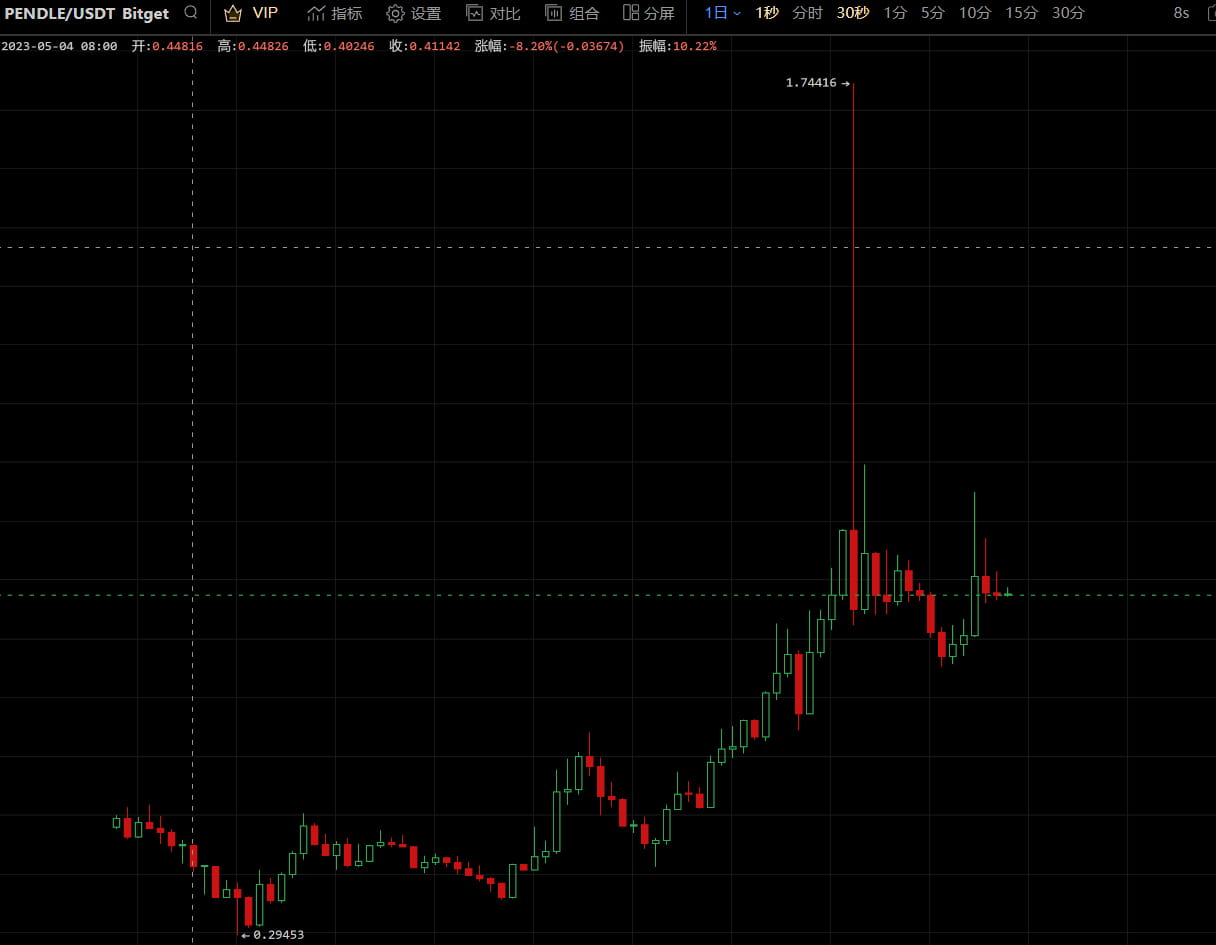
Today I bring you a very awesome defi project. It is really imaginative and interesting. It is PENDLE. The price of the currency is also rising fiercely. It has increased 3 or 4 times in 2 months. It has already been completed in half a year. With a 10-fold increase, it can be said that the fundamentals and model of the project are top-notch. As you can see in the picture below, the current market value of this project is still relatively low, only 85 million US dollars, ranking 230+.
Pendle is a decentralized "yield trading protocol" built on etherum and arbitrum, which allows users to implement various yield management strategies, which can amplify your profits.
When ENDLE V2 was launched, its token economics model was also modified and a staking mechanism was added. Staking users can obtain a share of the platform’s interest-earning asset income and a share of interest rate transaction fees. PENDLE also gives higher PENDLE token emission incentives to interest-earning asset liquidity providers, thereby continuously attracting the participation of interest-earning assets, thereby increasing TVL.

The advantage of PENDLE is that its white paper is very simple and is in Chinese.
What is Pendle used for?
It puts control of revenue back into the hands of users.
Pendle is a permissionless yield trading protocol that allows users to execute various yield management strategies.
To understand Pendle, it can be divided into 3 parts:
1. Tokenization of earnings
First, Pendle packages the "yield-bearing token" into SY (standardized yield token) - after packaging (such as stETH → SY-stETH), its underlying interest-bearing token will be compatible with Pendle AMM. Then, SY is split into two components: principal and income, namely PT (principal token) and YT (income token). This process is called revenue tokenization, where the revenue is split into independent tokens.
2.Pendle AMM
Both PT and YT can be traded through Pendle’s AMM. Although this is the core engine of Pendle, users do not need to understand AMM to trade PT and YT.
3.vePENDLE
As an interest rate derivatives agreement, the interest rate derivatives market of traditional finance (with a nominal value of more than 400 trillion US dollars) is introduced into DeFi, making it accessible to the public.
$vePENDLE is the governance token of PENDLE, which needs to be obtained by pledging $PENDLE. The greater the amount or the longer the pledge time, the more $vePENDLE you get. When it expires, 1 $vePENDLE can be exchanged for 1 $PENDLE.
Voting: Similar to curve’s mechanism, pendle will also provide $PENDLE rewards to certain pools. Which pools can receive them needs to be voted by $vePENDLE holders every Thursday at 00:00 UTC.
Rewards: Pendle charges a 3% fee from all earnings generated by YT, and currently, 100% of this fee is distributed to vePENDLE holders.

By creating a yield trading market in DeFi, Pendle unlocks the full potential of yield, enabling users to execute advanced yield strategies such as:
Fixed income (e.g. via stETH)
Establishing a long yield position (e.g. betting on stETH’s yield rising by purchasing more yield tokens)
Earn more without increasing risk (like using your stETH to provide liquidity)
Any of the above hybrid strategies, learn how to execute them in our Yield Trading Handbook.

The Pendle protocol has two revenue streams:
transaction fee
Fees incurred by all transactions on Pendle AMM.
YT charges
Pendle charges a 3% fee from all earnings generated by all YT, as well as the earnings from PT that expired but were not redeemed.
Pendle distributes all YT fee income to all vePENDLE holders, while transaction fee income is distributed to vePENDLE voters of the corresponding pool (for example, vePENDLE holders who vote for "Pool X" will receive payments from "Pool X" transaction fee income).
Currently, the Pendle protocol distributes all protocol income to vePENDLE holders, and the Pendle treasury does not receive any distribution. In the future, a portion of the protocol revenue may be allocated to the Pendle treasury.
data:
Looking at TVL on the chain, the recent increase is simply exaggerated. It currently exceeds 140 million US dollars, far exceeding its market value, and the growth rate is exaggerated.


Token distribution
Team tokens will remain locked until April 2023. After that, any increase in circulating supply will come from incentives and ecological construction.
In October 2022, weekly issuance was 667,705 and has since decreased by 1.1% weekly until April 2026. The current token economy will eventually reach a terminal inflation rate of 2% per year (for ongoing incentives).
As the industry matures, the governance mechanism can make the best change recommendations based on the development of the ecosystem.
The maximum supply is 10,000,000,000 ANKR, and the current circulation rate is 96.63%. The current price of the currency is US$0.88, with the highest point being US$1.7. However, it has risen a bit sharply now, from 0.1 at the beginning of 2023 to 0.8 currently, which is almost 10 times. .

Finally, we conclude that the project is also a DeFi project and is very innovative. As mentioned at the beginning, the fundamentals and model are invincible, so TVL keeps rising and rising, because everyone knows that the bull market is about to start, and who doesn’t want to buy it with cheap money? What about good assets? So for those who want to hold it for a long time, this is obviously a great product, simply unbeatable. As for the current price, since it has already increased 10 times, it is really not a big problem to wait for the correction to buy it, and the current market value is not high.