

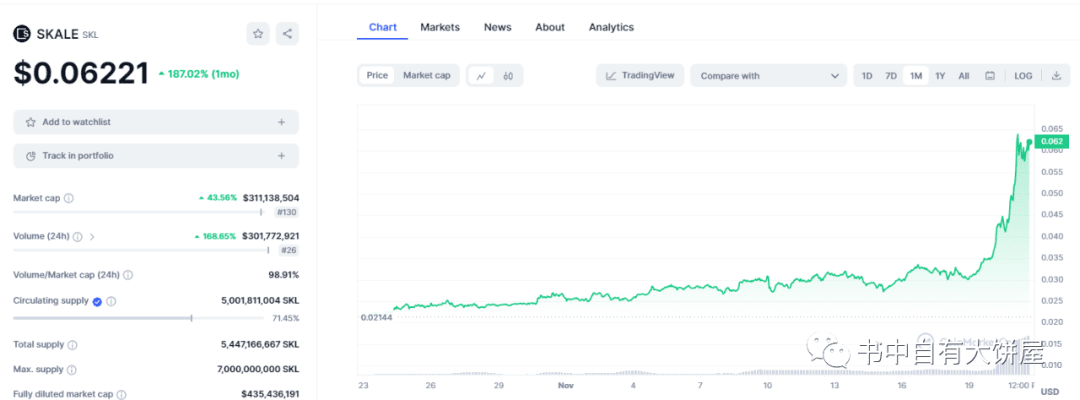
Today we continue to talk about a recently popular project, which is also in the L2 field. It can be regarded as a hybrid product of Layer1 and Layer2. The benchmark product is actually somewhat similar to the near sharding network, but it is built around Ethereum, which is SKALE. Currently Seeing that the trend is very exaggerated, it has doubled in 7 days, from 0.3 to 0.66. The current market value has reached 310 million US dollars, ranking 130+.
Introduction
SKALE proposes a decentralized, configurable second-layer on-demand Ethereum side chain network that provides storage functions and supports high-throughput, low-cost, and low-latency transactions. In addition, SKALE also proposes a communication protocol to allow participants in completely different systems to communicate with each other.
This system provides a subscription-based decentralized network for the configuration and deployment of Byzantine fault-tolerant sidechains with high throughput, Ethereum Virtual Machine compatibility, storage support, and provable security. Each proof-of-stake sidechain is highly configurable and consists of nodes staking SKALE tokens on the Ethereum mainnet, while its consensus mechanism utilizes an asynchronous Byzantine fault-tolerant protocol. The SKALE blockchain can execute second-level block times and can run more than 2,000 transactions per second on each chain.
The SKALE network is positioned as Ethereum's "elastic side chain network" and can support thousands of independent blockchains, side chains, storage chains and other types of sub-chains. These blockchains are connected to the Ethereum main network and are fully compatible with the Ethereum ecosystem.
SKALE now has over 50,000 lines of code and a network designed to run hundreds of thousands of SKALE sub-chains (S-chains) simultaneously. SKALES' test S-Chain core network can handle 20,000 transactions per second, with a block time of approximately 1 second. The design goal is to enable 800 nodes in the network to operate cumulatively to 1 million TPS. The main application of these S chains is to provide Layer 2 functions for Layer 1 public chains. What is unique about this technology is that SKALE can run full-state smart contracts in a Layer 2 environment.
The side chain in the SKALE network is operated by a set of virtualized subnodes (Virtualized Subnodes) selected from the network node set. Each side chain is highly configurable, and users can freely choose the side chain’s specifications, consensus protocol, virtual machine, parent chain, and customized security measures.
The SKALE network uses Solidity as the programming language for smart contracts. The operating model is fully compatible with EVM and supports the mainstream Ethereum token standard. It can also connect to the network through web3.js and web3.py, and use tools such as Truffle and Remix to achieve development friendly.
SKALE network configuration
The SKALE network consists of two parts: SKALE nodes and SKALE administrators. The SKALE administrator is a smart contract deployed on the Ethereum main network. The SKALE administrator contract plays the role of "entrance" and is responsible for tasks such as the creation and destruction of nodes, the creation and destruction of elastic side chains, virtual child node rotation, and SKALE reward issuance.
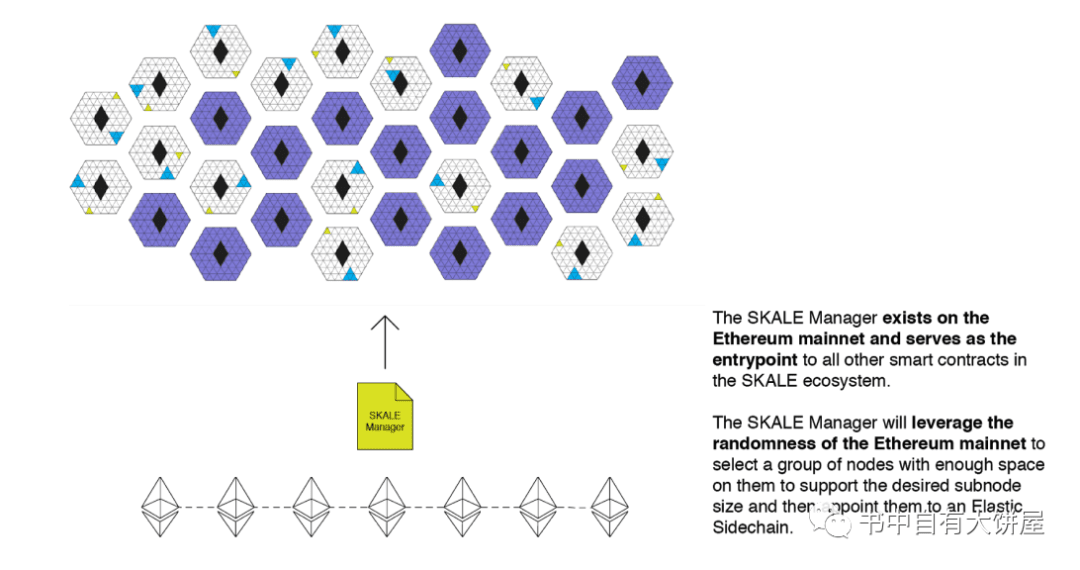
Among them, virtual child nodes are participants of the elastic side chain and are responsible for executing the SKALE consensus, running the SKALE EVM and promoting inter-chain communication.
Creation and destruction of elastic sidechains
The customizable "elastic side chain" is one of SKALE's innovations. "Elasticity" means that the blockchain is not fixed and users can use 1/128 (small), 1/16 (medium) or 1/1 (large) of node resources and 3, 6 and Choose a blockchain configuration with 12-month duration options and the storage capacity of the network, and use SKALE tokens to pay the corresponding rent. (The current cost of resources consumed in the SKALE network depends on the specifications and life cycle of the chain, and the cost will be dynamically calculated based on current network conditions and system load in the future.)
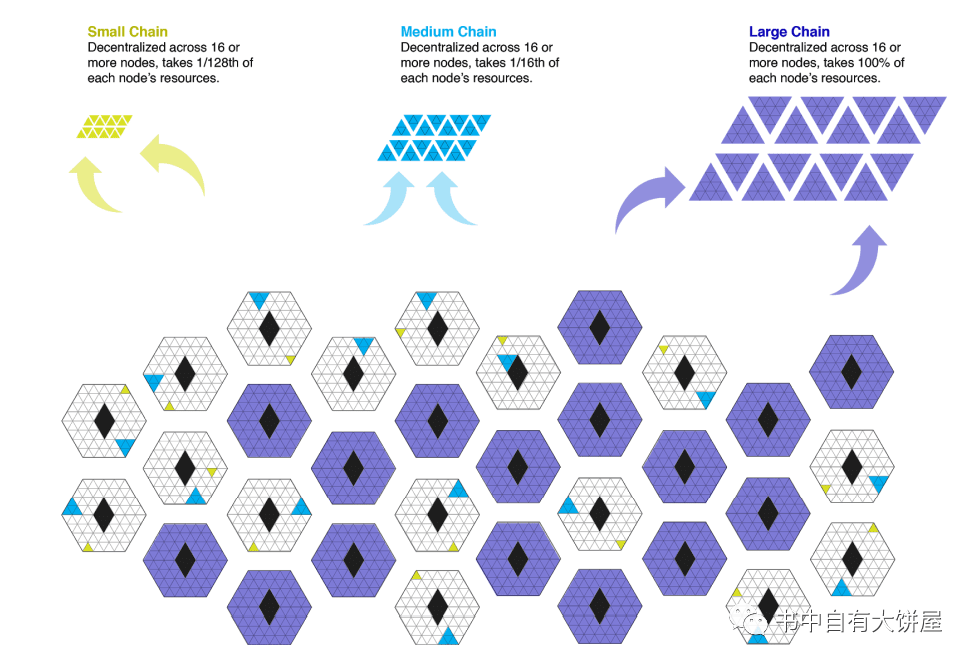
After the user submits the application to the SKALE administrator, a new elastic side chain will be created.
If the rent paid by the user has been consumed, or the user deletes its elastic side chain, the elastic side chain will be destroyed. In addition, users can also rotate the virtual sub-nodes of the elastic side chain to avoid collusion and ensure the decentralization of the elastic side chain.
Overall, the creation and destruction of SKALE's elastic sidechains are similar to our usual model of renting cloud servers, that is, selecting resources on demand and paying according to resources. After the rent is consumed, the user can choose to renew or delete the server (that is, the elastic side chain). Just like Docker and Kubernetes allow for easily customizable and scalable cloud services, SKALE's vision is to provide decentralized "chain services."
Project implementation mechanism
Sidechains in the network are operated by a set of virtual sub-nodes selected from a collection of network nodes, and they occupy all or part of each node's computing and storage resources (multi-tenant). Each sidechain is highly configurable, and users are free to choose the sidechain’s specifications, consensus protocol, virtual machine, parent chain, and additional security measures (for example, the rotation frequency of virtual child nodes).
SKALE token is a practical and functional token. To gain the authority to work in the network, nodes must run the SKALE daemon through a series of smart contracts (also known as SKALE administrators), as well as stake a predetermined number of SKALE tokens on the Ethereum mainnet. Once a node is recognized by the network, 24 peer nodes will be randomly selected to review its running time and latency - these indicators will be regularly submitted to the SKALE administrator, thereby affecting the rewards for nodes participating in the network.
When creating a resilient sidechain, users specify the blockchain configuration they require and pay based on the lease term for the network resources they plan to rent to run the blockchain. If the network has sufficient bandwidth, nodes that meet the computing and storage requirements of the blockchain's specified configuration will participate in the network as virtual child nodes.
The Ethereum Virtual Machine (EVM) compatibility of the elastic side chain allows users to directly deploy their existing Ethereum-based smart contracts on the side chain. At the same time, the increase in gas limit improves the computing and storage of the Ethereum mainnet EVM. , which brings more application scenarios to smart contracts with high efficiency or high performance that could not be achieved before. For example, each elastic side chain deploying a FileStorage smart contract is capable of storing large files (up to 100MB) on network nodes - while achieving the same function on the Ethereum mainnet would require approximately 10,000 blocks. .
Each elastic sidechain also supports BLS signatures in its consensus model, supporting inter-chain communication. By using the co-signature of another blockchain, virtual child nodes on each blockchain are able to verify the signature and proposed transactions of the other blockchain. This is true for all blockchains on the Ethereum mainnet. This extension supports a microservices model, where each blockchain can perform specific operations and use its output as input to other elastic sidechains.
Since each node in the network has been participating in the assigned elastic sidechain, at the end of each network period, they are rewarded based on performance (as measured by their peer nodes). When the life cycle of an elastic side chain ends, the resources (computing, storage) of its virtual child nodes will be released so that they can participate in the newly created elastic side chain.
Ecological construction
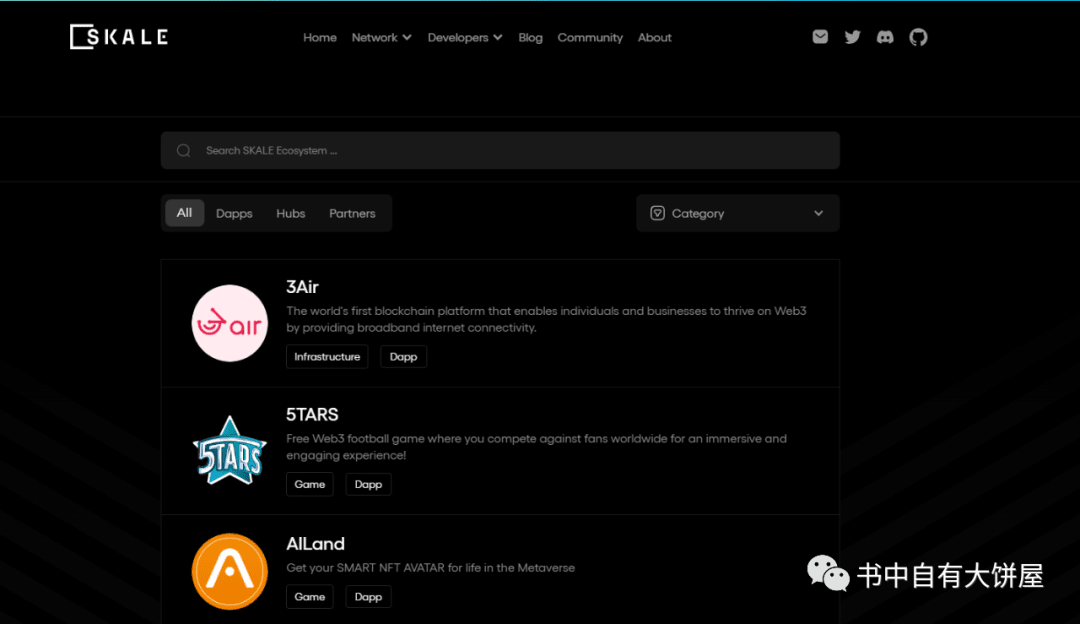
There are currently 110+ applications on the official website, currently focusing on games, NFT and other fields.
IMA cross-chain bridge
SKALE launched the IMA (Interchain Messaging Agent) cross-chain bridge in July this year, allowing users to transfer digital assets that support mainstream ERC standards and general message data between Ethereum and any SKALE chain.
Financing situation
2020-09-14: SKALE Network completed a public financing round of US$5 million.
2020-07-01: SKALE Network is online on the mainnet.
2019-10-01: SKALE Network completed US$17.1 million in financing.
2018-10-04: SKALE Network completed US$9.65 million in financing.
Other chain data
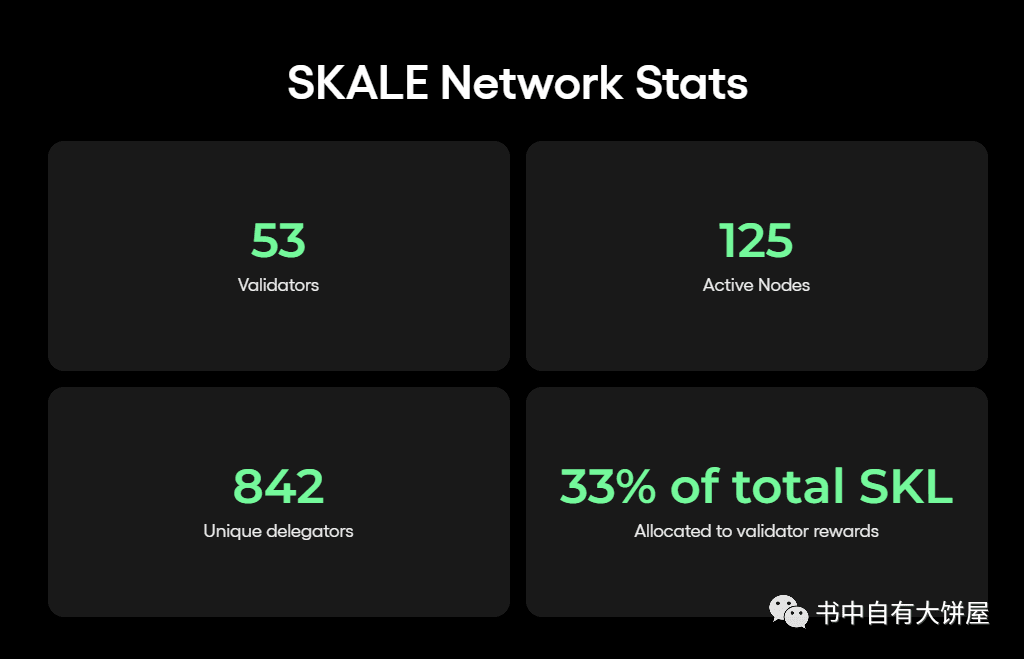
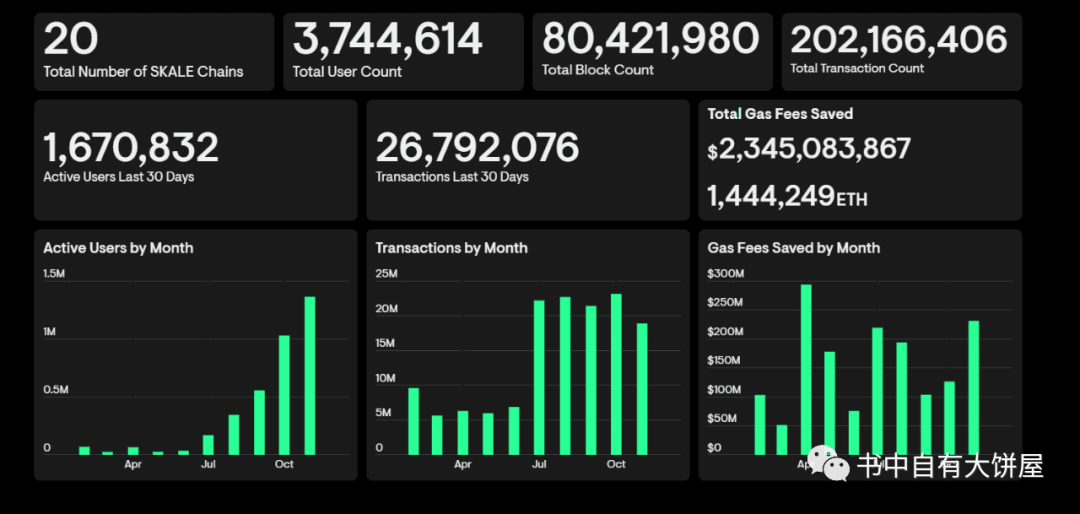
There are currently 53 validators, 125 nodes, and 800+ committees. The current chain does not consume gas. There are a total of 20 chains and a total number of users of 3.7 million. The total number of pledged tokens is currently 2.5 billion, because its return is relatively high, with almost 10% reporting.
Token economy
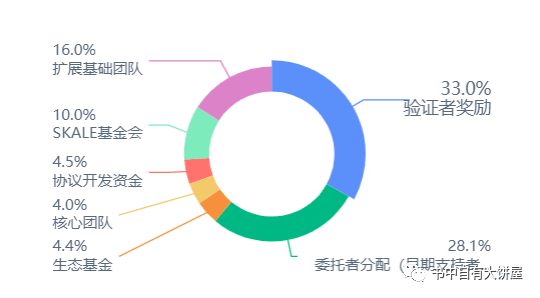
The project was launched on 2020-12-01, and the maximum total supply of tokens was 7,000,000,000. The current total supply is 5,447,166,667, and the current circulation is 5,001,811,004. The current currency price is 0.066 US dollars, and the currency price was $1.2388 at its peak (2021-03- 12), so from this point of view, it has basically dropped by 99%, and then look at the distribution of tokens, the core team 4%, the foundation 10%, the founding team 16%, that is, the team has almost 30%, and then the general Some of them are rewards for validators, etc.
Finally, I will summarize the project. This project is actually quite interesting. Mechanically, it is different from the traditional sharding method. Then the token model is added to it, which means that creating a sub-chain requires consuming tokens, which means It is a deflationary model, and it supports Ethereum, so it adds a new expansion method to Ethereum. Although the method is a bit like NEAR, near you do things yourself, you do not do it for Ethereum. Work, so SKALE is very smart and follows the boss. As for the analysis of the reasons for this project’s surge, first of all, this project also launched the mainnet in June this year, which can be regarded as a wave of good news. Second, its market value is also very low. It has fallen by 99%, which is almost the bottom. Third, the fundamentals of this project are still good. L2 is definitely the main force in the bull market and has a big narrative, so this increase is actually not bad. As for the strategy for tokens, it’s still about the planet.