

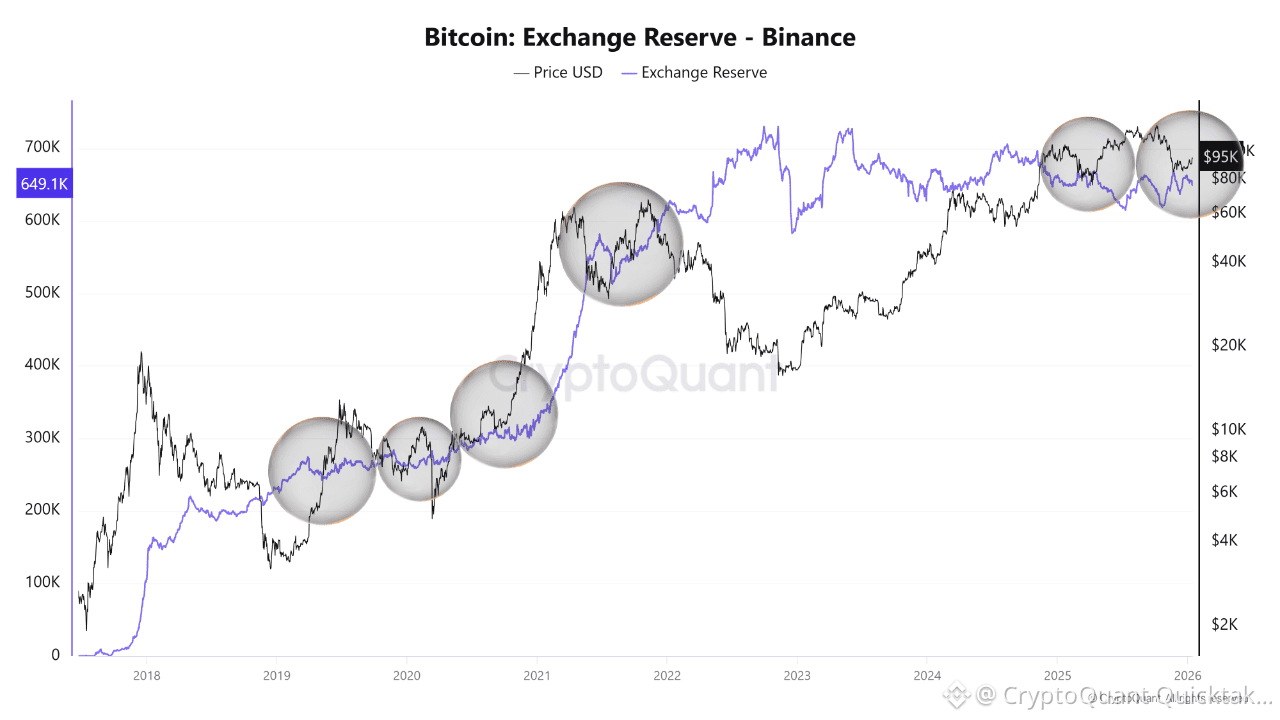
Historically, sustained declines in Binance exchange reserves have coincided with the formation of upward price trends in Bitcoin. Reserve outflows reduce readily available supply on exchanges, weakening selling pressure and often signaling the early stages of medium to long term bullish cycles.
A dip to peak analysis of prior reserve drawdown periods highlights a consistent historical pattern. In early 2019, Bitcoin appreciated from $6,500 to $13,800, delivering a 112.3% gain. Following the March 2020 Covid driven market shock, reserves again fell below price levels, after which Bitcoin advanced from $7,300 to $10,500, a 43.8% increase. The most significant reserve contraction occurred during late 2020 to early 2021, preceding a historic rally from $9,000 to $64,000, representing a 611% gain. More recently, during the 2024–2025 ETF driven cycle, Bitcoin rose from approximately $78,000 to $127,000, achieving a 62.8% increase.
Across all observed cycles, whenever Binance exchange reserves declined below prevailing price levels, Bitcoin generated upside returns ranging between 40% and 600%.
Currently, Binance exchange reserves stand near 649K BTC, while Bitcoin trades around $95,000. Reserves remain structurally below price levels and continue to trend downward. From a historical and market-structure perspective, this suggests that BTC is not being positioned on exchanges for distribution. Instead, current reserve dynamics support the view that Bitcoin’s upward trend remains intact, with further upside potential over the medium to long term.
Written by PelinayPA
