

BoChain Finance learned that on October 7, Ethereum co-founder Vitalik Buterin (V God) published an article discussing "changes to the protocol and staking pools may increase decentralization and reduce consensus overhead."
The article points out that there are currently two types of Ethereum staking: node operators and delegators. Vitalik believes that both have flaws: the centralization risk of node operators and unnecessary consensus layer burdens.
Vitalik believes that decentralization can be improved by expanding the rights of delegates to choose which node operators to delegate their stake to. #一起来跟单 #注意资金安全 #美联储是否加息? #BTC #ETH $BTC $ETH $BNB
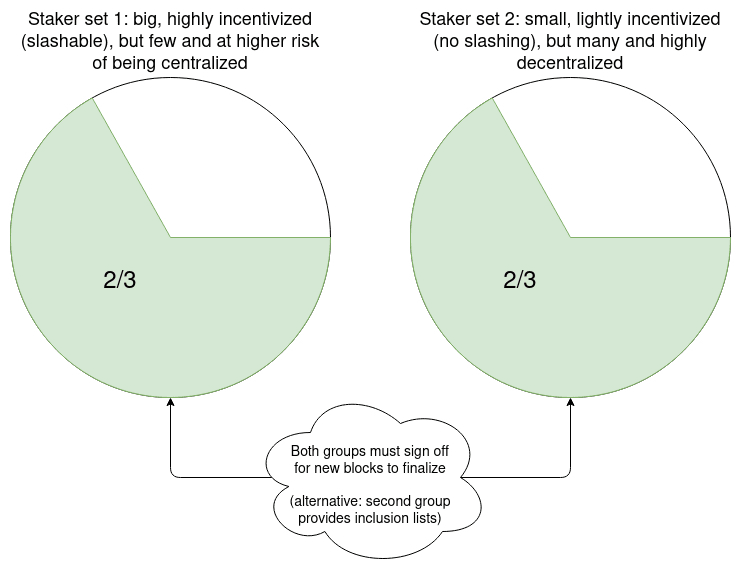
Node operators will have a “weight” in consensus that is proportional to the total stake delegated to them; delegators can choose to play a role in consensus that will be “lighter” than full stake and not subject to prolonged withdrawals and large stake risks, but will still act as a check on node operators.
Additionally, there is value in splitting staking into a higher complexity slashable tier that functions every slot but may only have 10,000 participants, while lower complexity tiers are only occasionally called in to participate.
Lower complexity tiers may be exempt from slashing entirely, or may randomly offer their participants the opportunity to make temporary (i.e., a few periods) deposits and be subject to slashing.
In practice, this can be achieved by increasing the validator balance cap, and then implementing a balance threshold (e.g. 2048 ETH) to determine which existing validators enter higher or lower complexity tiers.