Bitcoin holds $70K while traditional markets crack under geopolitical pressure.
BTC climbed 3.1% to $70,352 on Tuesday morning, recovering from a weekend dip below $68K. ETH, SOL, DOGE and XRP gained between 2-4%.
The backdrop is anything but calm. Saudi Arabia agreed to grant the U.S. military access to King Fahd Air Base for potential strikes on Iran — a reversal of its earlier stance. The UAE has taken similar steps. If Gulf states join the conflict directly, this transforms from a U.S.-Israel air campaign into a full regional coalition war.
Iran's deputy speaker ruled out talks with the U.S., and the Strait of Hormuz remains effectively shut with only a trickle of vessels passing through.
Traditional markets felt it immediately: S&P 500 futures down 0.5%, European shares set to drop 0.8%, Brent crude up 4% to ~$104. Gold extended its longest daily losing streak on record — a safe-haven asset falling during an active war breaks every historical precedent. The most likely explanation is forced selling by funds facing margin calls, with gold being the most liquid asset to dump.
Meanwhile, BTC — supposedly the volatile one — is holding its range while gold is in freefall. That contrast alone is worth noting.
Trump's five-day window for Iran expires Saturday. Saudi Arabia joining the coalition changes the calculus entirely, putting oil infrastructure on both sides of the Gulf at risk.
Whether Bitcoin's $70K hold is genuine resilience or just the market waiting for the next headline — the rest of the week will tell.
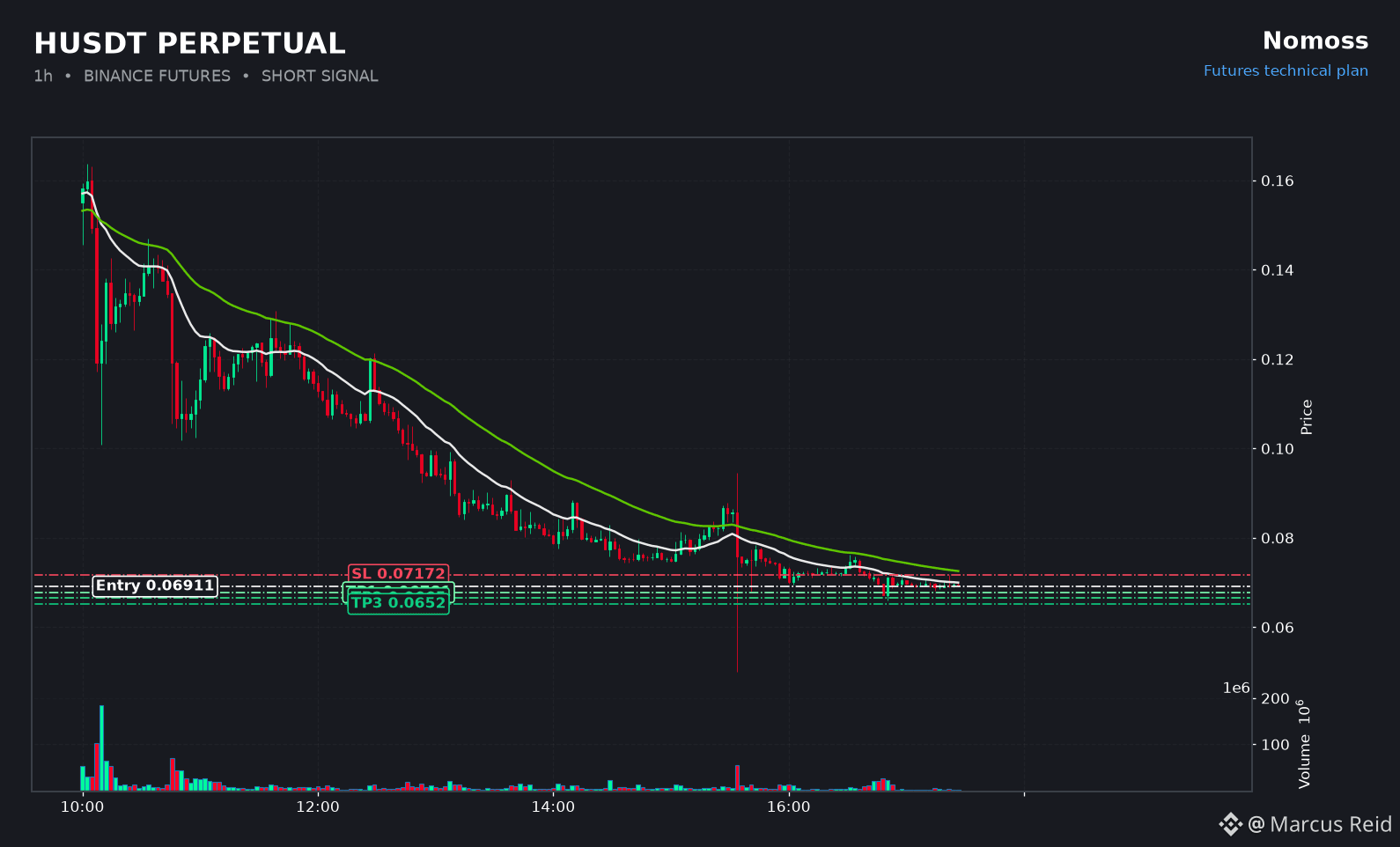
The $HUMA short is moving in the expected direction and the position is holding well so far. If you’re still in the trade, you can move your stop-loss back to entry to remove the risk while letting the downside continue if momentum expands further.
$XRP – Holding up well after the dip, buyers stepping back in around this zone
Trading Plan Long $XRP Entry: 1.39– 1.43 SL: 1.32 TP: 1.50 TP: 1.60 TP: 1.72
The recent pullback looks controlled rather than aggressive, with selling pressure fading instead of expanding. Price is stabilizing around this area instead of breaking down, showing buyers are still active. When structure holds like this after a push higher, it often sets up for continuation as momentum begins to rebuild.
Balancer Labs Is Shutting Down — But the Protocol Lives On
Balancer Labs, the company behind one of DeFi's earliest automated market makers, is winding down operations. Founder Fernando Martinelli confirmed the decision on Monday, citing unsustainable costs, zero revenue at the corporate level, and lingering legal exposure from the $116 million exploit back in November.
The numbers tell the story. Balancer peaked at $3.3 billion in TVL during the 2021 bull run. By October 2025, that had already dropped to $800 million. The hack accelerated the decline — $500 million in TVL evaporated within two weeks. Today, Balancer sits at $158 million.
CEO Marcus Hardt acknowledged the core issue: the protocol was spending far more on liquidity incentives than it was earning, diluting BAL holders in the process. Martinelli framed it bluntly — Balancer Labs had become "a liability rather than an asset to the protocol."
The protocol itself isn't dead, though. Both founders are pushing for a transition to the Balancer Foundation and its DAO. The proposed restructuring includes cutting BAL emissions to zero, redirecting fees to the DAO treasury, reducing headcount, and slashing operating costs.
Martinelli pointed out that Balancer still generated over $1 million in revenue across the past three months. "The problem isn't that Balancer doesn't work," he said. "The problem is that the economics around Balancer aren't working. Those are fixable."
Two governance proposals are now live for DAO members to vote on — one covering operational restructuring, the other a full BAL tokenomics revamp.
A textbook case of why DeFi protocols need sustainable economics from the start, not just TVL growth.
Prediction markets just got a regulatory wake-up call.
Both Kalshi and Polymarket announced new trading guardrails on Monday aimed at curbing insider trading — a move that follows weeks of criticism after traders on Polymarket appeared to profit from advance knowledge of U.S. and Israeli strikes on Iran.
Kalshi is preemptively banning political candidates from trading on their own campaigns and barring anyone involved in college or professional sports — athletes, personnel, referees — from event contracts. The company says this has been in the works for months ahead of anticipated regulatory guidance.
Polymarket went broader, prohibiting users who trade on stolen confidential information, illegal tips, or who can directly influence market outcomes.
The timing is no coincidence. The same day, Senators Adam Schiff (D) and John Curtis (R) introduced a bipartisan bill — the Prediction Markets Are Gambling Act — that would ban CFTC-registered platforms from listing event contracts resembling sports bets or casino games.
Kalshi CEO Tarek Mansour fired back, calling the bill the "casino lobby hard at work" and arguing it protects monopolies rather than consumers.
Meanwhile, both platforms remain embroiled in legal battles across multiple states asserting that sports event contracts require gambling licenses. The platforms maintain they fall under exclusive CFTC jurisdiction.
The prediction market industry is growing fast, but so is the scrutiny. Self-regulation may buy time, but Washington clearly has its own plans.
Prediction Markets Get Their Own VC Fund — Backed by Polymarket and Kalshi CEOs
A new venture capital firm called 5c(c) Capital is launching with a singular focus: prediction markets. The fund carries the backing of Polymarket founder Shayne Coplan and Kalshi co-founder Tarek Mansour, and is targeting a $35 million raise to deploy across roughly 20 early-stage companies over two years.
The name itself is a nod to the section of the Commodity Exchange Act that governs prediction markets — a clear signal of where the founders see this space heading.
Rather than funding more exchanges, 5c(c) Capital is going after the infrastructure layer: data tools, liquidity services, and compliance systems that support the broader prediction market ecosystem. The thesis is straightforward — as platforms like Polymarket and Kalshi expand, the surrounding toolkit needs to keep up.
The timing is hard to argue with. Since the U.S. presidential election cycle, prediction market volumes have surged. New users are flowing in, and major players including Coinbase, Kraken, and Robinhood have started offering event-based contracts. Polymarket runs on-chain; Kalshi operates within a CFTC-regulated framework. Both models are attracting serious attention.
More than 20 early investors have already committed, including a Millennium Management portfolio manager and founders from rival platforms like PredictIt. The fund positions itself as potentially the first VC vehicle built specifically around the regulatory and market structure of prediction markets.
The broader takeaway: prediction markets are no longer a niche experiment. Capital is now flowing not just into the platforms themselves, but into the second- and third-order businesses they create.
Strategy Unveils $44.1 Billion Capital Plan to Fund More Bitcoin Purchases
Michael Saylor's Strategy has announced a massive new capital-raising effort totaling $44.1 billion, structured across three distinct programs aimed at accelerating its Bitcoin accumulation.
The breakdown:
• $21 billion from selling MSTR common stock via a new at-the-market program • $21 billion from its high-yield perpetual preferred stock, Stretch (STRC) • $2.1 billion from Strike (STRK), another perpetual preferred offering
No specific timeline was given — shares will be sold "from time to time" at the company's discretion.
This marks a shift in Strategy's funding approach. Rather than relying on large one-off convertible debt raises, the revised ATM program allows incremental share sales into the open market. The preferred stocks (STRC and STRK) pay monthly dividends to investors while letting Strategy grow its BTC position without diluting MSTR common holders further.
The numbers this year are significant. Strategy has added roughly 90,000 BTC to its treasury in Q1 2026 alone, including a 22,337 BTC purchase on March 16 and 17,994 BTC on March 9 — both multi-billion dollar transactions. The most recent buy was 1,031 BTC for $76.6 million on Monday.
Total holdings now stand at 762,099 Bitcoin, valued at approximately $54 billion. The company is currently sitting on an unrealized loss of 6.3% on its position, with BTC still down nearly 70% from its all-time high.
Whether this level of conviction pays off depends entirely on where Bitcoin goes from here. But one thing is clear: Strategy is not slowing down.
I tried to visualize what 100,000 TPS actually feels like, not just how it sounds
When I first read about $SIGN targeting 100,000 TPS, it didn’t really hit me. Numbers in crypto are always big, so it’s easy to just scroll past them. But then I paused and tried to think about it in a more real-world way.
If this is meant for a national payment system, then it’s not about peak performance, it’s about consistency under pressure. Millions of people transacting at the same time, everyday payments, subsidies, transfers… all happening without delay. In that context, 100,000 TPS starts to feel less like an ambitious target and more like a baseline requirement.
What caught my attention more was the “immediate finality” part. Not waiting for confirmations, not probabilistic settlement. Once a transaction is committed, it’s done. That’s a very different expectation compared to most public chains, and probably much closer to how existing financial systems operate.
The rest of the design also feels very intentional. Identity tied to certificates, ISO standards built in from the start, and different privacy modes depending on whether it’s wholesale or retail. It doesn’t read like something trying to attract developers, it reads like something trying to pass institutional scrutiny.
I’m not sure how all of this performs outside of controlled environments, but the direction is clear. This isn’t about experimenting with blockchain anymore, it’s about making it fit into systems that already exist.
The latest draft of the Digital Asset Market Clarity Act is drawing early pushback from the crypto industry.
Senators Alsobrooks and Tillis released revised language that explicitly bans yield payments on stablecoin balances. The bill would still permit rewards tied to user activities, but any program that resembles an interest-bearing bank deposit is off the table. The mechanics of what qualifies as an allowable activity-based reward remain vague — a gap the industry flagged immediately during a closed-door Capitol Hill review on Monday.
The compromise emerged from months of lobbying friction between crypto firms and the banking sector. Banks pushed hard to ensure stablecoins wouldn't function as deposit-like products that could undercut traditional lending. The result is a narrow carve-out that satisfies neither side entirely.
Beyond yield, two other sticking points remain unresolved: oversight of DeFi (Democrats want stronger illicit finance protections) and a proposed ban on senior government officials profiting personally from crypto — widely understood as targeting President Trump.
The Clarity Act is the second and more consequential piece of U.S. crypto legislation following last year's passage of the GENIUS Act on stablecoins. If it clears the Senate Banking Committee and reaches a floor vote, it would represent the most comprehensive regulatory framework for digital assets in U.S. history — and potentially unlock significant institutional capital that's been sitting on the sidelines waiting for legal certainty.
What If You Didn’t Have to Spend Tokens to Use a Blockchain?
One assumption I’ve always taken for granted in crypto is pretty simple.
If you want to transact, you spend tokens.
That’s how almost every chain works.
But the more I look into Midnight Network, the more I realize they’re trying to break that pattern.
Instead of spending the native token directly, holding $night generates DUST over time — and DUST is what actually gets used for transactions.
That changes the dynamic quite a bit.
Because once DUST is the thing being consumed, and $night just keeps generating it, you’re no longer reducing your core balance every time you use the network.
It starts to feel less like “pay per action” and more like having a resource that replenishes.
For regular users, that might just feel like a smoother experience.
But for businesses, it could mean something more practical.
Costs become more predictable, and less tied to market volatility in the same way typical gas models are.
Of course, how this plays out at scale is still something to watch.
But it does make me think that the idea of “spending tokens every time you transact” might not be as fixed as it seems.
The SEC has submitted its proposed crypto asset interpretation to the White House Office of Management and Budget for formal review.
Under the proposal, four categories of digital assets — digital commodities, digital tools, digital collectibles (including NFTs), and stablecoins — would not be classified as securities under federal law. SEC Chair Paul Atkins framed it as establishing a "coherent token taxonomy" to clarify how the agency treats non-security crypto assets and whether they qualify as investment contracts.
The move follows last week's memorandum of understanding between the SEC and CFTC on coordinated oversight, and is designed to serve as a regulatory bridge until Congress passes comprehensive market structure legislation.
Meanwhile, Politico reports that White House officials and Congressional lawmakers have reached an agreement in principle on stablecoin yield provisions that could advance the CLARITY Act through the Senate Banking Committee. The bill's markup was postponed in January after Coinbase CEO Brian Armstrong publicly opposed its original language.
No new markup date has been announced. Senate Majority Leader John Thune has indicated the chamber will prioritize the SAVE America Act before moving to bipartisan crypto legislation.
Bottom line: The regulatory framework for digital assets is taking shape through both executive action and legislative negotiation. The SEC's interpretation, if finalized, would mark the most significant federal policy shift on crypto classification to date.
The Solana Foundation just dropped a major play for institutional adoption — and this time, the pitch is privacy.
In a report titled "Privacy on Solana: A Full-Spectrum Approach for the Modern Enterprise," the foundation argues that the next wave of crypto adoption hinges on giving companies control over what they disclose and to whom. Not transparency for its own sake, but selective transparency as a design choice.
The core idea: privacy is a spectrum, not a switch. The report lays out four modes — pseudonymity, confidentiality, anonymity, and fully private systems — each suited to different enterprise needs. Think encrypted order books, private credit risk calculations, or payroll processing that doesn't broadcast salaries on-chain.
Solana's speed is the enabler here. High throughput and low latency make advanced privacy techniques like zero-knowledge proofs and multiparty computation run at near-web speeds, rather than remaining theoretical.
Critically, the foundation positions privacy and regulation as compatible. Features like auditor keys let designated parties decrypt transactions when required. Wallets can prove compliance status without revealing identity. The framework is built so enterprises can mix and match privacy tools while staying within regulatory boundaries.
"Customers expect it and applications require it," the report states. "On Solana, you choose your privacy level — from encrypted balances to zero-knowledge anonymity to multiparty confidential computing."
This is a calculated shift. Solana is no longer just competing on speed and fees. It's positioning itself as the chain where institutions can actually operate under real-world compliance constraints — without sacrificing the benefits of public blockchain infrastructure.
Bitcoin Spot Volumes Sink to 2023 Lows — Rallies Running on Headlines, Not Demand
Binance BTC spot volumes are on pace for their weakest month since Q3 2023, tracking around $52 billion versus the $88 billion recorded back in September of that year. That puts current activity squarely in line with the prior bear market.
Exchange flow data tells the same story. Seven-day cumulative flows on Binance hit $6.38 billion — the lowest since 2024 — while Coinbase held relatively steady at $5.14 billion, suggesting long-term holders are sitting tight.
Meanwhile, whale inflow momentum surged to 74.3, the highest reading across any cycle peak in the past 11 years. That kind of aggressive capital rotation typically amplifies short-term volatility.
Monday's push above $71,700 was triggered by headlines around a reported US pause on Iran strikes, not by fresh spot demand. Open interest dropped roughly 9,700 BTC (~4%) over 13 hours as the price rose — a clear sign of short liquidations, not new money entering. Binance alone recorded over $44 million in short liquidations within a single hour.
The Coinbase premium stayed negative throughout the move, confirming limited US spot participation.
Bottom line: price is moving higher, but the engine behind it is leverage unwinds and headline reactions, not organic buying. Until spot volumes recover, rallies remain fragile.
Backpack Exchange Launches BP Token on Solana — 25% Airdrop, Zero Insider Allocation
Backpack Exchange just rolled out its native token, BP, with a total supply of 1 billion. The standout move: 250 million tokens (25%) go directly to users at launch — mostly through an airdrop to existing points program participants and Mad Lads NFT holders.
No tokens were allocated to founders, team members, or investors at inception. That is a deliberate break from the typical exchange token playbook, where insiders usually hold significant portions from day one.
The remaining 75% follows a structured unlock schedule: • 37.5% unlocks over time, tied to operational milestones like market expansion and product launches • 37.5% stays locked in a corporate treasury until after a potential IPO
Backpack also introduced a mechanism allowing long-term stakers to convert BP into company equity — effectively linking the token to real ownership in the firm, not just trading incentives or governance rights.
Worth noting: Backpack was founded by former FTX and Alameda Research employees. After early scrutiny following the FTX collapse, the company acquired FTX's European arm and relaunched it as Backpack EU, pushing into regulated markets.
A user-first token structure with equity conversion and no insider allocation at launch — rare in this space.
BlackRock CEO Larry Fink just dropped his annual letter — and tokenization is front and center.
Fink argues the current financial system works well for those who already own assets, but leaves most workers on the sidelines. His proposed solution: tokenized funds and digital wallets as the bridge to broader market access.
The numbers back it up. BlackRock now has nearly $150 billion in assets connected to digital markets. Its BUIDL fund is the largest tokenized fund globally, and the firm manages $65 billion in stablecoin reserves plus close to $80 billion in digital asset ETPs.
Fink compared tokenization today to the internet in 1996 — not a replacement for traditional finance, but a gradual upgrade to the rails underneath it. He called on policymakers to build clear regulatory frameworks covering buyer protections, counterparty-risk standards, and digital identity checks.
The bigger picture: Fink sees tokenization as part of a necessary overhaul of U.S. capital markets, alongside structural reform of Social Security and new private-market funding models for energy, manufacturing, and AI.
This is not hype. This is the largest asset manager on the planet making a multi-billion-dollar bet that better infrastructure means more investors, not fewer.
I thought TokenTable was just another vesting tool… but it’s not really about vesting
At first glance, I almost skipped over this part of $SIGN . TokenTable sounded like something I’d seen before. Vesting, allocations, distribution logic… nothing new on the surface. But the more I read, the more I realized I was looking at it from the wrong angle. It’s not really about creating tokens or even managing them. It’s about what happens after. Who gets what, when they get it, and more importantly… how you prove that it was done correctly. And that last part is where things started to click for me. Most systems today seem to treat distribution and auditing as two separate steps. First you execute, then later you try to reconstruct what happened for reporting. TokenTable feels like it flips that. The distribution is defined upfront through something like an allocation manifest, and everything that happens afterward just follows that structure. So instead of asking “what happened?” after the fact, you already have a verifiable record of what was supposed to happen. I might be simplifying it, but that shift feels bigger than it sounds. What stood out even more is how the audit layer isn’t added later. It’s built into the process itself. Every distribution event comes with proof that eligibility was checked, rules were followed, and outcomes match the original plan. Not reconstructed logs, but actual evidence generated as part of execution. And then this connects back into Sign Protocol. Which kind of makes the whole thing feel less like a standalone tool and more like one piece of a larger system. Every action becomes an attestation. Everything is queryable. Different programs, even across different organizations, can theoretically rely on the same structure of evidence. That’s the part I keep thinking about. If multiple systems are generating compatible “proofs” of what they’re doing, then things like cross-agency audits or reconciliation don’t have to be manual anymore. At least in theory. Also, the scale of the problem here is not small. Government transfers alone are massive, and a lot of inefficiency seems to come from exactly these gaps. Wrong recipients, duplicated payments, lack of verification before funds go out. TokenTable seems designed directly around those failure points, not just around token mechanics. But yeah, I still have some doubts. A lot of this only really matters if institutions actually use it. And that means coordination between different departments, agreeing on shared formats, changing existing processes… which is usually the hardest part. There’s also the reality that simpler tools already exist and have developer traction. Even if they don’t solve the audit side fully, they’re easier to adopt. Still, I can’t shake the feeling that Sign is building in a part of the stack most people ignore. Not the creation of assets, but the distribution layer with verifiable evidence baked in. If that piece becomes important, this starts to look very different. I’m still watching how this develops. @SignOfficial #SignDigitalSovereignInfra $SIGN
I tried to picture what 100,000 TPS actually means in practice
When I first saw the number in $SIGN ’s CBDC architecture, it didn’t really register. 100,000 TPS sounds impressive, but also kind of abstract. Crypto throws around big numbers all the time.
But then I thought about it differently. If you’re talking about a national payment system, not just a chain with traders and bots, that throughput isn’t just a flex. It’s basically the difference between something that “works in theory” and something that can actually handle millions of people using it at the same time.
What made me pause more wasn’t even the TPS itself, it was the “immediate finality” part. No waiting, no probabilistic settlement. Once it’s done, it’s done. For retail payments at a national level, that feels like a requirement, not an upgrade.
The rest of the stack also feels very… institutional. Identity tied through certificates, ISO standards baked in, different privacy modes depending on whether it’s wholesale or retail. It doesn’t read like typical crypto infra, more like something designed to fit into how central banks already operate.
I’m not deep enough technically to judge how realistic all of this is at scale, but the direction is clear. This isn’t built for experimentation, it’s built for deployment.
Strategy (MSTR) just rolled out a fresh $42 billion at-the-market equity program — $21B in common stock and $21B in its new STRC preferred series. On top of that, a separate $2.1B ATM for STRK preferred stock replaces the prior program.
The company also expanded its sales syndicate to 19 agents, adding Moelis & Company, A.G.P./Alliance Global Partners, and StoneX Financial. More intermediaries means smoother, more gradual capital deployment into the market.
As of March 22, Strategy still had roughly $30B in remaining capacity across existing programs: ~$6.24B in common stock, $1.98B in STRC, $20.33B in STRK, and $1.62B in STRF.
Last week, the company bought another 1,031 BTC, pushing total holdings to 762,099 coins. Shares are modestly green on Monday with BTC trading just above $71,300.
The playbook hasn't changed — Saylor keeps stacking. The scale of the capital raise, though, signals that the appetite for bitcoin exposure through equity markets is far from exhausted.
Tom Lee's Bitmine (BMNR) added another 65,341 ETH last week — roughly $138 million worth — pushing total holdings past 4.66 million tokens.
That's 3.86% of ETH's entire circulating supply, now controlled by a single entity.
The pace has accelerated for three straight weeks, up from an average of ~50,000 ETH per week prior. Cash reserves also climbed to $1.1 billion.
Lee's thesis: ETH is in the "final stages of the mini-crypto winter." The firm is buying heavier into weakness, not pulling back.
The catch? Bitmine is sitting on an estimated $7 billion in unrealized losses on its ether position. The conviction is clear — the question is whether the timing holds up.
Three weeks of increasing accumulation while underwater on the trade. That's either disciplined long-term positioning or a very expensive bet. Markets will decide.