
Professor Of Chart By S
4.6k Posts

Professor Of Chart By S
Report
Block User
Full-Time Trader | Technical Analysis | Sharing Setups on Binance Spot/Perps Daily I On-chain Technicals |
15 Following
2.0K+ Followers
4.8K+ Liked
Posts
All
Quotes
Videos
Live
$0.23 BREAKOUT OR DISTRIBUTION? $MET IS AT A KEY LEVEL
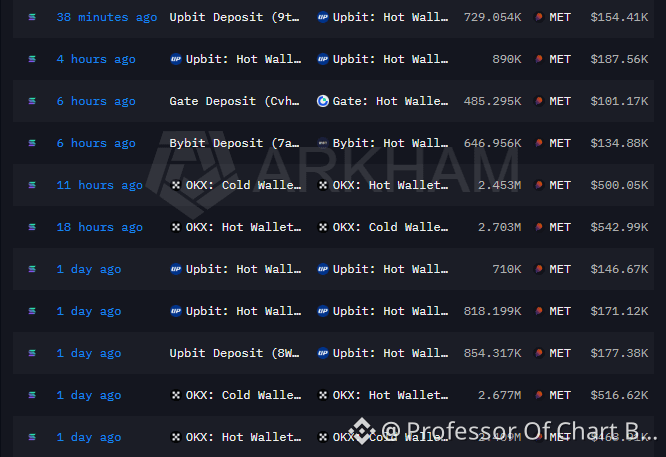
over 10M $MET tokens have moved into Tier-1 exchange hot wallets in a single day.
That’s a lot of supply sitting where it can be actively traded.
Now $MET is testing the $0.2200 supply zone.
The key level is $0.2300. If met breaks and holds above it, momentum could continue.
But if price gets rejected, those exchange deposits could add serious selling pressure.
#MET
$0.23 BREAKOUT OR DISTRIBUTION? $MET IS AT A KEY LEVEL
over 10M $MET tokens have moved into Tier-1 exchange hot wallets in a single day.
That’s a lot of supply sitting where it can be actively traded.
Now $MET is testing the $0.2200 supply zone.
The key level is $0.2300. If met breaks and holds above it, momentum could continue.
But if price gets rejected, those exchange deposits could add serious selling pressure.
#MET
over 10M $MET tokens have moved into Tier-1 exchange hot wallets in a single day.
That’s a lot of supply sitting where it can be actively traded.
Now $MET is testing the $0.2200 supply zone.
The key level is $0.2300. If met breaks and holds above it, momentum could continue.
But if price gets rejected, those exchange deposits could add serious selling pressure.
#MET
1
32
THE CRAZY FLOW SHIFT ON $LIT RIGHT NOW!
If you’re watching $LIT after that sharp rejection from $5.30, the flow data is getting interesting.
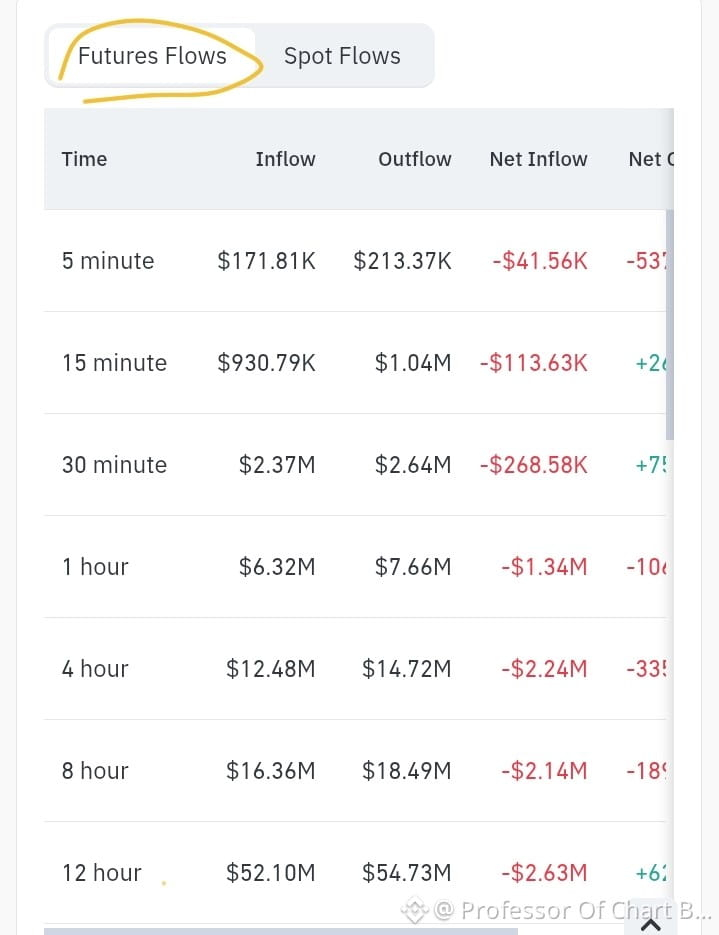
• Futures (1-Hour): -$1.34M Net Outflow — leverage is getting flushed as price trades near $4.50.
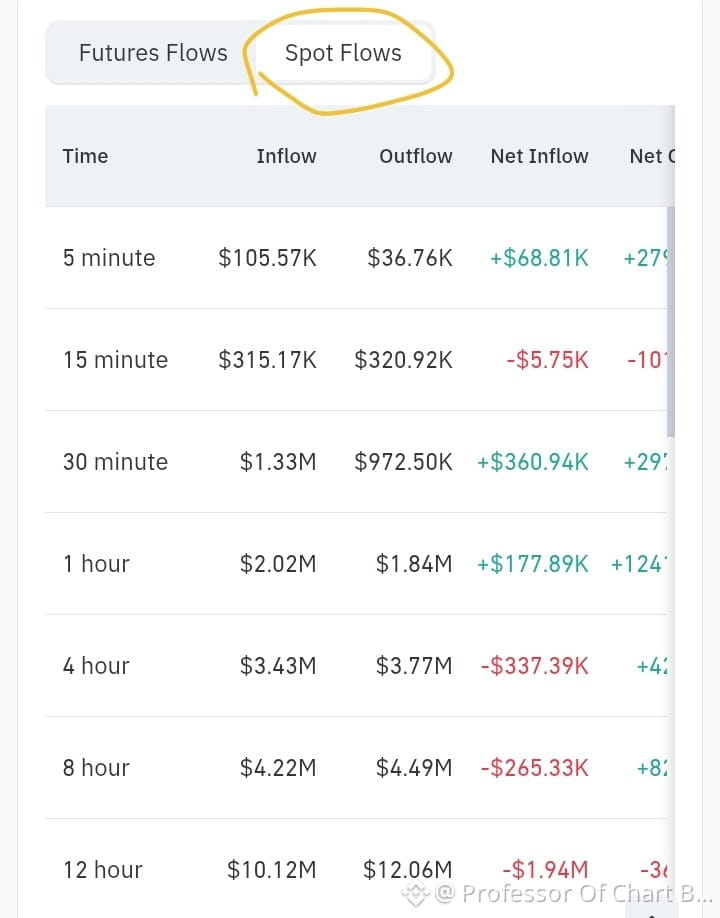
• Spot (1-Hour): +$177.89K Net Inflow — short-term spot buying is showing up, but it’s not strong enough yet to fully reverse the sell-off.
• 4-Hour: Spot is back to -$337K, while Futures show -$2.24M.
The Fresh 30M Pulse: $LIT spot flipped to +$360.94K, while futures are still bleeding -$268.58K.
That’s the part I’m watching. Futures traders are clearly reducing exposure, while spot flow is starting to fight back. If spot demand keeps building and LIT holds the $4.40–$4.50 zone, the next bounce could get interesting.
#Lıt
THE CRAZY FLOW SHIFT ON $LIT RIGHT NOW!
If you’re watching $LIT after that sharp rejection from $5.30, the flow data is getting interesting.
• Futures (1-Hour): -$1.34M Net Outflow — leverage is getting flushed as price trades near $4.50.
• Spot (1-Hour): +$177.89K Net Inflow — short-term spot buying is showing up, but it’s not strong enough yet to fully reverse the sell-off.
• 4-Hour: Spot is back to -$337K, while Futures show -$2.24M.
The Fresh 30M Pulse: $LIT spot flipped to +$360.94K, while futures are still bleeding -$268.58K.
That’s the part I’m watching. Futures traders are clearly reducing exposure, while spot flow is starting to fight back. If spot demand keeps building and LIT holds the $4.40–$4.50 zone, the next bounce could get interesting.
#Lıt
If you’re watching $LIT after that sharp rejection from $5.30, the flow data is getting interesting.
• Futures (1-Hour): -$1.34M Net Outflow — leverage is getting flushed as price trades near $4.50.
• Spot (1-Hour): +$177.89K Net Inflow — short-term spot buying is showing up, but it’s not strong enough yet to fully reverse the sell-off.
• 4-Hour: Spot is back to -$337K, while Futures show -$2.24M.
The Fresh 30M Pulse: $LIT spot flipped to +$360.94K, while futures are still bleeding -$268.58K.
That’s the part I’m watching. Futures traders are clearly reducing exposure, while spot flow is starting to fight back. If spot demand keeps building and LIT holds the $4.40–$4.50 zone, the next bounce could get interesting.
#Lıt
188
·
--
Bullish
$BTR ON THE MOVE: BREAKOUT OR LEVERAGE TRAP? 0.12
$BTR just ripped out of its $0.045 base and is knocking right on the door of $0.0710!
But before you hit market buy, look under the hood at the order flow:
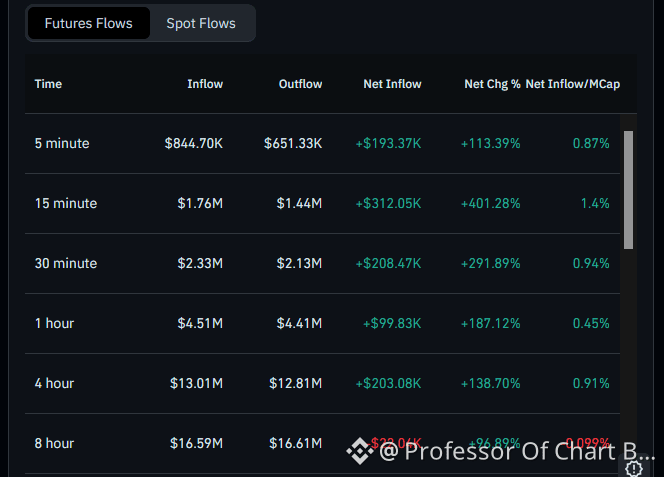
Futures Flows: Exploding green (+400% net inflow on the 15m!). Leverage is piling in hard.
Spot Flows: Deep in the red across every timeframe. Spot is selling while perps are buying.
Key Levels to Map:
Support Flip Zone: $0.066 – $0.071 (Must hold this consolidation to maintain momentum).
Macro Target: $0.1068 (The major liquidity line overhead).
If buyers successfully turn this resistance box into support, the runway up to $0.1068 opens up fast. But watch out for sudden long flushes if funding gets too heated.
#BTR
$BTR ON THE MOVE: BREAKOUT OR LEVERAGE TRAP? 0.12
$BTR just ripped out of its $0.045 base and is knocking right on the door of $0.0710!
But before you hit market buy, look under the hood at the order flow:
Futures Flows: Exploding green (+400% net inflow on the 15m!). Leverage is piling in hard.
Spot Flows: Deep in the red across every timeframe. Spot is selling while perps are buying.
Key Levels to Map:
Support Flip Zone: $0.066 – $0.071 (Must hold this consolidation to maintain momentum).
Macro Target: $0.1068 (The major liquidity line overhead).
If buyers successfully turn this resistance box into support, the runway up to $0.1068 opens up fast. But watch out for sudden long flushes if funding gets too heated.
#BTR
$BTR just ripped out of its $0.045 base and is knocking right on the door of $0.0710!
But before you hit market buy, look under the hood at the order flow:
Futures Flows: Exploding green (+400% net inflow on the 15m!). Leverage is piling in hard.
Spot Flows: Deep in the red across every timeframe. Spot is selling while perps are buying.
Key Levels to Map:
Support Flip Zone: $0.066 – $0.071 (Must hold this consolidation to maintain momentum).
Macro Target: $0.1068 (The major liquidity line overhead).
If buyers successfully turn this resistance box into support, the runway up to $0.1068 opens up fast. But watch out for sudden long flushes if funding gets too heated.
#BTR
155
$1,300 SHORT MAGNET CAN $ZEC BREAK HIGHER?
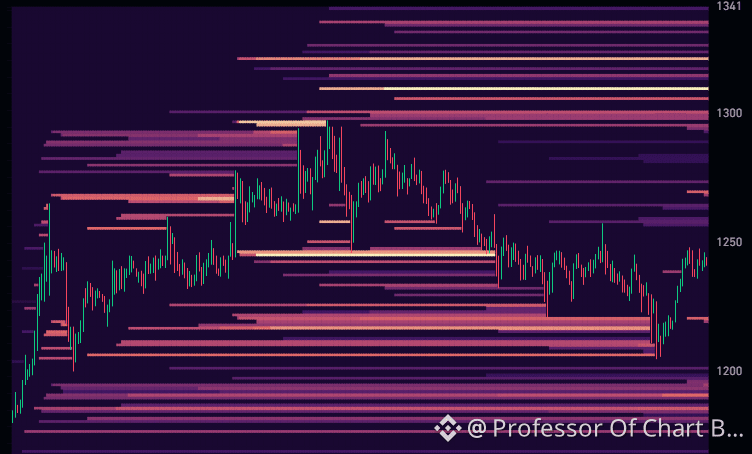
Guys, that dip toward $1,200 just flushed a lot of overleveraged longs, and now the liquidation map is showing the other side.
The key level is simple:
$1,200 — must hold for the bounce
$1,280–$1,300 — major short liquidation zone
There’s a heavy wall of short liquidity sitting below $1,300. If momentum continues, $ZEC could naturally get pulled toward that zone.
I’m not calling a blind entry here. I’m watching how $ZEC reacts around $1,280–$1,300 because that could decide the next major move.
#ZECUSDT
$1,300 SHORT MAGNET CAN $ZEC BREAK HIGHER?
Guys, that dip toward $1,200 just flushed a lot of overleveraged longs, and now the liquidation map is showing the other side.
The key level is simple:
$1,200 — must hold for the bounce
$1,280–$1,300 — major short liquidation zone
There’s a heavy wall of short liquidity sitting below $1,300. If momentum continues, $ZEC could naturally get pulled toward that zone.
I’m not calling a blind entry here. I’m watching how $ZEC reacts around $1,280–$1,300 because that could decide the next major move.
#ZECUSDT
Guys, that dip toward $1,200 just flushed a lot of overleveraged longs, and now the liquidation map is showing the other side.
The key level is simple:
$1,200 — must hold for the bounce
$1,280–$1,300 — major short liquidation zone
There’s a heavy wall of short liquidity sitting below $1,300. If momentum continues, $ZEC could naturally get pulled toward that zone.
I’m not calling a blind entry here. I’m watching how $ZEC reacts around $1,280–$1,300 because that could decide the next major move.
#ZECUSDT
139
·
--
Bullish
WHALE STILL HOLDING — $0.12 COULD BE NEXT FOR $BULLA
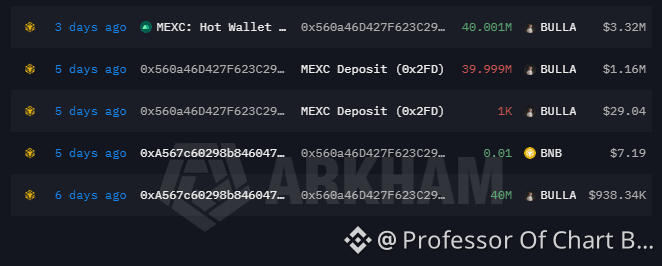
Guys, I already shared my analysis on this whale, and the latest move is getting interesting.
This wallet holds around 40M $BULLA and hasn’t moved a single token despite the recent pump.
Just a few hours ago, $BULLA pushed all the way toward $0.12, and now it’s starting to move higher again.
The interesting part? The whale is already sitting in profit, but still hasn’t taken any tokens off the wallet.
That’s definitely something I’m watching.
If momentum continues, $0.12 could come back into focus for #BULLA
WHALE STILL HOLDING — $0.12 COULD BE NEXT FOR $BULLA
Guys, I already shared my analysis on this whale, and the latest move is getting interesting.
This wallet holds around 40M $BULLA and hasn’t moved a single token despite the recent pump.
Just a few hours ago, $BULLA pushed all the way toward $0.12, and now it’s starting to move higher again.
The interesting part? The whale is already sitting in profit, but still hasn’t taken any tokens off the wallet.
That’s definitely something I’m watching.
If momentum continues, $0.12 could come back into focus for #BULLA
Guys, I already shared my analysis on this whale, and the latest move is getting interesting.
This wallet holds around 40M $BULLA and hasn’t moved a single token despite the recent pump.
Just a few hours ago, $BULLA pushed all the way toward $0.12, and now it’s starting to move higher again.
The interesting part? The whale is already sitting in profit, but still hasn’t taken any tokens off the wallet.
That’s definitely something I’m watching.
If momentum continues, $0.12 could come back into focus for #BULLA
250
30D trade $USELESS 466.8 USDT
$USELESS Rejected Again — Sellers Are Taking Control
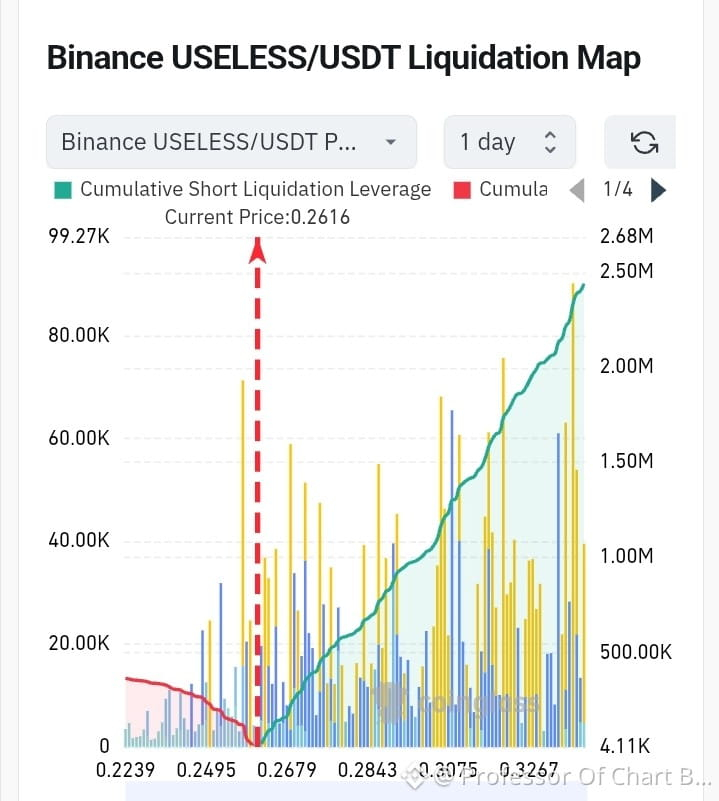
The rejection I was watching on $USELESS is playing out. Price failed around the 0.31–0.33 zone and dropped sharply back to 0.262.
The liquidation map is interesting too — there’s still a large cluster of short liquidations above the current price, meaning a strong reclaim could trigger another squeeze.
For $USELESS , 0.2953 → 0.3003 → 0.310 remain the key levels. Until those are reclaimed, I’d treat rallies as potential rejection zones.
Lose 0.25 and the downside can open up fast
$USELESS Rejected Again — Sellers Are Taking Control
The rejection I was watching on $USELESS is playing out. Price failed around the 0.31–0.33 zone and dropped sharply back to 0.262.
The liquidation map is interesting too — there’s still a large cluster of short liquidations above the current price, meaning a strong reclaim could trigger another squeeze.
For $USELESS , 0.2953 → 0.3003 → 0.310 remain the key levels. Until those are reclaimed, I’d treat rallies as potential rejection zones.
Lose 0.25 and the downside can open up fast
The rejection I was watching on $USELESS is playing out. Price failed around the 0.31–0.33 zone and dropped sharply back to 0.262.
The liquidation map is interesting too — there’s still a large cluster of short liquidations above the current price, meaning a strong reclaim could trigger another squeeze.
For $USELESS , 0.2953 → 0.3003 → 0.310 remain the key levels. Until those are reclaimed, I’d treat rallies as potential rejection zones.
Lose 0.25 and the downside can open up fast
232
$0.0608 SHORT SQUEEZE? $CHIP LIQUIDATION MAP IS LOADED
Guys, $CHIP is consolidating around $0.0582, but the liquidation map is showing a clear upside magnet.
A massive 50x short liquidation cluster is sitting around $0.0607–$0.0608, with cumulative short leverage above 700K.
But there’s a catch.
Long liquidation liquidity is stacked around $0.0568–$0.0572, so a quick wick down could flush late longs before the next move.
I’m watching $0.0608 for the squeeze and $0.0570 for the shakeout zone.
#chip
$0.0608 SHORT SQUEEZE? $CHIP LIQUIDATION MAP IS LOADED
Guys, $CHIP is consolidating around $0.0582, but the liquidation map is showing a clear upside magnet.
A massive 50x short liquidation cluster is sitting around $0.0607–$0.0608, with cumulative short leverage above 700K.
But there’s a catch.
Long liquidation liquidity is stacked around $0.0568–$0.0572, so a quick wick down could flush late longs before the next move.
I’m watching $0.0608 for the squeeze and $0.0570 for the shakeout zone.
#chip
Guys, $CHIP is consolidating around $0.0582, but the liquidation map is showing a clear upside magnet.
A massive 50x short liquidation cluster is sitting around $0.0607–$0.0608, with cumulative short leverage above 700K.
But there’s a catch.
Long liquidation liquidity is stacked around $0.0568–$0.0572, so a quick wick down could flush late longs before the next move.
I’m watching $0.0608 for the squeeze and $0.0570 for the shakeout zone.
#chip
99
·
--
Bullish
$RAYSOL Liquidation Map: Liquidity Pocket at 1.459 vs. Heavy Long Shelf Below.
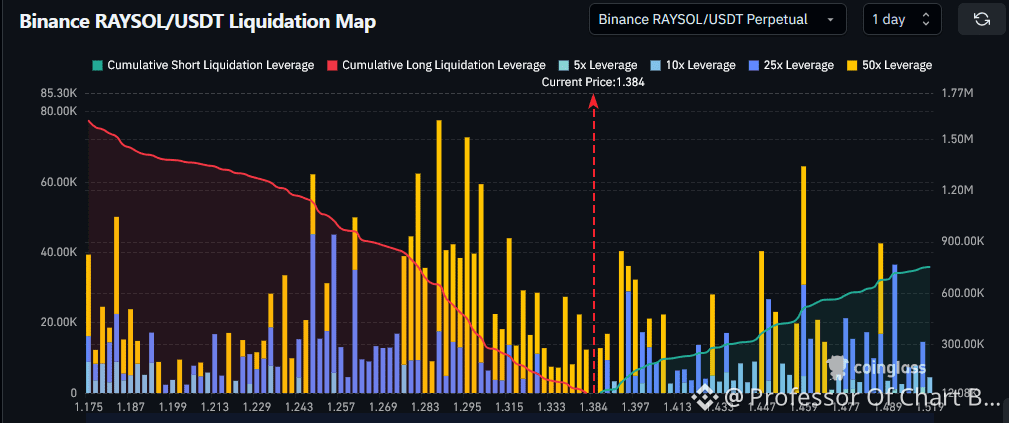
$RAYSOL is currently compressing around $1.384, caught between two distinct leverage profiles:
Overhead Magnet: A prominent 50x short liquidation cluster is resting at $1.459 (with initial stops at $1.397–$1.413).
Any continuation push will likely treat $1.459 as a prime squeeze target.
Downside Risk: Below $1.350 sits an enormous wall of long leverage, heavily concentrated between $1.283 and $1.295.
#raysol
$RAYSOL Liquidation Map: Liquidity Pocket at 1.459 vs. Heavy Long Shelf Below.
$RAYSOL is currently compressing around $1.384, caught between two distinct leverage profiles:
Overhead Magnet: A prominent 50x short liquidation cluster is resting at $1.459 (with initial stops at $1.397–$1.413).
Any continuation push will likely treat $1.459 as a prime squeeze target.
Downside Risk: Below $1.350 sits an enormous wall of long leverage, heavily concentrated between $1.283 and $1.295.
#raysol
$RAYSOL is currently compressing around $1.384, caught between two distinct leverage profiles:
Overhead Magnet: A prominent 50x short liquidation cluster is resting at $1.459 (with initial stops at $1.397–$1.413).
Any continuation push will likely treat $1.459 as a prime squeeze target.
Downside Risk: Below $1.350 sits an enormous wall of long leverage, heavily concentrated between $1.283 and $1.295.
#raysol
63
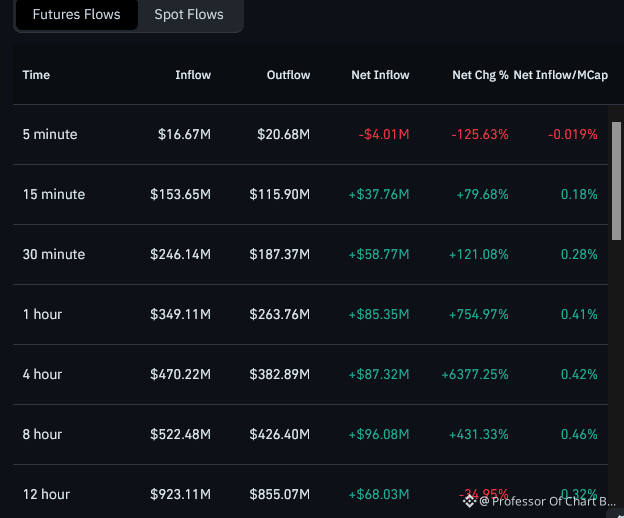
$1,262 BREAKOUT? $ZEC FUTURES FLOW IS MASSIVELY IMBALANCED
Guys, $ZEC is around $1,243 and the higher-timeframe flow still looks bullish.
But here’s the interesting part:
1H Futures: +$85.35M
1H Spot: +$6.60M
On 4H, futures are still +$87.32M while spot is only +$6.75M.
So this move is being driven heavily by futures positioning, not strong spot accumulation.
Now ZEC is testing the key $1,262 resistance.
Break and hold above $1,262 → bullish continuation
Rejection → $1,153 support
Lose $1,153 → $1,125 next
I’m bullish, but I wouldn’t blindly chase $ZEC until spot buyers start showing more strength.
#zec
$1,262 BREAKOUT? $ZEC FUTURES FLOW IS MASSIVELY IMBALANCED
Guys, $ZEC is around $1,243 and the higher-timeframe flow still looks bullish.
But here’s the interesting part:
1H Futures: +$85.35M
1H Spot: +$6.60M
On 4H, futures are still +$87.32M while spot is only +$6.75M.
So this move is being driven heavily by futures positioning, not strong spot accumulation.
Now ZEC is testing the key $1,262 resistance.
Break and hold above $1,262 → bullish continuation
Rejection → $1,153 support
Lose $1,153 → $1,125 next
I’m bullish, but I wouldn’t blindly chase $ZEC until spot buyers start showing more strength.
#zec
Guys, $ZEC is around $1,243 and the higher-timeframe flow still looks bullish.
But here’s the interesting part:
1H Futures: +$85.35M
1H Spot: +$6.60M
On 4H, futures are still +$87.32M while spot is only +$6.75M.
So this move is being driven heavily by futures positioning, not strong spot accumulation.
Now ZEC is testing the key $1,262 resistance.
Break and hold above $1,262 → bullish continuation
Rejection → $1,153 support
Lose $1,153 → $1,125 next
I’m bullish, but I wouldn’t blindly chase $ZEC until spot buyers start showing more strength.
#zec
2
4.5k
$0.80 BREAKOUT NEXT? $PONS WHALE FLOW IS GETTING INTERESTING
Guys, the $PONS recovery from $0.65 is catching my attention.
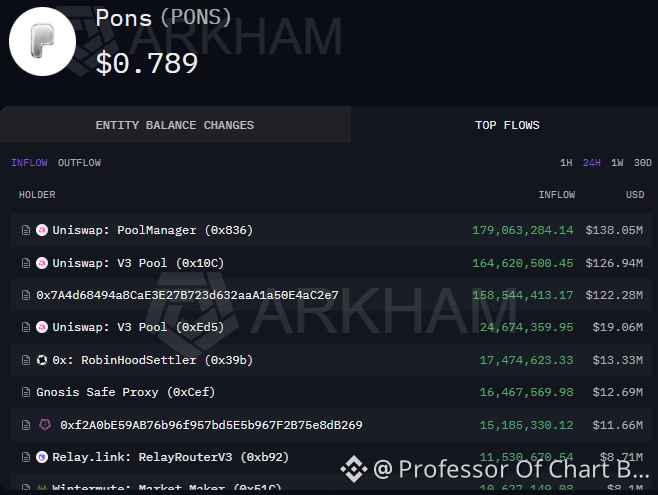
Arkham shows Wintermute accumulating 10.6M $PONS worth around $8.1M. At the same time, around $13.3M is sitting with RobinHoodSettler, while over $280M is locked in Uniswap V3 liquidity.
The timing is interesting PONS bounced hard from the lows and is now testing the $0.80 resistance.
If $0.80 breaks with volume, PONS could have room for another leg higher.
#pons
$0.80 BREAKOUT NEXT? $PONS WHALE FLOW IS GETTING INTERESTING
Guys, the $PONS recovery from $0.65 is catching my attention.
Arkham shows Wintermute accumulating 10.6M $PONS worth around $8.1M. At the same time, around $13.3M is sitting with RobinHoodSettler, while over $280M is locked in Uniswap V3 liquidity.
The timing is interesting PONS bounced hard from the lows and is now testing the $0.80 resistance.
If $0.80 breaks with volume, PONS could have room for another leg higher.
#pons
Guys, the $PONS recovery from $0.65 is catching my attention.
Arkham shows Wintermute accumulating 10.6M $PONS worth around $8.1M. At the same time, around $13.3M is sitting with RobinHoodSettler, while over $280M is locked in Uniswap V3 liquidity.
The timing is interesting PONS bounced hard from the lows and is now testing the $0.80 resistance.
If $0.80 breaks with volume, PONS could have room for another leg higher.
#pons
214
·
--
Bearish
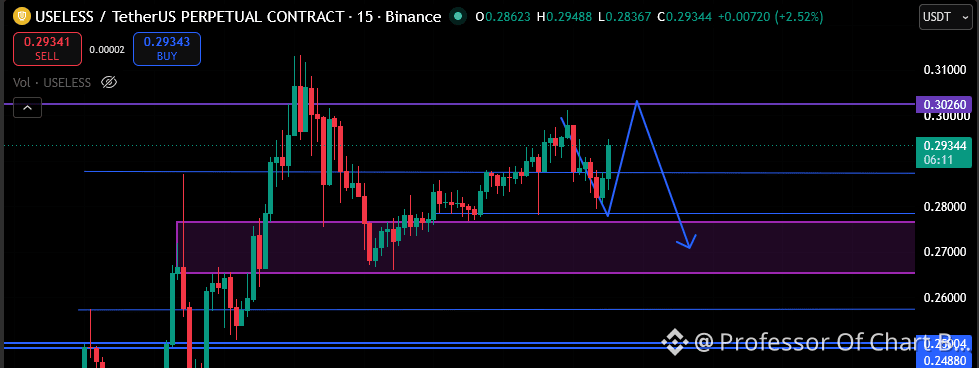
$0.30 REJECTION SETUP? $USELESS COULD DROP TO $0.278
Guys, $USELESS is approaching an interesting zone.
If price spikes into $0.3030–$0.3060 or even stretches toward $0.3150, I’ll be watching for a short squeeze followed by a rejection.
The setup gets interesting if $USELESS closes back below $0.3010 on 15M.
Entry: $0.2990–$0.3030 after rejection
SL: $0.3085 or above the wick high
TP1: $0.2880
TP2: $0.2780
No blind entries here — I want to see the rejection first.
$0.30 REJECTION SETUP? $USELESS COULD DROP TO $0.278
Guys, $USELESS is approaching an interesting zone.
If price spikes into $0.3030–$0.3060 or even stretches toward $0.3150, I’ll be watching for a short squeeze followed by a rejection.
The setup gets interesting if $USELESS closes back below $0.3010 on 15M.
Entry: $0.2990–$0.3030 after rejection
SL: $0.3085 or above the wick high
TP1: $0.2880
TP2: $0.2780
No blind entries here — I want to see the rejection first.
Guys, $USELESS is approaching an interesting zone.
If price spikes into $0.3030–$0.3060 or even stretches toward $0.3150, I’ll be watching for a short squeeze followed by a rejection.
The setup gets interesting if $USELESS closes back below $0.3010 on 15M.
Entry: $0.2990–$0.3030 after rejection
SL: $0.3085 or above the wick high
TP1: $0.2880
TP2: $0.2780
No blind entries here — I want to see the rejection first.
254
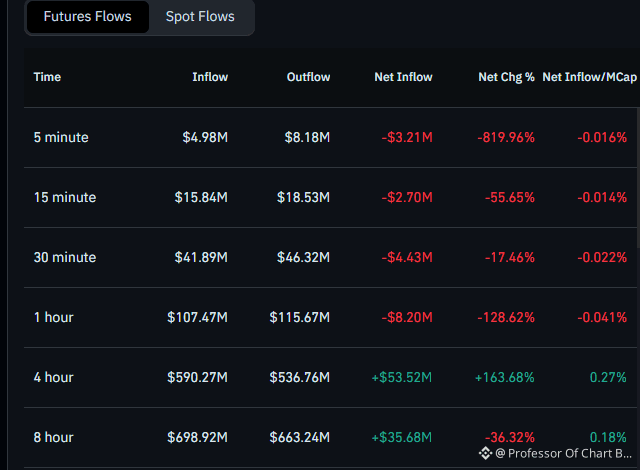
$1,120 NEXT? $ZEC LEVERAGE IS STARTING TO UNWIND
Guys, $ZEC futures flow just flipped hard.
Futures added +$53.5M over 4H, but the 1H suddenly turned to -$8.20M, including -$3.21M in just 5 minutes.
Spot also stayed heavily negative, with -$4.13M outflow in 1H.
Now $ZEC has formed a lower high around $1,194 and is slipping back toward $1,177.
Late longs from the $1,200 push could be under pressure.
If selling continues, I’m watching $1,120 as the next major level.
$1,120 NEXT? $ZEC LEVERAGE IS STARTING TO UNWIND
Guys, $ZEC futures flow just flipped hard.
Futures added +$53.5M over 4H, but the 1H suddenly turned to -$8.20M, including -$3.21M in just 5 minutes.
Spot also stayed heavily negative, with -$4.13M outflow in 1H.
Now $ZEC has formed a lower high around $1,194 and is slipping back toward $1,177.
Late longs from the $1,200 push could be under pressure.
If selling continues, I’m watching $1,120 as the next major level.
Guys, $ZEC futures flow just flipped hard.
Futures added +$53.5M over 4H, but the 1H suddenly turned to -$8.20M, including -$3.21M in just 5 minutes.
Spot also stayed heavily negative, with -$4.13M outflow in 1H.
Now $ZEC has formed a lower high around $1,194 and is slipping back toward $1,177.
Late longs from the $1,200 push could be under pressure.
If selling continues, I’m watching $1,120 as the next major level.
1
126
WHALES ARE BUYING THE DIP? $MARSCOIN FLOW JUST FLIPPED.
Guys, after hours of selling, the on-chain flow around $MARSCOIN is starting to look different.
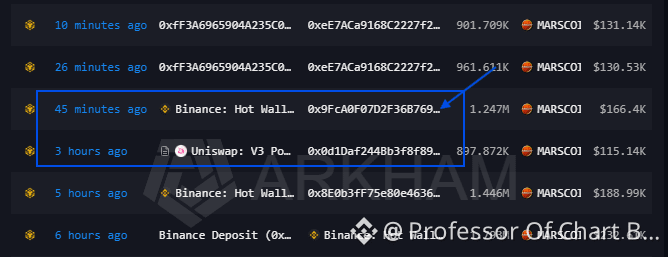
Just 45 minutes ago, 1.247M $MARSCOIN worth $166K moved from Binance into a private wallet.
A few hours earlier, another wallet withdrew 1.446M tokens worth $188.9K from Binance.
We’re also seeing 900K–960K token transfers between private wallets over the last 30 minutes.
This doesn’t confirm a reversal, but fewer tokens sitting on Binance could mean less immediate sell pressure.
If these withdrawals continue, MARSCOIN could be setting up for a recovery. I’m watching the exchange flows closely.
#marscoin
WHALES ARE BUYING THE DIP? $MARSCOIN FLOW JUST FLIPPED.
Guys, after hours of selling, the on-chain flow around $MARSCOIN is starting to look different.
Just 45 minutes ago, 1.247M $MARSCOIN worth $166K moved from Binance into a private wallet.
A few hours earlier, another wallet withdrew 1.446M tokens worth $188.9K from Binance.
We’re also seeing 900K–960K token transfers between private wallets over the last 30 minutes.
This doesn’t confirm a reversal, but fewer tokens sitting on Binance could mean less immediate sell pressure.
If these withdrawals continue, MARSCOIN could be setting up for a recovery. I’m watching the exchange flows closely.
#marscoin
Guys, after hours of selling, the on-chain flow around $MARSCOIN is starting to look different.
Just 45 minutes ago, 1.247M $MARSCOIN worth $166K moved from Binance into a private wallet.
A few hours earlier, another wallet withdrew 1.446M tokens worth $188.9K from Binance.
We’re also seeing 900K–960K token transfers between private wallets over the last 30 minutes.
This doesn’t confirm a reversal, but fewer tokens sitting on Binance could mean less immediate sell pressure.
If these withdrawals continue, MARSCOIN could be setting up for a recovery. I’m watching the exchange flows closely.
#marscoin
1
469

42
·
--
Bearish
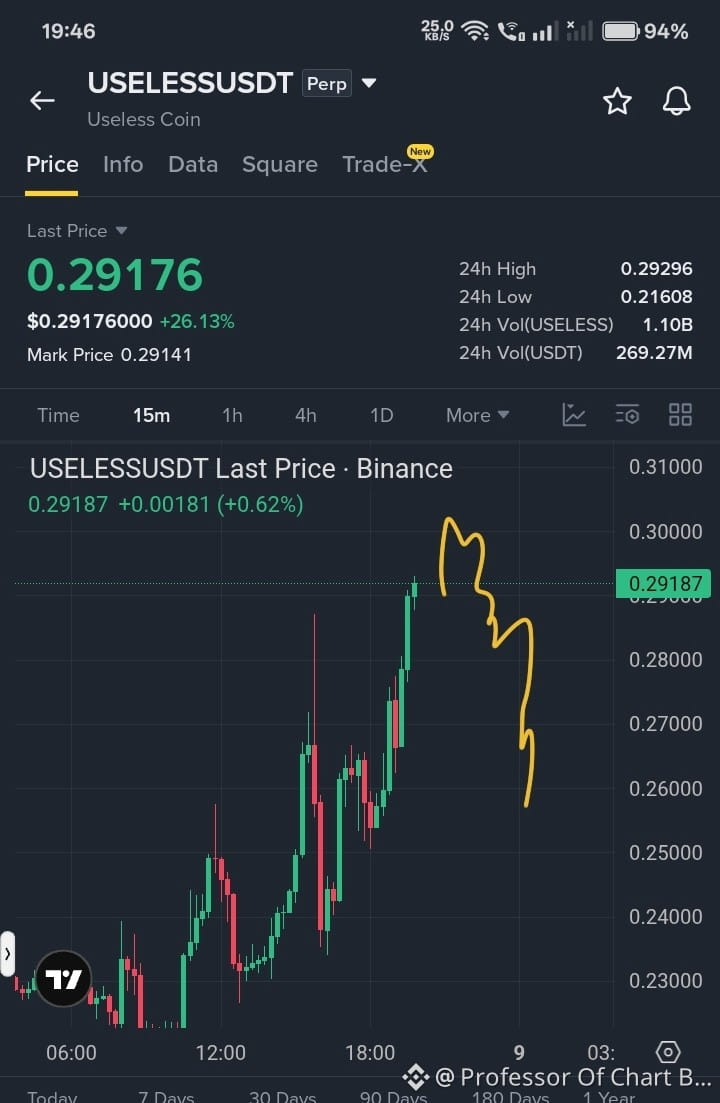
$USELESS — 0.2953 → 0.3003 → 0.310 ARE CRITICAL REJECTION LEVELS
$USELESS is approaching a zone where I’m expecting strong rejection if buyers fail to break through.
The key levels I’m watching are 0.2953, 0.3003 and 0.310. These could act as major resistance, especially if momentum starts weakening into each level.
If $USELESS gets rejected around these zones, I’d expect a pullback before any further upside.
Watch these levels closely rejection here could be the setup.
#useless
$USELESS — 0.2953 → 0.3003 → 0.310 ARE CRITICAL REJECTION LEVELS
$USELESS is approaching a zone where I’m expecting strong rejection if buyers fail to break through.
The key levels I’m watching are 0.2953, 0.3003 and 0.310. These could act as major resistance, especially if momentum starts weakening into each level.
If $USELESS gets rejected around these zones, I’d expect a pullback before any further upside.
Watch these levels closely rejection here could be the setup.
#useless
$USELESS is approaching a zone where I’m expecting strong rejection if buyers fail to break through.
The key levels I’m watching are 0.2953, 0.3003 and 0.310. These could act as major resistance, especially if momentum starts weakening into each level.
If $USELESS gets rejected around these zones, I’d expect a pullback before any further upside.
Watch these levels closely rejection here could be the setup.
#useless
1
281
ANOTHER 35M $SOPH MOVED SELLING PRESSURE ISN’T OVER
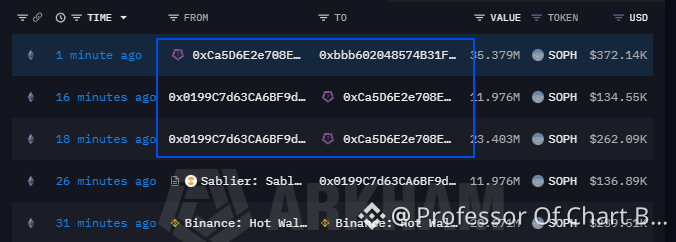
Guys, the $SOPH chart is breaking down, and the on-chain activity is getting interesting.
Just minutes ago, 11.97M SOPH was unlocked from a Sablier vesting contract. Those tokens were then routed through a proxy and consolidated into a 35.37M $SOPH stack worth around $372K.
At the same time, price is printing heavy red candles after the move toward $0.012, now trading near the critical $0.0095 support.
If more unlocked tokens keep moving toward exchanges, SOPH could face another wave of selling.
I’m watching $0.0095 closely. Lose that level and the downside could accelerate.
#SOPH
ANOTHER 35M $SOPH MOVED SELLING PRESSURE ISN’T OVER
Guys, the $SOPH chart is breaking down, and the on-chain activity is getting interesting.
Just minutes ago, 11.97M SOPH was unlocked from a Sablier vesting contract. Those tokens were then routed through a proxy and consolidated into a 35.37M $SOPH stack worth around $372K.
At the same time, price is printing heavy red candles after the move toward $0.012, now trading near the critical $0.0095 support.
If more unlocked tokens keep moving toward exchanges, SOPH could face another wave of selling.
I’m watching $0.0095 closely. Lose that level and the downside could accelerate.
#SOPH
Guys, the $SOPH chart is breaking down, and the on-chain activity is getting interesting.
Just minutes ago, 11.97M SOPH was unlocked from a Sablier vesting contract. Those tokens were then routed through a proxy and consolidated into a 35.37M $SOPH stack worth around $372K.
At the same time, price is printing heavy red candles after the move toward $0.012, now trading near the critical $0.0095 support.
If more unlocked tokens keep moving toward exchanges, SOPH could face another wave of selling.
I’m watching $0.0095 closely. Lose that level and the downside could accelerate.
#SOPH
75
·
--
Bearish
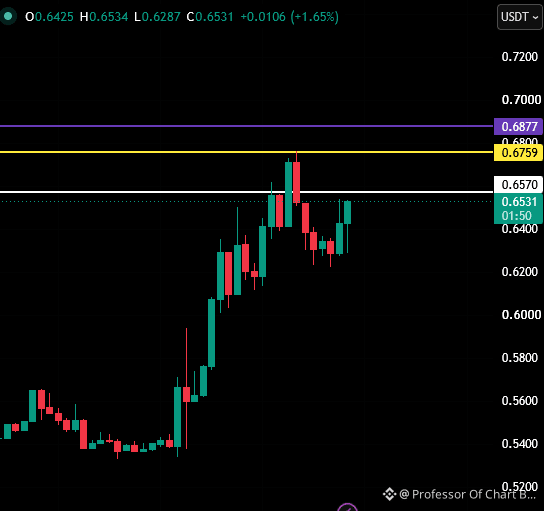
$AERO UPDATE: Don’t Get Trapped Chasing Green Candles
$AERO is bouncing hard to $0.653, but look at what’s waiting overhead before you rush into a trade.
Crucial Levels on Watch: $0.6759: Local swing high resistance
$0.6877: Heavy resistance zone
These two levels have a high probability of rejecting price and triggering a corrective drop if momentum stalls.
Reminder:
Don't just place blind limit orders. Watch the price action and order flow as it tests 0.6759 – 0.6877. Wait for clear rejection or confirmed breakout before taking a position. Manage your risk!
$AERO UPDATE: Don’t Get Trapped Chasing Green Candles
$AERO is bouncing hard to $0.653, but look at what’s waiting overhead before you rush into a trade.
Crucial Levels on Watch: $0.6759: Local swing high resistance
$0.6877: Heavy resistance zone
These two levels have a high probability of rejecting price and triggering a corrective drop if momentum stalls.
Reminder:
Don't just place blind limit orders. Watch the price action and order flow as it tests 0.6759 – 0.6877. Wait for clear rejection or confirmed breakout before taking a position. Manage your risk!
$AERO is bouncing hard to $0.653, but look at what’s waiting overhead before you rush into a trade.
Crucial Levels on Watch: $0.6759: Local swing high resistance
$0.6877: Heavy resistance zone
These two levels have a high probability of rejecting price and triggering a corrective drop if momentum stalls.
Reminder:
Don't just place blind limit orders. Watch the price action and order flow as it tests 0.6759 – 0.6877. Wait for clear rejection or confirmed breakout before taking a position. Manage your risk!
32
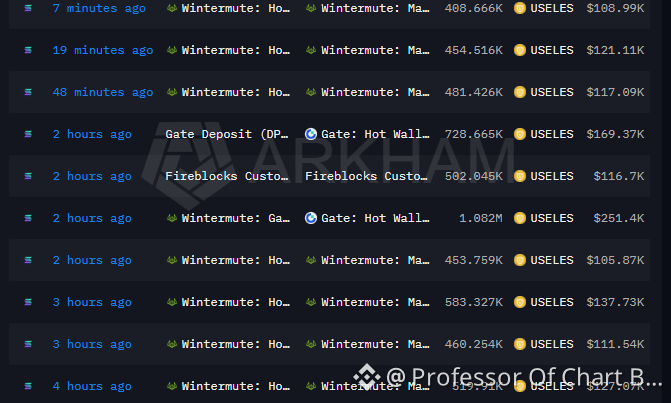
Wintermute just distributed into the $USELESS breakout.
Look at the confluence:
Wintermute sent 1.08M $USELESS ($251K) straight to Gate.io hot wallets alongside active transfers across their MM addresses.
The 1H chart immediately spiked to $0.2871 to hunt buy stops, then got slammed down to $0.244 (-8% rejection).
Retail bought the breakout, market makers provided the exit liquidity.
Watch $0.240 closely losing it opens up a fast drop back to the $0.22 base. Always wait for candle closes before chasing.
#useless
Wintermute just distributed into the $USELESS breakout.
Look at the confluence:
Wintermute sent 1.08M $USELESS ($251K) straight to Gate.io hot wallets alongside active transfers across their MM addresses.
The 1H chart immediately spiked to $0.2871 to hunt buy stops, then got slammed down to $0.244 (-8% rejection).
Retail bought the breakout, market makers provided the exit liquidity.
Watch $0.240 closely losing it opens up a fast drop back to the $0.22 base. Always wait for candle closes before chasing.
#useless
Look at the confluence:
Wintermute sent 1.08M $USELESS ($251K) straight to Gate.io hot wallets alongside active transfers across their MM addresses.
The 1H chart immediately spiked to $0.2871 to hunt buy stops, then got slammed down to $0.244 (-8% rejection).
Retail bought the breakout, market makers provided the exit liquidity.
Watch $0.240 closely losing it opens up a fast drop back to the $0.22 base. Always wait for candle closes before chasing.
#useless
2
373
·
--
Bearish
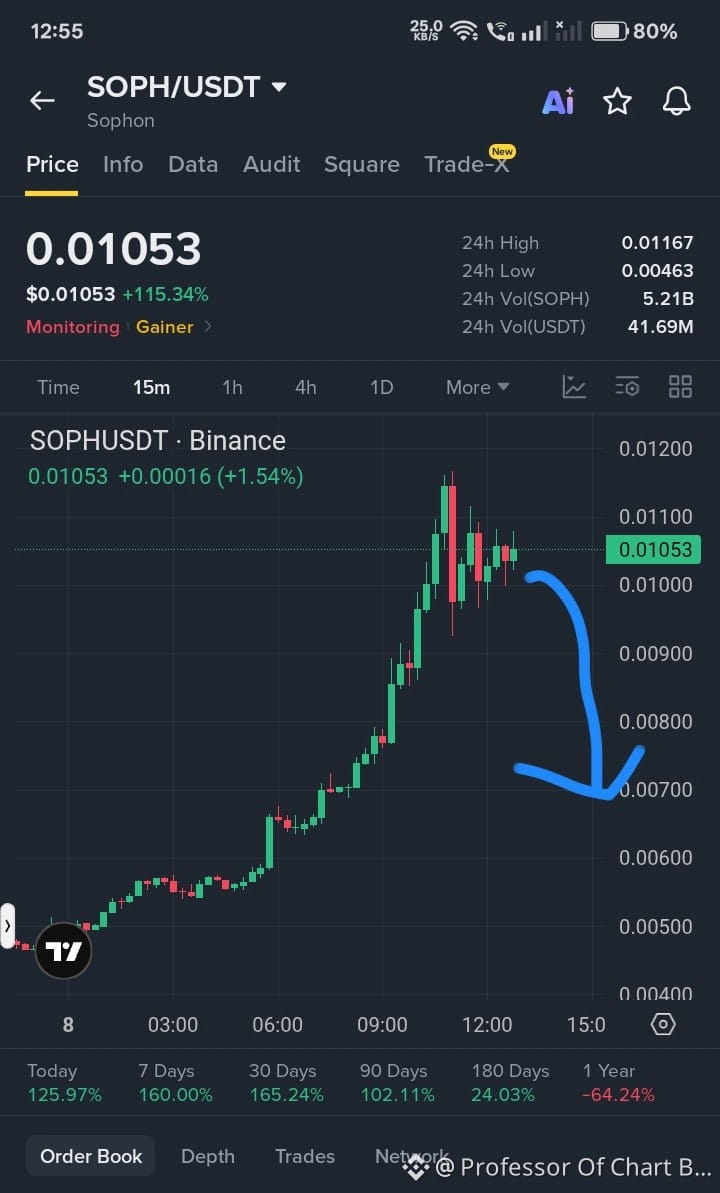
$SOPH FLUSH COMING? TARGET: $0.007
I’ve been tracking $SOPH after this explosive move, and the spot vs futures inflow/outflow is starting to raise a red flag.
Price pushed from around $0.005 to above $0.011, but momentum is now slowing near the highs. If futures leverage keeps building while spot demand weakens, SOPH could see a sharp flush as late longs get trapped.
The level I’m watching is $0.007.
If the current structure breaks, $SOPH → $0.007 is the downside target I’m watching.
$SOPH FLUSH COMING? TARGET: $0.007
I’ve been tracking $SOPH after this explosive move, and the spot vs futures inflow/outflow is starting to raise a red flag.
Price pushed from around $0.005 to above $0.011, but momentum is now slowing near the highs. If futures leverage keeps building while spot demand weakens, SOPH could see a sharp flush as late longs get trapped.
The level I’m watching is $0.007.
If the current structure breaks, $SOPH → $0.007 is the downside target I’m watching.
I’ve been tracking $SOPH after this explosive move, and the spot vs futures inflow/outflow is starting to raise a red flag.
Price pushed from around $0.005 to above $0.011, but momentum is now slowing near the highs. If futures leverage keeps building while spot demand weakens, SOPH could see a sharp flush as late longs get trapped.
The level I’m watching is $0.007.
If the current structure breaks, $SOPH → $0.007 is the downside target I’m watching.
140
·
--
Bullish
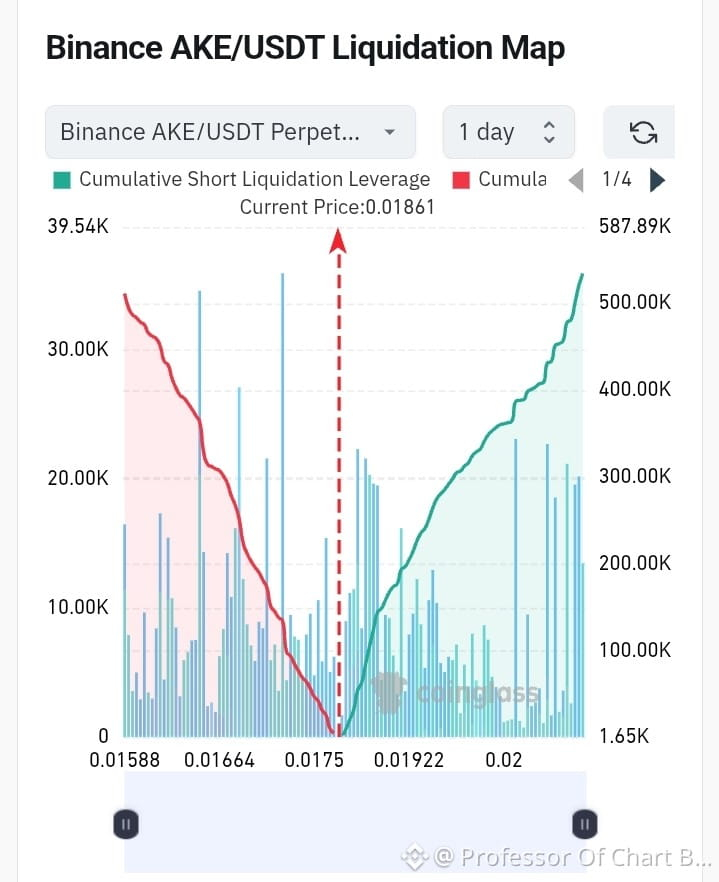
$0.02 TARGET? $AKE SHORT SQUEEZE IS BUILDING
AKE is trading around $0.0186, and the liquidation map shows a strong build-up of short liquidity above the current price.
If $AKE breaks the $0.019–$0.020 zone, those shorts could start getting squeezed and fuel another move higher.
The setup looks interesting here. Watching AKE closely. 👀
#AKE
$0.02 TARGET? $AKE SHORT SQUEEZE IS BUILDING
AKE is trading around $0.0186, and the liquidation map shows a strong build-up of short liquidity above the current price.
If $AKE breaks the $0.019–$0.020 zone, those shorts could start getting squeezed and fuel another move higher.
The setup looks interesting here. Watching AKE closely. 👀
#AKE
AKE is trading around $0.0186, and the liquidation map shows a strong build-up of short liquidity above the current price.
If $AKE breaks the $0.019–$0.020 zone, those shorts could start getting squeezed and fuel another move higher.
The setup looks interesting here. Watching AKE closely. 👀
#AKE
58
Log in to explore more content
Join global crypto users on Binance Square
⚡️ Get latest and useful information about crypto.
💬 Trusted by the world’s largest crypto exchange.
👍 Discover real insights from verified creators.
Email / Phone number
Trending Topics
USAugustPPIRisesLessThanExpected
3,607 views
130 Discussing
🚨 US AUG PPI: Rises LESS Than Expected! Bullish for Crypto? 🚀
PPI +0.4% MoM as expected, but CORE PPI only +0.2% vs +0.3% expected - cooling!
What it means:
• Wholesale inflation softer than feared
• Fed rate hike chance now 62% - but dovish signals coming
• Core PCE revisions expected downward - bullish
• BTC usually pumps on softer PPI
Fed meeting Sep 15-16 - Market now expects pause, not hike?
Is this the green light for Q4 rally?
#Bitcoin #PPI #Fed #CryptoNews #BTC#usaugustppiriseslessthanexpected
True News
·1 Likes
·785 views
SECApprovesNasdaqTexasCommodityTrustRule
4,137 views
185 Discussing
ECBRaisesRatesSecondTimeTo2.5%
2,027 views
129 Discussing