

E C H O
285 Paylaşımlar

E C H O
Şikayət et
İstifadəçini blokla
62 İzlənilir
5.7K+ İzləyicilər
397 Bəyəndi
Postlar
Hamısı
Canlı
·
--
Tərcüməyə bax
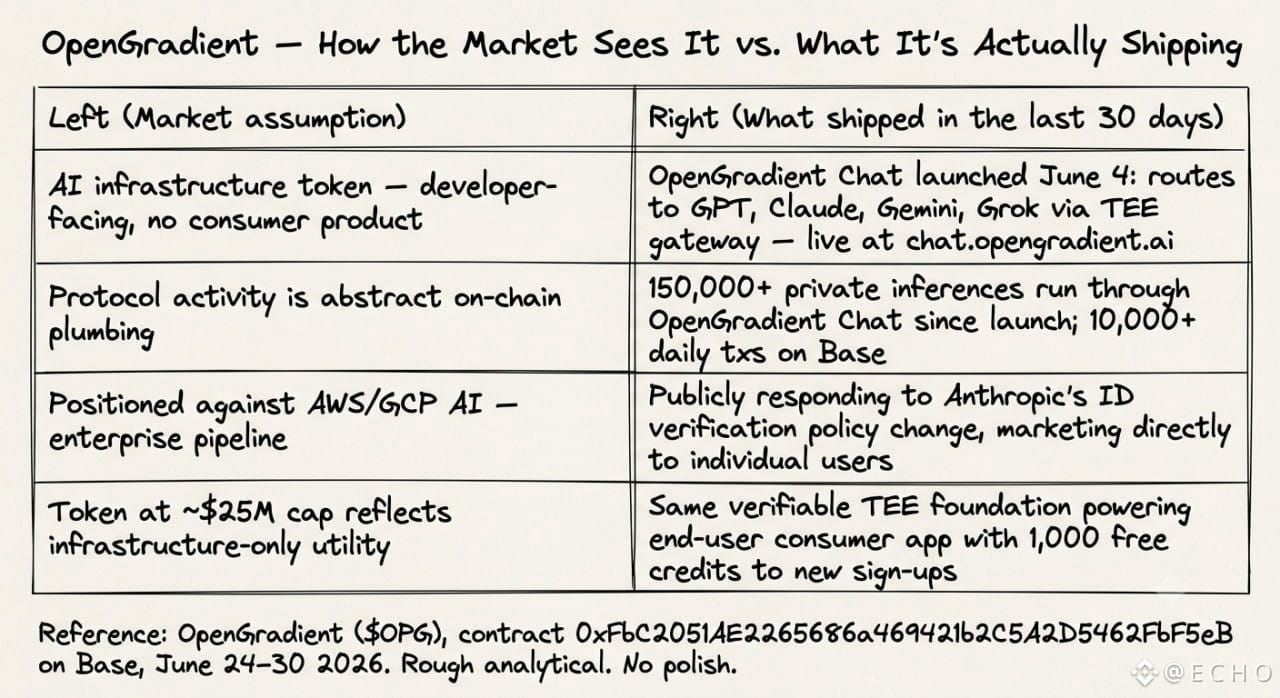
The moment that stopped me cold during this task wasn't the network numbers — it was a post from @OpenGradient account this week referencing Anthropic's updated privacy policy. They noted Anthropic now reserves the right to request government ID, a photo, and biometric data from users. And underneath that, they linked to OpenGradient Chat. $OPG #OPG
hold up — that's actually a sharp piece of real-world positioning. OpenGradient Chat routes to GPT, Claude, Gemini, and Grok through TEE-isolated gateways with Oblivious HTTP anonymization. They launched it June 4. Since then, the account says 150,000+ inferences have run privately through the platform — every one inside a hardware enclave, nothing logged. And the network behind all of it processed another 10,000+ daily transactions this past week on Base, contract 0xFbC2051AE2265686a469421b2C5A2D5462FbF5eB, ticking quietly.
The insight isn't the privacy angle itself. It's that the market is pricing $OPG like a pure infrastructure token at ~$25M cap, while the team is quietly shipping consumer AI products that compete directly with the apps most people use daily. That's a different category of project. Most "AI infra" tokens never touch an end user. This one is at chat.opengradient.ai now.
I'm genuinely unsure whether the consumer layer generates inference demand that meaningfully flows back to the token, or whether it's a separate surface sitting loosely on top. But one of those scenarios is very different from the other...
The moment that stopped me cold during this task wasn't the network numbers — it was a post from @OpenGradient account this week referencing Anthropic's updated privacy policy. They noted Anthropic now reserves the right to request government ID, a photo, and biometric data from users. And underneath that, they linked to OpenGradient Chat. $OPG #OPG
hold up — that's actually a sharp piece of real-world positioning. OpenGradient Chat routes to GPT, Claude, Gemini, and Grok through TEE-isolated gateways with Oblivious HTTP anonymization. They launched it June 4. Since then, the account says 150,000+ inferences have run privately through the platform — every one inside a hardware enclave, nothing logged. And the network behind all of it processed another 10,000+ daily transactions this past week on Base, contract 0xFbC2051AE2265686a469421b2C5A2D5462FbF5eB, ticking quietly.
The insight isn't the privacy angle itself. It's that the market is pricing $OPG like a pure infrastructure token at ~$25M cap, while the team is quietly shipping consumer AI products that compete directly with the apps most people use daily. That's a different category of project. Most "AI infra" tokens never touch an end user. This one is at chat.opengradient.ai now.
I'm genuinely unsure whether the consumer layer generates inference demand that meaningfully flows back to the token, or whether it's a separate surface sitting loosely on top. But one of those scenarios is very different from the other...
hold up — that's actually a sharp piece of real-world positioning. OpenGradient Chat routes to GPT, Claude, Gemini, and Grok through TEE-isolated gateways with Oblivious HTTP anonymization. They launched it June 4. Since then, the account says 150,000+ inferences have run privately through the platform — every one inside a hardware enclave, nothing logged. And the network behind all of it processed another 10,000+ daily transactions this past week on Base, contract 0xFbC2051AE2265686a469421b2C5A2D5462FbF5eB, ticking quietly.
The insight isn't the privacy angle itself. It's that the market is pricing $OPG like a pure infrastructure token at ~$25M cap, while the team is quietly shipping consumer AI products that compete directly with the apps most people use daily. That's a different category of project. Most "AI infra" tokens never touch an end user. This one is at chat.opengradient.ai now.
I'm genuinely unsure whether the consumer layer generates inference demand that meaningfully flows back to the token, or whether it's a separate surface sitting loosely on top. But one of those scenarios is very different from the other...
7
1
243
·
--
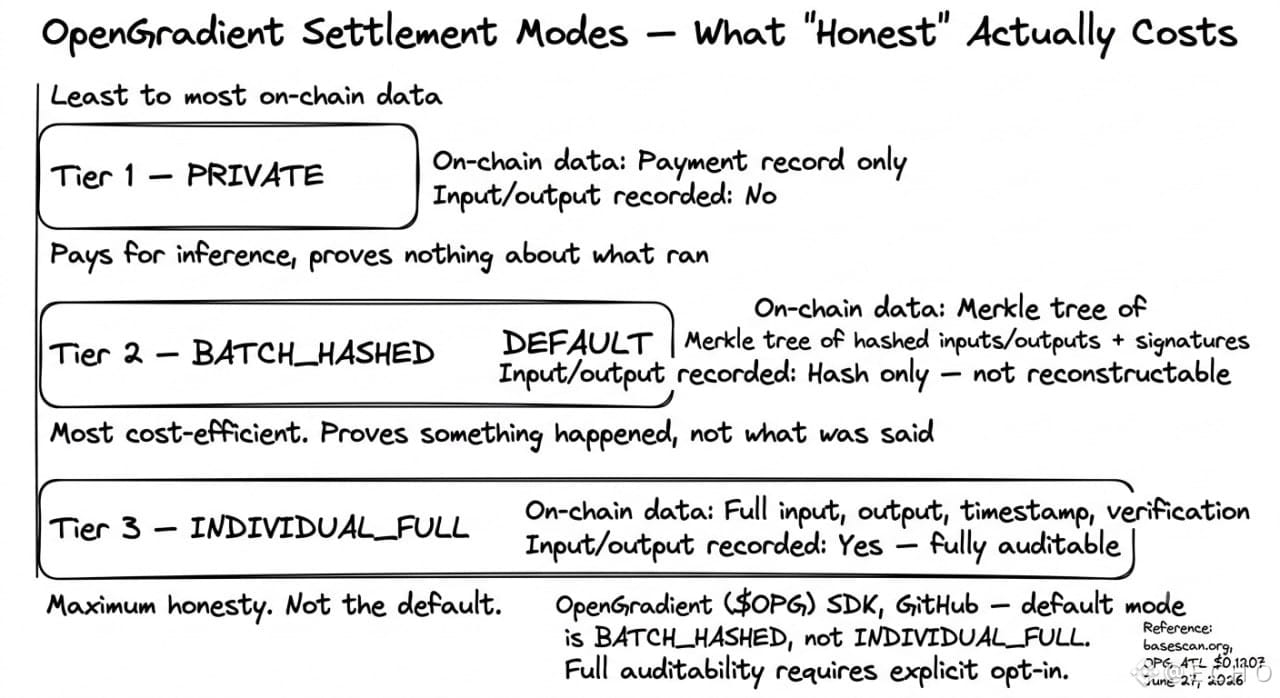
SDK sənədlərindəki nəsə kiçik bir detal məni bu CreatorPad tapşırığında dayandırdı. OpenGradient $OPG @OpenGradient #OPG ilə vaxt sərf etdim və hər dəfəyə bir şeyə qayıtdım: SDK-nın özünə əvvəlcədən daxil etdiyi settlement rejim seçimləri.
Üç rejim var. PRIVATE — ödəniş qeyd olunur, başqa heç nə. BATCH_HASHED — girişlərin və çıxışların hash-ları Merkle ağacına yığılır, xərc baxımından səmərəlidir və xüsusən default-dur. INDIVIDUAL_FULL — giriş, çıxış, timestamp və doğrulama hamısı on-çeynə yazılır, maksimum audit oluna bilmə.
Bu iyerarxiya önəmlidir. “honest” rejimi — yəni əslində nə istənildiyini və nə geri gəldiyini qeydə alan rejim — soruşmadan tərtibatçılara verilən şey deyil. Onlar hashed batch alırlar: bu, nəyinsə baş verdiyini sübut edir, amma nə soruşulduğunu və nə alındığını yenidən qurmağa imkan vermir.
Bəs OpenGradient AI-ni daha “honest” edirmi? Texniki olaraq bəli — hətta BATCH_HASHED də mərkəzləşdirilmiş API çağırışından daha izlənə biləndir. Amma “heç nədən daha honest” və “modelin dediyini faktiki olaraq yoxlaya bilirsən” iki fərqli iddiadır. $OPG bu gün $0.133 civarında ticarət edir; 27 iyunda basescan.org vasitəsilə $0.1207 tarixi minimumuna düşdükdən sonra. Görünür bazar tam audit oluna bilməni mükafat kimi qiymətləndirmir. Üstəlik default seçim layihənin bildiyini göstərir: tərtibatçıların çoxu daha ucuz yola gedəcək.
Bunun məqbul bir UX güzəşti olub-olmadığını, ya da tam şəffaflığın qiyməti çox olduğu üçün sadəcə default olaraq sakitcə geri çəkilən bir güzəşt olduğunu düşündüm.
Hələ də tam olaraq hansı olduğunu dəqiqləşdirə bilmədim.
SDK sənədlərindəki nəsə kiçik bir detal məni bu CreatorPad tapşırığında dayandırdı. OpenGradient $OPG @OpenGradient #OPG ilə vaxt sərf etdim və hər dəfəyə bir şeyə qayıtdım: SDK-nın özünə əvvəlcədən daxil etdiyi settlement rejim seçimləri.
Üç rejim var. PRIVATE — ödəniş qeyd olunur, başqa heç nə. BATCH_HASHED — girişlərin və çıxışların hash-ları Merkle ağacına yığılır, xərc baxımından səmərəlidir və xüsusən default-dur. INDIVIDUAL_FULL — giriş, çıxış, timestamp və doğrulama hamısı on-çeynə yazılır, maksimum audit oluna bilmə.
Bu iyerarxiya önəmlidir. “honest” rejimi — yəni əslində nə istənildiyini və nə geri gəldiyini qeydə alan rejim — soruşmadan tərtibatçılara verilən şey deyil. Onlar hashed batch alırlar: bu, nəyinsə baş verdiyini sübut edir, amma nə soruşulduğunu və nə alındığını yenidən qurmağa imkan vermir.
Bəs OpenGradient AI-ni daha “honest” edirmi? Texniki olaraq bəli — hətta BATCH_HASHED də mərkəzləşdirilmiş API çağırışından daha izlənə biləndir. Amma “heç nədən daha honest” və “modelin dediyini faktiki olaraq yoxlaya bilirsən” iki fərqli iddiadır. $OPG bu gün $0.133 civarında ticarət edir; 27 iyunda basescan.org vasitəsilə $0.1207 tarixi minimumuna düşdükdən sonra. Görünür bazar tam audit oluna bilməni mükafat kimi qiymətləndirmir. Üstəlik default seçim layihənin bildiyini göstərir: tərtibatçıların çoxu daha ucuz yola gedəcək.
Bunun məqbul bir UX güzəşti olub-olmadığını, ya da tam şəffaflığın qiyməti çox olduğu üçün sadəcə default olaraq sakitcə geri çəkilən bir güzəşt olduğunu düşündüm.
Hələ də tam olaraq hansı olduğunu dəqiqləşdirə bilmədim.
Üç rejim var. PRIVATE — ödəniş qeyd olunur, başqa heç nə. BATCH_HASHED — girişlərin və çıxışların hash-ları Merkle ağacına yığılır, xərc baxımından səmərəlidir və xüsusən default-dur. INDIVIDUAL_FULL — giriş, çıxış, timestamp və doğrulama hamısı on-çeynə yazılır, maksimum audit oluna bilmə.
Bu iyerarxiya önəmlidir. “honest” rejimi — yəni əslində nə istənildiyini və nə geri gəldiyini qeydə alan rejim — soruşmadan tərtibatçılara verilən şey deyil. Onlar hashed batch alırlar: bu, nəyinsə baş verdiyini sübut edir, amma nə soruşulduğunu və nə alındığını yenidən qurmağa imkan vermir.
Bəs OpenGradient AI-ni daha “honest” edirmi? Texniki olaraq bəli — hətta BATCH_HASHED də mərkəzləşdirilmiş API çağırışından daha izlənə biləndir. Amma “heç nədən daha honest” və “modelin dediyini faktiki olaraq yoxlaya bilirsən” iki fərqli iddiadır. $OPG bu gün $0.133 civarında ticarət edir; 27 iyunda basescan.org vasitəsilə $0.1207 tarixi minimumuna düşdükdən sonra. Görünür bazar tam audit oluna bilməni mükafat kimi qiymətləndirmir. Üstəlik default seçim layihənin bildiyini göstərir: tərtibatçıların çoxu daha ucuz yola gedəcək.
Bunun məqbul bir UX güzəşti olub-olmadığını, ya da tam şəffaflığın qiyməti çox olduğu üçün sadəcə default olaraq sakitcə geri çəkilən bir güzəşt olduğunu düşündüm.
Hələ də tam olaraq hansı olduğunu dəqiqləşdirə bilmədim.
5
2
347
·
--
Tərcüməyə bax
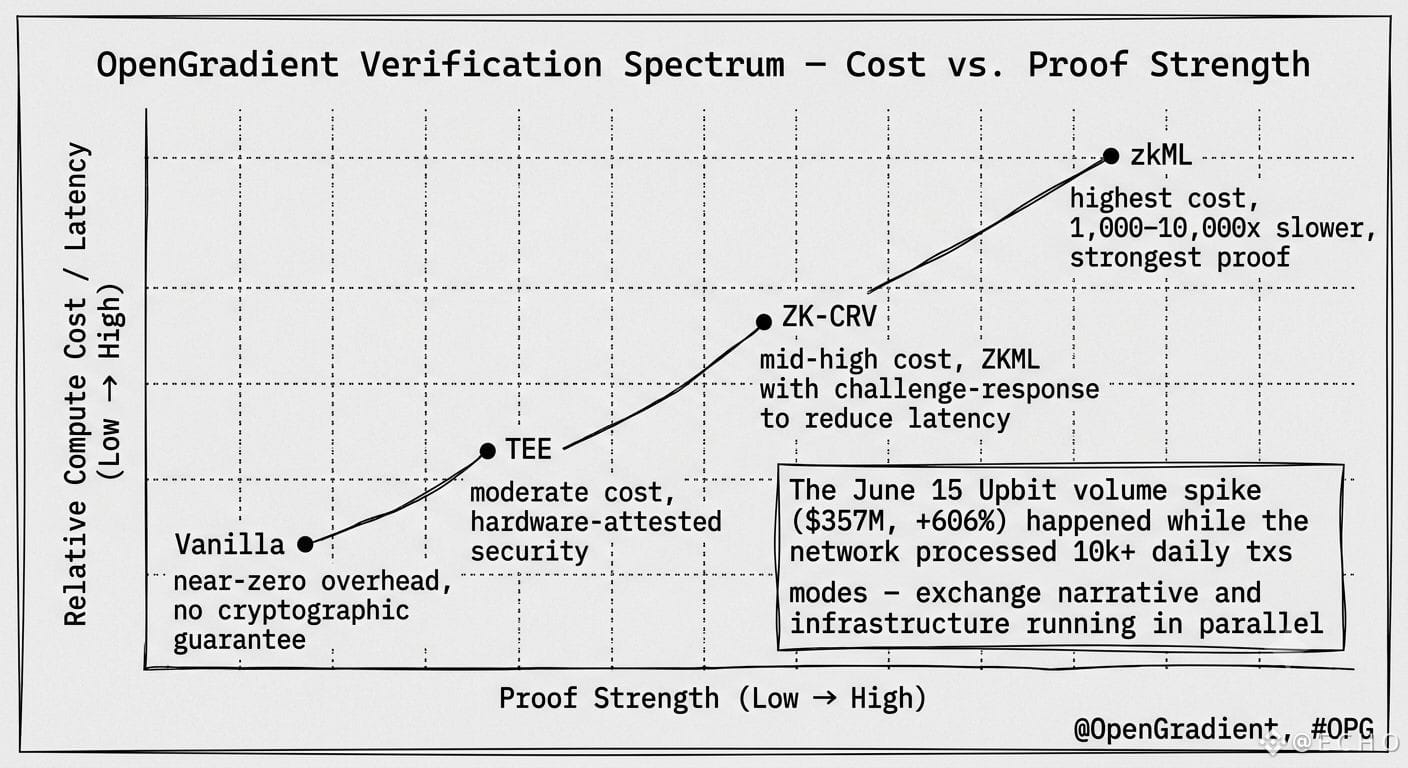
The thing that made me pause — not the pitch, not the token metrics — was the "verification menu." OpenGradient lets you choose how much proof you want per inference: zkML, TEE, ZK-CRV, or vanilla with almost no overhead. @OpenGradient frames this as a developer design choice. In practice it's a statement about what a verifiable world actually looks like — not uniform, not maximalist. A spectrum. $OPG #OPG
The Upbit listing on June 15 sent 24h volume to $357.69M — a 606% spike on a token with $39M market cap at the time. That's pure exchange narrative momentum. And yet on-chain, the network kept doing what it does: 10,000+ daily transactions settling against 4.2M+ blocks produced, proofs committing at consensus before anything touches the ledger. The listing noise and the infrastructure signal were running in parallel, completely decoupled.
I kept thinking about what "verifiable" even means at scale. The vision isn't that everything gets a zkML proof — those run 1,000 to 10,000 times slower and cost more. The vision is that the right things get verified at the right cost. A DeFi risk model gets a heavy proof. A casual agent query maybe doesn't. The architecture encodes that judgment directly.
Hmm… but who decides which inferences deserve the heavy proof? And does that selection layer eventually become its own trust problem?
The thing that made me pause — not the pitch, not the token metrics — was the "verification menu." OpenGradient lets you choose how much proof you want per inference: zkML, TEE, ZK-CRV, or vanilla with almost no overhead. @OpenGradient frames this as a developer design choice. In practice it's a statement about what a verifiable world actually looks like — not uniform, not maximalist. A spectrum. $OPG #OPG
The Upbit listing on June 15 sent 24h volume to $357.69M — a 606% spike on a token with $39M market cap at the time. That's pure exchange narrative momentum. And yet on-chain, the network kept doing what it does: 10,000+ daily transactions settling against 4.2M+ blocks produced, proofs committing at consensus before anything touches the ledger. The listing noise and the infrastructure signal were running in parallel, completely decoupled.
I kept thinking about what "verifiable" even means at scale. The vision isn't that everything gets a zkML proof — those run 1,000 to 10,000 times slower and cost more. The vision is that the right things get verified at the right cost. A DeFi risk model gets a heavy proof. A casual agent query maybe doesn't. The architecture encodes that judgment directly.
Hmm… but who decides which inferences deserve the heavy proof? And does that selection layer eventually become its own trust problem?
The Upbit listing on June 15 sent 24h volume to $357.69M — a 606% spike on a token with $39M market cap at the time. That's pure exchange narrative momentum. And yet on-chain, the network kept doing what it does: 10,000+ daily transactions settling against 4.2M+ blocks produced, proofs committing at consensus before anything touches the ledger. The listing noise and the infrastructure signal were running in parallel, completely decoupled.
I kept thinking about what "verifiable" even means at scale. The vision isn't that everything gets a zkML proof — those run 1,000 to 10,000 times slower and cost more. The vision is that the right things get verified at the right cost. A DeFi risk model gets a heavy proof. A casual agent query maybe doesn't. The architecture encodes that judgment directly.
Hmm… but who decides which inferences deserve the heavy proof? And does that selection layer eventually become its own trust problem?
5
2
152
·
--
Tərcüməyə bax
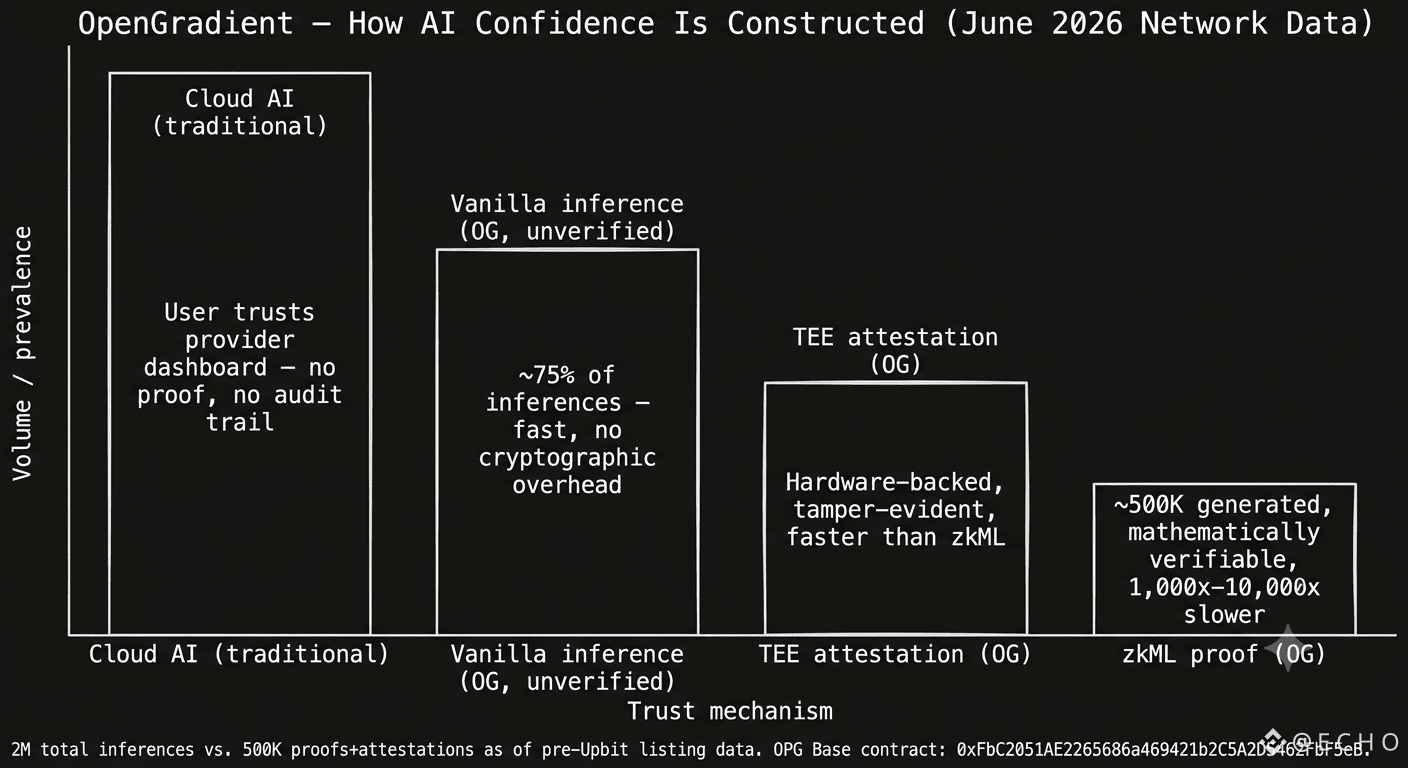
The thing that actually stopped me mid-task was reading the OpenGradient docs architecture page. Specifically this line: "once 2/3+ validators agree, the proof is permanently recorded on the ledger." That's not a promise. That's a live consensus mechanism. @OpenGradient has already generated 500,000+ zkML proofs and TEE attestations across 2 million verifiable inferences — and somewhere in that pile is a public confidence argument the AI industry still can't make from the cloud. $OPG #OPG
The numbers from just this month add texture. On June 15, the Upbit listing sent 24-hour volume to $357M — more than nine times market cap in a session. Price whipsawed from $0.3064 open down to $0.1815. But the network underneath didn't blink. Daily on-chain transactions held above 10,000. 4.2 million blocks produced. The machinery kept running independent of the speculation layer sitting on top of it.
That's the thing about the public confidence angle. Most AI systems ask you to trust a dashboard. OpenGradient asks validators to agree on a proof — and the disagreement itself would be visible on-chain. I kept sitting with that during the task. It's a genuinely different epistemic structure for AI outputs.
…but the uncomfortable pivot is this: 500K proofs across 2 million inferences means roughly 1 in 4 inferences got the full treatment. Who decided the other three didn't need to be verified?
The thing that actually stopped me mid-task was reading the OpenGradient docs architecture page. Specifically this line: "once 2/3+ validators agree, the proof is permanently recorded on the ledger." That's not a promise. That's a live consensus mechanism. @OpenGradient has already generated 500,000+ zkML proofs and TEE attestations across 2 million verifiable inferences — and somewhere in that pile is a public confidence argument the AI industry still can't make from the cloud. $OPG #OPG
The numbers from just this month add texture. On June 15, the Upbit listing sent 24-hour volume to $357M — more than nine times market cap in a session. Price whipsawed from $0.3064 open down to $0.1815. But the network underneath didn't blink. Daily on-chain transactions held above 10,000. 4.2 million blocks produced. The machinery kept running independent of the speculation layer sitting on top of it.
That's the thing about the public confidence angle. Most AI systems ask you to trust a dashboard. OpenGradient asks validators to agree on a proof — and the disagreement itself would be visible on-chain. I kept sitting with that during the task. It's a genuinely different epistemic structure for AI outputs.
…but the uncomfortable pivot is this: 500K proofs across 2 million inferences means roughly 1 in 4 inferences got the full treatment. Who decided the other three didn't need to be verified?
The numbers from just this month add texture. On June 15, the Upbit listing sent 24-hour volume to $357M — more than nine times market cap in a session. Price whipsawed from $0.3064 open down to $0.1815. But the network underneath didn't blink. Daily on-chain transactions held above 10,000. 4.2 million blocks produced. The machinery kept running independent of the speculation layer sitting on top of it.
That's the thing about the public confidence angle. Most AI systems ask you to trust a dashboard. OpenGradient asks validators to agree on a proof — and the disagreement itself would be visible on-chain. I kept sitting with that during the task. It's a genuinely different epistemic structure for AI outputs.
…but the uncomfortable pivot is this: 500K proofs across 2 million inferences means roughly 1 in 4 inferences got the full treatment. Who decided the other three didn't need to be verified?
6
1
148
·
--
Bir şey işimi midə qaldırdı. Müəssisə AI-pitch-i deyil. Onun altında qurulan, real şəkildə hazırlanan şey.
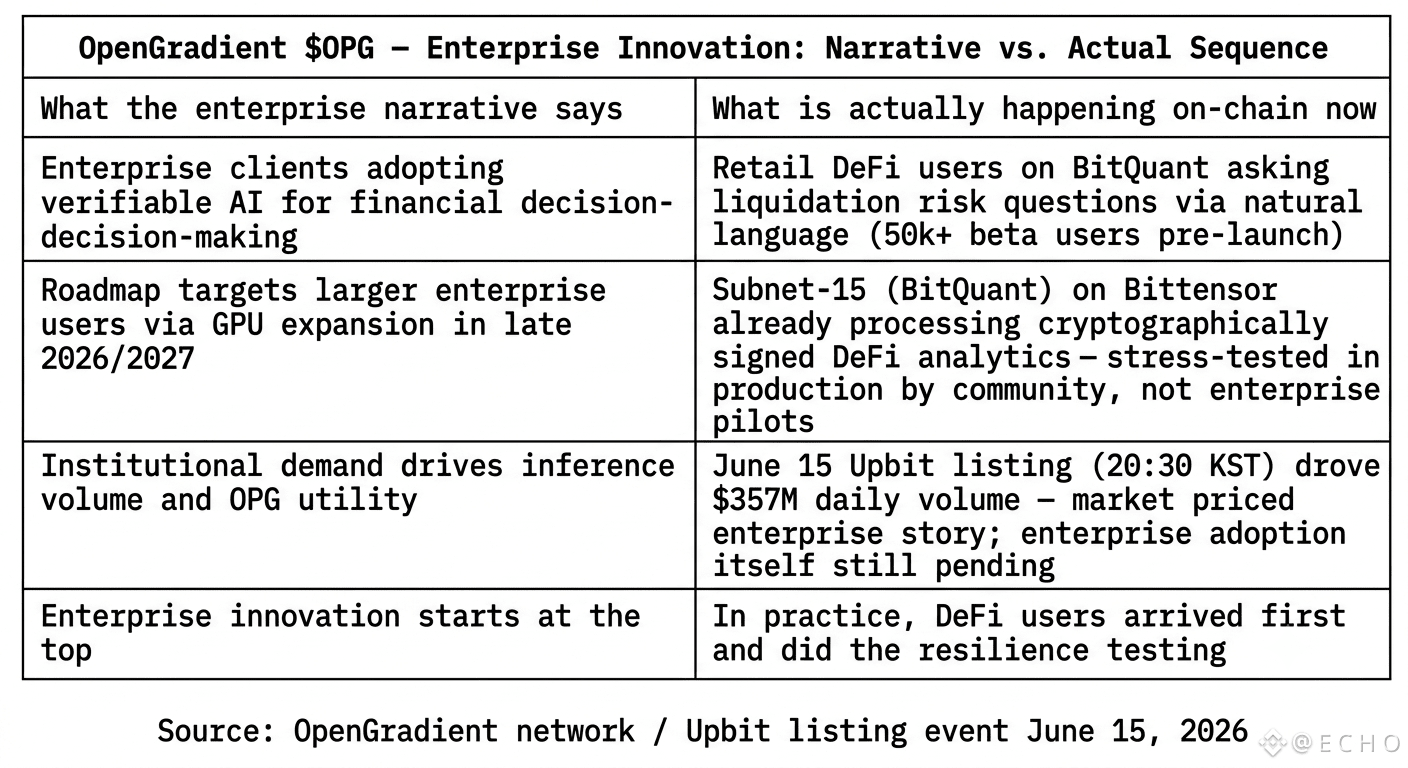
OpenGradient $OPG @OpenGradient #OPG müəssisə innovasiyası istiqamətində özünü marketinq edir — DeFi üçün verifikasiyalı AI, maliyyə agentləri, auditable (yoxlana bilən) inference. Yol xəritəsi dili 2027-ci ilə qədər GPU genişlənməsinə işarə edir ki, daha böyük müəssisə istifadəçilərini cəlb etsin. Amma hazırda real iş görən canlı tətbiq elə BitQuant-dur — Bittensor-un subnet-15-ində işləyən, açıq mənbəli DeFi kəmiyyət agenti; “əgər SOL 20% düşsə, hansı fondlar (pools) ləğv olunur?” kimi təbii dil risk sorğularını emal edir və kriptoqrafik imzalı cavablar qaytarır. Müəssisə sazişi deyil. İlk öncə degens üçün və degens tərəfindən qurulmuş permissionless alət.
Məhz müəssisələrin bu infrastrukturluq model barədə qaçırdığı ardıcıllıq budur. Ciddi institusional istifadə ssenarisi — maliyyə riski üçün auditable AI qərarları — hələ satınalma komandası ona əl vurmazdan əvvəl, real ləğv sualları verən retail DeFi istifadəçiləri tərəfindən “vəhşi” şəraitdə stress-test olunur. BitQuant-da pre-launch zamanı 50k+ beta istifadəçi, buna “müəssisə səviyyəli” demədən, əslində enterprise-grade etibarlılıq testini aparırdı.
Sonra Upbit listing iyunun 15-də 20:30 KST-də baş verdi, 24 saatlıq OPG həcmi $357M-ə yüksəldi. Bazar müəssisə hekayəsini qiymətləndirdi. Real müəssisə hekayəsi hələ də hər DeFi sorğusu bir-bir yazılır.
Mən daim düşünürəm: hansı müəssisələr həqiqətən ilk gedəcək — və bura gəldikləri vaxtadək sübut infrastrukturu artıq isti vəziyyətdə hazır olacaqmı, yoxsa kənarları hələ də bir az kobuddur…
Bir şey işimi midə qaldırdı. Müəssisə AI-pitch-i deyil. Onun altında qurulan, real şəkildə hazırlanan şey.
OpenGradient $OPG @OpenGradient #OPG müəssisə innovasiyası istiqamətində özünü marketinq edir — DeFi üçün verifikasiyalı AI, maliyyə agentləri, auditable (yoxlana bilən) inference. Yol xəritəsi dili 2027-ci ilə qədər GPU genişlənməsinə işarə edir ki, daha böyük müəssisə istifadəçilərini cəlb etsin. Amma hazırda real iş görən canlı tətbiq elə BitQuant-dur — Bittensor-un subnet-15-ində işləyən, açıq mənbəli DeFi kəmiyyət agenti; “əgər SOL 20% düşsə, hansı fondlar (pools) ləğv olunur?” kimi təbii dil risk sorğularını emal edir və kriptoqrafik imzalı cavablar qaytarır. Müəssisə sazişi deyil. İlk öncə degens üçün və degens tərəfindən qurulmuş permissionless alət.
Məhz müəssisələrin bu infrastrukturluq model barədə qaçırdığı ardıcıllıq budur. Ciddi institusional istifadə ssenarisi — maliyyə riski üçün auditable AI qərarları — hələ satınalma komandası ona əl vurmazdan əvvəl, real ləğv sualları verən retail DeFi istifadəçiləri tərəfindən “vəhşi” şəraitdə stress-test olunur. BitQuant-da pre-launch zamanı 50k+ beta istifadəçi, buna “müəssisə səviyyəli” demədən, əslində enterprise-grade etibarlılıq testini aparırdı.
Sonra Upbit listing iyunun 15-də 20:30 KST-də baş verdi, 24 saatlıq OPG həcmi $357M-ə yüksəldi. Bazar müəssisə hekayəsini qiymətləndirdi. Real müəssisə hekayəsi hələ də hər DeFi sorğusu bir-bir yazılır.
Mən daim düşünürəm: hansı müəssisələr həqiqətən ilk gedəcək — və bura gəldikləri vaxtadək sübut infrastrukturu artıq isti vəziyyətdə hazır olacaqmı, yoxsa kənarları hələ də bir az kobuddur…
OpenGradient $OPG @OpenGradient #OPG müəssisə innovasiyası istiqamətində özünü marketinq edir — DeFi üçün verifikasiyalı AI, maliyyə agentləri, auditable (yoxlana bilən) inference. Yol xəritəsi dili 2027-ci ilə qədər GPU genişlənməsinə işarə edir ki, daha böyük müəssisə istifadəçilərini cəlb etsin. Amma hazırda real iş görən canlı tətbiq elə BitQuant-dur — Bittensor-un subnet-15-ində işləyən, açıq mənbəli DeFi kəmiyyət agenti; “əgər SOL 20% düşsə, hansı fondlar (pools) ləğv olunur?” kimi təbii dil risk sorğularını emal edir və kriptoqrafik imzalı cavablar qaytarır. Müəssisə sazişi deyil. İlk öncə degens üçün və degens tərəfindən qurulmuş permissionless alət.
Məhz müəssisələrin bu infrastrukturluq model barədə qaçırdığı ardıcıllıq budur. Ciddi institusional istifadə ssenarisi — maliyyə riski üçün auditable AI qərarları — hələ satınalma komandası ona əl vurmazdan əvvəl, real ləğv sualları verən retail DeFi istifadəçiləri tərəfindən “vəhşi” şəraitdə stress-test olunur. BitQuant-da pre-launch zamanı 50k+ beta istifadəçi, buna “müəssisə səviyyəli” demədən, əslində enterprise-grade etibarlılıq testini aparırdı.
Sonra Upbit listing iyunun 15-də 20:30 KST-də baş verdi, 24 saatlıq OPG həcmi $357M-ə yüksəldi. Bazar müəssisə hekayəsini qiymətləndirdi. Real müəssisə hekayəsi hələ də hər DeFi sorğusu bir-bir yazılır.
Mən daim düşünürəm: hansı müəssisələr həqiqətən ilk gedəcək — və bura gəldikləri vaxtadək sübut infrastrukturu artıq isti vəziyyətdə hazır olacaqmı, yoxsa kənarları hələ də bir az kobuddur…
25
21
149
·
--
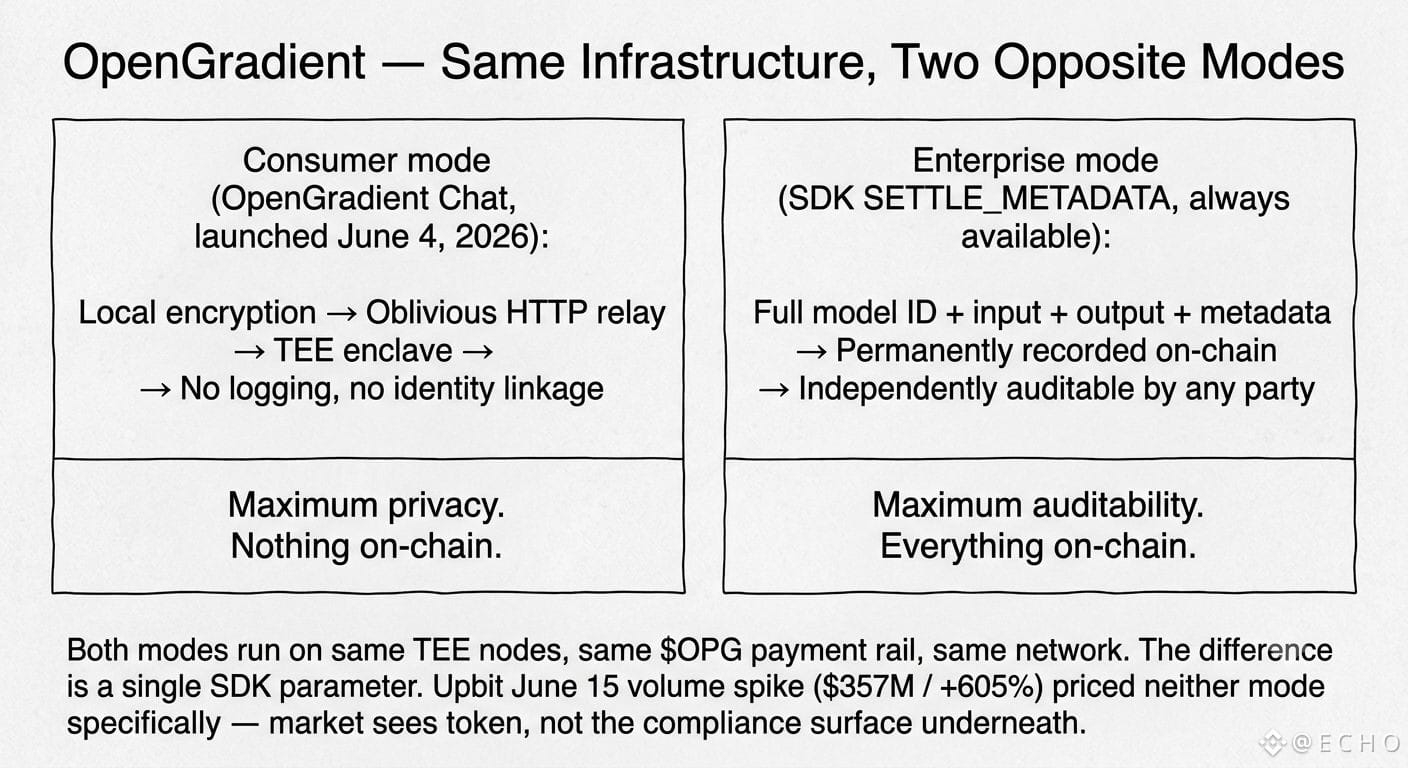
Məni işin ortasında dayandıran şey agent hekayəsi və ya token mexanikası deyildi. Bu, @OpenGradient SDK sənədlərində basdırılmış bir detal idi: tam model giriş, çıxış və nəticə metadata-nızı daimi olaraq on-chain qeyd edən SETTLE_METADATA adlı bir ödəmə rejimi var. Bu, bir hash deyil. Bütün şey. Bu, əslində çox insanın heç vaxt açmayacağı bir inkişaf etdirici seçimində gizlənmiş bir müəssisə uyğunsuzluğu artefaktıdır. $OPG #OPG
Bunun məni necə çəkdiyinə baxaq. OpenGradient Chat 4 iyunda gizlilik-öncəli arxitektura ilə təqdim olundu — yerli şifrələmə, oblivious HTTP relay, TEE-isolated gateway. Bütün pitch, sizin təşviqinizin görünməz qalmasıdır. Bu, istehlakçı məhsuludur. Amma eyni infrastrukturun altında, SDK müəssisələr üçün tam əksini təklif edir: maksimum şəffaflıq, tam audit qabiliyyəti, hər bir nəticə daimi olaraq on-chain oxunaqlı. Hər ikisi gerçəkdir. Hər ikisi canlıdır.
15 iyun tarixində Upbit siyahı fəaliyyətinə geri döndüm — $357M həcm, 605% artım — və bu diqqətin demək olar ki, heç biri buna yönəlmədi. Bazar $OPG -i AI hekayə tokeni kimi qiymətləndirir. Əslində nə olacağı isə müəssisələrin bilmədiyi bir uyğunsuzluq qatıdır ki, istehlakçı gizlilik tətbiqinin altında sakitcə oturur.
…hələ də başımda işləyirəm ki, bir müəssisə satınalma komandası mövcud təchizatçı münasibətləri üzərində kripto-settled nəticəsini gerçəkdən seçəcəkmi. Bu sürtünmə yalnız texniki sübutu yaratmaqla həll olunmayıb.
Məni işin ortasında dayandıran şey agent hekayəsi və ya token mexanikası deyildi. Bu, @OpenGradient SDK sənədlərində basdırılmış bir detal idi: tam model giriş, çıxış və nəticə metadata-nızı daimi olaraq on-chain qeyd edən SETTLE_METADATA adlı bir ödəmə rejimi var. Bu, bir hash deyil. Bütün şey. Bu, əslində çox insanın heç vaxt açmayacağı bir inkişaf etdirici seçimində gizlənmiş bir müəssisə uyğunsuzluğu artefaktıdır. $OPG #OPG
Bunun məni necə çəkdiyinə baxaq. OpenGradient Chat 4 iyunda gizlilik-öncəli arxitektura ilə təqdim olundu — yerli şifrələmə, oblivious HTTP relay, TEE-isolated gateway. Bütün pitch, sizin təşviqinizin görünməz qalmasıdır. Bu, istehlakçı məhsuludur. Amma eyni infrastrukturun altında, SDK müəssisələr üçün tam əksini təklif edir: maksimum şəffaflıq, tam audit qabiliyyəti, hər bir nəticə daimi olaraq on-chain oxunaqlı. Hər ikisi gerçəkdir. Hər ikisi canlıdır.
15 iyun tarixində Upbit siyahı fəaliyyətinə geri döndüm — $357M həcm, 605% artım — və bu diqqətin demək olar ki, heç biri buna yönəlmədi. Bazar $OPG -i AI hekayə tokeni kimi qiymətləndirir. Əslində nə olacağı isə müəssisələrin bilmədiyi bir uyğunsuzluq qatıdır ki, istehlakçı gizlilik tətbiqinin altında sakitcə oturur.
…hələ də başımda işləyirəm ki, bir müəssisə satınalma komandası mövcud təchizatçı münasibətləri üzərində kripto-settled nəticəsini gerçəkdən seçəcəkmi. Bu sürtünmə yalnız texniki sübutu yaratmaqla həll olunmayıb.
Bunun məni necə çəkdiyinə baxaq. OpenGradient Chat 4 iyunda gizlilik-öncəli arxitektura ilə təqdim olundu — yerli şifrələmə, oblivious HTTP relay, TEE-isolated gateway. Bütün pitch, sizin təşviqinizin görünməz qalmasıdır. Bu, istehlakçı məhsuludur. Amma eyni infrastrukturun altında, SDK müəssisələr üçün tam əksini təklif edir: maksimum şəffaflıq, tam audit qabiliyyəti, hər bir nəticə daimi olaraq on-chain oxunaqlı. Hər ikisi gerçəkdir. Hər ikisi canlıdır.
15 iyun tarixində Upbit siyahı fəaliyyətinə geri döndüm — $357M həcm, 605% artım — və bu diqqətin demək olar ki, heç biri buna yönəlmədi. Bazar $OPG -i AI hekayə tokeni kimi qiymətləndirir. Əslində nə olacağı isə müəssisələrin bilmədiyi bir uyğunsuzluq qatıdır ki, istehlakçı gizlilik tətbiqinin altında sakitcə oturur.
…hələ də başımda işləyirəm ki, bir müəssisə satınalma komandası mövcud təchizatçı münasibətləri üzərində kripto-settled nəticəsini gerçəkdən seçəcəkmi. Bu sürtünmə yalnız texniki sübutu yaratmaqla həll olunmayıb.
160
·
--
Tərcüməyə bax
The moment that stuck with me during the CreatorPad task wasn't in the docs. It was a number. @OpenGradient currently sits at 263,500+ unique wallets and the network has crossed 4.2 million blocks — but only ~1.85 million on-chain transactions total. That's a thin tx-to-wallet ratio for a project whose whole future supposedly hinges on autonomous AI agents transacting constantly. $OPG #OPG
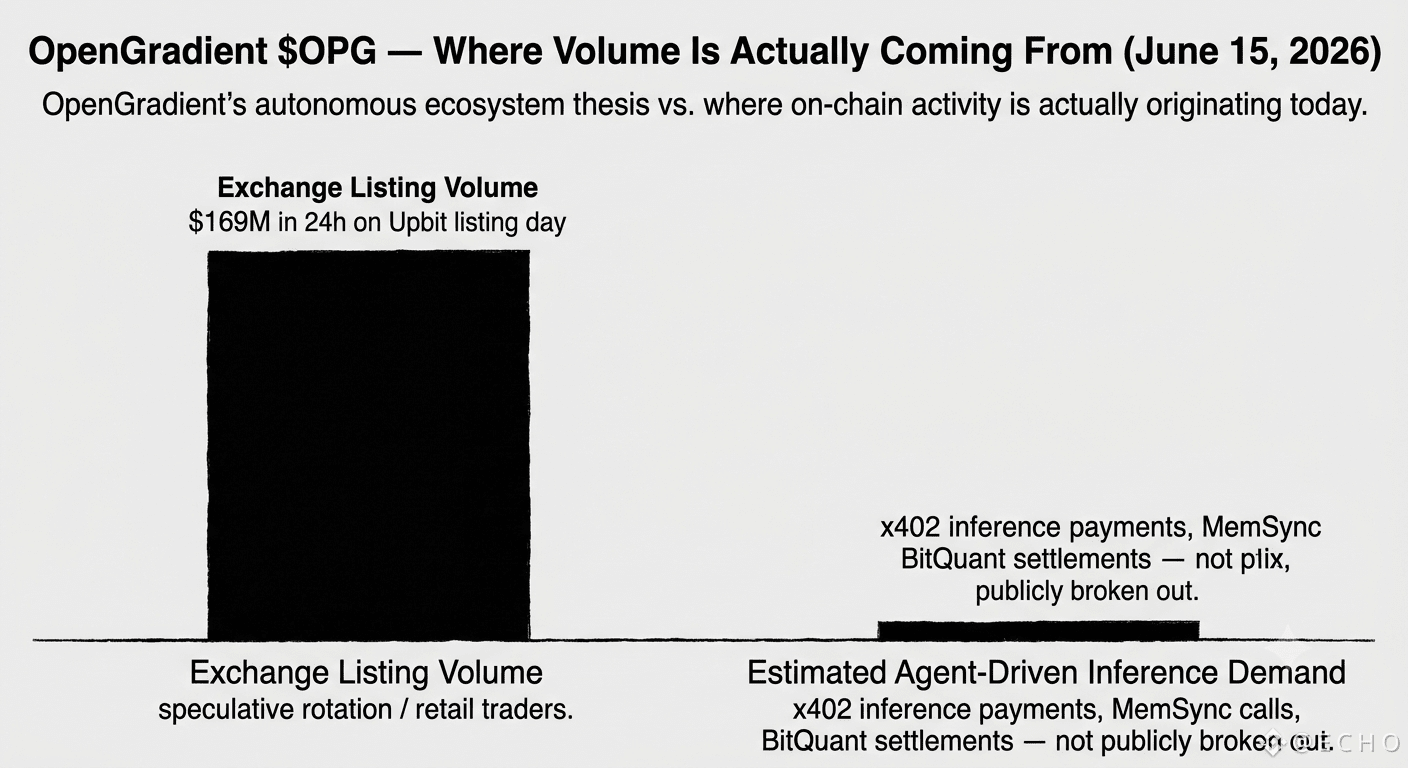
The pitch for autonomous ecosystems is this: AI agents will eventually call models, pay in $OPG via x402, store context in MemSync, coordinate across other agents, repeat — all without any human touching it. And structurally, the rails exist. The x402 gateway is live. MemSync gives agents persistent cross-session memory. The Model Hub has 2,000+ models sitting ready. The scaffolding is genuinely there.
But here's the thing I kept circling back to. When Upbit listed $OPG on June 15 and volume exploded to $357M in 24 hours — that wasn't agents transacting. That was humans, rotating in and out, speculating on what autonomous activity might eventually look like. The usage that's actually happening right now is humans accessing AI tools, not agents commissioning other agents.
Which isn't a fatal flaw. Infrastructure often sits quiet before demand catches up. But there's a version of this where the autonomous ecosystem stays perpetually two roadmap items away, while human speculators keep writing its story.
Does the agent-to-agent economy actually materialize here, or does OpenGradient end up primarily a developer utility with an agentic narrative that was always ahead of its moment…
The moment that stuck with me during the CreatorPad task wasn't in the docs. It was a number. @OpenGradient currently sits at 263,500+ unique wallets and the network has crossed 4.2 million blocks — but only ~1.85 million on-chain transactions total. That's a thin tx-to-wallet ratio for a project whose whole future supposedly hinges on autonomous AI agents transacting constantly. $OPG #OPG
The pitch for autonomous ecosystems is this: AI agents will eventually call models, pay in $OPG via x402, store context in MemSync, coordinate across other agents, repeat — all without any human touching it. And structurally, the rails exist. The x402 gateway is live. MemSync gives agents persistent cross-session memory. The Model Hub has 2,000+ models sitting ready. The scaffolding is genuinely there.
But here's the thing I kept circling back to. When Upbit listed $OPG on June 15 and volume exploded to $357M in 24 hours — that wasn't agents transacting. That was humans, rotating in and out, speculating on what autonomous activity might eventually look like. The usage that's actually happening right now is humans accessing AI tools, not agents commissioning other agents.
Which isn't a fatal flaw. Infrastructure often sits quiet before demand catches up. But there's a version of this where the autonomous ecosystem stays perpetually two roadmap items away, while human speculators keep writing its story.
Does the agent-to-agent economy actually materialize here, or does OpenGradient end up primarily a developer utility with an agentic narrative that was always ahead of its moment…
The pitch for autonomous ecosystems is this: AI agents will eventually call models, pay in $OPG via x402, store context in MemSync, coordinate across other agents, repeat — all without any human touching it. And structurally, the rails exist. The x402 gateway is live. MemSync gives agents persistent cross-session memory. The Model Hub has 2,000+ models sitting ready. The scaffolding is genuinely there.
But here's the thing I kept circling back to. When Upbit listed $OPG on June 15 and volume exploded to $357M in 24 hours — that wasn't agents transacting. That was humans, rotating in and out, speculating on what autonomous activity might eventually look like. The usage that's actually happening right now is humans accessing AI tools, not agents commissioning other agents.
Which isn't a fatal flaw. Infrastructure often sits quiet before demand catches up. But there's a version of this where the autonomous ecosystem stays perpetually two roadmap items away, while human speculators keep writing its story.
Does the agent-to-agent economy actually materialize here, or does OpenGradient end up primarily a developer utility with an agentic narrative that was always ahead of its moment…
1
125
·
--
Tərcüməyə bax
Something clicked mid-task that I hadn't expected. @OpenGradient , $OPG, #OPG — the autonomous economic activity angle sounds abstract until you trace how the payment loop actually closes.
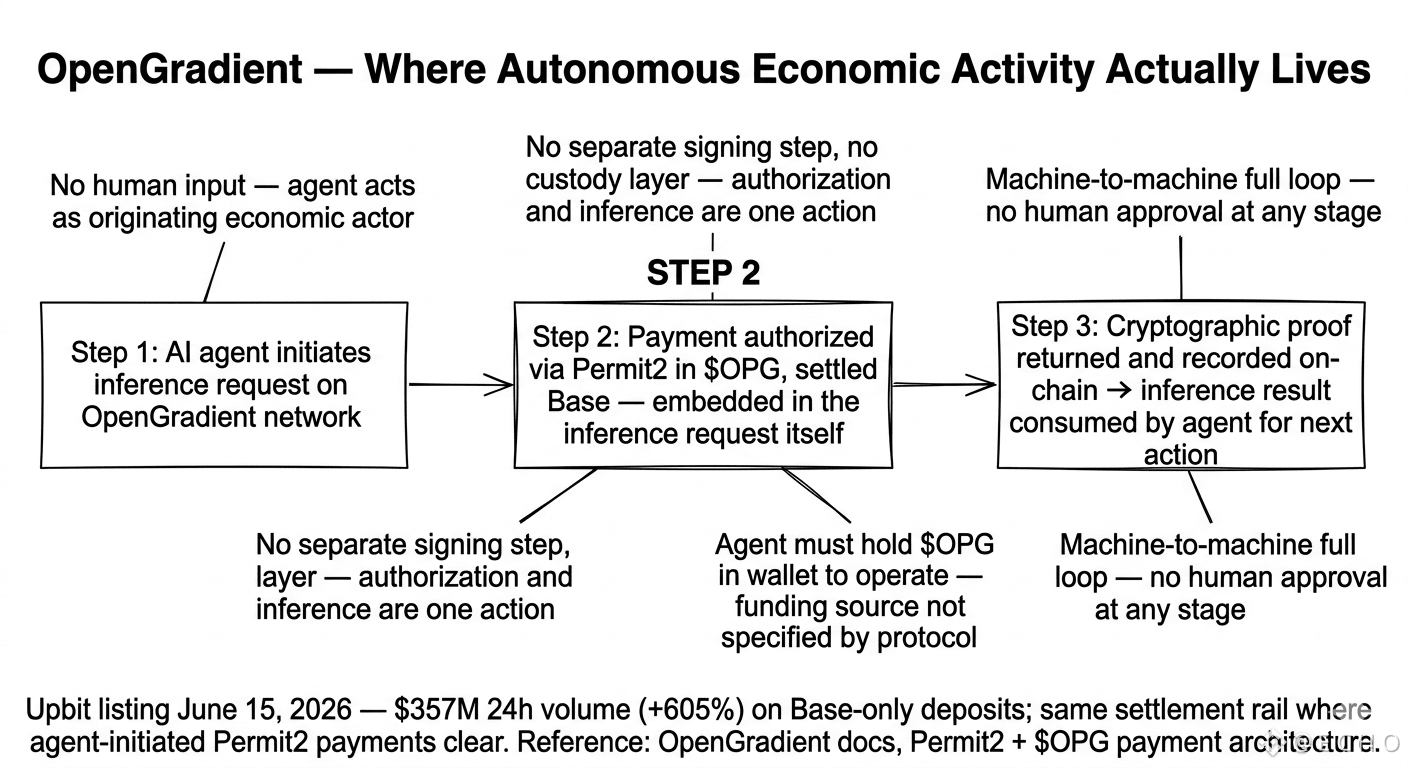
Every verified AI call on the network settles in $OPG on Base through Permit2. No API key. No credit card. No human approving the transaction. The agent holds a wallet, makes an inference request, pays, gets a cryptographic result back. That's it. The whole thing is machine-to-machine, denominated in a token, settled on a public ledger. When Upbit listed OPG on June 15 and volume hit $357M in 24 hours — a 605% spike — all that liquidity landed on top of a network where the actual economic actors triggering on-chain transactions are increasingly not people. They're agents running BitQuant strategies or MemSync workflows, each one spending $OPG per call.
I kept re-reading that Permit2 detail. Because most "autonomous agent" projects have a human somewhere in the loop — a wallet signer, a custody layer, something. Here the payment authorization is baked into the inference request itself. The agent is the economic actor from start to finish.
Hmm… but that also means the agent needs to hold $OPG to operate. Which raises a question nobody's really answered yet: who capitalizes these agents, and does that dependency quietly recentralize the whole thing around whoever funds the wallet?
Something clicked mid-task that I hadn't expected. @OpenGradient , $OPG , #OPG — the autonomous economic activity angle sounds abstract until you trace how the payment loop actually closes.
Every verified AI call on the network settles in $OPG on Base through Permit2. No API key. No credit card. No human approving the transaction. The agent holds a wallet, makes an inference request, pays, gets a cryptographic result back. That's it. The whole thing is machine-to-machine, denominated in a token, settled on a public ledger. When Upbit listed OPG on June 15 and volume hit $357M in 24 hours — a 605% spike — all that liquidity landed on top of a network where the actual economic actors triggering on-chain transactions are increasingly not people. They're agents running BitQuant strategies or MemSync workflows, each one spending $OPG per call.
I kept re-reading that Permit2 detail. Because most "autonomous agent" projects have a human somewhere in the loop — a wallet signer, a custody layer, something. Here the payment authorization is baked into the inference request itself. The agent is the economic actor from start to finish.
Hmm… but that also means the agent needs to hold $OPG to operate. Which raises a question nobody's really answered yet: who capitalizes these agents, and does that dependency quietly recentralize the whole thing around whoever funds the wallet?
Every verified AI call on the network settles in $OPG on Base through Permit2. No API key. No credit card. No human approving the transaction. The agent holds a wallet, makes an inference request, pays, gets a cryptographic result back. That's it. The whole thing is machine-to-machine, denominated in a token, settled on a public ledger. When Upbit listed OPG on June 15 and volume hit $357M in 24 hours — a 605% spike — all that liquidity landed on top of a network where the actual economic actors triggering on-chain transactions are increasingly not people. They're agents running BitQuant strategies or MemSync workflows, each one spending $OPG per call.
I kept re-reading that Permit2 detail. Because most "autonomous agent" projects have a human somewhere in the loop — a wallet signer, a custody layer, something. Here the payment authorization is baked into the inference request itself. The agent is the economic actor from start to finish.
Hmm… but that also means the agent needs to hold $OPG to operate. Which raises a question nobody's really answered yet: who capitalizes these agents, and does that dependency quietly recentralize the whole thing around whoever funds the wallet?
2
1
167
·
--
Bu @OpenGradient tapşırığı zamanı məni narahat edən şey böyük etimad təqdimatı deyildi — sənədlərdəki bir sakit memarlıq detayı idi. $OPG #OPG
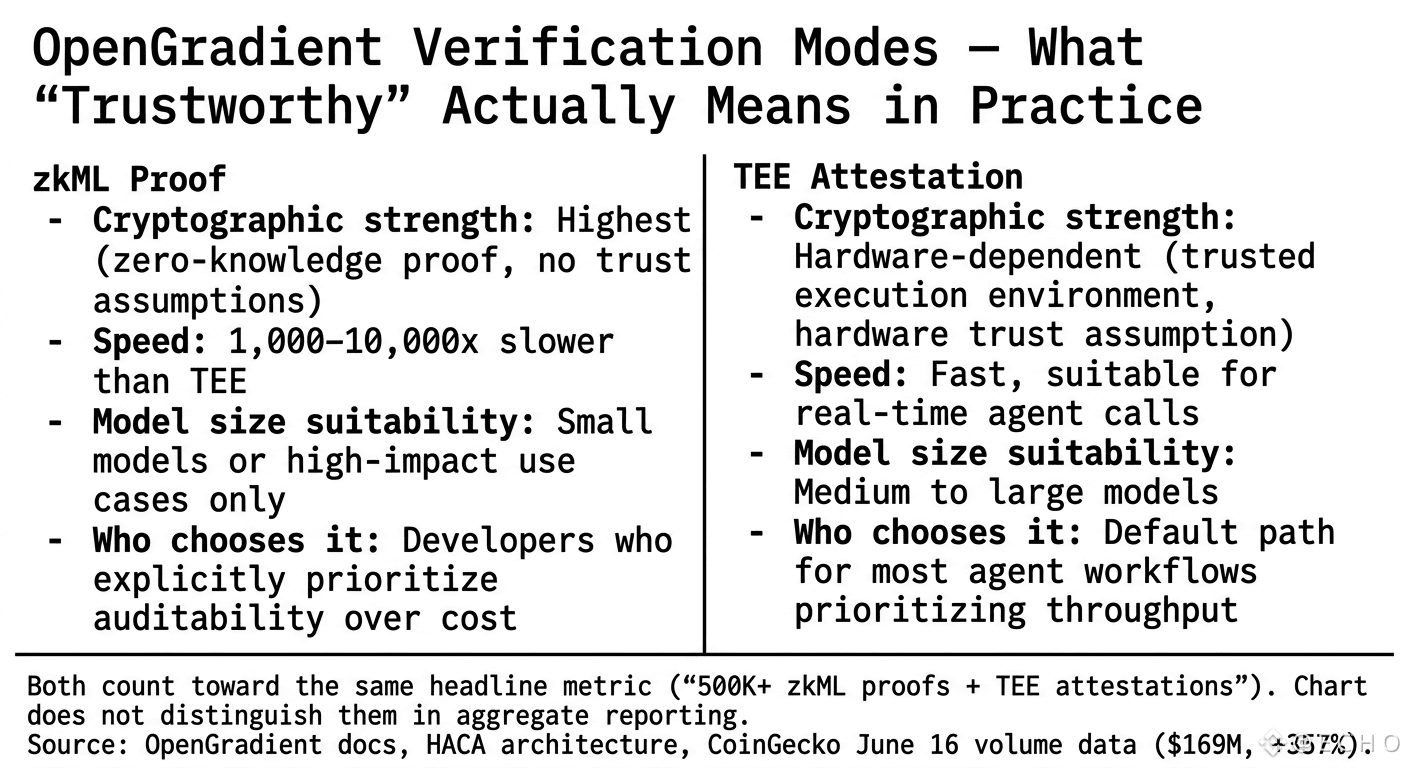
Bir agent bu şəbəkədə bir çıxarış etdikdə, sübut yolu əslində bölünür. zkML sizə ən güclü kriptoqrafik zəmanət verir, amma 1,000-dən 10,000 dəfə daha yavaş işləyir. TEE daha sürətlidir, daha böyük modelləri idarə edir, amma hardware etimad fərziyyələrinə söykənir. İnkişaf etdiricilər seçir. Bu, kiçik bir qeyd deyil — bu, tam etibarlılıq sualıdır və konfiqurasiya parametri olaraq düz orada oturur. Və agentləri idarə edən əksər insanlar ən ucuz və sürətli olanı seçəcək, bu da həmişə ən sərt zəmanətə malik olan rejim olmur.
Burada on-chain rəqəmlərlə bunu çarpaz yoxlayırdım. 2 milyondan çox təsdiq edilə bilən çıxarış işlənib, 500K+ zkML sübutları və TEE təsdiqləri rəsmi rəqəmlərə əsasən birləşdirilib. Upbit OPG-ni 15 iyun 2026-cı il tarixində saat 20:30 KST-də $169M-lik 24 saatlıq həcmlə siyahıya aldı, bu da CoinGecko-ya görə əvvəlki sessiyadan 357% artım idi. Şəbəkə açıqca hərəkət edir. Amma həcmlər sizə agentlərin gerçəkdən hansı təsdiq rejimini seçdiyi barədə heç nə demir.
Bu, səmimi açıq sualdır. Kimin üçün etibarlıdır və hansı sübut yolu altında? TEE təsdiqləri ilə işləyən bir agentin təhlükəsizlik hekayəsi zkML ilə işləyən bir agentdən fərqlidir. Hər ikisi eyni başlıq metrikasına daxildir.
Hmm. Bu fərqin heç bir paneldə müntəzəm istifadəçilərin gördüyü bir yerdə görünüb-görünməyəcəyini düşünürəm…
Bu @OpenGradient tapşırığı zamanı məni narahat edən şey böyük etimad təqdimatı deyildi — sənədlərdəki bir sakit memarlıq detayı idi. $OPG #OPG
Bir agent bu şəbəkədə bir çıxarış etdikdə, sübut yolu əslində bölünür. zkML sizə ən güclü kriptoqrafik zəmanət verir, amma 1,000-dən 10,000 dəfə daha yavaş işləyir. TEE daha sürətlidir, daha böyük modelləri idarə edir, amma hardware etimad fərziyyələrinə söykənir. İnkişaf etdiricilər seçir. Bu, kiçik bir qeyd deyil — bu, tam etibarlılıq sualıdır və konfiqurasiya parametri olaraq düz orada oturur. Və agentləri idarə edən əksər insanlar ən ucuz və sürətli olanı seçəcək, bu da həmişə ən sərt zəmanətə malik olan rejim olmur.
Burada on-chain rəqəmlərlə bunu çarpaz yoxlayırdım. 2 milyondan çox təsdiq edilə bilən çıxarış işlənib, 500K+ zkML sübutları və TEE təsdiqləri rəsmi rəqəmlərə əsasən birləşdirilib. Upbit OPG-ni 15 iyun 2026-cı il tarixində saat 20:30 KST-də $169M-lik 24 saatlıq həcmlə siyahıya aldı, bu da CoinGecko-ya görə əvvəlki sessiyadan 357% artım idi. Şəbəkə açıqca hərəkət edir. Amma həcmlər sizə agentlərin gerçəkdən hansı təsdiq rejimini seçdiyi barədə heç nə demir.
Bu, səmimi açıq sualdır. Kimin üçün etibarlıdır və hansı sübut yolu altında? TEE təsdiqləri ilə işləyən bir agentin təhlükəsizlik hekayəsi zkML ilə işləyən bir agentdən fərqlidir. Hər ikisi eyni başlıq metrikasına daxildir.
Hmm. Bu fərqin heç bir paneldə müntəzəm istifadəçilərin gördüyü bir yerdə görünüb-görünməyəcəyini düşünürəm…
Bir agent bu şəbəkədə bir çıxarış etdikdə, sübut yolu əslində bölünür. zkML sizə ən güclü kriptoqrafik zəmanət verir, amma 1,000-dən 10,000 dəfə daha yavaş işləyir. TEE daha sürətlidir, daha böyük modelləri idarə edir, amma hardware etimad fərziyyələrinə söykənir. İnkişaf etdiricilər seçir. Bu, kiçik bir qeyd deyil — bu, tam etibarlılıq sualıdır və konfiqurasiya parametri olaraq düz orada oturur. Və agentləri idarə edən əksər insanlar ən ucuz və sürətli olanı seçəcək, bu da həmişə ən sərt zəmanətə malik olan rejim olmur.
Burada on-chain rəqəmlərlə bunu çarpaz yoxlayırdım. 2 milyondan çox təsdiq edilə bilən çıxarış işlənib, 500K+ zkML sübutları və TEE təsdiqləri rəsmi rəqəmlərə əsasən birləşdirilib. Upbit OPG-ni 15 iyun 2026-cı il tarixində saat 20:30 KST-də $169M-lik 24 saatlıq həcmlə siyahıya aldı, bu da CoinGecko-ya görə əvvəlki sessiyadan 357% artım idi. Şəbəkə açıqca hərəkət edir. Amma həcmlər sizə agentlərin gerçəkdən hansı təsdiq rejimini seçdiyi barədə heç nə demir.
Bu, səmimi açıq sualdır. Kimin üçün etibarlıdır və hansı sübut yolu altında? TEE təsdiqləri ilə işləyən bir agentin təhlükəsizlik hekayəsi zkML ilə işləyən bir agentdən fərqlidir. Hər ikisi eyni başlıq metrikasına daxildir.
Hmm. Bu fərqin heç bir paneldə müntəzəm istifadəçilərin gördüyü bir yerdə görünüb-görünməyəcəyini düşünürəm…
4
2
333
·
--
Tərcüməyə bax
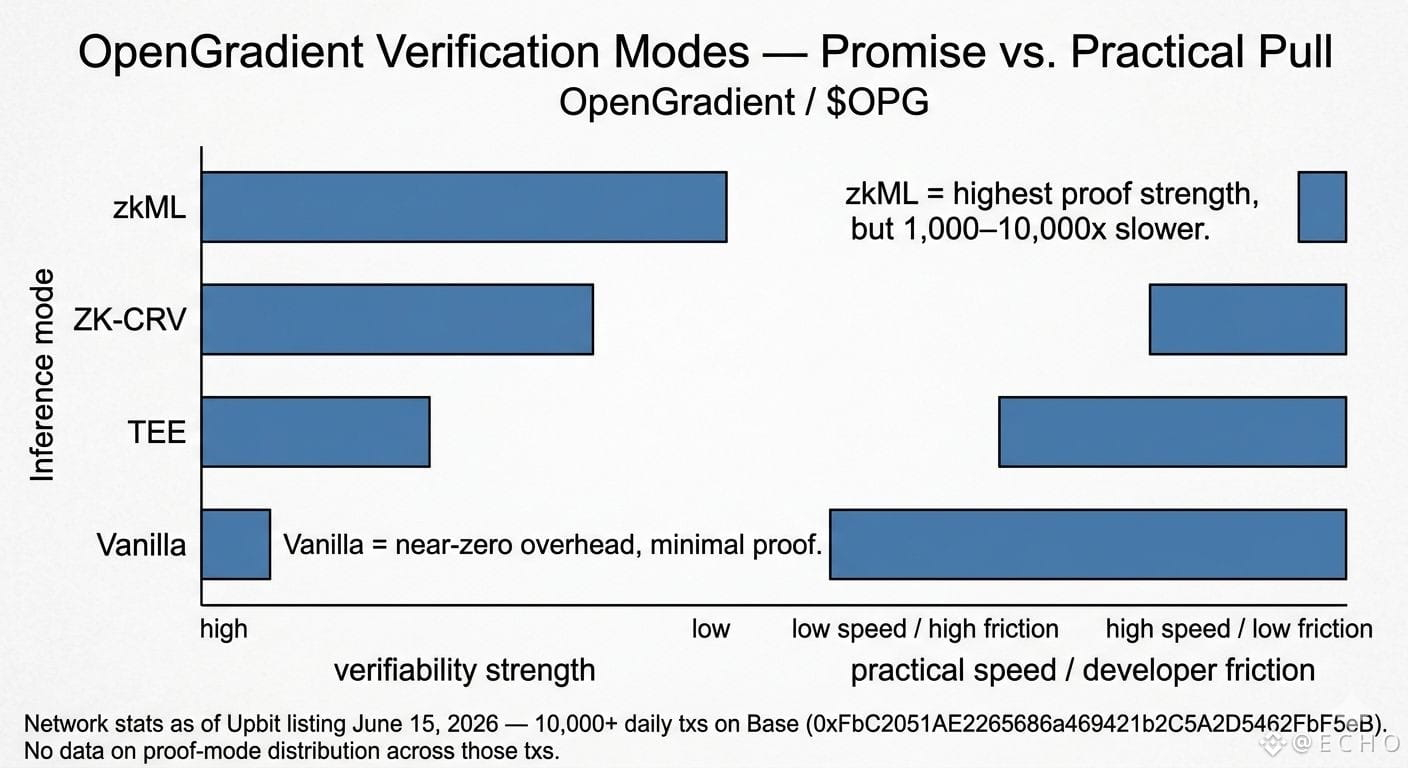
The thing that actually stuck with me during this CreatorPad task on OpenGradient and verifiable market analysis — it wasn't the headline infrastructure. It was a quiet design choice buried in the docs. @OpenGradient built a "trust menu" into HACA: developers pick between vanilla signature, TEE attestation, or zkML proof per inference. $OPG #OPG . That's the architecture behind 1.85M+ on-chain transactions and 10,000+ daily running as of the Upbit listing on June 15 (contract 0xFbC2051AE2265686a469421b2C5A2D5462FbF5eB, Base network, volume spiking past $169M that same day).
Here's what gave me pause. The whole pitch for verifiable market analysis is that AI outputs can now carry cryptographic receipts — which model ran, what data went in, proof settled on-chain. Clean. But zkML is 1,000 to 10,000x slower than vanilla inference. The docs say this openly. So in practice, when a developer is shipping something real and latency matters, they're probably not defaulting to maximum verifiability.
I kept thinking about that gap. The most powerful proof mode is also the most friction-heavy. The market analysis use case OpenGradient keeps citing — risk forecasts, DeFi signals, auditable outputs — those are exactly the scenarios that need the strongest verification. And also exactly where speed pressure pushes builders toward the lighter modes.
Hmm… so who actually ends up using zkML for high-stakes market calls versus just saying they could?
The thing that actually stuck with me during this CreatorPad task on OpenGradient and verifiable market analysis — it wasn't the headline infrastructure. It was a quiet design choice buried in the docs. @OpenGradient built a "trust menu" into HACA: developers pick between vanilla signature, TEE attestation, or zkML proof per inference. $OPG #OPG . That's the architecture behind 1.85M+ on-chain transactions and 10,000+ daily running as of the Upbit listing on June 15 (contract 0xFbC2051AE2265686a469421b2C5A2D5462FbF5eB, Base network, volume spiking past $169M that same day).
Here's what gave me pause. The whole pitch for verifiable market analysis is that AI outputs can now carry cryptographic receipts — which model ran, what data went in, proof settled on-chain. Clean. But zkML is 1,000 to 10,000x slower than vanilla inference. The docs say this openly. So in practice, when a developer is shipping something real and latency matters, they're probably not defaulting to maximum verifiability.
I kept thinking about that gap. The most powerful proof mode is also the most friction-heavy. The market analysis use case OpenGradient keeps citing — risk forecasts, DeFi signals, auditable outputs — those are exactly the scenarios that need the strongest verification. And also exactly where speed pressure pushes builders toward the lighter modes.
Hmm… so who actually ends up using zkML for high-stakes market calls versus just saying they could?
Here's what gave me pause. The whole pitch for verifiable market analysis is that AI outputs can now carry cryptographic receipts — which model ran, what data went in, proof settled on-chain. Clean. But zkML is 1,000 to 10,000x slower than vanilla inference. The docs say this openly. So in practice, when a developer is shipping something real and latency matters, they're probably not defaulting to maximum verifiability.
I kept thinking about that gap. The most powerful proof mode is also the most friction-heavy. The market analysis use case OpenGradient keeps citing — risk forecasts, DeFi signals, auditable outputs — those are exactly the scenarios that need the strongest verification. And also exactly where speed pressure pushes builders toward the lighter modes.
Hmm… so who actually ends up using zkML for high-stakes market calls versus just saying they could?
1
209
·
--
Tərcüməyə bax
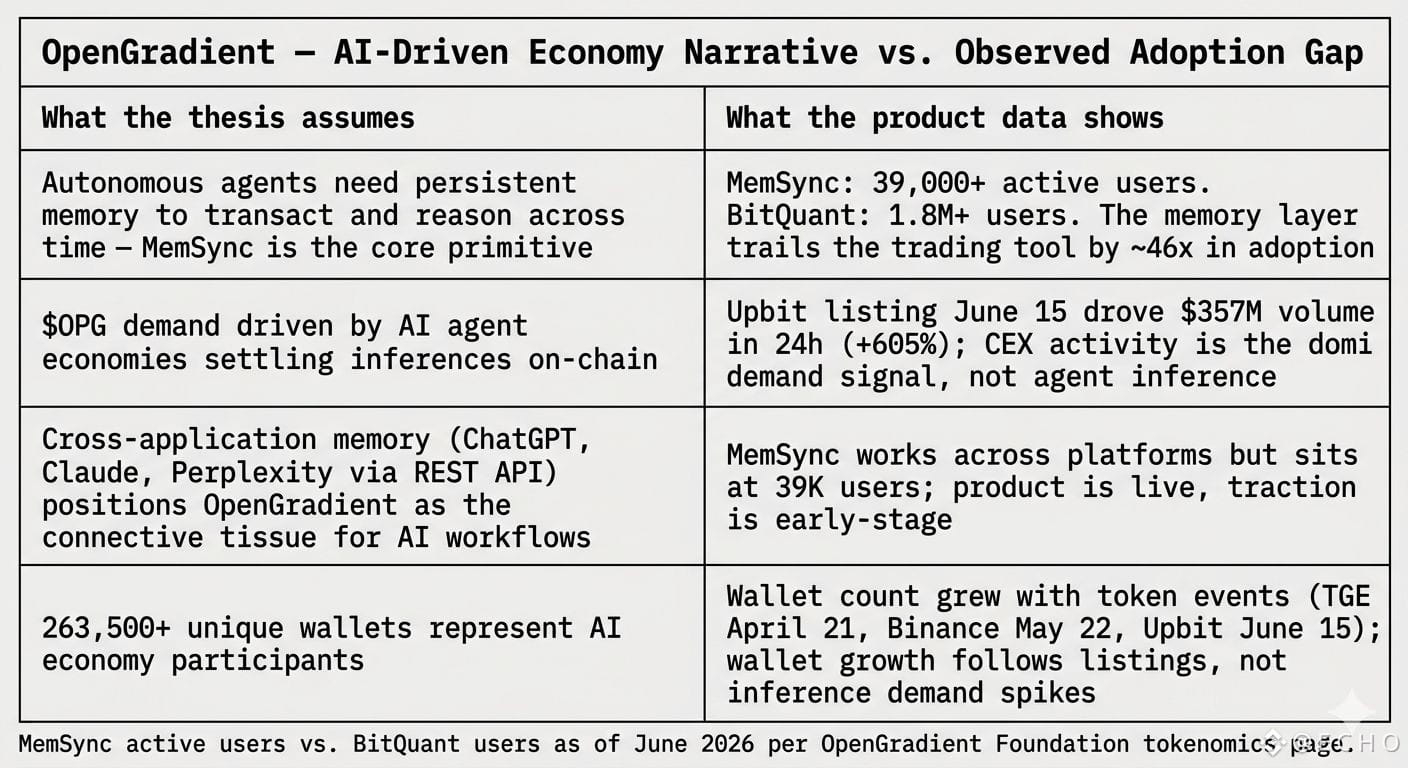
Something about MemSync kept pulling me back mid-task. Not BitQuant, not the verifiable inference architecture — MemSync. OpenGradient #OPG @OpenGradient frames it as a universal AI memory layer, and sure, that sounds like marketing. But the actual mechanic is different from what I expected: it's a REST API sitting on top of OpenGradient's verifiable inference infrastructure, pulling persistent context across different AI platforms — ChatGPT, Claude, Perplexity — storing, retrieving, and building on prior interactions over time. That's not an in-house feature. That's a cross-application memory primitive.
And here's what made me hold up. For an AI-driven decentralized economy to actually function — agents transacting, reasoning, executing on behalf of users across time — those agents need memory that isn't session-bound. Right now MemSync has 39,000+ active users, a small number against BitQuant's 1.8 million, but probably the more structurally significant product of the two for what this is supposedly building toward.
The Upbit listing on June 15 pushed $OPG volume to $357M in 24 hours, +605% on the day. Wallets interacting with the network crossed 263,500. Token momentum is real. But MemSync's 39K active users versus BitQuant's 1.8M tells you which product the market is pricing in — and it isn't the one that matters most for persistent agent economies.
Hmm… if the memory layer stays this thinly adopted while trading volume dominates, is $OPG pricing the AI-driven economy thesis, or just the CEX attention cycle?
Something about MemSync kept pulling me back mid-task. Not BitQuant, not the verifiable inference architecture — MemSync. OpenGradient #OPG @OpenGradient frames it as a universal AI memory layer, and sure, that sounds like marketing. But the actual mechanic is different from what I expected: it's a REST API sitting on top of OpenGradient's verifiable inference infrastructure, pulling persistent context across different AI platforms — ChatGPT, Claude, Perplexity — storing, retrieving, and building on prior interactions over time. That's not an in-house feature. That's a cross-application memory primitive.
And here's what made me hold up. For an AI-driven decentralized economy to actually function — agents transacting, reasoning, executing on behalf of users across time — those agents need memory that isn't session-bound. Right now MemSync has 39,000+ active users, a small number against BitQuant's 1.8 million, but probably the more structurally significant product of the two for what this is supposedly building toward.
The Upbit listing on June 15 pushed $OPG volume to $357M in 24 hours, +605% on the day. Wallets interacting with the network crossed 263,500. Token momentum is real. But MemSync's 39K active users versus BitQuant's 1.8M tells you which product the market is pricing in — and it isn't the one that matters most for persistent agent economies.
Hmm… if the memory layer stays this thinly adopted while trading volume dominates, is $OPG pricing the AI-driven economy thesis, or just the CEX attention cycle?
And here's what made me hold up. For an AI-driven decentralized economy to actually function — agents transacting, reasoning, executing on behalf of users across time — those agents need memory that isn't session-bound. Right now MemSync has 39,000+ active users, a small number against BitQuant's 1.8 million, but probably the more structurally significant product of the two for what this is supposedly building toward.
The Upbit listing on June 15 pushed $OPG volume to $357M in 24 hours, +605% on the day. Wallets interacting with the network crossed 263,500. Token momentum is real. But MemSync's 39K active users versus BitQuant's 1.8M tells you which product the market is pricing in — and it isn't the one that matters most for persistent agent economies.
Hmm… if the memory layer stays this thinly adopted while trading volume dominates, is $OPG pricing the AI-driven economy thesis, or just the CEX attention cycle?
1
1
165
·
--
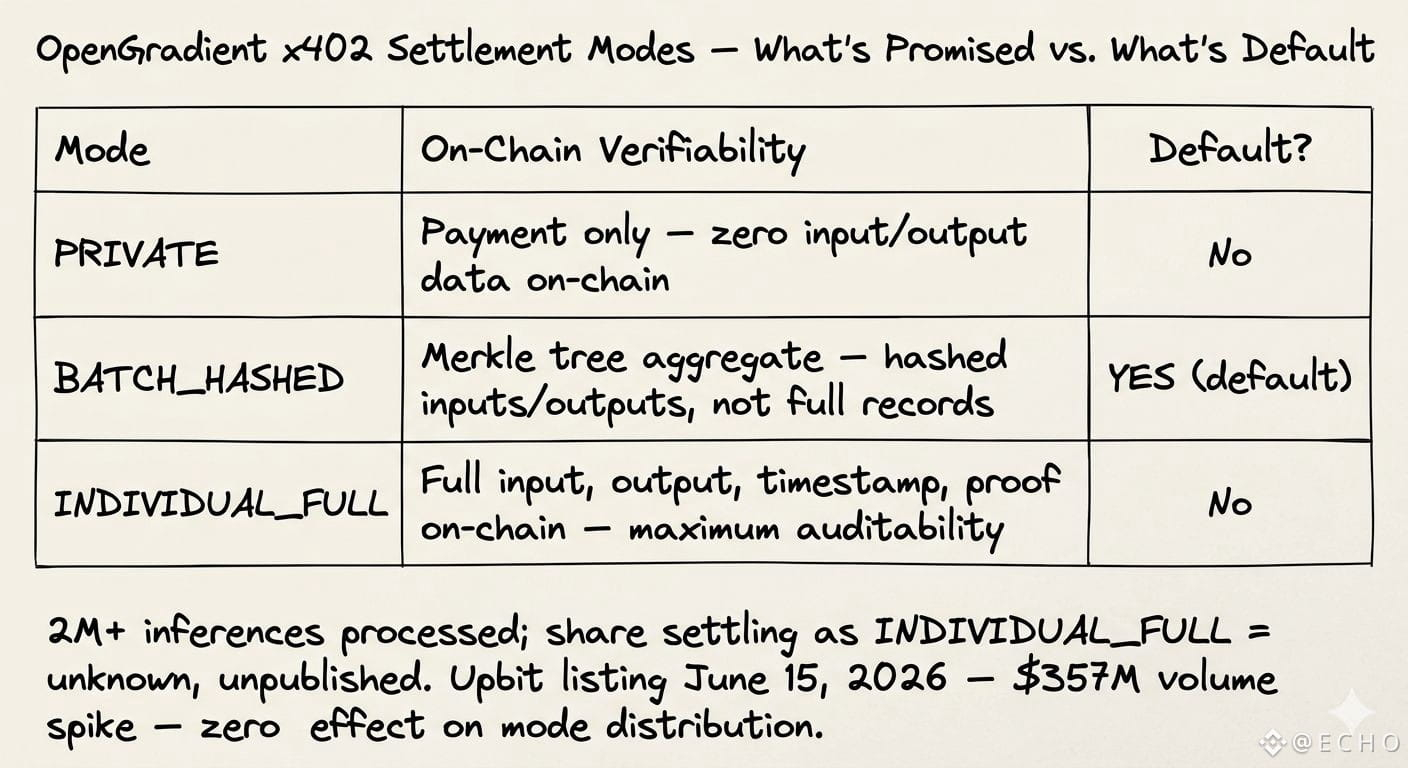
Məni işim ortasında ələ alan şey nə həcm, nə də siyahılar idi. Açıq Gradient Python SDK sənədlərində dəfn olunmuş bir cümlə — x402 vasitəsilə üç təsdiq rejimi: PRIVATE, BATCH_HASHED və INDIVIDUAL_FULL. Default? BATCH_HASHED. Təsdiqləri Merkle ağacına birləşdirir, giriş və çıxışları hash edir, ən az xərc tələb edir. @OpenGradient $OPG #OPG
Bu dizayn seçimi, mərkəzləşdirilməmiş intellektin indiki yerdə harada olduğunu hər şeyi söyləyir. Tam audit edə bilməkdə deyil — bu INDIVIDUAL_FULL, heç kimin default olaraq seçdiyi bir rejimdir, çünki bahalıdır. "İntellekt on-chain-dir" təqdimatı, tam aşkar etmədən hash etdiyiniz orta seçimdə yaşayır. Model Hub-da 2000+ model, 2 milyon təsdiq işlənmiş — bu fəaliyyətin əksəriyyəti, ehtimal ki, Merkle ağacına birləşmiş təsdiqlər kimi, ayrı-ayrılıqda on-chain qeydləri ilə yoxlanılmır.
Və sonra Upbit, OPG-ni 15 iyun tarixində 20:30 KST-də siyahıya aldı, həcm 24 saatda 357 milyon dollar artdı. Token $0.3064-dən açıldı, $0.1815-ə düşdü. Klassik siyahı candlestick-i. Bu qiymət hərəkəti şəbəkədəki təsdiq davranışına toxunmadı — iki tamamilə ayrı sistem paralel işləyir.
hmm… O PRIVATE rejimini düşünürəm — yalnız ödəniş, on-chain-də sıfır məlumat. Bu, buradakı "decentralized intelligence" üçün nə deməkdir. Bəs bu üç rejim üzrə paylanma praktikada necə görünür? Heç kim o rəqəmi dərc etməyib.
Məni işim ortasında ələ alan şey nə həcm, nə də siyahılar idi. Açıq Gradient Python SDK sənədlərində dəfn olunmuş bir cümlə — x402 vasitəsilə üç təsdiq rejimi: PRIVATE, BATCH_HASHED və INDIVIDUAL_FULL. Default? BATCH_HASHED. Təsdiqləri Merkle ağacına birləşdirir, giriş və çıxışları hash edir, ən az xərc tələb edir. @OpenGradient $OPG #OPG
Bu dizayn seçimi, mərkəzləşdirilməmiş intellektin indiki yerdə harada olduğunu hər şeyi söyləyir. Tam audit edə bilməkdə deyil — bu INDIVIDUAL_FULL, heç kimin default olaraq seçdiyi bir rejimdir, çünki bahalıdır. "İntellekt on-chain-dir" təqdimatı, tam aşkar etmədən hash etdiyiniz orta seçimdə yaşayır. Model Hub-da 2000+ model, 2 milyon təsdiq işlənmiş — bu fəaliyyətin əksəriyyəti, ehtimal ki, Merkle ağacına birləşmiş təsdiqlər kimi, ayrı-ayrılıqda on-chain qeydləri ilə yoxlanılmır.
Və sonra Upbit, OPG-ni 15 iyun tarixində 20:30 KST-də siyahıya aldı, həcm 24 saatda 357 milyon dollar artdı. Token $0.3064-dən açıldı, $0.1815-ə düşdü. Klassik siyahı candlestick-i. Bu qiymət hərəkəti şəbəkədəki təsdiq davranışına toxunmadı — iki tamamilə ayrı sistem paralel işləyir.
hmm… O PRIVATE rejimini düşünürəm — yalnız ödəniş, on-chain-də sıfır məlumat. Bu, buradakı "decentralized intelligence" üçün nə deməkdir. Bəs bu üç rejim üzrə paylanma praktikada necə görünür? Heç kim o rəqəmi dərc etməyib.
Bu dizayn seçimi, mərkəzləşdirilməmiş intellektin indiki yerdə harada olduğunu hər şeyi söyləyir. Tam audit edə bilməkdə deyil — bu INDIVIDUAL_FULL, heç kimin default olaraq seçdiyi bir rejimdir, çünki bahalıdır. "İntellekt on-chain-dir" təqdimatı, tam aşkar etmədən hash etdiyiniz orta seçimdə yaşayır. Model Hub-da 2000+ model, 2 milyon təsdiq işlənmiş — bu fəaliyyətin əksəriyyəti, ehtimal ki, Merkle ağacına birləşmiş təsdiqlər kimi, ayrı-ayrılıqda on-chain qeydləri ilə yoxlanılmır.
Və sonra Upbit, OPG-ni 15 iyun tarixində 20:30 KST-də siyahıya aldı, həcm 24 saatda 357 milyon dollar artdı. Token $0.3064-dən açıldı, $0.1815-ə düşdü. Klassik siyahı candlestick-i. Bu qiymət hərəkəti şəbəkədəki təsdiq davranışına toxunmadı — iki tamamilə ayrı sistem paralel işləyir.
hmm… O PRIVATE rejimini düşünürəm — yalnız ödəniş, on-chain-də sıfır məlumat. Bu, buradakı "decentralized intelligence" üçün nə deməkdir. Bəs bu üç rejim üzrə paylanma praktikada necə görünür? Heç kim o rəqəmi dərc etməyib.
2
2
156
·
--
Doğrulanıb
Tərcüməyə bax
Something I kept circling back to during this CreatorPad task on OpenGradient. @OpenGradient $OPG #OPG markets "transparent computation" — every inference verifiable, nothing hidden. Clean idea. But transparency here isn't uniform. It's layered, and who controls the layer matters.
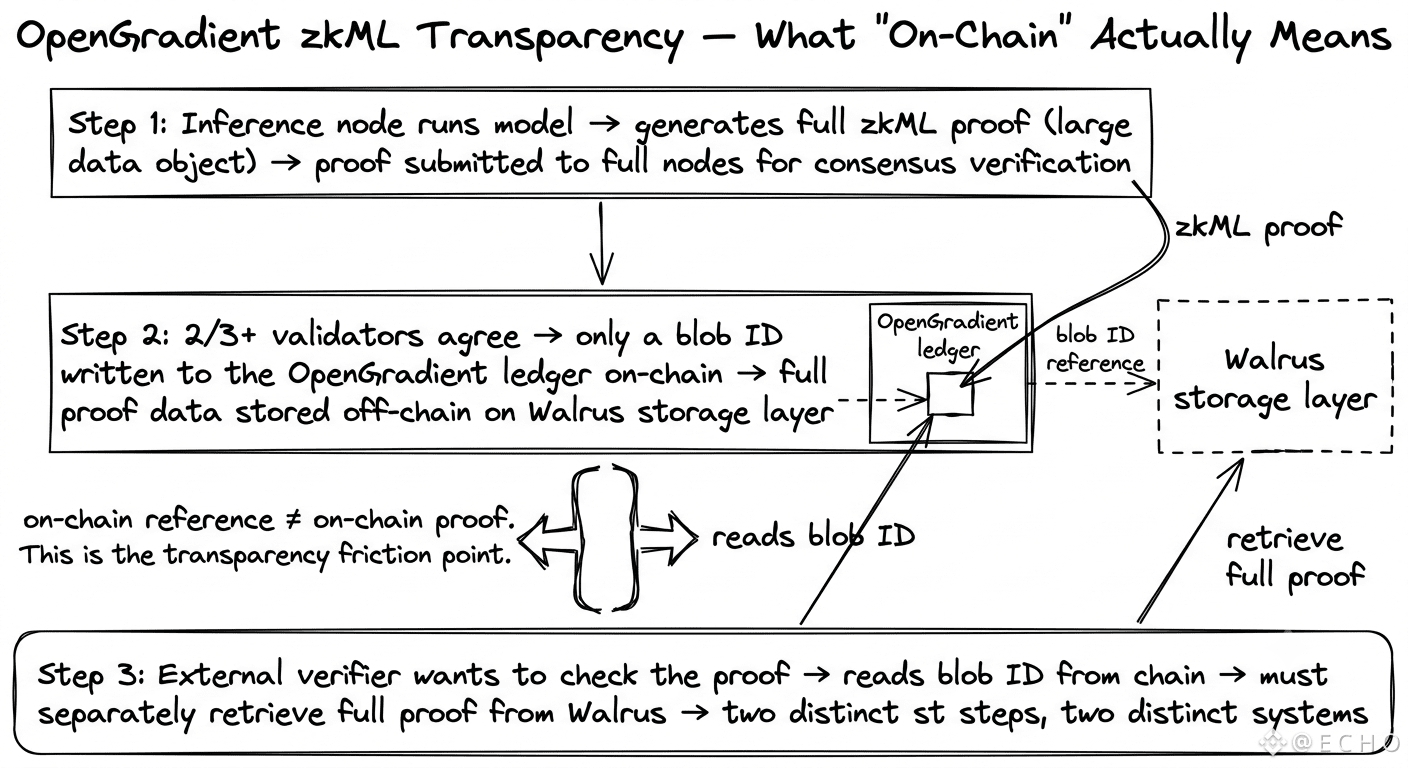
Dug into the architecture docs. For zkML proofs — the highest-trust verification mode — the full proof data doesn't live on-chain. Only a blob ID reference gets recorded on the OpenGradient ledger. The actual proof sits on Walrus, an off-chain storage layer. So "fully transparent computation" means: the chain holds a pointer, not the thing itself. That pointer is permanent and tamper-resistant, sure. But verifying the actual proof means going off-chain to retrieve it. Those are two different acts, and most people reading "verifiable on-chain" won't clock that distinction.
Meanwhile, on June 15 when Upbit listed OPG, volume hit $357.69M — a 606% spike — with the token opening at $0.3064 before dipping to $0.1815. All exchange-side noise. Nothing about that volume touched inference demand or proof retrieval patterns on the actual network.
I've sat with that blob ID detail longer than expected. It's not deceptive exactly — it's an engineering tradeoff, large proof data would be chain-prohibitive. But "transparent" usually implies the whole thing is visible, not a reference to where the thing lives.
Does the pointer count as transparency? Or does transparency only hold if anyone can pull the full proof without going somewhere else to get it?
Something I kept circling back to during this CreatorPad task on OpenGradient. @OpenGradient $OPG #OPG markets "transparent computation" — every inference verifiable, nothing hidden. Clean idea. But transparency here isn't uniform. It's layered, and who controls the layer matters.
Dug into the architecture docs. For zkML proofs — the highest-trust verification mode — the full proof data doesn't live on-chain. Only a blob ID reference gets recorded on the OpenGradient ledger. The actual proof sits on Walrus, an off-chain storage layer. So "fully transparent computation" means: the chain holds a pointer, not the thing itself. That pointer is permanent and tamper-resistant, sure. But verifying the actual proof means going off-chain to retrieve it. Those are two different acts, and most people reading "verifiable on-chain" won't clock that distinction.
Meanwhile, on June 15 when Upbit listed OPG, volume hit $357.69M — a 606% spike — with the token opening at $0.3064 before dipping to $0.1815. All exchange-side noise. Nothing about that volume touched inference demand or proof retrieval patterns on the actual network.
I've sat with that blob ID detail longer than expected. It's not deceptive exactly — it's an engineering tradeoff, large proof data would be chain-prohibitive. But "transparent" usually implies the whole thing is visible, not a reference to where the thing lives.
Does the pointer count as transparency? Or does transparency only hold if anyone can pull the full proof without going somewhere else to get it?
Dug into the architecture docs. For zkML proofs — the highest-trust verification mode — the full proof data doesn't live on-chain. Only a blob ID reference gets recorded on the OpenGradient ledger. The actual proof sits on Walrus, an off-chain storage layer. So "fully transparent computation" means: the chain holds a pointer, not the thing itself. That pointer is permanent and tamper-resistant, sure. But verifying the actual proof means going off-chain to retrieve it. Those are two different acts, and most people reading "verifiable on-chain" won't clock that distinction.
Meanwhile, on June 15 when Upbit listed OPG, volume hit $357.69M — a 606% spike — with the token opening at $0.3064 before dipping to $0.1815. All exchange-side noise. Nothing about that volume touched inference demand or proof retrieval patterns on the actual network.
I've sat with that blob ID detail longer than expected. It's not deceptive exactly — it's an engineering tradeoff, large proof data would be chain-prohibitive. But "transparent" usually implies the whole thing is visible, not a reference to where the thing lives.
Does the pointer count as transparency? Or does transparency only hold if anyone can pull the full proof without going somewhere else to get it?
2
1
141
·
--
Bir şey Bedrock genişmiqyaslı iştirak bucağında iş zamanı baş verdi, və bu, mənim gözlədiyim kimi olmadı.
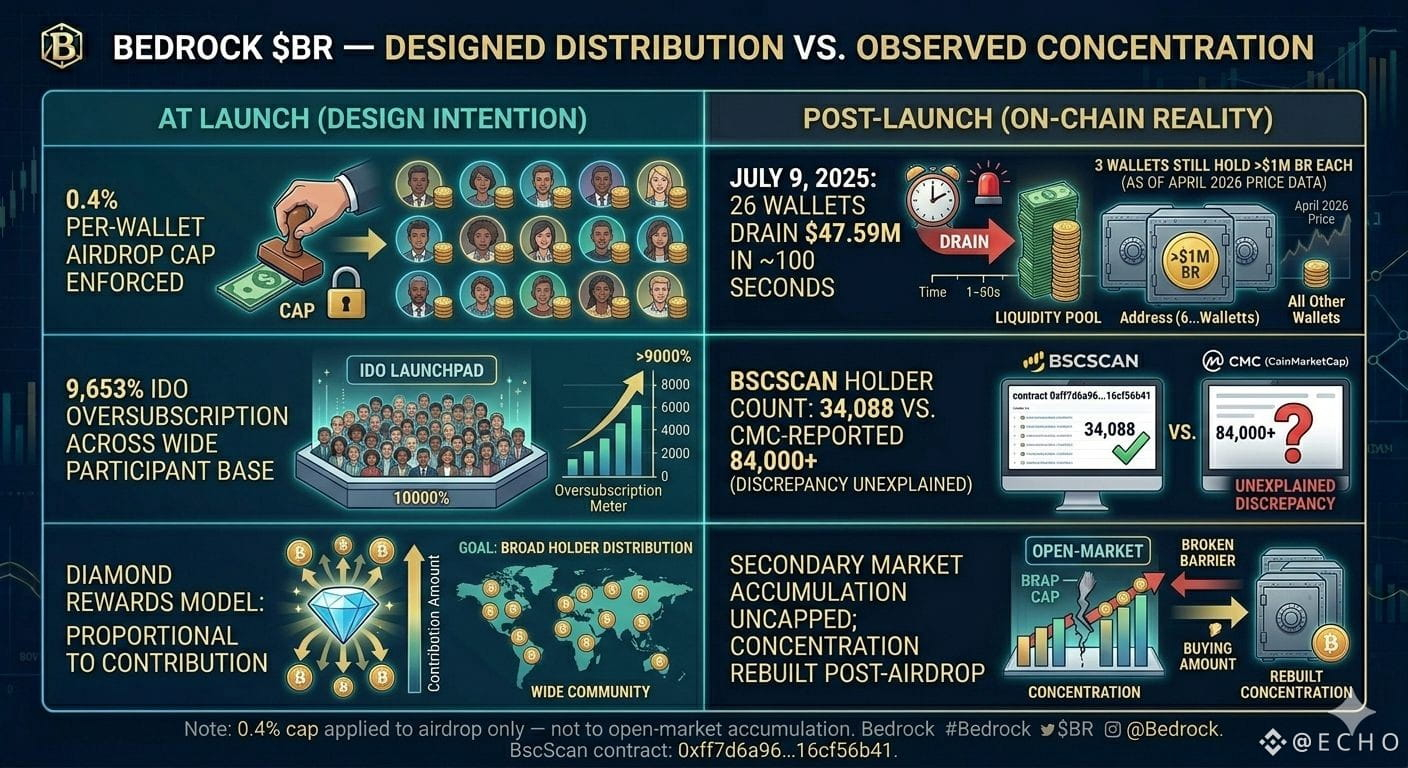
@Bedrock daim geniş iştirakdan danışır — multi-zəncir, multi-assets, açıq giriş. Və görünüşdə $BR bunu təqdim etdi: 9,653% IDO həddindən artıq abunə, 2026-cı ilin may ayı üzrə $1.2B TVL, BNBchain üzrə 84,000+ CoinMarketCap izlənilən sahib. #Bedrock hətta balinaların paylanma zamanı ələ keçirməsini önləmək üçün açıq şəkildə hər cüzdan üçün 0.4% sərt airdrop sərhədini əlavə etdi. Bu dizayn seçimi gerçəkdir — nisbətə uyğun Diamond mükafatları, ədalətli mövsüm mexanizmləri. Kağız üzərində, miqyas və genişlik.
Sonra gözləyin — 2025-ci ilin iyul ayında. İyirmi altı cüzdan Binance Alpha hovuzlarından təxminən 100 saniyə ərzində $47.59M çəkdi, 50% BR çökməsinə səbəb oldu. 2026-cı ilin aprel ayı qiymət analizinə görə, 3 cüzdan hələ də $1M BR-dən yuxarıdır. BscScan üzrə sahib sayı 34,088-dir. 0.4% sərhəd airdrop-u məhdudlaşdırdı — bu, ikincil yığımı məhdudlaşdırmadı. Bunlar fərqli problemlərdir, və dizayn yalnız birini həll etdi.
Mən uniBTC Etherscan təchizatını Chainlink PoR feed-ə qarşı yoxlamaq üçün vaxt sərf etdim. O hissə həqiqətən də doğru çıxır. Protokol qatında iştirak miqyasda fəaliyyət göstərir. Bu, token qatında iştirakın mərkəzləşməyə doğru bu sakit sürüşmədir.
Beləliklə, mənim buraxmadığım sual: protokolda genişmiqyaslı iştirak, onu idarə edənlərdə paylanmış iştirak deməkdirmi?
Bir şey Bedrock genişmiqyaslı iştirak bucağında iş zamanı baş verdi, və bu, mənim gözlədiyim kimi olmadı.
@Bedrock daim geniş iştirakdan danışır — multi-zəncir, multi-assets, açıq giriş. Və görünüşdə $BR bunu təqdim etdi: 9,653% IDO həddindən artıq abunə, 2026-cı ilin may ayı üzrə $1.2B TVL, BNBchain üzrə 84,000+ CoinMarketCap izlənilən sahib. #Bedrock hətta balinaların paylanma zamanı ələ keçirməsini önləmək üçün açıq şəkildə hər cüzdan üçün 0.4% sərt airdrop sərhədini əlavə etdi. Bu dizayn seçimi gerçəkdir — nisbətə uyğun Diamond mükafatları, ədalətli mövsüm mexanizmləri. Kağız üzərində, miqyas və genişlik.
Sonra gözləyin — 2025-ci ilin iyul ayında. İyirmi altı cüzdan Binance Alpha hovuzlarından təxminən 100 saniyə ərzində $47.59M çəkdi, 50% BR çökməsinə səbəb oldu. 2026-cı ilin aprel ayı qiymət analizinə görə, 3 cüzdan hələ də $1M BR-dən yuxarıdır. BscScan üzrə sahib sayı 34,088-dir. 0.4% sərhəd airdrop-u məhdudlaşdırdı — bu, ikincil yığımı məhdudlaşdırmadı. Bunlar fərqli problemlərdir, və dizayn yalnız birini həll etdi.
Mən uniBTC Etherscan təchizatını Chainlink PoR feed-ə qarşı yoxlamaq üçün vaxt sərf etdim. O hissə həqiqətən də doğru çıxır. Protokol qatında iştirak miqyasda fəaliyyət göstərir. Bu, token qatında iştirakın mərkəzləşməyə doğru bu sakit sürüşmədir.
Beləliklə, mənim buraxmadığım sual: protokolda genişmiqyaslı iştirak, onu idarə edənlərdə paylanmış iştirak deməkdirmi?
@Bedrock daim geniş iştirakdan danışır — multi-zəncir, multi-assets, açıq giriş. Və görünüşdə $BR bunu təqdim etdi: 9,653% IDO həddindən artıq abunə, 2026-cı ilin may ayı üzrə $1.2B TVL, BNBchain üzrə 84,000+ CoinMarketCap izlənilən sahib. #Bedrock hətta balinaların paylanma zamanı ələ keçirməsini önləmək üçün açıq şəkildə hər cüzdan üçün 0.4% sərt airdrop sərhədini əlavə etdi. Bu dizayn seçimi gerçəkdir — nisbətə uyğun Diamond mükafatları, ədalətli mövsüm mexanizmləri. Kağız üzərində, miqyas və genişlik.
Sonra gözləyin — 2025-ci ilin iyul ayında. İyirmi altı cüzdan Binance Alpha hovuzlarından təxminən 100 saniyə ərzində $47.59M çəkdi, 50% BR çökməsinə səbəb oldu. 2026-cı ilin aprel ayı qiymət analizinə görə, 3 cüzdan hələ də $1M BR-dən yuxarıdır. BscScan üzrə sahib sayı 34,088-dir. 0.4% sərhəd airdrop-u məhdudlaşdırdı — bu, ikincil yığımı məhdudlaşdırmadı. Bunlar fərqli problemlərdir, və dizayn yalnız birini həll etdi.
Mən uniBTC Etherscan təchizatını Chainlink PoR feed-ə qarşı yoxlamaq üçün vaxt sərf etdim. O hissə həqiqətən də doğru çıxır. Protokol qatında iştirak miqyasda fəaliyyət göstərir. Bu, token qatında iştirakın mərkəzləşməyə doğru bu sakit sürüşmədir.
Beləliklə, mənim buraxmadığım sual: protokolda genişmiqyaslı iştirak, onu idarə edənlərdə paylanmış iştirak deməkdirmi?
6
3
283
·
--
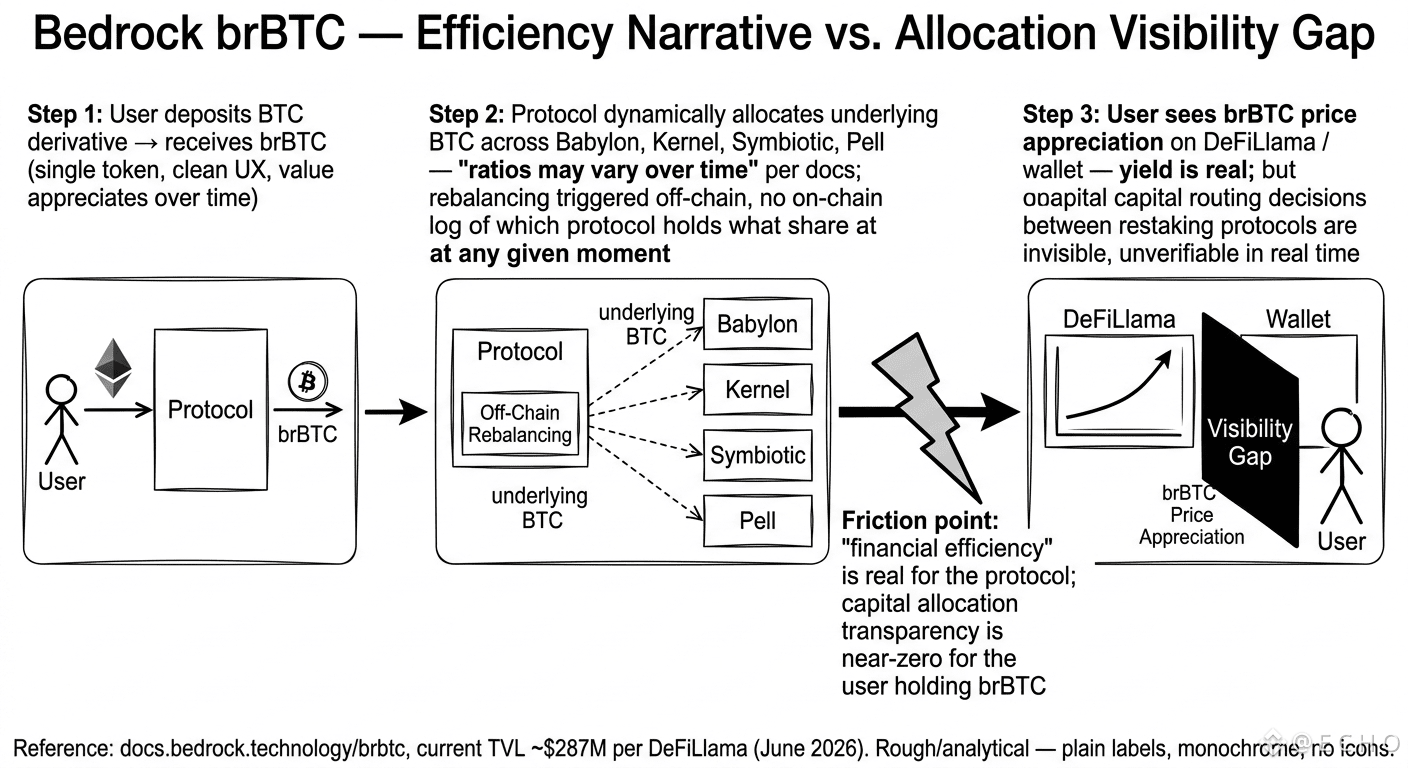
@Bedrock tapşırığında bir şey məni erkən pozdu. Maliyyə səmərəliliyi çərçivəsi başdan-ayağa inandırıcıdır — boşda qalan BTC-lər bir anda Babylon, Kernel, Symbiotic, Pell-ə yönləndirilir, gəlir birləşir, $BR idarəetmə təbəqəsini bir araya gətirir. #Bedrock TVL hazırda DeFiLlama-da təxminən 287 milyon dollar civarındadır. Real kapital, real rəqəmlər.
Amma sonra brBTC təyin etmə mexanizmini araşdırmağa başladım. Sənədlərdə girovun "bir neçə restaking protokolu arasında dinamik olaraq təyin olunduğu" və "təyin etmə nisbətlərinin zamanla dəyişə biləcəyi" deyilir. Bu, mürəkkəb səslənir. Dayan — o kapitalın protokollar arasında necə hərəkət etdiyinə dair on-chain qeyd haradadır? Asanlıqla izlənilə bilən bir qeyd yoxdur. Yenidən balanslaşdırma protokol səviyyəsində, qeyri-şəffaf şəkildə baş verir. İstifadəçilərin gördüyü tək bir tokenin dəyərinin artmasıdır. Əslində baş verənlər — hansı restaking protokolunun sizin BTC-nizdən nə qədərini saxladığı və bunun nə vaxt dəyişdiyi — on-chain-də oxunaqlı bir şəkildə görünmür.
Maliyyə səmərəliliyinin burada nə demək olduğunu düşünməyə davam etdim. Protokol üçün, bu həqiqətən səmərəlidir — bir yığılmış mövqe, avtomatlaşdırılmış yenidən təyin etmə, birləşdirilmiş gəlir. brBTC saxlayan istifadəçi üçün, səmərəlilik gerçəkdir, amma görünürlük demək olar ki, sıfırdır. Siz yönləndirməyə etibar edirsiniz, onu təsdiqləmirsiniz.
Hmm. Bəlkə bu miqdarda problem deyil. Amma hansı TVL-də təyin etmə məntiqindəki qeyri-şəffaflıq bir xüsusiyyət olmağı dayandırır və riskə çevrilir?
@Bedrock tapşırığında bir şey məni erkən pozdu. Maliyyə səmərəliliyi çərçivəsi başdan-ayağa inandırıcıdır — boşda qalan BTC-lər bir anda Babylon, Kernel, Symbiotic, Pell-ə yönləndirilir, gəlir birləşir, $BR idarəetmə təbəqəsini bir araya gətirir. #Bedrock TVL hazırda DeFiLlama-da təxminən 287 milyon dollar civarındadır. Real kapital, real rəqəmlər.
Amma sonra brBTC təyin etmə mexanizmini araşdırmağa başladım. Sənədlərdə girovun "bir neçə restaking protokolu arasında dinamik olaraq təyin olunduğu" və "təyin etmə nisbətlərinin zamanla dəyişə biləcəyi" deyilir. Bu, mürəkkəb səslənir. Dayan — o kapitalın protokollar arasında necə hərəkət etdiyinə dair on-chain qeyd haradadır? Asanlıqla izlənilə bilən bir qeyd yoxdur. Yenidən balanslaşdırma protokol səviyyəsində, qeyri-şəffaf şəkildə baş verir. İstifadəçilərin gördüyü tək bir tokenin dəyərinin artmasıdır. Əslində baş verənlər — hansı restaking protokolunun sizin BTC-nizdən nə qədərini saxladığı və bunun nə vaxt dəyişdiyi — on-chain-də oxunaqlı bir şəkildə görünmür.
Maliyyə səmərəliliyinin burada nə demək olduğunu düşünməyə davam etdim. Protokol üçün, bu həqiqətən səmərəlidir — bir yığılmış mövqe, avtomatlaşdırılmış yenidən təyin etmə, birləşdirilmiş gəlir. brBTC saxlayan istifadəçi üçün, səmərəlilik gerçəkdir, amma görünürlük demək olar ki, sıfırdır. Siz yönləndirməyə etibar edirsiniz, onu təsdiqləmirsiniz.
Hmm. Bəlkə bu miqdarda problem deyil. Amma hansı TVL-də təyin etmə məntiqindəki qeyri-şəffaflıq bir xüsusiyyət olmağı dayandırır və riskə çevrilir?
Amma sonra brBTC təyin etmə mexanizmini araşdırmağa başladım. Sənədlərdə girovun "bir neçə restaking protokolu arasında dinamik olaraq təyin olunduğu" və "təyin etmə nisbətlərinin zamanla dəyişə biləcəyi" deyilir. Bu, mürəkkəb səslənir. Dayan — o kapitalın protokollar arasında necə hərəkət etdiyinə dair on-chain qeyd haradadır? Asanlıqla izlənilə bilən bir qeyd yoxdur. Yenidən balanslaşdırma protokol səviyyəsində, qeyri-şəffaf şəkildə baş verir. İstifadəçilərin gördüyü tək bir tokenin dəyərinin artmasıdır. Əslində baş verənlər — hansı restaking protokolunun sizin BTC-nizdən nə qədərini saxladığı və bunun nə vaxt dəyişdiyi — on-chain-də oxunaqlı bir şəkildə görünmür.
Maliyyə səmərəliliyinin burada nə demək olduğunu düşünməyə davam etdim. Protokol üçün, bu həqiqətən səmərəlidir — bir yığılmış mövqe, avtomatlaşdırılmış yenidən təyin etmə, birləşdirilmiş gəlir. brBTC saxlayan istifadəçi üçün, səmərəlilik gerçəkdir, amma görünürlük demək olar ki, sıfırdır. Siz yönləndirməyə etibar edirsiniz, onu təsdiqləmirsiniz.
Hmm. Bəlkə bu miqdarda problem deyil. Amma hansı TVL-də təyin etmə məntiqindəki qeyri-şəffaflıq bir xüsusiyyət olmağı dayandırır və riskə çevrilir?
9
4
253
·
--
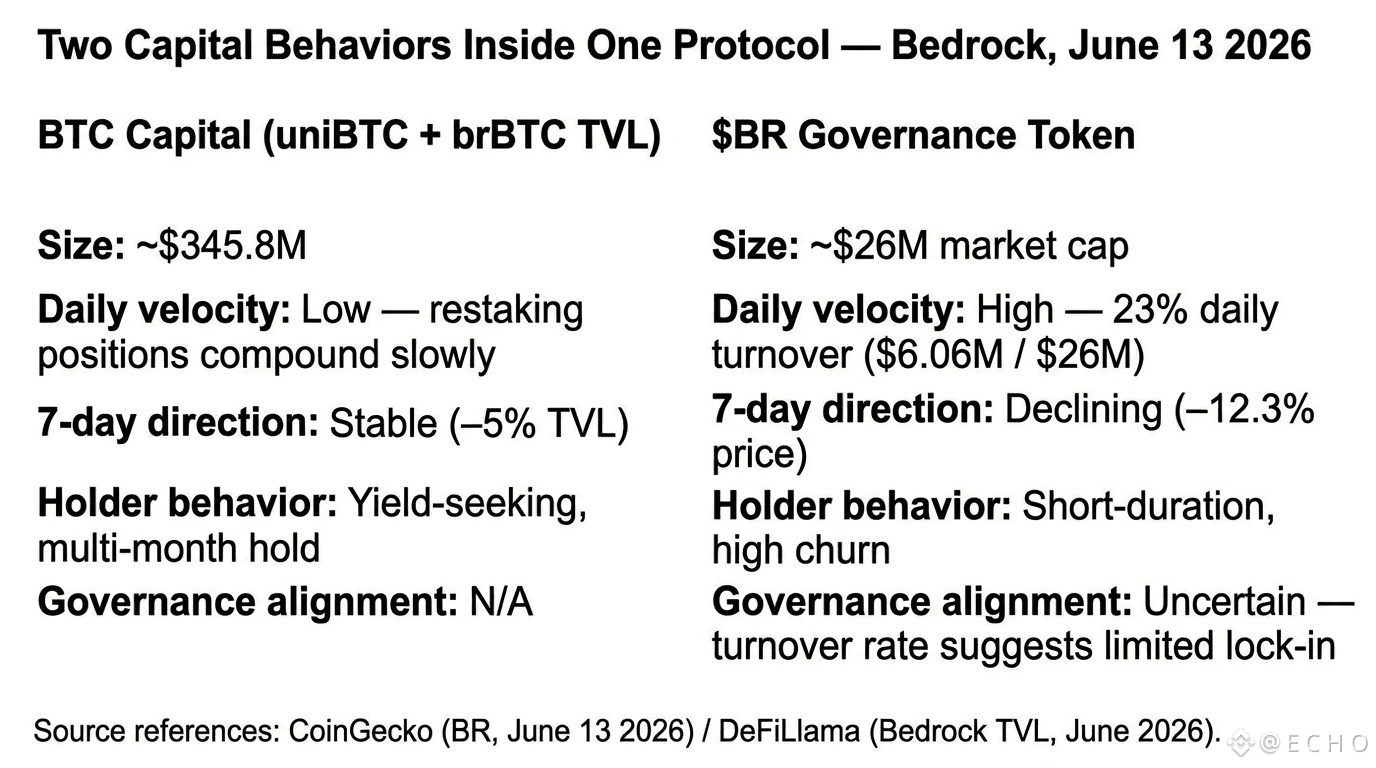
İşin ortasında rəqəmləri yoxladım. Bedrock-un protokolu TVL $345.8M uniBTC və brBTC üzrə oturur. @Bedrock və $BR , idarəetmə tokeninin bu dəyərləri ələ keçirməsi üçün dizayn edilib. #Bedrock . Kağız üzərində uyğun görünür.
Sonra xüsusi olaraq BR bazarına baxdım. Bazar dəyəri ~$26M. Günlük həcmi: Hazırda CoinGecko-ya görə $6.06M. Bu, gündəlik dövriyyənin təxminən 23%-dir. İdarəetmə tokeni üçün $345M-dən yuxarı idarə olunan BTC kapitalında… bu, səbr görünmür. Tez pulun dövr etməsi kimi görünür.
Real kapital bazarları mənzərəsi bir protokol daxilində iki ayrı davranışdır. BTC səbirli — Babylon-un yenidən stake mövqeləri yavaş-yavaş birikərək, Kernel, SatLayer, Pell, Mellow, Symbiotic arasında sakitcə bölünür. $BR isə gündəlik 23% sürətlə dövr edir, bu həftə 12.3% azalıb. Depozit edənlər və token ticarətçiləri tamamilə fərqli zaman çizelgələri ilə işləyirlər. brBTC, real vaxtda ayrılma açıqlaması olmadan altı protokol arasında dinamik olaraq yönləndirilir — bu, hər kəsin açıq şəkildə çərçivəyə saldığına nisbətən daha çox idarə olunan gəlir məhsuluna yaxındır.
BTC qalır. Kim $BR -ü kifayət qədər uzun müddət saxlayır ki, həqiqətən bir şeyə səs versin... bu hələ də işlədiyim hissədir.
İşin ortasında rəqəmləri yoxladım. Bedrock-un protokolu TVL $345.8M uniBTC və brBTC üzrə oturur. @Bedrock və $BR , idarəetmə tokeninin bu dəyərləri ələ keçirməsi üçün dizayn edilib. #Bedrock . Kağız üzərində uyğun görünür.
Sonra xüsusi olaraq BR bazarına baxdım. Bazar dəyəri ~$26M. Günlük həcmi: Hazırda CoinGecko-ya görə $6.06M. Bu, gündəlik dövriyyənin təxminən 23%-dir. İdarəetmə tokeni üçün $345M-dən yuxarı idarə olunan BTC kapitalında… bu, səbr görünmür. Tez pulun dövr etməsi kimi görünür.
Real kapital bazarları mənzərəsi bir protokol daxilində iki ayrı davranışdır. BTC səbirli — Babylon-un yenidən stake mövqeləri yavaş-yavaş birikərək, Kernel, SatLayer, Pell, Mellow, Symbiotic arasında sakitcə bölünür. $BR isə gündəlik 23% sürətlə dövr edir, bu həftə 12.3% azalıb. Depozit edənlər və token ticarətçiləri tamamilə fərqli zaman çizelgələri ilə işləyirlər. brBTC, real vaxtda ayrılma açıqlaması olmadan altı protokol arasında dinamik olaraq yönləndirilir — bu, hər kəsin açıq şəkildə çərçivəyə saldığına nisbətən daha çox idarə olunan gəlir məhsuluna yaxındır.
BTC qalır. Kim $BR -ü kifayət qədər uzun müddət saxlayır ki, həqiqətən bir şeyə səs versin... bu hələ də işlədiyim hissədir.
Sonra xüsusi olaraq BR bazarına baxdım. Bazar dəyəri ~$26M. Günlük həcmi: Hazırda CoinGecko-ya görə $6.06M. Bu, gündəlik dövriyyənin təxminən 23%-dir. İdarəetmə tokeni üçün $345M-dən yuxarı idarə olunan BTC kapitalında… bu, səbr görünmür. Tez pulun dövr etməsi kimi görünür.
Real kapital bazarları mənzərəsi bir protokol daxilində iki ayrı davranışdır. BTC səbirli — Babylon-un yenidən stake mövqeləri yavaş-yavaş birikərək, Kernel, SatLayer, Pell, Mellow, Symbiotic arasında sakitcə bölünür. $BR isə gündəlik 23% sürətlə dövr edir, bu həftə 12.3% azalıb. Depozit edənlər və token ticarətçiləri tamamilə fərqli zaman çizelgələri ilə işləyirlər. brBTC, real vaxtda ayrılma açıqlaması olmadan altı protokol arasında dinamik olaraq yönləndirilir — bu, hər kəsin açıq şəkildə çərçivəyə saldığına nisbətən daha çox idarə olunan gəlir məhsuluna yaxındır.
BTC qalır. Kim $BR -ü kifayət qədər uzun müddət saxlayır ki, həqiqətən bir şeyə səs versin... bu hələ də işlədiyim hissədir.
13
8
193
·
--
Tərcüməyə bax
Finished a CreatorPad task on #Bedrock alignment model and the thing that actually stopped me mid-read was a number from almost exactly a year ago — still sitting in the data, still unresolved.
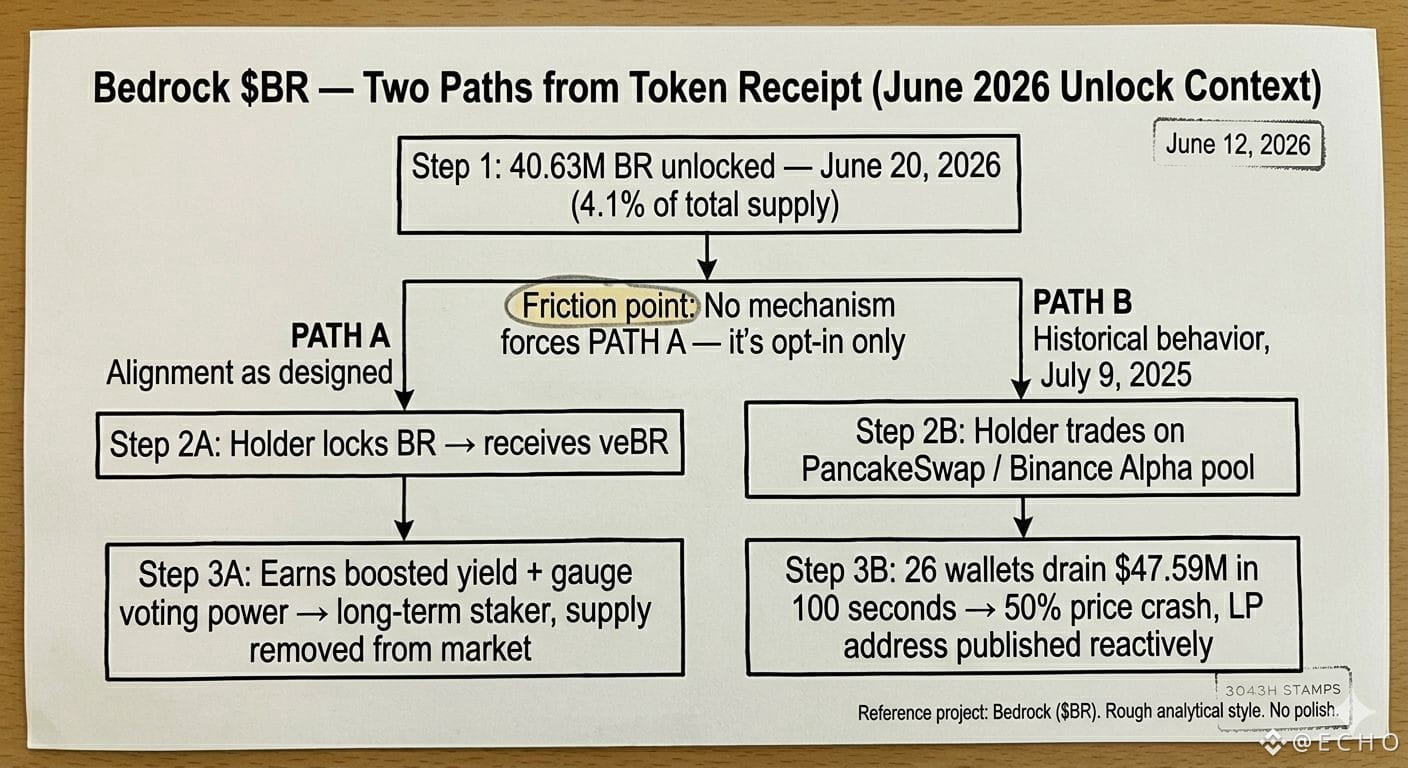
July 9, 2025: 26 wallets drained $47.59M from Binance Alpha pools in under 100 seconds. $BR dropped 50%. @Bedrock responded by publishing their official PancakeSwap LP address (0x5f6f…) and pledging liquidity stability. That's the transparency move. Fine. But the contrast is stark: the protocol had just spent weeks building a veBR alignment story — lock $BR, share in governance, earn boosted yield, skin in the game — and the dominant on-chain behavior in that moment was 26 addresses exiting at speed, not 26 committed stakers holding through.
That gap is the real insight. The alignment mechanism exists — PoSL, veBR emissions, seasonal resets, protocol revenue buybacks. On paper it's coherent. But the participants who moved the price weren't engaged with any of that layer. They were trading incentive campaigns, not expressing protocol conviction. The veBR model only aligns the people who opted into it. Everyone else is just… there for the cycle.
I came out of this task more curious than critical, honestly. The design is genuine. But I keep wondering: with the June 20 unlock dropping another 40.63M BR into circulation this week, how many of those new recipients go straight to veBR lock-up… versus straight to PancakeSwap?
Finished a CreatorPad task on #Bedrock alignment model and the thing that actually stopped me mid-read was a number from almost exactly a year ago — still sitting in the data, still unresolved.
July 9, 2025: 26 wallets drained $47.59M from Binance Alpha pools in under 100 seconds. $BR dropped 50%. @Bedrock responded by publishing their official PancakeSwap LP address (0x5f6f…) and pledging liquidity stability. That's the transparency move. Fine. But the contrast is stark: the protocol had just spent weeks building a veBR alignment story — lock $BR , share in governance, earn boosted yield, skin in the game — and the dominant on-chain behavior in that moment was 26 addresses exiting at speed, not 26 committed stakers holding through.
That gap is the real insight. The alignment mechanism exists — PoSL, veBR emissions, seasonal resets, protocol revenue buybacks. On paper it's coherent. But the participants who moved the price weren't engaged with any of that layer. They were trading incentive campaigns, not expressing protocol conviction. The veBR model only aligns the people who opted into it. Everyone else is just… there for the cycle.
I came out of this task more curious than critical, honestly. The design is genuine. But I keep wondering: with the June 20 unlock dropping another 40.63M BR into circulation this week, how many of those new recipients go straight to veBR lock-up… versus straight to PancakeSwap?
July 9, 2025: 26 wallets drained $47.59M from Binance Alpha pools in under 100 seconds. $BR dropped 50%. @Bedrock responded by publishing their official PancakeSwap LP address (0x5f6f…) and pledging liquidity stability. That's the transparency move. Fine. But the contrast is stark: the protocol had just spent weeks building a veBR alignment story — lock $BR , share in governance, earn boosted yield, skin in the game — and the dominant on-chain behavior in that moment was 26 addresses exiting at speed, not 26 committed stakers holding through.
That gap is the real insight. The alignment mechanism exists — PoSL, veBR emissions, seasonal resets, protocol revenue buybacks. On paper it's coherent. But the participants who moved the price weren't engaged with any of that layer. They were trading incentive campaigns, not expressing protocol conviction. The veBR model only aligns the people who opted into it. Everyone else is just… there for the cycle.
I came out of this task more curious than critical, honestly. The design is genuine. But I keep wondering: with the June 20 unlock dropping another 40.63M BR into circulation this week, how many of those new recipients go straight to veBR lock-up… versus straight to PancakeSwap?
8
5
196
·
--
Bir CreatorPad tapşırığına yarıdan çox vaxt sərf edirdim, niyə Bedrock-un iştirak modellərini yenidən müəyyən edə biləcəyini düşündüm, birdən BR Ticarət Zolağı strukturunu görəndə donub qaldım.
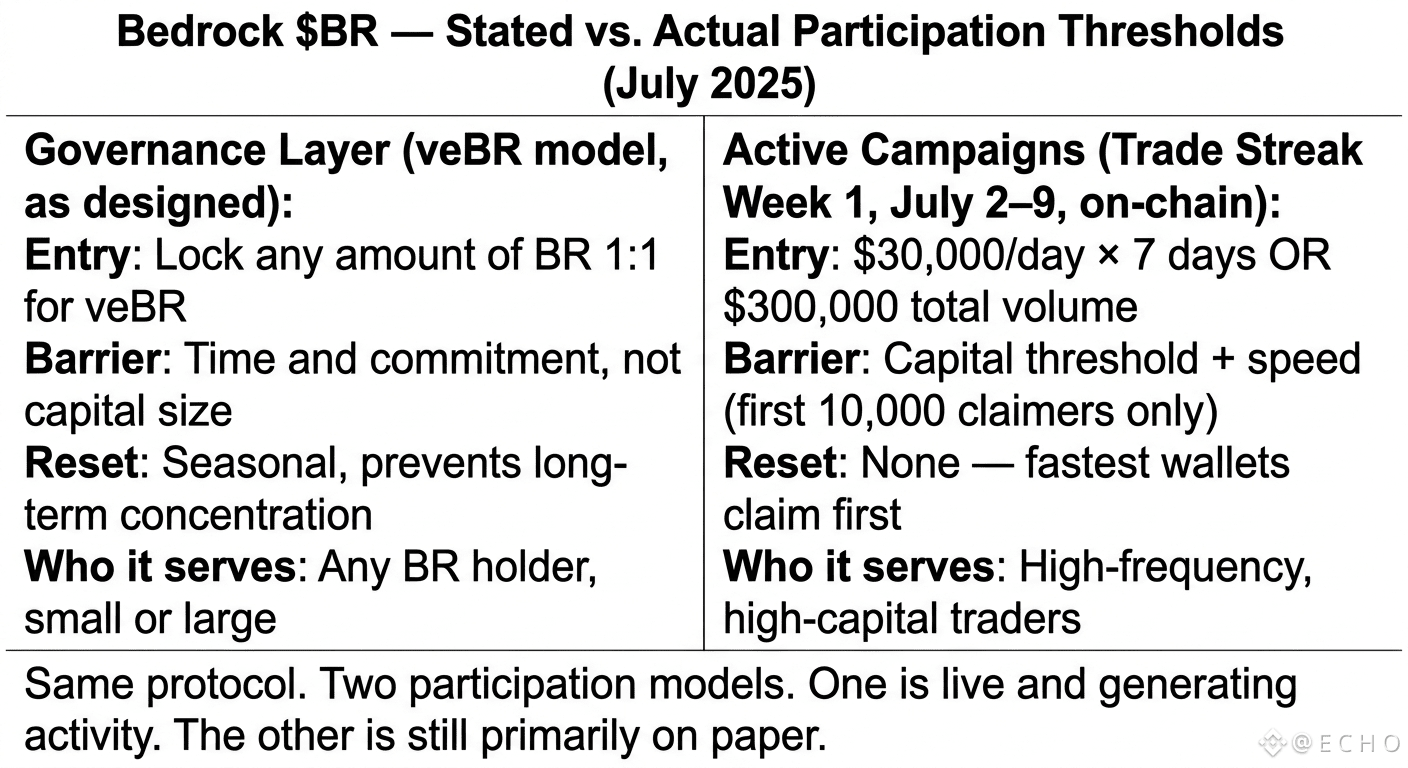
@Bedrock $BR #Bedrock çərçivələr iştirakın geniş və əlçatan olduğunu göstərir — veBR idarəetməsi, ölçü ilə səsvermə, icma yönləndirmə protokolu. Bu, vəd olunanlardır. Amma sonra Ticarət Zolağı Həftə 1-in (2–9 iyul) iştirakın nə olduğunu müəyyən etdiyinə baxdım: gündə $30,000 yeddi ardıcıl gün üçün, ya da $300,000 ümumi BR/USDT həcmi ilə iştirak etmək üçün. İlk 10,000 uyğun olan iddiaçı $100K hovuzunu bölüşür. Yalnız ən sürətlilər daxil olur.
Dayan — bu, iştirak modeli deyil. Bu, icma iştirakını paltara bürünmüş kapital və sürət filtridir. Əvvəlki Ticarət Karnavalı 60,000 cüzdana $180,000 ümumi mükafat verdi. Bu, geniş görünür, amma ən yaxşı 50 treyderin ortalama $4.45 milyon qazandığını gördükdə, gerçək mənzərə dəyişir. Bəs burada iştirakını kim müəyyən edir?
Bu suala qayıdıram: veBR idarəetmə qatının gerçəkdən geniş, səbirli sahiblər üçün dizayn edildiyini düşünürəm. Kilitlənmə müddəti səsvermə gücünü artırır. Mövsümi sıfırlamalar konsentrasiyanı önləyir. Kağız üzərində bu, əksər modellərdən daha bərabərdir. Amma hazırda yürüdülən kampaniyalar — gerçək on-chain fəaliyyətini yaradanlar — sakitcə əksər cüzdanların malik olmadığı kapital girişini tələb edir.
Hmm. Bəlkə Bedrock-un qurduğu iştirak modeli ilə Bedrock-un praktiki olaraq yürüdüyü iştirak modeli, hələ bir-birinə yaxınlaşmağı gözləyən iki ayrı şeydir…
Bir CreatorPad tapşırığına yarıdan çox vaxt sərf edirdim, niyə Bedrock-un iştirak modellərini yenidən müəyyən edə biləcəyini düşündüm, birdən BR Ticarət Zolağı strukturunu görəndə donub qaldım.
@Bedrock $BR #Bedrock çərçivələr iştirakın geniş və əlçatan olduğunu göstərir — veBR idarəetməsi, ölçü ilə səsvermə, icma yönləndirmə protokolu. Bu, vəd olunanlardır. Amma sonra Ticarət Zolağı Həftə 1-in (2–9 iyul) iştirakın nə olduğunu müəyyən etdiyinə baxdım: gündə $30,000 yeddi ardıcıl gün üçün, ya da $300,000 ümumi BR/USDT həcmi ilə iştirak etmək üçün. İlk 10,000 uyğun olan iddiaçı $100K hovuzunu bölüşür. Yalnız ən sürətlilər daxil olur.
Dayan — bu, iştirak modeli deyil. Bu, icma iştirakını paltara bürünmüş kapital və sürət filtridir. Əvvəlki Ticarət Karnavalı 60,000 cüzdana $180,000 ümumi mükafat verdi. Bu, geniş görünür, amma ən yaxşı 50 treyderin ortalama $4.45 milyon qazandığını gördükdə, gerçək mənzərə dəyişir. Bəs burada iştirakını kim müəyyən edir?
Bu suala qayıdıram: veBR idarəetmə qatının gerçəkdən geniş, səbirli sahiblər üçün dizayn edildiyini düşünürəm. Kilitlənmə müddəti səsvermə gücünü artırır. Mövsümi sıfırlamalar konsentrasiyanı önləyir. Kağız üzərində bu, əksər modellərdən daha bərabərdir. Amma hazırda yürüdülən kampaniyalar — gerçək on-chain fəaliyyətini yaradanlar — sakitcə əksər cüzdanların malik olmadığı kapital girişini tələb edir.
Hmm. Bəlkə Bedrock-un qurduğu iştirak modeli ilə Bedrock-un praktiki olaraq yürüdüyü iştirak modeli, hələ bir-birinə yaxınlaşmağı gözləyən iki ayrı şeydir…
@Bedrock $BR #Bedrock çərçivələr iştirakın geniş və əlçatan olduğunu göstərir — veBR idarəetməsi, ölçü ilə səsvermə, icma yönləndirmə protokolu. Bu, vəd olunanlardır. Amma sonra Ticarət Zolağı Həftə 1-in (2–9 iyul) iştirakın nə olduğunu müəyyən etdiyinə baxdım: gündə $30,000 yeddi ardıcıl gün üçün, ya da $300,000 ümumi BR/USDT həcmi ilə iştirak etmək üçün. İlk 10,000 uyğun olan iddiaçı $100K hovuzunu bölüşür. Yalnız ən sürətlilər daxil olur.
Dayan — bu, iştirak modeli deyil. Bu, icma iştirakını paltara bürünmüş kapital və sürət filtridir. Əvvəlki Ticarət Karnavalı 60,000 cüzdana $180,000 ümumi mükafat verdi. Bu, geniş görünür, amma ən yaxşı 50 treyderin ortalama $4.45 milyon qazandığını gördükdə, gerçək mənzərə dəyişir. Bəs burada iştirakını kim müəyyən edir?
Bu suala qayıdıram: veBR idarəetmə qatının gerçəkdən geniş, səbirli sahiblər üçün dizayn edildiyini düşünürəm. Kilitlənmə müddəti səsvermə gücünü artırır. Mövsümi sıfırlamalar konsentrasiyanı önləyir. Kağız üzərində bu, əksər modellərdən daha bərabərdir. Amma hazırda yürüdülən kampaniyalar — gerçək on-chain fəaliyyətini yaradanlar — sakitcə əksər cüzdanların malik olmadığı kapital girişini tələb edir.
Hmm. Bəlkə Bedrock-un qurduğu iştirak modeli ilə Bedrock-un praktiki olaraq yürüdüyü iştirak modeli, hələ bir-birinə yaxınlaşmağı gözləyən iki ayrı şeydir…
9
6
222
·
--
Tərcüməyə bax
Doing the CreatorPad task on Bedrock and user optionality, and the thing that kept nagging at me wasn't the number of chains — it was the fine print underneath them.
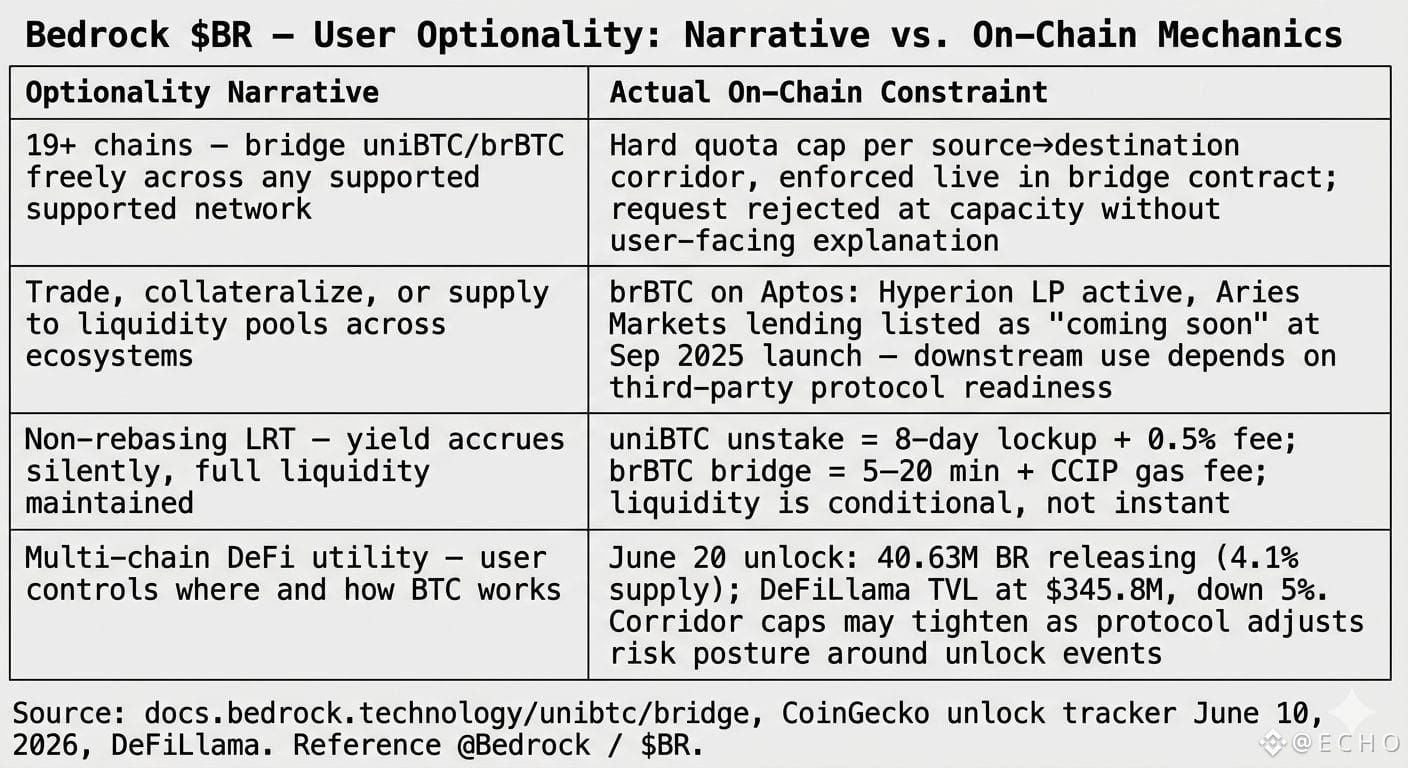
@Bedrock $BR uniBTC and brBTC are genuinely bridgeable across 19+ networks via Chainlink CCIP. That part is real. The June 20 token unlock in ten days — 40.63M BR dropping, per CoinGecko's tracker — had me looking at the actual bridge docs more carefully than usual. And that's where I noticed it: every corridor has a hard quota cap, enforced live at the contract level. Bridge request gets rejected silently if the route's available capacity is full. No error explanation. Just a rejection. #Bedrock
That's not a criticism exactly. It's a design choice for security, and a reasonable one. But it does change what "optionality" actually means in practice. The narrative is nineteen chains, move freely. The reality is nineteen chains, move freely within per-route capacity windows that shift based on demand and the protocol's own security posture. Most users won't hit those caps under normal conditions. But the optionality isn't unconditional.
I kept thinking about this versus the headline… hmm. It's the difference between "you can go anywhere" and "you can go anywhere if the lane isn't full." Both might technically be true.
Does the bridge cap model add meaningful security without practically constraining optionality at scale, or does it quietly become the binding constraint the moment TVL climbs back toward $1B?
Doing the CreatorPad task on Bedrock and user optionality, and the thing that kept nagging at me wasn't the number of chains — it was the fine print underneath them.
@Bedrock $BR uniBTC and brBTC are genuinely bridgeable across 19+ networks via Chainlink CCIP. That part is real. The June 20 token unlock in ten days — 40.63M BR dropping, per CoinGecko's tracker — had me looking at the actual bridge docs more carefully than usual. And that's where I noticed it: every corridor has a hard quota cap, enforced live at the contract level. Bridge request gets rejected silently if the route's available capacity is full. No error explanation. Just a rejection. #Bedrock
That's not a criticism exactly. It's a design choice for security, and a reasonable one. But it does change what "optionality" actually means in practice. The narrative is nineteen chains, move freely. The reality is nineteen chains, move freely within per-route capacity windows that shift based on demand and the protocol's own security posture. Most users won't hit those caps under normal conditions. But the optionality isn't unconditional.
I kept thinking about this versus the headline… hmm. It's the difference between "you can go anywhere" and "you can go anywhere if the lane isn't full." Both might technically be true.
Does the bridge cap model add meaningful security without practically constraining optionality at scale, or does it quietly become the binding constraint the moment TVL climbs back toward $1B?
@Bedrock $BR uniBTC and brBTC are genuinely bridgeable across 19+ networks via Chainlink CCIP. That part is real. The June 20 token unlock in ten days — 40.63M BR dropping, per CoinGecko's tracker — had me looking at the actual bridge docs more carefully than usual. And that's where I noticed it: every corridor has a hard quota cap, enforced live at the contract level. Bridge request gets rejected silently if the route's available capacity is full. No error explanation. Just a rejection. #Bedrock
That's not a criticism exactly. It's a design choice for security, and a reasonable one. But it does change what "optionality" actually means in practice. The narrative is nineteen chains, move freely. The reality is nineteen chains, move freely within per-route capacity windows that shift based on demand and the protocol's own security posture. Most users won't hit those caps under normal conditions. But the optionality isn't unconditional.
I kept thinking about this versus the headline… hmm. It's the difference between "you can go anywhere" and "you can go anywhere if the lane isn't full." Both might technically be true.
Does the bridge cap model add meaningful security without practically constraining optionality at scale, or does it quietly become the binding constraint the moment TVL climbs back toward $1B?
2
128
·
--
Tərcüməyə bax
Checked the DeFiLlama page for @Bedrock uniBTC just now. $289.14M locked across 18 chains. $BR . #Bedrock . Then I looked at the 7-day fees line — it said $1. One dollar. Against close to three hundred million in staked BTC.
That's not a bug. Bedrock's revenue model runs entirely on redemption fees — the protocol earns only when users create delayed withdrawal requests. When BTC sits, nothing accrues. And right now it's sitting hard. $104M on Bitcoin native, $80M on Ethereum, $63.9M on Merlin, and change scattered across BOB, BSC, Mantle, Berachain, and a dozen more. All locked, barely moving. Cumulative protocol revenue since launch across all of this: $26,381. Total. That number is verifiable on the DeFiLlama adapter right now.
Hold up — that might actually be the case. If BTC routes in and doesn't leave, the protocol is functioning as base-layer infrastructure. You don't collect fees on movement you never charge for. The real question is whether zero-fee-at-rest is intentional positioning — settle the routing layer first, capture value later — or a model that just never gets revisited.
$289M sticky and $1 taken in last week. Hmm. Whether that's the behavior of something quietly becoming foundational or a protocol that built the pipes before the meter, I haven't decided.
Checked the DeFiLlama page for @Bedrock uniBTC just now. $289.14M locked across 18 chains. $BR . #Bedrock . Then I looked at the 7-day fees line — it said $1. One dollar. Against close to three hundred million in staked BTC.
That's not a bug. Bedrock's revenue model runs entirely on redemption fees — the protocol earns only when users create delayed withdrawal requests. When BTC sits, nothing accrues. And right now it's sitting hard. $104M on Bitcoin native, $80M on Ethereum, $63.9M on Merlin, and change scattered across BOB, BSC, Mantle, Berachain, and a dozen more. All locked, barely moving. Cumulative protocol revenue since launch across all of this: $26,381. Total. That number is verifiable on the DeFiLlama adapter right now.
Hold up — that might actually be the case. If BTC routes in and doesn't leave, the protocol is functioning as base-layer infrastructure. You don't collect fees on movement you never charge for. The real question is whether zero-fee-at-rest is intentional positioning — settle the routing layer first, capture value later — or a model that just never gets revisited.
$289M sticky and $1 taken in last week. Hmm. Whether that's the behavior of something quietly becoming foundational or a protocol that built the pipes before the meter, I haven't decided.
That's not a bug. Bedrock's revenue model runs entirely on redemption fees — the protocol earns only when users create delayed withdrawal requests. When BTC sits, nothing accrues. And right now it's sitting hard. $104M on Bitcoin native, $80M on Ethereum, $63.9M on Merlin, and change scattered across BOB, BSC, Mantle, Berachain, and a dozen more. All locked, barely moving. Cumulative protocol revenue since launch across all of this: $26,381. Total. That number is verifiable on the DeFiLlama adapter right now.
Hold up — that might actually be the case. If BTC routes in and doesn't leave, the protocol is functioning as base-layer infrastructure. You don't collect fees on movement you never charge for. The real question is whether zero-fee-at-rest is intentional positioning — settle the routing layer first, capture value later — or a model that just never gets revisited.
$289M sticky and $1 taken in last week. Hmm. Whether that's the behavior of something quietly becoming foundational or a protocol that built the pipes before the meter, I haven't decided.
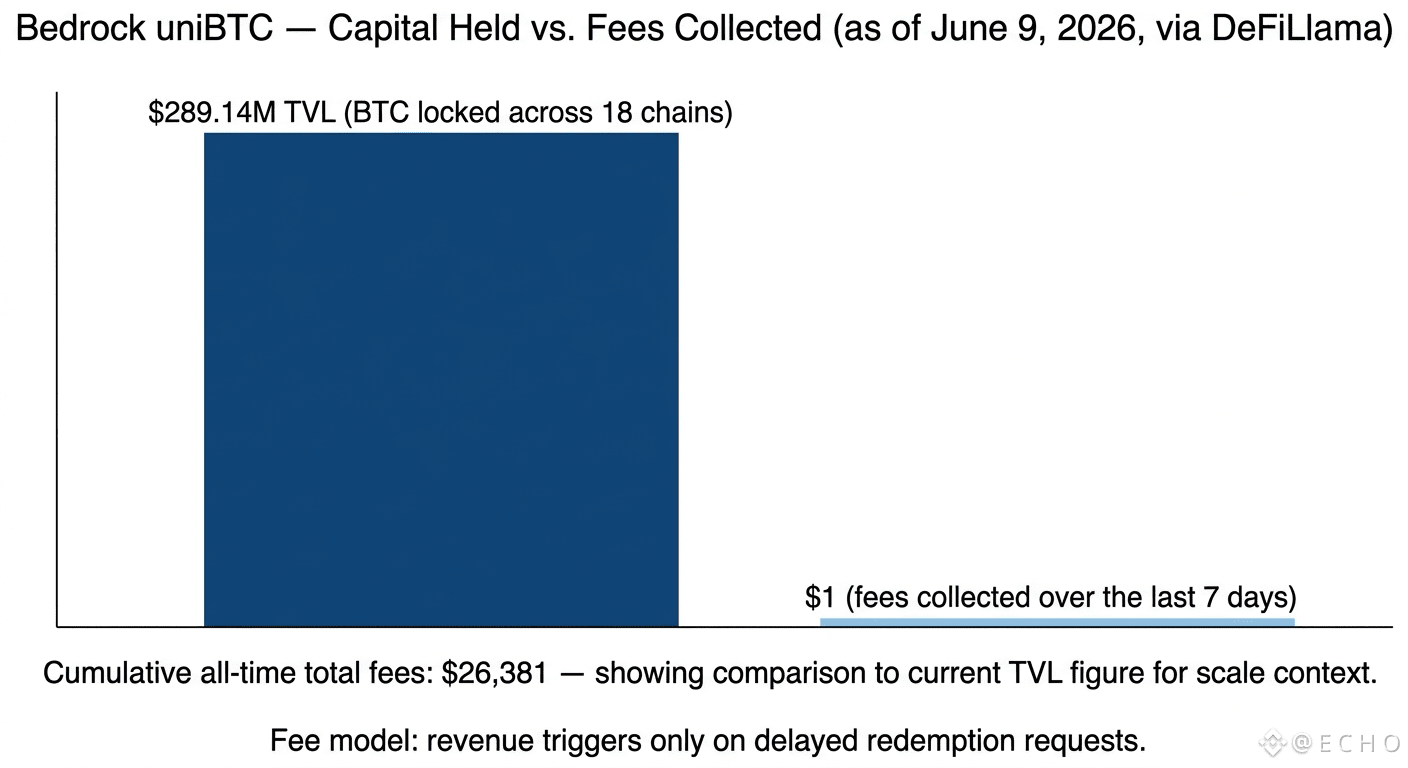
6
2
212
Daha çox kontent araşdırmaq üçün daxil olun
Binance Square-də qlobal kriptovalyuta istifadəçilərinə qoşulun
⚡️ Kriptovalyuta haqqında ən son və faydalı məlumatları əldə edin.
💬 Dünyanın ən böyük kriptovalyuta birjası tərəfindən etibar edilir.
👍 Doğrulanmış yaradıcılardan gələn real məlumatları kəşf edin.
E-poçt/Telefon nömrəsi
Trenddə olan mövzular
QNTRises287%
1,690 baxış
Müzakirə edir: 111
#QNTRises287%
🚀 QNT +287% — diqqət tələb edən bir hərəkət.
Bu qədər kəskin yüksəliş bazarda sentimentin, likvidliyin və ticarət aktivliyinin ani dəyişimini göstərə bilər. Amma şaquli (vertikal) hərəkətdən sonra volatillik (dəyişkənlik) tez genişlənə bilər.
Mənim nəticəm: şamı (kəskin artım şamını) qovlamayın — həcmi, likvidliyi və QNT-nin qırılmadan sonra (breakout) bunu davam etdirə bilməsini izləyin. 📊
#QNTRises287% #QNT #Crypto #Binance
$QNT
PALASH5
·0 bəyənmə
·238 baxış
TrumpRejectsAIRulesForVoluntaryAudits
6,094 baxış
Müzakirə edir: 263
BitgetHotWalletBreachTiedToThirdPartySecurityFlaw
3,072 baxış
Müzakirə edir: 204