
iPreMyZX
2.3k Paylaşımlar

iPreMyZX
Şikayət et
İstifadəçini blokla
Açıq ticarət
Daimi treyder
2.5 il
40 İzlənilir
10.5K+ İzləyicilər
7.0K+ Bəyəndi
Postlar
Portfel
Hamısı
Sitatlar
·
--
Tərcüməyə bax
I initially looked at $DUSK like I would look at most L1 tokens: supply, liquidity, staking yield and market demand.
But the more I studied Dusk, the more I realized the token has a much more practical role inside the network.
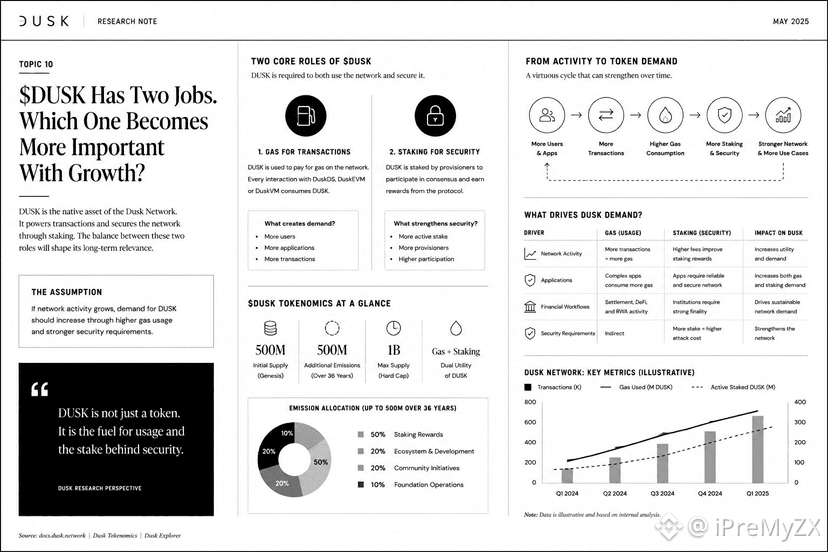
DUSK is used for transaction fees and staking. Every transaction consumes gas, while staking DUSK allows provisioners to participate in consensus and earn protocol rewards.
That creates an assumption I’m not completely comfortable with:
If Dusk grows, does token demand actually grow with it?
It depends on what kind of activity grows.
More applications could mean more transactions and therefore more gas usage. More financial activity could also increase the importance of reliable validators securing the network.
But there is another side.
Dusk currently has an initial supply of 500 million DUSK, with another 500 million scheduled to be emitted over 36 years for staking incentives.
So I don't think it makes sense to look at DUSK economics through supply alone.
I’m more interested in the relationship between network activity → gas consumption → staking → security → token demand.
If Dusk becomes infrastructure for regulated assets, private transactions and financial applications, then DUSK could gradually become less about simply holding a blockchain token and more about accessing and securing an actual financial network.
But that is still an assumption.
The real test is whether meaningful usage eventually creates enough onchain activity for DUSK’s utility to matter economically.
That’s the part I’m watching.
Not just what $DUSK is worth today, but how necessary it becomes if Dusk actually gets used.
@Dusk_Foundation #dusk
I initially looked at $DUSK like I would look at most L1 tokens: supply, liquidity, staking yield and market demand.
But the more I studied Dusk, the more I realized the token has a much more practical role inside the network.
DUSK is used for transaction fees and staking. Every transaction consumes gas, while staking DUSK allows provisioners to participate in consensus and earn protocol rewards.
That creates an assumption I’m not completely comfortable with:
If Dusk grows, does token demand actually grow with it?
It depends on what kind of activity grows.
More applications could mean more transactions and therefore more gas usage. More financial activity could also increase the importance of reliable validators securing the network.
But there is another side.
Dusk currently has an initial supply of 500 million DUSK, with another 500 million scheduled to be emitted over 36 years for staking incentives.
So I don't think it makes sense to look at DUSK economics through supply alone.
I’m more interested in the relationship between network activity → gas consumption → staking → security → token demand.
If Dusk becomes infrastructure for regulated assets, private transactions and financial applications, then DUSK could gradually become less about simply holding a blockchain token and more about accessing and securing an actual financial network.
But that is still an assumption.
The real test is whether meaningful usage eventually creates enough onchain activity for DUSK’s utility to matter economically.
That’s the part I’m watching.
Not just what $DUSK is worth today, but how necessary it becomes if Dusk actually gets used.
@Dusk #dusk
But the more I studied Dusk, the more I realized the token has a much more practical role inside the network.
DUSK is used for transaction fees and staking. Every transaction consumes gas, while staking DUSK allows provisioners to participate in consensus and earn protocol rewards.
That creates an assumption I’m not completely comfortable with:
If Dusk grows, does token demand actually grow with it?
It depends on what kind of activity grows.
More applications could mean more transactions and therefore more gas usage. More financial activity could also increase the importance of reliable validators securing the network.
But there is another side.
Dusk currently has an initial supply of 500 million DUSK, with another 500 million scheduled to be emitted over 36 years for staking incentives.
So I don't think it makes sense to look at DUSK economics through supply alone.
I’m more interested in the relationship between network activity → gas consumption → staking → security → token demand.
If Dusk becomes infrastructure for regulated assets, private transactions and financial applications, then DUSK could gradually become less about simply holding a blockchain token and more about accessing and securing an actual financial network.
But that is still an assumption.
The real test is whether meaningful usage eventually creates enough onchain activity for DUSK’s utility to matter economically.
That’s the part I’m watching.
Not just what $DUSK is worth today, but how necessary it becomes if Dusk actually gets used.
@Dusk #dusk
1
1
101
·
--
Tərcüməyə bax
I used to assume that when a blockchain talks about fast finality, the main benefit is simple: transactions feel faster.
The more I look at Dusk, the more I think that misses the bigger point.
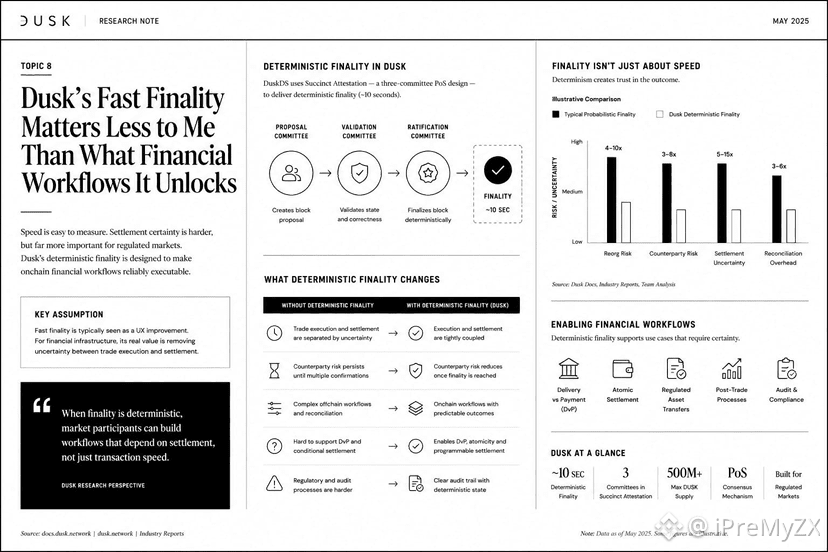
Dusk’s architecture is built around deterministic settlement through DuskDS and its Succinct Attestation consensus mechanism. Once a block is finalized, the network treats that state as final rather than leaving users to think about the usual uncertainty around reorganizations.
So I started asking a different question:
What does deterministic finality actually change for financial workflows?
My assumption was that it would mostly improve the user experience.
But if I’m looking at tokenized assets, the consequences seem more interesting.
A regulated transaction isn't just “send token A from wallet X to wallet Y.” There can be an asset leg, a payment leg, eligibility requirements, transfer restrictions and settlement conditions. Dusk's market-infrastructure design specifically connects deterministic finality with these workflows, including delivery-versus-payment.
That changes how I interpret speed.
The value may not be saving someone a few seconds while transferring an asset.
The value could be reducing the uncertainty between trade execution and actual settlement.
And that matters even more when the asset being transferred represents something like a regulated security, fund or other financial instrument.
I’m still cautious about assuming that better settlement automatically creates adoption. Infrastructure can be technically elegant without becoming commercially important.
But my working assumption has changed:
Dusk’s finality isn't interesting because it is fast. It's interesting if that finality makes financial workflows easier to coordinate onchain.
That is the part I want to watch.
@Dusk_Foundation #dusk $DUSK
I used to assume that when a blockchain talks about fast finality, the main benefit is simple: transactions feel faster.
The more I look at Dusk, the more I think that misses the bigger point.
Dusk’s architecture is built around deterministic settlement through DuskDS and its Succinct Attestation consensus mechanism. Once a block is finalized, the network treats that state as final rather than leaving users to think about the usual uncertainty around reorganizations.
So I started asking a different question:
What does deterministic finality actually change for financial workflows?
My assumption was that it would mostly improve the user experience.
But if I’m looking at tokenized assets, the consequences seem more interesting.
A regulated transaction isn't just “send token A from wallet X to wallet Y.” There can be an asset leg, a payment leg, eligibility requirements, transfer restrictions and settlement conditions. Dusk's market-infrastructure design specifically connects deterministic finality with these workflows, including delivery-versus-payment.
That changes how I interpret speed.
The value may not be saving someone a few seconds while transferring an asset.
The value could be reducing the uncertainty between trade execution and actual settlement.
And that matters even more when the asset being transferred represents something like a regulated security, fund or other financial instrument.
I’m still cautious about assuming that better settlement automatically creates adoption. Infrastructure can be technically elegant without becoming commercially important.
But my working assumption has changed:
Dusk’s finality isn't interesting because it is fast. It's interesting if that finality makes financial workflows easier to coordinate onchain.
That is the part I want to watch.
@Dusk #dusk $DUSK
The more I look at Dusk, the more I think that misses the bigger point.
Dusk’s architecture is built around deterministic settlement through DuskDS and its Succinct Attestation consensus mechanism. Once a block is finalized, the network treats that state as final rather than leaving users to think about the usual uncertainty around reorganizations.
So I started asking a different question:
What does deterministic finality actually change for financial workflows?
My assumption was that it would mostly improve the user experience.
But if I’m looking at tokenized assets, the consequences seem more interesting.
A regulated transaction isn't just “send token A from wallet X to wallet Y.” There can be an asset leg, a payment leg, eligibility requirements, transfer restrictions and settlement conditions. Dusk's market-infrastructure design specifically connects deterministic finality with these workflows, including delivery-versus-payment.
That changes how I interpret speed.
The value may not be saving someone a few seconds while transferring an asset.
The value could be reducing the uncertainty between trade execution and actual settlement.
And that matters even more when the asset being transferred represents something like a regulated security, fund or other financial instrument.
I’m still cautious about assuming that better settlement automatically creates adoption. Infrastructure can be technically elegant without becoming commercially important.
But my working assumption has changed:
Dusk’s finality isn't interesting because it is fast. It's interesting if that finality makes financial workflows easier to coordinate onchain.
That is the part I want to watch.
@Dusk #dusk $DUSK
1
113
·
--
Tərcüməyə bax
At first, this looked like an unnecessary complication to me.
If Dusk already offers an EVM environment with Solidity, familiar wallets and tools like Hardhat and Foundry, why would anyone choose a separate native execution environment?
The answer becomes clearer when you look at what the two paths are actually designed to do.
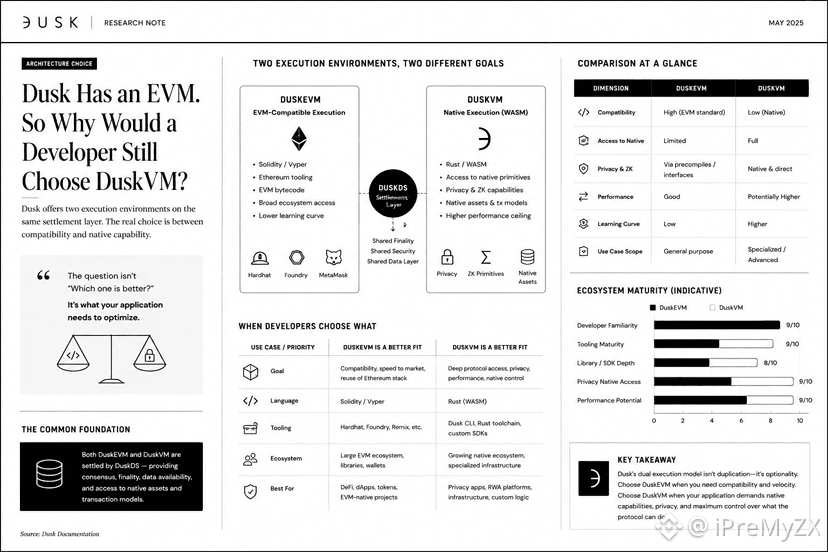
DuskEVM is built for compatibility. It gives developers a familiar Ethereum-style environment while using DuskDS underneath for settlement and data availability. That makes sense for DeFi, tokenized-asset applications and projects that want existing EVM infrastructure.
DuskVM is solving a different problem.
It runs Rust/WASM contracts directly on the Dusk L1 and is intended for applications that need deeper access to native assets, Dusk's transaction models, privacy or zero-knowledge capabilities.
That creates an interesting trade-off.
DuskEVM lowers the barrier to entry.
DuskVM increases access to the underlying protocol.
So I don't think the question is really “Which one is better?”
It's more about what the application is trying to optimize.
If compatibility is the priority, EVM makes obvious sense. But if the application needs functionality that sits close to Dusk's privacy and L1 primitives, adding another abstraction layer may not be desirable.
That is what I find interesting about Dusk's architecture.
It isn't forcing every developer into one execution model. It is separating compatibility from native capability, while keeping both connected to the same settlement foundation.
The real test now is whether developers actually find that choice valuable enough to use.
Because architecture only becomes an advantage when builders can feel the difference.
@Dusk_Foundation #dusk $DUSK
At first, this looked like an unnecessary complication to me.
If Dusk already offers an EVM environment with Solidity, familiar wallets and tools like Hardhat and Foundry, why would anyone choose a separate native execution environment?
The answer becomes clearer when you look at what the two paths are actually designed to do.
DuskEVM is built for compatibility. It gives developers a familiar Ethereum-style environment while using DuskDS underneath for settlement and data availability. That makes sense for DeFi, tokenized-asset applications and projects that want existing EVM infrastructure.
DuskVM is solving a different problem.
It runs Rust/WASM contracts directly on the Dusk L1 and is intended for applications that need deeper access to native assets, Dusk's transaction models, privacy or zero-knowledge capabilities.
That creates an interesting trade-off.
DuskEVM lowers the barrier to entry.
DuskVM increases access to the underlying protocol.
So I don't think the question is really “Which one is better?”
It's more about what the application is trying to optimize.
If compatibility is the priority, EVM makes obvious sense. But if the application needs functionality that sits close to Dusk's privacy and L1 primitives, adding another abstraction layer may not be desirable.
That is what I find interesting about Dusk's architecture.
It isn't forcing every developer into one execution model. It is separating compatibility from native capability, while keeping both connected to the same settlement foundation.
The real test now is whether developers actually find that choice valuable enough to use.
Because architecture only becomes an advantage when builders can feel the difference.
@Dusk #dusk $DUSK
If Dusk already offers an EVM environment with Solidity, familiar wallets and tools like Hardhat and Foundry, why would anyone choose a separate native execution environment?
The answer becomes clearer when you look at what the two paths are actually designed to do.
DuskEVM is built for compatibility. It gives developers a familiar Ethereum-style environment while using DuskDS underneath for settlement and data availability. That makes sense for DeFi, tokenized-asset applications and projects that want existing EVM infrastructure.
DuskVM is solving a different problem.
It runs Rust/WASM contracts directly on the Dusk L1 and is intended for applications that need deeper access to native assets, Dusk's transaction models, privacy or zero-knowledge capabilities.
That creates an interesting trade-off.
DuskEVM lowers the barrier to entry.
DuskVM increases access to the underlying protocol.
So I don't think the question is really “Which one is better?”
It's more about what the application is trying to optimize.
If compatibility is the priority, EVM makes obvious sense. But if the application needs functionality that sits close to Dusk's privacy and L1 primitives, adding another abstraction layer may not be desirable.
That is what I find interesting about Dusk's architecture.
It isn't forcing every developer into one execution model. It is separating compatibility from native capability, while keeping both connected to the same settlement foundation.
The real test now is whether developers actually find that choice valuable enough to use.
Because architecture only becomes an advantage when builders can feel the difference.
@Dusk #dusk $DUSK
1
88
·
--
Tərcüməyə bax
At first, this looked like an unnecessary complication to me.
If Dusk already offers an EVM environment with Solidity, familiar wallets and tools like Hardhat and Foundry, why would anyone choose a separate native execution environment?
The answer becomes clearer when you look at what the two paths are actually designed to do.
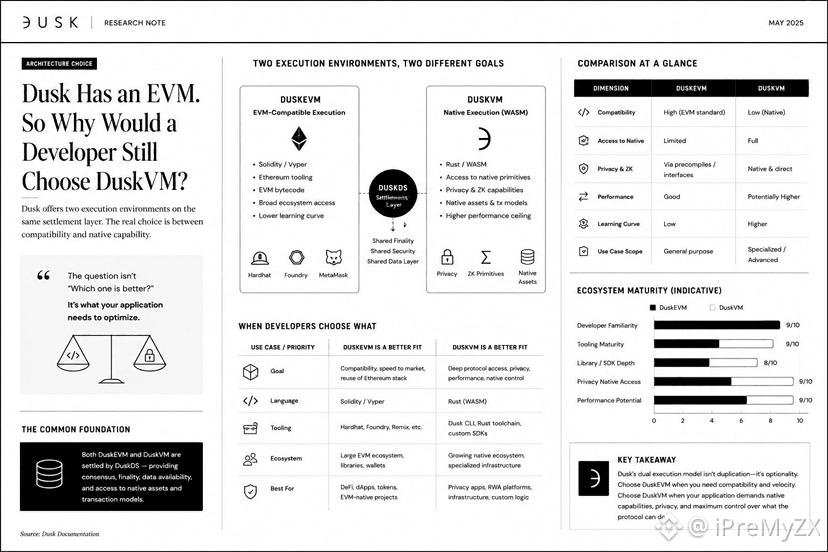
DuskEVM is built for compatibility. It gives developers a familiar Ethereum-style environment while using DuskDS underneath for settlement and data availability. That makes sense for DeFi, tokenized-asset applications and projects that want existing EVM infrastructure.
DuskVM is solving a different problem.
It runs Rust/WASM contracts directly on the Dusk L1 and is intended for applications that need deeper access to native assets, Dusk's transaction models, privacy or zero-knowledge capabilities.
That creates an interesting trade-off.
DuskEVM lowers the barrier to entry.
DuskVM increases access to the underlying protocol.
So I don't think the question is really “Which one is better?”
It's more about what the application is trying to optimize.
If compatibility is the priority, EVM makes obvious sense. But if the application needs functionality that sits close to Dusk's privacy and L1 primitives, adding another abstraction layer may not be desirable.
That is what I find interesting about Dusk's architecture.
It isn't forcing every developer into one execution model. It is separating compatibility from native capability, while keeping both connected to the same settlement foundation.
The real test now is whether developers actually find that choice valuable enough to use.
Because architecture only becomes an advantage when builders can feel the difference.
@Dusk_Foundation #dusk $DUSK
At first, this looked like an unnecessary complication to me.
If Dusk already offers an EVM environment with Solidity, familiar wallets and tools like Hardhat and Foundry, why would anyone choose a separate native execution environment?
The answer becomes clearer when you look at what the two paths are actually designed to do.
DuskEVM is built for compatibility. It gives developers a familiar Ethereum-style environment while using DuskDS underneath for settlement and data availability. That makes sense for DeFi, tokenized-asset applications and projects that want existing EVM infrastructure.
DuskVM is solving a different problem.
It runs Rust/WASM contracts directly on the Dusk L1 and is intended for applications that need deeper access to native assets, Dusk's transaction models, privacy or zero-knowledge capabilities.
That creates an interesting trade-off.
DuskEVM lowers the barrier to entry.
DuskVM increases access to the underlying protocol.
So I don't think the question is really “Which one is better?”
It's more about what the application is trying to optimize.
If compatibility is the priority, EVM makes obvious sense. But if the application needs functionality that sits close to Dusk's privacy and L1 primitives, adding another abstraction layer may not be desirable.
That is what I find interesting about Dusk's architecture.
It isn't forcing every developer into one execution model. It is separating compatibility from native capability, while keeping both connected to the same settlement foundation.
The real test now is whether developers actually find that choice valuable enough to use.
Because architecture only becomes an advantage when builders can feel the difference.
@Dusk #dusk $DUSK
If Dusk already offers an EVM environment with Solidity, familiar wallets and tools like Hardhat and Foundry, why would anyone choose a separate native execution environment?
The answer becomes clearer when you look at what the two paths are actually designed to do.
DuskEVM is built for compatibility. It gives developers a familiar Ethereum-style environment while using DuskDS underneath for settlement and data availability. That makes sense for DeFi, tokenized-asset applications and projects that want existing EVM infrastructure.
DuskVM is solving a different problem.
It runs Rust/WASM contracts directly on the Dusk L1 and is intended for applications that need deeper access to native assets, Dusk's transaction models, privacy or zero-knowledge capabilities.
That creates an interesting trade-off.
DuskEVM lowers the barrier to entry.
DuskVM increases access to the underlying protocol.
So I don't think the question is really “Which one is better?”
It's more about what the application is trying to optimize.
If compatibility is the priority, EVM makes obvious sense. But if the application needs functionality that sits close to Dusk's privacy and L1 primitives, adding another abstraction layer may not be desirable.
That is what I find interesting about Dusk's architecture.
It isn't forcing every developer into one execution model. It is separating compatibility from native capability, while keeping both connected to the same settlement foundation.
The real test now is whether developers actually find that choice valuable enough to use.
Because architecture only becomes an advantage when builders can feel the difference.
@Dusk #dusk $DUSK
91
·
--
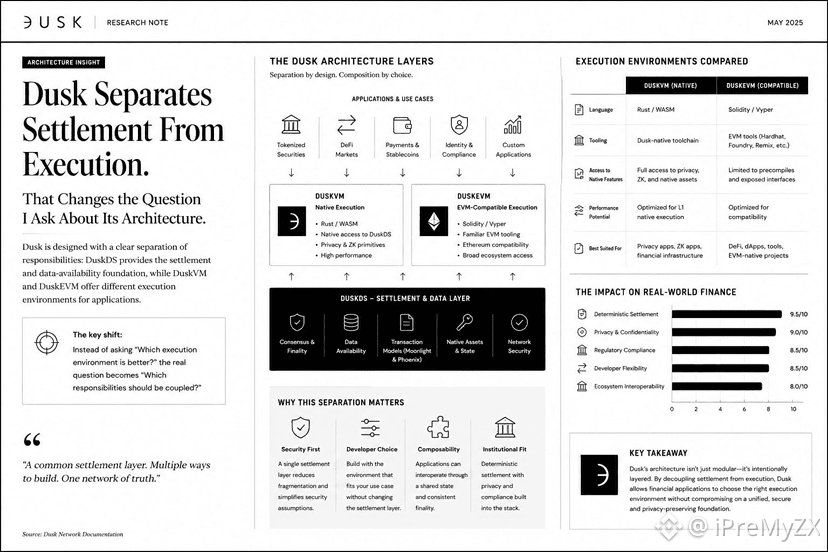
Əvvəlcə Dusk-un arxitekturasına icra tərəfdən baxdım.
Bu mənə təbii gəldi. Smart kontraktlar tətbiqlərin “yaşadığı” yerdir, ona görə də bunun əsas hekayə olduğunu düşündüm.
Sonra DuskDS-ə daha yaxından baxdım.
Dusk, öz settlement (məskunlaşma) və data-availability (məlumat mövcudluğu) təməllərini icra mühitlərindən ayırır. DuskDS konsensusu, finality-ni, data availability-ni və şəbəkənin transaksiyalar modellərini idarə edir, DuskVM və DuskEVM isə tətbiqlərin məntiqi icra etməsi üçün fərqli yollar təqdim edir.
Bu ayrım dizayn haqqında düşüncə tərzimə təsir edir.
“Hans hansı icra mühiti daha yaxşıdır?” sualını vermək əvəzinə, mən daha faydalı sualın belə olduğunu düşünürəm: hansı məsuliyyətlər həqiqətən bir-biri ilə bağlı (coupled) olmalıdır?
DuskEVM tərtibatçılara Solidity verir, tanış EVM alətlərinin ekosistemini və Ethereum-uyğun infrastruktur təklif edir. DuskVM isə fərqli bir yol tutur: Rust/WASM kontraktlarına Dusk L1 üzərində birbaşa icra etməyə imkan verir—tətbiqlərə yerli aktivlərə daha dərin giriş, pryvaci (məxfilik) və ya sıfır-bilik (zero-knowledge) imkanları lazım olduqda.
Bu arada, DuskDS onların altında yenə də settlement qat kimi qalır.
Tənzimlənən maliyyə tətbiqləri üçün bu fərq, ilkin göründüyündən daha çox önəm daşıya bilər.
Tokenləşdirilmiş aktivə tətbiq məntiqi üçün bir mühit, məxfilik üçün başqa bir sıra primitivlər və hər şeyin altında deterministik settlement lazım ola bilər. Dusk mahiyyətcə hər bir tətbiqi tək icra modelinə məcbur etməkdənsə, bu işləri bir-birindən ayırmağa çalışır.
Maraqlı olan sadəcə Dusk-un modul olması deyil.
Bu modulluğun maliyyə tətbiqlərinə ümumi settlement təməlinə zərər vermədən, həqiqətən ehtiyac duyduqları icra mühitini seçməyə imkan verib-verməməsidir.
Bu, indi daha yaxından izlədiyim memarlıq (architectural) kompromisidir.
@Dusk_Foundation #dusk $DUSK
Əvvəlcə Dusk-un arxitekturasına icra tərəfdən baxdım.
Bu mənə təbii gəldi. Smart kontraktlar tətbiqlərin “yaşadığı” yerdir, ona görə də bunun əsas hekayə olduğunu düşündüm.
Sonra DuskDS-ə daha yaxından baxdım.
Dusk, öz settlement (məskunlaşma) və data-availability (məlumat mövcudluğu) təməllərini icra mühitlərindən ayırır. DuskDS konsensusu, finality-ni, data availability-ni və şəbəkənin transaksiyalar modellərini idarə edir, DuskVM və DuskEVM isə tətbiqlərin məntiqi icra etməsi üçün fərqli yollar təqdim edir.
Bu ayrım dizayn haqqında düşüncə tərzimə təsir edir.
“Hans hansı icra mühiti daha yaxşıdır?” sualını vermək əvəzinə, mən daha faydalı sualın belə olduğunu düşünürəm: hansı məsuliyyətlər həqiqətən bir-biri ilə bağlı (coupled) olmalıdır?
DuskEVM tərtibatçılara Solidity verir, tanış EVM alətlərinin ekosistemini və Ethereum-uyğun infrastruktur təklif edir. DuskVM isə fərqli bir yol tutur: Rust/WASM kontraktlarına Dusk L1 üzərində birbaşa icra etməyə imkan verir—tətbiqlərə yerli aktivlərə daha dərin giriş, pryvaci (məxfilik) və ya sıfır-bilik (zero-knowledge) imkanları lazım olduqda.
Bu arada, DuskDS onların altında yenə də settlement qat kimi qalır.
Tənzimlənən maliyyə tətbiqləri üçün bu fərq, ilkin göründüyündən daha çox önəm daşıya bilər.
Tokenləşdirilmiş aktivə tətbiq məntiqi üçün bir mühit, məxfilik üçün başqa bir sıra primitivlər və hər şeyin altında deterministik settlement lazım ola bilər. Dusk mahiyyətcə hər bir tətbiqi tək icra modelinə məcbur etməkdənsə, bu işləri bir-birindən ayırmağa çalışır.
Maraqlı olan sadəcə Dusk-un modul olması deyil.
Bu modulluğun maliyyə tətbiqlərinə ümumi settlement təməlinə zərər vermədən, həqiqətən ehtiyac duyduqları icra mühitini seçməyə imkan verib-verməməsidir.
Bu, indi daha yaxından izlədiyim memarlıq (architectural) kompromisidir.
@Dusk #dusk $DUSK
Bu mənə təbii gəldi. Smart kontraktlar tətbiqlərin “yaşadığı” yerdir, ona görə də bunun əsas hekayə olduğunu düşündüm.
Sonra DuskDS-ə daha yaxından baxdım.
Dusk, öz settlement (məskunlaşma) və data-availability (məlumat mövcudluğu) təməllərini icra mühitlərindən ayırır. DuskDS konsensusu, finality-ni, data availability-ni və şəbəkənin transaksiyalar modellərini idarə edir, DuskVM və DuskEVM isə tətbiqlərin məntiqi icra etməsi üçün fərqli yollar təqdim edir.
Bu ayrım dizayn haqqında düşüncə tərzimə təsir edir.
“Hans hansı icra mühiti daha yaxşıdır?” sualını vermək əvəzinə, mən daha faydalı sualın belə olduğunu düşünürəm: hansı məsuliyyətlər həqiqətən bir-biri ilə bağlı (coupled) olmalıdır?
DuskEVM tərtibatçılara Solidity verir, tanış EVM alətlərinin ekosistemini və Ethereum-uyğun infrastruktur təklif edir. DuskVM isə fərqli bir yol tutur: Rust/WASM kontraktlarına Dusk L1 üzərində birbaşa icra etməyə imkan verir—tətbiqlərə yerli aktivlərə daha dərin giriş, pryvaci (məxfilik) və ya sıfır-bilik (zero-knowledge) imkanları lazım olduqda.
Bu arada, DuskDS onların altında yenə də settlement qat kimi qalır.
Tənzimlənən maliyyə tətbiqləri üçün bu fərq, ilkin göründüyündən daha çox önəm daşıya bilər.
Tokenləşdirilmiş aktivə tətbiq məntiqi üçün bir mühit, məxfilik üçün başqa bir sıra primitivlər və hər şeyin altında deterministik settlement lazım ola bilər. Dusk mahiyyətcə hər bir tətbiqi tək icra modelinə məcbur etməkdənsə, bu işləri bir-birindən ayırmağa çalışır.
Maraqlı olan sadəcə Dusk-un modul olması deyil.
Bu modulluğun maliyyə tətbiqlərinə ümumi settlement təməlinə zərər vermədən, həqiqətən ehtiyac duyduqları icra mühitini seçməyə imkan verib-verməməsidir.
Bu, indi daha yaxından izlədiyim memarlıq (architectural) kompromisidir.
@Dusk #dusk $DUSK
3
2
150
·
--
Tərcüməyə bax
I used to think tokenization was mostly about taking an existing financial asset and putting a token around it.
The more I looked at Dusk Trade, the less complete that definition felt.
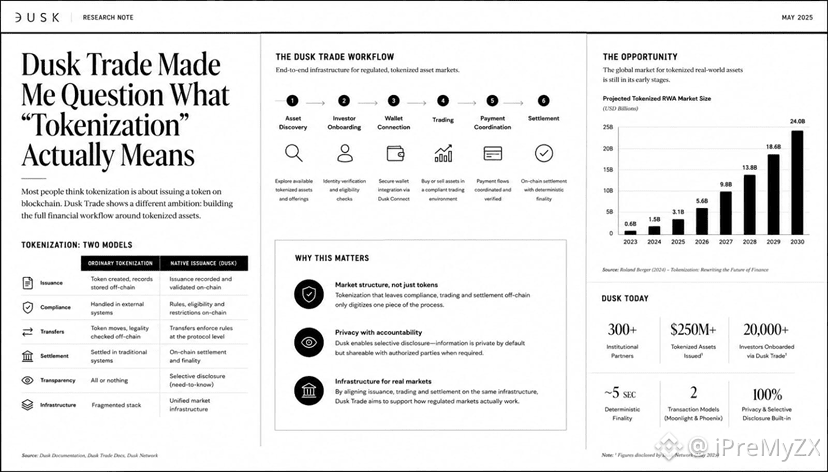
Dusk Trade is positioned as the application layer for tokenized financial assets, but the workflow goes far beyond creating and transferring a token. It includes asset discovery, investor onboarding, wallet connection, eligibility, trading, payment coordination and settlement.
That distinction matters.
A token can exist onchain while the important parts of the financial process remain somewhere else. Dusk's own documentation separates ordinary tokenization from native issuance, where issuance, transfers, servicing and settlement can be designed around the ledger itself.
That's the part I find more interesting.
If an investor still has to move between separate systems for identity, eligibility, custody, trading and settlement, then putting the asset onchain hasn't necessarily changed the market structure. It may have only digitized one component.
Dusk is trying to approach the problem differently: connect those pieces around the same infrastructure, while keeping sensitive information private and allowing specific information to be disclosed when required.
So my question isn't simply whether Dusk can tokenize securities.
It's whether a blockchain can actually absorb enough of the surrounding financial workflow to make tokenization meaningfully different from the systems it is supposed to improve.
That feels like the harder test.
And probably the more important one.
@Dusk_Foundation #dusk $DUSK
I used to think tokenization was mostly about taking an existing financial asset and putting a token around it.
The more I looked at Dusk Trade, the less complete that definition felt.
Dusk Trade is positioned as the application layer for tokenized financial assets, but the workflow goes far beyond creating and transferring a token. It includes asset discovery, investor onboarding, wallet connection, eligibility, trading, payment coordination and settlement.
That distinction matters.
A token can exist onchain while the important parts of the financial process remain somewhere else. Dusk's own documentation separates ordinary tokenization from native issuance, where issuance, transfers, servicing and settlement can be designed around the ledger itself.
That's the part I find more interesting.
If an investor still has to move between separate systems for identity, eligibility, custody, trading and settlement, then putting the asset onchain hasn't necessarily changed the market structure. It may have only digitized one component.
Dusk is trying to approach the problem differently: connect those pieces around the same infrastructure, while keeping sensitive information private and allowing specific information to be disclosed when required.
So my question isn't simply whether Dusk can tokenize securities.
It's whether a blockchain can actually absorb enough of the surrounding financial workflow to make tokenization meaningfully different from the systems it is supposed to improve.
That feels like the harder test.
And probably the more important one.
@Dusk #dusk $DUSK
The more I looked at Dusk Trade, the less complete that definition felt.
Dusk Trade is positioned as the application layer for tokenized financial assets, but the workflow goes far beyond creating and transferring a token. It includes asset discovery, investor onboarding, wallet connection, eligibility, trading, payment coordination and settlement.
That distinction matters.
A token can exist onchain while the important parts of the financial process remain somewhere else. Dusk's own documentation separates ordinary tokenization from native issuance, where issuance, transfers, servicing and settlement can be designed around the ledger itself.
That's the part I find more interesting.
If an investor still has to move between separate systems for identity, eligibility, custody, trading and settlement, then putting the asset onchain hasn't necessarily changed the market structure. It may have only digitized one component.
Dusk is trying to approach the problem differently: connect those pieces around the same infrastructure, while keeping sensitive information private and allowing specific information to be disclosed when required.
So my question isn't simply whether Dusk can tokenize securities.
It's whether a blockchain can actually absorb enough of the surrounding financial workflow to make tokenization meaningfully different from the systems it is supposed to improve.
That feels like the harder test.
And probably the more important one.
@Dusk #dusk $DUSK
1
88
·
--
Tərcüməyə bax
👀 I went a little deeper into Zedger today, and I think I was looking at the wrong thing at first.
My first thought was basically: okay, @Dusk_Foundation is putting regulated securities onchain. Got it.
But Zedger gets more interesting when you look beyond the token itself.
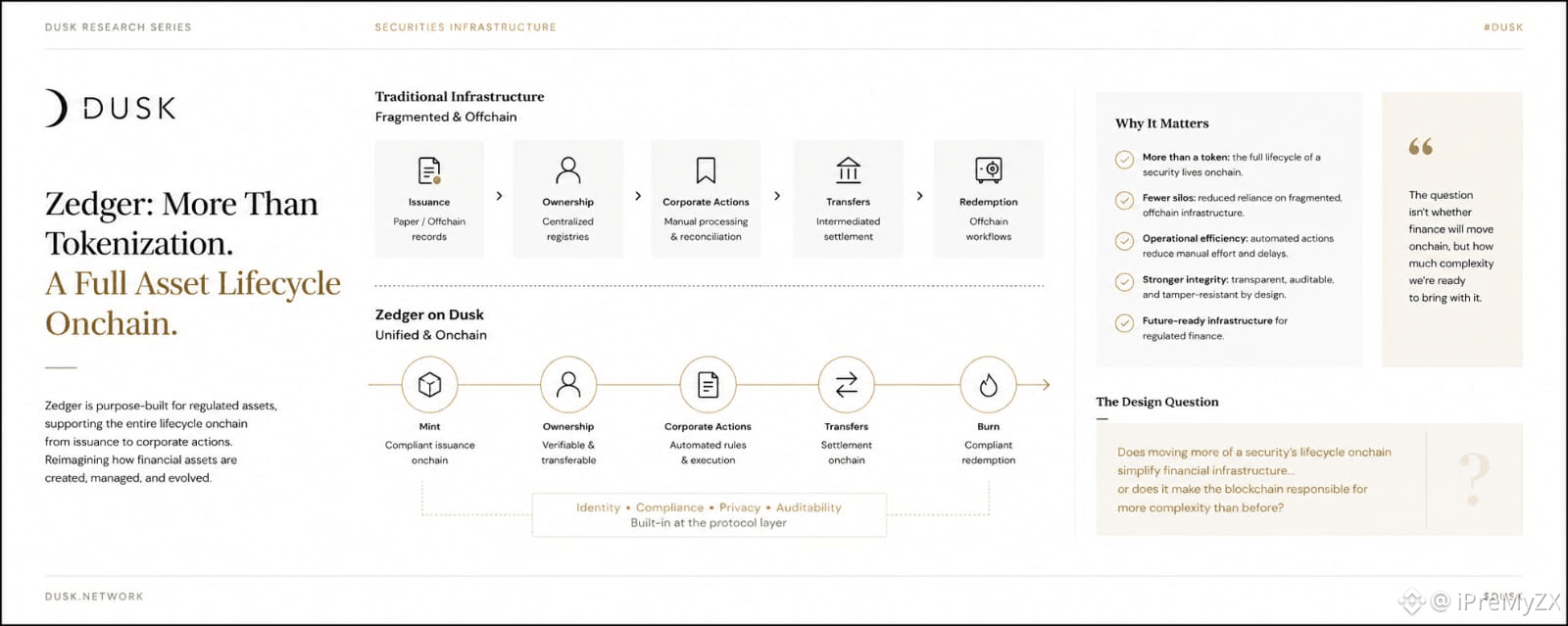
It’s built around regulated assets and supports things like minting, burning and corporate actions. In other words, the chain isn't necessarily just acting like a digital receipt for an asset that lives somewhere else.
More of the actual lifecycle can be handled as part of the infrastructure.
And that changes the way I think about tokenized securities.
A security isn't just a balance sitting in a wallet. Ownership can change. Rules can apply. Corporate events can happen. The asset can be created, modified, redeemed or removed.
If some of those processes can happen directly within the infrastructure, there's potentially less separation between “the asset” and “the system managing the asset.”
That's the part I find genuinely interesting about Zedger.
But there's also a catch.
The more financial logic you bring onchain, the more real-world complexity the protocol has to deal with correctly.
You aren't just moving tokens anymore. You're trying to represent legal and financial rules in a system that has to behave predictably.
So I'm left with a question rather than a conclusion:
Does putting more of a security's lifecycle onchain actually make financial infrastructure simpler… or are we just moving more of the complexity onto the blockchain?
That's the part of Zedger I'm still thinking about.
#dusk $DUSK
👀 I went a little deeper into Zedger today, and I think I was looking at the wrong thing at first.
My first thought was basically: okay, @Dusk is putting regulated securities onchain. Got it.
But Zedger gets more interesting when you look beyond the token itself.
It’s built around regulated assets and supports things like minting, burning and corporate actions. In other words, the chain isn't necessarily just acting like a digital receipt for an asset that lives somewhere else.
More of the actual lifecycle can be handled as part of the infrastructure.
And that changes the way I think about tokenized securities.
A security isn't just a balance sitting in a wallet. Ownership can change. Rules can apply. Corporate events can happen. The asset can be created, modified, redeemed or removed.
If some of those processes can happen directly within the infrastructure, there's potentially less separation between “the asset” and “the system managing the asset.”
That's the part I find genuinely interesting about Zedger.
But there's also a catch.
The more financial logic you bring onchain, the more real-world complexity the protocol has to deal with correctly.
You aren't just moving tokens anymore. You're trying to represent legal and financial rules in a system that has to behave predictably.
So I'm left with a question rather than a conclusion:
Does putting more of a security's lifecycle onchain actually make financial infrastructure simpler… or are we just moving more of the complexity onto the blockchain?
That's the part of Zedger I'm still thinking about.
#dusk $DUSK
My first thought was basically: okay, @Dusk is putting regulated securities onchain. Got it.
But Zedger gets more interesting when you look beyond the token itself.
It’s built around regulated assets and supports things like minting, burning and corporate actions. In other words, the chain isn't necessarily just acting like a digital receipt for an asset that lives somewhere else.
More of the actual lifecycle can be handled as part of the infrastructure.
And that changes the way I think about tokenized securities.
A security isn't just a balance sitting in a wallet. Ownership can change. Rules can apply. Corporate events can happen. The asset can be created, modified, redeemed or removed.
If some of those processes can happen directly within the infrastructure, there's potentially less separation between “the asset” and “the system managing the asset.”
That's the part I find genuinely interesting about Zedger.
But there's also a catch.
The more financial logic you bring onchain, the more real-world complexity the protocol has to deal with correctly.
You aren't just moving tokens anymore. You're trying to represent legal and financial rules in a system that has to behave predictably.
So I'm left with a question rather than a conclusion:
Does putting more of a security's lifecycle onchain actually make financial infrastructure simpler… or are we just moving more of the complexity onto the blockchain?
That's the part of Zedger I'm still thinking about.
#dusk $DUSK
2
1
3
83
·
--
Mən Dusk-un sıfır-bilik (zero-knowledge) texnologiyasına məxfilik tərəfdən baxmağa başladım.
Bu, başlamaq üçün ən aşkar yer idi.
Əgər bir blokçeyn hər hansısa bir şeyi əsas məlumatların hamısını üzə çıxarmadan yoxlaya bilirsə, ZK-nı əməliyyatları və balansları məxfi saxlamaq üçün bir yol kimi düşünmək təbiidir.
Amma Dusk-a daha çox baxdıqca, uyğunluq (compliance) tərəfi daha da maraqlı oldu.
Məsələn, tənzimlənən bir aktiv haqqında düşünün.
Bir investor onu almağa uyğun olduğunu sübut etməli ola bilər. Bir əməliyyat müəyyən qaydalara əməl etməlidir. Bir təşkilat isə doğru şərtlərin yerinə yetirildiyini nümayiş etdirməli ola bilər.
Amma bunların heç də hamısı o demək deyil ki, hamı investorun tam kimliyini, maliyyə vəziyyətini və ya əməliyyat tarixçəsini görməlidir.
Məhz bu fərq Dusk-un yanaşmasını diqqətimə çatdırdı.
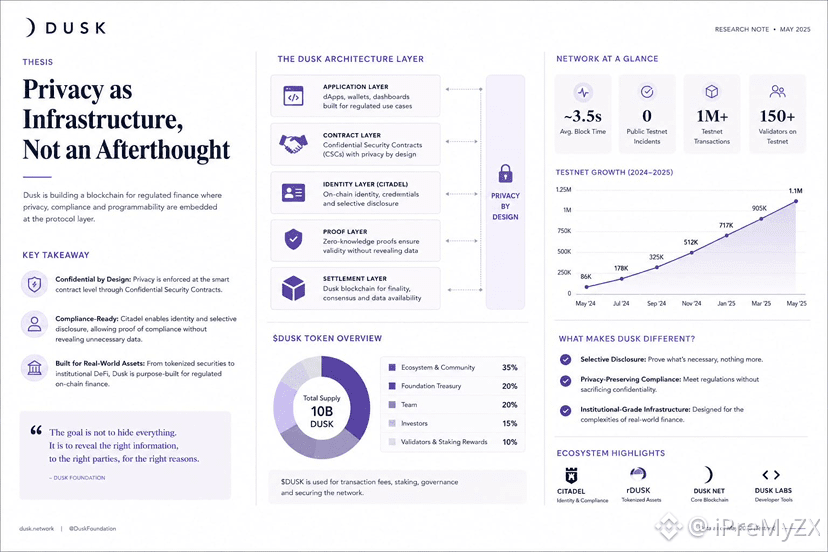
Citadel şəxsiyyət infrastrukturunu təmin edir, Dusk isə sıfır-bilik və seçmə açıqlama (selective-disclosure) mexanizmlərindən istifadə edir.
Maraqlı ehtimal sadəcə məlumatı gizlətmək deyil.
Bu, həmin faktın arxasında olan hər şeyi ifşa etmədən konkret bir həqiqəti sübut etməkdir.
Kimsənin tam maliyyə profilini açıqlamaq məcbur deyil ki, onun uyğun olduğunu sübut edəsən.
Sadəcə tələb olunan şərtə uyğun gəldiyini təsdiqləmək üçün etibarlı bir yol lazımdır.
Bu, Dusk-da ZK haqqında düşüncəmizi dəyişir.
Bəlkə də onun ən vacib rolu blokçeyn əməliyyatlarını məxfi etmək deyil.
Bəlkə də bu, uyğunluğun özünü daha seçmə etməsidir.
@Dusk_Foundation üçün əsas sual budur: bu model həqiqətən nə qədər irəli gedə bilər.
Məzmun və həssas məlumatlar qorunarkən, tənzimləyici tələblər blokçeynin kriptoqrafik şəkildə yoxladığı şeylərə çevrilə bilər?
Bu alınsa, məxfilik və uyğunluq bir-birinə qarşı tələblər kimi görünməyi dayandırır.
Onlar eyni infrastrukturun iki hissəsi kimi görünməyə başlayır.
$DUSK #dusk
Mən Dusk-un sıfır-bilik (zero-knowledge) texnologiyasına məxfilik tərəfdən baxmağa başladım.
Bu, başlamaq üçün ən aşkar yer idi.
Əgər bir blokçeyn hər hansısa bir şeyi əsas məlumatların hamısını üzə çıxarmadan yoxlaya bilirsə, ZK-nı əməliyyatları və balansları məxfi saxlamaq üçün bir yol kimi düşünmək təbiidir.
Amma Dusk-a daha çox baxdıqca, uyğunluq (compliance) tərəfi daha da maraqlı oldu.
Məsələn, tənzimlənən bir aktiv haqqında düşünün.
Bir investor onu almağa uyğun olduğunu sübut etməli ola bilər. Bir əməliyyat müəyyən qaydalara əməl etməlidir. Bir təşkilat isə doğru şərtlərin yerinə yetirildiyini nümayiş etdirməli ola bilər.
Amma bunların heç də hamısı o demək deyil ki, hamı investorun tam kimliyini, maliyyə vəziyyətini və ya əməliyyat tarixçəsini görməlidir.
Məhz bu fərq Dusk-un yanaşmasını diqqətimə çatdırdı.
Citadel şəxsiyyət infrastrukturunu təmin edir, Dusk isə sıfır-bilik və seçmə açıqlama (selective-disclosure) mexanizmlərindən istifadə edir.
Maraqlı ehtimal sadəcə məlumatı gizlətmək deyil.
Bu, həmin faktın arxasında olan hər şeyi ifşa etmədən konkret bir həqiqəti sübut etməkdir.
Kimsənin tam maliyyə profilini açıqlamaq məcbur deyil ki, onun uyğun olduğunu sübut edəsən.
Sadəcə tələb olunan şərtə uyğun gəldiyini təsdiqləmək üçün etibarlı bir yol lazımdır.
Bu, Dusk-da ZK haqqında düşüncəmizi dəyişir.
Bəlkə də onun ən vacib rolu blokçeyn əməliyyatlarını məxfi etmək deyil.
Bəlkə də bu, uyğunluğun özünü daha seçmə etməsidir.
@Dusk üçün əsas sual budur: bu model həqiqətən nə qədər irəli gedə bilər.
Məzmun və həssas məlumatlar qorunarkən, tənzimləyici tələblər blokçeynin kriptoqrafik şəkildə yoxladığı şeylərə çevrilə bilər?
Bu alınsa, məxfilik və uyğunluq bir-birinə qarşı tələblər kimi görünməyi dayandırır.
Onlar eyni infrastrukturun iki hissəsi kimi görünməyə başlayır.
$DUSK #dusk
Bu, başlamaq üçün ən aşkar yer idi.
Əgər bir blokçeyn hər hansısa bir şeyi əsas məlumatların hamısını üzə çıxarmadan yoxlaya bilirsə, ZK-nı əməliyyatları və balansları məxfi saxlamaq üçün bir yol kimi düşünmək təbiidir.
Amma Dusk-a daha çox baxdıqca, uyğunluq (compliance) tərəfi daha da maraqlı oldu.
Məsələn, tənzimlənən bir aktiv haqqında düşünün.
Bir investor onu almağa uyğun olduğunu sübut etməli ola bilər. Bir əməliyyat müəyyən qaydalara əməl etməlidir. Bir təşkilat isə doğru şərtlərin yerinə yetirildiyini nümayiş etdirməli ola bilər.
Amma bunların heç də hamısı o demək deyil ki, hamı investorun tam kimliyini, maliyyə vəziyyətini və ya əməliyyat tarixçəsini görməlidir.
Məhz bu fərq Dusk-un yanaşmasını diqqətimə çatdırdı.
Citadel şəxsiyyət infrastrukturunu təmin edir, Dusk isə sıfır-bilik və seçmə açıqlama (selective-disclosure) mexanizmlərindən istifadə edir.
Maraqlı ehtimal sadəcə məlumatı gizlətmək deyil.
Bu, həmin faktın arxasında olan hər şeyi ifşa etmədən konkret bir həqiqəti sübut etməkdir.
Kimsənin tam maliyyə profilini açıqlamaq məcbur deyil ki, onun uyğun olduğunu sübut edəsən.
Sadəcə tələb olunan şərtə uyğun gəldiyini təsdiqləmək üçün etibarlı bir yol lazımdır.
Bu, Dusk-da ZK haqqında düşüncəmizi dəyişir.
Bəlkə də onun ən vacib rolu blokçeyn əməliyyatlarını məxfi etmək deyil.
Bəlkə də bu, uyğunluğun özünü daha seçmə etməsidir.
@Dusk üçün əsas sual budur: bu model həqiqətən nə qədər irəli gedə bilər.
Məzmun və həssas məlumatlar qorunarkən, tənzimləyici tələblər blokçeynin kriptoqrafik şəkildə yoxladığı şeylərə çevrilə bilər?
Bu alınsa, məxfilik və uyğunluq bir-birinə qarşı tələblər kimi görünməyi dayandırır.
Onlar eyni infrastrukturun iki hissəsi kimi görünməyə başlayır.
$DUSK #dusk
1
99
·
--
Tərcüməyə bax
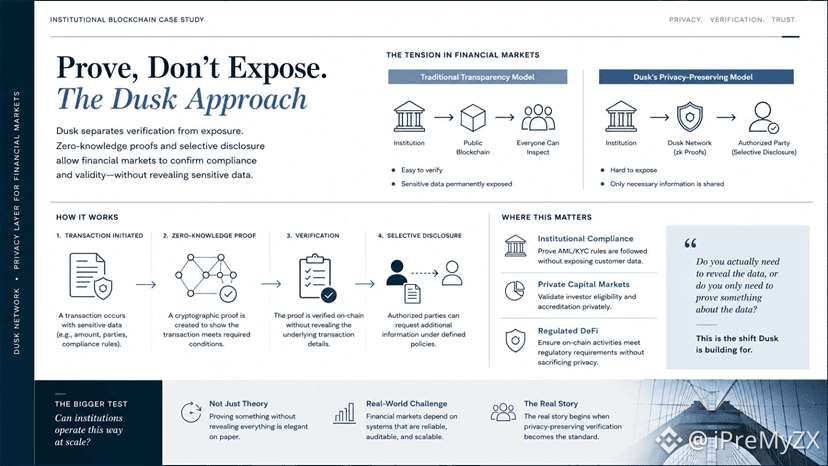
The more I study Dusk, the less convincing the usual “private blockchain” description becomes.
A truly interesting privacy system can't simply make information disappear. Financial markets still need verification. Someone has to establish that a transaction is valid, an investor is eligible, or a financial rule has been followed.
That creates a tension I find much more interesting than privacy alone.
Dusk approaches it through a combination of shielded transactions, zero-knowledge proofs and selective disclosure.
The idea isn't necessarily to expose the underlying information. Instead, cryptographic proofs can demonstrate that certain conditions are satisfied without revealing everything behind the transaction.
That distinction matters.
Imagine an institution needs to prove that a transaction followed the required rules. On a completely transparent blockchain, the easiest solution is often to publish the underlying activity and let everyone inspect it.
But that creates another problem: sensitive financial information becomes permanently visible.
Dusk's approach asks a different question:
Do you actually need to reveal the data, or do you only need to prove something about the data?
That's where zero-knowledge technology becomes particularly interesting to me.
The objective isn't “hide everything.”
It's closer to prove what needs to be proven while keeping unnecessary information private.
Selective disclosure adds another layer. When an authorized party genuinely needs additional information, privacy doesn't necessarily mean refusing access. It can mean controlling who receives it and under what circumstances.
So I'm starting to see Dusk's privacy architecture less as an attempt to escape verification and more as an attempt to separate verification from exposure.
The bigger test, though, is practical.
Can institutions actually operate this way at scale?
Because proving something without revealing everything sounds elegant on paper. The real story begins when financial markets depend on it.
@Dusk_Foundation #dusk $DUSK
The more I study Dusk, the less convincing the usual “private blockchain” description becomes.
A truly interesting privacy system can't simply make information disappear. Financial markets still need verification. Someone has to establish that a transaction is valid, an investor is eligible, or a financial rule has been followed.
That creates a tension I find much more interesting than privacy alone.
Dusk approaches it through a combination of shielded transactions, zero-knowledge proofs and selective disclosure.
The idea isn't necessarily to expose the underlying information. Instead, cryptographic proofs can demonstrate that certain conditions are satisfied without revealing everything behind the transaction.
That distinction matters.
Imagine an institution needs to prove that a transaction followed the required rules. On a completely transparent blockchain, the easiest solution is often to publish the underlying activity and let everyone inspect it.
But that creates another problem: sensitive financial information becomes permanently visible.
Dusk's approach asks a different question:
Do you actually need to reveal the data, or do you only need to prove something about the data?
That's where zero-knowledge technology becomes particularly interesting to me.
The objective isn't “hide everything.”
It's closer to prove what needs to be proven while keeping unnecessary information private.
Selective disclosure adds another layer. When an authorized party genuinely needs additional information, privacy doesn't necessarily mean refusing access. It can mean controlling who receives it and under what circumstances.
So I'm starting to see Dusk's privacy architecture less as an attempt to escape verification and more as an attempt to separate verification from exposure.
The bigger test, though, is practical.
Can institutions actually operate this way at scale?
Because proving something without revealing everything sounds elegant on paper. The real story begins when financial markets depend on it.
@Dusk #dusk $DUSK
A truly interesting privacy system can't simply make information disappear. Financial markets still need verification. Someone has to establish that a transaction is valid, an investor is eligible, or a financial rule has been followed.
That creates a tension I find much more interesting than privacy alone.
Dusk approaches it through a combination of shielded transactions, zero-knowledge proofs and selective disclosure.
The idea isn't necessarily to expose the underlying information. Instead, cryptographic proofs can demonstrate that certain conditions are satisfied without revealing everything behind the transaction.
That distinction matters.
Imagine an institution needs to prove that a transaction followed the required rules. On a completely transparent blockchain, the easiest solution is often to publish the underlying activity and let everyone inspect it.
But that creates another problem: sensitive financial information becomes permanently visible.
Dusk's approach asks a different question:
Do you actually need to reveal the data, or do you only need to prove something about the data?
That's where zero-knowledge technology becomes particularly interesting to me.
The objective isn't “hide everything.”
It's closer to prove what needs to be proven while keeping unnecessary information private.
Selective disclosure adds another layer. When an authorized party genuinely needs additional information, privacy doesn't necessarily mean refusing access. It can mean controlling who receives it and under what circumstances.
So I'm starting to see Dusk's privacy architecture less as an attempt to escape verification and more as an attempt to separate verification from exposure.
The bigger test, though, is practical.
Can institutions actually operate this way at scale?
Because proving something without revealing everything sounds elegant on paper. The real story begins when financial markets depend on it.
@Dusk #dusk $DUSK
3
102
·
--
Tərcüməyə bax
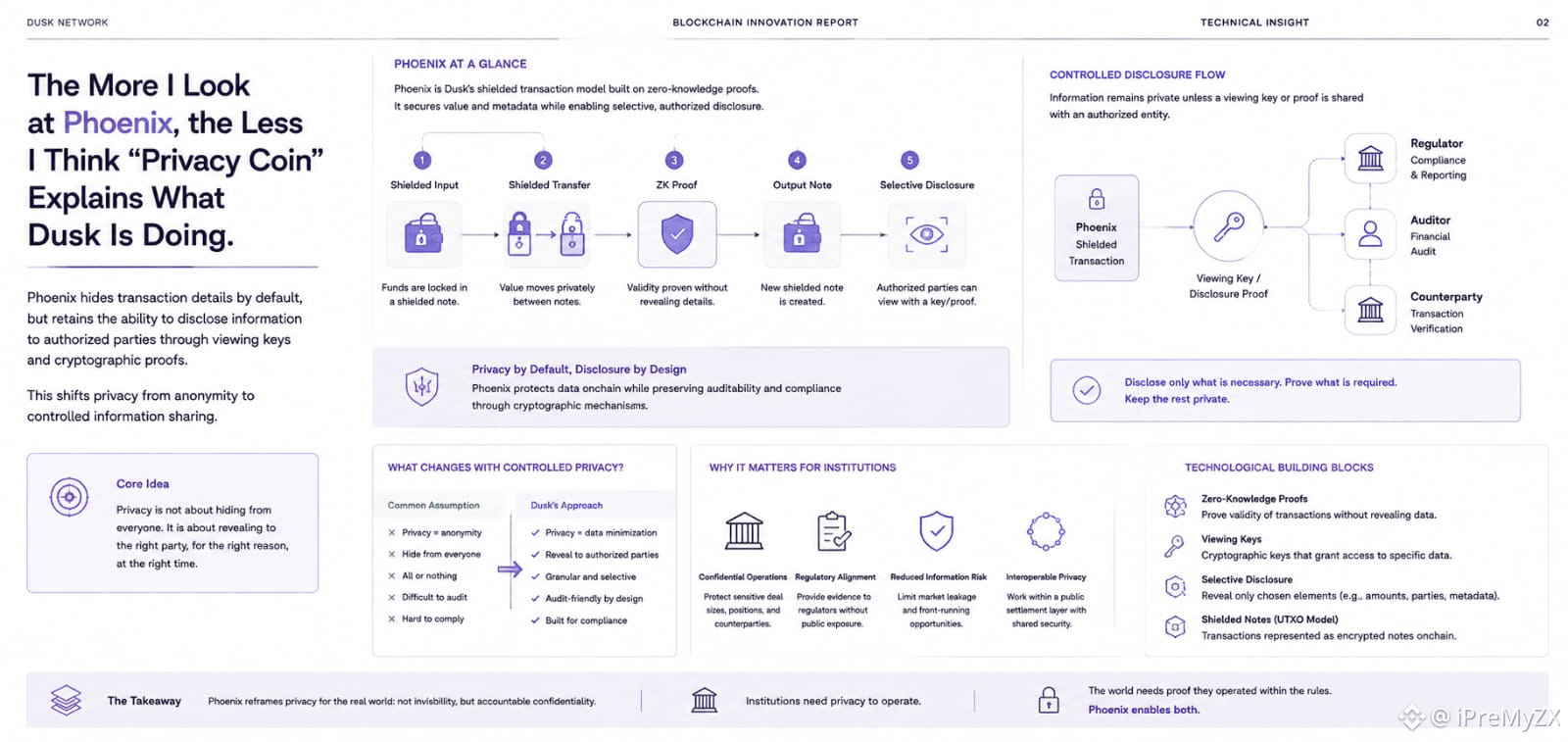
I initially looked at Phoenix through the usual lens: private transactions, hidden amounts, and less information exposed onchain.
That description is technically useful, but I think it misses the more interesting part of Dusk.
Phoenix isn't simply about making financial activity disappear. The architecture is built around shielded transactions while still allowing authorized access to relevant information through viewing mechanisms.
That changes the question.
Instead of asking, “How anonymous is this blockchain?” I think the better question is:
Who should be able to see what, and under which conditions?
That's a very different way to think about privacy.
For an ordinary user, privacy might mean keeping balances and transaction history away from public observers. But financial institutions have a more complicated requirement. They may need confidentiality from the wider market while still being able to demonstrate information to an auditor, regulator, counterparty, or other authorized party.
This is where Phoenix becomes more interesting to me.
Zero-knowledge proofs can establish that a transaction follows the required rules without exposing every underlying detail. Selective disclosure can then create a controlled path for revealing information when there is a legitimate reason to do so.
So Dusk isn't necessarily choosing between privacy and compliance.
It's exploring whether they can coexist through controlled visibility.
And that may be a much more relevant model for regulated financial markets than simply making everything public or everything private.
The part I'm watching now is whether this architecture actually changes how institutions behave.
Because building selective privacy is one challenge.
Getting real financial activity to depend on it is the much harder test.
@Dusk_Foundation #dusk $DUSK
I initially looked at Phoenix through the usual lens: private transactions, hidden amounts, and less information exposed onchain.
That description is technically useful, but I think it misses the more interesting part of Dusk.
Phoenix isn't simply about making financial activity disappear. The architecture is built around shielded transactions while still allowing authorized access to relevant information through viewing mechanisms.
That changes the question.
Instead of asking, “How anonymous is this blockchain?” I think the better question is:
Who should be able to see what, and under which conditions?
That's a very different way to think about privacy.
For an ordinary user, privacy might mean keeping balances and transaction history away from public observers. But financial institutions have a more complicated requirement. They may need confidentiality from the wider market while still being able to demonstrate information to an auditor, regulator, counterparty, or other authorized party.
This is where Phoenix becomes more interesting to me.
Zero-knowledge proofs can establish that a transaction follows the required rules without exposing every underlying detail. Selective disclosure can then create a controlled path for revealing information when there is a legitimate reason to do so.
So Dusk isn't necessarily choosing between privacy and compliance.
It's exploring whether they can coexist through controlled visibility.
And that may be a much more relevant model for regulated financial markets than simply making everything public or everything private.
The part I'm watching now is whether this architecture actually changes how institutions behave.
Because building selective privacy is one challenge.
Getting real financial activity to depend on it is the much harder test.
@Dusk #dusk $DUSK
That description is technically useful, but I think it misses the more interesting part of Dusk.
Phoenix isn't simply about making financial activity disappear. The architecture is built around shielded transactions while still allowing authorized access to relevant information through viewing mechanisms.
That changes the question.
Instead of asking, “How anonymous is this blockchain?” I think the better question is:
Who should be able to see what, and under which conditions?
That's a very different way to think about privacy.
For an ordinary user, privacy might mean keeping balances and transaction history away from public observers. But financial institutions have a more complicated requirement. They may need confidentiality from the wider market while still being able to demonstrate information to an auditor, regulator, counterparty, or other authorized party.
This is where Phoenix becomes more interesting to me.
Zero-knowledge proofs can establish that a transaction follows the required rules without exposing every underlying detail. Selective disclosure can then create a controlled path for revealing information when there is a legitimate reason to do so.
So Dusk isn't necessarily choosing between privacy and compliance.
It's exploring whether they can coexist through controlled visibility.
And that may be a much more relevant model for regulated financial markets than simply making everything public or everything private.
The part I'm watching now is whether this architecture actually changes how institutions behave.
Because building selective privacy is one challenge.
Getting real financial activity to depend on it is the much harder test.
@Dusk #dusk $DUSK
1
2
105
·
--
Tərcüməyə bax
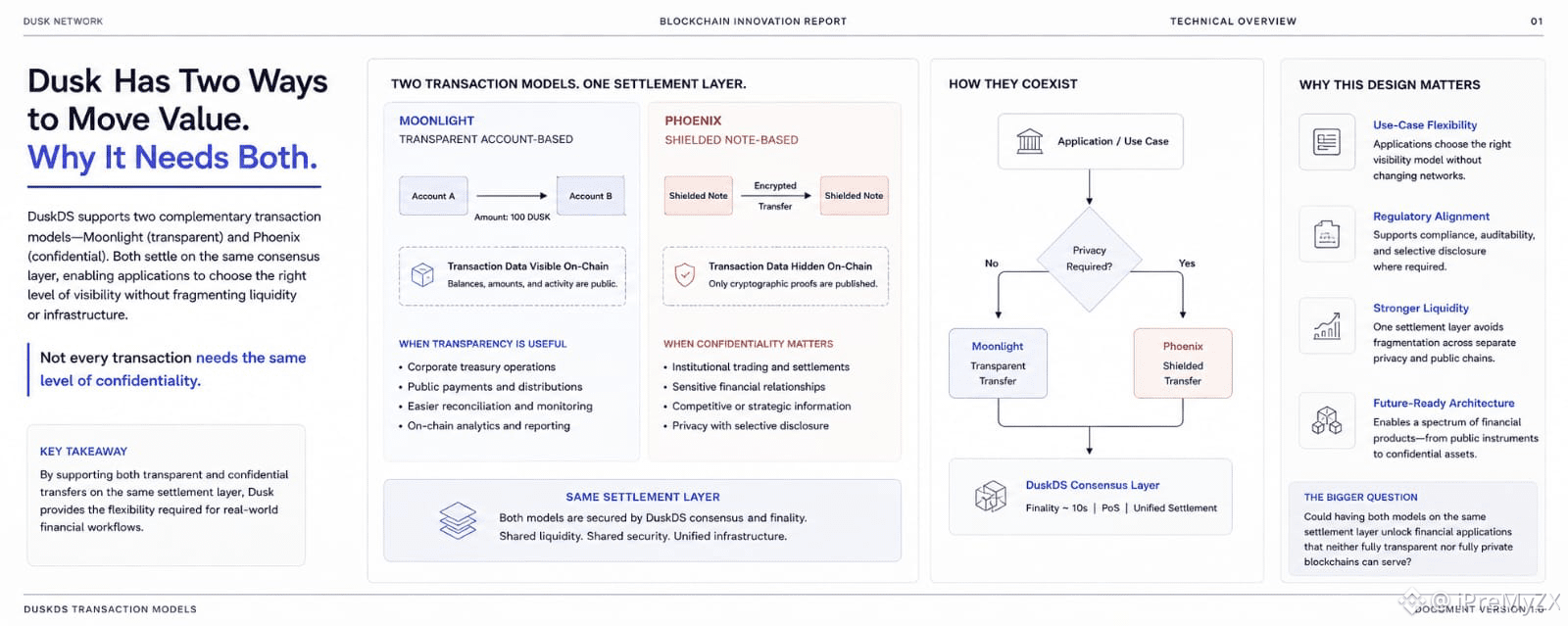
When I first looked at Dusk’s transaction architecture, I expected the privacy story to be straightforward: a blockchain designed around confidential transactions.
Then I noticed something more interesting.
DuskDS supports two different transaction models: Moonlight, which uses a transparent account-based approach, and Phoenix, which uses shielded notes for confidential transfers.
At first, having both can look like unnecessary complexity. If privacy is such an important part of Dusk, why not make everything private?
But the more I think about regulated financial markets, the more this design starts to make sense.
Not every transaction needs the same level of confidentiality.
There are situations where transparent activity is useful. A public transfer can make accounting, monitoring, treasury operations or certain forms of verification easier.
Then there are transactions where exposing the amount, participants or financial relationships creates information leakage that an institution simply doesn't want.
That's where Phoenix becomes more interesting.
Instead of forcing the entire network into one privacy model, Dusk appears to be treating transaction visibility as something that can depend on the use case.
And I think that's the bigger idea.
A regulated asset might need compliance without requiring every market participant to see every transaction detail. An institution could need to prove something to an authorized party while keeping sensitive financial information away from the wider market.
So I'm starting to see Moonlight and Phoenix less as competing transaction systems and more as two different tools operating on the same settlement layer.
The real question for me isn't whether one is better.
It's whether having both allows Dusk to serve financial applications that sit somewhere between completely transparent blockchains and completely private systems.
That middle ground could be where the interesting part of Dusk's architecture actually lives.
@Dusk_Foundation #dusk $DUSK
When I first looked at Dusk’s transaction architecture, I expected the privacy story to be straightforward: a blockchain designed around confidential transactions.
Then I noticed something more interesting.
DuskDS supports two different transaction models: Moonlight, which uses a transparent account-based approach, and Phoenix, which uses shielded notes for confidential transfers.
At first, having both can look like unnecessary complexity. If privacy is such an important part of Dusk, why not make everything private?
But the more I think about regulated financial markets, the more this design starts to make sense.
Not every transaction needs the same level of confidentiality.
There are situations where transparent activity is useful. A public transfer can make accounting, monitoring, treasury operations or certain forms of verification easier.
Then there are transactions where exposing the amount, participants or financial relationships creates information leakage that an institution simply doesn't want.
That's where Phoenix becomes more interesting.
Instead of forcing the entire network into one privacy model, Dusk appears to be treating transaction visibility as something that can depend on the use case.
And I think that's the bigger idea.
A regulated asset might need compliance without requiring every market participant to see every transaction detail. An institution could need to prove something to an authorized party while keeping sensitive financial information away from the wider market.
So I'm starting to see Moonlight and Phoenix less as competing transaction systems and more as two different tools operating on the same settlement layer.
The real question for me isn't whether one is better.
It's whether having both allows Dusk to serve financial applications that sit somewhere between completely transparent blockchains and completely private systems.
That middle ground could be where the interesting part of Dusk's architecture actually lives.
@Dusk #dusk $DUSK
Then I noticed something more interesting.
DuskDS supports two different transaction models: Moonlight, which uses a transparent account-based approach, and Phoenix, which uses shielded notes for confidential transfers.
At first, having both can look like unnecessary complexity. If privacy is such an important part of Dusk, why not make everything private?
But the more I think about regulated financial markets, the more this design starts to make sense.
Not every transaction needs the same level of confidentiality.
There are situations where transparent activity is useful. A public transfer can make accounting, monitoring, treasury operations or certain forms of verification easier.
Then there are transactions where exposing the amount, participants or financial relationships creates information leakage that an institution simply doesn't want.
That's where Phoenix becomes more interesting.
Instead of forcing the entire network into one privacy model, Dusk appears to be treating transaction visibility as something that can depend on the use case.
And I think that's the bigger idea.
A regulated asset might need compliance without requiring every market participant to see every transaction detail. An institution could need to prove something to an authorized party while keeping sensitive financial information away from the wider market.
So I'm starting to see Moonlight and Phoenix less as competing transaction systems and more as two different tools operating on the same settlement layer.
The real question for me isn't whether one is better.
It's whether having both allows Dusk to serve financial applications that sit somewhere between completely transparent blockchains and completely private systems.
That middle ground could be where the interesting part of Dusk's architecture actually lives.
@Dusk #dusk $DUSK
1
92
·
--
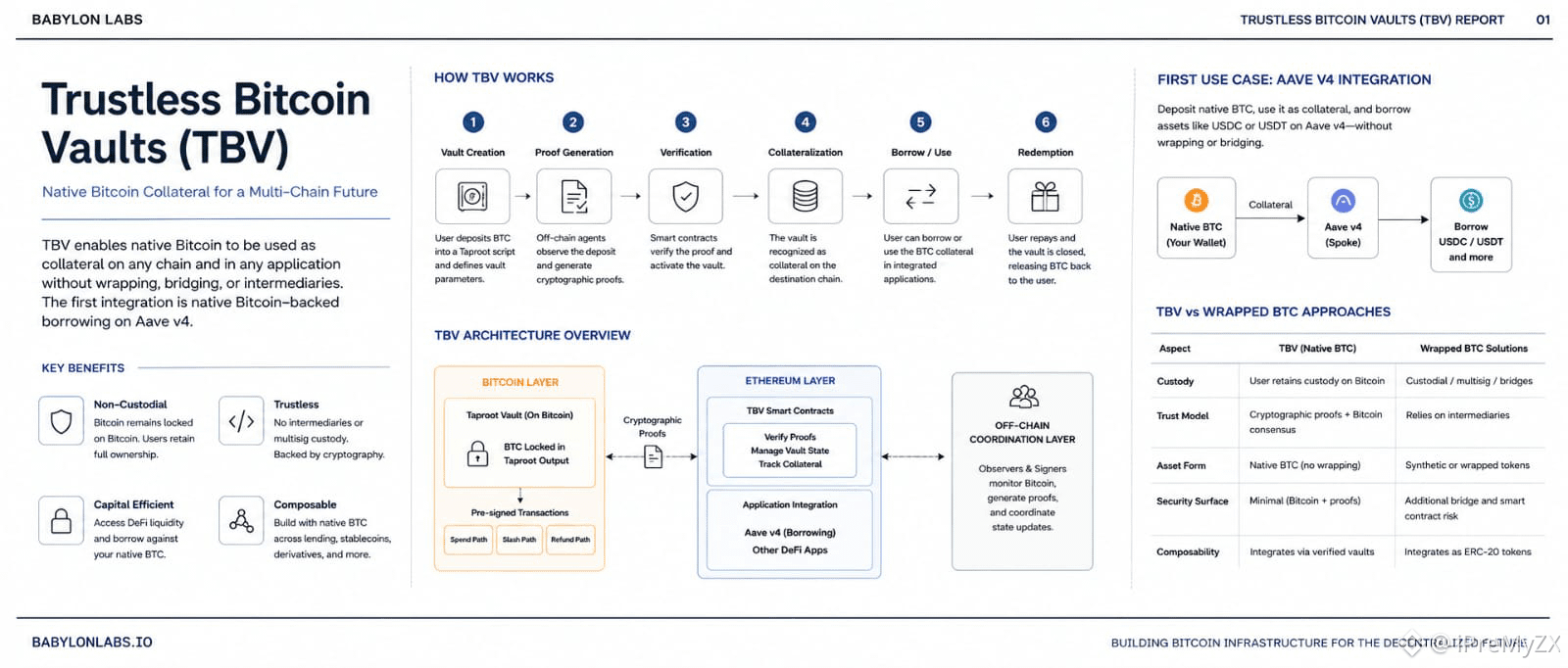
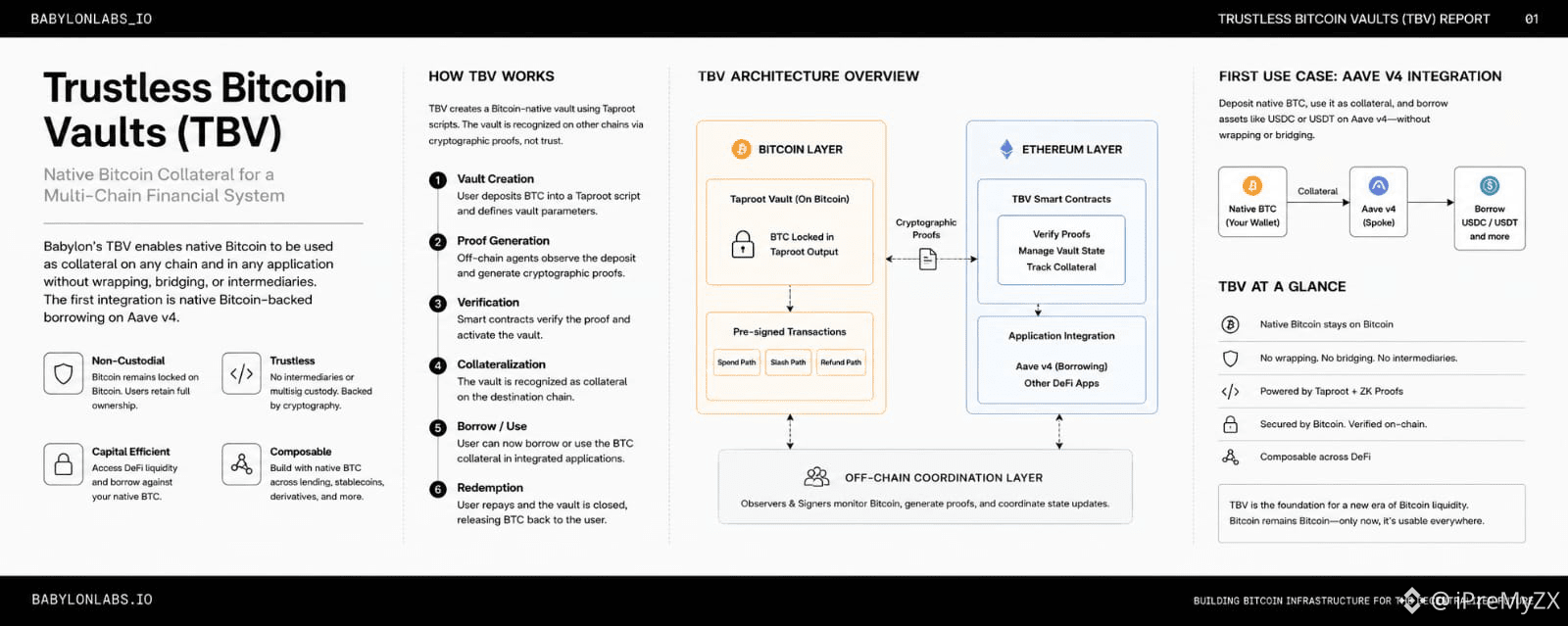
Mən Trustless Bitcoin Vaults (TBV) sənədlərinə elə düşünərək girdim ki, sanki sarılmış BTC və yerli BTC ilə təmin edilən borclanma eyni problemi müxtəlif alətlərlə həll edir.
Bir neçə saat oxuduqdan sonra bunun eyni fərziyyədən belə başladığını düşünmürəm.
Sarılmış BTC soruşur: "Bitcoin-i DeFi-ə necə gətirək?"
TBV isə sanki belə soruşur: "DeFi onu istifadə etməzdən əvvəl Bitcoin niyə mütləq başqa bir şeyə çevrilməlidir?"
Bu fərq mənə borclanma axınından daha çox təsir etdi.
Sarılmış BTC-ni düşünməyin ən asan yolu budur ki, o, tətbiqlərin artıq işləməyə bildiyi başqa bir Bitcoin versiyası yaradır. Bu, praktikdir və buna görə standart oldu. Amma hər əlavə qat da işlək qalmalı olan başqa bir fərziyyələr dəsti ilə gəlir.
TBV mürəkkəbliyi yox etmir—onu köçürür.
Başqa bir Bitcoin təqdimatı yaratmaq əvəzinə, protokol yerli BTC-ni artıq olduğu yerdə saxlamağa çalışır və onun Aave v4 kimi tətbiqlər üçün təminat statusunu sübut edir. İnkişaf çətinliyi sarılmış aktivin yaradılmasından fərqli olaraq, müxtəlif sistemlər arasında doğrulamanın koordinasiyasına keçir.
Bu, tamamilə fərqli dizayn fəlsəfəsidir.
Mən deyim ki, yanaşmalardan biri avtomatik olaraq o birini əvəz edir—demirəm. Sarılmış BTC artıq formalaşmış ekosistemə və bu gün dərin likvidliyə malikdir. Amma hər iki modeli müqayisə etdikdən sonra gördüm ki, onlar fərqli şeylərə optimallaşır. Biri mövcud DeFi-lə uyğunluğa üstünlük verir. Digəri isə Bitcoin-in özündə dəyişiklikləri azaltmağa.
Bu, ən böyük nəticəm oldu.
Mən bu dovşan yuvasına elə düşünərək girdim ki, innovasiya "Bitcoin-ə qarşı borclanmaqdır". Mən isə daha maraqlı sualın etibar fərziyyələrinin harada daxil edildiyi—və istifadəyə əl atmadan onları azaltmaq mümkün olub-olmaması olduğu qənaətinə gəldim.
Bu, elə Trustless Bitcoin Vaults (TBV) ictimai testnetdən kənara keçdikcə davam etdirilməyə dəyər söhbət kimi görünür.
@babylonlabs_io $BABY #baby
Mən Trustless Bitcoin Vaults (TBV) sənədlərinə elə düşünərək girdim ki, sanki sarılmış BTC və yerli BTC ilə təmin edilən borclanma eyni problemi müxtəlif alətlərlə həll edir.
Bir neçə saat oxuduqdan sonra bunun eyni fərziyyədən belə başladığını düşünmürəm.
Sarılmış BTC soruşur: "Bitcoin-i DeFi-ə necə gətirək?"
TBV isə sanki belə soruşur: "DeFi onu istifadə etməzdən əvvəl Bitcoin niyə mütləq başqa bir şeyə çevrilməlidir?"
Bu fərq mənə borclanma axınından daha çox təsir etdi.
Sarılmış BTC-ni düşünməyin ən asan yolu budur ki, o, tətbiqlərin artıq işləməyə bildiyi başqa bir Bitcoin versiyası yaradır. Bu, praktikdir və buna görə standart oldu. Amma hər əlavə qat da işlək qalmalı olan başqa bir fərziyyələr dəsti ilə gəlir.
TBV mürəkkəbliyi yox etmir—onu köçürür.
Başqa bir Bitcoin təqdimatı yaratmaq əvəzinə, protokol yerli BTC-ni artıq olduğu yerdə saxlamağa çalışır və onun Aave v4 kimi tətbiqlər üçün təminat statusunu sübut edir. İnkişaf çətinliyi sarılmış aktivin yaradılmasından fərqli olaraq, müxtəlif sistemlər arasında doğrulamanın koordinasiyasına keçir.
Bu, tamamilə fərqli dizayn fəlsəfəsidir.
Mən deyim ki, yanaşmalardan biri avtomatik olaraq o birini əvəz edir—demirəm. Sarılmış BTC artıq formalaşmış ekosistemə və bu gün dərin likvidliyə malikdir. Amma hər iki modeli müqayisə etdikdən sonra gördüm ki, onlar fərqli şeylərə optimallaşır. Biri mövcud DeFi-lə uyğunluğa üstünlük verir. Digəri isə Bitcoin-in özündə dəyişiklikləri azaltmağa.
Bu, ən böyük nəticəm oldu.
Mən bu dovşan yuvasına elə düşünərək girdim ki, innovasiya "Bitcoin-ə qarşı borclanmaqdır". Mən isə daha maraqlı sualın etibar fərziyyələrinin harada daxil edildiyi—və istifadəyə əl atmadan onları azaltmaq mümkün olub-olmaması olduğu qənaətinə gəldim.
Bu, elə Trustless Bitcoin Vaults (TBV) ictimai testnetdən kənara keçdikcə davam etdirilməyə dəyər söhbət kimi görünür.
@BabylonLabs_io $BABY #baby
Bir neçə saat oxuduqdan sonra bunun eyni fərziyyədən belə başladığını düşünmürəm.
Sarılmış BTC soruşur: "Bitcoin-i DeFi-ə necə gətirək?"
TBV isə sanki belə soruşur: "DeFi onu istifadə etməzdən əvvəl Bitcoin niyə mütləq başqa bir şeyə çevrilməlidir?"
Bu fərq mənə borclanma axınından daha çox təsir etdi.
Sarılmış BTC-ni düşünməyin ən asan yolu budur ki, o, tətbiqlərin artıq işləməyə bildiyi başqa bir Bitcoin versiyası yaradır. Bu, praktikdir və buna görə standart oldu. Amma hər əlavə qat da işlək qalmalı olan başqa bir fərziyyələr dəsti ilə gəlir.
TBV mürəkkəbliyi yox etmir—onu köçürür.
Başqa bir Bitcoin təqdimatı yaratmaq əvəzinə, protokol yerli BTC-ni artıq olduğu yerdə saxlamağa çalışır və onun Aave v4 kimi tətbiqlər üçün təminat statusunu sübut edir. İnkişaf çətinliyi sarılmış aktivin yaradılmasından fərqli olaraq, müxtəlif sistemlər arasında doğrulamanın koordinasiyasına keçir.
Bu, tamamilə fərqli dizayn fəlsəfəsidir.
Mən deyim ki, yanaşmalardan biri avtomatik olaraq o birini əvəz edir—demirəm. Sarılmış BTC artıq formalaşmış ekosistemə və bu gün dərin likvidliyə malikdir. Amma hər iki modeli müqayisə etdikdən sonra gördüm ki, onlar fərqli şeylərə optimallaşır. Biri mövcud DeFi-lə uyğunluğa üstünlük verir. Digəri isə Bitcoin-in özündə dəyişiklikləri azaltmağa.
Bu, ən böyük nəticəm oldu.
Mən bu dovşan yuvasına elə düşünərək girdim ki, innovasiya "Bitcoin-ə qarşı borclanmaqdır". Mən isə daha maraqlı sualın etibar fərziyyələrinin harada daxil edildiyi—və istifadəyə əl atmadan onları azaltmaq mümkün olub-olmaması olduğu qənaətinə gəldim.
Bu, elə Trustless Bitcoin Vaults (TBV) ictimai testnetdən kənara keçdikcə davam etdirilməyə dəyər söhbət kimi görünür.
@BabylonLabs_io $BABY #baby
3
1
105
·
--
Mən Trustless Bitcoin Vaults-ın (TBV) testnetini açdım və maraqlı hissənin borclanma axını olacağını düşündüm. BTC-ni kilidlə, Aave v4 vasitəsilə aktivləri borc al, oldu. Başlıqlar da məhz buna fokuslanır.
Amma sonda tamamilə başqa bir şeyə diqqət etdim.
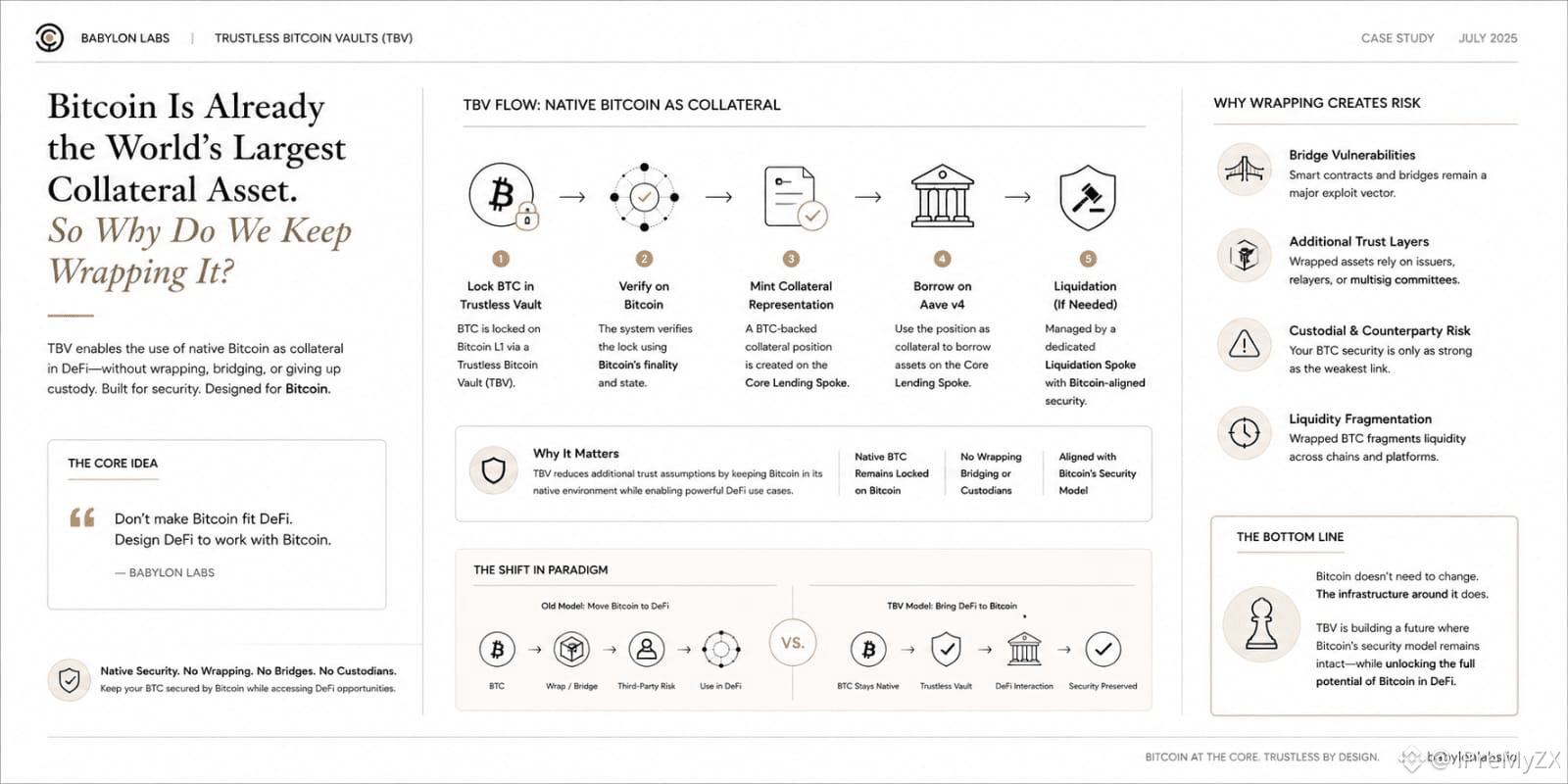
Məni geri çəkən hissə borc ala bildiyim şey deyildi. Borc almadan əvvəl baş verməyən şey idi. Doğma Bitcoin əvvəlcə başqa bir tokenə bükülmürdü və bu, etibar fərziyyətlərinin harada yaşadığını dəyişir.
Bu, incə bir fərqdir, amma məncə vacibdir.
Əksər Bitcoin DeFi müzakirələri sonda körpülər, kənar saxlayıcılar (custodians) və ya sintetik (süni) təqdimatlar barədə söhbətlərə çevrilir. TBV isə fərqli bir sual verir kimi görünür: əgər Bitcoin onsuz da təminat (kollateral) kimidirsə, niyə iştirak etmək üçün əvvəlcə başqa nəyəsə çevrilməlidir?
Testnet həm də bunu işlətməyin sadə olmadığını xatırlatdı. Sadə görünən istifadəçi axınının arxasında Bitcoin, Ethereum və protokolun özü arasında çoxlu koordinasiya dayanır. İnterfeys elə təmizdir ki, neçə hissənin sinxron qalmalı olduğunu asanlıqla gözdən qaçıra bilərsən.
Testdən sonra rəy verdim, çünki çox güman ki, açıq testnetdə ən qiymətli hissə budur. Sənədləşmə dizaynı izah edir, amma real istifadəçilər diaqramların heç vaxt göstərə bilmədiyi sürtünmə nöqtələrini üzə çıxarır.
Ən böyük nəticəm, Bitcoinə qarşı borc götürməyi bacarmam deyildi. Babylonun mövcud BTC kreditləşdirmə bazarları ilə rəqabət aparmağa o qədər də maraqlı görünməməsi idi; daha çox həmin bazarların illərdir arxalandığı fərziyyətləri dəyişmək istəyir.
Bu yanaşmanın yeni standart olub-olmayacağı hələ açıq sualdır. Amma axını özümdən keçirəndən sonra düşünürəm ki, izləməyə dəyər sual məhz budur.
@babylonlabs_io $BABY #baby
Mən Trustless Bitcoin Vaults-ın (TBV) testnetini açdım və maraqlı hissənin borclanma axını olacağını düşündüm. BTC-ni kilidlə, Aave v4 vasitəsilə aktivləri borc al, oldu. Başlıqlar da məhz buna fokuslanır.
Amma sonda tamamilə başqa bir şeyə diqqət etdim.
Məni geri çəkən hissə borc ala bildiyim şey deyildi. Borc almadan əvvəl baş verməyən şey idi. Doğma Bitcoin əvvəlcə başqa bir tokenə bükülmürdü və bu, etibar fərziyyətlərinin harada yaşadığını dəyişir.
Bu, incə bir fərqdir, amma məncə vacibdir.
Əksər Bitcoin DeFi müzakirələri sonda körpülər, kənar saxlayıcılar (custodians) və ya sintetik (süni) təqdimatlar barədə söhbətlərə çevrilir. TBV isə fərqli bir sual verir kimi görünür: əgər Bitcoin onsuz da təminat (kollateral) kimidirsə, niyə iştirak etmək üçün əvvəlcə başqa nəyəsə çevrilməlidir?
Testnet həm də bunu işlətməyin sadə olmadığını xatırlatdı. Sadə görünən istifadəçi axınının arxasında Bitcoin, Ethereum və protokolun özü arasında çoxlu koordinasiya dayanır. İnterfeys elə təmizdir ki, neçə hissənin sinxron qalmalı olduğunu asanlıqla gözdən qaçıra bilərsən.
Testdən sonra rəy verdim, çünki çox güman ki, açıq testnetdə ən qiymətli hissə budur. Sənədləşmə dizaynı izah edir, amma real istifadəçilər diaqramların heç vaxt göstərə bilmədiyi sürtünmə nöqtələrini üzə çıxarır.
Ən böyük nəticəm, Bitcoinə qarşı borc götürməyi bacarmam deyildi. Babylonun mövcud BTC kreditləşdirmə bazarları ilə rəqabət aparmağa o qədər də maraqlı görünməməsi idi; daha çox həmin bazarların illərdir arxalandığı fərziyyətləri dəyişmək istəyir.
Bu yanaşmanın yeni standart olub-olmayacağı hələ açıq sualdır. Amma axını özümdən keçirəndən sonra düşünürəm ki, izləməyə dəyər sual məhz budur.
@BabylonLabs_io $BABY #baby
Amma sonda tamamilə başqa bir şeyə diqqət etdim.
Məni geri çəkən hissə borc ala bildiyim şey deyildi. Borc almadan əvvəl baş verməyən şey idi. Doğma Bitcoin əvvəlcə başqa bir tokenə bükülmürdü və bu, etibar fərziyyətlərinin harada yaşadığını dəyişir.
Bu, incə bir fərqdir, amma məncə vacibdir.
Əksər Bitcoin DeFi müzakirələri sonda körpülər, kənar saxlayıcılar (custodians) və ya sintetik (süni) təqdimatlar barədə söhbətlərə çevrilir. TBV isə fərqli bir sual verir kimi görünür: əgər Bitcoin onsuz da təminat (kollateral) kimidirsə, niyə iştirak etmək üçün əvvəlcə başqa nəyəsə çevrilməlidir?
Testnet həm də bunu işlətməyin sadə olmadığını xatırlatdı. Sadə görünən istifadəçi axınının arxasında Bitcoin, Ethereum və protokolun özü arasında çoxlu koordinasiya dayanır. İnterfeys elə təmizdir ki, neçə hissənin sinxron qalmalı olduğunu asanlıqla gözdən qaçıra bilərsən.
Testdən sonra rəy verdim, çünki çox güman ki, açıq testnetdə ən qiymətli hissə budur. Sənədləşmə dizaynı izah edir, amma real istifadəçilər diaqramların heç vaxt göstərə bilmədiyi sürtünmə nöqtələrini üzə çıxarır.
Ən böyük nəticəm, Bitcoinə qarşı borc götürməyi bacarmam deyildi. Babylonun mövcud BTC kreditləşdirmə bazarları ilə rəqabət aparmağa o qədər də maraqlı görünməməsi idi; daha çox həmin bazarların illərdir arxalandığı fərziyyətləri dəyişmək istəyir.
Bu yanaşmanın yeni standart olub-olmayacağı hələ açıq sualdır. Amma axını özümdən keçirəndən sonra düşünürəm ki, izləməyə dəyər sual məhz budur.
@BabylonLabs_io $BABY #baby
3
1
126
·
--
#baby $BABY
Mən Trustless Bitcoin Vaults (TBV) haqqında oxumağa başladım, çünki borclanma axınını anlamaq istəyirdim.
Sonda protokolun etibarı harada saxlamağı seçməsi üzərində daha çox düşündüm.
Əvvəlcə “yerli Bitcoin girovu” mənə başqa bir məhsul təsviri kimi gəldi. Arxitekturaya daha dərindən girdikcə bunun bir dizayn qərarı olduğunu daha aydın gördüm.
Bitcoin-dən daha sürətli olması istənilmir.
Onun EVM aktivinə çevrilməsi də tələb olunmur.
Əvəzində sistem Bitcoin-in öz qaydalarını qəbul etmək və qalan infrastrukturun qalan hissəsini məhz bu qaydalar ətrafında qurmaq üçün yaradılıb.
Bu, gözlənilmədən fərqli bir fəlsəfə kimi hiss olunur.
Çoxu cross-chain sistemlər sürtünməni azaltmağa çalışır: aktivi daha asan daşımağa imkan verən əlavə bir qat təqdim edirlər. TBV isə sanki əks yanaşma sərgiləyir. O, Bitcoin-in öz hesablaşma modelinin olduğunu qəbul edir və sonra soruşur ki, borcvermə infrastrukturu onu əvəz etmədən, ona necə uyğun ola bilər.
Bu yanaşmaları nə qədər müqayisə etdim, bunun kapital səmərəliliyi barədə bir müzakirə olduğuna bir o qədər də daha az inandım.
Bu, toxunulmadan qalmağa layiq olan fərziyyələr barədə bir müzakirəyə çevrildi.
Hər bir protokolun kompromisləri var. TBV də bundan azad deyil. Koordinasiya, yoxlama və əməliyyat mürəkkəbliyi sadəcə qəsdən nəzarət (custody) minimuma endirilir deyə yox olmur.
Amma mürəkkəblik və etibar həmişə eyni şey deyil.
Biri mühəndislikdən gəlir.
Digəri isə istifadəçilərdən əlavə tərəflərə inanmağı tələb etməkdən.
Mən hələ də sənədləri işləyirəm, amma məni ən çox tək bu fərq düşündürdü.
Düşünürəm ki, DeFi-də Bitcoin-in gələcəyi BTC-ni ən sürətli hərəkət etdirən hansı protokolla qərar verilməyəcək.
Bəlkə də, qərar, insanların ilk növbədə Bitcoin-ə niyə güvəndiyini təşkil edən ən az şeyi dəyişən hansı protokolla veriləcək.
@babylonlabs_io
#baby $BABY
#baby $BABY
Mən Trustless Bitcoin Vaults (TBV) haqqında oxumağa başladım, çünki borclanma axınını anlamaq istəyirdim.
Sonda protokolun etibarı harada saxlamağı seçməsi üzərində daha çox düşündüm.
Əvvəlcə “yerli Bitcoin girovu” mənə başqa bir məhsul təsviri kimi gəldi. Arxitekturaya daha dərindən girdikcə bunun bir dizayn qərarı olduğunu daha aydın gördüm.
Bitcoin-dən daha sürətli olması istənilmir.
Onun EVM aktivinə çevrilməsi də tələb olunmur.
Əvəzində sistem Bitcoin-in öz qaydalarını qəbul etmək və qalan infrastrukturun qalan hissəsini məhz bu qaydalar ətrafında qurmaq üçün yaradılıb.
Bu, gözlənilmədən fərqli bir fəlsəfə kimi hiss olunur.
Çoxu cross-chain sistemlər sürtünməni azaltmağa çalışır: aktivi daha asan daşımağa imkan verən əlavə bir qat təqdim edirlər. TBV isə sanki əks yanaşma sərgiləyir. O, Bitcoin-in öz hesablaşma modelinin olduğunu qəbul edir və sonra soruşur ki, borcvermə infrastrukturu onu əvəz etmədən, ona necə uyğun ola bilər.
Bu yanaşmaları nə qədər müqayisə etdim, bunun kapital səmərəliliyi barədə bir müzakirə olduğuna bir o qədər də daha az inandım.
Bu, toxunulmadan qalmağa layiq olan fərziyyələr barədə bir müzakirəyə çevrildi.
Hər bir protokolun kompromisləri var. TBV də bundan azad deyil. Koordinasiya, yoxlama və əməliyyat mürəkkəbliyi sadəcə qəsdən nəzarət (custody) minimuma endirilir deyə yox olmur.
Amma mürəkkəblik və etibar həmişə eyni şey deyil.
Biri mühəndislikdən gəlir.
Digəri isə istifadəçilərdən əlavə tərəflərə inanmağı tələb etməkdən.
Mən hələ də sənədləri işləyirəm, amma məni ən çox tək bu fərq düşündürdü.
Düşünürəm ki, DeFi-də Bitcoin-in gələcəyi BTC-ni ən sürətli hərəkət etdirən hansı protokolla qərar verilməyəcək.
Bəlkə də, qərar, insanların ilk növbədə Bitcoin-ə niyə güvəndiyini təşkil edən ən az şeyi dəyişən hansı protokolla veriləcək.
@BabylonLabs_io
#baby $BABY
Mən Trustless Bitcoin Vaults (TBV) haqqında oxumağa başladım, çünki borclanma axınını anlamaq istəyirdim.
Sonda protokolun etibarı harada saxlamağı seçməsi üzərində daha çox düşündüm.
Əvvəlcə “yerli Bitcoin girovu” mənə başqa bir məhsul təsviri kimi gəldi. Arxitekturaya daha dərindən girdikcə bunun bir dizayn qərarı olduğunu daha aydın gördüm.
Bitcoin-dən daha sürətli olması istənilmir.
Onun EVM aktivinə çevrilməsi də tələb olunmur.
Əvəzində sistem Bitcoin-in öz qaydalarını qəbul etmək və qalan infrastrukturun qalan hissəsini məhz bu qaydalar ətrafında qurmaq üçün yaradılıb.
Bu, gözlənilmədən fərqli bir fəlsəfə kimi hiss olunur.
Çoxu cross-chain sistemlər sürtünməni azaltmağa çalışır: aktivi daha asan daşımağa imkan verən əlavə bir qat təqdim edirlər. TBV isə sanki əks yanaşma sərgiləyir. O, Bitcoin-in öz hesablaşma modelinin olduğunu qəbul edir və sonra soruşur ki, borcvermə infrastrukturu onu əvəz etmədən, ona necə uyğun ola bilər.
Bu yanaşmaları nə qədər müqayisə etdim, bunun kapital səmərəliliyi barədə bir müzakirə olduğuna bir o qədər də daha az inandım.
Bu, toxunulmadan qalmağa layiq olan fərziyyələr barədə bir müzakirəyə çevrildi.
Hər bir protokolun kompromisləri var. TBV də bundan azad deyil. Koordinasiya, yoxlama və əməliyyat mürəkkəbliyi sadəcə qəsdən nəzarət (custody) minimuma endirilir deyə yox olmur.
Amma mürəkkəblik və etibar həmişə eyni şey deyil.
Biri mühəndislikdən gəlir.
Digəri isə istifadəçilərdən əlavə tərəflərə inanmağı tələb etməkdən.
Mən hələ də sənədləri işləyirəm, amma məni ən çox tək bu fərq düşündürdü.
Düşünürəm ki, DeFi-də Bitcoin-in gələcəyi BTC-ni ən sürətli hərəkət etdirən hansı protokolla qərar verilməyəcək.
Bəlkə də, qərar, insanların ilk növbədə Bitcoin-ə niyə güvəndiyini təşkil edən ən az şeyi dəyişən hansı protokolla veriləcək.
@BabylonLabs_io
#baby $BABY
3
123
·
--
#baby $BABY
Trustless Bitcoin Vaults (TBV) haqqında oxumağa başladım, borc götürmə faizlərini müqayisə edəcəyimi düşünürdüm.
Baş vermədi.
Daha az aydın görünən bir şeyə yenə də geri qayıtdım: yerli Bitcoin girov kimi çevrildikdən sonra etibar (trust) harada oturur.
İllər boyu standart yol hamı tərəfindən “yerinə oturtulmuş” kimi görünürdü. BTC-ni sarmala, körpülə, DeFi ilə qarşılıqlı işlət, sonra davam et. Mən bu əlavə qatları Bitcoini öz zəncirindən kənarda faydalı etmək üçün qaçılmaz xərci kimi qəbul etdim.
TBV isə bu fərziyyənin default (standart) kimi qəbul edilməsini şübhə altına aldı.
Diqqət çəkən odur ki, Bitcoin birdən-birə sürtünməsiz (frictionless) olmur. Olmur. Yerli BTC yenə də Bitcoin-in öz hesablaşma tempinə tabedir və başqa bir zəncir daha sürətli icra istəyirsə, bu ritm itmir.
Fərq protokolun həmin sürtünməni harada “udmaq” (absorbs etmək) seçimindədir.
Bitcoin-in başqa bir reprezentasiyasını (təsvirini) təqdim etmək əvəzinə, TBV girovun Bitcoin-in özünə bağlı qalmasını saxlayır və borclanma (lending) məntiqini məhz bu reallıq üzərində qurur. Gözləmə yox olmur—sadəcə körpünün və ya custodianun qaydalarına yox, Bitcoin-in öz qaydalarına uyğun olaraq davam edir.
Bunun barədə nə qədər çox düşünürəmsə, bir o qədər də bu, borc götürmə ilə bağlı müzakirə kimi görünmür.
Bu, dizayn prioritetləri barədə müzakirədir.
Dərhal rahatlığa optimallaşdırmaq daha yaxşıdır, yoxsa ilk növbədə Bitcoini dəyərli edən təhlükəsizlik ehtimallarını qorumaq?
Mən hələ də arxitektura üzərində işləyirəm və əminəm ki, hələ tam qiymətləndirmədiyim bəzi kompromislər var.
Amma bir şey dəyişdi.
Mən artıq Bitcoin infrastrukturunu BTC-nin nə qədər tez hərəkət etdiyinə görə mühakimə etmirəm.
Onun hər hansı bir şeyi ümumiyyətlə hərəkət etdirməzdən əvvəl məndən nəyi etibar (trust) kimi tələb etdiyinə daha diqqətlə baxıram.
@babylonlabs_io
#baby
#baby $BABY
Trustless Bitcoin Vaults (TBV) haqqında oxumağa başladım, borc götürmə faizlərini müqayisə edəcəyimi düşünürdüm.
Baş vermədi.
Daha az aydın görünən bir şeyə yenə də geri qayıtdım: yerli Bitcoin girov kimi çevrildikdən sonra etibar (trust) harada oturur.
İllər boyu standart yol hamı tərəfindən “yerinə oturtulmuş” kimi görünürdü. BTC-ni sarmala, körpülə, DeFi ilə qarşılıqlı işlət, sonra davam et. Mən bu əlavə qatları Bitcoini öz zəncirindən kənarda faydalı etmək üçün qaçılmaz xərci kimi qəbul etdim.
TBV isə bu fərziyyənin default (standart) kimi qəbul edilməsini şübhə altına aldı.
Diqqət çəkən odur ki, Bitcoin birdən-birə sürtünməsiz (frictionless) olmur. Olmur. Yerli BTC yenə də Bitcoin-in öz hesablaşma tempinə tabedir və başqa bir zəncir daha sürətli icra istəyirsə, bu ritm itmir.
Fərq protokolun həmin sürtünməni harada “udmaq” (absorbs etmək) seçimindədir.
Bitcoin-in başqa bir reprezentasiyasını (təsvirini) təqdim etmək əvəzinə, TBV girovun Bitcoin-in özünə bağlı qalmasını saxlayır və borclanma (lending) məntiqini məhz bu reallıq üzərində qurur. Gözləmə yox olmur—sadəcə körpünün və ya custodianun qaydalarına yox, Bitcoin-in öz qaydalarına uyğun olaraq davam edir.
Bunun barədə nə qədər çox düşünürəmsə, bir o qədər də bu, borc götürmə ilə bağlı müzakirə kimi görünmür.
Bu, dizayn prioritetləri barədə müzakirədir.
Dərhal rahatlığa optimallaşdırmaq daha yaxşıdır, yoxsa ilk növbədə Bitcoini dəyərli edən təhlükəsizlik ehtimallarını qorumaq?
Mən hələ də arxitektura üzərində işləyirəm və əminəm ki, hələ tam qiymətləndirmədiyim bəzi kompromislər var.
Amma bir şey dəyişdi.
Mən artıq Bitcoin infrastrukturunu BTC-nin nə qədər tez hərəkət etdiyinə görə mühakimə etmirəm.
Onun hər hansı bir şeyi ümumiyyətlə hərəkət etdirməzdən əvvəl məndən nəyi etibar (trust) kimi tələb etdiyinə daha diqqətlə baxıram.
@BabylonLabs_io
#baby
Trustless Bitcoin Vaults (TBV) haqqında oxumağa başladım, borc götürmə faizlərini müqayisə edəcəyimi düşünürdüm.
Baş vermədi.
Daha az aydın görünən bir şeyə yenə də geri qayıtdım: yerli Bitcoin girov kimi çevrildikdən sonra etibar (trust) harada oturur.
İllər boyu standart yol hamı tərəfindən “yerinə oturtulmuş” kimi görünürdü. BTC-ni sarmala, körpülə, DeFi ilə qarşılıqlı işlət, sonra davam et. Mən bu əlavə qatları Bitcoini öz zəncirindən kənarda faydalı etmək üçün qaçılmaz xərci kimi qəbul etdim.
TBV isə bu fərziyyənin default (standart) kimi qəbul edilməsini şübhə altına aldı.
Diqqət çəkən odur ki, Bitcoin birdən-birə sürtünməsiz (frictionless) olmur. Olmur. Yerli BTC yenə də Bitcoin-in öz hesablaşma tempinə tabedir və başqa bir zəncir daha sürətli icra istəyirsə, bu ritm itmir.
Fərq protokolun həmin sürtünməni harada “udmaq” (absorbs etmək) seçimindədir.
Bitcoin-in başqa bir reprezentasiyasını (təsvirini) təqdim etmək əvəzinə, TBV girovun Bitcoin-in özünə bağlı qalmasını saxlayır və borclanma (lending) məntiqini məhz bu reallıq üzərində qurur. Gözləmə yox olmur—sadəcə körpünün və ya custodianun qaydalarına yox, Bitcoin-in öz qaydalarına uyğun olaraq davam edir.
Bunun barədə nə qədər çox düşünürəmsə, bir o qədər də bu, borc götürmə ilə bağlı müzakirə kimi görünmür.
Bu, dizayn prioritetləri barədə müzakirədir.
Dərhal rahatlığa optimallaşdırmaq daha yaxşıdır, yoxsa ilk növbədə Bitcoini dəyərli edən təhlükəsizlik ehtimallarını qorumaq?
Mən hələ də arxitektura üzərində işləyirəm və əminəm ki, hələ tam qiymətləndirmədiyim bəzi kompromislər var.
Amma bir şey dəyişdi.
Mən artıq Bitcoin infrastrukturunu BTC-nin nə qədər tez hərəkət etdiyinə görə mühakimə etmirəm.
Onun hər hansı bir şeyi ümumiyyətlə hərəkət etdirməzdən əvvəl məndən nəyi etibar (trust) kimi tələb etdiyinə daha diqqətlə baxıram.
@BabylonLabs_io
#baby
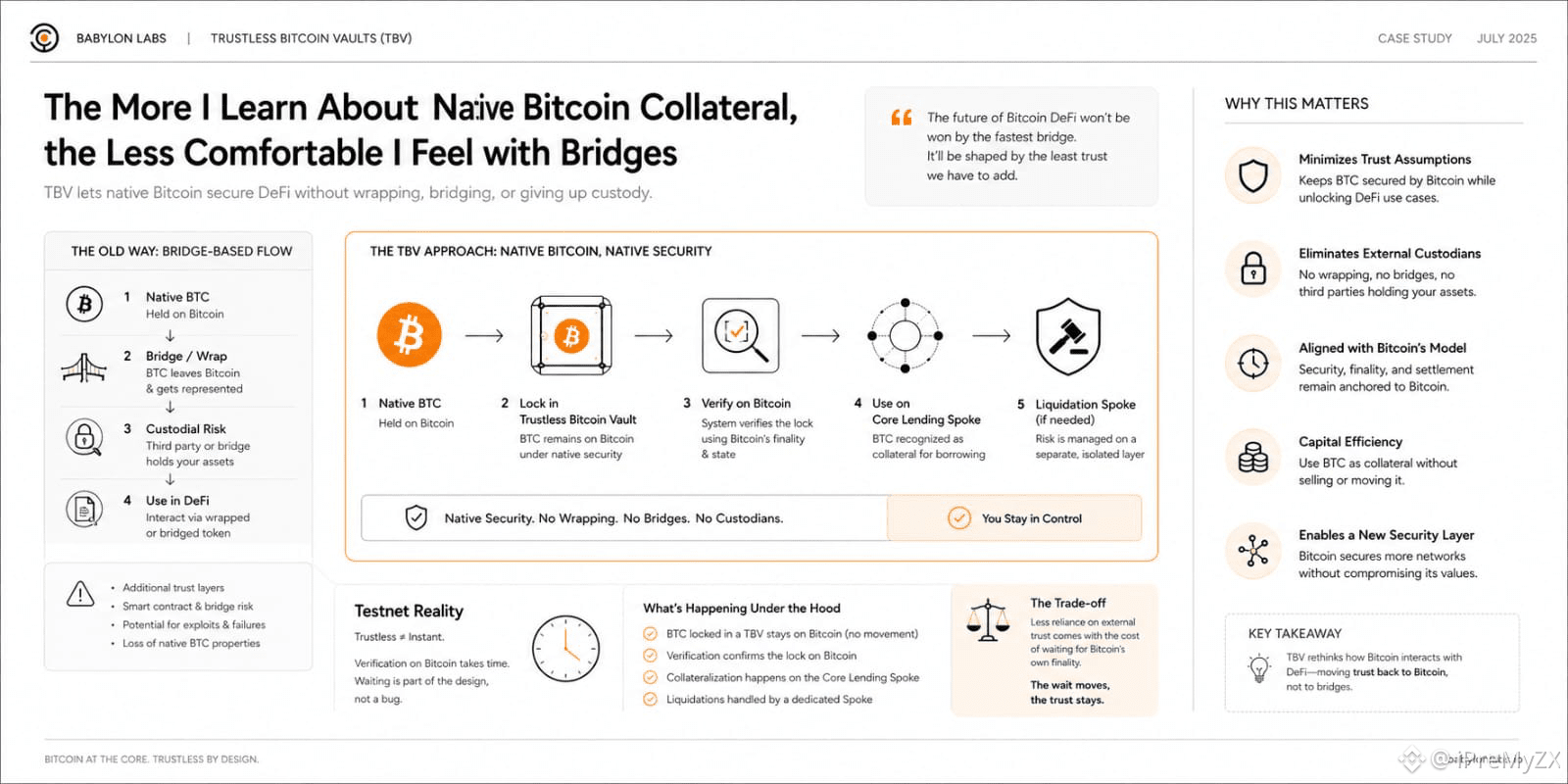
1
1
123
·
--
#baby $BABY
Gecə vaxtı Trustless Bitcoin Vaults (TBV) haqqında gözlədiyimdən daha çox vaxt sərf edib oxudum.
İçəri girəndə maraqlı hissənin yerli Bitcoin hesabına qarşı borc götürmək olacağını düşünürdüm. Hamının ilk diqqət etdiyi xüsusiyyət budur.
Amma əvəzinə daim daha səssiz bir şeyə qayıdırdım.
Bəs etibar (trust) gerçəkdə hara hərəkət edir?
Əksər Bitcoin DeFi dizaynları qarşılıqlı fəaliyyət (interoperability) problemini başqa bir qat əlavə etməklə həll edir—sarılmış (wrapped) aktiv, körpü (bridge) və ya kənar qəyyum (custodian). Siz elastiklik qazanırsınız, amma həm də təhlükəsizliyi Bitcoininkinə demək olar ki, bərabər önəm daşıyan başqa bir sistemin məsuliyyətini da miras alırsınız.
TBV bu güzəştlərin yox olduğunu iddia etmir.
Sadəcə, onların yaşadığı yeri dəyişir.
Yerli BTC Bitcoin tərəfindən təmin olunmuş qalır, eyni zamanda onun girov statusu borclanma kimi tətbiqlər üçün tanınır. Bu, kiçik görünən bir memarlıq (arxitektura) qərarı kimi səslənir, amma anlayanda protokolun prioritetini Bitcoin-i köçürməkdən daha çox, Bitcoin-in etibar (trust) modelini qorumağa yönəltdiyini görürsünüz.
Əvvəlki yanaşmalarla nə qədər müqayisə etdim, bu hekayənin borclanma (lending) haqqında olmasını bir o qədər də az düşündüm.
Daha çox dizayn fəlsəfəsi (design philosophy) haqqında hekayə kimi görünməyə başladı.
Bir yol Bitcoin-dən mövcud DeFi infrastrukturuna uyğunlaşmağı istəyir.
Digəri isə infrastrukturu Bitcoin ətrafında uyğunlaşdırmağı.
Mən hələ də mexanikanı oxuyuram, çünki hər sistemin limitləri var və bu limitlər adətən ən maraqlı dərslərin gizləndiyi yerdə olur.
Amma dəftərimi bağlayarkən bu sualı da yanımda saxladım:
Bitcoin daha çox ekosistemdə istifadəyə yararlı olduqca, qalib gələn dizaynlar rahatlığı maksimum edənlər olacaq—or özündə Bitcoin-ə edilən dəyişiklikləri minimuma endirənlər?
@babylonlabs_io
#baby
#baby $BABY
Gecə vaxtı Trustless Bitcoin Vaults (TBV) haqqında gözlədiyimdən daha çox vaxt sərf edib oxudum.
İçəri girəndə maraqlı hissənin yerli Bitcoin hesabına qarşı borc götürmək olacağını düşünürdüm. Hamının ilk diqqət etdiyi xüsusiyyət budur.
Amma əvəzinə daim daha səssiz bir şeyə qayıdırdım.
Bəs etibar (trust) gerçəkdə hara hərəkət edir?
Əksər Bitcoin DeFi dizaynları qarşılıqlı fəaliyyət (interoperability) problemini başqa bir qat əlavə etməklə həll edir—sarılmış (wrapped) aktiv, körpü (bridge) və ya kənar qəyyum (custodian). Siz elastiklik qazanırsınız, amma həm də təhlükəsizliyi Bitcoininkinə demək olar ki, bərabər önəm daşıyan başqa bir sistemin məsuliyyətini da miras alırsınız.
TBV bu güzəştlərin yox olduğunu iddia etmir.
Sadəcə, onların yaşadığı yeri dəyişir.
Yerli BTC Bitcoin tərəfindən təmin olunmuş qalır, eyni zamanda onun girov statusu borclanma kimi tətbiqlər üçün tanınır. Bu, kiçik görünən bir memarlıq (arxitektura) qərarı kimi səslənir, amma anlayanda protokolun prioritetini Bitcoin-i köçürməkdən daha çox, Bitcoin-in etibar (trust) modelini qorumağa yönəltdiyini görürsünüz.
Əvvəlki yanaşmalarla nə qədər müqayisə etdim, bu hekayənin borclanma (lending) haqqında olmasını bir o qədər də az düşündüm.
Daha çox dizayn fəlsəfəsi (design philosophy) haqqında hekayə kimi görünməyə başladı.
Bir yol Bitcoin-dən mövcud DeFi infrastrukturuna uyğunlaşmağı istəyir.
Digəri isə infrastrukturu Bitcoin ətrafında uyğunlaşdırmağı.
Mən hələ də mexanikanı oxuyuram, çünki hər sistemin limitləri var və bu limitlər adətən ən maraqlı dərslərin gizləndiyi yerdə olur.
Amma dəftərimi bağlayarkən bu sualı da yanımda saxladım:
Bitcoin daha çox ekosistemdə istifadəyə yararlı olduqca, qalib gələn dizaynlar rahatlığı maksimum edənlər olacaq—or özündə Bitcoin-ə edilən dəyişiklikləri minimuma endirənlər?
@BabylonLabs_io
#baby
Gecə vaxtı Trustless Bitcoin Vaults (TBV) haqqında gözlədiyimdən daha çox vaxt sərf edib oxudum.
İçəri girəndə maraqlı hissənin yerli Bitcoin hesabına qarşı borc götürmək olacağını düşünürdüm. Hamının ilk diqqət etdiyi xüsusiyyət budur.
Amma əvəzinə daim daha səssiz bir şeyə qayıdırdım.
Bəs etibar (trust) gerçəkdə hara hərəkət edir?
Əksər Bitcoin DeFi dizaynları qarşılıqlı fəaliyyət (interoperability) problemini başqa bir qat əlavə etməklə həll edir—sarılmış (wrapped) aktiv, körpü (bridge) və ya kənar qəyyum (custodian). Siz elastiklik qazanırsınız, amma həm də təhlükəsizliyi Bitcoininkinə demək olar ki, bərabər önəm daşıyan başqa bir sistemin məsuliyyətini da miras alırsınız.
TBV bu güzəştlərin yox olduğunu iddia etmir.
Sadəcə, onların yaşadığı yeri dəyişir.
Yerli BTC Bitcoin tərəfindən təmin olunmuş qalır, eyni zamanda onun girov statusu borclanma kimi tətbiqlər üçün tanınır. Bu, kiçik görünən bir memarlıq (arxitektura) qərarı kimi səslənir, amma anlayanda protokolun prioritetini Bitcoin-i köçürməkdən daha çox, Bitcoin-in etibar (trust) modelini qorumağa yönəltdiyini görürsünüz.
Əvvəlki yanaşmalarla nə qədər müqayisə etdim, bu hekayənin borclanma (lending) haqqında olmasını bir o qədər də az düşündüm.
Daha çox dizayn fəlsəfəsi (design philosophy) haqqında hekayə kimi görünməyə başladı.
Bir yol Bitcoin-dən mövcud DeFi infrastrukturuna uyğunlaşmağı istəyir.
Digəri isə infrastrukturu Bitcoin ətrafında uyğunlaşdırmağı.
Mən hələ də mexanikanı oxuyuram, çünki hər sistemin limitləri var və bu limitlər adətən ən maraqlı dərslərin gizləndiyi yerdə olur.
Amma dəftərimi bağlayarkən bu sualı da yanımda saxladım:
Bitcoin daha çox ekosistemdə istifadəyə yararlı olduqca, qalib gələn dizaynlar rahatlığı maksimum edənlər olacaq—or özündə Bitcoin-ə edilən dəyişiklikləri minimuma endirənlər?
@BabylonLabs_io
#baby
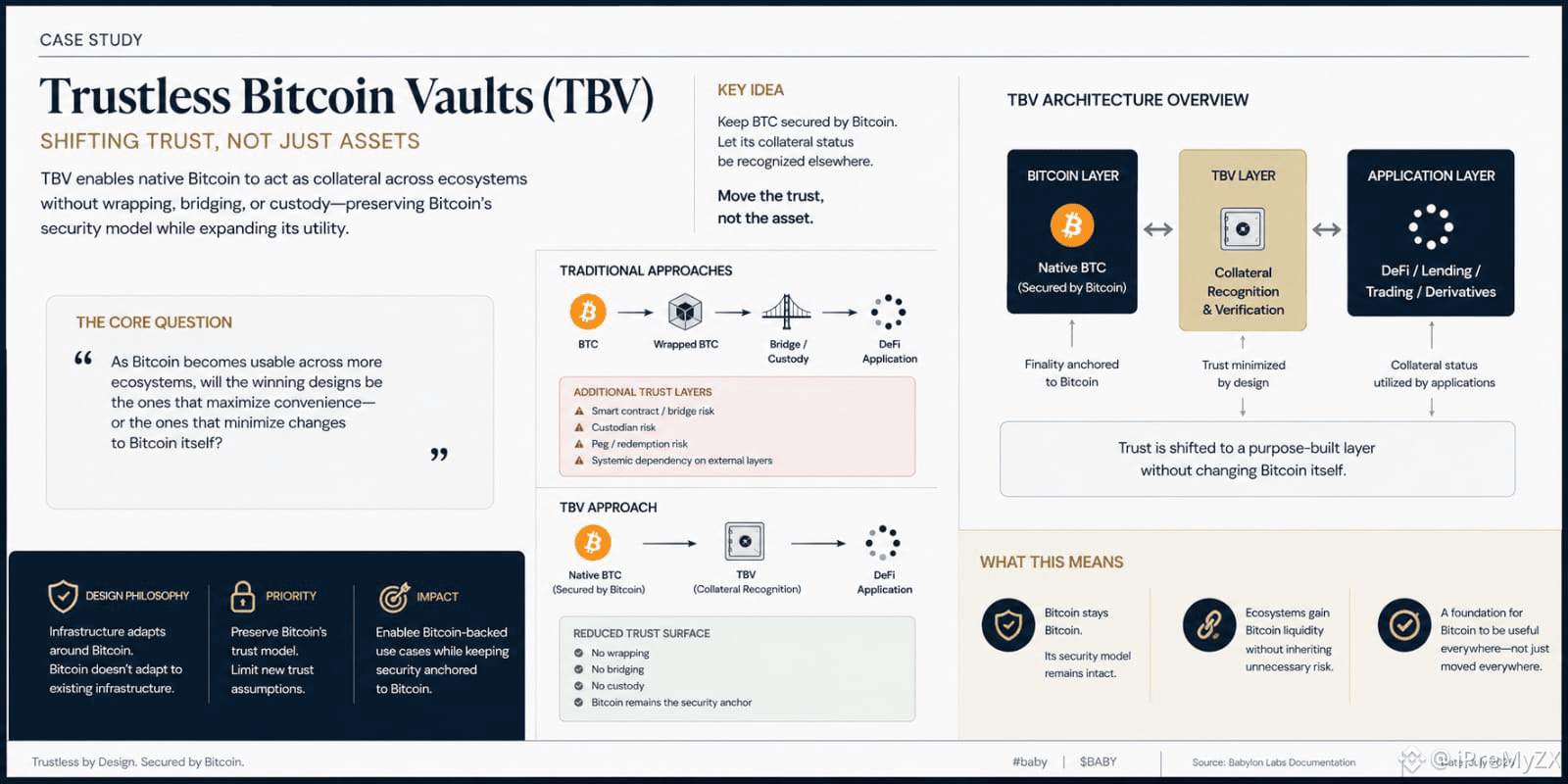
1
105
·
--
#baby $BABY
Bir vaxtlar insanların Bitcoin-i niyə bükdüyünü (wrapped) başa düşdüyümü düşünürdüm.
Sadəcə elə normal yol kimi hiss olunurdu. Əgər DeFi-də BTC istifadə etmək istəyirdinsə, onu wrapped edirdin, köçürürdün (bridged) və davam edirdin. Mən heç vaxt həqiqətən bunun üzərində düşünmədim, çünki hamı bunu sadəcə iştirak etməyin qiyməti kimi qəbul edirdi.
Sonra bir axşam özümü @BabylonLabs_io-dan Trustless Bitcoin Vaults (TBV) haqqında oxuyarkən tapdım.
Casual (sadə) araşdırma kimi başlayan iş gözlədiyimdən daha uzun bir “dovşan yuvasına” çevrildi.
Maraqlı olan hissə TBV-nin Bitcoin-dən başqa bir şəkildə istifadə etməyə imkan verməsi deyildi. Onun altında gizlənən sual idi.
Bitcoin niyə faydalı olmaq üçün mütləq nəyəsə çevrilməlidir?
Bu fikir mənimlə qaldı.
Nə qədər çox öyrəndimsə, bir o qədər anladım ki, Bitcoin-in ətrafına əlavə qatlar qatmağı onun əvvəlcə zəruri olub-olmadığını soruşmaqdan daha rahat sayırıq. Wrapper-lar, bridges-lər, custodians-lər real problemləri həll edirdi, amma eyni zamanda biz çox nadir hallarda etiraz etdiyimiz fərziyyələrə çevrildi.
TBV isə bunu fərqli yanaşma ilə edir: yerli (native) Bitcoin-i təminat (collateral) kimi istifadə etməyə imkan verir və eyni zamanda Bitcoin-in özünün təhlükəsizlik modelinə bağlı qalır. Sanki ticarət güzəştlərinin (trade-off) olmadığını iddia etmək deyil. Söhbət istifadəçilərin qəbul etməli olduğu güzəştlərin hansını dəyişməkdən gedir.
Mən hələ də öyrənirəm, ona görə bütün cavablarımın olduğunu iddia etmirəm.
Amma hərdən bir protokol elə olur ki, sən sadəcə müqayisə etmək üçün başqa bir funksiya əlavə etməklə yox, düşünmə tərzini dəyişir.
Mənim üçün @babylonlabs_io has məhz bunu etdi.
Bəlkə də qazandığım ən dəyərli şey izləyəcək yeni bir məhsul olmamışdı—saxlayıb davamlı verməli olduğum yeni bir sual idi.
#baby $BABY
Bir vaxtlar insanların Bitcoin-i niyə bükdüyünü (wrapped) başa düşdüyümü düşünürdüm.
Sadəcə elə normal yol kimi hiss olunurdu. Əgər DeFi-də BTC istifadə etmək istəyirdinsə, onu wrapped edirdin, köçürürdün (bridged) və davam edirdin. Mən heç vaxt həqiqətən bunun üzərində düşünmədim, çünki hamı bunu sadəcə iştirak etməyin qiyməti kimi qəbul edirdi.
Sonra bir axşam özümü @BabylonLabs_io-dan Trustless Bitcoin Vaults (TBV) haqqında oxuyarkən tapdım.
Casual (sadə) araşdırma kimi başlayan iş gözlədiyimdən daha uzun bir “dovşan yuvasına” çevrildi.
Maraqlı olan hissə TBV-nin Bitcoin-dən başqa bir şəkildə istifadə etməyə imkan verməsi deyildi. Onun altında gizlənən sual idi.
Bitcoin niyə faydalı olmaq üçün mütləq nəyəsə çevrilməlidir?
Bu fikir mənimlə qaldı.
Nə qədər çox öyrəndimsə, bir o qədər anladım ki, Bitcoin-in ətrafına əlavə qatlar qatmağı onun əvvəlcə zəruri olub-olmadığını soruşmaqdan daha rahat sayırıq. Wrapper-lar, bridges-lər, custodians-lər real problemləri həll edirdi, amma eyni zamanda biz çox nadir hallarda etiraz etdiyimiz fərziyyələrə çevrildi.
TBV isə bunu fərqli yanaşma ilə edir: yerli (native) Bitcoin-i təminat (collateral) kimi istifadə etməyə imkan verir və eyni zamanda Bitcoin-in özünün təhlükəsizlik modelinə bağlı qalır. Sanki ticarət güzəştlərinin (trade-off) olmadığını iddia etmək deyil. Söhbət istifadəçilərin qəbul etməli olduğu güzəştlərin hansını dəyişməkdən gedir.
Mən hələ də öyrənirəm, ona görə bütün cavablarımın olduğunu iddia etmirəm.
Amma hərdən bir protokol elə olur ki, sən sadəcə müqayisə etmək üçün başqa bir funksiya əlavə etməklə yox, düşünmə tərzini dəyişir.
Mənim üçün @BabylonLabs_io has məhz bunu etdi.
Bəlkə də qazandığım ən dəyərli şey izləyəcək yeni bir məhsul olmamışdı—saxlayıb davamlı verməli olduğum yeni bir sual idi.
Bir vaxtlar insanların Bitcoin-i niyə bükdüyünü (wrapped) başa düşdüyümü düşünürdüm.
Sadəcə elə normal yol kimi hiss olunurdu. Əgər DeFi-də BTC istifadə etmək istəyirdinsə, onu wrapped edirdin, köçürürdün (bridged) və davam edirdin. Mən heç vaxt həqiqətən bunun üzərində düşünmədim, çünki hamı bunu sadəcə iştirak etməyin qiyməti kimi qəbul edirdi.
Sonra bir axşam özümü @BabylonLabs_io-dan Trustless Bitcoin Vaults (TBV) haqqında oxuyarkən tapdım.
Casual (sadə) araşdırma kimi başlayan iş gözlədiyimdən daha uzun bir “dovşan yuvasına” çevrildi.
Maraqlı olan hissə TBV-nin Bitcoin-dən başqa bir şəkildə istifadə etməyə imkan verməsi deyildi. Onun altında gizlənən sual idi.
Bitcoin niyə faydalı olmaq üçün mütləq nəyəsə çevrilməlidir?
Bu fikir mənimlə qaldı.
Nə qədər çox öyrəndimsə, bir o qədər anladım ki, Bitcoin-in ətrafına əlavə qatlar qatmağı onun əvvəlcə zəruri olub-olmadığını soruşmaqdan daha rahat sayırıq. Wrapper-lar, bridges-lər, custodians-lər real problemləri həll edirdi, amma eyni zamanda biz çox nadir hallarda etiraz etdiyimiz fərziyyələrə çevrildi.
TBV isə bunu fərqli yanaşma ilə edir: yerli (native) Bitcoin-i təminat (collateral) kimi istifadə etməyə imkan verir və eyni zamanda Bitcoin-in özünün təhlükəsizlik modelinə bağlı qalır. Sanki ticarət güzəştlərinin (trade-off) olmadığını iddia etmək deyil. Söhbət istifadəçilərin qəbul etməli olduğu güzəştlərin hansını dəyişməkdən gedir.
Mən hələ də öyrənirəm, ona görə bütün cavablarımın olduğunu iddia etmirəm.
Amma hərdən bir protokol elə olur ki, sən sadəcə müqayisə etmək üçün başqa bir funksiya əlavə etməklə yox, düşünmə tərzini dəyişir.
Mənim üçün @BabylonLabs_io has məhz bunu etdi.
Bəlkə də qazandığım ən dəyərli şey izləyəcək yeni bir məhsul olmamışdı—saxlayıb davamlı verməli olduğum yeni bir sual idi.
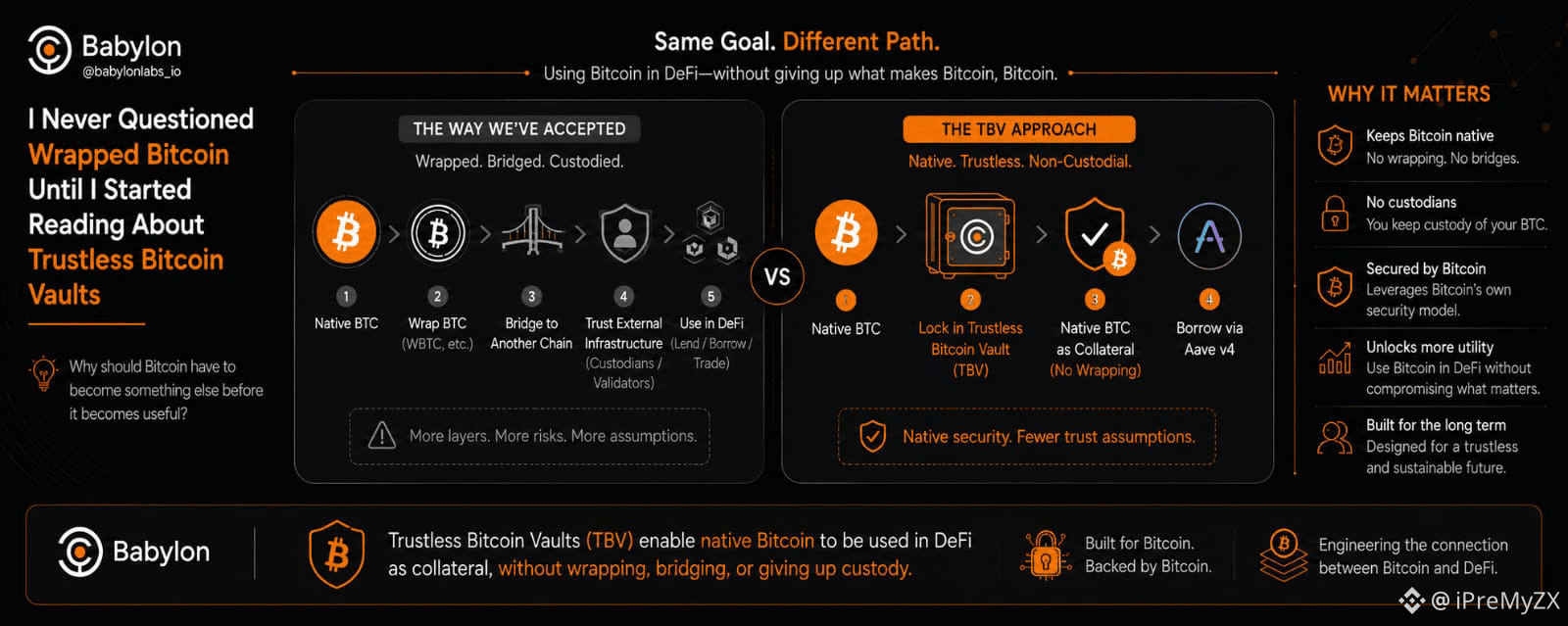
102
·
--
#baby $BABY
Bir sənədin illərdir qəbul etdiyim bir şeyi sorğulamağa məni gətirəcəyini gözləmirdim.
Bu, gecə yarısı Bitcoin infrastrukturunu oxuyarkən oldu. Eyni naxışı hər dəfə görürdüm. Hər dəfə Bitcoin DeFi-də iştirak etmək istəyəndə, ilk göstəriş demək olar ki, avtomatik olurdu.
Bük.
Körpü qur.
Başqa bir yerə köçür.
Bir nöqtədə anladım ki, artıq niyə soruşmağı dayandırmışam.
Bəlkə də ideya kifayət qədər uzun təkrarlananda belə olur. Kompromis kimi hissdən çıxır və yeganə seçim kimi görünməyə başlayır.
Sonra @babylonlabs_io -dən Trustless Bitcoin Vaults (TBV) haqqında oxumağa başladım.
Diqqətimi cəlb edən onun daha sürətli və ya daha böyük bir şey vəd etməsi deyildi. Heç vaxt özümün də sorğulamadığım bir fərziyyəti sorğulaması idi.
Bitcoin niyə faydalı olmaq üçün Bitcoin-dən ayrılmalıdır?
Bu fikirlə daha çox oturduqca, qalan hər şey geriyə doğru görünməyə başladı. Bəlkə illərldir DeFi-yi Bitcoin-in öz təhlükəsizlik modelinə hörmət etməsi üçün uyğunlaşdırmaq əvəzinə, Bitcoin-i DeFi-yə uyğunlaşdırmaq yolları dizayn edirik.
TBV heç cür bütün ticarət güzəştlərini (trade-off) sehr kimi aradan qaldırmır. Bitcoin yenə də Bitcoin-dir. Yerləşdirmə (settlement) yenə də vaxt tələb edir.
Amma inam (etibar) yerdəyişir.
İstifadəçilərdən wrapper-lərə, körpülərə və ya qəyyumlara inanmağı istəmək əvəzinə, sistem daha çox Bitcoin-in öz qaydalarına söykənir.
Bu, rahatlığı qovmaq kimi yox, açmağa çalışdığın aktivə hörmət etmək kimi hiss olunur.
Bəlkə də Bitcoin DeFi-nin indiyə qədər çatışmayan istiqaməti məhz budur.
#baby $BABY
Bir sənədin illərdir qəbul etdiyim bir şeyi sorğulamağa məni gətirəcəyini gözləmirdim.
Bu, gecə yarısı Bitcoin infrastrukturunu oxuyarkən oldu. Eyni naxışı hər dəfə görürdüm. Hər dəfə Bitcoin DeFi-də iştirak etmək istəyəndə, ilk göstəriş demək olar ki, avtomatik olurdu.
Bük.
Körpü qur.
Başqa bir yerə köçür.
Bir nöqtədə anladım ki, artıq niyə soruşmağı dayandırmışam.
Bəlkə də ideya kifayət qədər uzun təkrarlananda belə olur. Kompromis kimi hissdən çıxır və yeganə seçim kimi görünməyə başlayır.
Sonra @BabylonLabs_io -dən Trustless Bitcoin Vaults (TBV) haqqında oxumağa başladım.
Diqqətimi cəlb edən onun daha sürətli və ya daha böyük bir şey vəd etməsi deyildi. Heç vaxt özümün də sorğulamadığım bir fərziyyəti sorğulaması idi.
Bitcoin niyə faydalı olmaq üçün Bitcoin-dən ayrılmalıdır?
Bu fikirlə daha çox oturduqca, qalan hər şey geriyə doğru görünməyə başladı. Bəlkə illərldir DeFi-yi Bitcoin-in öz təhlükəsizlik modelinə hörmət etməsi üçün uyğunlaşdırmaq əvəzinə, Bitcoin-i DeFi-yə uyğunlaşdırmaq yolları dizayn edirik.
TBV heç cür bütün ticarət güzəştlərini (trade-off) sehr kimi aradan qaldırmır. Bitcoin yenə də Bitcoin-dir. Yerləşdirmə (settlement) yenə də vaxt tələb edir.
Amma inam (etibar) yerdəyişir.
İstifadəçilərdən wrapper-lərə, körpülərə və ya qəyyumlara inanmağı istəmək əvəzinə, sistem daha çox Bitcoin-in öz qaydalarına söykənir.
Bu, rahatlığı qovmaq kimi yox, açmağa çalışdığın aktivə hörmət etmək kimi hiss olunur.
Bəlkə də Bitcoin DeFi-nin indiyə qədər çatışmayan istiqaməti məhz budur.
Bir sənədin illərdir qəbul etdiyim bir şeyi sorğulamağa məni gətirəcəyini gözləmirdim.
Bu, gecə yarısı Bitcoin infrastrukturunu oxuyarkən oldu. Eyni naxışı hər dəfə görürdüm. Hər dəfə Bitcoin DeFi-də iştirak etmək istəyəndə, ilk göstəriş demək olar ki, avtomatik olurdu.
Bük.
Körpü qur.
Başqa bir yerə köçür.
Bir nöqtədə anladım ki, artıq niyə soruşmağı dayandırmışam.
Bəlkə də ideya kifayət qədər uzun təkrarlananda belə olur. Kompromis kimi hissdən çıxır və yeganə seçim kimi görünməyə başlayır.
Sonra @BabylonLabs_io -dən Trustless Bitcoin Vaults (TBV) haqqında oxumağa başladım.
Diqqətimi cəlb edən onun daha sürətli və ya daha böyük bir şey vəd etməsi deyildi. Heç vaxt özümün də sorğulamadığım bir fərziyyəti sorğulaması idi.
Bitcoin niyə faydalı olmaq üçün Bitcoin-dən ayrılmalıdır?
Bu fikirlə daha çox oturduqca, qalan hər şey geriyə doğru görünməyə başladı. Bəlkə illərldir DeFi-yi Bitcoin-in öz təhlükəsizlik modelinə hörmət etməsi üçün uyğunlaşdırmaq əvəzinə, Bitcoin-i DeFi-yə uyğunlaşdırmaq yolları dizayn edirik.
TBV heç cür bütün ticarət güzəştlərini (trade-off) sehr kimi aradan qaldırmır. Bitcoin yenə də Bitcoin-dir. Yerləşdirmə (settlement) yenə də vaxt tələb edir.
Amma inam (etibar) yerdəyişir.
İstifadəçilərdən wrapper-lərə, körpülərə və ya qəyyumlara inanmağı istəmək əvəzinə, sistem daha çox Bitcoin-in öz qaydalarına söykənir.
Bu, rahatlığı qovmaq kimi yox, açmağa çalışdığın aktivə hörmət etmək kimi hiss olunur.
Bəlkə də Bitcoin DeFi-nin indiyə qədər çatışmayan istiqaməti məhz budur.
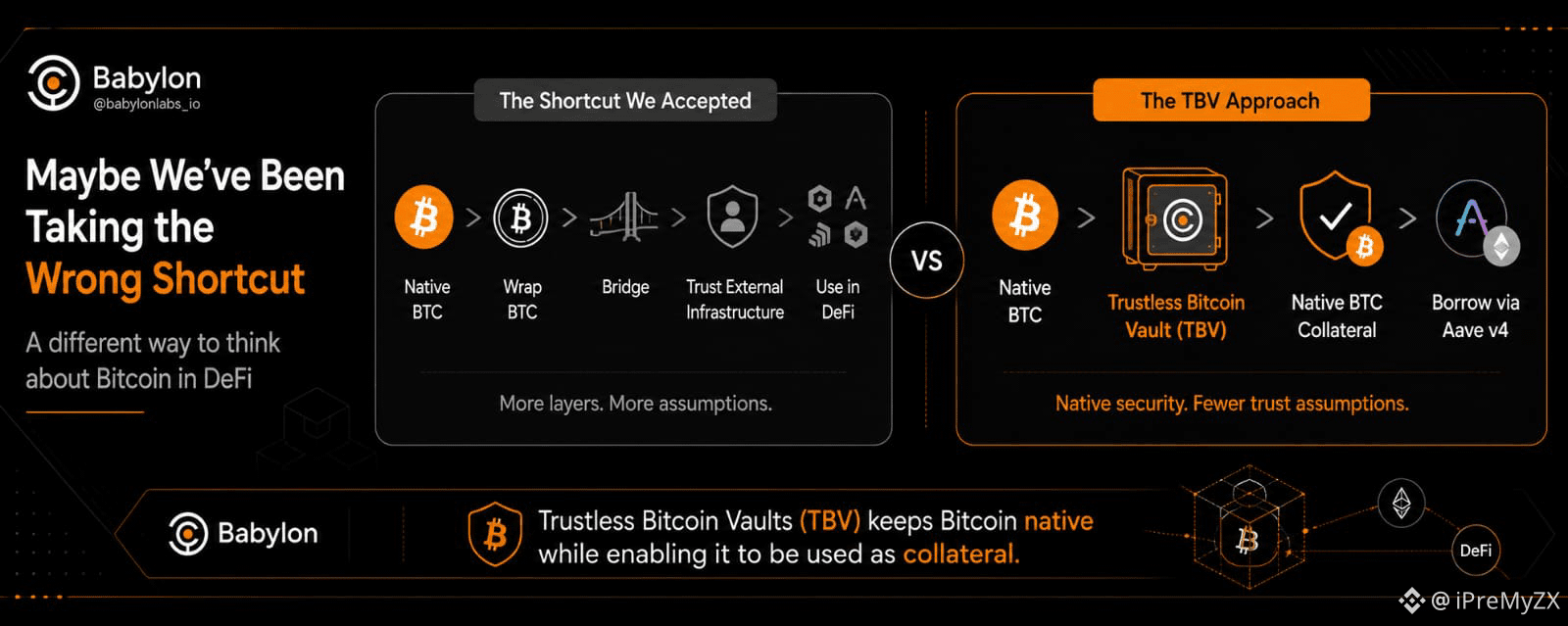
1
117
·
--
#baby $BABY
Bir neçə gün əvvəl, adi rutinimlə məşğul olurdum. Masanın üstündə qəhvə, bir neçə tab açıq və qrafiklərə baxmaq yerinə kripto infrastrukturunu oxumaqla keçən başqa bir axşam.
Yeni bir layihə axtarmırdım. Əslində, Bitcoin niyə hələ də bu qədər DeFi-nin böyük hissəsindən kənar hiss olunur sualını anlamağa çalışırdım—halbuki məkanın ən böyük aktividir.
Həmişə ən açıq cavab belə görünürdü: "Sadəcə sarın."
İllərdir bunu çox da düşünmədən qəbul etmişdim.
Amma @babylonlabs_io və Trustless Bitcoin Vaults (TBV) haqqında oxuduqca, Bitcoin-i sarmağın bəlkə də rahatlaşdığımız—mütləq ən yaxşı həll olmayan—bir qısa yol olduğunu daha aydın anladım.
Bu yanaşma bir problemi həll edərək, bir neçə başqa problemin ortaya çıxmasına səbəb oldu.
Bitcoin-i zəncirlər arasında daşımaq, körpülərdən (bridges) asılı olmaq və ya vasitəçilərə güvənmək yavaş-yavaş normal yola çevrildi. Düşünmürəm ki, çoxumuz Bitcoin-in həqiqətən də başqa yerdə faydalı olmaq üçün öz təhlükəsizlik modelini tərk etməyə ehtiyacının olub-olmadığını soruşmağı dayandırmışıq.
Məhz bu məni TBV-yə yaxınlaşdırdı.
Bitcoin-i dəyişmək əvəzinə ideya ondan ibarətdir ki, doğma Bitcoin girov kimi istifadə olunsun, eyni zamanda onun Bitcoin-in özünə bağlanmış (anchored) qalması təmin edilsin. Bu, Bitcoin-i DeFi-yə məcburən uyğunlaşdırmaq kimi deyil, daha çox Bitcoin-in artıq nə olduğuna hörmət edən infrastruktur dizayn etmək kimi hiss olunur.
Hələ öyrənirəm və düşünmürəm ki, heç bir protokolun bütün cavabları var.
Amma bəzən elə bir ideya ilə rastlaşırsan ki, illərdir daşıdığın bir fərziyyəni yenidən düşünməyə məcbur edir.
Mənim üçün @babylonlabs_io həmin layihələrdən biri olub.
#baby $BABY
Bir neçə gün əvvəl, adi rutinimlə məşğul olurdum. Masanın üstündə qəhvə, bir neçə tab açıq və qrafiklərə baxmaq yerinə kripto infrastrukturunu oxumaqla keçən başqa bir axşam.
Yeni bir layihə axtarmırdım. Əslində, Bitcoin niyə hələ də bu qədər DeFi-nin böyük hissəsindən kənar hiss olunur sualını anlamağa çalışırdım—halbuki məkanın ən böyük aktividir.
Həmişə ən açıq cavab belə görünürdü: "Sadəcə sarın."
İllərdir bunu çox da düşünmədən qəbul etmişdim.
Amma @BabylonLabs_io və Trustless Bitcoin Vaults (TBV) haqqında oxuduqca, Bitcoin-i sarmağın bəlkə də rahatlaşdığımız—mütləq ən yaxşı həll olmayan—bir qısa yol olduğunu daha aydın anladım.
Bu yanaşma bir problemi həll edərək, bir neçə başqa problemin ortaya çıxmasına səbəb oldu.
Bitcoin-i zəncirlər arasında daşımaq, körpülərdən (bridges) asılı olmaq və ya vasitəçilərə güvənmək yavaş-yavaş normal yola çevrildi. Düşünmürəm ki, çoxumuz Bitcoin-in həqiqətən də başqa yerdə faydalı olmaq üçün öz təhlükəsizlik modelini tərk etməyə ehtiyacının olub-olmadığını soruşmağı dayandırmışıq.
Məhz bu məni TBV-yə yaxınlaşdırdı.
Bitcoin-i dəyişmək əvəzinə ideya ondan ibarətdir ki, doğma Bitcoin girov kimi istifadə olunsun, eyni zamanda onun Bitcoin-in özünə bağlanmış (anchored) qalması təmin edilsin. Bu, Bitcoin-i DeFi-yə məcburən uyğunlaşdırmaq kimi deyil, daha çox Bitcoin-in artıq nə olduğuna hörmət edən infrastruktur dizayn etmək kimi hiss olunur.
Hələ öyrənirəm və düşünmürəm ki, heç bir protokolun bütün cavabları var.
Amma bəzən elə bir ideya ilə rastlaşırsan ki, illərdir daşıdığın bir fərziyyəni yenidən düşünməyə məcbur edir.
Mənim üçün @BabylonLabs_io həmin layihələrdən biri olub.
Bir neçə gün əvvəl, adi rutinimlə məşğul olurdum. Masanın üstündə qəhvə, bir neçə tab açıq və qrafiklərə baxmaq yerinə kripto infrastrukturunu oxumaqla keçən başqa bir axşam.
Yeni bir layihə axtarmırdım. Əslində, Bitcoin niyə hələ də bu qədər DeFi-nin böyük hissəsindən kənar hiss olunur sualını anlamağa çalışırdım—halbuki məkanın ən böyük aktividir.
Həmişə ən açıq cavab belə görünürdü: "Sadəcə sarın."
İllərdir bunu çox da düşünmədən qəbul etmişdim.
Amma @BabylonLabs_io və Trustless Bitcoin Vaults (TBV) haqqında oxuduqca, Bitcoin-i sarmağın bəlkə də rahatlaşdığımız—mütləq ən yaxşı həll olmayan—bir qısa yol olduğunu daha aydın anladım.
Bu yanaşma bir problemi həll edərək, bir neçə başqa problemin ortaya çıxmasına səbəb oldu.
Bitcoin-i zəncirlər arasında daşımaq, körpülərdən (bridges) asılı olmaq və ya vasitəçilərə güvənmək yavaş-yavaş normal yola çevrildi. Düşünmürəm ki, çoxumuz Bitcoin-in həqiqətən də başqa yerdə faydalı olmaq üçün öz təhlükəsizlik modelini tərk etməyə ehtiyacının olub-olmadığını soruşmağı dayandırmışıq.
Məhz bu məni TBV-yə yaxınlaşdırdı.
Bitcoin-i dəyişmək əvəzinə ideya ondan ibarətdir ki, doğma Bitcoin girov kimi istifadə olunsun, eyni zamanda onun Bitcoin-in özünə bağlanmış (anchored) qalması təmin edilsin. Bu, Bitcoin-i DeFi-yə məcburən uyğunlaşdırmaq kimi deyil, daha çox Bitcoin-in artıq nə olduğuna hörmət edən infrastruktur dizayn etmək kimi hiss olunur.
Hələ öyrənirəm və düşünmürəm ki, heç bir protokolun bütün cavabları var.
Amma bəzən elə bir ideya ilə rastlaşırsan ki, illərdir daşıdığın bir fərziyyəni yenidən düşünməyə məcbur edir.
Mənim üçün @BabylonLabs_io həmin layihələrdən biri olub.
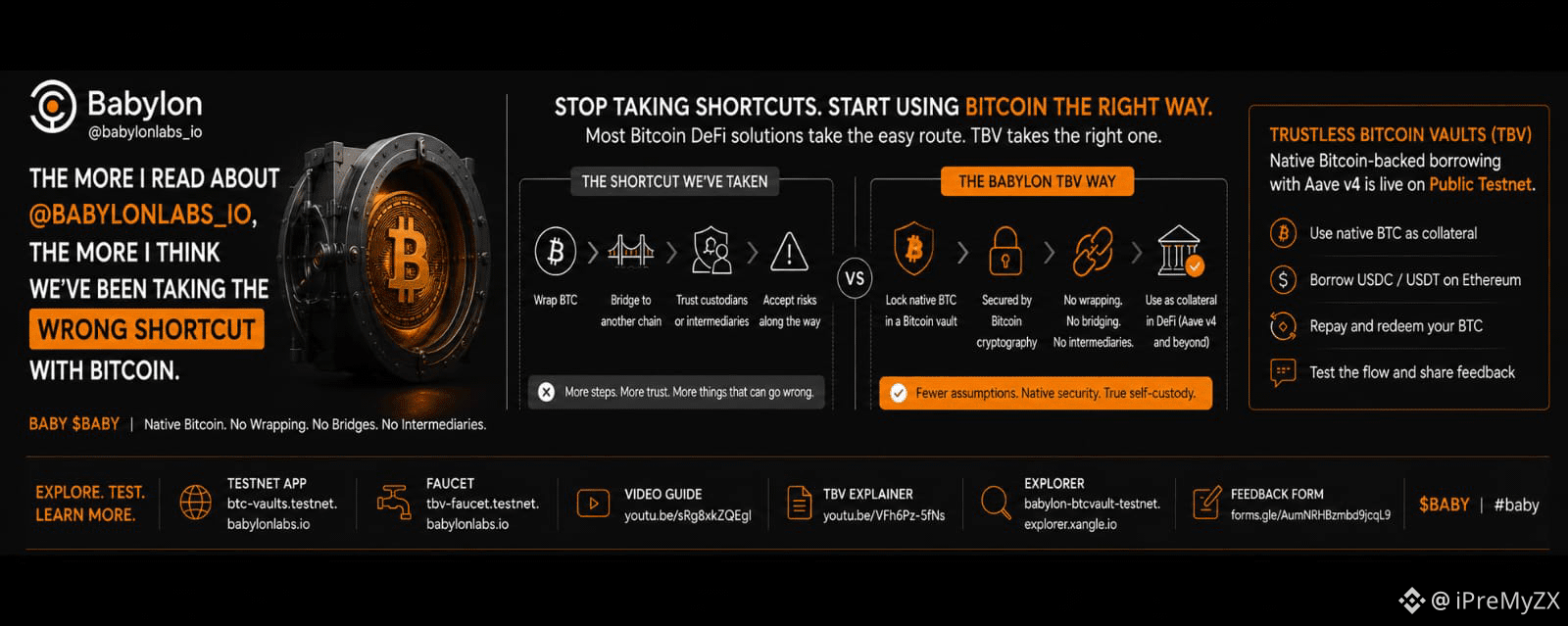
84
·
--
#baby $BABY
İnsanlar DeFi-də Bitcoin haqqında danışanda söhbət adətən gəlir (yield) ətrafında fırlanır. Hansı protokol daha çoxunu təklif edir? Hansı strategiya daha səmərəlidir?
Məkana daha çox girdikcə, bu müzakirələrin daha böyük bir sualı kənarda qoyduğunu daha çox hiss etdim.
Biz o gəliri qazanmazdan əvvəl nəyə razılaşırıq?
İllərdir DeFi-də Bitcoin-dən istifadə etmək çox vaxt bir sıra güzəştləri qəbul etmək demək olub. BTC-ni sarın (wrap). Onu başqa şəbəkəyə (chain) körpüləyin. Mərkəzləşdirilmiş vasitəçi və ya başqa bir infrastruktura etibar edin. Bu addımlar o qədər yayğınlaşdı ki, çoxumuz onları artıq güzəşt kimi düşünməyi dayandırdıq.
@babylonlabs_io tərəfindən yazılmış Trustless Bitcoin Vaults (TBV) haqqında oxumaq mənə həmin fərziyyəni yenidən düşünməyə səbəb oldu.
Diqqətimi çəkən daha yüksək gəlir vədindən çox, lazımsız etibarı azaltmaq cəhdi oldu. TBV, BTC-ni sarımadan, körpüləmədən və ya mərkəzləşdirilmiş vasitəçilərə etibar etmədən, doğma Bitcoin-in təminat (collateral) kimi xidmət etməsinə imkan yaratmaq üçün nəzərdə tutulub. Bu yanaşma, mənə Bitcoin-in ilkin təhlükəsizlik modelinə daha yaxın gəlir.
Mən həm də maraqlı tapıram ki, ilk tətbiq Aave v4 ilə doğma Bitcoin-təminatlı borclanmağa yönəlib. DeFi-i yenidən icad etməyə çalışmaq yerinə, Bitcoin-in ona ilk dəfə necə daxil olduğunu yenidən düşünür.
Mən demirəm ki, mövcud bütün həllər yanlışdır və ya TBV yekun cavabdır. Amma düşünürəm ki, bu, söhbəti daha fundamental bir məqama doğru dəyişir.
Bəlkə də ən böyük yenilik başqa bir gəlir (yield) yaratma yolunu tapmaq deyil.
Bəlkə də bu, hələ oraya çatmazdan əvvəl səssizcə qəbul etdiyimiz güzəştlərin sayını azaltmaqdır.
Bu baxış @babylonlabs_io -ın mənə düşünməyə vadar etdiyi şey oldu.
#baby $BABY
İnsanlar DeFi-də Bitcoin haqqında danışanda söhbət adətən gəlir (yield) ətrafında fırlanır. Hansı protokol daha çoxunu təklif edir? Hansı strategiya daha səmərəlidir?
Məkana daha çox girdikcə, bu müzakirələrin daha böyük bir sualı kənarda qoyduğunu daha çox hiss etdim.
Biz o gəliri qazanmazdan əvvəl nəyə razılaşırıq?
İllərdir DeFi-də Bitcoin-dən istifadə etmək çox vaxt bir sıra güzəştləri qəbul etmək demək olub. BTC-ni sarın (wrap). Onu başqa şəbəkəyə (chain) körpüləyin. Mərkəzləşdirilmiş vasitəçi və ya başqa bir infrastruktura etibar edin. Bu addımlar o qədər yayğınlaşdı ki, çoxumuz onları artıq güzəşt kimi düşünməyi dayandırdıq.
@BabylonLabs_io tərəfindən yazılmış Trustless Bitcoin Vaults (TBV) haqqında oxumaq mənə həmin fərziyyəni yenidən düşünməyə səbəb oldu.
Diqqətimi çəkən daha yüksək gəlir vədindən çox, lazımsız etibarı azaltmaq cəhdi oldu. TBV, BTC-ni sarımadan, körpüləmədən və ya mərkəzləşdirilmiş vasitəçilərə etibar etmədən, doğma Bitcoin-in təminat (collateral) kimi xidmət etməsinə imkan yaratmaq üçün nəzərdə tutulub. Bu yanaşma, mənə Bitcoin-in ilkin təhlükəsizlik modelinə daha yaxın gəlir.
Mən həm də maraqlı tapıram ki, ilk tətbiq Aave v4 ilə doğma Bitcoin-təminatlı borclanmağa yönəlib. DeFi-i yenidən icad etməyə çalışmaq yerinə, Bitcoin-in ona ilk dəfə necə daxil olduğunu yenidən düşünür.
Mən demirəm ki, mövcud bütün həllər yanlışdır və ya TBV yekun cavabdır. Amma düşünürəm ki, bu, söhbəti daha fundamental bir məqama doğru dəyişir.
Bəlkə də ən böyük yenilik başqa bir gəlir (yield) yaratma yolunu tapmaq deyil.
Bəlkə də bu, hələ oraya çatmazdan əvvəl səssizcə qəbul etdiyimiz güzəştlərin sayını azaltmaqdır.
Bu baxış @BabylonLabs_io -ın mənə düşünməyə vadar etdiyi şey oldu.
İnsanlar DeFi-də Bitcoin haqqında danışanda söhbət adətən gəlir (yield) ətrafında fırlanır. Hansı protokol daha çoxunu təklif edir? Hansı strategiya daha səmərəlidir?
Məkana daha çox girdikcə, bu müzakirələrin daha böyük bir sualı kənarda qoyduğunu daha çox hiss etdim.
Biz o gəliri qazanmazdan əvvəl nəyə razılaşırıq?
İllərdir DeFi-də Bitcoin-dən istifadə etmək çox vaxt bir sıra güzəştləri qəbul etmək demək olub. BTC-ni sarın (wrap). Onu başqa şəbəkəyə (chain) körpüləyin. Mərkəzləşdirilmiş vasitəçi və ya başqa bir infrastruktura etibar edin. Bu addımlar o qədər yayğınlaşdı ki, çoxumuz onları artıq güzəşt kimi düşünməyi dayandırdıq.
@BabylonLabs_io tərəfindən yazılmış Trustless Bitcoin Vaults (TBV) haqqında oxumaq mənə həmin fərziyyəni yenidən düşünməyə səbəb oldu.
Diqqətimi çəkən daha yüksək gəlir vədindən çox, lazımsız etibarı azaltmaq cəhdi oldu. TBV, BTC-ni sarımadan, körpüləmədən və ya mərkəzləşdirilmiş vasitəçilərə etibar etmədən, doğma Bitcoin-in təminat (collateral) kimi xidmət etməsinə imkan yaratmaq üçün nəzərdə tutulub. Bu yanaşma, mənə Bitcoin-in ilkin təhlükəsizlik modelinə daha yaxın gəlir.
Mən həm də maraqlı tapıram ki, ilk tətbiq Aave v4 ilə doğma Bitcoin-təminatlı borclanmağa yönəlib. DeFi-i yenidən icad etməyə çalışmaq yerinə, Bitcoin-in ona ilk dəfə necə daxil olduğunu yenidən düşünür.
Mən demirəm ki, mövcud bütün həllər yanlışdır və ya TBV yekun cavabdır. Amma düşünürəm ki, bu, söhbəti daha fundamental bir məqama doğru dəyişir.
Bəlkə də ən böyük yenilik başqa bir gəlir (yield) yaratma yolunu tapmaq deyil.
Bəlkə də bu, hələ oraya çatmazdan əvvəl səssizcə qəbul etdiyimiz güzəştlərin sayını azaltmaqdır.
Bu baxış @BabylonLabs_io -ın mənə düşünməyə vadar etdiyi şey oldu.
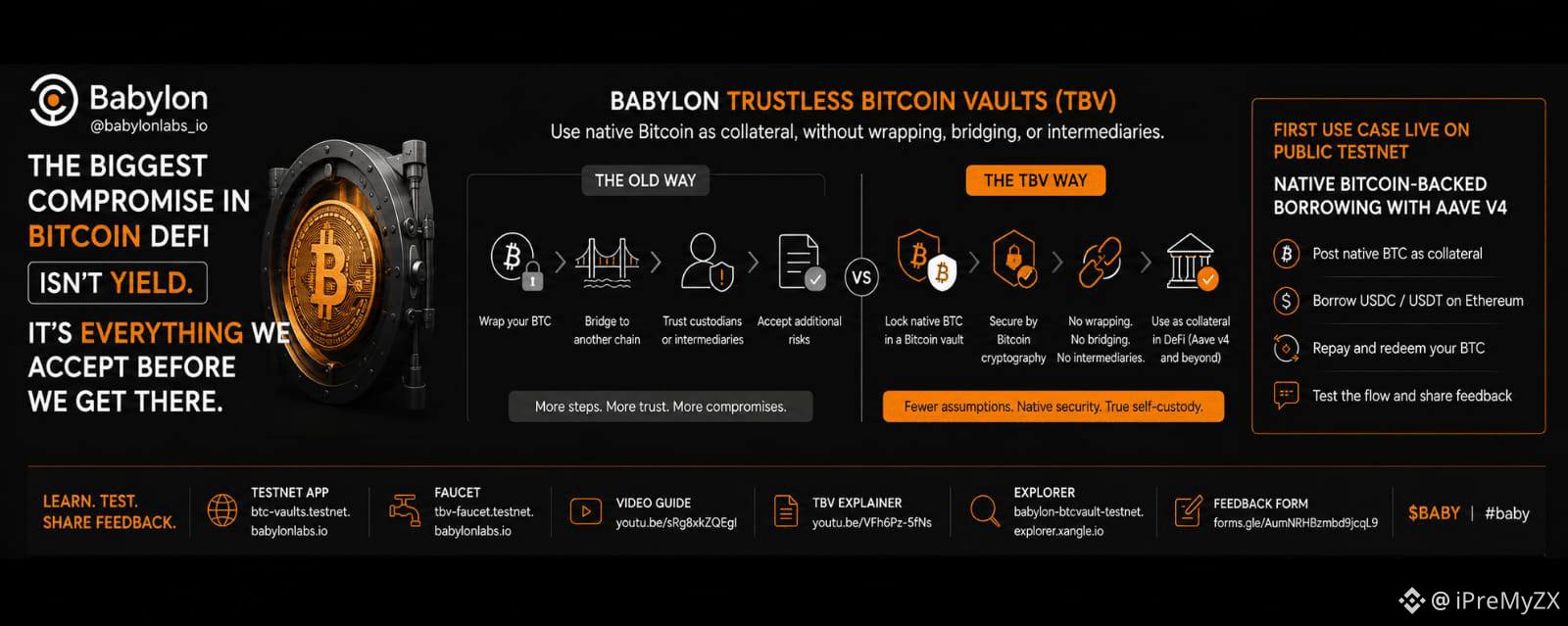
87
Daha çox kontent araşdırmaq üçün daxil olun
Binance Square-də qlobal kriptovalyuta istifadəçilərinə qoşulun
⚡️ Kriptovalyuta haqqında ən son və faydalı məlumatları əldə edin.
💬 Dünyanın ən böyük kriptovalyuta birjası tərəfindən etibar edilir.
👍 Doğrulanmış yaradıcılardan gələn real məlumatları kəşf edin.
E-poçt/Telefon nömrəsi
Trenddə olan mövzular
AppleDebutsFoldablePhone
8,518 baxış
Müzakirə edir: 211
$BTC
Apple qatlanan ekran göndərdi
Fanatlar dövrləşdirməni hesablayır
Köhnə “börk” isə neçə BTC lazım olduğunu hesablayır
Qardaşlar
Apple nəhayət boğulduğunu açdı
İlk dəfə qatlanan telefon
iPhone Duo
Çin bazarında 15999-dan başlayır
Ən yüksək versiyası birbaşa 26499-a qədər
Mən bu qiymətə baxdım
İlk reaksiyam bahadır demək yox
Dərhal birja açıb hesabladım
İndiki kriptovalyuta qiymətlərinə görə
bu telefon təxminən 0.025 BTC edir
0.025 BTC
Çox deyil kimi səslənir, elə deyil?
Amma tarixə bax.
O vaxt iPhone 4s çıxanda
qiymət BTC-yə çevriləndə 162 BTC idi
iPhone 6 1.7 BTC
iPhone 13 0.018 BTC
iPhone 17 0.007 BTC
Bu trendi görürsünüz?
Pulunuz artmır
Sadəcə Bitcoin, Apple-ın qiymətini sizinkindən daha “seyreltir”
Əyləncəlisi odur ki, təqdimatda
Apple səhmi “roller-koster” kimi oynadı
Başlanğıcda əvvəlcə düşdü
sonra yenə qalxdı
Bağışlanışda isə azacıq dəyər itirdi
Bazar bu yüksək qiymətli qatlanan cihazın yaxşı satılıb-satılmayacağına dair
çox da yekdil deyil😂😂
Amma qardaşlar
Apple yeni cihaz buraxdı deyə texnologiya “inək” gəldi kimi düşünməyin
“Böyük çörək” (BTC) yüksəlişə mütləq addımlamamalıdır
Apple ilə kripto dünyası arasında birbaşa pul axını yoxdur
Çox telefon satsın da
kripto bazarına avtomatik bir qəpik axmaz
Bu, istehlak tərəfi üçün aparat üzrə müsbət xəbərdir
Yoxsa birbaşa “böyük çörəyi” yüksəldə bilən böyük məntiq deyil
BTC-nin qiymətinin əsas istiqaməti yenə də
FED-in faiz endirməsi və ABŞ dövlət istiqrazlarının gəlirliliyi
Apple yeni məhsul sadəcə sahə üzrə kiçik bir “isti mövzu”dur
Yalnız qısa müddətdə sektorun hissiyatını qaldıra bilər
Ümumi bazarın böyük trendini dəyişmir
Əgər siz onsuz da telefon dəyişməyi düşünürsünüzsə
və üstəlik əlində 0.025 BTC dəyərində boş pulu varsa
Alardınız?
#appledebutsfoldablephone
孔大锤
·2 bəyənmə
·2k baxış
EUExtendsCentralContactPointToCASPs
0 baxış
Müzakirə edir: 1
US10YTreasuryYieldHitsHighestSinceNov2023
12,536 baxış
Müzakirə edir: 243