
Cryptopolitan
57.6k Paylaşımlar

Cryptopolitan
 Square Verified+
Şikayət et
İstifadəçini blokla
Crypto news that doesn't waste your time. Breaking updates, market analysis, on-chain insights. Building the smartest crypto community.

Creator of the Year
1 İzlənilir
161.5K+ İzləyicilər
573.2K+ Bəyəndi
1 Nişanlar
Postlar
BƏRKİDİLDİ
Cryptopolitan-də biz araşdırma aparır, təhlil edir və xəbərləri təqdim edirik—gündəlik.
Fasiləsiz yeniliklərdən dərindən təhlil, təhsil bələdçiləri və bazar məlumatlarına qədər, sizi neytral və autentik xəbərlərlə məlumatlandırmaq üçün buradayıq.
Bizi etibar etdiyiniz üçün təşəkkür edirik ki, sizin etibarlı mənbəyiniz oluruq!
Cryptopolitan-də biz araşdırma aparır, təhlil edir və xəbərləri təqdim edirik—gündəlik.
Fasiləsiz yeniliklərdən dərindən təhlil, təhsil bələdçiləri və bazar məlumatlarına qədər, sizi neytral və autentik xəbərlərlə məlumatlandırmaq üçün buradayıq.
Bizi etibar etdiyiniz üçün təşəkkür edirik ki, sizin etibarlı mənbəyiniz oluruq!
Fasiləsiz yeniliklərdən dərindən təhlil, təhsil bələdçiləri və bazar məlumatlarına qədər, sizi neytral və autentik xəbərlərlə məlumatlandırmaq üçün buradayıq.
Bizi etibar etdiyiniz üçün təşəkkür edirik ki, sizin etibarlı mənbəyiniz oluruq!
120
68
340
1.8k
Məqalə
Tərcüməyə bax
Ninepoint launches first US ETF with bet on North American energy integrationOn September 22, Toronto-based asset management firm Ninepoint Partners initiated trading for its first U.S.-listed fund, hoping that the energy links that unite Canada and the U.S. will endure beyond trade rifts affecting the border.
The Ninepoint North American Energy Independence ETF, which trades on the NYSE Arca under the symbol ENRG, aggregates all companies involved in oil and gas production, pipelines, nuclear and uranium, copper and key minerals into one actively managed portfolio.
This combination also places the investment fund in the center of an issue that cryptocurrency miners are more than familiar with: access to power. Grid access and approved mining locations increasingly affect whether a Bitcoin miner continues mining or directs his efforts into artificial intelligence and high-performance computing (HPC).
What ENRG actually holds
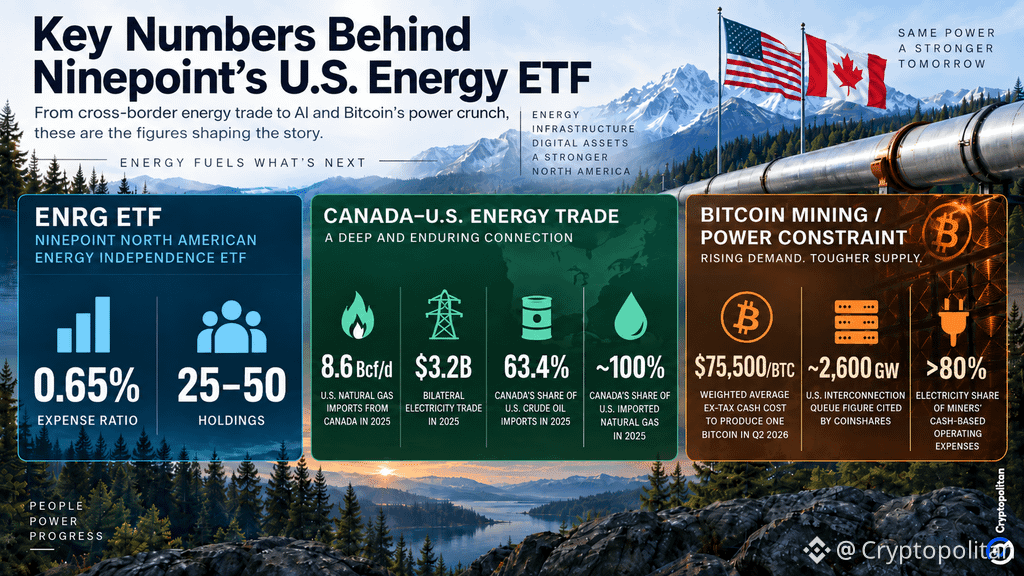
The ENRG has between 25 and 50 stocks in its portfolio and charges an expense ratio of 0.65%. Its portfolio covers the fields of energy supply, transport infrastructure, nuclear energy and uranium, and electrification inputs, including copper and critical minerals. The fund has its focus in Canada as well as in Mexico and the USA, although it can have up to 10% of its investments allowed outside North America. Its SEC filing confirms the management fee of 0.65% and lists Tidal Investments as adviser and Ninepoint Partners as sub-adviser.
Ninepoint co-CEO John Wilson told Reuters that about two-thirds of the fund’s oil and gas producers will be based in the U.S., while Canadian pipeline operators and uranium, copper and other metals miners will make up most of those asset classes.
The thesis: integration outlasts the rhetoric
Wilson’s situation is simple to comprehend. The dependence of the nations on energy across their borders has been in place long before one government came into power, and it will not be removed due to the change of the political powers.
It would be naive to think that the headline stuff is going away any time in the next two years.
—John Wilson, Ninepoint co-CEO.
Trade statistics illustrate just how strong those connections are. As per the EIA, in 2025, the daily average for American natural gas imports from Canada was 8.6 billion cubic feet. Electricity trade amounted to $3.2 billion, with imports from Canada accounting for 67% of the turnover. According to the Canada Energy Regulator, Canada accounted for 63.4% of imports of crude oil and almost 100% of natural gas imported by the U.S. in that period.
According to Ninepoint portfolio manager Eric Nuttall, this strong dependency can be explained on the basis of energy security.
Energy security stopped being an abstraction with Russia’s war in Ukraine and China’s export controls on rare earths.
—Eric Nuttall
Where crypto mining meets the power fight
Ninepoint’s demand theory is directly related to crypto mining. According to the IEA, the electricity demand of data centers increased by 17% and points to the fact that grid connections, transformer stations, and other infrastructure are bottlenecks in terms of providing new connections.
According to Cryptopolitan, the ongoing work on building OpenAI’s computing capacity brings increasing value to power, land, and existing interconnections.
Ninepoint ENRG ETF: North American Energy and Bitcoin Mining Power Stats
The pressures are already apparent in mining economics. CoinShares estimated the weighted average ex-tax cash cost of producing one Bitcoin is around $75,500 as of Q2 2026. The company referred to the U.S. interconnection queue’s staggering figure of approximately 2,600 GW, while the newest available report from the Berkeley Lab showed that more than 2,060 GW of both active generation and storage were in queue awaiting a grid connection at the end of 2025. The discrepancy is likely due to the difference in varying definitions of queues and dates of reporting of the data; therefore, numbers shall not be taken as exact equivalents.
According to the Cambridge Centre for Alternative Finance, electricity represents over 80% of the operating expenditures of miners. Given the expensive and limited nature of electricity, Core Scientific, Keel, Cipher and IREN are scaling down their mining capacity or discontinuing it by repurposing their installations for AI and HPC. The effect on crypto is indirect, but still meaningful.
If electricity gets more costly or less reliable in North America, miners will seek other sources of cheap, reliable electricity. ENRG by itself will not have an impact on Bitcoin price, but it has a relationship with the same constraints that affect Bitcoin mining as a whole.
The smartest crypto minds already read our newsletter. Want in? Join them.
Ninepoint launches first US ETF with bet on North American energy integration
On September 22, Toronto-based asset management firm Ninepoint Partners initiated trading for its first U.S.-listed fund, hoping that the energy links that unite Canada and the U.S. will endure beyond trade rifts affecting the border.
The Ninepoint North American Energy Independence ETF, which trades on the NYSE Arca under the symbol ENRG, aggregates all companies involved in oil and gas production, pipelines, nuclear and uranium, copper and key minerals into one actively managed portfolio.
This combination also places the investment fund in the center of an issue that cryptocurrency miners are more than familiar with: access to power. Grid access and approved mining locations increasingly affect whether a Bitcoin miner continues mining or directs his efforts into artificial intelligence and high-performance computing (HPC).
What ENRG actually holds
The ENRG has between 25 and 50 stocks in its portfolio and charges an expense ratio of 0.65%. Its portfolio covers the fields of energy supply, transport infrastructure, nuclear energy and uranium, and electrification inputs, including copper and critical minerals. The fund has its focus in Canada as well as in Mexico and the USA, although it can have up to 10% of its investments allowed outside North America. Its SEC filing confirms the management fee of 0.65% and lists Tidal Investments as adviser and Ninepoint Partners as sub-adviser.
Ninepoint co-CEO John Wilson told Reuters that about two-thirds of the fund’s oil and gas producers will be based in the U.S., while Canadian pipeline operators and uranium, copper and other metals miners will make up most of those asset classes.
The thesis: integration outlasts the rhetoric
Wilson’s situation is simple to comprehend. The dependence of the nations on energy across their borders has been in place long before one government came into power, and it will not be removed due to the change of the political powers.
It would be naive to think that the headline stuff is going away any time in the next two years.
—John Wilson, Ninepoint co-CEO.
Trade statistics illustrate just how strong those connections are. As per the EIA, in 2025, the daily average for American natural gas imports from Canada was 8.6 billion cubic feet. Electricity trade amounted to $3.2 billion, with imports from Canada accounting for 67% of the turnover. According to the Canada Energy Regulator, Canada accounted for 63.4% of imports of crude oil and almost 100% of natural gas imported by the U.S. in that period.
According to Ninepoint portfolio manager Eric Nuttall, this strong dependency can be explained on the basis of energy security.
Energy security stopped being an abstraction with Russia’s war in Ukraine and China’s export controls on rare earths.
—Eric Nuttall
Where crypto mining meets the power fight
Ninepoint’s demand theory is directly related to crypto mining. According to the IEA, the electricity demand of data centers increased by 17% and points to the fact that grid connections, transformer stations, and other infrastructure are bottlenecks in terms of providing new connections.
According to Cryptopolitan, the ongoing work on building OpenAI’s computing capacity brings increasing value to power, land, and existing interconnections.
Ninepoint ENRG ETF: North American Energy and Bitcoin Mining Power Stats
The pressures are already apparent in mining economics. CoinShares estimated the weighted average ex-tax cash cost of producing one Bitcoin is around $75,500 as of Q2 2026. The company referred to the U.S. interconnection queue’s staggering figure of approximately 2,600 GW, while the newest available report from the Berkeley Lab showed that more than 2,060 GW of both active generation and storage were in queue awaiting a grid connection at the end of 2025. The discrepancy is likely due to the difference in varying definitions of queues and dates of reporting of the data; therefore, numbers shall not be taken as exact equivalents.
According to the Cambridge Centre for Alternative Finance, electricity represents over 80% of the operating expenditures of miners. Given the expensive and limited nature of electricity, Core Scientific, Keel, Cipher and IREN are scaling down their mining capacity or discontinuing it by repurposing their installations for AI and HPC. The effect on crypto is indirect, but still meaningful.
If electricity gets more costly or less reliable in North America, miners will seek other sources of cheap, reliable electricity. ENRG by itself will not have an impact on Bitcoin price, but it has a relationship with the same constraints that affect Bitcoin mining as a whole.
The smartest crypto minds already read our newsletter. Want in? Join them.
The Ninepoint North American Energy Independence ETF, which trades on the NYSE Arca under the symbol ENRG, aggregates all companies involved in oil and gas production, pipelines, nuclear and uranium, copper and key minerals into one actively managed portfolio.
This combination also places the investment fund in the center of an issue that cryptocurrency miners are more than familiar with: access to power. Grid access and approved mining locations increasingly affect whether a Bitcoin miner continues mining or directs his efforts into artificial intelligence and high-performance computing (HPC).
What ENRG actually holds
The ENRG has between 25 and 50 stocks in its portfolio and charges an expense ratio of 0.65%. Its portfolio covers the fields of energy supply, transport infrastructure, nuclear energy and uranium, and electrification inputs, including copper and critical minerals. The fund has its focus in Canada as well as in Mexico and the USA, although it can have up to 10% of its investments allowed outside North America. Its SEC filing confirms the management fee of 0.65% and lists Tidal Investments as adviser and Ninepoint Partners as sub-adviser.
Ninepoint co-CEO John Wilson told Reuters that about two-thirds of the fund’s oil and gas producers will be based in the U.S., while Canadian pipeline operators and uranium, copper and other metals miners will make up most of those asset classes.
The thesis: integration outlasts the rhetoric
Wilson’s situation is simple to comprehend. The dependence of the nations on energy across their borders has been in place long before one government came into power, and it will not be removed due to the change of the political powers.
It would be naive to think that the headline stuff is going away any time in the next two years.
—John Wilson, Ninepoint co-CEO.
Trade statistics illustrate just how strong those connections are. As per the EIA, in 2025, the daily average for American natural gas imports from Canada was 8.6 billion cubic feet. Electricity trade amounted to $3.2 billion, with imports from Canada accounting for 67% of the turnover. According to the Canada Energy Regulator, Canada accounted for 63.4% of imports of crude oil and almost 100% of natural gas imported by the U.S. in that period.
According to Ninepoint portfolio manager Eric Nuttall, this strong dependency can be explained on the basis of energy security.
Energy security stopped being an abstraction with Russia’s war in Ukraine and China’s export controls on rare earths.
—Eric Nuttall
Where crypto mining meets the power fight
Ninepoint’s demand theory is directly related to crypto mining. According to the IEA, the electricity demand of data centers increased by 17% and points to the fact that grid connections, transformer stations, and other infrastructure are bottlenecks in terms of providing new connections.
According to Cryptopolitan, the ongoing work on building OpenAI’s computing capacity brings increasing value to power, land, and existing interconnections.
Ninepoint ENRG ETF: North American Energy and Bitcoin Mining Power Stats
The pressures are already apparent in mining economics. CoinShares estimated the weighted average ex-tax cash cost of producing one Bitcoin is around $75,500 as of Q2 2026. The company referred to the U.S. interconnection queue’s staggering figure of approximately 2,600 GW, while the newest available report from the Berkeley Lab showed that more than 2,060 GW of both active generation and storage were in queue awaiting a grid connection at the end of 2025. The discrepancy is likely due to the difference in varying definitions of queues and dates of reporting of the data; therefore, numbers shall not be taken as exact equivalents.
According to the Cambridge Centre for Alternative Finance, electricity represents over 80% of the operating expenditures of miners. Given the expensive and limited nature of electricity, Core Scientific, Keel, Cipher and IREN are scaling down their mining capacity or discontinuing it by repurposing their installations for AI and HPC. The effect on crypto is indirect, but still meaningful.
If electricity gets more costly or less reliable in North America, miners will seek other sources of cheap, reliable electricity. ENRG by itself will not have an impact on Bitcoin price, but it has a relationship with the same constraints that affect Bitcoin mining as a whole.
The smartest crypto minds already read our newsletter. Want in? Join them.
87
Məqalə
2027-ci il G20 sədrliyindən əvvəl Böyük Britaniyanın Burnham qlobal AI standartlarını tələb edirBirləşmiş Millətlər Təşkilatının (BMT) Baş Assambleyasında ilk çıxışında Baş nazir Endi Burnhem süni intellekt üzrə qlobal qaydalar toplusunun yaradılmasını asanlaşdırmaq üçün Böyük Britaniyanın imkanlarını təşviq edib. O bildirib ki, Böyük Britaniya bu təşəbbüsdə liderə çevrilməyə hazırlaşır və Reuters-in məlumatına görə 2027-ci ildə G20 sədrliyi dövründə diqqəti süni intellektə yönəltmək niyyətindədir.
Bu təşəbbüs təkcə AI təhlükəsizliyinin təmin edilməsi ilə kifayətlənmir. Standartların qəbul edilməsi AI iqtisadiyyatında bazara çıxışa, uyğunluqla bağlı xərclərə və investisiya qərarlarına təsir göstərə bilər; PwC-yə görə bu iqtisadiyyat 2050-ci ilə qədər infrastruktur üçün 31,6 trilyon ABŞ dolları investisiya tələb edəcək. Burnham bildirib ki, belə miqyaslı qərarlar texnologiyanı işləyib hazırlayan korporasiyaların yox, seçilmiş hökumətlərin üzərinə düşməlidir.
2027-ci il G20 sədrliyindən əvvəl Böyük Britaniyanın Burnham qlobal AI standartlarını tələb edir
Birləşmiş Millətlər Təşkilatının (BMT) Baş Assambleyasında ilk çıxışında Baş nazir Endi Burnhem süni intellekt üzrə qlobal qaydalar toplusunun yaradılmasını asanlaşdırmaq üçün Böyük Britaniyanın imkanlarını təşviq edib. O bildirib ki, Böyük Britaniya bu təşəbbüsdə liderə çevrilməyə hazırlaşır və Reuters-in məlumatına görə 2027-ci ildə G20 sədrliyi dövründə diqqəti süni intellektə yönəltmək niyyətindədir.
Bu təşəbbüs təkcə AI təhlükəsizliyinin təmin edilməsi ilə kifayətlənmir. Standartların qəbul edilməsi AI iqtisadiyyatında bazara çıxışa, uyğunluqla bağlı xərclərə və investisiya qərarlarına təsir göstərə bilər; PwC-yə görə bu iqtisadiyyat 2050-ci ilə qədər infrastruktur üçün 31,6 trilyon ABŞ dolları investisiya tələb edəcək. Burnham bildirib ki, belə miqyaslı qərarlar texnologiyanı işləyib hazırlayan korporasiyaların yox, seçilmiş hökumətlərin üzərinə düşməlidir.
Bu təşəbbüs təkcə AI təhlükəsizliyinin təmin edilməsi ilə kifayətlənmir. Standartların qəbul edilməsi AI iqtisadiyyatında bazara çıxışa, uyğunluqla bağlı xərclərə və investisiya qərarlarına təsir göstərə bilər; PwC-yə görə bu iqtisadiyyat 2050-ci ilə qədər infrastruktur üçün 31,6 trilyon ABŞ dolları investisiya tələb edəcək. Burnham bildirib ki, belə miqyaslı qərarlar texnologiyanı işləyib hazırlayan korporasiyaların yox, seçilmiş hökumətlərin üzərinə düşməlidir.
142
Doğrulanıb
Məqalə
Ucuz DA-nın ödəyə biləcəyini yoxlayan blob iqtisadiyyatı planı fonunda Celestia-nın TIA-si canlanırCoinMarketCap məlumatlarına görə, Celestia-nın TIA-si 23 sentyabrda təxminən 0,48 ABŞ dolları səviyyəsində ticarət edirdi ki, bu da əvvəlki 24 saatla müqayisədə təxminən 11% yüksəkdir. Artım, Celestia-nın 22 sentyabrda yenilənmiş Sustainable Blob Economy (Dayanıqlı Blob İqtisadiyyatı) idarəetmə paketini buraxmasından sonra elan olunub.
Təklif həm də məlumatların əlçatanlığı bazarı üçün daha geniş bir sual ortaya qoyur: Celestia, rollapsləri öz platformasına gətirəcək şəkildə blokməkanı əlçatanlığını (affordability) təmin etmək imkanına malikdirmi və belə istifadədən protokol üçün dayanıqlı gəlir mənbəyi kimi istifadə etmək mümkündürmü?
Ucuz DA-nın ödəyə biləcəyini yoxlayan blob iqtisadiyyatı planı fonunda Celestia-nın TIA-si canlanır
CoinMarketCap məlumatlarına görə, Celestia-nın TIA-si 23 sentyabrda təxminən 0,48 ABŞ dolları səviyyəsində ticarət edirdi ki, bu da əvvəlki 24 saatla müqayisədə təxminən 11% yüksəkdir. Artım, Celestia-nın 22 sentyabrda yenilənmiş Sustainable Blob Economy (Dayanıqlı Blob İqtisadiyyatı) idarəetmə paketini buraxmasından sonra elan olunub.
Təklif həm də məlumatların əlçatanlığı bazarı üçün daha geniş bir sual ortaya qoyur: Celestia, rollapsləri öz platformasına gətirəcək şəkildə blokməkanı əlçatanlığını (affordability) təmin etmək imkanına malikdirmi və belə istifadədən protokol üçün dayanıqlı gəlir mənbəyi kimi istifadə etmək mümkündürmü?
Təklif həm də məlumatların əlçatanlığı bazarı üçün daha geniş bir sual ortaya qoyur: Celestia, rollapsləri öz platformasına gətirəcək şəkildə blokməkanı əlçatanlığını (affordability) təmin etmək imkanına malikdirmi və belə istifadədən protokol üçün dayanıqlı gəlir mənbəyi kimi istifadə etmək mümkündürmü?
1
560
2026-da Kripto Layihəsini Necə Araşdırmaq: Fundamental Analiz AlətləriCryptoRank ilə tokenomika, vestinq, komanda və maliyyələşdirmə daxil olmaqla 2026-cı ildə kripto layihələrini necə araşdırmağı öyrənin.
“Öz araşdırmanı apar” ifadəsi kriptoda ən çox təkrarlanan məsləhətlərdən biridir, amma nadir hallarda kimsə onun əslində nədən ibarət olduğunu izah edir. Yaxşı araşdırma mümkün qədər çox məlumat toplamaqdan daha çox hansı siqnalların önəmli olduğunu bilməyə, onları necə şərh etməyi anlamağa və əsas risklərin harada gizlənə biləcəyini görməyə bağlıdır.
Kripto layihəsini araşdırmağı, ona pul qoymazdan əvvəl biznesə yoxlama aparmaq kimi düşünün. Onu kim idarə edir, necə pul qazanır, onu artıq kimlər dəstəkləyib və nə səhv gedə bilər—bunu bilmək istəyirsiniz. Məqsəd özünüzü alışa inandırmaq deyil. Araşdırmanın məqsədi ilkin investisiya tezisini (əsaslandırmasını) sorğulamaqdır. Güclü brendinq, iddialı yol xəritələri və müsbət narrativlər ilk baxışdan demək olar ki, istənilən layihəni cəlbedici göstərə bilər. Fundamental araşdırma isə bunun üst qatını aşır və üzə çıxa biləcək zəiflikləri, riskləri və sübuta yetməyə bilər fərziyyələri axtarır.
2026-da Kripto Layihəsini Necə Araşdırmaq: Fundamental Analiz Alətləri
CryptoRank ilə tokenomika, vestinq, komanda və maliyyələşdirmə daxil olmaqla 2026-cı ildə kripto layihələrini necə araşdırmağı öyrənin.
“Öz araşdırmanı apar” ifadəsi kriptoda ən çox təkrarlanan məsləhətlərdən biridir, amma nadir hallarda kimsə onun əslində nədən ibarət olduğunu izah edir. Yaxşı araşdırma mümkün qədər çox məlumat toplamaqdan daha çox hansı siqnalların önəmli olduğunu bilməyə, onları necə şərh etməyi anlamağa və əsas risklərin harada gizlənə biləcəyini görməyə bağlıdır.
Kripto layihəsini araşdırmağı, ona pul qoymazdan əvvəl biznesə yoxlama aparmaq kimi düşünün. Onu kim idarə edir, necə pul qazanır, onu artıq kimlər dəstəkləyib və nə səhv gedə bilər—bunu bilmək istəyirsiniz. Məqsəd özünüzü alışa inandırmaq deyil. Araşdırmanın məqsədi ilkin investisiya tezisini (əsaslandırmasını) sorğulamaqdır. Güclü brendinq, iddialı yol xəritələri və müsbət narrativlər ilk baxışdan demək olar ki, istənilən layihəni cəlbedici göstərə bilər. Fundamental araşdırma isə bunun üst qatını aşır və üzə çıxa biləcək zəiflikləri, riskləri və sübuta yetməyə bilər fərziyyələri axtarır.
“Öz araşdırmanı apar” ifadəsi kriptoda ən çox təkrarlanan məsləhətlərdən biridir, amma nadir hallarda kimsə onun əslində nədən ibarət olduğunu izah edir. Yaxşı araşdırma mümkün qədər çox məlumat toplamaqdan daha çox hansı siqnalların önəmli olduğunu bilməyə, onları necə şərh etməyi anlamağa və əsas risklərin harada gizlənə biləcəyini görməyə bağlıdır.
Kripto layihəsini araşdırmağı, ona pul qoymazdan əvvəl biznesə yoxlama aparmaq kimi düşünün. Onu kim idarə edir, necə pul qazanır, onu artıq kimlər dəstəkləyib və nə səhv gedə bilər—bunu bilmək istəyirsiniz. Məqsəd özünüzü alışa inandırmaq deyil. Araşdırmanın məqsədi ilkin investisiya tezisini (əsaslandırmasını) sorğulamaqdır. Güclü brendinq, iddialı yol xəritələri və müsbət narrativlər ilk baxışdan demək olar ki, istənilən layihəni cəlbedici göstərə bilər. Fundamental araşdırma isə bunun üst qatını aşır və üzə çıxa biləcək zəiflikləri, riskləri və sübuta yetməyə bilər fərziyyələri axtarır.
258
Tərcüməyə bax
GOP senator turns spotlight on US president’s crypto venturesA first-term Republican has defected from the party and called for an investigation into the two sons of US presidents. Sen. John Curtis of Utah cited cryptocurrency companies affiliated with the incumbent president’s family. He addressed the Senate Judiciary Committee, asking for subpoenas for Donald Trump Jr. and Hunter Biden.
A Republican asking questions his own party has avoided
Curtis directed his letter to Judiciary Committee Chair Chuck Grassley from Iowa and the committee’s ranking Democrat Dick Durbin from Illinois to investigate “the use of family relationships for private financial benefit, favoritism, or access by domestic and foreign entities.”
On X, Curtis made the difference between a gift and what transpired during the wedding of Trump Jr., saying, “A toaster is a wedding gift. A private island party thrown at the expense of a Putin-connected oligarch is another story altogether.” According to Curtis, the Republicans have “nearly worn out the subpoena machine” investigating the foreign dealings of Hunter Biden and shouldn’t stop now.
A toaster is a wedding gift. A private-island party paid for by a Putin-connected oligarch is something else. Republicans nearly wore out the subpoena machine investigating Hunter Biden’s foreign relationships. We should not unplug it now. ‘Trust us’ was not enough then, and it… pic.twitter.com/dcWqUO6e2X
— Senator John Curtis (@SenJohnCurtis) September 22, 2026
The senator, who was elected to the Senate for the first time and doesn’t have any election dates until 2030, stated that it would help “to establish the facts, determine if there are relevant ethics, disclosure, or anti-corruption laws applicable, and identify what steps are needed to reform the role of the office to prevent its use for personal gain.”
Crypto promotion and prediction markets in the frame
In the case of Trump Jr., Curtis singled out several issues, among which crypto is very close. The lawyer mentioned the businessman’s active promotion of family cryptocurrency projects, work on prediction markets, foreign real estate transactions, and contracts with defense companies.
The latter issue is a subject for regulation since those platforms come under the authority of the Commodity Futures Trading Commission, and according to Curtis, the deals may bring up a question of whether foreign individuals have access to the relatives of the sitting president.
The catalyst of the deal was a gift. According to Curtis, Kremlev is a Russian oligarch who had recently traveled with Vladimir Putin’s delegation to China, and he threw an after-party in the Bahamas for the Trumps’ wedding. Trump Jr.’s wife, Bettina Anderson, stated on Instagram that the couple had been provided with the celebration on a private island, and it was a very generous gift from Kremlev. Last week, ProPublica published information that the event had been “secretly financed” by an oligarch associated with Putin. The president said last week that his son had paid back Kremlev.
But the demand was not limited to the Trump side alone. Curtis demanded that Hunter Biden be issued a subpoena as well, arguing that he had substantial business dealings abroad, especially with China and Ukraine, when his father either was in office or seeking office, CBS News reported. Joe Biden had pardoned his son in December 2024, but Curtis mentioned that the son had denied involving his father in business dealings.
Durbin, who is the ranking Democrat on the committee, supported the demand. He argued that “corruption at the highest levels of our government should never be tolerated,” and highlighted that whereas Hunter Biden had already testified under oath to Congress, Trump Jr. had not yet done so. To ignore the issue, according to Durbin, would be to make the committee a part of “a cover up.”
The CLARITY backdrop and $1.4 billion in crypto income
This is happening at a crucial time for crypto regulation policy. The letter came about a week after Republican senators failed to secure enough votes from the Democrats to move forward with the Digital Asset Market Clarity Act, which was to provide market structure regulations in the industry. Some of the Democrats stated that their reason for opposing it was that the president “was using crypto to convert the presidency into a money-making scheme.”
There is an actual figure behind this allegation. Trump has stated that he earned $1.4 billion through digital asset investments by 2025. Prior to this, the Democrats have called for investigations into his memecoin, World Liberty Financial, owned by his family, and a $500 million deal with the Abu Dhabi royal family. The Republicans said that Trump had made concessions on ethics language prior to voting.
The smartest crypto minds already read our newsletter. Want in? Join them.
GOP senator turns spotlight on US president’s crypto ventures
A first-term Republican has defected from the party and called for an investigation into the two sons of US presidents. Sen. John Curtis of Utah cited cryptocurrency companies affiliated with the incumbent president’s family. He addressed the Senate Judiciary Committee, asking for subpoenas for Donald Trump Jr. and Hunter Biden.
A Republican asking questions his own party has avoided
Curtis directed his letter to Judiciary Committee Chair Chuck Grassley from Iowa and the committee’s ranking Democrat Dick Durbin from Illinois to investigate “the use of family relationships for private financial benefit, favoritism, or access by domestic and foreign entities.”
On X, Curtis made the difference between a gift and what transpired during the wedding of Trump Jr., saying, “A toaster is a wedding gift. A private island party thrown at the expense of a Putin-connected oligarch is another story altogether.” According to Curtis, the Republicans have “nearly worn out the subpoena machine” investigating the foreign dealings of Hunter Biden and shouldn’t stop now.
A toaster is a wedding gift. A private-island party paid for by a Putin-connected oligarch is something else. Republicans nearly wore out the subpoena machine investigating Hunter Biden’s foreign relationships. We should not unplug it now. ‘Trust us’ was not enough then, and it… pic.twitter.com/dcWqUO6e2X
— Senator John Curtis (@SenJohnCurtis) September 22, 2026
The senator, who was elected to the Senate for the first time and doesn’t have any election dates until 2030, stated that it would help “to establish the facts, determine if there are relevant ethics, disclosure, or anti-corruption laws applicable, and identify what steps are needed to reform the role of the office to prevent its use for personal gain.”
Crypto promotion and prediction markets in the frame
In the case of Trump Jr., Curtis singled out several issues, among which crypto is very close. The lawyer mentioned the businessman’s active promotion of family cryptocurrency projects, work on prediction markets, foreign real estate transactions, and contracts with defense companies.
The latter issue is a subject for regulation since those platforms come under the authority of the Commodity Futures Trading Commission, and according to Curtis, the deals may bring up a question of whether foreign individuals have access to the relatives of the sitting president.
The catalyst of the deal was a gift. According to Curtis, Kremlev is a Russian oligarch who had recently traveled with Vladimir Putin’s delegation to China, and he threw an after-party in the Bahamas for the Trumps’ wedding. Trump Jr.’s wife, Bettina Anderson, stated on Instagram that the couple had been provided with the celebration on a private island, and it was a very generous gift from Kremlev. Last week, ProPublica published information that the event had been “secretly financed” by an oligarch associated with Putin. The president said last week that his son had paid back Kremlev.
But the demand was not limited to the Trump side alone. Curtis demanded that Hunter Biden be issued a subpoena as well, arguing that he had substantial business dealings abroad, especially with China and Ukraine, when his father either was in office or seeking office, CBS News reported. Joe Biden had pardoned his son in December 2024, but Curtis mentioned that the son had denied involving his father in business dealings.
Durbin, who is the ranking Democrat on the committee, supported the demand. He argued that “corruption at the highest levels of our government should never be tolerated,” and highlighted that whereas Hunter Biden had already testified under oath to Congress, Trump Jr. had not yet done so. To ignore the issue, according to Durbin, would be to make the committee a part of “a cover up.”
The CLARITY backdrop and $1.4 billion in crypto income
This is happening at a crucial time for crypto regulation policy. The letter came about a week after Republican senators failed to secure enough votes from the Democrats to move forward with the Digital Asset Market Clarity Act, which was to provide market structure regulations in the industry. Some of the Democrats stated that their reason for opposing it was that the president “was using crypto to convert the presidency into a money-making scheme.”
There is an actual figure behind this allegation. Trump has stated that he earned $1.4 billion through digital asset investments by 2025. Prior to this, the Democrats have called for investigations into his memecoin, World Liberty Financial, owned by his family, and a $500 million deal with the Abu Dhabi royal family. The Republicans said that Trump had made concessions on ethics language prior to voting.
The smartest crypto minds already read our newsletter. Want in? Join them.
A Republican asking questions his own party has avoided
Curtis directed his letter to Judiciary Committee Chair Chuck Grassley from Iowa and the committee’s ranking Democrat Dick Durbin from Illinois to investigate “the use of family relationships for private financial benefit, favoritism, or access by domestic and foreign entities.”
On X, Curtis made the difference between a gift and what transpired during the wedding of Trump Jr., saying, “A toaster is a wedding gift. A private island party thrown at the expense of a Putin-connected oligarch is another story altogether.” According to Curtis, the Republicans have “nearly worn out the subpoena machine” investigating the foreign dealings of Hunter Biden and shouldn’t stop now.
A toaster is a wedding gift. A private-island party paid for by a Putin-connected oligarch is something else. Republicans nearly wore out the subpoena machine investigating Hunter Biden’s foreign relationships. We should not unplug it now. ‘Trust us’ was not enough then, and it… pic.twitter.com/dcWqUO6e2X
— Senator John Curtis (@SenJohnCurtis) September 22, 2026
The senator, who was elected to the Senate for the first time and doesn’t have any election dates until 2030, stated that it would help “to establish the facts, determine if there are relevant ethics, disclosure, or anti-corruption laws applicable, and identify what steps are needed to reform the role of the office to prevent its use for personal gain.”
Crypto promotion and prediction markets in the frame
In the case of Trump Jr., Curtis singled out several issues, among which crypto is very close. The lawyer mentioned the businessman’s active promotion of family cryptocurrency projects, work on prediction markets, foreign real estate transactions, and contracts with defense companies.
The latter issue is a subject for regulation since those platforms come under the authority of the Commodity Futures Trading Commission, and according to Curtis, the deals may bring up a question of whether foreign individuals have access to the relatives of the sitting president.
The catalyst of the deal was a gift. According to Curtis, Kremlev is a Russian oligarch who had recently traveled with Vladimir Putin’s delegation to China, and he threw an after-party in the Bahamas for the Trumps’ wedding. Trump Jr.’s wife, Bettina Anderson, stated on Instagram that the couple had been provided with the celebration on a private island, and it was a very generous gift from Kremlev. Last week, ProPublica published information that the event had been “secretly financed” by an oligarch associated with Putin. The president said last week that his son had paid back Kremlev.
But the demand was not limited to the Trump side alone. Curtis demanded that Hunter Biden be issued a subpoena as well, arguing that he had substantial business dealings abroad, especially with China and Ukraine, when his father either was in office or seeking office, CBS News reported. Joe Biden had pardoned his son in December 2024, but Curtis mentioned that the son had denied involving his father in business dealings.
Durbin, who is the ranking Democrat on the committee, supported the demand. He argued that “corruption at the highest levels of our government should never be tolerated,” and highlighted that whereas Hunter Biden had already testified under oath to Congress, Trump Jr. had not yet done so. To ignore the issue, according to Durbin, would be to make the committee a part of “a cover up.”
The CLARITY backdrop and $1.4 billion in crypto income
This is happening at a crucial time for crypto regulation policy. The letter came about a week after Republican senators failed to secure enough votes from the Democrats to move forward with the Digital Asset Market Clarity Act, which was to provide market structure regulations in the industry. Some of the Democrats stated that their reason for opposing it was that the president “was using crypto to convert the presidency into a money-making scheme.”
There is an actual figure behind this allegation. Trump has stated that he earned $1.4 billion through digital asset investments by 2025. Prior to this, the Democrats have called for investigations into his memecoin, World Liberty Financial, owned by his family, and a $500 million deal with the Abu Dhabi royal family. The Republicans said that Trump had made concessions on ethics language prior to voting.
The smartest crypto minds already read our newsletter. Want in? Join them.
185
Məqalə
Tərcüməyə bax
OpenAI cuts GPT-6 Sol and Luna prices by 50% to defend developer shareOn Tuesday, OpenAI introduced the GPT-6 Sol and the GPT-6 Luna, and they are both priced to be at least 50% lower than the rates of the GPT-5.6 models they supersede. OpenAI’s price cuts are aimed at developers and enterprises that have begun selecting models on the basis of the cost of completed tasks instead of just benchmark scores.
Interestingly enough, this news coincided with Anthropic’s announcement of the reduced price of its flagship model.
Half the price of the GPT-5.6 models
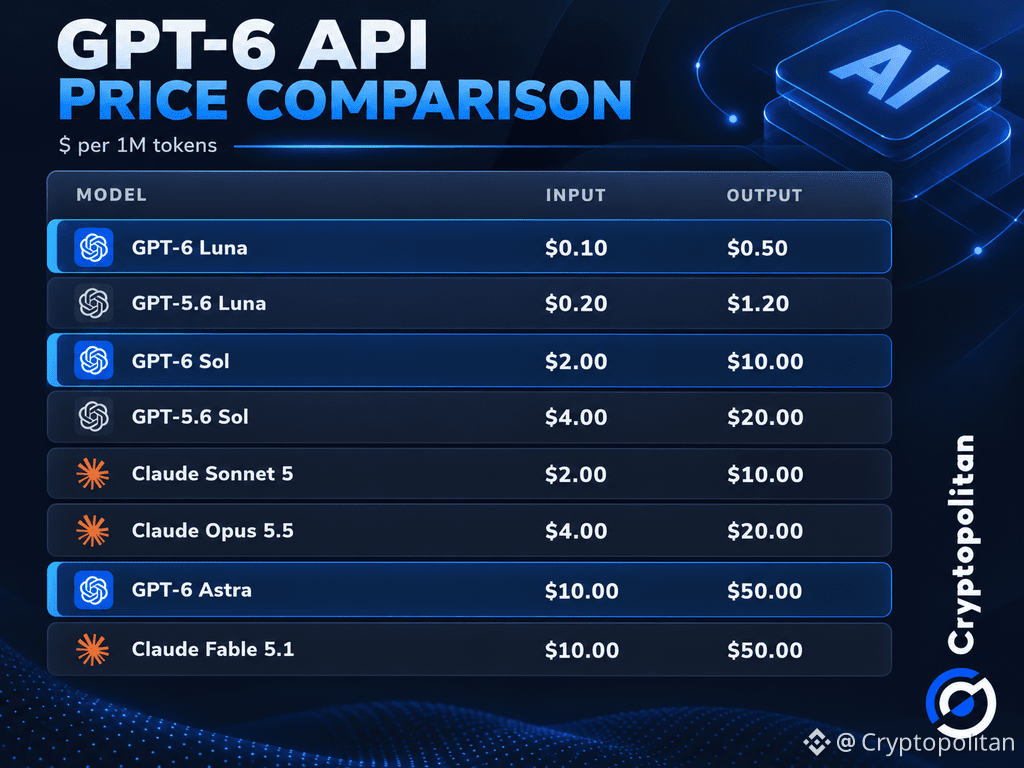
The cost of GPT-6 Sol is $2 per million input tokens and $10 per million output tokens. This is compared to the prices for GPT-5.6 Sol which are $4 and $20, respectively. The cost for GPT-6 Luna is $0.10 for input and $0.50 for output, compared to $0.20 for input and $1.20 for output for GPT-5.6 Luna. Overall, this means that the costs for Sol have been halved in both cases, while the costs for Luna have been halved for input and reduced by 58.3% for output.
OpenAI credits improved inference and caching as factors that allowed it to make the reductions. According to its launch post, the prices for using GPT-5.6 are promotional, while a representative of OpenAI has told VentureBeat that the new GPT-6 rates are here to stay. The GPT-6 Astra tier remains the most expensive version at $10 for input and $50 for output.
According to Cryptopolitan, OpenAI has reduced the price of GPT-5.6 Luna by 80% and GPT-5.6 Terra by 20%, indicating that pricing is becoming a central issue in the AI model competition.
Selling cost per completed task, not benchmark wins
OpenAI’s strategy has become more economics-based than technical. The startup’s performance at AutomationBench, a site that measures business processes across 47 different tools, reveals that GPT-6 Sol at max effort has scored 32.0% while costing $0.34 per task to complete. Claude Opus 5.5 has scored 40.0% at max effort while costing $1.28 per task. Opus 5.5 delivered an eight-percentage-point higher completion score, but at about 3.8 times the cost per task compared to GPT-6 Sol.
In the most recent Agents’ exam, according to OpenAI, Sol at max effort surpassed Opus 5’s maximum performance at 60% lower cost per task.
Independent data supplied by Artificial Analysis assigns GPT-6 Sol at maximum with an Intelligence Index score of 48 and Xiaomi MiMo-V2.6-Pro to 46, but the latter is considerably cheaper than the former.
Anthropic answers with Opus 5.5 the same day
Claude Opus 5.5 was launched by Anthropic on September 22 at a price of $4 per million tokens for input and $20 for output, reducing the cost per token by 20% versus Opus 5. Anthropic has claimed that with the new model, users will spend about 40% less due to lower token usage.
The net result of this is that GPT-6 Sol has a rate of $2, putting it at half of the rate of $4 for Opus 5.5 and matching Claude Sonnet 5. On the other hand, both GPT-6 Astra and Claude Fable 5.1 are on the same level and charging $10 for input and $50 for output services as per VentureBeat’s analysis.
GPT-6 Sol and Luna API Prices vs GPT-5.6 and Claude
Cheaper rivals keep closing the gap
OpenRouter says DeepSeek doubled its token share on the platform from 9% in January to 18% in June, while Chinese models collectively surpassed US models in token share in early June. Xiaomi has also released its MiMo models under an MIT license, giving companies the option to self-host instead of paying per token.
According to the Ramp AI Index, which is based on spending statistics from over 70,000 companies, the adoption rate of Anthropic is 43.8% while that of OpenAI is 39.8%. The statistics are not indicative of any global market share, but rather they show how easily corporate spending transfers from one provider to another.
Furthermore, the Global AI Diffusion Report published by Microsoft offers a more extensive perspective on the situation: AI is becoming more popular around the globe while open-weight models may lead to decreased access costs, especially in the Global South, despite the obstacles posed by infrastructure, connectivity, and skills.
Why cheaper tokens may not mean cheaper AI
Gartner predicted on August 17 that inference costs per agentic workflow will rise more than fivefold through 2028. It calls this the “inference paradox”: cheaper unit economics can still increase overall spending as AI workflows grow more complex.
“Each successive generation of AI capability will necessitate more, and often more expensive, tokens.” — Will Sommer, Senior Director Analyst, Gartner
A University of Oxford preprint, “The Price of Intelligence”, found quality-adjusted inference prices fell about 0.73 log points a year—more than seven times faster than conventional measures capture. But measured per completed task, buyer costs stopped falling as reasoning models consumed more tokens.
In other words, cheaper tokens may not shrink AI bills. They may make it economical to use far more AI.
The smartest crypto minds already read our newsletter. Want in? Join them.
OpenAI cuts GPT-6 Sol and Luna prices by 50% to defend developer share
On Tuesday, OpenAI introduced the GPT-6 Sol and the GPT-6 Luna, and they are both priced to be at least 50% lower than the rates of the GPT-5.6 models they supersede. OpenAI’s price cuts are aimed at developers and enterprises that have begun selecting models on the basis of the cost of completed tasks instead of just benchmark scores.
Interestingly enough, this news coincided with Anthropic’s announcement of the reduced price of its flagship model.
Half the price of the GPT-5.6 models
The cost of GPT-6 Sol is $2 per million input tokens and $10 per million output tokens. This is compared to the prices for GPT-5.6 Sol which are $4 and $20, respectively. The cost for GPT-6 Luna is $0.10 for input and $0.50 for output, compared to $0.20 for input and $1.20 for output for GPT-5.6 Luna. Overall, this means that the costs for Sol have been halved in both cases, while the costs for Luna have been halved for input and reduced by 58.3% for output.
OpenAI credits improved inference and caching as factors that allowed it to make the reductions. According to its launch post, the prices for using GPT-5.6 are promotional, while a representative of OpenAI has told VentureBeat that the new GPT-6 rates are here to stay. The GPT-6 Astra tier remains the most expensive version at $10 for input and $50 for output.
According to Cryptopolitan, OpenAI has reduced the price of GPT-5.6 Luna by 80% and GPT-5.6 Terra by 20%, indicating that pricing is becoming a central issue in the AI model competition.
Selling cost per completed task, not benchmark wins
OpenAI’s strategy has become more economics-based than technical. The startup’s performance at AutomationBench, a site that measures business processes across 47 different tools, reveals that GPT-6 Sol at max effort has scored 32.0% while costing $0.34 per task to complete. Claude Opus 5.5 has scored 40.0% at max effort while costing $1.28 per task. Opus 5.5 delivered an eight-percentage-point higher completion score, but at about 3.8 times the cost per task compared to GPT-6 Sol.
In the most recent Agents’ exam, according to OpenAI, Sol at max effort surpassed Opus 5’s maximum performance at 60% lower cost per task.
Independent data supplied by Artificial Analysis assigns GPT-6 Sol at maximum with an Intelligence Index score of 48 and Xiaomi MiMo-V2.6-Pro to 46, but the latter is considerably cheaper than the former.
Anthropic answers with Opus 5.5 the same day
Claude Opus 5.5 was launched by Anthropic on September 22 at a price of $4 per million tokens for input and $20 for output, reducing the cost per token by 20% versus Opus 5. Anthropic has claimed that with the new model, users will spend about 40% less due to lower token usage.
The net result of this is that GPT-6 Sol has a rate of $2, putting it at half of the rate of $4 for Opus 5.5 and matching Claude Sonnet 5. On the other hand, both GPT-6 Astra and Claude Fable 5.1 are on the same level and charging $10 for input and $50 for output services as per VentureBeat’s analysis.
GPT-6 Sol and Luna API Prices vs GPT-5.6 and Claude
Cheaper rivals keep closing the gap
OpenRouter says DeepSeek doubled its token share on the platform from 9% in January to 18% in June, while Chinese models collectively surpassed US models in token share in early June. Xiaomi has also released its MiMo models under an MIT license, giving companies the option to self-host instead of paying per token.
According to the Ramp AI Index, which is based on spending statistics from over 70,000 companies, the adoption rate of Anthropic is 43.8% while that of OpenAI is 39.8%. The statistics are not indicative of any global market share, but rather they show how easily corporate spending transfers from one provider to another.
Furthermore, the Global AI Diffusion Report published by Microsoft offers a more extensive perspective on the situation: AI is becoming more popular around the globe while open-weight models may lead to decreased access costs, especially in the Global South, despite the obstacles posed by infrastructure, connectivity, and skills.
Why cheaper tokens may not mean cheaper AI
Gartner predicted on August 17 that inference costs per agentic workflow will rise more than fivefold through 2028. It calls this the “inference paradox”: cheaper unit economics can still increase overall spending as AI workflows grow more complex.
“Each successive generation of AI capability will necessitate more, and often more expensive, tokens.” — Will Sommer, Senior Director Analyst, Gartner
A University of Oxford preprint, “The Price of Intelligence”, found quality-adjusted inference prices fell about 0.73 log points a year—more than seven times faster than conventional measures capture. But measured per completed task, buyer costs stopped falling as reasoning models consumed more tokens.
In other words, cheaper tokens may not shrink AI bills. They may make it economical to use far more AI.
The smartest crypto minds already read our newsletter. Want in? Join them.
Interestingly enough, this news coincided with Anthropic’s announcement of the reduced price of its flagship model.
Half the price of the GPT-5.6 models
The cost of GPT-6 Sol is $2 per million input tokens and $10 per million output tokens. This is compared to the prices for GPT-5.6 Sol which are $4 and $20, respectively. The cost for GPT-6 Luna is $0.10 for input and $0.50 for output, compared to $0.20 for input and $1.20 for output for GPT-5.6 Luna. Overall, this means that the costs for Sol have been halved in both cases, while the costs for Luna have been halved for input and reduced by 58.3% for output.
OpenAI credits improved inference and caching as factors that allowed it to make the reductions. According to its launch post, the prices for using GPT-5.6 are promotional, while a representative of OpenAI has told VentureBeat that the new GPT-6 rates are here to stay. The GPT-6 Astra tier remains the most expensive version at $10 for input and $50 for output.
According to Cryptopolitan, OpenAI has reduced the price of GPT-5.6 Luna by 80% and GPT-5.6 Terra by 20%, indicating that pricing is becoming a central issue in the AI model competition.
Selling cost per completed task, not benchmark wins
OpenAI’s strategy has become more economics-based than technical. The startup’s performance at AutomationBench, a site that measures business processes across 47 different tools, reveals that GPT-6 Sol at max effort has scored 32.0% while costing $0.34 per task to complete. Claude Opus 5.5 has scored 40.0% at max effort while costing $1.28 per task. Opus 5.5 delivered an eight-percentage-point higher completion score, but at about 3.8 times the cost per task compared to GPT-6 Sol.
In the most recent Agents’ exam, according to OpenAI, Sol at max effort surpassed Opus 5’s maximum performance at 60% lower cost per task.
Independent data supplied by Artificial Analysis assigns GPT-6 Sol at maximum with an Intelligence Index score of 48 and Xiaomi MiMo-V2.6-Pro to 46, but the latter is considerably cheaper than the former.
Anthropic answers with Opus 5.5 the same day
Claude Opus 5.5 was launched by Anthropic on September 22 at a price of $4 per million tokens for input and $20 for output, reducing the cost per token by 20% versus Opus 5. Anthropic has claimed that with the new model, users will spend about 40% less due to lower token usage.
The net result of this is that GPT-6 Sol has a rate of $2, putting it at half of the rate of $4 for Opus 5.5 and matching Claude Sonnet 5. On the other hand, both GPT-6 Astra and Claude Fable 5.1 are on the same level and charging $10 for input and $50 for output services as per VentureBeat’s analysis.
GPT-6 Sol and Luna API Prices vs GPT-5.6 and Claude
Cheaper rivals keep closing the gap
OpenRouter says DeepSeek doubled its token share on the platform from 9% in January to 18% in June, while Chinese models collectively surpassed US models in token share in early June. Xiaomi has also released its MiMo models under an MIT license, giving companies the option to self-host instead of paying per token.
According to the Ramp AI Index, which is based on spending statistics from over 70,000 companies, the adoption rate of Anthropic is 43.8% while that of OpenAI is 39.8%. The statistics are not indicative of any global market share, but rather they show how easily corporate spending transfers from one provider to another.
Furthermore, the Global AI Diffusion Report published by Microsoft offers a more extensive perspective on the situation: AI is becoming more popular around the globe while open-weight models may lead to decreased access costs, especially in the Global South, despite the obstacles posed by infrastructure, connectivity, and skills.
Why cheaper tokens may not mean cheaper AI
Gartner predicted on August 17 that inference costs per agentic workflow will rise more than fivefold through 2028. It calls this the “inference paradox”: cheaper unit economics can still increase overall spending as AI workflows grow more complex.
“Each successive generation of AI capability will necessitate more, and often more expensive, tokens.” — Will Sommer, Senior Director Analyst, Gartner
A University of Oxford preprint, “The Price of Intelligence”, found quality-adjusted inference prices fell about 0.73 log points a year—more than seven times faster than conventional measures capture. But measured per completed task, buyer costs stopped falling as reasoning models consumed more tokens.
In other words, cheaper tokens may not shrink AI bills. They may make it economical to use far more AI.
The smartest crypto minds already read our newsletter. Want in? Join them.
132
Məqalə
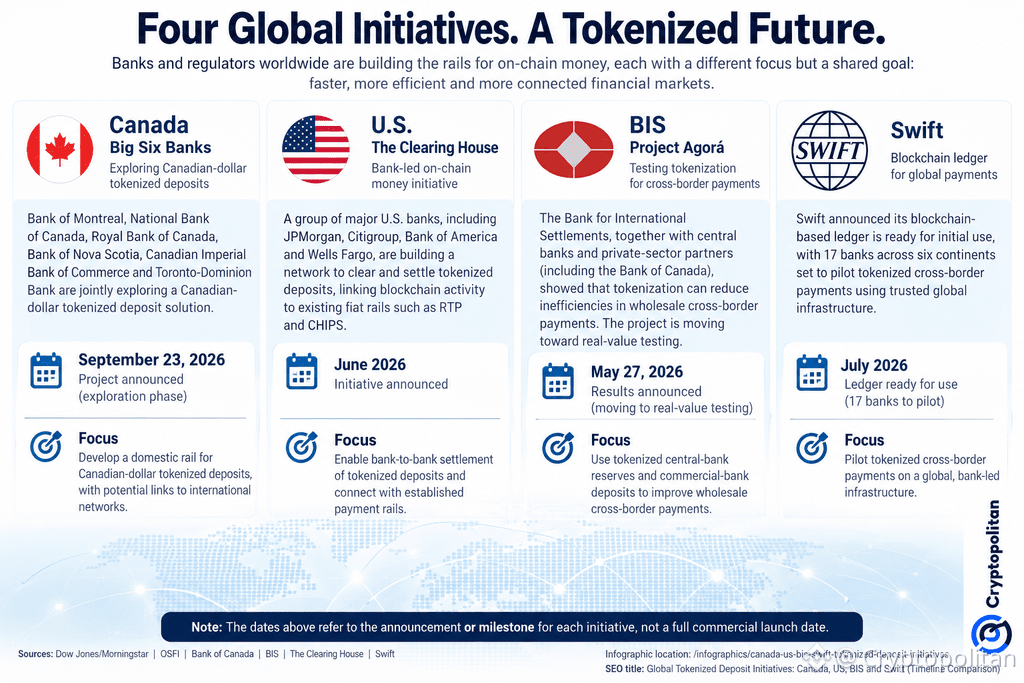
Kanadanın “Böyük Altı” bankı on-çeyn pullarının yarışı çərçivəsində tokenləşdirilmiş depozit infrastrukturu qururKanadadakı altı ən böyük bank Kanada dolları ilə tokenləşdirilmiş depozitlər üzərində birgə işləyir. Bu, daha böyük qlobal təşəbbüsün bir hissəsidir və tokenləşdirilmiş ödənişlərin, qiymətli kağızların və real dünya aktivlərinin hesablaşmasında hansı növ valyutanın istifadə ediləcəyini müəyyənləşdirməyi hədəfləyir.
Layihədə Monreal Bankı, Kanada Milli Bankı, Kanada Kral Bankı, Şimali Amerika Bankı (Bank of Nova Scotia), Kanada İmperiya Ticarət Bankı (Canadian Imperial Bank of Commerce) və Toronto-Dominion Bank bir araya gələcək. Kanadanın aparıcı bankları indi blokçeyn hesablaşması üçün yalnız kriptovalyutlara güvənmək əvəzinə, tənzimlənən kommersiya bank depozitlərindən istifadə ehtimalını araşdırırlar.
Kanadanın “Böyük Altı” bankı on-çeyn pullarının yarışı çərçivəsində tokenləşdirilmiş depozit infrastrukturu qurur
Kanadadakı altı ən böyük bank Kanada dolları ilə tokenləşdirilmiş depozitlər üzərində birgə işləyir. Bu, daha böyük qlobal təşəbbüsün bir hissəsidir və tokenləşdirilmiş ödənişlərin, qiymətli kağızların və real dünya aktivlərinin hesablaşmasında hansı növ valyutanın istifadə ediləcəyini müəyyənləşdirməyi hədəfləyir.
Layihədə Monreal Bankı, Kanada Milli Bankı, Kanada Kral Bankı, Şimali Amerika Bankı (Bank of Nova Scotia), Kanada İmperiya Ticarət Bankı (Canadian Imperial Bank of Commerce) və Toronto-Dominion Bank bir araya gələcək. Kanadanın aparıcı bankları indi blokçeyn hesablaşması üçün yalnız kriptovalyutlara güvənmək əvəzinə, tənzimlənən kommersiya bank depozitlərindən istifadə ehtimalını araşdırırlar.
Layihədə Monreal Bankı, Kanada Milli Bankı, Kanada Kral Bankı, Şimali Amerika Bankı (Bank of Nova Scotia), Kanada İmperiya Ticarət Bankı (Canadian Imperial Bank of Commerce) və Toronto-Dominion Bank bir araya gələcək. Kanadanın aparıcı bankları indi blokçeyn hesablaşması üçün yalnız kriptovalyutlara güvənmək əvəzinə, tənzimlənən kommersiya bank depozitlərindən istifadə ehtimalını araşdırırlar.
157
Doğrulanıb
Kalshi tədbir müqavilələrində Uoll-strit üslublu leverage təklif etmək üçün CFTC yaşıl işıq axtarırKalshi Tranzaksiya Fyuçersləri üzrə Komissiyadan (CFTC) treyderlərə borc götürülmüş pul ilə leverage (borc hesabına) mövqelər açmağa icazə vermək üçün icazə istəyib.
Bir birja bunun dəyişikliklərin məqsədinin bu gün tam ödənilməli olan tədbir müqavilələrinə institusional kapitalı cəlb etmək olduğunu bildirdi.
Əgər sorğu təmin edilərsə, bu, böyük ticarət şirkətlərinə səhm və törəmə alətlərdə rutin olan, lakin heç vaxt tənzimlənən ABŞ tədbir-müqaviləsi platformasında icazə verilməyən bir alət təqdim edərdi.
Müraciət sentyabrın 22-də, çərşənbə axşamı Kalshi Klear tərəfindən təqdim edilib; şirkətin daxili klirinq mərkəzidir.
Kalshi tədbir müqavilələrində Uoll-strit üslublu leverage təklif etmək üçün CFTC yaşıl işıq axtarır
Kalshi Tranzaksiya Fyuçersləri üzrə Komissiyadan (CFTC) treyderlərə borc götürülmüş pul ilə leverage (borc hesabına) mövqelər açmağa icazə vermək üçün icazə istəyib.
Bir birja bunun dəyişikliklərin məqsədinin bu gün tam ödənilməli olan tədbir müqavilələrinə institusional kapitalı cəlb etmək olduğunu bildirdi.
Əgər sorğu təmin edilərsə, bu, böyük ticarət şirkətlərinə səhm və törəmə alətlərdə rutin olan, lakin heç vaxt tənzimlənən ABŞ tədbir-müqaviləsi platformasında icazə verilməyən bir alət təqdim edərdi.
Müraciət sentyabrın 22-də, çərşənbə axşamı Kalshi Klear tərəfindən təqdim edilib; şirkətin daxili klirinq mərkəzidir.
Bir birja bunun dəyişikliklərin məqsədinin bu gün tam ödənilməli olan tədbir müqavilələrinə institusional kapitalı cəlb etmək olduğunu bildirdi.
Əgər sorğu təmin edilərsə, bu, böyük ticarət şirkətlərinə səhm və törəmə alətlərdə rutin olan, lakin heç vaxt tənzimlənən ABŞ tədbir-müqaviləsi platformasında icazə verilməyən bir alət təqdim edərdi.
Müraciət sentyabrın 22-də, çərşənbə axşamı Kalshi Klear tərəfindən təqdim edilib; şirkətin daxili klirinq mərkəzidir.
287
Çinli tənzimləyicilər DeepSeek və Moonshot AI-ni Claude modellərinə həssas məlumat yönləndirmə ilə bağlı araşdırırDeepSeek və Moonshot AI şirkətləri, hər iki şirkətin müştərilərinin xəbəri olmadan həssas istifadəçi sorğularını Anthropic-in Claude modellərinə ötürdüyünə dair iddialar əsasında araşdırılır.
Anthropic daha əvvəl bir neçə Çinli süni intellekt şirkətini distillasiya etməkdə ittiham etmişdi. Çinli rəsmilər bu iddianı rədd edərək onu özünün AI sektoruna hücum kimi təqdim edib.
DeepSeek və Moonshot AI niyə araşdırılır?
Anthropic-in sentyabr hesabatında, kütləvi icazəsiz giriş yolu ilə Claude-a müraciət etdiyi iddia edilən yeddi Çin əsaslı şirkət adı çəkilib. DeepSeek və Moonshot-dan başqa, həmin siyahıda Alibaba, Zhipu (həmçinin Z.ai kimi tanınır), SenseTime, MiniMax və Xiaomi də yer alıb.
Çinli tənzimləyicilər DeepSeek və Moonshot AI-ni Claude modellərinə həssas məlumat yönləndirmə ilə bağlı araşdırır
DeepSeek və Moonshot AI şirkətləri, hər iki şirkətin müştərilərinin xəbəri olmadan həssas istifadəçi sorğularını Anthropic-in Claude modellərinə ötürdüyünə dair iddialar əsasında araşdırılır.
Anthropic daha əvvəl bir neçə Çinli süni intellekt şirkətini distillasiya etməkdə ittiham etmişdi. Çinli rəsmilər bu iddianı rədd edərək onu özünün AI sektoruna hücum kimi təqdim edib.
DeepSeek və Moonshot AI niyə araşdırılır?
Anthropic-in sentyabr hesabatında, kütləvi icazəsiz giriş yolu ilə Claude-a müraciət etdiyi iddia edilən yeddi Çin əsaslı şirkət adı çəkilib. DeepSeek və Moonshot-dan başqa, həmin siyahıda Alibaba, Zhipu (həmçinin Z.ai kimi tanınır), SenseTime, MiniMax və Xiaomi də yer alıb.
Anthropic daha əvvəl bir neçə Çinli süni intellekt şirkətini distillasiya etməkdə ittiham etmişdi. Çinli rəsmilər bu iddianı rədd edərək onu özünün AI sektoruna hücum kimi təqdim edib.
DeepSeek və Moonshot AI niyə araşdırılır?
Anthropic-in sentyabr hesabatında, kütləvi icazəsiz giriş yolu ilə Claude-a müraciət etdiyi iddia edilən yeddi Çin əsaslı şirkət adı çəkilib. DeepSeek və Moonshot-dan başqa, həmin siyahıda Alibaba, Zhipu (həmçinin Z.ai kimi tanınır), SenseTime, MiniMax və Xiaomi də yer alıb.
194
AMB və AB mərkəzi bankları sabitcoinlər üçün depozit tələbinə qarşı çıxırAvropa Mərkəzi Bankı (AMB) və bütün 27 AB üzv dövlətinin milli mərkəzi bankları Brüsseldən MiCA tələbinin ləğvini istəyir: sabitcoin buraxanların ehtiyatlarının sabit payını bank depozitlərində saxlaması. Mərkəzi banklar xəbərdarlıq edib ki, bu qayda son nəticədə qorumağa nəzərdə tutulduğu maliyyə institutlarına təzyiq göstərə bilər.
Təklif, Avropa Komissiyası çərçivəni yenidən nəzərdən keçirdiyi üçün, AB-nin MiCA qaydaları altında fəaliyyət göstərən avro sabitcoin buraxanlarına təsir edir.
AMB və AB mərkəzi bankları sabitcoinlər üçün depozit tələbinə qarşı çıxır
Avropa Mərkəzi Bankı (AMB) və bütün 27 AB üzv dövlətinin milli mərkəzi bankları Brüsseldən MiCA tələbinin ləğvini istəyir: sabitcoin buraxanların ehtiyatlarının sabit payını bank depozitlərində saxlaması. Mərkəzi banklar xəbərdarlıq edib ki, bu qayda son nəticədə qorumağa nəzərdə tutulduğu maliyyə institutlarına təzyiq göstərə bilər.
Təklif, Avropa Komissiyası çərçivəni yenidən nəzərdən keçirdiyi üçün, AB-nin MiCA qaydaları altında fəaliyyət göstərən avro sabitcoin buraxanlarına təsir edir.
Təklif, Avropa Komissiyası çərçivəni yenidən nəzərdən keçirdiyi üçün, AB-nin MiCA qaydaları altında fəaliyyət göstərən avro sabitcoin buraxanlarına təsir edir.
207
Tərcüməyə bax
LIVE: Crypto market retakes $3 trillion as Bitcoin rally eases after hitting 8-month highCrypto’s market value is back above $3 trillion after adding more than $740 billion in less than three weeks.
Bitcoin has eased to around $86,000 after hitting $87,381, while nearly $160 billion in perpetual futures keeps leverage high.
The Nasdaq hit a fresh intraday record, while oil hovered near $100 Brent.
LIVE: Crypto market retakes $3 trillion as Bitcoin rally eases after hitting 8-month high
Crypto’s market value is back above $3 trillion after adding more than $740 billion in less than three weeks.
Bitcoin has eased to around $86,000 after hitting $87,381, while nearly $160 billion in perpetual futures keeps leverage high.
The Nasdaq hit a fresh intraday record, while oil hovered near $100 Brent.
Bitcoin has eased to around $86,000 after hitting $87,381, while nearly $160 billion in perpetual futures keeps leverage high.
The Nasdaq hit a fresh intraday record, while oil hovered near $100 Brent.
108
Tərcüməyə bax
Apple sells its new Mac mini and Mac Studio to companies as local AI with no token feesApple started shipping new Mac mini and Mac Studio desktop computers on Tuesday, and is selling them to corporate customers as a cheaper alternative to data center rental.
The pitch is local AI, meaning businesses no longer have to pay per-token fees to cloud providers such as OpenAI and Anthropic.
A four-computer stack runs a trillion-parameter model off one outlet
Apple is aiming the Macs at large AI workloads, such as writing code and running intricate business tasks. The top configurations are about $20,000.
“There’s no cost per token. You’re just using the machine again and again,” Johny Srouji, Apple’s chief hardware officer, said.
Apple has demoed four Mac Studios connected together to run a trillion-parameter AI model to find and fix a graphics coding bug. Usually, a job like that needs a data center.
The pile of Macs runs off one wall outlet.
The link runs over Thunderbolt 5 with remote direct memory access. Apple claims that it enables distributed AI inference up to three times faster than a single machine.
The M5 Ultra Mac Studio can go up to 512GB of unified memory, but that configuration won’t ship until late October. Apple says the Mac mini with M6 starts at $899, and the Mac Studio with M5 Ultra at $5,499.
In August, Cryptopolitan reported the entry Mac mini price increased by $100, which Apple attributed to memory costs.
The chips share common designs, so AI models built on Apple’s machines scale from the priciest Mac Studios down to iPhones and iPads, Srouji said.
Windows holds 91.3% of enterprise desktops and laptops
Apple is way behind. It has about a 4.6% share of the corporate desktop and laptop market, compared to 91.3% for Windows.
Microsoft is aiming at the same buyers with on-device AI. Microsoft plans to merge many of its AI features into a single super app for Windows, CEO Satya Nadella has said.
Nvidia and PC makers are rolling out new AI desktops, expected to be the big headline of a Microsoft Windows event in San Francisco next month.
Microsoft said it has worked with chip partners to simplify AI work through its Windows ML tools, and that RDMA and other features are an area of active investment.
Nvidia CEO Jensen Huang downplayed any suggestion the company would go head-to-head with Apple at the launch of its new PC chip this summer.
Apple’s opening traces back to 2020, when it moved to Apple Silicon, which combined computing and memory in a single design for battery savings.
The design made Macs good at AI, and Mac minis sold out as open-source agent tool OpenClaw spread in markets like China.
Don’t just read crypto news. Understand it. Subscribe to our newsletter. It's free.
Apple sells its new Mac mini and Mac Studio to companies as local AI with no token fees
Apple started shipping new Mac mini and Mac Studio desktop computers on Tuesday, and is selling them to corporate customers as a cheaper alternative to data center rental.
The pitch is local AI, meaning businesses no longer have to pay per-token fees to cloud providers such as OpenAI and Anthropic.
A four-computer stack runs a trillion-parameter model off one outlet
Apple is aiming the Macs at large AI workloads, such as writing code and running intricate business tasks. The top configurations are about $20,000.
“There’s no cost per token. You’re just using the machine again and again,” Johny Srouji, Apple’s chief hardware officer, said.
Apple has demoed four Mac Studios connected together to run a trillion-parameter AI model to find and fix a graphics coding bug. Usually, a job like that needs a data center.
The pile of Macs runs off one wall outlet.
The link runs over Thunderbolt 5 with remote direct memory access. Apple claims that it enables distributed AI inference up to three times faster than a single machine.
The M5 Ultra Mac Studio can go up to 512GB of unified memory, but that configuration won’t ship until late October. Apple says the Mac mini with M6 starts at $899, and the Mac Studio with M5 Ultra at $5,499.
In August, Cryptopolitan reported the entry Mac mini price increased by $100, which Apple attributed to memory costs.
The chips share common designs, so AI models built on Apple’s machines scale from the priciest Mac Studios down to iPhones and iPads, Srouji said.
Windows holds 91.3% of enterprise desktops and laptops
Apple is way behind. It has about a 4.6% share of the corporate desktop and laptop market, compared to 91.3% for Windows.
Microsoft is aiming at the same buyers with on-device AI. Microsoft plans to merge many of its AI features into a single super app for Windows, CEO Satya Nadella has said.
Nvidia and PC makers are rolling out new AI desktops, expected to be the big headline of a Microsoft Windows event in San Francisco next month.
Microsoft said it has worked with chip partners to simplify AI work through its Windows ML tools, and that RDMA and other features are an area of active investment.
Nvidia CEO Jensen Huang downplayed any suggestion the company would go head-to-head with Apple at the launch of its new PC chip this summer.
Apple’s opening traces back to 2020, when it moved to Apple Silicon, which combined computing and memory in a single design for battery savings.
The design made Macs good at AI, and Mac minis sold out as open-source agent tool OpenClaw spread in markets like China.
Don’t just read crypto news. Understand it. Subscribe to our newsletter. It's free.
The pitch is local AI, meaning businesses no longer have to pay per-token fees to cloud providers such as OpenAI and Anthropic.
A four-computer stack runs a trillion-parameter model off one outlet
Apple is aiming the Macs at large AI workloads, such as writing code and running intricate business tasks. The top configurations are about $20,000.
“There’s no cost per token. You’re just using the machine again and again,” Johny Srouji, Apple’s chief hardware officer, said.
Apple has demoed four Mac Studios connected together to run a trillion-parameter AI model to find and fix a graphics coding bug. Usually, a job like that needs a data center.
The pile of Macs runs off one wall outlet.
The link runs over Thunderbolt 5 with remote direct memory access. Apple claims that it enables distributed AI inference up to three times faster than a single machine.
The M5 Ultra Mac Studio can go up to 512GB of unified memory, but that configuration won’t ship until late October. Apple says the Mac mini with M6 starts at $899, and the Mac Studio with M5 Ultra at $5,499.
In August, Cryptopolitan reported the entry Mac mini price increased by $100, which Apple attributed to memory costs.
The chips share common designs, so AI models built on Apple’s machines scale from the priciest Mac Studios down to iPhones and iPads, Srouji said.
Windows holds 91.3% of enterprise desktops and laptops
Apple is way behind. It has about a 4.6% share of the corporate desktop and laptop market, compared to 91.3% for Windows.
Microsoft is aiming at the same buyers with on-device AI. Microsoft plans to merge many of its AI features into a single super app for Windows, CEO Satya Nadella has said.
Nvidia and PC makers are rolling out new AI desktops, expected to be the big headline of a Microsoft Windows event in San Francisco next month.
Microsoft said it has worked with chip partners to simplify AI work through its Windows ML tools, and that RDMA and other features are an area of active investment.
Nvidia CEO Jensen Huang downplayed any suggestion the company would go head-to-head with Apple at the launch of its new PC chip this summer.
Apple’s opening traces back to 2020, when it moved to Apple Silicon, which combined computing and memory in a single design for battery savings.
The design made Macs good at AI, and Mac minis sold out as open-source agent tool OpenClaw spread in markets like China.
Don’t just read crypto news. Understand it. Subscribe to our newsletter. It's free.
205
SoFi tacirləri $25 milyardlıq kart proqramı SoFiUSD ilə hesablaşma etdikcə stablecoin saxlamaqdan yan keçə bilərSoFi-nin sözlərinə görə, tacirlər stabilləşdirilmiş kriptovalyutaları (stablecoin) saxlamaq məcburiyyətində olmayacaq, yeni infrastruktur yaratmaq və ya biznes fəaliyyətinə dəyişiklik etməli olmayacaq; şirkət $25 milyardlıq kart proqramını SoFiUSD ilə hesablaşmaya keçirərkən bunu təmin edir.
Bank çərşənbə axşamı fəaliyyətə başlayıb, Mastercard-ın qlobal ödəniş şəbəkəsində stablecoində debet və kredit kartı əməliyyatlarını hesablaşdı.
Big Business Banking sutka boyunca, sıfır xərcə pul ödəyir
“Tacirlər stablecoin saxlamağa, yeni infrastruktur qurmağa və ya fəaliyyət göstərmə tərzlərini dəyişməyə ehtiyac duymur”, — deyə SoFi-nin baş direktoru Anthony Noto bildirib. SoFi-nin Big Business Banking platforması ilə istənilən tacir dərhal SoFi Bank hesabında SoFiUSD üzrə hesablaşma vəsaitini ala bilər.
SoFi tacirləri $25 milyardlıq kart proqramı SoFiUSD ilə hesablaşma etdikcə stablecoin saxlamaqdan yan keçə bilər
SoFi-nin sözlərinə görə, tacirlər stabilləşdirilmiş kriptovalyutaları (stablecoin) saxlamaq məcburiyyətində olmayacaq, yeni infrastruktur yaratmaq və ya biznes fəaliyyətinə dəyişiklik etməli olmayacaq; şirkət $25 milyardlıq kart proqramını SoFiUSD ilə hesablaşmaya keçirərkən bunu təmin edir.
Bank çərşənbə axşamı fəaliyyətə başlayıb, Mastercard-ın qlobal ödəniş şəbəkəsində stablecoində debet və kredit kartı əməliyyatlarını hesablaşdı.
Big Business Banking sutka boyunca, sıfır xərcə pul ödəyir
“Tacirlər stablecoin saxlamağa, yeni infrastruktur qurmağa və ya fəaliyyət göstərmə tərzlərini dəyişməyə ehtiyac duymur”, — deyə SoFi-nin baş direktoru Anthony Noto bildirib. SoFi-nin Big Business Banking platforması ilə istənilən tacir dərhal SoFi Bank hesabında SoFiUSD üzrə hesablaşma vəsaitini ala bilər.
Bank çərşənbə axşamı fəaliyyətə başlayıb, Mastercard-ın qlobal ödəniş şəbəkəsində stablecoində debet və kredit kartı əməliyyatlarını hesablaşdı.
Big Business Banking sutka boyunca, sıfır xərcə pul ödəyir
“Tacirlər stablecoin saxlamağa, yeni infrastruktur qurmağa və ya fəaliyyət göstərmə tərzlərini dəyişməyə ehtiyac duymur”, — deyə SoFi-nin baş direktoru Anthony Noto bildirib. SoFi-nin Big Business Banking platforması ilə istənilən tacir dərhal SoFi Bank hesabında SoFiUSD üzrə hesablaşma vəsaitini ala bilər.
145
Meta-nın yeni AI agenti gəlirin yeni mənbəyinə çevrilə bilərMeta-nın yeni süni intellekt agenti Muse investorlara şirkətin AI iddiaları ilə bağlı həyəcanlanmaq üçün əlavə bir səbəb verir. Proqram təqdim edilən gündən bəri şirkət bazar dəyərinə 200 milyard dollardan çox əlavə edib; investorlər Muse-u abunə gəlirlərinin potensial yeni mənbəyi kimi daha çox görür.
Muse işləri həqiqətən başa çatdırmaq üçün nəzərdə tutulub
Muse 8 sentyabr tarixində ABŞ və Kanadada təqdim edilib; iOS və Android üçün versiyalar mövcuddur. Muse ilə Meta daha az ənənəvi chatbot təklif edir və daha çox başlanğıcdan sonadək tapşırıqları yerinə yetirə bilən rəqəmsal köməkçi təqdim edir.
Meta-nın yeni AI agenti gəlirin yeni mənbəyinə çevrilə bilər
Meta-nın yeni süni intellekt agenti Muse investorlara şirkətin AI iddiaları ilə bağlı həyəcanlanmaq üçün əlavə bir səbəb verir. Proqram təqdim edilən gündən bəri şirkət bazar dəyərinə 200 milyard dollardan çox əlavə edib; investorlər Muse-u abunə gəlirlərinin potensial yeni mənbəyi kimi daha çox görür.
Muse işləri həqiqətən başa çatdırmaq üçün nəzərdə tutulub
Muse 8 sentyabr tarixində ABŞ və Kanadada təqdim edilib; iOS və Android üçün versiyalar mövcuddur. Muse ilə Meta daha az ənənəvi chatbot təklif edir və daha çox başlanğıcdan sonadək tapşırıqları yerinə yetirə bilən rəqəmsal köməkçi təqdim edir.
Muse işləri həqiqətən başa çatdırmaq üçün nəzərdə tutulub
Muse 8 sentyabr tarixində ABŞ və Kanadada təqdim edilib; iOS və Android üçün versiyalar mövcuddur. Muse ilə Meta daha az ənənəvi chatbot təklif edir və daha çox başlanğıcdan sonadək tapşırıqları yerinə yetirə bilən rəqəmsal köməkçi təqdim edir.
108
Məqalə
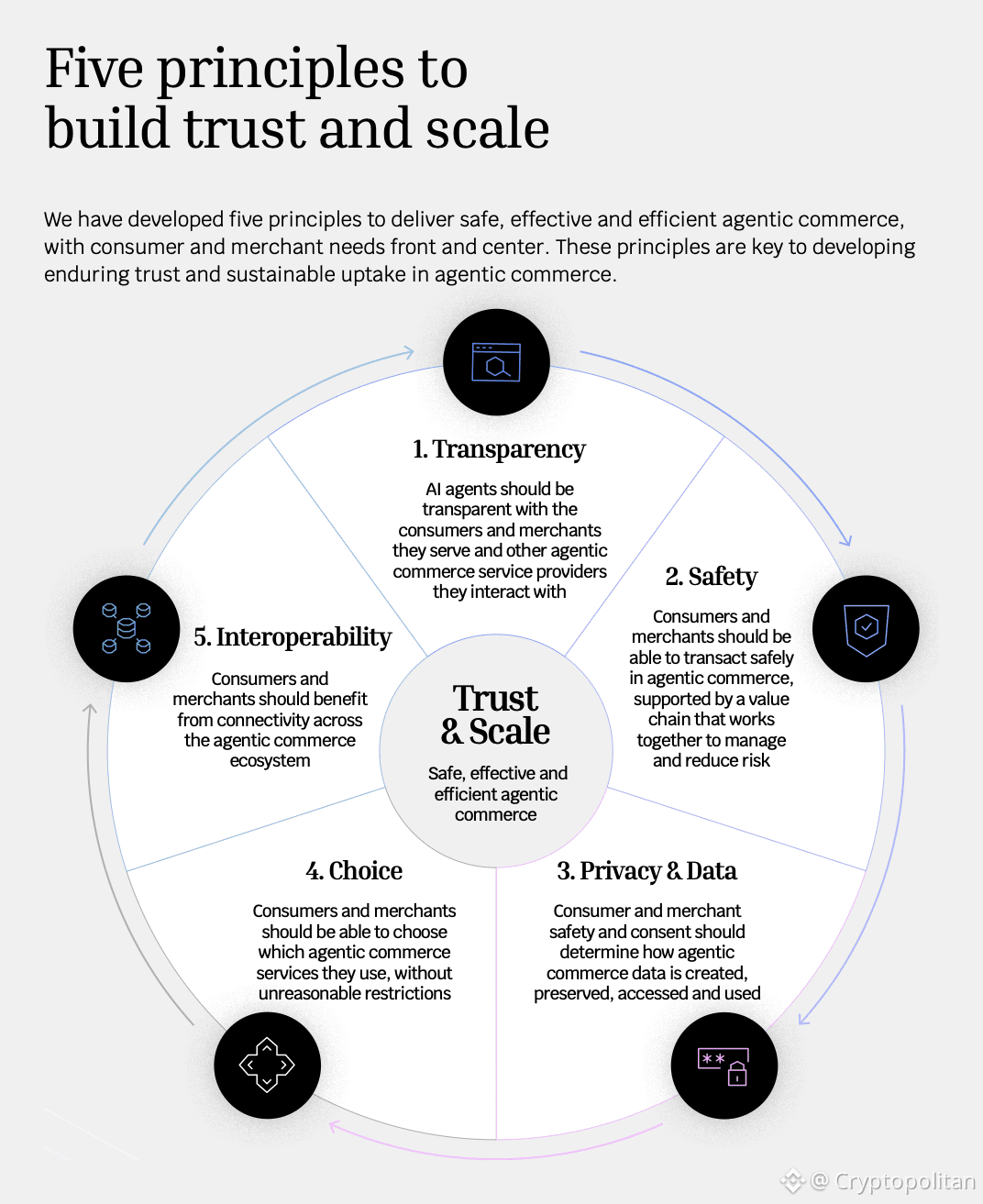
NatWest, Bank of America və dörd tərəfdaş AI alış-veriş agentlərinin özünü açıqlamasını istəyirSentyabrın 22-də altı bank agentik kommersiya üzrə bütün tərəflərin əməliyyatda AI agentinin olub-olmadığını və onun kimin adından çıxış etdiyini bildirməsini təklif edən birgə prinsiplər dərc etdi.
“Agentik Kommersiyada Etibarı Yaratmaq” adlı məqalə NatWest Group, Bank of America, Capital One, ING Group, Commonwealth Bank of Australia və Yeni Zelandiyanın ASB Bankı tərəfindən həmmüəlliflik edilib.
Prinsiplər könüllüdür, məcburedici deyil. Banklar təkliflərlə bağlı dövlət siyasəti hazırlayanlarla məsləhətləşməyi və onları necə tətbiq etmək barədə ikinci bir məqalə dərc etməyi planlaşdırır.
NatWest, Bank of America və dörd tərəfdaş AI alış-veriş agentlərinin özünü açıqlamasını istəyir
Sentyabrın 22-də altı bank agentik kommersiya üzrə bütün tərəflərin əməliyyatda AI agentinin olub-olmadığını və onun kimin adından çıxış etdiyini bildirməsini təklif edən birgə prinsiplər dərc etdi.
“Agentik Kommersiyada Etibarı Yaratmaq” adlı məqalə NatWest Group, Bank of America, Capital One, ING Group, Commonwealth Bank of Australia və Yeni Zelandiyanın ASB Bankı tərəfindən həmmüəlliflik edilib.
Prinsiplər könüllüdür, məcburedici deyil. Banklar təkliflərlə bağlı dövlət siyasəti hazırlayanlarla məsləhətləşməyi və onları necə tətbiq etmək barədə ikinci bir məqalə dərc etməyi planlaşdırır.
“Agentik Kommersiyada Etibarı Yaratmaq” adlı məqalə NatWest Group, Bank of America, Capital One, ING Group, Commonwealth Bank of Australia və Yeni Zelandiyanın ASB Bankı tərəfindən həmmüəlliflik edilib.
Prinsiplər könüllüdür, məcburedici deyil. Banklar təkliflərlə bağlı dövlət siyasəti hazırlayanlarla məsləhətləşməyi və onları necə tətbiq etmək barədə ikinci bir məqalə dərc etməyi planlaşdırır.
109
Bernstein proqnoz bazarı üzrə perspektivini 10 dəfə artıraraq $10T-ə qaldırırBernstein proqnozlaşdırır ki, proqnoz bazarları 2035-ci ilə qədər hər il 10 trilyon dollara qədər ticarət həcmi görə bilər; bu göstərici hazırda gözlənilən ildə 410 milyard dollardan yüksələcək. Proqnoz, proqnoz bazarı platformalarının bu sahədə dominantlıq uğrunda çalışdığı bir vaxta təsadüf edir; bunlara Kalshi və Polymarket daxildir.
Bu proqnoz həmin şirkətlər üçün önəmlidir, çünki onlar maliyyə müqavilələrinin sənayedə əsas faktor olacağı fərziyyəsinə söykənir və bu, idmanı geridə qoymalıdır.
İdmanı sıxışdırmaq üçün maliyyə aktivləri
Məlumata görə, Bernstein 2025-dən 2035-ə qədər həcmın hər il təxminən 70% artacağını gözləyir. Daha iddialı proqnoz isə qarışıqla bağlıdır. Kripto, səhmlər və kommersiya malları üzrə müqavilələrə bağlı həcm 2025-də ümumi həcmın təxminən 12%-ni təşkil edirdi. 2035 üçün Bernstein bu payın 49%-ə yüksələcəyini gözləyir. Bu, idmana aid olan paydan daha böyük olmağa yetərli ola bilər; çünki idman hazırda ən önəmli kateqoriyadır.
Bernstein proqnoz bazarı üzrə perspektivini 10 dəfə artıraraq $10T-ə qaldırır
Bernstein proqnozlaşdırır ki, proqnoz bazarları 2035-ci ilə qədər hər il 10 trilyon dollara qədər ticarət həcmi görə bilər; bu göstərici hazırda gözlənilən ildə 410 milyard dollardan yüksələcək. Proqnoz, proqnoz bazarı platformalarının bu sahədə dominantlıq uğrunda çalışdığı bir vaxta təsadüf edir; bunlara Kalshi və Polymarket daxildir.
Bu proqnoz həmin şirkətlər üçün önəmlidir, çünki onlar maliyyə müqavilələrinin sənayedə əsas faktor olacağı fərziyyəsinə söykənir və bu, idmanı geridə qoymalıdır.
İdmanı sıxışdırmaq üçün maliyyə aktivləri
Məlumata görə, Bernstein 2025-dən 2035-ə qədər həcmın hər il təxminən 70% artacağını gözləyir. Daha iddialı proqnoz isə qarışıqla bağlıdır. Kripto, səhmlər və kommersiya malları üzrə müqavilələrə bağlı həcm 2025-də ümumi həcmın təxminən 12%-ni təşkil edirdi. 2035 üçün Bernstein bu payın 49%-ə yüksələcəyini gözləyir. Bu, idmana aid olan paydan daha böyük olmağa yetərli ola bilər; çünki idman hazırda ən önəmli kateqoriyadır.
Bu proqnoz həmin şirkətlər üçün önəmlidir, çünki onlar maliyyə müqavilələrinin sənayedə əsas faktor olacağı fərziyyəsinə söykənir və bu, idmanı geridə qoymalıdır.
İdmanı sıxışdırmaq üçün maliyyə aktivləri
Məlumata görə, Bernstein 2025-dən 2035-ə qədər həcmın hər il təxminən 70% artacağını gözləyir. Daha iddialı proqnoz isə qarışıqla bağlıdır. Kripto, səhmlər və kommersiya malları üzrə müqavilələrə bağlı həcm 2025-də ümumi həcmın təxminən 12%-ni təşkil edirdi. 2035 üçün Bernstein bu payın 49%-ə yüksələcəyini gözləyir. Bu, idmana aid olan paydan daha böyük olmağa yetərli ola bilər; çünki idman hazırda ən önəmli kateqoriyadır.
177
Rusiya kriptousərici bazası 44 milyard dollarlıq ehtiyatlarla 20 milyona çatırÖlkənin maliyyə nazirliyinin məlumatına görə, Rusiyada kriptovalyutadan istifadə edən təxminən 20 milyon insan var və onların əlində 44 milyard ABŞ dollarından çox dəyərində sikkələr toplanıb.
Moskvada mərkəzi hökumət rəqəmin 2027-ci ildə, rəqəmsal aktivlərlə əməliyyatların leqallaşdırılmasından sonra ilk il, daha 10 milyon artacağını gözləyir.
20 milyon rus kriptodan istifadə edir; gündəlik dövriyyədə 50 milyard rubl vəsait iştirak edir
Rusiya Federasiyasında təxminən 20 milyon sakinin kriptovalyutadan istifadə etdiyi Rusiya maliyyə nazirinin müavini İvan Çebeskovun bildirdiyi kimi məlumdur.
Rusiya kriptousərici bazası 44 milyard dollarlıq ehtiyatlarla 20 milyona çatır
Ölkənin maliyyə nazirliyinin məlumatına görə, Rusiyada kriptovalyutadan istifadə edən təxminən 20 milyon insan var və onların əlində 44 milyard ABŞ dollarından çox dəyərində sikkələr toplanıb.
Moskvada mərkəzi hökumət rəqəmin 2027-ci ildə, rəqəmsal aktivlərlə əməliyyatların leqallaşdırılmasından sonra ilk il, daha 10 milyon artacağını gözləyir.
20 milyon rus kriptodan istifadə edir; gündəlik dövriyyədə 50 milyard rubl vəsait iştirak edir
Rusiya Federasiyasında təxminən 20 milyon sakinin kriptovalyutadan istifadə etdiyi Rusiya maliyyə nazirinin müavini İvan Çebeskovun bildirdiyi kimi məlumdur.
Moskvada mərkəzi hökumət rəqəmin 2027-ci ildə, rəqəmsal aktivlərlə əməliyyatların leqallaşdırılmasından sonra ilk il, daha 10 milyon artacağını gözləyir.
20 milyon rus kriptodan istifadə edir; gündəlik dövriyyədə 50 milyard rubl vəsait iştirak edir
Rusiya Federasiyasında təxminən 20 milyon sakinin kriptovalyutadan istifadə etdiyi Rusiya maliyyə nazirinin müavini İvan Çebeskovun bildirdiyi kimi məlumdur.
1
250
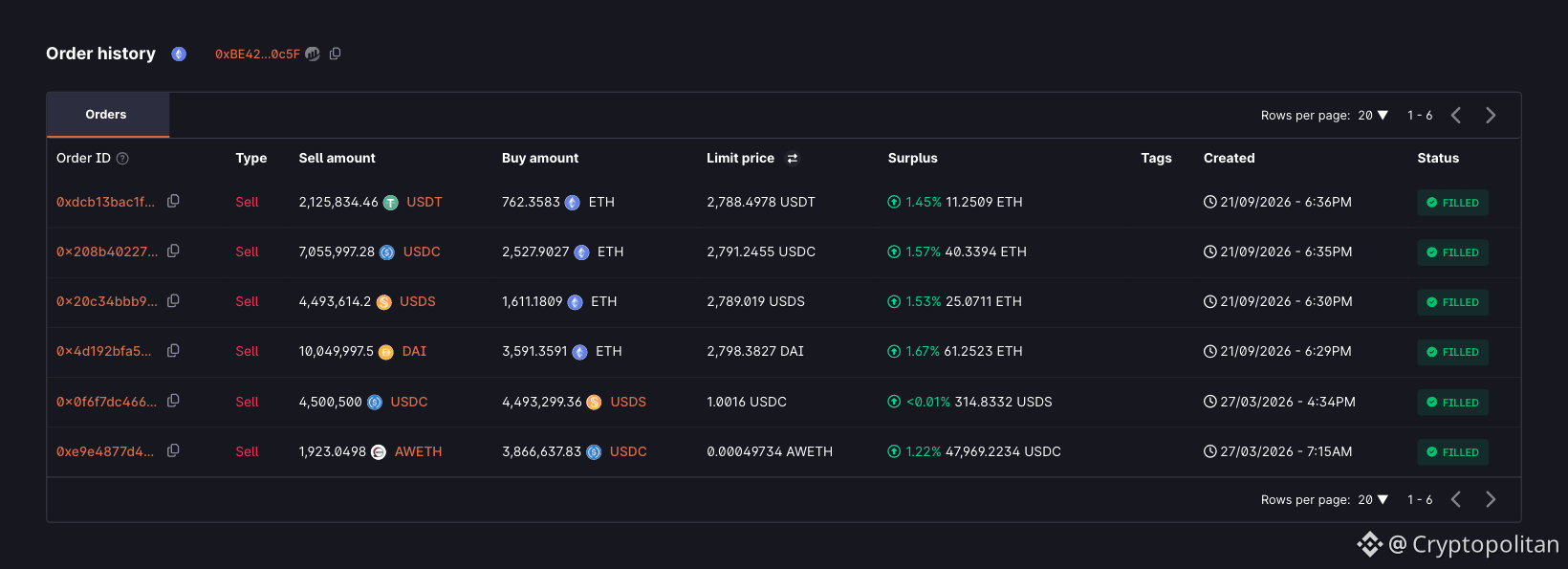
Məqalə
Tərcüməyə bax
Ethereum ICO whale spends $23.7 million on ETH it sold at $2,010 in MarchOn Sept. 21, a wallet from Ethereum’s 2015 ICO dumped $23.7 million worth of stablecoins into 8,492.8 ETH, paying about $2,794 a coin.
That’s almost 39% more than the $2,010 it fetched when it sold in March, by Cryptopolitan’s calculation.
Four Cow Swap orders cleared in eight minutes on Sept. 21
The purchase took place via Cow Swap, a decentralized exchange aggregator that pools orders. Address 0xBE42…0c5F dumped four stablecoins at once.
On-chain analyst ai_9684xtpa, who originally flagged the trade on X, pegged the total spend at $23.72 million with the cost basis at $2,793.59.
The four fills were: 10,049,997.50 DAI for 3,591.36 ETH, 4,493,614.20 USDS for 1,611.18 ETH, 7,055,997.28 USDC for 2,527.90 ETH and 2,125,834.46 USDT for 762.36 ETH.
The stablecoins departed the wallet between 15:29 and 15:37 UTC on Sept. 21, the CoW Protocol explorer order history shows.
In that same session, the wallet cleared about 809 wrapped ether of debt on DeFi lender Aave, and pulled ~8,876 ETH of collateral back out. With the new purchase, it now has about 16,773 ETH.
In the same order history, two rows down, dated March 27, the address sold 1,923.05 Aave-wrapped ether for 3,866,637.83 USDC. That works out to $2,010.68 a coin, with ETH finishing that day at $1,992.
CoW Protocol explorer order history for wallet 0xBE42…0c5F.
The whale exited around $2,010 and reentered around $2,794. At $2,749 for ETH at 12:38 UTC on Sept. 22, the new stack is down around $382,000.
ETH traded as high as $2,807 within hours of the buy, the first print above $2,800 since Jan. 30, 2026.
A $12,028 founding stake hit about $108.6 million at the Sept. 21 high
The address is connected to Ethereum’s original sale. It was a subscription of 38,800 ETH at about $0.31 a coin, tokens that landed when the network went live in 2015, said ai_9684xtpa.
The original outlay was about $12,028. That same position would be worth around $108.6 million at the Sept. 21 high near $2,800.
In February, OG whales removed tens of thousands of ETH from OKX and Binance into self-custody while ETH traded close to $2,037.
Separate data showed that large holders had shed up to 1.5% of their reserves in early 2026 as the price fell below $2,000.
Another entity that dispersed purchases across new addresses picked up 21,520 ETH, equal to about $55.8 million, across five days starting Sept. 18. It paid between $2,450 and $2,762 for an average of $2,593 and is up about $3.25 million on paper.
That cluster sold UBTC, wrapped bitcoin from Hyperliquid, to fund the ETH. It’s similar to a previous Hyperliquid whale who traded 1,107 BTC for 34,422 ETH, although no one has confirmed the two are the same trader.
Tom Lee’s Bitmine added 27,562 ETH last week, and now holds close to 4.9% of ETH’s supply.
Spot ether ETFs took in $270 million on Monday, led by BlackRock’s ETHA at $110.1 million and Fidelity’s FETH at $73 million.
The smartest crypto minds already read our newsletter. Want in? Join them.
Ethereum ICO whale spends $23.7 million on ETH it sold at $2,010 in March
On Sept. 21, a wallet from Ethereum’s 2015 ICO dumped $23.7 million worth of stablecoins into 8,492.8 ETH, paying about $2,794 a coin.
That’s almost 39% more than the $2,010 it fetched when it sold in March, by Cryptopolitan’s calculation.
Four Cow Swap orders cleared in eight minutes on Sept. 21
The purchase took place via Cow Swap, a decentralized exchange aggregator that pools orders. Address 0xBE42…0c5F dumped four stablecoins at once.
On-chain analyst ai_9684xtpa, who originally flagged the trade on X, pegged the total spend at $23.72 million with the cost basis at $2,793.59.
The four fills were: 10,049,997.50 DAI for 3,591.36 ETH, 4,493,614.20 USDS for 1,611.18 ETH, 7,055,997.28 USDC for 2,527.90 ETH and 2,125,834.46 USDT for 762.36 ETH.
The stablecoins departed the wallet between 15:29 and 15:37 UTC on Sept. 21, the CoW Protocol explorer order history shows.
In that same session, the wallet cleared about 809 wrapped ether of debt on DeFi lender Aave, and pulled ~8,876 ETH of collateral back out. With the new purchase, it now has about 16,773 ETH.
In the same order history, two rows down, dated March 27, the address sold 1,923.05 Aave-wrapped ether for 3,866,637.83 USDC. That works out to $2,010.68 a coin, with ETH finishing that day at $1,992.
CoW Protocol explorer order history for wallet 0xBE42…0c5F.
The whale exited around $2,010 and reentered around $2,794. At $2,749 for ETH at 12:38 UTC on Sept. 22, the new stack is down around $382,000.
ETH traded as high as $2,807 within hours of the buy, the first print above $2,800 since Jan. 30, 2026.
A $12,028 founding stake hit about $108.6 million at the Sept. 21 high
The address is connected to Ethereum’s original sale. It was a subscription of 38,800 ETH at about $0.31 a coin, tokens that landed when the network went live in 2015, said ai_9684xtpa.
The original outlay was about $12,028. That same position would be worth around $108.6 million at the Sept. 21 high near $2,800.
In February, OG whales removed tens of thousands of ETH from OKX and Binance into self-custody while ETH traded close to $2,037.
Separate data showed that large holders had shed up to 1.5% of their reserves in early 2026 as the price fell below $2,000.
Another entity that dispersed purchases across new addresses picked up 21,520 ETH, equal to about $55.8 million, across five days starting Sept. 18. It paid between $2,450 and $2,762 for an average of $2,593 and is up about $3.25 million on paper.
That cluster sold UBTC, wrapped bitcoin from Hyperliquid, to fund the ETH. It’s similar to a previous Hyperliquid whale who traded 1,107 BTC for 34,422 ETH, although no one has confirmed the two are the same trader.
Tom Lee’s Bitmine added 27,562 ETH last week, and now holds close to 4.9% of ETH’s supply.
Spot ether ETFs took in $270 million on Monday, led by BlackRock’s ETHA at $110.1 million and Fidelity’s FETH at $73 million.
The smartest crypto minds already read our newsletter. Want in? Join them.
That’s almost 39% more than the $2,010 it fetched when it sold in March, by Cryptopolitan’s calculation.
Four Cow Swap orders cleared in eight minutes on Sept. 21
The purchase took place via Cow Swap, a decentralized exchange aggregator that pools orders. Address 0xBE42…0c5F dumped four stablecoins at once.
On-chain analyst ai_9684xtpa, who originally flagged the trade on X, pegged the total spend at $23.72 million with the cost basis at $2,793.59.
The four fills were: 10,049,997.50 DAI for 3,591.36 ETH, 4,493,614.20 USDS for 1,611.18 ETH, 7,055,997.28 USDC for 2,527.90 ETH and 2,125,834.46 USDT for 762.36 ETH.
The stablecoins departed the wallet between 15:29 and 15:37 UTC on Sept. 21, the CoW Protocol explorer order history shows.
In that same session, the wallet cleared about 809 wrapped ether of debt on DeFi lender Aave, and pulled ~8,876 ETH of collateral back out. With the new purchase, it now has about 16,773 ETH.
In the same order history, two rows down, dated March 27, the address sold 1,923.05 Aave-wrapped ether for 3,866,637.83 USDC. That works out to $2,010.68 a coin, with ETH finishing that day at $1,992.
CoW Protocol explorer order history for wallet 0xBE42…0c5F.
The whale exited around $2,010 and reentered around $2,794. At $2,749 for ETH at 12:38 UTC on Sept. 22, the new stack is down around $382,000.
ETH traded as high as $2,807 within hours of the buy, the first print above $2,800 since Jan. 30, 2026.
A $12,028 founding stake hit about $108.6 million at the Sept. 21 high
The address is connected to Ethereum’s original sale. It was a subscription of 38,800 ETH at about $0.31 a coin, tokens that landed when the network went live in 2015, said ai_9684xtpa.
The original outlay was about $12,028. That same position would be worth around $108.6 million at the Sept. 21 high near $2,800.
In February, OG whales removed tens of thousands of ETH from OKX and Binance into self-custody while ETH traded close to $2,037.
Separate data showed that large holders had shed up to 1.5% of their reserves in early 2026 as the price fell below $2,000.
Another entity that dispersed purchases across new addresses picked up 21,520 ETH, equal to about $55.8 million, across five days starting Sept. 18. It paid between $2,450 and $2,762 for an average of $2,593 and is up about $3.25 million on paper.
That cluster sold UBTC, wrapped bitcoin from Hyperliquid, to fund the ETH. It’s similar to a previous Hyperliquid whale who traded 1,107 BTC for 34,422 ETH, although no one has confirmed the two are the same trader.
Tom Lee’s Bitmine added 27,562 ETH last week, and now holds close to 4.9% of ETH’s supply.
Spot ether ETFs took in $270 million on Monday, led by BlackRock’s ETHA at $110.1 million and Fidelity’s FETH at $73 million.
The smartest crypto minds already read our newsletter. Want in? Join them.
142
Doğrulanıb
Tərcüməyə bax
Binance and Circle agree USDC promotion as part of $100M ownership stake dealAn SEC filing has revealed that Binance paid $100 million for a slice of Circle (NYSE: CRCL).
The same filing also shows that Binance agreed to be paid for promoting the USDC stablecoin on its exchange over the next five years.
Did Binance buy Circle stocks?
An SEC filing has revealed that Binance received 1,237,011 of Circle’s Class A shares at $80.84 apiece through a private placement that closed on September 17.
Circle priced the shares below where its stock was trading at the time, but neither the company nor the filing revealed how much the discount was. Also, because the placement was unregistered, Binance cannot resell the shares unless they are later registered or an exemption applies.
Under the terms of the deal, for two years from its closing, or until Binance ends the commercial side of the deal under certain conditions, whichever happens first, it cannot sell, transfer, pledge or hedge the stock.
The few exceptions allow Binance to transfer shares to its own affiliates. A board-approved takeover can still go through and also Binance must sell if a court or law forces it to. Despite not being able to touch the stock, Binance keeps every shareholder right it would normally have, including the vote.
Circle got $100 million in cash from selling the shares and in return, Binance agreed to promote USDC to its users.
Specifically, in exchange for marketing and promotional work for USDC, Circle will pay Binance a monthly fee based on a percentage of the USDC balance held through Binance’s Modular Smart Contract Wallet service.
The arrangement runs for five years, and either company can walk away early if certain conditions happen — though the filing doesn’t say what those conditions are.
How is the deal beneficial to Binance and Circle?
CRCL was trading in the mid-$80s on September 17 when the deal closed, and over the next few trading days, the stock climbed, closing at $94.49 on September 21. At that price, Binance’s 1,237,011 shares would be worth roughly $116.9 million. However, due to the two-year lockup, none of that paper gain can be cashed out right now.
Over the past 12 months, CRCL stock dropped by about 34%. The deal with Binance, the largest crypto exchange in the world, is partly about distribution.
Getting favorable placement and active promotion on the platform could help USDC grow, especially at a time when regulatory pressure in Europe has made things harder for USDT, USDC’s biggest rival stablecoin.
This deal is the third version of Binance and Circle’s partnership since late 2024, and it replaces earlier agreements from November 2024 and August 2025.
The original agreement was announced in December 2024 at Abu Dhabi Finance Week, when Binance said it would start offering USDC across its products and hold some USDC in its own corporate treasury.
If you're reading this, you’re already ahead. Stay there with our newsletter.
Binance and Circle agree USDC promotion as part of $100M ownership stake deal
An SEC filing has revealed that Binance paid $100 million for a slice of Circle (NYSE: CRCL).
The same filing also shows that Binance agreed to be paid for promoting the USDC stablecoin on its exchange over the next five years.
Did Binance buy Circle stocks?
An SEC filing has revealed that Binance received 1,237,011 of Circle’s Class A shares at $80.84 apiece through a private placement that closed on September 17.
Circle priced the shares below where its stock was trading at the time, but neither the company nor the filing revealed how much the discount was. Also, because the placement was unregistered, Binance cannot resell the shares unless they are later registered or an exemption applies.
Under the terms of the deal, for two years from its closing, or until Binance ends the commercial side of the deal under certain conditions, whichever happens first, it cannot sell, transfer, pledge or hedge the stock.
The few exceptions allow Binance to transfer shares to its own affiliates. A board-approved takeover can still go through and also Binance must sell if a court or law forces it to. Despite not being able to touch the stock, Binance keeps every shareholder right it would normally have, including the vote.
Circle got $100 million in cash from selling the shares and in return, Binance agreed to promote USDC to its users.
Specifically, in exchange for marketing and promotional work for USDC, Circle will pay Binance a monthly fee based on a percentage of the USDC balance held through Binance’s Modular Smart Contract Wallet service.
The arrangement runs for five years, and either company can walk away early if certain conditions happen — though the filing doesn’t say what those conditions are.
How is the deal beneficial to Binance and Circle?
CRCL was trading in the mid-$80s on September 17 when the deal closed, and over the next few trading days, the stock climbed, closing at $94.49 on September 21. At that price, Binance’s 1,237,011 shares would be worth roughly $116.9 million. However, due to the two-year lockup, none of that paper gain can be cashed out right now.
Over the past 12 months, CRCL stock dropped by about 34%. The deal with Binance, the largest crypto exchange in the world, is partly about distribution.
Getting favorable placement and active promotion on the platform could help USDC grow, especially at a time when regulatory pressure in Europe has made things harder for USDT, USDC’s biggest rival stablecoin.
This deal is the third version of Binance and Circle’s partnership since late 2024, and it replaces earlier agreements from November 2024 and August 2025.
The original agreement was announced in December 2024 at Abu Dhabi Finance Week, when Binance said it would start offering USDC across its products and hold some USDC in its own corporate treasury.
If you're reading this, you’re already ahead. Stay there with our newsletter.
The same filing also shows that Binance agreed to be paid for promoting the USDC stablecoin on its exchange over the next five years.
Did Binance buy Circle stocks?
An SEC filing has revealed that Binance received 1,237,011 of Circle’s Class A shares at $80.84 apiece through a private placement that closed on September 17.
Circle priced the shares below where its stock was trading at the time, but neither the company nor the filing revealed how much the discount was. Also, because the placement was unregistered, Binance cannot resell the shares unless they are later registered or an exemption applies.
Under the terms of the deal, for two years from its closing, or until Binance ends the commercial side of the deal under certain conditions, whichever happens first, it cannot sell, transfer, pledge or hedge the stock.
The few exceptions allow Binance to transfer shares to its own affiliates. A board-approved takeover can still go through and also Binance must sell if a court or law forces it to. Despite not being able to touch the stock, Binance keeps every shareholder right it would normally have, including the vote.
Circle got $100 million in cash from selling the shares and in return, Binance agreed to promote USDC to its users.
Specifically, in exchange for marketing and promotional work for USDC, Circle will pay Binance a monthly fee based on a percentage of the USDC balance held through Binance’s Modular Smart Contract Wallet service.
The arrangement runs for five years, and either company can walk away early if certain conditions happen — though the filing doesn’t say what those conditions are.
How is the deal beneficial to Binance and Circle?
CRCL was trading in the mid-$80s on September 17 when the deal closed, and over the next few trading days, the stock climbed, closing at $94.49 on September 21. At that price, Binance’s 1,237,011 shares would be worth roughly $116.9 million. However, due to the two-year lockup, none of that paper gain can be cashed out right now.
Over the past 12 months, CRCL stock dropped by about 34%. The deal with Binance, the largest crypto exchange in the world, is partly about distribution.
Getting favorable placement and active promotion on the platform could help USDC grow, especially at a time when regulatory pressure in Europe has made things harder for USDT, USDC’s biggest rival stablecoin.
This deal is the third version of Binance and Circle’s partnership since late 2024, and it replaces earlier agreements from November 2024 and August 2025.
The original agreement was announced in December 2024 at Abu Dhabi Finance Week, when Binance said it would start offering USDC across its products and hold some USDC in its own corporate treasury.
If you're reading this, you’re already ahead. Stay there with our newsletter.
128
Daha çox kontent araşdırmaq üçün daxil olun
Binance Square-də qlobal kriptovalyuta istifadəçilərinə qoşulun
⚡️ Kriptovalyuta haqqında ən son və faydalı məlumatları əldə edin.
💬 Dünyanın ən böyük kriptovalyuta birjası tərəfindən etibar edilir.
👍 Doğrulanmış yaradıcılardan gələn real məlumatları kəşf edin.
E-poçt/Telefon nömrəsi
Trenddə olan mövzular
AIStocksWhatNext
511,114 baxış
Müzakirə edir: 3,814
Trendləşən hashtag kampaniyamızda Paylaş və Qazan Trafik Mükafatı
✨ Mövzu: AI səhmələri yüksəlməyə davam etdikcə hansı digər investisiya imkanları hələ də qalır?
👉 Necə qoşulmaq:
#AIStocksWhatNext hashtagı ilə qısa post və ya məqalə dərc edin
Bəllə edin ki, siz boğasınız, yoxsa ayısınız, həm də AI səhm portfelinizi və ya treydinizi paylaşın — treyd widgetından istifadə uyğunluğunuzu artıra bilər.
Həmçinin məlumatlar və ya qrafiklər paylaşaraq postunuzu gücləndirə, AI tərəfindən yaradılmış şəkillərdən isə çəkinə bilərsiniz.
✍️ Aşağıdakı bucaqlara əsasən kontent yaradın:
- Nvidia deyir ki, çip satışları gələn il ikiqat olacaq və aparıcı AI şirkətləri rekord gəlir vurmağa davam edir — bunun arxasında dayanan hesablama xərci də həqiqətən heyrətamiz dərəcədə böyükdür. AI tələbi doğrudan da artır? Və bu nə qədər davam edə bilər? AI səhmələri bütün bazarda yüksəlib. Bu, real bir qırılma/breakout-dur, yoxsa sadəcə qısamüddətli sıçrayış?
- Sənaye liderləri AI inkişafını ləngitmək çağırışı edir, Trump isə gələcəkdə AI-nin ABŞ ÜDM-nin 25%-ni təşkil edə biləcəyini iddia edərək “AI Force” qurmaq planı haqqında danışır. Sizin tərəfiniz kim tərəfindədır? Dövlət səviyyəsində dəstək AI səhmələri üçün uzunmüddətli qazanc olacaqmı?
- Siz AI səhmələrini alırsınız? Trade paylaşma widgetımızla AI ilə bağlı treydinizi və ya portfelinizi paylaşın.
⏰ Kampaniya Dövrü:
- 2026-09-22 7:00 - 2026-09-24 4:00 UTC
🎁 Mükafat:
- Yuxarıdakı qaydalara uyğun gələn və 100-dən çox söz ehtiva edən ixtisaslı postlar nəzərdən keçiriləcək və 500-dən 3,000-ə qədər təsadüfi trafik artımı ala bilər. Postunuz seçilərsə, feed katibinizdən bildiriş alacaqsınız.
- Məqalənizin Binance Square Official-da nümayiş olunması üçün şans qazanın
Postunuz üçün ideyalar lazımdır? Mövzu səhifəsinə keçin #AIStocksWhatNext və ya Square Guide on How to Post for Better Reach.
Binance Square Official
·431 bəyənmə
·1.1M baxış
BitcoinTops$87KAtEightMonthHigh
1,003 baxış
Müzakirə edir: 37
ZECBreaksAbove$1600AtRecordHigh
461 baxış
Müzakirə edir: 23