
Crypto Breaking
19.9k Paylaşımlar

Crypto Breaking
 Square Verified+
Şikayət et
İstifadəçini blokla
Get real-time cryptocurrency news, blockchain updates, market analysis, and expert insights. Explore the latest trends in Bitcoin, Ethereum, DeFi, and Web3.
6 İzlənilir
32.8K+ İzləyicilər
31.6K+ Bəyəndi
Postlar
Hamısı
Sitatlar
Məqalə
Tərcüməyə bax
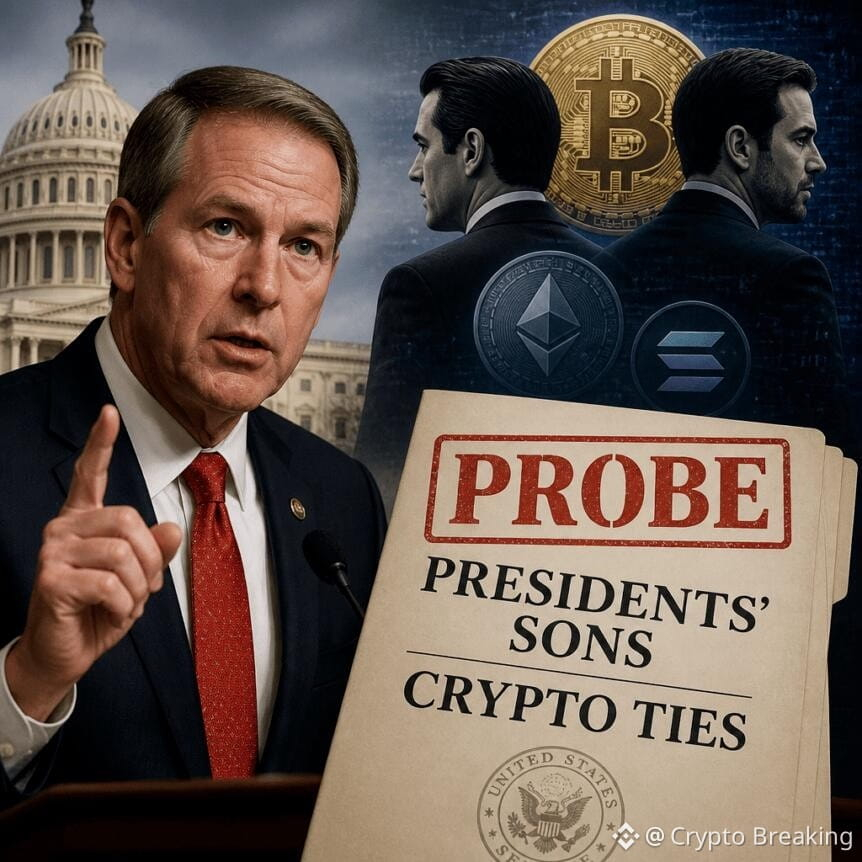
Republican Senator Seeks Probe of Presidents’ Sons Linked to CryptoRepublican Sen. John Curtis of Utah has urged the Senate Judiciary Committee to investigate whether Donald Trump’s son and President Joe Biden’s son used family ties to the presidency for private gain, with Curtis explicitly pointing to their involvement in cryptocurrency and related financial activities.
In a letter sent to Judiciary Committee Chair Chuck Grassley and ranking member Dick Durbin, Curtis requested subpoenas for Donald Trump Jr. and Hunter Biden, arguing the committee should examine whether presidential family relationships were used for “private financial benefit, preferential treatment, or access by domestic and foreign interest.”
Key takeaways
Sen. John Curtis asked the Senate Judiciary Committee to investigate Donald Trump Jr. and Hunter Biden using subpoenas.
Curtis’ allegations focus on potential conflicts of interest and how presidential connections may have translated into value for business dealings.
For Donald Trump Jr., Curtis specifically cited crypto-linked roles and advisory activities, noting they fall under the regulatory scope of the CFTC.
Curtis linked Hunter Biden’s case to “substantial business with foreign entities” and the alleged use of presidential ties for advantage.
The push for investigations arrives amid continued uncertainty around US crypto market-structure legislation, after the Digital Asset Market Clarity Act failed to advance.
Curtis targets crypto and family ties in requested subpoenas
According to Curtis’ letter, the committee should probe whether the sons’ proximity to their respective fathers influenced financial outcomes. He argued the investigation should “establish the facts,” determine which ethics, disclosure, or anti-corruption laws may apply, and identify reforms to ensure the presidency is not used as “a vehicle for private enrichment by those closest to it.”
For Donald Trump Jr., Curtis highlighted multiple points, including the former president’s son’s acceptance of gifts from Russian oligarch Umar Kremlev tied to a wedding, as well as what Curtis described as “active promotion of family-backed cryptocurrency ventures.” The senator also referenced advisory roles with prediction market platforms, arguing those platforms are within the scope of the Commodity Futures Trading Commission.
Curtis also pointed to President Trump’s public statement last week that Donald Trump Jr. had repaid Kremlev for what the couple described as a “generous wedding gift.”
Hunter Biden scrutiny centers on foreign business and possible implied access
Curtis’ request did not stop with Trump Jr. He also called for a similar probe into Hunter Biden, citing what he characterized as “substantial business with foreign entities.”
In the letter, Curtis argued that the committee should look at situations where either man’s relationship to the presidency was “invoked or understood to provide value.” Curtis noted that President Biden issued a pardon for Hunter Biden in December 2024 for crimes Hunter “committed or may have committed or taken part in over the last decade,” and referenced Hunter Biden’s position that he did not involve his father in business dealings.
The senator framed the issue less as a determination of wrongdoing at the outset and more as a fact-finding and legal assessment exercise aimed at clarifying whether existing rules were triggered and what safeguards should be strengthened if they were not.
Why this matters as crypto policy remains contested in the Senate
Curtis’ letter arrives in a political climate where crypto oversight and market regulation continue to be difficult to reconcile in Congress. The renewed push for investigations follows a week after Senate Republicans failed to secure enough Democratic support for the Digital Asset Market Clarity Act, a bill expected to lay out market-structure rules for digital assets.
Some Democrats said they were not willing to support the bill because of concerns that President Trump would “use crypto to turn the presidency into a profit generating machine.” The president has also disclosed that he earned $1.4 billion from ventures tied to digital assets in 2025, according to coverage referenced in the underlying reporting.
Republicans argued the bill incorporated stronger ethics provisions that would affect the president’s crypto investments ahead of the vote. Still, many Democrats maintained that the measures did not go far enough to prevent corruption and improper influence.
Against that backdrop, Curtis’ focus on subpoenas and potential conflict-of-interest patterns reflects a broader theme: even as legislators debate how to regulate crypto markets, they are also pushing for scrutiny of whether public office—and the public’s perception of access to officeholders—can be leveraged through crypto-related business activity.
Investigations into the Trump family’s crypto ties already featured in this Congress
Curtis’ request is not the first attempt during the current Congressional session to draw lawmakers’ attention to potential crypto conflicts around the Trump family. Earlier calls for probes have largely come from House and Senate Democrats, who urged authorities to examine possible conflicts connected to Trump’s memecoin, his family’s World Liberty Financial business, and a separate $500 million deal associated with Abu Dhabi’s royal family.
Earlier coverage also pointed to Senate Democrats pushing for hearings and oversight into whether crypto ventures created incentives that blurred the line between official responsibilities and private financial interests.
Curtis is serving his first term in the Senate and is not up for reelection until 2030.
Readers should watch whether the Judiciary Committee agrees to act on the subpoenas Curtis is urging, and how that decision may intersect with the Senate’s stalled efforts to pass broader market-structure legislation—particularly as lawmakers continue to debate whether existing ethics frameworks can effectively address alleged conflicts tied to crypto.
This article was originally published as Republican Senator Seeks Probe of Presidents’ Sons Linked to Crypto on Crypto Breaking News – your trusted source for crypto news, Bitcoin news, and blockchain updates.
Republican Senator Seeks Probe of Presidents’ Sons Linked to Crypto
Republican Sen. John Curtis of Utah has urged the Senate Judiciary Committee to investigate whether Donald Trump’s son and President Joe Biden’s son used family ties to the presidency for private gain, with Curtis explicitly pointing to their involvement in cryptocurrency and related financial activities.
In a letter sent to Judiciary Committee Chair Chuck Grassley and ranking member Dick Durbin, Curtis requested subpoenas for Donald Trump Jr. and Hunter Biden, arguing the committee should examine whether presidential family relationships were used for “private financial benefit, preferential treatment, or access by domestic and foreign interest.”
Key takeaways
Sen. John Curtis asked the Senate Judiciary Committee to investigate Donald Trump Jr. and Hunter Biden using subpoenas.
Curtis’ allegations focus on potential conflicts of interest and how presidential connections may have translated into value for business dealings.
For Donald Trump Jr., Curtis specifically cited crypto-linked roles and advisory activities, noting they fall under the regulatory scope of the CFTC.
Curtis linked Hunter Biden’s case to “substantial business with foreign entities” and the alleged use of presidential ties for advantage.
The push for investigations arrives amid continued uncertainty around US crypto market-structure legislation, after the Digital Asset Market Clarity Act failed to advance.
Curtis targets crypto and family ties in requested subpoenas
According to Curtis’ letter, the committee should probe whether the sons’ proximity to their respective fathers influenced financial outcomes. He argued the investigation should “establish the facts,” determine which ethics, disclosure, or anti-corruption laws may apply, and identify reforms to ensure the presidency is not used as “a vehicle for private enrichment by those closest to it.”
For Donald Trump Jr., Curtis highlighted multiple points, including the former president’s son’s acceptance of gifts from Russian oligarch Umar Kremlev tied to a wedding, as well as what Curtis described as “active promotion of family-backed cryptocurrency ventures.” The senator also referenced advisory roles with prediction market platforms, arguing those platforms are within the scope of the Commodity Futures Trading Commission.
Curtis also pointed to President Trump’s public statement last week that Donald Trump Jr. had repaid Kremlev for what the couple described as a “generous wedding gift.”
Hunter Biden scrutiny centers on foreign business and possible implied access
Curtis’ request did not stop with Trump Jr. He also called for a similar probe into Hunter Biden, citing what he characterized as “substantial business with foreign entities.”
In the letter, Curtis argued that the committee should look at situations where either man’s relationship to the presidency was “invoked or understood to provide value.” Curtis noted that President Biden issued a pardon for Hunter Biden in December 2024 for crimes Hunter “committed or may have committed or taken part in over the last decade,” and referenced Hunter Biden’s position that he did not involve his father in business dealings.
The senator framed the issue less as a determination of wrongdoing at the outset and more as a fact-finding and legal assessment exercise aimed at clarifying whether existing rules were triggered and what safeguards should be strengthened if they were not.
Why this matters as crypto policy remains contested in the Senate
Curtis’ letter arrives in a political climate where crypto oversight and market regulation continue to be difficult to reconcile in Congress. The renewed push for investigations follows a week after Senate Republicans failed to secure enough Democratic support for the Digital Asset Market Clarity Act, a bill expected to lay out market-structure rules for digital assets.
Some Democrats said they were not willing to support the bill because of concerns that President Trump would “use crypto to turn the presidency into a profit generating machine.” The president has also disclosed that he earned $1.4 billion from ventures tied to digital assets in 2025, according to coverage referenced in the underlying reporting.
Republicans argued the bill incorporated stronger ethics provisions that would affect the president’s crypto investments ahead of the vote. Still, many Democrats maintained that the measures did not go far enough to prevent corruption and improper influence.
Against that backdrop, Curtis’ focus on subpoenas and potential conflict-of-interest patterns reflects a broader theme: even as legislators debate how to regulate crypto markets, they are also pushing for scrutiny of whether public office—and the public’s perception of access to officeholders—can be leveraged through crypto-related business activity.
Investigations into the Trump family’s crypto ties already featured in this Congress
Curtis’ request is not the first attempt during the current Congressional session to draw lawmakers’ attention to potential crypto conflicts around the Trump family. Earlier calls for probes have largely come from House and Senate Democrats, who urged authorities to examine possible conflicts connected to Trump’s memecoin, his family’s World Liberty Financial business, and a separate $500 million deal associated with Abu Dhabi’s royal family.
Earlier coverage also pointed to Senate Democrats pushing for hearings and oversight into whether crypto ventures created incentives that blurred the line between official responsibilities and private financial interests.
Curtis is serving his first term in the Senate and is not up for reelection until 2030.
Readers should watch whether the Judiciary Committee agrees to act on the subpoenas Curtis is urging, and how that decision may intersect with the Senate’s stalled efforts to pass broader market-structure legislation—particularly as lawmakers continue to debate whether existing ethics frameworks can effectively address alleged conflicts tied to crypto.
This article was originally published as Republican Senator Seeks Probe of Presidents’ Sons Linked to Crypto on Crypto Breaking News – your trusted source for crypto news, Bitcoin news, and blockchain updates.
In a letter sent to Judiciary Committee Chair Chuck Grassley and ranking member Dick Durbin, Curtis requested subpoenas for Donald Trump Jr. and Hunter Biden, arguing the committee should examine whether presidential family relationships were used for “private financial benefit, preferential treatment, or access by domestic and foreign interest.”
Key takeaways
Sen. John Curtis asked the Senate Judiciary Committee to investigate Donald Trump Jr. and Hunter Biden using subpoenas.
Curtis’ allegations focus on potential conflicts of interest and how presidential connections may have translated into value for business dealings.
For Donald Trump Jr., Curtis specifically cited crypto-linked roles and advisory activities, noting they fall under the regulatory scope of the CFTC.
Curtis linked Hunter Biden’s case to “substantial business with foreign entities” and the alleged use of presidential ties for advantage.
The push for investigations arrives amid continued uncertainty around US crypto market-structure legislation, after the Digital Asset Market Clarity Act failed to advance.
Curtis targets crypto and family ties in requested subpoenas
According to Curtis’ letter, the committee should probe whether the sons’ proximity to their respective fathers influenced financial outcomes. He argued the investigation should “establish the facts,” determine which ethics, disclosure, or anti-corruption laws may apply, and identify reforms to ensure the presidency is not used as “a vehicle for private enrichment by those closest to it.”
For Donald Trump Jr., Curtis highlighted multiple points, including the former president’s son’s acceptance of gifts from Russian oligarch Umar Kremlev tied to a wedding, as well as what Curtis described as “active promotion of family-backed cryptocurrency ventures.” The senator also referenced advisory roles with prediction market platforms, arguing those platforms are within the scope of the Commodity Futures Trading Commission.
Curtis also pointed to President Trump’s public statement last week that Donald Trump Jr. had repaid Kremlev for what the couple described as a “generous wedding gift.”
Hunter Biden scrutiny centers on foreign business and possible implied access
Curtis’ request did not stop with Trump Jr. He also called for a similar probe into Hunter Biden, citing what he characterized as “substantial business with foreign entities.”
In the letter, Curtis argued that the committee should look at situations where either man’s relationship to the presidency was “invoked or understood to provide value.” Curtis noted that President Biden issued a pardon for Hunter Biden in December 2024 for crimes Hunter “committed or may have committed or taken part in over the last decade,” and referenced Hunter Biden’s position that he did not involve his father in business dealings.
The senator framed the issue less as a determination of wrongdoing at the outset and more as a fact-finding and legal assessment exercise aimed at clarifying whether existing rules were triggered and what safeguards should be strengthened if they were not.
Why this matters as crypto policy remains contested in the Senate
Curtis’ letter arrives in a political climate where crypto oversight and market regulation continue to be difficult to reconcile in Congress. The renewed push for investigations follows a week after Senate Republicans failed to secure enough Democratic support for the Digital Asset Market Clarity Act, a bill expected to lay out market-structure rules for digital assets.
Some Democrats said they were not willing to support the bill because of concerns that President Trump would “use crypto to turn the presidency into a profit generating machine.” The president has also disclosed that he earned $1.4 billion from ventures tied to digital assets in 2025, according to coverage referenced in the underlying reporting.
Republicans argued the bill incorporated stronger ethics provisions that would affect the president’s crypto investments ahead of the vote. Still, many Democrats maintained that the measures did not go far enough to prevent corruption and improper influence.
Against that backdrop, Curtis’ focus on subpoenas and potential conflict-of-interest patterns reflects a broader theme: even as legislators debate how to regulate crypto markets, they are also pushing for scrutiny of whether public office—and the public’s perception of access to officeholders—can be leveraged through crypto-related business activity.
Investigations into the Trump family’s crypto ties already featured in this Congress
Curtis’ request is not the first attempt during the current Congressional session to draw lawmakers’ attention to potential crypto conflicts around the Trump family. Earlier calls for probes have largely come from House and Senate Democrats, who urged authorities to examine possible conflicts connected to Trump’s memecoin, his family’s World Liberty Financial business, and a separate $500 million deal associated with Abu Dhabi’s royal family.
Earlier coverage also pointed to Senate Democrats pushing for hearings and oversight into whether crypto ventures created incentives that blurred the line between official responsibilities and private financial interests.
Curtis is serving his first term in the Senate and is not up for reelection until 2030.
Readers should watch whether the Judiciary Committee agrees to act on the subpoenas Curtis is urging, and how that decision may intersect with the Senate’s stalled efforts to pass broader market-structure legislation—particularly as lawmakers continue to debate whether existing ethics frameworks can effectively address alleged conflicts tied to crypto.
This article was originally published as Republican Senator Seeks Probe of Presidents’ Sons Linked to Crypto on Crypto Breaking News – your trusted source for crypto news, Bitcoin news, and blockchain updates.
30

Məqalə
Tərcüməyə bax
CFTC Warns on Risky Prediction Market “Mention” ContractsThe U.S. Commodity Futures Trading Commission (CFTC) has issued fresh guidance warning that “mention markets” in prediction trading—contracts that settle based on whether a specific person says certain words, attends an event, appears publicly, or interacts with someone—face a heightened risk of manipulation. The regulator’s advisory signals that exchanges seeking to list these products may need to clear a higher bar on oversight, verifiability, and susceptibility to external influence.
In a statement released Tuesday, the CFTC’s Division of Market Oversight said that listing these contract types is generally limited to “limited circumstances” consistent with the Commodity Exchange Act. The agency’s remarks come amid broader scrutiny of how prediction markets are structured and policed, including enforcement actions tied to alleged trading around privileged information.
Key takeaways
The CFTC warns that mention markets settle on discrete personal conduct that may be neither independently generated nor externally verifiable, increasing manipulation risk.
Exchanges are encouraged to apply a stricter checklist, including oversight capability and whether settlement triggers are verifiable.
Recent enforcement in the prediction market space underscores the agency’s focus on information asymmetry and conduct-based settlement mechanics.
Separate reporting highlights unusual Kalshi trading in an Ether-related market, adding to questions about integrity monitoring even as the platform rejects manipulation claims.
Why the CFTC singled out “mention markets”
The advisory, issued by the CFTC’s Division of Market Oversight, is aimed at regulated entities responsible for bringing contracts to market. The CFTC described mention markets as event-driven derivatives where the settlement depends on what an individual does—such as saying specific words or showing up—rather than on market-wide outcomes or easily measurable external data.
According to the regulator, this structure can create a “heightened risk of manipulation” because the settlement outcome hinges on a person’s conduct, which may not be independently produced and may be hard for outsiders to verify reliably.
The CFTC’s position effectively reframes the issue: it is not merely the fact that a contract references an event, but how the contract defines what counts as an outcome and whether that outcome can be checked without ambiguity.
The agency’s checklist for exchanges
Reporting from CNBC indicates the CFTC letter highlights four considerations that exchanges should evaluate before listing mention-market contracts. Those factors include whether the exchange has adequate oversight measures to detect manipulation, whether the words or actions used for settlement are independently verifiable, whether outside pressure could influence the subject’s conduct, and what obligations the subject of the contract may have.
The regulatory guidance also reinforces that exchanges and contract-issuing parties are expected to think beyond the initial listing proposal. In the CFTC’s framing, the exchange’s role in monitoring market behavior and safeguarding contract integrity becomes central—particularly where the settlement trigger could be influenced by the very person referenced in the contract.
CFTC Chair Mike Selig publicly welcomed the staff guidance on Tuesday, posting that “regulatory clarity drives sound markets,” and stating that the advisory reminds designated contract markets (DCMs) of their obligations to list contracts that are not readily susceptible to manipulation.
The CFTC’s guidance, published as an official advisory, can be found via the regulator’s press materials: CFTC.
Enforcement momentum in conduct-based prediction contracts
The warning is arriving against a backdrop of legal action focused on manipulation risks in prediction markets. Earlier coverage highlighted a case involving a former White House teleprompter operator whose trading was tied to U.S. President Donald Trump’s speeches. That matter reportedly resulted in an order requiring the individual to return $107,539 in profits and pay a $65,000 civil penalty.
Earlier reporting on the enforcement details came from Cointelegraph, including coverage of how the matter related to “Kalshi” contracts tied to what the president would say. The recurrence of scrutiny around speech- and conduct-based settlement mechanisms helps explain why the CFTC is emphasizing the “discrete conduct” problem: when a contract’s payoff is linked to an individual’s behavior, regulators are more likely to see opportunities for information advantages and influence.
Notably, the CFTC’s advisory wording points to a core compliance dilemma for prediction markets: the more directly a contract settles on a person’s specific actions, the more difficult it can be to demonstrate that the settlement will be independently generated and verifiably fair.
Broader scrutiny extends beyond “mention” products
Separate from Tuesday’s mention-market warning, new reporting has drawn attention to unusual trading behavior on Kalshi, a platform that offers event-based contracts. According to a Wall Street Journal report, nearly one million trades worth more than $5 billion occurred in a single market tied to the price of Ether. The Journal said that more than a third of those trades took place in nearly identical amounts around $5,500.
The Wall Street Journal also reported that federal regulators and traders have taken notice of the activity. Kalshi, however, rejected suggestions that the transactions amounted to wash trading, according to the same coverage.
While this Ether-related episode does not necessarily involve the same “mention” contract mechanics, it fits into a larger pattern: regulators and market participants are increasingly focused on whether trading activity and settlement designs can be squared with market integrity expectations. For investors and traders, this means due diligence is likely to extend beyond whether a product is popular or liquid, and toward how an exchange identifies unusual activity and enforces its rules.
Earlier, CNBC and NPR reported in August that the CFTC had begun examining mention markets over manipulation concerns. The reporting also said that Kalshi removed mention markets tied to sporting events “until further notice” while the review proceeded, reflecting the practical impact guidance and enforcement can have on what exchanges list and how quickly they respond to regulatory pressure.
What to watch next
For exchanges and market makers, the immediate question is how strictly they will apply the CFTC’s “limited circumstances” framing when assessing new mention-market proposals, and whether they will tighten verification and monitoring procedures. For traders, the larger takeaway is that conduct-based settlement mechanics—especially where external influence or verifiability issues exist—will likely remain under the microscope, even as platforms continue expanding prediction product lineups.
This article was originally published as CFTC Warns on Risky Prediction Market “Mention” Contracts on Crypto Breaking News – your trusted source for crypto news, Bitcoin news, and blockchain updates.
CFTC Warns on Risky Prediction Market “Mention” Contracts
The U.S. Commodity Futures Trading Commission (CFTC) has issued fresh guidance warning that “mention markets” in prediction trading—contracts that settle based on whether a specific person says certain words, attends an event, appears publicly, or interacts with someone—face a heightened risk of manipulation. The regulator’s advisory signals that exchanges seeking to list these products may need to clear a higher bar on oversight, verifiability, and susceptibility to external influence.
In a statement released Tuesday, the CFTC’s Division of Market Oversight said that listing these contract types is generally limited to “limited circumstances” consistent with the Commodity Exchange Act. The agency’s remarks come amid broader scrutiny of how prediction markets are structured and policed, including enforcement actions tied to alleged trading around privileged information.
Key takeaways
The CFTC warns that mention markets settle on discrete personal conduct that may be neither independently generated nor externally verifiable, increasing manipulation risk.
Exchanges are encouraged to apply a stricter checklist, including oversight capability and whether settlement triggers are verifiable.
Recent enforcement in the prediction market space underscores the agency’s focus on information asymmetry and conduct-based settlement mechanics.
Separate reporting highlights unusual Kalshi trading in an Ether-related market, adding to questions about integrity monitoring even as the platform rejects manipulation claims.
Why the CFTC singled out “mention markets”
The advisory, issued by the CFTC’s Division of Market Oversight, is aimed at regulated entities responsible for bringing contracts to market. The CFTC described mention markets as event-driven derivatives where the settlement depends on what an individual does—such as saying specific words or showing up—rather than on market-wide outcomes or easily measurable external data.
According to the regulator, this structure can create a “heightened risk of manipulation” because the settlement outcome hinges on a person’s conduct, which may not be independently produced and may be hard for outsiders to verify reliably.
The CFTC’s position effectively reframes the issue: it is not merely the fact that a contract references an event, but how the contract defines what counts as an outcome and whether that outcome can be checked without ambiguity.
The agency’s checklist for exchanges
Reporting from CNBC indicates the CFTC letter highlights four considerations that exchanges should evaluate before listing mention-market contracts. Those factors include whether the exchange has adequate oversight measures to detect manipulation, whether the words or actions used for settlement are independently verifiable, whether outside pressure could influence the subject’s conduct, and what obligations the subject of the contract may have.
The regulatory guidance also reinforces that exchanges and contract-issuing parties are expected to think beyond the initial listing proposal. In the CFTC’s framing, the exchange’s role in monitoring market behavior and safeguarding contract integrity becomes central—particularly where the settlement trigger could be influenced by the very person referenced in the contract.
CFTC Chair Mike Selig publicly welcomed the staff guidance on Tuesday, posting that “regulatory clarity drives sound markets,” and stating that the advisory reminds designated contract markets (DCMs) of their obligations to list contracts that are not readily susceptible to manipulation.
The CFTC’s guidance, published as an official advisory, can be found via the regulator’s press materials: CFTC.
Enforcement momentum in conduct-based prediction contracts
The warning is arriving against a backdrop of legal action focused on manipulation risks in prediction markets. Earlier coverage highlighted a case involving a former White House teleprompter operator whose trading was tied to U.S. President Donald Trump’s speeches. That matter reportedly resulted in an order requiring the individual to return $107,539 in profits and pay a $65,000 civil penalty.
Earlier reporting on the enforcement details came from Cointelegraph, including coverage of how the matter related to “Kalshi” contracts tied to what the president would say. The recurrence of scrutiny around speech- and conduct-based settlement mechanisms helps explain why the CFTC is emphasizing the “discrete conduct” problem: when a contract’s payoff is linked to an individual’s behavior, regulators are more likely to see opportunities for information advantages and influence.
Notably, the CFTC’s advisory wording points to a core compliance dilemma for prediction markets: the more directly a contract settles on a person’s specific actions, the more difficult it can be to demonstrate that the settlement will be independently generated and verifiably fair.
Broader scrutiny extends beyond “mention” products
Separate from Tuesday’s mention-market warning, new reporting has drawn attention to unusual trading behavior on Kalshi, a platform that offers event-based contracts. According to a Wall Street Journal report, nearly one million trades worth more than $5 billion occurred in a single market tied to the price of Ether. The Journal said that more than a third of those trades took place in nearly identical amounts around $5,500.
The Wall Street Journal also reported that federal regulators and traders have taken notice of the activity. Kalshi, however, rejected suggestions that the transactions amounted to wash trading, according to the same coverage.
While this Ether-related episode does not necessarily involve the same “mention” contract mechanics, it fits into a larger pattern: regulators and market participants are increasingly focused on whether trading activity and settlement designs can be squared with market integrity expectations. For investors and traders, this means due diligence is likely to extend beyond whether a product is popular or liquid, and toward how an exchange identifies unusual activity and enforces its rules.
Earlier, CNBC and NPR reported in August that the CFTC had begun examining mention markets over manipulation concerns. The reporting also said that Kalshi removed mention markets tied to sporting events “until further notice” while the review proceeded, reflecting the practical impact guidance and enforcement can have on what exchanges list and how quickly they respond to regulatory pressure.
What to watch next
For exchanges and market makers, the immediate question is how strictly they will apply the CFTC’s “limited circumstances” framing when assessing new mention-market proposals, and whether they will tighten verification and monitoring procedures. For traders, the larger takeaway is that conduct-based settlement mechanics—especially where external influence or verifiability issues exist—will likely remain under the microscope, even as platforms continue expanding prediction product lineups.
This article was originally published as CFTC Warns on Risky Prediction Market “Mention” Contracts on Crypto Breaking News – your trusted source for crypto news, Bitcoin news, and blockchain updates.
In a statement released Tuesday, the CFTC’s Division of Market Oversight said that listing these contract types is generally limited to “limited circumstances” consistent with the Commodity Exchange Act. The agency’s remarks come amid broader scrutiny of how prediction markets are structured and policed, including enforcement actions tied to alleged trading around privileged information.
Key takeaways
The CFTC warns that mention markets settle on discrete personal conduct that may be neither independently generated nor externally verifiable, increasing manipulation risk.
Exchanges are encouraged to apply a stricter checklist, including oversight capability and whether settlement triggers are verifiable.
Recent enforcement in the prediction market space underscores the agency’s focus on information asymmetry and conduct-based settlement mechanics.
Separate reporting highlights unusual Kalshi trading in an Ether-related market, adding to questions about integrity monitoring even as the platform rejects manipulation claims.
Why the CFTC singled out “mention markets”
The advisory, issued by the CFTC’s Division of Market Oversight, is aimed at regulated entities responsible for bringing contracts to market. The CFTC described mention markets as event-driven derivatives where the settlement depends on what an individual does—such as saying specific words or showing up—rather than on market-wide outcomes or easily measurable external data.
According to the regulator, this structure can create a “heightened risk of manipulation” because the settlement outcome hinges on a person’s conduct, which may not be independently produced and may be hard for outsiders to verify reliably.
The CFTC’s position effectively reframes the issue: it is not merely the fact that a contract references an event, but how the contract defines what counts as an outcome and whether that outcome can be checked without ambiguity.
The agency’s checklist for exchanges
Reporting from CNBC indicates the CFTC letter highlights four considerations that exchanges should evaluate before listing mention-market contracts. Those factors include whether the exchange has adequate oversight measures to detect manipulation, whether the words or actions used for settlement are independently verifiable, whether outside pressure could influence the subject’s conduct, and what obligations the subject of the contract may have.
The regulatory guidance also reinforces that exchanges and contract-issuing parties are expected to think beyond the initial listing proposal. In the CFTC’s framing, the exchange’s role in monitoring market behavior and safeguarding contract integrity becomes central—particularly where the settlement trigger could be influenced by the very person referenced in the contract.
CFTC Chair Mike Selig publicly welcomed the staff guidance on Tuesday, posting that “regulatory clarity drives sound markets,” and stating that the advisory reminds designated contract markets (DCMs) of their obligations to list contracts that are not readily susceptible to manipulation.
The CFTC’s guidance, published as an official advisory, can be found via the regulator’s press materials: CFTC.
Enforcement momentum in conduct-based prediction contracts
The warning is arriving against a backdrop of legal action focused on manipulation risks in prediction markets. Earlier coverage highlighted a case involving a former White House teleprompter operator whose trading was tied to U.S. President Donald Trump’s speeches. That matter reportedly resulted in an order requiring the individual to return $107,539 in profits and pay a $65,000 civil penalty.
Earlier reporting on the enforcement details came from Cointelegraph, including coverage of how the matter related to “Kalshi” contracts tied to what the president would say. The recurrence of scrutiny around speech- and conduct-based settlement mechanisms helps explain why the CFTC is emphasizing the “discrete conduct” problem: when a contract’s payoff is linked to an individual’s behavior, regulators are more likely to see opportunities for information advantages and influence.
Notably, the CFTC’s advisory wording points to a core compliance dilemma for prediction markets: the more directly a contract settles on a person’s specific actions, the more difficult it can be to demonstrate that the settlement will be independently generated and verifiably fair.
Broader scrutiny extends beyond “mention” products
Separate from Tuesday’s mention-market warning, new reporting has drawn attention to unusual trading behavior on Kalshi, a platform that offers event-based contracts. According to a Wall Street Journal report, nearly one million trades worth more than $5 billion occurred in a single market tied to the price of Ether. The Journal said that more than a third of those trades took place in nearly identical amounts around $5,500.
The Wall Street Journal also reported that federal regulators and traders have taken notice of the activity. Kalshi, however, rejected suggestions that the transactions amounted to wash trading, according to the same coverage.
While this Ether-related episode does not necessarily involve the same “mention” contract mechanics, it fits into a larger pattern: regulators and market participants are increasingly focused on whether trading activity and settlement designs can be squared with market integrity expectations. For investors and traders, this means due diligence is likely to extend beyond whether a product is popular or liquid, and toward how an exchange identifies unusual activity and enforces its rules.
Earlier, CNBC and NPR reported in August that the CFTC had begun examining mention markets over manipulation concerns. The reporting also said that Kalshi removed mention markets tied to sporting events “until further notice” while the review proceeded, reflecting the practical impact guidance and enforcement can have on what exchanges list and how quickly they respond to regulatory pressure.
What to watch next
For exchanges and market makers, the immediate question is how strictly they will apply the CFTC’s “limited circumstances” framing when assessing new mention-market proposals, and whether they will tighten verification and monitoring procedures. For traders, the larger takeaway is that conduct-based settlement mechanics—especially where external influence or verifiability issues exist—will likely remain under the microscope, even as platforms continue expanding prediction product lineups.
This article was originally published as CFTC Warns on Risky Prediction Market “Mention” Contracts on Crypto Breaking News – your trusted source for crypto news, Bitcoin news, and blockchain updates.
64

Məqalə
Tərcüməyə bax
CFTC Warns on Risky Prediction Market “Mention” ContractsThe U.S. Commodity Futures Trading Commission (CFTC) has issued a warning to regulated exchanges about “mention markets,” a type of prediction contract that settles based on whether a person says or does something. In a Tuesday advisory, the regulator said these contracts carry a heightened risk of manipulation and should only be listed in limited circumstances under the Commodity Exchange Act.
The guidance comes as prediction market activity draws growing regulatory scrutiny, particularly after enforcement actions tied to allegations that traders benefited from non-public information. For exchanges weighing whether to list event contracts tied to an individual’s specific words or conduct, the CFTC’s letter lays out a framework for assessing settlement verifiability and oversight readiness.
Key takeaways
The CFTC says “mention markets” present a heightened manipulation risk because settlement depends on a person’s discrete conduct, which may not be verifiable or independently generated.
The commission advised that there are only “limited circumstances” where mention markets can be listed consistently with the Commodity Exchange Act.
Exchanges should evaluate oversight capabilities to detect manipulation and whether settlement criteria are independently verifiable.
External pressure that could influence the subject’s conduct—and any related obligations the subject may have—are part of the CFTC’s review.
The warning follows enforcement involving prediction contracts tied to political speeches, underscoring the regulator’s focus on information advantage and settlement conduct.
Why “mention markets” drew a regulator warning
In its advisory, the CFTC’s Division of Market Oversight said mention markets—contracts based on whether an individual will say certain words, attend or appear at an event, or interact with another person—may be inconsistent with the Commodity Exchange Act except in narrow cases.
The regulator’s central concern is that the settlement mechanism relies on conduct that can be neither independently generated nor externally verifiable. According to the CFTC, that structure “presents a heightened risk of manipulation” because it can make it easier for market participants to affect outcomes or profit from information advantages related to someone’s future actions.
The CFTC press release about the advisory is available via the regulator’s website: https://www.cftc.gov/PressRoom/PressReleases/9302-26.
Enforcement history is shaping the regulator’s approach
The CFTC’s warning arrives amid a string of allegations and cases where traders were accused of using privileged information to profit in prediction markets. One prominent example cited in the report involves a former White House teleprompter operator who was ordered last month to return $107,539 in profits and pay a $65,000 civil penalty related to contracts tied to then-President Donald Trump’s speeches.
Earlier coverage from Cointelegraph discussed that case in the context of how politically tied prediction contracts can intersect with information access. See: https://cointelegraph.com/news/trump-teleprompter-operator-made-100k-betting-kalshi-markets-tied-to-speeches-abc.
By emphasizing the risks tied to “discrete conduct” and limited verifiability, the CFTC’s guidance signals that settlement design matters as much as trading behavior. Even if a contract’s price action reflects legitimate market views, the regulator appears concerned when the contract outcome can be influenced—or when market participants can act on information about what a person will do or say before that conduct becomes public.
What exchanges are expected to consider
According to reporting by CNBC, the CFTC letter outlines four factors that exchanges listing mention markets should consider:
Whether there are adequate oversight measures in place to detect manipulation.
Whether the words or actions used for settlement are independently verifiable.
Whether external pressure could influence the subject’s conduct, potentially affecting whether the event occurs as expected.
What outside obligations the subject of the mention market may have, which could shape their behavior or the likelihood that the contract condition will be met.
This checklist frames mention markets not just as a novel product category, but as a compliance and risk-management challenge. Exchanges that previously treated these contracts as straightforward event bets may now need to demonstrate stronger controls around how outcomes are determined and how manipulation could realistically occur.
CFTC leadership ties the advisory to “regulatory clarity”
CFTC Chair Mike Selig publicly welcomed the guidance in an X post on Tuesday, saying that “regulatory clarity drives sound markets.” In the post, he referenced staff reminding designated contract markets (DCMs) of their obligation to list only contracts that are not readily susceptible to manipulation.
The chair’s post is available at: https://x.com/ChairmanSelig/status/2102500746834874859?s=20.
While the advisory is addressed to regulated entities, the implications extend across the broader prediction market ecosystem. As more contracts are designed around human behavior—rather than purely observable, externally confirmed outcomes—platforms may face tighter scrutiny on whether the settlement criteria can be verified without ambiguity and whether market structure could incentivize gaming of the subject’s conduct.
What to watch next for prediction markets
Exchanges considering mention markets will likely need to document how their oversight can identify manipulation and how settlement conditions can be verified. The most immediate uncertainty for market participants is how broadly regulators will interpret the “limited circumstances” standard—particularly as more politically or socially contingent contracts come under review.
This article was originally published as CFTC Warns on Risky Prediction Market “Mention” Contracts on Crypto Breaking News – your trusted source for crypto news, Bitcoin news, and blockchain updates.
CFTC Warns on Risky Prediction Market “Mention” Contracts
The U.S. Commodity Futures Trading Commission (CFTC) has issued a warning to regulated exchanges about “mention markets,” a type of prediction contract that settles based on whether a person says or does something. In a Tuesday advisory, the regulator said these contracts carry a heightened risk of manipulation and should only be listed in limited circumstances under the Commodity Exchange Act.
The guidance comes as prediction market activity draws growing regulatory scrutiny, particularly after enforcement actions tied to allegations that traders benefited from non-public information. For exchanges weighing whether to list event contracts tied to an individual’s specific words or conduct, the CFTC’s letter lays out a framework for assessing settlement verifiability and oversight readiness.
Key takeaways
The CFTC says “mention markets” present a heightened manipulation risk because settlement depends on a person’s discrete conduct, which may not be verifiable or independently generated.
The commission advised that there are only “limited circumstances” where mention markets can be listed consistently with the Commodity Exchange Act.
Exchanges should evaluate oversight capabilities to detect manipulation and whether settlement criteria are independently verifiable.
External pressure that could influence the subject’s conduct—and any related obligations the subject may have—are part of the CFTC’s review.
The warning follows enforcement involving prediction contracts tied to political speeches, underscoring the regulator’s focus on information advantage and settlement conduct.
Why “mention markets” drew a regulator warning
In its advisory, the CFTC’s Division of Market Oversight said mention markets—contracts based on whether an individual will say certain words, attend or appear at an event, or interact with another person—may be inconsistent with the Commodity Exchange Act except in narrow cases.
The regulator’s central concern is that the settlement mechanism relies on conduct that can be neither independently generated nor externally verifiable. According to the CFTC, that structure “presents a heightened risk of manipulation” because it can make it easier for market participants to affect outcomes or profit from information advantages related to someone’s future actions.
The CFTC press release about the advisory is available via the regulator’s website: https://www.cftc.gov/PressRoom/PressReleases/9302-26.
Enforcement history is shaping the regulator’s approach
The CFTC’s warning arrives amid a string of allegations and cases where traders were accused of using privileged information to profit in prediction markets. One prominent example cited in the report involves a former White House teleprompter operator who was ordered last month to return $107,539 in profits and pay a $65,000 civil penalty related to contracts tied to then-President Donald Trump’s speeches.
Earlier coverage from Cointelegraph discussed that case in the context of how politically tied prediction contracts can intersect with information access. See: https://cointelegraph.com/news/trump-teleprompter-operator-made-100k-betting-kalshi-markets-tied-to-speeches-abc.
By emphasizing the risks tied to “discrete conduct” and limited verifiability, the CFTC’s guidance signals that settlement design matters as much as trading behavior. Even if a contract’s price action reflects legitimate market views, the regulator appears concerned when the contract outcome can be influenced—or when market participants can act on information about what a person will do or say before that conduct becomes public.
What exchanges are expected to consider
According to reporting by CNBC, the CFTC letter outlines four factors that exchanges listing mention markets should consider:
Whether there are adequate oversight measures in place to detect manipulation.
Whether the words or actions used for settlement are independently verifiable.
Whether external pressure could influence the subject’s conduct, potentially affecting whether the event occurs as expected.
What outside obligations the subject of the mention market may have, which could shape their behavior or the likelihood that the contract condition will be met.
This checklist frames mention markets not just as a novel product category, but as a compliance and risk-management challenge. Exchanges that previously treated these contracts as straightforward event bets may now need to demonstrate stronger controls around how outcomes are determined and how manipulation could realistically occur.
CFTC leadership ties the advisory to “regulatory clarity”
CFTC Chair Mike Selig publicly welcomed the guidance in an X post on Tuesday, saying that “regulatory clarity drives sound markets.” In the post, he referenced staff reminding designated contract markets (DCMs) of their obligation to list only contracts that are not readily susceptible to manipulation.
The chair’s post is available at: https://x.com/ChairmanSelig/status/2102500746834874859?s=20.
While the advisory is addressed to regulated entities, the implications extend across the broader prediction market ecosystem. As more contracts are designed around human behavior—rather than purely observable, externally confirmed outcomes—platforms may face tighter scrutiny on whether the settlement criteria can be verified without ambiguity and whether market structure could incentivize gaming of the subject’s conduct.
What to watch next for prediction markets
Exchanges considering mention markets will likely need to document how their oversight can identify manipulation and how settlement conditions can be verified. The most immediate uncertainty for market participants is how broadly regulators will interpret the “limited circumstances” standard—particularly as more politically or socially contingent contracts come under review.
This article was originally published as CFTC Warns on Risky Prediction Market “Mention” Contracts on Crypto Breaking News – your trusted source for crypto news, Bitcoin news, and blockchain updates.
The guidance comes as prediction market activity draws growing regulatory scrutiny, particularly after enforcement actions tied to allegations that traders benefited from non-public information. For exchanges weighing whether to list event contracts tied to an individual’s specific words or conduct, the CFTC’s letter lays out a framework for assessing settlement verifiability and oversight readiness.
Key takeaways
The CFTC says “mention markets” present a heightened manipulation risk because settlement depends on a person’s discrete conduct, which may not be verifiable or independently generated.
The commission advised that there are only “limited circumstances” where mention markets can be listed consistently with the Commodity Exchange Act.
Exchanges should evaluate oversight capabilities to detect manipulation and whether settlement criteria are independently verifiable.
External pressure that could influence the subject’s conduct—and any related obligations the subject may have—are part of the CFTC’s review.
The warning follows enforcement involving prediction contracts tied to political speeches, underscoring the regulator’s focus on information advantage and settlement conduct.
Why “mention markets” drew a regulator warning
In its advisory, the CFTC’s Division of Market Oversight said mention markets—contracts based on whether an individual will say certain words, attend or appear at an event, or interact with another person—may be inconsistent with the Commodity Exchange Act except in narrow cases.
The regulator’s central concern is that the settlement mechanism relies on conduct that can be neither independently generated nor externally verifiable. According to the CFTC, that structure “presents a heightened risk of manipulation” because it can make it easier for market participants to affect outcomes or profit from information advantages related to someone’s future actions.
The CFTC press release about the advisory is available via the regulator’s website: https://www.cftc.gov/PressRoom/PressReleases/9302-26.
Enforcement history is shaping the regulator’s approach
The CFTC’s warning arrives amid a string of allegations and cases where traders were accused of using privileged information to profit in prediction markets. One prominent example cited in the report involves a former White House teleprompter operator who was ordered last month to return $107,539 in profits and pay a $65,000 civil penalty related to contracts tied to then-President Donald Trump’s speeches.
Earlier coverage from Cointelegraph discussed that case in the context of how politically tied prediction contracts can intersect with information access. See: https://cointelegraph.com/news/trump-teleprompter-operator-made-100k-betting-kalshi-markets-tied-to-speeches-abc.
By emphasizing the risks tied to “discrete conduct” and limited verifiability, the CFTC’s guidance signals that settlement design matters as much as trading behavior. Even if a contract’s price action reflects legitimate market views, the regulator appears concerned when the contract outcome can be influenced—or when market participants can act on information about what a person will do or say before that conduct becomes public.
What exchanges are expected to consider
According to reporting by CNBC, the CFTC letter outlines four factors that exchanges listing mention markets should consider:
Whether there are adequate oversight measures in place to detect manipulation.
Whether the words or actions used for settlement are independently verifiable.
Whether external pressure could influence the subject’s conduct, potentially affecting whether the event occurs as expected.
What outside obligations the subject of the mention market may have, which could shape their behavior or the likelihood that the contract condition will be met.
This checklist frames mention markets not just as a novel product category, but as a compliance and risk-management challenge. Exchanges that previously treated these contracts as straightforward event bets may now need to demonstrate stronger controls around how outcomes are determined and how manipulation could realistically occur.
CFTC leadership ties the advisory to “regulatory clarity”
CFTC Chair Mike Selig publicly welcomed the guidance in an X post on Tuesday, saying that “regulatory clarity drives sound markets.” In the post, he referenced staff reminding designated contract markets (DCMs) of their obligation to list only contracts that are not readily susceptible to manipulation.
The chair’s post is available at: https://x.com/ChairmanSelig/status/2102500746834874859?s=20.
While the advisory is addressed to regulated entities, the implications extend across the broader prediction market ecosystem. As more contracts are designed around human behavior—rather than purely observable, externally confirmed outcomes—platforms may face tighter scrutiny on whether the settlement criteria can be verified without ambiguity and whether market structure could incentivize gaming of the subject’s conduct.
What to watch next for prediction markets
Exchanges considering mention markets will likely need to document how their oversight can identify manipulation and how settlement conditions can be verified. The most immediate uncertainty for market participants is how broadly regulators will interpret the “limited circumstances” standard—particularly as more politically or socially contingent contracts come under review.
This article was originally published as CFTC Warns on Risky Prediction Market “Mention” Contracts on Crypto Breaking News – your trusted source for crypto news, Bitcoin news, and blockchain updates.
111

Məqalə
Tərcüməyə bax
Arch Lending Targets Tokenized Stocks as Next Collateral MarketArch Lending is preparing to move deeper into credit markets for tokenized equities, with plans to offer loans backed by onchain representations of stocks and exchange-traded funds (ETFs). Speaking on Cointelegraph’s Chain Reaction podcast, Arch co-founder and chief revenue officer Himanshu Sahay said the lender wants to enter “pretty soon,” citing a growing need for borrowing against tokenized stock assets.
Sahay pointed to rapid expansion in tokenized equities over the past year, while also arguing that lending against those assets remains limited today. He predicted that more lenders will follow, especially as tokenized stocks issued by platforms such as Superstate, Robinhood, and Securitize become more widely used in collateral frameworks.
Key takeaways
Arch Lending plans to launch loans backed by tokenized equities “pretty soon,” aiming to address limited credit availability for onchain stock assets.
Sahay said tokenized equities have expanded quickly over the past year, but lending usage still lags the pace of issuance and experimentation.
Arch’s current loan book is still dominated by crypto collateral: Sahay said Bitcoin makes up more than 80% of exposure.
Interest in using XRP as collateral is reportedly growing among US borrowers.
Tokenized equities lending is already emerging via platforms like Ondo Finance and infrastructure providers tied to Ethereum-based lending protocols.
Arch’s shift from crypto-only lending to onchain stocks
While Arch’s core business is rooted in crypto-backed lending, Sahay emphasized that the lender is actively looking for additional collateral categories as the tokenized equities ecosystem matures. The company has already expanded beyond cryptocurrencies into real-world assets (RWAs), offering loans backed by tokenized gold and stablecoin-linked gold products issued by Paxos and Tether, according to Sahay.
Even with that progress, Sahay described Bitcoin as the dominant collateral in Arch’s current lending operations, accounting for more than 80% of the lender’s existing loan book. That detail underscores a transition phase: Arch is expanding its collateral menu, but crypto remains the base business while the market for tokenized equities develops deeper liquidity and clearer credit pathways.
Sahay also noted an uptick in demand for XRP collateral, particularly from borrowers in the United States. For lenders, the relevance of a collateral asset hinges on custody, valuation reliability, liquidation mechanics, and borrower appetite—so increases in specific collateral usage often signal that risk models and market plumbing are becoming more robust.
Tokenized equity credit is already taking shape
Arch would not be the first lender to attempt credit exposure to tokenized equities. Over the past year, tokenized stocks and ETFs have begun appearing across lending and collateral products, suggesting the industry is converging on Ethereum-based rails and DeFi-compatible collateral workflows.
In February, Ondo Finance launched DeFi lending markets for two of its tokenized ETFs through an integration with lending protocol Morpho. Ondo’s tokenized versions of the SPDR S&P 500 ETF and Invesco QQQ can be used as collateral for borrowing on Ethereum.
Beyond dedicated lending venues, other firms have also moved toward broader composability of tokenized equities. Kraken made its 10 xStocks eligible to support futures and margin positions in July. Meanwhile, Coinbase’s B20 stocks launched on Base in August, using price-feed infrastructure designed to support use cases that include DeFi borrowing and lending.
For investors and borrowers, these steps matter because they reduce friction: if tokenized equities can be used across multiple systems—rather than being confined to a single application—then lenders get more reliable access to collateral and liquidation workflows, while borrowers can more easily integrate the assets into existing strategies.
What’s driving demand: the onchain stocks market is growing
The push toward equity-backed lending aligns with expansion in the underlying tokenized equities market. According to RWA.xyz data cited in Cointelegraph’s coverage, distributed tokenized stock value has risen to about $3.15 billion, up from roughly $630 million a year earlier.
That magnitude of growth helps explain why lenders are considering tokenized equities more seriously. However, growth in issued or distributed token value does not automatically translate into deep lending markets. Lenders still need mechanisms to price the collateral, manage volatility, and execute liquidations efficiently—especially if the tokenized asset references traditional equities with their own settlement and liquidity characteristics.
Arch’s stated intent to add equity-collateral loans fits this broader pattern: as tokenized equities scale, the next layer of adoption is typically finance infrastructure—credit, margin, and yield—provided risk teams can support it. The “limited” lending described by Sahay suggests that, despite issuance momentum, the market still has room for additional lenders to compete on terms, collateral support, and risk management.
Why Arch’s timing could matter
Arch’s move comes at a moment when tokenized stocks and ETFs are increasingly being treated as collateral across multiple platforms and use cases. If tokenized equities continue to attract liquidity, lenders that expand collateral coverage earlier may capture relationships with borrowers seeking diversified collateral strategies—particularly when crypto-only borrowing is constrained by liquidity or collateral concentration concerns.
At the same time, the transition is not instantaneous. Sahay’s comments indicate that Arch’s current exposure remains largely tied to crypto, with Bitcoin still representing the vast majority of the existing loan book. That suggests Arch will likely approach tokenized equity lending with caution—building the operational and risk infrastructure needed to support assets with distinct market behavior compared with traditional crypto benchmarks.
For now, readers should watch whether Arch’s tokenized equity lending plans translate into actual launch details—such as which tokenized equities will be supported first, how collateral valuation and liquidation are handled, and whether demand from borrowers grows alongside the broader tokenized equities market. The combination of issuance expansion and the still-limited state of lending could determine how quickly this segment becomes a standard offering for credit providers.
This article was originally published as Arch Lending Targets Tokenized Stocks as Next Collateral Market on Crypto Breaking News – your trusted source for crypto news, Bitcoin news, and blockchain updates.
Arch Lending Targets Tokenized Stocks as Next Collateral Market
Arch Lending is preparing to move deeper into credit markets for tokenized equities, with plans to offer loans backed by onchain representations of stocks and exchange-traded funds (ETFs). Speaking on Cointelegraph’s Chain Reaction podcast, Arch co-founder and chief revenue officer Himanshu Sahay said the lender wants to enter “pretty soon,” citing a growing need for borrowing against tokenized stock assets.
Sahay pointed to rapid expansion in tokenized equities over the past year, while also arguing that lending against those assets remains limited today. He predicted that more lenders will follow, especially as tokenized stocks issued by platforms such as Superstate, Robinhood, and Securitize become more widely used in collateral frameworks.
Key takeaways
Arch Lending plans to launch loans backed by tokenized equities “pretty soon,” aiming to address limited credit availability for onchain stock assets.
Sahay said tokenized equities have expanded quickly over the past year, but lending usage still lags the pace of issuance and experimentation.
Arch’s current loan book is still dominated by crypto collateral: Sahay said Bitcoin makes up more than 80% of exposure.
Interest in using XRP as collateral is reportedly growing among US borrowers.
Tokenized equities lending is already emerging via platforms like Ondo Finance and infrastructure providers tied to Ethereum-based lending protocols.
Arch’s shift from crypto-only lending to onchain stocks
While Arch’s core business is rooted in crypto-backed lending, Sahay emphasized that the lender is actively looking for additional collateral categories as the tokenized equities ecosystem matures. The company has already expanded beyond cryptocurrencies into real-world assets (RWAs), offering loans backed by tokenized gold and stablecoin-linked gold products issued by Paxos and Tether, according to Sahay.
Even with that progress, Sahay described Bitcoin as the dominant collateral in Arch’s current lending operations, accounting for more than 80% of the lender’s existing loan book. That detail underscores a transition phase: Arch is expanding its collateral menu, but crypto remains the base business while the market for tokenized equities develops deeper liquidity and clearer credit pathways.
Sahay also noted an uptick in demand for XRP collateral, particularly from borrowers in the United States. For lenders, the relevance of a collateral asset hinges on custody, valuation reliability, liquidation mechanics, and borrower appetite—so increases in specific collateral usage often signal that risk models and market plumbing are becoming more robust.
Tokenized equity credit is already taking shape
Arch would not be the first lender to attempt credit exposure to tokenized equities. Over the past year, tokenized stocks and ETFs have begun appearing across lending and collateral products, suggesting the industry is converging on Ethereum-based rails and DeFi-compatible collateral workflows.
In February, Ondo Finance launched DeFi lending markets for two of its tokenized ETFs through an integration with lending protocol Morpho. Ondo’s tokenized versions of the SPDR S&P 500 ETF and Invesco QQQ can be used as collateral for borrowing on Ethereum.
Beyond dedicated lending venues, other firms have also moved toward broader composability of tokenized equities. Kraken made its 10 xStocks eligible to support futures and margin positions in July. Meanwhile, Coinbase’s B20 stocks launched on Base in August, using price-feed infrastructure designed to support use cases that include DeFi borrowing and lending.
For investors and borrowers, these steps matter because they reduce friction: if tokenized equities can be used across multiple systems—rather than being confined to a single application—then lenders get more reliable access to collateral and liquidation workflows, while borrowers can more easily integrate the assets into existing strategies.
What’s driving demand: the onchain stocks market is growing
The push toward equity-backed lending aligns with expansion in the underlying tokenized equities market. According to RWA.xyz data cited in Cointelegraph’s coverage, distributed tokenized stock value has risen to about $3.15 billion, up from roughly $630 million a year earlier.
That magnitude of growth helps explain why lenders are considering tokenized equities more seriously. However, growth in issued or distributed token value does not automatically translate into deep lending markets. Lenders still need mechanisms to price the collateral, manage volatility, and execute liquidations efficiently—especially if the tokenized asset references traditional equities with their own settlement and liquidity characteristics.
Arch’s stated intent to add equity-collateral loans fits this broader pattern: as tokenized equities scale, the next layer of adoption is typically finance infrastructure—credit, margin, and yield—provided risk teams can support it. The “limited” lending described by Sahay suggests that, despite issuance momentum, the market still has room for additional lenders to compete on terms, collateral support, and risk management.
Why Arch’s timing could matter
Arch’s move comes at a moment when tokenized stocks and ETFs are increasingly being treated as collateral across multiple platforms and use cases. If tokenized equities continue to attract liquidity, lenders that expand collateral coverage earlier may capture relationships with borrowers seeking diversified collateral strategies—particularly when crypto-only borrowing is constrained by liquidity or collateral concentration concerns.
At the same time, the transition is not instantaneous. Sahay’s comments indicate that Arch’s current exposure remains largely tied to crypto, with Bitcoin still representing the vast majority of the existing loan book. That suggests Arch will likely approach tokenized equity lending with caution—building the operational and risk infrastructure needed to support assets with distinct market behavior compared with traditional crypto benchmarks.
For now, readers should watch whether Arch’s tokenized equity lending plans translate into actual launch details—such as which tokenized equities will be supported first, how collateral valuation and liquidation are handled, and whether demand from borrowers grows alongside the broader tokenized equities market. The combination of issuance expansion and the still-limited state of lending could determine how quickly this segment becomes a standard offering for credit providers.
This article was originally published as Arch Lending Targets Tokenized Stocks as Next Collateral Market on Crypto Breaking News – your trusted source for crypto news, Bitcoin news, and blockchain updates.
Sahay pointed to rapid expansion in tokenized equities over the past year, while also arguing that lending against those assets remains limited today. He predicted that more lenders will follow, especially as tokenized stocks issued by platforms such as Superstate, Robinhood, and Securitize become more widely used in collateral frameworks.
Key takeaways
Arch Lending plans to launch loans backed by tokenized equities “pretty soon,” aiming to address limited credit availability for onchain stock assets.
Sahay said tokenized equities have expanded quickly over the past year, but lending usage still lags the pace of issuance and experimentation.
Arch’s current loan book is still dominated by crypto collateral: Sahay said Bitcoin makes up more than 80% of exposure.
Interest in using XRP as collateral is reportedly growing among US borrowers.
Tokenized equities lending is already emerging via platforms like Ondo Finance and infrastructure providers tied to Ethereum-based lending protocols.
Arch’s shift from crypto-only lending to onchain stocks
While Arch’s core business is rooted in crypto-backed lending, Sahay emphasized that the lender is actively looking for additional collateral categories as the tokenized equities ecosystem matures. The company has already expanded beyond cryptocurrencies into real-world assets (RWAs), offering loans backed by tokenized gold and stablecoin-linked gold products issued by Paxos and Tether, according to Sahay.
Even with that progress, Sahay described Bitcoin as the dominant collateral in Arch’s current lending operations, accounting for more than 80% of the lender’s existing loan book. That detail underscores a transition phase: Arch is expanding its collateral menu, but crypto remains the base business while the market for tokenized equities develops deeper liquidity and clearer credit pathways.
Sahay also noted an uptick in demand for XRP collateral, particularly from borrowers in the United States. For lenders, the relevance of a collateral asset hinges on custody, valuation reliability, liquidation mechanics, and borrower appetite—so increases in specific collateral usage often signal that risk models and market plumbing are becoming more robust.
Tokenized equity credit is already taking shape
Arch would not be the first lender to attempt credit exposure to tokenized equities. Over the past year, tokenized stocks and ETFs have begun appearing across lending and collateral products, suggesting the industry is converging on Ethereum-based rails and DeFi-compatible collateral workflows.
In February, Ondo Finance launched DeFi lending markets for two of its tokenized ETFs through an integration with lending protocol Morpho. Ondo’s tokenized versions of the SPDR S&P 500 ETF and Invesco QQQ can be used as collateral for borrowing on Ethereum.
Beyond dedicated lending venues, other firms have also moved toward broader composability of tokenized equities. Kraken made its 10 xStocks eligible to support futures and margin positions in July. Meanwhile, Coinbase’s B20 stocks launched on Base in August, using price-feed infrastructure designed to support use cases that include DeFi borrowing and lending.
For investors and borrowers, these steps matter because they reduce friction: if tokenized equities can be used across multiple systems—rather than being confined to a single application—then lenders get more reliable access to collateral and liquidation workflows, while borrowers can more easily integrate the assets into existing strategies.
What’s driving demand: the onchain stocks market is growing
The push toward equity-backed lending aligns with expansion in the underlying tokenized equities market. According to RWA.xyz data cited in Cointelegraph’s coverage, distributed tokenized stock value has risen to about $3.15 billion, up from roughly $630 million a year earlier.
That magnitude of growth helps explain why lenders are considering tokenized equities more seriously. However, growth in issued or distributed token value does not automatically translate into deep lending markets. Lenders still need mechanisms to price the collateral, manage volatility, and execute liquidations efficiently—especially if the tokenized asset references traditional equities with their own settlement and liquidity characteristics.
Arch’s stated intent to add equity-collateral loans fits this broader pattern: as tokenized equities scale, the next layer of adoption is typically finance infrastructure—credit, margin, and yield—provided risk teams can support it. The “limited” lending described by Sahay suggests that, despite issuance momentum, the market still has room for additional lenders to compete on terms, collateral support, and risk management.
Why Arch’s timing could matter
Arch’s move comes at a moment when tokenized stocks and ETFs are increasingly being treated as collateral across multiple platforms and use cases. If tokenized equities continue to attract liquidity, lenders that expand collateral coverage earlier may capture relationships with borrowers seeking diversified collateral strategies—particularly when crypto-only borrowing is constrained by liquidity or collateral concentration concerns.
At the same time, the transition is not instantaneous. Sahay’s comments indicate that Arch’s current exposure remains largely tied to crypto, with Bitcoin still representing the vast majority of the existing loan book. That suggests Arch will likely approach tokenized equity lending with caution—building the operational and risk infrastructure needed to support assets with distinct market behavior compared with traditional crypto benchmarks.
For now, readers should watch whether Arch’s tokenized equity lending plans translate into actual launch details—such as which tokenized equities will be supported first, how collateral valuation and liquidation are handled, and whether demand from borrowers grows alongside the broader tokenized equities market. The combination of issuance expansion and the still-limited state of lending could determine how quickly this segment becomes a standard offering for credit providers.
This article was originally published as Arch Lending Targets Tokenized Stocks as Next Collateral Market on Crypto Breaking News – your trusted source for crypto news, Bitcoin news, and blockchain updates.
31
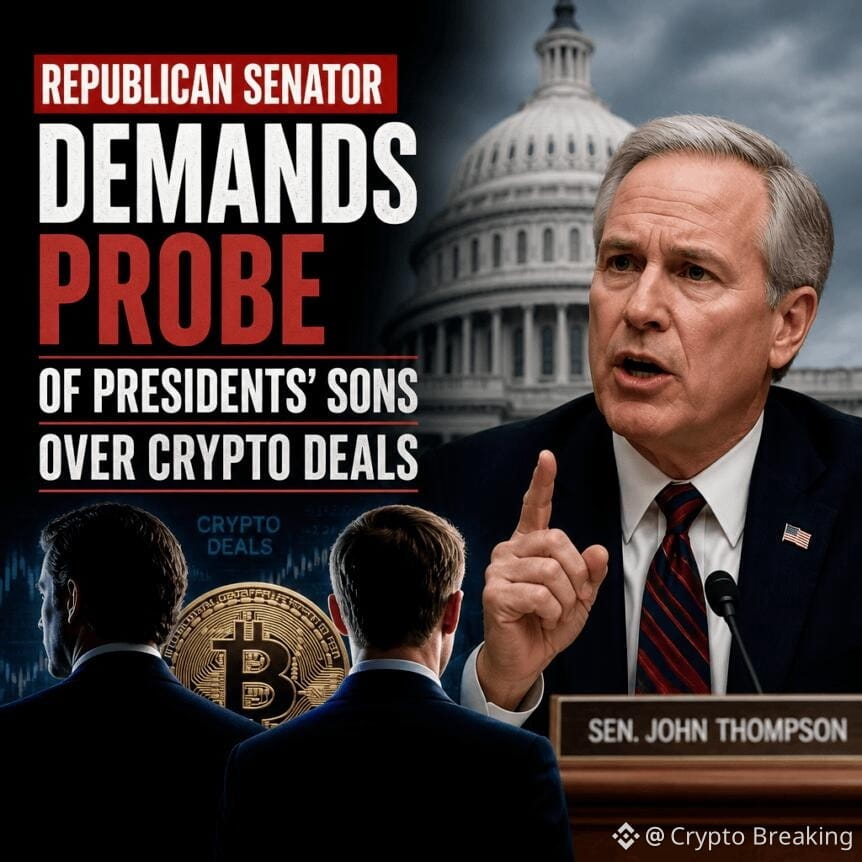
Məqalə
Tərcüməyə bax
Republican Senator Demands Probe of Presidents’ Sons Over Crypto DealsRepublican Senator John Curtis of Utah has asked the U.S. Senate Judiciary Committee to investigate whether the sons of President Donald Trump and former President Joe Biden used their family ties to obtain private financial benefits—an inquiry that Curtis says should include subpoenas for Donald Trump Jr. and Hunter Biden.
In a Monday letter to Senate Judiciary Committee Chair Chuck Grassley and ranking member Dick Durbin, Curtis argued that lawmakers should probe “the use of presidential family relationships for private financial benefit, preferential treatment, or access by domestic and foreign interest.” The Utah senator’s request centers heavily on alleged cryptocurrency-related activity involving Trump Jr., while also citing Hunter Biden’s international business dealings.
Key takeaways
Sen. John Curtis urged the Senate Judiciary Committee to investigate whether presidential family relationships were used for private financial gain.
Curtis asked for subpoenas for Donald Trump Jr. and Hunter Biden, citing specific concerns tied to cryptocurrency ventures and foreign business.
Trump Jr. was singled out for accepting gifts reportedly linked to Russian oligarch Umar Kremlev and for promoting family-backed crypto initiatives.
The call for inquiry comes after Senate Republicans failed to move the Digital Asset Market Clarity Act despite Democrats’ objections.
Democrats have tied broader crypto policy disputes to concerns that the presidency could be leveraged for profit through digital-asset businesses.
A Judiciary probe focused on family ties and crypto exposure
According to the letter, Curtis wants the committee to examine whether ethics, disclosure, or anti-corruption laws apply to conduct involving Trump Jr. and Hunter Biden. He emphasized that the objective should be to establish facts, determine legal applicability, and identify reforms needed to prevent the presidency from becoming a pathway to private enrichment.
Curtis specifically pointed to Donald Trump Jr.’s actions, including his acceptance of gifts from Umar Kremlev as part of his wedding. The senator also cited what he described as Trump Jr.’s “active promotion of family-backed cryptocurrency ventures” and advisory roles connected to prediction market platforms—entities that, according to Curtis, fall under the regulatory authority of the U.S. Commodity Futures Trading Commission.
Last week, President Trump said that his son repaid Kremlev for what Trump Jr. and his wife described as a “generous wedding gift.” Curtis’s request builds on that broader narrative by asking whether the underlying relationship and crypto involvement warrant formal scrutiny.
Hunter Biden: foreign business and the role of presidential proximity
Curtis also asked for a similar probe into Hunter Biden. His letter frames the request around “substantial business with foreign entities” and instances where, Curtis argued, either man’s relationship to the presidency was “invoked or understood to provide value.”
The letter notes that Joe Biden issued a pardon for Hunter Biden in December 2024 for crimes he “committed or may have committed or taken part in over the last decade.” Curtis also referenced Hunter Biden’s prior denials that his father was involved in his business dealings.
While Curtis’s focus is on potential misuse of access or preferential treatment, the request implicitly raises a question that extends beyond any single prosecution: whether existing rules are sufficient to address situations in which family members operate in sensitive sectors while their proximity to the White House or a former administration may influence outcomes.
Crypto regulation debate heightens as clarity legislation stalls
Curtis’s letter arrives amid an ongoing political dispute over U.S. digital-asset oversight. A week earlier, Senate Republicans failed to secure enough support from Democrats to pass the Digital Asset Market Clarity Act—legislation described as intended to establish market structure rules for the crypto industry.
In coverage cited in the article, some Democrats argued against the bill on the grounds that Trump was “using crypto to turn the presidency into a profit generating machine.” The argument references the broader concern that digital-asset activity connected to the president could raise conflict-of-interest issues that statutory ethics provisions may not adequately address.
Republicans said the president had agreed to stronger ethics provisions related to his crypto investments before the vote. Still, Democrats contended that the proposed measures did not go far enough to prevent corruption.
The tension highlights an asymmetry: while the legislation aimed to create regulatory clarity for the market, the political debate has also become a referendum on how lawmakers view the connection between crypto business activity and the presidency itself.
What to watch next
For investors and builders, the practical question is whether a Judiciary Committee inquiry will lead to new subpoenas, targeted disclosures, or recommendations for ethics enforcement—outcomes that could affect compliance planning and the perceived legitimacy of crypto-related public affairs. The scope of any investigation, and whether it meaningfully intersects with pending regulatory reforms, remains the key uncertainty.
This article was originally published as Republican Senator Demands Probe of Presidents’ Sons Over Crypto Deals on Crypto Breaking News – your trusted source for crypto news, Bitcoin news, and blockchain updates.
Republican Senator Demands Probe of Presidents’ Sons Over Crypto Deals
Republican Senator John Curtis of Utah has asked the U.S. Senate Judiciary Committee to investigate whether the sons of President Donald Trump and former President Joe Biden used their family ties to obtain private financial benefits—an inquiry that Curtis says should include subpoenas for Donald Trump Jr. and Hunter Biden.
In a Monday letter to Senate Judiciary Committee Chair Chuck Grassley and ranking member Dick Durbin, Curtis argued that lawmakers should probe “the use of presidential family relationships for private financial benefit, preferential treatment, or access by domestic and foreign interest.” The Utah senator’s request centers heavily on alleged cryptocurrency-related activity involving Trump Jr., while also citing Hunter Biden’s international business dealings.
Key takeaways
Sen. John Curtis urged the Senate Judiciary Committee to investigate whether presidential family relationships were used for private financial gain.
Curtis asked for subpoenas for Donald Trump Jr. and Hunter Biden, citing specific concerns tied to cryptocurrency ventures and foreign business.
Trump Jr. was singled out for accepting gifts reportedly linked to Russian oligarch Umar Kremlev and for promoting family-backed crypto initiatives.
The call for inquiry comes after Senate Republicans failed to move the Digital Asset Market Clarity Act despite Democrats’ objections.
Democrats have tied broader crypto policy disputes to concerns that the presidency could be leveraged for profit through digital-asset businesses.
A Judiciary probe focused on family ties and crypto exposure
According to the letter, Curtis wants the committee to examine whether ethics, disclosure, or anti-corruption laws apply to conduct involving Trump Jr. and Hunter Biden. He emphasized that the objective should be to establish facts, determine legal applicability, and identify reforms needed to prevent the presidency from becoming a pathway to private enrichment.
Curtis specifically pointed to Donald Trump Jr.’s actions, including his acceptance of gifts from Umar Kremlev as part of his wedding. The senator also cited what he described as Trump Jr.’s “active promotion of family-backed cryptocurrency ventures” and advisory roles connected to prediction market platforms—entities that, according to Curtis, fall under the regulatory authority of the U.S. Commodity Futures Trading Commission.
Last week, President Trump said that his son repaid Kremlev for what Trump Jr. and his wife described as a “generous wedding gift.” Curtis’s request builds on that broader narrative by asking whether the underlying relationship and crypto involvement warrant formal scrutiny.
Hunter Biden: foreign business and the role of presidential proximity
Curtis also asked for a similar probe into Hunter Biden. His letter frames the request around “substantial business with foreign entities” and instances where, Curtis argued, either man’s relationship to the presidency was “invoked or understood to provide value.”
The letter notes that Joe Biden issued a pardon for Hunter Biden in December 2024 for crimes he “committed or may have committed or taken part in over the last decade.” Curtis also referenced Hunter Biden’s prior denials that his father was involved in his business dealings.
While Curtis’s focus is on potential misuse of access or preferential treatment, the request implicitly raises a question that extends beyond any single prosecution: whether existing rules are sufficient to address situations in which family members operate in sensitive sectors while their proximity to the White House or a former administration may influence outcomes.
Crypto regulation debate heightens as clarity legislation stalls
Curtis’s letter arrives amid an ongoing political dispute over U.S. digital-asset oversight. A week earlier, Senate Republicans failed to secure enough support from Democrats to pass the Digital Asset Market Clarity Act—legislation described as intended to establish market structure rules for the crypto industry.
In coverage cited in the article, some Democrats argued against the bill on the grounds that Trump was “using crypto to turn the presidency into a profit generating machine.” The argument references the broader concern that digital-asset activity connected to the president could raise conflict-of-interest issues that statutory ethics provisions may not adequately address.
Republicans said the president had agreed to stronger ethics provisions related to his crypto investments before the vote. Still, Democrats contended that the proposed measures did not go far enough to prevent corruption.
The tension highlights an asymmetry: while the legislation aimed to create regulatory clarity for the market, the political debate has also become a referendum on how lawmakers view the connection between crypto business activity and the presidency itself.
What to watch next
For investors and builders, the practical question is whether a Judiciary Committee inquiry will lead to new subpoenas, targeted disclosures, or recommendations for ethics enforcement—outcomes that could affect compliance planning and the perceived legitimacy of crypto-related public affairs. The scope of any investigation, and whether it meaningfully intersects with pending regulatory reforms, remains the key uncertainty.
This article was originally published as Republican Senator Demands Probe of Presidents’ Sons Over Crypto Deals on Crypto Breaking News – your trusted source for crypto news, Bitcoin news, and blockchain updates.
In a Monday letter to Senate Judiciary Committee Chair Chuck Grassley and ranking member Dick Durbin, Curtis argued that lawmakers should probe “the use of presidential family relationships for private financial benefit, preferential treatment, or access by domestic and foreign interest.” The Utah senator’s request centers heavily on alleged cryptocurrency-related activity involving Trump Jr., while also citing Hunter Biden’s international business dealings.
Key takeaways
Sen. John Curtis urged the Senate Judiciary Committee to investigate whether presidential family relationships were used for private financial gain.
Curtis asked for subpoenas for Donald Trump Jr. and Hunter Biden, citing specific concerns tied to cryptocurrency ventures and foreign business.
Trump Jr. was singled out for accepting gifts reportedly linked to Russian oligarch Umar Kremlev and for promoting family-backed crypto initiatives.
The call for inquiry comes after Senate Republicans failed to move the Digital Asset Market Clarity Act despite Democrats’ objections.
Democrats have tied broader crypto policy disputes to concerns that the presidency could be leveraged for profit through digital-asset businesses.
A Judiciary probe focused on family ties and crypto exposure
According to the letter, Curtis wants the committee to examine whether ethics, disclosure, or anti-corruption laws apply to conduct involving Trump Jr. and Hunter Biden. He emphasized that the objective should be to establish facts, determine legal applicability, and identify reforms needed to prevent the presidency from becoming a pathway to private enrichment.
Curtis specifically pointed to Donald Trump Jr.’s actions, including his acceptance of gifts from Umar Kremlev as part of his wedding. The senator also cited what he described as Trump Jr.’s “active promotion of family-backed cryptocurrency ventures” and advisory roles connected to prediction market platforms—entities that, according to Curtis, fall under the regulatory authority of the U.S. Commodity Futures Trading Commission.
Last week, President Trump said that his son repaid Kremlev for what Trump Jr. and his wife described as a “generous wedding gift.” Curtis’s request builds on that broader narrative by asking whether the underlying relationship and crypto involvement warrant formal scrutiny.
Hunter Biden: foreign business and the role of presidential proximity
Curtis also asked for a similar probe into Hunter Biden. His letter frames the request around “substantial business with foreign entities” and instances where, Curtis argued, either man’s relationship to the presidency was “invoked or understood to provide value.”
The letter notes that Joe Biden issued a pardon for Hunter Biden in December 2024 for crimes he “committed or may have committed or taken part in over the last decade.” Curtis also referenced Hunter Biden’s prior denials that his father was involved in his business dealings.
While Curtis’s focus is on potential misuse of access or preferential treatment, the request implicitly raises a question that extends beyond any single prosecution: whether existing rules are sufficient to address situations in which family members operate in sensitive sectors while their proximity to the White House or a former administration may influence outcomes.
Crypto regulation debate heightens as clarity legislation stalls
Curtis’s letter arrives amid an ongoing political dispute over U.S. digital-asset oversight. A week earlier, Senate Republicans failed to secure enough support from Democrats to pass the Digital Asset Market Clarity Act—legislation described as intended to establish market structure rules for the crypto industry.
In coverage cited in the article, some Democrats argued against the bill on the grounds that Trump was “using crypto to turn the presidency into a profit generating machine.” The argument references the broader concern that digital-asset activity connected to the president could raise conflict-of-interest issues that statutory ethics provisions may not adequately address.
Republicans said the president had agreed to stronger ethics provisions related to his crypto investments before the vote. Still, Democrats contended that the proposed measures did not go far enough to prevent corruption.
The tension highlights an asymmetry: while the legislation aimed to create regulatory clarity for the market, the political debate has also become a referendum on how lawmakers view the connection between crypto business activity and the presidency itself.
What to watch next
For investors and builders, the practical question is whether a Judiciary Committee inquiry will lead to new subpoenas, targeted disclosures, or recommendations for ethics enforcement—outcomes that could affect compliance planning and the perceived legitimacy of crypto-related public affairs. The scope of any investigation, and whether it meaningfully intersects with pending regulatory reforms, remains the key uncertainty.
This article was originally published as Republican Senator Demands Probe of Presidents’ Sons Over Crypto Deals on Crypto Breaking News – your trusted source for crypto news, Bitcoin news, and blockchain updates.
31

Məqalə
Tərcüməyə bax
Arch Lending Signals Tokenized Stocks as Next Collateral AssetArch Lending is preparing to expand its credit offerings to include loans backed by tokenized equities, as lenders increasingly look for new collateral categories to support onchain borrowing. Co-founder and chief revenue officer Himanshu Sahay said the firm expects to move “pretty soon,” arguing that demand for credit against tokenized stocks is growing as the asset class scales.
Speaking on Cointelegraph’s Chain Reaction podcast, Sahay pointed to rapid growth in tokenized equities over the past year, while noting that lending capacity against those assets still appears limited. He expects more lenders to follow as tokenized stock products mature and become easier to use in collateral frameworks.
Key takeaways
Arch Lending plans to add loans backed by tokenized equities, expanding beyond crypto-only collateral.
Sahay links the push to growing tokenized stock issuance and a shortage of credit options that support borrowers.
Arch has recently launched tokenized real-world asset loans backed by Paxos Gold and Tether Gold.
Existing Arch lending is still crypto-led, with Bitcoin representing more than 80% of the loan book, and rising interest in XRP among US borrowers.
Arch’s next step: credit against tokenized stocks
Arch has already expanded beyond cryptocurrencies, launching loans backed by tokenized real-world assets including Paxos Gold and Tether Gold in recent weeks, according to Sahay. However, crypto remains the dominant collateral category in its current portfolio: Sahay said Bitcoin accounts for more than 80% of Arch’s loan book.
Even within crypto collateral, Arch is seeing shifting borrower preferences. Sahay said the lender has noticed growing interest in XRP as collateral, particularly among US borrowers—an indication that demand for specific asset types may depend on regional borrower needs and available liquidity rather than broad “market beta” alone.
Against that backdrop, tokenized equities represent a logical extension. Sahay cited the broader expansion of tokenized stock offerings from firms including Superstate, Robinhood, and Securitize, suggesting that a larger universe of onchain share tokens is being created—yet lending against those tokens remains relatively underdeveloped compared with more established collateral categories.
In practical terms, the appeal for lenders is straightforward: tokenized stocks and ETFs could enable borrowers to access credit without liquidating underlying exposure, while providing lenders with a collateral pool that may diversify beyond digital assets like BTC and ETH.
Why tokenized equity lending is gaining traction
Arch would not be entering the market first. Tokenized stocks and exchange-traded funds (ETFs) have been moving into collateral and lending products as infrastructure matures.
In February, Ondo Finance launched DeFi lending markets for two tokenized ETFs through an integration with lending protocol Morpho, according to Ondo Finance’s announcement. Ondo’s tokenized versions of the SPDR S&P 500 ETF and Invesco QQQ can be used as collateral for borrowing on Ethereum.
Beyond dedicated lending markets, tokenized equities are also starting to appear in adjacent functions tied to leverage and market operations. Kraken, for example, made 10 xStocks eligible to back futures and margin positions in July, according to Kraken’s product update. Coinbase also rolled out B20 stocks on Base in August, described as including price-feed infrastructure intended to support use cases that can include DeFi borrowing and lending, as previously reported by Cointelegraph.
The throughline across these developments is that tokenized equities are becoming more “programmable” within crypto ecosystems—an essential requirement for credit markets, where collateral eligibility, valuation, and liquidation mechanics determine whether assets can be reliably used in borrowing.
Market expansion: tokenized stocks grow faster than lending options
One reason lenders can justify moving into tokenized equity collateral is the scale of the underlying market. The article cites RWA.xyz data showing distributed tokenized stock value has climbed to about $3.15 billion, up from roughly $630 million a year earlier.
This growth suggests that more capital is being wrapped into tokenized formats that can, in principle, be used in DeFi lending and other credit structures. But the gap that Sahay highlighted remains important: despite rapid tokenized equities adoption, lending backed by these assets is still described as limited. For investors and borrowers, that difference matters because it can translate into fewer opportunities to access leverage or liquidity using those assets, as well as potentially less competitive borrowing conditions than in more mature collateral segments.
As more platforms begin to expand eligibility for tokenized stocks—whether through dedicated lending markets or through margin and futures pathways—the credit ecosystem could become more resilient. It may also normalize tokenized equities as collateral beyond niche experiments.
What to watch next for tokenized equity collateral
Arch’s planned expansion will likely be judged on several practical questions: how quickly it can integrate tokenized stock collateral, how lenders and borrowers manage valuation and risk across different issuers, and whether Arch’s approach aligns with broader market infrastructure being developed by other venues.
With tokenized stock value growing sharply and multiple crypto platforms already moving tokenized equities into lending-adjacent uses, the next phase will be less about whether lending is possible and more about whether it becomes competitive, scalable, and consistent enough to attract mainstream borrower demand.
In the coming months, readers should watch for Arch’s timing on tokenized equity-backed lending and for additional platforms to announce similar collateral expansions—signals that the market may be transitioning from early infrastructure pilots into fully functional credit offerings.
This article was originally published as Arch Lending Signals Tokenized Stocks as Next Collateral Asset on Crypto Breaking News – your trusted source for crypto news, Bitcoin news, and blockchain updates.
Arch Lending Signals Tokenized Stocks as Next Collateral Asset
Arch Lending is preparing to expand its credit offerings to include loans backed by tokenized equities, as lenders increasingly look for new collateral categories to support onchain borrowing. Co-founder and chief revenue officer Himanshu Sahay said the firm expects to move “pretty soon,” arguing that demand for credit against tokenized stocks is growing as the asset class scales.
Speaking on Cointelegraph’s Chain Reaction podcast, Sahay pointed to rapid growth in tokenized equities over the past year, while noting that lending capacity against those assets still appears limited. He expects more lenders to follow as tokenized stock products mature and become easier to use in collateral frameworks.
Key takeaways
Arch Lending plans to add loans backed by tokenized equities, expanding beyond crypto-only collateral.
Sahay links the push to growing tokenized stock issuance and a shortage of credit options that support borrowers.
Arch has recently launched tokenized real-world asset loans backed by Paxos Gold and Tether Gold.
Existing Arch lending is still crypto-led, with Bitcoin representing more than 80% of the loan book, and rising interest in XRP among US borrowers.
Arch’s next step: credit against tokenized stocks
Arch has already expanded beyond cryptocurrencies, launching loans backed by tokenized real-world assets including Paxos Gold and Tether Gold in recent weeks, according to Sahay. However, crypto remains the dominant collateral category in its current portfolio: Sahay said Bitcoin accounts for more than 80% of Arch’s loan book.
Even within crypto collateral, Arch is seeing shifting borrower preferences. Sahay said the lender has noticed growing interest in XRP as collateral, particularly among US borrowers—an indication that demand for specific asset types may depend on regional borrower needs and available liquidity rather than broad “market beta” alone.
Against that backdrop, tokenized equities represent a logical extension. Sahay cited the broader expansion of tokenized stock offerings from firms including Superstate, Robinhood, and Securitize, suggesting that a larger universe of onchain share tokens is being created—yet lending against those tokens remains relatively underdeveloped compared with more established collateral categories.
In practical terms, the appeal for lenders is straightforward: tokenized stocks and ETFs could enable borrowers to access credit without liquidating underlying exposure, while providing lenders with a collateral pool that may diversify beyond digital assets like BTC and ETH.
Why tokenized equity lending is gaining traction
Arch would not be entering the market first. Tokenized stocks and exchange-traded funds (ETFs) have been moving into collateral and lending products as infrastructure matures.
In February, Ondo Finance launched DeFi lending markets for two tokenized ETFs through an integration with lending protocol Morpho, according to Ondo Finance’s announcement. Ondo’s tokenized versions of the SPDR S&P 500 ETF and Invesco QQQ can be used as collateral for borrowing on Ethereum.
Beyond dedicated lending markets, tokenized equities are also starting to appear in adjacent functions tied to leverage and market operations. Kraken, for example, made 10 xStocks eligible to back futures and margin positions in July, according to Kraken’s product update. Coinbase also rolled out B20 stocks on Base in August, described as including price-feed infrastructure intended to support use cases that can include DeFi borrowing and lending, as previously reported by Cointelegraph.
The throughline across these developments is that tokenized equities are becoming more “programmable” within crypto ecosystems—an essential requirement for credit markets, where collateral eligibility, valuation, and liquidation mechanics determine whether assets can be reliably used in borrowing.
Market expansion: tokenized stocks grow faster than lending options
One reason lenders can justify moving into tokenized equity collateral is the scale of the underlying market. The article cites RWA.xyz data showing distributed tokenized stock value has climbed to about $3.15 billion, up from roughly $630 million a year earlier.
This growth suggests that more capital is being wrapped into tokenized formats that can, in principle, be used in DeFi lending and other credit structures. But the gap that Sahay highlighted remains important: despite rapid tokenized equities adoption, lending backed by these assets is still described as limited. For investors and borrowers, that difference matters because it can translate into fewer opportunities to access leverage or liquidity using those assets, as well as potentially less competitive borrowing conditions than in more mature collateral segments.
As more platforms begin to expand eligibility for tokenized stocks—whether through dedicated lending markets or through margin and futures pathways—the credit ecosystem could become more resilient. It may also normalize tokenized equities as collateral beyond niche experiments.
What to watch next for tokenized equity collateral
Arch’s planned expansion will likely be judged on several practical questions: how quickly it can integrate tokenized stock collateral, how lenders and borrowers manage valuation and risk across different issuers, and whether Arch’s approach aligns with broader market infrastructure being developed by other venues.
With tokenized stock value growing sharply and multiple crypto platforms already moving tokenized equities into lending-adjacent uses, the next phase will be less about whether lending is possible and more about whether it becomes competitive, scalable, and consistent enough to attract mainstream borrower demand.
In the coming months, readers should watch for Arch’s timing on tokenized equity-backed lending and for additional platforms to announce similar collateral expansions—signals that the market may be transitioning from early infrastructure pilots into fully functional credit offerings.
This article was originally published as Arch Lending Signals Tokenized Stocks as Next Collateral Asset on Crypto Breaking News – your trusted source for crypto news, Bitcoin news, and blockchain updates.
Speaking on Cointelegraph’s Chain Reaction podcast, Sahay pointed to rapid growth in tokenized equities over the past year, while noting that lending capacity against those assets still appears limited. He expects more lenders to follow as tokenized stock products mature and become easier to use in collateral frameworks.
Key takeaways
Arch Lending plans to add loans backed by tokenized equities, expanding beyond crypto-only collateral.
Sahay links the push to growing tokenized stock issuance and a shortage of credit options that support borrowers.
Arch has recently launched tokenized real-world asset loans backed by Paxos Gold and Tether Gold.
Existing Arch lending is still crypto-led, with Bitcoin representing more than 80% of the loan book, and rising interest in XRP among US borrowers.
Arch’s next step: credit against tokenized stocks
Arch has already expanded beyond cryptocurrencies, launching loans backed by tokenized real-world assets including Paxos Gold and Tether Gold in recent weeks, according to Sahay. However, crypto remains the dominant collateral category in its current portfolio: Sahay said Bitcoin accounts for more than 80% of Arch’s loan book.
Even within crypto collateral, Arch is seeing shifting borrower preferences. Sahay said the lender has noticed growing interest in XRP as collateral, particularly among US borrowers—an indication that demand for specific asset types may depend on regional borrower needs and available liquidity rather than broad “market beta” alone.
Against that backdrop, tokenized equities represent a logical extension. Sahay cited the broader expansion of tokenized stock offerings from firms including Superstate, Robinhood, and Securitize, suggesting that a larger universe of onchain share tokens is being created—yet lending against those tokens remains relatively underdeveloped compared with more established collateral categories.
In practical terms, the appeal for lenders is straightforward: tokenized stocks and ETFs could enable borrowers to access credit without liquidating underlying exposure, while providing lenders with a collateral pool that may diversify beyond digital assets like BTC and ETH.
Why tokenized equity lending is gaining traction
Arch would not be entering the market first. Tokenized stocks and exchange-traded funds (ETFs) have been moving into collateral and lending products as infrastructure matures.
In February, Ondo Finance launched DeFi lending markets for two tokenized ETFs through an integration with lending protocol Morpho, according to Ondo Finance’s announcement. Ondo’s tokenized versions of the SPDR S&P 500 ETF and Invesco QQQ can be used as collateral for borrowing on Ethereum.
Beyond dedicated lending markets, tokenized equities are also starting to appear in adjacent functions tied to leverage and market operations. Kraken, for example, made 10 xStocks eligible to back futures and margin positions in July, according to Kraken’s product update. Coinbase also rolled out B20 stocks on Base in August, described as including price-feed infrastructure intended to support use cases that can include DeFi borrowing and lending, as previously reported by Cointelegraph.
The throughline across these developments is that tokenized equities are becoming more “programmable” within crypto ecosystems—an essential requirement for credit markets, where collateral eligibility, valuation, and liquidation mechanics determine whether assets can be reliably used in borrowing.
Market expansion: tokenized stocks grow faster than lending options
One reason lenders can justify moving into tokenized equity collateral is the scale of the underlying market. The article cites RWA.xyz data showing distributed tokenized stock value has climbed to about $3.15 billion, up from roughly $630 million a year earlier.
This growth suggests that more capital is being wrapped into tokenized formats that can, in principle, be used in DeFi lending and other credit structures. But the gap that Sahay highlighted remains important: despite rapid tokenized equities adoption, lending backed by these assets is still described as limited. For investors and borrowers, that difference matters because it can translate into fewer opportunities to access leverage or liquidity using those assets, as well as potentially less competitive borrowing conditions than in more mature collateral segments.
As more platforms begin to expand eligibility for tokenized stocks—whether through dedicated lending markets or through margin and futures pathways—the credit ecosystem could become more resilient. It may also normalize tokenized equities as collateral beyond niche experiments.
What to watch next for tokenized equity collateral
Arch’s planned expansion will likely be judged on several practical questions: how quickly it can integrate tokenized stock collateral, how lenders and borrowers manage valuation and risk across different issuers, and whether Arch’s approach aligns with broader market infrastructure being developed by other venues.
With tokenized stock value growing sharply and multiple crypto platforms already moving tokenized equities into lending-adjacent uses, the next phase will be less about whether lending is possible and more about whether it becomes competitive, scalable, and consistent enough to attract mainstream borrower demand.
In the coming months, readers should watch for Arch’s timing on tokenized equity-backed lending and for additional platforms to announce similar collateral expansions—signals that the market may be transitioning from early infrastructure pilots into fully functional credit offerings.
This article was originally published as Arch Lending Signals Tokenized Stocks as Next Collateral Asset on Crypto Breaking News – your trusted source for crypto news, Bitcoin news, and blockchain updates.
40

Məqalə
Tərcüməyə bax
Canada’s Major Banks Pilot Tokenized CAD Deposits for SettlementSix of Canada’s largest banks have begun work on a shared concept for moving tokenized Canadian dollar (CAD) deposits between financial institutions. The initiative, announced Tuesday, would represent bank deposits as digital tokens while keeping the deposits’ legal status tied to the issuing banks.
Bank of Montreal, CIBC, National Bank of Canada, Royal Bank of Canada, Scotiabank and TD Bank Group said the project’s first phase will concentrate on transferring tokenized deposits across Canadian institutions. The banks also hinted at possible later interoperability with other digital asset ecosystems.
Key takeaways
Six major Canadian banks are jointly exploring tokenized CAD deposits as a way to move digital representations of deposits between institutions.
The plan’s early scope is domestic interbank settlement; future steps could connect the approach to broader digital asset systems.
OSFI recently clarified that tokenized deposits are “not legally distinct” from traditional deposits, supporting the effort from a regulatory perspective.
Tokenized deposits differ from fiat-backed stablecoins because the deposits remain a liability of a regulated bank, not a separate digital asset issued by a third party.
Canada’s stablecoin framework is progressing separately and is designed for fiat-backed stablecoins issued by non-financial institutions, not banks.
A joint effort to tokenize deposits—without changing their legal nature
In the announcement, the participating banks framed tokenized deposits as a mechanism to modernize payments. The core idea is to use digital tokens to represent deposits, enabling them to move more quickly and—according to the banks—support “programmable” payment features.
What investors and builders should notice is that the tokenization concept described here is not about converting deposits into a new category of asset that sits outside banking regulation. The banks’ approach is explicitly grounded in existing deposit structures: the tokenized product still corresponds to money held at a regulated bank and remains that bank’s liability.
This distinction matters because it shapes how risk and oversight are applied. According to OSFI’s earlier guidance, the underlying technology used to deliver a financial product does not determine its legal character.
Regulatory backdrop: OSFI’s clarification came earlier this month
Less than two weeks before the banks’ joint announcement, Canada’s banking regulator provided additional clarity on tokenized deposits. On Sept. 10, the Office of the Superintendent of Financial Institutions (OSFI) stated that tokenized deposits are “not legally distinct from traditional deposits.” OSFI also emphasized that legality is determined by the nature of the product, not by whether it is implemented on-chain or through another technology layer.
That timing is more than a coincidence. By aligning their work with OSFI’s interpretation, the banks are effectively operating in a clearer regulatory lane—one that treats tokenized deposits as functionally equivalent to conventional deposits from a legal standpoint.
Still, the banks did not lay out the end-to-end architecture in the materials referenced in the announcement. Readers should expect further details to come as the first phase develops, especially around custody, settlement finality, operational controls, and how interoperability would work in practice.
Tokenized deposits vs. stablecoins: Canada is regulating both, but differently
The new deposit-token initiative sits alongside a broader regulatory push for digital money in Canada, but the policy frameworks are not interchangeable.
Canada’s Stablecoin Act was enacted in March as part of Bill C-15. The legislation establishes a federal framework for fiat-backed stablecoins, requiring non-financial institution issuers to register with the Bank of Canada, keep reserves at least 1:1 in high-quality liquid assets, and enable redemption at par. The framework is expected to take effect in 2027.
However, the Act’s scope is narrower than the tokenized-deposits project. The stablecoin framework covers fiat-backed stablecoins issued by non-financial institutions; banks and credit unions already subject to prudential regulation are outside its scope. The legislation also restricts issuers covered by the framework from presenting stablecoins as deposits or as insured under a public deposit insurance system.
That separation explains why tokenized deposits are being explored by banks under deposit-style legal treatment, while stablecoin policy is aimed at different issuer types. Even though both approaches involve token-like instruments, the regulatory intent diverges: tokenized deposits aim to preserve the traditional banking liability structure, while stablecoin rules focus on how non-bank issuers back and redeem fiat-linked tokens.
What the next phase could mean for payments
The banks said their first phase will focus on moving tokenized deposits between Canadian financial institutions. If successful, that could reduce certain friction points in cross-institution payment flows by enabling more direct digital transfer of deposit-linked balances.
The banks also indicated that longer-term plans could involve opening the system to other deposit-taking institutions, and possibly connecting with other digital asset systems. That raises an important question for the market: whether tokenized deposits will remain primarily an interbank settlement tool within the regulated banking perimeter, or whether they will evolve toward wider interoperability with permissioned networks and, potentially, broader on-chain payment rails.
For now, the initiative is explicitly framed as a development effort. The article notes that Cointelegraph reached out to CIBC for additional details but did not receive an immediate response, suggesting that key technical and operational specifics have yet to be publicly clarified.
Over the coming months, market participants will want to watch how participating banks define the project’s scope in practice—particularly how they handle settlement finality, compliance controls, and whether the pilot results influence wider adoption across Canada’s financial sector—especially in light of OSFI’s recent regulatory clarification.
This article was originally published as Canada’s Major Banks Pilot Tokenized CAD Deposits for Settlement on Crypto Breaking News – your trusted source for crypto news, Bitcoin news, and blockchain updates.
Canada’s Major Banks Pilot Tokenized CAD Deposits for Settlement
Six of Canada’s largest banks have begun work on a shared concept for moving tokenized Canadian dollar (CAD) deposits between financial institutions. The initiative, announced Tuesday, would represent bank deposits as digital tokens while keeping the deposits’ legal status tied to the issuing banks.
Bank of Montreal, CIBC, National Bank of Canada, Royal Bank of Canada, Scotiabank and TD Bank Group said the project’s first phase will concentrate on transferring tokenized deposits across Canadian institutions. The banks also hinted at possible later interoperability with other digital asset ecosystems.
Key takeaways
Six major Canadian banks are jointly exploring tokenized CAD deposits as a way to move digital representations of deposits between institutions.
The plan’s early scope is domestic interbank settlement; future steps could connect the approach to broader digital asset systems.
OSFI recently clarified that tokenized deposits are “not legally distinct” from traditional deposits, supporting the effort from a regulatory perspective.
Tokenized deposits differ from fiat-backed stablecoins because the deposits remain a liability of a regulated bank, not a separate digital asset issued by a third party.
Canada’s stablecoin framework is progressing separately and is designed for fiat-backed stablecoins issued by non-financial institutions, not banks.
A joint effort to tokenize deposits—without changing their legal nature
In the announcement, the participating banks framed tokenized deposits as a mechanism to modernize payments. The core idea is to use digital tokens to represent deposits, enabling them to move more quickly and—according to the banks—support “programmable” payment features.
What investors and builders should notice is that the tokenization concept described here is not about converting deposits into a new category of asset that sits outside banking regulation. The banks’ approach is explicitly grounded in existing deposit structures: the tokenized product still corresponds to money held at a regulated bank and remains that bank’s liability.
This distinction matters because it shapes how risk and oversight are applied. According to OSFI’s earlier guidance, the underlying technology used to deliver a financial product does not determine its legal character.
Regulatory backdrop: OSFI’s clarification came earlier this month
Less than two weeks before the banks’ joint announcement, Canada’s banking regulator provided additional clarity on tokenized deposits. On Sept. 10, the Office of the Superintendent of Financial Institutions (OSFI) stated that tokenized deposits are “not legally distinct from traditional deposits.” OSFI also emphasized that legality is determined by the nature of the product, not by whether it is implemented on-chain or through another technology layer.
That timing is more than a coincidence. By aligning their work with OSFI’s interpretation, the banks are effectively operating in a clearer regulatory lane—one that treats tokenized deposits as functionally equivalent to conventional deposits from a legal standpoint.
Still, the banks did not lay out the end-to-end architecture in the materials referenced in the announcement. Readers should expect further details to come as the first phase develops, especially around custody, settlement finality, operational controls, and how interoperability would work in practice.
Tokenized deposits vs. stablecoins: Canada is regulating both, but differently
The new deposit-token initiative sits alongside a broader regulatory push for digital money in Canada, but the policy frameworks are not interchangeable.
Canada’s Stablecoin Act was enacted in March as part of Bill C-15. The legislation establishes a federal framework for fiat-backed stablecoins, requiring non-financial institution issuers to register with the Bank of Canada, keep reserves at least 1:1 in high-quality liquid assets, and enable redemption at par. The framework is expected to take effect in 2027.
However, the Act’s scope is narrower than the tokenized-deposits project. The stablecoin framework covers fiat-backed stablecoins issued by non-financial institutions; banks and credit unions already subject to prudential regulation are outside its scope. The legislation also restricts issuers covered by the framework from presenting stablecoins as deposits or as insured under a public deposit insurance system.
That separation explains why tokenized deposits are being explored by banks under deposit-style legal treatment, while stablecoin policy is aimed at different issuer types. Even though both approaches involve token-like instruments, the regulatory intent diverges: tokenized deposits aim to preserve the traditional banking liability structure, while stablecoin rules focus on how non-bank issuers back and redeem fiat-linked tokens.
What the next phase could mean for payments
The banks said their first phase will focus on moving tokenized deposits between Canadian financial institutions. If successful, that could reduce certain friction points in cross-institution payment flows by enabling more direct digital transfer of deposit-linked balances.
The banks also indicated that longer-term plans could involve opening the system to other deposit-taking institutions, and possibly connecting with other digital asset systems. That raises an important question for the market: whether tokenized deposits will remain primarily an interbank settlement tool within the regulated banking perimeter, or whether they will evolve toward wider interoperability with permissioned networks and, potentially, broader on-chain payment rails.
For now, the initiative is explicitly framed as a development effort. The article notes that Cointelegraph reached out to CIBC for additional details but did not receive an immediate response, suggesting that key technical and operational specifics have yet to be publicly clarified.
Over the coming months, market participants will want to watch how participating banks define the project’s scope in practice—particularly how they handle settlement finality, compliance controls, and whether the pilot results influence wider adoption across Canada’s financial sector—especially in light of OSFI’s recent regulatory clarification.
This article was originally published as Canada’s Major Banks Pilot Tokenized CAD Deposits for Settlement on Crypto Breaking News – your trusted source for crypto news, Bitcoin news, and blockchain updates.
Bank of Montreal, CIBC, National Bank of Canada, Royal Bank of Canada, Scotiabank and TD Bank Group said the project’s first phase will concentrate on transferring tokenized deposits across Canadian institutions. The banks also hinted at possible later interoperability with other digital asset ecosystems.
Key takeaways
Six major Canadian banks are jointly exploring tokenized CAD deposits as a way to move digital representations of deposits between institutions.
The plan’s early scope is domestic interbank settlement; future steps could connect the approach to broader digital asset systems.
OSFI recently clarified that tokenized deposits are “not legally distinct” from traditional deposits, supporting the effort from a regulatory perspective.
Tokenized deposits differ from fiat-backed stablecoins because the deposits remain a liability of a regulated bank, not a separate digital asset issued by a third party.
Canada’s stablecoin framework is progressing separately and is designed for fiat-backed stablecoins issued by non-financial institutions, not banks.
A joint effort to tokenize deposits—without changing their legal nature
In the announcement, the participating banks framed tokenized deposits as a mechanism to modernize payments. The core idea is to use digital tokens to represent deposits, enabling them to move more quickly and—according to the banks—support “programmable” payment features.
What investors and builders should notice is that the tokenization concept described here is not about converting deposits into a new category of asset that sits outside banking regulation. The banks’ approach is explicitly grounded in existing deposit structures: the tokenized product still corresponds to money held at a regulated bank and remains that bank’s liability.
This distinction matters because it shapes how risk and oversight are applied. According to OSFI’s earlier guidance, the underlying technology used to deliver a financial product does not determine its legal character.
Regulatory backdrop: OSFI’s clarification came earlier this month
Less than two weeks before the banks’ joint announcement, Canada’s banking regulator provided additional clarity on tokenized deposits. On Sept. 10, the Office of the Superintendent of Financial Institutions (OSFI) stated that tokenized deposits are “not legally distinct from traditional deposits.” OSFI also emphasized that legality is determined by the nature of the product, not by whether it is implemented on-chain or through another technology layer.
That timing is more than a coincidence. By aligning their work with OSFI’s interpretation, the banks are effectively operating in a clearer regulatory lane—one that treats tokenized deposits as functionally equivalent to conventional deposits from a legal standpoint.
Still, the banks did not lay out the end-to-end architecture in the materials referenced in the announcement. Readers should expect further details to come as the first phase develops, especially around custody, settlement finality, operational controls, and how interoperability would work in practice.
Tokenized deposits vs. stablecoins: Canada is regulating both, but differently
The new deposit-token initiative sits alongside a broader regulatory push for digital money in Canada, but the policy frameworks are not interchangeable.
Canada’s Stablecoin Act was enacted in March as part of Bill C-15. The legislation establishes a federal framework for fiat-backed stablecoins, requiring non-financial institution issuers to register with the Bank of Canada, keep reserves at least 1:1 in high-quality liquid assets, and enable redemption at par. The framework is expected to take effect in 2027.
However, the Act’s scope is narrower than the tokenized-deposits project. The stablecoin framework covers fiat-backed stablecoins issued by non-financial institutions; banks and credit unions already subject to prudential regulation are outside its scope. The legislation also restricts issuers covered by the framework from presenting stablecoins as deposits or as insured under a public deposit insurance system.
That separation explains why tokenized deposits are being explored by banks under deposit-style legal treatment, while stablecoin policy is aimed at different issuer types. Even though both approaches involve token-like instruments, the regulatory intent diverges: tokenized deposits aim to preserve the traditional banking liability structure, while stablecoin rules focus on how non-bank issuers back and redeem fiat-linked tokens.
What the next phase could mean for payments
The banks said their first phase will focus on moving tokenized deposits between Canadian financial institutions. If successful, that could reduce certain friction points in cross-institution payment flows by enabling more direct digital transfer of deposit-linked balances.
The banks also indicated that longer-term plans could involve opening the system to other deposit-taking institutions, and possibly connecting with other digital asset systems. That raises an important question for the market: whether tokenized deposits will remain primarily an interbank settlement tool within the regulated banking perimeter, or whether they will evolve toward wider interoperability with permissioned networks and, potentially, broader on-chain payment rails.
For now, the initiative is explicitly framed as a development effort. The article notes that Cointelegraph reached out to CIBC for additional details but did not receive an immediate response, suggesting that key technical and operational specifics have yet to be publicly clarified.
Over the coming months, market participants will want to watch how participating banks define the project’s scope in practice—particularly how they handle settlement finality, compliance controls, and whether the pilot results influence wider adoption across Canada’s financial sector—especially in light of OSFI’s recent regulatory clarification.
This article was originally published as Canada’s Major Banks Pilot Tokenized CAD Deposits for Settlement on Crypto Breaking News – your trusted source for crypto news, Bitcoin news, and blockchain updates.
54
Məqalə
Tərcüməyə bax
Zcash Launches First European ETP After US ETF Approval21Shares has expanded its European ETP lineup with two physically backed products—one linked to Zcash (ZEC) and another tied to Ether.fi’s ETHFI token. The Zcash launch marks the first exchange-traded product in Europe specifically offering exposure to the privacy-focused coin through regulated market infrastructure.
On Tuesday, the firm listed its physically backed Zcash ETP on Euronext Paris and Amsterdam, enabling investors to obtain ZEC exposure via traditional brokerage accounts without directly holding the cryptocurrency. In parallel, 21Shares introduced a physically backed ETP tracking ETHFI, the governance and utility token of Ether.fi, also trading on Euronext Paris and Amsterdam.
Key takeaways
21Shares launched Europe’s first Zcash-linked physically backed ETP on Euronext Paris and Amsterdam.
A second new product tracks Ether.fi’s ETHFI token, also in physically backed form on the same venues.
Both ETPs charge a 2.5% annual management fee—significantly higher than many comparable European crypto products focused on bitcoin and ether.
The expansion follows the U.S. debut of a Grayscale Zcash ETF trading on NYSE Arca under ticker ZCSH, underlining growing institutional reach for ZEC.
Regulated access for Zcash in Europe
ETPs have become a common route for institutional and retail investors to access crypto exposure within traditional market frameworks. By listing a physically backed Zcash ETP, 21Shares is effectively bringing ZEC into that ecosystem on two major Euronext markets: Paris and Amsterdam.
The listing structure is straightforward: rather than using derivatives or synthetic exposure, a physically backed ETP is designed to hold the underlying asset. For investors, that can simplify operational considerations—especially for those who prefer not to self-custody or manage direct exchange and wallet logistics—while still accessing ZEC exposure through a broker.
However, the economics matter. The 2.5% annual management fee is well above the level charged by many bitcoin and ether ETPs in Europe, which could influence investor demand—particularly for those assessing total cost over time rather than only near-term price momentum.
ETHFI ETP broadens the theme beyond privacy coins
Alongside the Zcash product, 21Shares launched an ETP tracking ETHFI, the token associated with Ether.fi, a decentralized finance protocol offering staking and other crypto-based financial services. Like the Zcash offering, the ETHFI ETP is physically backed and trades on Euronext Paris and Amsterdam.
This second listing signals that 21Shares is not only focused on privacy-coin exposure. Instead, it is also adding a product tied to the broader DeFi ecosystem—where token value is often linked to participation in protocol services such as staking, governance, and network activity. For investors, that creates a choice between two different “entry points” into crypto themes: privacy-focused infrastructure on the one hand, and DeFi utility on the other.
As with the Zcash ETP, the 2.5% annual fee also sets a notable baseline. Traders and long-term holders will likely weigh that ongoing cost against expected volatility and the pace at which token fundamentals can change in DeFi markets.
Zcash’s surge renews Bitcoin comparisons
21Shares’ decision to launch the Zcash ETP arrives amid a renewed spotlight on the coin after a strong market run. According to CoinMarketCap data cited in the original reporting, Zcash recently pushed above $1,500 and has gained nearly 1,100% over the past year.
That performance has pulled Zcash back into debates about whether it can operate as more than a niche privacy asset. In particular, renewed attention has returned to the idea of Zcash acting as a potential alternative to bitcoin—an argument that has appeared in past discussions around network effects and long-term survivability.
Grayscale head of research Zach Pandl has previously argued that Zcash could benefit from “second-mover advantages” that might help it overcome bitcoin’s entrenched network effects, according to earlier commentary covered by Cointelegraph. The broader question for investors is whether Zcash can convert price momentum into durable demand from institutional channels—especially as more regulated products become available.
At the same time, the existence of institutional ETP and ETF wrappers does not automatically solve underlying adoption challenges. For privacy-focused networks, sustainability often depends not only on price cycles but also on ecosystem growth, developer activity, liquidity depth, and regulatory treatment across jurisdictions.
Institutional momentum: U.S. ETF and ongoing mining activity
Europe’s new Zcash ETP follows a related development in the U.S. Earlier coverage highlighted the launch of a Grayscale Zcash ETF that trades on NYSE Arca under the ticker ZCSH, described in the original reporting as arriving after U.S. regulatory approval.
Taken together, a U.S. exchange-traded product plus the arrival of a European ETP suggests Zcash is increasingly on the radar of asset managers that focus on regulated access. That shift matters because it can widen the investor base—particularly among participants who may face internal constraints on direct cryptocurrency ownership.
There are also signals of scale within the network’s proof-of-work ecosystem. Fortitude Digital Mining told Cointelegraph that it mined about 28% of all ZEC produced in the first half of 2026, framing its focus on Zcash around its proof-of-work model, capped supply, and privacy features. While such statements do not directly determine price, they can be relevant to how investors think about network participation and the operational depth behind the asset.
For now, investors should treat the product rollout as a step forward in access rather than a guarantee of sustained outperformance. The key variable will be whether higher-cost ETP structures—especially with a 2.5% fee—can attract steady flows as the market digests Zcash’s recent rally.
Looking ahead, readers should watch how trading volumes and inflow dynamics develop for both of the new Euronext listings, and whether Zcash’s institutional exposure continues to broaden after the U.S. ETF addition—alongside any further clarity on long-term catalysts for ZEC that go beyond price momentum.
This article was originally published as Zcash Launches First European ETP After US ETF Approval on Crypto Breaking News – your trusted source for crypto news, Bitcoin news, and blockchain updates.
Zcash Launches First European ETP After US ETF Approval
21Shares has expanded its European ETP lineup with two physically backed products—one linked to Zcash (ZEC) and another tied to Ether.fi’s ETHFI token. The Zcash launch marks the first exchange-traded product in Europe specifically offering exposure to the privacy-focused coin through regulated market infrastructure.
On Tuesday, the firm listed its physically backed Zcash ETP on Euronext Paris and Amsterdam, enabling investors to obtain ZEC exposure via traditional brokerage accounts without directly holding the cryptocurrency. In parallel, 21Shares introduced a physically backed ETP tracking ETHFI, the governance and utility token of Ether.fi, also trading on Euronext Paris and Amsterdam.
Key takeaways
21Shares launched Europe’s first Zcash-linked physically backed ETP on Euronext Paris and Amsterdam.
A second new product tracks Ether.fi’s ETHFI token, also in physically backed form on the same venues.
Both ETPs charge a 2.5% annual management fee—significantly higher than many comparable European crypto products focused on bitcoin and ether.
The expansion follows the U.S. debut of a Grayscale Zcash ETF trading on NYSE Arca under ticker ZCSH, underlining growing institutional reach for ZEC.
Regulated access for Zcash in Europe
ETPs have become a common route for institutional and retail investors to access crypto exposure within traditional market frameworks. By listing a physically backed Zcash ETP, 21Shares is effectively bringing ZEC into that ecosystem on two major Euronext markets: Paris and Amsterdam.
The listing structure is straightforward: rather than using derivatives or synthetic exposure, a physically backed ETP is designed to hold the underlying asset. For investors, that can simplify operational considerations—especially for those who prefer not to self-custody or manage direct exchange and wallet logistics—while still accessing ZEC exposure through a broker.
However, the economics matter. The 2.5% annual management fee is well above the level charged by many bitcoin and ether ETPs in Europe, which could influence investor demand—particularly for those assessing total cost over time rather than only near-term price momentum.
ETHFI ETP broadens the theme beyond privacy coins
Alongside the Zcash product, 21Shares launched an ETP tracking ETHFI, the token associated with Ether.fi, a decentralized finance protocol offering staking and other crypto-based financial services. Like the Zcash offering, the ETHFI ETP is physically backed and trades on Euronext Paris and Amsterdam.
This second listing signals that 21Shares is not only focused on privacy-coin exposure. Instead, it is also adding a product tied to the broader DeFi ecosystem—where token value is often linked to participation in protocol services such as staking, governance, and network activity. For investors, that creates a choice between two different “entry points” into crypto themes: privacy-focused infrastructure on the one hand, and DeFi utility on the other.
As with the Zcash ETP, the 2.5% annual fee also sets a notable baseline. Traders and long-term holders will likely weigh that ongoing cost against expected volatility and the pace at which token fundamentals can change in DeFi markets.
Zcash’s surge renews Bitcoin comparisons
21Shares’ decision to launch the Zcash ETP arrives amid a renewed spotlight on the coin after a strong market run. According to CoinMarketCap data cited in the original reporting, Zcash recently pushed above $1,500 and has gained nearly 1,100% over the past year.
That performance has pulled Zcash back into debates about whether it can operate as more than a niche privacy asset. In particular, renewed attention has returned to the idea of Zcash acting as a potential alternative to bitcoin—an argument that has appeared in past discussions around network effects and long-term survivability.
Grayscale head of research Zach Pandl has previously argued that Zcash could benefit from “second-mover advantages” that might help it overcome bitcoin’s entrenched network effects, according to earlier commentary covered by Cointelegraph. The broader question for investors is whether Zcash can convert price momentum into durable demand from institutional channels—especially as more regulated products become available.
At the same time, the existence of institutional ETP and ETF wrappers does not automatically solve underlying adoption challenges. For privacy-focused networks, sustainability often depends not only on price cycles but also on ecosystem growth, developer activity, liquidity depth, and regulatory treatment across jurisdictions.
Institutional momentum: U.S. ETF and ongoing mining activity
Europe’s new Zcash ETP follows a related development in the U.S. Earlier coverage highlighted the launch of a Grayscale Zcash ETF that trades on NYSE Arca under the ticker ZCSH, described in the original reporting as arriving after U.S. regulatory approval.
Taken together, a U.S. exchange-traded product plus the arrival of a European ETP suggests Zcash is increasingly on the radar of asset managers that focus on regulated access. That shift matters because it can widen the investor base—particularly among participants who may face internal constraints on direct cryptocurrency ownership.
There are also signals of scale within the network’s proof-of-work ecosystem. Fortitude Digital Mining told Cointelegraph that it mined about 28% of all ZEC produced in the first half of 2026, framing its focus on Zcash around its proof-of-work model, capped supply, and privacy features. While such statements do not directly determine price, they can be relevant to how investors think about network participation and the operational depth behind the asset.
For now, investors should treat the product rollout as a step forward in access rather than a guarantee of sustained outperformance. The key variable will be whether higher-cost ETP structures—especially with a 2.5% fee—can attract steady flows as the market digests Zcash’s recent rally.
Looking ahead, readers should watch how trading volumes and inflow dynamics develop for both of the new Euronext listings, and whether Zcash’s institutional exposure continues to broaden after the U.S. ETF addition—alongside any further clarity on long-term catalysts for ZEC that go beyond price momentum.
This article was originally published as Zcash Launches First European ETP After US ETF Approval on Crypto Breaking News – your trusted source for crypto news, Bitcoin news, and blockchain updates.
On Tuesday, the firm listed its physically backed Zcash ETP on Euronext Paris and Amsterdam, enabling investors to obtain ZEC exposure via traditional brokerage accounts without directly holding the cryptocurrency. In parallel, 21Shares introduced a physically backed ETP tracking ETHFI, the governance and utility token of Ether.fi, also trading on Euronext Paris and Amsterdam.
Key takeaways
21Shares launched Europe’s first Zcash-linked physically backed ETP on Euronext Paris and Amsterdam.
A second new product tracks Ether.fi’s ETHFI token, also in physically backed form on the same venues.
Both ETPs charge a 2.5% annual management fee—significantly higher than many comparable European crypto products focused on bitcoin and ether.
The expansion follows the U.S. debut of a Grayscale Zcash ETF trading on NYSE Arca under ticker ZCSH, underlining growing institutional reach for ZEC.
Regulated access for Zcash in Europe
ETPs have become a common route for institutional and retail investors to access crypto exposure within traditional market frameworks. By listing a physically backed Zcash ETP, 21Shares is effectively bringing ZEC into that ecosystem on two major Euronext markets: Paris and Amsterdam.
The listing structure is straightforward: rather than using derivatives or synthetic exposure, a physically backed ETP is designed to hold the underlying asset. For investors, that can simplify operational considerations—especially for those who prefer not to self-custody or manage direct exchange and wallet logistics—while still accessing ZEC exposure through a broker.
However, the economics matter. The 2.5% annual management fee is well above the level charged by many bitcoin and ether ETPs in Europe, which could influence investor demand—particularly for those assessing total cost over time rather than only near-term price momentum.
ETHFI ETP broadens the theme beyond privacy coins
Alongside the Zcash product, 21Shares launched an ETP tracking ETHFI, the token associated with Ether.fi, a decentralized finance protocol offering staking and other crypto-based financial services. Like the Zcash offering, the ETHFI ETP is physically backed and trades on Euronext Paris and Amsterdam.
This second listing signals that 21Shares is not only focused on privacy-coin exposure. Instead, it is also adding a product tied to the broader DeFi ecosystem—where token value is often linked to participation in protocol services such as staking, governance, and network activity. For investors, that creates a choice between two different “entry points” into crypto themes: privacy-focused infrastructure on the one hand, and DeFi utility on the other.
As with the Zcash ETP, the 2.5% annual fee also sets a notable baseline. Traders and long-term holders will likely weigh that ongoing cost against expected volatility and the pace at which token fundamentals can change in DeFi markets.
Zcash’s surge renews Bitcoin comparisons
21Shares’ decision to launch the Zcash ETP arrives amid a renewed spotlight on the coin after a strong market run. According to CoinMarketCap data cited in the original reporting, Zcash recently pushed above $1,500 and has gained nearly 1,100% over the past year.
That performance has pulled Zcash back into debates about whether it can operate as more than a niche privacy asset. In particular, renewed attention has returned to the idea of Zcash acting as a potential alternative to bitcoin—an argument that has appeared in past discussions around network effects and long-term survivability.
Grayscale head of research Zach Pandl has previously argued that Zcash could benefit from “second-mover advantages” that might help it overcome bitcoin’s entrenched network effects, according to earlier commentary covered by Cointelegraph. The broader question for investors is whether Zcash can convert price momentum into durable demand from institutional channels—especially as more regulated products become available.
At the same time, the existence of institutional ETP and ETF wrappers does not automatically solve underlying adoption challenges. For privacy-focused networks, sustainability often depends not only on price cycles but also on ecosystem growth, developer activity, liquidity depth, and regulatory treatment across jurisdictions.
Institutional momentum: U.S. ETF and ongoing mining activity
Europe’s new Zcash ETP follows a related development in the U.S. Earlier coverage highlighted the launch of a Grayscale Zcash ETF that trades on NYSE Arca under the ticker ZCSH, described in the original reporting as arriving after U.S. regulatory approval.
Taken together, a U.S. exchange-traded product plus the arrival of a European ETP suggests Zcash is increasingly on the radar of asset managers that focus on regulated access. That shift matters because it can widen the investor base—particularly among participants who may face internal constraints on direct cryptocurrency ownership.
There are also signals of scale within the network’s proof-of-work ecosystem. Fortitude Digital Mining told Cointelegraph that it mined about 28% of all ZEC produced in the first half of 2026, framing its focus on Zcash around its proof-of-work model, capped supply, and privacy features. While such statements do not directly determine price, they can be relevant to how investors think about network participation and the operational depth behind the asset.
For now, investors should treat the product rollout as a step forward in access rather than a guarantee of sustained outperformance. The key variable will be whether higher-cost ETP structures—especially with a 2.5% fee—can attract steady flows as the market digests Zcash’s recent rally.
Looking ahead, readers should watch how trading volumes and inflow dynamics develop for both of the new Euronext listings, and whether Zcash’s institutional exposure continues to broaden after the U.S. ETF addition—alongside any further clarity on long-term catalysts for ZEC that go beyond price momentum.
This article was originally published as Zcash Launches First European ETP After US ETF Approval on Crypto Breaking News – your trusted source for crypto news, Bitcoin news, and blockchain updates.
54

Məqalə
Tərcüməyə bax
CLARITY Vote Failure May Boost Crypto PAC Spending in Key RacesThe U.S. Senate’s decision last week to let the Digital Asset Market Clarity (CLARITY) Act stall has quickly turned into more than a legislative setback for crypto. Industry political groups are already recalibrating their midterm strategy with the 2026 election just weeks away, betting that lawmakers’ voting records will shape who receives financial support—or faces opposition.
On Sept. 15, senators voted 49 in favor and 50 against advancing the CLARITY Act, sharply reducing the odds that Congress will pass the bill before its current window of session time closes and the next Congress convenes in 2027. While some advocates have floated the possibility of another vote during a later phase of the legislative calendar, at least one major crypto-aligned PAC is acting as though the fight will shift to election season.
Key takeaways
The Senate voted 49–50 against advancing the CLARITY Act on Sept. 15, leaving limited time for passage before 2027.
Fairshake—backed by Coinbase and Ripple Labs—plans to spend $30 million opposing Sen. Sherrod Brown in Ohio’s 2026 Senate race.
Stand With Crypto says lawmakers’ CLARITY votes could have “consequences” in the 2026 midterms based on how they voted.
As of Monday, multiple major crypto-aligned PACs had not disclosed new spending with the Federal Election Commission following the CLARITY vote.
CLARITY stalls—and the electoral clock starts ticking
The CLARITY Act’s failure to move forward in the Senate is being treated by crypto stakeholders as a clear signal about which members of Congress are reliable allies on market-structure policy and which are not. Steve Gannon, a partner at Davis Wright Tremaine, told Cointelegraph that the vote “provided the industry with a very clear picture of who are long-term reliable supporters and who are not,” adding that it will be “difficult” for those who opposed CLARITY to argue that the industry should support them financially in the midterms.
That interpretation matters because the U.S. elections ecosystem often translates legislative alignments into fundraising and ad-buy decisions. With the 2026 midterms approaching—an election year widely expected to influence control of both chambers—crypto groups are signaling that voting outcomes on market structure will not be forgotten once campaigns start.
Fairshake targets Sherrod Brown as a test case
One of the clearest indications of how quickly the politics may intensify comes from Fairshake. The PAC, backed by Coinbase and Ripple Labs, announced plans to put $30 million toward opposing Sherrod Brown in Ohio’s Senate race.
Brown previously chaired the Senate Banking Committee when Democrats held the majority. According to the reporting, he has also supported policies that are broadly described as hostile to crypto—positioning his potential return as a threat to efforts to advance CLARITY later.
Fairshake’s move also echoes what happened during Brown’s last campaign cycle. The former Ohio senator lost his 2024 reelection bid to Republican Bernie Moreno after Fairshake spent about $41 million opposing the Democrat. The PAC also deployed more than $130 million on ads across the 2024 election cycle, giving a preview of the scale of advertising and pressure it may bring if it believes CLARITY has a realistic path only with the right Senate composition.
Cointelegraph requested comments from Brown’s campaign but did not receive an immediate response.
Crypto-aligned groups warn members of Congress could face consequences
Beyond Fairshake’s spending plans, industry-backed advocacy initiatives are also preparing to translate the CLARITY vote into electoral pressure. Stand With Crypto—an initiative launched by Coinbase in 2023—warned that lawmakers who did not advance the CLARITY Act could face “consequences” in the 2026 midterms based on their voting behavior.
Stand With Crypto is positioned to influence both campaign messaging and PAC targeting, because it is designed to rate politicians based on their stance toward crypto. In a highly contested election year, those ratings can help shape where money goes and which candidates receive priority support.
“The results of [the CLARITY Act] vote make it clear which officials are with our community, and which are against us — and we’ll make sure our advocates are ready to cast their ballots accordingly in this and future elections,” said Stand With Crypto executive director Mason Lynaugh.
That framing suggests crypto groups believe the Senate vote itself will become campaign material: a concrete record that can be highlighted during fundraising appeals, voter outreach, and debate preparation.
What filings show—and what remains uncertain
While the political response is already in motion, there is still a timing and disclosure gap that readers should watch. As of Monday, Fairshake and affiliate PACs Defend American Jobs and Protect Progress had not disclosed expenditures to the Federal Election Commission (FEC) following the CLARITY vote.
FEC filing data cited in the reporting also indicated no post-CLARITY spending by other crypto-aligned PACs, including Fellowship—funded by Cantor Fitzgerald and Anchorage Digital—and the Digital Freedom Fund, described as backed by Gemini co-founders Tyler and Cameron Winklevoss.
That doesn’t necessarily mean spending won’t follow; political groups may delay disclosures depending on filing cycles, contract timing, or when expenditures are finalized. But it does reinforce that the real impact of the CLARITY vote—beyond messaging—may unfold in stages as campaign finance paperwork catches up.
Meanwhile, some advocates have suggested the CLARITY bill could still return for another vote during later congressional periods. Still, the narrow margin in the Senate—just one vote separating supporters and opponents—highlights how precarious any future attempt could be without a shift in the coalition.
Closing perspective
For crypto participants, the immediate question is not whether CLARITY failed to advance once—it already did—but whether lawmakers who opposed the bill will face sustained electoral pressure and whether that pressure changes the math for future market-structure legislation. With spending plans forming and FEC disclosures still pending for some groups, the next few weeks of campaign developments should offer the clearest clues about how aggressively the industry intends to convert a legislative vote into political leverage.
This article was originally published as CLARITY Vote Failure May Boost Crypto PAC Spending in Key Races on Crypto Breaking News – your trusted source for crypto news, Bitcoin news, and blockchain updates.
CLARITY Vote Failure May Boost Crypto PAC Spending in Key Races
The U.S. Senate’s decision last week to let the Digital Asset Market Clarity (CLARITY) Act stall has quickly turned into more than a legislative setback for crypto. Industry political groups are already recalibrating their midterm strategy with the 2026 election just weeks away, betting that lawmakers’ voting records will shape who receives financial support—or faces opposition.
On Sept. 15, senators voted 49 in favor and 50 against advancing the CLARITY Act, sharply reducing the odds that Congress will pass the bill before its current window of session time closes and the next Congress convenes in 2027. While some advocates have floated the possibility of another vote during a later phase of the legislative calendar, at least one major crypto-aligned PAC is acting as though the fight will shift to election season.
Key takeaways
The Senate voted 49–50 against advancing the CLARITY Act on Sept. 15, leaving limited time for passage before 2027.
Fairshake—backed by Coinbase and Ripple Labs—plans to spend $30 million opposing Sen. Sherrod Brown in Ohio’s 2026 Senate race.
Stand With Crypto says lawmakers’ CLARITY votes could have “consequences” in the 2026 midterms based on how they voted.
As of Monday, multiple major crypto-aligned PACs had not disclosed new spending with the Federal Election Commission following the CLARITY vote.
CLARITY stalls—and the electoral clock starts ticking
The CLARITY Act’s failure to move forward in the Senate is being treated by crypto stakeholders as a clear signal about which members of Congress are reliable allies on market-structure policy and which are not. Steve Gannon, a partner at Davis Wright Tremaine, told Cointelegraph that the vote “provided the industry with a very clear picture of who are long-term reliable supporters and who are not,” adding that it will be “difficult” for those who opposed CLARITY to argue that the industry should support them financially in the midterms.
That interpretation matters because the U.S. elections ecosystem often translates legislative alignments into fundraising and ad-buy decisions. With the 2026 midterms approaching—an election year widely expected to influence control of both chambers—crypto groups are signaling that voting outcomes on market structure will not be forgotten once campaigns start.
Fairshake targets Sherrod Brown as a test case
One of the clearest indications of how quickly the politics may intensify comes from Fairshake. The PAC, backed by Coinbase and Ripple Labs, announced plans to put $30 million toward opposing Sherrod Brown in Ohio’s Senate race.
Brown previously chaired the Senate Banking Committee when Democrats held the majority. According to the reporting, he has also supported policies that are broadly described as hostile to crypto—positioning his potential return as a threat to efforts to advance CLARITY later.
Fairshake’s move also echoes what happened during Brown’s last campaign cycle. The former Ohio senator lost his 2024 reelection bid to Republican Bernie Moreno after Fairshake spent about $41 million opposing the Democrat. The PAC also deployed more than $130 million on ads across the 2024 election cycle, giving a preview of the scale of advertising and pressure it may bring if it believes CLARITY has a realistic path only with the right Senate composition.
Cointelegraph requested comments from Brown’s campaign but did not receive an immediate response.
Crypto-aligned groups warn members of Congress could face consequences
Beyond Fairshake’s spending plans, industry-backed advocacy initiatives are also preparing to translate the CLARITY vote into electoral pressure. Stand With Crypto—an initiative launched by Coinbase in 2023—warned that lawmakers who did not advance the CLARITY Act could face “consequences” in the 2026 midterms based on their voting behavior.
Stand With Crypto is positioned to influence both campaign messaging and PAC targeting, because it is designed to rate politicians based on their stance toward crypto. In a highly contested election year, those ratings can help shape where money goes and which candidates receive priority support.
“The results of [the CLARITY Act] vote make it clear which officials are with our community, and which are against us — and we’ll make sure our advocates are ready to cast their ballots accordingly in this and future elections,” said Stand With Crypto executive director Mason Lynaugh.
That framing suggests crypto groups believe the Senate vote itself will become campaign material: a concrete record that can be highlighted during fundraising appeals, voter outreach, and debate preparation.
What filings show—and what remains uncertain
While the political response is already in motion, there is still a timing and disclosure gap that readers should watch. As of Monday, Fairshake and affiliate PACs Defend American Jobs and Protect Progress had not disclosed expenditures to the Federal Election Commission (FEC) following the CLARITY vote.
FEC filing data cited in the reporting also indicated no post-CLARITY spending by other crypto-aligned PACs, including Fellowship—funded by Cantor Fitzgerald and Anchorage Digital—and the Digital Freedom Fund, described as backed by Gemini co-founders Tyler and Cameron Winklevoss.
That doesn’t necessarily mean spending won’t follow; political groups may delay disclosures depending on filing cycles, contract timing, or when expenditures are finalized. But it does reinforce that the real impact of the CLARITY vote—beyond messaging—may unfold in stages as campaign finance paperwork catches up.
Meanwhile, some advocates have suggested the CLARITY bill could still return for another vote during later congressional periods. Still, the narrow margin in the Senate—just one vote separating supporters and opponents—highlights how precarious any future attempt could be without a shift in the coalition.
Closing perspective
For crypto participants, the immediate question is not whether CLARITY failed to advance once—it already did—but whether lawmakers who opposed the bill will face sustained electoral pressure and whether that pressure changes the math for future market-structure legislation. With spending plans forming and FEC disclosures still pending for some groups, the next few weeks of campaign developments should offer the clearest clues about how aggressively the industry intends to convert a legislative vote into political leverage.
This article was originally published as CLARITY Vote Failure May Boost Crypto PAC Spending in Key Races on Crypto Breaking News – your trusted source for crypto news, Bitcoin news, and blockchain updates.
On Sept. 15, senators voted 49 in favor and 50 against advancing the CLARITY Act, sharply reducing the odds that Congress will pass the bill before its current window of session time closes and the next Congress convenes in 2027. While some advocates have floated the possibility of another vote during a later phase of the legislative calendar, at least one major crypto-aligned PAC is acting as though the fight will shift to election season.
Key takeaways
The Senate voted 49–50 against advancing the CLARITY Act on Sept. 15, leaving limited time for passage before 2027.
Fairshake—backed by Coinbase and Ripple Labs—plans to spend $30 million opposing Sen. Sherrod Brown in Ohio’s 2026 Senate race.
Stand With Crypto says lawmakers’ CLARITY votes could have “consequences” in the 2026 midterms based on how they voted.
As of Monday, multiple major crypto-aligned PACs had not disclosed new spending with the Federal Election Commission following the CLARITY vote.
CLARITY stalls—and the electoral clock starts ticking
The CLARITY Act’s failure to move forward in the Senate is being treated by crypto stakeholders as a clear signal about which members of Congress are reliable allies on market-structure policy and which are not. Steve Gannon, a partner at Davis Wright Tremaine, told Cointelegraph that the vote “provided the industry with a very clear picture of who are long-term reliable supporters and who are not,” adding that it will be “difficult” for those who opposed CLARITY to argue that the industry should support them financially in the midterms.
That interpretation matters because the U.S. elections ecosystem often translates legislative alignments into fundraising and ad-buy decisions. With the 2026 midterms approaching—an election year widely expected to influence control of both chambers—crypto groups are signaling that voting outcomes on market structure will not be forgotten once campaigns start.
Fairshake targets Sherrod Brown as a test case
One of the clearest indications of how quickly the politics may intensify comes from Fairshake. The PAC, backed by Coinbase and Ripple Labs, announced plans to put $30 million toward opposing Sherrod Brown in Ohio’s Senate race.
Brown previously chaired the Senate Banking Committee when Democrats held the majority. According to the reporting, he has also supported policies that are broadly described as hostile to crypto—positioning his potential return as a threat to efforts to advance CLARITY later.
Fairshake’s move also echoes what happened during Brown’s last campaign cycle. The former Ohio senator lost his 2024 reelection bid to Republican Bernie Moreno after Fairshake spent about $41 million opposing the Democrat. The PAC also deployed more than $130 million on ads across the 2024 election cycle, giving a preview of the scale of advertising and pressure it may bring if it believes CLARITY has a realistic path only with the right Senate composition.
Cointelegraph requested comments from Brown’s campaign but did not receive an immediate response.
Crypto-aligned groups warn members of Congress could face consequences
Beyond Fairshake’s spending plans, industry-backed advocacy initiatives are also preparing to translate the CLARITY vote into electoral pressure. Stand With Crypto—an initiative launched by Coinbase in 2023—warned that lawmakers who did not advance the CLARITY Act could face “consequences” in the 2026 midterms based on their voting behavior.
Stand With Crypto is positioned to influence both campaign messaging and PAC targeting, because it is designed to rate politicians based on their stance toward crypto. In a highly contested election year, those ratings can help shape where money goes and which candidates receive priority support.
“The results of [the CLARITY Act] vote make it clear which officials are with our community, and which are against us — and we’ll make sure our advocates are ready to cast their ballots accordingly in this and future elections,” said Stand With Crypto executive director Mason Lynaugh.
That framing suggests crypto groups believe the Senate vote itself will become campaign material: a concrete record that can be highlighted during fundraising appeals, voter outreach, and debate preparation.
What filings show—and what remains uncertain
While the political response is already in motion, there is still a timing and disclosure gap that readers should watch. As of Monday, Fairshake and affiliate PACs Defend American Jobs and Protect Progress had not disclosed expenditures to the Federal Election Commission (FEC) following the CLARITY vote.
FEC filing data cited in the reporting also indicated no post-CLARITY spending by other crypto-aligned PACs, including Fellowship—funded by Cantor Fitzgerald and Anchorage Digital—and the Digital Freedom Fund, described as backed by Gemini co-founders Tyler and Cameron Winklevoss.
That doesn’t necessarily mean spending won’t follow; political groups may delay disclosures depending on filing cycles, contract timing, or when expenditures are finalized. But it does reinforce that the real impact of the CLARITY vote—beyond messaging—may unfold in stages as campaign finance paperwork catches up.
Meanwhile, some advocates have suggested the CLARITY bill could still return for another vote during later congressional periods. Still, the narrow margin in the Senate—just one vote separating supporters and opponents—highlights how precarious any future attempt could be without a shift in the coalition.
Closing perspective
For crypto participants, the immediate question is not whether CLARITY failed to advance once—it already did—but whether lawmakers who opposed the bill will face sustained electoral pressure and whether that pressure changes the math for future market-structure legislation. With spending plans forming and FEC disclosures still pending for some groups, the next few weeks of campaign developments should offer the clearest clues about how aggressively the industry intends to convert a legislative vote into political leverage.
This article was originally published as CLARITY Vote Failure May Boost Crypto PAC Spending in Key Races on Crypto Breaking News – your trusted source for crypto news, Bitcoin news, and blockchain updates.
33
Məqalə
Neft 90$-dan Aşağı Düşdüyü və Dəstək Gücləndiyi Vaxt Bitcoin 86K-ni HədəfləyirBitcoin çərşənbə axşamı 86.000 ABŞ dolları ətrafında dar diapazonda ticarət edib, Bazar ertəsi 33 həftəlik yüksəkliklərə doğru atılmış addımdan sonra fasilə verib. Hərəkət daha geniş risk əhval-ruhiyyəsinin sabit göründüyü bir vaxtda baş verdi, neft isə demək olar ki, üç həftədir görünməyən səviyyələrə düşdü—enerji bazarlarında yumşalma; bu isə makro gözləntilər vasitəsilə yenə də kriptoya təsir göstərə bilər.
Eyni zamanda, geosiyasətdəki inkişaflar qeyri-müəyyənlik qatını artırdı. ABŞ Prezidenti Donald Tramp Birləşmiş Millətlər Təşkilatına bildirdi ki, ABŞ-İran müharibəsinə son qoyulmasına dair razılaşma noyabrın aralıq seçkilərindən sonra gələ bilər; bu isə treyderlərin qısa müddətdə eskalasiyanın ehtimalı ilə diplomatiyanın gecikmiş şəkildə irəliləməsi ehtimallarını müqayisə etməsinə səbəb oldu.
Neft 90$-dan Aşağı Düşdüyü və Dəstək Gücləndiyi Vaxt Bitcoin 86K-ni Hədəfləyir
Bitcoin çərşənbə axşamı 86.000 ABŞ dolları ətrafında dar diapazonda ticarət edib, Bazar ertəsi 33 həftəlik yüksəkliklərə doğru atılmış addımdan sonra fasilə verib. Hərəkət daha geniş risk əhval-ruhiyyəsinin sabit göründüyü bir vaxtda baş verdi, neft isə demək olar ki, üç həftədir görünməyən səviyyələrə düşdü—enerji bazarlarında yumşalma; bu isə makro gözləntilər vasitəsilə yenə də kriptoya təsir göstərə bilər.
Eyni zamanda, geosiyasətdəki inkişaflar qeyri-müəyyənlik qatını artırdı. ABŞ Prezidenti Donald Tramp Birləşmiş Millətlər Təşkilatına bildirdi ki, ABŞ-İran müharibəsinə son qoyulmasına dair razılaşma noyabrın aralıq seçkilərindən sonra gələ bilər; bu isə treyderlərin qısa müddətdə eskalasiyanın ehtimalı ilə diplomatiyanın gecikmiş şəkildə irəliləməsi ehtimallarını müqayisə etməsinə səbəb oldu.
Eyni zamanda, geosiyasətdəki inkişaflar qeyri-müəyyənlik qatını artırdı. ABŞ Prezidenti Donald Tramp Birləşmiş Millətlər Təşkilatına bildirdi ki, ABŞ-İran müharibəsinə son qoyulmasına dair razılaşma noyabrın aralıq seçkilərindən sonra gələ bilər; bu isə treyderlərin qısa müddətdə eskalasiyanın ehtimalı ilə diplomatiyanın gecikmiş şəkildə irəliləməsi ehtimallarını müqayisə etməsinə səbəb oldu.
248
Məqalə
Tərcüməyə bax
Zcash Launches First European ETP After US ETF Approval21Shares has rolled out a new set of exchange-traded products in Europe, bringing Zcash exposure to regulated Euronext markets and pairing it with a physically backed product tied to Ether.fi’s ETHFI token. The Zcash launch underscores how far privacy coins have traveled from niche infrastructure toward mainstream portfolio wrappers.
On Tuesday, the firm listed its physically backed Zcash ETP on both Euronext Paris and Euronext Amsterdam, giving investors the ability to hold Zcash-linked exposure through brokerage accounts rather than managing the cryptocurrency directly.
Key takeaways
21Shares listed a physically backed Zcash ETP on Euronext Paris and Amsterdam, offering ZEC exposure in a traditional investment format.
A second physically backed ETP tracks ETHFI, the governance and utility token of Ether.fi, trading on the same Euronext venues.
Both products charge a 2.5% annual management fee, which is higher than many comparable European crypto ETPs.
The timing aligns with strong Zcash performance, including a recent push above $1,500 and a large gain over the past year, according to CoinMarketCap data.
US and European product expansion is building momentum, following the earlier launch of Grayscale’s Zcash ETF on NYSE Arca.
Physically backed Zcash enters the Euronext wrapper
With the new Zcash ETP, 21Shares is effectively translating ZEC ownership into an exchange-listed product. Instead of buying and safeguarding the coin themselves, investors can access the asset through regulated trading and standard brokerage infrastructure.
The ETP is described as physically backed, meaning the product is intended to be supported by underlying Zcash holdings rather than relying on derivatives-based exposure. That structure often appeals to investors who want direct asset linkage while avoiding custody and operational complexity.
ETHFI ETP also lands in Europe
Alongside the privacy-coin listing, 21Shares introduced an ETP tracking ETHFI, associated with Ether.fi—an ecosystem that supports staking and other crypto financial services. The ETHFI product, like the Zcash offering, is physically backed and trades on Euronext Paris and Euronext Amsterdam.
For investors, the ETHFI ETP provides a similar “wrapper” experience for a token tied to a DeFi platform’s governance and utility. It also signals that ETP issuance in Europe is not limited to legacy assets such as bitcoin and ether, but is extending into tokenized access to active on-chain finance segments.
Fees: 2.5% puts both products above many peers
While the headline is new access via Euronext, the pricing details are equally important for potential buyers. Both the Zcash and ETHFI ETPs carry an annual management fee of 2.5%. The fee level stands out because it is well above what many Bitcoin- and Ether-linked investment products typically charge in Europe.
That higher fee can matter significantly for investors planning to hold over longer periods, especially in a market where alternative routes to crypto exposure—such as lower-fee ETPs or other regulated products—may be available. Investors evaluating either ETP may want to compare the total cost relative to their time horizon and expected volatility.
Zcash’s momentum revives “Bitcoin alternative” comparisons
The Euronext listing arrives during a period of renewed attention to Zcash’s market performance. The article notes that Zcash recently moved above $1,500 and was up nearly 1,100% over the past year, based on CoinMarketCap data.
That performance has also been feeding broader discussions about whether Zcash can serve as an alternative to bitcoin in certain narratives. Cointelegraph previously reported that Grayscale’s head of research, Zach Pandl, argued that Zcash could benefit from “second-mover advantages,” potentially helping it overcome Bitcoin’s entrenched network effects—an area where some earlier alternatives have struggled.
In practical terms, product listings like these often follow market interest. When an asset’s price action and institutional visibility rise together, it can create a feedback loop: regulated wrappers expand the investor base, and that expanded access can further boost attention.
Mining interest and institutional build-out
The Zcash story is not only about exchange-traded products. Mining activity has also been in focus. Cointelegraph reported that Fortitude Digital Mining said it mined about 28% of all ZEC produced in the first half of 2026, highlighting the scale of its operations on the network. The company tied its focus to Zcash’s proof-of-work model, its capped supply, and privacy features.
Meanwhile, Zcash’s move into regulated product structures is not confined to Europe. The source notes that the addition comes after the arrival of the Grayscale Zcash ETF in the United States, which trades on NYSE Arca under the ticker ZCSH. Combined with this European rollout, the trend points to a widening institutional appetite for Zcash exposure—despite ongoing debates about how privacy-oriented assets fit into regulated finance.
Investors should watch how these ETPs trade after launch—particularly whether the relatively high 2.5% fee influences demand—and whether Zcash’s recent momentum persists alongside further product announcements in other jurisdictions.
This article was originally published as Zcash Launches First European ETP After US ETF Approval on Crypto Breaking News – your trusted source for crypto news, Bitcoin news, and blockchain updates.
Zcash Launches First European ETP After US ETF Approval
21Shares has rolled out a new set of exchange-traded products in Europe, bringing Zcash exposure to regulated Euronext markets and pairing it with a physically backed product tied to Ether.fi’s ETHFI token. The Zcash launch underscores how far privacy coins have traveled from niche infrastructure toward mainstream portfolio wrappers.
On Tuesday, the firm listed its physically backed Zcash ETP on both Euronext Paris and Euronext Amsterdam, giving investors the ability to hold Zcash-linked exposure through brokerage accounts rather than managing the cryptocurrency directly.
Key takeaways
21Shares listed a physically backed Zcash ETP on Euronext Paris and Amsterdam, offering ZEC exposure in a traditional investment format.
A second physically backed ETP tracks ETHFI, the governance and utility token of Ether.fi, trading on the same Euronext venues.
Both products charge a 2.5% annual management fee, which is higher than many comparable European crypto ETPs.
The timing aligns with strong Zcash performance, including a recent push above $1,500 and a large gain over the past year, according to CoinMarketCap data.
US and European product expansion is building momentum, following the earlier launch of Grayscale’s Zcash ETF on NYSE Arca.
Physically backed Zcash enters the Euronext wrapper
With the new Zcash ETP, 21Shares is effectively translating ZEC ownership into an exchange-listed product. Instead of buying and safeguarding the coin themselves, investors can access the asset through regulated trading and standard brokerage infrastructure.
The ETP is described as physically backed, meaning the product is intended to be supported by underlying Zcash holdings rather than relying on derivatives-based exposure. That structure often appeals to investors who want direct asset linkage while avoiding custody and operational complexity.
ETHFI ETP also lands in Europe
Alongside the privacy-coin listing, 21Shares introduced an ETP tracking ETHFI, associated with Ether.fi—an ecosystem that supports staking and other crypto financial services. The ETHFI product, like the Zcash offering, is physically backed and trades on Euronext Paris and Euronext Amsterdam.
For investors, the ETHFI ETP provides a similar “wrapper” experience for a token tied to a DeFi platform’s governance and utility. It also signals that ETP issuance in Europe is not limited to legacy assets such as bitcoin and ether, but is extending into tokenized access to active on-chain finance segments.
Fees: 2.5% puts both products above many peers
While the headline is new access via Euronext, the pricing details are equally important for potential buyers. Both the Zcash and ETHFI ETPs carry an annual management fee of 2.5%. The fee level stands out because it is well above what many Bitcoin- and Ether-linked investment products typically charge in Europe.
That higher fee can matter significantly for investors planning to hold over longer periods, especially in a market where alternative routes to crypto exposure—such as lower-fee ETPs or other regulated products—may be available. Investors evaluating either ETP may want to compare the total cost relative to their time horizon and expected volatility.
Zcash’s momentum revives “Bitcoin alternative” comparisons
The Euronext listing arrives during a period of renewed attention to Zcash’s market performance. The article notes that Zcash recently moved above $1,500 and was up nearly 1,100% over the past year, based on CoinMarketCap data.
That performance has also been feeding broader discussions about whether Zcash can serve as an alternative to bitcoin in certain narratives. Cointelegraph previously reported that Grayscale’s head of research, Zach Pandl, argued that Zcash could benefit from “second-mover advantages,” potentially helping it overcome Bitcoin’s entrenched network effects—an area where some earlier alternatives have struggled.
In practical terms, product listings like these often follow market interest. When an asset’s price action and institutional visibility rise together, it can create a feedback loop: regulated wrappers expand the investor base, and that expanded access can further boost attention.
Mining interest and institutional build-out
The Zcash story is not only about exchange-traded products. Mining activity has also been in focus. Cointelegraph reported that Fortitude Digital Mining said it mined about 28% of all ZEC produced in the first half of 2026, highlighting the scale of its operations on the network. The company tied its focus to Zcash’s proof-of-work model, its capped supply, and privacy features.
Meanwhile, Zcash’s move into regulated product structures is not confined to Europe. The source notes that the addition comes after the arrival of the Grayscale Zcash ETF in the United States, which trades on NYSE Arca under the ticker ZCSH. Combined with this European rollout, the trend points to a widening institutional appetite for Zcash exposure—despite ongoing debates about how privacy-oriented assets fit into regulated finance.
Investors should watch how these ETPs trade after launch—particularly whether the relatively high 2.5% fee influences demand—and whether Zcash’s recent momentum persists alongside further product announcements in other jurisdictions.
This article was originally published as Zcash Launches First European ETP After US ETF Approval on Crypto Breaking News – your trusted source for crypto news, Bitcoin news, and blockchain updates.
On Tuesday, the firm listed its physically backed Zcash ETP on both Euronext Paris and Euronext Amsterdam, giving investors the ability to hold Zcash-linked exposure through brokerage accounts rather than managing the cryptocurrency directly.
Key takeaways
21Shares listed a physically backed Zcash ETP on Euronext Paris and Amsterdam, offering ZEC exposure in a traditional investment format.
A second physically backed ETP tracks ETHFI, the governance and utility token of Ether.fi, trading on the same Euronext venues.
Both products charge a 2.5% annual management fee, which is higher than many comparable European crypto ETPs.
The timing aligns with strong Zcash performance, including a recent push above $1,500 and a large gain over the past year, according to CoinMarketCap data.
US and European product expansion is building momentum, following the earlier launch of Grayscale’s Zcash ETF on NYSE Arca.
Physically backed Zcash enters the Euronext wrapper
With the new Zcash ETP, 21Shares is effectively translating ZEC ownership into an exchange-listed product. Instead of buying and safeguarding the coin themselves, investors can access the asset through regulated trading and standard brokerage infrastructure.
The ETP is described as physically backed, meaning the product is intended to be supported by underlying Zcash holdings rather than relying on derivatives-based exposure. That structure often appeals to investors who want direct asset linkage while avoiding custody and operational complexity.
ETHFI ETP also lands in Europe
Alongside the privacy-coin listing, 21Shares introduced an ETP tracking ETHFI, associated with Ether.fi—an ecosystem that supports staking and other crypto financial services. The ETHFI product, like the Zcash offering, is physically backed and trades on Euronext Paris and Euronext Amsterdam.
For investors, the ETHFI ETP provides a similar “wrapper” experience for a token tied to a DeFi platform’s governance and utility. It also signals that ETP issuance in Europe is not limited to legacy assets such as bitcoin and ether, but is extending into tokenized access to active on-chain finance segments.
Fees: 2.5% puts both products above many peers
While the headline is new access via Euronext, the pricing details are equally important for potential buyers. Both the Zcash and ETHFI ETPs carry an annual management fee of 2.5%. The fee level stands out because it is well above what many Bitcoin- and Ether-linked investment products typically charge in Europe.
That higher fee can matter significantly for investors planning to hold over longer periods, especially in a market where alternative routes to crypto exposure—such as lower-fee ETPs or other regulated products—may be available. Investors evaluating either ETP may want to compare the total cost relative to their time horizon and expected volatility.
Zcash’s momentum revives “Bitcoin alternative” comparisons
The Euronext listing arrives during a period of renewed attention to Zcash’s market performance. The article notes that Zcash recently moved above $1,500 and was up nearly 1,100% over the past year, based on CoinMarketCap data.
That performance has also been feeding broader discussions about whether Zcash can serve as an alternative to bitcoin in certain narratives. Cointelegraph previously reported that Grayscale’s head of research, Zach Pandl, argued that Zcash could benefit from “second-mover advantages,” potentially helping it overcome Bitcoin’s entrenched network effects—an area where some earlier alternatives have struggled.
In practical terms, product listings like these often follow market interest. When an asset’s price action and institutional visibility rise together, it can create a feedback loop: regulated wrappers expand the investor base, and that expanded access can further boost attention.
Mining interest and institutional build-out
The Zcash story is not only about exchange-traded products. Mining activity has also been in focus. Cointelegraph reported that Fortitude Digital Mining said it mined about 28% of all ZEC produced in the first half of 2026, highlighting the scale of its operations on the network. The company tied its focus to Zcash’s proof-of-work model, its capped supply, and privacy features.
Meanwhile, Zcash’s move into regulated product structures is not confined to Europe. The source notes that the addition comes after the arrival of the Grayscale Zcash ETF in the United States, which trades on NYSE Arca under the ticker ZCSH. Combined with this European rollout, the trend points to a widening institutional appetite for Zcash exposure—despite ongoing debates about how privacy-oriented assets fit into regulated finance.
Investors should watch how these ETPs trade after launch—particularly whether the relatively high 2.5% fee influences demand—and whether Zcash’s recent momentum persists alongside further product announcements in other jurisdictions.
This article was originally published as Zcash Launches First European ETP After US ETF Approval on Crypto Breaking News – your trusted source for crypto news, Bitcoin news, and blockchain updates.
25
Məqalə
Tərcüməyə bax
Is Satoshi’s 1.1M BTC Wallet Real? Key Ownership QuestionsBitcoin’s origin story remains wrapped in mystery—even for the coins commonly linked to Satoshi Nakamoto. A recent on-chain transfer of roughly 600 BTC, mined in March 2010 and dormant for more than 16 years, reignited speculation that “Satoshi’s” stash may have finally moved. Yet blockchain evidence can trace holdings and spending patterns far more reliably than it can identify a specific individual.
According to Whale Alert, the 600 BTC transfer showed no direct connection to the widely discussed Satoshi holdings cluster. Meanwhile, blockchain research firm Bitquery examined the underlying block rewards and found that most of the relevant blocks did not cleanly match the distinctive mining pattern attributed to “Patoshi”—the name used for the suspected early-miner fingerprint associated with Satoshi. Together, the findings underline a key limitation: the chain records transactions, not who controls the keys at any given moment.
Key takeaways
The 600 BTC moved after 16 years came from 12 old block rewards mined in March 2010, but the sender is not proven to be Satoshi.
Whale Alert reported no connection between the 600 BTC transfer and the commonly tracked Satoshi-associated stash.
Bitquery found that 10 of the 12 blocks did not match the “Patoshi” mining fingerprint, while the remaining two only weakly matched in a way that could occur by chance.
Even if a mining pattern points to one early operator, it cannot confirm that the same person still controlled the keys in 2026.
Bitquery’s full reconstruction suggests the total “Satoshi” estimate can vary significantly depending on how strictly the fingerprint is applied.
Why the long-dormant 600 BTC transfer didn’t settle the Satoshi question
The recent activity involved 12 block rewards mined over four days in March 2010, each remaining untouched until Sept. 5 of this year. The coins were spent in a short window—one-by-one—within roughly half an hour, an on-chain detail that naturally drew attention to whether the move could be linked to the earliest era of Bitcoin mining.
However, multiple lines of analysis complicate the “Satoshi woke up” narrative. Whale Alert reported no connection between the 600 BTC and the tracked Satoshi-linked holdings. Bitquery’s review went further: it reported that 10 of the 12 blocks involved in this transfer did not match the “Patoshi” mining pattern associated with Satoshi in the earliest blocks.
For the two blocks that did show weak matches, Bitquery researcher Gaurav Agrawal noted the matching could plausibly happen by chance. Importantly, this distinction matters for readers trying to separate “connected by pattern” from “connected by identity.”
“What the chain cannot say is whether the hand in 2026 belongs to the person who ran the machine in 2010.”
Even if the coins clearly originate from a period of early mining, the chain does not reveal who held the private keys when the coins were moved. Agrawal also emphasized that keys can be inherited, sold, stolen, or recovered from old storage media—meaning the blockchain may only show that someone had control at the time of spending, not who that someone is.
There’s another practical clue: the spending transactions used modern wallet software. The Bitcoin client used in 2010 would not have supported the same tooling. That implies the keys were likely loaded into a newer system by whoever controlled them in 2026, but it still doesn’t identify whether that controller is the original miner—or a later party who obtained the keys.
The “Patoshi” fingerprint and the limits of circumstantial evidence
The broader claim that Satoshi controlled about 1.1 million BTC rests on forensic-style reconstruction rather than direct proof. The basic method is to identify a recurring mining “fingerprint” in Bitcoin’s early blocks—then attribute blocks with similar traits to a single operator.
In 2013, researcher Sergio Demian Lerner publicly identified what he described as a distinctive pattern in the earliest blocks and argued it reflected one miner operating differently from others. Lerner estimated the miner amassed around 1.1 million BTC, and—more than a decade later—he continued to stand by the calculation, describing it as accurate with the caveat that the evidence remains circumstantial, not “math proof” or direct witness.
The argument is strengthened by additional observations that link early recipients to that same pattern. According to Lerner, several early Bitcoin users—Hal Finney, Dustin D. Trammell, Nicholas Bohm, and Mike Hearn—received transfers showing the Patoshi mining fingerprint. In his view, the fact that those transfers traced back to coinbases in the Patoshi pattern provides “compelling reasons” to connect Patoshi to Satoshi, even though it is still not absolute proof.
Lerner also suggested the miner likely used specialized mining software rather than the standard client. If true, that would imply an unusually fast setup after Bitcoin’s early release, making it “highly improbable” that a different party formed a matching operation later on.
Bitquery’s reconstruction: one stash estimate, multiple possible sizes
Thirteen years after Lerner’s work, Bitquery attempted a more comprehensive rebuild of the Patoshi fingerprint from raw early blocks. In a report released through its investigations, Bitquery said it graded 54,316 early-era blocks and followed every coin through Sept. 1, 2026.
The firm reported a “highest grade” reconstruction that agrees with the published Patoshi list on 99.2% of blocks. It also said it found zero exceptions in a timestamp-ordering test across 5,836 adjacent block pairs, with Agrawal stating, “I don’t know of a stronger test for this.”
Still, the work also highlights how sensitive the estimate can be. While Bitquery’s reconstruction supports the idea of a concentrated early-mining origin, the total count of attributed coins changes depending on how strictly the pattern criteria are applied.
Agrawal said a strict interpretation of the fingerprint covers just under 0.9 million BTC, while a “most generous reading” lands around 1.17 million. He emphasized that published estimates between roughly 1.0 million and 1.13 million fall inside that range, so the firm’s analysis did not “move the number” so much as clarify the uncertainty boundaries.
For investors and market observers, the practical takeaway is simple: the “1.1 million BTC” figure is best understood as an estimate derived from rules about pattern matching, not a precise, settled ledger fact.
What the chain can confirm—and what remains unknowable
Agrawal framed the “Satoshi owns 1.1 million BTC” claim as three separate assertions stacked together. First is that the coins likely came from one mining machine—supported by stronger evidence. Second is that the machine belonged to Satoshi—presented as circumstantial. Third is that the keys still sit under Satoshi’s control, which cannot be proven merely because the coins have historically stayed unmoved.
Bitquery also reported a 2010 transaction moving 600 BTC in two transfers about an hour apart. The first moved at 22:04 UTC and spent 10 block rewards worth 500 BTC; the second moved at 23:07 UTC and spent two block rewards worth 100 BTC. Those rewards were mined at various points throughout 2009, spanning near both the start and end of Bitcoin’s first year.
Agrawal argued that this May 2010 moment is “the clearest” where the chain itself, rather than statistical pattern matching, suggests the blocks belonged together—effectively the closest the chain gets to confirming that blocks from across 2009 ended up under one wallet, matching what the broader Patoshi pattern claims for the entire set.
Yet this does not answer the individual identity question for the Sept. 5 transfer. Bitquery said the 600 BTC moved this month do not belong to the Patoshi miner, and it reported no new evidence connecting this activity to “Satoshi’s” stash. As Agrawal put it, “nothing in the math settles it, so we will never be sure.”
What readers should watch next is less about whether “Satoshi” coins move and more about how researchers refine fingerprint tests and attribution thresholds. The chain can narrow possibilities through spending behavior and mining structure, but unless keys can be linked to a specific person over time, the biggest uncertainty—who controls the coins—will likely remain unresolved.
This article was originally published as Is Satoshi’s 1.1M BTC Wallet Real? Key Ownership Questions on Crypto Breaking News – your trusted source for crypto news, Bitcoin news, and blockchain updates.
Is Satoshi’s 1.1M BTC Wallet Real? Key Ownership Questions
Bitcoin’s origin story remains wrapped in mystery—even for the coins commonly linked to Satoshi Nakamoto. A recent on-chain transfer of roughly 600 BTC, mined in March 2010 and dormant for more than 16 years, reignited speculation that “Satoshi’s” stash may have finally moved. Yet blockchain evidence can trace holdings and spending patterns far more reliably than it can identify a specific individual.
According to Whale Alert, the 600 BTC transfer showed no direct connection to the widely discussed Satoshi holdings cluster. Meanwhile, blockchain research firm Bitquery examined the underlying block rewards and found that most of the relevant blocks did not cleanly match the distinctive mining pattern attributed to “Patoshi”—the name used for the suspected early-miner fingerprint associated with Satoshi. Together, the findings underline a key limitation: the chain records transactions, not who controls the keys at any given moment.
Key takeaways
The 600 BTC moved after 16 years came from 12 old block rewards mined in March 2010, but the sender is not proven to be Satoshi.
Whale Alert reported no connection between the 600 BTC transfer and the commonly tracked Satoshi-associated stash.
Bitquery found that 10 of the 12 blocks did not match the “Patoshi” mining fingerprint, while the remaining two only weakly matched in a way that could occur by chance.
Even if a mining pattern points to one early operator, it cannot confirm that the same person still controlled the keys in 2026.
Bitquery’s full reconstruction suggests the total “Satoshi” estimate can vary significantly depending on how strictly the fingerprint is applied.
Why the long-dormant 600 BTC transfer didn’t settle the Satoshi question
The recent activity involved 12 block rewards mined over four days in March 2010, each remaining untouched until Sept. 5 of this year. The coins were spent in a short window—one-by-one—within roughly half an hour, an on-chain detail that naturally drew attention to whether the move could be linked to the earliest era of Bitcoin mining.
However, multiple lines of analysis complicate the “Satoshi woke up” narrative. Whale Alert reported no connection between the 600 BTC and the tracked Satoshi-linked holdings. Bitquery’s review went further: it reported that 10 of the 12 blocks involved in this transfer did not match the “Patoshi” mining pattern associated with Satoshi in the earliest blocks.
For the two blocks that did show weak matches, Bitquery researcher Gaurav Agrawal noted the matching could plausibly happen by chance. Importantly, this distinction matters for readers trying to separate “connected by pattern” from “connected by identity.”
“What the chain cannot say is whether the hand in 2026 belongs to the person who ran the machine in 2010.”
Even if the coins clearly originate from a period of early mining, the chain does not reveal who held the private keys when the coins were moved. Agrawal also emphasized that keys can be inherited, sold, stolen, or recovered from old storage media—meaning the blockchain may only show that someone had control at the time of spending, not who that someone is.
There’s another practical clue: the spending transactions used modern wallet software. The Bitcoin client used in 2010 would not have supported the same tooling. That implies the keys were likely loaded into a newer system by whoever controlled them in 2026, but it still doesn’t identify whether that controller is the original miner—or a later party who obtained the keys.
The “Patoshi” fingerprint and the limits of circumstantial evidence
The broader claim that Satoshi controlled about 1.1 million BTC rests on forensic-style reconstruction rather than direct proof. The basic method is to identify a recurring mining “fingerprint” in Bitcoin’s early blocks—then attribute blocks with similar traits to a single operator.
In 2013, researcher Sergio Demian Lerner publicly identified what he described as a distinctive pattern in the earliest blocks and argued it reflected one miner operating differently from others. Lerner estimated the miner amassed around 1.1 million BTC, and—more than a decade later—he continued to stand by the calculation, describing it as accurate with the caveat that the evidence remains circumstantial, not “math proof” or direct witness.
The argument is strengthened by additional observations that link early recipients to that same pattern. According to Lerner, several early Bitcoin users—Hal Finney, Dustin D. Trammell, Nicholas Bohm, and Mike Hearn—received transfers showing the Patoshi mining fingerprint. In his view, the fact that those transfers traced back to coinbases in the Patoshi pattern provides “compelling reasons” to connect Patoshi to Satoshi, even though it is still not absolute proof.
Lerner also suggested the miner likely used specialized mining software rather than the standard client. If true, that would imply an unusually fast setup after Bitcoin’s early release, making it “highly improbable” that a different party formed a matching operation later on.
Bitquery’s reconstruction: one stash estimate, multiple possible sizes
Thirteen years after Lerner’s work, Bitquery attempted a more comprehensive rebuild of the Patoshi fingerprint from raw early blocks. In a report released through its investigations, Bitquery said it graded 54,316 early-era blocks and followed every coin through Sept. 1, 2026.
The firm reported a “highest grade” reconstruction that agrees with the published Patoshi list on 99.2% of blocks. It also said it found zero exceptions in a timestamp-ordering test across 5,836 adjacent block pairs, with Agrawal stating, “I don’t know of a stronger test for this.”
Still, the work also highlights how sensitive the estimate can be. While Bitquery’s reconstruction supports the idea of a concentrated early-mining origin, the total count of attributed coins changes depending on how strictly the pattern criteria are applied.
Agrawal said a strict interpretation of the fingerprint covers just under 0.9 million BTC, while a “most generous reading” lands around 1.17 million. He emphasized that published estimates between roughly 1.0 million and 1.13 million fall inside that range, so the firm’s analysis did not “move the number” so much as clarify the uncertainty boundaries.
For investors and market observers, the practical takeaway is simple: the “1.1 million BTC” figure is best understood as an estimate derived from rules about pattern matching, not a precise, settled ledger fact.
What the chain can confirm—and what remains unknowable
Agrawal framed the “Satoshi owns 1.1 million BTC” claim as three separate assertions stacked together. First is that the coins likely came from one mining machine—supported by stronger evidence. Second is that the machine belonged to Satoshi—presented as circumstantial. Third is that the keys still sit under Satoshi’s control, which cannot be proven merely because the coins have historically stayed unmoved.
Bitquery also reported a 2010 transaction moving 600 BTC in two transfers about an hour apart. The first moved at 22:04 UTC and spent 10 block rewards worth 500 BTC; the second moved at 23:07 UTC and spent two block rewards worth 100 BTC. Those rewards were mined at various points throughout 2009, spanning near both the start and end of Bitcoin’s first year.
Agrawal argued that this May 2010 moment is “the clearest” where the chain itself, rather than statistical pattern matching, suggests the blocks belonged together—effectively the closest the chain gets to confirming that blocks from across 2009 ended up under one wallet, matching what the broader Patoshi pattern claims for the entire set.
Yet this does not answer the individual identity question for the Sept. 5 transfer. Bitquery said the 600 BTC moved this month do not belong to the Patoshi miner, and it reported no new evidence connecting this activity to “Satoshi’s” stash. As Agrawal put it, “nothing in the math settles it, so we will never be sure.”
What readers should watch next is less about whether “Satoshi” coins move and more about how researchers refine fingerprint tests and attribution thresholds. The chain can narrow possibilities through spending behavior and mining structure, but unless keys can be linked to a specific person over time, the biggest uncertainty—who controls the coins—will likely remain unresolved.
This article was originally published as Is Satoshi’s 1.1M BTC Wallet Real? Key Ownership Questions on Crypto Breaking News – your trusted source for crypto news, Bitcoin news, and blockchain updates.
According to Whale Alert, the 600 BTC transfer showed no direct connection to the widely discussed Satoshi holdings cluster. Meanwhile, blockchain research firm Bitquery examined the underlying block rewards and found that most of the relevant blocks did not cleanly match the distinctive mining pattern attributed to “Patoshi”—the name used for the suspected early-miner fingerprint associated with Satoshi. Together, the findings underline a key limitation: the chain records transactions, not who controls the keys at any given moment.
Key takeaways
The 600 BTC moved after 16 years came from 12 old block rewards mined in March 2010, but the sender is not proven to be Satoshi.
Whale Alert reported no connection between the 600 BTC transfer and the commonly tracked Satoshi-associated stash.
Bitquery found that 10 of the 12 blocks did not match the “Patoshi” mining fingerprint, while the remaining two only weakly matched in a way that could occur by chance.
Even if a mining pattern points to one early operator, it cannot confirm that the same person still controlled the keys in 2026.
Bitquery’s full reconstruction suggests the total “Satoshi” estimate can vary significantly depending on how strictly the fingerprint is applied.
Why the long-dormant 600 BTC transfer didn’t settle the Satoshi question
The recent activity involved 12 block rewards mined over four days in March 2010, each remaining untouched until Sept. 5 of this year. The coins were spent in a short window—one-by-one—within roughly half an hour, an on-chain detail that naturally drew attention to whether the move could be linked to the earliest era of Bitcoin mining.
However, multiple lines of analysis complicate the “Satoshi woke up” narrative. Whale Alert reported no connection between the 600 BTC and the tracked Satoshi-linked holdings. Bitquery’s review went further: it reported that 10 of the 12 blocks involved in this transfer did not match the “Patoshi” mining pattern associated with Satoshi in the earliest blocks.
For the two blocks that did show weak matches, Bitquery researcher Gaurav Agrawal noted the matching could plausibly happen by chance. Importantly, this distinction matters for readers trying to separate “connected by pattern” from “connected by identity.”
“What the chain cannot say is whether the hand in 2026 belongs to the person who ran the machine in 2010.”
Even if the coins clearly originate from a period of early mining, the chain does not reveal who held the private keys when the coins were moved. Agrawal also emphasized that keys can be inherited, sold, stolen, or recovered from old storage media—meaning the blockchain may only show that someone had control at the time of spending, not who that someone is.
There’s another practical clue: the spending transactions used modern wallet software. The Bitcoin client used in 2010 would not have supported the same tooling. That implies the keys were likely loaded into a newer system by whoever controlled them in 2026, but it still doesn’t identify whether that controller is the original miner—or a later party who obtained the keys.
The “Patoshi” fingerprint and the limits of circumstantial evidence
The broader claim that Satoshi controlled about 1.1 million BTC rests on forensic-style reconstruction rather than direct proof. The basic method is to identify a recurring mining “fingerprint” in Bitcoin’s early blocks—then attribute blocks with similar traits to a single operator.
In 2013, researcher Sergio Demian Lerner publicly identified what he described as a distinctive pattern in the earliest blocks and argued it reflected one miner operating differently from others. Lerner estimated the miner amassed around 1.1 million BTC, and—more than a decade later—he continued to stand by the calculation, describing it as accurate with the caveat that the evidence remains circumstantial, not “math proof” or direct witness.
The argument is strengthened by additional observations that link early recipients to that same pattern. According to Lerner, several early Bitcoin users—Hal Finney, Dustin D. Trammell, Nicholas Bohm, and Mike Hearn—received transfers showing the Patoshi mining fingerprint. In his view, the fact that those transfers traced back to coinbases in the Patoshi pattern provides “compelling reasons” to connect Patoshi to Satoshi, even though it is still not absolute proof.
Lerner also suggested the miner likely used specialized mining software rather than the standard client. If true, that would imply an unusually fast setup after Bitcoin’s early release, making it “highly improbable” that a different party formed a matching operation later on.
Bitquery’s reconstruction: one stash estimate, multiple possible sizes
Thirteen years after Lerner’s work, Bitquery attempted a more comprehensive rebuild of the Patoshi fingerprint from raw early blocks. In a report released through its investigations, Bitquery said it graded 54,316 early-era blocks and followed every coin through Sept. 1, 2026.
The firm reported a “highest grade” reconstruction that agrees with the published Patoshi list on 99.2% of blocks. It also said it found zero exceptions in a timestamp-ordering test across 5,836 adjacent block pairs, with Agrawal stating, “I don’t know of a stronger test for this.”
Still, the work also highlights how sensitive the estimate can be. While Bitquery’s reconstruction supports the idea of a concentrated early-mining origin, the total count of attributed coins changes depending on how strictly the pattern criteria are applied.
Agrawal said a strict interpretation of the fingerprint covers just under 0.9 million BTC, while a “most generous reading” lands around 1.17 million. He emphasized that published estimates between roughly 1.0 million and 1.13 million fall inside that range, so the firm’s analysis did not “move the number” so much as clarify the uncertainty boundaries.
For investors and market observers, the practical takeaway is simple: the “1.1 million BTC” figure is best understood as an estimate derived from rules about pattern matching, not a precise, settled ledger fact.
What the chain can confirm—and what remains unknowable
Agrawal framed the “Satoshi owns 1.1 million BTC” claim as three separate assertions stacked together. First is that the coins likely came from one mining machine—supported by stronger evidence. Second is that the machine belonged to Satoshi—presented as circumstantial. Third is that the keys still sit under Satoshi’s control, which cannot be proven merely because the coins have historically stayed unmoved.
Bitquery also reported a 2010 transaction moving 600 BTC in two transfers about an hour apart. The first moved at 22:04 UTC and spent 10 block rewards worth 500 BTC; the second moved at 23:07 UTC and spent two block rewards worth 100 BTC. Those rewards were mined at various points throughout 2009, spanning near both the start and end of Bitcoin’s first year.
Agrawal argued that this May 2010 moment is “the clearest” where the chain itself, rather than statistical pattern matching, suggests the blocks belonged together—effectively the closest the chain gets to confirming that blocks from across 2009 ended up under one wallet, matching what the broader Patoshi pattern claims for the entire set.
Yet this does not answer the individual identity question for the Sept. 5 transfer. Bitquery said the 600 BTC moved this month do not belong to the Patoshi miner, and it reported no new evidence connecting this activity to “Satoshi’s” stash. As Agrawal put it, “nothing in the math settles it, so we will never be sure.”
What readers should watch next is less about whether “Satoshi” coins move and more about how researchers refine fingerprint tests and attribution thresholds. The chain can narrow possibilities through spending behavior and mining structure, but unless keys can be linked to a specific person over time, the biggest uncertainty—who controls the coins—will likely remain unresolved.
This article was originally published as Is Satoshi’s 1.1M BTC Wallet Real? Key Ownership Questions on Crypto Breaking News – your trusted source for crypto news, Bitcoin news, and blockchain updates.
1
158
Məqalə
Tərcüməyə bax
ECB and EU Central Banks Push MiCA Changes on Stablecoin Deposit CapsThe European System of Central Banks (ESCB) is pushing to loosen parts of the upcoming MiCA framework governing how stablecoin issuers hold reserves. In a response published this Tuesday to the European Commission’s review of the Markets in Crypto-Assets Regulation (MiCA), the ESCB argues that mandatory requirements tying stablecoin reserves to bank deposits could generate liquidity stress for banks during periods of rapid redemption.
Instead of insisting that issuers keep a fixed share of reserves parked in deposits at credit institutions, the ESCB proposes replacing the bank-deposit thresholds with liquidity rules calibrated to how quickly reserve assets can be used—specifically focusing on assets maturing within one and five working days. The ESCB also points to instruments such as overnight reverse repurchase agreements (repos) and short-term sovereign bonds as potential reserve tools.
Key takeaways
The ESCB wants to replace MiCA’s fixed bank-deposit reserve requirements with liquidity requirements based on time-to-maturity (one and five working days).
ESCB warns that a stablecoin run could force fast withdrawals from banks, potentially exposing credit institutions to liquidity problems.
The proposal aligns with earlier draft liquidity “buckets” developed by the European Banking Authority (EBA) in 2024.
Central banks also caution that MiCA enforcement gaps could allow non-compliant firms to keep serving EU customers.
The risk debate echoes concerns raised by stablecoin issuers, including Tether’s CEO, about MiCA’s deposit-linked approach.
From deposit floors to liquidity time buckets
At the heart of the ESCB’s proposal is a shift in how reserve adequacy is measured. The current MiCA-related approach requires a minimum proportion of stablecoin reserves to be held as deposits at credit institutions—30% for standard stablecoins and 60% for “significant” stablecoins.
In its published response to the European Commission’s MiCA review, the ESCB argues this model creates what it describes as a direct link between stablecoin issuers and banks. That linkage matters, the ESCB says, because if holders redeem at pace, issuers may need to withdraw deposited funds quickly—behavior that can strain bank liquidity at exactly the moment it is most needed.
To reduce that dependency, the ESCB backs liquidity requirements that focus on reserve assets’ maturity horizons. Under the new direction, issuers would have to hold minimum liquidity amounts among reserve assets maturing within defined short periods, rather than meeting a mandated share in the form of bank deposits.
How the ESCB’s alternative aligns with EBA drafts
The ESCB’s framing references draft rules from the European Banking Authority (EBA) that were published in 2024. Those drafts outline distinct liquidity thresholds for stablecoin reserves depending on whether a token is classified as “significant” or “non-significant.”
According to the EBA draft rules cited by the ESCB, significant stablecoins would be required to hold at least 40% of reserves in assets maturing within one working day and at least 60% in assets maturing within five working days. For non-significant tokens, the draft thresholds are 20% for one working day and 30% for five working days.
The ESCB’s Tuesday response suggests that, operationally, liquidity can be achieved without the rigid deposit framework—highlighting overnight reverse repurchase agreements and short-term sovereign bonds as examples of instruments that can help issuers meet near-term liquidity targets.
Why central banks see systemic two-way risks
The ESCB does not treat the risk as one-directional. While it emphasizes that stablecoin redemption pressure could pull liquidity out of banks, it also warns that bank stress can spill into stablecoin reserves.
As part of that argument, the ESCB points to the March 2023 collapse of Silicon Valley Bank. In the aftermath, a run on Circle’s USDC stablecoin followed disclosures that Circle had held $3.3 billion of its reserves at the failed institution. The ESCB uses this episode to illustrate how concentration of reserve funds in a single credit institution—and the resulting loss of confidence—can translate quickly into stablecoin redemption pressure.
Taken together, the ESCB’s approach implies that reserve rules should aim to reduce both the need for rapid bank-linked withdrawals during stablecoin stress and the vulnerability of stablecoins to bank-specific failure events.
MiCA enforcement challenges beyond reserve rules
Beyond the mechanics of reserve holding, the ESCB also cautioned that MiCA’s implementation may face “material challenges” in enforcement. The concern, as expressed in the response, is that even firms that fail to comply with MiCA requirements could still reach or continue serving EU customers.
That point broadens the discussion beyond liquidity buffers. Investors and users have largely focused on whether reserves are safe and liquid; central banks are effectively arguing that safety depends not only on what reserves look like, but also on whether the regulatory framework is implemented and enforced in a way that prevents non-compliant entities from operating inside the EU market.
Stablecoin industry warnings were already on the record
The ESCB’s position also echoes arguments made by stablecoin industry figures. In an October 2024 interview with Cointelegraph, Tether CEO Paolo Ardoino warned that MiCA’s bank-deposit reserve requirement could create systemic risks for both banks and issuers.
Ardoino illustrated the concern with a hypothetical example: if a stablecoin issuer had €10 billion in reserves and €6 billion had to be kept as bank deposits, then if a bank lent out 90% of those deposited funds, only €600 million might remain readily available. In a scenario where the issuer needed billions quickly to meet redemptions, that mismatch between depositor availability and redemption demands could contribute to a liquidity crunch.
In its Tuesday response, the ESCB references a similar dynamic—stating that a stablecoin run could force an issuer to withdraw deposits rapidly and that the impact could be most acute when stablecoin reserves represent a meaningful share of a bank’s funding.
With the ESCB’s response now on the record, the key next question is how the European Commission will balance MiCA’s original bank-deposit intent with the liquidity-time-bucket approach advocated by central banks and aligned with EBA draft rules. Readers should watch for how the final MiCA implementation details handle both liquidity measurement and enforcement capacity—especially during periods of market stress when reserve behavior is tested in real time.
This article was originally published as ECB and EU Central Banks Push MiCA Changes on Stablecoin Deposit Caps on Crypto Breaking News – your trusted source for crypto news, Bitcoin news, and blockchain updates.
ECB and EU Central Banks Push MiCA Changes on Stablecoin Deposit Caps
The European System of Central Banks (ESCB) is pushing to loosen parts of the upcoming MiCA framework governing how stablecoin issuers hold reserves. In a response published this Tuesday to the European Commission’s review of the Markets in Crypto-Assets Regulation (MiCA), the ESCB argues that mandatory requirements tying stablecoin reserves to bank deposits could generate liquidity stress for banks during periods of rapid redemption.
Instead of insisting that issuers keep a fixed share of reserves parked in deposits at credit institutions, the ESCB proposes replacing the bank-deposit thresholds with liquidity rules calibrated to how quickly reserve assets can be used—specifically focusing on assets maturing within one and five working days. The ESCB also points to instruments such as overnight reverse repurchase agreements (repos) and short-term sovereign bonds as potential reserve tools.
Key takeaways
The ESCB wants to replace MiCA’s fixed bank-deposit reserve requirements with liquidity requirements based on time-to-maturity (one and five working days).
ESCB warns that a stablecoin run could force fast withdrawals from banks, potentially exposing credit institutions to liquidity problems.
The proposal aligns with earlier draft liquidity “buckets” developed by the European Banking Authority (EBA) in 2024.
Central banks also caution that MiCA enforcement gaps could allow non-compliant firms to keep serving EU customers.
The risk debate echoes concerns raised by stablecoin issuers, including Tether’s CEO, about MiCA’s deposit-linked approach.
From deposit floors to liquidity time buckets
At the heart of the ESCB’s proposal is a shift in how reserve adequacy is measured. The current MiCA-related approach requires a minimum proportion of stablecoin reserves to be held as deposits at credit institutions—30% for standard stablecoins and 60% for “significant” stablecoins.
In its published response to the European Commission’s MiCA review, the ESCB argues this model creates what it describes as a direct link between stablecoin issuers and banks. That linkage matters, the ESCB says, because if holders redeem at pace, issuers may need to withdraw deposited funds quickly—behavior that can strain bank liquidity at exactly the moment it is most needed.
To reduce that dependency, the ESCB backs liquidity requirements that focus on reserve assets’ maturity horizons. Under the new direction, issuers would have to hold minimum liquidity amounts among reserve assets maturing within defined short periods, rather than meeting a mandated share in the form of bank deposits.
How the ESCB’s alternative aligns with EBA drafts
The ESCB’s framing references draft rules from the European Banking Authority (EBA) that were published in 2024. Those drafts outline distinct liquidity thresholds for stablecoin reserves depending on whether a token is classified as “significant” or “non-significant.”
According to the EBA draft rules cited by the ESCB, significant stablecoins would be required to hold at least 40% of reserves in assets maturing within one working day and at least 60% in assets maturing within five working days. For non-significant tokens, the draft thresholds are 20% for one working day and 30% for five working days.
The ESCB’s Tuesday response suggests that, operationally, liquidity can be achieved without the rigid deposit framework—highlighting overnight reverse repurchase agreements and short-term sovereign bonds as examples of instruments that can help issuers meet near-term liquidity targets.
Why central banks see systemic two-way risks
The ESCB does not treat the risk as one-directional. While it emphasizes that stablecoin redemption pressure could pull liquidity out of banks, it also warns that bank stress can spill into stablecoin reserves.
As part of that argument, the ESCB points to the March 2023 collapse of Silicon Valley Bank. In the aftermath, a run on Circle’s USDC stablecoin followed disclosures that Circle had held $3.3 billion of its reserves at the failed institution. The ESCB uses this episode to illustrate how concentration of reserve funds in a single credit institution—and the resulting loss of confidence—can translate quickly into stablecoin redemption pressure.
Taken together, the ESCB’s approach implies that reserve rules should aim to reduce both the need for rapid bank-linked withdrawals during stablecoin stress and the vulnerability of stablecoins to bank-specific failure events.
MiCA enforcement challenges beyond reserve rules
Beyond the mechanics of reserve holding, the ESCB also cautioned that MiCA’s implementation may face “material challenges” in enforcement. The concern, as expressed in the response, is that even firms that fail to comply with MiCA requirements could still reach or continue serving EU customers.
That point broadens the discussion beyond liquidity buffers. Investors and users have largely focused on whether reserves are safe and liquid; central banks are effectively arguing that safety depends not only on what reserves look like, but also on whether the regulatory framework is implemented and enforced in a way that prevents non-compliant entities from operating inside the EU market.
Stablecoin industry warnings were already on the record
The ESCB’s position also echoes arguments made by stablecoin industry figures. In an October 2024 interview with Cointelegraph, Tether CEO Paolo Ardoino warned that MiCA’s bank-deposit reserve requirement could create systemic risks for both banks and issuers.
Ardoino illustrated the concern with a hypothetical example: if a stablecoin issuer had €10 billion in reserves and €6 billion had to be kept as bank deposits, then if a bank lent out 90% of those deposited funds, only €600 million might remain readily available. In a scenario where the issuer needed billions quickly to meet redemptions, that mismatch between depositor availability and redemption demands could contribute to a liquidity crunch.
In its Tuesday response, the ESCB references a similar dynamic—stating that a stablecoin run could force an issuer to withdraw deposits rapidly and that the impact could be most acute when stablecoin reserves represent a meaningful share of a bank’s funding.
With the ESCB’s response now on the record, the key next question is how the European Commission will balance MiCA’s original bank-deposit intent with the liquidity-time-bucket approach advocated by central banks and aligned with EBA draft rules. Readers should watch for how the final MiCA implementation details handle both liquidity measurement and enforcement capacity—especially during periods of market stress when reserve behavior is tested in real time.
This article was originally published as ECB and EU Central Banks Push MiCA Changes on Stablecoin Deposit Caps on Crypto Breaking News – your trusted source for crypto news, Bitcoin news, and blockchain updates.
Instead of insisting that issuers keep a fixed share of reserves parked in deposits at credit institutions, the ESCB proposes replacing the bank-deposit thresholds with liquidity rules calibrated to how quickly reserve assets can be used—specifically focusing on assets maturing within one and five working days. The ESCB also points to instruments such as overnight reverse repurchase agreements (repos) and short-term sovereign bonds as potential reserve tools.
Key takeaways
The ESCB wants to replace MiCA’s fixed bank-deposit reserve requirements with liquidity requirements based on time-to-maturity (one and five working days).
ESCB warns that a stablecoin run could force fast withdrawals from banks, potentially exposing credit institutions to liquidity problems.
The proposal aligns with earlier draft liquidity “buckets” developed by the European Banking Authority (EBA) in 2024.
Central banks also caution that MiCA enforcement gaps could allow non-compliant firms to keep serving EU customers.
The risk debate echoes concerns raised by stablecoin issuers, including Tether’s CEO, about MiCA’s deposit-linked approach.
From deposit floors to liquidity time buckets
At the heart of the ESCB’s proposal is a shift in how reserve adequacy is measured. The current MiCA-related approach requires a minimum proportion of stablecoin reserves to be held as deposits at credit institutions—30% for standard stablecoins and 60% for “significant” stablecoins.
In its published response to the European Commission’s MiCA review, the ESCB argues this model creates what it describes as a direct link between stablecoin issuers and banks. That linkage matters, the ESCB says, because if holders redeem at pace, issuers may need to withdraw deposited funds quickly—behavior that can strain bank liquidity at exactly the moment it is most needed.
To reduce that dependency, the ESCB backs liquidity requirements that focus on reserve assets’ maturity horizons. Under the new direction, issuers would have to hold minimum liquidity amounts among reserve assets maturing within defined short periods, rather than meeting a mandated share in the form of bank deposits.
How the ESCB’s alternative aligns with EBA drafts
The ESCB’s framing references draft rules from the European Banking Authority (EBA) that were published in 2024. Those drafts outline distinct liquidity thresholds for stablecoin reserves depending on whether a token is classified as “significant” or “non-significant.”
According to the EBA draft rules cited by the ESCB, significant stablecoins would be required to hold at least 40% of reserves in assets maturing within one working day and at least 60% in assets maturing within five working days. For non-significant tokens, the draft thresholds are 20% for one working day and 30% for five working days.
The ESCB’s Tuesday response suggests that, operationally, liquidity can be achieved without the rigid deposit framework—highlighting overnight reverse repurchase agreements and short-term sovereign bonds as examples of instruments that can help issuers meet near-term liquidity targets.
Why central banks see systemic two-way risks
The ESCB does not treat the risk as one-directional. While it emphasizes that stablecoin redemption pressure could pull liquidity out of banks, it also warns that bank stress can spill into stablecoin reserves.
As part of that argument, the ESCB points to the March 2023 collapse of Silicon Valley Bank. In the aftermath, a run on Circle’s USDC stablecoin followed disclosures that Circle had held $3.3 billion of its reserves at the failed institution. The ESCB uses this episode to illustrate how concentration of reserve funds in a single credit institution—and the resulting loss of confidence—can translate quickly into stablecoin redemption pressure.
Taken together, the ESCB’s approach implies that reserve rules should aim to reduce both the need for rapid bank-linked withdrawals during stablecoin stress and the vulnerability of stablecoins to bank-specific failure events.
MiCA enforcement challenges beyond reserve rules
Beyond the mechanics of reserve holding, the ESCB also cautioned that MiCA’s implementation may face “material challenges” in enforcement. The concern, as expressed in the response, is that even firms that fail to comply with MiCA requirements could still reach or continue serving EU customers.
That point broadens the discussion beyond liquidity buffers. Investors and users have largely focused on whether reserves are safe and liquid; central banks are effectively arguing that safety depends not only on what reserves look like, but also on whether the regulatory framework is implemented and enforced in a way that prevents non-compliant entities from operating inside the EU market.
Stablecoin industry warnings were already on the record
The ESCB’s position also echoes arguments made by stablecoin industry figures. In an October 2024 interview with Cointelegraph, Tether CEO Paolo Ardoino warned that MiCA’s bank-deposit reserve requirement could create systemic risks for both banks and issuers.
Ardoino illustrated the concern with a hypothetical example: if a stablecoin issuer had €10 billion in reserves and €6 billion had to be kept as bank deposits, then if a bank lent out 90% of those deposited funds, only €600 million might remain readily available. In a scenario where the issuer needed billions quickly to meet redemptions, that mismatch between depositor availability and redemption demands could contribute to a liquidity crunch.
In its Tuesday response, the ESCB references a similar dynamic—stating that a stablecoin run could force an issuer to withdraw deposits rapidly and that the impact could be most acute when stablecoin reserves represent a meaningful share of a bank’s funding.
With the ESCB’s response now on the record, the key next question is how the European Commission will balance MiCA’s original bank-deposit intent with the liquidity-time-bucket approach advocated by central banks and aligned with EBA draft rules. Readers should watch for how the final MiCA implementation details handle both liquidity measurement and enforcement capacity—especially during periods of market stress when reserve behavior is tested in real time.
This article was originally published as ECB and EU Central Banks Push MiCA Changes on Stablecoin Deposit Caps on Crypto Breaking News – your trusted source for crypto news, Bitcoin news, and blockchain updates.
63

Məqalə
Tərcüməyə bax
Kakao Pay and KakaoBank to Probe Stablecoins With FireblocksKakao Pay and KakaoBank, two major financial players in South Korea’s Kakao ecosystem, have signed a memorandum of understanding (MoU) with crypto custody and infrastructure provider Fireblocks. The partnership is designed to explore digital asset use cases, including stablecoins, through proof-of-concept testing focused on infrastructure requirements specific to the South Korean market.
According to the announcement, the companies will work together to evaluate digital asset infrastructure that can meet local expectations around regulation, security, and service delivery. Fireblocks said it already provides infrastructure to more than 2,500 institutions, including over 100 banks, highlighting that the collaboration is likely aimed at bringing proven enterprise-grade tooling into Kakao’s domestic financial offerings.
Key takeaways
Kakao Pay and KakaoBank are partnering with Fireblocks to run stablecoin and digital-asset infrastructure proof-of-concepts tailored to South Korea.
The MoU focuses on regulatory, security, and service requirements rather than announcing any near-term product launch or deployment schedule.
Fireblocks’ enterprise footprint—spanning over 2,500 institutions and more than 100 banks—positions it as an infrastructure partner for regulated finance use cases.
The deal adds momentum to a broader wave of stablecoin experiments in South Korea, including won-denominated pilots by other financial firms.
This comes after Kakao Group pursued stablecoin-related work with Circle, signaling continued institutional interest in onchain payments.
Why Kakao’s MoU matters for onchain finance in South Korea
For investors and builders, the most important detail in deals like this is often not a promised product timeline, but the direction of travel. Kakao Pay and KakaoBank are already positioned at the intersection of consumer payments and banking services in South Korea. By teaming up with an established crypto infrastructure provider, they are signaling that stablecoins—and the infrastructure required to support them—are moving from isolated trials toward more structured enterprise evaluation.
The scope is also telling: the agreement centers on proof-of-concept testing for infrastructure suited to local regulatory, security, and service requirements. That emphasis aligns with the reality that stablecoin deployments in mainstream finance depend on more than token mechanics. Institutions typically need secure custody, robust operational controls, and infrastructure that can integrate with existing systems while complying with domestic standards.
Enterprise infrastructure focus: what Fireblocks brings
Fireblocks is a known name in institutional crypto infrastructure, with the company stating it serves more than 2,500 institutions, including over 100 banks. While the MoU does not disclose specific technical architecture in the announcement, that enterprise scale suggests Kakao’s goal is likely to pressure-test how Fireblocks’ infrastructure can support compliant operations for digital assets—particularly stablecoins.
From an editorial standpoint, this matters because stablecoin experimentation has increasingly turned into an infrastructure conversation. The successful path to production often hinges on operational safety and integration capabilities: how assets are managed, how transactions are authorized, and how systems remain resilient under real-world usage and scrutiny.
Part of a broader stablecoin push across Kakao and South Korea
This new MoU follows earlier activity within the Kakao ecosystem. In July, Kakao Group signed a separate memorandum of understanding with stablecoin issuer Circle to explore blockchain-based payment infrastructure and related digital asset technology. That collaboration included evaluating opportunities around won-denominated stablecoins and associated services, according to earlier coverage from Cointelegraph: Kakao Circle won stablecoin payment infrastructure.
More broadly, Kakao Pay and KakaoBank are not acting alone. Cointelegraph previously reported that several South Korean financial and technology firms have been evaluating stablecoin opportunities as the country works on its regulatory framework for digital assets. One reference in that direction is Cointelegraph’s coverage of South Korea’s efforts to consolidate crypto law and related policy shifts: South Korea consolidated crypto law, tax repeal.
Stablecoin trials already underway: won-denominated experiments
The Kakao-Fireblocks agreement arrives amid an ongoing series of stablecoin pilots and proofs of concept in South Korea. In May, Cointelegraph reported that KB Financial Group completed a won-denominated stablecoin pilot covering issuance, offline merchant payments, and cross-border remittances: KB Financial Group stablecoin pilot.
In July, Cointelegraph also detailed how fintech company Toss partnered with Optimism and Sunnyside Labs on a proof of concept for won-based stablecoin payment infrastructure: Toss partners on won-stablecoin PoC. While each effort may differ in approach and partner stack, the common thread is the move toward practical payment rail testing, not just token issuance experimentation.
What changes with the Kakao announcement is the nature of the institutions involved. A combination of a major mobile payments service (Kakao Pay) and one of South Korea’s largest internet-only banks (KakaoBank) suggests a stronger pathway to scaling stablecoin use into consumer-facing workflows—if the proof-of-concept results support that direction. The MoU’s lack of a launch date also indicates the work is likely still in an assessment phase, where risk controls and regulatory fit will determine whether anything progresses beyond testing.
For readers tracking the sector, the competitive dynamic is worth noting. South Korea’s stablecoin efforts appear to be accelerating across multiple institutions, and each new partnership can influence how quickly the market gains confidence in infrastructure readiness—especially around security and compliance. As framework details develop, firms that can demonstrate operational reliability in PoCs will be better positioned when the window for wider adoption opens.
Next, the market will watch for concrete outcomes from Kakao Pay and KakaoBank’s proof-of-concept work—whether they publish results, narrow down specific stablecoin use cases, or expand testing into more operationally complex payment scenarios. Until then, the biggest uncertainty remains timing and scope: the agreement signals commitment, but the path from MoU to live deployments will likely depend on regulatory interpretation and the proof-of-concept findings.
This article was originally published as Kakao Pay and KakaoBank to Probe Stablecoins With Fireblocks on Crypto Breaking News – your trusted source for crypto news, Bitcoin news, and blockchain updates.
Kakao Pay and KakaoBank to Probe Stablecoins With Fireblocks
Kakao Pay and KakaoBank, two major financial players in South Korea’s Kakao ecosystem, have signed a memorandum of understanding (MoU) with crypto custody and infrastructure provider Fireblocks. The partnership is designed to explore digital asset use cases, including stablecoins, through proof-of-concept testing focused on infrastructure requirements specific to the South Korean market.
According to the announcement, the companies will work together to evaluate digital asset infrastructure that can meet local expectations around regulation, security, and service delivery. Fireblocks said it already provides infrastructure to more than 2,500 institutions, including over 100 banks, highlighting that the collaboration is likely aimed at bringing proven enterprise-grade tooling into Kakao’s domestic financial offerings.
Key takeaways
Kakao Pay and KakaoBank are partnering with Fireblocks to run stablecoin and digital-asset infrastructure proof-of-concepts tailored to South Korea.
The MoU focuses on regulatory, security, and service requirements rather than announcing any near-term product launch or deployment schedule.
Fireblocks’ enterprise footprint—spanning over 2,500 institutions and more than 100 banks—positions it as an infrastructure partner for regulated finance use cases.
The deal adds momentum to a broader wave of stablecoin experiments in South Korea, including won-denominated pilots by other financial firms.
This comes after Kakao Group pursued stablecoin-related work with Circle, signaling continued institutional interest in onchain payments.
Why Kakao’s MoU matters for onchain finance in South Korea
For investors and builders, the most important detail in deals like this is often not a promised product timeline, but the direction of travel. Kakao Pay and KakaoBank are already positioned at the intersection of consumer payments and banking services in South Korea. By teaming up with an established crypto infrastructure provider, they are signaling that stablecoins—and the infrastructure required to support them—are moving from isolated trials toward more structured enterprise evaluation.
The scope is also telling: the agreement centers on proof-of-concept testing for infrastructure suited to local regulatory, security, and service requirements. That emphasis aligns with the reality that stablecoin deployments in mainstream finance depend on more than token mechanics. Institutions typically need secure custody, robust operational controls, and infrastructure that can integrate with existing systems while complying with domestic standards.
Enterprise infrastructure focus: what Fireblocks brings
Fireblocks is a known name in institutional crypto infrastructure, with the company stating it serves more than 2,500 institutions, including over 100 banks. While the MoU does not disclose specific technical architecture in the announcement, that enterprise scale suggests Kakao’s goal is likely to pressure-test how Fireblocks’ infrastructure can support compliant operations for digital assets—particularly stablecoins.
From an editorial standpoint, this matters because stablecoin experimentation has increasingly turned into an infrastructure conversation. The successful path to production often hinges on operational safety and integration capabilities: how assets are managed, how transactions are authorized, and how systems remain resilient under real-world usage and scrutiny.
Part of a broader stablecoin push across Kakao and South Korea
This new MoU follows earlier activity within the Kakao ecosystem. In July, Kakao Group signed a separate memorandum of understanding with stablecoin issuer Circle to explore blockchain-based payment infrastructure and related digital asset technology. That collaboration included evaluating opportunities around won-denominated stablecoins and associated services, according to earlier coverage from Cointelegraph: Kakao Circle won stablecoin payment infrastructure.
More broadly, Kakao Pay and KakaoBank are not acting alone. Cointelegraph previously reported that several South Korean financial and technology firms have been evaluating stablecoin opportunities as the country works on its regulatory framework for digital assets. One reference in that direction is Cointelegraph’s coverage of South Korea’s efforts to consolidate crypto law and related policy shifts: South Korea consolidated crypto law, tax repeal.
Stablecoin trials already underway: won-denominated experiments
The Kakao-Fireblocks agreement arrives amid an ongoing series of stablecoin pilots and proofs of concept in South Korea. In May, Cointelegraph reported that KB Financial Group completed a won-denominated stablecoin pilot covering issuance, offline merchant payments, and cross-border remittances: KB Financial Group stablecoin pilot.
In July, Cointelegraph also detailed how fintech company Toss partnered with Optimism and Sunnyside Labs on a proof of concept for won-based stablecoin payment infrastructure: Toss partners on won-stablecoin PoC. While each effort may differ in approach and partner stack, the common thread is the move toward practical payment rail testing, not just token issuance experimentation.
What changes with the Kakao announcement is the nature of the institutions involved. A combination of a major mobile payments service (Kakao Pay) and one of South Korea’s largest internet-only banks (KakaoBank) suggests a stronger pathway to scaling stablecoin use into consumer-facing workflows—if the proof-of-concept results support that direction. The MoU’s lack of a launch date also indicates the work is likely still in an assessment phase, where risk controls and regulatory fit will determine whether anything progresses beyond testing.
For readers tracking the sector, the competitive dynamic is worth noting. South Korea’s stablecoin efforts appear to be accelerating across multiple institutions, and each new partnership can influence how quickly the market gains confidence in infrastructure readiness—especially around security and compliance. As framework details develop, firms that can demonstrate operational reliability in PoCs will be better positioned when the window for wider adoption opens.
Next, the market will watch for concrete outcomes from Kakao Pay and KakaoBank’s proof-of-concept work—whether they publish results, narrow down specific stablecoin use cases, or expand testing into more operationally complex payment scenarios. Until then, the biggest uncertainty remains timing and scope: the agreement signals commitment, but the path from MoU to live deployments will likely depend on regulatory interpretation and the proof-of-concept findings.
This article was originally published as Kakao Pay and KakaoBank to Probe Stablecoins With Fireblocks on Crypto Breaking News – your trusted source for crypto news, Bitcoin news, and blockchain updates.
According to the announcement, the companies will work together to evaluate digital asset infrastructure that can meet local expectations around regulation, security, and service delivery. Fireblocks said it already provides infrastructure to more than 2,500 institutions, including over 100 banks, highlighting that the collaboration is likely aimed at bringing proven enterprise-grade tooling into Kakao’s domestic financial offerings.
Key takeaways
Kakao Pay and KakaoBank are partnering with Fireblocks to run stablecoin and digital-asset infrastructure proof-of-concepts tailored to South Korea.
The MoU focuses on regulatory, security, and service requirements rather than announcing any near-term product launch or deployment schedule.
Fireblocks’ enterprise footprint—spanning over 2,500 institutions and more than 100 banks—positions it as an infrastructure partner for regulated finance use cases.
The deal adds momentum to a broader wave of stablecoin experiments in South Korea, including won-denominated pilots by other financial firms.
This comes after Kakao Group pursued stablecoin-related work with Circle, signaling continued institutional interest in onchain payments.
Why Kakao’s MoU matters for onchain finance in South Korea
For investors and builders, the most important detail in deals like this is often not a promised product timeline, but the direction of travel. Kakao Pay and KakaoBank are already positioned at the intersection of consumer payments and banking services in South Korea. By teaming up with an established crypto infrastructure provider, they are signaling that stablecoins—and the infrastructure required to support them—are moving from isolated trials toward more structured enterprise evaluation.
The scope is also telling: the agreement centers on proof-of-concept testing for infrastructure suited to local regulatory, security, and service requirements. That emphasis aligns with the reality that stablecoin deployments in mainstream finance depend on more than token mechanics. Institutions typically need secure custody, robust operational controls, and infrastructure that can integrate with existing systems while complying with domestic standards.
Enterprise infrastructure focus: what Fireblocks brings
Fireblocks is a known name in institutional crypto infrastructure, with the company stating it serves more than 2,500 institutions, including over 100 banks. While the MoU does not disclose specific technical architecture in the announcement, that enterprise scale suggests Kakao’s goal is likely to pressure-test how Fireblocks’ infrastructure can support compliant operations for digital assets—particularly stablecoins.
From an editorial standpoint, this matters because stablecoin experimentation has increasingly turned into an infrastructure conversation. The successful path to production often hinges on operational safety and integration capabilities: how assets are managed, how transactions are authorized, and how systems remain resilient under real-world usage and scrutiny.
Part of a broader stablecoin push across Kakao and South Korea
This new MoU follows earlier activity within the Kakao ecosystem. In July, Kakao Group signed a separate memorandum of understanding with stablecoin issuer Circle to explore blockchain-based payment infrastructure and related digital asset technology. That collaboration included evaluating opportunities around won-denominated stablecoins and associated services, according to earlier coverage from Cointelegraph: Kakao Circle won stablecoin payment infrastructure.
More broadly, Kakao Pay and KakaoBank are not acting alone. Cointelegraph previously reported that several South Korean financial and technology firms have been evaluating stablecoin opportunities as the country works on its regulatory framework for digital assets. One reference in that direction is Cointelegraph’s coverage of South Korea’s efforts to consolidate crypto law and related policy shifts: South Korea consolidated crypto law, tax repeal.
Stablecoin trials already underway: won-denominated experiments
The Kakao-Fireblocks agreement arrives amid an ongoing series of stablecoin pilots and proofs of concept in South Korea. In May, Cointelegraph reported that KB Financial Group completed a won-denominated stablecoin pilot covering issuance, offline merchant payments, and cross-border remittances: KB Financial Group stablecoin pilot.
In July, Cointelegraph also detailed how fintech company Toss partnered with Optimism and Sunnyside Labs on a proof of concept for won-based stablecoin payment infrastructure: Toss partners on won-stablecoin PoC. While each effort may differ in approach and partner stack, the common thread is the move toward practical payment rail testing, not just token issuance experimentation.
What changes with the Kakao announcement is the nature of the institutions involved. A combination of a major mobile payments service (Kakao Pay) and one of South Korea’s largest internet-only banks (KakaoBank) suggests a stronger pathway to scaling stablecoin use into consumer-facing workflows—if the proof-of-concept results support that direction. The MoU’s lack of a launch date also indicates the work is likely still in an assessment phase, where risk controls and regulatory fit will determine whether anything progresses beyond testing.
For readers tracking the sector, the competitive dynamic is worth noting. South Korea’s stablecoin efforts appear to be accelerating across multiple institutions, and each new partnership can influence how quickly the market gains confidence in infrastructure readiness—especially around security and compliance. As framework details develop, firms that can demonstrate operational reliability in PoCs will be better positioned when the window for wider adoption opens.
Next, the market will watch for concrete outcomes from Kakao Pay and KakaoBank’s proof-of-concept work—whether they publish results, narrow down specific stablecoin use cases, or expand testing into more operationally complex payment scenarios. Until then, the biggest uncertainty remains timing and scope: the agreement signals commitment, but the path from MoU to live deployments will likely depend on regulatory interpretation and the proof-of-concept findings.
This article was originally published as Kakao Pay and KakaoBank to Probe Stablecoins With Fireblocks on Crypto Breaking News – your trusted source for crypto news, Bitcoin news, and blockchain updates.
38
Məqalə
Tərcüməyə bax
Crypto Market Cap Tops $3T Again as Bitcoin Lifts AltcoinsCrypto’s rebound pushed total market capitalization back toward the $3 trillion mark on Tuesday, led by gains in Bitcoin and a broad lift across major altcoins. At the same time, indicators of leverage in derivatives markets rose, underscoring how quickly risk appetite—and speculative positioning—can change during fast-moving rallies.
Bitcoin traded around $86,000, up roughly 4.5% over 24 hours, according to CoinGecko. Ether (ETH) added about 2.3% to $2,745, XRP rose 5.7% to $1.53, and Solana (SOL) climbed around 3.6% to $117. Among other large-cap names, BNB gained about 1.6%, while Dogecoin (DOGE) was reported as one of the strongest performers, rising roughly 11%.
Key takeaways
Total crypto market cap hovered just under $3 trillion, up around 4.3% day over day, as majors extended a broad rally.
Perpetual futures open interest rose to nearly $160 billion, the highest level since late October 2025, signaling renewed leverage.
Liquidations were skewed by a surge: $920 million in bearish positions were reportedly cleared on Monday, which can fuel volatility.
US spot Bitcoin ETFs recorded nearly $1 billion in inflows on Monday, the largest single-day tally since October 2025.
Outside the top market leaders, Akedo’s AKE saw outsized momentum, gaining roughly 170% over seven days before a sharp pullback from its weekly high.
Market cap returns near $3 trillion as majors catch a bid
The rally’s breadth mattered: Bitcoin’s rise wasn’t isolated to the market leader, and instead pulled several high-volume peers higher in tandem. CoinGecko data cited in the report placed total crypto market capitalization just below $3 trillion at the time of writing, reflecting an overall gain of about 4.3% from the prior day.
For traders, the key takeaway isn’t only that prices moved up—it’s that the move showed up across multiple segments of the market. When liquidity and risk appetite broaden, it can reduce the probability that the rally is merely a single-asset rebound, though it does not eliminate the risk of a quick reversal if leverage continues building.
Derivatives leverage climbs; liquidations hint at fast feedback loops
Bloomberg reported that open interest across crypto perpetual futures climbed to nearly $160 billion, its highest reading since late October 2025. Alongside that, the same report said more than $920 million in bearish positions were liquidated on Monday as prices rose.
These two datapoints are important when interpreted together. Higher open interest suggests more capital is tied up in leveraged positions, while large liquidation totals indicate that price moves were strong enough to force accounts to unwind. That combination can create a feedback loop: bullish liquidations can push prices higher in the short term, but when sentiment flips, the same leverage can accelerate downside moves.
Investors watching this phase typically track whether open interest continues to rise in parallel with spot prices—or whether it peaks and begins to cool. The former often signals that the market is still adding risk, while the latter can suggest the move is maturing and becoming more dependent on spot demand rather than leverage mechanics.
Spot Bitcoin ETF inflows add a separate layer of demand
While futures positioning reflects speculative appetite, spot Bitcoin ETFs reflect a more direct form of institutional and retail portfolio activity. Earlier coverage referenced in the piece from Cointelegraph said US spot Bitcoin ETFs drew nearly $1 billion on Monday—described as the largest single-day inflow since October 2025.
That matters because sustained ETF inflows can help anchor rallies, especially when leverage-led moves run into profit-taking. The practical question for market participants is whether ETF demand continues beyond a single day and whether it aligns with changes in derivatives open interest. When spot and leverage move in the same direction, rallies tend to have more staying power; when they diverge, volatility often increases.
High-beta tokens flash early strength—then retrace
Beyond majors, the article highlighted Akedo’s AKE token as one of the week’s biggest movers. It was described as ranked 208th among roughly 8,161 active cryptocurrencies listed on CoinMarketCap, with the token up about 170% over the past seven days, lifting market capitalization to around $1.2 billion at the time of writing.
However, the piece also noted a sharp intrawave reversal: AKE reportedly reached an all-time high of $0.1467 on Sunday before dropping more than 60% from its peak. Traders reportedly exchanged $108.9 million worth of AKE in the past 24 hours, reinforcing that the token’s move was accompanied by heavy turnover.
This kind of path—rapid spike to a new high followed by a steep retrace—often reflects speculative momentum and thinner order-book depth at higher price levels. For traders, the most actionable point is to treat “headline gains” in smaller caps as fragile: price can reverse quickly when crowded positions unwind, especially if broader market leverage cools.
Going forward, readers should watch whether total market cap holds near $3 trillion and whether derivatives open interest continues to climb or starts to flatten after the reported liquidation burst. The next tell will likely be whether ETF inflows persist alongside spot strength—or whether the rally becomes increasingly reliant on leveraged positioning, which tends to raise the odds of a sharper pullback.
This article was originally published as Crypto Market Cap Tops $3T Again as Bitcoin Lifts Altcoins on Crypto Breaking News – your trusted source for crypto news, Bitcoin news, and blockchain updates.
Crypto Market Cap Tops $3T Again as Bitcoin Lifts Altcoins
Crypto’s rebound pushed total market capitalization back toward the $3 trillion mark on Tuesday, led by gains in Bitcoin and a broad lift across major altcoins. At the same time, indicators of leverage in derivatives markets rose, underscoring how quickly risk appetite—and speculative positioning—can change during fast-moving rallies.
Bitcoin traded around $86,000, up roughly 4.5% over 24 hours, according to CoinGecko. Ether (ETH) added about 2.3% to $2,745, XRP rose 5.7% to $1.53, and Solana (SOL) climbed around 3.6% to $117. Among other large-cap names, BNB gained about 1.6%, while Dogecoin (DOGE) was reported as one of the strongest performers, rising roughly 11%.
Key takeaways
Total crypto market cap hovered just under $3 trillion, up around 4.3% day over day, as majors extended a broad rally.
Perpetual futures open interest rose to nearly $160 billion, the highest level since late October 2025, signaling renewed leverage.
Liquidations were skewed by a surge: $920 million in bearish positions were reportedly cleared on Monday, which can fuel volatility.
US spot Bitcoin ETFs recorded nearly $1 billion in inflows on Monday, the largest single-day tally since October 2025.
Outside the top market leaders, Akedo’s AKE saw outsized momentum, gaining roughly 170% over seven days before a sharp pullback from its weekly high.
Market cap returns near $3 trillion as majors catch a bid
The rally’s breadth mattered: Bitcoin’s rise wasn’t isolated to the market leader, and instead pulled several high-volume peers higher in tandem. CoinGecko data cited in the report placed total crypto market capitalization just below $3 trillion at the time of writing, reflecting an overall gain of about 4.3% from the prior day.
For traders, the key takeaway isn’t only that prices moved up—it’s that the move showed up across multiple segments of the market. When liquidity and risk appetite broaden, it can reduce the probability that the rally is merely a single-asset rebound, though it does not eliminate the risk of a quick reversal if leverage continues building.
Derivatives leverage climbs; liquidations hint at fast feedback loops
Bloomberg reported that open interest across crypto perpetual futures climbed to nearly $160 billion, its highest reading since late October 2025. Alongside that, the same report said more than $920 million in bearish positions were liquidated on Monday as prices rose.
These two datapoints are important when interpreted together. Higher open interest suggests more capital is tied up in leveraged positions, while large liquidation totals indicate that price moves were strong enough to force accounts to unwind. That combination can create a feedback loop: bullish liquidations can push prices higher in the short term, but when sentiment flips, the same leverage can accelerate downside moves.
Investors watching this phase typically track whether open interest continues to rise in parallel with spot prices—or whether it peaks and begins to cool. The former often signals that the market is still adding risk, while the latter can suggest the move is maturing and becoming more dependent on spot demand rather than leverage mechanics.
Spot Bitcoin ETF inflows add a separate layer of demand
While futures positioning reflects speculative appetite, spot Bitcoin ETFs reflect a more direct form of institutional and retail portfolio activity. Earlier coverage referenced in the piece from Cointelegraph said US spot Bitcoin ETFs drew nearly $1 billion on Monday—described as the largest single-day inflow since October 2025.
That matters because sustained ETF inflows can help anchor rallies, especially when leverage-led moves run into profit-taking. The practical question for market participants is whether ETF demand continues beyond a single day and whether it aligns with changes in derivatives open interest. When spot and leverage move in the same direction, rallies tend to have more staying power; when they diverge, volatility often increases.
High-beta tokens flash early strength—then retrace
Beyond majors, the article highlighted Akedo’s AKE token as one of the week’s biggest movers. It was described as ranked 208th among roughly 8,161 active cryptocurrencies listed on CoinMarketCap, with the token up about 170% over the past seven days, lifting market capitalization to around $1.2 billion at the time of writing.
However, the piece also noted a sharp intrawave reversal: AKE reportedly reached an all-time high of $0.1467 on Sunday before dropping more than 60% from its peak. Traders reportedly exchanged $108.9 million worth of AKE in the past 24 hours, reinforcing that the token’s move was accompanied by heavy turnover.
This kind of path—rapid spike to a new high followed by a steep retrace—often reflects speculative momentum and thinner order-book depth at higher price levels. For traders, the most actionable point is to treat “headline gains” in smaller caps as fragile: price can reverse quickly when crowded positions unwind, especially if broader market leverage cools.
Going forward, readers should watch whether total market cap holds near $3 trillion and whether derivatives open interest continues to climb or starts to flatten after the reported liquidation burst. The next tell will likely be whether ETF inflows persist alongside spot strength—or whether the rally becomes increasingly reliant on leveraged positioning, which tends to raise the odds of a sharper pullback.
This article was originally published as Crypto Market Cap Tops $3T Again as Bitcoin Lifts Altcoins on Crypto Breaking News – your trusted source for crypto news, Bitcoin news, and blockchain updates.
Bitcoin traded around $86,000, up roughly 4.5% over 24 hours, according to CoinGecko. Ether (ETH) added about 2.3% to $2,745, XRP rose 5.7% to $1.53, and Solana (SOL) climbed around 3.6% to $117. Among other large-cap names, BNB gained about 1.6%, while Dogecoin (DOGE) was reported as one of the strongest performers, rising roughly 11%.
Key takeaways
Total crypto market cap hovered just under $3 trillion, up around 4.3% day over day, as majors extended a broad rally.
Perpetual futures open interest rose to nearly $160 billion, the highest level since late October 2025, signaling renewed leverage.
Liquidations were skewed by a surge: $920 million in bearish positions were reportedly cleared on Monday, which can fuel volatility.
US spot Bitcoin ETFs recorded nearly $1 billion in inflows on Monday, the largest single-day tally since October 2025.
Outside the top market leaders, Akedo’s AKE saw outsized momentum, gaining roughly 170% over seven days before a sharp pullback from its weekly high.
Market cap returns near $3 trillion as majors catch a bid
The rally’s breadth mattered: Bitcoin’s rise wasn’t isolated to the market leader, and instead pulled several high-volume peers higher in tandem. CoinGecko data cited in the report placed total crypto market capitalization just below $3 trillion at the time of writing, reflecting an overall gain of about 4.3% from the prior day.
For traders, the key takeaway isn’t only that prices moved up—it’s that the move showed up across multiple segments of the market. When liquidity and risk appetite broaden, it can reduce the probability that the rally is merely a single-asset rebound, though it does not eliminate the risk of a quick reversal if leverage continues building.
Derivatives leverage climbs; liquidations hint at fast feedback loops
Bloomberg reported that open interest across crypto perpetual futures climbed to nearly $160 billion, its highest reading since late October 2025. Alongside that, the same report said more than $920 million in bearish positions were liquidated on Monday as prices rose.
These two datapoints are important when interpreted together. Higher open interest suggests more capital is tied up in leveraged positions, while large liquidation totals indicate that price moves were strong enough to force accounts to unwind. That combination can create a feedback loop: bullish liquidations can push prices higher in the short term, but when sentiment flips, the same leverage can accelerate downside moves.
Investors watching this phase typically track whether open interest continues to rise in parallel with spot prices—or whether it peaks and begins to cool. The former often signals that the market is still adding risk, while the latter can suggest the move is maturing and becoming more dependent on spot demand rather than leverage mechanics.
Spot Bitcoin ETF inflows add a separate layer of demand
While futures positioning reflects speculative appetite, spot Bitcoin ETFs reflect a more direct form of institutional and retail portfolio activity. Earlier coverage referenced in the piece from Cointelegraph said US spot Bitcoin ETFs drew nearly $1 billion on Monday—described as the largest single-day inflow since October 2025.
That matters because sustained ETF inflows can help anchor rallies, especially when leverage-led moves run into profit-taking. The practical question for market participants is whether ETF demand continues beyond a single day and whether it aligns with changes in derivatives open interest. When spot and leverage move in the same direction, rallies tend to have more staying power; when they diverge, volatility often increases.
High-beta tokens flash early strength—then retrace
Beyond majors, the article highlighted Akedo’s AKE token as one of the week’s biggest movers. It was described as ranked 208th among roughly 8,161 active cryptocurrencies listed on CoinMarketCap, with the token up about 170% over the past seven days, lifting market capitalization to around $1.2 billion at the time of writing.
However, the piece also noted a sharp intrawave reversal: AKE reportedly reached an all-time high of $0.1467 on Sunday before dropping more than 60% from its peak. Traders reportedly exchanged $108.9 million worth of AKE in the past 24 hours, reinforcing that the token’s move was accompanied by heavy turnover.
This kind of path—rapid spike to a new high followed by a steep retrace—often reflects speculative momentum and thinner order-book depth at higher price levels. For traders, the most actionable point is to treat “headline gains” in smaller caps as fragile: price can reverse quickly when crowded positions unwind, especially if broader market leverage cools.
Going forward, readers should watch whether total market cap holds near $3 trillion and whether derivatives open interest continues to climb or starts to flatten after the reported liquidation burst. The next tell will likely be whether ETF inflows persist alongside spot strength—or whether the rally becomes increasingly reliant on leveraged positioning, which tends to raise the odds of a sharper pullback.
This article was originally published as Crypto Market Cap Tops $3T Again as Bitcoin Lifts Altcoins on Crypto Breaking News – your trusted source for crypto news, Bitcoin news, and blockchain updates.
27

Məqalə
Tərcüməyə bax
Crypto Market Metric Points to Altseason as Bitcoin Share Slips Below 60%Bitcoin pushed to around $86,000 this week, lifting broader crypto sentiment and helping the total market value reclaim the $3 trillion mark. Alongside the move, several cross-asset signals have shifted—most notably a Glassnode metric that now points toward stronger altcoin performance.
At the same time, spot ETF flows in the US have surged back to levels not seen since October 2025, with record daily inflows reported for both Bitcoin and Ether products. Together, the data suggests the current rally isn’t confined to the largest asset classes, though market structure still matters as investors weigh whether this is a sustained rotation or a short-lived burst.
Key takeaways
Glassnode’s Altcoin Cycle Signal rose to 81.25 (0–100 scale) as the “altcoin season” read improved in the wake of the latest market upswing.
Altcoin market cap reached $1.19 trillion on Tuesday, the highest level since late January, with altcoins up 33% since Aug. 19.
Bitcoin dominance has stayed rangebound near 59%–60% and has not broken above 60% in the past month.
US spot Bitcoin ETFs recorded $999 million in inflows on Monday, while Ether ETFs pulled in $270 million—both the highest daily totals since October 2025, per Farside Investors.
Glassnode’s “altcoin season” signal turns bullish
Glassnode’s on-chain analytics has renewed attention on altcoin relative strength this week. Its Altcoin Cycle Signal—an internally developed measure that compares the combined market cap of the 250 largest cryptocurrencies (excluding stablecoins) against Bitcoin—has flipped to favor altcoins, a condition crypto traders commonly label “altseason.”
In Glassnode’s framework, an “altcoin season” signal is generated when relative market-cap growth among the group of top altcoins temporarily outpaces that of Bitcoin. While the broad logic is clear, Glassnode does not publish the exact methodology behind the calculation.
As of Monday, the seven-day rolling mean of the signal stood at 81.25 on Glassnode’s normalized 0–100 scale, indicating a stronger tilt toward altcoin outperformance than earlier in the cycle.
Glassnode attributed part of the shift to breadth in the latest rally. In a post on X, the firm highlighted that an earlier August move saw altcoins lag in terms of participation, whereas the current upswing has “ignited the full breadth of the altcoin market.”
Altcoin market cap hits the highest point since late January
The signal is reinforced by market-cap data. According to the article’s figures, the combined altcoin market cap reached $1.19 trillion on Tuesday—its highest reading since late January.
That metric has also shown meaningful acceleration since Aug. 19, when crypto markets experienced a flash upside tied to a US Treasury announcement about interventions in bond markets. Since then, altcoins’ total market capitalization has increased by 33%.
For traders and portfolio managers, this combination—an “altcoin season” read alongside a rising altcoin market cap—can matter because it can indicate that the rally is expanding beyond Bitcoin leadership. However, rotation signals still tend to be fragile until they show persistence across multiple trading sessions and market conditions.
Bitcoin dominance remains capped near 60%
While altcoins have regained momentum, Bitcoin’s share of the overall market has not broken decisively upward. The article notes that Bitcoin dominance has remained rangebound since the Aug. 19 period, currently sitting at 59.7% versus 59.2% on Aug. 19.
Crucially, dominance has failed to push through the 60% level over the last month—an area many market observers treat as a psychological and technical threshold for whether capital is rotating away from Bitcoin or consolidating in it.
Trader and commentator Matthew Hyland characterized the environment as “complacency” among Bitcoin investors, arguing that investors have been slow to accept that Bitcoin has lacked sustained progress against altcoins since dominance reached about 66% in June 2025. His comments point to a tension: even if Bitcoin remains strong in absolute terms, relative underperformance versus altcoins can still drive strategic repositioning.
ETF inflows rebound sharply for both Bitcoin and Ether
Beyond on-chain and market-cap measures, investor behavior also appears to be shifting. This week has brought a broad rebound in US spot ETF demand across both Bitcoin and Ether products, suggesting renewed risk appetite—or, at minimum, renewed willingness to allocate through regulated vehicles.
On Monday, the combined inflows into US spot Bitcoin ETFs totaled $999 million. Ether ETFs, meanwhile, recorded $270 million in inflows. In both cases, the daily totals were described as the highest since October 2025, based on data from Farside Investors.
Cointelegraph previously reported that Bitcoin ETF investors’ aggregate cost basis sat just below $86,000 at the end of last week. With BTC/USD attempting to establish that level as support, the renewed ETF buying becomes particularly relevant: cost basis can influence how investors react to pullbacks, and steady inflows can help sustain demand during volatility.
For market participants, the ETF angle is also notable because it links the current move to a broader pool of investors who may prefer ETF access over spot exchanges. When ETF flows rise in tandem with improvements in altcoin-relative signals, it can indicate a more synchronized shift in sentiment across the market.
Going forward, investors will likely watch whether the altcoin “season” signal holds above its recent threshold and whether Bitcoin dominance can either break higher above 60% or continue to stay capped—both scenarios could shape how long this rotation lasts. On the ETF front, the key question is whether inflows remain strong beyond a single day, since sustained demand is more likely to translate into durable price leadership across the broader market.
This article was originally published as Crypto Market Metric Points to Altseason as Bitcoin Share Slips Below 60% on Crypto Breaking News – your trusted source for crypto news, Bitcoin news, and blockchain updates.
Crypto Market Metric Points to Altseason as Bitcoin Share Slips Below 60%
Bitcoin pushed to around $86,000 this week, lifting broader crypto sentiment and helping the total market value reclaim the $3 trillion mark. Alongside the move, several cross-asset signals have shifted—most notably a Glassnode metric that now points toward stronger altcoin performance.
At the same time, spot ETF flows in the US have surged back to levels not seen since October 2025, with record daily inflows reported for both Bitcoin and Ether products. Together, the data suggests the current rally isn’t confined to the largest asset classes, though market structure still matters as investors weigh whether this is a sustained rotation or a short-lived burst.
Key takeaways
Glassnode’s Altcoin Cycle Signal rose to 81.25 (0–100 scale) as the “altcoin season” read improved in the wake of the latest market upswing.
Altcoin market cap reached $1.19 trillion on Tuesday, the highest level since late January, with altcoins up 33% since Aug. 19.
Bitcoin dominance has stayed rangebound near 59%–60% and has not broken above 60% in the past month.
US spot Bitcoin ETFs recorded $999 million in inflows on Monday, while Ether ETFs pulled in $270 million—both the highest daily totals since October 2025, per Farside Investors.
Glassnode’s “altcoin season” signal turns bullish
Glassnode’s on-chain analytics has renewed attention on altcoin relative strength this week. Its Altcoin Cycle Signal—an internally developed measure that compares the combined market cap of the 250 largest cryptocurrencies (excluding stablecoins) against Bitcoin—has flipped to favor altcoins, a condition crypto traders commonly label “altseason.”
In Glassnode’s framework, an “altcoin season” signal is generated when relative market-cap growth among the group of top altcoins temporarily outpaces that of Bitcoin. While the broad logic is clear, Glassnode does not publish the exact methodology behind the calculation.
As of Monday, the seven-day rolling mean of the signal stood at 81.25 on Glassnode’s normalized 0–100 scale, indicating a stronger tilt toward altcoin outperformance than earlier in the cycle.
Glassnode attributed part of the shift to breadth in the latest rally. In a post on X, the firm highlighted that an earlier August move saw altcoins lag in terms of participation, whereas the current upswing has “ignited the full breadth of the altcoin market.”
Altcoin market cap hits the highest point since late January
The signal is reinforced by market-cap data. According to the article’s figures, the combined altcoin market cap reached $1.19 trillion on Tuesday—its highest reading since late January.
That metric has also shown meaningful acceleration since Aug. 19, when crypto markets experienced a flash upside tied to a US Treasury announcement about interventions in bond markets. Since then, altcoins’ total market capitalization has increased by 33%.
For traders and portfolio managers, this combination—an “altcoin season” read alongside a rising altcoin market cap—can matter because it can indicate that the rally is expanding beyond Bitcoin leadership. However, rotation signals still tend to be fragile until they show persistence across multiple trading sessions and market conditions.
Bitcoin dominance remains capped near 60%
While altcoins have regained momentum, Bitcoin’s share of the overall market has not broken decisively upward. The article notes that Bitcoin dominance has remained rangebound since the Aug. 19 period, currently sitting at 59.7% versus 59.2% on Aug. 19.
Crucially, dominance has failed to push through the 60% level over the last month—an area many market observers treat as a psychological and technical threshold for whether capital is rotating away from Bitcoin or consolidating in it.
Trader and commentator Matthew Hyland characterized the environment as “complacency” among Bitcoin investors, arguing that investors have been slow to accept that Bitcoin has lacked sustained progress against altcoins since dominance reached about 66% in June 2025. His comments point to a tension: even if Bitcoin remains strong in absolute terms, relative underperformance versus altcoins can still drive strategic repositioning.
ETF inflows rebound sharply for both Bitcoin and Ether
Beyond on-chain and market-cap measures, investor behavior also appears to be shifting. This week has brought a broad rebound in US spot ETF demand across both Bitcoin and Ether products, suggesting renewed risk appetite—or, at minimum, renewed willingness to allocate through regulated vehicles.
On Monday, the combined inflows into US spot Bitcoin ETFs totaled $999 million. Ether ETFs, meanwhile, recorded $270 million in inflows. In both cases, the daily totals were described as the highest since October 2025, based on data from Farside Investors.
Cointelegraph previously reported that Bitcoin ETF investors’ aggregate cost basis sat just below $86,000 at the end of last week. With BTC/USD attempting to establish that level as support, the renewed ETF buying becomes particularly relevant: cost basis can influence how investors react to pullbacks, and steady inflows can help sustain demand during volatility.
For market participants, the ETF angle is also notable because it links the current move to a broader pool of investors who may prefer ETF access over spot exchanges. When ETF flows rise in tandem with improvements in altcoin-relative signals, it can indicate a more synchronized shift in sentiment across the market.
Going forward, investors will likely watch whether the altcoin “season” signal holds above its recent threshold and whether Bitcoin dominance can either break higher above 60% or continue to stay capped—both scenarios could shape how long this rotation lasts. On the ETF front, the key question is whether inflows remain strong beyond a single day, since sustained demand is more likely to translate into durable price leadership across the broader market.
This article was originally published as Crypto Market Metric Points to Altseason as Bitcoin Share Slips Below 60% on Crypto Breaking News – your trusted source for crypto news, Bitcoin news, and blockchain updates.
At the same time, spot ETF flows in the US have surged back to levels not seen since October 2025, with record daily inflows reported for both Bitcoin and Ether products. Together, the data suggests the current rally isn’t confined to the largest asset classes, though market structure still matters as investors weigh whether this is a sustained rotation or a short-lived burst.
Key takeaways
Glassnode’s Altcoin Cycle Signal rose to 81.25 (0–100 scale) as the “altcoin season” read improved in the wake of the latest market upswing.
Altcoin market cap reached $1.19 trillion on Tuesday, the highest level since late January, with altcoins up 33% since Aug. 19.
Bitcoin dominance has stayed rangebound near 59%–60% and has not broken above 60% in the past month.
US spot Bitcoin ETFs recorded $999 million in inflows on Monday, while Ether ETFs pulled in $270 million—both the highest daily totals since October 2025, per Farside Investors.
Glassnode’s “altcoin season” signal turns bullish
Glassnode’s on-chain analytics has renewed attention on altcoin relative strength this week. Its Altcoin Cycle Signal—an internally developed measure that compares the combined market cap of the 250 largest cryptocurrencies (excluding stablecoins) against Bitcoin—has flipped to favor altcoins, a condition crypto traders commonly label “altseason.”
In Glassnode’s framework, an “altcoin season” signal is generated when relative market-cap growth among the group of top altcoins temporarily outpaces that of Bitcoin. While the broad logic is clear, Glassnode does not publish the exact methodology behind the calculation.
As of Monday, the seven-day rolling mean of the signal stood at 81.25 on Glassnode’s normalized 0–100 scale, indicating a stronger tilt toward altcoin outperformance than earlier in the cycle.
Glassnode attributed part of the shift to breadth in the latest rally. In a post on X, the firm highlighted that an earlier August move saw altcoins lag in terms of participation, whereas the current upswing has “ignited the full breadth of the altcoin market.”
Altcoin market cap hits the highest point since late January
The signal is reinforced by market-cap data. According to the article’s figures, the combined altcoin market cap reached $1.19 trillion on Tuesday—its highest reading since late January.
That metric has also shown meaningful acceleration since Aug. 19, when crypto markets experienced a flash upside tied to a US Treasury announcement about interventions in bond markets. Since then, altcoins’ total market capitalization has increased by 33%.
For traders and portfolio managers, this combination—an “altcoin season” read alongside a rising altcoin market cap—can matter because it can indicate that the rally is expanding beyond Bitcoin leadership. However, rotation signals still tend to be fragile until they show persistence across multiple trading sessions and market conditions.
Bitcoin dominance remains capped near 60%
While altcoins have regained momentum, Bitcoin’s share of the overall market has not broken decisively upward. The article notes that Bitcoin dominance has remained rangebound since the Aug. 19 period, currently sitting at 59.7% versus 59.2% on Aug. 19.
Crucially, dominance has failed to push through the 60% level over the last month—an area many market observers treat as a psychological and technical threshold for whether capital is rotating away from Bitcoin or consolidating in it.
Trader and commentator Matthew Hyland characterized the environment as “complacency” among Bitcoin investors, arguing that investors have been slow to accept that Bitcoin has lacked sustained progress against altcoins since dominance reached about 66% in June 2025. His comments point to a tension: even if Bitcoin remains strong in absolute terms, relative underperformance versus altcoins can still drive strategic repositioning.
ETF inflows rebound sharply for both Bitcoin and Ether
Beyond on-chain and market-cap measures, investor behavior also appears to be shifting. This week has brought a broad rebound in US spot ETF demand across both Bitcoin and Ether products, suggesting renewed risk appetite—or, at minimum, renewed willingness to allocate through regulated vehicles.
On Monday, the combined inflows into US spot Bitcoin ETFs totaled $999 million. Ether ETFs, meanwhile, recorded $270 million in inflows. In both cases, the daily totals were described as the highest since October 2025, based on data from Farside Investors.
Cointelegraph previously reported that Bitcoin ETF investors’ aggregate cost basis sat just below $86,000 at the end of last week. With BTC/USD attempting to establish that level as support, the renewed ETF buying becomes particularly relevant: cost basis can influence how investors react to pullbacks, and steady inflows can help sustain demand during volatility.
For market participants, the ETF angle is also notable because it links the current move to a broader pool of investors who may prefer ETF access over spot exchanges. When ETF flows rise in tandem with improvements in altcoin-relative signals, it can indicate a more synchronized shift in sentiment across the market.
Going forward, investors will likely watch whether the altcoin “season” signal holds above its recent threshold and whether Bitcoin dominance can either break higher above 60% or continue to stay capped—both scenarios could shape how long this rotation lasts. On the ETF front, the key question is whether inflows remain strong beyond a single day, since sustained demand is more likely to translate into durable price leadership across the broader market.
This article was originally published as Crypto Market Metric Points to Altseason as Bitcoin Share Slips Below 60% on Crypto Breaking News – your trusted source for crypto news, Bitcoin news, and blockchain updates.
32

Məqalə
Tərcüməyə bax
Solstice CEO: Crypto’s boom-and-bust cycles are losing steamSolana-based DeFi executive Ben Nadareski says the crypto market’s era of extreme boom-and-bust cycles may be fading as liquidity deepens across trading venues—even in downturns. Speaking on Cointelegraph’s Chain Reaction, the CEO of Solstice argued that broader participation and more robust market infrastructure reduce the conditions that historically amplified sharp price moves.
Nadareski also framed crypto increasingly as a destination for institutional capital and mainstream wealth, rather than purely speculative trading. While he cautioned against reliving past turbulence, he pointed to data suggesting volatility is already declining in major markets like Bitcoin as volumes and market depth rise.
Key takeaways
Nadareski links lower volatility to deeper liquidity across major trading pairs, noting it has improved even during bear markets.
Glassnode and Fasanara Digital report that Bitcoin’s one-year realized volatility dropped sharply over 2025, attributing part of the move to growing market depth and institutional participation.
Bitcoin spot volumes expanded to a higher daily range compared with the prior cycle, consistent with a more liquid market structure.
Nadareski expects stablecoins on Solana to grow from roughly $16 billion in current market capitalization to potentially near $100 billion within five years.
Stablecoins are increasingly central to trading, with CEX.IO data cited as showing they made up 75% of total trading volume in Q1 2026.
Why deeper liquidity could dampen the old cycle
Nadareski’s core argument is structural: when liquidity is thicker, markets tend to absorb buying and selling pressure with less violent repricing. On Cointelegraph’s Chain Reaction, he said liquidity across major crypto trading pairs has increased significantly, including during bear markets, which he argued lessens the likelihood of the sharp swings that characterized earlier cycles.
His comments emphasize an investor-relevant shift. When volatility is driven by thin order books and crowded positioning, price moves can accelerate as liquidations and forced selling cascade. In contrast, deeper markets can reduce the severity of those feedback loops by improving execution and limiting sudden liquidity gaps.
“We don’t want to go through 2017. We don’t want to go through 2021. We don’t want to go through these massive fluctuations,” Nadareski said, framing the goal as a market that is still volatile at times, but less prone to extreme destabilizing moves.
Bitcoin data aligns with a lower-volatility narrative
Nadareski’s thesis is reinforced by market data cited from blockchain analytics firm Glassnode and asset manager Fasanara Digital. In a December 2025 report, the firms found Bitcoin’s one-year realized volatility fell from 84.4% to 43%. They attributed part of this decline to “growing market depth and institutional participation.”
The report also highlighted activity that typically accompanies deeper liquidity. It said daily Bitcoin spot volumes increased to between $8 billion and $22 billion per day from $4 billion to $13 billion during the previous market cycle, according to Glassnode’s research summary.
Separately, earlier coverage from Cointelegraph noted SkyBridge Capital managing partner Anthony Scaramucci arguing in March that Bitcoin’s four-year cycle has been “muted” by institutional investors and spot Bitcoin ETF inflows—though he suggested the traditional cycle dynamics had not fully disappeared. Taken together, the picture is not that volatility is gone, but that its drivers appear to be changing as participation and trading mechanics evolve.
Stablecoin growth on Solana: potential path to $100B
Nadareski also turned to stablecoins, predicting rapid expansion of Solana’s stablecoin market. He said the value of stablecoins on Solana could rise above $50 billion and approach $100 billion over the next five years, citing what he described as increasing adoption among fintech companies as well as Solana’s transaction speed and low fees.
To anchor the forecast, the article cited DefiLlama data placing Solana’s stablecoin market capitalization at about $16 billion. The gap between current levels and a possible $100 billion outcome reflects both a broader stablecoin adoption thesis and a network-specific bet on Solana’s ability to attract payments and on-chain settlement use cases.
For traders and liquidity providers, the practical implication is that stablecoins are increasingly the “working capital” of crypto markets. Stablecoin supply and trading behavior can influence how quickly capital rotates between spot and derivatives, and how readily liquidity is available during market stress.
Stablecoins as market fuel, not just a side component
The importance of stablecoins extends beyond one chain. The article cited CEX.IO data indicating stablecoins accounted for 75% of total crypto trading volume in the first quarter of 2026—described as the highest share on record—while transaction volume surpassed $28 trillion.
This matters because a higher stablecoin share often implies that more trading volume is funded in liquid, dollar-pegged instruments. In theory, that can support smoother execution and help markets maintain liquidity across different price regimes. At the same time, stablecoin growth can also concentrate certain risks—such as reliance on issuance and reserve structures—though the underlying mechanics were not elaborated in the source material.
Within the broader market structure, the combination of deeper liquidity, institutional participation, and stablecoin-enabled trading suggests that today’s crypto market may be operating closer to the behavior of traditional capital markets than it did during the most chaotic periods of earlier retail-driven cycles.
What to watch next is whether declining realized volatility and expanding spot volume persist as market participants test new liquidity conditions across bull and bear phases. On the stablecoin front, readers should track whether growth on Solana stays consistent with Nadareski’s multi-year projections and whether stablecoin dominance in trading continues to widen rather than normalize.
This article was originally published as Solstice CEO: Crypto’s boom-and-bust cycles are losing steam on Crypto Breaking News – your trusted source for crypto news, Bitcoin news, and blockchain updates.
Solstice CEO: Crypto’s boom-and-bust cycles are losing steam
Solana-based DeFi executive Ben Nadareski says the crypto market’s era of extreme boom-and-bust cycles may be fading as liquidity deepens across trading venues—even in downturns. Speaking on Cointelegraph’s Chain Reaction, the CEO of Solstice argued that broader participation and more robust market infrastructure reduce the conditions that historically amplified sharp price moves.
Nadareski also framed crypto increasingly as a destination for institutional capital and mainstream wealth, rather than purely speculative trading. While he cautioned against reliving past turbulence, he pointed to data suggesting volatility is already declining in major markets like Bitcoin as volumes and market depth rise.
Key takeaways
Nadareski links lower volatility to deeper liquidity across major trading pairs, noting it has improved even during bear markets.
Glassnode and Fasanara Digital report that Bitcoin’s one-year realized volatility dropped sharply over 2025, attributing part of the move to growing market depth and institutional participation.
Bitcoin spot volumes expanded to a higher daily range compared with the prior cycle, consistent with a more liquid market structure.
Nadareski expects stablecoins on Solana to grow from roughly $16 billion in current market capitalization to potentially near $100 billion within five years.
Stablecoins are increasingly central to trading, with CEX.IO data cited as showing they made up 75% of total trading volume in Q1 2026.
Why deeper liquidity could dampen the old cycle
Nadareski’s core argument is structural: when liquidity is thicker, markets tend to absorb buying and selling pressure with less violent repricing. On Cointelegraph’s Chain Reaction, he said liquidity across major crypto trading pairs has increased significantly, including during bear markets, which he argued lessens the likelihood of the sharp swings that characterized earlier cycles.
His comments emphasize an investor-relevant shift. When volatility is driven by thin order books and crowded positioning, price moves can accelerate as liquidations and forced selling cascade. In contrast, deeper markets can reduce the severity of those feedback loops by improving execution and limiting sudden liquidity gaps.
“We don’t want to go through 2017. We don’t want to go through 2021. We don’t want to go through these massive fluctuations,” Nadareski said, framing the goal as a market that is still volatile at times, but less prone to extreme destabilizing moves.
Bitcoin data aligns with a lower-volatility narrative
Nadareski’s thesis is reinforced by market data cited from blockchain analytics firm Glassnode and asset manager Fasanara Digital. In a December 2025 report, the firms found Bitcoin’s one-year realized volatility fell from 84.4% to 43%. They attributed part of this decline to “growing market depth and institutional participation.”
The report also highlighted activity that typically accompanies deeper liquidity. It said daily Bitcoin spot volumes increased to between $8 billion and $22 billion per day from $4 billion to $13 billion during the previous market cycle, according to Glassnode’s research summary.
Separately, earlier coverage from Cointelegraph noted SkyBridge Capital managing partner Anthony Scaramucci arguing in March that Bitcoin’s four-year cycle has been “muted” by institutional investors and spot Bitcoin ETF inflows—though he suggested the traditional cycle dynamics had not fully disappeared. Taken together, the picture is not that volatility is gone, but that its drivers appear to be changing as participation and trading mechanics evolve.
Stablecoin growth on Solana: potential path to $100B
Nadareski also turned to stablecoins, predicting rapid expansion of Solana’s stablecoin market. He said the value of stablecoins on Solana could rise above $50 billion and approach $100 billion over the next five years, citing what he described as increasing adoption among fintech companies as well as Solana’s transaction speed and low fees.
To anchor the forecast, the article cited DefiLlama data placing Solana’s stablecoin market capitalization at about $16 billion. The gap between current levels and a possible $100 billion outcome reflects both a broader stablecoin adoption thesis and a network-specific bet on Solana’s ability to attract payments and on-chain settlement use cases.
For traders and liquidity providers, the practical implication is that stablecoins are increasingly the “working capital” of crypto markets. Stablecoin supply and trading behavior can influence how quickly capital rotates between spot and derivatives, and how readily liquidity is available during market stress.
Stablecoins as market fuel, not just a side component
The importance of stablecoins extends beyond one chain. The article cited CEX.IO data indicating stablecoins accounted for 75% of total crypto trading volume in the first quarter of 2026—described as the highest share on record—while transaction volume surpassed $28 trillion.
This matters because a higher stablecoin share often implies that more trading volume is funded in liquid, dollar-pegged instruments. In theory, that can support smoother execution and help markets maintain liquidity across different price regimes. At the same time, stablecoin growth can also concentrate certain risks—such as reliance on issuance and reserve structures—though the underlying mechanics were not elaborated in the source material.
Within the broader market structure, the combination of deeper liquidity, institutional participation, and stablecoin-enabled trading suggests that today’s crypto market may be operating closer to the behavior of traditional capital markets than it did during the most chaotic periods of earlier retail-driven cycles.
What to watch next is whether declining realized volatility and expanding spot volume persist as market participants test new liquidity conditions across bull and bear phases. On the stablecoin front, readers should track whether growth on Solana stays consistent with Nadareski’s multi-year projections and whether stablecoin dominance in trading continues to widen rather than normalize.
This article was originally published as Solstice CEO: Crypto’s boom-and-bust cycles are losing steam on Crypto Breaking News – your trusted source for crypto news, Bitcoin news, and blockchain updates.
Nadareski also framed crypto increasingly as a destination for institutional capital and mainstream wealth, rather than purely speculative trading. While he cautioned against reliving past turbulence, he pointed to data suggesting volatility is already declining in major markets like Bitcoin as volumes and market depth rise.
Key takeaways
Nadareski links lower volatility to deeper liquidity across major trading pairs, noting it has improved even during bear markets.
Glassnode and Fasanara Digital report that Bitcoin’s one-year realized volatility dropped sharply over 2025, attributing part of the move to growing market depth and institutional participation.
Bitcoin spot volumes expanded to a higher daily range compared with the prior cycle, consistent with a more liquid market structure.
Nadareski expects stablecoins on Solana to grow from roughly $16 billion in current market capitalization to potentially near $100 billion within five years.
Stablecoins are increasingly central to trading, with CEX.IO data cited as showing they made up 75% of total trading volume in Q1 2026.
Why deeper liquidity could dampen the old cycle
Nadareski’s core argument is structural: when liquidity is thicker, markets tend to absorb buying and selling pressure with less violent repricing. On Cointelegraph’s Chain Reaction, he said liquidity across major crypto trading pairs has increased significantly, including during bear markets, which he argued lessens the likelihood of the sharp swings that characterized earlier cycles.
His comments emphasize an investor-relevant shift. When volatility is driven by thin order books and crowded positioning, price moves can accelerate as liquidations and forced selling cascade. In contrast, deeper markets can reduce the severity of those feedback loops by improving execution and limiting sudden liquidity gaps.
“We don’t want to go through 2017. We don’t want to go through 2021. We don’t want to go through these massive fluctuations,” Nadareski said, framing the goal as a market that is still volatile at times, but less prone to extreme destabilizing moves.
Bitcoin data aligns with a lower-volatility narrative
Nadareski’s thesis is reinforced by market data cited from blockchain analytics firm Glassnode and asset manager Fasanara Digital. In a December 2025 report, the firms found Bitcoin’s one-year realized volatility fell from 84.4% to 43%. They attributed part of this decline to “growing market depth and institutional participation.”
The report also highlighted activity that typically accompanies deeper liquidity. It said daily Bitcoin spot volumes increased to between $8 billion and $22 billion per day from $4 billion to $13 billion during the previous market cycle, according to Glassnode’s research summary.
Separately, earlier coverage from Cointelegraph noted SkyBridge Capital managing partner Anthony Scaramucci arguing in March that Bitcoin’s four-year cycle has been “muted” by institutional investors and spot Bitcoin ETF inflows—though he suggested the traditional cycle dynamics had not fully disappeared. Taken together, the picture is not that volatility is gone, but that its drivers appear to be changing as participation and trading mechanics evolve.
Stablecoin growth on Solana: potential path to $100B
Nadareski also turned to stablecoins, predicting rapid expansion of Solana’s stablecoin market. He said the value of stablecoins on Solana could rise above $50 billion and approach $100 billion over the next five years, citing what he described as increasing adoption among fintech companies as well as Solana’s transaction speed and low fees.
To anchor the forecast, the article cited DefiLlama data placing Solana’s stablecoin market capitalization at about $16 billion. The gap between current levels and a possible $100 billion outcome reflects both a broader stablecoin adoption thesis and a network-specific bet on Solana’s ability to attract payments and on-chain settlement use cases.
For traders and liquidity providers, the practical implication is that stablecoins are increasingly the “working capital” of crypto markets. Stablecoin supply and trading behavior can influence how quickly capital rotates between spot and derivatives, and how readily liquidity is available during market stress.
Stablecoins as market fuel, not just a side component
The importance of stablecoins extends beyond one chain. The article cited CEX.IO data indicating stablecoins accounted for 75% of total crypto trading volume in the first quarter of 2026—described as the highest share on record—while transaction volume surpassed $28 trillion.
This matters because a higher stablecoin share often implies that more trading volume is funded in liquid, dollar-pegged instruments. In theory, that can support smoother execution and help markets maintain liquidity across different price regimes. At the same time, stablecoin growth can also concentrate certain risks—such as reliance on issuance and reserve structures—though the underlying mechanics were not elaborated in the source material.
Within the broader market structure, the combination of deeper liquidity, institutional participation, and stablecoin-enabled trading suggests that today’s crypto market may be operating closer to the behavior of traditional capital markets than it did during the most chaotic periods of earlier retail-driven cycles.
What to watch next is whether declining realized volatility and expanding spot volume persist as market participants test new liquidity conditions across bull and bear phases. On the stablecoin front, readers should track whether growth on Solana stays consistent with Nadareski’s multi-year projections and whether stablecoin dominance in trading continues to widen rather than normalize.
This article was originally published as Solstice CEO: Crypto’s boom-and-bust cycles are losing steam on Crypto Breaking News – your trusted source for crypto news, Bitcoin news, and blockchain updates.
40

Məqalə
AI daha da avtonomlaşdıqca OpenAI qlobal AI təhlükəsizliyi standartlarını irəli sürürSüni intellekt təkcə suallara cavab verməkdən daha çox iş görməyə doğru irəliləyir. AI sistemləri indi vaxtilə demək olar ki, tamamilə insanların öhdəsində olan kod yazma, tədqiqat, analiz və digər tapşırıqlarda kömək edir. Bu, yeni bir sual doğurur: AI növbəti nəsil AI-nin qurulmasında daha böyük rol oynamağa başlayanda nə baş verir?
OpenAI indi bu sualı cavablamaq üçün beynəlxalq standartlar çağırır. 21 sentyabr tarixli “Building standards for the next phase of AI” (AI-nin növbəti mərhələsi üçün standartların hazırlanması) adlı paylaşımında OpenAI, frontier AI üçün ortaq texniki standartlar yaratmaq məqsədilə ABŞ-ın rəhbərlik etdiyi beynəlxalq təşəbbüsü təklif edib. Şirkət deyir ki, bu standartlar ölkələrə AI-nin imkanlarını ölçməyə, riskləri qiymətləndirməyə, qoruyucu tədbirləri sınaqdan keçirməyə və ciddi insidentləri daha ardıcıl metodlarla bildirməyə kömək edə bilər.
AI daha da avtonomlaşdıqca OpenAI qlobal AI təhlükəsizliyi standartlarını irəli sürür
Süni intellekt təkcə suallara cavab verməkdən daha çox iş görməyə doğru irəliləyir. AI sistemləri indi vaxtilə demək olar ki, tamamilə insanların öhdəsində olan kod yazma, tədqiqat, analiz və digər tapşırıqlarda kömək edir. Bu, yeni bir sual doğurur: AI növbəti nəsil AI-nin qurulmasında daha böyük rol oynamağa başlayanda nə baş verir?
OpenAI indi bu sualı cavablamaq üçün beynəlxalq standartlar çağırır. 21 sentyabr tarixli “Building standards for the next phase of AI” (AI-nin növbəti mərhələsi üçün standartların hazırlanması) adlı paylaşımında OpenAI, frontier AI üçün ortaq texniki standartlar yaratmaq məqsədilə ABŞ-ın rəhbərlik etdiyi beynəlxalq təşəbbüsü təklif edib. Şirkət deyir ki, bu standartlar ölkələrə AI-nin imkanlarını ölçməyə, riskləri qiymətləndirməyə, qoruyucu tədbirləri sınaqdan keçirməyə və ciddi insidentləri daha ardıcıl metodlarla bildirməyə kömək edə bilər.
OpenAI indi bu sualı cavablamaq üçün beynəlxalq standartlar çağırır. 21 sentyabr tarixli “Building standards for the next phase of AI” (AI-nin növbəti mərhələsi üçün standartların hazırlanması) adlı paylaşımında OpenAI, frontier AI üçün ortaq texniki standartlar yaratmaq məqsədilə ABŞ-ın rəhbərlik etdiyi beynəlxalq təşəbbüsü təklif edib. Şirkət deyir ki, bu standartlar ölkələrə AI-nin imkanlarını ölçməyə, riskləri qiymətləndirməyə, qoruyucu tədbirləri sınaqdan keçirməyə və ciddi insidentləri daha ardıcıl metodlarla bildirməyə kömək edə bilər.
19

Məqalə
Tərcüməyə bax
Bitcoin (BTC) Reaches 8-Month High, Sets Sights On $90,000Bitcoin (BTC) crossed $87,000 on Monday, reaching an 8-month high of $87,397 amid renewed demand, forced short covering, spot Bitcoin ETF inflows, and improved market sentiment.
The flagship cryptocurrency jumped nearly 7% on Monday, reaching $87,397 before closing at $86,593. However, the price is down 1.40% during the ongoing session, trading around $85,396.
Bitcoin Eyes $90,000
According to Bloomberg, BTC extended its recovery by over $10,000 from the previous week’s lows, and is trading at levels last seen at the end of January 2026. The latest rally has been bolstered by renewed spot Bitcoin ETF demand and a substantial short squeeze as traders cover their positions.
However, Nicolai Sondergaard, Senior Research Analyst at Nansen, told crypto.news that despite the rally, Hyperliquid’s largest Bitcoin holders remained net short. Nansen also flagged that more BTC was moving to exchanges than leaving them, potentially raising the supply of BTC available in the market.
Sondergaard said:
“Bitcoin’s move above $84,000 looks less like a clean macro-driven accumulation event and more like a combination of renewed ETF demand and a large short squeeze. The important distinction is that price has turned bullish faster than positioning has.”
Sondergaard added that the rally could continue if under-positioned buyers keep buying BTC. However, price action could reverse if Treasury yields increase again or ETF inflows weaken.
Spot Demand Key For Bitcoin (BTC)
Spot demand has played a key role in driving BTC’s advance. Jeff Ko, Chief Analyst at ViaBTC, highlighted the Coinbase Premium, which returned to positive territory on Friday. This meant BTC traded at a higher price on the exchange than on other offshore platforms.
The index helps assess buying interest from American institutions and investors. Meanwhile, the USDT/USD pair rose from 0.9991 to 0.9998, which Ko said indicates genuine demand rather than one sustained by borrowed capital.
BTC’s rebound came after two major setbacks: the Federal Reserve increasing the benchmark interest rate by 25 basis points and the US Senate’s failure to advance the CLARITY Act. All 12 voting members of the Federal Open Market Committee supported the hike, with 16 officials projecting at least one more hike in 2026. As a result, BTC retreated towards $75,000, while Bitcoin ETFs reported substantial withdrawals.
The ETFs reported combined withdrawals of around $746.3 million on September 15 and September 16, before reporting $159.5 million in inflows on September 17 and $433 million on September 18.
Key Levels For Bitcoin (BTC)
According to Sondergaard, $87,000 and $90,000 are key levels for BTC. A clear break above $87,000 will bring the flagship cryptocurrency within sight of $90,000, a key psychological level. However, it may face resistance around $92,000 if it crosses this level.
“The next level to look for would be $87k, given $85k is broken and held; then $90k would be psychological, and again some levels to look for around $92k.”
However, BTC will need sustained spot buying to support a push above these levels, and it will need to avoid any macroeconomic shocks on the horizon. Sondergaard believes a lack of spot and ETF demand could bring perpetual futures into play, leaving BTC more vulnerable to geopolitical events and large sell-offs.
Technical indicators favor positive momentum for now. Earlier, BTC reclaimed its
This article was originally published as Bitcoin (BTC) Reaches 8-Month High, Sets Sights On $90,000 on Crypto Breaking News – your trusted source for crypto news, Bitcoin news, and blockchain updates.
Bitcoin (BTC) Reaches 8-Month High, Sets Sights On $90,000
Bitcoin (BTC) crossed $87,000 on Monday, reaching an 8-month high of $87,397 amid renewed demand, forced short covering, spot Bitcoin ETF inflows, and improved market sentiment.
The flagship cryptocurrency jumped nearly 7% on Monday, reaching $87,397 before closing at $86,593. However, the price is down 1.40% during the ongoing session, trading around $85,396.
Bitcoin Eyes $90,000
According to Bloomberg, BTC extended its recovery by over $10,000 from the previous week’s lows, and is trading at levels last seen at the end of January 2026. The latest rally has been bolstered by renewed spot Bitcoin ETF demand and a substantial short squeeze as traders cover their positions.
However, Nicolai Sondergaard, Senior Research Analyst at Nansen, told crypto.news that despite the rally, Hyperliquid’s largest Bitcoin holders remained net short. Nansen also flagged that more BTC was moving to exchanges than leaving them, potentially raising the supply of BTC available in the market.
Sondergaard said:
“Bitcoin’s move above $84,000 looks less like a clean macro-driven accumulation event and more like a combination of renewed ETF demand and a large short squeeze. The important distinction is that price has turned bullish faster than positioning has.”
Sondergaard added that the rally could continue if under-positioned buyers keep buying BTC. However, price action could reverse if Treasury yields increase again or ETF inflows weaken.
Spot Demand Key For Bitcoin (BTC)
Spot demand has played a key role in driving BTC’s advance. Jeff Ko, Chief Analyst at ViaBTC, highlighted the Coinbase Premium, which returned to positive territory on Friday. This meant BTC traded at a higher price on the exchange than on other offshore platforms.
The index helps assess buying interest from American institutions and investors. Meanwhile, the USDT/USD pair rose from 0.9991 to 0.9998, which Ko said indicates genuine demand rather than one sustained by borrowed capital.
BTC’s rebound came after two major setbacks: the Federal Reserve increasing the benchmark interest rate by 25 basis points and the US Senate’s failure to advance the CLARITY Act. All 12 voting members of the Federal Open Market Committee supported the hike, with 16 officials projecting at least one more hike in 2026. As a result, BTC retreated towards $75,000, while Bitcoin ETFs reported substantial withdrawals.
The ETFs reported combined withdrawals of around $746.3 million on September 15 and September 16, before reporting $159.5 million in inflows on September 17 and $433 million on September 18.
Key Levels For Bitcoin (BTC)
According to Sondergaard, $87,000 and $90,000 are key levels for BTC. A clear break above $87,000 will bring the flagship cryptocurrency within sight of $90,000, a key psychological level. However, it may face resistance around $92,000 if it crosses this level.
“The next level to look for would be $87k, given $85k is broken and held; then $90k would be psychological, and again some levels to look for around $92k.”
However, BTC will need sustained spot buying to support a push above these levels, and it will need to avoid any macroeconomic shocks on the horizon. Sondergaard believes a lack of spot and ETF demand could bring perpetual futures into play, leaving BTC more vulnerable to geopolitical events and large sell-offs.
Technical indicators favor positive momentum for now. Earlier, BTC reclaimed its
This article was originally published as Bitcoin (BTC) Reaches 8-Month High, Sets Sights On $90,000 on Crypto Breaking News – your trusted source for crypto news, Bitcoin news, and blockchain updates.
The flagship cryptocurrency jumped nearly 7% on Monday, reaching $87,397 before closing at $86,593. However, the price is down 1.40% during the ongoing session, trading around $85,396.
Bitcoin Eyes $90,000
According to Bloomberg, BTC extended its recovery by over $10,000 from the previous week’s lows, and is trading at levels last seen at the end of January 2026. The latest rally has been bolstered by renewed spot Bitcoin ETF demand and a substantial short squeeze as traders cover their positions.
However, Nicolai Sondergaard, Senior Research Analyst at Nansen, told crypto.news that despite the rally, Hyperliquid’s largest Bitcoin holders remained net short. Nansen also flagged that more BTC was moving to exchanges than leaving them, potentially raising the supply of BTC available in the market.
Sondergaard said:
“Bitcoin’s move above $84,000 looks less like a clean macro-driven accumulation event and more like a combination of renewed ETF demand and a large short squeeze. The important distinction is that price has turned bullish faster than positioning has.”
Sondergaard added that the rally could continue if under-positioned buyers keep buying BTC. However, price action could reverse if Treasury yields increase again or ETF inflows weaken.
Spot Demand Key For Bitcoin (BTC)
Spot demand has played a key role in driving BTC’s advance. Jeff Ko, Chief Analyst at ViaBTC, highlighted the Coinbase Premium, which returned to positive territory on Friday. This meant BTC traded at a higher price on the exchange than on other offshore platforms.
The index helps assess buying interest from American institutions and investors. Meanwhile, the USDT/USD pair rose from 0.9991 to 0.9998, which Ko said indicates genuine demand rather than one sustained by borrowed capital.
BTC’s rebound came after two major setbacks: the Federal Reserve increasing the benchmark interest rate by 25 basis points and the US Senate’s failure to advance the CLARITY Act. All 12 voting members of the Federal Open Market Committee supported the hike, with 16 officials projecting at least one more hike in 2026. As a result, BTC retreated towards $75,000, while Bitcoin ETFs reported substantial withdrawals.
The ETFs reported combined withdrawals of around $746.3 million on September 15 and September 16, before reporting $159.5 million in inflows on September 17 and $433 million on September 18.
Key Levels For Bitcoin (BTC)
According to Sondergaard, $87,000 and $90,000 are key levels for BTC. A clear break above $87,000 will bring the flagship cryptocurrency within sight of $90,000, a key psychological level. However, it may face resistance around $92,000 if it crosses this level.
“The next level to look for would be $87k, given $85k is broken and held; then $90k would be psychological, and again some levels to look for around $92k.”
However, BTC will need sustained spot buying to support a push above these levels, and it will need to avoid any macroeconomic shocks on the horizon. Sondergaard believes a lack of spot and ETF demand could bring perpetual futures into play, leaving BTC more vulnerable to geopolitical events and large sell-offs.
Technical indicators favor positive momentum for now. Earlier, BTC reclaimed its
This article was originally published as Bitcoin (BTC) Reaches 8-Month High, Sets Sights On $90,000 on Crypto Breaking News – your trusted source for crypto news, Bitcoin news, and blockchain updates.
127

Məqalə
Tərcüməyə bax
Solstice CEO Says Crypto’s Boom-Bust Cycles Are CoolingCrypto markets are unlikely to revisit the kind of extreme boom-and-bust swings that defined earlier cycles, according to Ben Nadareski, CEO of Solana-based DeFi firm Solstice. Speaking on Cointelegraph’s Chain Reaction, he argued that deeper liquidity and broader participation are changing how digital assets move—reducing the conditions that once amplified price moves.
Nadareski said liquidity across major trading pairs has increased substantially even during bear markets, making it harder for sharp dislocations to snowball. In his view, crypto is increasingly a place where institutional capital and household wealth allocate—not a market dominated by short-term speculative trading.
Key takeaways
Nadareski believes deeper liquidity is dampening the sharp, cycle-defining price swings seen in earlier years.
Blockchain analytics and asset manager research cited in the article links falling realized volatility to growing market depth and institutional participation.
Solana’s stablecoin market is projected to expand meaningfully, with Nadareski suggesting growth toward the $100 billion range over five years.
Stablecoins are portrayed as an increasingly central source of trading liquidity, including in the context of CEX.IO’s reported share of volume.
Deeper liquidity as a volatility buffer
Nadareski’s core argument is that market structure has evolved. When liquidity thickens across major trading venues and pairs—even in downturns—the same shocks can be absorbed with less dramatic price impact. That, he said, lowers the likelihood of the “massive fluctuations” that characterized the 2017 and 2021 eras.
His comments align with market data referenced from a December 2025 report by blockchain analytics firm Glassnode and asset manager Fasanara Digital. The report found that Bitcoin’s one-year realized volatility fell from 84.4% to 43%, attributing at least part of the decline to improving market depth and institutional participation.
The report also points to rising activity in spot markets. Glassnode and Fasanara reported that daily Bitcoin spot volumes increased to a range of $8 billion to $22 billion—up from $4 billion to $13 billion during the prior market cycle, according to their analysis of the periods covered in the study.
The implication for traders and investors is straightforward: if liquidity is structurally deeper, liquidations and cascading moves may be less severe than in cycles when markets were thinner and leverage was more prone to amplify volatility.
Institutional participation reshapes the trading cycle
Nadareski’s view also echoes broader industry commentary that has argued institutional access changes the rhythm of crypto cycles. Earlier coverage referenced in the article notes that in March, SkyBridge Capital managing partner Anthony Scaramucci described Bitcoin’s four-year cycle as “muted” by institutional investors and spot Bitcoin ETF inflows—while still suggesting a traditional cycle pattern has not fully disappeared.
Taken together, the message is not that volatility disappears, but that its character can shift. When more participants use more durable funding channels—rather than purely speculative short-term positioning—market depth can improve and the probability of violent, self-reinforcing moves may decline.
That distinction matters for portfolio planning. Rather than assuming every cycle will deliver the same drawdowns and blow-off behavior, investors may increasingly evaluate how liquidity, leverage conditions, and institutional flows interact as a set of moving parts.
Solana stablecoins: a growth thesis aimed at $100 billion
Beyond market structure, Nadareski offered a more specific forecast tied to the Solana ecosystem’s stablecoin development. He predicted stablecoin supply on Solana could rise above $50 billion and potentially approach $100 billion over the next five years.
Nadareski linked that outlook to what he described as growing adoption by fintech companies, alongside Solana’s transaction speed and low fees—factors he argued support stablecoin usage beyond simple on-chain experimentation.
The article notes that Solana currently holds about $16 billion in stablecoin market capitalization, citing DefiLlama data. If the projections hold, that would imply a multi-year expansion that goes well beyond incremental growth, effectively treating stablecoins on Solana as a potential major distribution layer for everyday crypto settlement and payments.
Stablecoins as liquidity: what current flow data suggests
The piece also frames stablecoins as a key driver of liquidity across crypto markets, not merely a niche asset category. According to data referenced from CEX.IO, stablecoins accounted for 75% of total crypto trading volume in the first quarter of 2026—described as the highest share on record in the article—while transaction volume exceeded $28 trillion.
This matters because trading liquidity is often the fuel behind efficient price discovery. When stablecoins dominate trading pairs, they can reduce friction for market participants who need fast access to value without converting into fiat. In practice, that can help sustain deeper order books and shorten the time markets spend in “thin” states where volatility is more likely to spike.
For builders and allocators, the question is whether stablecoin growth is broadening into real usage—payments, remittances, and on-chain settlement—at the same time that markets deepen. If it does, projections like Nadareski’s become easier to contextualize: stablecoins would not just expand supply, but also reinforce the liquidity ecosystem that helps moderate cycle volatility.
Investors watching the next phase of the market may want to track two things in parallel: whether realized volatility continues to trend lower as liquidity deepens, and whether stablecoin growth—especially on networks like Solana—translates into durable, volume-backed adoption rather than purely incremental issuance.
This article was originally published as Solstice CEO Says Crypto’s Boom-Bust Cycles Are Cooling on Crypto Breaking News – your trusted source for crypto news, Bitcoin news, and blockchain updates.
Solstice CEO Says Crypto’s Boom-Bust Cycles Are Cooling
Crypto markets are unlikely to revisit the kind of extreme boom-and-bust swings that defined earlier cycles, according to Ben Nadareski, CEO of Solana-based DeFi firm Solstice. Speaking on Cointelegraph’s Chain Reaction, he argued that deeper liquidity and broader participation are changing how digital assets move—reducing the conditions that once amplified price moves.
Nadareski said liquidity across major trading pairs has increased substantially even during bear markets, making it harder for sharp dislocations to snowball. In his view, crypto is increasingly a place where institutional capital and household wealth allocate—not a market dominated by short-term speculative trading.
Key takeaways
Nadareski believes deeper liquidity is dampening the sharp, cycle-defining price swings seen in earlier years.
Blockchain analytics and asset manager research cited in the article links falling realized volatility to growing market depth and institutional participation.
Solana’s stablecoin market is projected to expand meaningfully, with Nadareski suggesting growth toward the $100 billion range over five years.
Stablecoins are portrayed as an increasingly central source of trading liquidity, including in the context of CEX.IO’s reported share of volume.
Deeper liquidity as a volatility buffer
Nadareski’s core argument is that market structure has evolved. When liquidity thickens across major trading venues and pairs—even in downturns—the same shocks can be absorbed with less dramatic price impact. That, he said, lowers the likelihood of the “massive fluctuations” that characterized the 2017 and 2021 eras.
His comments align with market data referenced from a December 2025 report by blockchain analytics firm Glassnode and asset manager Fasanara Digital. The report found that Bitcoin’s one-year realized volatility fell from 84.4% to 43%, attributing at least part of the decline to improving market depth and institutional participation.
The report also points to rising activity in spot markets. Glassnode and Fasanara reported that daily Bitcoin spot volumes increased to a range of $8 billion to $22 billion—up from $4 billion to $13 billion during the prior market cycle, according to their analysis of the periods covered in the study.
The implication for traders and investors is straightforward: if liquidity is structurally deeper, liquidations and cascading moves may be less severe than in cycles when markets were thinner and leverage was more prone to amplify volatility.
Institutional participation reshapes the trading cycle
Nadareski’s view also echoes broader industry commentary that has argued institutional access changes the rhythm of crypto cycles. Earlier coverage referenced in the article notes that in March, SkyBridge Capital managing partner Anthony Scaramucci described Bitcoin’s four-year cycle as “muted” by institutional investors and spot Bitcoin ETF inflows—while still suggesting a traditional cycle pattern has not fully disappeared.
Taken together, the message is not that volatility disappears, but that its character can shift. When more participants use more durable funding channels—rather than purely speculative short-term positioning—market depth can improve and the probability of violent, self-reinforcing moves may decline.
That distinction matters for portfolio planning. Rather than assuming every cycle will deliver the same drawdowns and blow-off behavior, investors may increasingly evaluate how liquidity, leverage conditions, and institutional flows interact as a set of moving parts.
Solana stablecoins: a growth thesis aimed at $100 billion
Beyond market structure, Nadareski offered a more specific forecast tied to the Solana ecosystem’s stablecoin development. He predicted stablecoin supply on Solana could rise above $50 billion and potentially approach $100 billion over the next five years.
Nadareski linked that outlook to what he described as growing adoption by fintech companies, alongside Solana’s transaction speed and low fees—factors he argued support stablecoin usage beyond simple on-chain experimentation.
The article notes that Solana currently holds about $16 billion in stablecoin market capitalization, citing DefiLlama data. If the projections hold, that would imply a multi-year expansion that goes well beyond incremental growth, effectively treating stablecoins on Solana as a potential major distribution layer for everyday crypto settlement and payments.
Stablecoins as liquidity: what current flow data suggests
The piece also frames stablecoins as a key driver of liquidity across crypto markets, not merely a niche asset category. According to data referenced from CEX.IO, stablecoins accounted for 75% of total crypto trading volume in the first quarter of 2026—described as the highest share on record in the article—while transaction volume exceeded $28 trillion.
This matters because trading liquidity is often the fuel behind efficient price discovery. When stablecoins dominate trading pairs, they can reduce friction for market participants who need fast access to value without converting into fiat. In practice, that can help sustain deeper order books and shorten the time markets spend in “thin” states where volatility is more likely to spike.
For builders and allocators, the question is whether stablecoin growth is broadening into real usage—payments, remittances, and on-chain settlement—at the same time that markets deepen. If it does, projections like Nadareski’s become easier to contextualize: stablecoins would not just expand supply, but also reinforce the liquidity ecosystem that helps moderate cycle volatility.
Investors watching the next phase of the market may want to track two things in parallel: whether realized volatility continues to trend lower as liquidity deepens, and whether stablecoin growth—especially on networks like Solana—translates into durable, volume-backed adoption rather than purely incremental issuance.
This article was originally published as Solstice CEO Says Crypto’s Boom-Bust Cycles Are Cooling on Crypto Breaking News – your trusted source for crypto news, Bitcoin news, and blockchain updates.
Nadareski said liquidity across major trading pairs has increased substantially even during bear markets, making it harder for sharp dislocations to snowball. In his view, crypto is increasingly a place where institutional capital and household wealth allocate—not a market dominated by short-term speculative trading.
Key takeaways
Nadareski believes deeper liquidity is dampening the sharp, cycle-defining price swings seen in earlier years.
Blockchain analytics and asset manager research cited in the article links falling realized volatility to growing market depth and institutional participation.
Solana’s stablecoin market is projected to expand meaningfully, with Nadareski suggesting growth toward the $100 billion range over five years.
Stablecoins are portrayed as an increasingly central source of trading liquidity, including in the context of CEX.IO’s reported share of volume.
Deeper liquidity as a volatility buffer
Nadareski’s core argument is that market structure has evolved. When liquidity thickens across major trading venues and pairs—even in downturns—the same shocks can be absorbed with less dramatic price impact. That, he said, lowers the likelihood of the “massive fluctuations” that characterized the 2017 and 2021 eras.
His comments align with market data referenced from a December 2025 report by blockchain analytics firm Glassnode and asset manager Fasanara Digital. The report found that Bitcoin’s one-year realized volatility fell from 84.4% to 43%, attributing at least part of the decline to improving market depth and institutional participation.
The report also points to rising activity in spot markets. Glassnode and Fasanara reported that daily Bitcoin spot volumes increased to a range of $8 billion to $22 billion—up from $4 billion to $13 billion during the prior market cycle, according to their analysis of the periods covered in the study.
The implication for traders and investors is straightforward: if liquidity is structurally deeper, liquidations and cascading moves may be less severe than in cycles when markets were thinner and leverage was more prone to amplify volatility.
Institutional participation reshapes the trading cycle
Nadareski’s view also echoes broader industry commentary that has argued institutional access changes the rhythm of crypto cycles. Earlier coverage referenced in the article notes that in March, SkyBridge Capital managing partner Anthony Scaramucci described Bitcoin’s four-year cycle as “muted” by institutional investors and spot Bitcoin ETF inflows—while still suggesting a traditional cycle pattern has not fully disappeared.
Taken together, the message is not that volatility disappears, but that its character can shift. When more participants use more durable funding channels—rather than purely speculative short-term positioning—market depth can improve and the probability of violent, self-reinforcing moves may decline.
That distinction matters for portfolio planning. Rather than assuming every cycle will deliver the same drawdowns and blow-off behavior, investors may increasingly evaluate how liquidity, leverage conditions, and institutional flows interact as a set of moving parts.
Solana stablecoins: a growth thesis aimed at $100 billion
Beyond market structure, Nadareski offered a more specific forecast tied to the Solana ecosystem’s stablecoin development. He predicted stablecoin supply on Solana could rise above $50 billion and potentially approach $100 billion over the next five years.
Nadareski linked that outlook to what he described as growing adoption by fintech companies, alongside Solana’s transaction speed and low fees—factors he argued support stablecoin usage beyond simple on-chain experimentation.
The article notes that Solana currently holds about $16 billion in stablecoin market capitalization, citing DefiLlama data. If the projections hold, that would imply a multi-year expansion that goes well beyond incremental growth, effectively treating stablecoins on Solana as a potential major distribution layer for everyday crypto settlement and payments.
Stablecoins as liquidity: what current flow data suggests
The piece also frames stablecoins as a key driver of liquidity across crypto markets, not merely a niche asset category. According to data referenced from CEX.IO, stablecoins accounted for 75% of total crypto trading volume in the first quarter of 2026—described as the highest share on record in the article—while transaction volume exceeded $28 trillion.
This matters because trading liquidity is often the fuel behind efficient price discovery. When stablecoins dominate trading pairs, they can reduce friction for market participants who need fast access to value without converting into fiat. In practice, that can help sustain deeper order books and shorten the time markets spend in “thin” states where volatility is more likely to spike.
For builders and allocators, the question is whether stablecoin growth is broadening into real usage—payments, remittances, and on-chain settlement—at the same time that markets deepen. If it does, projections like Nadareski’s become easier to contextualize: stablecoins would not just expand supply, but also reinforce the liquidity ecosystem that helps moderate cycle volatility.
Investors watching the next phase of the market may want to track two things in parallel: whether realized volatility continues to trend lower as liquidity deepens, and whether stablecoin growth—especially on networks like Solana—translates into durable, volume-backed adoption rather than purely incremental issuance.
This article was originally published as Solstice CEO Says Crypto’s Boom-Bust Cycles Are Cooling on Crypto Breaking News – your trusted source for crypto news, Bitcoin news, and blockchain updates.
1
169
Daha çox kontent araşdırmaq üçün daxil olun
Binance Square-də qlobal kriptovalyuta istifadəçilərinə qoşulun
⚡️ Kriptovalyuta haqqında ən son və faydalı məlumatları əldə edin.
💬 Dünyanın ən böyük kriptovalyuta birjası tərəfindən etibar edilir.
👍 Doğrulanmış yaradıcılardan gələn real məlumatları kəşf edin.
E-poçt/Telefon nömrəsi
Trenddə olan mövzular
AIStocksWhatNext
448,401 baxış
Müzakirə edir: 3,335
Trendləşən hashtag kampaniyamızda Paylaş və Qazan Trafik Mükafatı
✨ Mövzu: AI səhmələri yüksəlməyə davam etdikcə hansı digər investisiya imkanları hələ də qalır?
👉 Necə qoşulmaq:
#AIStocksWhatNext hashtagı ilə qısa post və ya məqalə dərc edin
Bəllə edin ki, siz boğasınız, yoxsa ayısınız, həm də AI səhm portfelinizi və ya treydinizi paylaşın — treyd widgetından istifadə uyğunluğunuzu artıra bilər.
Həmçinin məlumatlar və ya qrafiklər paylaşaraq postunuzu gücləndirə, AI tərəfindən yaradılmış şəkillərdən isə çəkinə bilərsiniz.
✍️ Aşağıdakı bucaqlara əsasən kontent yaradın:
- Nvidia deyir ki, çip satışları gələn il ikiqat olacaq və aparıcı AI şirkətləri rekord gəlir vurmağa davam edir — bunun arxasında dayanan hesablama xərci də həqiqətən heyrətamiz dərəcədə böyükdür. AI tələbi doğrudan da artır? Və bu nə qədər davam edə bilər? AI səhmələri bütün bazarda yüksəlib. Bu, real bir qırılma/breakout-dur, yoxsa sadəcə qısamüddətli sıçrayış?
- Sənaye liderləri AI inkişafını ləngitmək çağırışı edir, Trump isə gələcəkdə AI-nin ABŞ ÜDM-nin 25%-ni təşkil edə biləcəyini iddia edərək “AI Force” qurmaq planı haqqında danışır. Sizin tərəfiniz kim tərəfindədır? Dövlət səviyyəsində dəstək AI səhmələri üçün uzunmüddətli qazanc olacaqmı?
- Siz AI səhmələrini alırsınız? Trade paylaşma widgetımızla AI ilə bağlı treydinizi və ya portfelinizi paylaşın.
⏰ Kampaniya Dövrü:
- 2026-09-22 7:00 - 2026-09-24 4:00 UTC
🎁 Mükafat:
- Yuxarıdakı qaydalara uyğun gələn və 100-dən çox söz ehtiva edən ixtisaslı postlar nəzərdən keçiriləcək və 500-dən 3,000-ə qədər təsadüfi trafik artımı ala bilər. Postunuz seçilərsə, feed katibinizdən bildiriş alacaqsınız.
- Məqalənizin Binance Square Official-da nümayiş olunması üçün şans qazanın
Postunuz üçün ideyalar lazımdır? Mövzu səhifəsinə keçin #AIStocksWhatNext və ya Square Guide on How to Post for Better Reach.
Binance Square Official
·406 bəyənmə
·1M baxış
BitcoinTops$87KAtEightMonthHigh
130 baxış
Müzakirə edir: 10
BitwiseNEARStakingETPAssetsTop$100M
4,996 baxış
Müzakirə edir: 39