

LadyChain 1
142 Paylaşımlar

LadyChain 1
Şikayət et
İstifadəçini blokla
Crypto & Web3 enthusiast | Exploring blockchain & AI | Sharing thoughts, trends & fresh ideas for the future of tech | Open collaboration.
0 İzlənilir
5 İzləyicilər
5 Bəyəndi
Postlar
·
--
Tərcüməyə bax
The AI Narrative Is Evolving From Models to Autonomous Agents
Artificial Superintelligence Alliance ($FET ) sits at an interesting intersection between artificial intelligence, decentralized infrastructure, and autonomous agents.
The broader AI narrative in crypto is gradually shifting.
Early projects mainly focused on bringing machine learning models and AI-related computing into blockchain ecosystems. The next question is whether AI agents can actually interact with digital markets, applications, and other agents without requiring humans to control every step.
This is where projects like the Artificial Superintelligence Alliance become interesting.
The alliance brings together Fetch.ai , SingularityNET, and CUDOS with the broader goal of developing decentralized AI infrastructure and services.
AI agents could potentially perform tasks such as finding information, coordinating services, interacting with applications, or executing predefined actions based on user instructions.
But the infrastructure needs to solve several difficult problems.
Agents need reliable data. They need access to computing resources. They need ways to communicate with other systems. And most importantly, users need to be able to trust the outputs and actions generated by these systems.
Blockchain can potentially provide useful infrastructure for coordination, payments, identity, and verification, but it does not automatically solve every AI problem.
That is why real adoption will matter more than the AI narrative itself.
The $FET token is part of the economic layer supporting the ecosystem, while the larger thesis depends on whether decentralized AI services can attract developers and real users.
The interesting question is:
Will AI agents become another crypto narrative, or will they eventually become actual users of blockchain infrastructure?
$FET #ASI #ArtificialIntelligence #AIAgents
The AI Narrative Is Evolving From Models to Autonomous Agents
Artificial Superintelligence Alliance ($FET ) sits at an interesting intersection between artificial intelligence, decentralized infrastructure, and autonomous agents.
The broader AI narrative in crypto is gradually shifting.
Early projects mainly focused on bringing machine learning models and AI-related computing into blockchain ecosystems. The next question is whether AI agents can actually interact with digital markets, applications, and other agents without requiring humans to control every step.
This is where projects like the Artificial Superintelligence Alliance become interesting.
The alliance brings together Fetch.ai , SingularityNET, and CUDOS with the broader goal of developing decentralized AI infrastructure and services.
AI agents could potentially perform tasks such as finding information, coordinating services, interacting with applications, or executing predefined actions based on user instructions.
But the infrastructure needs to solve several difficult problems.
Agents need reliable data. They need access to computing resources. They need ways to communicate with other systems. And most importantly, users need to be able to trust the outputs and actions generated by these systems.
Blockchain can potentially provide useful infrastructure for coordination, payments, identity, and verification, but it does not automatically solve every AI problem.
That is why real adoption will matter more than the AI narrative itself.
The $FET token is part of the economic layer supporting the ecosystem, while the larger thesis depends on whether decentralized AI services can attract developers and real users.
The interesting question is:
Will AI agents become another crypto narrative, or will they eventually become actual users of blockchain infrastructure?
$FET #ASI #ArtificialIntelligence #AIAgents
Artificial Superintelligence Alliance ($FET ) sits at an interesting intersection between artificial intelligence, decentralized infrastructure, and autonomous agents.
The broader AI narrative in crypto is gradually shifting.
Early projects mainly focused on bringing machine learning models and AI-related computing into blockchain ecosystems. The next question is whether AI agents can actually interact with digital markets, applications, and other agents without requiring humans to control every step.
This is where projects like the Artificial Superintelligence Alliance become interesting.
The alliance brings together Fetch.ai , SingularityNET, and CUDOS with the broader goal of developing decentralized AI infrastructure and services.
AI agents could potentially perform tasks such as finding information, coordinating services, interacting with applications, or executing predefined actions based on user instructions.
But the infrastructure needs to solve several difficult problems.
Agents need reliable data. They need access to computing resources. They need ways to communicate with other systems. And most importantly, users need to be able to trust the outputs and actions generated by these systems.
Blockchain can potentially provide useful infrastructure for coordination, payments, identity, and verification, but it does not automatically solve every AI problem.
That is why real adoption will matter more than the AI narrative itself.
The $FET token is part of the economic layer supporting the ecosystem, while the larger thesis depends on whether decentralized AI services can attract developers and real users.
The interesting question is:
Will AI agents become another crypto narrative, or will they eventually become actual users of blockchain infrastructure?
$FET #ASI #ArtificialIntelligence #AIAgents
6
·
--
Tərcüməyə bax
Aave V4 Shows How DeFi Lending Is Evolving Beyond Simple Borrowing
Aave ($AAVE ) continues to expand its lending infrastructure as the protocol moves deeper into its V4 development.
One development worth watching is the growth of Aave V4 deposits, which recently crossed $1 billion according to CoinMarketCap’s latest coverage. The protocol has also been working through new collateral proposals and expanding the range of assets that can interact with its lending markets.
This matters because decentralized lending is becoming more complex.
The early DeFi model was relatively simple: deposit an asset, borrow another asset, and manage the collateral ratio.
Modern lending protocols are trying to support a much broader financial system. That requires better risk management, more flexible markets, deeper liquidity, and mechanisms that can respond to different types of collateral.
Aave’s V4 is designed around that evolution.
The protocol is also expanding across multiple blockchain ecosystems, which creates another challenge: liquidity can become fragmented when users and assets are distributed across different networks.
A successful lending protocol therefore needs more than high total value locked. It needs active borrowers, sustainable liquidity, efficient risk management, and continued developer activity.
The $AAVE token is part of the protocol’s governance and broader ecosystem, while the underlying lending markets generate the activity that ultimately determines whether the infrastructure is useful.
The interesting question is no longer simply how much liquidity a DeFi protocol can attract.
It is whether that liquidity can support sustainable borrowing demand.
Can Aave V4 turn deeper liquidity and more flexible markets into the next stage of decentralized lending?
$AAVE #Aave #DeFi #Lending
Aave V4 Shows How DeFi Lending Is Evolving Beyond Simple Borrowing
Aave ($AAVE ) continues to expand its lending infrastructure as the protocol moves deeper into its V4 development.
One development worth watching is the growth of Aave V4 deposits, which recently crossed $1 billion according to CoinMarketCap’s latest coverage. The protocol has also been working through new collateral proposals and expanding the range of assets that can interact with its lending markets.
This matters because decentralized lending is becoming more complex.
The early DeFi model was relatively simple: deposit an asset, borrow another asset, and manage the collateral ratio.
Modern lending protocols are trying to support a much broader financial system. That requires better risk management, more flexible markets, deeper liquidity, and mechanisms that can respond to different types of collateral.
Aave’s V4 is designed around that evolution.
The protocol is also expanding across multiple blockchain ecosystems, which creates another challenge: liquidity can become fragmented when users and assets are distributed across different networks.
A successful lending protocol therefore needs more than high total value locked. It needs active borrowers, sustainable liquidity, efficient risk management, and continued developer activity.
The $AAVE token is part of the protocol’s governance and broader ecosystem, while the underlying lending markets generate the activity that ultimately determines whether the infrastructure is useful.
The interesting question is no longer simply how much liquidity a DeFi protocol can attract.
It is whether that liquidity can support sustainable borrowing demand.
Can Aave V4 turn deeper liquidity and more flexible markets into the next stage of decentralized lending?
$AAVE #Aave #DeFi #Lending
Aave ($AAVE ) continues to expand its lending infrastructure as the protocol moves deeper into its V4 development.
One development worth watching is the growth of Aave V4 deposits, which recently crossed $1 billion according to CoinMarketCap’s latest coverage. The protocol has also been working through new collateral proposals and expanding the range of assets that can interact with its lending markets.
This matters because decentralized lending is becoming more complex.
The early DeFi model was relatively simple: deposit an asset, borrow another asset, and manage the collateral ratio.
Modern lending protocols are trying to support a much broader financial system. That requires better risk management, more flexible markets, deeper liquidity, and mechanisms that can respond to different types of collateral.
Aave’s V4 is designed around that evolution.
The protocol is also expanding across multiple blockchain ecosystems, which creates another challenge: liquidity can become fragmented when users and assets are distributed across different networks.
A successful lending protocol therefore needs more than high total value locked. It needs active borrowers, sustainable liquidity, efficient risk management, and continued developer activity.
The $AAVE token is part of the protocol’s governance and broader ecosystem, while the underlying lending markets generate the activity that ultimately determines whether the infrastructure is useful.
The interesting question is no longer simply how much liquidity a DeFi protocol can attract.
It is whether that liquidity can support sustainable borrowing demand.
Can Aave V4 turn deeper liquidity and more flexible markets into the next stage of decentralized lending?
$AAVE #Aave #DeFi #Lending
5
·
--
Tərcüməyə bax
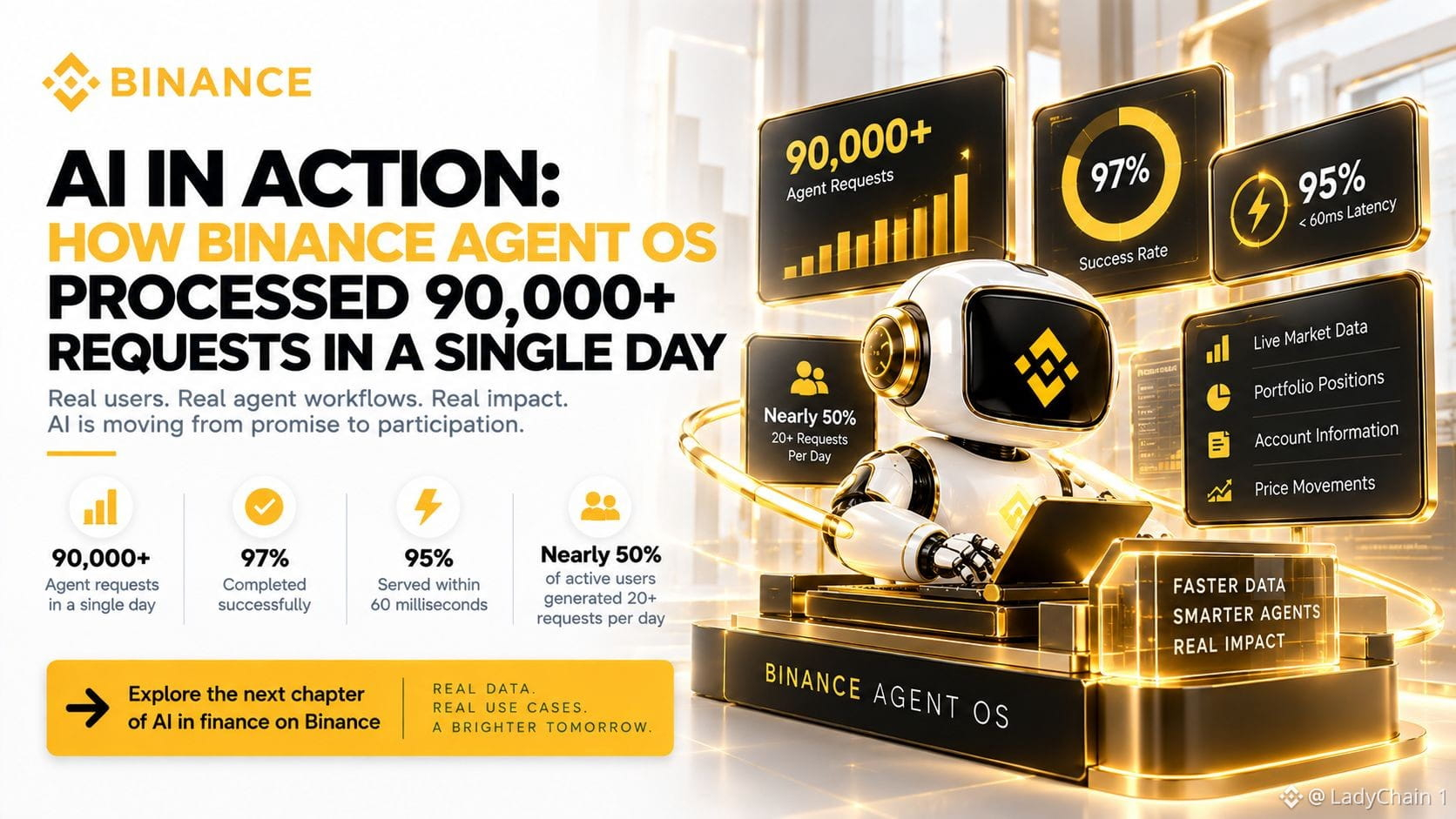
AI in Action: How Binance Agent OS Processed 90,000+ Requests in a Single Day AI is moving from promise to participation. Binance Agent OS's first-week production data makes the transition concrete. The performance numbers In a single day: 90,000+ agent requests processed. 97% completed successfully. 95% served within 60 milliseconds. Each number addresses a different dimension of production readiness. Volume confirms genuine adoption. 97% success rate at this scale reflects serious reliability engineering — in a distributed system under load, keeping failures below 3% requires architectural discipline. 95% sub-60ms is the critical one for financial use: agents monitoring live markets need responses fast enough to act on current data, not data that has already moved. Binance Agent OS meets that requirement for 95% of requests. How users are actually using it Nearly half of active users generated 20+ requests daily — the behavioral signature of genuine agentic workflows, not manual queries. The most-used capabilities: live market data, portfolio positions, account information, price movements. These are the continuous inputs a financial monitoring agent needs to function. The user base adopting Binance Agent OS in its first weeks is running agents persistently, not experimenting casually. What this means for the AI economy The question that has followed record AI infrastructure investment — whether capability translates into durable, useful applications — is being answered in production. 90,000 daily requests. 97% success. 95% under 60ms. These are not benchmark results. They are operating metrics from a live financial infrastructure product with real users running real agent workflows. The next chapter of AI is not about intelligence. It is about useful action at scale. For informational purposes only. Not financial advice.
AI in Action: How Binance Agent OS Processed 90,000+ Requests in a Single Day AI is moving from promise to participation. Binance Agent OS's first-week production data makes the transition concrete. The performance numbers In a single day: 90,000+ agent requests processed. 97% completed successfully. 95% served within 60 milliseconds. Each number addresses a different dimension of production readiness. Volume confirms genuine adoption. 97% success rate at this scale reflects serious reliability engineering — in a distributed system under load, keeping failures below 3% requires architectural discipline. 95% sub-60ms is the critical one for financial use: agents monitoring live markets need responses fast enough to act on current data, not data that has already moved. Binance Agent OS meets that requirement for 95% of requests. How users are actually using it Nearly half of active users generated 20+ requests daily — the behavioral signature of genuine agentic workflows, not manual queries. The most-used capabilities: live market data, portfolio positions, account information, price movements. These are the continuous inputs a financial monitoring agent needs to function. The user base adopting Binance Agent OS in its first weeks is running agents persistently, not experimenting casually. What this means for the AI economy The question that has followed record AI infrastructure investment — whether capability translates into durable, useful applications — is being answered in production. 90,000 daily requests. 97% success. 95% under 60ms. These are not benchmark results. They are operating metrics from a live financial infrastructure product with real users running real agent workflows. The next chapter of AI is not about intelligence. It is about useful action at scale. For informational purposes only. Not financial advice.
2
·
--
Tərcüməyə bax
Bitget just became the latest reminder that exchange security isn’t only about how much money sits in a protection fund. Reports say around $351.6M left Bitget’s hot and warm wallets, while its cold wallets were reportedly untouched. Withdrawals were paused, and the exchange says its $464M User Protection Fund is enough to cover the reported loss. What I find more interesting is the uncertainty around the attack itself. The exact vector is still being investigated, while on-chain trackers have identified a smaller amount moving from labeled addresses. That gap makes the upcoming 24-hour report particularly important. The attacker also appears to have converted a large amount into ETH, making the funds much harder to freeze. Personally, I think the protection fund is reassuring, but it doesn’t answer the bigger question: how did the funds leave in the first place? Until the attack vector is confirmed, it’s difficult to know whether this was an isolated incident or something other exchanges should be paying attention to. For me, the next report matters more than the headline number. If the vector is clearly identified and fixed, confidence can start to recover. If not, withdrawal concerns could become the bigger story going into the weekend.
Bitget just became the latest reminder that exchange security isn’t only about how much money sits in a protection fund. Reports say around $351.6M left Bitget’s hot and warm wallets, while its cold wallets were reportedly untouched. Withdrawals were paused, and the exchange says its $464M User Protection Fund is enough to cover the reported loss. What I find more interesting is the uncertainty around the attack itself. The exact vector is still being investigated, while on-chain trackers have identified a smaller amount moving from labeled addresses. That gap makes the upcoming 24-hour report particularly important. The attacker also appears to have converted a large amount into ETH, making the funds much harder to freeze. Personally, I think the protection fund is reassuring, but it doesn’t answer the bigger question: how did the funds leave in the first place? Until the attack vector is confirmed, it’s difficult to know whether this was an isolated incident or something other exchanges should be paying attention to. For me, the next report matters more than the headline number. If the vector is clearly identified and fixed, confidence can start to recover. If not, withdrawal concerns could become the bigger story going into the weekend.
1
·
--
Tərcüməyə bax
A 5% Treasury yield sounds like a problem for Bitcoin, but history makes the picture a little more complicated. The 10-year yield reaching 5.12% puts BTC in a very different environment from the one we’ve become used to. When investors can get a relatively high yield from US government debt without taking crypto-level volatility, the opportunity cost of holding BTC naturally becomes harder to ignore. That may explain some of the pressure around $84K. But I don’t think higher yields automatically mean Bitcoin’s rally is over. We’ve seen BTC perform strongly even when Treasury yields were elevated. The bigger question is why yields are rising and whether that pressure continues. For me, $83K is an interesting level to watch. If BTC can hold it despite rising yields, that would show some resilience. If it breaks, $80K and $75K could become more relevant areas. Personally, I’m watching the relationship between yields and BTC more than either chart on its own. Higher yields can flush out leverage and speculative positioning — but that cleanup can also leave the market healthier once the pressure fades. So is 5% Treasury yield competition for Bitcoin? Absolutely. But whether it becomes a lasting headwind or simply another volatility phase is what I’m watching next.
A 5% Treasury yield sounds like a problem for Bitcoin, but history makes the picture a little more complicated. The 10-year yield reaching 5.12% puts BTC in a very different environment from the one we’ve become used to. When investors can get a relatively high yield from US government debt without taking crypto-level volatility, the opportunity cost of holding BTC naturally becomes harder to ignore. That may explain some of the pressure around $84K. But I don’t think higher yields automatically mean Bitcoin’s rally is over. We’ve seen BTC perform strongly even when Treasury yields were elevated. The bigger question is why yields are rising and whether that pressure continues. For me, $83K is an interesting level to watch. If BTC can hold it despite rising yields, that would show some resilience. If it breaks, $80K and $75K could become more relevant areas. Personally, I’m watching the relationship between yields and BTC more than either chart on its own. Higher yields can flush out leverage and speculative positioning — but that cleanup can also leave the market healthier once the pressure fades. So is 5% Treasury yield competition for Bitcoin? Absolutely. But whether it becomes a lasting headwind or simply another volatility phase is what I’m watching next.
BTC-0,37%
IEFETF+0,29%
25
·
--
Tərcüməyə bax
$18B in BTC and ETH options expiring on Friday sounds scary at first, but I think the headline can be a little misleading. The interesting part isn’t just the size of the expiry. It’s the gap between the current BTC price and the $75K max pain level. A move back there would be significant, but max pain isn’t a price target that automatically pulls Bitcoin toward it. What I’m watching instead is how the market behaves as the expiry gets closer. With so much open interest, dealer hedging could create some sharp moves in either direction, especially if BTC approaches the major positioning levels. The bullish side is also worth considering. A put/call ratio around 0.66 suggests the options book isn’t overwhelmingly defensive, and some traders may simply be using puts as protection after the recent rally. Personally, I wouldn’t read Friday’s expiry as either an automatic crash signal or a bullish catalyst. For me, the real test comes after the options settle. Does BTC hold the higher range once the hedging pressure disappears, or does the market finally give back some of the recent gains?
$18B in BTC and ETH options expiring on Friday sounds scary at first, but I think the headline can be a little misleading. The interesting part isn’t just the size of the expiry. It’s the gap between the current BTC price and the $75K max pain level. A move back there would be significant, but max pain isn’t a price target that automatically pulls Bitcoin toward it. What I’m watching instead is how the market behaves as the expiry gets closer. With so much open interest, dealer hedging could create some sharp moves in either direction, especially if BTC approaches the major positioning levels. The bullish side is also worth considering. A put/call ratio around 0.66 suggests the options book isn’t overwhelmingly defensive, and some traders may simply be using puts as protection after the recent rally. Personally, I wouldn’t read Friday’s expiry as either an automatic crash signal or a bullish catalyst. For me, the real test comes after the options settle. Does BTC hold the higher range once the hedging pressure disappears, or does the market finally give back some of the recent gains?
25
·
--
Tərcüməyə bax
Bitcoin hitting an eight-month high is impressive, but what caught my attention was how quickly four other major alts started moving even faster. BCH, NEAR, DOGE and XRP all had strong sessions, but I don’t think they should be treated as one big “altseason” trade. Each move has a different story behind it. BCH has the CME futures catalyst, NEAR has activity around Intents, while XRP and DOGE also benefited from a wave of short liquidations. That’s why I’m more interested in what happens after the initial pump. A big green candle can show momentum, but it doesn’t necessarily mean the market has found lasting demand. For me, the real test is whether these assets can hold their gains and maintain strong spot volume once the short squeeze fades. If they can, the move becomes much more interesting. If most of the gains disappear within a few sessions, then it may have been more about positioning than genuine rotation. Right now, I’m watching the follow-through more than the percentage gains.
Bitcoin hitting an eight-month high is impressive, but what caught my attention was how quickly four other major alts started moving even faster. BCH, NEAR, DOGE and XRP all had strong sessions, but I don’t think they should be treated as one big “altseason” trade. Each move has a different story behind it. BCH has the CME futures catalyst, NEAR has activity around Intents, while XRP and DOGE also benefited from a wave of short liquidations. That’s why I’m more interested in what happens after the initial pump. A big green candle can show momentum, but it doesn’t necessarily mean the market has found lasting demand. For me, the real test is whether these assets can hold their gains and maintain strong spot volume once the short squeeze fades. If they can, the move becomes much more interesting. If most of the gains disappear within a few sessions, then it may have been more about positioning than genuine rotation. Right now, I’m watching the follow-through more than the percentage gains.
32
·
--
Stellar-ın Növbəti Çətinliyi Blokçeyn Yolçalarını Real Ödəniş Həcminə Çevirməkdir
Stellar ($XLM ) sərhədlərarası pul köçürmələri üçün infrastruktur kimi illərlə mövqe tutub. Son inkişaflar göstərir ki, ödənişə yönəlmiş bu yanaşma maliyyə sistemində stablkoinlərin payı artdıqca hələ də aktualdır.
Diqqət etmək lazım olan inkişaflardan biri BVNK-nin qlobal stablkoin ödəniş platformuna Stellar şəbəkəsinin inteqrasiyasıdır. Son xəbərlərə görə, müştərilər BVNK-nin mövcud infrastrukturu vasitəsilə 130-dan çox bazarda ödənişlər, remittanslar və xəzinə axınları üçün Stellar-dan istifadə edə bilərlər.
Əhəmiyyət tək bir inteqrasiyanın hüdudlarından kənara çıxır.
Blokçeyn ödəniş şəbəkələri üçün vacib sual sadəcə əməliyyatların sürətli və ya ucuz olub-olmaması deyil. Daha böyük çətinlik şirkətlərin şəbəkədən əslində dəyərli məbləğdə pulu köçürmək üçün istifadə edib-etməməsidir.
Stellar bu istifadə halı üçün nəzərdə tutulub. XLM şəbəkənin doğma aktividir və əməliyyat haqlarını, həmçinin çoxvalyutalı köçürmələri dəstəkləyir; əsas blokçeyn isə hesablaşma üçün infrastrukturu təmin edir.
Stellar həmçinin stablkoin ekosistemindəki rolunu genişləndirir. USDT0 bu ayın əvvəlində LayerZero vasitəsilə Stellar üzərində işə salınıb və şəbəkəyə stablkoinlə bağlı daha bir istifadə nümunəsi əlavə edib.
Bu, ənənəvi maliyyə infrastrukturu ilə blokçeyn yolçaları arasında maraqlı kəsişmə yaradır.
Daha çox ödəniş provayderi, fintech şirkətləri və maliyyə institutları mövcud sistemlərini blokçeyn şəbəkələrinə qoşarsa, Stellar kimi şəbəkələr həmin əməliyyatların arxasında duran infrastrukturun bir hissəsinə çevrilə bilər.
Amma qəbul hələ də real ödəniş həcmi, aktiv istifadəçilər, stablkoin fəaliyyəti və şəbəkəni inteqrasiya edən şirkətlərin sayı ilə ölçülməlidir.
Əsas sual budur:
Stellar artan ödəniş inteqrasiyaları siyahısını dayanıqlı şəkildə real dünyada istifadəyə çevirə bilərmi?
$XLM #Stellar #Blockchain #Stablecoins #Payments
Stellar-ın Növbəti Çətinliyi Blokçeyn Yolçalarını Real Ödəniş Həcminə Çevirməkdir
Stellar ($XLM ) sərhədlərarası pul köçürmələri üçün infrastruktur kimi illərlə mövqe tutub. Son inkişaflar göstərir ki, ödənişə yönəlmiş bu yanaşma maliyyə sistemində stablkoinlərin payı artdıqca hələ də aktualdır.
Diqqət etmək lazım olan inkişaflardan biri BVNK-nin qlobal stablkoin ödəniş platformuna Stellar şəbəkəsinin inteqrasiyasıdır. Son xəbərlərə görə, müştərilər BVNK-nin mövcud infrastrukturu vasitəsilə 130-dan çox bazarda ödənişlər, remittanslar və xəzinə axınları üçün Stellar-dan istifadə edə bilərlər.
Əhəmiyyət tək bir inteqrasiyanın hüdudlarından kənara çıxır.
Blokçeyn ödəniş şəbəkələri üçün vacib sual sadəcə əməliyyatların sürətli və ya ucuz olub-olmaması deyil. Daha böyük çətinlik şirkətlərin şəbəkədən əslində dəyərli məbləğdə pulu köçürmək üçün istifadə edib-etməməsidir.
Stellar bu istifadə halı üçün nəzərdə tutulub. XLM şəbəkənin doğma aktividir və əməliyyat haqlarını, həmçinin çoxvalyutalı köçürmələri dəstəkləyir; əsas blokçeyn isə hesablaşma üçün infrastrukturu təmin edir.
Stellar həmçinin stablkoin ekosistemindəki rolunu genişləndirir. USDT0 bu ayın əvvəlində LayerZero vasitəsilə Stellar üzərində işə salınıb və şəbəkəyə stablkoinlə bağlı daha bir istifadə nümunəsi əlavə edib.
Bu, ənənəvi maliyyə infrastrukturu ilə blokçeyn yolçaları arasında maraqlı kəsişmə yaradır.
Daha çox ödəniş provayderi, fintech şirkətləri və maliyyə institutları mövcud sistemlərini blokçeyn şəbəkələrinə qoşarsa, Stellar kimi şəbəkələr həmin əməliyyatların arxasında duran infrastrukturun bir hissəsinə çevrilə bilər.
Amma qəbul hələ də real ödəniş həcmi, aktiv istifadəçilər, stablkoin fəaliyyəti və şəbəkəni inteqrasiya edən şirkətlərin sayı ilə ölçülməlidir.
Əsas sual budur:
Stellar artan ödəniş inteqrasiyaları siyahısını dayanıqlı şəkildə real dünyada istifadəyə çevirə bilərmi?
$XLM #Stellar #Blockchain #Stablecoins #Payments
Stellar ($XLM ) sərhədlərarası pul köçürmələri üçün infrastruktur kimi illərlə mövqe tutub. Son inkişaflar göstərir ki, ödənişə yönəlmiş bu yanaşma maliyyə sistemində stablkoinlərin payı artdıqca hələ də aktualdır.
Diqqət etmək lazım olan inkişaflardan biri BVNK-nin qlobal stablkoin ödəniş platformuna Stellar şəbəkəsinin inteqrasiyasıdır. Son xəbərlərə görə, müştərilər BVNK-nin mövcud infrastrukturu vasitəsilə 130-dan çox bazarda ödənişlər, remittanslar və xəzinə axınları üçün Stellar-dan istifadə edə bilərlər.
Əhəmiyyət tək bir inteqrasiyanın hüdudlarından kənara çıxır.
Blokçeyn ödəniş şəbəkələri üçün vacib sual sadəcə əməliyyatların sürətli və ya ucuz olub-olmaması deyil. Daha böyük çətinlik şirkətlərin şəbəkədən əslində dəyərli məbləğdə pulu köçürmək üçün istifadə edib-etməməsidir.
Stellar bu istifadə halı üçün nəzərdə tutulub. XLM şəbəkənin doğma aktividir və əməliyyat haqlarını, həmçinin çoxvalyutalı köçürmələri dəstəkləyir; əsas blokçeyn isə hesablaşma üçün infrastrukturu təmin edir.
Stellar həmçinin stablkoin ekosistemindəki rolunu genişləndirir. USDT0 bu ayın əvvəlində LayerZero vasitəsilə Stellar üzərində işə salınıb və şəbəkəyə stablkoinlə bağlı daha bir istifadə nümunəsi əlavə edib.
Bu, ənənəvi maliyyə infrastrukturu ilə blokçeyn yolçaları arasında maraqlı kəsişmə yaradır.
Daha çox ödəniş provayderi, fintech şirkətləri və maliyyə institutları mövcud sistemlərini blokçeyn şəbəkələrinə qoşarsa, Stellar kimi şəbəkələr həmin əməliyyatların arxasında duran infrastrukturun bir hissəsinə çevrilə bilər.
Amma qəbul hələ də real ödəniş həcmi, aktiv istifadəçilər, stablkoin fəaliyyəti və şəbəkəni inteqrasiya edən şirkətlərin sayı ilə ölçülməlidir.
Əsas sual budur:
Stellar artan ödəniş inteqrasiyaları siyahısını dayanıqlı şəkildə real dünyada istifadəyə çevirə bilərmi?
$XLM #Stellar #Blockchain #Stablecoins #Payments
54
·
--
Injective-nin Meridian Yeniləməsi RWA İnfrastrukturunu Daha da Onchain-ə Yaxınlaşdırır
Injective ($INJ ) maliyyə infrastrukturunda rolunu Meridian mainnet yeniləməsinin işə düşməsi ilə genişləndirir.
Yeniləmə 24 sentyabr tarixində aktiv olub və tənzimlənən real dünya aktivləri (regulated real-world assets) ilə tokenləşdirilmiş səhədlər ətrafında yeni imkanlar təqdim edir. Məqsəd onchain üzərində maliyyə məhsullarının daha asan şəkildə buraxılmasını, ticarətini və hesablaşmasını təmin etməkdir.
Bu, blokçeyn əsaslı maliyyə üçün vacib bir istiqamətdir, çünki tokenləşdirmə prosesin yalnız bir hissəsidir. Maliyyə bazarları həm də ticarət infrastrukturu, hesablaşma mexanizmləri, uyğunluq (compliance) məsələləri və likvidlik tələb edir.
Injective RWA-ni ayrıca bir tətbiq qatqı kimi qiymətləndirməkdənsə, bu istifadələr (use cases) ətrafında öz blokçeynini qurur.
Ekosistemdə diqqətçəkən başqa bir məqam onun maliyyə bazarlarına fokusudur. Injective ticarət və digər maliyyə fəaliyyətləri üçün mərkəzləşdirilməmiş tətbiqləri (dApps) dəstəkləmək üçün nəzərdə tutulub, halbuki $INJ idarəetmə (governance), staking və şəbəkənin iqtisadi mexanizmləri üçün istifadə olunur.
Bu baxımdan Meridian yeniləməsi sadəcə texniki yeniləmə kimi də qiymətləndirilə bilər. O, blokçeyn infrastrukturu ilə daha strukturlaşdırılmış tənzimləyici çərçivələr daxilində fəaliyyət göstərən maliyyə məhsullarını birləşdirməyə yönəlmiş cəhddir.
İndi əsas sual budur: bu yeni imkanları tərtibatçılar, institutlar və istifadəçilər necə mənimsəyəcək.
Tokenləşdirilmiş səhədlər və tənzimlənən RWAlar onchain bazarların mənalı bir hissəsinə çevriləcək, yoxsa qəbul daha çox erkən istifadəçilərlə məhdud qalacaq?
$INJ #Injective #RWA #RealWorldAssets
Injective-nin Meridian Yeniləməsi RWA İnfrastrukturunu Daha da Onchain-ə Yaxınlaşdırır
Injective ($INJ ) maliyyə infrastrukturunda rolunu Meridian mainnet yeniləməsinin işə düşməsi ilə genişləndirir.
Yeniləmə 24 sentyabr tarixində aktiv olub və tənzimlənən real dünya aktivləri (regulated real-world assets) ilə tokenləşdirilmiş səhədlər ətrafında yeni imkanlar təqdim edir. Məqsəd onchain üzərində maliyyə məhsullarının daha asan şəkildə buraxılmasını, ticarətini və hesablaşmasını təmin etməkdir.
Bu, blokçeyn əsaslı maliyyə üçün vacib bir istiqamətdir, çünki tokenləşdirmə prosesin yalnız bir hissəsidir. Maliyyə bazarları həm də ticarət infrastrukturu, hesablaşma mexanizmləri, uyğunluq (compliance) məsələləri və likvidlik tələb edir.
Injective RWA-ni ayrıca bir tətbiq qatqı kimi qiymətləndirməkdənsə, bu istifadələr (use cases) ətrafında öz blokçeynini qurur.
Ekosistemdə diqqətçəkən başqa bir məqam onun maliyyə bazarlarına fokusudur. Injective ticarət və digər maliyyə fəaliyyətləri üçün mərkəzləşdirilməmiş tətbiqləri (dApps) dəstəkləmək üçün nəzərdə tutulub, halbuki $INJ idarəetmə (governance), staking və şəbəkənin iqtisadi mexanizmləri üçün istifadə olunur.
Bu baxımdan Meridian yeniləməsi sadəcə texniki yeniləmə kimi də qiymətləndirilə bilər. O, blokçeyn infrastrukturu ilə daha strukturlaşdırılmış tənzimləyici çərçivələr daxilində fəaliyyət göstərən maliyyə məhsullarını birləşdirməyə yönəlmiş cəhddir.
İndi əsas sual budur: bu yeni imkanları tərtibatçılar, institutlar və istifadəçilər necə mənimsəyəcək.
Tokenləşdirilmiş səhədlər və tənzimlənən RWAlar onchain bazarların mənalı bir hissəsinə çevriləcək, yoxsa qəbul daha çox erkən istifadəçilərlə məhdud qalacaq?
$INJ #Injective #RWA #RealWorldAssets
Injective ($INJ ) maliyyə infrastrukturunda rolunu Meridian mainnet yeniləməsinin işə düşməsi ilə genişləndirir.
Yeniləmə 24 sentyabr tarixində aktiv olub və tənzimlənən real dünya aktivləri (regulated real-world assets) ilə tokenləşdirilmiş səhədlər ətrafında yeni imkanlar təqdim edir. Məqsəd onchain üzərində maliyyə məhsullarının daha asan şəkildə buraxılmasını, ticarətini və hesablaşmasını təmin etməkdir.
Bu, blokçeyn əsaslı maliyyə üçün vacib bir istiqamətdir, çünki tokenləşdirmə prosesin yalnız bir hissəsidir. Maliyyə bazarları həm də ticarət infrastrukturu, hesablaşma mexanizmləri, uyğunluq (compliance) məsələləri və likvidlik tələb edir.
Injective RWA-ni ayrıca bir tətbiq qatqı kimi qiymətləndirməkdənsə, bu istifadələr (use cases) ətrafında öz blokçeynini qurur.
Ekosistemdə diqqətçəkən başqa bir məqam onun maliyyə bazarlarına fokusudur. Injective ticarət və digər maliyyə fəaliyyətləri üçün mərkəzləşdirilməmiş tətbiqləri (dApps) dəstəkləmək üçün nəzərdə tutulub, halbuki $INJ idarəetmə (governance), staking və şəbəkənin iqtisadi mexanizmləri üçün istifadə olunur.
Bu baxımdan Meridian yeniləməsi sadəcə texniki yeniləmə kimi də qiymətləndirilə bilər. O, blokçeyn infrastrukturu ilə daha strukturlaşdırılmış tənzimləyici çərçivələr daxilində fəaliyyət göstərən maliyyə məhsullarını birləşdirməyə yönəlmiş cəhddir.
İndi əsas sual budur: bu yeni imkanları tərtibatçılar, institutlar və istifadəçilər necə mənimsəyəcək.
Tokenləşdirilmiş səhədlər və tənzimlənən RWAlar onchain bazarların mənalı bir hissəsinə çevriləcək, yoxsa qəbul daha çox erkən istifadəçilərlə məhdud qalacaq?
$INJ #Injective #RWA #RealWorldAssets
71
·
--
Bittensor’un Daha Böyük Testi AI Rəqabətini Faydalı Məhsullara Çevirir
Bittensor ($TAO ) AI və kripto kəsişməsindəki daha maraqlı layihələrdən biridir, çünki sadəcə bir AI tətbiqini blokçeynə yerləşdirmir.
Onun modeli ixtisaslaşmış subnetlər şəbəkəsi üzərində qurulub: iştirakçılar müxtəlif növ maşın intellekti təqdim edir və töhfələrinin dəyərinə görə mükafatlandırılır.
Bu isə tək bir mərkəzləşdirilmiş model yox, AI üçün bir bazar yaradır.
Konsept cəlbedicidir, amma çətin bir sual da doğurur: subnet-in həqiqətən faydalı intellekt təqdim edib-etmədiyini necə ölçmək olar?
Bittensor’un stimullaşdırma sistemi dəyərli töhfələri mükafatlandırmaq üçün nəzərdə tutulub, amma şəbəkənin uzunmüddətli uğuru bu stimulların tərtibatçıların və istifadəçilərin həqiqətən ehtiyac duyduğu xidmətlərə gətirib-çıxarmasından asılıdır.
Subnet-lərin sayının artması da başqa bir problem yaradır. Daha ixtisaslaşmış bazarlar eksperimentləri artıra bilər, amma ekosistemi yeni gələnlər üçün anlamağı və istiqamət tapmağı çətinləşdirə bilər.
Məhz burada infrastruktur, məlumat keyfiyyəti, model performansı və real tələb önəm qazanır.
$TAO token Bittensor’un iqtisadi sisteminin mərkəzində dayanır, subnet tokenləri isə geniş şəbəkə daxilində ayrı-ayrı AI bazarlarının formalaşmasına imkan verir.
Son dövrdə bazar aktivliyi yenidən Bittensor’a diqqəti artırıb, amma qiymət hərəkəti layihəni qiymətləndirmək üçün ən vacib göstərici deyil.
Daha böyük sual budur: mərkəzləşdirilmiş alternativlərlə rəqabət apara biləcək faydalı xidmətlər istehsal etmək üçün mərkəzləşdirilməmiş AI bazarları yarada bilirmi?
Əgər Bittensor eksperimentləri davamlı tələblə çevirə bilsə, AI iqtisadiyyatı inkişaf etdikcə onun modeli daha da əhəmiyyətli ola bilər.
Mərkəzləşdirilməmiş AI üçün daha vacib olan nədir: daha yaxşı modellər, yoxsa daha yaxşı stimullar?
$TAO #Bittensor #AI #DePIN
Bittensor’un Daha Böyük Testi AI Rəqabətini Faydalı Məhsullara Çevirir
Bittensor ($TAO ) AI və kripto kəsişməsindəki daha maraqlı layihələrdən biridir, çünki sadəcə bir AI tətbiqini blokçeynə yerləşdirmir.
Onun modeli ixtisaslaşmış subnetlər şəbəkəsi üzərində qurulub: iştirakçılar müxtəlif növ maşın intellekti təqdim edir və töhfələrinin dəyərinə görə mükafatlandırılır.
Bu isə tək bir mərkəzləşdirilmiş model yox, AI üçün bir bazar yaradır.
Konsept cəlbedicidir, amma çətin bir sual da doğurur: subnet-in həqiqətən faydalı intellekt təqdim edib-etmədiyini necə ölçmək olar?
Bittensor’un stimullaşdırma sistemi dəyərli töhfələri mükafatlandırmaq üçün nəzərdə tutulub, amma şəbəkənin uzunmüddətli uğuru bu stimulların tərtibatçıların və istifadəçilərin həqiqətən ehtiyac duyduğu xidmətlərə gətirib-çıxarmasından asılıdır.
Subnet-lərin sayının artması da başqa bir problem yaradır. Daha ixtisaslaşmış bazarlar eksperimentləri artıra bilər, amma ekosistemi yeni gələnlər üçün anlamağı və istiqamət tapmağı çətinləşdirə bilər.
Məhz burada infrastruktur, məlumat keyfiyyəti, model performansı və real tələb önəm qazanır.
$TAO token Bittensor’un iqtisadi sisteminin mərkəzində dayanır, subnet tokenləri isə geniş şəbəkə daxilində ayrı-ayrı AI bazarlarının formalaşmasına imkan verir.
Son dövrdə bazar aktivliyi yenidən Bittensor’a diqqəti artırıb, amma qiymət hərəkəti layihəni qiymətləndirmək üçün ən vacib göstərici deyil.
Daha böyük sual budur: mərkəzləşdirilmiş alternativlərlə rəqabət apara biləcək faydalı xidmətlər istehsal etmək üçün mərkəzləşdirilməmiş AI bazarları yarada bilirmi?
Əgər Bittensor eksperimentləri davamlı tələblə çevirə bilsə, AI iqtisadiyyatı inkişaf etdikcə onun modeli daha da əhəmiyyətli ola bilər.
Mərkəzləşdirilməmiş AI üçün daha vacib olan nədir: daha yaxşı modellər, yoxsa daha yaxşı stimullar?
$TAO #Bittensor #AI #DePIN
Bittensor ($TAO ) AI və kripto kəsişməsindəki daha maraqlı layihələrdən biridir, çünki sadəcə bir AI tətbiqini blokçeynə yerləşdirmir.
Onun modeli ixtisaslaşmış subnetlər şəbəkəsi üzərində qurulub: iştirakçılar müxtəlif növ maşın intellekti təqdim edir və töhfələrinin dəyərinə görə mükafatlandırılır.
Bu isə tək bir mərkəzləşdirilmiş model yox, AI üçün bir bazar yaradır.
Konsept cəlbedicidir, amma çətin bir sual da doğurur: subnet-in həqiqətən faydalı intellekt təqdim edib-etmədiyini necə ölçmək olar?
Bittensor’un stimullaşdırma sistemi dəyərli töhfələri mükafatlandırmaq üçün nəzərdə tutulub, amma şəbəkənin uzunmüddətli uğuru bu stimulların tərtibatçıların və istifadəçilərin həqiqətən ehtiyac duyduğu xidmətlərə gətirib-çıxarmasından asılıdır.
Subnet-lərin sayının artması da başqa bir problem yaradır. Daha ixtisaslaşmış bazarlar eksperimentləri artıra bilər, amma ekosistemi yeni gələnlər üçün anlamağı və istiqamət tapmağı çətinləşdirə bilər.
Məhz burada infrastruktur, məlumat keyfiyyəti, model performansı və real tələb önəm qazanır.
$TAO token Bittensor’un iqtisadi sisteminin mərkəzində dayanır, subnet tokenləri isə geniş şəbəkə daxilində ayrı-ayrı AI bazarlarının formalaşmasına imkan verir.
Son dövrdə bazar aktivliyi yenidən Bittensor’a diqqəti artırıb, amma qiymət hərəkəti layihəni qiymətləndirmək üçün ən vacib göstərici deyil.
Daha böyük sual budur: mərkəzləşdirilmiş alternativlərlə rəqabət apara biləcək faydalı xidmətlər istehsal etmək üçün mərkəzləşdirilməmiş AI bazarları yarada bilirmi?
Əgər Bittensor eksperimentləri davamlı tələblə çevirə bilsə, AI iqtisadiyyatı inkişaf etdikcə onun modeli daha da əhəmiyyətli ola bilər.
Mərkəzləşdirilməmiş AI üçün daha vacib olan nədir: daha yaxşı modellər, yoxsa daha yaxşı stimullar?
$TAO #Bittensor #AI #DePIN
·
--
0G Süni İntellekt İqtisadiyyatı üçün İnfrastruktur İnşa edir
0G ( $0G ) blokçeynə AI infrastruktur perspektivindən yaxınlaşır: saxlama, məlumatın əlçatanlığı, hesablama və onchain AI tətbiqləri üçün nəzərdə tutulmuş Layer 1-i birləşdirir.
Bu fikir önəmlidir, çünki AI iş yükləri böyük həcmdə data və hesablama gücü tələb edir. Ənənəvi bulud infrastrukturu bu resursları təmin edə bilər, amma mərkəzləşdirilməmiş şəbəkələr resursların bir neçə iştirakçı tərəfindən təmin olunduğu fərqli modelə baxır.
0G arxitekturası daxilində bir neçə funksiyanı ayırır: 0G Chain, 0G Storage, 0G Data Availability və 0G Compute.
Son inkişaf Ascend-dir; bu, stake edilmiş 0G-ni AI hesablama kreditləri ilə birləşdirir. Layihə həmçinin Infinite AI hazırlayır və bununla da mərkəzləşdirilməmiş AI ekosisteminə əlavə bir qat əlavə edir.
Çətinlik infrastrukturun real tələbat yaratmasına nail olmaqdır.
AI tərtibatçıları etibarlı performans, rəqabətə davamlı xərclər, kifayət qədər hesablama gücü və sadə alətlərə ehtiyac duyur. Mərkəzləşdirilməmiş şəbəkə yalnız rəvayət deyil, bu amillərdə rəqabət aparmalıdır.
$0G token şəbəkənin iqtisadi sisteminin bir hissəsidir və iştirakçılığı infrastruktur istifadəsi ilə bağlayır.
0G üçün izlənilməsi ən faydalı göstəricilər hesablama tələbi, saxlama istifadəsi, tərtibatçı fəaliyyəti və şəbəkədə işləyən tətbiqlərdir.
Ümumi sual budur: mərkəzləşdirilməmiş infrastruktur gündəlik AI iş yükləri üçün kifayət qədər praktik ola bilərmi?
Əgər ola bilsə, 0G kimi layihələr blokçeyn şəbəkələrini böyüyən AI iqtisadiyyatı ilə əlaqələndirməkdə rol oynaya bilər.
$0G #0G #AI #DePIN
0G Süni İntellekt İqtisadiyyatı üçün İnfrastruktur İnşa edir
0G ( $0G ) blokçeynə AI infrastruktur perspektivindən yaxınlaşır: saxlama, məlumatın əlçatanlığı, hesablama və onchain AI tətbiqləri üçün nəzərdə tutulmuş Layer 1-i birləşdirir.
Bu fikir önəmlidir, çünki AI iş yükləri böyük həcmdə data və hesablama gücü tələb edir. Ənənəvi bulud infrastrukturu bu resursları təmin edə bilər, amma mərkəzləşdirilməmiş şəbəkələr resursların bir neçə iştirakçı tərəfindən təmin olunduğu fərqli modelə baxır.
0G arxitekturası daxilində bir neçə funksiyanı ayırır: 0G Chain, 0G Storage, 0G Data Availability və 0G Compute.
Son inkişaf Ascend-dir; bu, stake edilmiş 0G-ni AI hesablama kreditləri ilə birləşdirir. Layihə həmçinin Infinite AI hazırlayır və bununla da mərkəzləşdirilməmiş AI ekosisteminə əlavə bir qat əlavə edir.
Çətinlik infrastrukturun real tələbat yaratmasına nail olmaqdır.
AI tərtibatçıları etibarlı performans, rəqabətə davamlı xərclər, kifayət qədər hesablama gücü və sadə alətlərə ehtiyac duyur. Mərkəzləşdirilməmiş şəbəkə yalnız rəvayət deyil, bu amillərdə rəqabət aparmalıdır.
$0G token şəbəkənin iqtisadi sisteminin bir hissəsidir və iştirakçılığı infrastruktur istifadəsi ilə bağlayır.
0G üçün izlənilməsi ən faydalı göstəricilər hesablama tələbi, saxlama istifadəsi, tərtibatçı fəaliyyəti və şəbəkədə işləyən tətbiqlərdir.
Ümumi sual budur: mərkəzləşdirilməmiş infrastruktur gündəlik AI iş yükləri üçün kifayət qədər praktik ola bilərmi?
Əgər ola bilsə, 0G kimi layihələr blokçeyn şəbəkələrini böyüyən AI iqtisadiyyatı ilə əlaqələndirməkdə rol oynaya bilər.
$0G #0G #AI #DePIN
0G ( $0G ) blokçeynə AI infrastruktur perspektivindən yaxınlaşır: saxlama, məlumatın əlçatanlığı, hesablama və onchain AI tətbiqləri üçün nəzərdə tutulmuş Layer 1-i birləşdirir.
Bu fikir önəmlidir, çünki AI iş yükləri böyük həcmdə data və hesablama gücü tələb edir. Ənənəvi bulud infrastrukturu bu resursları təmin edə bilər, amma mərkəzləşdirilməmiş şəbəkələr resursların bir neçə iştirakçı tərəfindən təmin olunduğu fərqli modelə baxır.
0G arxitekturası daxilində bir neçə funksiyanı ayırır: 0G Chain, 0G Storage, 0G Data Availability və 0G Compute.
Son inkişaf Ascend-dir; bu, stake edilmiş 0G-ni AI hesablama kreditləri ilə birləşdirir. Layihə həmçinin Infinite AI hazırlayır və bununla da mərkəzləşdirilməmiş AI ekosisteminə əlavə bir qat əlavə edir.
Çətinlik infrastrukturun real tələbat yaratmasına nail olmaqdır.
AI tərtibatçıları etibarlı performans, rəqabətə davamlı xərclər, kifayət qədər hesablama gücü və sadə alətlərə ehtiyac duyur. Mərkəzləşdirilməmiş şəbəkə yalnız rəvayət deyil, bu amillərdə rəqabət aparmalıdır.
$0G token şəbəkənin iqtisadi sisteminin bir hissəsidir və iştirakçılığı infrastruktur istifadəsi ilə bağlayır.
0G üçün izlənilməsi ən faydalı göstəricilər hesablama tələbi, saxlama istifadəsi, tərtibatçı fəaliyyəti və şəbəkədə işləyən tətbiqlərdir.
Ümumi sual budur: mərkəzləşdirilməmiş infrastruktur gündəlik AI iş yükləri üçün kifayət qədər praktik ola bilərmi?
Əgər ola bilsə, 0G kimi layihələr blokçeyn şəbəkələrini böyüyən AI iqtisadiyyatı ilə əlaqələndirməkdə rol oynaya bilər.
$0G #0G #AI #DePIN
32
·
--
Tərcüməyə bax
BTC just closed above its 50-week moving average for the first time in 45 weeks, and that’s a pretty important technical shift. What I find interesting is that this level has rejected Bitcoin several times before, so reclaiming it is only part of the story. The bigger question is whether $78K–$79K can now turn into support. The next levels are fairly clear: $86K is the next resistance, followed by $90K and potentially $93K if momentum continues. But I wouldn’t ignore how this move happened. Part of the push toward $85K appears to have been driven by short liquidations, which can make a rally look stronger than the underlying spot demand actually is. For me, the weekly close matters more than the initial breakout. If BTC can hold above the 50W MA and buyers keep showing up, this could be a meaningful shift in structure. If it falls back below, we may learn that the reclaim was another failed attempt. Now the real test is whether the former resistance can become support.
BTC just closed above its 50-week moving average for the first time in 45 weeks, and that’s a pretty important technical shift. What I find interesting is that this level has rejected Bitcoin several times before, so reclaiming it is only part of the story. The bigger question is whether $78K–$79K can now turn into support. The next levels are fairly clear: $86K is the next resistance, followed by $90K and potentially $93K if momentum continues. But I wouldn’t ignore how this move happened. Part of the push toward $85K appears to have been driven by short liquidations, which can make a rally look stronger than the underlying spot demand actually is. For me, the weekly close matters more than the initial breakout. If BTC can hold above the 50W MA and buyers keep showing up, this could be a meaningful shift in structure. If it falls back below, we may learn that the reclaim was another failed attempt. Now the real test is whether the former resistance can become support.
26
·
--
Tərcüməyə bax
The Fed hiked rates, but Bitcoin didn’t exactly follow the script. BTC briefly dropped below $75K around the decision, then bounced back toward $80K within 48 hours. What caught my attention is that the market seems to be focusing less on the rate hike itself and more on what’s happening with liquidity underneath. The Fed is still tightening the price of money, but its balance sheet and reserve levels tell a more complicated story. Treasury purchases and reserve management can provide support without necessarily meaning we’re back to full-blown QE. That distinction matters. Personally, I’m not ready to call this a new liquidity wave just because BTC bounced. ETF flows still need to show more consistency, especially after recent outflows. For me, $81K is the level to watch next. If BTC can hold above it with real spot demand, the recovery starts to look more convincing. The big question isn’t whether the Fed is easing or tightening. It’s whether liquidity is actually finding its way back into Bitcoin.
The Fed hiked rates, but Bitcoin didn’t exactly follow the script. BTC briefly dropped below $75K around the decision, then bounced back toward $80K within 48 hours. What caught my attention is that the market seems to be focusing less on the rate hike itself and more on what’s happening with liquidity underneath. The Fed is still tightening the price of money, but its balance sheet and reserve levels tell a more complicated story. Treasury purchases and reserve management can provide support without necessarily meaning we’re back to full-blown QE. That distinction matters. Personally, I’m not ready to call this a new liquidity wave just because BTC bounced. ETF flows still need to show more consistency, especially after recent outflows. For me, $81K is the level to watch next. If BTC can hold above it with real spot demand, the recovery starts to look more convincing. The big question isn’t whether the Fed is easing or tightening. It’s whether liquidity is actually finding its way back into Bitcoin.
36
·
--
Tərcüməyə bax
Creditcoin Is Taking RWA Beyond Tokenized Assets
Creditcoin ($CTC ) approaches the real-world asset sector from the perspective of credit infrastructure.
Instead of focusing only on tokenizing physical or financial assets, Creditcoin is designed to record credit transactions and connect lenders and borrowers across blockchain networks.
The idea addresses a real problem in emerging markets. People and businesses may have borrowing histories with non-bank lenders, but those records are not always recognized by traditional financial institutions.
Creditcoin aims to create an objective record of credit activity on a public blockchain. This could make credit histories easier to verify and potentially connect them with a broader digital financial system.
That makes the project interesting within the RWA narrative.
Real-world financial activity is not limited to assets such as real estate or bonds. Credit records, lending relationships, and repayment history can also become part of onchain financial infrastructure.
But the technology alone is not enough.
A credit network needs reliable data, lenders, borrowers, risk assessment, liquidity, and sustainable repayment activity.
The $CTC token is the native asset of the Creditcoin network and supports its broader ecosystem.
The key metric to watch is therefore real credit activity rather than simply token transactions.
Can blockchain-based credit records improve access to financing while making lending data more transparent?
$CTC #Creditcoin #RWA #RealWorldAssets
Creditcoin Is Taking RWA Beyond Tokenized Assets
Creditcoin ($CTC ) approaches the real-world asset sector from the perspective of credit infrastructure.
Instead of focusing only on tokenizing physical or financial assets, Creditcoin is designed to record credit transactions and connect lenders and borrowers across blockchain networks.
The idea addresses a real problem in emerging markets. People and businesses may have borrowing histories with non-bank lenders, but those records are not always recognized by traditional financial institutions.
Creditcoin aims to create an objective record of credit activity on a public blockchain. This could make credit histories easier to verify and potentially connect them with a broader digital financial system.
That makes the project interesting within the RWA narrative.
Real-world financial activity is not limited to assets such as real estate or bonds. Credit records, lending relationships, and repayment history can also become part of onchain financial infrastructure.
But the technology alone is not enough.
A credit network needs reliable data, lenders, borrowers, risk assessment, liquidity, and sustainable repayment activity.
The $CTC token is the native asset of the Creditcoin network and supports its broader ecosystem.
The key metric to watch is therefore real credit activity rather than simply token transactions.
Can blockchain-based credit records improve access to financing while making lending data more transparent?
$CTC #Creditcoin #RWA #RealWorldAssets
Creditcoin ($CTC ) approaches the real-world asset sector from the perspective of credit infrastructure.
Instead of focusing only on tokenizing physical or financial assets, Creditcoin is designed to record credit transactions and connect lenders and borrowers across blockchain networks.
The idea addresses a real problem in emerging markets. People and businesses may have borrowing histories with non-bank lenders, but those records are not always recognized by traditional financial institutions.
Creditcoin aims to create an objective record of credit activity on a public blockchain. This could make credit histories easier to verify and potentially connect them with a broader digital financial system.
That makes the project interesting within the RWA narrative.
Real-world financial activity is not limited to assets such as real estate or bonds. Credit records, lending relationships, and repayment history can also become part of onchain financial infrastructure.
But the technology alone is not enough.
A credit network needs reliable data, lenders, borrowers, risk assessment, liquidity, and sustainable repayment activity.
The $CTC token is the native asset of the Creditcoin network and supports its broader ecosystem.
The key metric to watch is therefore real credit activity rather than simply token transactions.
Can blockchain-based credit records improve access to financing while making lending data more transparent?
$CTC #Creditcoin #RWA #RealWorldAssets
43
·
--
Dusk tənzimlənən onçeyn maliyyə üçün infrastruktur qurur
Dusk ($DUSK ) tənzimlənən maliyyə bazarları üçün tələb olunan infrastrukturun üzərində fokuslanaraq real dünya aktivlərinə fərqli yanaşır.
Dusk, RWA-ların (real dünya aktivlərinin) buraxılışı, ticarəti və hesablaşması üçün nəzərdə tutulmuş 1-ci qat (Layer 1) protokoldur. Onun arxitekturası rəqəmsal qiymətli kağızları və digər tənzimlənən aktivləri dəstəkləmək üçün məxfilik qoruyan texnologiya, sıfır bilik sübutları və uyğunluq (compliance) alətlərini birləşdirir.
Bu fokus vacibdir, çünki tokenləşdirmə sadəcə başlanğıcdır.
Maliyyə institutları həmçinin etibarlı hesablaşma, mülkiyyət qeydləri, uyğunluq prosesləri və ikinci bazarlar üçün infrastruktur tələb edir. Dusk bu tələbləri vahid bir blokçeyn mühitində qarşılamaq üçün dizayn edilib.
Diqqət yetiriləcək əsas inkişaf DuskEVM-dir. Onun testnet-i tərtibatçılara tanış Ethereum alətlərindən istifadə edərək Solidity tətbiqləri yerləşdirməyə imkan verir və bu, Dusk üzərində maliyyə tətbiqləri qurmaq üçün maneəni potensial olaraq azalda bilər.
Layihə, həmçinin planlaşdırılan NPEX-ə bağlı ekosistemi də daxil olmaqla, tənzimlənən RWA tətbiqləri istiqamətində də işləyir.
Şəbəkə daxilində $DUSK tokenindən istifadə olunur: qaz (gas) və staking üçün də daxil olmaqla. O, infrastruktur vasitəsilə buraxılan real dünya aktivlərindən fərqləndirilməlidir.
Maraqlı sual budur: Dusk öz tənzimləyici və texniki infrastrukturunu real şəbəkə aktivliyinə çevirə biləcəkmi?
RWA-nın mənimsənilməsi token buraxılışından daha çox şey tələb edəcək. İştirakçılara (issuer-lər), tərtibatçılara, likvidliyə və istifadəçilərə ehtiyac olacaq.
Uyğunluğa (compliance) yönəlmiş blokçeyn tənzimlənən onçeyn bazarları üçün praktiki əsas ola bilərmi?
$DUSK #Dusk #RWA #RealWorldAssets
Dusk tənzimlənən onçeyn maliyyə üçün infrastruktur qurur
Dusk ($DUSK ) tənzimlənən maliyyə bazarları üçün tələb olunan infrastrukturun üzərində fokuslanaraq real dünya aktivlərinə fərqli yanaşır.
Dusk, RWA-ların (real dünya aktivlərinin) buraxılışı, ticarəti və hesablaşması üçün nəzərdə tutulmuş 1-ci qat (Layer 1) protokoldur. Onun arxitekturası rəqəmsal qiymətli kağızları və digər tənzimlənən aktivləri dəstəkləmək üçün məxfilik qoruyan texnologiya, sıfır bilik sübutları və uyğunluq (compliance) alətlərini birləşdirir.
Bu fokus vacibdir, çünki tokenləşdirmə sadəcə başlanğıcdır.
Maliyyə institutları həmçinin etibarlı hesablaşma, mülkiyyət qeydləri, uyğunluq prosesləri və ikinci bazarlar üçün infrastruktur tələb edir. Dusk bu tələbləri vahid bir blokçeyn mühitində qarşılamaq üçün dizayn edilib.
Diqqət yetiriləcək əsas inkişaf DuskEVM-dir. Onun testnet-i tərtibatçılara tanış Ethereum alətlərindən istifadə edərək Solidity tətbiqləri yerləşdirməyə imkan verir və bu, Dusk üzərində maliyyə tətbiqləri qurmaq üçün maneəni potensial olaraq azalda bilər.
Layihə, həmçinin planlaşdırılan NPEX-ə bağlı ekosistemi də daxil olmaqla, tənzimlənən RWA tətbiqləri istiqamətində də işləyir.
Şəbəkə daxilində $DUSK tokenindən istifadə olunur: qaz (gas) və staking üçün də daxil olmaqla. O, infrastruktur vasitəsilə buraxılan real dünya aktivlərindən fərqləndirilməlidir.
Maraqlı sual budur: Dusk öz tənzimləyici və texniki infrastrukturunu real şəbəkə aktivliyinə çevirə biləcəkmi?
RWA-nın mənimsənilməsi token buraxılışından daha çox şey tələb edəcək. İştirakçılara (issuer-lər), tərtibatçılara, likvidliyə və istifadəçilərə ehtiyac olacaq.
Uyğunluğa (compliance) yönəlmiş blokçeyn tənzimlənən onçeyn bazarları üçün praktiki əsas ola bilərmi?
$DUSK #Dusk #RWA #RealWorldAssets
Dusk ($DUSK ) tənzimlənən maliyyə bazarları üçün tələb olunan infrastrukturun üzərində fokuslanaraq real dünya aktivlərinə fərqli yanaşır.
Dusk, RWA-ların (real dünya aktivlərinin) buraxılışı, ticarəti və hesablaşması üçün nəzərdə tutulmuş 1-ci qat (Layer 1) protokoldur. Onun arxitekturası rəqəmsal qiymətli kağızları və digər tənzimlənən aktivləri dəstəkləmək üçün məxfilik qoruyan texnologiya, sıfır bilik sübutları və uyğunluq (compliance) alətlərini birləşdirir.
Bu fokus vacibdir, çünki tokenləşdirmə sadəcə başlanğıcdır.
Maliyyə institutları həmçinin etibarlı hesablaşma, mülkiyyət qeydləri, uyğunluq prosesləri və ikinci bazarlar üçün infrastruktur tələb edir. Dusk bu tələbləri vahid bir blokçeyn mühitində qarşılamaq üçün dizayn edilib.
Diqqət yetiriləcək əsas inkişaf DuskEVM-dir. Onun testnet-i tərtibatçılara tanış Ethereum alətlərindən istifadə edərək Solidity tətbiqləri yerləşdirməyə imkan verir və bu, Dusk üzərində maliyyə tətbiqləri qurmaq üçün maneəni potensial olaraq azalda bilər.
Layihə, həmçinin planlaşdırılan NPEX-ə bağlı ekosistemi də daxil olmaqla, tənzimlənən RWA tətbiqləri istiqamətində də işləyir.
Şəbəkə daxilində $DUSK tokenindən istifadə olunur: qaz (gas) və staking üçün də daxil olmaqla. O, infrastruktur vasitəsilə buraxılan real dünya aktivlərindən fərqləndirilməlidir.
Maraqlı sual budur: Dusk öz tənzimləyici və texniki infrastrukturunu real şəbəkə aktivliyinə çevirə biləcəkmi?
RWA-nın mənimsənilməsi token buraxılışından daha çox şey tələb edəcək. İştirakçılara (issuer-lər), tərtibatçılara, likvidliyə və istifadəçilərə ehtiyac olacaq.
Uyğunluğa (compliance) yönəlmiş blokçeyn tənzimlənən onçeyn bazarları üçün praktiki əsas ola bilərmi?
$DUSK #Dusk #RWA #RealWorldAssets
54
·
--
“Privacy coins” (məxfilik sikkələri) yenidən diqqət çəkir, amma maraqlı olan təkcə qiymət hərəkəti deyil.
ZEC 1,400 dollardan yuxarı itələdi, XMR isə ilk 10-luğa daxil oldu, amma bu iki layihə barədə mübahisə fərqlidir. Monero məxfiliyi standart olaraq təqdim edir, Zcash isə istifadəçilərə “shielded” (gizlədilmiş) əməliyyatlar seçimi verir.
Şəxsən mənim üçün “hansı daha yaxşıdır” mövzusu ətrafındakı rəvayətdən daha çox, qəbul olunma (adoption) sualı maraqlıdır.
Son hadisələr məxfiliyin hələ də real dünyada istifadə hallarının olduğunu göstərir, amma spekulyasiya bu aktivləri də onların əsas göstəricilərindən (fundamentals) xeyli uzağa apara bilər. Daha çətin sual budur: bu impuls davamlı tələbatə çevrilə bilərmi?
ZEC üçün institusional maraq və son dövr qiymət gücü izlənməyə dəyər. XMR üçün isə onun uzun illərdir mövcud olan məxfilik modeli şəxsiyyətinin (identity) əsasını təşkil edir.
Bəlkə də real test “hansı məxfilik sikkəsi rəvayəti qazanır” deyil.
Sual budur: həvəs (hype) sönəndən sonra insanlar həqiqətən də onlardan istifadə etməyə davam edirmi.
“Privacy coins” (məxfilik sikkələri) yenidən diqqət çəkir, amma maraqlı olan təkcə qiymət hərəkəti deyil.
ZEC 1,400 dollardan yuxarı itələdi, XMR isə ilk 10-luğa daxil oldu, amma bu iki layihə barədə mübahisə fərqlidir. Monero məxfiliyi standart olaraq təqdim edir, Zcash isə istifadəçilərə “shielded” (gizlədilmiş) əməliyyatlar seçimi verir.
Şəxsən mənim üçün “hansı daha yaxşıdır” mövzusu ətrafındakı rəvayətdən daha çox, qəbul olunma (adoption) sualı maraqlıdır.
Son hadisələr məxfiliyin hələ də real dünyada istifadə hallarının olduğunu göstərir, amma spekulyasiya bu aktivləri də onların əsas göstəricilərindən (fundamentals) xeyli uzağa apara bilər. Daha çətin sual budur: bu impuls davamlı tələbatə çevrilə bilərmi?
ZEC üçün institusional maraq və son dövr qiymət gücü izlənməyə dəyər. XMR üçün isə onun uzun illərdir mövcud olan məxfilik modeli şəxsiyyətinin (identity) əsasını təşkil edir.
Bəlkə də real test “hansı məxfilik sikkəsi rəvayəti qazanır” deyil.
Sual budur: həvəs (hype) sönəndən sonra insanlar həqiqətən də onlardan istifadə etməyə davam edirmi.
ZEC 1,400 dollardan yuxarı itələdi, XMR isə ilk 10-luğa daxil oldu, amma bu iki layihə barədə mübahisə fərqlidir. Monero məxfiliyi standart olaraq təqdim edir, Zcash isə istifadəçilərə “shielded” (gizlədilmiş) əməliyyatlar seçimi verir.
Şəxsən mənim üçün “hansı daha yaxşıdır” mövzusu ətrafındakı rəvayətdən daha çox, qəbul olunma (adoption) sualı maraqlıdır.
Son hadisələr məxfiliyin hələ də real dünyada istifadə hallarının olduğunu göstərir, amma spekulyasiya bu aktivləri də onların əsas göstəricilərindən (fundamentals) xeyli uzağa apara bilər. Daha çətin sual budur: bu impuls davamlı tələbatə çevrilə bilərmi?
ZEC üçün institusional maraq və son dövr qiymət gücü izlənməyə dəyər. XMR üçün isə onun uzun illərdir mövcud olan məxfilik modeli şəxsiyyətinin (identity) əsasını təşkil edir.
Bəlkə də real test “hansı məxfilik sikkəsi rəvayəti qazanır” deyil.
Sual budur: həvəs (hype) sönəndən sonra insanlar həqiqətən də onlardan istifadə etməyə davam edirmi.
230
·
--
AIOZ Süni İntellekt və Kontent üçün Mərkəzsiz İnfrastruktur Qurur
AIOZ Şəbəkəsi ( $AIOZ ) mərkəzsiz fiziki infrastrukturunu AI, yaddaş və rəqəmsal kontentin paylanması ilə birləşdirir.
DePIN-in arxasındakı əsas ideya, mərkəzləşdirilmiş məlumat mərkəzlərinə tam etibar etmək əvəzinə, mərkəzləşdirilməmiş şəbəkə vasitəsilə istifadə olunmayan hesablama, yaddaş və bant genişliyi resurslarını birləşdirməkdir.
AIOZ bu modeli bir neçə sahəyə tətbiq edir. Onun infrastrukturu mərkəzləşdirilməmiş yaddaş, AI hesablamaları və kontentin çatdırılmasını dəstəkləyir; bu da şəbəkəyə sadə blokçeyn tranzaksiyalarından kənar istifadə halları qazandırır.
AI tərəfi xüsusilə maraqlıdır. AI tətbiqləri artan həcmdə hesablama gücü və yaddaş tələb edir, halbuki mərkəzləşdirilməmiş infrastrukturu bu resursları şəbəkə üzərindən paylamağın başqa bir yolunu təqdim edir.
Amma aparat avadanlığını qoşmaq sadəcə başlanğıcdır.
Mərkəzləşdirilməmiş infrastruktur şəbəkəsi etibarlı nodlara, rəqabətədavamlı xərclərə, sabit performansa və real tələbat yaradan tətbiqlərə də ehtiyac duyur. Davamlı istifadə olmasa, resursların böyük şəbəkəsi avtomatik olaraq mənalı fayda yaratmır.
AIOZ həmçinin Ethereum və Cosmos ilə qarşılıqlı fəaliyyət (interoperabillik) dəstəyi verir və bu, tərtibatçılara onun ekosistemi ilə qarşılıqlı təsir üçün əlavə yollar təqdim edir.
$AIOZ tokeni şəbəkə daxilində tranzaksiyalar və ekosistem iştirakçılığı üçün istifadə olunur; token iqtisadiyyatını şəbəkə aktivliyi ilə əlaqələndirir.
AIOZ üçün izlənməyə dəyər əsas göstəricilər praktiki olanlardır: şəbəkə istifadəsi, yaddaş tələbatı, AI yükləri, kontentin çatdırılması və tərtibatçıların mənimsənilməsi.
Daha geniş DePIN sektoru hələ inkişaf edir. Onun uzunmüddətli potensialı, mərkəzləşdirilməmiş infrastrukturun rəqabətədavamlı xərclərlə faydalı xidmətlər təqdim edib-etməməsindən asılı olacaq.
AIOZ bu modeli bir neçə sahədə rəqəmsal infrastruktur üzrə sınaqdan keçirən bir layihədir.
$AIOZ #AIOZ #DePIN #AI
AIOZ Süni İntellekt və Kontent üçün Mərkəzsiz İnfrastruktur Qurur
AIOZ Şəbəkəsi ( $AIOZ ) mərkəzsiz fiziki infrastrukturunu AI, yaddaş və rəqəmsal kontentin paylanması ilə birləşdirir.
DePIN-in arxasındakı əsas ideya, mərkəzləşdirilmiş məlumat mərkəzlərinə tam etibar etmək əvəzinə, mərkəzləşdirilməmiş şəbəkə vasitəsilə istifadə olunmayan hesablama, yaddaş və bant genişliyi resurslarını birləşdirməkdir.
AIOZ bu modeli bir neçə sahəyə tətbiq edir. Onun infrastrukturu mərkəzləşdirilməmiş yaddaş, AI hesablamaları və kontentin çatdırılmasını dəstəkləyir; bu da şəbəkəyə sadə blokçeyn tranzaksiyalarından kənar istifadə halları qazandırır.
AI tərəfi xüsusilə maraqlıdır. AI tətbiqləri artan həcmdə hesablama gücü və yaddaş tələb edir, halbuki mərkəzləşdirilməmiş infrastrukturu bu resursları şəbəkə üzərindən paylamağın başqa bir yolunu təqdim edir.
Amma aparat avadanlığını qoşmaq sadəcə başlanğıcdır.
Mərkəzləşdirilməmiş infrastruktur şəbəkəsi etibarlı nodlara, rəqabətədavamlı xərclərə, sabit performansa və real tələbat yaradan tətbiqlərə də ehtiyac duyur. Davamlı istifadə olmasa, resursların böyük şəbəkəsi avtomatik olaraq mənalı fayda yaratmır.
AIOZ həmçinin Ethereum və Cosmos ilə qarşılıqlı fəaliyyət (interoperabillik) dəstəyi verir və bu, tərtibatçılara onun ekosistemi ilə qarşılıqlı təsir üçün əlavə yollar təqdim edir.
$AIOZ tokeni şəbəkə daxilində tranzaksiyalar və ekosistem iştirakçılığı üçün istifadə olunur; token iqtisadiyyatını şəbəkə aktivliyi ilə əlaqələndirir.
AIOZ üçün izlənməyə dəyər əsas göstəricilər praktiki olanlardır: şəbəkə istifadəsi, yaddaş tələbatı, AI yükləri, kontentin çatdırılması və tərtibatçıların mənimsənilməsi.
Daha geniş DePIN sektoru hələ inkişaf edir. Onun uzunmüddətli potensialı, mərkəzləşdirilməmiş infrastrukturun rəqabətədavamlı xərclərlə faydalı xidmətlər təqdim edib-etməməsindən asılı olacaq.
AIOZ bu modeli bir neçə sahədə rəqəmsal infrastruktur üzrə sınaqdan keçirən bir layihədir.
$AIOZ #AIOZ #DePIN #AI
AIOZ Şəbəkəsi ( $AIOZ ) mərkəzsiz fiziki infrastrukturunu AI, yaddaş və rəqəmsal kontentin paylanması ilə birləşdirir.
DePIN-in arxasındakı əsas ideya, mərkəzləşdirilmiş məlumat mərkəzlərinə tam etibar etmək əvəzinə, mərkəzləşdirilməmiş şəbəkə vasitəsilə istifadə olunmayan hesablama, yaddaş və bant genişliyi resurslarını birləşdirməkdir.
AIOZ bu modeli bir neçə sahəyə tətbiq edir. Onun infrastrukturu mərkəzləşdirilməmiş yaddaş, AI hesablamaları və kontentin çatdırılmasını dəstəkləyir; bu da şəbəkəyə sadə blokçeyn tranzaksiyalarından kənar istifadə halları qazandırır.
AI tərəfi xüsusilə maraqlıdır. AI tətbiqləri artan həcmdə hesablama gücü və yaddaş tələb edir, halbuki mərkəzləşdirilməmiş infrastrukturu bu resursları şəbəkə üzərindən paylamağın başqa bir yolunu təqdim edir.
Amma aparat avadanlığını qoşmaq sadəcə başlanğıcdır.
Mərkəzləşdirilməmiş infrastruktur şəbəkəsi etibarlı nodlara, rəqabətədavamlı xərclərə, sabit performansa və real tələbat yaradan tətbiqlərə də ehtiyac duyur. Davamlı istifadə olmasa, resursların böyük şəbəkəsi avtomatik olaraq mənalı fayda yaratmır.
AIOZ həmçinin Ethereum və Cosmos ilə qarşılıqlı fəaliyyət (interoperabillik) dəstəyi verir və bu, tərtibatçılara onun ekosistemi ilə qarşılıqlı təsir üçün əlavə yollar təqdim edir.
$AIOZ tokeni şəbəkə daxilində tranzaksiyalar və ekosistem iştirakçılığı üçün istifadə olunur; token iqtisadiyyatını şəbəkə aktivliyi ilə əlaqələndirir.
AIOZ üçün izlənməyə dəyər əsas göstəricilər praktiki olanlardır: şəbəkə istifadəsi, yaddaş tələbatı, AI yükləri, kontentin çatdırılması və tərtibatçıların mənimsənilməsi.
Daha geniş DePIN sektoru hələ inkişaf edir. Onun uzunmüddətli potensialı, mərkəzləşdirilməmiş infrastrukturun rəqabətədavamlı xərclərlə faydalı xidmətlər təqdim edib-etməməsindən asılı olacaq.
AIOZ bu modeli bir neçə sahədə rəqəmsal infrastruktur üzrə sınaqdan keçirən bir layihədir.
$AIOZ #AIOZ #DePIN #AI
82
·
--
Chintai Tokenizasiya üçün İnstitusional İnfrastruktur İnşa edir
Chintai ( $CHEX ) RWA sektorunun daha praktik sahələrindən birinə—tokenləşdirilmiş aktivlər və tənzimlənən rəqəmsal bazarlar üçün infrastrukturun yaradılmasına—fokuslanır.
Layihə, real dünya aktivlərinin onchain şəkildə buraxıla, idarə oluna və ticarət edilə biləcəyi blokçeyn əsaslı mühit təqdim etməyi hədəfləyir. Buraya ənənəvi olaraq maliyyə bazarlarında mövcud olan, lakin blokçeyn əsaslı hesablaşma və mülkiyyət qeydlərindən faydalana bilən aktivlər daxildir.
Chintai-ni maraqlı edən məhz tokenizasiya arxasındakı infrastruktur yönümüdür.
Token yaratmaq prosesin yalnız bir hissəsidir. İnstitusional aktivlər həmçinin uyğunluq (compliance), idarə olunan giriş, etibarlı hesablaşma və bu aktivlərin həqiqətən istifadə oluna və ya köçürülə biləcəyi bir bazar tələb edir.
Chintai bu tələblər əsasında dizayn edilib: onun şəbəkəsi aktivin buraxılmasını və likvidliyi dəstəkləyir, institusional istifadə hallarını hədəfləyir.
CHEX tokeni Chintai Network-un utiliti (istifadə) tokenidir. O, ekosistemdə likvidliyi dəstəkləmək üçün nəzərdə tutulmuş müxtəlif mexanizmlər və resurs emalı üçün istifadə olunur.
RWA layihələrini qiymətləndirərkən bu fərq önəmlidir. CHEX özü Chintai vasitəsilə buraxılan hər bir real dünya aktivinə birbaşa iddia deyil. Daha doğrusu, o, həmin aktivlərin ətrafındakı şəbəkə infrastrukturunu dəstəkləyir.
Əsas sual isə qəbuldur.
Tokenizasiya mənalı olmalıdırsa, layihələr real aktivlərə, etibarlı emissiyalara, kifayət qədər likvidliyə və yaranan bazarlarla qarşılıqlı əlaqəyə hazır istifadəçilərə ehtiyac duyur.
Chintai maraqlıdır, çünki bu infrastruktur tələblərinin bir neçəsini şəbəkə səviyyəsində həll etməyə çalışır.
RWA sektoru sonda tokenləşdirilən aktivlərin sayından daha çox, həmin aktivlərin onchain üzərində faydalı və köçürülə bilən maliyyə alətlərinə çevrilib-çevrilməməsi ilə qiymətləndirilə bilər.
$CHEX #Chintai #RWA #RealWorldAssets
Chintai Tokenizasiya üçün İnstitusional İnfrastruktur İnşa edir
Chintai ( $CHEX ) RWA sektorunun daha praktik sahələrindən birinə—tokenləşdirilmiş aktivlər və tənzimlənən rəqəmsal bazarlar üçün infrastrukturun yaradılmasına—fokuslanır.
Layihə, real dünya aktivlərinin onchain şəkildə buraxıla, idarə oluna və ticarət edilə biləcəyi blokçeyn əsaslı mühit təqdim etməyi hədəfləyir. Buraya ənənəvi olaraq maliyyə bazarlarında mövcud olan, lakin blokçeyn əsaslı hesablaşma və mülkiyyət qeydlərindən faydalana bilən aktivlər daxildir.
Chintai-ni maraqlı edən məhz tokenizasiya arxasındakı infrastruktur yönümüdür.
Token yaratmaq prosesin yalnız bir hissəsidir. İnstitusional aktivlər həmçinin uyğunluq (compliance), idarə olunan giriş, etibarlı hesablaşma və bu aktivlərin həqiqətən istifadə oluna və ya köçürülə biləcəyi bir bazar tələb edir.
Chintai bu tələblər əsasında dizayn edilib: onun şəbəkəsi aktivin buraxılmasını və likvidliyi dəstəkləyir, institusional istifadə hallarını hədəfləyir.
CHEX tokeni Chintai Network-un utiliti (istifadə) tokenidir. O, ekosistemdə likvidliyi dəstəkləmək üçün nəzərdə tutulmuş müxtəlif mexanizmlər və resurs emalı üçün istifadə olunur.
RWA layihələrini qiymətləndirərkən bu fərq önəmlidir. CHEX özü Chintai vasitəsilə buraxılan hər bir real dünya aktivinə birbaşa iddia deyil. Daha doğrusu, o, həmin aktivlərin ətrafındakı şəbəkə infrastrukturunu dəstəkləyir.
Əsas sual isə qəbuldur.
Tokenizasiya mənalı olmalıdırsa, layihələr real aktivlərə, etibarlı emissiyalara, kifayət qədər likvidliyə və yaranan bazarlarla qarşılıqlı əlaqəyə hazır istifadəçilərə ehtiyac duyur.
Chintai maraqlıdır, çünki bu infrastruktur tələblərinin bir neçəsini şəbəkə səviyyəsində həll etməyə çalışır.
RWA sektoru sonda tokenləşdirilən aktivlərin sayından daha çox, həmin aktivlərin onchain üzərində faydalı və köçürülə bilən maliyyə alətlərinə çevrilib-çevrilməməsi ilə qiymətləndirilə bilər.
$CHEX #Chintai #RWA #RealWorldAssets
Chintai ( $CHEX ) RWA sektorunun daha praktik sahələrindən birinə—tokenləşdirilmiş aktivlər və tənzimlənən rəqəmsal bazarlar üçün infrastrukturun yaradılmasına—fokuslanır.
Layihə, real dünya aktivlərinin onchain şəkildə buraxıla, idarə oluna və ticarət edilə biləcəyi blokçeyn əsaslı mühit təqdim etməyi hədəfləyir. Buraya ənənəvi olaraq maliyyə bazarlarında mövcud olan, lakin blokçeyn əsaslı hesablaşma və mülkiyyət qeydlərindən faydalana bilən aktivlər daxildir.
Chintai-ni maraqlı edən məhz tokenizasiya arxasındakı infrastruktur yönümüdür.
Token yaratmaq prosesin yalnız bir hissəsidir. İnstitusional aktivlər həmçinin uyğunluq (compliance), idarə olunan giriş, etibarlı hesablaşma və bu aktivlərin həqiqətən istifadə oluna və ya köçürülə biləcəyi bir bazar tələb edir.
Chintai bu tələblər əsasında dizayn edilib: onun şəbəkəsi aktivin buraxılmasını və likvidliyi dəstəkləyir, institusional istifadə hallarını hədəfləyir.
CHEX tokeni Chintai Network-un utiliti (istifadə) tokenidir. O, ekosistemdə likvidliyi dəstəkləmək üçün nəzərdə tutulmuş müxtəlif mexanizmlər və resurs emalı üçün istifadə olunur.
RWA layihələrini qiymətləndirərkən bu fərq önəmlidir. CHEX özü Chintai vasitəsilə buraxılan hər bir real dünya aktivinə birbaşa iddia deyil. Daha doğrusu, o, həmin aktivlərin ətrafındakı şəbəkə infrastrukturunu dəstəkləyir.
Əsas sual isə qəbuldur.
Tokenizasiya mənalı olmalıdırsa, layihələr real aktivlərə, etibarlı emissiyalara, kifayət qədər likvidliyə və yaranan bazarlarla qarşılıqlı əlaqəyə hazır istifadəçilərə ehtiyac duyur.
Chintai maraqlıdır, çünki bu infrastruktur tələblərinin bir neçəsini şəbəkə səviyyəsində həll etməyə çalışır.
RWA sektoru sonda tokenləşdirilən aktivlərin sayından daha çox, həmin aktivlərin onchain üzərində faydalı və köçürülə bilən maliyyə alətlərinə çevrilib-çevrilməməsi ilə qiymətləndirilə bilər.
$CHEX #Chintai #RWA #RealWorldAssets
97
·
--
Tərcüməyə bax
Morpho Shows Why DeFi Lending Is Moving Toward Flexible Markets
Morpho ( $MORPHO ) is taking a different approach to decentralized lending by giving users and market creators more flexibility over how lending markets are structured.
Rather than relying on one universal lending pool, Morpho’s infrastructure allows permissionless markets to be created around specific assets, collateral, risk parameters, and oracle configurations.
This design can be useful as DeFi becomes more diverse.
Different assets have different liquidity, volatility, and risk characteristics. A single risk model may not work equally well for every market. Morpho’s approach allows market parameters to be tailored to specific use cases.
Recent integrations have also expanded the range of assets and applications that can connect to Morpho’s lending infrastructure.
This matters because DeFi lending is increasingly competing on infrastructure rather than simply on the amount of capital deposited.
The ability to create markets with clearly defined parameters can help protocols serve more specialized use cases while giving users more choices.
At the same time, flexibility introduces responsibility. Market design, oracle quality, liquidity, smart-contract security, and risk management remain critical.
For Morpho, adoption should therefore be measured not only by total value locked, but also by the number and quality of markets being created and the activity taking place across them.
The broader DeFi trend is moving toward modular financial infrastructure, where different applications can use specialized lending markets instead of relying on a single standardized model.
Morpho is an interesting project to watch as that model develops.
$MORPHO #Morpho #DeFi #Lending
Morpho Shows Why DeFi Lending Is Moving Toward Flexible Markets
Morpho ( $MORPHO ) is taking a different approach to decentralized lending by giving users and market creators more flexibility over how lending markets are structured.
Rather than relying on one universal lending pool, Morpho’s infrastructure allows permissionless markets to be created around specific assets, collateral, risk parameters, and oracle configurations.
This design can be useful as DeFi becomes more diverse.
Different assets have different liquidity, volatility, and risk characteristics. A single risk model may not work equally well for every market. Morpho’s approach allows market parameters to be tailored to specific use cases.
Recent integrations have also expanded the range of assets and applications that can connect to Morpho’s lending infrastructure.
This matters because DeFi lending is increasingly competing on infrastructure rather than simply on the amount of capital deposited.
The ability to create markets with clearly defined parameters can help protocols serve more specialized use cases while giving users more choices.
At the same time, flexibility introduces responsibility. Market design, oracle quality, liquidity, smart-contract security, and risk management remain critical.
For Morpho, adoption should therefore be measured not only by total value locked, but also by the number and quality of markets being created and the activity taking place across them.
The broader DeFi trend is moving toward modular financial infrastructure, where different applications can use specialized lending markets instead of relying on a single standardized model.
Morpho is an interesting project to watch as that model develops.
$MORPHO #Morpho #DeFi #Lending
Morpho ( $MORPHO ) is taking a different approach to decentralized lending by giving users and market creators more flexibility over how lending markets are structured.
Rather than relying on one universal lending pool, Morpho’s infrastructure allows permissionless markets to be created around specific assets, collateral, risk parameters, and oracle configurations.
This design can be useful as DeFi becomes more diverse.
Different assets have different liquidity, volatility, and risk characteristics. A single risk model may not work equally well for every market. Morpho’s approach allows market parameters to be tailored to specific use cases.
Recent integrations have also expanded the range of assets and applications that can connect to Morpho’s lending infrastructure.
This matters because DeFi lending is increasingly competing on infrastructure rather than simply on the amount of capital deposited.
The ability to create markets with clearly defined parameters can help protocols serve more specialized use cases while giving users more choices.
At the same time, flexibility introduces responsibility. Market design, oracle quality, liquidity, smart-contract security, and risk management remain critical.
For Morpho, adoption should therefore be measured not only by total value locked, but also by the number and quality of markets being created and the activity taking place across them.
The broader DeFi trend is moving toward modular financial infrastructure, where different applications can use specialized lending markets instead of relying on a single standardized model.
Morpho is an interesting project to watch as that model develops.
$MORPHO #Morpho #DeFi #Lending
45
·
--
Tərcüməyə bax
Pendle Is Expanding Its Role in Tokenized Yield
Pendle ( $PENDLE ) is gaining attention after a new institutional infrastructure strategy became available on its platform through an onchain product called NGI+.
The product tracks the NAV of Partners Group’s Next Generation Infrastructure strategy, giving users onchain access to exposure connected to a traditional infrastructure fund.
What makes this interesting is how it fits Pendle’s core design.
Pendle focuses on tokenizing and trading future yield. Instead of treating a yield-bearing asset as a single position, the protocol separates the underlying asset from its future yield, creating markets around different components of the return.
The addition of an institutional infrastructure product expands the range of assets that can interact with this model.
It also shows why RWA adoption is not only about putting traditional assets onchain. The next question is what financial functions those assets can perform after tokenization.
If tokenized assets can be integrated into yield markets, liquidity pools, and other DeFi applications, blockchain infrastructure can provide additional ways to interact with traditionally structured assets.
However, growth in tokenized products does not automatically mean sustainable adoption. Liquidity, product demand, transparency, and the quality of the underlying assets remain important factors.
For Pendle, the interesting metric is whether new institutional and RWA products can bring meaningful activity to its yield markets.
The broader opportunity is connecting traditional financial products with programmable onchain markets.
Pendle is one example of how that connection could develop as tokenized assets become more common.
$PENDLE #Pendle #DeFi #RWA
Pendle Is Expanding Its Role in Tokenized Yield
Pendle ( $PENDLE ) is gaining attention after a new institutional infrastructure strategy became available on its platform through an onchain product called NGI+.
The product tracks the NAV of Partners Group’s Next Generation Infrastructure strategy, giving users onchain access to exposure connected to a traditional infrastructure fund.
What makes this interesting is how it fits Pendle’s core design.
Pendle focuses on tokenizing and trading future yield. Instead of treating a yield-bearing asset as a single position, the protocol separates the underlying asset from its future yield, creating markets around different components of the return.
The addition of an institutional infrastructure product expands the range of assets that can interact with this model.
It also shows why RWA adoption is not only about putting traditional assets onchain. The next question is what financial functions those assets can perform after tokenization.
If tokenized assets can be integrated into yield markets, liquidity pools, and other DeFi applications, blockchain infrastructure can provide additional ways to interact with traditionally structured assets.
However, growth in tokenized products does not automatically mean sustainable adoption. Liquidity, product demand, transparency, and the quality of the underlying assets remain important factors.
For Pendle, the interesting metric is whether new institutional and RWA products can bring meaningful activity to its yield markets.
The broader opportunity is connecting traditional financial products with programmable onchain markets.
Pendle is one example of how that connection could develop as tokenized assets become more common.
$PENDLE #Pendle #DeFi #RWA
Pendle ( $PENDLE ) is gaining attention after a new institutional infrastructure strategy became available on its platform through an onchain product called NGI+.
The product tracks the NAV of Partners Group’s Next Generation Infrastructure strategy, giving users onchain access to exposure connected to a traditional infrastructure fund.
What makes this interesting is how it fits Pendle’s core design.
Pendle focuses on tokenizing and trading future yield. Instead of treating a yield-bearing asset as a single position, the protocol separates the underlying asset from its future yield, creating markets around different components of the return.
The addition of an institutional infrastructure product expands the range of assets that can interact with this model.
It also shows why RWA adoption is not only about putting traditional assets onchain. The next question is what financial functions those assets can perform after tokenization.
If tokenized assets can be integrated into yield markets, liquidity pools, and other DeFi applications, blockchain infrastructure can provide additional ways to interact with traditionally structured assets.
However, growth in tokenized products does not automatically mean sustainable adoption. Liquidity, product demand, transparency, and the quality of the underlying assets remain important factors.
For Pendle, the interesting metric is whether new institutional and RWA products can bring meaningful activity to its yield markets.
The broader opportunity is connecting traditional financial products with programmable onchain markets.
Pendle is one example of how that connection could develop as tokenized assets become more common.
$PENDLE #Pendle #DeFi #RWA
65
Daha çox kontent araşdırmaq üçün daxil olun
Binance Square-də qlobal kriptovalyuta istifadəçilərinə qoşulun
⚡️ Kriptovalyuta haqqında ən son və faydalı məlumatları əldə edin.
💬 Dünyanın ən böyük kriptovalyuta birjası tərəfindən etibar edilir.
👍 Doğrulanmış yaradıcılardan gələn real məlumatları kəşf edin.
E-poçt/Telefon nömrəsi
Trenddə olan mövzular
PolymarketBankFailureBetsDrawFDICConcern
5,869 baxış
Müzakirə edir: 265
#polymarketbankfailurebetsdrawfdicconcern
🚨 Bazar Xəbərdarlığı: Polymarketdə Bank Çöküşü Üzərinə Bahis FDIC Narahatlığı Yaratdı
Vəziyyət: Maliyyə dünyası Polymarketdə—xüsusilə iri bankların çöküş ehtimalına mərc edən—yüksək mərcli proqnoz bazarının diqqəti və narahatlığı cəlb etməsi ilə guruldayır. Bu proses FDIC daxil olmaqla tənzimləyicilər tərəfindən ciddi izlənilmə mövzusu olub. Nəticədə bazar əhvalı birbaşa tənzimləyici nəzarəti artıran və ya gücləndirən qeyri-sabit rəy (feedback) döngüsü yaranıb; bu da sektorda kütləvi həcm və yüksək volatillik doğurur.
Bunun Treyderlər üçün mənası: Maliyyə çətinliyi ilə bağlı proqnoz bazarları bu qədər güclü diqqət qazananda bu, həddindən artıq bazar gərginliyi və yüksəlmiş sistemik risk siqnalı verir. Treyderlər bank sektorunda yoluxma (contagion) riskini yaxından izləyir; bu isə risk idarəçiliyi və sektor rotasiyası üçün kritik məqamdır.
Diqqət yetiriləsi izlənilə bilən treyd edilə bilən sikkələr:
$BTC (Bitcoin): Ən önəmli makro hedcinq. Fiat bankçılıq sabitliyi ilə bağlı narahatlıqlar artdıqca treyderlər tez-tez qeyri-mərkəzləşmiş, suveren olmayan dəyər saxlayıcısı kimi Bitcoinə kapital yönləndirir.
$ETH (Ethereum): Qeyri-mərkəzləşdirilmiş maliyyə (DeFi) ekosisteminin lideri. Ənənəvi bank sektoru təzyiq altında qalarsa, diqqətin artması çox vaxt Ethereum üzərində qurulmuş onçeyn (on-chain) maliyyə və kreditləşmə protokollarına yönəlir.
$BNB (Binance Coin): Birja sağlamlığı və daha geniş bazar əhvalı üçün proxy kimi. Böyük birja tokenlərinin qəfil maliyyə xəbərlərinə necə reaksiya verdiyini izləmək ümumi bazar likvidliyi və treyder etimadı barədə fikir verir.
Sistemik riskə qarşı hedcinq edirsiniz, yoxsa kənardan izləyirsiniz? Gəlin aşağıdakı şərhlərdə strategiyanızı müzakirə edək! 👇
#Polymarket #FDIC #BankingSector #PredictionMarkets
Axiom AlphA
·0 bəyənmə
·2.6k baxış
BlackRockBuildsTokenizedPortfoliosForOndo
4,202 baxış
Müzakirə edir: 187
BitwiseFilesToListNEARETFOnNYSEArca
6,019 baxış
Müzakirə edir: 204