

BlockSavvy 1
82 Paylaşımlar

BlockSavvy 1
Şikayət et
İstifadəçini blokla
Crypto research & insights for businesses, investors, and innovators. Focused on trends, project evaluation, and strategic guidance.
0 İzlənilir
2 İzləyicilər
2 Bəyəndi
Postlar
·
--
Tərcüməyə bax
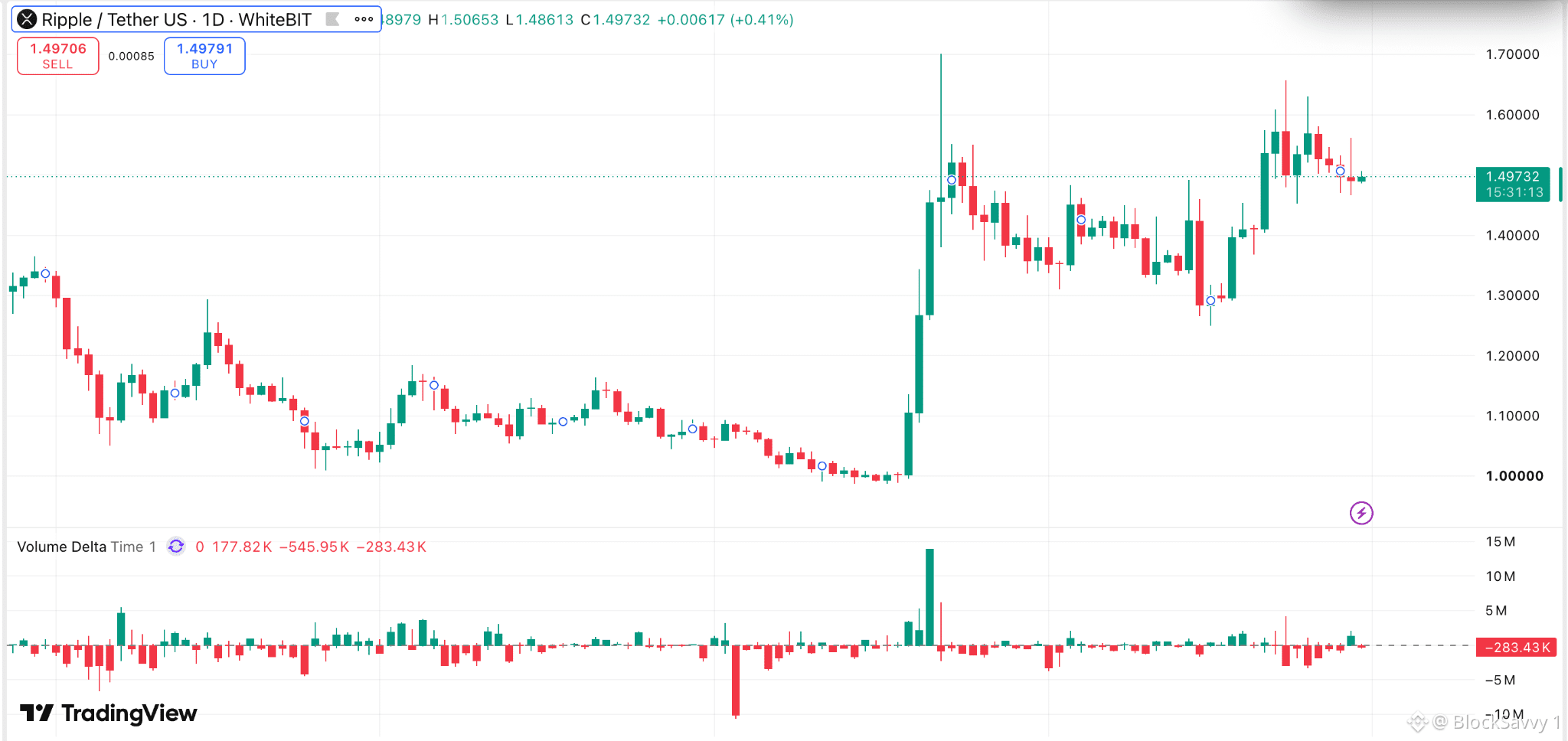
$XRP Is Back Around $1.50. Can It Stay There This Time? $XRP has had a pretty good recovery from the $1 area, but getting above $1.50 and staying there are two different things. The latest push reached roughly $1.60 before pulling back. Now it’s hovering just under $1.50, with neither side making much progress. Аfter that first sharp jump from around $1, XRP eventually slipped back toward $1.30, then recovered again. Buyers have been showing up on the dips, although those repeated pullbacks from the $1.55–$1.60 area suggest there’s still selling to work through. I’ve been using the quieter stretches to look through the rest of my TradingView watchlist too. WhiteBIT TradFi pairs are available there now, so a quick XRP check sometimes turns into checking a few stock setups as well 😅 Easy to spend longer on there than planned. For XRP, I’d like to see a few daily closes above $1.50 before getting too excited about another move higher. A brief push through it wouldn’t tell us much on its own. How price behaves afterward is what I’m watching. #Macro Insights# #Altcoin Season#
$XRP Is Back Around $1.50. Can It Stay There This Time? $XRP has had a pretty good recovery from the $1 area, but getting above $1.50 and staying there are two different things. The latest push reached roughly $1.60 before pulling back. Now it’s hovering just under $1.50, with neither side making much progress. Аfter that first sharp jump from around $1, XRP eventually slipped back toward $1.30, then recovered again. Buyers have been showing up on the dips, although those repeated pullbacks from the $1.55–$1.60 area suggest there’s still selling to work through. I’ve been using the quieter stretches to look through the rest of my TradingView watchlist too. WhiteBIT TradFi pairs are available there now, so a quick XRP check sometimes turns into checking a few stock setups as well 😅 Easy to spend longer on there than planned. For XRP, I’d like to see a few daily closes above $1.50 before getting too excited about another move higher. A brief push through it wouldn’t tell us much on its own. How price behaves afterward is what I’m watching. #Macro Insights# #Altcoin Season#
48
·
--
Tərcüməyə bax
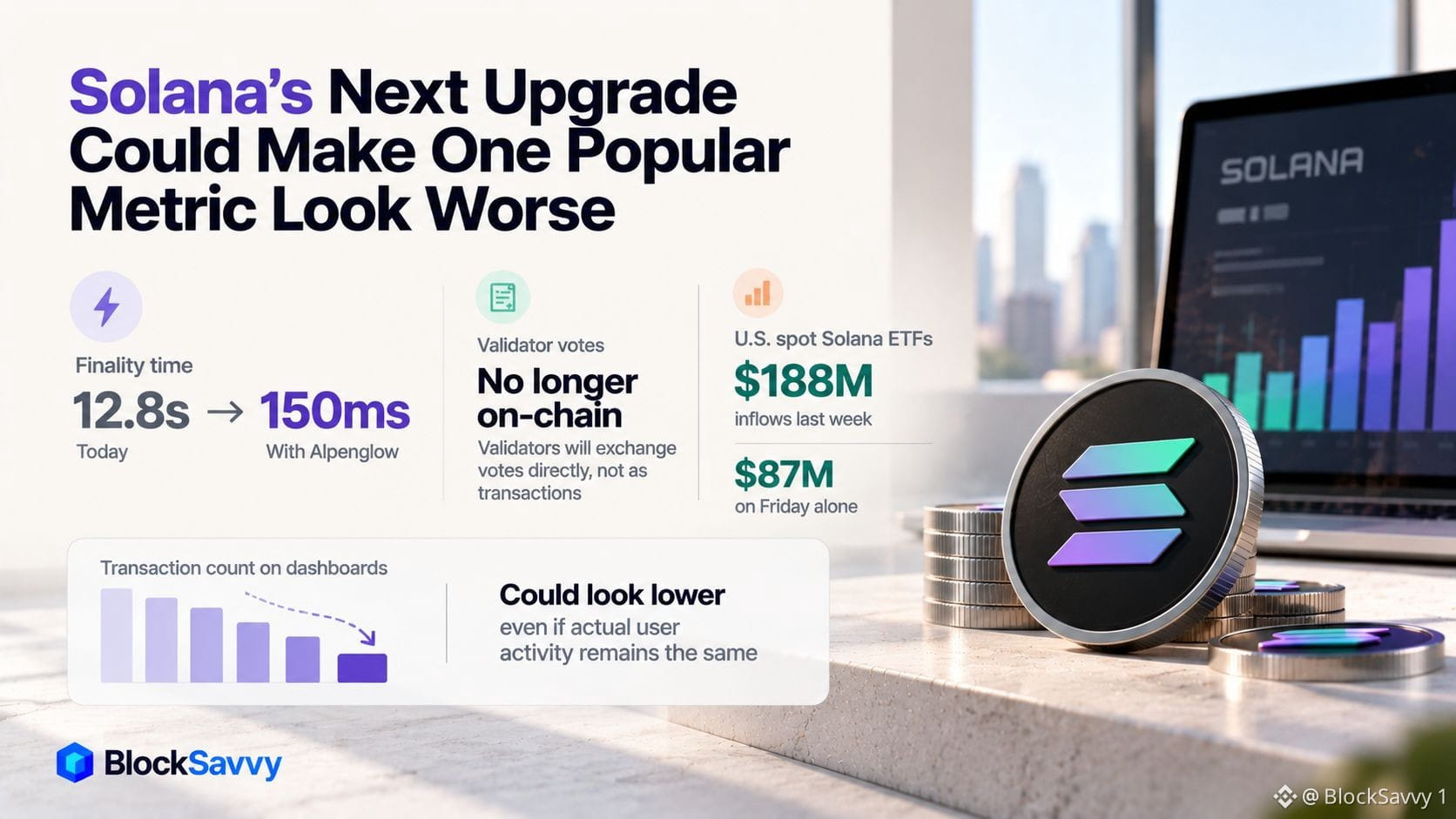
Solana’s Next Upgrade Could Make One Popular Metric Look Worse $SOL ’s Alpenglow upgrade has now reached both of Solana’s public testing networks, with developers targeting finality of roughly 150 milliseconds, down from about 12.8 seconds today. That’s the headline number, but there’s a less obvious change underneath it. Alpenglow changes how validators communicate their votes. Those votes currently appear as transactions inside Solana blocks. Under the new system, validators exchange them directly instead. So once Alpenglow eventually reaches mainnet, some dashboards could suddenly show fewer Solana transactions even if actual user activity hasn’t fallen at all. The Solana Foundation has already warned data providers that comparisons will need adjusting. Meanwhile, institutional interest has been moving the other way. U.S. spot Solana ETFs just recorded their biggest week yet, taking in $188M, including a record $87M on Friday alone. Bitwise’s BSOL accounted for about $128M of the weekly total. That creates a slightly weird setup: Solana could become substantially faster while one of the metrics people use to judge its activity moves lower. A good reminder that with blockchains, sometimes the methodology changes before the market narrative catches up. #Macro Insights# #Altcoin Season#
Solana’s Next Upgrade Could Make One Popular Metric Look Worse $SOL ’s Alpenglow upgrade has now reached both of Solana’s public testing networks, with developers targeting finality of roughly 150 milliseconds, down from about 12.8 seconds today. That’s the headline number, but there’s a less obvious change underneath it. Alpenglow changes how validators communicate their votes. Those votes currently appear as transactions inside Solana blocks. Under the new system, validators exchange them directly instead. So once Alpenglow eventually reaches mainnet, some dashboards could suddenly show fewer Solana transactions even if actual user activity hasn’t fallen at all. The Solana Foundation has already warned data providers that comparisons will need adjusting. Meanwhile, institutional interest has been moving the other way. U.S. spot Solana ETFs just recorded their biggest week yet, taking in $188M, including a record $87M on Friday alone. Bitwise’s BSOL accounted for about $128M of the weekly total. That creates a slightly weird setup: Solana could become substantially faster while one of the metrics people use to judge its activity moves lower. A good reminder that with blockchains, sometimes the methodology changes before the market narrative catches up. #Macro Insights# #Altcoin Season#
51
·
--
Tərcüməyə bax
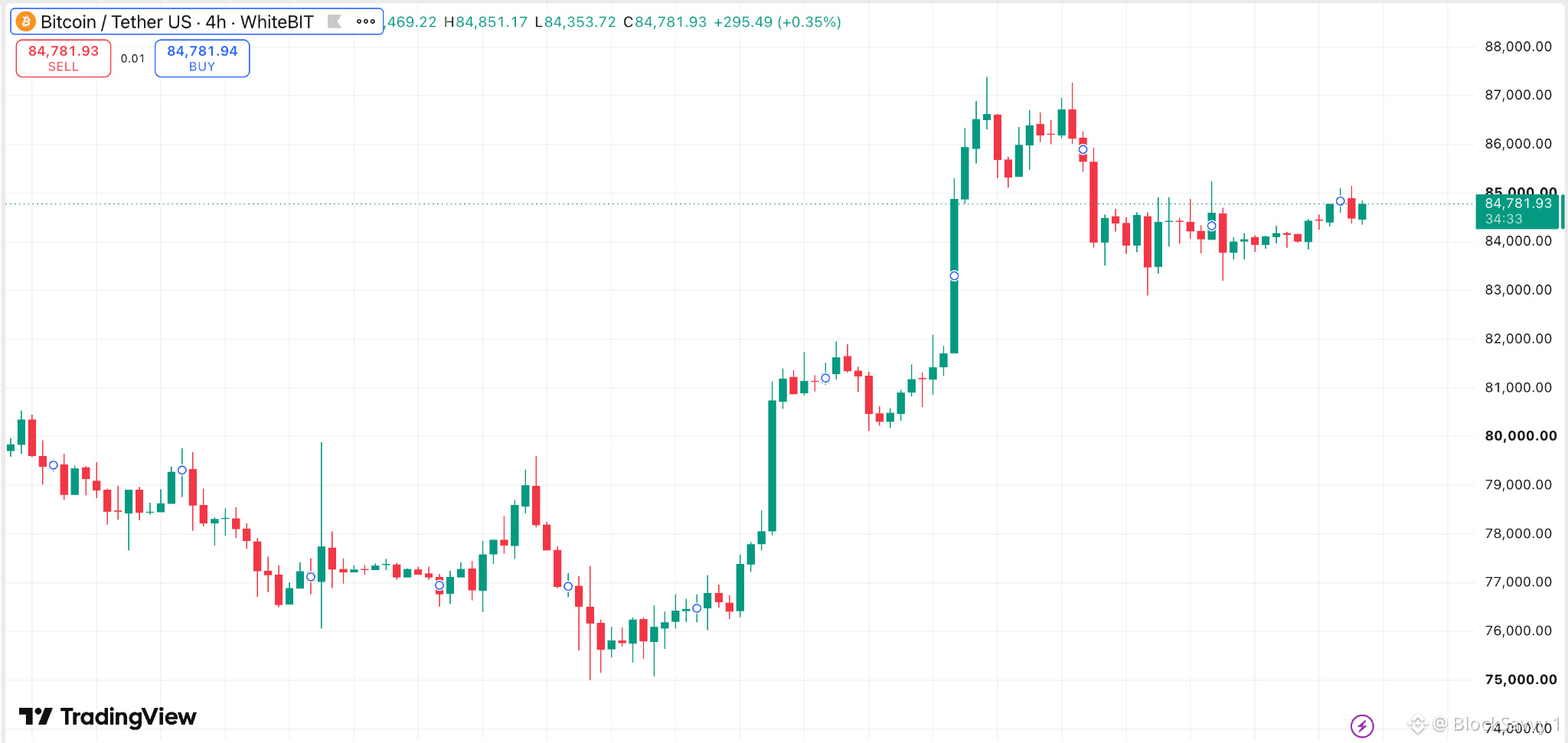
Bitcoin Is Doing Something Traders Usually Hate: Nothing After the move from roughly $75K to above $87K, $BTC has spent the last few days hanging around the $84K-$85K area. The 4-hour chart captures it pretty well: a sharp repricing higher, a pullback, and then a surprisingly tight cluster of candles rather than an immediate continuation or reversal. The timing is useful context. Treasury yields recently jumped to their highest levels since 2007 and expectations for further Fed hikes increased, both of which put pressure on risk assets. Bitcoin briefly slipped toward $83K, but buyers pulled it back into the mid-$84Ks. That’s why I’ve been checking the wider market alongside this range on TradingView. With WhiteBIT TradFi available there too, it’s easier to keep the traditional market setups beside $BTC and see whether they start moving together again. At the same time, holders are taking profits. On-chain realized profit data shows selling after BTC’s strong quarter, but the pace has been considerably slower than around previous major market peaks. So the boring part of this chart might actually be the part worth watching. $BTC absorbed a fast rally, profit-taking and a tougher rates backdrop without immediately giving the breakout back. Now I’d be watching whether this range becomes a base for another attempt higher, or simply the place where buyers finally run out of patience. #BTC Price Analysis# #Bitcoin Price Prediction: What is Bitcoins next move?#
Bitcoin Is Doing Something Traders Usually Hate: Nothing After the move from roughly $75K to above $87K, $BTC has spent the last few days hanging around the $84K-$85K area. The 4-hour chart captures it pretty well: a sharp repricing higher, a pullback, and then a surprisingly tight cluster of candles rather than an immediate continuation or reversal. The timing is useful context. Treasury yields recently jumped to their highest levels since 2007 and expectations for further Fed hikes increased, both of which put pressure on risk assets. Bitcoin briefly slipped toward $83K, but buyers pulled it back into the mid-$84Ks. That’s why I’ve been checking the wider market alongside this range on TradingView. With WhiteBIT TradFi available there too, it’s easier to keep the traditional market setups beside $BTC and see whether they start moving together again. At the same time, holders are taking profits. On-chain realized profit data shows selling after BTC’s strong quarter, but the pace has been considerably slower than around previous major market peaks. So the boring part of this chart might actually be the part worth watching. $BTC absorbed a fast rally, profit-taking and a tougher rates backdrop without immediately giving the breakout back. Now I’d be watching whether this range becomes a base for another attempt higher, or simply the place where buyers finally run out of patience. #BTC Price Analysis# #Bitcoin Price Prediction: What is Bitcoins next move?#
58
·
--
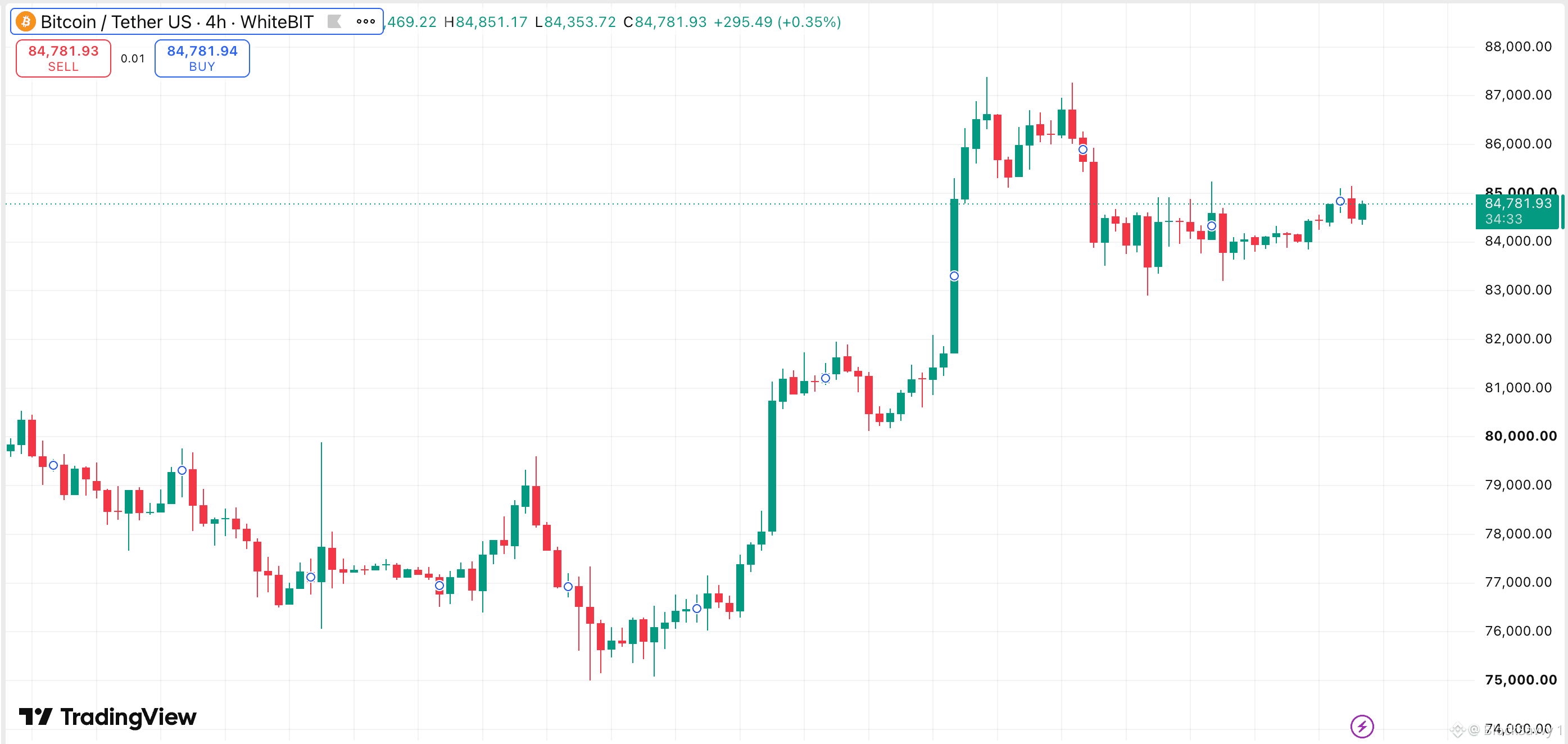
Bitcoin Treyderlərin Əksəriyyətinin Adətən Nifrət Etdiyi Bir Şeyi Edir: Heç Nə Təxminən $75K-dan $87K-dan yuxarıya doğru hərəkətdən sonra $BTC son bir neçə gündür $84K–$85K aralığında dolaşıb: kəskin şəkildə daha yüksək qiymətə yenidən qiymətləndirmə, ardınca geri çəkilmə və sonra dərhal davam etmə və ya tərsinə dönüş əvəzinə gözlənilmədən sıx şamlar klasteri. Vaxtlama kontekst üçün önəmlidir. Xəzinə istiqrazlarının gəlirliliyi son vaxtlar 2007-ci ildən bəri ən yüksək səviyyələrə sıçradı və əlavə Fed yüksəlişləri gözləntiləri artdı; bunların hər ikisi risk aktivlərinə təzyiq göstərdi. Bitcoin qısa müddətə $83K-ya yaxınlaşdı, amma alıcılar onu yenidən $84K-ların ortasına çəkdi. Eyni zamanda, sahibkarlar mənfəət götürür. On-çeyn reallaşdırılmış mənfəət məlumatları BTC-nin güclü rübündən sonra satışın olduğunu göstərir, amma temp əvvəlki böyük bazar pikləri ilə müqayisədə xeyli yavaşdır. Deməli, bu chart-dakı “darıxdırıcı” hissə bəlkə də izləməyə dəyər hissədir. $BTC sürətli yüksəlişi, mənfəət götürməni və daha sərt faiz dərəcələri fonunu dərhal qırılmanı geri qaytarmadan uddu. İndi bu aralığın başqa bir yüksəliş cəhdi üçün baza olub-olmadığını, yoxsa alıcıların nəhayət səbirinin tükənəcəyi yer olub-olmadığını izləmək üçün yaxşı vaxtdır. #BTC Qiymət Analizi# #Bitcoin Qiymət Proqnozu: Bitkoinin növbəti hərəkəti nə olacaq?#
Bitcoin Treyderlərin Əksəriyyətinin Adətən Nifrət Etdiyi Bir Şeyi Edir: Heç Nə Təxminən $75K-dan $87K-dan yuxarıya doğru hərəkətdən sonra $BTC son bir neçə gündür $84K–$85K aralığında dolaşıb: kəskin şəkildə daha yüksək qiymətə yenidən qiymətləndirmə, ardınca geri çəkilmə və sonra dərhal davam etmə və ya tərsinə dönüş əvəzinə gözlənilmədən sıx şamlar klasteri. Vaxtlama kontekst üçün önəmlidir. Xəzinə istiqrazlarının gəlirliliyi son vaxtlar 2007-ci ildən bəri ən yüksək səviyyələrə sıçradı və əlavə Fed yüksəlişləri gözləntiləri artdı; bunların hər ikisi risk aktivlərinə təzyiq göstərdi. Bitcoin qısa müddətə $83K-ya yaxınlaşdı, amma alıcılar onu yenidən $84K-ların ortasına çəkdi. Eyni zamanda, sahibkarlar mənfəət götürür. On-çeyn reallaşdırılmış mənfəət məlumatları BTC-nin güclü rübündən sonra satışın olduğunu göstərir, amma temp əvvəlki böyük bazar pikləri ilə müqayisədə xeyli yavaşdır. Deməli, bu chart-dakı “darıxdırıcı” hissə bəlkə də izləməyə dəyər hissədir. $BTC sürətli yüksəlişi, mənfəət götürməni və daha sərt faiz dərəcələri fonunu dərhal qırılmanı geri qaytarmadan uddu. İndi bu aralığın başqa bir yüksəliş cəhdi üçün baza olub-olmadığını, yoxsa alıcıların nəhayət səbirinin tükənəcəyi yer olub-olmadığını izləmək üçün yaxşı vaxtdır. #BTC Qiymət Analizi# #Bitcoin Qiymət Proqnozu: Bitkoinin növbəti hərəkəti nə olacaq?#
67
·
--
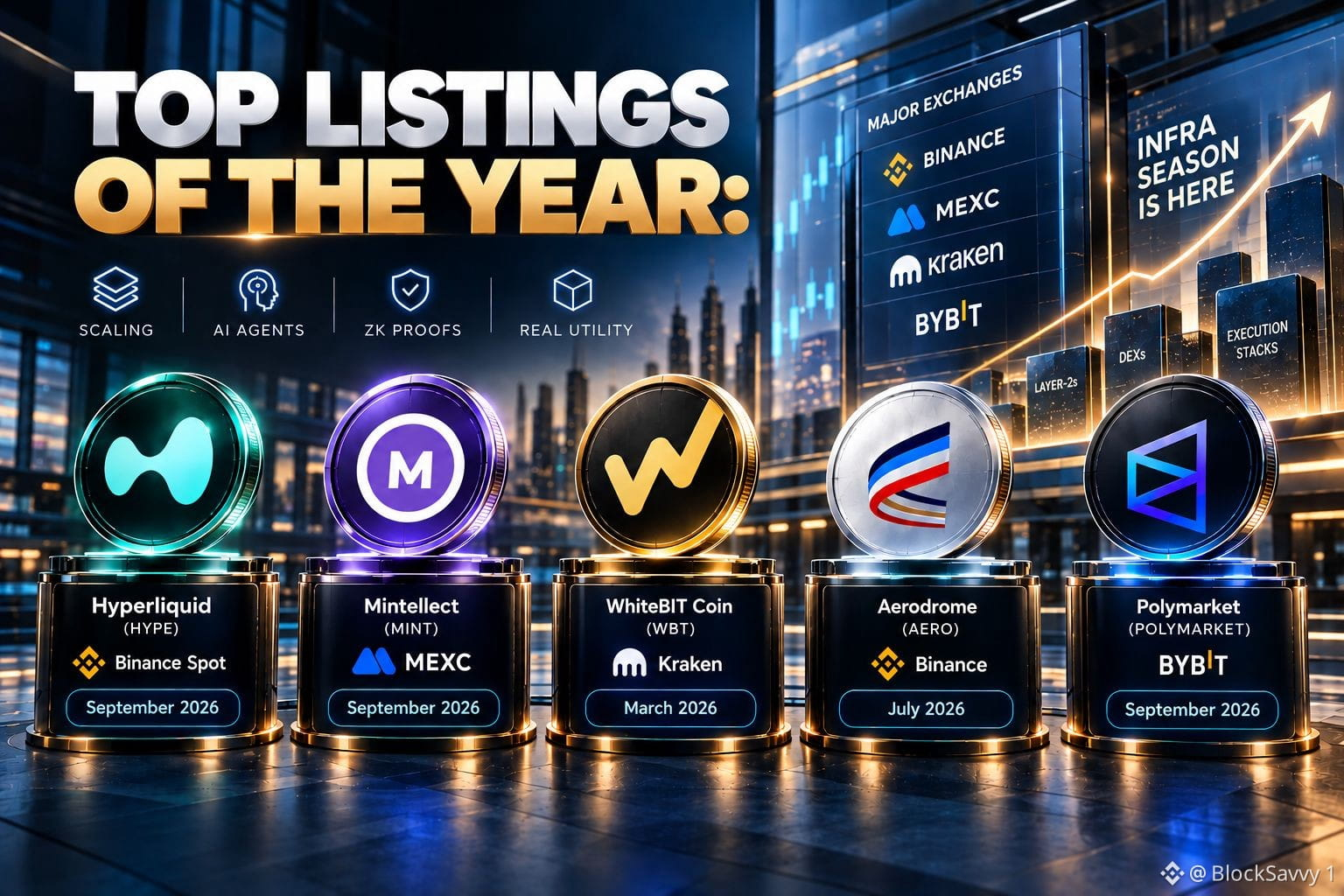
🎯 İlin Ən Yaxşı Siyahılarının Tam Təhlili: Niyə İnfrastruktur Mövsümü Rəsmi Başlayıb Bazarın içinə bir az qazdım və bunu gördüm: böyük birjalar memecoinləri qovmaqdan əl çəkib daha ciddi işlərə fokuslanır. 🤔 Bu il infrastruktur tokenləri böyük birjalara çıxış əldə edir və bunun heç bir səbəbsiz olmadığını başa düşdüm. Ona görə də ilin ən yaxşı listinglərini özümün siyahım kimi yığmağa qərar verdim (sadəcə iki qəpik fikrim). S&P indeksinə daxilolma, ICE investisiyaları və protokol birləşmələri kimi institusional siqnallara baxdım. 📊 Bunların hamısını bir yerə yığanda mənim “infra season” dediyim şey alınır. Pul həqiqətən də real mexanikası olan, möhkəm protokolları olan və arxasında institusional etibar dayanan layihələrə axır. İLİN ƏN YAXŞI LİSTİNGLƏRİ (mənim fikrimcə): 🔹 Hyperliquid (HYPE) Binance Spot | Sentyabr 2026 🔹 Mintellect (MINT) MEXC | Sentyabr 2026 🔹 WhiteBIT Coin ( $WBT) Kraken | Mart 2026 🔹 Aerodrome (AERO) Binance | İyul 2026 🔹 Polymarket (POLYMARKET) Bybit | Sentyabr 2026 (Pre-market) Birjalar real problemləri həll edən tokenləri siyahıya salır. Skalinq, AI agentlər, ZK proof-lar — bu, sadəcə növbəti $BTC klonları deyil. BTC-yerli ekosistem xeyli böyüyüb, amma böyümə üçün infrastruktur lazımdır. Layer-2-lər, desentralizə olunmuş birjalar və yeni icra (execution) stack-lər — real pulun getdiyi yer buradır. Görünür, infra season artıq buradadır. Alətləri kim idarə edirsə, gücü də o idarə edir. 🚀 Məlumatlılıq (Disclaimer): Bu, maliyyə və ya investisiya məsləhəti deyil. Qərar verməzdən əvvəl DYOR edin. Öz məsuliyyətinizlə istifadə edin. #BTC Price Analysis# #Bitcoin Price Prediction: What is Bitcoins next move?# #Altcoin Season#
🎯 İlin Ən Yaxşı Siyahılarının Tam Təhlili: Niyə İnfrastruktur Mövsümü Rəsmi Başlayıb Bazarın içinə bir az qazdım və bunu gördüm: böyük birjalar memecoinləri qovmaqdan əl çəkib daha ciddi işlərə fokuslanır. 🤔 Bu il infrastruktur tokenləri böyük birjalara çıxış əldə edir və bunun heç bir səbəbsiz olmadığını başa düşdüm. Ona görə də ilin ən yaxşı listinglərini özümün siyahım kimi yığmağa qərar verdim (sadəcə iki qəpik fikrim). S&P indeksinə daxilolma, ICE investisiyaları və protokol birləşmələri kimi institusional siqnallara baxdım. 📊 Bunların hamısını bir yerə yığanda mənim “infra season” dediyim şey alınır. Pul həqiqətən də real mexanikası olan, möhkəm protokolları olan və arxasında institusional etibar dayanan layihələrə axır. İLİN ƏN YAXŞI LİSTİNGLƏRİ (mənim fikrimcə): 🔹 Hyperliquid (HYPE) Binance Spot | Sentyabr 2026 🔹 Mintellect (MINT) MEXC | Sentyabr 2026 🔹 WhiteBIT Coin ( $WBT) Kraken | Mart 2026 🔹 Aerodrome (AERO) Binance | İyul 2026 🔹 Polymarket (POLYMARKET) Bybit | Sentyabr 2026 (Pre-market) Birjalar real problemləri həll edən tokenləri siyahıya salır. Skalinq, AI agentlər, ZK proof-lar — bu, sadəcə növbəti $BTC klonları deyil. BTC-yerli ekosistem xeyli böyüyüb, amma böyümə üçün infrastruktur lazımdır. Layer-2-lər, desentralizə olunmuş birjalar və yeni icra (execution) stack-lər — real pulun getdiyi yer buradır. Görünür, infra season artıq buradadır. Alətləri kim idarə edirsə, gücü də o idarə edir. 🚀 Məlumatlılıq (Disclaimer): Bu, maliyyə və ya investisiya məsləhəti deyil. Qərar verməzdən əvvəl DYOR edin. Öz məsuliyyətinizlə istifadə edin. #BTC Price Analysis# #Bitcoin Price Prediction: What is Bitcoins next move?# #Altcoin Season#
73
·
--
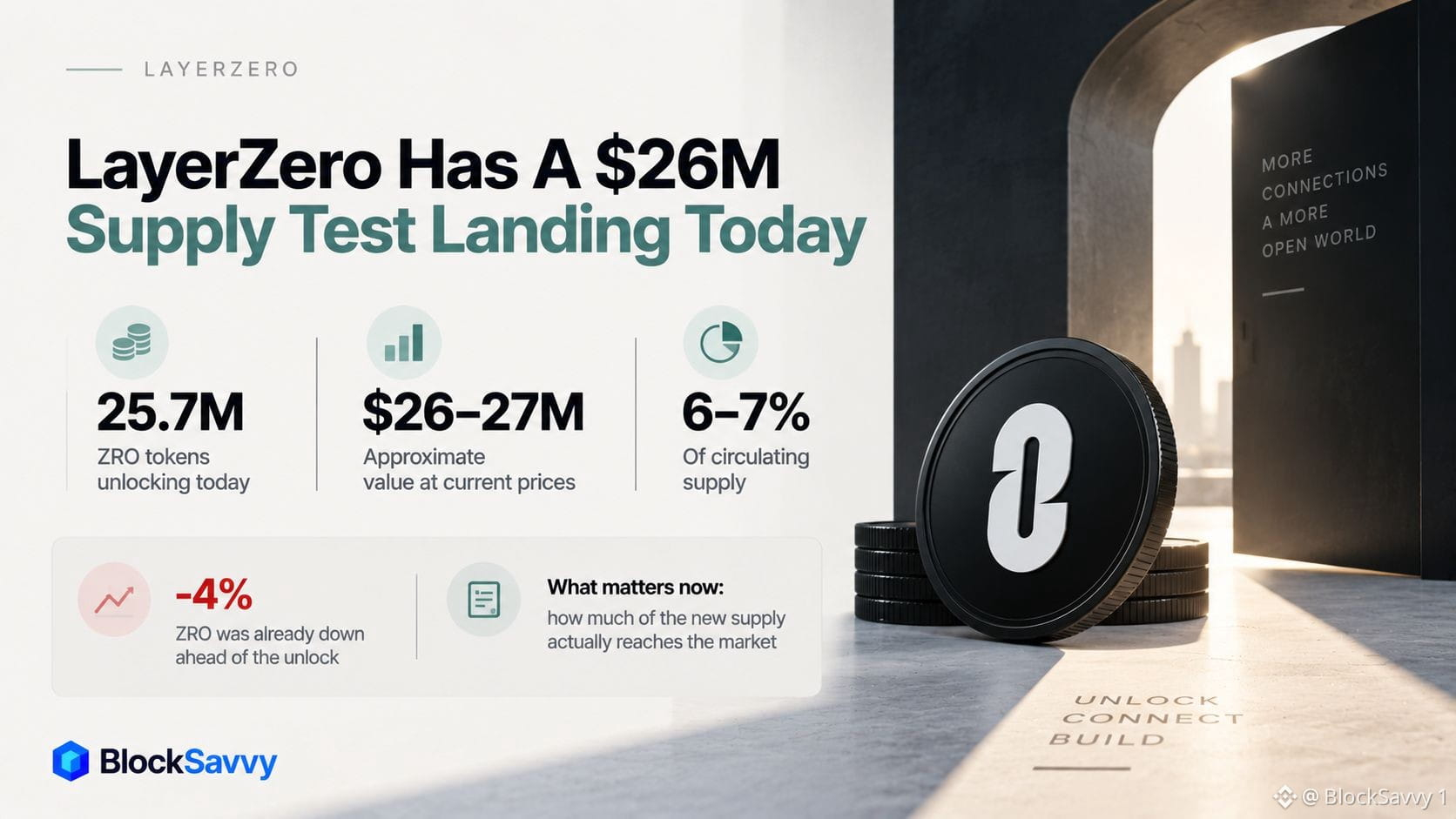
LayerZero-nun $26M Təchizat Test Enişi Oldu $ZRO tokenomikanın çox görünən bir hissəsi ilə bağlıdır: təxminən 25,7 milyon token, təxminən $26–27 milyon dəyərində, açıldı. Mövcud izləyicilərə görə bu açılış dövriyyədə olan təchizatın təxminən 6–7%-ni təşkil edir və bu, tokenin hazırkı “floating” həcmi ilə müqayisədə qeyri-adi dərəcədə böyükdür. ZRO isə artıq təxminən 4% düşmüşdü; yaxınlaşan açılış ticarətçilərin izlədiyi əsas təchizat həddindən artıq təzyiq (supply overhang) parçalarından biri kimi göstərilirdi. Bunun fonunda müşayiət olunan bir hack, delistinq və ya açıq-aydın layihəyə məxsus şok yox idi. Açılışları maraqlı edən odur ki, başlıq rəqəmi sizə nəyin həqiqətən satışa çıxarılacağını demir. Bu buraxılışlar plan üzrə idi, hamı onları görürdü. Ticarətçilər əvvəlcədən hec edə bilərdi, sahiblər isə satmamağı seçə bilərdi və yeni təchizatın bir hissəsi heç bir zaman birjaya çata bilməz. Buna görə də izləniləcək “daha düzgün” məsələ açılışın özündən çox, ondan sonrakı idi. Yəni bu 25,7M ZRO-nun həqiqətən likvid bazar təchizatı olub-olmaması və birja balansları ilə satış aktivliyinin onlarla birlikdə hərəkət edib-etməməsidir. #Macro Insights# #Altcoin Season#
LayerZero-nun $26M Təchizat Test Enişi Oldu $ZRO tokenomikanın çox görünən bir hissəsi ilə bağlıdır: təxminən 25,7 milyon token, təxminən $26–27 milyon dəyərində, açıldı. Mövcud izləyicilərə görə bu açılış dövriyyədə olan təchizatın təxminən 6–7%-ni təşkil edir və bu, tokenin hazırkı “floating” həcmi ilə müqayisədə qeyri-adi dərəcədə böyükdür. ZRO isə artıq təxminən 4% düşmüşdü; yaxınlaşan açılış ticarətçilərin izlədiyi əsas təchizat həddindən artıq təzyiq (supply overhang) parçalarından biri kimi göstərilirdi. Bunun fonunda müşayiət olunan bir hack, delistinq və ya açıq-aydın layihəyə məxsus şok yox idi. Açılışları maraqlı edən odur ki, başlıq rəqəmi sizə nəyin həqiqətən satışa çıxarılacağını demir. Bu buraxılışlar plan üzrə idi, hamı onları görürdü. Ticarətçilər əvvəlcədən hec edə bilərdi, sahiblər isə satmamağı seçə bilərdi və yeni təchizatın bir hissəsi heç bir zaman birjaya çata bilməz. Buna görə də izləniləcək “daha düzgün” məsələ açılışın özündən çox, ondan sonrakı idi. Yəni bu 25,7M ZRO-nun həqiqətən likvid bazar təchizatı olub-olmaması və birja balansları ilə satış aktivliyinin onlarla birlikdə hərəkət edib-etməməsidir. #Macro Insights# #Altcoin Season#
171
·
--
Tərcüməyə bax
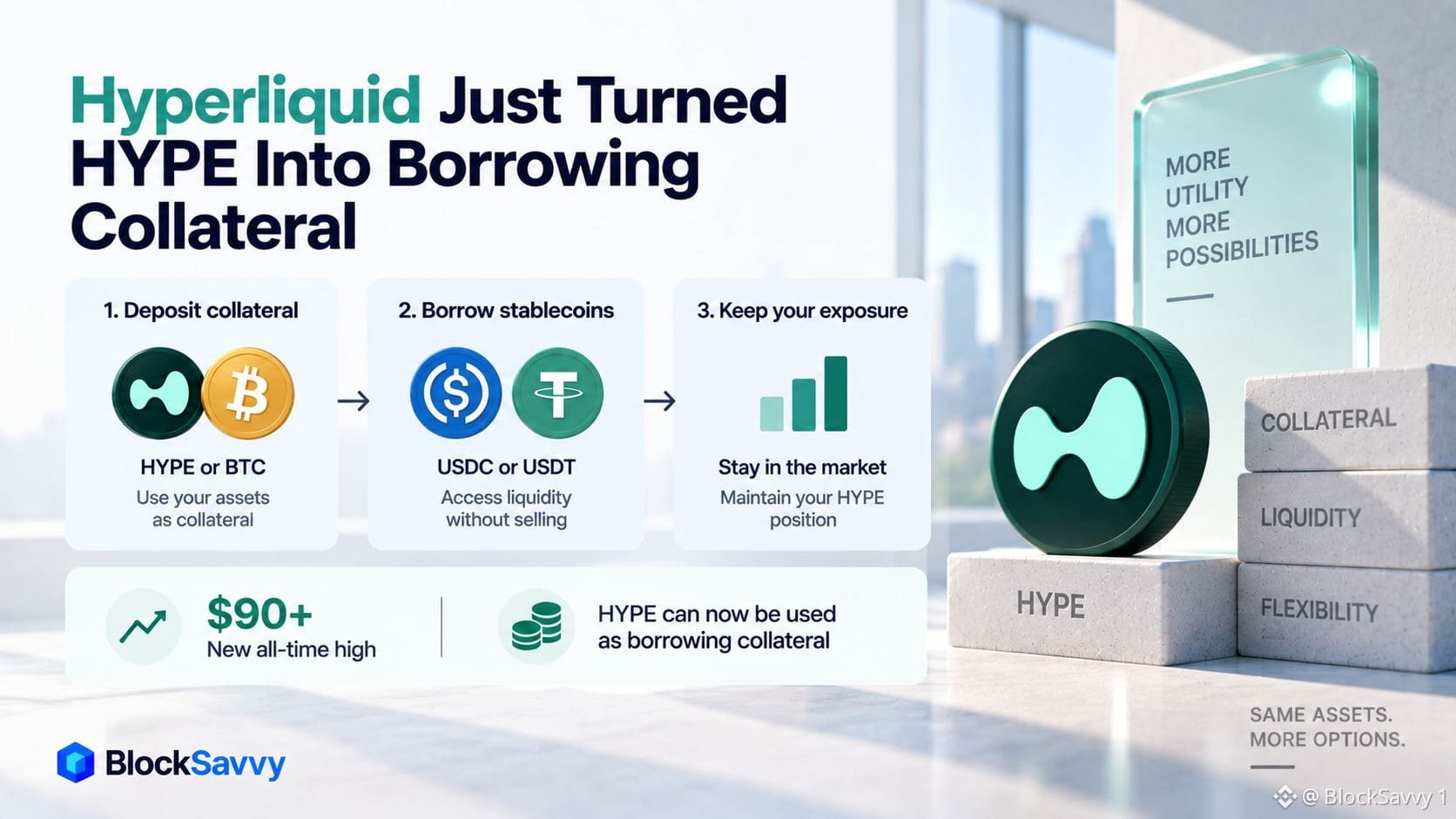
Hyperliquid Just Turned HYPE Into Borrowing Collateral Hyperliquid added manual borrowing, letting users post assets including $HYPE and $BTC as collateral and borrow stablecoins such as USDC and USDT. The launch landed just as HYPE pushed above $90 to a new all-time high. The interesting bit isn’t the new ATH. It’s what happens to HYPE when it becomes productive collateral. A holder no longer necessarily has to sell HYPE to free up dollar liquidity. They can keep the exposure, lock the token as collateral and borrow stablecoins against it instead. That creates another source of demand for the token that has little to do with directional trading. But there’s a second side to that trade. Once an asset becomes widely usable as collateral, its price starts affecting more than portfolios. A sharp HYPE drawdown can now push leveraged borrowers toward liquidation, turning falling collateral values into forced selling. That’s how a token gradually stops being just something people trade and starts becoming part of the plumbing underneath the market. #Macro Insights# #Altcoin Season#
Hyperliquid Just Turned HYPE Into Borrowing Collateral Hyperliquid added manual borrowing, letting users post assets including $HYPE and $BTC as collateral and borrow stablecoins such as USDC and USDT. The launch landed just as HYPE pushed above $90 to a new all-time high. The interesting bit isn’t the new ATH. It’s what happens to HYPE when it becomes productive collateral. A holder no longer necessarily has to sell HYPE to free up dollar liquidity. They can keep the exposure, lock the token as collateral and borrow stablecoins against it instead. That creates another source of demand for the token that has little to do with directional trading. But there’s a second side to that trade. Once an asset becomes widely usable as collateral, its price starts affecting more than portfolios. A sharp HYPE drawdown can now push leveraged borrowers toward liquidation, turning falling collateral values into forced selling. That’s how a token gradually stops being just something people trade and starts becoming part of the plumbing underneath the market. #Macro Insights# #Altcoin Season#
62
·
--
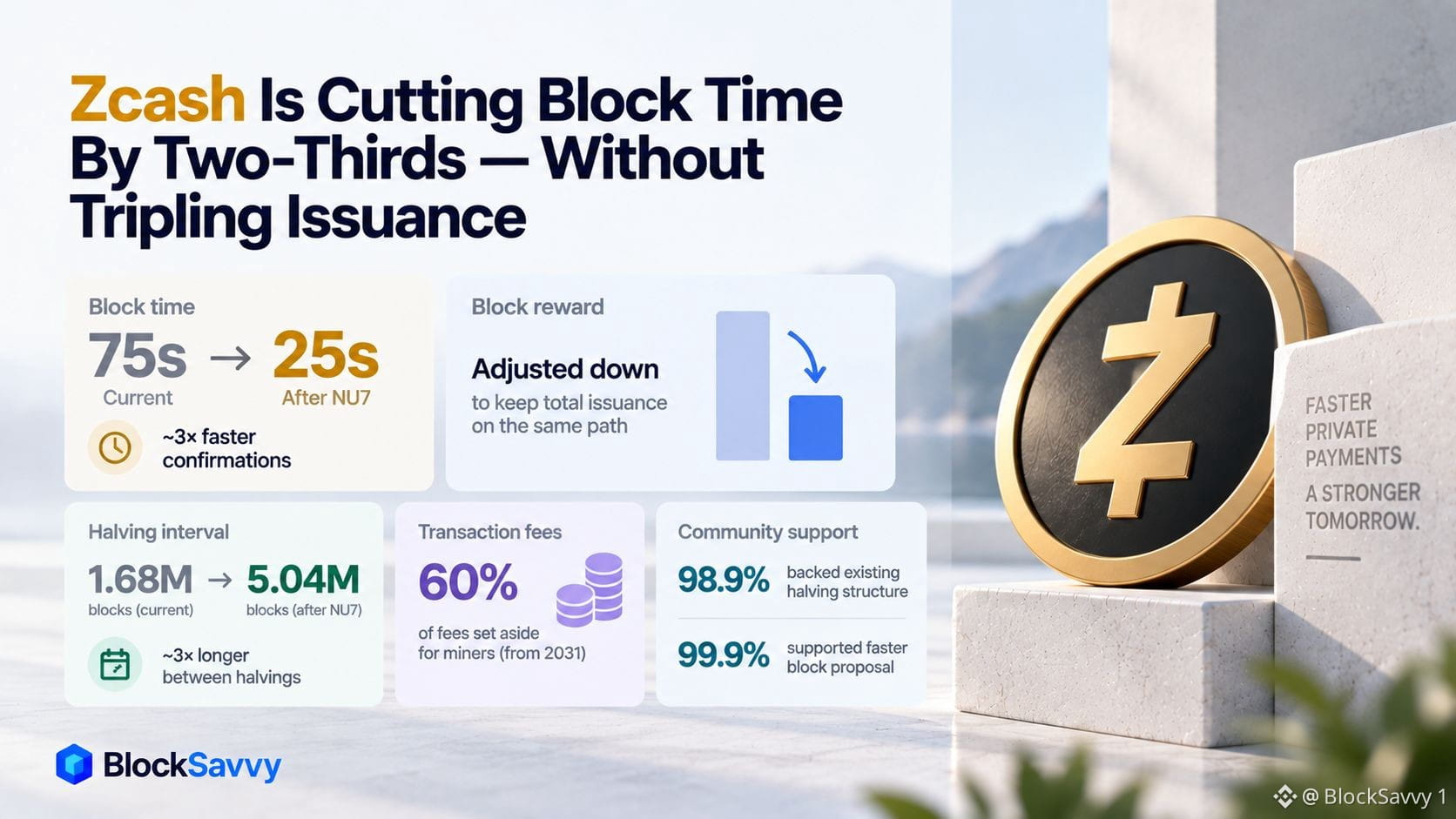
Zcash blok vaxtını üçdəbirədək azaldır—buraxılışı üç dəfə artırmadan $ZEC tərtibatçıları NU7 üçün noyabrın 5-i hədəfləyir; bu yeniləmə Zcash-in blok vaxtını 75 saniyədən 25 saniyəyə endirəcək. Bu da təsdiqlərin təxminən üç dəfə daha tez çatması deməkdir. Maraqlı hissə odur ki, bunu uzunmüddətli buraxılış cədvəlini dəyişmədən edirlər. Bloklar üç dəfə daha tez gəlsəydi, sadəcə blok başına eyni mükafatı saxlamaq yeni təklifi kəskin artırardı. Bunun əvəzinə NU7 blok başına mükafatı təxminən eyni əmsalla azaldır və yarılanma intervalını 1.68M blokdan 5.04M bloka qədər uzadır. Daha çox blok, eyni baza buraxılış yolu. Bu işdə minerlər üçün vacib olan ikinci bir detal da var. Zcash-in yeni davamlılıq mexanizmi çərçivəsində əməliyyat haqqının təxminən 60%-i kənara ayrılmağa başlayacaq; bu vəsaitlər isə 2031-ci ilin fevralından etibarən, adi buraxılış azalaraq davam etdikcə, mədənçilik mükafatlarına geri axacaq. İcmanın səsverməsi də qeyri-adi dərəcədə qətiyyətli idi: mövcud yarılanma strukturunun qorunmasına 98.9% dəstək verdi, ZEC-ə əsaslanan səslərin 99.9%-i isə daha sürətli blok təklifini dəstəklədi. Yəni NU7 eyni anda iki iş görür: indi özəl ödənişləri daha sürətli hiss etdirmək və eyni zamanda şəbəkə təhlükəsizliyinin gələcək illərdə necə ödənəcəyini artıq tənzimləmək. #Macro Insights# #Altcoin Season#
Zcash blok vaxtını üçdəbirədək azaldır—buraxılışı üç dəfə artırmadan $ZEC tərtibatçıları NU7 üçün noyabrın 5-i hədəfləyir; bu yeniləmə Zcash-in blok vaxtını 75 saniyədən 25 saniyəyə endirəcək. Bu da təsdiqlərin təxminən üç dəfə daha tez çatması deməkdir. Maraqlı hissə odur ki, bunu uzunmüddətli buraxılış cədvəlini dəyişmədən edirlər. Bloklar üç dəfə daha tez gəlsəydi, sadəcə blok başına eyni mükafatı saxlamaq yeni təklifi kəskin artırardı. Bunun əvəzinə NU7 blok başına mükafatı təxminən eyni əmsalla azaldır və yarılanma intervalını 1.68M blokdan 5.04M bloka qədər uzadır. Daha çox blok, eyni baza buraxılış yolu. Bu işdə minerlər üçün vacib olan ikinci bir detal da var. Zcash-in yeni davamlılıq mexanizmi çərçivəsində əməliyyat haqqının təxminən 60%-i kənara ayrılmağa başlayacaq; bu vəsaitlər isə 2031-ci ilin fevralından etibarən, adi buraxılış azalaraq davam etdikcə, mədənçilik mükafatlarına geri axacaq. İcmanın səsverməsi də qeyri-adi dərəcədə qətiyyətli idi: mövcud yarılanma strukturunun qorunmasına 98.9% dəstək verdi, ZEC-ə əsaslanan səslərin 99.9%-i isə daha sürətli blok təklifini dəstəklədi. Yəni NU7 eyni anda iki iş görür: indi özəl ödənişləri daha sürətli hiss etdirmək və eyni zamanda şəbəkə təhlükəsizliyinin gələcək illərdə necə ödənəcəyini artıq tənzimləmək. #Macro Insights# #Altcoin Season#
43
·
--
Tərcüməyə bax
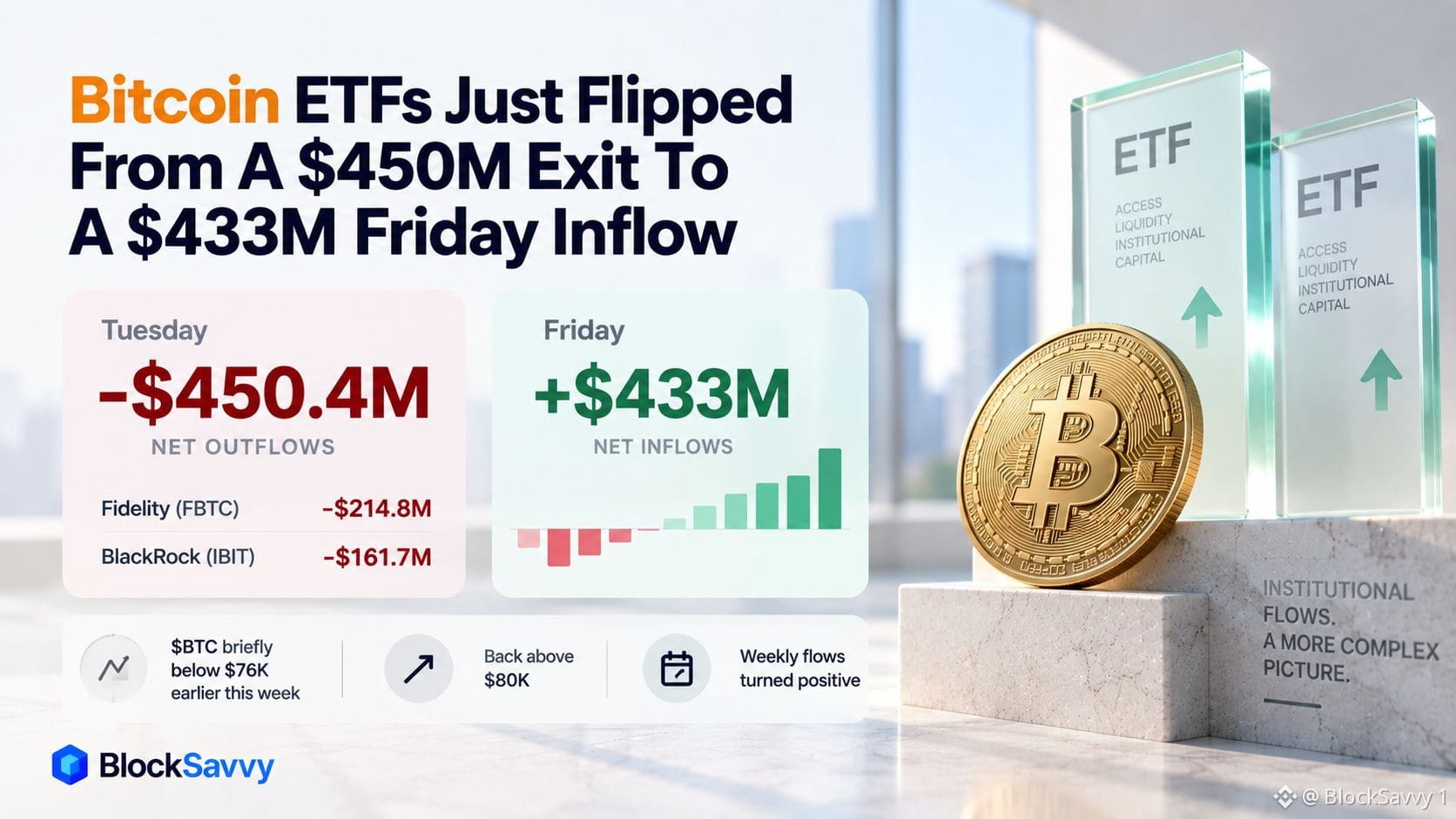
Bitcoin ETFs Just Flipped From A $450M Exit To A $433M Friday Inflow The interesting part of this week’s $BTC ETF data isn’t that money moved in or out. It’s how quickly the direction changed. On Tuesday, U.S. spot Bitcoin ETFs recorded about $450.4M in net outflows, their largest daily withdrawal since late June. Fidelity’s FBTC accounted for roughly $214.8M and BlackRock’s IBIT another $161.7M. By Friday, the picture had reversed. Bitcoin ETFs pulled in roughly $433M in a single day, enough to push the full week back into positive territory. That’s almost a complete round trip in institutional flows within three trading sessions. It also happened while $BTC recovered above $80K after briefly trading below $76K earlier in the week. ETF flows are often treated as a simple demand gauge: green number bullish, red number bearish. This week is a good example of why that can be misleading. The bigger signal may be how quickly ETF capital is now reacting to changes in price, rates and regulatory headlines. A $450M exit no longer necessarily describes the mood even a few sessions later. #BTC Price Analysis# #Bitcoin Price Prediction: What is Bitcoins next move?#
Bitcoin ETFs Just Flipped From A $450M Exit To A $433M Friday Inflow The interesting part of this week’s $BTC ETF data isn’t that money moved in or out. It’s how quickly the direction changed. On Tuesday, U.S. spot Bitcoin ETFs recorded about $450.4M in net outflows, their largest daily withdrawal since late June. Fidelity’s FBTC accounted for roughly $214.8M and BlackRock’s IBIT another $161.7M. By Friday, the picture had reversed. Bitcoin ETFs pulled in roughly $433M in a single day, enough to push the full week back into positive territory. That’s almost a complete round trip in institutional flows within three trading sessions. It also happened while $BTC recovered above $80K after briefly trading below $76K earlier in the week. ETF flows are often treated as a simple demand gauge: green number bullish, red number bearish. This week is a good example of why that can be misleading. The bigger signal may be how quickly ETF capital is now reacting to changes in price, rates and regulatory headlines. A $450M exit no longer necessarily describes the mood even a few sessions later. #BTC Price Analysis# #Bitcoin Price Prediction: What is Bitcoins next move?#
45
·
--
Tərcüməyə bax
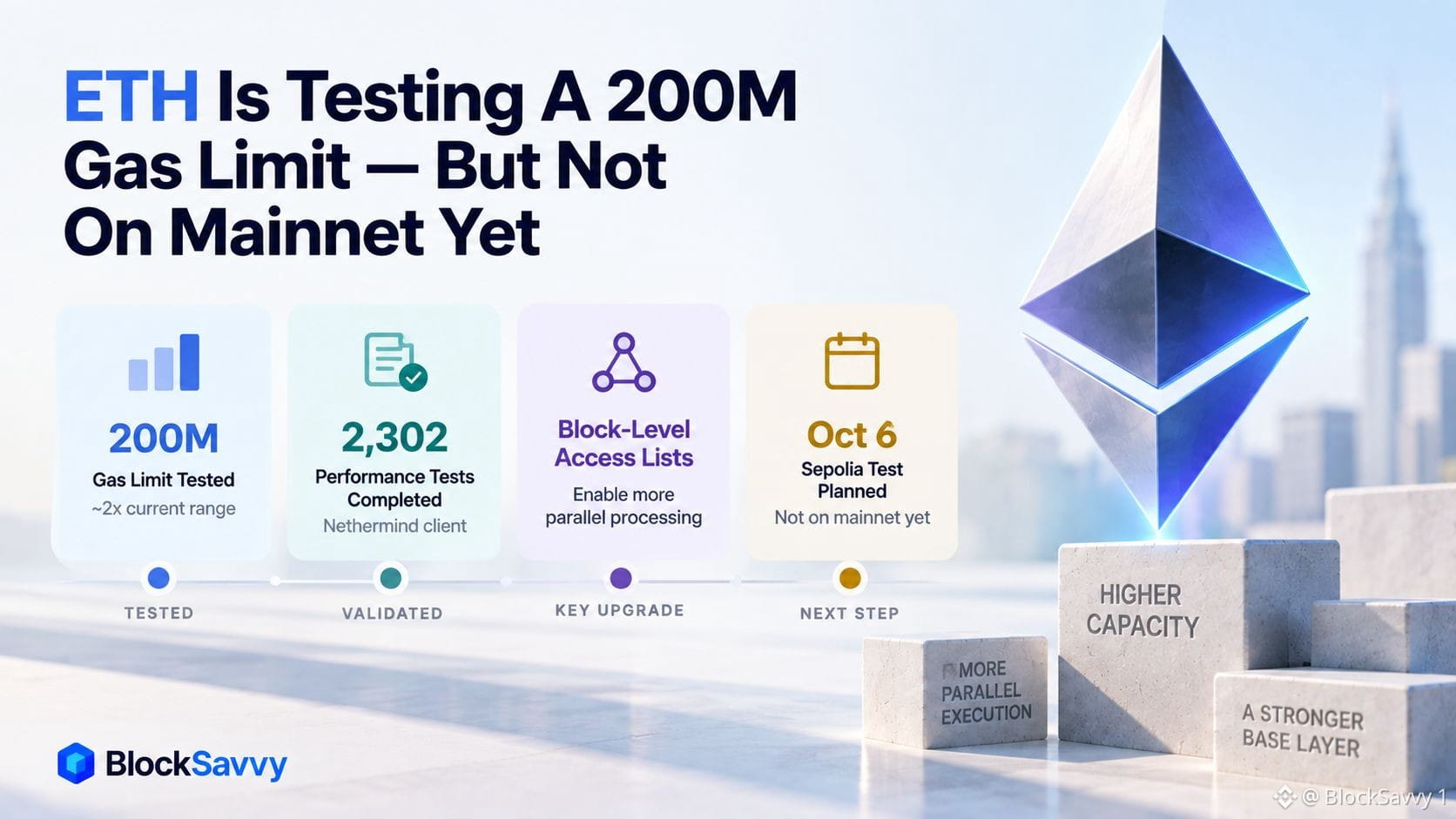
ETH Is Testing A 200M Gas Limit - But Not On Mainnet Yet Ethereum’s next big capacity experiment just cleared an important rehearsal. The upcoming Glamsterdam upgrade has successfully tested blocks at a 200 million gas limit, roughly double the kind of range Ethereum has been operating around recently. The point isn’t simply “more transactions per block.” $ETH developers are testing whether the network can process much heavier blocks without making validation unstable. One of the bigger changes is block-level access lists. Instead of execution staying mostly sequential, transactions can declare which parts of Ethereum’s state they need to touch, making more parallel processing possible. Nethermind says its client completed all 2,302 performance tests for the new setup. That matters because Ethereum’s scaling story has mostly been about pushing activity onto L2s. Glamsterdam is a different kind of scaling: increasing what the base layer itself can safely handle. The 200M setting is still experimental and isn’t currently scheduled to go straight onto mainnet. A proposed Sepolia test is set for October 6 first. So the interesting number here isn’t 200M by itself. It’s how far Ethereum can raise its execution ceiling before validator hardware becomes the bottleneck. #ETHBlockchain #ETHFoundation
ETH Is Testing A 200M Gas Limit - But Not On Mainnet Yet Ethereum’s next big capacity experiment just cleared an important rehearsal. The upcoming Glamsterdam upgrade has successfully tested blocks at a 200 million gas limit, roughly double the kind of range Ethereum has been operating around recently. The point isn’t simply “more transactions per block.” $ETH developers are testing whether the network can process much heavier blocks without making validation unstable. One of the bigger changes is block-level access lists. Instead of execution staying mostly sequential, transactions can declare which parts of Ethereum’s state they need to touch, making more parallel processing possible. Nethermind says its client completed all 2,302 performance tests for the new setup. That matters because Ethereum’s scaling story has mostly been about pushing activity onto L2s. Glamsterdam is a different kind of scaling: increasing what the base layer itself can safely handle. The 200M setting is still experimental and isn’t currently scheduled to go straight onto mainnet. A proposed Sepolia test is set for October 6 first. So the interesting number here isn’t 200M by itself. It’s how far Ethereum can raise its execution ceiling before validator hardware becomes the bottleneck. #ETHBlockchain #ETHFoundation
62
·
--
Tərcüməyə bax
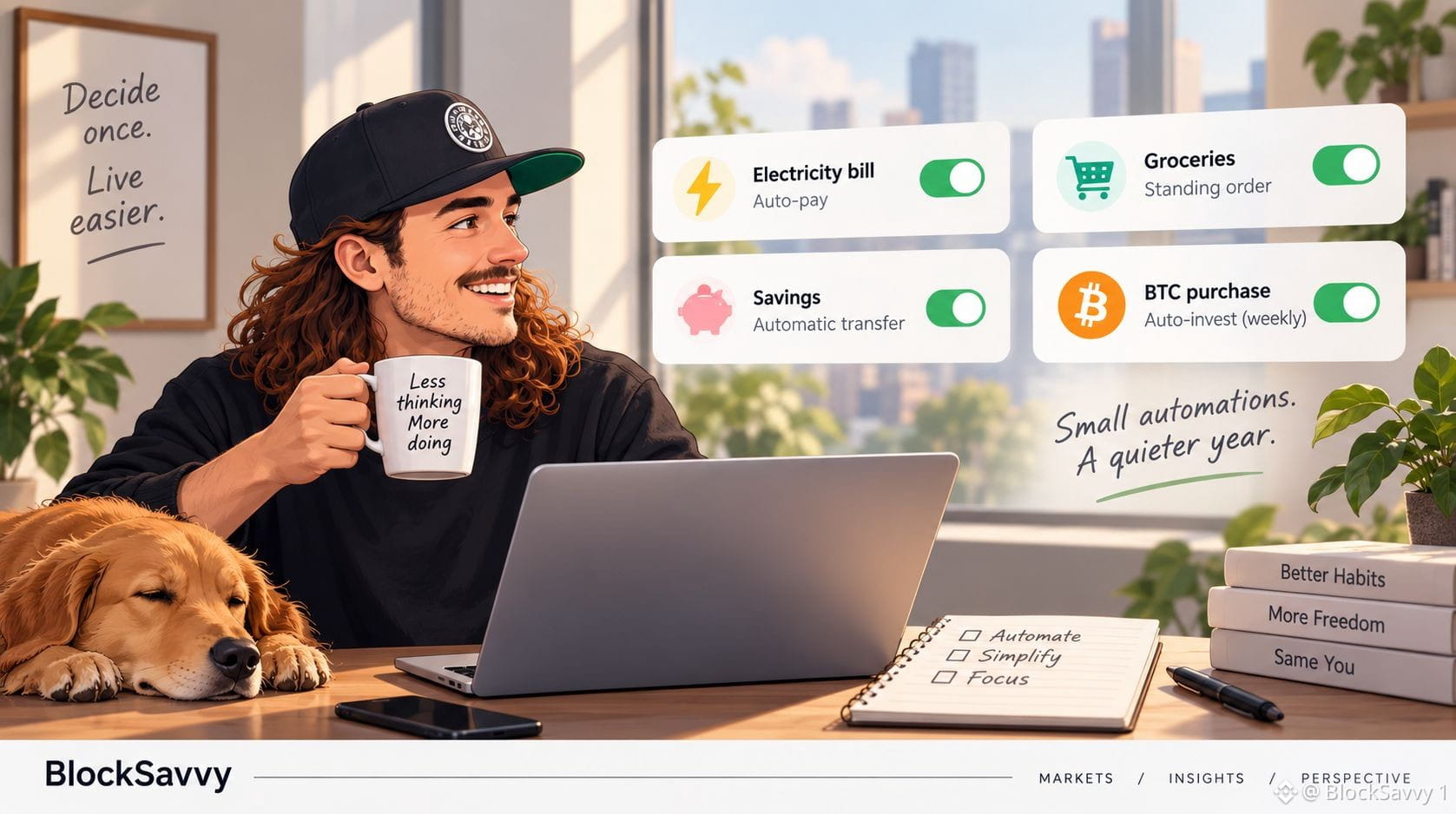
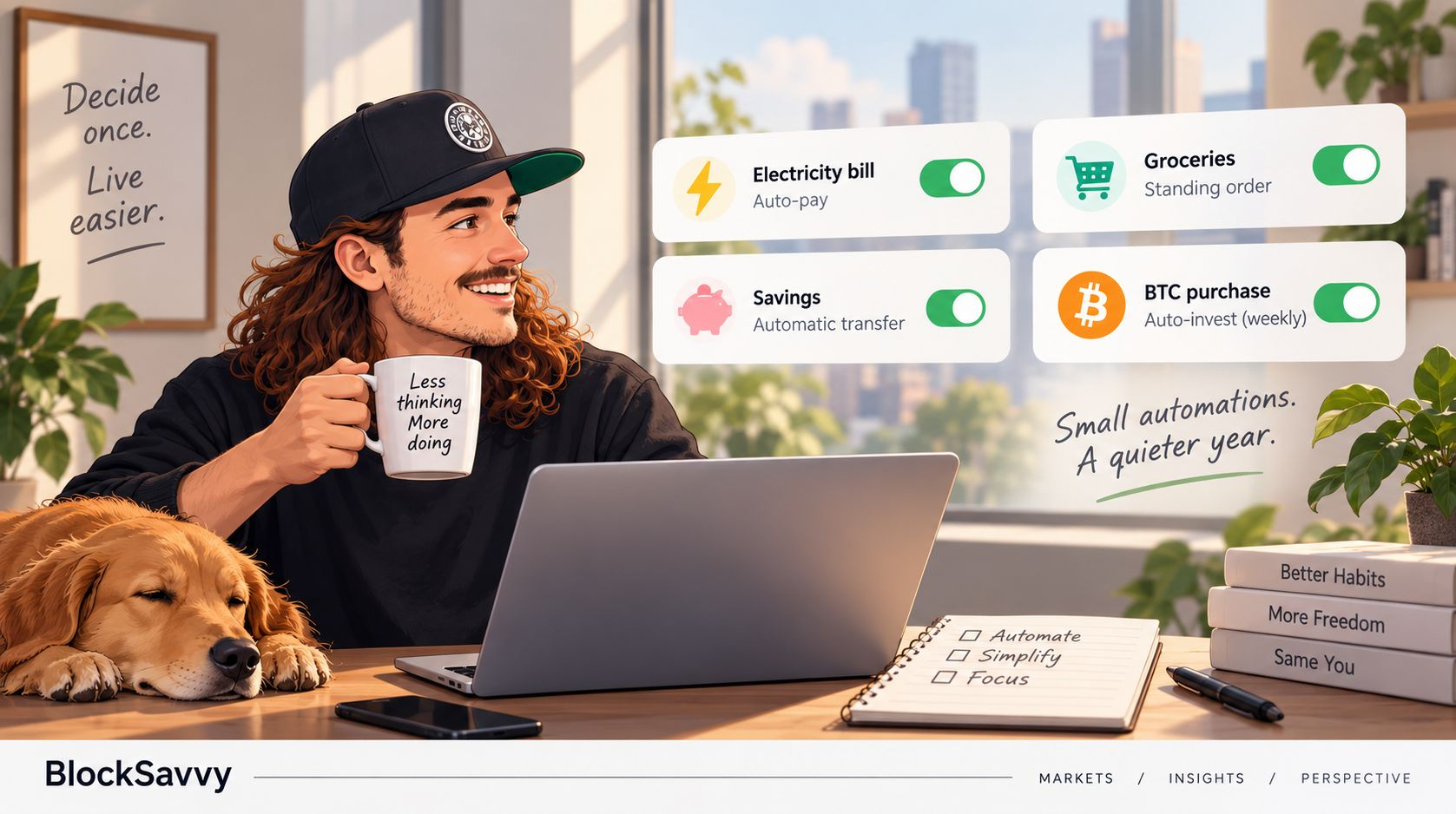
Oat Milk, Savings, and the Same Recurring Question Doing my usual end-of-year list of what actually made this year quieter, and the theme surprised me. You know why? Cause it wasn't the big stuff, it was every small thing I automated, so I'd stop arguing with myself about it on a loop. The electricity bill went on autopay, so I stopped opening the app every month just to grumble and pay it anyway. The grocery staples became a standing order, so I stopped "deciding" to buy oat milk for the fortieth time. A chunk of every paycheck now moves to savings before I can talk myself out of it. And then there was the weekly $BTC buy I kept negotiating with myself over, every single week, should I this week, should I skip it, is now a good entry or a bad one. I set up Auto-Invest on WhiteBIT to just run it weekly with no minimum amount, so I never had to save up before starting. It smooths the buy price out over time through dollar-cost averaging, and I can pause or stop the plan whenever I want, so committing to it never felt like a real decision either. https://bit.ly/3TaCjJT None of these changes saved me much time, but what they actually did was end a recurring internal debate I'd already had a hundred times and kept having again anyway. So that's the theme of my year, apparently: decide once, then stop arguing with myself about it weekly. The crypto buy was just one of the arguments I finally retired. Disclaimer: This is not financial or investment advice. Do your own research before making any decisions. Use at your own risk. #BTC Price Analysis# #Bitcoin Price Prediction: What is Bitcoins next move?#
Oat Milk, Savings, and the Same Recurring Question Doing my usual end-of-year list of what actually made this year quieter, and the theme surprised me. You know why? Cause it wasn't the big stuff, it was every small thing I automated, so I'd stop arguing with myself about it on a loop. The electricity bill went on autopay, so I stopped opening the app every month just to grumble and pay it anyway. The grocery staples became a standing order, so I stopped "deciding" to buy oat milk for the fortieth time. A chunk of every paycheck now moves to savings before I can talk myself out of it. And then there was the weekly $BTC buy I kept negotiating with myself over, every single week, should I this week, should I skip it, is now a good entry or a bad one. I set up Auto-Invest on WhiteBIT to just run it weekly with no minimum amount, so I never had to save up before starting. It smooths the buy price out over time through dollar-cost averaging, and I can pause or stop the plan whenever I want, so committing to it never felt like a real decision either. https://bit.ly/3TaCjJT None of these changes saved me much time, but what they actually did was end a recurring internal debate I'd already had a hundred times and kept having again anyway. So that's the theme of my year, apparently: decide once, then stop arguing with myself about it weekly. The crypto buy was just one of the arguments I finally retired. Disclaimer: This is not financial or investment advice. Do your own research before making any decisions. Use at your own risk. #BTC Price Analysis# #Bitcoin Price Prediction: What is Bitcoins next move?#
·
--
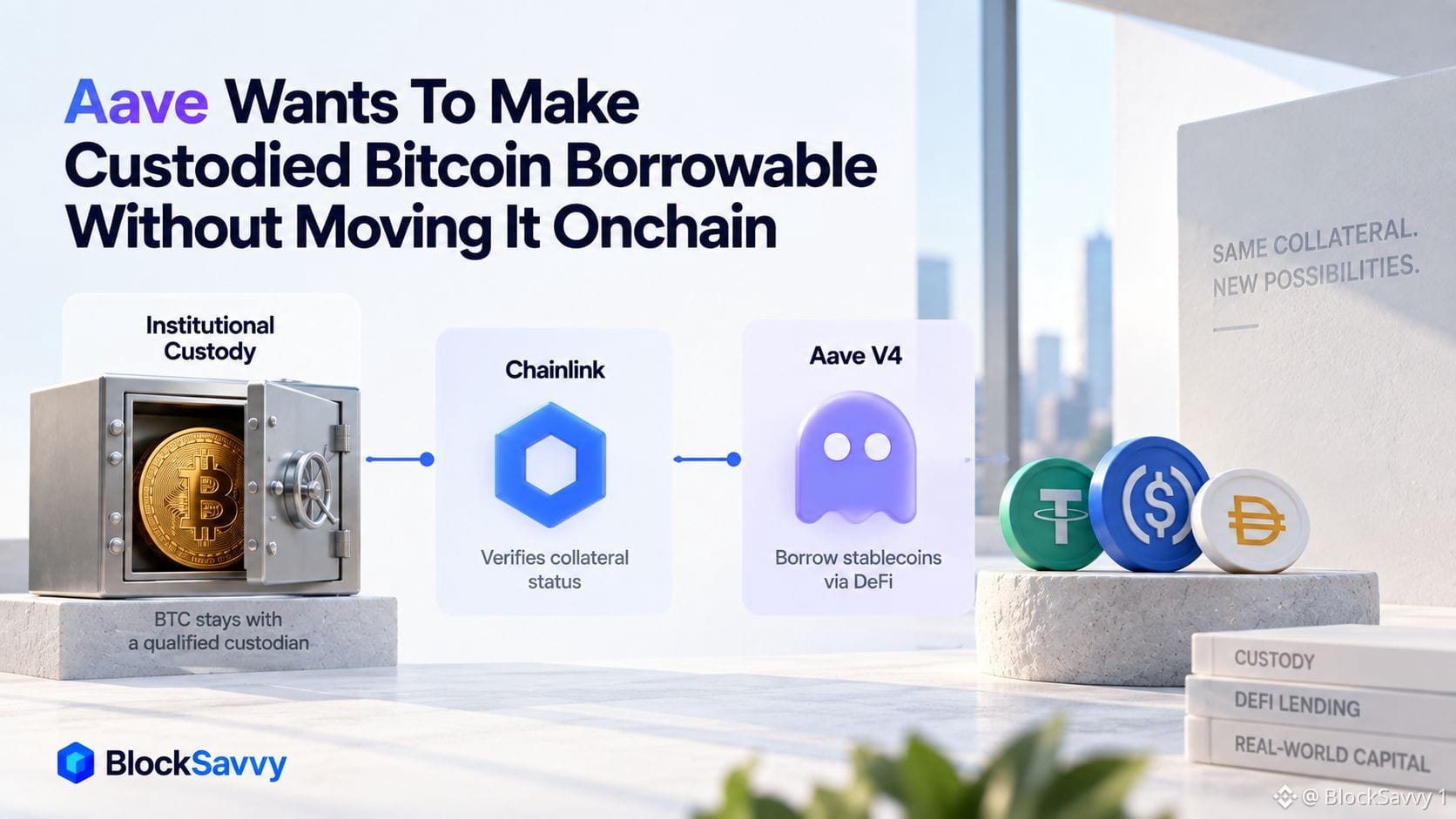
Aave Onchain-da hərəkət etdirmədən custodied Bitcoin-i borc götürülən etmək istəyir Aave-nin ən son V4 təklifi diqqətçəkəndir, çünki DeFi kreditləşməsindəki yöndəmsiz fərziyyələrdən birinə hücum edir: adətən girov DeFi-yə daxil edilmədən borc götürmək olmur. Təklif olunan mexanizmdə, institutlar ixtisaslaşmış qəyyum (custodian) vasitəsilə $BTC-ni qəyyumda saxlaya, eyni zamanda Aave V4 vasitəsilə stablecoin-lər üzrə borc götürə bilər. Chainlink qəyyum ilə kreditləşmə bazarı arasında koordinasiya qatının rolu ilə çıxış edərək, Bitcoin-in özünün protokola sarğı (wrapped) edilərək köçürülməsini və depozitini tələb etmədən girovun statusunun yoxlanmasına kömək edər. Bu, mexanikaları xeyli dəyişir. Yerli (native) BTC saxlayan bir institut tənzimlənən qəyyumluq ilə rahat ola bilər, amma likvidliyə çıxış üçün mütləq wrapped-asset, bridge və ya smart-contract ekspozisiyasını daxil etmək istəməyə bilər. Girovun oturduğu yeri ilə kreditin yarandığı yeri ayırmaq potensial olaraq bu addımı aradan qaldıra bilər. Bu həm də qəribə bir hibrid yaradır: kredit DeFi-dir, amma girov sisteminin mühüm bir hissəsi offchain qalır. $AAVE üçün bu, V4-də sadəcə başqa bir pərakəndə depozit hovuzuna rəqabət aparmaqdan daha maraqlı istiqamət ola bilər. Girovun mütləq olaraq DeFi-nin içində yaşaması lazım gəlmədikdə DeFi kreditləşməsi tamam fərqli görünməyə başlayır. #Macro Insights# #Altcoin Season#
Aave Onchain-da hərəkət etdirmədən custodied Bitcoin-i borc götürülən etmək istəyir Aave-nin ən son V4 təklifi diqqətçəkəndir, çünki DeFi kreditləşməsindəki yöndəmsiz fərziyyələrdən birinə hücum edir: adətən girov DeFi-yə daxil edilmədən borc götürmək olmur. Təklif olunan mexanizmdə, institutlar ixtisaslaşmış qəyyum (custodian) vasitəsilə $BTC-ni qəyyumda saxlaya, eyni zamanda Aave V4 vasitəsilə stablecoin-lər üzrə borc götürə bilər. Chainlink qəyyum ilə kreditləşmə bazarı arasında koordinasiya qatının rolu ilə çıxış edərək, Bitcoin-in özünün protokola sarğı (wrapped) edilərək köçürülməsini və depozitini tələb etmədən girovun statusunun yoxlanmasına kömək edər. Bu, mexanikaları xeyli dəyişir. Yerli (native) BTC saxlayan bir institut tənzimlənən qəyyumluq ilə rahat ola bilər, amma likvidliyə çıxış üçün mütləq wrapped-asset, bridge və ya smart-contract ekspozisiyasını daxil etmək istəməyə bilər. Girovun oturduğu yeri ilə kreditin yarandığı yeri ayırmaq potensial olaraq bu addımı aradan qaldıra bilər. Bu həm də qəribə bir hibrid yaradır: kredit DeFi-dir, amma girov sisteminin mühüm bir hissəsi offchain qalır. $AAVE üçün bu, V4-də sadəcə başqa bir pərakəndə depozit hovuzuna rəqabət aparmaqdan daha maraqlı istiqamət ola bilər. Girovun mütləq olaraq DeFi-nin içində yaşaması lazım gəlmədikdə DeFi kreditləşməsi tamam fərqli görünməyə başlayır. #Macro Insights# #Altcoin Season#
64
·
--
Tərcüməyə bax
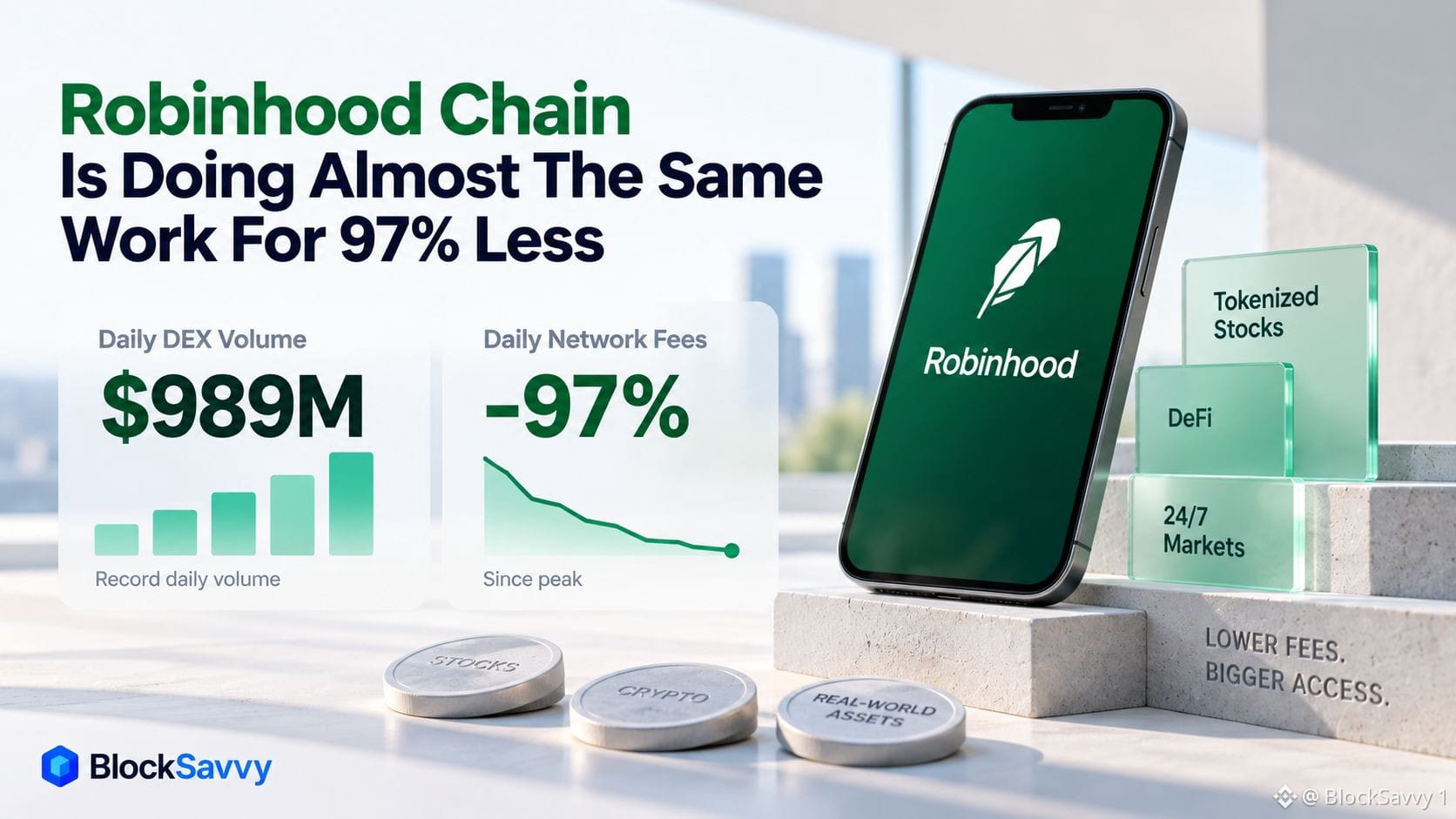
Robinhood Chain Is Doing Almost The Same Work For 97% Less Robinhood Chain is still processing transactions close to its record pace, but the amount users are paying to do it has collapsed. Daily network fees are down roughly 97% from their peak. That makes the $ETH L2 interesting for a reason that has little to do with transaction counts. Blockchains usually look healthier when activity and fees rise together. Here, activity has stayed elevated while the cost of that activity has compressed dramatically. In other words, usage hasn't disappeared — the price of blockspace has. That's good for users, but it creates a different question for the network itself. High transaction counts make a nice activity chart; fees tell you how much economic value the chain is actually capturing from that demand. And Robinhood Chain isn't exactly a quiet network. It recently recorded roughly $989M in daily DEX volume, with tokenized stocks becoming a meaningful part of its onchain activity. Cheap blockspace can scale surprisingly far. The harder part is figuring out how much that blockspace is eventually worth. #Macro Insights# #Altcoin Season#
Robinhood Chain Is Doing Almost The Same Work For 97% Less Robinhood Chain is still processing transactions close to its record pace, but the amount users are paying to do it has collapsed. Daily network fees are down roughly 97% from their peak. That makes the $ETH L2 interesting for a reason that has little to do with transaction counts. Blockchains usually look healthier when activity and fees rise together. Here, activity has stayed elevated while the cost of that activity has compressed dramatically. In other words, usage hasn't disappeared — the price of blockspace has. That's good for users, but it creates a different question for the network itself. High transaction counts make a nice activity chart; fees tell you how much economic value the chain is actually capturing from that demand. And Robinhood Chain isn't exactly a quiet network. It recently recorded roughly $989M in daily DEX volume, with tokenized stocks becoming a meaningful part of its onchain activity. Cheap blockspace can scale surprisingly far. The harder part is figuring out how much that blockspace is eventually worth. #Macro Insights# #Altcoin Season#
41
·
--
Tərcüməyə bax
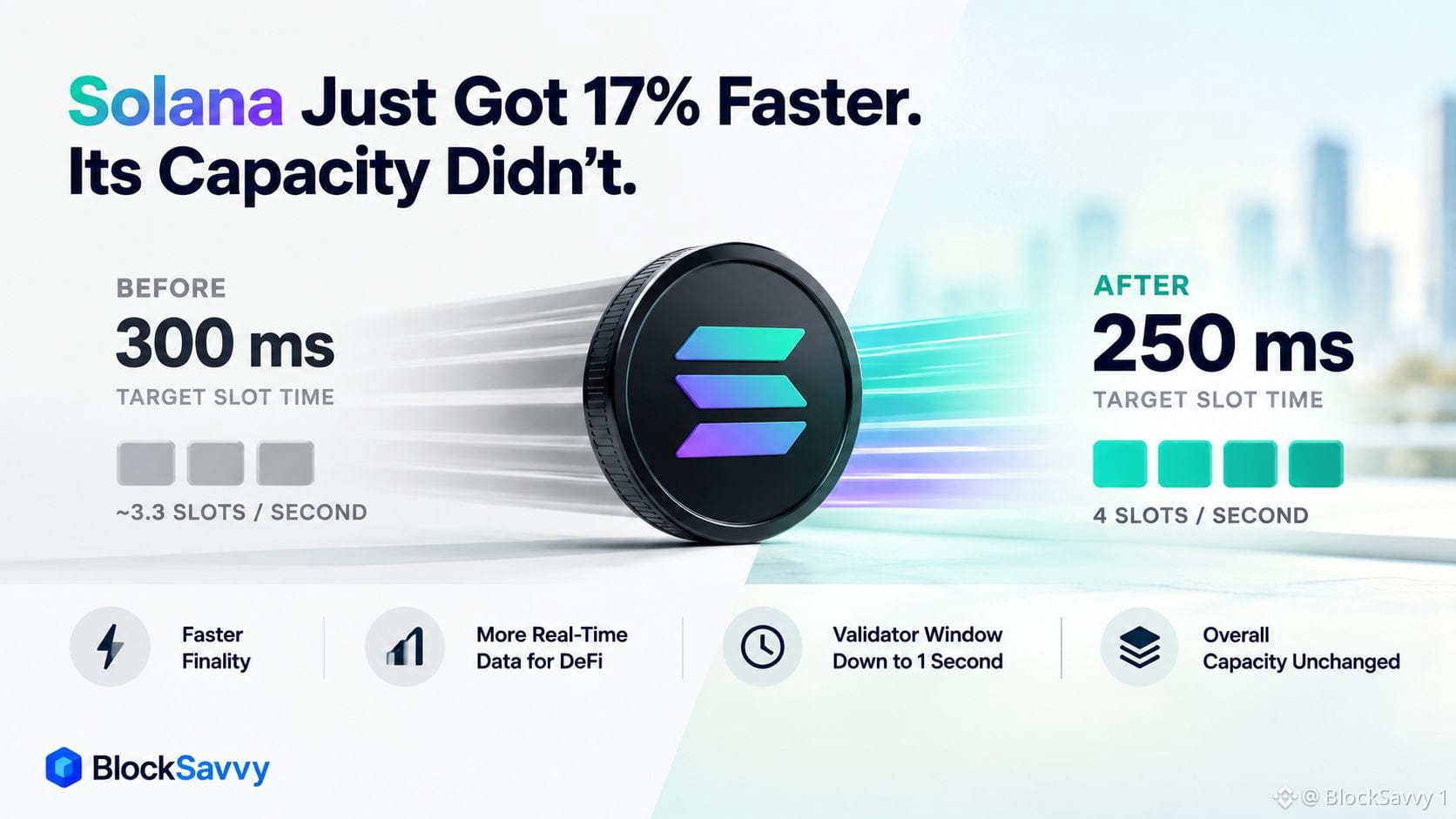
Solana Just Got 17% Faster. Its Capacity Didn't. $SOL quietly had a fairly meaningful network change this week. Solana cut its target slot time from 300ms to 250ms, meaning the chain now targets four slots every second instead of roughly 3.3. The obvious interpretation is “17% faster blocks = 17% more throughput, but that's not actually what happened. Compute and data limits per slot were reduced alongside the shorter slot time, so overall processing capacity stays roughly the same. What improves is freshness: wallets, DEXs, oracles and trading systems get a newer view of the chain more frequently. For DeFi, a 50ms difference isn't as trivial as it sounds. Automated market makers and oracle-driven markets operate in an environment where prices can change between a transaction being constructed and actually reaching the network. Shorter slots shrink that window. There's another interesting side effect: validators still lead for four consecutive slots, but their control window has fallen from 1.2 seconds to 1 second. Solana ultimately wants to push slots down again to 200ms, although that step depends on validator block-skip rates remaining acceptable. So this isn't really a TPS story, it's Solana trying to make the same capacity feel more real-time. #Macro Insights# #Altcoin Season#
Solana Just Got 17% Faster. Its Capacity Didn't. $SOL quietly had a fairly meaningful network change this week. Solana cut its target slot time from 300ms to 250ms, meaning the chain now targets four slots every second instead of roughly 3.3. The obvious interpretation is “17% faster blocks = 17% more throughput, but that's not actually what happened. Compute and data limits per slot were reduced alongside the shorter slot time, so overall processing capacity stays roughly the same. What improves is freshness: wallets, DEXs, oracles and trading systems get a newer view of the chain more frequently. For DeFi, a 50ms difference isn't as trivial as it sounds. Automated market makers and oracle-driven markets operate in an environment where prices can change between a transaction being constructed and actually reaching the network. Shorter slots shrink that window. There's another interesting side effect: validators still lead for four consecutive slots, but their control window has fallen from 1.2 seconds to 1 second. Solana ultimately wants to push slots down again to 200ms, although that step depends on validator block-skip rates remaining acceptable. So this isn't really a TPS story, it's Solana trying to make the same capacity feel more real-time. #Macro Insights# #Altcoin Season#
62
·
--
Tərcüməyə bax
Oat Milk, Savings, and the Same Recurring Question Doing my usual end-of-year list of what actually made this year quieter, and the theme surprised me. You know why? Cause it wasn't the big stuff, it was every small thing I automated, so I'd stop arguing with myself about it on a loop. The electricity bill went on autopay, so I stopped opening the app every month just to grumble and pay it anyway. The grocery staples became a standing order, so I stopped "deciding" to buy oat milk for the fortieth time. A chunk of every paycheck now moves to savings before I can talk myself out of it. And then there was the weekly $BTC buy I kept negotiating with myself over, every single week, should I this week, should I skip it, is now a good entry or a bad one. I set up Auto-Invest on WhiteBIT to just run it weekly with no minimum amount, so I never had to save up before starting. It smooths the buy price out over time through dollar-cost averaging, and I can pause or stop the plan whenever I want, so committing to it never felt like a real decision either. https://bit.ly/3TaCjJT None of these changes saved me much time, but what they actually did was end a recurring internal debate I'd already had a hundred times and kept having again anyway. So that's the theme of my year, apparently: decide once, then stop arguing with myself about it weekly. The crypto buy was just one of the arguments I finally retired. Disclaimer: This is not financial or investment advice. Do your own research before making any decisions. Use at your own risk. #BTC Price Analysis# #Bitcoin Price Prediction: What is Bitcoins next move?#
Oat Milk, Savings, and the Same Recurring Question Doing my usual end-of-year list of what actually made this year quieter, and the theme surprised me. You know why? Cause it wasn't the big stuff, it was every small thing I automated, so I'd stop arguing with myself about it on a loop. The electricity bill went on autopay, so I stopped opening the app every month just to grumble and pay it anyway. The grocery staples became a standing order, so I stopped "deciding" to buy oat milk for the fortieth time. A chunk of every paycheck now moves to savings before I can talk myself out of it. And then there was the weekly $BTC buy I kept negotiating with myself over, every single week, should I this week, should I skip it, is now a good entry or a bad one. I set up Auto-Invest on WhiteBIT to just run it weekly with no minimum amount, so I never had to save up before starting. It smooths the buy price out over time through dollar-cost averaging, and I can pause or stop the plan whenever I want, so committing to it never felt like a real decision either. https://bit.ly/3TaCjJT None of these changes saved me much time, but what they actually did was end a recurring internal debate I'd already had a hundred times and kept having again anyway. So that's the theme of my year, apparently: decide once, then stop arguing with myself about it weekly. The crypto buy was just one of the arguments I finally retired. Disclaimer: This is not financial or investment advice. Do your own research before making any decisions. Use at your own risk. #BTC Price Analysis# #Bitcoin Price Prediction: What is Bitcoins next move?#
·
--
Tərcüməyə bax
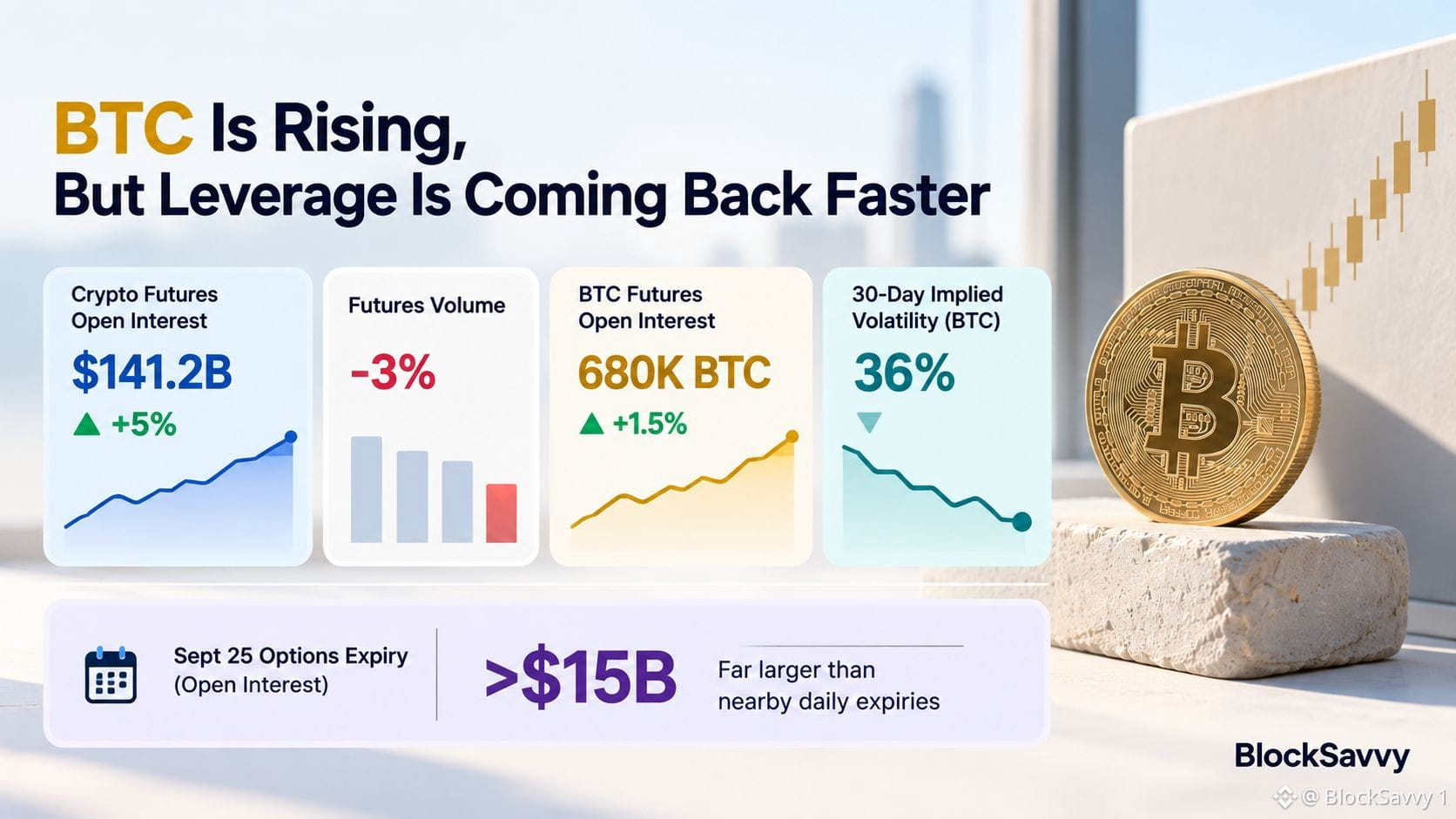
BTC is Rising, But The Leverage Is Coming Back Faster $BTC pushed back above $80K after spending much of the past two weeks stuck in a fairly tight range. The more interesting move is happening underneath the price. Crypto futures open interest expanded by nearly 5% to $141.2B, while daily futures volume actually fell about 3%. That combination matters: more positions are being opened and held, rather than the move simply being driven by a burst of short-term trading. Bitcoin futures OI also climbed from roughly 670K BTC to 680K BTC during the move. At the same time, implied volatility has been getting cheaper - BTC 30-day IV dropped to around 36%, while Deribit data earlier this week had most BTC option tenors sitting around 38–39%. So we're getting a slightly unusual mix: price up, leverage rebuilding, but options aren't pricing in dramatically bigger moves yet. And there's a pretty large positioning event coming up. The September 25 BTC options expiry currently carries more than $15B in open interest on Deribit, far larger than the nearby daily expiries. That's the part I'd pay attention to over the next few sessions. Not just whether $BTC moves higher, but whether open interest keeps expanding while volatility stays this cheap. #BTC Price Analysis# #Bitcoin Price Prediction: What is Bitcoins next move?#
BTC is Rising, But The Leverage Is Coming Back Faster $BTC pushed back above $80K after spending much of the past two weeks stuck in a fairly tight range. The more interesting move is happening underneath the price. Crypto futures open interest expanded by nearly 5% to $141.2B, while daily futures volume actually fell about 3%. That combination matters: more positions are being opened and held, rather than the move simply being driven by a burst of short-term trading. Bitcoin futures OI also climbed from roughly 670K BTC to 680K BTC during the move. At the same time, implied volatility has been getting cheaper - BTC 30-day IV dropped to around 36%, while Deribit data earlier this week had most BTC option tenors sitting around 38–39%. So we're getting a slightly unusual mix: price up, leverage rebuilding, but options aren't pricing in dramatically bigger moves yet. And there's a pretty large positioning event coming up. The September 25 BTC options expiry currently carries more than $15B in open interest on Deribit, far larger than the nearby daily expiries. That's the part I'd pay attention to over the next few sessions. Not just whether $BTC moves higher, but whether open interest keeps expanding while volatility stays this cheap. #BTC Price Analysis# #Bitcoin Price Prediction: What is Bitcoins next move?#
70
·
--
Tərcüməyə bax
One Bitcoin Miner Finally Chose AI Instead 👀 We've talked plenty about Bitcoin miners experimenting with AI. Now there's a useful example of what that transition actually looks like when a company commits to it. Hyperscale Data has stopped Bitcoin mining at its Michigan facility and is converting the site into AI infrastructure. Its shares, meanwhile, recently hit an all-time low, so the market clearly isn't treating "pivot to AI" as a magic fix. I think that's an important distinction because the miner-to-AI story often gets simplified into: AI pays more for electricity, so miners can just switch. But a Bitcoin mining site isn't automatically an AI data center. $BTC mining can tolerate things that AI workloads often can't. Mining machines can be switched off when power gets expensive. Many AI customers need reliable uptime, different cooling, networking, hardware and considerably more complicated infrastructure. So miners may have something extremely valuable, access to large amounts of power, without necessarily having the finished product AI companies want. That's why I'm watching the companies that actually complete these conversions rather than every miner that puts "HPC" into an investor presentation. The power connection might be the moat. Everything built around it is still a business. #BTC Price Analysis# #Bitcoin Price Prediction: What is Bitcoins next move?#
One Bitcoin Miner Finally Chose AI Instead 👀 We've talked plenty about Bitcoin miners experimenting with AI. Now there's a useful example of what that transition actually looks like when a company commits to it. Hyperscale Data has stopped Bitcoin mining at its Michigan facility and is converting the site into AI infrastructure. Its shares, meanwhile, recently hit an all-time low, so the market clearly isn't treating "pivot to AI" as a magic fix. I think that's an important distinction because the miner-to-AI story often gets simplified into: AI pays more for electricity, so miners can just switch. But a Bitcoin mining site isn't automatically an AI data center. $BTC mining can tolerate things that AI workloads often can't. Mining machines can be switched off when power gets expensive. Many AI customers need reliable uptime, different cooling, networking, hardware and considerably more complicated infrastructure. So miners may have something extremely valuable, access to large amounts of power, without necessarily having the finished product AI companies want. That's why I'm watching the companies that actually complete these conversions rather than every miner that puts "HPC" into an investor presentation. The power connection might be the moat. Everything built around it is still a business. #BTC Price Analysis# #Bitcoin Price Prediction: What is Bitcoins next move?#

45
·
--
Tərcüməyə bax
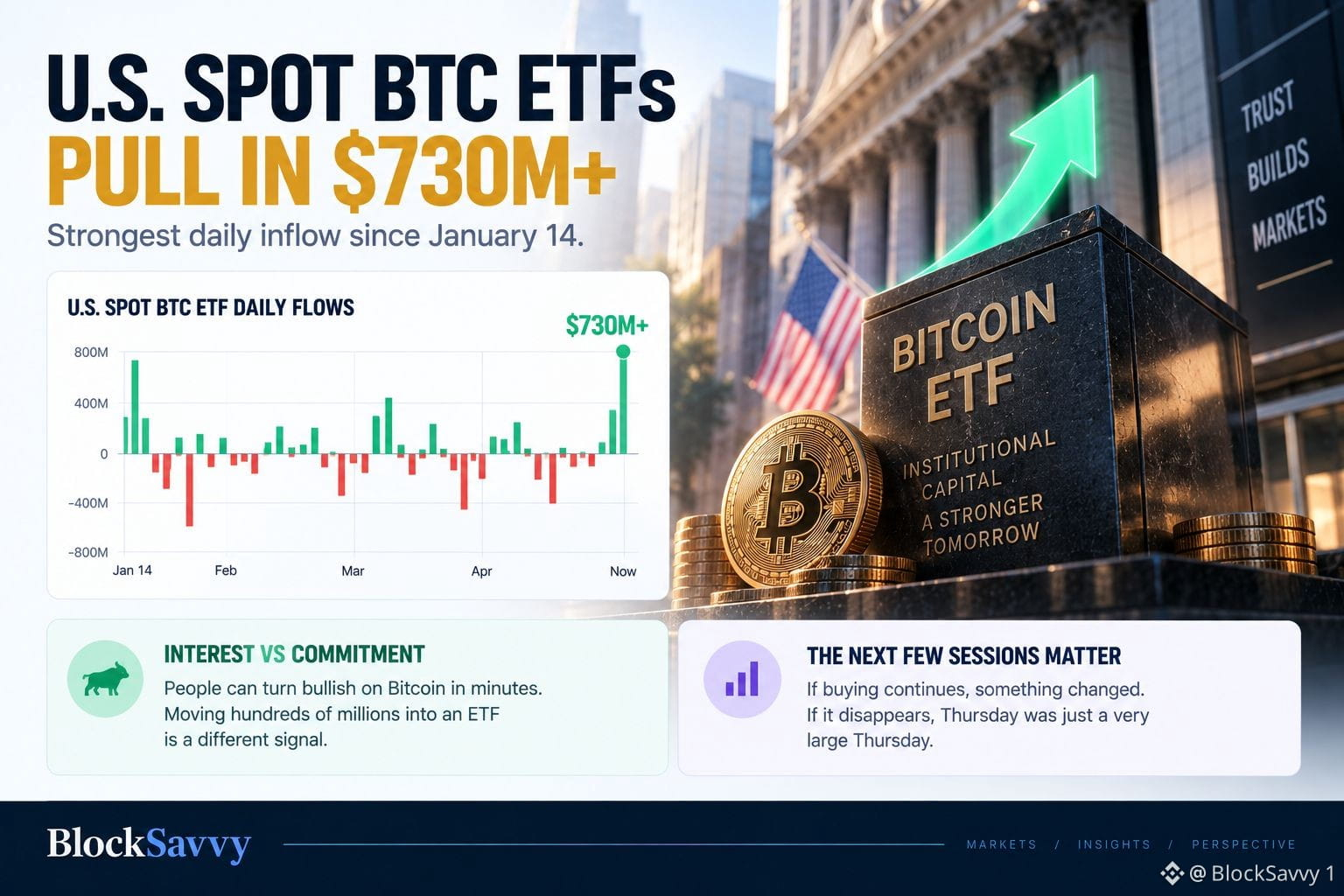
Bitcoin ETFs Just Had Their Biggest Day Since January After several sessions of inconsistent flows, U.S. spot $BTC ETFs pulled in more than $730 million in a single day, their strongest daily inflow since January 14. What I like about ETF flows is how quickly they expose the difference between interest and commitment. People can turn bullish on Bitcoin in minutes. Actually moving hundreds of millions into an ETF is a different signal. But one huge day still isn't a trend. Bitcoin ETF flows have been alternating between inflows and outflows recently, which makes the next few sessions more interesting than the $730M headline itself. If the buying continues, something changed. If it disappears tomorrow, Thursday was just a very large Thursday. 🤷♂️ #BTC Price Analysis# #Bitcoin Price Prediction: What is Bitcoins next move?#
Bitcoin ETFs Just Had Their Biggest Day Since January After several sessions of inconsistent flows, U.S. spot $BTC ETFs pulled in more than $730 million in a single day, their strongest daily inflow since January 14. What I like about ETF flows is how quickly they expose the difference between interest and commitment. People can turn bullish on Bitcoin in minutes. Actually moving hundreds of millions into an ETF is a different signal. But one huge day still isn't a trend. Bitcoin ETF flows have been alternating between inflows and outflows recently, which makes the next few sessions more interesting than the $730M headline itself. If the buying continues, something changed. If it disappears tomorrow, Thursday was just a very large Thursday. 🤷♂️ #BTC Price Analysis# #Bitcoin Price Prediction: What is Bitcoins next move?#
57
·
--
Tərcüməyə bax
AMC Just Found Out What Happens When Someone Tokenizes Your Stock Without Asking 😅 AMC's CEO isn't particularly happy about Robinhood-linked tokenized shares carrying the company's ticker, arguing that investors could mistake them for actual AMC equity. AMC shares then jumped about 21% in overnight trading as the dispute attracted attention. This exposes a slightly awkward part of the tokenized-stock boom. When you buy a traditional share, there's a fairly well-understood relationship between the investor, broker, clearing system and issuing company. Tokenization can add another wrapper around that relationship, and suddenly the thing trading on-chain may track a stock without necessarily being the stock itself. That's where I think $ETH and other tokenization infrastructure eventually run into a branding problem as much as a technical one. If an app shows me something called "AMC," what exactly do I own? A share? A token backed by a share? A derivative tracking the share? And what legal claim do I actually have if something goes wrong? Tokenizing an asset is easy to explain. Explaining the wrapper might be the harder part. #ETHBlockchain #ETHFoundation
AMC Just Found Out What Happens When Someone Tokenizes Your Stock Without Asking 😅 AMC's CEO isn't particularly happy about Robinhood-linked tokenized shares carrying the company's ticker, arguing that investors could mistake them for actual AMC equity. AMC shares then jumped about 21% in overnight trading as the dispute attracted attention. This exposes a slightly awkward part of the tokenized-stock boom. When you buy a traditional share, there's a fairly well-understood relationship between the investor, broker, clearing system and issuing company. Tokenization can add another wrapper around that relationship, and suddenly the thing trading on-chain may track a stock without necessarily being the stock itself. That's where I think $ETH and other tokenization infrastructure eventually run into a branding problem as much as a technical one. If an app shows me something called "AMC," what exactly do I own? A share? A token backed by a share? A derivative tracking the share? And what legal claim do I actually have if something goes wrong? Tokenizing an asset is easy to explain. Explaining the wrapper might be the harder part. #ETHBlockchain #ETHFoundation

68
·
--
Tərcüməyə bax
Privacy Coins Suddenly Remembered How to Rally 👀 $ZEC jumped roughly 15% in a day and around 20% over the week, outperforming every major crypto asset as the broader market recovered. I find privacy coins interesting because they've spent years stuck between two completely opposite forces. There is a very obvious use case for financial privacy on public blockchains, but there is also regulatory pressure that makes exchanges and institutions cautious about supporting assets specifically designed around it. And yet Zcash is still here. Maybe the more interesting question isn't whether privacy coins return to their old prominence. It's whether the wider crypto industry eventually builds enough privacy into wallets, stablecoins and smart-contract networks that dedicated privacy assets become less necessary. $ZEC succeeding and crypto becoming more private aren't necessarily the same bet. #Macro Insights# #Altcoin Season#
Privacy Coins Suddenly Remembered How to Rally 👀 $ZEC jumped roughly 15% in a day and around 20% over the week, outperforming every major crypto asset as the broader market recovered. I find privacy coins interesting because they've spent years stuck between two completely opposite forces. There is a very obvious use case for financial privacy on public blockchains, but there is also regulatory pressure that makes exchanges and institutions cautious about supporting assets specifically designed around it. And yet Zcash is still here. Maybe the more interesting question isn't whether privacy coins return to their old prominence. It's whether the wider crypto industry eventually builds enough privacy into wallets, stablecoins and smart-contract networks that dedicated privacy assets become less necessary. $ZEC succeeding and crypto becoming more private aren't necessarily the same bet. #Macro Insights# #Altcoin Season#

78
Daha çox kontent araşdırmaq üçün daxil olun
Binance Square-də qlobal kriptovalyuta istifadəçilərinə qoşulun
⚡️ Kriptovalyuta haqqında ən son və faydalı məlumatları əldə edin.
💬 Dünyanın ən böyük kriptovalyuta birjası tərəfindən etibar edilir.
👍 Doğrulanmış yaradıcılardan gələn real məlumatları kəşf edin.
E-poçt/Telefon nömrəsi
Trenddə olan mövzular
BitcoinClears$85200
21 baxış
Müzakirə edir: 27
#BitcoinClears$85200
Bitcoin yenidən 85,200-dən yuxarıya itələdi; BTC, ABŞ-dan gələn yeni iqtisadi məlumatlara geniş bazarların reaksiyası fonunda təxminən 85K ətrafında ticarət edir.
🎯 NİYƏ TREYDERLƏRƏ ƏHƏMİYYƏTLİDİR:
85K zonası indi həcm, likvidlik və impulsun təsdiqi üçün diqqət yetiriləcək əsas sahədir.
📊 TİCARƏTƏ NƏZARƏT:
• BTC spot həcmi
• 85K–86K qiymət hərəkəti
• OI + Funding
• ETF axınları
• BTC dominansı
🔥 10X DÜŞÜNCƏSİ: Sıçrayışı (breakout) qovlama. Mövqe tutmazdan əvvəl qiymət + həcm təsdiqini izləyin.
$ARK $MOVR $QNT
Cheri Texiera O7ec
·0 bəyənmə
·379 baxış
AltcoinSeasonIndexHoldsAbove60For5Days
1,626 baxış
Müzakirə edir: 246
BitcoinSlipsBelow$84000
1,080 baxış
Müzakirə edir: 63