
AshCrypto 1
118 Paylaşımlar

AshCrypto 1
Şikayət et
İstifadəçini blokla
Cryptocurrency expert | KOL | Simplifying #DeFi | Join the crypto revolution | NFT | #Binance #BNB ⭐
0 İzlənilir
6 İzləyicilər
8 Bəyəndi
Postlar
·
--
Tərcüməyə bax
This is the perception gap.
$PEPE and $PUMP can move because attention rotates fast on CMC, meme charts and social feeds. Pyth is a different kind of opportunity because attention may still be behind the actual product curve.
Most people still talk about Pyth like it is another oracle project.
Then you look at the stack.
Nasdaq Basic through Pyth Data Marketplace.
$723.77B in August RWA perp volume priced by Pyth.
96.27% share of tracked RWA perp pricing.
$10.4M ARR.
$2.9M gross new ARR in August.
3,500+ market feeds.
138+ first-party publishers.
That does not look like a small crypto infra story anymore.
Nasdaq Basic gives approved clients real-time U.S. equity market data through Pyth’s marketplace channel after they license directly with Nasdaq.
That is market-data distribution language, not just DeFi feed language.
My read is simple: the product has moved faster than the market’s mental model.
If people still see Pyth as only a token-price oracle, they are missing the lane it is trying to own.
Nasdaq makes that harder to miss.
#Altcoin Season# #PEPE
This is the perception gap.
$PEPE and $PUMP can move because attention rotates fast on CMC, meme charts and social feeds. Pyth is a different kind of opportunity because attention may still be behind the actual product curve.
Most people still talk about Pyth like it is another oracle project.
Then you look at the stack.
Nasdaq Basic through Pyth Data Marketplace.
$723.77B in August RWA perp volume priced by Pyth.
96.27% share of tracked RWA perp pricing.
$10.4M ARR.
$2.9M gross new ARR in August.
3,500+ market feeds.
138+ first-party publishers.
That does not look like a small crypto infra story anymore.
Nasdaq Basic gives approved clients real-time U.S. equity market data through Pyth’s marketplace channel after they license directly with Nasdaq.
That is market-data distribution language, not just DeFi feed language.
My read is simple: the product has moved faster than the market’s mental model.
If people still see Pyth as only a token-price oracle, they are missing the lane it is trying to own.
Nasdaq makes that harder to miss.
#Altcoin Season# #PEPE
$PEPE and $PUMP can move because attention rotates fast on CMC, meme charts and social feeds. Pyth is a different kind of opportunity because attention may still be behind the actual product curve.
Most people still talk about Pyth like it is another oracle project.
Then you look at the stack.
Nasdaq Basic through Pyth Data Marketplace.
$723.77B in August RWA perp volume priced by Pyth.
96.27% share of tracked RWA perp pricing.
$10.4M ARR.
$2.9M gross new ARR in August.
3,500+ market feeds.
138+ first-party publishers.
That does not look like a small crypto infra story anymore.
Nasdaq Basic gives approved clients real-time U.S. equity market data through Pyth’s marketplace channel after they license directly with Nasdaq.
That is market-data distribution language, not just DeFi feed language.
My read is simple: the product has moved faster than the market’s mental model.
If people still see Pyth as only a token-price oracle, they are missing the lane it is trying to own.
Nasdaq makes that harder to miss.
#Altcoin Season# #PEPE
38
·
--
Tərcüməyə bax
TOKEN2049 Ain’t What I’m Watching This Year 👀
Communities around $ETH and $GRAM know exactly what large crypto conferences are designed to do: they bring thousands of people into the same city and make discovery happen at a scale no private room could reproduce.
TOKEN2049 expects more than 25,000 attendees in Singapore this October, and as the room grows, every interaction competes with the constant movement and noise around it.
That is why the number I am watching is 23.
After TOKEN2049 closes, a three-day $Trump Coin Club experience is planned in Singapore for 23 eligible attendees.
The contrast reveals two completely different objectives. Twenty-five thousand people maximize discovery, while a group of 23 concentrates the experience into a truly wholesome gathering 💫
#Altcoin Season#
TOKEN2049 Ain’t What I’m Watching This Year 👀
Communities around $ETH and $GRAM know exactly what large crypto conferences are designed to do: they bring thousands of people into the same city and make discovery happen at a scale no private room could reproduce.
TOKEN2049 expects more than 25,000 attendees in Singapore this October, and as the room grows, every interaction competes with the constant movement and noise around it.
That is why the number I am watching is 23.
After TOKEN2049 closes, a three-day $Trump Coin Club experience is planned in Singapore for 23 eligible attendees.
The contrast reveals two completely different objectives. Twenty-five thousand people maximize discovery, while a group of 23 concentrates the experience into a truly wholesome gathering 💫
#Altcoin Season#
Communities around $ETH and $GRAM know exactly what large crypto conferences are designed to do: they bring thousands of people into the same city and make discovery happen at a scale no private room could reproduce.
TOKEN2049 expects more than 25,000 attendees in Singapore this October, and as the room grows, every interaction competes with the constant movement and noise around it.
That is why the number I am watching is 23.
After TOKEN2049 closes, a three-day $Trump Coin Club experience is planned in Singapore for 23 eligible attendees.
The contrast reveals two completely different objectives. Twenty-five thousand people maximize discovery, while a group of 23 concentrates the experience into a truly wholesome gathering 💫
#Altcoin Season#
58
·
--
Tərcüməyə bax
The same trade can do more 👀
Across this altcoin season, $HYPE and $ZEC have both given traders setups worth acting on, and once the view is clear, most people focus on direction, entry, and risk, then execute wherever their capital already sits.
I think the venue deserves more thought.
If I am going to generate the volume anyway, I would rather place the trade where that activity creates value beyond the position itself.
Aevo does this across this week’s qualifying Perp Majors and its options markets as volume accumulates toward the 10m requirement for the projected 808,800 USDC year-end distribution.
Year-end eligibility also requires an active COMMANDER or LEGEND stake.
That makes venue choice part of the trade itself.
The setup stays the same, but the activity can keep building toward December.
For me, that gives every planned trade another reason to run through Aevo 🔥
#Altcoin Season#
The same trade can do more 👀
Across this altcoin season, $HYPE and $ZEC have both given traders setups worth acting on, and once the view is clear, most people focus on direction, entry, and risk, then execute wherever their capital already sits.
I think the venue deserves more thought.
If I am going to generate the volume anyway, I would rather place the trade where that activity creates value beyond the position itself.
Aevo does this across this week’s qualifying Perp Majors and its options markets as volume accumulates toward the 10m requirement for the projected 808,800 USDC year-end distribution.
Year-end eligibility also requires an active COMMANDER or LEGEND stake.
That makes venue choice part of the trade itself.
The setup stays the same, but the activity can keep building toward December.
For me, that gives every planned trade another reason to run through Aevo 🔥
#Altcoin Season#
Across this altcoin season, $HYPE and $ZEC have both given traders setups worth acting on, and once the view is clear, most people focus on direction, entry, and risk, then execute wherever their capital already sits.
I think the venue deserves more thought.
If I am going to generate the volume anyway, I would rather place the trade where that activity creates value beyond the position itself.
Aevo does this across this week’s qualifying Perp Majors and its options markets as volume accumulates toward the 10m requirement for the projected 808,800 USDC year-end distribution.
Year-end eligibility also requires an active COMMANDER or LEGEND stake.
That makes venue choice part of the trade itself.
The setup stays the same, but the activity can keep building toward December.
For me, that gives every planned trade another reason to run through Aevo 🔥
#Altcoin Season#
57
·
--
Tərcüməyə bax
Sleeping Giants Eventually Start Shipping Again 😤
I’ll be honest. For a while, Zora looked far too quiet.
Now $BNB is joining the pairing and crosschain surface being built around $ZORA
Zoom out and the pattern becomes difficult to ignore.
One summer has delivered a serious rebuild:
- Multichain expanded to Robinhood Chain and Solana
- Custom Pairs opened new markets around stocks, memes, and majors
- More than 4,000 pairs were created
- BNB support now extends pairing and crosschain trading again
That is a platform coming out of hibernation with intent.
Fresh leadership appears willing to move quickly, communicate more, and put distribution back on the agenda.
Zora still has to translate this shipping pace into sustained users and volume.
But the product is moving again.
Every added chain expands what can be paired, where it can trade, and who can participate.
If this pace continues, Zora’s quiet period may end up looking like the setup for a much bigger return.
#Altcoin Season#
Sleeping Giants Eventually Start Shipping Again 😤
I’ll be honest. For a while, Zora looked far too quiet.
Now $BNB is joining the pairing and crosschain surface being built around $ZORA
Zoom out and the pattern becomes difficult to ignore.
One summer has delivered a serious rebuild:
- Multichain expanded to Robinhood Chain and Solana
- Custom Pairs opened new markets around stocks, memes, and majors
- More than 4,000 pairs were created
- BNB support now extends pairing and crosschain trading again
That is a platform coming out of hibernation with intent.
Fresh leadership appears willing to move quickly, communicate more, and put distribution back on the agenda.
Zora still has to translate this shipping pace into sustained users and volume.
But the product is moving again.
Every added chain expands what can be paired, where it can trade, and who can participate.
If this pace continues, Zora’s quiet period may end up looking like the setup for a much bigger return.
#Altcoin Season#
I’ll be honest. For a while, Zora looked far too quiet.
Now $BNB is joining the pairing and crosschain surface being built around $ZORA
Zoom out and the pattern becomes difficult to ignore.
One summer has delivered a serious rebuild:
- Multichain expanded to Robinhood Chain and Solana
- Custom Pairs opened new markets around stocks, memes, and majors
- More than 4,000 pairs were created
- BNB support now extends pairing and crosschain trading again
That is a platform coming out of hibernation with intent.
Fresh leadership appears willing to move quickly, communicate more, and put distribution back on the agenda.
Zora still has to translate this shipping pace into sustained users and volume.
But the product is moving again.
Every added chain expands what can be paired, where it can trade, and who can participate.
If this pace continues, Zora’s quiet period may end up looking like the setup for a much bigger return.
#Altcoin Season#
51
·
--
Tərcüməyə bax
Reinsurance Moved Onchain, Underwriting Did Not 🛡️
The money side of insurance is quietly moving onchain, and the part that decides who actually gets covered has not moved at all.
In June, SurancePlus began issuing tokenized reinsurance securities on $SOL in a $12M program against a 2026 to 2027 excess-of-loss contract at around $5,000 a ticket, which is one of the more interesting RWA launches on Solana this year.
$LINK is wiring the same institutional plumbing from the other end, with Swift, Euroclear, UBS and JP Morgan's Kinexys building against its runtime environment.
So the capital and the settlement are getting solved.
Underwriting is the piece that stays offchain, because pricing a risk means reading an applicant's claims history, their finances and records they would never publish, and every quote means handing that file to one more company that keeps a copy.
It is why onchain insurance so far mostly covers smart contract failure, which is the one risk anyone can price from public data alone.
Arcium changes what the underwriter has to receive, splitting the applicant's file into fragments across a cluster of nodes where no single node holds a readable copy, while the model still returns the correct price.
The policy and the premium settle on Solana as an ordinary public transaction, so an auditor or a regulator can check the book even though the file behind each quote stays sealed.
That compute layer has been live on Mainnet Alpha since February 2, with more than 2.5 million computations run so far.
Reinsurance capital found its way onchain and underwriting did not, and my read is that whoever closes that gap opens a market worth north of $780B that has never had a reason to look at crypto.
#RWA #Solana
Reinsurance Moved Onchain, Underwriting Did Not 🛡️
The money side of insurance is quietly moving onchain, and the part that decides who actually gets covered has not moved at all.
In June, SurancePlus began issuing tokenized reinsurance securities on $SOL in a $12M program against a 2026 to 2027 excess-of-loss contract at around $5,000 a ticket, which is one of the more interesting RWA launches on Solana this year.
$LINK is wiring the same institutional plumbing from the other end, with Swift, Euroclear, UBS and JP Morgan's Kinexys building against its runtime environment.
So the capital and the settlement are getting solved.
Underwriting is the piece that stays offchain, because pricing a risk means reading an applicant's claims history, their finances and records they would never publish, and every quote means handing that file to one more company that keeps a copy.
It is why onchain insurance so far mostly covers smart contract failure, which is the one risk anyone can price from public data alone.
Arcium changes what the underwriter has to receive, splitting the applicant's file into fragments across a cluster of nodes where no single node holds a readable copy, while the model still returns the correct price.
The policy and the premium settle on Solana as an ordinary public transaction, so an auditor or a regulator can check the book even though the file behind each quote stays sealed.
That compute layer has been live on Mainnet Alpha since February 2, with more than 2.5 million computations run so far.
Reinsurance capital found its way onchain and underwriting did not, and my read is that whoever closes that gap opens a market worth north of $780B that has never had a reason to look at crypto.
#RWA #Solana
The money side of insurance is quietly moving onchain, and the part that decides who actually gets covered has not moved at all.
In June, SurancePlus began issuing tokenized reinsurance securities on $SOL in a $12M program against a 2026 to 2027 excess-of-loss contract at around $5,000 a ticket, which is one of the more interesting RWA launches on Solana this year.
$LINK is wiring the same institutional plumbing from the other end, with Swift, Euroclear, UBS and JP Morgan's Kinexys building against its runtime environment.
So the capital and the settlement are getting solved.
Underwriting is the piece that stays offchain, because pricing a risk means reading an applicant's claims history, their finances and records they would never publish, and every quote means handing that file to one more company that keeps a copy.
It is why onchain insurance so far mostly covers smart contract failure, which is the one risk anyone can price from public data alone.
Arcium changes what the underwriter has to receive, splitting the applicant's file into fragments across a cluster of nodes where no single node holds a readable copy, while the model still returns the correct price.
The policy and the premium settle on Solana as an ordinary public transaction, so an auditor or a regulator can check the book even though the file behind each quote stays sealed.
That compute layer has been live on Mainnet Alpha since February 2, with more than 2.5 million computations run so far.
Reinsurance capital found its way onchain and underwriting did not, and my read is that whoever closes that gap opens a market worth north of $780B that has never had a reason to look at crypto.
#RWA #Solana
64
·
--
Tərcüməyə bax
Ostium odds look too low 👀
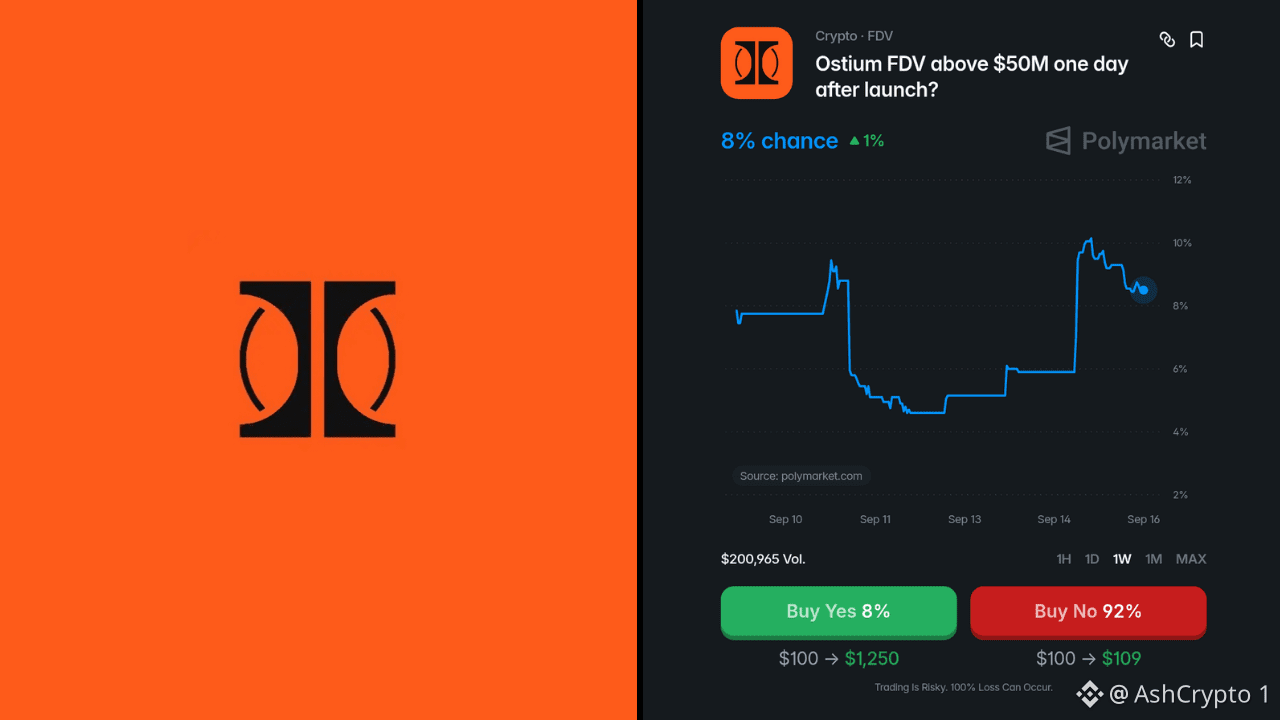
8% on Yes with almost $201K already traded.
That is exactly the kind of Polymarket market that makes me stop scrolling.
The question is whether Ostium can launch above a $50M FDV one day after launch. The market is overwhelmingly saying no, but I am taking Yes.
$50M is not an insane launch valuation in crypto, especially when the requirement is only to clear that level at the defined post-launch snapshot. It does not need to prove that valuation for the next six months.
And the 8% price is what makes this interesting.
The lower the probability I buy at, the larger the potential payout if the crowd is wrong. Roughly speaking, a $10 Yes position around 8% represents about $125 at resolution if Yes wins, before fees and execution differences.
That's the asymmetry I want.
I'd rather rotate a small piece of my $BNB exposure into a specific prediction like this than chase another token after it has already pumped.
I also don't need Ostium to actually resolve Yes to make money on the position. If launch excitement pushes the odds from 8% to 15% or 20%, Polymarket gives me the freedom to sell before resolution.
Low odds. Defined catalyst. Huge repricing potential.
I'm taking Yes.
#Altcoin Season#
Ostium odds look too low 👀
8% on Yes with almost $201K already traded.
That is exactly the kind of Polymarket market that makes me stop scrolling.
The question is whether Ostium can launch above a $50M FDV one day after launch. The market is overwhelmingly saying no, but I am taking Yes.
$50M is not an insane launch valuation in crypto, especially when the requirement is only to clear that level at the defined post-launch snapshot. It does not need to prove that valuation for the next six months.
And the 8% price is what makes this interesting.
The lower the probability I buy at, the larger the potential payout if the crowd is wrong. Roughly speaking, a $10 Yes position around 8% represents about $125 at resolution if Yes wins, before fees and execution differences.
That's the asymmetry I want.
I'd rather rotate a small piece of my $BNB exposure into a specific prediction like this than chase another token after it has already pumped.
I also don't need Ostium to actually resolve Yes to make money on the position. If launch excitement pushes the odds from 8% to 15% or 20%, Polymarket gives me the freedom to sell before resolution.
Low odds. Defined catalyst. Huge repricing potential.
I'm taking Yes.
#Altcoin Season#
8% on Yes with almost $201K already traded.
That is exactly the kind of Polymarket market that makes me stop scrolling.
The question is whether Ostium can launch above a $50M FDV one day after launch. The market is overwhelmingly saying no, but I am taking Yes.
$50M is not an insane launch valuation in crypto, especially when the requirement is only to clear that level at the defined post-launch snapshot. It does not need to prove that valuation for the next six months.
And the 8% price is what makes this interesting.
The lower the probability I buy at, the larger the potential payout if the crowd is wrong. Roughly speaking, a $10 Yes position around 8% represents about $125 at resolution if Yes wins, before fees and execution differences.
That's the asymmetry I want.
I'd rather rotate a small piece of my $BNB exposure into a specific prediction like this than chase another token after it has already pumped.
I also don't need Ostium to actually resolve Yes to make money on the position. If launch excitement pushes the odds from 8% to 15% or 20%, Polymarket gives me the freedom to sell before resolution.
Low odds. Defined catalyst. Huge repricing potential.
I'm taking Yes.
#Altcoin Season#
81
·
--
Tərcüməyə bax
When Staking Connects to Real Activity 📈
$MET offers an interesting example of how staking can be connected to activity generated by a working protocol.
Meteora’s Referral Staking Program allows participants to earn a share of protocol fees generated through liquidity providers they refer. Rewards depend on actual usage and program conditions, so the return is not a guaranteed 36% fixed APY.
That distinction matters. Sustainable rewards should come from measurable activity rather than an emissions number designed only to attract deposits.
I see a related opportunity developing around $KAITO .
Kaito’s value proposition is built around products people can use: AI-powered market intelligence, mindshare analytics, creator campaigns, verified attention and social-trading context through Pulse.
The stronger these products become, the more reasons users, creators, projects and brands have to participate in the wider Kaito ecosystem. Staking can align holders with that growth and provide access to additional participation opportunities, even when the displayed base APR changes.
Meteora connects staking with liquidity and protocol fees. Kaito can connect staking with attention, data and ecosystem participation.
That is the kind of utility that can make holding a token more meaningful over time.
When Staking Connects to Real Activity 📈
$MET offers an interesting example of how staking can be connected to activity generated by a working protocol.
Meteora’s Referral Staking Program allows participants to earn a share of protocol fees generated through liquidity providers they refer. Rewards depend on actual usage and program conditions, so the return is not a guaranteed 36% fixed APY.
That distinction matters. Sustainable rewards should come from measurable activity rather than an emissions number designed only to attract deposits.
I see a related opportunity developing around $KAITO .
Kaito’s value proposition is built around products people can use: AI-powered market intelligence, mindshare analytics, creator campaigns, verified attention and social-trading context through Pulse.
The stronger these products become, the more reasons users, creators, projects and brands have to participate in the wider Kaito ecosystem. Staking can align holders with that growth and provide access to additional participation opportunities, even when the displayed base APR changes.
Meteora connects staking with liquidity and protocol fees. Kaito can connect staking with attention, data and ecosystem participation.
That is the kind of utility that can make holding a token more meaningful over time.
$MET offers an interesting example of how staking can be connected to activity generated by a working protocol.
Meteora’s Referral Staking Program allows participants to earn a share of protocol fees generated through liquidity providers they refer. Rewards depend on actual usage and program conditions, so the return is not a guaranteed 36% fixed APY.
That distinction matters. Sustainable rewards should come from measurable activity rather than an emissions number designed only to attract deposits.
I see a related opportunity developing around $KAITO .
Kaito’s value proposition is built around products people can use: AI-powered market intelligence, mindshare analytics, creator campaigns, verified attention and social-trading context through Pulse.
The stronger these products become, the more reasons users, creators, projects and brands have to participate in the wider Kaito ecosystem. Staking can align holders with that growth and provide access to additional participation opportunities, even when the displayed base APR changes.
Meteora connects staking with liquidity and protocol fees. Kaito can connect staking with attention, data and ecosystem participation.
That is the kind of utility that can make holding a token more meaningful over time.
65
·
--
Uyğunluq Proqramlaşdırıla Bilən olur ⚖️
Mən hesab edirəm ki, Space and Time kripto tənzimlənməsinin hara doğru getdiyi ilə bağlı düzgün istiqamətə malikdir.
CLARITY söhbəti sadəcə layihələrə başqa bir hüquqi yoxlama siyahısı vermək deyil.
Bu, əsl mərkəzsizləşmə və şəffaf fəaliyyətə malik infrastruktur ilə hələ də əsasən gizli nəzarətdən asılı olan sistemləri fərqləndirmək haqqındadır.
Space and Time əvvəldən verifikasiya üzərində qurulur.
Bu, mənalı bir üstünlükdür.
Proof of SQL tətbiqdən verilənlər bazasının nəticəsini kim hazırlayıbsa, onu kor-koranə etibar etməyi istəmir.
O, həmin nəticənin kriptoqrafik şəkildə yoxlanmasına imkan verir.
$XMR kimi məxfilik yönümlü şəbəkələrə baxanda mən kriptonun daim açıqlama ilə istifadəçi suverenliyi arasında tarazlıq qurduğunu xatırlayıram.
Uyğunluq hər şeyi açıqlamaq demək deyil.
Daha güclü model, lazım olmayanı lazımsız şəkildə açıqlamadan, vacib olanı sübut edir.
Space and Time artıq bu fəlsəfəyə heyrətamiz dərəcədə yaxındır.
#Altcoin Season#
Uyğunluq Proqramlaşdırıla Bilən olur ⚖️
Mən hesab edirəm ki, Space and Time kripto tənzimlənməsinin hara doğru getdiyi ilə bağlı düzgün istiqamətə malikdir.
CLARITY söhbəti sadəcə layihələrə başqa bir hüquqi yoxlama siyahısı vermək deyil.
Bu, əsl mərkəzsizləşmə və şəffaf fəaliyyətə malik infrastruktur ilə hələ də əsasən gizli nəzarətdən asılı olan sistemləri fərqləndirmək haqqındadır.
Space and Time əvvəldən verifikasiya üzərində qurulur.
Bu, mənalı bir üstünlükdür.
Proof of SQL tətbiqdən verilənlər bazasının nəticəsini kim hazırlayıbsa, onu kor-koranə etibar etməyi istəmir.
O, həmin nəticənin kriptoqrafik şəkildə yoxlanmasına imkan verir.
$XMR kimi məxfilik yönümlü şəbəkələrə baxanda mən kriptonun daim açıqlama ilə istifadəçi suverenliyi arasında tarazlıq qurduğunu xatırlayıram.
Uyğunluq hər şeyi açıqlamaq demək deyil.
Daha güclü model, lazım olmayanı lazımsız şəkildə açıqlamadan, vacib olanı sübut edir.
Space and Time artıq bu fəlsəfəyə heyrətamiz dərəcədə yaxındır.
#Altcoin Season#
Mən hesab edirəm ki, Space and Time kripto tənzimlənməsinin hara doğru getdiyi ilə bağlı düzgün istiqamətə malikdir.
CLARITY söhbəti sadəcə layihələrə başqa bir hüquqi yoxlama siyahısı vermək deyil.
Bu, əsl mərkəzsizləşmə və şəffaf fəaliyyətə malik infrastruktur ilə hələ də əsasən gizli nəzarətdən asılı olan sistemləri fərqləndirmək haqqındadır.
Space and Time əvvəldən verifikasiya üzərində qurulur.
Bu, mənalı bir üstünlükdür.
Proof of SQL tətbiqdən verilənlər bazasının nəticəsini kim hazırlayıbsa, onu kor-koranə etibar etməyi istəmir.
O, həmin nəticənin kriptoqrafik şəkildə yoxlanmasına imkan verir.
$XMR kimi məxfilik yönümlü şəbəkələrə baxanda mən kriptonun daim açıqlama ilə istifadəçi suverenliyi arasında tarazlıq qurduğunu xatırlayıram.
Uyğunluq hər şeyi açıqlamaq demək deyil.
Daha güclü model, lazım olmayanı lazımsız şəkildə açıqlamadan, vacib olanı sübut edir.
Space and Time artıq bu fəlsəfəyə heyrətamiz dərəcədə yaxındır.
#Altcoin Season#
82
·
--
Tərcüməyə bax
Buybacks Can Change The Entire Conversation 🔄
Tokenholder alignment has become one of the market’s hardest tests.
Anyone following the discussions around $AAVE knows that users increasingly care about how protocol success flows back toward the token.
Attention eventually disappears when holders cannot see their place in the business.
Trust works the same way.
Once it weakens, another roadmap will rarely repair it on its own.
Clear communication and visible action matter much more.
Zora’s ($ZORA ) incoming CEO is openly putting buybacks and rewards near the top of the agenda.
The plan also includes restarting community incentives, improving communication, and using the mobile app to onboard new participants.
I like that the priorities address the relationship between the company, product, and tokenholders directly.
Execution still decides everything.
Buybacks need a sustainable structure, incentives need clear objectives, and rebuilding trust will take time.
But this feels like a healthier starting point for Zora than ignoring the tension.
Fresh leadership now has an opportunity to align the product’s growth with the people who remained invested in its future.
That could give the entire Zora story a much-needed reset.
#Altcoin Season#
Buybacks Can Change The Entire Conversation 🔄
Tokenholder alignment has become one of the market’s hardest tests.
Anyone following the discussions around $AAVE knows that users increasingly care about how protocol success flows back toward the token.
Attention eventually disappears when holders cannot see their place in the business.
Trust works the same way.
Once it weakens, another roadmap will rarely repair it on its own.
Clear communication and visible action matter much more.
Zora’s ($ZORA ) incoming CEO is openly putting buybacks and rewards near the top of the agenda.
The plan also includes restarting community incentives, improving communication, and using the mobile app to onboard new participants.
I like that the priorities address the relationship between the company, product, and tokenholders directly.
Execution still decides everything.
Buybacks need a sustainable structure, incentives need clear objectives, and rebuilding trust will take time.
But this feels like a healthier starting point for Zora than ignoring the tension.
Fresh leadership now has an opportunity to align the product’s growth with the people who remained invested in its future.
That could give the entire Zora story a much-needed reset.
#Altcoin Season#
Tokenholder alignment has become one of the market’s hardest tests.
Anyone following the discussions around $AAVE knows that users increasingly care about how protocol success flows back toward the token.
Attention eventually disappears when holders cannot see their place in the business.
Trust works the same way.
Once it weakens, another roadmap will rarely repair it on its own.
Clear communication and visible action matter much more.
Zora’s ($ZORA ) incoming CEO is openly putting buybacks and rewards near the top of the agenda.
The plan also includes restarting community incentives, improving communication, and using the mobile app to onboard new participants.
I like that the priorities address the relationship between the company, product, and tokenholders directly.
Execution still decides everything.
Buybacks need a sustainable structure, incentives need clear objectives, and rebuilding trust will take time.
But this feels like a healthier starting point for Zora than ignoring the tension.
Fresh leadership now has an opportunity to align the product’s growth with the people who remained invested in its future.
That could give the entire Zora story a much-needed reset.
#Altcoin Season#
57
·
--
Tərcüməyə bax
Most Important Infrastructure Is Usually Invisible 🧱
$LINK became core infrastructure by turning external data into something contracts can use.
ZK proofs have a similar hidden dependency.
A proof can show that a computation followed its rules without exposing the private data behind it.
Think of it as a sealed certificate containing a result without the confidential file.
Creating that certificate does not finish the job.
Someone still needs to verify that it is genuine.
I think the market pays far more attention to proof generation than this checking layer.
zkVerify turns verification into dedicated infrastructure.
Its role is clear:
• Check proofs from multiple systems
• Make verified results reusable by applications or chains
• Require $VFY as payment for each verification request
Under the current model, 70% of each paid fee is burned.
The bullish case depends on recurring proof activity, which can be tracked through verification volume and fees.
#Infrastructure #Altcoin Season#
Most Important Infrastructure Is Usually Invisible 🧱
$LINK became core infrastructure by turning external data into something contracts can use.
ZK proofs have a similar hidden dependency.
A proof can show that a computation followed its rules without exposing the private data behind it.
Think of it as a sealed certificate containing a result without the confidential file.
Creating that certificate does not finish the job.
Someone still needs to verify that it is genuine.
I think the market pays far more attention to proof generation than this checking layer.
zkVerify turns verification into dedicated infrastructure.
Its role is clear:
• Check proofs from multiple systems
• Make verified results reusable by applications or chains
• Require $VFY as payment for each verification request
Under the current model, 70% of each paid fee is burned.
The bullish case depends on recurring proof activity, which can be tracked through verification volume and fees.
#Infrastructure #Altcoin Season#
$LINK became core infrastructure by turning external data into something contracts can use.
ZK proofs have a similar hidden dependency.
A proof can show that a computation followed its rules without exposing the private data behind it.
Think of it as a sealed certificate containing a result without the confidential file.
Creating that certificate does not finish the job.
Someone still needs to verify that it is genuine.
I think the market pays far more attention to proof generation than this checking layer.
zkVerify turns verification into dedicated infrastructure.
Its role is clear:
• Check proofs from multiple systems
• Make verified results reusable by applications or chains
• Require $VFY as payment for each verification request
Under the current model, 70% of each paid fee is burned.
The bullish case depends on recurring proof activity, which can be tracked through verification volume and fees.
#Infrastructure #Altcoin Season#
69
·
--
Tərcüməyə bax
$SOL To Break $150? 📉
Polymarket gives it 22%.
I'm fading it.
Look at how traders have treated every rally in this market.
The probability touched roughly 30%, dropped toward 23%, recovered again, then slid straight back to 22%.
That's repeated rejection.
And $150 is not a small target from here.
For Yes to win, Solana needs momentum to change considerably before December 31.
Could it happen? Absolutely.
Would I pay 22 cents on the dollar for it today?
No.
I'd rather take the 78% side and force the market to prove me wrong.
$HYPE gives me another liquid crypto angle while I trade the actual SOL destination through Polymarket.
That's what makes these markets interesting.
I don't need to nail every candle.
I need to nail the outcome.
#Altcoin Season#
$SOL To Break $150? 📉
Polymarket gives it 22%.
I'm fading it.
Look at how traders have treated every rally in this market.
The probability touched roughly 30%, dropped toward 23%, recovered again, then slid straight back to 22%.
That's repeated rejection.
And $150 is not a small target from here.
For Yes to win, Solana needs momentum to change considerably before December 31.
Could it happen? Absolutely.
Would I pay 22 cents on the dollar for it today?
No.
I'd rather take the 78% side and force the market to prove me wrong.
$HYPE gives me another liquid crypto angle while I trade the actual SOL destination through Polymarket.
That's what makes these markets interesting.
I don't need to nail every candle.
I need to nail the outcome.
#Altcoin Season#
Polymarket gives it 22%.
I'm fading it.
Look at how traders have treated every rally in this market.
The probability touched roughly 30%, dropped toward 23%, recovered again, then slid straight back to 22%.
That's repeated rejection.
And $150 is not a small target from here.
For Yes to win, Solana needs momentum to change considerably before December 31.
Could it happen? Absolutely.
Would I pay 22 cents on the dollar for it today?
No.
I'd rather take the 78% side and force the market to prove me wrong.
$HYPE gives me another liquid crypto angle while I trade the actual SOL destination through Polymarket.
That's what makes these markets interesting.
I don't need to nail every candle.
I need to nail the outcome.
#Altcoin Season#

61
·
--
Tərcüməyə bax
Markets Spike Compute Must Too ⚡
Theoriq's research needs are bursty by nature, and that's not really a coincidence, markets themselves behave in almost exactly the same rhythm.
Quiet stretches get broken suddenly by demand for massive compute, right at the moment a training run or a full evaluation sweep actually needs it most.
Why does that matter for a curation platform specifically?
Because DeFi runs on that identical rhythm underneath everything else. Calm periods. Then sudden liquidation cascades and volatility spikes nobody scheduled in advance.
Handling exactly that kind of unpredictable, bursty demand without ever breaking under real pressure is a test networks like $SOL have already been through during major volatility spikes of their own.
Targon supplies that same kind of elasticity to Theoriq's own research pipeline, large blocks of GPU capacity available on short notice rather than sitting idle most of the time waiting around.
Matching infrastructure elasticity to market elasticity sounds obvious once you actually say it out loud like that.
Almost nobody builds for it in advance though.
Most teams just react once the spike has already hit them.
#Altcoin Season# #DeFi
Markets Spike Compute Must Too ⚡
Theoriq's research needs are bursty by nature, and that's not really a coincidence, markets themselves behave in almost exactly the same rhythm.
Quiet stretches get broken suddenly by demand for massive compute, right at the moment a training run or a full evaluation sweep actually needs it most.
Why does that matter for a curation platform specifically?
Because DeFi runs on that identical rhythm underneath everything else. Calm periods. Then sudden liquidation cascades and volatility spikes nobody scheduled in advance.
Handling exactly that kind of unpredictable, bursty demand without ever breaking under real pressure is a test networks like $SOL have already been through during major volatility spikes of their own.
Targon supplies that same kind of elasticity to Theoriq's own research pipeline, large blocks of GPU capacity available on short notice rather than sitting idle most of the time waiting around.
Matching infrastructure elasticity to market elasticity sounds obvious once you actually say it out loud like that.
Almost nobody builds for it in advance though.
Most teams just react once the spike has already hit them.
#Altcoin Season# #DeFi
Theoriq's research needs are bursty by nature, and that's not really a coincidence, markets themselves behave in almost exactly the same rhythm.
Quiet stretches get broken suddenly by demand for massive compute, right at the moment a training run or a full evaluation sweep actually needs it most.
Why does that matter for a curation platform specifically?
Because DeFi runs on that identical rhythm underneath everything else. Calm periods. Then sudden liquidation cascades and volatility spikes nobody scheduled in advance.
Handling exactly that kind of unpredictable, bursty demand without ever breaking under real pressure is a test networks like $SOL have already been through during major volatility spikes of their own.
Targon supplies that same kind of elasticity to Theoriq's own research pipeline, large blocks of GPU capacity available on short notice rather than sitting idle most of the time waiting around.
Matching infrastructure elasticity to market elasticity sounds obvious once you actually say it out loud like that.
Almost nobody builds for it in advance though.
Most teams just react once the spike has already hit them.
#Altcoin Season# #DeFi
62
·
--
Tərcüməyə bax
Space and Time is the market leader here. 🌐
There is a category in crypto that barely has a name yet: the verified data layer for onchain finance.
Space and Time owns it.
Not as a claim, as a product suite that is already live and serving institutional clients.
Virtual Vaults for institutional credit verification.
CLARITY Compliance Framework for regulatory evidence generation.
Dreamspace for no-code AI app deployment on verified data.
Microsoft Fabric integration bringing ZK-proven blockchain data into enterprise analytics.
$TAO is competing for the AI infrastructure narrative and $RENDER is dominating the decentralized compute story.
Both are legitimate.
But neither sits at the intersection of verified data, institutional finance, and regulatory compliance the way Space and Time does.
The agent economy, the RWA wave, and the regulatory clarity moment are all arriving at the same time.
Space and Time is the only infrastructure project I have found that was built specifically for all three simultaneously.
That is not positioning.
That is product.
#Altcoin Season# #AI
Space and Time is the market leader here. 🌐
There is a category in crypto that barely has a name yet: the verified data layer for onchain finance.
Space and Time owns it.
Not as a claim, as a product suite that is already live and serving institutional clients.
Virtual Vaults for institutional credit verification.
CLARITY Compliance Framework for regulatory evidence generation.
Dreamspace for no-code AI app deployment on verified data.
Microsoft Fabric integration bringing ZK-proven blockchain data into enterprise analytics.
$TAO is competing for the AI infrastructure narrative and $RENDER is dominating the decentralized compute story.
Both are legitimate.
But neither sits at the intersection of verified data, institutional finance, and regulatory compliance the way Space and Time does.
The agent economy, the RWA wave, and the regulatory clarity moment are all arriving at the same time.
Space and Time is the only infrastructure project I have found that was built specifically for all three simultaneously.
That is not positioning.
That is product.
#Altcoin Season# #AI
There is a category in crypto that barely has a name yet: the verified data layer for onchain finance.
Space and Time owns it.
Not as a claim, as a product suite that is already live and serving institutional clients.
Virtual Vaults for institutional credit verification.
CLARITY Compliance Framework for regulatory evidence generation.
Dreamspace for no-code AI app deployment on verified data.
Microsoft Fabric integration bringing ZK-proven blockchain data into enterprise analytics.
$TAO is competing for the AI infrastructure narrative and $RENDER is dominating the decentralized compute story.
Both are legitimate.
But neither sits at the intersection of verified data, institutional finance, and regulatory compliance the way Space and Time does.
The agent economy, the RWA wave, and the regulatory clarity moment are all arriving at the same time.
Space and Time is the only infrastructure project I have found that was built specifically for all three simultaneously.
That is not positioning.
That is product.
#Altcoin Season# #AI
60
·
--
Tərcüməyə bax
The Market Is Sleeping On This Platform 👇
I think crypto spends too much time chasing finished narratives.
The market gives endless attention to culture around $BONK and liquidity infrastructure around $AERO
But tokens are usually the outcome. $aero
The more interesting question is where the next wave of markets gets created.
Very few platforms are making that process genuinely open.
Zora already has more than 4,000 pairs created.
Creators can build custom markets around memes, creator coins, tokenized assets, and other supported tokens.
Solana pairs are free to launch, with the first trade activating the coin.
Plenty of those experiments will disappear.
But the platform creating thousands of them only needs a handful to become culturally relevant.
That makes Zora feel seriously underwatched to me.
It is building where DeFi infrastructure, internet culture, and permissionless creation are beginning to overlap.
I think it should be getting far more attention than it currently does.
If market attention eventually catches up with the product, Zora could become very difficult to ignore.
#DeFi #Altcoin Season#
The Market Is Sleeping On This Platform 👇
I think crypto spends too much time chasing finished narratives.
The market gives endless attention to culture around $BONK and liquidity infrastructure around $AERO
But tokens are usually the outcome. $aero
The more interesting question is where the next wave of markets gets created.
Very few platforms are making that process genuinely open.
Zora already has more than 4,000 pairs created.
Creators can build custom markets around memes, creator coins, tokenized assets, and other supported tokens.
Solana pairs are free to launch, with the first trade activating the coin.
Plenty of those experiments will disappear.
But the platform creating thousands of them only needs a handful to become culturally relevant.
That makes Zora feel seriously underwatched to me.
It is building where DeFi infrastructure, internet culture, and permissionless creation are beginning to overlap.
I think it should be getting far more attention than it currently does.
If market attention eventually catches up with the product, Zora could become very difficult to ignore.
#DeFi #Altcoin Season#
I think crypto spends too much time chasing finished narratives.
The market gives endless attention to culture around $BONK and liquidity infrastructure around $AERO
But tokens are usually the outcome. $aero
The more interesting question is where the next wave of markets gets created.
Very few platforms are making that process genuinely open.
Zora already has more than 4,000 pairs created.
Creators can build custom markets around memes, creator coins, tokenized assets, and other supported tokens.
Solana pairs are free to launch, with the first trade activating the coin.
Plenty of those experiments will disappear.
But the platform creating thousands of them only needs a handful to become culturally relevant.
That makes Zora feel seriously underwatched to me.
It is building where DeFi infrastructure, internet culture, and permissionless creation are beginning to overlap.
I think it should be getting far more attention than it currently does.
If market attention eventually catches up with the product, Zora could become very difficult to ignore.
#DeFi #Altcoin Season#
53
·
--
Tərcüməyə bax
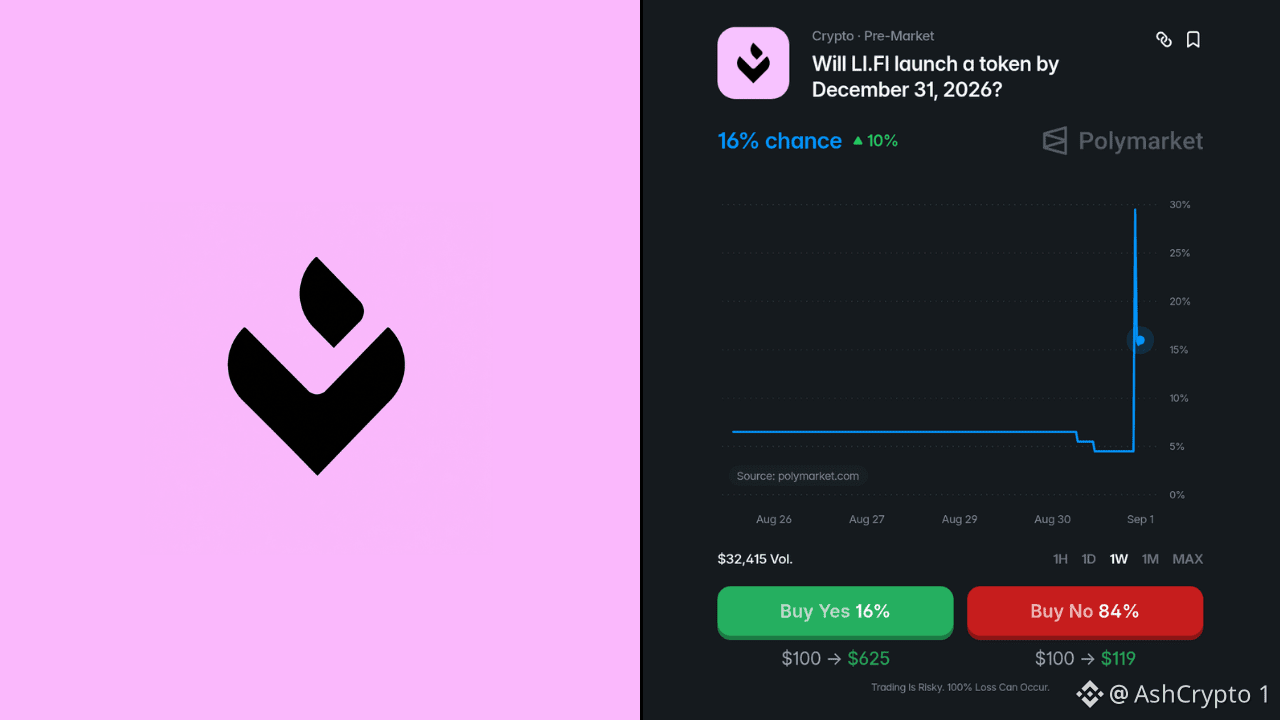
🚨 Is LI FI's token launch waking up?
Here's the plot twist. A chunk of the newest move on this chart has been funded through $HYPE , a sharper use of the coin than just holding it and hoping.
This thing sat near the bottom the entire stretch, then shot straight up out of nowhere right at the very end.
16% chance right now, up 10%, still the clear underdog, but that spike is the freshest thing on the whole chart.
$32,415 in volume means people are already paying attention.
I'm taking Yes, even as the underdog. A move this sudden after that much quiet usually means something just changed.
Exit anytime the read changes for you, no obligation to sit through the whole timeline.
Polymarket remains the cleanest way to cash in on a read this fresh, and $ARB tends to show up right alongside markets waking up like this one.
#Altcoin Season#
🚨 Is LI FI's token launch waking up?
Here's the plot twist. A chunk of the newest move on this chart has been funded through $HYPE , a sharper use of the coin than just holding it and hoping.
This thing sat near the bottom the entire stretch, then shot straight up out of nowhere right at the very end.
16% chance right now, up 10%, still the clear underdog, but that spike is the freshest thing on the whole chart.
$32,415 in volume means people are already paying attention.
I'm taking Yes, even as the underdog. A move this sudden after that much quiet usually means something just changed.
Exit anytime the read changes for you, no obligation to sit through the whole timeline.
Polymarket remains the cleanest way to cash in on a read this fresh, and $ARB tends to show up right alongside markets waking up like this one.
#Altcoin Season#
Here's the plot twist. A chunk of the newest move on this chart has been funded through $HYPE , a sharper use of the coin than just holding it and hoping.
This thing sat near the bottom the entire stretch, then shot straight up out of nowhere right at the very end.
16% chance right now, up 10%, still the clear underdog, but that spike is the freshest thing on the whole chart.
$32,415 in volume means people are already paying attention.
I'm taking Yes, even as the underdog. A move this sudden after that much quiet usually means something just changed.
Exit anytime the read changes for you, no obligation to sit through the whole timeline.
Polymarket remains the cleanest way to cash in on a read this fresh, and $ARB tends to show up right alongside markets waking up like this one.
#Altcoin Season#
58
·
--
Tərcüməyə bax
Your Prompt Is Readable While It Runs 🔐
Every model you use has to receive your prompt in the clear before it can answer.
A policy is the only thing stopping somebody from reading it at that point, and a policy is a promise rather than a mechanism.
An entire business got built on people being uncomfortable with that, and $VVV now runs inference that keeps nothing on file for around 3.5 million users at roughly 2 million calls a day.
$TAO sits further down the same stack, coordinating thousands of independent operators who run the models, and every one of those operators can see the job it is processing.
So the exposure is not really at the app layer at all.
Venice reaching that scale on a no-logging pitch tells you the demand is real.
It also shows where the ceiling is, because not storing a prompt and not reading a prompt are two different commitments.
The file gets deleted afterwards, and it was still readable while the work was happening.
That distinction is going to matter far more once agents start handling things people would never type into a chat window themselves.
Arcium moves the guarantee out of the policy and into the arithmetic.
A computation splits across a cluster of independent nodes, each node holds one fragment of the input, and none of them can reconstruct what was sent.
So the answer comes back correct and no machine in the chain ever held a readable copy of the question.
That has been live on Mainnet Alpha since February 2, with more than 4,000 nodes and over 30 apps running on it.
But Blackthorn is the AI protocol built on top of it and that has not shipped, so I am watching it rather than counting it.
A promise not to look is worth something, and a system that cannot look is worth a great deal more, which is why regulated DeFi and AI workloads will land on cryptography rather than on terms of service.
#AI #DeFi
Your Prompt Is Readable While It Runs 🔐
Every model you use has to receive your prompt in the clear before it can answer.
A policy is the only thing stopping somebody from reading it at that point, and a policy is a promise rather than a mechanism.
An entire business got built on people being uncomfortable with that, and $VVV now runs inference that keeps nothing on file for around 3.5 million users at roughly 2 million calls a day.
$TAO sits further down the same stack, coordinating thousands of independent operators who run the models, and every one of those operators can see the job it is processing.
So the exposure is not really at the app layer at all.
Venice reaching that scale on a no-logging pitch tells you the demand is real.
It also shows where the ceiling is, because not storing a prompt and not reading a prompt are two different commitments.
The file gets deleted afterwards, and it was still readable while the work was happening.
That distinction is going to matter far more once agents start handling things people would never type into a chat window themselves.
Arcium moves the guarantee out of the policy and into the arithmetic.
A computation splits across a cluster of independent nodes, each node holds one fragment of the input, and none of them can reconstruct what was sent.
So the answer comes back correct and no machine in the chain ever held a readable copy of the question.
That has been live on Mainnet Alpha since February 2, with more than 4,000 nodes and over 30 apps running on it.
But Blackthorn is the AI protocol built on top of it and that has not shipped, so I am watching it rather than counting it.
A promise not to look is worth something, and a system that cannot look is worth a great deal more, which is why regulated DeFi and AI workloads will land on cryptography rather than on terms of service.
#AI #DeFi
Every model you use has to receive your prompt in the clear before it can answer.
A policy is the only thing stopping somebody from reading it at that point, and a policy is a promise rather than a mechanism.
An entire business got built on people being uncomfortable with that, and $VVV now runs inference that keeps nothing on file for around 3.5 million users at roughly 2 million calls a day.
$TAO sits further down the same stack, coordinating thousands of independent operators who run the models, and every one of those operators can see the job it is processing.
So the exposure is not really at the app layer at all.
Venice reaching that scale on a no-logging pitch tells you the demand is real.
It also shows where the ceiling is, because not storing a prompt and not reading a prompt are two different commitments.
The file gets deleted afterwards, and it was still readable while the work was happening.
That distinction is going to matter far more once agents start handling things people would never type into a chat window themselves.
Arcium moves the guarantee out of the policy and into the arithmetic.
A computation splits across a cluster of independent nodes, each node holds one fragment of the input, and none of them can reconstruct what was sent.
So the answer comes back correct and no machine in the chain ever held a readable copy of the question.
That has been live on Mainnet Alpha since February 2, with more than 4,000 nodes and over 30 apps running on it.
But Blackthorn is the AI protocol built on top of it and that has not shipped, so I am watching it rather than counting it.
A promise not to look is worth something, and a system that cannot look is worth a great deal more, which is why regulated DeFi and AI workloads will land on cryptography rather than on terms of service.
#AI #DeFi
69
·
--
Tərcüməyə bax
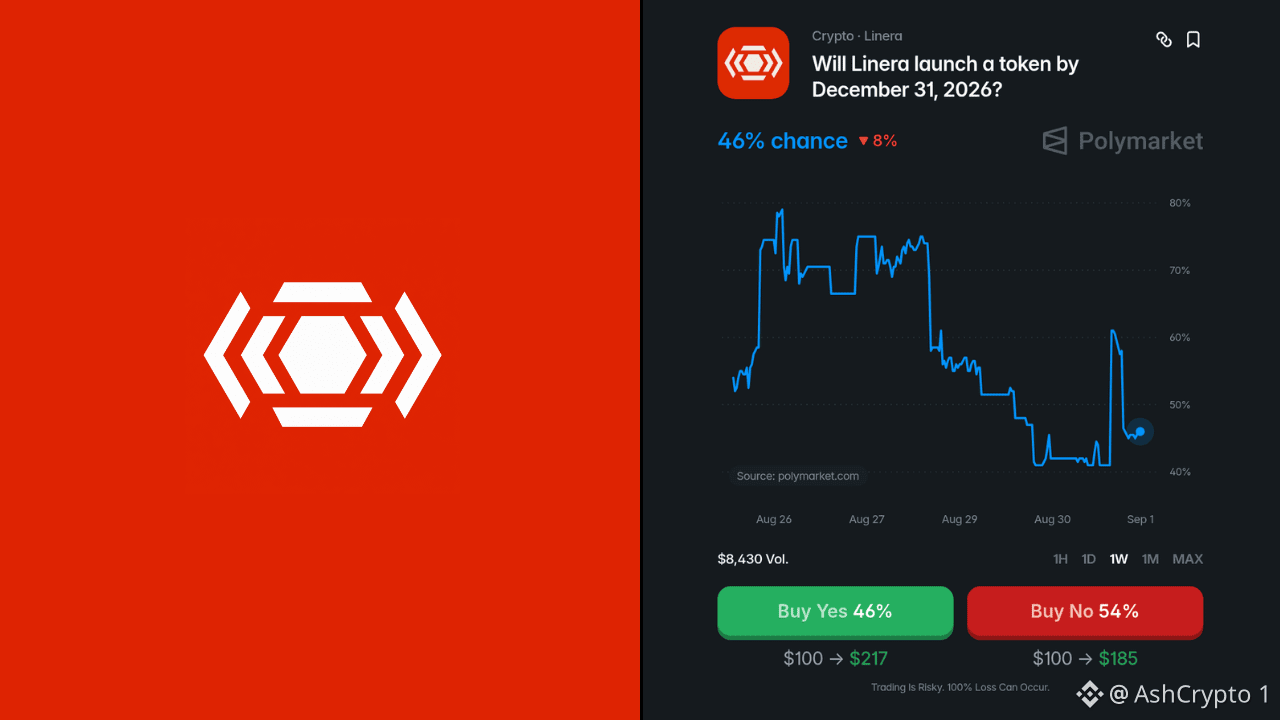
Will Linera launch its token in time? 🚨
This one had a real peak, all the way near 78%, and it's been a long slide down ever since.
46% chance right now, down 8%. It's still fairly quiet too, $8,430 in volume, which leaves room for this number to keep moving before more people catch on.
I'm taking No. A slide this long from a peak this high usually needs more than one small bounce to actually reverse.
$SOL has funded a chunk of this fade, and that's a sharper way to use the coin than just watching its chart do nothing.
$POL tends to show up right alongside it, its presence on this platform keeps climbing too.
Exit whenever you want on this one, you're never locked in until the actual date.
Polymarket remains one of the more reliable ways to profit from a read like this.
#Altcoin Season#
Will Linera launch its token in time? 🚨
This one had a real peak, all the way near 78%, and it's been a long slide down ever since.
46% chance right now, down 8%. It's still fairly quiet too, $8,430 in volume, which leaves room for this number to keep moving before more people catch on.
I'm taking No. A slide this long from a peak this high usually needs more than one small bounce to actually reverse.
$SOL has funded a chunk of this fade, and that's a sharper way to use the coin than just watching its chart do nothing.
$POL tends to show up right alongside it, its presence on this platform keeps climbing too.
Exit whenever you want on this one, you're never locked in until the actual date.
Polymarket remains one of the more reliable ways to profit from a read like this.
#Altcoin Season#
This one had a real peak, all the way near 78%, and it's been a long slide down ever since.
46% chance right now, down 8%. It's still fairly quiet too, $8,430 in volume, which leaves room for this number to keep moving before more people catch on.
I'm taking No. A slide this long from a peak this high usually needs more than one small bounce to actually reverse.
$SOL has funded a chunk of this fade, and that's a sharper way to use the coin than just watching its chart do nothing.
$POL tends to show up right alongside it, its presence on this platform keeps climbing too.
Exit whenever you want on this one, you're never locked in until the actual date.
Polymarket remains one of the more reliable ways to profit from a read like this.
#Altcoin Season#
66
·
--
Yeni $KAITO Katalyst Kampaniyaları Çatır Çatır Yayınlanır 🔥
Bu dəqiqə Kaito Katalyst-də yeni kampaniyaları canlı şəkildə izləyirəm, o cümlədən $MX-dən olan birini də. Etiraf edim ki, bunun mexanikası əvvəl gördüyüm əksər creator kampaniyalarından tamamilə fərqlidir.
Katalyst yaradıcılara (creators) sadəcə paylaşdığına görə yox, əslində sürdüyü nəticələrə görə ödəniş edir. Tweet üçün sabit məbləğ əvəzinə mükafatlar real nəticələrə uyğun hesablanır: məsələn, mindshare, kliklər, qeydiyyatlar, depozitlər və ya kampaniyanın qurulduğu platform fəaliyyətinə görə.
Bu da o deməkdir ki, ödəniş həqiqətən bir creator-un yaratdığı təsiri əks etdirir; hər kəsin, məzmunu təsir edib-etməməsindən asılı olmayaraq, eyni məbləği alması yox.
Creatorlar üçün başlamaq olduqca sadədir. Kaito Studio-ya daxil olursunuz, canlı kampaniyaları yoxlayırsınız və sizə uyğun olanlara müraciət edirsiniz. Daxil olanda brief-ə əsasən kontent yaradırsınız və mükafatlar kontentin doğurduğu real nəticələrlə birlikdə artır.
Mən bunu adi sabit tarifli razılaşmalardan daha çox bəyənirəm, çünki həqiqətən zəhmət çəkib real nişanlanma (engagement) və ya konversiya yaradan creator-lar ən çox ödəniş alanlar olur; sadəcə ən böyük izləyici kütləsinə malik olan yox.
Siz də creator kimi təsirinizə görə daha yaxşı şəkildə necə ödəniş ala biləcəyinizi axtarırsınızsa, indi Kaito Studio-da canlı Katalyst kampaniyalarına baxın.
#Altcoin Season# #Macro Insights#
Yeni $KAITO Katalyst Kampaniyaları Çatır Çatır Yayınlanır 🔥
Bu dəqiqə Kaito Katalyst-də yeni kampaniyaları canlı şəkildə izləyirəm, o cümlədən $MX-dən olan birini də. Etiraf edim ki, bunun mexanikası əvvəl gördüyüm əksər creator kampaniyalarından tamamilə fərqlidir.
Katalyst yaradıcılara (creators) sadəcə paylaşdığına görə yox, əslində sürdüyü nəticələrə görə ödəniş edir. Tweet üçün sabit məbləğ əvəzinə mükafatlar real nəticələrə uyğun hesablanır: məsələn, mindshare, kliklər, qeydiyyatlar, depozitlər və ya kampaniyanın qurulduğu platform fəaliyyətinə görə.
Bu da o deməkdir ki, ödəniş həqiqətən bir creator-un yaratdığı təsiri əks etdirir; hər kəsin, məzmunu təsir edib-etməməsindən asılı olmayaraq, eyni məbləği alması yox.
Creatorlar üçün başlamaq olduqca sadədir. Kaito Studio-ya daxil olursunuz, canlı kampaniyaları yoxlayırsınız və sizə uyğun olanlara müraciət edirsiniz. Daxil olanda brief-ə əsasən kontent yaradırsınız və mükafatlar kontentin doğurduğu real nəticələrlə birlikdə artır.
Mən bunu adi sabit tarifli razılaşmalardan daha çox bəyənirəm, çünki həqiqətən zəhmət çəkib real nişanlanma (engagement) və ya konversiya yaradan creator-lar ən çox ödəniş alanlar olur; sadəcə ən böyük izləyici kütləsinə malik olan yox.
Siz də creator kimi təsirinizə görə daha yaxşı şəkildə necə ödəniş ala biləcəyinizi axtarırsınızsa, indi Kaito Studio-da canlı Katalyst kampaniyalarına baxın.
#Altcoin Season# #Macro Insights#
Bu dəqiqə Kaito Katalyst-də yeni kampaniyaları canlı şəkildə izləyirəm, o cümlədən $MX-dən olan birini də. Etiraf edim ki, bunun mexanikası əvvəl gördüyüm əksər creator kampaniyalarından tamamilə fərqlidir.
Katalyst yaradıcılara (creators) sadəcə paylaşdığına görə yox, əslində sürdüyü nəticələrə görə ödəniş edir. Tweet üçün sabit məbləğ əvəzinə mükafatlar real nəticələrə uyğun hesablanır: məsələn, mindshare, kliklər, qeydiyyatlar, depozitlər və ya kampaniyanın qurulduğu platform fəaliyyətinə görə.
Bu da o deməkdir ki, ödəniş həqiqətən bir creator-un yaratdığı təsiri əks etdirir; hər kəsin, məzmunu təsir edib-etməməsindən asılı olmayaraq, eyni məbləği alması yox.
Creatorlar üçün başlamaq olduqca sadədir. Kaito Studio-ya daxil olursunuz, canlı kampaniyaları yoxlayırsınız və sizə uyğun olanlara müraciət edirsiniz. Daxil olanda brief-ə əsasən kontent yaradırsınız və mükafatlar kontentin doğurduğu real nəticələrlə birlikdə artır.
Mən bunu adi sabit tarifli razılaşmalardan daha çox bəyənirəm, çünki həqiqətən zəhmət çəkib real nişanlanma (engagement) və ya konversiya yaradan creator-lar ən çox ödəniş alanlar olur; sadəcə ən böyük izləyici kütləsinə malik olan yox.
Siz də creator kimi təsirinizə görə daha yaxşı şəkildə necə ödəniş ala biləcəyinizi axtarırsınızsa, indi Kaito Studio-da canlı Katalyst kampaniyalarına baxın.
#Altcoin Season# #Macro Insights#
81
·
--
Tərcüməyə bax
$52 $SUI Is Impossible.
Right up until…It Isn’t 👀
At roughly $0.73, Sui has a market cap near $2.97 billion.
A 72X move would put $SUI around $52.
That sounds completely ridiculous at first.
Now look at the actual valuation.
With approximately 4.07 billion tokens circulating, a $52 price would represent a market cap near $212 billion.
Against the maximum 10 billion supply, the fully diluted valuation would be roughly $520 billion.
That is an enormous valuation.
Reaching it would require Sui to become one of the most important networks in crypto.
But this is also an ecosystem that has already surpassed 5.8 billion total transactions across DeFi, payments, gaming and stablecoins.
I’m not pretending the supply disappears or that a 72X happens easily.
I’m asking whether a global financial network could eventually justify a global-scale valuation.
People called trillion-dollar crypto assets impossible once too.
The $52 scenario is aggressive, but the maths deserves a more serious conversation than immediate dismissal.
#Altcoin Season#
$52 $SUI Is Impossible.
Right up until…It Isn’t 👀
At roughly $0.73, Sui has a market cap near $2.97 billion.
A 72X move would put $SUI around $52.
That sounds completely ridiculous at first.
Now look at the actual valuation.
With approximately 4.07 billion tokens circulating, a $52 price would represent a market cap near $212 billion.
Against the maximum 10 billion supply, the fully diluted valuation would be roughly $520 billion.
That is an enormous valuation.
Reaching it would require Sui to become one of the most important networks in crypto.
But this is also an ecosystem that has already surpassed 5.8 billion total transactions across DeFi, payments, gaming and stablecoins.
I’m not pretending the supply disappears or that a 72X happens easily.
I’m asking whether a global financial network could eventually justify a global-scale valuation.
People called trillion-dollar crypto assets impossible once too.
The $52 scenario is aggressive, but the maths deserves a more serious conversation than immediate dismissal.
#Altcoin Season#
Right up until…It Isn’t 👀
At roughly $0.73, Sui has a market cap near $2.97 billion.
A 72X move would put $SUI around $52.
That sounds completely ridiculous at first.
Now look at the actual valuation.
With approximately 4.07 billion tokens circulating, a $52 price would represent a market cap near $212 billion.
Against the maximum 10 billion supply, the fully diluted valuation would be roughly $520 billion.
That is an enormous valuation.
Reaching it would require Sui to become one of the most important networks in crypto.
But this is also an ecosystem that has already surpassed 5.8 billion total transactions across DeFi, payments, gaming and stablecoins.
I’m not pretending the supply disappears or that a 72X happens easily.
I’m asking whether a global financial network could eventually justify a global-scale valuation.
People called trillion-dollar crypto assets impossible once too.
The $52 scenario is aggressive, but the maths deserves a more serious conversation than immediate dismissal.
#Altcoin Season#
73
·
--
Tərcüməyə bax
This Chart Just BOOMED 🔥
$ZORA spent most of August compressed inside a narrow range with limited momentum.
That all changed when their price broke higher around August 21 and established a new trading range above the previous base.
After several days of consolidation, the latest expansion pushed through the month’s local highs with a sharp increase in volume. Volume is important here because it shows the move attracted genuine market participation.
Vertical breakouts often cool once early traders take profit. The key signal now is whether buyers continue defending the higher range formed after the breakout.
Holding above the previous consolidation would suggest the market is accepting Zora at a higher valuation.
Falling completely back into the old range would weaken that interpretation and make the breakout look less established. I’ll watching how price and volume behave during this consolidation rather than focusing on the next candle.
From a structural perspective, the chart has moved from compression into expansion and is now testing whether that change can hold.
The market has become significantly more active, but the quality of the next consolidation will provide the clearest confirmation 🫡
#Altcoin Season#
This Chart Just BOOMED 🔥
$ZORA spent most of August compressed inside a narrow range with limited momentum.
That all changed when their price broke higher around August 21 and established a new trading range above the previous base.
After several days of consolidation, the latest expansion pushed through the month’s local highs with a sharp increase in volume. Volume is important here because it shows the move attracted genuine market participation.
Vertical breakouts often cool once early traders take profit. The key signal now is whether buyers continue defending the higher range formed after the breakout.
Holding above the previous consolidation would suggest the market is accepting Zora at a higher valuation.
Falling completely back into the old range would weaken that interpretation and make the breakout look less established. I’ll watching how price and volume behave during this consolidation rather than focusing on the next candle.
From a structural perspective, the chart has moved from compression into expansion and is now testing whether that change can hold.
The market has become significantly more active, but the quality of the next consolidation will provide the clearest confirmation 🫡
#Altcoin Season#
$ZORA spent most of August compressed inside a narrow range with limited momentum.
That all changed when their price broke higher around August 21 and established a new trading range above the previous base.
After several days of consolidation, the latest expansion pushed through the month’s local highs with a sharp increase in volume. Volume is important here because it shows the move attracted genuine market participation.
Vertical breakouts often cool once early traders take profit. The key signal now is whether buyers continue defending the higher range formed after the breakout.
Holding above the previous consolidation would suggest the market is accepting Zora at a higher valuation.
Falling completely back into the old range would weaken that interpretation and make the breakout look less established. I’ll watching how price and volume behave during this consolidation rather than focusing on the next candle.
From a structural perspective, the chart has moved from compression into expansion and is now testing whether that change can hold.
The market has become significantly more active, but the quality of the next consolidation will provide the clearest confirmation 🫡
#Altcoin Season#
49
Daha çox kontent araşdırmaq üçün daxil olun
Binance Square-də qlobal kriptovalyuta istifadəçilərinə qoşulun
⚡️ Kriptovalyuta haqqında ən son və faydalı məlumatları əldə edin.
💬 Dünyanın ən böyük kriptovalyuta birjası tərəfindən etibar edilir.
👍 Doğrulanmış yaradıcılardan gələn real məlumatları kəşf edin.
E-poçt/Telefon nömrəsi
Trenddə olan mövzular
AIStocksWhatNext
667,937 baxış
Müzakirə edir: 4,947
Trendləşən hashtag kampaniyamızda Paylaş və Qazan Trafik Mükafatı
✨ Mövzu: AI səhmələri yüksəlməyə davam etdikcə hansı digər investisiya imkanları hələ də qalır?
👉 Necə qoşulmaq:
#AIStocksWhatNext hashtagı ilə qısa post və ya məqalə dərc edin
Bəllə edin ki, siz boğasınız, yoxsa ayısınız, həm də AI səhm portfelinizi və ya treydinizi paylaşın — treyd widgetından istifadə uyğunluğunuzu artıra bilər.
Həmçinin məlumatlar və ya qrafiklər paylaşaraq postunuzu gücləndirə, AI tərəfindən yaradılmış şəkillərdən isə çəkinə bilərsiniz.
✍️ Aşağıdakı bucaqlara əsasən kontent yaradın:
- Nvidia deyir ki, çip satışları gələn il ikiqat olacaq və aparıcı AI şirkətləri rekord gəlir vurmağa davam edir — bunun arxasında dayanan hesablama xərci də həqiqətən heyrətamiz dərəcədə böyükdür. AI tələbi doğrudan da artır? Və bu nə qədər davam edə bilər? AI səhmələri bütün bazarda yüksəlib. Bu, real bir qırılma/breakout-dur, yoxsa sadəcə qısamüddətli sıçrayış?
- Sənaye liderləri AI inkişafını ləngitmək çağırışı edir, Trump isə gələcəkdə AI-nin ABŞ ÜDM-nin 25%-ni təşkil edə biləcəyini iddia edərək “AI Force” qurmaq planı haqqında danışır. Sizin tərəfiniz kim tərəfindədır? Dövlət səviyyəsində dəstək AI səhmələri üçün uzunmüddətli qazanc olacaqmı?
- Siz AI səhmələrini alırsınız? Trade paylaşma widgetımızla AI ilə bağlı treydinizi və ya portfelinizi paylaşın.
⏰ Kampaniya Dövrü:
- 2026-09-22 7:00 - 2026-09-24 4:00 UTC
🎁 Mükafat:
- Yuxarıdakı qaydalara uyğun gələn və 100-dən çox söz ehtiva edən ixtisaslı postlar nəzərdən keçiriləcək və 500-dən 3,000-ə qədər təsadüfi trafik artımı ala bilər. Postunuz seçilərsə, feed katibinizdən bildiriş alacaqsınız.
- Məqalənizin Binance Square Official-da nümayiş olunması üçün şans qazanın
Postunuz üçün ideyalar lazımdır? Mövzu səhifəsinə keçin #AIStocksWhatNext və ya Square Guide on How to Post for Better Reach.
Binance Square Official
·492 bəyənmə
·1.3M baxış
21SharesLaunchesEuropesFirstZcashETP
13,519 baxış
Müzakirə edir: 460
CardanoJoinsX402PaymentStandard
9,277 baxış
Müzakirə edir: 352