
000000000x
42 Paylaşımlar

000000000x
Şikayət et
İstifadəçini blokla
一个小目标
4 İzlənilir
1 İzləyicilər
1 Bəyəndi
Postlar
Hamısı
Videolar
·
--
Tərcüməyə bax
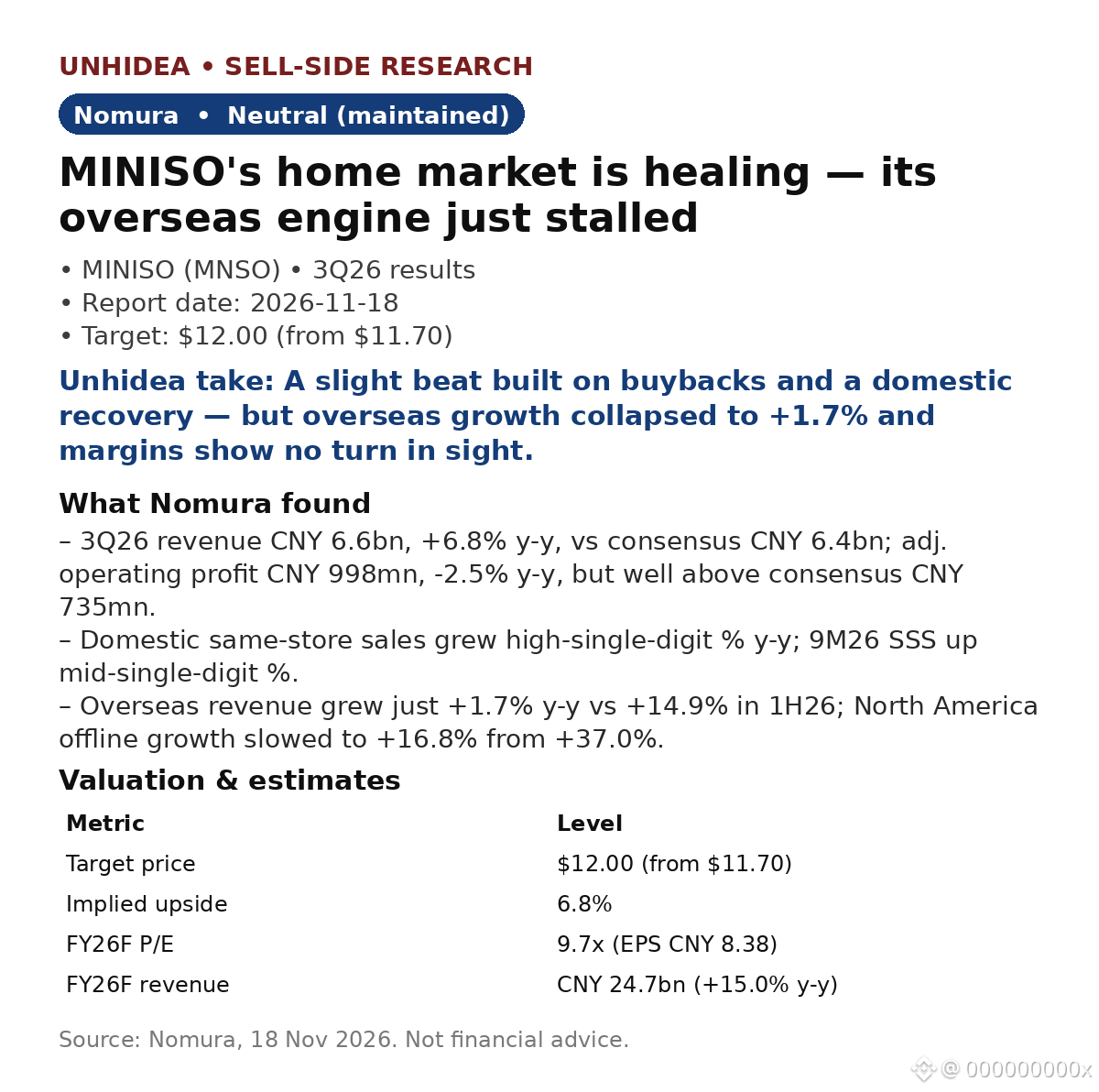
$MNSO: Nomura keeps Neutral — domestic recovery is real, but overseas growth just fell off a cliff
- 3Q26 revenue CNY 6.6bn, +6.8% y-y, ahead of consensus CNY 6.4bn; adj. operating profit CNY 998mn, -2.5% y-y but far above consensus CNY 735mn.
- Domestic same-store sales grew high-single-digit % y-y in 3Q26 (9M26: mid-single-digit %). The home market is healing.
- Overseas is the problem: revenue +1.7% y-y vs +14.9% in 1H26. North America offline growth slowed to +16.8% from +37.0%; overseas inventory hit 271 days (vs 212 a year ago).
- Margins: gross margin +0.6pp y-y, wiped out by sales & distribution costs +2.9pp y-y. Nomura sees no margin turnaround in 4Q26.
- Valuation: target $12.00 (from $11.70, 6.8% upside) at an unchanged 10.0x forward P/E; the stock trades at 9.7x FY26F P/E. FY26F revenue CNY 24.7bn, +15.0% y-y; FD normalized EPS CNY 8.38, -11.7% y-y.
Unhidea take: overseas was the growth story behind MINISO's premium — at +1.7% with 271 days of inventory, that story is on pause. Inventory ties up cash and forces discounting before it shows in margins.
Unhidea take: buybacks of >CNY 1bn (~4.5% of shares) are doing the heavy lifting while normalized EPS still falls 11.7% in FY26F. A cheap stock (9.7x) waiting for an overseas re-acceleration, not a turnaround yet.
Risks: domestic SSS slowdown, overseas uncertainty, intensifying competition.
Source: Nomura, 18 Nov 2026. Not financial advice.
$MNSO: Nomura keeps Neutral — domestic recovery is real, but overseas growth just fell off a cliff
- 3Q26 revenue CNY 6.6bn, +6.8% y-y, ahead of consensus CNY 6.4bn; adj. operating profit CNY 998mn, -2.5% y-y but far above consensus CNY 735mn.
- Domestic same-store sales grew high-single-digit % y-y in 3Q26 (9M26: mid-single-digit %). The home market is healing.
- Overseas is the problem: revenue +1.7% y-y vs +14.9% in 1H26. North America offline growth slowed to +16.8% from +37.0%; overseas inventory hit 271 days (vs 212 a year ago).
- Margins: gross margin +0.6pp y-y, wiped out by sales & distribution costs +2.9pp y-y. Nomura sees no margin turnaround in 4Q26.
- Valuation: target $12.00 (from $11.70, 6.8% upside) at an unchanged 10.0x forward P/E; the stock trades at 9.7x FY26F P/E. FY26F revenue CNY 24.7bn, +15.0% y-y; FD normalized EPS CNY 8.38, -11.7% y-y.
Unhidea take: overseas was the growth story behind MINISO's premium — at +1.7% with 271 days of inventory, that story is on pause. Inventory ties up cash and forces discounting before it shows in margins.
Unhidea take: buybacks of >CNY 1bn (~4.5% of shares) are doing the heavy lifting while normalized EPS still falls 11.7% in FY26F. A cheap stock (9.7x) waiting for an overseas re-acceleration, not a turnaround yet.
Risks: domestic SSS slowdown, overseas uncertainty, intensifying competition.
Source: Nomura, 18 Nov 2026. Not financial advice.
- 3Q26 revenue CNY 6.6bn, +6.8% y-y, ahead of consensus CNY 6.4bn; adj. operating profit CNY 998mn, -2.5% y-y but far above consensus CNY 735mn.
- Domestic same-store sales grew high-single-digit % y-y in 3Q26 (9M26: mid-single-digit %). The home market is healing.
- Overseas is the problem: revenue +1.7% y-y vs +14.9% in 1H26. North America offline growth slowed to +16.8% from +37.0%; overseas inventory hit 271 days (vs 212 a year ago).
- Margins: gross margin +0.6pp y-y, wiped out by sales & distribution costs +2.9pp y-y. Nomura sees no margin turnaround in 4Q26.
- Valuation: target $12.00 (from $11.70, 6.8% upside) at an unchanged 10.0x forward P/E; the stock trades at 9.7x FY26F P/E. FY26F revenue CNY 24.7bn, +15.0% y-y; FD normalized EPS CNY 8.38, -11.7% y-y.
Unhidea take: overseas was the growth story behind MINISO's premium — at +1.7% with 271 days of inventory, that story is on pause. Inventory ties up cash and forces discounting before it shows in margins.
Unhidea take: buybacks of >CNY 1bn (~4.5% of shares) are doing the heavy lifting while normalized EPS still falls 11.7% in FY26F. A cheap stock (9.7x) waiting for an overseas re-acceleration, not a turnaround yet.
Risks: domestic SSS slowdown, overseas uncertainty, intensifying competition.
Source: Nomura, 18 Nov 2026. Not financial advice.
MNSOUS-0,21%
12
·
--
Tərcüməyə bax
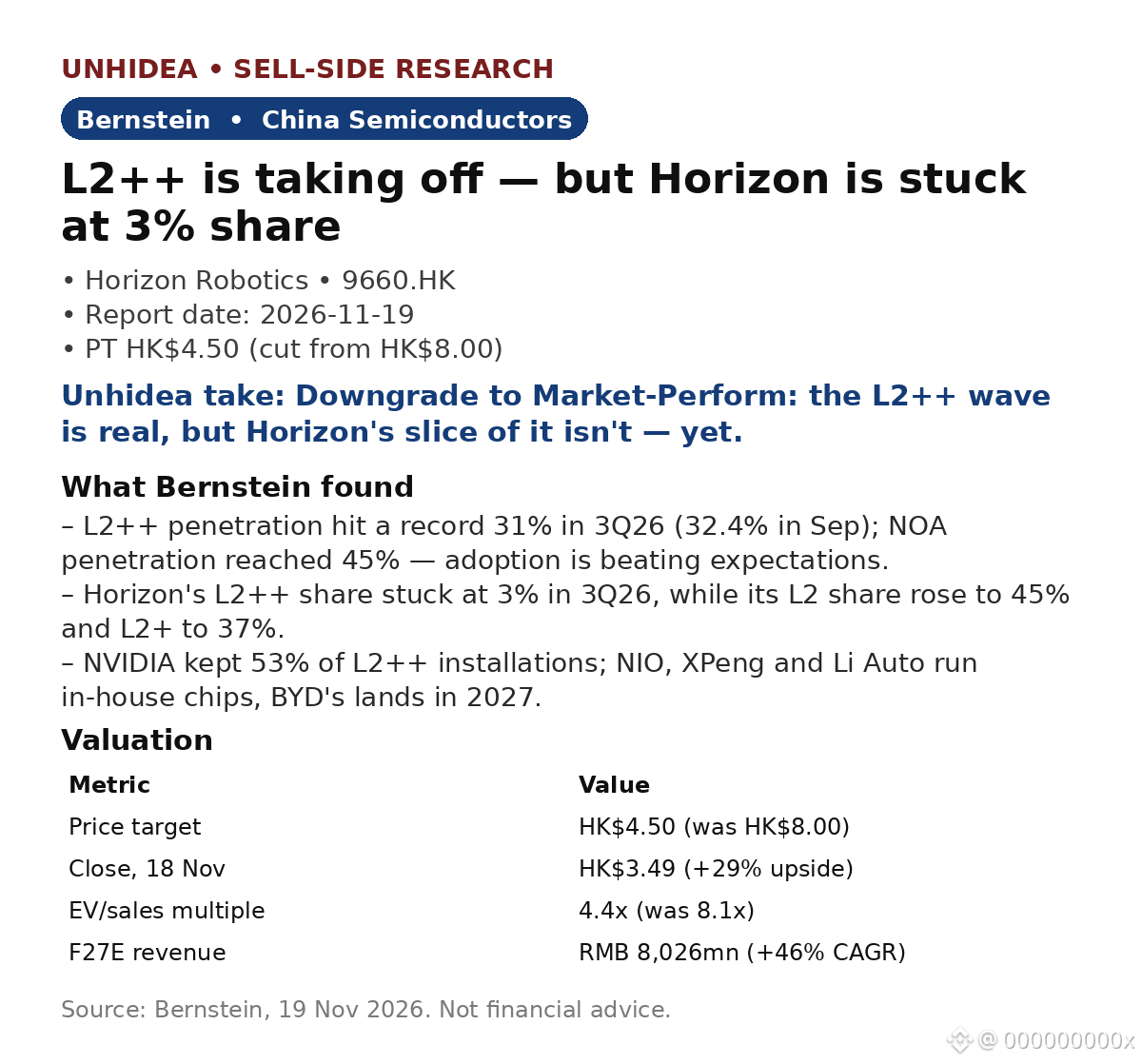
$9660.HK: Bernstein downgrades Horizon Robotics to Market-Perform, PT slashed HK$8.00 → HK$4.50 — L2++ is booming, but Horizon is missing it
- The wave is real: L2++ penetration hit a record 31% in 3Q26 (32.4% in September) and NOA reached 45% — adoption is running ahead of Bernstein's expectations.
- Horizon's slice isn't: its L2++ share stayed at 3% in 3Q26, even as L2 share rose to 45% and L2+ to 37%. Design wins and HSD-model sales keep missing.
- The squeeze: NVIDIA held 53% of L2++ installations in 3Q26; NIO, XPeng and Li Auto already run in-house chips, BYD's lands in 2027 and Chery is building its own.
- Headwinds on both sides: China PV sales fell 25% YoY in 3Q26, and Horizon is shifting toward a lower-visibility Licensing & Services model.
- Valuation: PT HK$4.50 is +29% vs the HK$3.49 close (18 Nov), on 4.4x EV/sales (was 8.1x) applied to 2BF revenue of RMB11.8bn. F27E revenue RMB8,026mn (+46.1% CAGR) — growth is not the problem, share is.
Unhidea take: the report frames this as a Horizon problem, but 31% penetration with NVIDIA at 53% says the merchant-chip race is consolidating around the incumbent — for every other merchant supplier, share is now won or lost at the OEM's in-house decision.
Unhidea take: if BYD's in-house SoC lands in 2027 as planned, Horizon's two key accounts (BYD, VW) become the whole thesis — watch design-win announcements, not quarterly revenue, as the leading indicator.
Risks: OEM in-house chips, weak China auto cycle, L2++ design-win conversion, licensing-model visibility.
Source: Bernstein, 19 Nov 2026. Not financial advice.
$9660.HK: Bernstein downgrades Horizon Robotics to Market-Perform, PT slashed HK$8.00 → HK$4.50 — L2++ is booming, but Horizon is missing it
- The wave is real: L2++ penetration hit a record 31% in 3Q26 (32.4% in September) and NOA reached 45% — adoption is running ahead of Bernstein's expectations.
- Horizon's slice isn't: its L2++ share stayed at 3% in 3Q26, even as L2 share rose to 45% and L2+ to 37%. Design wins and HSD-model sales keep missing.
- The squeeze: NVIDIA held 53% of L2++ installations in 3Q26; NIO, XPeng and Li Auto already run in-house chips, BYD's lands in 2027 and Chery is building its own.
- Headwinds on both sides: China PV sales fell 25% YoY in 3Q26, and Horizon is shifting toward a lower-visibility Licensing & Services model.
- Valuation: PT HK$4.50 is +29% vs the HK$3.49 close (18 Nov), on 4.4x EV/sales (was 8.1x) applied to 2BF revenue of RMB11.8bn. F27E revenue RMB8,026mn (+46.1% CAGR) — growth is not the problem, share is.
Unhidea take: the report frames this as a Horizon problem, but 31% penetration with NVIDIA at 53% says the merchant-chip race is consolidating around the incumbent — for every other merchant supplier, share is now won or lost at the OEM's in-house decision.
Unhidea take: if BYD's in-house SoC lands in 2027 as planned, Horizon's two key accounts (BYD, VW) become the whole thesis — watch design-win announcements, not quarterly revenue, as the leading indicator.
Risks: OEM in-house chips, weak China auto cycle, L2++ design-win conversion, licensing-model visibility.
Source: Bernstein, 19 Nov 2026. Not financial advice.
- The wave is real: L2++ penetration hit a record 31% in 3Q26 (32.4% in September) and NOA reached 45% — adoption is running ahead of Bernstein's expectations.
- Horizon's slice isn't: its L2++ share stayed at 3% in 3Q26, even as L2 share rose to 45% and L2+ to 37%. Design wins and HSD-model sales keep missing.
- The squeeze: NVIDIA held 53% of L2++ installations in 3Q26; NIO, XPeng and Li Auto already run in-house chips, BYD's lands in 2027 and Chery is building its own.
- Headwinds on both sides: China PV sales fell 25% YoY in 3Q26, and Horizon is shifting toward a lower-visibility Licensing & Services model.
- Valuation: PT HK$4.50 is +29% vs the HK$3.49 close (18 Nov), on 4.4x EV/sales (was 8.1x) applied to 2BF revenue of RMB11.8bn. F27E revenue RMB8,026mn (+46.1% CAGR) — growth is not the problem, share is.
Unhidea take: the report frames this as a Horizon problem, but 31% penetration with NVIDIA at 53% says the merchant-chip race is consolidating around the incumbent — for every other merchant supplier, share is now won or lost at the OEM's in-house decision.
Unhidea take: if BYD's in-house SoC lands in 2027 as planned, Horizon's two key accounts (BYD, VW) become the whole thesis — watch design-win announcements, not quarterly revenue, as the leading indicator.
Risks: OEM in-house chips, weak China auto cycle, L2++ design-win conversion, licensing-model visibility.
Source: Bernstein, 19 Nov 2026. Not financial advice.
NVDA-4,14%
LIUS-1,17%
126
·
--
Tərcüməyə bax
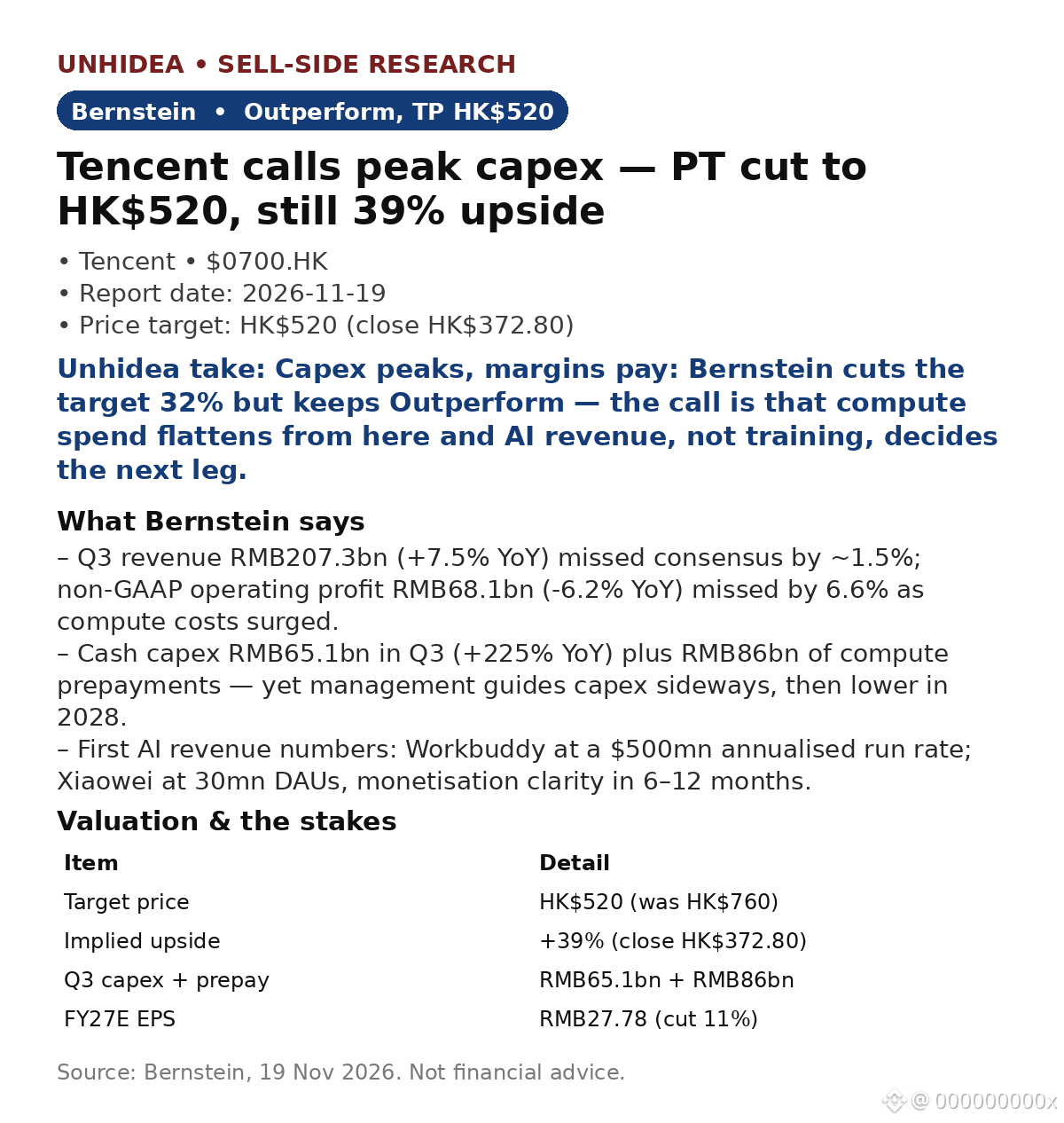
$0700.HK: Tencent calls peak capex — Bernstein keeps Outperform, PT HK$520 (cut from HK$760)
- Q3 revenue RMB207.3bn (+7.5% YoY), ~1.5% below consensus; non-GAAP operating profit RMB68.1bn (-6.2% YoY), 6.6% below consensus — compute costs did the damage.
- Capex is the story: RMB65.1bn in Q3 (+225% YoY) plus RMB86bn of compute prepayments — yet management says capex tracks sideways, then falls in 2028. Bernstein: the second name after Sony to call hardware costs unsustainable.
- The bill: bandwidth & server costs +132% YoY, non-staff R&D +152%. Ads still +18.8% to RMB43.0bn, gaming +4.6% to RMB66.5bn, FBS +9.4% to RMB63.7bn. Core operating profit ex-AI spend +8% to RMB83.3bn.
- First AI revenue numbers: Workbuddy at a $500mn annualised run rate; Xiaowei at 30mn DAUs, monetisation in 6–12 months. US chip curbs delay training, not inference revenue, Bernstein says.
- Valuation: PT HK$520 is +39% vs the HK$372.80 close (18 Nov), near the HK$370 52-week low, on ~11x trailing earnings after a 38% YTD slide; FY27E EPS cut 11% to RMB27.78.
Unhidea take: peak capex is the debate beyond Tencent — if a buyer of this scale flattens spend, the AI hardware cycle's duration is the question.
Unhidea take: Tencent trades at ~11x while the AI option is unpriced — Workbuddy and Xiaowei are the first hard numbers; if monetisation lands, Bernstein's 16x FY+1 multiple is the re-rating path.
Risks: US chip curbs, China macro, gaming comps, AI monetisation timing.
Source: Bernstein, 19 Nov 2026. Not financial advice.
$0700.HK: Tencent calls peak capex — Bernstein keeps Outperform, PT HK$520 (cut from HK$760)
- Q3 revenue RMB207.3bn (+7.5% YoY), ~1.5% below consensus; non-GAAP operating profit RMB68.1bn (-6.2% YoY), 6.6% below consensus — compute costs did the damage.
- Capex is the story: RMB65.1bn in Q3 (+225% YoY) plus RMB86bn of compute prepayments — yet management says capex tracks sideways, then falls in 2028. Bernstein: the second name after Sony to call hardware costs unsustainable.
- The bill: bandwidth & server costs +132% YoY, non-staff R&D +152%. Ads still +18.8% to RMB43.0bn, gaming +4.6% to RMB66.5bn, FBS +9.4% to RMB63.7bn. Core operating profit ex-AI spend +8% to RMB83.3bn.
- First AI revenue numbers: Workbuddy at a $500mn annualised run rate; Xiaowei at 30mn DAUs, monetisation in 6–12 months. US chip curbs delay training, not inference revenue, Bernstein says.
- Valuation: PT HK$520 is +39% vs the HK$372.80 close (18 Nov), near the HK$370 52-week low, on ~11x trailing earnings after a 38% YTD slide; FY27E EPS cut 11% to RMB27.78.
Unhidea take: peak capex is the debate beyond Tencent — if a buyer of this scale flattens spend, the AI hardware cycle's duration is the question.
Unhidea take: Tencent trades at ~11x while the AI option is unpriced — Workbuddy and Xiaowei are the first hard numbers; if monetisation lands, Bernstein's 16x FY+1 multiple is the re-rating path.
Risks: US chip curbs, China macro, gaming comps, AI monetisation timing.
Source: Bernstein, 19 Nov 2026. Not financial advice.
- Q3 revenue RMB207.3bn (+7.5% YoY), ~1.5% below consensus; non-GAAP operating profit RMB68.1bn (-6.2% YoY), 6.6% below consensus — compute costs did the damage.
- Capex is the story: RMB65.1bn in Q3 (+225% YoY) plus RMB86bn of compute prepayments — yet management says capex tracks sideways, then falls in 2028. Bernstein: the second name after Sony to call hardware costs unsustainable.
- The bill: bandwidth & server costs +132% YoY, non-staff R&D +152%. Ads still +18.8% to RMB43.0bn, gaming +4.6% to RMB66.5bn, FBS +9.4% to RMB63.7bn. Core operating profit ex-AI spend +8% to RMB83.3bn.
- First AI revenue numbers: Workbuddy at a $500mn annualised run rate; Xiaowei at 30mn DAUs, monetisation in 6–12 months. US chip curbs delay training, not inference revenue, Bernstein says.
- Valuation: PT HK$520 is +39% vs the HK$372.80 close (18 Nov), near the HK$370 52-week low, on ~11x trailing earnings after a 38% YTD slide; FY27E EPS cut 11% to RMB27.78.
Unhidea take: peak capex is the debate beyond Tencent — if a buyer of this scale flattens spend, the AI hardware cycle's duration is the question.
Unhidea take: Tencent trades at ~11x while the AI option is unpriced — Workbuddy and Xiaowei are the first hard numbers; if monetisation lands, Bernstein's 16x FY+1 multiple is the re-rating path.
Risks: US chip curbs, China macro, gaming comps, AI monetisation timing.
Source: Bernstein, 19 Nov 2026. Not financial advice.
114
·
--
Tərcüməyə bax
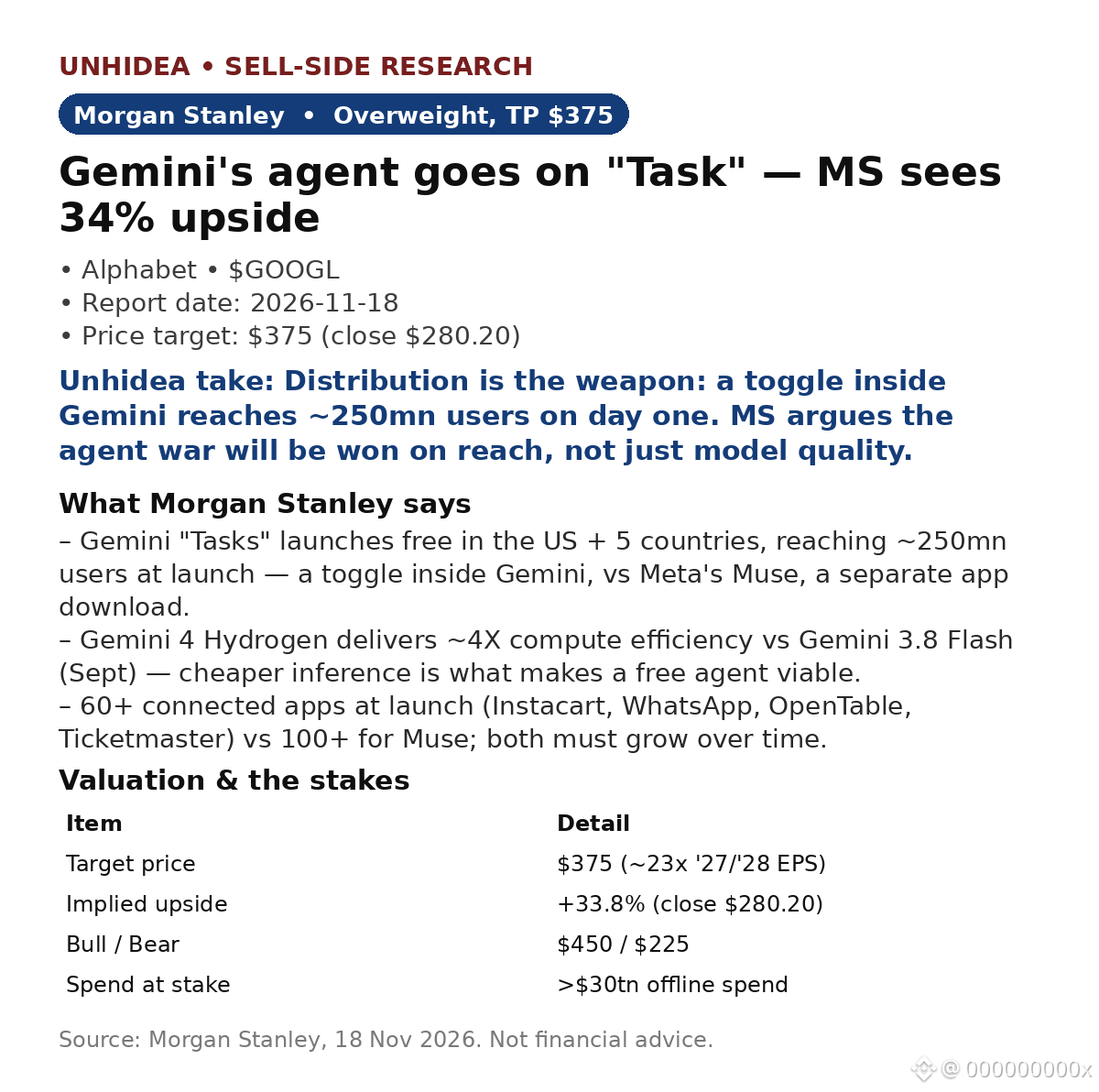
$GOOGL: Gemini's agent is now on "Task" — Morgan Stanley keeps Overweight, TP $375 (+34% vs $280.20 close on 17 Nov)
- "Tasks" rolls out free in the US + 5 countries to ~250mn users — a toggle inside Gemini (1bn+ MAUs), no download. Meta's Muse is a separate app with ~12mn MAUs (third-party data).
- Gemini 4 Hydrogen delivers ~4X compute efficiency vs Gemini 3.8 Flash (Sept). Meta targets a 10X cost gain for Muse in '27 — efficiency decides who can afford a free agent.
- 60+ connected apps at launch (Instacart, WhatsApp, OpenTable) vs 100+ for Muse. MS: agents that scale first win more business adoption — that favours Google.
- The catch: search monetizes ~20–40% of transaction value vs low-single-digit agentic commissions. If Tasks shifts queries without adding spend, it eats Google's best margin.
- MS sees >$30tn of offline spend up for grabs; bull $450, bear $225. Shares +0.8% to $282.44 on 18 Nov (post-report, Finnhub), ~31% below the $408.61 high.
Unhidea take: the agent war is a distribution war — a toggle in front of a billion users beats a download. The test is whether Tasks becomes a habit or a demo.
Unhidea take: watch search, not Tasks. If agentic shopping grows while search slows, the multiple compresses — MS's $375 assumes search stays durable.
Risks: search cannibalization, Meta/Amazon competition, AI capex/ROIC, regulation.
Source: Morgan Stanley, 18 Nov 2026. Not financial advice.
$GOOGL : Gemini's agent is now on "Task" — Morgan Stanley keeps Overweight, TP $375 (+34% vs $280.20 close on 17 Nov)
- "Tasks" rolls out free in the US + 5 countries to ~250mn users — a toggle inside Gemini (1bn+ MAUs), no download. Meta's Muse is a separate app with ~12mn MAUs (third-party data).
- Gemini 4 Hydrogen delivers ~4X compute efficiency vs Gemini 3.8 Flash (Sept). Meta targets a 10X cost gain for Muse in '27 — efficiency decides who can afford a free agent.
- 60+ connected apps at launch (Instacart, WhatsApp, OpenTable) vs 100+ for Muse. MS: agents that scale first win more business adoption — that favours Google.
- The catch: search monetizes ~20–40% of transaction value vs low-single-digit agentic commissions. If Tasks shifts queries without adding spend, it eats Google's best margin.
- MS sees >$30tn of offline spend up for grabs; bull $450, bear $225. Shares +0.8% to $282.44 on 18 Nov (post-report, Finnhub), ~31% below the $408.61 high.
Unhidea take: the agent war is a distribution war — a toggle in front of a billion users beats a download. The test is whether Tasks becomes a habit or a demo.
Unhidea take: watch search, not Tasks. If agentic shopping grows while search slows, the multiple compresses — MS's $375 assumes search stays durable.
Risks: search cannibalization, Meta/Amazon competition, AI capex/ROIC, regulation.
Source: Morgan Stanley, 18 Nov 2026. Not financial advice.
- "Tasks" rolls out free in the US + 5 countries to ~250mn users — a toggle inside Gemini (1bn+ MAUs), no download. Meta's Muse is a separate app with ~12mn MAUs (third-party data).
- Gemini 4 Hydrogen delivers ~4X compute efficiency vs Gemini 3.8 Flash (Sept). Meta targets a 10X cost gain for Muse in '27 — efficiency decides who can afford a free agent.
- 60+ connected apps at launch (Instacart, WhatsApp, OpenTable) vs 100+ for Muse. MS: agents that scale first win more business adoption — that favours Google.
- The catch: search monetizes ~20–40% of transaction value vs low-single-digit agentic commissions. If Tasks shifts queries without adding spend, it eats Google's best margin.
- MS sees >$30tn of offline spend up for grabs; bull $450, bear $225. Shares +0.8% to $282.44 on 18 Nov (post-report, Finnhub), ~31% below the $408.61 high.
Unhidea take: the agent war is a distribution war — a toggle in front of a billion users beats a download. The test is whether Tasks becomes a habit or a demo.
Unhidea take: watch search, not Tasks. If agentic shopping grows while search slows, the multiple compresses — MS's $375 assumes search stays durable.
Risks: search cannibalization, Meta/Amazon competition, AI capex/ROIC, regulation.
Source: Morgan Stanley, 18 Nov 2026. Not financial advice.
89
·
--
Tərcüməyə bax
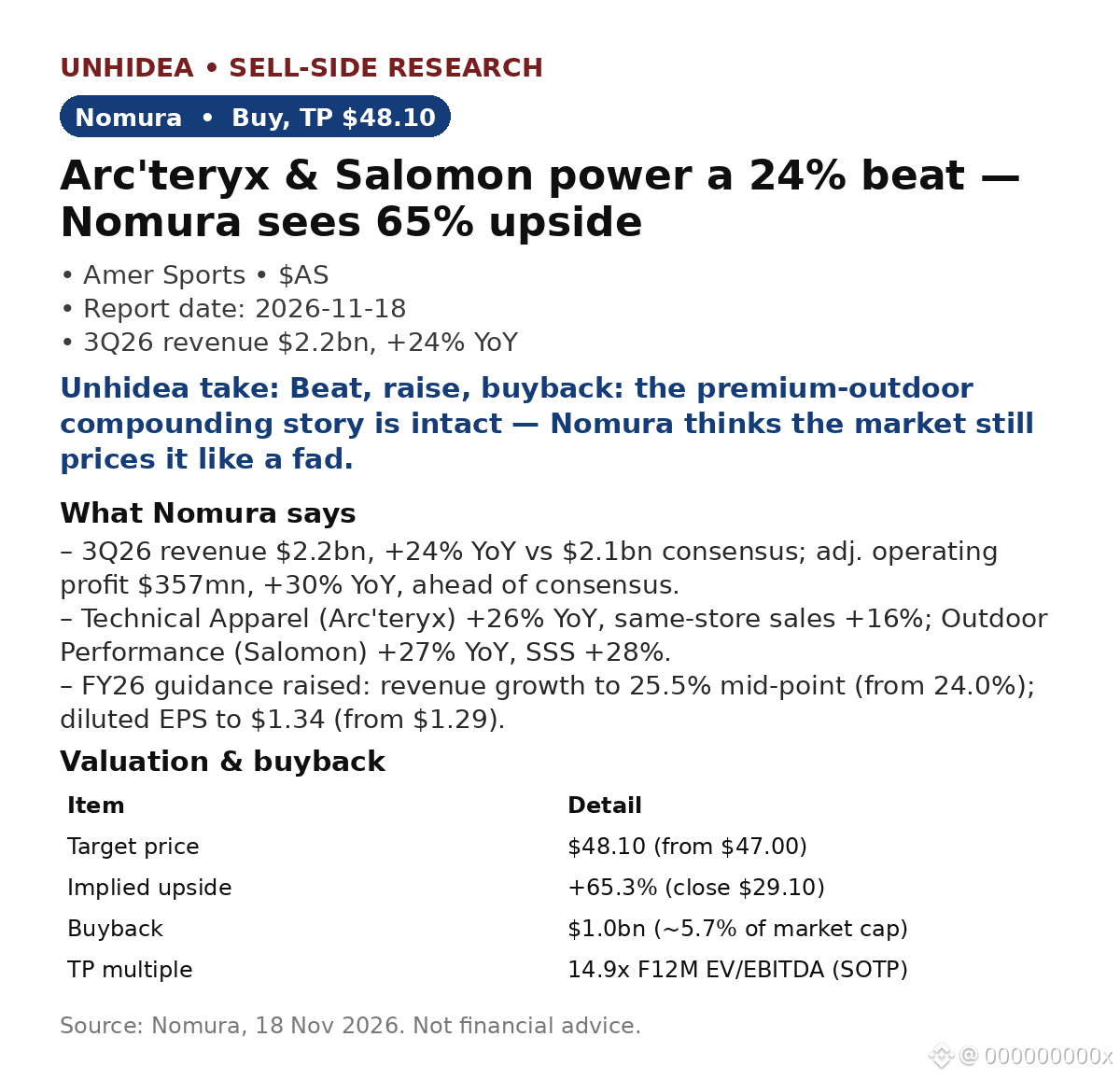
$AS: Arc'teryx & Salomon power a 24% beat — Nomura reiterates Buy, TP $48.10 (+65% upside)
- 3Q26 revenue $2.2bn, +24% YoY, vs $2.1bn consensus. Adj. operating profit $357mn, +30% YoY, ahead of consensus. Adj. EPS $0.42 vs $0.35 expected.
- Technical Apparel (Arc'teryx) +26% YoY, same-store sales +16%; Outdoor Performance (Salomon) +27% YoY, SSS +28%. Ball & Racquet +12%, but margin fell 2.1pp on Wilson investment.
- Guidance raised: FY26 revenue growth to 25.5% (from 24.0%); diluted EPS to $1.34 (from $1.29). A $1bn buyback (~5.7% of market cap) adds a floor.
- Shares +3.9% to $30.24 on 17 Nov while the S&P fell ~1%, then +2.3% to $30.95 on 18 Nov (post-report market data). SOTP target implies 14.9x forward EV/EBITDA.
Unhidea take: two brands growing 26–27% with DTC pricing power, plus a buyback floor — the market still prices Amer like a cyclical retailer; Nomura's 65% upside says brand platform.
Unhidea take: the Street is split — UBS cut its target to $56, Nomura holds $48.10, both Buy. That gap is the debate: what multiple for a 25% grower at 59.3% gross margin?
Risks: Wilson drag, DTC execution, tariffs/FX, premium-consumer slowdown.
Source: Nomura, 18 Nov 2026. Post-report prices: Finnhub/market data. Not financial advice.
$AS: Arc'teryx & Salomon power a 24% beat — Nomura reiterates Buy, TP $48.10 (+65% upside)
- 3Q26 revenue $2.2bn, +24% YoY, vs $2.1bn consensus. Adj. operating profit $357mn, +30% YoY, ahead of consensus. Adj. EPS $0.42 vs $0.35 expected.
- Technical Apparel (Arc'teryx) +26% YoY, same-store sales +16%; Outdoor Performance (Salomon) +27% YoY, SSS +28%. Ball & Racquet +12%, but margin fell 2.1pp on Wilson investment.
- Guidance raised: FY26 revenue growth to 25.5% (from 24.0%); diluted EPS to $1.34 (from $1.29). A $1bn buyback (~5.7% of market cap) adds a floor.
- Shares +3.9% to $30.24 on 17 Nov while the S&P fell ~1%, then +2.3% to $30.95 on 18 Nov (post-report market data). SOTP target implies 14.9x forward EV/EBITDA.
Unhidea take: two brands growing 26–27% with DTC pricing power, plus a buyback floor — the market still prices Amer like a cyclical retailer; Nomura's 65% upside says brand platform.
Unhidea take: the Street is split — UBS cut its target to $56, Nomura holds $48.10, both Buy. That gap is the debate: what multiple for a 25% grower at 59.3% gross margin?
Risks: Wilson drag, DTC execution, tariffs/FX, premium-consumer slowdown.
Source: Nomura, 18 Nov 2026. Post-report prices: Finnhub/market data. Not financial advice.
- 3Q26 revenue $2.2bn, +24% YoY, vs $2.1bn consensus. Adj. operating profit $357mn, +30% YoY, ahead of consensus. Adj. EPS $0.42 vs $0.35 expected.
- Technical Apparel (Arc'teryx) +26% YoY, same-store sales +16%; Outdoor Performance (Salomon) +27% YoY, SSS +28%. Ball & Racquet +12%, but margin fell 2.1pp on Wilson investment.
- Guidance raised: FY26 revenue growth to 25.5% (from 24.0%); diluted EPS to $1.34 (from $1.29). A $1bn buyback (~5.7% of market cap) adds a floor.
- Shares +3.9% to $30.24 on 17 Nov while the S&P fell ~1%, then +2.3% to $30.95 on 18 Nov (post-report market data). SOTP target implies 14.9x forward EV/EBITDA.
Unhidea take: two brands growing 26–27% with DTC pricing power, plus a buyback floor — the market still prices Amer like a cyclical retailer; Nomura's 65% upside says brand platform.
Unhidea take: the Street is split — UBS cut its target to $56, Nomura holds $48.10, both Buy. That gap is the debate: what multiple for a 25% grower at 59.3% gross margin?
Risks: Wilson drag, DTC execution, tariffs/FX, premium-consumer slowdown.
Source: Nomura, 18 Nov 2026. Post-report prices: Finnhub/market data. Not financial advice.
ASUS-0,25%
75
·
--
Tərcüməyə bax
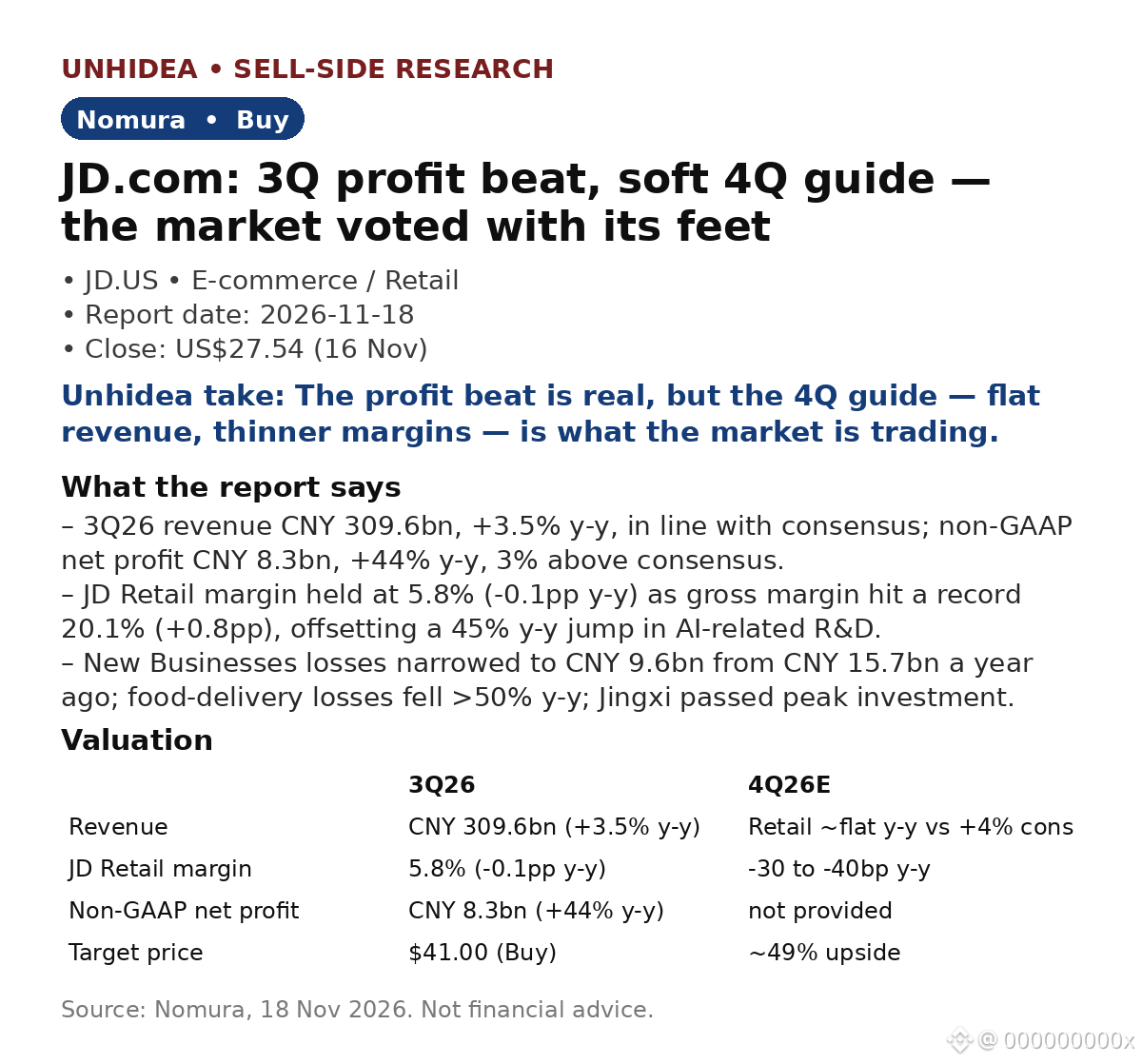
JD.com ($JD): Nomura stays Buy at $41 — a 3Q profit beat, a soft 4Q guide, and a market that voted with its feet
- 3Q26 revenue CNY 309.6bn, +3.5% y-y, in line; non-GAAP net profit CNY 8.3bn, +44% y-y, 3% above consensus; non-GAAP op profit CNY 7.3bn, 15% above consensus.
- JD Retail held a 5.8% margin (-0.1pp y-y); gross margin hit a record 20.1% (+0.8pp), offsetting a 45% y-y jump in AI R&D.
- New Businesses losses narrowed to CNY 9.6bn from CNY 15.7bn a year ago; food-delivery losses fell >50% y-y.
- But 4Q looks soft: JD Retail revenue seen flat y-y vs +4% consensus; margin -30 to -40bp y-y vs -10bp expected.
- Valuation: the $41 target implies 8.5x FY27E P/E vs 5.7x now — ~49% upside vs the $27.54 close on 16 Nov.
Unhidea take: the beat is real but backward-looking — the market is pricing the 4Q guide, not the 3Q print.
Unhidea take: JD's story is now margin discipline, not growth — shrinking losses matter more than a flat top line.
Market reaction: shares fell 7.7% on 17 Nov to $25.43, then 2.0% more on 18 Nov to $24.92 (Finnhub).
Risks: weak consumption; competition; CECONYOMY integration (deal closed 12 Nov).
Source: Nomura, 18 Nov 2026. Not financial advice.
JD.com ($JD): Nomura stays Buy at $41 — a 3Q profit beat, a soft 4Q guide, and a market that voted with its feet
- 3Q26 revenue CNY 309.6bn, +3.5% y-y, in line; non-GAAP net profit CNY 8.3bn, +44% y-y, 3% above consensus; non-GAAP op profit CNY 7.3bn, 15% above consensus.
- JD Retail held a 5.8% margin (-0.1pp y-y); gross margin hit a record 20.1% (+0.8pp), offsetting a 45% y-y jump in AI R&D.
- New Businesses losses narrowed to CNY 9.6bn from CNY 15.7bn a year ago; food-delivery losses fell >50% y-y.
- But 4Q looks soft: JD Retail revenue seen flat y-y vs +4% consensus; margin -30 to -40bp y-y vs -10bp expected.
- Valuation: the $41 target implies 8.5x FY27E P/E vs 5.7x now — ~49% upside vs the $27.54 close on 16 Nov.
Unhidea take: the beat is real but backward-looking — the market is pricing the 4Q guide, not the 3Q print.
Unhidea take: JD's story is now margin discipline, not growth — shrinking losses matter more than a flat top line.
Market reaction: shares fell 7.7% on 17 Nov to $25.43, then 2.0% more on 18 Nov to $24.92 (Finnhub).
Risks: weak consumption; competition; CECONYOMY integration (deal closed 12 Nov).
Source: Nomura, 18 Nov 2026. Not financial advice.
- 3Q26 revenue CNY 309.6bn, +3.5% y-y, in line; non-GAAP net profit CNY 8.3bn, +44% y-y, 3% above consensus; non-GAAP op profit CNY 7.3bn, 15% above consensus.
- JD Retail held a 5.8% margin (-0.1pp y-y); gross margin hit a record 20.1% (+0.8pp), offsetting a 45% y-y jump in AI R&D.
- New Businesses losses narrowed to CNY 9.6bn from CNY 15.7bn a year ago; food-delivery losses fell >50% y-y.
- But 4Q looks soft: JD Retail revenue seen flat y-y vs +4% consensus; margin -30 to -40bp y-y vs -10bp expected.
- Valuation: the $41 target implies 8.5x FY27E P/E vs 5.7x now — ~49% upside vs the $27.54 close on 16 Nov.
Unhidea take: the beat is real but backward-looking — the market is pricing the 4Q guide, not the 3Q print.
Unhidea take: JD's story is now margin discipline, not growth — shrinking losses matter more than a flat top line.
Market reaction: shares fell 7.7% on 17 Nov to $25.43, then 2.0% more on 18 Nov to $24.92 (Finnhub).
Risks: weak consumption; competition; CECONYOMY integration (deal closed 12 Nov).
Source: Nomura, 18 Nov 2026. Not financial advice.
JDUS+1,16%
4
·
--
Tərcüməyə bax
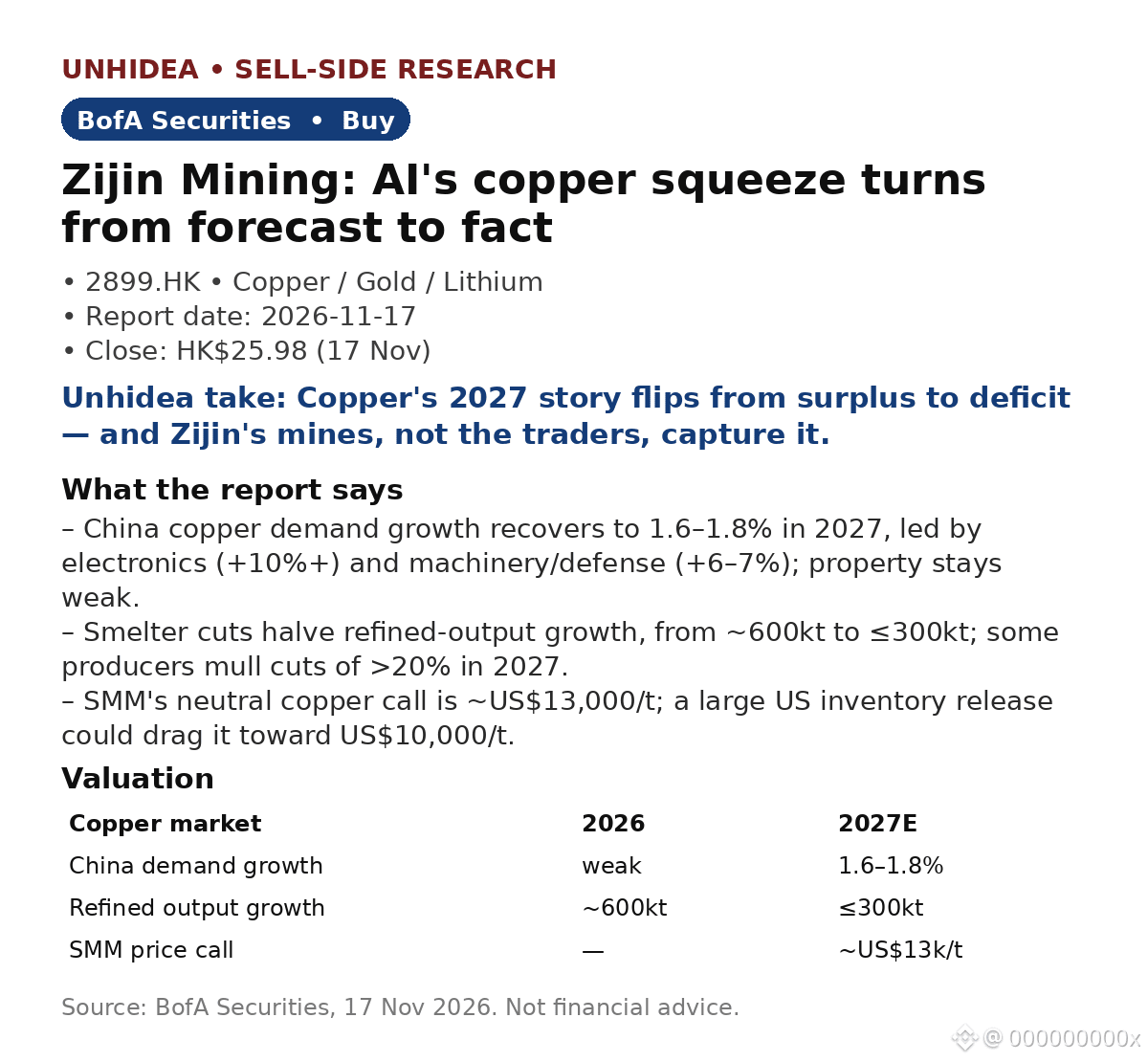
Zijin Mining (2899.HK): BofA stays Buy — China copper demand recovers as smelters cut
- China copper demand growth recovers to 1.6–1.8% in 2027, led by electronics (+10%+) and machinery/defense (+6–7%); property still weak.
- Smelter cuts halve refined-output growth, ~600kt to ≤300kt; SMM's neutral call is ~US$13,000/t, US inventory releases a risk toward US$10,000/t.
- Zijin keeps 2026 guidance (excl. ~50kt Kamoa-Kakula losses); existing mines deliver 1.40–1.45mnt in 2028 vs 1.50mnt target; Africa adds 300kt+.
- AI infra is the kicker: M8 CCL demand triples, 2.5mn to 7.5mn/month by end-2027; InP is >70% of Yunnan Germanium's net profit at >65% margin, orders locked thru 2027.
- Zijin rated Buy, HK$25.98 close on 17 Nov; price objective not restated in this note.
Unhidea take: copper is AI's forgotten bottleneck — the market debates GPUs while the metal wiring every data center flips from surplus to deficit.
Unhidea take: Zijin's edge is volume growth into a deficit — it grows while smelters shrink; in a tight market, tonnes beat multiples.
Risks: weak macro; US inventory releases; Kamoa-Kakula disruption.
Source: BofA Securities, 17 Nov 2026. Not financial advice.
Zijin Mining (2899.HK): BofA stays Buy — China copper demand recovers as smelters cut
- China copper demand growth recovers to 1.6–1.8% in 2027, led by electronics (+10%+) and machinery/defense (+6–7%); property still weak.
- Smelter cuts halve refined-output growth, ~600kt to ≤300kt; SMM's neutral call is ~US$13,000/t, US inventory releases a risk toward US$10,000/t.
- Zijin keeps 2026 guidance (excl. ~50kt Kamoa-Kakula losses); existing mines deliver 1.40–1.45mnt in 2028 vs 1.50mnt target; Africa adds 300kt+.
- AI infra is the kicker: M8 CCL demand triples, 2.5mn to 7.5mn/month by end-2027; InP is >70% of Yunnan Germanium's net profit at >65% margin, orders locked thru 2027.
- Zijin rated Buy, HK$25.98 close on 17 Nov; price objective not restated in this note.
Unhidea take: copper is AI's forgotten bottleneck — the market debates GPUs while the metal wiring every data center flips from surplus to deficit.
Unhidea take: Zijin's edge is volume growth into a deficit — it grows while smelters shrink; in a tight market, tonnes beat multiples.
Risks: weak macro; US inventory releases; Kamoa-Kakula disruption.
Source: BofA Securities, 17 Nov 2026. Not financial advice.
- China copper demand growth recovers to 1.6–1.8% in 2027, led by electronics (+10%+) and machinery/defense (+6–7%); property still weak.
- Smelter cuts halve refined-output growth, ~600kt to ≤300kt; SMM's neutral call is ~US$13,000/t, US inventory releases a risk toward US$10,000/t.
- Zijin keeps 2026 guidance (excl. ~50kt Kamoa-Kakula losses); existing mines deliver 1.40–1.45mnt in 2028 vs 1.50mnt target; Africa adds 300kt+.
- AI infra is the kicker: M8 CCL demand triples, 2.5mn to 7.5mn/month by end-2027; InP is >70% of Yunnan Germanium's net profit at >65% margin, orders locked thru 2027.
- Zijin rated Buy, HK$25.98 close on 17 Nov; price objective not restated in this note.
Unhidea take: copper is AI's forgotten bottleneck — the market debates GPUs while the metal wiring every data center flips from surplus to deficit.
Unhidea take: Zijin's edge is volume growth into a deficit — it grows while smelters shrink; in a tight market, tonnes beat multiples.
Risks: weak macro; US inventory releases; Kamoa-Kakula disruption.
Source: BofA Securities, 17 Nov 2026. Not financial advice.
53
·
--
Tərcüməyə bax
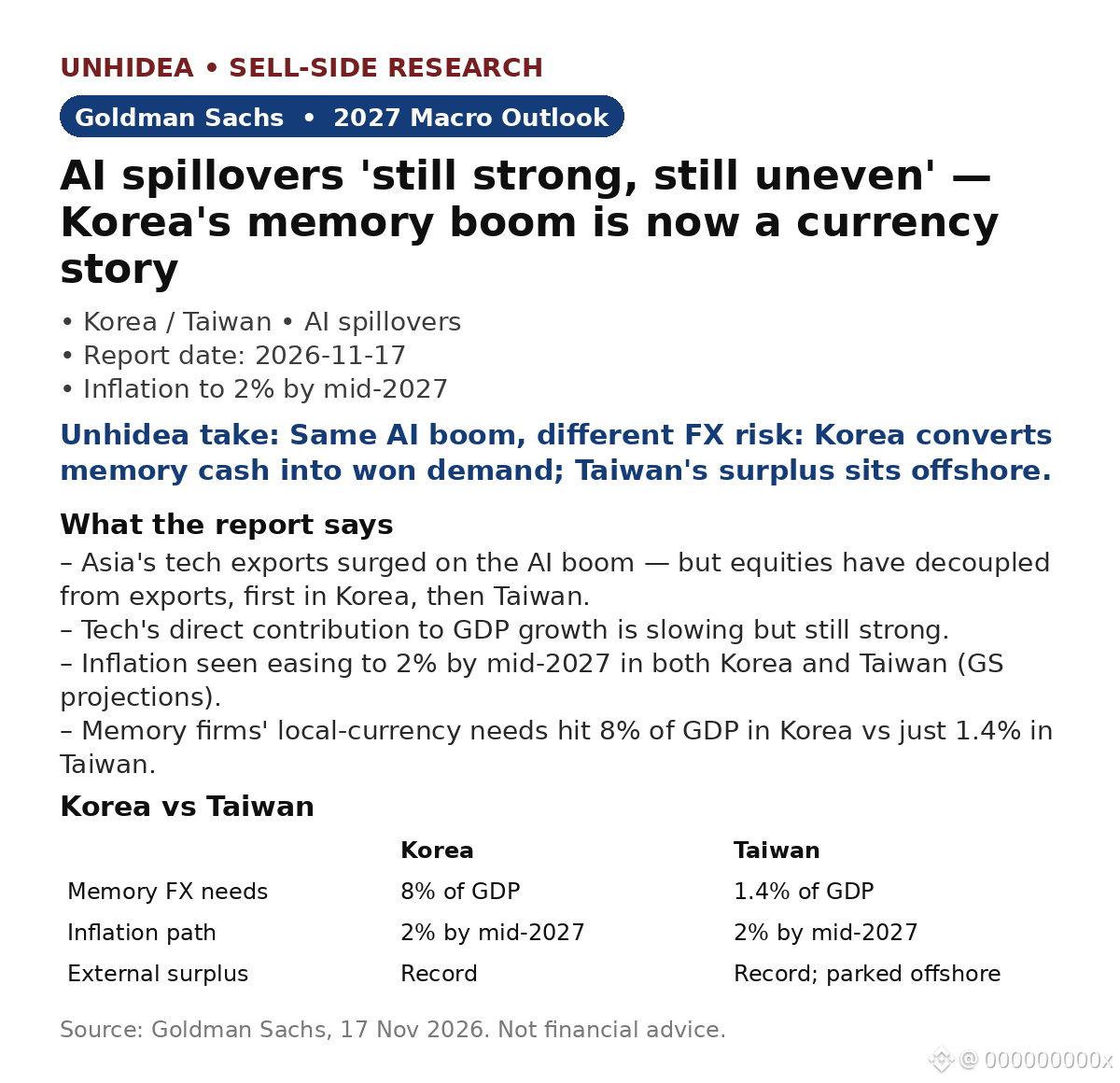
AI spillovers "still strong, still uneven": Goldman Sachs' 2027 Korea/Taiwan outlook — Samsung's memory windfall is now a currency story
- Asia's tech exports surged on the AI boom, but equities have decoupled from exports — first in Korea, then Taiwan. The index is no longer a clean read on the export cycle.
- Tech's direct contribution to GDP growth is slowing but still strong. Inflation is seen easing to 2% by mid-2027 in both Korea and Taiwan (GS projections).
- Memory companies' local-currency needs reach 8% of GDP in Korea vs just 1.4% in Taiwan. Korea converts the boom into won demand; Taiwan's record surplus is parked offshore.
- Post-report market news: Nvidia's FQ3 revenue was $115.84bn, +103% YoY vs ~$109bn expected, guiding ~$130bn vs ~$125bn expected — and Samsung and SK Hynix rallied in Korea after the print.
Unhidea take: the decoupling is the signal — Korea/Taiwan equities now trade the AI narrative and memory pricing, not export volumes. A soft export print no longer means a soft index, and vice versa.
Unhidea take: the 8% vs 1.4% gap is the real trade. Korea's won faces structural demand from memory cash conversion while Taiwan's surplus sits offshore — same AI boom, opposite FX pressure. Watch KRW, not just KOSPI.
Risks: AI capex cuts, memory price reversal, FX volatility, US-China export controls.
Source: Goldman Sachs, 17 Nov 2026. Not financial advice.
AI spillovers "still strong, still uneven": Goldman Sachs' 2027 Korea/Taiwan outlook — Samsung's memory windfall is now a currency story
- Asia's tech exports surged on the AI boom, but equities have decoupled from exports — first in Korea, then Taiwan. The index is no longer a clean read on the export cycle.
- Tech's direct contribution to GDP growth is slowing but still strong. Inflation is seen easing to 2% by mid-2027 in both Korea and Taiwan (GS projections).
- Memory companies' local-currency needs reach 8% of GDP in Korea vs just 1.4% in Taiwan. Korea converts the boom into won demand; Taiwan's record surplus is parked offshore.
- Post-report market news: Nvidia's FQ3 revenue was $115.84bn, +103% YoY vs ~$109bn expected, guiding ~$130bn vs ~$125bn expected — and Samsung and SK Hynix rallied in Korea after the print.
Unhidea take: the decoupling is the signal — Korea/Taiwan equities now trade the AI narrative and memory pricing, not export volumes. A soft export print no longer means a soft index, and vice versa.
Unhidea take: the 8% vs 1.4% gap is the real trade. Korea's won faces structural demand from memory cash conversion while Taiwan's surplus sits offshore — same AI boom, opposite FX pressure. Watch KRW, not just KOSPI.
Risks: AI capex cuts, memory price reversal, FX volatility, US-China export controls.
Source: Goldman Sachs, 17 Nov 2026. Not financial advice.
- Asia's tech exports surged on the AI boom, but equities have decoupled from exports — first in Korea, then Taiwan. The index is no longer a clean read on the export cycle.
- Tech's direct contribution to GDP growth is slowing but still strong. Inflation is seen easing to 2% by mid-2027 in both Korea and Taiwan (GS projections).
- Memory companies' local-currency needs reach 8% of GDP in Korea vs just 1.4% in Taiwan. Korea converts the boom into won demand; Taiwan's record surplus is parked offshore.
- Post-report market news: Nvidia's FQ3 revenue was $115.84bn, +103% YoY vs ~$109bn expected, guiding ~$130bn vs ~$125bn expected — and Samsung and SK Hynix rallied in Korea after the print.
Unhidea take: the decoupling is the signal — Korea/Taiwan equities now trade the AI narrative and memory pricing, not export volumes. A soft export print no longer means a soft index, and vice versa.
Unhidea take: the 8% vs 1.4% gap is the real trade. Korea's won faces structural demand from memory cash conversion while Taiwan's surplus sits offshore — same AI boom, opposite FX pressure. Watch KRW, not just KOSPI.
Risks: AI capex cuts, memory price reversal, FX volatility, US-China export controls.
Source: Goldman Sachs, 17 Nov 2026. Not financial advice.
420
·
--
Tərcüməyə bax
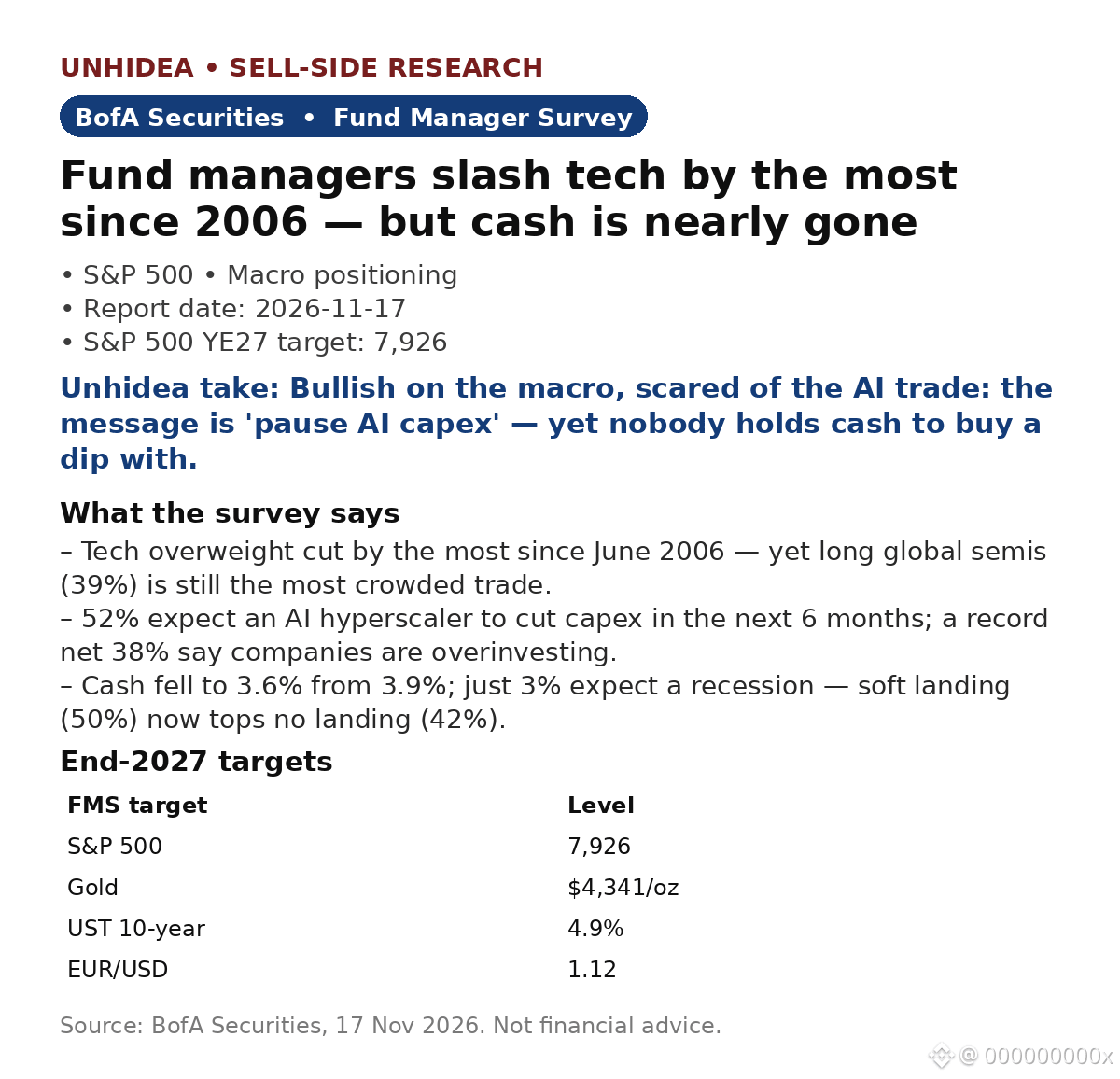
$SPX: BofA's fund manager survey — tech dumped by the most since 2006, yet cash is nearly gone
- Investors slashed tech overweight by the most since June 2006, but long global semis (39%) is still the most crowded trade. 193 managers, $526bn, surveyed 6–12 Nov.
- 52% expect an AI hyperscaler to cut capex in the next 6 months; a record net 38% say companies are overinvesting; only 16% want firms to boost capex — lowest since May 2020.
- Cash fell to 3.6% from 3.9%. BofA stays tactically risk-off: not enough "fear" to buy. Just 3% expect a recession; soft landing (50%) now tops no landing (42%) for the first time since June.
- Top tail risks: AI bubble (34%) and hyperscaler credit event (31%). 38% name AI hyperscaler bonds the most likely source of a systemic credit event, ahead of private credit (30%).
- End-2027 targets: S&P 500 7,926, gold $4,341/oz — a record net 23% call gold undervalued — UST 10y 4.9%, EUR/USD 1.12.
Unhidea take: the survey is long the AI trade and scared of it at the same time — 39% crowded long semis, 52% expecting a capex cut. That is a positioning trap, not a bubble call: the pain trade is a capex headline, not a recession.
Unhidea take: with cash at 3.6%, there is no dry powder left. BofA's "not enough fear to buy" means the next leg down, if it comes, has no natural buyers. Watch the 52%: it turns self-fulfilling the moment one hyperscaler blinks.
Risks: AI capex cuts, hyperscaler credit stress, sticky inflation, disorderly bond yields.
Source: BofA Securities, 17 Nov 2026. Not financial advice.
$SPX : BofA's fund manager survey — tech dumped by the most since 2006, yet cash is nearly gone
- Investors slashed tech overweight by the most since June 2006, but long global semis (39%) is still the most crowded trade. 193 managers, $526bn, surveyed 6–12 Nov.
- 52% expect an AI hyperscaler to cut capex in the next 6 months; a record net 38% say companies are overinvesting; only 16% want firms to boost capex — lowest since May 2020.
- Cash fell to 3.6% from 3.9%. BofA stays tactically risk-off: not enough "fear" to buy. Just 3% expect a recession; soft landing (50%) now tops no landing (42%) for the first time since June.
- Top tail risks: AI bubble (34%) and hyperscaler credit event (31%). 38% name AI hyperscaler bonds the most likely source of a systemic credit event, ahead of private credit (30%).
- End-2027 targets: S&P 500 7,926, gold $4,341/oz — a record net 23% call gold undervalued — UST 10y 4.9%, EUR/USD 1.12.
Unhidea take: the survey is long the AI trade and scared of it at the same time — 39% crowded long semis, 52% expecting a capex cut. That is a positioning trap, not a bubble call: the pain trade is a capex headline, not a recession.
Unhidea take: with cash at 3.6%, there is no dry powder left. BofA's "not enough fear to buy" means the next leg down, if it comes, has no natural buyers. Watch the 52%: it turns self-fulfilling the moment one hyperscaler blinks.
Risks: AI capex cuts, hyperscaler credit stress, sticky inflation, disorderly bond yields.
Source: BofA Securities, 17 Nov 2026. Not financial advice.
- Investors slashed tech overweight by the most since June 2006, but long global semis (39%) is still the most crowded trade. 193 managers, $526bn, surveyed 6–12 Nov.
- 52% expect an AI hyperscaler to cut capex in the next 6 months; a record net 38% say companies are overinvesting; only 16% want firms to boost capex — lowest since May 2020.
- Cash fell to 3.6% from 3.9%. BofA stays tactically risk-off: not enough "fear" to buy. Just 3% expect a recession; soft landing (50%) now tops no landing (42%) for the first time since June.
- Top tail risks: AI bubble (34%) and hyperscaler credit event (31%). 38% name AI hyperscaler bonds the most likely source of a systemic credit event, ahead of private credit (30%).
- End-2027 targets: S&P 500 7,926, gold $4,341/oz — a record net 23% call gold undervalued — UST 10y 4.9%, EUR/USD 1.12.
Unhidea take: the survey is long the AI trade and scared of it at the same time — 39% crowded long semis, 52% expecting a capex cut. That is a positioning trap, not a bubble call: the pain trade is a capex headline, not a recession.
Unhidea take: with cash at 3.6%, there is no dry powder left. BofA's "not enough fear to buy" means the next leg down, if it comes, has no natural buyers. Watch the 52%: it turns self-fulfilling the moment one hyperscaler blinks.
Risks: AI capex cuts, hyperscaler credit stress, sticky inflation, disorderly bond yields.
Source: BofA Securities, 17 Nov 2026. Not financial advice.
180
·
--
Tərcüməyə bax
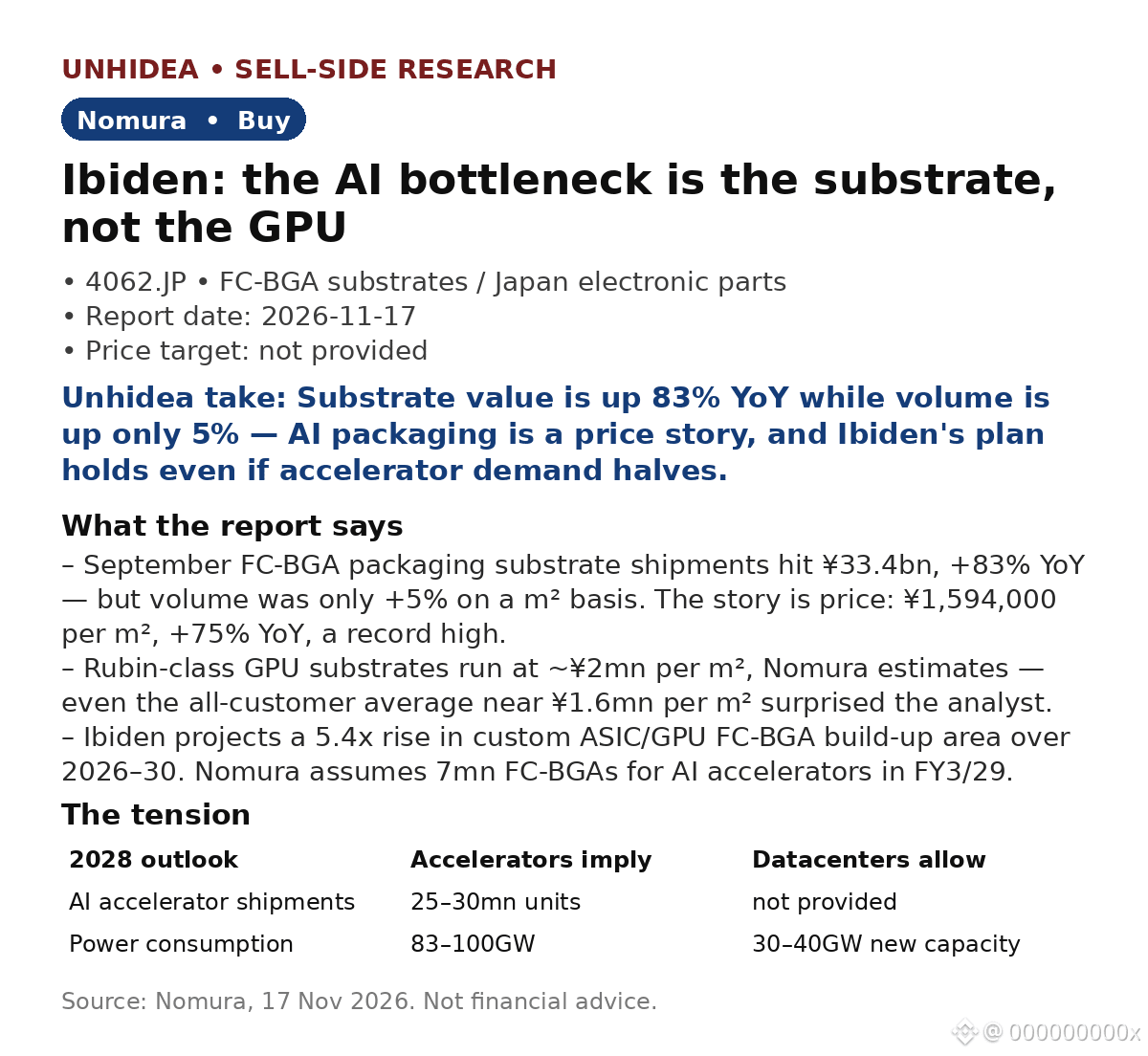
Ibiden (4062.JP): the AI bottleneck isn't the GPU — it's the substrate it sits on. Nomura rates it Buy as Japan's FC-BGA shipments jump 83% YoY.
- Sept FC-BGA substrates hit ¥33.4bn, +83% YoY — but volume only +5%. The story is price: ¥1,594,000/m², +75% YoY, a record. Rubin-class GPU substrates run ~¥2mn/m².
- Nomura's warning: 2028 accelerator forecasts (25–30mn units) imply 83–100GW of power — yet the market expects only 30–40GW of new US datacenter capacity in 2028. Something has to give.
- Ibiden projects a 5.4x rise in FC-BGA build-up area over 2026–30; Nomura assumes 7mn AI-accelerator FC-BGAs in FY3/29, achievable even if accelerator shipments halve to 12.5–15mn.
- Since the report: NVDA's FQ3 print (Nov 17) — revenue $115.84bn, +103% YoY, Q4 guide ~$130bn — demand vs the construction-delay worry. (Post-report market news.)
Unhidea take: substrates are where AI demand becomes a priced, physical bottleneck — value compounds on price and mix, not units.
Unhidea take: the question is no longer whether AI demand exists, but whether datacenters get built fast enough to house it. Ibiden's plan is sized for the bear case.
Risks: rival capacity could ease tight supply-demand; datacenter delays and tighter US export controls could cut accelerator demand.
Source: Nomura, 17 Nov 2026. Not financial advice.
Ibiden (4062.JP): the AI bottleneck isn't the GPU — it's the substrate it sits on. Nomura rates it Buy as Japan's FC-BGA shipments jump 83% YoY.
- Sept FC-BGA substrates hit ¥33.4bn, +83% YoY — but volume only +5%. The story is price: ¥1,594,000/m², +75% YoY, a record. Rubin-class GPU substrates run ~¥2mn/m².
- Nomura's warning: 2028 accelerator forecasts (25–30mn units) imply 83–100GW of power — yet the market expects only 30–40GW of new US datacenter capacity in 2028. Something has to give.
- Ibiden projects a 5.4x rise in FC-BGA build-up area over 2026–30; Nomura assumes 7mn AI-accelerator FC-BGAs in FY3/29, achievable even if accelerator shipments halve to 12.5–15mn.
- Since the report: NVDA's FQ3 print (Nov 17) — revenue $115.84bn, +103% YoY, Q4 guide ~$130bn — demand vs the construction-delay worry. (Post-report market news.)
Unhidea take: substrates are where AI demand becomes a priced, physical bottleneck — value compounds on price and mix, not units.
Unhidea take: the question is no longer whether AI demand exists, but whether datacenters get built fast enough to house it. Ibiden's plan is sized for the bear case.
Risks: rival capacity could ease tight supply-demand; datacenter delays and tighter US export controls could cut accelerator demand.
Source: Nomura, 17 Nov 2026. Not financial advice.
- Sept FC-BGA substrates hit ¥33.4bn, +83% YoY — but volume only +5%. The story is price: ¥1,594,000/m², +75% YoY, a record. Rubin-class GPU substrates run ~¥2mn/m².
- Nomura's warning: 2028 accelerator forecasts (25–30mn units) imply 83–100GW of power — yet the market expects only 30–40GW of new US datacenter capacity in 2028. Something has to give.
- Ibiden projects a 5.4x rise in FC-BGA build-up area over 2026–30; Nomura assumes 7mn AI-accelerator FC-BGAs in FY3/29, achievable even if accelerator shipments halve to 12.5–15mn.
- Since the report: NVDA's FQ3 print (Nov 17) — revenue $115.84bn, +103% YoY, Q4 guide ~$130bn — demand vs the construction-delay worry. (Post-report market news.)
Unhidea take: substrates are where AI demand becomes a priced, physical bottleneck — value compounds on price and mix, not units.
Unhidea take: the question is no longer whether AI demand exists, but whether datacenters get built fast enough to house it. Ibiden's plan is sized for the bear case.
Risks: rival capacity could ease tight supply-demand; datacenter delays and tighter US export controls could cut accelerator demand.
Source: Nomura, 17 Nov 2026. Not financial advice.
245
·
--
Tərcüməyə bax
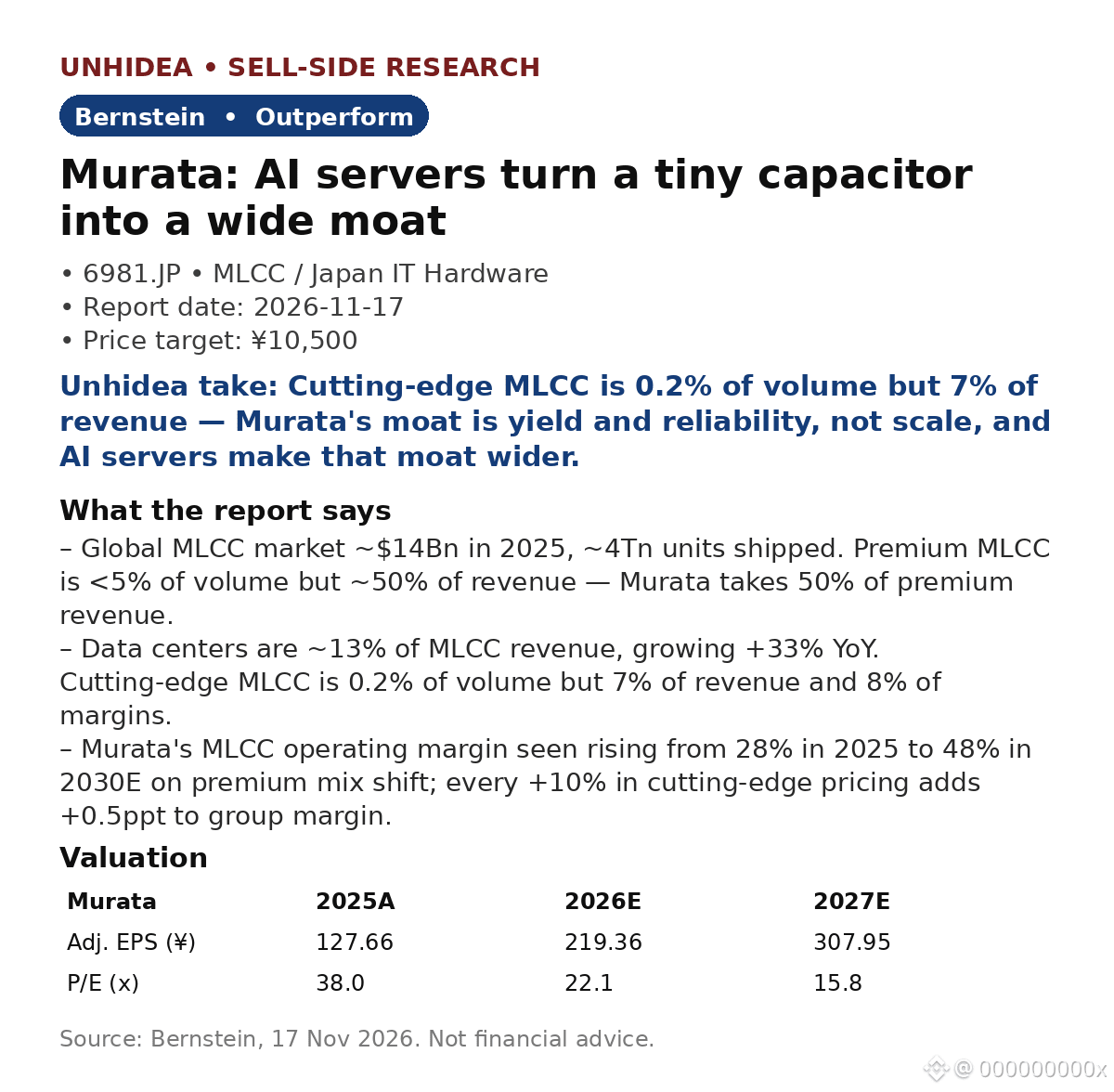
Murata (6981.JP): Bernstein sees ~116% upside as AI servers turn a tiny capacitor into a wide moat — target ¥10,500 vs ¥4,855 close on 16 Nov
- Global MLCC market ~$14Bn in 2025, ~4Tn units. Premium is <5% of volume but ~50% of revenue — Murata takes 50% of premium revenue.
- Data centers ~13% of MLCC revenue, +33% YoY. Cutting-edge MLCC: 0.2% of volume, 7% of revenue, 8% of margins.
- AI-server MLCCs must run 24/7 for 10+ years, near-zero failure — a bar most rivals can't clear at scale. Murata R&D is 9% of revenue vs 4–7% for peers.
- Mix shift, not price hikes: Murata MLCC margin seen rising 28% (2025) to 48% (2030E). Every +10% in cutting-edge pricing adds +0.5ppt to group margin.
- Bernstein reiterates Outperform, TP ¥10,500. Adj. EPS ¥219.36 in 2026E (+72% YoY), ¥307.95 in 2027E; 22.1x / 15.8x P/E.
Unhidea take: the AI trade has been about GPUs and power — but every AI rack needs thousands of MLCCs that cannot fail. Murata's edge is the boring, certified, yield-driven kind that compounds quietly.
Unhidea take: Bernstein gives China 5–10 years to catch up on premium MLCC. The AI buildout is happening now, and the qualified supplier list is effectively two names long — that window is the investment case.
Risks: Murata is reluctant to raise prices, so mix shift must deliver; an AI server slowdown or weak smartphone/auto demand would hit volumes.
Source: Bernstein, 17 Nov 2026. Not financial advice.
Murata (6981.JP): Bernstein sees ~116% upside as AI servers turn a tiny capacitor into a wide moat — target ¥10,500 vs ¥4,855 close on 16 Nov
- Global MLCC market ~$14Bn in 2025, ~4Tn units. Premium is <5% of volume but ~50% of revenue — Murata takes 50% of premium revenue.
- Data centers ~13% of MLCC revenue, +33% YoY. Cutting-edge MLCC: 0.2% of volume, 7% of revenue, 8% of margins.
- AI-server MLCCs must run 24/7 for 10+ years, near-zero failure — a bar most rivals can't clear at scale. Murata R&D is 9% of revenue vs 4–7% for peers.
- Mix shift, not price hikes: Murata MLCC margin seen rising 28% (2025) to 48% (2030E). Every +10% in cutting-edge pricing adds +0.5ppt to group margin.
- Bernstein reiterates Outperform, TP ¥10,500. Adj. EPS ¥219.36 in 2026E (+72% YoY), ¥307.95 in 2027E; 22.1x / 15.8x P/E.
Unhidea take: the AI trade has been about GPUs and power — but every AI rack needs thousands of MLCCs that cannot fail. Murata's edge is the boring, certified, yield-driven kind that compounds quietly.
Unhidea take: Bernstein gives China 5–10 years to catch up on premium MLCC. The AI buildout is happening now, and the qualified supplier list is effectively two names long — that window is the investment case.
Risks: Murata is reluctant to raise prices, so mix shift must deliver; an AI server slowdown or weak smartphone/auto demand would hit volumes.
Source: Bernstein, 17 Nov 2026. Not financial advice.
- Global MLCC market ~$14Bn in 2025, ~4Tn units. Premium is <5% of volume but ~50% of revenue — Murata takes 50% of premium revenue.
- Data centers ~13% of MLCC revenue, +33% YoY. Cutting-edge MLCC: 0.2% of volume, 7% of revenue, 8% of margins.
- AI-server MLCCs must run 24/7 for 10+ years, near-zero failure — a bar most rivals can't clear at scale. Murata R&D is 9% of revenue vs 4–7% for peers.
- Mix shift, not price hikes: Murata MLCC margin seen rising 28% (2025) to 48% (2030E). Every +10% in cutting-edge pricing adds +0.5ppt to group margin.
- Bernstein reiterates Outperform, TP ¥10,500. Adj. EPS ¥219.36 in 2026E (+72% YoY), ¥307.95 in 2027E; 22.1x / 15.8x P/E.
Unhidea take: the AI trade has been about GPUs and power — but every AI rack needs thousands of MLCCs that cannot fail. Murata's edge is the boring, certified, yield-driven kind that compounds quietly.
Unhidea take: Bernstein gives China 5–10 years to catch up on premium MLCC. The AI buildout is happening now, and the qualified supplier list is effectively two names long — that window is the investment case.
Risks: Murata is reluctant to raise prices, so mix shift must deliver; an AI server slowdown or weak smartphone/auto demand would hit volumes.
Source: Bernstein, 17 Nov 2026. Not financial advice.
4
·
--
Tərcüməyə bax
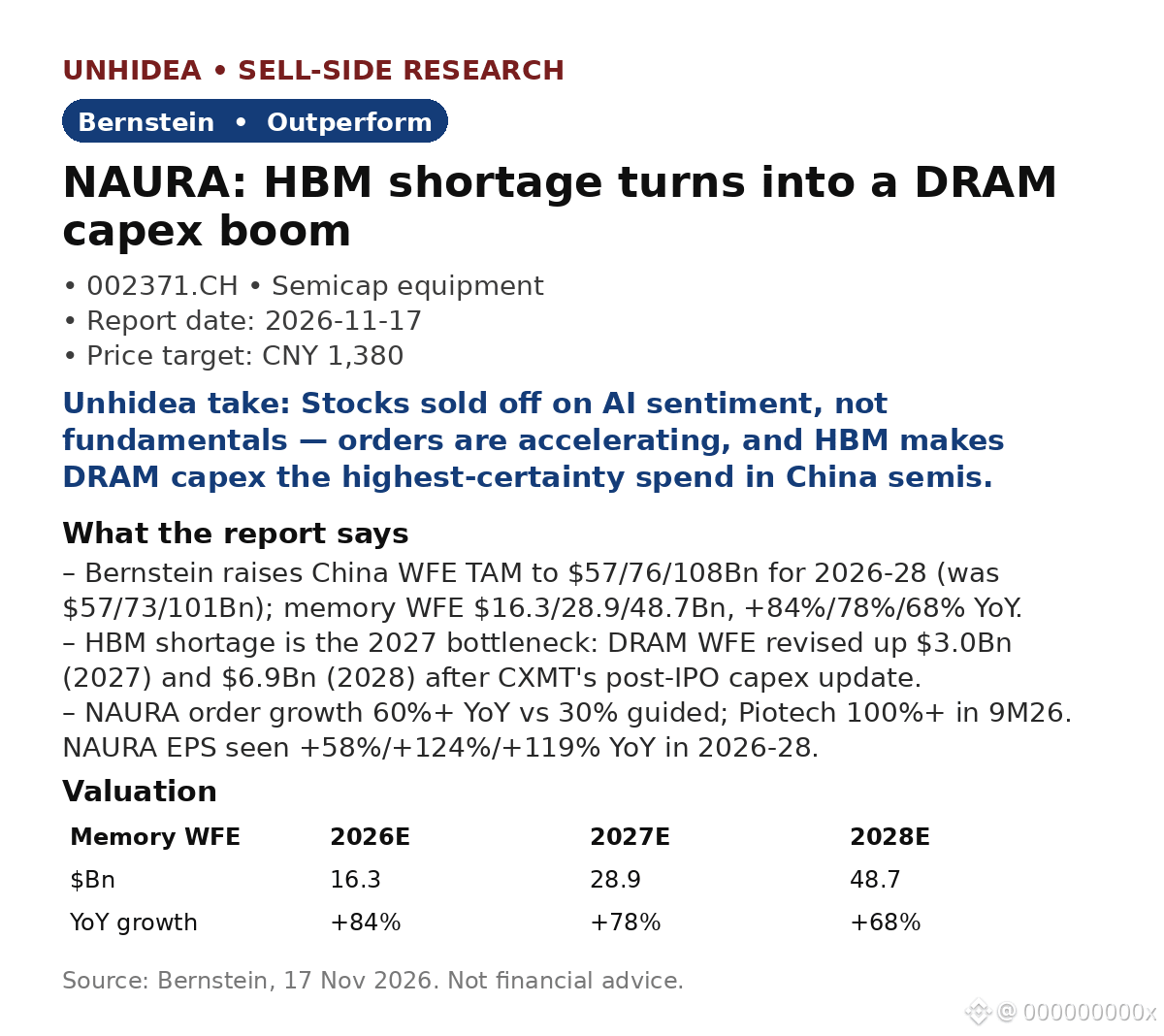
$NAURA: Bernstein's top pick as China's HBM shortage turns into a DRAM capex boom — target CNY 1,380 implies ~153% upside
- Bernstein raises China WFE TAM to $57/76/108Bn for 2026-28 (was $57/73/101Bn); memory WFE $16.3/28.9/48.7Bn, growing +84%/78%/68% YoY.
- HBM shortage is the 2027 bottleneck: DRAM WFE revised up $3.0Bn (2027) and $6.9Bn (2028) after CXMT's post-IPO capex update; YMTC DRAM expansion starts in 2027.
- NAURA order growth is 60%+ YoY vs 30% guided; EPS seen rising +58%/+124%/+119% YoY in 2026-28. Piotech orders 100%+ in 9M26.
- Localization steps up: mature-logic fabs' local-tool share jumps from <20% to 50%+ next year; Bernstein sees localization at 36%/49% in 2027/28.
- NAURA rated Outperform, target CNY 1,380 vs CNY 546.39 close on 16 Nov, at 32x 2028E P/E. AMEC CNY 660 and Piotech CNY 1,200, both Outperform.
Unhidea take: the market is pricing AI sentiment, not the order book — 60%+ order growth in a sector Bernstein says is "clearly not trading on fundamentals" is the disconnect; strong 1Q27 orders would be the re-rating trigger.
Unhidea take: HBM is the choke point that makes DRAM capex the most certain spend in semis — memory capacity can't be deferred if China wants AI self-sufficiency, so WFE is the purest localization play and NAURA's broadest portfolio captures the most of it.
Risks: no strong catalyst in 4Q26, near-term volatility; global AI sentiment.
Source: Bernstein, 17 Nov 2026. Not financial advice.
$NAURA: Bernstein's top pick as China's HBM shortage turns into a DRAM capex boom — target CNY 1,380 implies ~153% upside
- Bernstein raises China WFE TAM to $57/76/108Bn for 2026-28 (was $57/73/101Bn); memory WFE $16.3/28.9/48.7Bn, growing +84%/78%/68% YoY.
- HBM shortage is the 2027 bottleneck: DRAM WFE revised up $3.0Bn (2027) and $6.9Bn (2028) after CXMT's post-IPO capex update; YMTC DRAM expansion starts in 2027.
- NAURA order growth is 60%+ YoY vs 30% guided; EPS seen rising +58%/+124%/+119% YoY in 2026-28. Piotech orders 100%+ in 9M26.
- Localization steps up: mature-logic fabs' local-tool share jumps from <20% to 50%+ next year; Bernstein sees localization at 36%/49% in 2027/28.
- NAURA rated Outperform, target CNY 1,380 vs CNY 546.39 close on 16 Nov, at 32x 2028E P/E. AMEC CNY 660 and Piotech CNY 1,200, both Outperform.
Unhidea take: the market is pricing AI sentiment, not the order book — 60%+ order growth in a sector Bernstein says is "clearly not trading on fundamentals" is the disconnect; strong 1Q27 orders would be the re-rating trigger.
Unhidea take: HBM is the choke point that makes DRAM capex the most certain spend in semis — memory capacity can't be deferred if China wants AI self-sufficiency, so WFE is the purest localization play and NAURA's broadest portfolio captures the most of it.
Risks: no strong catalyst in 4Q26, near-term volatility; global AI sentiment.
Source: Bernstein, 17 Nov 2026. Not financial advice.
- Bernstein raises China WFE TAM to $57/76/108Bn for 2026-28 (was $57/73/101Bn); memory WFE $16.3/28.9/48.7Bn, growing +84%/78%/68% YoY.
- HBM shortage is the 2027 bottleneck: DRAM WFE revised up $3.0Bn (2027) and $6.9Bn (2028) after CXMT's post-IPO capex update; YMTC DRAM expansion starts in 2027.
- NAURA order growth is 60%+ YoY vs 30% guided; EPS seen rising +58%/+124%/+119% YoY in 2026-28. Piotech orders 100%+ in 9M26.
- Localization steps up: mature-logic fabs' local-tool share jumps from <20% to 50%+ next year; Bernstein sees localization at 36%/49% in 2027/28.
- NAURA rated Outperform, target CNY 1,380 vs CNY 546.39 close on 16 Nov, at 32x 2028E P/E. AMEC CNY 660 and Piotech CNY 1,200, both Outperform.
Unhidea take: the market is pricing AI sentiment, not the order book — 60%+ order growth in a sector Bernstein says is "clearly not trading on fundamentals" is the disconnect; strong 1Q27 orders would be the re-rating trigger.
Unhidea take: HBM is the choke point that makes DRAM capex the most certain spend in semis — memory capacity can't be deferred if China wants AI self-sufficiency, so WFE is the purest localization play and NAURA's broadest portfolio captures the most of it.
Risks: no strong catalyst in 4Q26, near-term volatility; global AI sentiment.
Source: Bernstein, 17 Nov 2026. Not financial advice.
2
·
--
Tərcüməyə bax
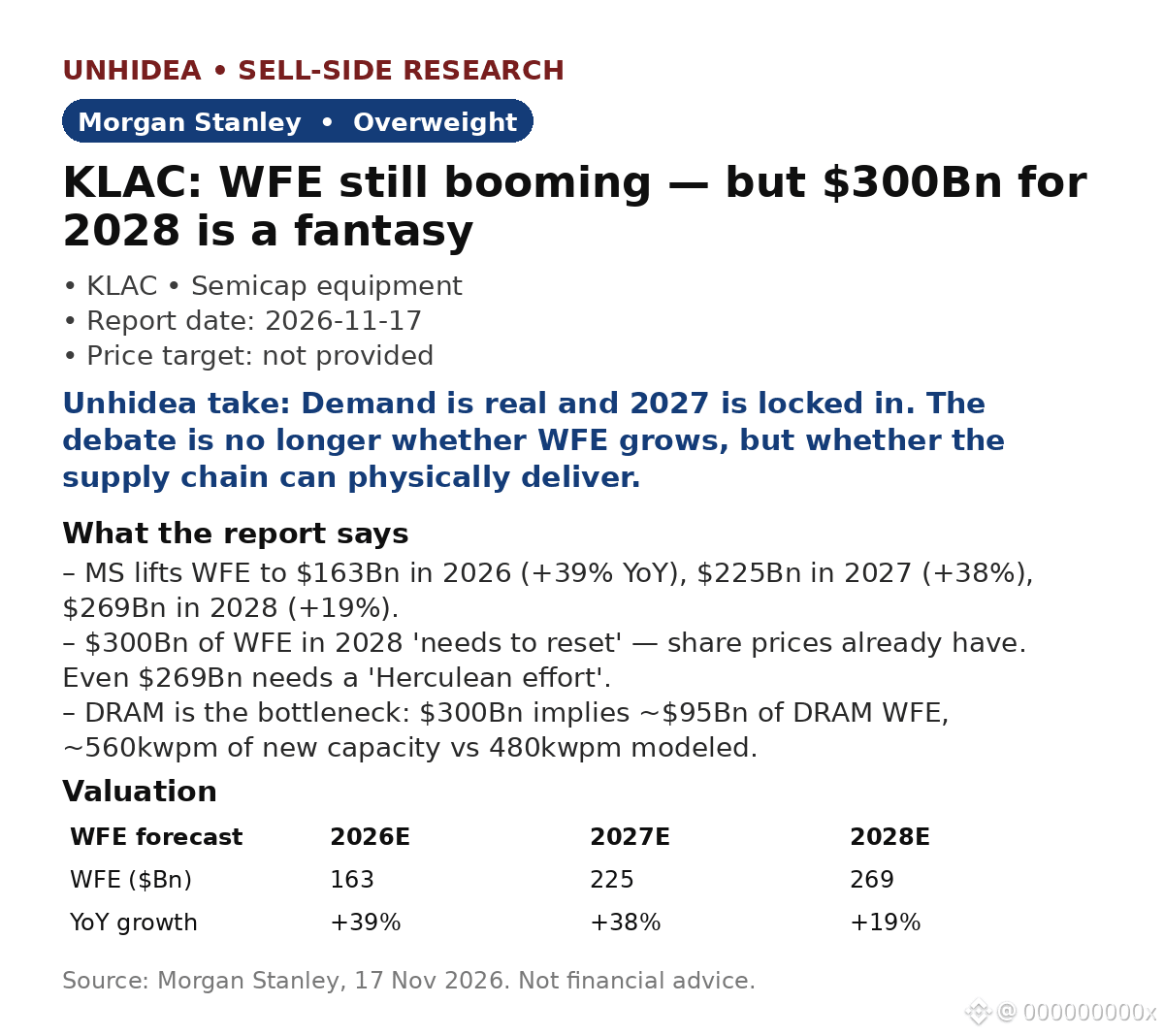
$KLAC: Morgan Stanley says the chip-equipment boom is real — but the $300Bn WFE dream for 2028 needs a reset
- MS lifts WFE to $163Bn in 2026 (+39% YoY), $225Bn in 2027 (+38%) and $269Bn in 2028 (+19%), up from $254Bn before.
- $300Bn in 2028 'needs to reset, as share prices have already done': expanding capacity 2.5x in 3 years is a stretch, and OEMs already miss shipments on component shortages.
- DRAM is the bottleneck: $300Bn implies ~$95Bn of DRAM WFE, needing ~560kwpm of new capacity vs 480kwpm modeled; NAND and mature logic would need >40% growth.
- Shipments are running at a $200–205Bn annualized WFE pace; the 2027 bull case has 'gradually materialized', incl. Intel spending $20Bn+ and ~500kwpm of DRAM greenfield adds.
- MS rates KLAC Overweight (no price target in this note); industry view In-Line.
- Since the report: NVIDIA beat FQ3 — $115.84Bn revenue vs ~$109Bn expected, adj EPS $2.68 vs $2.48, Q4 guide ~$130Bn (CNBC).
Unhidea take: the reset is about expectations, not demand — $269Bn in 2028 is still +19% growth; stocks fell because they were priced for $300Bn, not because fabs stopped ordering.
Unhidea take: the constraint has flipped from demand to physics — cleanroom space, components, 480kwpm vs 560kwpm. Every incremental wafer needs more inspection, so process-control demand scales with the ramp itself.
Risks: component shortages, DRAM pull-ins fading, further multiple compression.
Source: Morgan Stanley, 17 Nov 2026. Post-report news: CNBC. Not financial advice.
$KLAC : Morgan Stanley says the chip-equipment boom is real — but the $300Bn WFE dream for 2028 needs a reset
- MS lifts WFE to $163Bn in 2026 (+39% YoY), $225Bn in 2027 (+38%) and $269Bn in 2028 (+19%), up from $254Bn before.
- $300Bn in 2028 'needs to reset, as share prices have already done': expanding capacity 2.5x in 3 years is a stretch, and OEMs already miss shipments on component shortages.
- DRAM is the bottleneck: $300Bn implies ~$95Bn of DRAM WFE, needing ~560kwpm of new capacity vs 480kwpm modeled; NAND and mature logic would need >40% growth.
- Shipments are running at a $200–205Bn annualized WFE pace; the 2027 bull case has 'gradually materialized', incl. Intel spending $20Bn+ and ~500kwpm of DRAM greenfield adds.
- MS rates KLAC Overweight (no price target in this note); industry view In-Line.
- Since the report: NVIDIA beat FQ3 — $115.84Bn revenue vs ~$109Bn expected, adj EPS $2.68 vs $2.48, Q4 guide ~$130Bn (CNBC).
Unhidea take: the reset is about expectations, not demand — $269Bn in 2028 is still +19% growth; stocks fell because they were priced for $300Bn, not because fabs stopped ordering.
Unhidea take: the constraint has flipped from demand to physics — cleanroom space, components, 480kwpm vs 560kwpm. Every incremental wafer needs more inspection, so process-control demand scales with the ramp itself.
Risks: component shortages, DRAM pull-ins fading, further multiple compression.
Source: Morgan Stanley, 17 Nov 2026. Post-report news: CNBC. Not financial advice.
- MS lifts WFE to $163Bn in 2026 (+39% YoY), $225Bn in 2027 (+38%) and $269Bn in 2028 (+19%), up from $254Bn before.
- $300Bn in 2028 'needs to reset, as share prices have already done': expanding capacity 2.5x in 3 years is a stretch, and OEMs already miss shipments on component shortages.
- DRAM is the bottleneck: $300Bn implies ~$95Bn of DRAM WFE, needing ~560kwpm of new capacity vs 480kwpm modeled; NAND and mature logic would need >40% growth.
- Shipments are running at a $200–205Bn annualized WFE pace; the 2027 bull case has 'gradually materialized', incl. Intel spending $20Bn+ and ~500kwpm of DRAM greenfield adds.
- MS rates KLAC Overweight (no price target in this note); industry view In-Line.
- Since the report: NVIDIA beat FQ3 — $115.84Bn revenue vs ~$109Bn expected, adj EPS $2.68 vs $2.48, Q4 guide ~$130Bn (CNBC).
Unhidea take: the reset is about expectations, not demand — $269Bn in 2028 is still +19% growth; stocks fell because they were priced for $300Bn, not because fabs stopped ordering.
Unhidea take: the constraint has flipped from demand to physics — cleanroom space, components, 480kwpm vs 560kwpm. Every incremental wafer needs more inspection, so process-control demand scales with the ramp itself.
Risks: component shortages, DRAM pull-ins fading, further multiple compression.
Source: Morgan Stanley, 17 Nov 2026. Post-report news: CNBC. Not financial advice.
240
·
--
Tərcüməyə bax
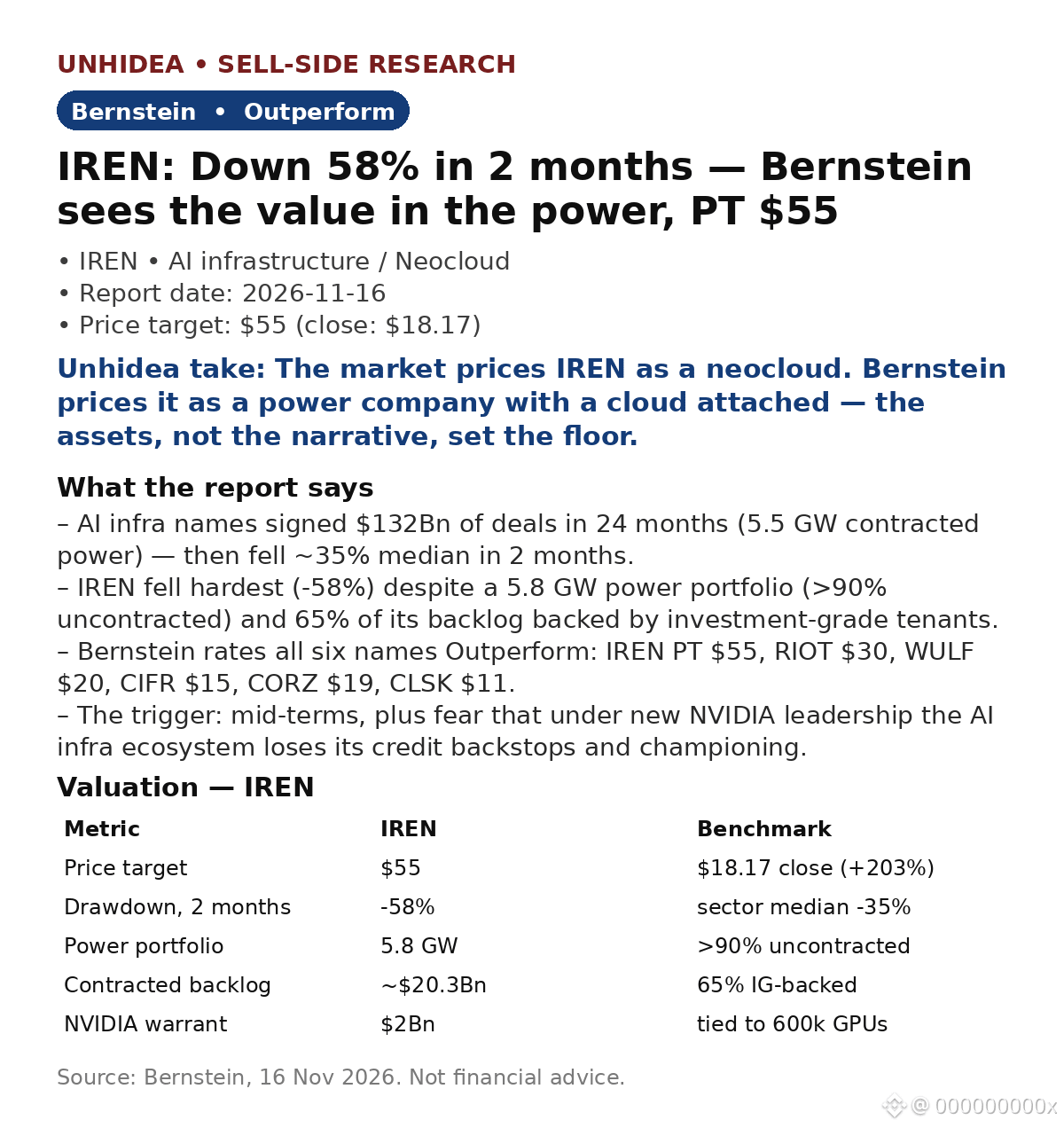
$IREN: Bernstein says the most-punished AI infra name is a power story — down 58% in 2 months, PT $55 (+203% vs the $18.17 close)
- The group signed $132Bn of AI deals in 24 months (5.5 GW) — then fell ~35% median in 2 months on mid-term nerves and fear new NVIDIA leadership ends the ecosystem's credit backstops.
- IREN fell hardest (-58%) though 65% of its ~$20.3Bn backlog is investment-grade backed; MSFT is the largest customer (48%), NVIDIA $3.4Bn.
- Its edge: 5.8 GW of power, >90% uncontracted — it can pace the cloud buildout or sell the power. Plus a $2Bn NVIDIA warrant tied to 600,000 GPUs.
- All six names rated Outperform (RIOT $30, WULF $20, CIFR $15, CORZ $19, CLSK $11); RIOT trades ~50% below contract value, WULF 22% below.
- Since the report: NVIDIA beat FQ3 — $115.84Bn revenue vs ~$109Bn expected, adj EPS $2.68 vs $2.48, Q4 guide ~$130Bn (CNBC).
Unhidea take: the market prices IREN's cloud execution risk as if the power were worthless — but power is the scarce asset, saleable even if the cloud stumbles.
Unhidea take: the 58% drawdown is opportunity and warning in one — the thesis needs IREN to execute the MSFT delivery without more delays.
Risks: cloud execution delays, spot GPU pricing, most CY27e capacity uncontracted, NVIDIA leadership transition.
Source: Bernstein, 16 Nov 2026. Post-report news: CNBC / Investing.com. Not financial advice.
$IREN : Bernstein says the most-punished AI infra name is a power story — down 58% in 2 months, PT $55 (+203% vs the $18.17 close)
- The group signed $132Bn of AI deals in 24 months (5.5 GW) — then fell ~35% median in 2 months on mid-term nerves and fear new NVIDIA leadership ends the ecosystem's credit backstops.
- IREN fell hardest (-58%) though 65% of its ~$20.3Bn backlog is investment-grade backed; MSFT is the largest customer (48%), NVIDIA $3.4Bn.
- Its edge: 5.8 GW of power, >90% uncontracted — it can pace the cloud buildout or sell the power. Plus a $2Bn NVIDIA warrant tied to 600,000 GPUs.
- All six names rated Outperform (RIOT $30, WULF $20, CIFR $15, CORZ $19, CLSK $11); RIOT trades ~50% below contract value, WULF 22% below.
- Since the report: NVIDIA beat FQ3 — $115.84Bn revenue vs ~$109Bn expected, adj EPS $2.68 vs $2.48, Q4 guide ~$130Bn (CNBC).
Unhidea take: the market prices IREN's cloud execution risk as if the power were worthless — but power is the scarce asset, saleable even if the cloud stumbles.
Unhidea take: the 58% drawdown is opportunity and warning in one — the thesis needs IREN to execute the MSFT delivery without more delays.
Risks: cloud execution delays, spot GPU pricing, most CY27e capacity uncontracted, NVIDIA leadership transition.
Source: Bernstein, 16 Nov 2026. Post-report news: CNBC / Investing.com. Not financial advice.
- The group signed $132Bn of AI deals in 24 months (5.5 GW) — then fell ~35% median in 2 months on mid-term nerves and fear new NVIDIA leadership ends the ecosystem's credit backstops.
- IREN fell hardest (-58%) though 65% of its ~$20.3Bn backlog is investment-grade backed; MSFT is the largest customer (48%), NVIDIA $3.4Bn.
- Its edge: 5.8 GW of power, >90% uncontracted — it can pace the cloud buildout or sell the power. Plus a $2Bn NVIDIA warrant tied to 600,000 GPUs.
- All six names rated Outperform (RIOT $30, WULF $20, CIFR $15, CORZ $19, CLSK $11); RIOT trades ~50% below contract value, WULF 22% below.
- Since the report: NVIDIA beat FQ3 — $115.84Bn revenue vs ~$109Bn expected, adj EPS $2.68 vs $2.48, Q4 guide ~$130Bn (CNBC).
Unhidea take: the market prices IREN's cloud execution risk as if the power were worthless — but power is the scarce asset, saleable even if the cloud stumbles.
Unhidea take: the 58% drawdown is opportunity and warning in one — the thesis needs IREN to execute the MSFT delivery without more delays.
Risks: cloud execution delays, spot GPU pricing, most CY27e capacity uncontracted, NVIDIA leadership transition.
Source: Bernstein, 16 Nov 2026. Post-report news: CNBC / Investing.com. Not financial advice.
487
·
--
Tərcüməyə bax
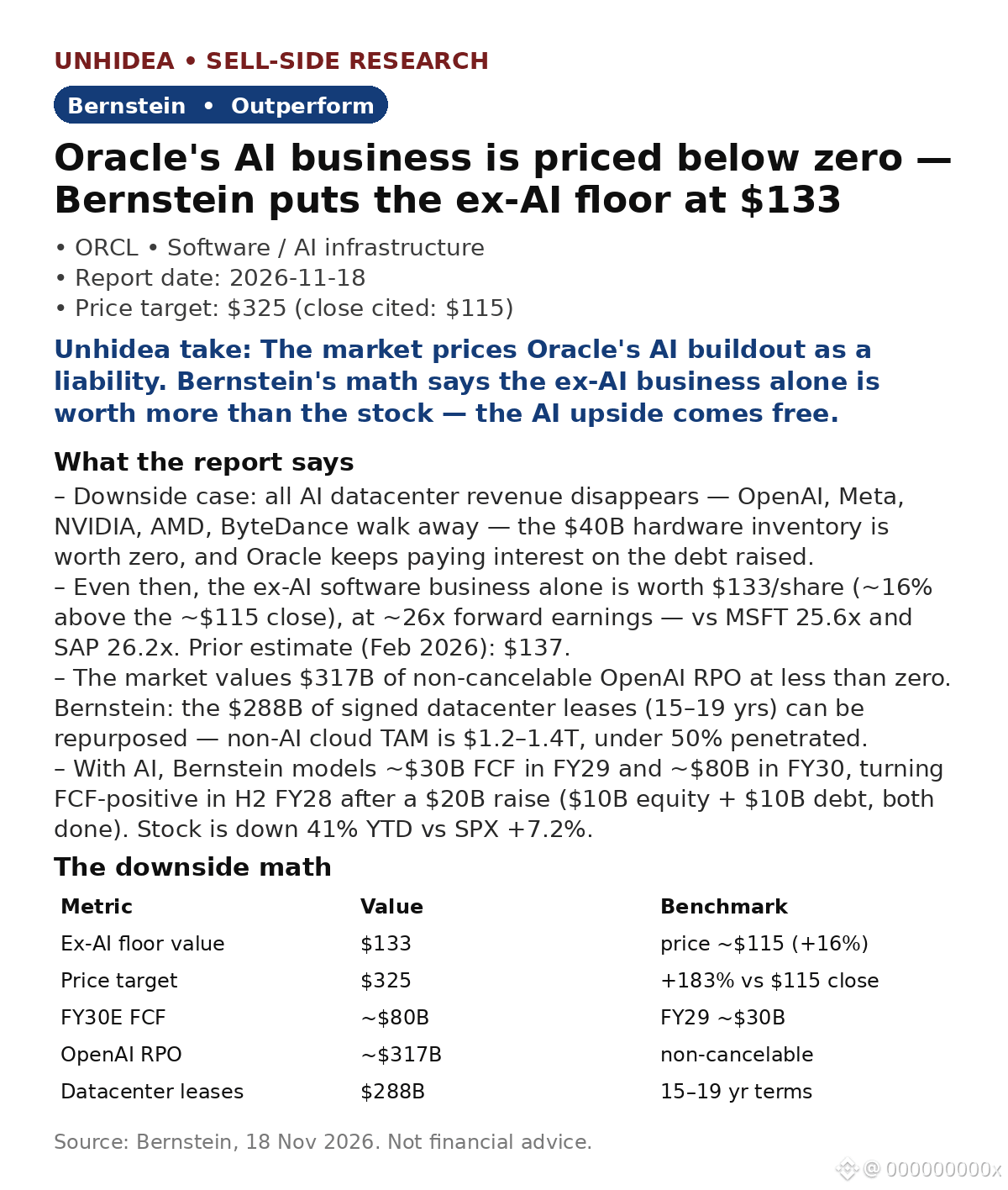
$ORCL: Bernstein says Oracle is worth $133 even if the AI buildout vanished — 16% above the $115 close — keeping Outperform, $325 target (+183%)
- Downside case: all AI datacenter revenue disappears — OpenAI, Meta, NVIDIA, AMD, ByteDance walk away — the $40B hardware is worth zero, and Oracle keeps paying the interest.
- Even then, the ex-AI software business alone is worth $133/share at ~26x forward earnings — in line with MSFT (25.6x) and SAP (26.2x). (Feb 2026: $137.)
- The market values $317B of non-cancelable OpenAI RPO at less than zero. The $288B of leases (15–19 yrs) can be repurposed — non-AI cloud TAM is $1.2–1.4T, under 50% penetrated.
- With AI, Bernstein models ~$30B FCF in FY29 and ~$80B in FY30, FCF-positive in H2 FY28 after a $20B raise ($10B equity + $10B debt, done).
Unhidea take: a mispricing story, not a growth story — ~16% protection to the ex-AI floor, AI optionality free.
Unhidea take: the $133 floor rests on the 26x multiple holding — if SaaS multiples compress, the floor falls too. Watch the multiple, not OpenAI headlines.
Risks: AI Winter, customers missing commitments, debt/interest burden, dilution.
Source: Bernstein, 18 Nov 2026. Not financial advice.
$ORCL : Bernstein says Oracle is worth $133 even if the AI buildout vanished — 16% above the $115 close — keeping Outperform, $325 target (+183%)
- Downside case: all AI datacenter revenue disappears — OpenAI, Meta, NVIDIA, AMD, ByteDance walk away — the $40B hardware is worth zero, and Oracle keeps paying the interest.
- Even then, the ex-AI software business alone is worth $133/share at ~26x forward earnings — in line with MSFT (25.6x) and SAP (26.2x). (Feb 2026: $137.)
- The market values $317B of non-cancelable OpenAI RPO at less than zero. The $288B of leases (15–19 yrs) can be repurposed — non-AI cloud TAM is $1.2–1.4T, under 50% penetrated.
- With AI, Bernstein models ~$30B FCF in FY29 and ~$80B in FY30, FCF-positive in H2 FY28 after a $20B raise ($10B equity + $10B debt, done).
Unhidea take: a mispricing story, not a growth story — ~16% protection to the ex-AI floor, AI optionality free.
Unhidea take: the $133 floor rests on the 26x multiple holding — if SaaS multiples compress, the floor falls too. Watch the multiple, not OpenAI headlines.
Risks: AI Winter, customers missing commitments, debt/interest burden, dilution.
Source: Bernstein, 18 Nov 2026. Not financial advice.
- Downside case: all AI datacenter revenue disappears — OpenAI, Meta, NVIDIA, AMD, ByteDance walk away — the $40B hardware is worth zero, and Oracle keeps paying the interest.
- Even then, the ex-AI software business alone is worth $133/share at ~26x forward earnings — in line with MSFT (25.6x) and SAP (26.2x). (Feb 2026: $137.)
- The market values $317B of non-cancelable OpenAI RPO at less than zero. The $288B of leases (15–19 yrs) can be repurposed — non-AI cloud TAM is $1.2–1.4T, under 50% penetrated.
- With AI, Bernstein models ~$30B FCF in FY29 and ~$80B in FY30, FCF-positive in H2 FY28 after a $20B raise ($10B equity + $10B debt, done).
Unhidea take: a mispricing story, not a growth story — ~16% protection to the ex-AI floor, AI optionality free.
Unhidea take: the $133 floor rests on the 26x multiple holding — if SaaS multiples compress, the floor falls too. Watch the multiple, not OpenAI headlines.
Risks: AI Winter, customers missing commitments, debt/interest burden, dilution.
Source: Bernstein, 18 Nov 2026. Not financial advice.
64
·
--
Tərcüməyə bax
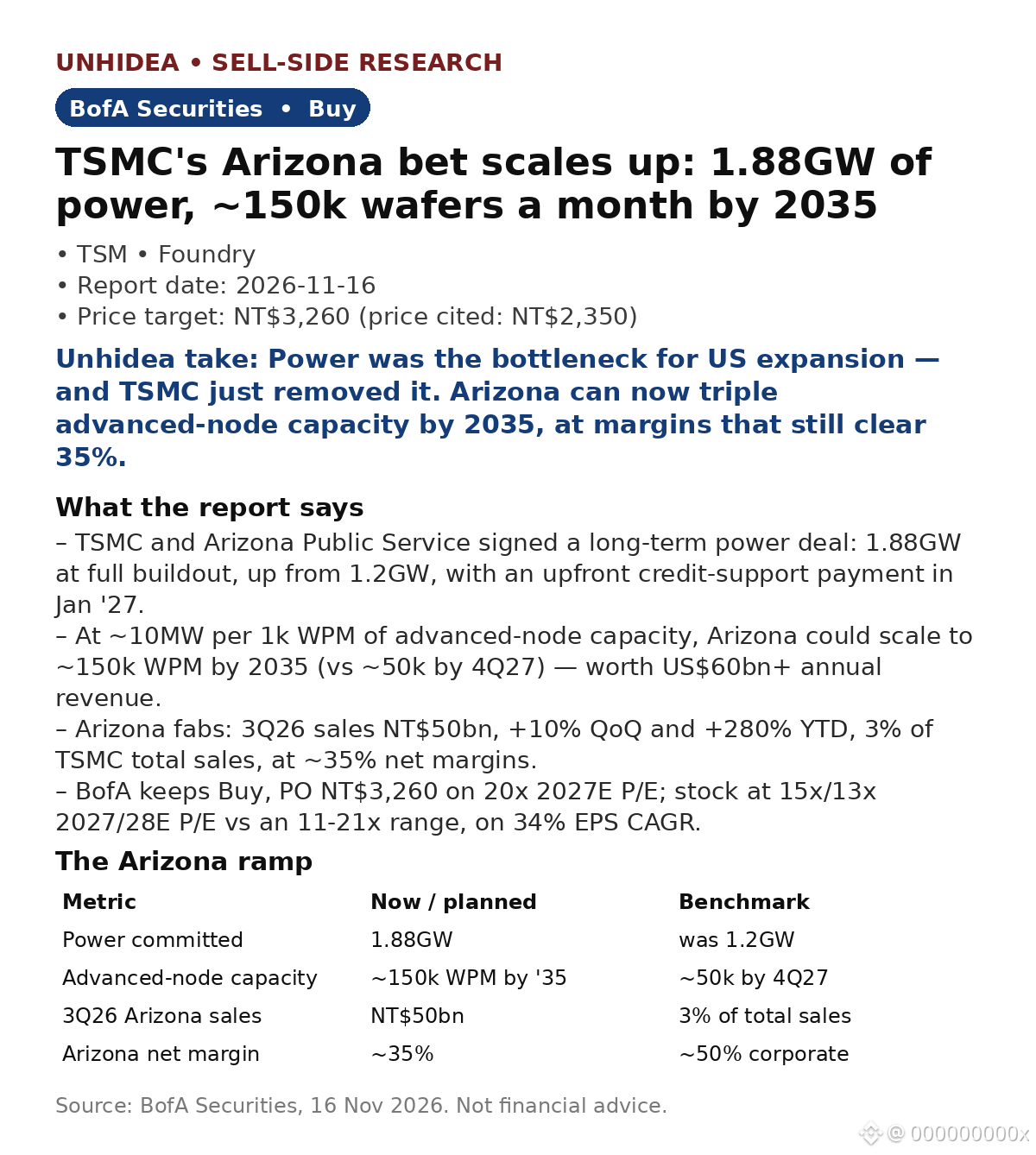
$TSM: BofA keeps Buy, NT$3,260 PT — ~39% above the NT$2,350 price cited — as an Arizona power deal unlocks a much bigger US buildout
- TSMC signed a long-term power deal with Arizona Public Service: 1.88GW at full buildout, up from 1.2GW, with an upfront credit-support payment in Jan '27.
- At ~10MW per 1k wafers/month of advanced-node capacity, BofA estimates Arizona can reach ~150k WPM by 2035 (vs ~50k by 4Q27), worth US$60bn+ a year — vs US$176bn TSMC revenue est. for 2026.
- Arizona fabs are already profitable: 3Q26 sales NT$50bn, +10% QoQ, +280% YTD, 3% of total sales, at ~35% net margins — below 43% in 1H26 and ~50% corporate.
- Valuation: 15x/13x 2027/28E P/E vs an 11-21x range, on 34% EPS CAGR; the PO is 20x 2027E P/E.
- Context (market news, after the report): Nvidia's FQ3 revenue was $115.8bn, +103% YoY.
Unhidea take: power, not demand, was the binding constraint on US chipmaking — a 1.88GW commitment turns Arizona from a showcase into a real second supply base.
Unhidea take: watch the margin bridge — 35% Arizona margins are the price of US resilience; how fast the gap to ~50% corporate closes is the story.
Risks: smartphone/consumer slowdown, Intel foundry ambitions, advanced-node execution, tariffs.
Source: BofA Securities, 16 Nov 2026. Not financial advice.
$TSM : BofA keeps Buy, NT$3,260 PT — ~39% above the NT$2,350 price cited — as an Arizona power deal unlocks a much bigger US buildout
- TSMC signed a long-term power deal with Arizona Public Service: 1.88GW at full buildout, up from 1.2GW, with an upfront credit-support payment in Jan '27.
- At ~10MW per 1k wafers/month of advanced-node capacity, BofA estimates Arizona can reach ~150k WPM by 2035 (vs ~50k by 4Q27), worth US$60bn+ a year — vs US$176bn TSMC revenue est. for 2026.
- Arizona fabs are already profitable: 3Q26 sales NT$50bn, +10% QoQ, +280% YTD, 3% of total sales, at ~35% net margins — below 43% in 1H26 and ~50% corporate.
- Valuation: 15x/13x 2027/28E P/E vs an 11-21x range, on 34% EPS CAGR; the PO is 20x 2027E P/E.
- Context (market news, after the report): Nvidia's FQ3 revenue was $115.8bn, +103% YoY.
Unhidea take: power, not demand, was the binding constraint on US chipmaking — a 1.88GW commitment turns Arizona from a showcase into a real second supply base.
Unhidea take: watch the margin bridge — 35% Arizona margins are the price of US resilience; how fast the gap to ~50% corporate closes is the story.
Risks: smartphone/consumer slowdown, Intel foundry ambitions, advanced-node execution, tariffs.
Source: BofA Securities, 16 Nov 2026. Not financial advice.
- TSMC signed a long-term power deal with Arizona Public Service: 1.88GW at full buildout, up from 1.2GW, with an upfront credit-support payment in Jan '27.
- At ~10MW per 1k wafers/month of advanced-node capacity, BofA estimates Arizona can reach ~150k WPM by 2035 (vs ~50k by 4Q27), worth US$60bn+ a year — vs US$176bn TSMC revenue est. for 2026.
- Arizona fabs are already profitable: 3Q26 sales NT$50bn, +10% QoQ, +280% YTD, 3% of total sales, at ~35% net margins — below 43% in 1H26 and ~50% corporate.
- Valuation: 15x/13x 2027/28E P/E vs an 11-21x range, on 34% EPS CAGR; the PO is 20x 2027E P/E.
- Context (market news, after the report): Nvidia's FQ3 revenue was $115.8bn, +103% YoY.
Unhidea take: power, not demand, was the binding constraint on US chipmaking — a 1.88GW commitment turns Arizona from a showcase into a real second supply base.
Unhidea take: watch the margin bridge — 35% Arizona margins are the price of US resilience; how fast the gap to ~50% corporate closes is the story.
Risks: smartphone/consumer slowdown, Intel foundry ambitions, advanced-node execution, tariffs.
Source: BofA Securities, 16 Nov 2026. Not financial advice.
154
·
--
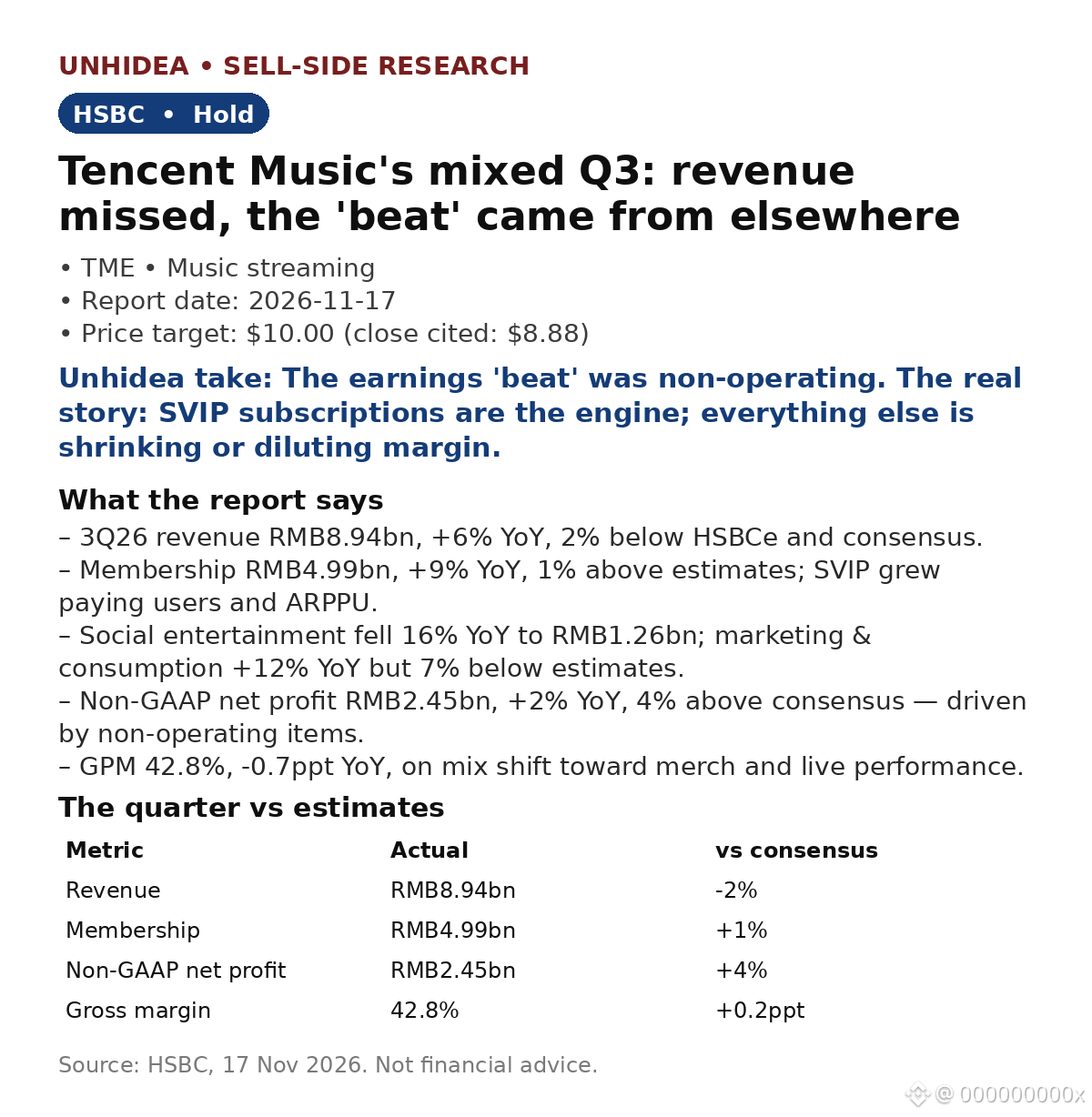
$TME: 3-cü rübün gəliri proqnozdan aşağı oldu — 8,94 mlrd RMB, illik müqayisədə +6%, bazar gözləntilərindən 2% aşağı — lakin HSBC “Saxla” reytinqini və $10,00 hədəf qiymətini qoruyur
- Gəlirin əsas hissəsi üzvlükdən gəldi: 4,99 mlrd RMB, illik müqayisədə +9%, proqnozlardan 1% yuxarı; SVIP ödənişli istifadəçilərin və hər ödənişli istifadəçiyə düşən orta gəlirin (ARPPU) artımına təkan verdi.
- Sosial əyləncə gəlirləri illik müqayisədə 16% azalaraq 1,26 mlrd RMB oldu; marketinq və istehlak 12% artsa da, proqnozdan 7% aşağı qaldı.
- Qeyri-GAAP xalis mənfəəti 2,45 mlrd RMB təşkil etdi, illik müqayisədə +2% və konsensusdan 4% yuxarı — lakin bu artım biznesin özündən deyil, əməliyyatdankənar maddələrdən qaynaqlandı.
- Ümumi mənfəət marjası (GPM) illik müqayisədə 0,7 faiz bəndi azalaraq 42,8% oldu; bunun səbəbi məhsul satışları və canlı çıxışların gəlir strukturunda daha böyük pay tutması idi.
- Səhmlərin geri alınması: 3-cü rübdə təxminən $300 mln dəyərində 34,7 mln ADS — bir rübdə bazar kapitallaşmasının 2,1%-i.
Qiymətləndirmə: $10,00 hədəf qiyməti (PT) 16 noyabrda göstərilən $8,88 bağlanış qiymətindən təxminən 13% yuxarıdır.
Unhidea-nın rəyi: Əməliyyatdankənar maddələrə əsaslanan “gözləntiləri üstələmə” əməliyyat nəticələrinin yaxşılaşması demək deyil — bunları çıxsaq, rüb proqnozlardan aşağı olub, qeyri-GAAP əməliyyat mənfəəti isə illik müqayisədə dəyişməyib.
Unhidea-nın rəyi: TME sakitcə abunə şirkətinə çevrilir — SVIP davamlı inkişafın əsas mühərrikidir; şirkəti ümumi gəlirə görə deyil, üzvlük üzrə ARPPU-ya əsasən qiymətləndirin.
Risklər: Ximalaya-nın inteqrasiya xərcləri, sosial əyləncə seqmentinin azalması, mənfəət marjasına gəlir strukturunun təzyiqi.
Mənbə: HSBC, 17 noyabr 2026. Bu, maliyyə məsləhəti deyil.
$TME: 3-cü rübün gəliri proqnozdan aşağı oldu — 8,94 mlrd RMB, illik müqayisədə +6%, bazar gözləntilərindən 2% aşağı — lakin HSBC “Saxla” reytinqini və $10,00 hədəf qiymətini qoruyur
- Gəlirin əsas hissəsi üzvlükdən gəldi: 4,99 mlrd RMB, illik müqayisədə +9%, proqnozlardan 1% yuxarı; SVIP ödənişli istifadəçilərin və hər ödənişli istifadəçiyə düşən orta gəlirin (ARPPU) artımına təkan verdi.
- Sosial əyləncə gəlirləri illik müqayisədə 16% azalaraq 1,26 mlrd RMB oldu; marketinq və istehlak 12% artsa da, proqnozdan 7% aşağı qaldı.
- Qeyri-GAAP xalis mənfəəti 2,45 mlrd RMB təşkil etdi, illik müqayisədə +2% və konsensusdan 4% yuxarı — lakin bu artım biznesin özündən deyil, əməliyyatdankənar maddələrdən qaynaqlandı.
- Ümumi mənfəət marjası (GPM) illik müqayisədə 0,7 faiz bəndi azalaraq 42,8% oldu; bunun səbəbi məhsul satışları və canlı çıxışların gəlir strukturunda daha böyük pay tutması idi.
- Səhmlərin geri alınması: 3-cü rübdə təxminən $300 mln dəyərində 34,7 mln ADS — bir rübdə bazar kapitallaşmasının 2,1%-i.
Qiymətləndirmə: $10,00 hədəf qiyməti (PT) 16 noyabrda göstərilən $8,88 bağlanış qiymətindən təxminən 13% yuxarıdır.
Unhidea-nın rəyi: Əməliyyatdankənar maddələrə əsaslanan “gözləntiləri üstələmə” əməliyyat nəticələrinin yaxşılaşması demək deyil — bunları çıxsaq, rüb proqnozlardan aşağı olub, qeyri-GAAP əməliyyat mənfəəti isə illik müqayisədə dəyişməyib.
Unhidea-nın rəyi: TME sakitcə abunə şirkətinə çevrilir — SVIP davamlı inkişafın əsas mühərrikidir; şirkəti ümumi gəlirə görə deyil, üzvlük üzrə ARPPU-ya əsasən qiymətləndirin.
Risklər: Ximalaya-nın inteqrasiya xərcləri, sosial əyləncə seqmentinin azalması, mənfəət marjasına gəlir strukturunun təzyiqi.
Mənbə: HSBC, 17 noyabr 2026. Bu, maliyyə məsləhəti deyil.
- Gəlirin əsas hissəsi üzvlükdən gəldi: 4,99 mlrd RMB, illik müqayisədə +9%, proqnozlardan 1% yuxarı; SVIP ödənişli istifadəçilərin və hər ödənişli istifadəçiyə düşən orta gəlirin (ARPPU) artımına təkan verdi.
- Sosial əyləncə gəlirləri illik müqayisədə 16% azalaraq 1,26 mlrd RMB oldu; marketinq və istehlak 12% artsa da, proqnozdan 7% aşağı qaldı.
- Qeyri-GAAP xalis mənfəəti 2,45 mlrd RMB təşkil etdi, illik müqayisədə +2% və konsensusdan 4% yuxarı — lakin bu artım biznesin özündən deyil, əməliyyatdankənar maddələrdən qaynaqlandı.
- Ümumi mənfəət marjası (GPM) illik müqayisədə 0,7 faiz bəndi azalaraq 42,8% oldu; bunun səbəbi məhsul satışları və canlı çıxışların gəlir strukturunda daha böyük pay tutması idi.
- Səhmlərin geri alınması: 3-cü rübdə təxminən $300 mln dəyərində 34,7 mln ADS — bir rübdə bazar kapitallaşmasının 2,1%-i.
Qiymətləndirmə: $10,00 hədəf qiyməti (PT) 16 noyabrda göstərilən $8,88 bağlanış qiymətindən təxminən 13% yuxarıdır.
Unhidea-nın rəyi: Əməliyyatdankənar maddələrə əsaslanan “gözləntiləri üstələmə” əməliyyat nəticələrinin yaxşılaşması demək deyil — bunları çıxsaq, rüb proqnozlardan aşağı olub, qeyri-GAAP əməliyyat mənfəəti isə illik müqayisədə dəyişməyib.
Unhidea-nın rəyi: TME sakitcə abunə şirkətinə çevrilir — SVIP davamlı inkişafın əsas mühərrikidir; şirkəti ümumi gəlirə görə deyil, üzvlük üzrə ARPPU-ya əsasən qiymətləndirin.
Risklər: Ximalaya-nın inteqrasiya xərcləri, sosial əyləncə seqmentinin azalması, mənfəət marjasına gəlir strukturunun təzyiqi.
Mənbə: HSBC, 17 noyabr 2026. Bu, maliyyə məsləhəti deyil.
TMEUS+0,52%
51
·
--
Tərcüməyə bax
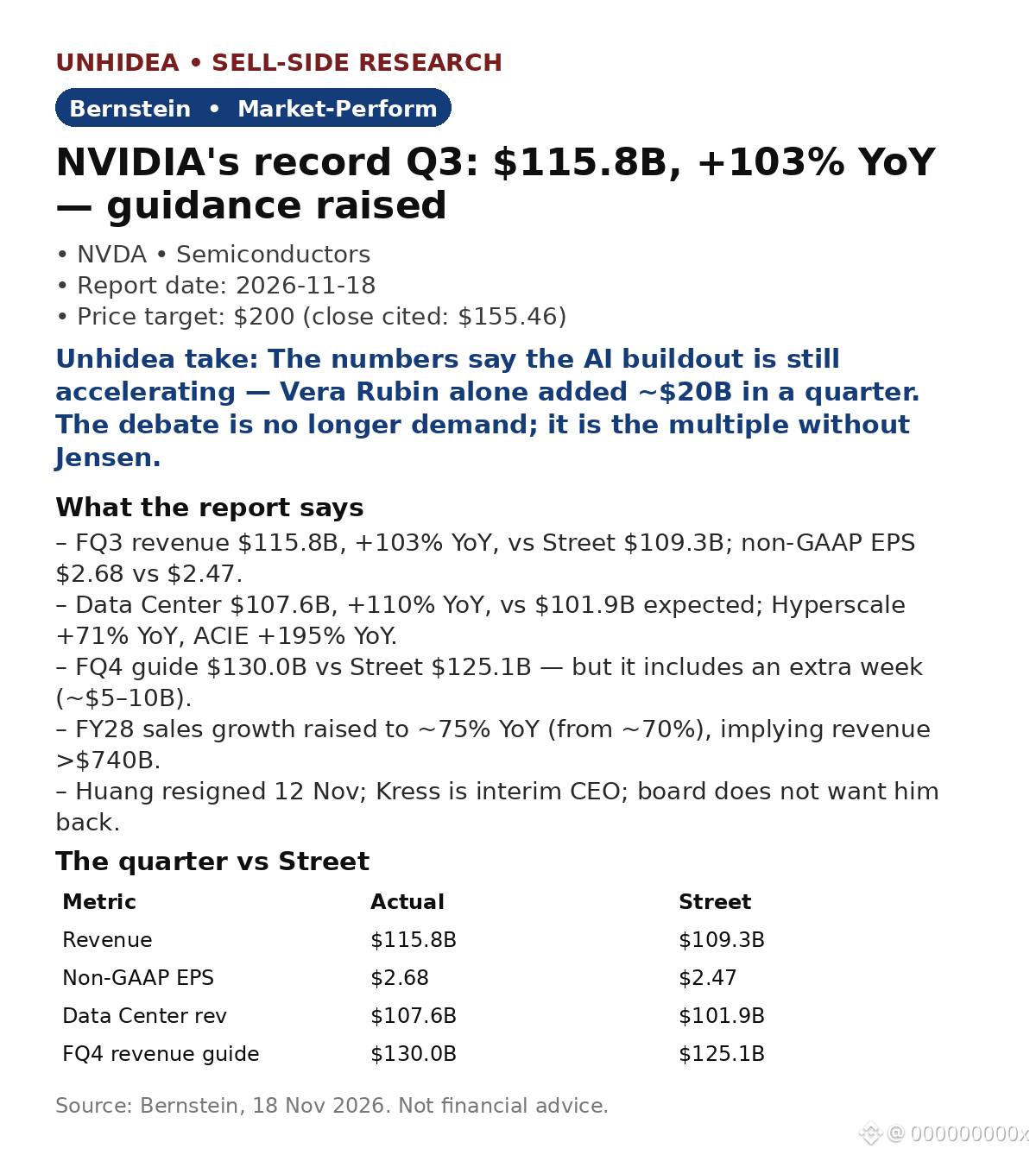
$NVDA: record Q3 — $115.8B revenue, +103% YoY — but Bernstein stays Market-Perform, $200 PT
FQ3 beat: revenue $115.8B (+103% YoY, +20% QoQ) vs Street $109.3B; EPS $2.68 vs $2.47. Data Center $107.6B, +110% YoY, vs $101.9B expected. Vera Rubin added ~$20B — the strongest ramp in company history.
- FQ4 guide $130B (±3%) vs Street $125.1B — but it includes an extra week (~$5–10B), so the normalized guide was likely light.
- FY28 sales growth raised to ~75% YoY (from ~70%), implying revenue >$740B, even with new BIS sanctions.
- Leadership: Huang resigned 12 Nov; Kress is interim CEO; the board does not want him back — near-term stable, long-term questions remain.
Valuation: $200 PT is ~29% above the $155.46 close cited (17 Nov); 52-week range $148.80–$243.37.
Unhidea take: the numbers say the AI buildout is still accelerating — Rubin alone did ~$20B in a quarter. The debate is no longer demand, it's the multiple without Jensen.
Unhidea take: ex the extra week, the Q4 guide is less heroic than the headline; the FY28 raise to ~75% is the real signal.
Risks: leadership transition, export controls, $390B supply commitments, margin trough.
Source: Bernstein, 18 Nov 2026. Not financial advice.
$NVDA : record Q3 — $115.8B revenue, +103% YoY — but Bernstein stays Market-Perform, $200 PT
FQ3 beat: revenue $115.8B (+103% YoY, +20% QoQ) vs Street $109.3B; EPS $2.68 vs $2.47. Data Center $107.6B, +110% YoY, vs $101.9B expected. Vera Rubin added ~$20B — the strongest ramp in company history.
- FQ4 guide $130B (±3%) vs Street $125.1B — but it includes an extra week (~$5–10B), so the normalized guide was likely light.
- FY28 sales growth raised to ~75% YoY (from ~70%), implying revenue >$740B, even with new BIS sanctions.
- Leadership: Huang resigned 12 Nov; Kress is interim CEO; the board does not want him back — near-term stable, long-term questions remain.
Valuation: $200 PT is ~29% above the $155.46 close cited (17 Nov); 52-week range $148.80–$243.37.
Unhidea take: the numbers say the AI buildout is still accelerating — Rubin alone did ~$20B in a quarter. The debate is no longer demand, it's the multiple without Jensen.
Unhidea take: ex the extra week, the Q4 guide is less heroic than the headline; the FY28 raise to ~75% is the real signal.
Risks: leadership transition, export controls, $390B supply commitments, margin trough.
Source: Bernstein, 18 Nov 2026. Not financial advice.
FQ3 beat: revenue $115.8B (+103% YoY, +20% QoQ) vs Street $109.3B; EPS $2.68 vs $2.47. Data Center $107.6B, +110% YoY, vs $101.9B expected. Vera Rubin added ~$20B — the strongest ramp in company history.
- FQ4 guide $130B (±3%) vs Street $125.1B — but it includes an extra week (~$5–10B), so the normalized guide was likely light.
- FY28 sales growth raised to ~75% YoY (from ~70%), implying revenue >$740B, even with new BIS sanctions.
- Leadership: Huang resigned 12 Nov; Kress is interim CEO; the board does not want him back — near-term stable, long-term questions remain.
Valuation: $200 PT is ~29% above the $155.46 close cited (17 Nov); 52-week range $148.80–$243.37.
Unhidea take: the numbers say the AI buildout is still accelerating — Rubin alone did ~$20B in a quarter. The debate is no longer demand, it's the multiple without Jensen.
Unhidea take: ex the extra week, the Q4 guide is less heroic than the headline; the FY28 raise to ~75% is the real signal.
Risks: leadership transition, export controls, $390B supply commitments, margin trough.
Source: Bernstein, 18 Nov 2026. Not financial advice.
35
·
--
Tərcüməyə bax
$9868.HK: XPeng's overseas cars earn ~2x domestic margins — Morgan Stanley says exports now fund the robot bet. Overweight, HK$70 target, 83% upside vs HK$38.28 close (17 Nov).
Overseas ASP is ~50% above domestic, at ~2x the gross margin. MS expects overseas to be 30% of 4Q26 revenue and over half of gross profit, holding vehicle GpM at 12–13% despite a richer MONA mix.
Production is sold out for months: L03 tops 20k/month, L05 10k/month, with 4+ and 2+ months of backlog, carrying deliveries through the 1Q27 low season.
Robotics is the next leg: auto R&D holds at ~Rmb5bn, robotics R&D rises in 2027, targeting several billion Rmb in revenue and gross profit, funded by positive FCF (Rmb3–4bn annual capex).
MS models 2027E revenue of Rmb103.3bn (+25% YoY) and a first profit in 2028E (EPS Rmb0.23 vs a Rmb0.37 loss in 2027E).
Unhidea take: overseas is the margin engine — every export car does the work of two at home, so the robot bet is funded by exports, not dilution.
Unhidea take: watch whether robotics revenue lands in 2027 — until then, XPeng is priced as a carmaker with a robot story.
Risks: competition; cash-flow pressure; slower demand. Source: Morgan Stanley, 17 Nov 2026. Not financial advice.
$9868.HK: XPeng's overseas cars earn ~2x domestic margins — Morgan Stanley says exports now fund the robot bet. Overweight, HK$70 target, 83% upside vs HK$38.28 close (17 Nov).
Overseas ASP is ~50% above domestic, at ~2x the gross margin. MS expects overseas to be 30% of 4Q26 revenue and over half of gross profit, holding vehicle GpM at 12–13% despite a richer MONA mix.
Production is sold out for months: L03 tops 20k/month, L05 10k/month, with 4+ and 2+ months of backlog, carrying deliveries through the 1Q27 low season.
Robotics is the next leg: auto R&D holds at ~Rmb5bn, robotics R&D rises in 2027, targeting several billion Rmb in revenue and gross profit, funded by positive FCF (Rmb3–4bn annual capex).
MS models 2027E revenue of Rmb103.3bn (+25% YoY) and a first profit in 2028E (EPS Rmb0.23 vs a Rmb0.37 loss in 2027E).
Unhidea take: overseas is the margin engine — every export car does the work of two at home, so the robot bet is funded by exports, not dilution.
Unhidea take: watch whether robotics revenue lands in 2027 — until then, XPeng is priced as a carmaker with a robot story.
Risks: competition; cash-flow pressure; slower demand. Source: Morgan Stanley, 17 Nov 2026. Not financial advice.
Overseas ASP is ~50% above domestic, at ~2x the gross margin. MS expects overseas to be 30% of 4Q26 revenue and over half of gross profit, holding vehicle GpM at 12–13% despite a richer MONA mix.
Production is sold out for months: L03 tops 20k/month, L05 10k/month, with 4+ and 2+ months of backlog, carrying deliveries through the 1Q27 low season.
Robotics is the next leg: auto R&D holds at ~Rmb5bn, robotics R&D rises in 2027, targeting several billion Rmb in revenue and gross profit, funded by positive FCF (Rmb3–4bn annual capex).
MS models 2027E revenue of Rmb103.3bn (+25% YoY) and a first profit in 2028E (EPS Rmb0.23 vs a Rmb0.37 loss in 2027E).
Unhidea take: overseas is the margin engine — every export car does the work of two at home, so the robot bet is funded by exports, not dilution.
Unhidea take: watch whether robotics revenue lands in 2027 — until then, XPeng is priced as a carmaker with a robot story.
Risks: competition; cash-flow pressure; slower demand. Source: Morgan Stanley, 17 Nov 2026. Not financial advice.
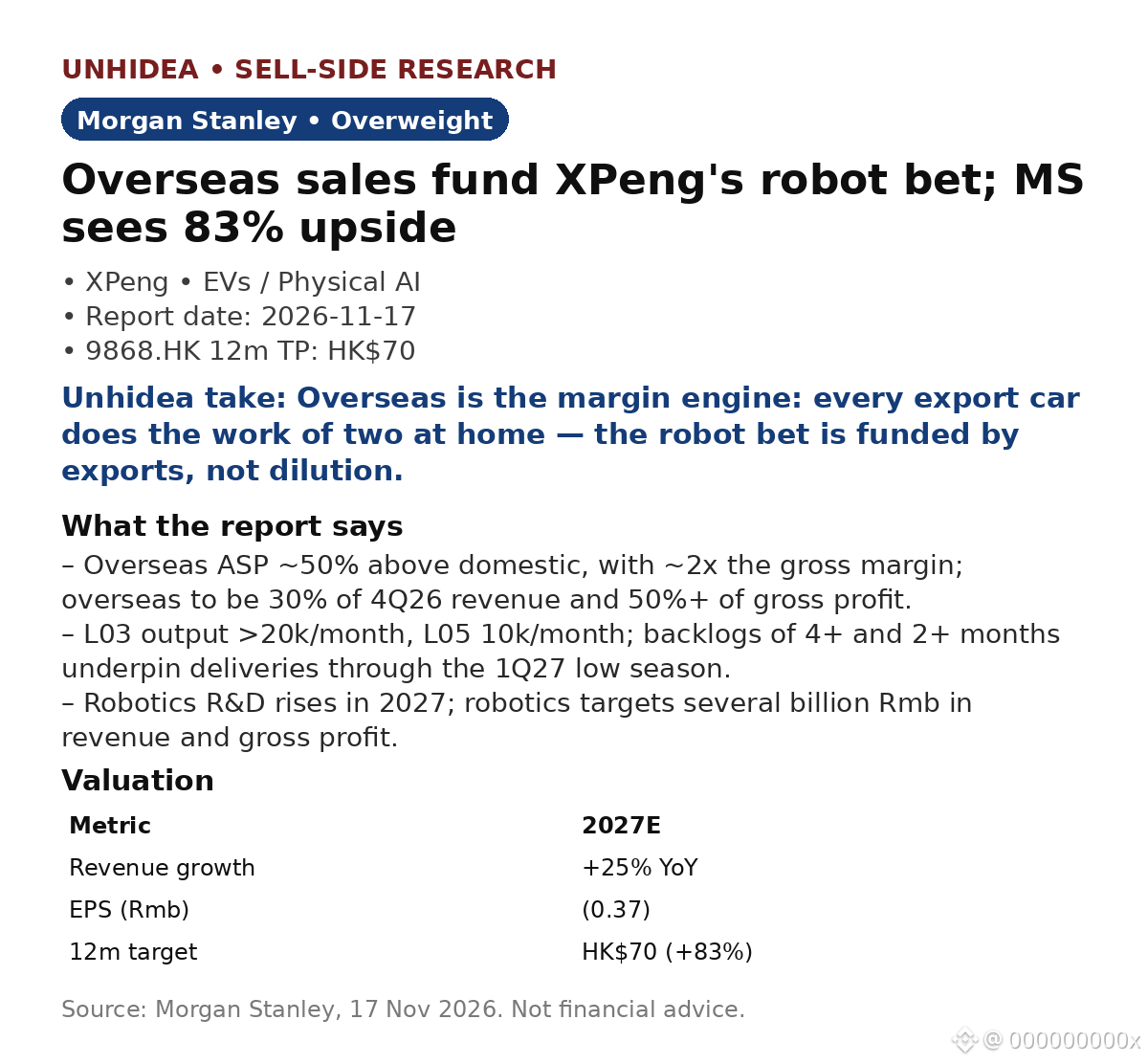
·
--
Tərcüməyə bax
Goldman Sachs: Hesai is no longer a car-parts story — robotics is now over half of revenue, and the higher-value half.
GS reiterates Buy on $HSAI, 12m target US$28, implying 94% upside. Robotics passed 50% of total revenue in 3Q26; GS models 62% by 2030E, revenue CAGR 32% in 2025-30E.
Actuation modules: 23k shipped in 3Q26 vs 12k in 2Q26, heading for six figures in 2027E. LiDAR EBIT margin hit 15.8% in 3Q26 vs 6.4% in 1Q26 as ADAS pricing stabilised. KOSMO, launched Oct 2026, already earns recurring revenue — Pixar RenderMan is a user.
2027E: revenue +39% (ADAS +27% YoY vs -5% in 2026E; non-ADAS +49%), non-GAAP EBIT +145% YoY, margin 13% vs 7%.
After the report: Nvidia Q3 revenue $115.8B beat consensus after the close on 17 Nov. Hesai is a key supplier to Nvidia's humanoid platform, per the report.
Unhidea take: the mix shift is the story — robotics LiDAR is ~15% of units but over 50% of LiDAR revenue, so the P&L now follows robots, not cars.
Unhidea take: watch KOSMO's ARR — recurring spatial-data revenue would stop the market valuing Hesai as a hardware supplier.
Risks: slower LiDAR adoption; pricing pressure; policy risk. Source: Goldman Sachs, 17 Nov 2026. Not financial advice.
Goldman Sachs: Hesai is no longer a car-parts story — robotics is now over half of revenue, and the higher-value half.
GS reiterates Buy on $HSAI, 12m target US$28, implying 94% upside. Robotics passed 50% of total revenue in 3Q26; GS models 62% by 2030E, revenue CAGR 32% in 2025-30E.
Actuation modules: 23k shipped in 3Q26 vs 12k in 2Q26, heading for six figures in 2027E. LiDAR EBIT margin hit 15.8% in 3Q26 vs 6.4% in 1Q26 as ADAS pricing stabilised. KOSMO, launched Oct 2026, already earns recurring revenue — Pixar RenderMan is a user.
2027E: revenue +39% (ADAS +27% YoY vs -5% in 2026E; non-ADAS +49%), non-GAAP EBIT +145% YoY, margin 13% vs 7%.
After the report: Nvidia Q3 revenue $115.8B beat consensus after the close on 17 Nov. Hesai is a key supplier to Nvidia's humanoid platform, per the report.
Unhidea take: the mix shift is the story — robotics LiDAR is ~15% of units but over 50% of LiDAR revenue, so the P&L now follows robots, not cars.
Unhidea take: watch KOSMO's ARR — recurring spatial-data revenue would stop the market valuing Hesai as a hardware supplier.
Risks: slower LiDAR adoption; pricing pressure; policy risk. Source: Goldman Sachs, 17 Nov 2026. Not financial advice.
GS reiterates Buy on $HSAI, 12m target US$28, implying 94% upside. Robotics passed 50% of total revenue in 3Q26; GS models 62% by 2030E, revenue CAGR 32% in 2025-30E.
Actuation modules: 23k shipped in 3Q26 vs 12k in 2Q26, heading for six figures in 2027E. LiDAR EBIT margin hit 15.8% in 3Q26 vs 6.4% in 1Q26 as ADAS pricing stabilised. KOSMO, launched Oct 2026, already earns recurring revenue — Pixar RenderMan is a user.
2027E: revenue +39% (ADAS +27% YoY vs -5% in 2026E; non-ADAS +49%), non-GAAP EBIT +145% YoY, margin 13% vs 7%.
After the report: Nvidia Q3 revenue $115.8B beat consensus after the close on 17 Nov. Hesai is a key supplier to Nvidia's humanoid platform, per the report.
Unhidea take: the mix shift is the story — robotics LiDAR is ~15% of units but over 50% of LiDAR revenue, so the P&L now follows robots, not cars.
Unhidea take: watch KOSMO's ARR — recurring spatial-data revenue would stop the market valuing Hesai as a hardware supplier.
Risks: slower LiDAR adoption; pricing pressure; policy risk. Source: Goldman Sachs, 17 Nov 2026. Not financial advice.
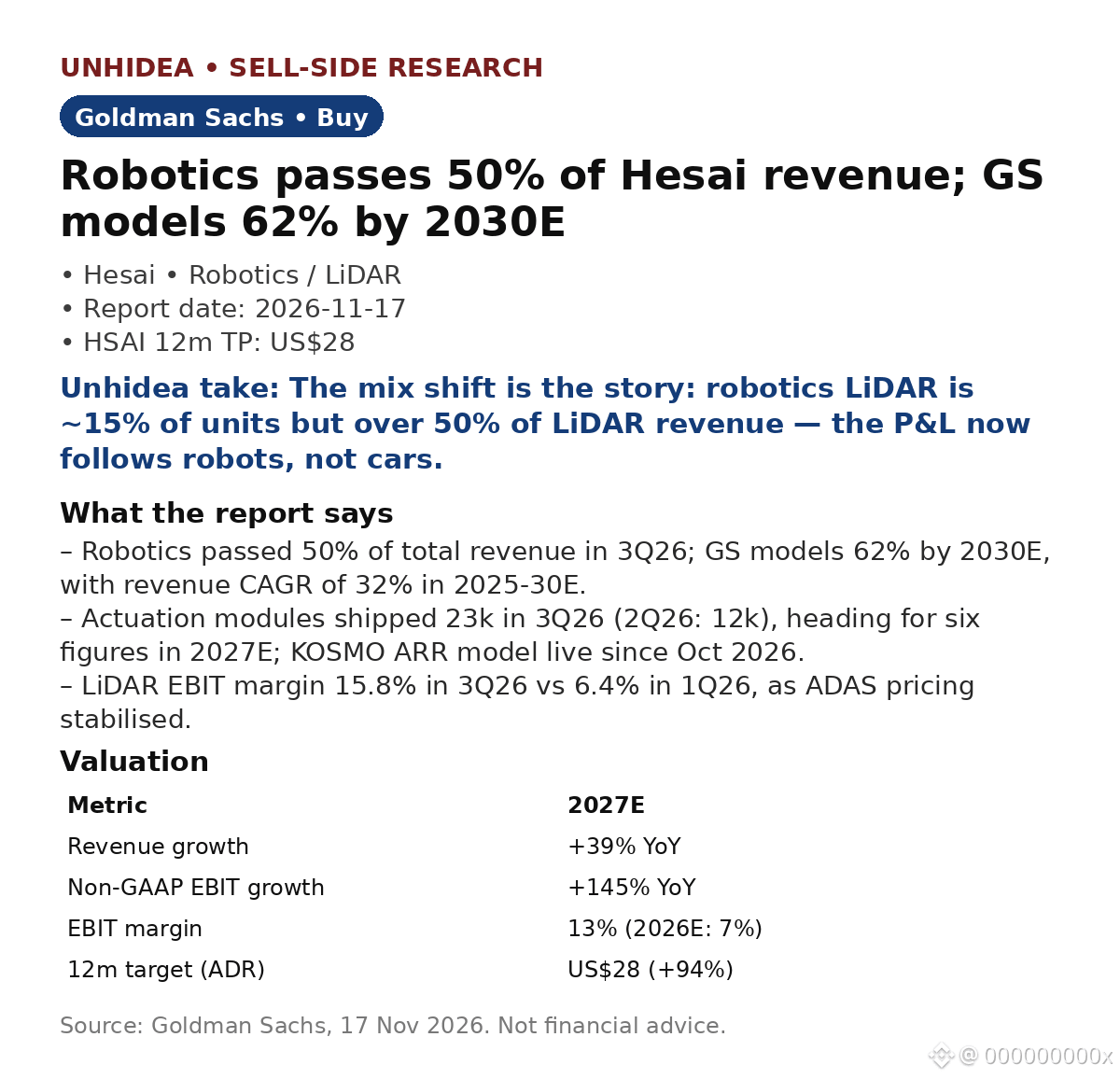
81
Daha çox kontent araşdırmaq üçün daxil olun
Binance Square-də qlobal kriptovalyuta istifadəçilərinə qoşulun
⚡️ Kriptovalyuta haqqında ən son və faydalı məlumatları əldə edin.
💬 Dünyanın ən böyük kriptovalyuta birjası tərəfindən etibar edilir.
👍 Doğrulanmış yaradıcılardan gələn real məlumatları kəşf edin.
E-poçt/Telefon nömrəsi
Trenddə olan mövzular
BTCRemainsUnderPressureAfterHawkishFOMCMinutes
56,019 baxış
Müzakirə edir: 725
FOMC iclasının protokolu | Fed protokolu göstərir ki, rəsmilərin demək olar ki, hamısı faizlərin daha da artırılacağını gözləyir, bəziləri isə dekabrda daha böyük artıma açıqdır
Binance News
·48 bəyənmə
·57.2k baxış
AnthropicToDebutAfter$83IPOPricing
14,864 baxış
Müzakirə edir: 76
NvidiaBoardReportedlySplitOverHuang’sReturn
18,556 baxış
Müzakirə edir: 315