


Today, we are talking about Sachin Dev Duggal, the founder and former CEO of the AI programming company Builder.ai.
He not only created a fake AI company that was 'all human, no intelligence.'
It fooled several hundred million dollars in funding from giants like SoftBank and Microsoft, achieving a valuation of $1.5 billion.
Moreover, it even dared to exaggerate its revenues to investors by 300%.
Yes, there is no AI in the background of this company; just a group of Indian guys pretending to be AI writing code.
Even more shocking, this scam persisted for 8 years.
But this week, he essentially finished playing.
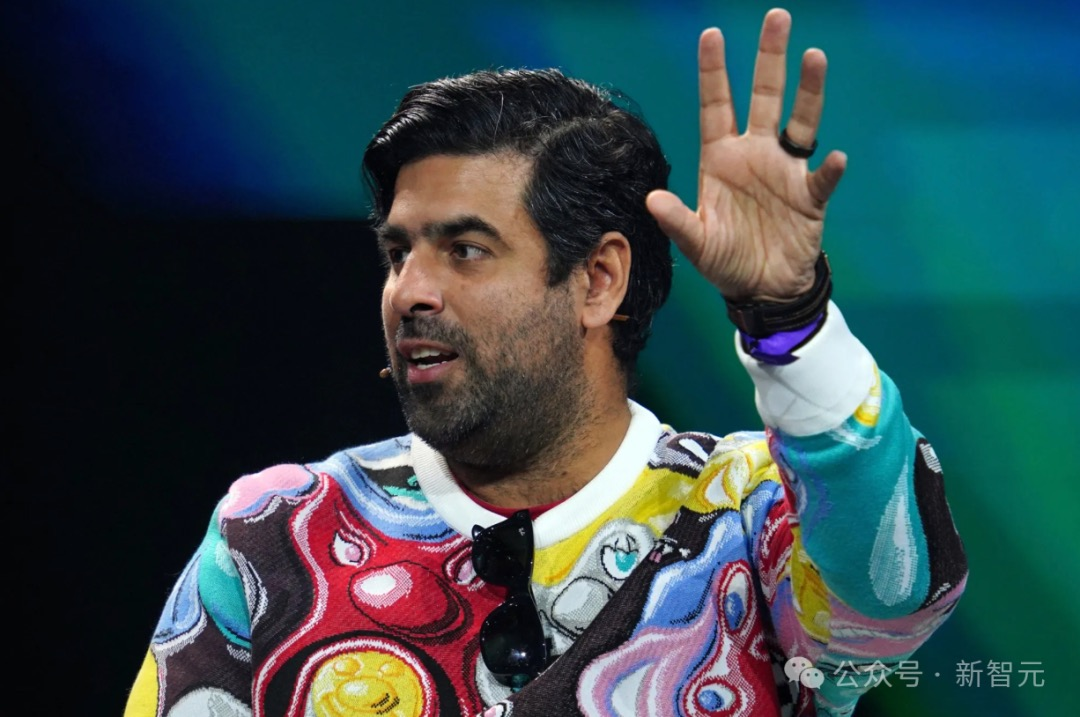 Image source: Deep Tide TechFlow Founder and former CEO Sachin Dev Duggal
Following the recent exposure of a 'fraud,' the previous round of investors hurriedly froze the remaining $37 million in their investment accounts (having invested a total of $50 million), leaving the company account with only $5 million, which was also restricted by government regulations on capital outflow, making it impossible to use for payroll.
There was no other choice; Builder.ai had to file for bankruptcy. At this point, the CEO had already been replaced by Manpreet Ratia, who was brought in to 'clean up the mess'—the founder Sachin Dev Duggal resigned as CEO in February, and Ratia took over.
This farce directly led to the largest collapse in AI startups since the release of ChatGPT in 2022—this company was valued at over $1.5 billion in the last round of financing.
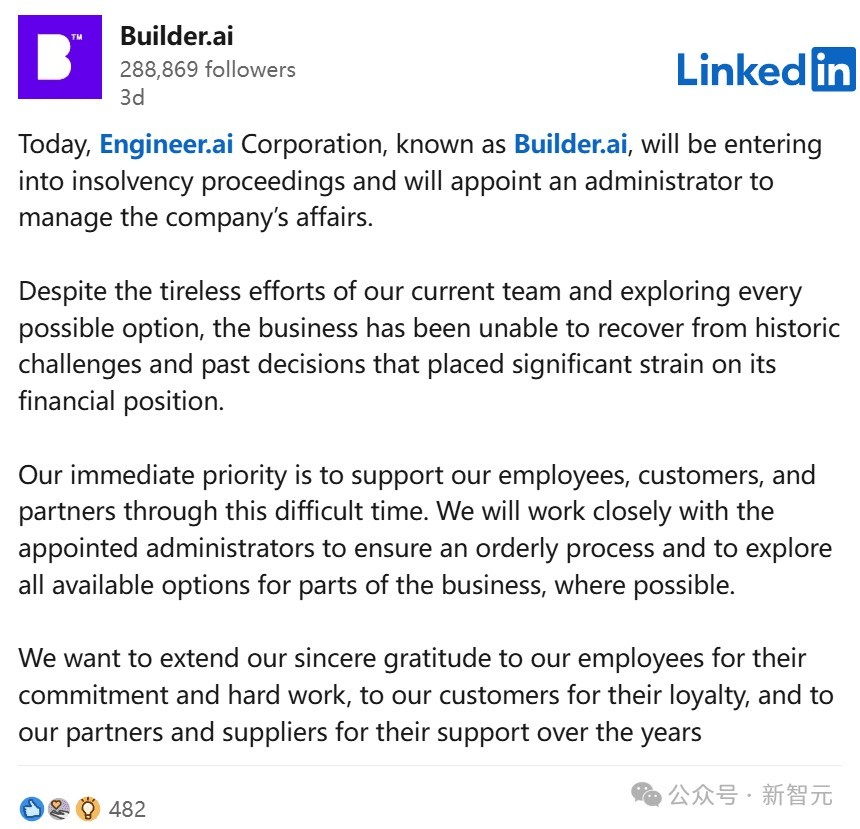 Image source: Public account ‧ New Intelligence Builder.ai's bankruptcy announcement
 Image source: Public account ‧ New Intelligence Builder.ai's official website is no longer accessible, leaving only two contact emails.
The 'big loser' in this storm, besides Viola Credit, which provided $50 million, is also one of the world's largest sovereign wealth funds, the Qatar Investment Authority (QIA), which led a $250 million financing two years ago.
In the same year, Microsoft also made investments and became a strategic partner. In fact, they even integrated Builder.ai into their cloud services.
Golden Age
Builder.ai was born in London, stemming from its founder Sachin Dev Duggal's dissatisfaction with traditional software development.
In the golden age of AI-driven narratives, Builder.ai had a promotional slogan that was too good to ignore: making software development 'as simple as ordering a pizza.'
This startup, founded in 2016, claims that it can enable non-engineers to build complex applications through a platform that is allegedly powered by AI, thereby popularizing software development.
The AI promotional slogan worked wonders for investors.
Builder.ai was formerly known as Engineer.ai, a company headquartered in London and Los Angeles that raised $29.5 million in funding from investors including Deepcore Inc. in 2018, which is a wholly-owned subsidiary of SoftBank.
Other investors also include the Zurich-based venture capital firm Lakestar (an early investor in Facebook Inc. and Airbnb Inc.) and Singapore-based Jungle Ventures.
 Image source: Public account ‧ New Intelligence Founder Sachin Dev Duggal at an early technology conference.
By 2022, Builder.ai had raised $195 million and in May 2023, added another $250 million in a funding round led by the Qatar Investment Authority (QIA).
In the same year, Microsoft joined as a strategic investor and partner, integrating its Builder.ai platform into its cloud service products.
 Image source: Public account ‧ New Intelligence
 Image source: Public account ‧ New Intelligence
This brought immense recognition, and the expectations that followed were equally huge.
In the following 8 years, it raised over $445 million in funding, with investors including Microsoft and the Qatar Investment Authority, and the company's valuation also crossed the $1.3 billion mark.
The solution provided by Builder.ai was to combine modular code components with human developers and coordinate by AI.
Its platform, named 'Builder Studio,' is equipped with a digital assistant called 'Natasha,' promising to deliver an AI-driven seamless user experience.
 Image source: Public account ‧ New Intelligence Builder.ai's flashy official website is now completely inaccessible.
But behind this vision is the reality that most of the work is done by developers in India, not AI.
In 2019, the Wall Street Journal exposed an embarrassing truth: Builder.ai's AI was more of a marketing gimmick than an engineering breakthrough.
 Image source: Public account ‧ New Intelligence
Several current and former employees stated that some pricing and scheduling calculations were done using traditional software, and most of the remaining work was also done manually by employees.
If you tell clients you are using AI, they are unlikely to think of technology from the 1950s. Decision trees are a very old and simple technology.
These individuals stated that the company lacks natural language processing technology, and the decision trees used internally should not be considered AI.
As reported, Builder.ai, this AI company, is 'all human, no intelligence.'
The gap between this narrative and reality will determine the company's development trajectory.
Only human, no intelligence.
The signs of deception by Builder.ai were not just revealed in the Wall Street Journal's report in 2019.
According to multiple former employees and insiders on Reddit, Builder.ai may have started out as 'all human, no intelligence.'
Multiple former employees stated that management could not possibly be unaware of the ongoing fraud but simply turned a blind eye. Working at this company for two years, hardly any projects were delivered.
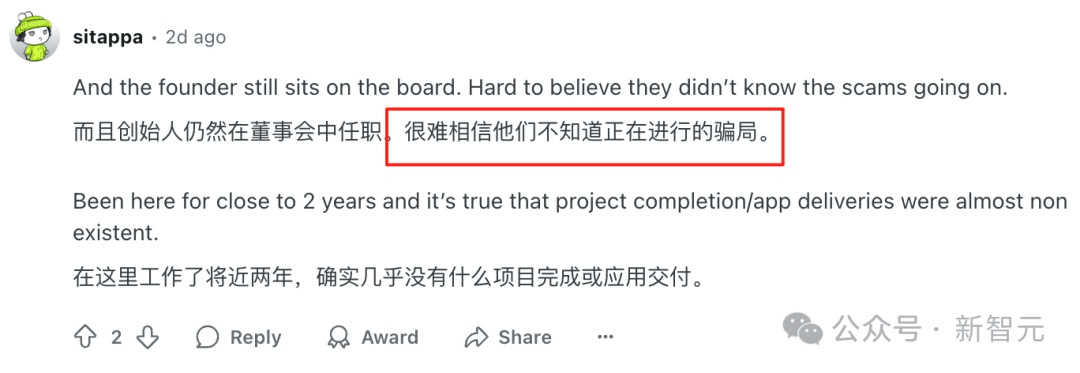 Image source: Public account ‧ New Intelligence
Moreover, former employees revealed that Builder.ai severely underpaid its employees, even calling the offered salaries 'too garbage,' and that it was not an AI-driven but a marketing-driven company.
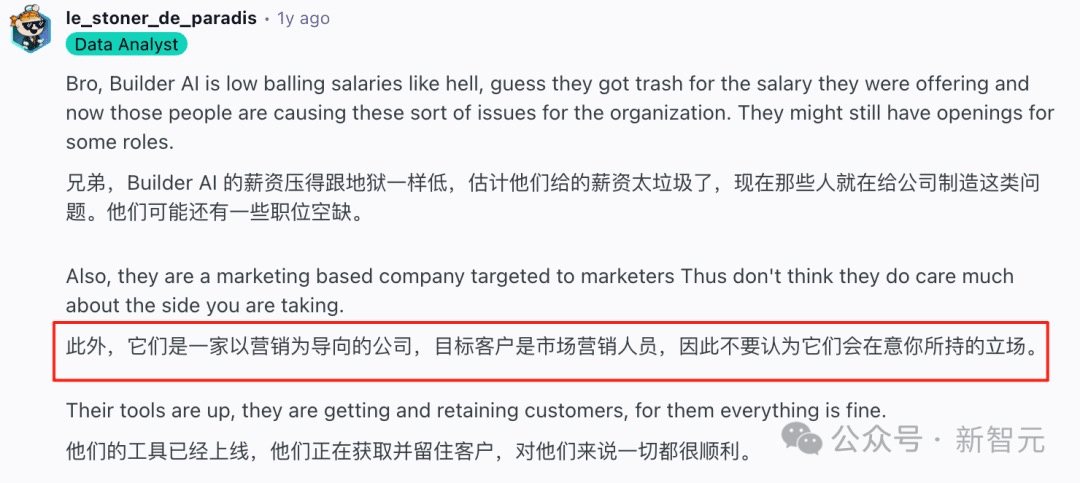 Image source: Public account ‧ New Intelligence
 Image source: Public account ‧ New Intelligence
A user discovered a lot of 'incomprehensible' issues while using Builder.ai's services a year ago.
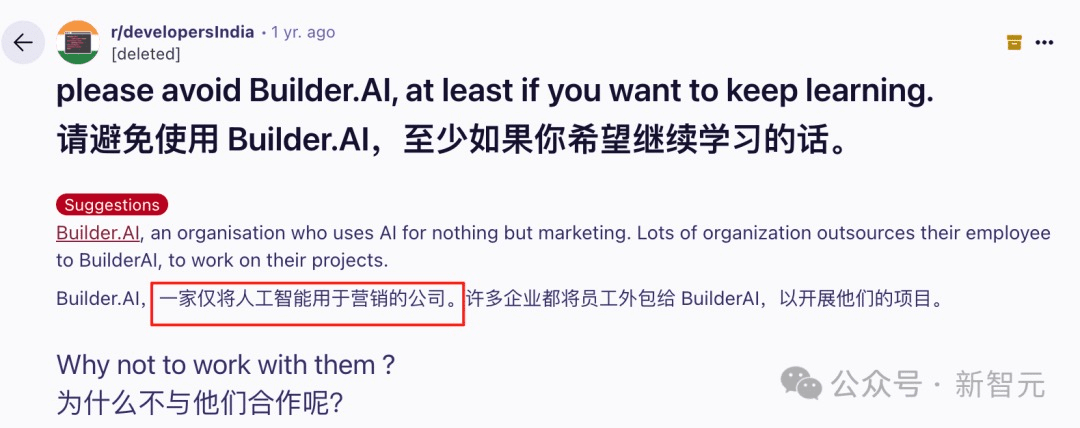 Image source: Public account ‧ New Intelligence
Including: extremely poor development experience, lack of modules, unusable code, inability to access IDE, and even some code being completely unmodifiable.
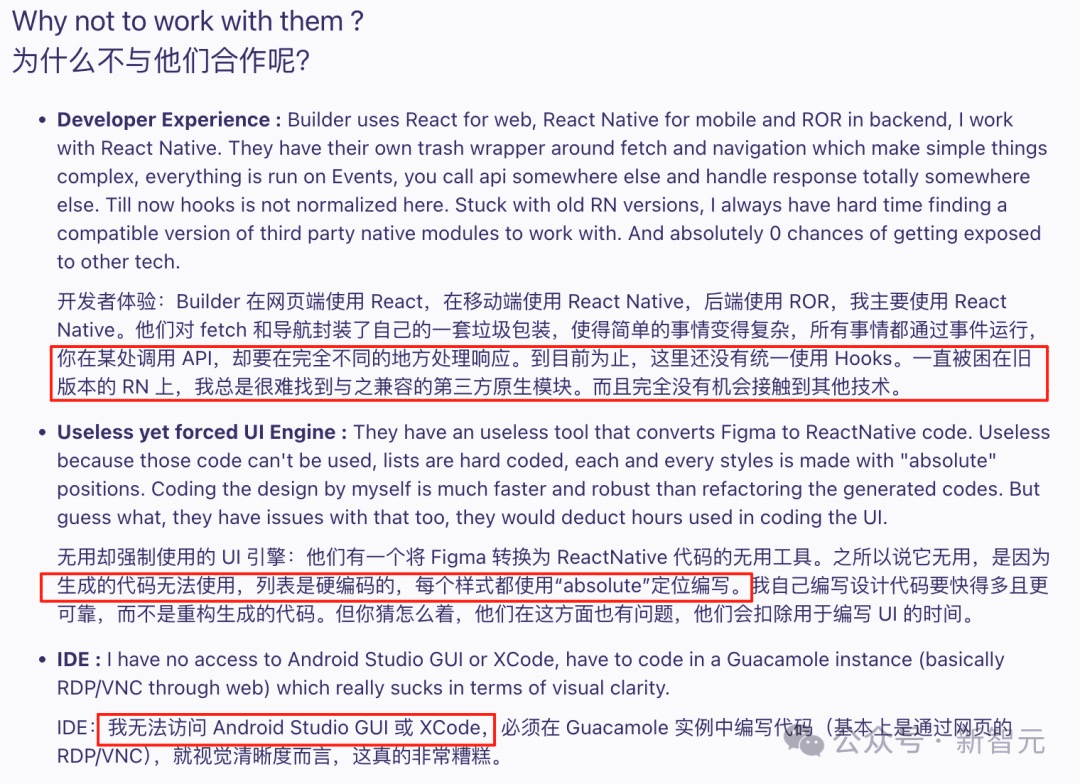 Image source: Public account ‧ New Intelligence
Insiders revealed that Builder.ai was actually a company that used 'AI domain names' for fraud. The company employed a large number of low-cost developers to 'pretend to be AI.'
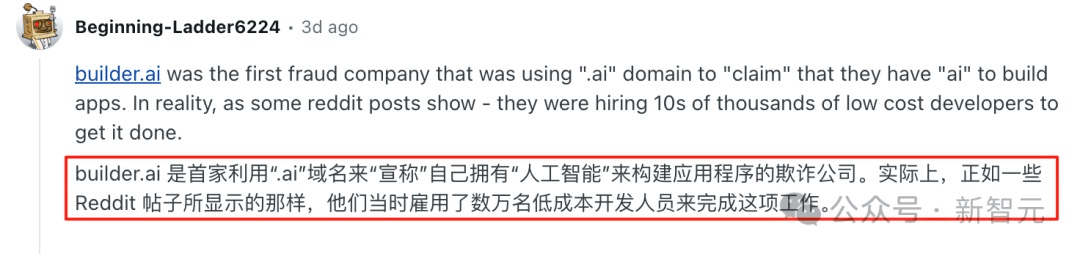 Image source: Public account ‧ New Intelligence
Moment of liquidation
As time passed, the fractures within Builder.ai continued to widen.
According to insiders, the company had long relied on exaggerated revenue forecasts and AI-related promotions to secure funding.
A large global workforce and a massive expansion plan, including developing new markets in Southeast Asia and the Middle East, have led to a constant increase in capital consumption rates.
 Image source: Public account ‧ New Intelligence
Meanwhile, the former CEO's legal issues have also been numerous.
According to the Financial Times, Duggal was involved in an investigation into a money laundering criminal case in India. In response, Builder.ai's chief legal counsel stated in a now-deleted blog post that Duggal was merely a witness in the case.
However, Duggal resigned as CEO in February but remained on the board and retained his 'wizard' title.
Taking over for him is Manpreet Ratia, a former senior executive at Amazon and Flipkart, who previously served as a managing partner at Builder.ai investor Jungle Ventures.
 Image source: Public account ‧ New Intelligence
Soon after, the moment of liquidation arrived.
In May 2025, one of Builder.ai's senior investors, Viola Credit, seized $37 million from the company's account, triggering a default.
Only $5 million in cash remained in the hands of CEO Manpreet Ratia, who took over just two months ago to clean up the aftermath.
A few days later, he filed for bankruptcy.
It turned out that Builder.ai provided lenders with exaggerated financial forecasts and falsely reported its revenue health.
This breach of contract allowed Viola Credit to take decisive action.
But the larger reason behind this structural collapse is that their business model never matched their brand promotion.
 Image source: Public account ‧ New Intelligence
Ratia admitted in an all-company conference call that the defeat was already determined. Most global employees were laid off, and the product once positioned as the flagship of AI innovation was also put on hold.
On May 20, it officially declared bankruptcy.
A month before the failure, the company underwent a last-minute restructuring, laying off 220 of its 770 employees.
Builder.ai stated this week that due to 'inability to recover from historical challenges and past decisions, which have placed immense pressure on the company's financial condition,' despite 'tireless efforts' from management, the company will appoint an executive to oversee the bankruptcy process.
According to the Financial Times, Builder.ai owes Amazon a total of $85 million and Microsoft $30 million.
Startup star
Why was Duggal initially able to win the favor of investors? Whether it was Qatari funds, SoftBank, or Microsoft, they are not easily deceived.
This brings us to Duggal's 'shiny' resume.
Sachin Dev Duggal began his career at age 14 by assembling PCs and created one of the world's first automated currency arbitrage trading systems for Deutsche Bank by age 17.
While still a student at Imperial College at the age of 21, he launched his next entrepreneurial project—a cloud computing company called Nivio.
 Image source: Public account ‧ New Intelligence
After leaving Nivio, which was valued at $100 million, Duggal focused on creating a photo-sharing app called Shoto.
However, he struggled to find frontend developers that met his needs. Duggal couldn't help but wonder: if even he had difficulty finding reliable help, how could someone without an engineering background start building an application?
Thus, he founded Builder.ai with the aim of making software construction 'as simple as ordering a pizza.'
The story that follows is already known by everyone.
AI washing
In the industry, the model of packaging traditional technical services as AI to deceive funding is referred to as 'AI washing.'
Its failure has reignited discussions about the necessity of conducting technical due diligence in AI transactions.
For clients, many of whom are startups and SMEs, this sudden shutdown left them scrambling to rebuild or migrate their applications. This highlights the risks of relying on emerging players to provide critical mission software infrastructure.
Despite this setback, the broader low-code/no-code market remains resilient.
Gartner predicts that by 2028, 60% of new enterprise applications will be developed using such platforms. It is expected that by the end of this year, the global market size will reach $26 billion.
From Gartner's praise to Fast Company's rankings, from star investors to the top company logos displayed on its website, Builder.ai seemed to be one of the great success stories of the AI era.
But like many companies built on hype, it confused scale with sustainability, and notoriety with viability.
Ultimately, the story of Builder.ai is less about a failed technology and more about the consequences of pretending it once worked.
In the investment frenzy sparked by ChatGPT, scale, valuation, and exposure do not equate to a moat.
The story of Builder.ai is much like that of the former Theranos—when there is a millimeter gap between technological promises and actual capabilities, the capital market will tear open a thousand-meter abyss in the next second.
 Image source: Public account ‧ New Intelligence
This article is reprinted with permission from: (Deep Tide TechFlow)
Original author: New Intelligence
'Fake AI company scams hundreds of millions! Behind it are Indian engineers pretending to be AI, even Microsoft was fooled,' this article was first published in 'Crypto City.'