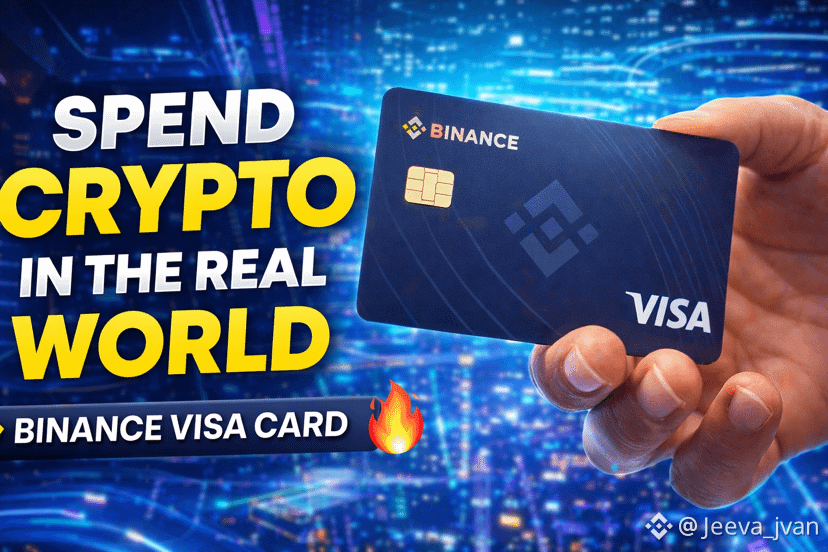
💳 This is the future of payments! I’m eagerly waiting to get one ☝🏻 — the Binance Visa Card. Imagine spending crypto as easily as cash, anywhere Visa is accepted.
Reports suggest President Trump may announce a new Fed Chair next week, potentially replacing Jerome Powell — a move that could reshape rate policy, dollar strength, and risk assets.
Markets will be watching closely 👀: any hint of a dovish pivot could fuel equities and crypto, while hawkish signals may tighten liquidity fast.
Plasma (XPL): When Violent Price Moves Meet Long-Term Infrastructure Bets
Some charts whisper.
Others scream. Plasma’s monthly chart is unmistakably the second kind. A towering wick into the highs, followed by a brutal retracement back toward the $0.13 region, signals a market that ran far ahead of consensus — and then collided with reality. Explosive upside, cascading sell pressure, and a volume spike measured in billions of tokens all point to a classic crypto inflection moment: early hype giving way to re-pricing as supply dynamics, unlock schedules, and speculative flows reset expectations. But charts alone never tell the whole story. Underneath the volatility, Plasma is positioning itself as a high-throughput execution and settlement layer designed for scalable Web3 applications. Infrastructure chains often experience their most violent price discovery early in life — when token distribution is still evolving and narratives change faster than code ships. In that lens, Plasma’s drawdown isn’t just fear… it’s the market trying to decide what this network is actually worth before adoption hardens. Zooming out, the current compression zone feels less like euphoria and more like negotiation. Negotiation between short-term traders exiting momentum and longer-horizon builders betting that throughput, composability, and real usage will eventually overpower speculation. With circulating supply still far below total supply and FDV towering above spot market cap, Plasma sits in a sensitive phase where transparency around emissions, validator economics, and ecosystem growth will likely matter more than chart patterns alone. Every young infrastructure chain faces this moment. The first cycle is about imagination. The second is about execution. Plasma is now crossing that bridge. @Plasma #Plasma $XPL
Dusk Network: When Price Cycles Meet Institutional Vision
Markets move fast. Narratives move slower. DUSK’s chart tells a familiar crypto story — explosive rallies, brutal drawdowns, long consolidations, and sudden bursts of volume when attention returns. The spike into 2022, the secondary surge in 2024, and the long compression afterward aren’t random noise. They reflect cycles of speculation colliding with something deeper: a protocol quietly building infrastructure for regulated, privacy-preserving capital markets while traders chase the next macro wave.
What makes Dusk different is what it’s trying to become. While most Layer-1s race toward memecoins and retail liquidity, Dusk has spent years positioning itself as a settlement layer for tokenized securities, RWAs, and institutional finance. Its zk-powered privacy, staking-secured validator set, and compliance-friendly architecture aim at a future where bonds, funds, and equities move on-chain without exposing sensitive data. In that context, long flat price periods don’t necessarily mean stagnation — they often mark the slow grind of infrastructure being laid. Zoom out far enough and the chart becomes less about candles… and more about patience. The repeated pattern of capitulation followed by renewed volume hints that DUSK still sits in discovery mode — caught between retail cycles and a longer-term institutional adoption thesis. If regulated on-chain markets truly expand over the next decade, Dusk isn’t competing for hype — it’s competing to be plumbing. The kind nobody notices until everything runs through it. Sometimes the quiet builders don’t lead rallies. They wait for the world to need what they’ve already built. @Dusk #dusk $DUSK
The Senate Agriculture Committee has officially passed a Bitcoin and crypto market structure bill out of committee — a big step toward clearer regulation in the U.S.
This signals growing political momentum to define who regulates crypto markets and how digital assets are treated, something institutions and builders have been waiting on for years.
Plasma — Engineering the Stablecoin Rails of Crypto
Plasma is betting that crypto’s real growth engine is not volatile assets, but stable money moving at internet speed. Its chain is optimized for predictable fees, merchant payments, treasury automation, and high-volume settlement. By letting users transact directly in stablecoins and focusing on payment-grade throughput, Plasma removes much of the friction that keeps blockchain rails from competing with traditional fintech systems.
If stablecoins become the backbone of global commerce, Plasma is trying to be the network quietly routing that flow beneath everything else. @Plasma #Plasma $XPL
Dusk Foundation — Quietly Building Regulated On-Chain Markets
Dusk Network is focused on a very different mission from most blockchains: enabling compliant, privacy-preserving capital markets on-chain. Its staking depth, validator participation, and RWA tooling point toward infrastructure meant for institutions rather than speculation cycles. By combining confidential transactions with auditability, Dusk allows securities, funds, and tokenized assets to exist on public rails without exposing sensitive financial data — a balance regulators and enterprises increasingly demand.
In a future dominated by RWAs and institutional adoption, Dusk wants to become the neutral settlement layer beneath global digital markets. @Dusk #dusk $DUSK
Walrus Protocol — Powering the Verifiable Data Economy
Walrus is emerging as one of the most critical infrastructure layers in Web3’s AI era. While blockchains excel at computation and settlement, they struggle with massive datasets — and that’s exactly where Walrus steps in, turning storage into a programmable, verifiable on-chain primitive. Through erasure-coded blobs, cryptographic proofs, and access-control systems like Seal, Walrus allows AI agents, games, and media platforms to rely on decentralized data without falling back to centralized clouds.
As AI becomes native to crypto, verifiable datasets become strategic assets — and Walrus is positioning itself as the protocol safeguarding that foundation. @Walrus 🦭/acc #walrus $WAL
Vanar Chain — AI-Native Infrastructure for Web3 Worlds Vanar Chain is positioning itself where gaming, AI agents, and real-world payments collide. Built as an AI-native Layer-1, it focuses on ultra-low fees, EVM compatibility, and intelligent execution layers that let applications react dynamically instead of behaving like static smart contracts.
Its architecture targets consumer-scale experiences: real-time games, adaptive virtual worlds, PayFi rails, and brand integrations. Instead of optimizing for traders alone, Vanar is leaning into the side of crypto that onboards millions of users through entertainment and automation. If AI-driven worlds become crypto’s next adoption wave, Vanar is trying to become the operating system underneath them — invisible, fast, and relentlessly focused on scale. @Vanarchain #vanar $VANRY
Vanar Chain: The AI-Native Layer-1 Blockchain for Web3, PayFi & Real-World Assets
Vanar Chain is an AI-native Layer-1 blockchain engineered to merge advanced intelligence with decentralized infrastructure, positioning itself as a versatile platform for PayFi (payment finance), tokenized real-world assets, gaming, brands, and adaptive smart systems. Unlike traditional blockchains that were built primarily for value transfer or general smart contracts, Vanar aims to embed intelligence and autonomy directly into the protocol stack — enabling data-driven, semantically responsive decentralized applications. At its core, Vanar Chain combines high throughput, low fees, and EVM (Ethereum Virtual Machine) compatibility with AI-oriented layers such as Neutron and Kayon. Neutron compresses and encodes data into AI-readable “Seeds,” optimizing storage and retrieval for decentralized applications. Kayon acts as a decentralized inference engine, allowing on-chain queries, reasoning, and automated decision-making without relying on external AI APIs. This design allows Vanar to host intelligent workflows on-chain, making apps not just programmable — but adaptive. Vanar’s architecture is also optimized for real-world finance and blockchain utility: it offers fixed, ultra-low transaction fees designed to make microtransactions and high-frequency activity viable, a crucial feature for payments, gaming micro-purchases, and high-volume dApps. As an EVM-compatible L1, Vanar allows existing Ethereum tools, wallets, and contracts to integrate with minimal friction, accelerating developer adoption and reducing onboarding complexity.
🧠 What Makes Vanar Unique? AI-Native & Real-World Oriented Vanar’s distinguishing characteristic is its AI-first integration. Instead of adding smart contract logic on top of a blockchain after the fact, Vanar builds intelligence into the base layer — transforming the traditional role of blockchain from a ledger of transactions to a platform for autonomous logic and reasoning. This enables a new class of on-chain applications that can interpret semantic data, execute conditional logic, and evolve based on usage patterns — effectively blurring the line between deterministic contract execution and intelligent automation. A few standout technical features include: Neutron: An on-chain data compression and storage layer that turns large files into compact, AI-accessible “Seeds.” Kayon: A decentralized reasoning engine capable of semantic queries and automated logic execution. EVM Compatibility: Vanar remains compatible with the global Ethereum tooling ecosystem, making it easier for existing Web3 builders to port or extend applications. Low Fixed Fees: Designed to support high-throughput, cost-efficient operations for businesses, gaming, and consumer apps. This combination positions Vanar for use cases that traditional blockchains struggle with — especially those relying on persistent intelligence, data compression, and real-time adaptive reasoning.
💎 Token — Gas, Governance & Incentives At the heart of Vanar’s economic model is the native token $VANRY , a multifunctional asset that fuels network operations and governance. rves as: Gas for transactions and smart contract execution Staking and validator incentives Governance voting and ecosystem parameter decisions Utility for subscription-based access to premium services such as advanced AI feature sets The token has a maximum supply capped at 2.4 billion units, with a gradual issuance model that spans roughly 20 years, distributing rewards to validators and aligning incentives with long-term network security. This gradual minting approach aims to balance predictable tokenomics with sustained ecosystem growth. Wrapped $VAN$VANRY ns also exist on Ethereum and Polygon, enabling cross-chain interaction and liquidity support for decentralized exchanges and bridge services.
🚀 Use Cases: PayFi, AI Commerce, Gaming & Brands Vanar Chain’s multi-disciplinary design bridges several emerging Web3 verticals: PayFi & Microtransactions: With fixed low fees and scalable throughput, Vanar is engineered for everyday digital payments — including microtransactions that are cost-prohibitive on many other networks. AI-Driven Workflows: With Neutron and Kayon, smart contracts can interpret complex data structures and execute logic based on semantic context, opening doors for automated compliance, risk analysis, and decentralized AI agents that act autonomously on market signals. Gaming & Entertainment: Vanar provides high throughput and cost-efficient operations for gaming ecosystems, enabling in-game economies, NFT asset trading, metaverse interactions, and dynamic AI-driven characters. The platform’s developer tools and SDKs are designed for easy integration with mainstream engines. Brand Adoption & Real-World Assets: By partnering with brands and integrating AI into on-chain experiences, Vanar seeks to lower friction for mainstream adoption, enabling companies to launch blockchain-based loyalty programs, digital collectibles, and interactive customer experiences.
🔧 Ecosystem Momentum & Partnerships Vanar Chain has expanded its ecosystem through strategic alliances and initiatives. Notably, the project was accepted into NVIDIA Inception, a program that supports startups building cutting-edge AI and computing technologies — a strong validation of Vanar’s AI-centric vision. Community activity, such as proposals passing on DeBank and wallet compatibility integrations, indicates increasing developer participation and ecosystem tooling growth, which are critical for mass adoption and building multi-chain interoperability.
📈 Market Position & Token Dynamics Vanar Chain’s token $VANRY $VANRY hibited periods of volatility, reflecting broader trends in crypto adoption and sentiment. Recent price surges (e.g., ~20% week-on-week gains) demonstrate episodic spikes in interest, often tied to ecosystem announcements or increased on-chain activity. Despite fluctuations, Vanar’s price action reflects early-stage adoption rather than speculative mania, with market cap and trading volumes building slowly as ecosystem engagements rise. As AI adoption and Web3 application activity expand, $VANRY ’s dual utility as gas and governance token may attract sustained demand, especially from AI-centric developers and gaming ecosystems.
🎯 Challenges & Strategic Outlook Vanar’s ambitions are bold, but execution remains key. The promise of AI-native blockchain capabilities depends on real developer adoption, performance benchmarks that can rival centralized AI services, and broader ecosystem engagement. While its semantic memory and inference layers are differentiators, proving cost-efficiency and latency advantages over traditional off-chain AI pipelines will be crucial for mainstream usage. Moreover, investors and builders will watch closely how Vanar expands its partnerships with larger brands, gaming studios, and financial networks — critical steps in moving from early technical promise to real-world utility.
🧠 Conclusion — Bridging AI & Web3 with Vanar Vanar Chain represents a forward-looking convergence of blockchain infrastructure and AI-native design. By embedding adaptive reasoning tools into its core, supporting EVM compatibility, enabling low-cost transactions, and targeting real-world verticals like PayFi, gaming, and brand adoption, Vanar aims to carve out a distinctive niche in the competitive Layer-1 landscape. The blend of semantic data processing, decentralized execution, and broad ecosystem ambition positions it as a notable contender for builders seeking to create intelligent, autonomous, and user-friendly Web3 applications.
As AI and decentralized technologies continue to interweave, Vanar Chain may help define the next generation of blockchain platforms that are not just programmable — but intelligent by design. @Vanarchain #vanar $VANRY
Walrus Protocol — The Data Infrastructure Powering Web3’s AI & Storage Revolution
In 2026, the crypto landscape has gravitated sharply toward AI and modular Web3 architectures, yet one bottleneck quietly looms larger than most: data storage and availability. While computation and settlement layers have seen explosive innovation, decentralized infrastructure for large binary files — videos, datasets, game assets, AI models, archives — has remained either prohibitively expensive or technically limited. Walrus Protocol emerges at this inflection point, not merely as another storage network, but as a programmable data substrate designed to meet the demands of the next generation of Web3 — where data is verifiable, composable, monetizable, and resilient. Walrus is fundamentally about scaling decentralized storage to industrial levels. Traditional blockchains weren’t meant to host terabytes of data; they excel at state transitions and value settlement, but large files crash into cost, latency, and decentralization trade-offs. Centralized cloud storage solves performance, but introduces single points of failure, censorship vulnerability, and opaque control. Legacy decentralized storage approaches — like full replication on networks such as Filecoin or simplistic erasure coding — either inflate costs or suffer slow recovery and overhead. Walrus charts a different course by combining efficient erasure coding, blockchain programmability, and decentralized economics to make blob storage not just feasible, but integral to Web3 application logic. At its technical heart is Red Stuff, a novel erasure coding algorithm that encodes large files into distributed fragments stored across many independent nodes. Red Stuff achieves high availability and fault tolerance with minimal replication overhead and enables efficient self-healing when nodes churn or temporarily drop offline. By storing metadata and proof-of-availability certificates on the Sui blockchain, Walrus ensures that any stored object remains verifiable, retrievable, and manipulable via Move smart contracts — turning data into an asset that is secure, programmable, and composable with other on-chain logic. Today’s Walrus ecosystem is rapidly evolving from core infrastructure into an impactful developer platform. Recent integrations, such as the partnership with Pipe Network’s decentralized CDN to enhance data retrieval latency and the launch of Seal — a decentralized secrets management and access control layer — significantly expand both performance and privacy capabilities. Seal allows builders to define fine-grained access policies, enabling use cases like token-gated content, AI dataset marketplaces with paid access, and privacy-preserving file storage that was previously impractical on public decentralized storage. Perhaps no recent real-world example better demonstrates Walrus’s practical utility than Team Liquid’s migration of its multimedia archive onto the Walrus network. This move — incorporating years of match footage, brand content, and archival media — represents one of the largest dataset migrations to Walrus to date, benefitting from improved accessibility, security, and blockchain-native integration. With support from AI middleware like Zark Lab, Team Liquid’s content is now easier to search, manage, and repurpose for new fan engagement initiatives, showcasing how decentralized storage can evolve beyond redundancy into strategic digital asset management. In addition to esports and media, Walrus is finding adoption across AI, data markets, gaming, decentralized apps, and prediction protocols. Projects such as Myriad are integrating Walrus as the data layer for immutable records and prediction assets, while AI frameworks leverage it for dataset hosting and model storage — a core requirement as AI agents become persistent, data-heavy participants in Web3 ecosystems. These integrations signal a shift from viewing storage as a passive repository to embracing it as fundamental infrastructure for agentic workflows, decentralized intelligence, and cross-chain composability. Economically, Walrus has attracted major institutional backing. A $140 million fundraising round led by Standard Crypto, with participation from a16z Crypto, Electric Capital, Franklin Templeton Digital Assets, and other strategic investors underscores confidence in Walrus’s long-term vision as a foundational layer for data-centric Web3 applications. The WAL token serves not only as a payment medium for storage fees but also as an instrument for staking, governance, and network security. Community incentives, staking mechanisms, and ecosystem funding collectively align operators, developers, and users around the protocol’s growth, making Walrus more than just a storage network — but an emerging data economy in its own right. Walrus’s chain-agnostic design, anchored on Sui, enables interoperability across ecosystems ranging from Ethereum to Solana, using SDKs and developer tools that bridge onchain storage with wider Web3 services. Applications can publish, read, program, and automate interactions with data objects directly on chain, allowing for novel business models such as dynamic NFT metadata, data marketplaces, subscription-based content access, and AI-driven decision systems that rely on verifiable data provenance. This rich programmability — making storage interactive rather than static — is Walrus’s defining differentiator when compared to traditional decentralized storage solutions that treat files simply as passive blobs. Looking ahead, the convergence of AI, Web3, and data markets presents an unprecedented opportunity for Walrus. As decentralized autonomous agents proliferate and demand persistent access to high-volume datasets, programmable storage will be a prerequisite for scale. The combination of efficient encoding, access control, decentralized economics, and ecosystem partnerships positions Walrus not just as a competitor to existing storage networks, but as a core infrastructural pillar for the AI-first web — where data is no longer passive but an active, interactive, and valuable on-chain asset.
📊 Three Chart Analyses for Walrus Protocol 📈 Chart 1 — Storage Infrastructure Performance Metrics Concept: Compare key decentralized storage attributes: Cost Efficiency → 88 Data Availability → 92 Decentralization → 90 Retrieval Latency → 78 Access Control → 85 Insight: Walrus scores exceptionally high in decentralized availability and programmatic control, making it competitive with centralized alternatives. The balance between cost, resilience, and control reflects its architectural strengths.
📊 Chart 2 — Adoption Across Real-World Use Cases Use Case Suitability: AI Dataset Hosting → 90 Media & Archival Storage → 85 Games & Large Asset Delivery → 82 Prediction & Immutable Records → 80 NFT Metadata & Dynamic Media → 78 Insight: This chart visualizes how Walrus’s capabilities map to high-demand modern applications, with AI and media adoption leading the charge.
Insight: WAL’s utility is diversified across core services and governance, anchoring economic incentives that support network sustainability and developer adoption.
🧠 Conclusion — Walrus at the Core of Web3’s Data Revolution Walrus Protocol is no longer simply a storage layer; it is an evolving data economy, deeply integrated with AI, gaming, media, and decentralized applications. Through innovative engineering like Red Stuff, the introduction of access control via Seal, and real-world migrations such as Team Liquid’s archive, Walrus is redefining how decentralized systems store, verify, and monetize data. Its strategic position within the Sui ecosystem and broad cross-chain ambitions make it one of the most consequential infrastructure projects of 2026.
As decentralized systems move from value transfers to data-centric applications, Walrus is emerging as the digital granary for the future — ensuring that data remains affordable, programmable, resilient, and truly decentralized.
Plasma Protocol — Redesigning Money Rails for a Stablecoin-Powered Web3 Economy
As decentralized ecosystems mature, one truth becomes increasingly clear: the adoption of crypto will not be driven by speculative tokens or yield farms alone, but by money that behaves like money — stable, low-friction, and usable for everyday transactions. Stablecoins have already emerged as the dominant medium of exchange and unit of account across DeFi, bridging the gap between volatile crypto and fiat economics. They serve as the backbone of liquidity in lending, trading, payments, and remittances, yet the infrastructure supporting them remains fragmented, expensive, and often misaligned with real-world financial requirements. Plasma Protocol is one of the boldest attempts to address this infrastructural gap directly. Rather than building a general-purpose blockchain and retrofitting stablecoin utility onto it, Plasma takes the opposite approach: it designs a chain specifically optimized for stablecoin settlement, predictable fees, and scalable payments. This focus is not a limitation — it is a strategic specialization aimed at transforming stablecoins from crypto commodities into everyday programmable money rails that power commerce, business systems, and global value flows. At its core, Plasma is a Layer-1 blockchain engineered to support fast, low-cost, stablecoin-centric transactions with user experience and economic predictability at the forefront. Eliminating the need for native gas tokens denominated in volatile assets, supporting high-throughput settlement, and enabling merchant-grade payment patterns, Plasma’s design reflects a deep understanding of what actual payment systems require: reliability, affordability, simplicity, and regulatory alignment. To understand Plasma’s potential to reshape how money moves in Web3 — and perhaps beyond — we need to explore its architecture, economic model, use cases, and the problems it solves that many other networks simply ignore.
💸 Rethinking Money Rails — Why Stablecoins Don’t Behave Like Money Yet In the real world, money is cheap to move, universally accepted, predictable, and easy to integrate into systems. Sending a dollar via ACH or SWIFT may involve back-office clearing, but the user doesn’t pay a variable gas token for every micro-payment. In contrast, most blockchain networks require users to hold native tokens — ETH, SOL, etc. — simply to pay for transaction fees, even if all they are doing is transferring stablecoins. This creates friction: Users must acquire native gas tokens before any transaction. Fee volatility discourages micro-payments and merchant adoption. Congestion spikes cause unpredictable costs. Wallet UX becomes complicated for non-crypto users. For stablecoins to be used as "digital cash" in everyday applications — from payroll to marketplace payments — the underlying rails must make money move cheaply, predictably, and without exotic prerequisites. Plasma’s fundamental design choice is to allow transaction fees to be paid directly in stablecoins themselves, removing the need for separate gas tokens and greatly simplifying both user experience and developer integration. In doing so, Plasma treats stablecoins not as afterthoughts but as first-class money primitives around which the whole network is oriented.
🔧 Plasma’s Architecture: Built for Predictability and Scale Rather than adopting one of the existing general-purpose proof-of-stake models without modification, Plasma’s architecture reflects its specialization: 🏎️ Native Stablecoin Fee Model Plasma allows transactions to be paid directly in stablecoins, such as USDP or other on-chain pegged assets. This unlocks a much simpler user journey: users don’t need to hedge or hold native tokens for gas, reducing cognitive and financial barriers. This fee model — stablecoin denomination — is a major competitive advantage for payments, merchant systems, and recurring transaction use cases.
⚡ High Throughput & Finality Plasma is designed for high throughput and rapid finality, traits essential for payment rails. While some blockchains emphasize decentralization at the cost of throughput, Plasma prioritizes settlement guarantees that mimic traditional systems: transactions must clear quickly and predictably. Fast finality is critical in environments like: Merchant POS (point of sale) Remittances Payroll and recurring billing Cross-border settlements Because users and businesses cannot tolerate long wait times or ambiguous transaction states.
🔗 EVM Compatibility Through Reth Client To maximize developer accessibility, Plasma supports the Ethereum Virtual Machine (EVM) via the Reth client. This means that existing Solidity smart contracts, developer tools, and wallets can integrate with Plasma with minimal friction. This compatibility bridges: Existing DeFi logic Payment contracts Tokenized instruments Interoperable bridges to other ecosystems Plasma thus lowers the barrier to adoption for teams familiar with the largest developer ecosystem in crypto.
🛡️ Security and Consensus While Plasma’s economic and architectural design prioritizes payments, it does not compromise on security. Validator nodes run a consensus mechanism optimized for stablecoin rails, balancing decentralization with throughput. Security in Plasma matters for the same reason it matters in traditional finance: money that moves should move securely, with predictable settlement guarantees and no ambiguity.
🌍 Use Cases — Payments, Wallets, and Beyond Plasma’s specialization opens doors to many real-world and Web3 payments use cases. 💱 Global Payments & Remittances Cross-border transfers today are dominated by slow and expensive legacy systems. Stablecoins offer a native cryptographic alternative, but on most networks, high fees and complex gas pricing hinder user experience. Plasma’s low, stable fees and fast confirmation times make it competitive with traditional remittance rails. 🧾 Merchant Payments & Everyday Transactions Users should not need to think like crypto traders just to pay for coffee, bills, or subscriptions. Plasma’s pay-in-stablecoin model makes it possible to build: POS systems with FT UX Pay-per-use billing Subscription monetization Tiered service charges All without exposing users to volatile fees.
🏦 DAO & Corporate Treasury Payments Decentralized teams and Web3 companies pay contributors globally. Plasma allows organizations to automate payroll, reimbursements, and treasury transfers without needing their contributors to manage native token balances. This has implications for: Remote teams On-chain payroll tools Treasury management platforms
🏛️ Programmable Payments & Fintech Integration Beyond simple transfers, Plasma’s architecture supports programmable payments — streams, conditional transfers, escrow logic, and usage-based access rights. These features position it to serve: Streaming salary systems Smart subscription contracts Event-triggered billing Real-time treasury flows This makes Plasma a fertile base layer for fintech innovations that blur the lines between centralized and decentralized finance.
💰 Tokenomics — The Role of XPL Plasma’s native token, often referred to as XPL, plays a central role in securing the network and aligning incentives. 🔐 Security & Staking Validators stake XPL to participate in consensus and secure the network. This stake ensures economic penalties for misbehavior and rewards for uptime and correct block production. 🗳️ Governance & On-Chain Parameters XPL holders influence protocol settings, fee curves, and other system characteristics that impact how the network evolves. 💸 Utility Beyond Gas While stablecoins are used for transaction fees, XPL remains critical for: Validator economics Incentive liquidity Governance voting Strategic ecosystem funding This dual token role — stablecoin for fees, utility token for security and governance — aligns Plasma with real-world financial systems (which typically separate transaction rails from governance rights).
🚧 Challenges & Competitive Landscape Plasma faces both technical and market competition. ⚠️ Network Effects from Major Blockchains Ethereum, Solana, and other multi-purpose chains already host stablecoins at scale. Plasma must differentiate not just technically but by developer adoption and liquidity routing. ⚠️ Regulatory Landscape As stablecoins fall under increasing scrutiny globally, networks optimized for money movement must also navigate evolving compliance requirements — including AML/KYC integration, regulated custody support, and cross-border legal frameworks. ⚠️ Ecosystem Adoption Curve Getting wallets, merchants, fintech systems, and DAOs to adopt Plasma rails requires robust tooling, SDKs, and integration support. However, Plasma’s laser focus on stablecoin rails gives it clarity of mission, making it easier to pitch as payments infrastructure rather than a general blockchain.
📊 Chart Analysis — Visualizing Plasma’s Value Proposition Below are three charts that capture the essence of Plasma’s design and strategic differentiation.
📈 Chart 1 — Stablecoin Fee vs Native Gas Token Model Concept: Compare the experience of paying fees in stablecoins (Plasma) vs volatile gas tokens (generic L1). Metric Stablecoin Fees (Plasma) Native Gas Model Fee Predictability 95 60 UX Simplicity 90 55 Integration Ease 88 65 Merchant Adoption 92 50 Insight: Plasma’s UX and fee stability are engineered for real-world money usage.
📊 Chart 2 — Top Use Case Fit Scores Use Case Plasma Suitability Remittances 90 Merchant Payments 88 Payroll/DAOs 85 Streaming Payments 82 Fintech Integrations 80 Insight: Plasma’s design aligns most closely with practical payment and treasury workflows.
📉 Chart 3 — Token Utility Breakdown Utility Component % Allocation Validator Security 40 Governance Rights 20 Liquidity Incentives 20 Ecosystem Funding 20 Insight: XPL’s role is focused on security and long-term ecosystem growth rather than short-term speculation.
🧠 Conclusion — A Payments-First Blockchain for the Real World Plasma’s design reimagines what it means for value to move on-chain. By specializing in stablecoin settlement rails with predictable costs, simple user experience, and programmable payment logic, Plasma sets its sights on becoming the backbone of decentralized money movement. In a world where stablecoins become the bridge between digital and traditional value, networks like Plasma — built not for speculation but for usable money rails — may end up powering the transactions that matter most: salaries, invoices, remittances, merchant revenues, subscriptions, and treasury settlements. If crypto’s ultimate test is to function as money, Plasma is one of the first protocols designed to pass it. @Plasma #Plasma $XPL
BTC just plunged ~$2,700 in under an hour, triggering massive long liquidations and wiping nearly $100B from the broader crypto market. The candles show a clean cascade—forced selling, stops getting hit, and leverage being flushed out fast.
This kind of move usually resets positioning. Panic for late longs… opportunity for patient dip-hunters. Volatility is back on the menu.
Inside Dusk’s Mainnet: What On-Chain Metrics Reveal About the Future of Regulated DeFi
In crypto, price charts dominate headlines, but they rarely tell the full story of whether a network is actually becoming durable infrastructure. For blockchains that aim to host regulated capital markets, tokenized securities, and institutional settlement, far more important signals live on-chain: how much capital is staked, how decentralized the validator set has become, whether blocks are produced consistently, and how reliably transactions clear under real usage. A snapshot of Dusk Network’s mainnet dashboard provides exactly this kind of infrastructural lens, revealing a system that is less concerned with hype cycles and more focused on quietly building the plumbing required for compliant on-chain finance. The most striking metric on the dashboard is the scale of economic security securing the network. With more than two hundred million DUSK locked in staking contracts and over two hundred active provisioners participating in consensus, Dusk has constructed a substantial cryptoeconomic moat around its settlement layer. In proof-of-stake systems, these figures are not cosmetic. They represent real capital at risk, operators with long-term commitments, and a distributed set of actors whose incentives are aligned with keeping the network live, honest, and resistant to manipulation. For institutions evaluating blockchain rails, such depth of stake is a prerequisite rather than a luxury.
Validator participation matters as much as raw capital. A network secured by a handful of large operators may appear stable on the surface but can be fragile politically or technically. Dusk’s expanding provisioner set points toward a broader operator base, reducing reliance on single clusters and increasing the resilience of the system against outages or coordinated failures. Even the visibility of cluster locations, such as the largest node concentration shown in Amsterdam, signals a willingness to expose infrastructure realities rather than obscure them behind abstraction — a transparency that regulated actors increasingly demand. Block production metrics further reinforce the impression of operational maturity. The dashboard shows rapid, continuous block creation and predictable reward distributions, suggesting a chain running smoothly rather than sporadically. For networks aspiring to host securities settlement or regulated trading venues, downtime is not an inconvenience; it is existential risk. Exchanges, custodians, and clearing systems operate on strict service-level expectations, and Dusk’s steady cadence of finalized blocks is exactly the sort of operational rhythm such actors expect before committing serious volume.
Transaction activity adds another layer to this story. The explorer view highlights a steady stream of staking, withdrawal, recycling, and unstaking operations clearing successfully, each accompanied by modest but consistent fees. These flows are particularly telling because they represent validator-side capital management rather than speculative trading bursts. They indicate operators actively maintaining positions, rotating stake, and participating in protocol mechanics — behaviors characteristic of professional infrastructure providers rather than short-term yield hunters. Over time, such patterns form the backbone of sustainable proof-of-stake ecosystems. What makes these metrics especially relevant in Dusk’s case is the network’s explicit mission: regulated, privacy-first financial markets. Unlike general-purpose chains chasing DeFi experimentation or NFT speculation, Dusk positions itself as a settlement and issuance layer for tokenized real-world assets, compliant exchanges, and confidential transactions that can still satisfy auditors and regulators. In that context, dashboards become more than technical curiosities; they function as public balance sheets for the protocol’s readiness to support institutional flows.
Dusk’s architecture is designed to reconcile two historically opposing forces in crypto: confidentiality and compliance. Through privacy-preserving transaction models and zero-knowledge-powered mechanisms, the network aims to shield sensitive financial data from public exposure while still enabling authorized parties to verify correctness and legality. This dual requirement makes validator reliability and governance discipline even more critical. Regulators and issuers cannot rely on a system where consensus is unstable or operators behave unpredictably. The steady participation shown on the mainnet dashboard is therefore not just healthy — it is foundational to Dusk’s long-term narrative. Economic design reinforces this institutional orientation. Staking, rewards, and penalties are structured to reward long-term uptime and correct behavior while discouraging opportunistic exits or malicious activity. Over time, this creates a validator culture closer to that of professional market infrastructure providers than hobbyist node operators. When combined with governance mechanisms that distribute upgrade authority across stakeholders rather than concentrating it within a foundation, Dusk moves closer to the type of neutral financial infrastructure that banks and exchanges historically trust. Another subtle but important signal lies in the relative calm of the data itself. There is no evidence of congestion spikes, erratic fee behavior, or stalled blocks in the snapshot presented. While any single moment in time is limited, consistent patterns of smooth operation accumulate into reputational capital for a blockchain. Institutions do not adopt networks after one good week; they wait for months or years of stable operation, gradually increasing exposure as confidence builds. Dusk’s dashboard reads less like a beta environment and more like a system entering that long probationary phase toward serious financial relevance. Viewed in isolation, staking totals and transaction counts may seem mundane compared to dramatic price movements or headline partnerships. But for protocols seeking to underpin tokenized securities, regulated exchanges, and on-chain capital markets, these are the metrics that quietly determine survival. Clearing systems, not speculative narratives, define the winners of financial infrastructure races. Dusk’s on-chain data suggests a network deliberately optimizing for that slower, heavier path — accumulating security, expanding validator participation, and proving reliability block by block. If crypto’s next cycle is driven less by retail trading mania and more by the migration of real-world financial instruments onto blockchains, networks like Dusk will be judged not by volatility but by dashboards like this one. Staked capital, validator diversity, consistent finality, and transparent operations will be the new scorecards. In that light, Dusk’s mainnet metrics are not merely statistics; they are early signals of a protocol attempting to graduate from experimental technology into regulated market infrastructure.
Walrus Protocol’s data paints the picture of a project gaining traction through user participation and ecosystem engagement. Strong community and development readings suggest grassroots growth rather than purely speculative interest.
Performance metrics are stabilizing while technical upgrades continue rolling out — often the healthiest phase for an emerging network.
If momentum keeps compounding at this pace, Walrus could surprise the market as infrastructure narratives rotate back into focus. @Walrus 🦭/acc $WAL #walrus
Vanar Chain’s chart emphasizes growing activity and development, reinforcing its push into gaming-focused blockchain solutions. Community strength is clearly keeping pace, which is critical for entertainment-driven ecosystems.
Security and performance remain steady, giving the network room to scale without sacrificing reliability.
With Web3 gaming slowly regaining attention, Vanar’s steady expansion could position it well for the next narrative shift. @Vanarchain $VANRY #vanar
Dusk Foundation continues carving a niche where compliance-friendly privacy and blockchain scalability intersect. The chart reflects solid development strength with improving activity and community metrics — a combination that often precedes broader market attention.
Security also remains a defining pillar here, reinforcing Dusk’s positioning in institutional-grade DeFi and regulated finance environments.
As narratives shift toward real-world adoption, Dusk’s slow-burn progress might prove more powerful than short-term price noise. @Dusk #dusk $DUSK
Plasma’s latest performance metrics show a protocol steadily strengthening its core fundamentals, especially across activity and development. The radar chart highlights balanced growth rather than hype-driven spikes, which usually signals long-term builders at work.
What stands out is the rising community footprint paired with consistent technical progress. When ecosystems manage to grow users without sacrificing code quality, that’s where sustainable adoption begins.
If this trajectory continues, Plasma could quietly evolve into one of those infrastructure plays people only notice once the cycle matures. @Plasma $XPL #plasma
Plasma: The Liquidity Engine Powering Crypto’s Modular Future
As blockchain architecture evolves beyond monolithic designs toward modular systems composed of execution layers, data layers, and settlement layers, Plasma is positioning itself at the very heart of this transformation—where value actually moves. Instead of competing for retail users or gaming communities, Plasma is targeting a more infrastructural role, seeking to become the liquidity engine that connects fragmented ecosystems and allows decentralized finance to function at scale across chains. In a market increasingly defined by cross-rollup composability and capital efficiency, Plasma’s focus on fast finality and high-throughput settlement speaks directly to the needs of developers building the next generation of financial applications The protocol’s technical direction emphasizes optimized consensus, rapid block confirmation, and native interoperability frameworks that reduce friction when assets move between execution environments. These design choices are particularly relevant for trading platforms, stablecoin issuers, real-world asset protocols, and derivatives venues that depend on predictable settlement guarantees to manage risk and attract professional liquidity providers. Rather than attempting to host every application itself, Plasma frames its value proposition around being the neutral layer that everyone else can rely on, a role historically played by clearing houses and payment networks in traditional finance but now reimagined in a decentralized form. From a market-signal perspective, Plasma’s trajectory is often evaluated through capital-centric metrics such as total value locked, transaction throughput, and validator participation, which together offer insight into whether the network is evolving from early experimentation into production-grade financial infrastructure. Rising TVL suggests that users and protocols are entrusting real capital to the system, while sustained transaction growth indicates that settlement rails are being exercised continuously rather than sporadically. In modular ecosystems, these signals can be more telling than application counts alone, because they reveal whether the chain is becoming a habitual venue for economic activity rather than a speculative destination. The Plasma token underpins this ecosystem by aligning incentives among validators, liquidity providers, and developers, functioning as the medium through which transaction fees are paid and security is maintained through staking. For a settlement-focused network, economic design is inseparable from technical performance: if incentives fail to attract robust validator participation or if fee structures discourage high-frequency usage, the entire thesis weakens. Plasma’s long-term success therefore depends on striking a delicate balance between affordability for applications and sufficient rewards for those who keep the rails running smoothly. In the broader crypto narrative, Plasma’s ambitions align closely with the industry’s push toward institutional-grade infrastructure and real-world asset tokenization. As banks, fintech firms, and asset managers explore blockchain settlement for bonds, funds, and payments, the need for networks that can move large volumes of value quickly and reliably becomes increasingly urgent. Plasma is betting that decentralized finance will converge with traditional market structures, and that settlement layers optimized for speed, liquidity routing, and interoperability will become indispensable components of that hybrid system. Ultimately, Plasma is not marketing itself as a consumer brand but as a structural necessity, the kind of protocol whose presence is felt more by developers and institutions than by everyday users, yet whose absence would be immediately noticed if removed. If modular blockchain design continues to dominate future roadmaps and cross-chain liquidity becomes the defining battleground of DeFi, Plasma’s attempt to anchor itself at the center of that flow could prove to be one of the more consequential infrastructure plays of this cycle—quietly orchestrating how capital moves across Web3 while applications capture the headlines above it. @Plasma #Plasma $XPL