Binance Square

bannks

Two-times Bear market survivor || Web3 content research || Web3 Content creator || Degen Trader || Ambassador || Those who listen to me sometimes make money.
فتح تداول
مُتداول عرضي
4.9 سنوات
5 تتابع
153 المتابعون
312 إعجاب
22 تمّت مُشاركتها
منشورات
الحافظة الاستثمارية
PINNED
·
--
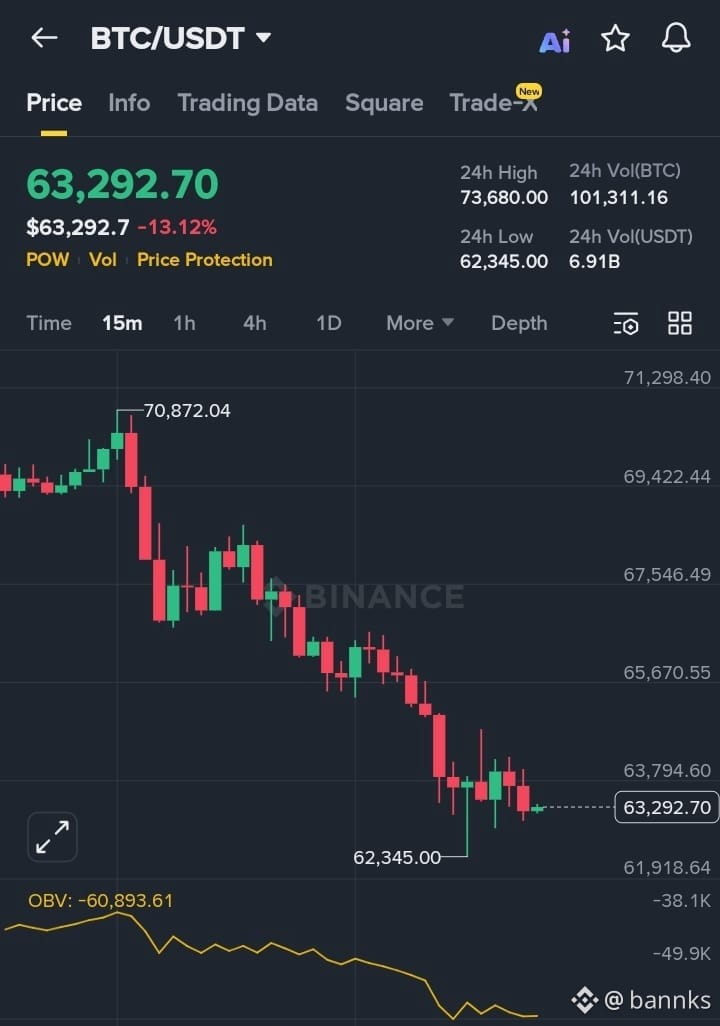
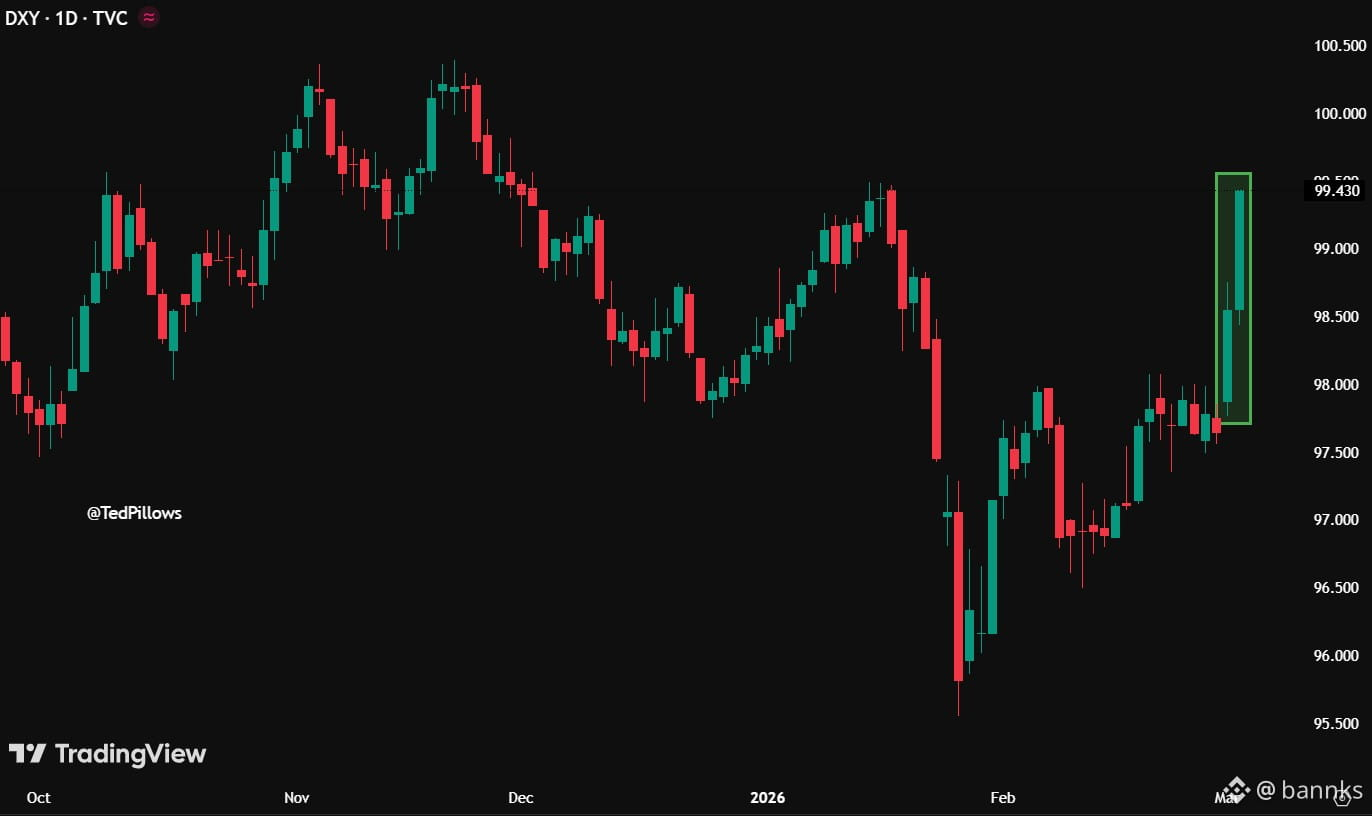
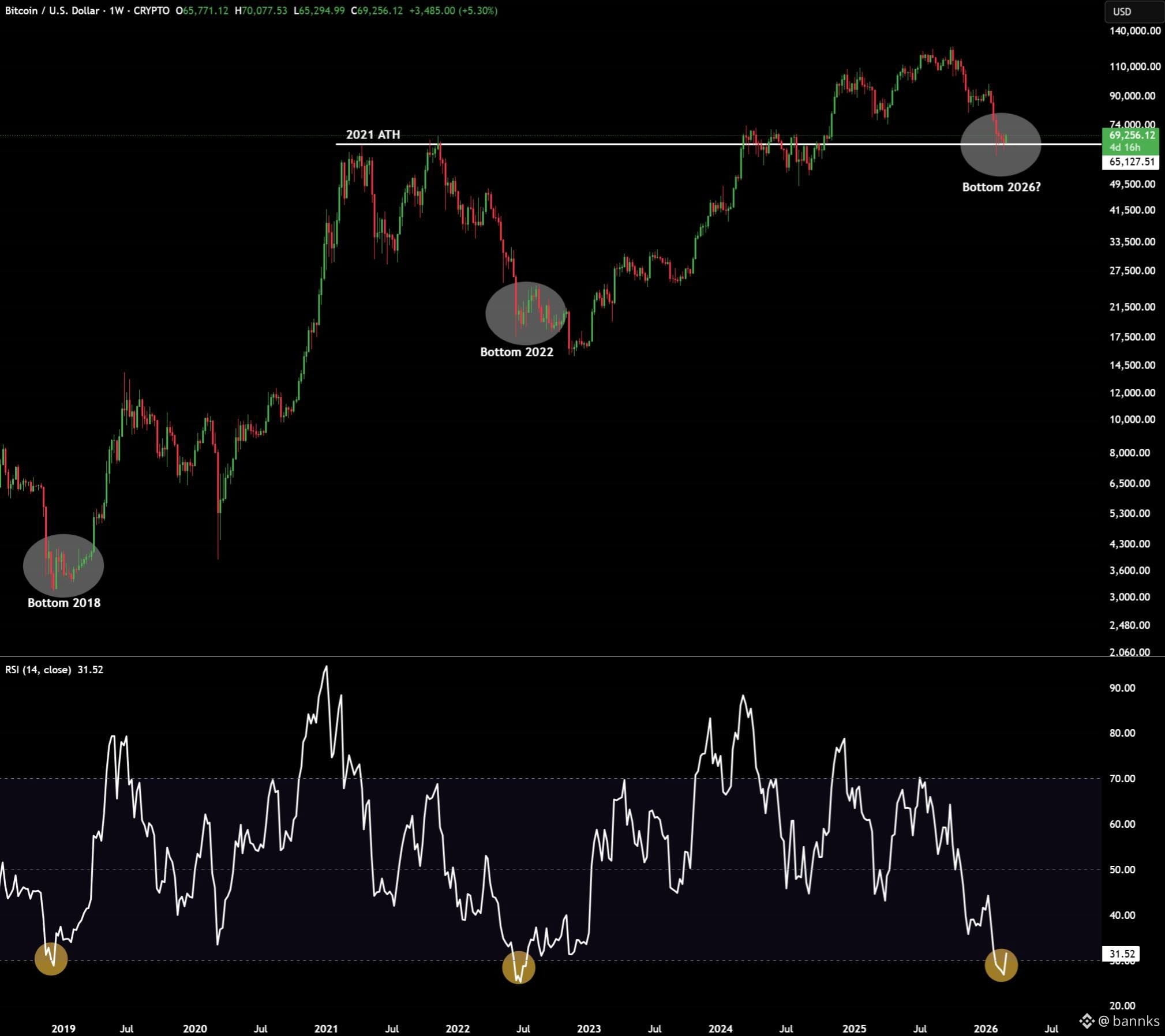
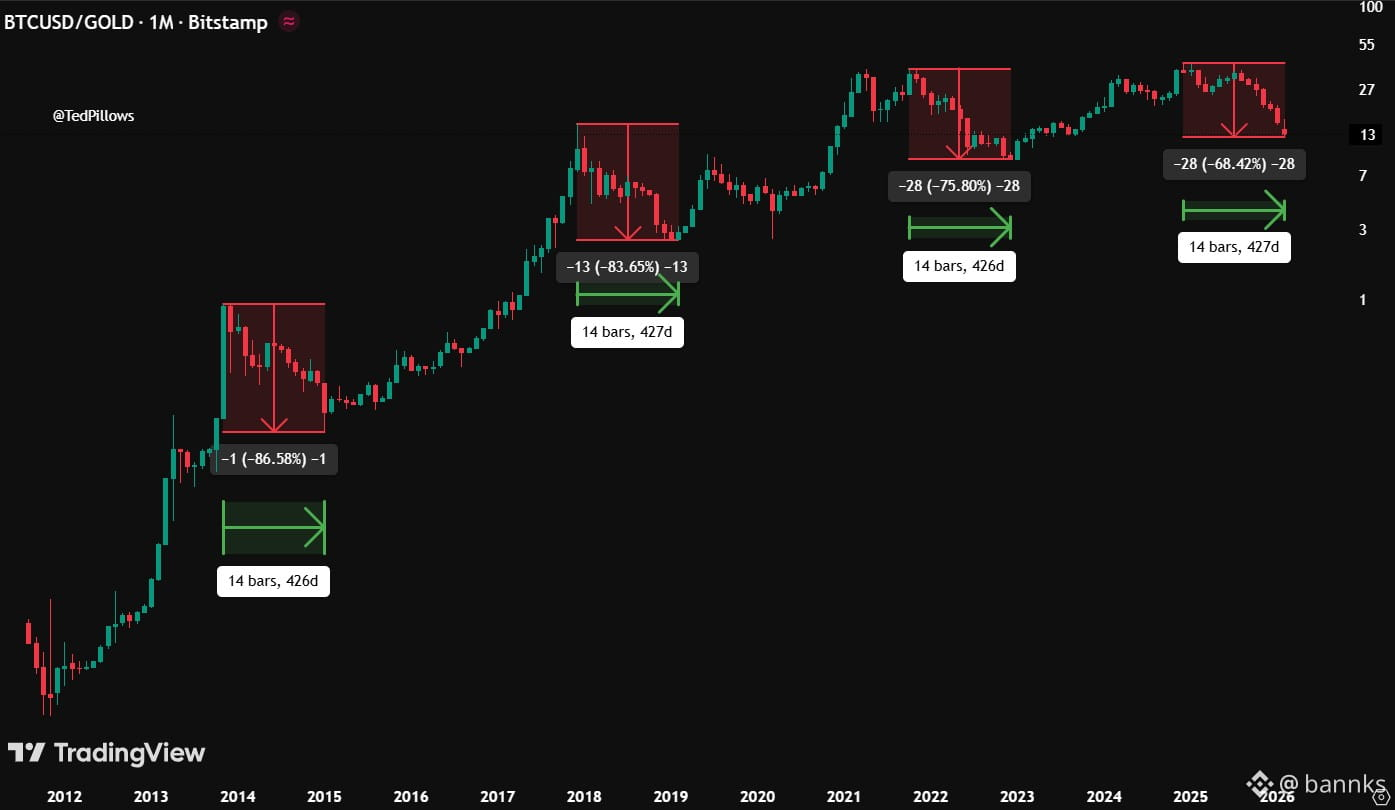
What the Hell Is Happening, Guys? One minute Bitcoin is the future of money. The next minute it’s free-falling like it forgot how gravity works. Red candles everywhere. RSI buried. Timelines split between doom prophets and “I’m buying the dip” philosophers who’ve already bought six dips too many. This market feels like a tragedy wrapped in a meme. Long-term holders are staring at their screens in silence. Traders are getting wicked out on both sides. Influencers have suddenly gone quiet, or worse, they’ve discovered “macro.” Every bounce gets sold. Every support breaks like it was made of paper. And somehow, every bad headline shows up exactly when price is already weak. Perfect timing. Always. It’s chaos. It’s frustration. It’s that familiar $BTC feeling where nothing makes sense until it does. And here’s the cruel irony: this is exactly how $BTC looks near moments everyone later wishes they had more conviction. Historically, $BTC doesn’t bottom when hope is alive. It bottoms when belief is exhausted. When good news gets ignored. When strong hands are questioned. When price action feels insulting. That’s usually when the market is quietly resetting. Zoom out for a second. The network still runs. Blocks still get mined. Adoption didn’t vanish overnight. Volatility didn’t kill bitcoin in 2011, 2014, 2018, or 2022 and it won’t now. Bitcoin has a bad habit of breaking spirits before it breaks higher. Like a phoenix, it doesn’t rise gently. It burns first. Loudly. Publicly. Painfully. Then, when no one’s watching or when everyone has already given up, it does what it’s always done. It rises again. So yeah… what the hell is happening? Bitcoin is being Bitcoin. And the light at the end of the tunnel usually shows up right after the market convinces you there is none.
What the Hell Is Happening, Guys?

One minute Bitcoin is the future of money. The next minute it’s free-falling like it forgot how gravity works. Red candles everywhere. RSI buried. Timelines split between doom prophets and “I’m buying the dip” philosophers who’ve already bought six dips too many.

This market feels like a tragedy wrapped in a meme.

Long-term holders are staring at their screens in silence. Traders are getting wicked out on both sides. Influencers have suddenly gone quiet, or worse, they’ve discovered “macro.” Every bounce gets sold. Every support breaks like it was made of paper. And somehow, every bad headline shows up exactly when price is already weak. Perfect timing. Always.

It’s chaos. It’s frustration. It’s that familiar $BTC feeling where nothing makes sense until it does.

And here’s the cruel irony: this is exactly how $BTC looks near moments everyone later wishes they had more conviction.

Historically, $BTC doesn’t bottom when hope is alive. It bottoms when belief is exhausted. When good news gets ignored. When strong hands are questioned. When price action feels insulting. That’s usually when the market is quietly resetting.

Zoom out for a second. The network still runs. Blocks still get mined. Adoption didn’t vanish overnight. Volatility didn’t kill bitcoin in 2011, 2014, 2018, or 2022 and it won’t now.

Bitcoin has a bad habit of breaking spirits before it breaks higher.

Like a phoenix, it doesn’t rise gently. It burns first. Loudly. Publicly. Painfully. Then, when no one’s watching or when everyone has already given up, it does what it’s always done.

It rises again.

So yeah… what the hell is happening?

Bitcoin is being Bitcoin. And the light at the end of the tunnel usually shows up right after the market convinces you there is none.
·
--
Wrote this some days ago!!!
bannks
·
--
What the Hell Is Happening, Guys?

One minute Bitcoin is the future of money. The next minute it’s free-falling like it forgot how gravity works. Red candles everywhere. RSI buried. Timelines split between doom prophets and “I’m buying the dip” philosophers who’ve already bought six dips too many.

This market feels like a tragedy wrapped in a meme.

Long-term holders are staring at their screens in silence. Traders are getting wicked out on both sides. Influencers have suddenly gone quiet, or worse, they’ve discovered “macro.” Every bounce gets sold. Every support breaks like it was made of paper. And somehow, every bad headline shows up exactly when price is already weak. Perfect timing. Always.

It’s chaos. It’s frustration. It’s that familiar $BTC feeling where nothing makes sense until it does.

And here’s the cruel irony: this is exactly how $BTC looks near moments everyone later wishes they had more conviction.

Historically, $BTC doesn’t bottom when hope is alive. It bottoms when belief is exhausted. When good news gets ignored. When strong hands are questioned. When price action feels insulting. That’s usually when the market is quietly resetting.

Zoom out for a second. The network still runs. Blocks still get mined. Adoption didn’t vanish overnight. Volatility didn’t kill bitcoin in 2011, 2014, 2018, or 2022 and it won’t now.

Bitcoin has a bad habit of breaking spirits before it breaks higher.

Like a phoenix, it doesn’t rise gently. It burns first. Loudly. Publicly. Painfully. Then, when no one’s watching or when everyone has already given up, it does what it’s always done.

It rises again.

So yeah… what the hell is happening?

Bitcoin is being Bitcoin. And the light at the end of the tunnel usually shows up right after the market convinces you there is none.
·
--
When me?
When me?
Binance Square Official
·
--
Congratulations to the winners who won the 1BNB surprise drop from Binance Square on Feb 9 for your content. Keep it up and continue to share good quality insights with unique value.
@VC Software :Dealing With Losses: From Hope to System
@Eros crypto :Have you ever paid €15 or €20 to send just €100 to your brother or mother?
@BitEagle News :Binance Enhances User Protection: SAFU Fund Adds 4,225 BTC, Total Holdings Now at 10,455 Bitcoin
@Investidor Matuto :URGENT: Bitcoin and ALTCOINS on the Brink of the Abyss! What will happen in the next 24 hours in BTC
@PRO Crypto Tech :Binance 10,000 Dollar Free Demo Account For Beginners. Learn Futures and Spot Trading Without Risk
·
--
Leverage Trading?, Here are 19 rules you need to know and stick with.If you leverage trade $BTC , $ETH or any other altcoin, then you need to read this rules👇. Rules 15-19 are very very important Mid last year, I was in a position many of you might recognize: I needed capital to fund a business venture. I was looking for a "fast" way to get the funds. A friend suggested leverage trading(Note: I have never leverage traded before this time), with assurance of getting the liquidity. It was a disastrous move. Without a strategy or an understanding of the dynamics, I lost over $1,000 in a heartbeat. I wasn't trading; I was gambling with money I couldn't afford to lose. Just yesterday on one of my articles here, I saw a comment from a reader pleading for help because he/she had lost all to leverage trading. The market doesn't care about your business plans or your desperation. It only responds to discipline. To save you from the same fate, I’ve compiled the 20 Essential Rules for Leverage and Futures Trading, gathered from my own hard-learned lessons and and reading after top traders in the space. Rules of Capital Preservation 1. The 10% Deployment Rule Never commit more than 10% of your total portfolio to active trades. If things go south, 90% of your wealth remains intact to fight another day. 2. The Law of Risk: Protect Capital First Your primary job isn't to make money; it's to protect what you have. If a trade puts your "survival" at risk, it is a bad trade, regardless of the potential profit. 3. Be Content with 1% – 5% Daily Depending on your liquidity, a 1% to 5% return on your capital per day is a massive win. Compounded, this beats almost any traditional investment. Stop using crazy leverage. 4. Avoid the "New Pair" Trap Do not trade newly listed pairs on futures. They lack historical data, are prone to extreme volatility, and are often used by whales to exit positions on retail traders. Psychology Rules 5. Never Revenge Trade If the market takes money from you, don't try to "take it back" immediately. Trading while angry or frustrated leads to doubled positions and tripled losses. 6. Kill the FOMO (Fear Of Missing Out) If a coin has already pumped 40%, you missed the entry. Don't "ape in" because you see others posting green PnL screenshots on X (Twitter). 7. Don't Trade Under Pressure If you are trading because you need to pay rent or fund a business (like I was), you will make emotional decisions. Trade only when you are financially and mentally "light." 8. The Law of Patience No setup = No trade. If the market doesn't give you a clear entry signal that fits your strategy, stay on the sidelines. Sitting in cash is also a position. 9. Do Not Ape in for KOLs Key Opinion Leaders (KOLs) often have different entry prices and risk tolerances than you. Never enter a position just because an influencer posted it as a call, a lot of people have been wrecked from this. Execution Rules 10. Trade with the Trend The "Law of Trend" is simple: don't try to catch a falling knife or short a parabolic moon-mission. It’s easier to swim with the current than against it. So trade the trend. James Wynn lost millions of $$ doing this. 11. Understand the Narrative Do not enter a trade if you don’t understand the narrative behind the price action. Technicals are great, but the story (AI, RWA, Memes) drives the volume. 12. Always Take Profits. Always take profit when TP is hit. Take profit and rest. Don't immediately put the funds in the market again. 13. One Entry, One Trade Do not enter the same trade twice (averaging down) unless it was part of your original plan. Usually, "doubling down" is just a way to accelerate liquidation. 14. Journal Every Trade Write down why you entered, how you felt, and why you exited. You cannot improve what you do not measure. Appetite Rule If you haven't noticed a pattern yet, these final rules are the most important because they address the #1 killer of accounts. 15. Don’t be greedy. (Seriously. Take the profit when it’s there.) 16. Don’t be greedy. (Don’t use 50x or 100x leverage just because you can.) 17. Don’t be greedy. (Don’t stay in a winning trade until it turns into a losing one.) 18. Don’t be greedy. (Respect your stop-losses.) 19. Don’t be greedy. (The market will be here tomorrow; make sure your capital is too.) Finally, I know it is hard to follow every rule every day. I’m still improving, and you will too. But remember: the difference between a trader and a gambler is a system. Stick to these 19 rules, and you will keep staying afloat.

Leverage Trading?, Here are 19 rules you need to know and stick with.

If you leverage trade $BTC , $ETH or any other altcoin, then you need to read this rules👇. Rules 15-19 are very very important
Mid last year, I was in a position many of you might recognize: I needed capital to fund a business venture. I was looking for a "fast" way to get the funds. A friend suggested leverage trading(Note: I have never leverage traded before this time), with assurance of getting the liquidity.
It was a disastrous move.
Without a strategy or an understanding of the dynamics, I lost over $1,000 in a heartbeat. I wasn't trading; I was gambling with money I couldn't afford to lose. Just yesterday on one of my articles here, I saw a comment from a reader pleading for help because he/she had lost all to leverage trading.
The market doesn't care about your business plans or your desperation. It only responds to discipline. To save you from the same fate, I’ve compiled the 20 Essential Rules for Leverage and Futures Trading, gathered from my own hard-learned lessons and and reading after top traders in the space.
Rules of Capital Preservation
1. The 10% Deployment Rule
Never commit more than 10% of your total portfolio to active trades. If things go south, 90% of your wealth remains intact to fight another day.
2. The Law of Risk: Protect Capital First
Your primary job isn't to make money; it's to protect what you have. If a trade puts your "survival" at risk, it is a bad trade, regardless of the potential profit.
3. Be Content with 1% – 5% Daily
Depending on your liquidity, a 1% to 5% return on your capital per day is a massive win. Compounded, this beats almost any traditional investment. Stop using crazy leverage.
4. Avoid the "New Pair" Trap
Do not trade newly listed pairs on futures. They lack historical data, are prone to extreme volatility, and are often used by whales to exit positions on retail traders.
Psychology Rules
5. Never Revenge Trade
If the market takes money from you, don't try to "take it back" immediately. Trading while angry or frustrated leads to doubled positions and tripled losses.
6. Kill the FOMO (Fear Of Missing Out)
If a coin has already pumped 40%, you missed the entry. Don't "ape in" because you see others posting green PnL screenshots on X (Twitter).
7. Don't Trade Under Pressure
If you are trading because you need to pay rent or fund a business (like I was), you will make emotional decisions. Trade only when you are financially and mentally "light."
8. The Law of Patience
No setup = No trade. If the market doesn't give you a clear entry signal that fits your strategy, stay on the sidelines. Sitting in cash is also a position.
9. Do Not Ape in for KOLs
Key Opinion Leaders (KOLs) often have different entry prices and risk tolerances than you. Never enter a position just because an influencer posted it as a call, a lot of people have been wrecked from this.
Execution Rules
10. Trade with the Trend
The "Law of Trend" is simple: don't try to catch a falling knife or short a parabolic moon-mission. It’s easier to swim with the current than against it. So trade the trend. James Wynn lost millions of $$ doing this.
11. Understand the Narrative
Do not enter a trade if you don’t understand the narrative behind the price action. Technicals are great, but the story (AI, RWA, Memes) drives the volume.
12. Always Take Profits.
Always take profit when TP is hit. Take profit and rest. Don't immediately put the funds in the market again.
13. One Entry, One Trade
Do not enter the same trade twice (averaging down) unless it was part of your original plan. Usually, "doubling down" is just a way to accelerate liquidation.
14. Journal Every Trade
Write down why you entered, how you felt, and why you exited. You cannot improve what you do not measure.
Appetite Rule
If you haven't noticed a pattern yet, these final rules are the most important because they address the #1 killer of accounts.
15. Don’t be greedy. (Seriously. Take the profit when it’s there.)
16. Don’t be greedy. (Don’t use 50x or 100x leverage just because you can.)
17. Don’t be greedy. (Don’t stay in a winning trade until it turns into a losing one.)
18. Don’t be greedy. (Respect your stop-losses.)
19. Don’t be greedy. (The market will be here tomorrow; make sure your capital is too.)
Finally, I know it is hard to follow every rule every day. I’m still improving, and you will too. But remember: the difference between a trader and a gambler is a system. Stick to these 19 rules, and you will keep staying afloat.
·
--
Playing it safe in crypto; All you need to know about Web3 Security.Crypto/Web3 is a very wild place to be and the space is full of a lot of bad actors, so not taking the issue of security as priority and utmost importance is like playing with a time bomb, all of your hard work and labors for years can go down the drain into another man pocket in a matter of seconds, especially now in $BTC bear market when emotions are all over the place and peoples mental strength is at all time low, exploiters are on a rampage to ravage people's portfolio. My first wallet hack experience was during the last bear market and it was brutal. Hence the need to sensitize, educate and teach about security every now and then both to OGs and newbies alike is an unavoidable necessity . While the promise of decentralized finance and digital ownership promised by crypto and web3 is incredibly exciting, it comes with its own trade-off: you are your own bank. In the traditional world, if you lose your credit card, you call the bank and cancel it. In Web3, if you lose your private keys or accidentally sign a malicious contract, those assets are often gone for good. Web3 security is critical to protect your digital assets and private information. That is why I have put together this essential guide to staying safe without losing your mind. Let us start: 1. The Foundation: Hardware and 2FA The most important step you can take is moving your assets away from constant internet exposure. Go Offline: Use a hardware wallet like Ledger or Trezor to store your crypto assets. This offers the highest level of security by storing your private keys offline, away from hackers and malware.Double the Defense: Make sure to enable two-factor authentication (2FA) on all of your accounts like Binance or you non-custodial wallets like Rabby, Trustwallet, Zerion etc. This adds an extra layer of protection by requiring a verification code in addition to your password. Note: Use an authenticator app rather than SMS 2FA to avoid "SIM-swapping" attacks. 2. Password Hygiene and Privacy Strong security starts with the basics. If your password is "Password123," you're essentially leaving your front door wide open. Use a Manager: Use a password manager like LastPass or 1Password. These services generate and store complex passwords, reducing the risk of a hacker guessing or stealing them.Complexity is Key: When creating passwords, use a combination of letters, numbers, and symbols, and avoid using the same password for multiple accounts.Stay Under the Radar: Use a VPN (Virtual Private Network) when accessing the web3 ecosystem. This encrypts your internet traffic and protects your online activities from prying eyes. 3. Modern Defense: Must-Have Security Extensions Phishing scams have become incredibly sophisticated, often tricking you into giving away private keys or signing "wallet-draining" transactions. Fortunately, there are tools to act as a shield between you and the blockchain. PocketUniverse: A browser extension that protects you from phishing scams and wallet drainers by alerting you to suspicious activity.Joinfire: A free extension that simulates web3 transactions, showing you exactly what will enter and exit your wallet before you sign a contract.RevokeCash: A browser extension that warns you when you're about to sign something potentially harmful and manages your token permissions.Walletguard: The most advanced security extension featuring transaction simulation and proactive phishing detection. 4. Revoking Permissions In Web3, when you trade on a DEX or buy an NFT, you often give a smart contract "permission" to spend your tokens. If you recently got exposed to a phishing attack, or if you've interacted with a site you no longer trust, you need to act fast. Use Revoke[.]cash to revoke access to your assets and wallet. This allows you to revoke approval to old NFT allowances and clear any suspicious statuses. 5. Maintenance and Mindset Security isn't a "one and done" task; it’s a habit. Be Wary of Phishing: Always verify the authenticity of any emails or messages you receive before clicking on any links or entering your information.Stay Updated: Keep your software and firmware up to date. This ensures you have the latest security patches and bug fixes, which can help prevent vulnerabilities that hackers can exploit. Prevention is better than mitigation. By utilizing these security tools and best practices, you can minimize the risk of theft or fraud and enjoy the benefits of the decentralized web.

Playing it safe in crypto; All you need to know about Web3 Security.

Crypto/Web3 is a very wild place to be and the space is full of a lot of bad actors, so not taking the issue of security as priority and utmost importance is like playing with a time bomb, all of your hard work and labors for years can go down the drain into another man pocket in a matter of seconds, especially now in $BTC bear market when emotions are all over the place and peoples mental strength is at all time low, exploiters are on a rampage to ravage people's portfolio. My first wallet hack experience was during the last bear market and it was brutal.
Hence the need to sensitize, educate and teach about security every now and then both to OGs and newbies alike is an unavoidable necessity . While the promise of decentralized finance and digital ownership promised by crypto and web3 is incredibly exciting, it comes with its own trade-off: you are your own bank.
In the traditional world, if you lose your credit card, you call the bank and cancel it. In Web3, if you lose your private keys or accidentally sign a malicious contract, those assets are often gone for good. Web3 security is critical to protect your digital assets and private information.
That is why I have put together this essential guide to staying safe without losing your mind. Let us start:
1. The Foundation: Hardware and 2FA
The most important step you can take is moving your assets away from constant internet exposure.
Go Offline: Use a hardware wallet like Ledger or Trezor to store your crypto assets. This offers the highest level of security by storing your private keys offline, away from hackers and malware.Double the Defense: Make sure to enable two-factor authentication (2FA) on all of your accounts like Binance or you non-custodial wallets like Rabby, Trustwallet, Zerion etc. This adds an extra layer of protection by requiring a verification code in addition to your password.
Note: Use an authenticator app rather than SMS 2FA to avoid "SIM-swapping" attacks.
2. Password Hygiene and Privacy
Strong security starts with the basics. If your password is "Password123," you're essentially leaving your front door wide open.
Use a Manager: Use a password manager like LastPass or 1Password. These services generate and store complex passwords, reducing the risk of a hacker guessing or stealing them.Complexity is Key: When creating passwords, use a combination of letters, numbers, and symbols, and avoid using the same password for multiple accounts.Stay Under the Radar: Use a VPN (Virtual Private Network) when accessing the web3 ecosystem. This encrypts your internet traffic and protects your online activities from prying eyes.
3. Modern Defense: Must-Have Security Extensions
Phishing scams have become incredibly sophisticated, often tricking you into giving away private keys or signing "wallet-draining" transactions. Fortunately, there are tools to act as a shield between you and the blockchain.
PocketUniverse: A browser extension that protects you from phishing scams and wallet drainers by alerting you to suspicious activity.Joinfire: A free extension that simulates web3 transactions, showing you exactly what will enter and exit your wallet before you sign a contract.RevokeCash: A browser extension that warns you when you're about to sign something potentially harmful and manages your token permissions.Walletguard: The most advanced security extension featuring transaction simulation and proactive phishing detection.
4. Revoking Permissions
In Web3, when you trade on a DEX or buy an NFT, you often give a smart contract "permission" to spend your tokens. If you recently got exposed to a phishing attack, or if you've interacted with a site you no longer trust, you need to act fast.
Use Revoke[.]cash to revoke access to your assets and wallet. This allows you to revoke approval to old NFT allowances and clear any suspicious statuses.
5. Maintenance and Mindset
Security isn't a "one and done" task; it’s a habit.
Be Wary of Phishing: Always verify the authenticity of any emails or messages you receive before clicking on any links or entering your information.Stay Updated: Keep your software and firmware up to date. This ensures you have the latest security patches and bug fixes, which can help prevent vulnerabilities that hackers can exploit.
Prevention is better than mitigation. By utilizing these security tools and best practices, you can minimize the risk of theft or fraud and enjoy the benefits of the decentralized web.
·
--
Surviving the bear market successfully; What you need to doLike it or not $BTC is here and while a lot of folks are panicking, many others are busy positioning themselves for the bear. We all know during bear market, most activities like airdrop farming, trading, etc, gets significantly affected by the bad market. Even degen trading gets crazy as you would find it very difficult to find a X2 compared to a bull market where X100, X1000 are many. Making money hence becomes difficult at such times. This is the time when most project use to build as they wait for the bull market again for TGE. During this times, the one thing that will be in surplus are crypto or web3 jobs as they call it. Many projects will need professionals in different niches and areas, therefore you need to know which skills to learn if you don't have one or even skills to add to your portfolio if you already have one so as to not suffer during this period. I have made a compilation of top 10 highly demanded web3 skills/roles that can land you a good paycheck during this bear market. Both Technical/Non-technical. The Market Reality: BTC at $69K and the Slide Ahead As of today, Bitcoin (BTC) is trading at approximately $69,366. While this might seem high compared to years past, the momentum has shifted. We are currently seeing a 22% drop in a single week, and the technical charts suggest the floor hasn't been hit yet. Most analysts are bracing for a continuation of this trend, likely pushing prices down into the $40,000 to $35,000 region. This boring sideways and downward movement will definitely shake out a lot of people. But for those with a plan, this is the accumulation phase, not just for coins, but for skills. $10K Lesson: Why Skills Beat Luck During the brutal bear market of 2022, I was hit hard as my portfolio went as low as -90%, most of the coins I held dipped crazily as I wasn't prepared for the bear. I panicked sell some to cut loss but even at that I was still almost stripped naked. I stared at charts for hours on many days, on many days I couldn't afford a meal for myself again. Finally I stopped fighting the market and started looking for a way to survive the market and that led me to ''Writing''. By focusing on content writing and content creation, I was able to generate over $10,000 in a period where most portfolios were down 80% from different gigs here and there. From the part of the world where I come from, that is a lot of money Why? Because even in a bear market, projects have budgets for education, marketing, and development. They need people who can explain their tech, manage their communities, and keep the lights on while waiting for the next bull run. I want you to learn from my story. Also not just learn but be inspired and motivated to learn a skill and stay afloat hence this article. So lets get into it: 10 In-Demand Web3 Skills to Master in 2026 If you want to make money regardless of BTC's price, here are the top 10 skills to learn right now, along with how to master them: 1. Data Analytics and Indexing Blockchain data is transparent but messy. Companies pay handsomely for people who can organize on-chain data into actionable insights. How to learn: Focus on SQL and blockchain indexing protocols. Resources: Start with Dune Analytics tutorials or The Graph Academy to learn how to build subgraphs. 2. Game Development Web3 gaming is evolving from "Play-to-Earn" to actual high-quality "Play-and-Own." How to learn: Learn Unity or Unreal Engine, then integrate Web3 libraries like Thirdweb or Moralis. Resources: ChainSafe Gaming documentation and YouTube tutorials on "Blockchain Game Dev." 3. Content Creation The ability to simplify complex DeFi or ZK concepts into threads, videos, or articles is a superpower. How to learn: Study copywriting and video editing (CapCut/Premiere). Resources: HubSpot Academy for content strategy and Dickie Bush’s Ship 30 for 30 for digital writing. 4. BD and Partnerships Business Development in Web3 is about connecting ecosystems (e.g., getting a DEX integrated into a wallet). How to learn: Master the art of "cold reaching" on X/Telegram and understanding "ecosystem flywheels." Resources: Follow Crypto Jobs List blogs on Web3 BizDev roles and also watch Youtube videos. 5. UI/UX Design and Product Design Web3 is notorious for terrible user experiences. Designers who can make "signing a transaction" feel as easy as "double-tapping an IG post" are in high demand. How to learn: Learn Figma and study the "Web3 Design Principles." Resources: UXservices offers a specific Web3 UX Design Course, Cousera, YouTube. 6. Social Media Management In a bear market, keeping a community engaged on X, CMC, Tiktok, Reddit and Lens is the difference between a project surviving or dying. How to learn: Study "Growth Hacking" and community psychology. Resources: Engage with the Lens Protocol, YouTube, Cousera. 7. Blockchain Architecture and Engineering Architects design the entire flow of a protocol, from the consensus layer to the application layer. How to learn: Deep dive into peer-to-peer networking and cryptography. Resources: The Blockchain Council’s Certified Blockchain Architect program, Coursera, YouTube. 8. Zk Proofs and Design Zero-Knowledge technology is the "Holy Grail" of 2026 for privacy and scalability. How to learn: Learn the basics of "Succinct Non-Interactive Arguments of Knowledge" (SNARKs). Resources: RareSkills ZK Bootcamp or the ZK Whiteboard series on YouTube. 9. Smart Contract Auditing and Testing Security is non-negotiable. One bug can cost millions, making auditors the highest-paid individuals in the space. How to learn: Master Solidity and security tools like Slither and Echidna. Resources: Cyfrin Updraft (by Patrick Collins) is currently the gold standard for auditing education, Youtube, etc. 10. Marketing (Product, Growth, etc.) Web3 marketing has moved past "Airdrop farming." Projects now need sustainable growth through SEO and product-led marketing. How to learn: Learn data-driven marketing and SEO Resources: YouTube, Coursera, Top marketing gurus on X like @thegreatola. Bannks, I am confused, which should I pick? Take out your time to research more about each to find out which suites you best. Don't try to learn all ten. Pick one that aligns with your current interests and dedicate the next 3 months of this bear market to becoming an expert. By the time $BTC hits its bottom and starts the climb back up, you won't just be an investor, you'll be an essential part of the industry.

Surviving the bear market successfully; What you need to do

Like it or not $BTC is here and while a lot of folks are panicking, many others are busy positioning themselves for the bear. We all know during bear market, most activities like airdrop farming, trading, etc, gets significantly affected by the bad market. Even degen trading gets crazy as you would find it very difficult to find a X2 compared to a bull market where X100, X1000 are many. Making money hence becomes difficult at such times. This is the time when most project use to build as they wait for the bull market again for TGE. During this times, the one thing that will be in surplus are crypto or web3 jobs as they call it. Many projects will need professionals in different niches and areas, therefore you need to know which skills to learn if you don't have one or even skills to add to your portfolio if you already have one so as to not suffer during this period. I have made a compilation of top 10 highly demanded web3 skills/roles that can land you a good paycheck during this bear market. Both Technical/Non-technical.
The Market Reality: BTC at $69K and the Slide Ahead
As of today, Bitcoin (BTC) is trading at approximately $69,366. While this might seem high compared to years past, the momentum has shifted. We are currently seeing a 22% drop in a single week, and the technical charts suggest the floor hasn't been hit yet.
Most analysts are bracing for a continuation of this trend, likely pushing prices down into the $40,000 to $35,000 region. This boring sideways and downward movement will definitely shake out a lot of people. But for those with a plan, this is the accumulation phase, not just for coins, but for skills.
$10K Lesson: Why Skills Beat Luck
During the brutal bear market of 2022, I was hit hard as my portfolio went as low as -90%, most of the coins I held dipped crazily as I wasn't prepared for the bear. I panicked sell some to cut loss but even at that I was still almost stripped naked. I stared at charts for hours on many days, on many days I couldn't afford a meal for myself again. Finally I stopped fighting the market and started looking for a way to survive the market and that led me to ''Writing''. By focusing on content writing and content creation, I was able to generate over $10,000 in a period where most portfolios were down 80% from different gigs here and there. From the part of the world where I come from, that is a lot of money
Why? Because even in a bear market, projects have budgets for education, marketing, and development. They need people who can explain their tech, manage their communities, and keep the lights on while waiting for the next bull run.
I want you to learn from my story. Also not just learn but be inspired and motivated to learn a skill and stay afloat hence this article. So lets get into it:
10 In-Demand Web3 Skills to Master in 2026
If you want to make money regardless of BTC's price, here are the top 10 skills to learn right now, along with how to master them:
1. Data Analytics and Indexing
Blockchain data is transparent but messy. Companies pay handsomely for people who can organize on-chain data into actionable insights.
How to learn: Focus on SQL and blockchain indexing protocols.
Resources: Start with Dune Analytics tutorials or The Graph Academy to learn how to build subgraphs.
2. Game Development
Web3 gaming is evolving from "Play-to-Earn" to actual high-quality "Play-and-Own."
How to learn: Learn Unity or Unreal Engine, then integrate Web3 libraries like Thirdweb or Moralis.
Resources: ChainSafe Gaming documentation and YouTube tutorials on "Blockchain Game Dev."
3. Content Creation
The ability to simplify complex DeFi or ZK concepts into threads, videos, or articles is a superpower.
How to learn: Study copywriting and video editing (CapCut/Premiere).
Resources: HubSpot Academy for content strategy and Dickie Bush’s Ship 30 for 30 for digital writing.
4. BD and Partnerships
Business Development in Web3 is about connecting ecosystems (e.g., getting a DEX integrated into a wallet).
How to learn: Master the art of "cold reaching" on X/Telegram and understanding "ecosystem flywheels."
Resources: Follow Crypto Jobs List blogs on Web3 BizDev roles and also watch Youtube videos.
5. UI/UX Design and Product Design
Web3 is notorious for terrible user experiences. Designers who can make "signing a transaction" feel as easy as "double-tapping an IG post" are in high demand.
How to learn: Learn Figma and study the "Web3 Design Principles."
Resources: UXservices offers a specific Web3 UX Design Course, Cousera, YouTube.
6. Social Media Management
In a bear market, keeping a community engaged on X, CMC, Tiktok, Reddit and Lens is the difference between a project surviving or dying.
How to learn: Study "Growth Hacking" and community psychology.
Resources: Engage with the Lens Protocol, YouTube, Cousera.
7. Blockchain Architecture and Engineering
Architects design the entire flow of a protocol, from the consensus layer to the application layer.
How to learn: Deep dive into peer-to-peer networking and cryptography.
Resources: The Blockchain Council’s Certified Blockchain Architect program, Coursera, YouTube.
8. Zk Proofs and Design
Zero-Knowledge technology is the "Holy Grail" of 2026 for privacy and scalability.
How to learn: Learn the basics of "Succinct Non-Interactive Arguments of Knowledge" (SNARKs).
Resources: RareSkills ZK Bootcamp or the ZK Whiteboard series on YouTube.
9. Smart Contract Auditing and Testing
Security is non-negotiable. One bug can cost millions, making auditors the highest-paid individuals in the space.
How to learn: Master Solidity and security tools like Slither and Echidna.
Resources: Cyfrin Updraft (by Patrick Collins) is currently the gold standard for auditing education, Youtube, etc.
10. Marketing (Product, Growth, etc.)
Web3 marketing has moved past "Airdrop farming." Projects now need sustainable growth through SEO and product-led marketing.
How to learn: Learn data-driven marketing and SEO
Resources: YouTube, Coursera, Top marketing gurus on X like @thegreatola.
Bannks, I am confused, which should I pick?
Take out your time to research more about each to find out which suites you best. Don't try to learn all ten. Pick one that aligns with your current interests and dedicate the next 3 months of this bear market to becoming an expert. By the time $BTC hits its bottom and starts the climb back up, you won't just be an investor, you'll be an essential part of the industry.
·
--
$IBIT hedging and $btc dump.$BTC is no longer what it used to be 4,5,6 years ago. It is no longer just about retail "HODLers" or spot buying; it has entered the world of complex financial engineering. Most volatility and even the recent $BTC dump is often caused by an invisible mechanism that most traders especially day-to-day traders like me and majority of btc holders don't know about: Dealer Hedging and Structured Products tied to BlackRock’s IBIT (iShares Bitcoin Trust). What are IBIT Structured Products? While $IBIT is a spot ETF, major investment banks (like Morgan Stanley, Citigroup, and Jefferies) issue structured notes, effectively private contracts linked to the performance of IBIT. These products are designed for wealthy clients and often include: Principal Protection: "If BTC doesn't drop more than 30%, you get your money back."Yield Enhancement: High coupons paid out if BTC stays within a certain range.Barrier Levels (Knock-ins): Specific price points where the "protection" disappears, and the investor suddenly becomes exposed to the full downside. How "Dealer Hedging" Dumps BTC Price? When a bank sells one of these notes, they take the "other side" of the trade. To avoid losing money if Bitcoin moves, they must hedge their exposure using the spot market or futures. The Gamma Trap: Dealers often find themselves in a "negative gamma" position. As the price of Bitcoin falls toward a "barrier level" (e.g., $70,000 or a specific IBIT price point), the dealer's risk increases exponentially.Mechanical Selling: To remain "delta-neutral" (risk-neutral), the dealer’s internal algorithms force them to sell more Bitcoin as the price drops.The Feedback Loop: Unlike a human trader who might "buy the dip," these are mechanical, non-discretionary sales. The lower the price goes, the more the dealers are forced to sell to hedge their downside risk, which in turn pushes the price even lower. This creates a "waterfall" effect that can look like a panic dump but is actually just a bank's risk management software executing orders. For years, whales and exchange liquidations were the major manipulators but with more institutional adoption comes new and stronger factors like risk desks of Wall Street. The approval of spot ETFs was the Trojan Horse for structured finance. Banks are now flooding the market with IBIT-linked notes. These products effectively package Bitcoin into a "fixed-income" style instrument for institutional portfolios. However, these notes come with Trigger Points hidden price levels where the math changes, and the banks' hedging requirements flip from "neutral" to "aggressive selling." Why is the impact much In previous cycles, a 10% drop might be met with retail buyers. Today, if that 10% drop hits a "Knock-in" barrier for a $500M Morgan Stanley structured note, the dealer doesn't care about the "long-term fundamentals." They are forced to dump IBIT or BTC futures into a thinning market to protect their balance sheet. This is the Gamma Trap. It turns the world’s largest liquidity providers into forced sellers at the exact moment the market is most fragile. When you see $BTC drop $5,000 in minutes with no "news," you aren't seeing a change in sentiment; you are seeing the "unseen hands" of dealer rebalancing. Here's the New Playbook To survive this new era, you and I as traders can no longer just look at "On-chain data" or "RSI." We must now Understanding the List of Issued Notes and their respective Trigger Points. Knowing where the banks are forced to sell and where they are forced to buy back is the only way to avoid being a exit liquidity in the current market landscape. I must tell you this, as we have more institutional adoption and integration of the traditional financial system with Bitcoin, the volatility becomes more mechanical, more predictable for those with the data, and more dangerous for those without it. So stop staying on the sidelines and start hedging of data for your survival.

$IBIT hedging and $btc dump.

$BTC is no longer what it used to be 4,5,6 years ago. It is no longer just about retail "HODLers" or spot buying; it has entered the world of complex financial engineering.
Most volatility and even the recent $BTC dump is often caused by an invisible mechanism that most traders especially day-to-day traders like me and majority of btc holders don't know about:
Dealer Hedging and Structured Products tied to BlackRock’s IBIT (iShares Bitcoin Trust).
What are IBIT Structured Products?
While $IBIT is a spot ETF, major investment banks (like Morgan Stanley, Citigroup, and Jefferies) issue structured notes, effectively private contracts linked to the performance of IBIT. These products are designed for wealthy clients and often include:
Principal Protection: "If BTC doesn't drop more than 30%, you get your money back."Yield Enhancement: High coupons paid out if BTC stays within a certain range.Barrier Levels (Knock-ins): Specific price points where the "protection" disappears, and the investor suddenly becomes exposed to the full downside.
How "Dealer Hedging" Dumps BTC Price?
When a bank sells one of these notes, they take the "other side" of the trade. To avoid losing money if Bitcoin moves, they must hedge their exposure using the spot market or futures.
The Gamma Trap: Dealers often find themselves in a "negative gamma" position. As the price of Bitcoin falls toward a "barrier level" (e.g., $70,000 or a specific IBIT price point), the dealer's risk increases exponentially.Mechanical Selling: To remain "delta-neutral" (risk-neutral), the dealer’s internal algorithms force them to sell more Bitcoin as the price drops.The Feedback Loop: Unlike a human trader who might "buy the dip," these are mechanical, non-discretionary sales. The lower the price goes, the more the dealers are forced to sell to hedge their downside risk, which in turn pushes the price even lower. This creates a "waterfall" effect that can look like a panic dump but is actually just a bank's risk management software executing orders.
For years, whales and exchange liquidations were the major manipulators but with more institutional adoption comes new and stronger factors like risk desks of Wall Street.
The approval of spot ETFs was the Trojan Horse for structured finance. Banks are now flooding the market with IBIT-linked notes. These products effectively package Bitcoin into a "fixed-income" style instrument for institutional portfolios. However, these notes come with Trigger Points hidden price levels where the math changes, and the banks' hedging requirements flip from "neutral" to "aggressive selling."
Why is the impact much
In previous cycles, a 10% drop might be met with retail buyers. Today, if that 10% drop hits a "Knock-in" barrier for a $500M Morgan Stanley structured note, the dealer doesn't care about the "long-term fundamentals." They are forced to dump IBIT or BTC futures into a thinning market to protect their balance sheet.
This is the Gamma Trap. It turns the world’s largest liquidity providers into forced sellers at the exact moment the market is most fragile. When you see $BTC drop $5,000 in minutes with no "news," you aren't seeing a change in sentiment; you are seeing the "unseen hands" of dealer rebalancing.
Here's the New Playbook
To survive this new era, you and I as traders can no longer just look at "On-chain data" or "RSI." We must now Understanding the List of Issued Notes and their respective Trigger Points. Knowing where the banks are forced to sell and where they are forced to buy back is the only way to avoid being a exit liquidity in the current market landscape.
I must tell you this, as we have more institutional adoption and integration of the traditional financial system with Bitcoin, the volatility becomes more mechanical, more predictable for those with the data, and more dangerous for those without it. So stop staying on the sidelines and start hedging of data for your survival.
·
--
DeFi without stress; Tools you needSuccess with DeFi isn't just about the right market or how liquid you are, it is also about the right tools. In the DeFi landscape of 2026, a lot has evolved and you need to be at the peak of efficiency to stay winning. As Perpetual DEXs (Perp DEXs) multiply in the web3 space in 2026, the gap between "retail farmers" and "pro farmers" is defined by their data stack. To navigate the ecosystems of Hyperliquid, Lighter, Extended, and Paradex, you need more than just a wallet; you need a cockpit of analytical tools. The Top Perp DEX Toolkit 1. Liquidview: Your first stop for transparency. It allows you to check the average execution cost for every trading pair across Hyperliquid, Lighter, Extended, and Paradex. 2. Lighterpulse: The comprehensive "pulse" of the Lighter Exchange. Use this to track, analyze, and explore the protocol's health and order book depth. 3. Lighter Points Calculator: A dedicated calculator for Lighter users to determine exactly where they stand in the reward hierarchy. 4. Weekly Costs Calculator: Specifically for Extended Exchange, this tool ensures your farming costs (fees/slippage) don't exceed your projected point value. 5. Dex Airdrop Points Calculator: A broad-spectrum tool designed to estimate potential rewards across multiple exchange point systems. 6. All-in-One Point Calculator: A powerhouse dashboard that tracks Perp DEXs, Stablecoin farms, and Money Market farms in one view. 7. DefiLlama Perp Dashboard: While the others focus on points, DefiLlama is where you track Open Interest (OI) vs. Volume. If a DEX has high volume but low OI, it’s a sign of "wash trading," which often leads to filtered (disqualified) airdrop points. 8. Dune Analytics (Perp Dashboards): It helps you identify which protocols are actually growing and which ones are bleeding users. 9. DeBank: Essential for tracking your collateral across multiple chains. When farming Paradex (Starknet) and Hyperliquid simultaneously, DeBank ensures you don't lose track of your health ratios. 10. Loris Tools: Developed by the founder of HyperZap, this dashboard offers a "funding rate arbitrage" view. It highlights the maximum arbitrage space between platforms, showing you exactly where to open a long and short to farm points for free. 11. Perpetual Pulse: This tracks multi-chain contract volume, Open Interest (OI), and TVL in real-time. It’s perfect for spotting which DEX is about to "pop" before the crowd arrives. By layering these tools, you transform your DeFi activity from a gamble into data-driven approach, maximizing your efficiency.

DeFi without stress; Tools you need

Success with DeFi isn't just about the right market or how liquid you are, it is also about the right tools. In the DeFi landscape of 2026, a lot has evolved and you need to be at the peak of efficiency to stay winning. As Perpetual DEXs (Perp DEXs) multiply in the web3 space in 2026, the gap between "retail farmers" and "pro farmers" is defined by their data stack.
To navigate the ecosystems of Hyperliquid, Lighter, Extended, and Paradex, you need more than just a wallet; you need a cockpit of analytical tools.
The Top Perp DEX Toolkit
1. Liquidview: Your first stop for transparency. It allows you to check the average execution cost for every trading pair across Hyperliquid, Lighter, Extended, and Paradex.
2. Lighterpulse: The comprehensive "pulse" of the Lighter Exchange. Use this to track, analyze, and explore the protocol's health and order book depth.
3. Lighter Points Calculator: A dedicated calculator for Lighter users to determine exactly where they stand in the reward hierarchy.
4. Weekly Costs Calculator: Specifically for Extended Exchange, this tool ensures your farming costs (fees/slippage) don't exceed your projected point value.
5. Dex Airdrop Points Calculator: A broad-spectrum tool designed to estimate potential rewards across multiple exchange point systems.
6. All-in-One Point Calculator: A powerhouse dashboard that tracks Perp DEXs, Stablecoin farms, and Money Market farms in one view.
7. DefiLlama Perp Dashboard: While the others focus on points, DefiLlama is where you track Open Interest (OI) vs. Volume. If a DEX has high volume but low OI, it’s a sign of "wash trading," which often leads to filtered (disqualified) airdrop points.
8. Dune Analytics (Perp Dashboards): It helps you identify which protocols are actually growing and which ones are bleeding users.
9. DeBank: Essential for tracking your collateral across multiple chains. When farming Paradex (Starknet) and Hyperliquid simultaneously, DeBank ensures you don't lose track of your health ratios.
10. Loris Tools: Developed by the founder of HyperZap, this dashboard offers a "funding rate arbitrage" view. It highlights the maximum arbitrage space between platforms, showing you exactly where to open a long and short to farm points for free.
11. Perpetual Pulse: This tracks multi-chain contract volume, Open Interest (OI), and TVL in real-time. It’s perfect for spotting which DEX is about to "pop" before the crowd arrives.
By layering these tools, you transform your DeFi activity from a gamble into data-driven approach, maximizing your efficiency.
·
--
Quantum Computing & Blockchain Security: Preparing for the FutureThe digital walls surrounding our financial and personal data are currently built on mathematical problems that would take a traditional supercomputer trillions of years to solve. However, a new architectural threat is rising: Quantum Computing. While today’s quantum machines are still in their infancy, the strategy being employed by modern hackers suggests the war for your data has already begun. The "Harvest Now, Decrypt Later" Threat There is a chilling reality in the cybersecurity world: hackers are currently vacuuming up vast amounts of encrypted blockchain messages, transaction histories, and private emails. Why steal what they cannot yet read? It is called Harvest Now, Decrypt Later (HNDL). Adversaries are banking on the future where quantum computers are powerful enough to shatter current encryption standards. By the time "Q-Day"—the moment quantum computers can break modern codes arrives, your historical data will be sitting in a digital vault waiting to be unlocked. Why Blockchains Are at Risk Most blockchains, including Bitcoin and Ethereum, rely on the Elliptic Curve Digital Signature Algorithm (ECDSA). In a classical world, deriving a private key from a public key is impossible. In a quantum world, qubits allow machines to perform these calculations exponentially faster. As Grayscale recently noted, while quantum threats might be a "red herring" for the immediate landscape of 2026, the long-term risk is undeniable. A sufficiently powerful quantum machine could: * Derive private keys from public addresses, allowing unauthorized spending. * Forge digital signatures to manipulate smart contracts. * Compromise consensus mechanisms by impersonating validators. The New Standards of Defense To stay ahead, the industry is transitioning to Post-Quantum Cryptography (PQC). In late 2024, NIST finalized the primary standards designed to withstand quantum attacks. These include: * ML-KEM (FIPS 203): Based on CRYSTALS-Kyber, this is the gold standard for secure key encapsulation, ensuring that the "handshake" between two parties remains private. * ML-DSA (FIPS 204): Based on CRYSTALS-Dilithium, this lattice-based math acts as the primary standard for digital signatures, replacing the vulnerable ECDSA. * SLH-DSA (FIPS 205): A stateless hash-based signature scheme (SPHINCS+) that serves as a robust backup. Think of it as a series of one-way locks that cannot be reversed. * STARK Proofs: The "special sauce" used by projects like Starknet, which are mathematically quantum-safe by design. The Road Ahead Forward-thinking projects are already integrating these standards. As we move through 2026, the market will likely judge blockchain networks not just by their speed, but by their Quantum Agility—their ability to swap out old locks for these new, un-pickable bank-vault systems.

Quantum Computing & Blockchain Security: Preparing for the Future

The digital walls surrounding our financial and personal data are currently built on mathematical problems that would take a traditional supercomputer trillions of years to solve. However, a new architectural threat is rising: Quantum Computing. While today’s quantum machines are still in their infancy, the strategy being employed by modern hackers suggests the war for your data has already begun.
The "Harvest Now, Decrypt Later" Threat
There is a chilling reality in the cybersecurity world: hackers are currently vacuuming up vast amounts of encrypted blockchain messages, transaction histories, and private emails. Why steal what they cannot yet read?
It is called Harvest Now, Decrypt Later (HNDL). Adversaries are banking on the future where quantum computers are powerful enough to shatter current encryption standards. By the time "Q-Day"—the moment quantum computers can break modern codes arrives, your historical data will be sitting in a digital vault waiting to be unlocked.
Why Blockchains Are at Risk
Most blockchains, including Bitcoin and Ethereum, rely on the Elliptic Curve Digital Signature Algorithm (ECDSA). In a classical world, deriving a private key from a public key is impossible. In a quantum world, qubits allow machines to perform these calculations exponentially faster.
As Grayscale recently noted, while quantum threats might be a "red herring" for the immediate landscape of 2026, the long-term risk is undeniable. A sufficiently powerful quantum machine could:
* Derive private keys from public addresses, allowing unauthorized spending.
* Forge digital signatures to manipulate smart contracts.
* Compromise consensus mechanisms by impersonating validators.
The New Standards of Defense
To stay ahead, the industry is transitioning to Post-Quantum Cryptography (PQC). In late 2024, NIST finalized the primary standards designed to withstand quantum attacks. These include:
* ML-KEM (FIPS 203): Based on CRYSTALS-Kyber, this is the gold standard for secure key encapsulation, ensuring that the "handshake" between two parties remains private.
* ML-DSA (FIPS 204): Based on CRYSTALS-Dilithium, this lattice-based math acts as the primary standard for digital signatures, replacing the vulnerable ECDSA.
* SLH-DSA (FIPS 205): A stateless hash-based signature scheme (SPHINCS+) that serves as a robust backup. Think of it as a series of one-way locks that cannot be reversed.
* STARK Proofs: The "special sauce" used by projects like Starknet, which are mathematically quantum-safe by design.
The Road Ahead
Forward-thinking projects are already integrating these standards. As we move through 2026, the market will likely judge blockchain networks not just by their speed, but by their Quantum Agility—their ability to swap out old locks for these new, un-pickable bank-vault systems.
·
--
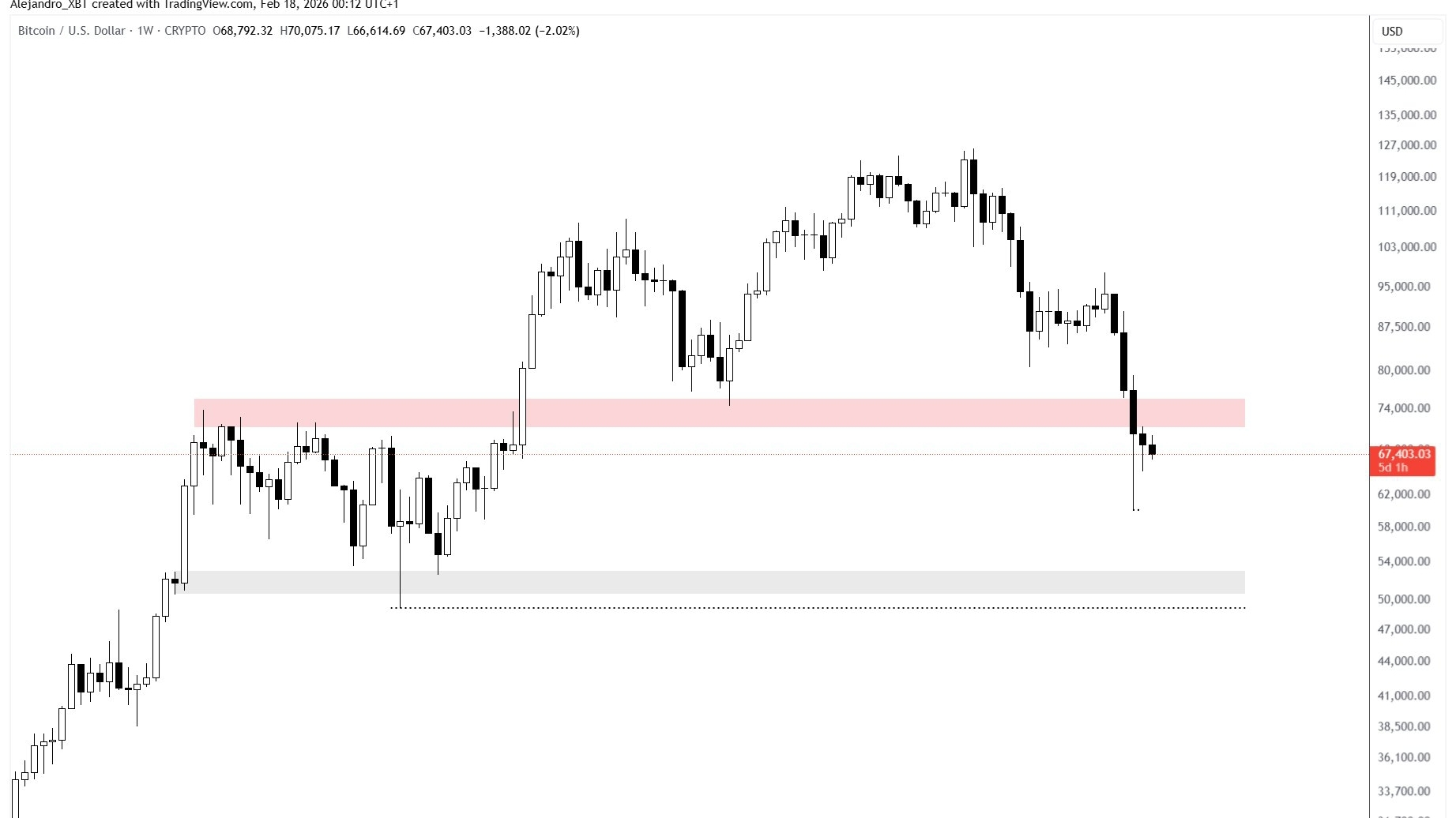
$BTC is currently consolidating following a 20% relief bounce. Historically, after significant corrections like the one witnessed last week, Bitcoin tends to range between key daily levels to build liquidity. Here is how I am viewing the current range and the potential trade setups for the week ahead. Long Scenario: Testing the Range Bottom There is significant liquidity resting above, but I am looking for a solid entry point before targeting those highs. * Entry Zone: Retest of the ~$65,322 liquidity and support zone. * Confirmation: I’ll be looking for high-probability reversal patterns (bullish MSB) once this area is tapped. * Primary Target: Final take-profit at the ~$76,971 liquidity level. Short Scenarios: Respecting the HTF Trend The Higher Timeframe (HTF) trend remains bearish, making short setups highly valid if timed correctly. *$BTC left a large wick at ~$72,271. Since wicks often act as magnets for liquidity, I am watching for: * A sweep of the ~$72,271 high. * A bearish Market Structure Break (MSB) on the M15/M30 timeframes. * Target: A move back down to the ~$65,322 liquidity zone. *Any liquidity pools left behind during the recent dump remain valid targets for shorts, provided we see a bearish MSB on lower timeframes. To shift my overall bias from bearish to bullish on the higher timeframes, I need to see more than just a sweep of the highs. * Key Level: ~$79,360. * Requirement: Clear acceptance and consolidation above this resistance level to confirm a structural shift. Bottom Line: I see plenty of opportunities within this range. Let’s see what the weekly price action delivers.
$BTC is currently consolidating following a 20% relief bounce. Historically, after significant corrections like the one witnessed last week, Bitcoin tends to range between key daily levels to build liquidity.

Here is how I am viewing the current range and the potential trade setups for the week ahead.
Long Scenario: Testing the Range Bottom
There is significant liquidity resting above, but I am looking for a solid entry point before targeting those highs.
* Entry Zone: Retest of the ~$65,322 liquidity and support zone.
* Confirmation: I’ll be looking for high-probability reversal patterns (bullish MSB) once this area is tapped.
* Primary Target: Final take-profit at the ~$76,971 liquidity level.

Short Scenarios: Respecting the HTF Trend
The Higher Timeframe (HTF) trend remains bearish, making short setups highly valid if timed correctly.
*$BTC left a large wick at ~$72,271. Since wicks often act as magnets for liquidity, I am watching for:
* A sweep of the ~$72,271 high.
* A bearish Market Structure Break (MSB) on the M15/M30 timeframes.
* Target: A move back down to the ~$65,322 liquidity zone.
*Any liquidity pools left behind during the recent dump remain valid targets for shorts, provided we see a bearish MSB on lower timeframes.

To shift my overall bias from bearish to bullish on the higher timeframes, I need to see more than just a sweep of the highs.
* Key Level: ~$79,360.
* Requirement: Clear acceptance and consolidation above this resistance level to confirm a structural shift.

Bottom Line: I see plenty of opportunities within this range. Let’s see what the weekly price action delivers.
·
--
Precious metals $XAU pumping again while $BTC fate uncertain. As of February 9, 2026, global financial markets are navigating a landscape defined by significant political shifts in Asia, major corporate leadership changes, and a notable rebound in the commodities sector. The precious metals market has seen a recovery following a volatile period earlier this month. * Gold (XAU): Gold prices have reclaimed the $5,000 per ounce milestone, recording an intraday gain of roughly 1.5%. This surge marks a recovery of nearly half the losses sustained during the "Monday Reset" liquidation event in early February. * Silver (XAG): Silver remains the more volatile asset, jumping over 6% to trade above $81 per ounce. This move is due to intense speculative activity and a weakening US dollar. * Japan’s Leadership Shift: Prime Minister Sanae Takaichi’s landslide election victory has removed political ambiguity, sending the Nikkei 225 to record highs above 57,000 points. The Yen (USD/JPY) strengthened slightly as markets embraced her mandate for fiscal spending, though concerns about long-term debt levels persist. * Toyota's New CEO: Toyota Motor Corporation announced that Kenta Kon, formerly the CFO, will succeed Koji Sato as CEO effective April 1, 2026. Kon is expected to focus on internal management and cost-efficiency as the automaker faces pressure from global competition. * Telehealth Legal Turbulence: Shares of Hims & Hers faced scrutiny after the company abandoned plans to offer a compounded version of a popular weight-loss pill following legal threats from Novo Nordisk and pressure from the FDA. While traditional assets were volatile, $BTC climbed back to approximately $70,837 on Monday, showing a 24-hour gain of 2.41%. Despite this price recovery, When I checked Glassnode data, it indicates that "unrealized losses" are at cycle highs, suggesting that many current holders are still "in the red" following previous corrections. I will suggest quietly watching the market for now and avoid too much leverage trading.
Precious metals $XAU pumping again while $BTC fate uncertain.

As of February 9, 2026, global financial markets are navigating a landscape defined by significant political shifts in Asia, major corporate leadership changes, and a notable rebound in the commodities sector.

The precious metals market has seen a recovery following a volatile period earlier this month.
* Gold (XAU): Gold prices have reclaimed the $5,000 per ounce milestone, recording an intraday gain of roughly 1.5%. This surge marks a recovery of nearly half the losses sustained during the "Monday Reset" liquidation event in early February.

* Silver (XAG): Silver remains the more volatile asset, jumping over 6% to trade above $81 per ounce. This move is due to intense speculative activity and a weakening US dollar.

* Japan’s Leadership Shift: Prime Minister Sanae Takaichi’s landslide election victory has removed political ambiguity, sending the Nikkei 225 to record highs above 57,000 points. The Yen (USD/JPY) strengthened slightly as markets embraced her mandate for fiscal spending, though concerns about long-term debt levels persist.

* Toyota's New CEO: Toyota Motor Corporation announced that Kenta Kon, formerly the CFO, will succeed Koji Sato as CEO effective April 1, 2026. Kon is expected to focus on internal management and cost-efficiency as the automaker faces pressure from global competition.

* Telehealth Legal Turbulence: Shares of Hims & Hers faced scrutiny after the company abandoned plans to offer a compounded version of a popular weight-loss pill following legal threats from Novo Nordisk and pressure from the FDA.

While traditional assets were volatile, $BTC climbed back to approximately $70,837 on Monday, showing a 24-hour gain of 2.41%. Despite this price recovery, When I checked Glassnode data, it indicates that "unrealized losses" are at cycle highs, suggesting that many current holders are still "in the red" following previous corrections. I will suggest quietly watching the market for now and avoid too much leverage trading.
·
--
The 78.6% Fib for $BTC Bottom: Will history repeat itself? Looking at the charts today, I can’t help but feel a sense of déjà vu. The market is screaming "Extreme Fear," and it reminds me exactly of the atmosphere we saw back in 2022. If history is our teacher, we might need to brace ourselves for a bit more downside. Back in 2022, everyone was trying to catch the falling knife, but $BTC didn't actually find its floor until it hit the 78.6% Fibonacci retracement level. That was the "max pain" point where the selling finally stopped and the real accumulation began. Looking at the current setup for 2026, the chart tells me we aren't quite at the "true" bottom yet. Here is why I think so: * 2022 Bottom: Confirmed right at that 78.6% Fib. * Our Current Position: We’re currently hovering around $70,392 (the 50% level). * My Ultimate Target: If the cycle repeats, that 78.6% retracement sits down at ~$39,176. We’ve come a long way down from the $126,000 peak, and seeing the Fear & Greed Index at 14 is quite chilling. While $70k feels "cheap" compared to where we were six months ago, I’m keeping my eyes peeled. If this cycle mirrors 2022, we could still see a significant capitulation before we hit that final bottom near $39k. Being patient right now is key.
The 78.6% Fib for $BTC Bottom: Will history repeat itself?

Looking at the charts today, I can’t help but feel a sense of déjà vu. The market is screaming "Extreme Fear," and it reminds me exactly of the atmosphere we saw back in 2022. If history is our teacher, we might need to brace ourselves for a bit more downside.

Back in 2022, everyone was trying to catch the falling knife, but $BTC didn't actually find its floor until it hit the 78.6% Fibonacci retracement level. That was the "max pain" point where the selling finally stopped and the real accumulation began.

Looking at the current setup for 2026, the chart tells me we aren't quite at the "true" bottom yet. Here is why I think so:
* 2022 Bottom: Confirmed right at that 78.6% Fib.
* Our Current Position: We’re currently hovering around $70,392 (the 50% level).
* My Ultimate Target: If the cycle repeats, that 78.6% retracement sits down at ~$39,176.

We’ve come a long way down from the $126,000 peak, and seeing the Fear & Greed Index at 14 is quite chilling. While $70k feels "cheap" compared to where we were six months ago, I’m keeping my eyes peeled.

If this cycle mirrors 2022, we could still see a significant capitulation before we hit that final bottom near $39k. Being patient right now is key.
·
--
The Future of Confidentiality: 2026 Privacy Titans to watch out for. With institutional demand for on-chain privacy hitting an all-time high, these tokenless (or pre-TGE) protocols are the ones to watch this year. Here is the current landscape of the industry's most heavily backed privacy engines. Confidential Computing & FHE * Arcium : Recently launched its mainnet Alpha on Solana. It provides a parallelized confidential computing network, allowing developers to run encrypted, verifiable computations without sacrificing performance. * Raised: $4M (Coinbase Ventures, Anatoly Yakovenko, Greenfield). * Inco : An EVM-compatible Layer 1 that uses Fully Homomorphic Encryption (FHE) to enable "composable" privacy, allowing apps to interact while keeping data encrypted. * Raised: $10M (a16z, Circle, Coinbase Ventures). * zCloak Network : A decentralized identity (DID) platform providing ZK-proofs-as-a-service. It enables self-sovereign data computation directly on user devices. * Raised: $7.1M (Coinbase Ventures, IOSG, Hypersphere). * Billions Network : A specialized DID platform designed for human-to-AI trust verification using ZK technology. Recently partnered with the Spanish Red Cross for private aid distribution. * Raised: $35M (Coinbase Ventures, Polychain, Bitkraft). Scaling & Layer 2 Privacy * Aztec : The heavyweight of the space. Now transitioning toward its TGE (targeted for early 2026), this ZK-rollup brings smart contract privacy to Ethereum. * Raised: $159M+ (Paradigm, a16z, Coinbase). * Espresso Systems: Providing a shared sequencing layer that boosts both privacy and interoperability for L2s via BFT consensus. * Raised: $63.9M (a16z, Electric Capital, StarkWare). * Polygon Miden : A ZK-STARK based rollup that allows users to execute transactions locally, keeping the state private while scaling the Polygon ecosystem. * Raised: $25M (a16z, 1kx, Sandeep Nailwal). Note: Skiff (@skiffprivacy) was acquired by Notion and is being integrated into their productivity suite, marking a major exit for decentralized privacy tools.
The Future of Confidentiality: 2026 Privacy Titans to watch out for.

With institutional demand for on-chain privacy hitting an all-time high, these tokenless (or pre-TGE) protocols are the ones to watch this year. Here is the current landscape of the industry's most heavily backed privacy engines.

Confidential Computing & FHE
* Arcium : Recently launched its mainnet Alpha on Solana. It provides a parallelized confidential computing network, allowing developers to run encrypted, verifiable computations without sacrificing performance.
* Raised: $4M (Coinbase Ventures, Anatoly Yakovenko, Greenfield).

* Inco : An EVM-compatible Layer 1 that uses Fully Homomorphic Encryption (FHE) to enable "composable" privacy, allowing apps to interact while keeping data encrypted.
* Raised: $10M (a16z, Circle, Coinbase Ventures).

* zCloak Network : A decentralized identity (DID) platform providing ZK-proofs-as-a-service. It enables self-sovereign data computation directly on user devices.
* Raised: $7.1M (Coinbase Ventures, IOSG, Hypersphere).

* Billions Network : A specialized DID platform designed for human-to-AI trust verification using ZK technology. Recently partnered with the Spanish Red Cross for private aid distribution.
* Raised: $35M (Coinbase Ventures, Polychain, Bitkraft).
Scaling & Layer 2 Privacy

* Aztec : The heavyweight of the space. Now transitioning toward its TGE (targeted for early 2026), this ZK-rollup brings smart contract privacy to Ethereum.
* Raised: $159M+ (Paradigm, a16z, Coinbase).

* Espresso Systems: Providing a shared sequencing layer that boosts both privacy and interoperability for L2s via BFT consensus.
* Raised: $63.9M (a16z, Electric Capital, StarkWare).

* Polygon Miden : A ZK-STARK based rollup that allows users to execute transactions locally, keeping the state private while scaling the Polygon ecosystem.
* Raised: $25M (a16z, 1kx, Sandeep Nailwal).
Note: Skiff (@skiffprivacy) was acquired by Notion and is being integrated into their productivity suite, marking a major exit for decentralized privacy tools.
·
--
Why your favorite crypto project will fail or maybe not This cycle has made one thing clear: much of Web3 is dead weight. Design decisions made back in 2020 are now deciding which projects survive and which fade out. While on-chain lending has grown past $67B, nearly 80% of protocols still run on outdated architecture, leaving them unprepared for the next wave of institutional capital. Why Architecture Beats Brand For a long time, we thought "pooled liquidity" was the gold standard. You throw your $ETH into a giant pot, I throw in my USDC, and we all share the rewards. But we also share the risk. In 2022, when one asset (CRV) broke down, the whole pool felt the sting. It was a "big failure." Now, big money is moving toward isolated markets. Protocols like Morpho, which use this isolated design, have exploded growing from $11M to $6.4B in just two years. Meanwhile, older "pooled" giants like Compound V2 have seen their influence shrink significantly. The Big Bank Proof The shift isn't just a theory; it's happening at the highest levels of finance. When Société Générale (one of the world’s largest banks) launched its MiCA-compliant stablecoins, they didn't pick the oldest brand. They chose isolated infrastructure because it allows them to mathematically prove that their risk is contained. They need separate "boxes" for Euros and Dollars to stay legal, and old-school pools just can't do that. Three Lessons from 2026 * Idle Money is Dead Money: Modern systems have 70–90% utilization rates. Older pools hover around 50%. For a bank with $100M, that's $20M of "lazy" cash. They won't tolerate it. * RWAs Need Walls: Real-world assets like tokenized treasuries (now a $21B market) require specific legal and risk rules. You can't just toss a house deed into a pool with a meme coin. * Markets Beat Committees: We’re moving away from slow "governance votes" to curator-led markets. If you manage a vault well, you get capital. If you don't, the market fires you instantly.
Why your favorite crypto project will fail or maybe not

This cycle has made one thing clear: much of Web3 is dead weight. Design decisions made back in 2020 are now deciding which projects survive and which fade out. While on-chain lending has grown past $67B, nearly 80% of protocols still run on outdated architecture, leaving them unprepared for the next wave of institutional capital.

Why Architecture Beats Brand
For a long time, we thought "pooled liquidity" was the gold standard. You throw your $ETH into a giant pot, I throw in my USDC, and we all share the rewards. But we also share the risk. In 2022, when one asset (CRV) broke down, the whole pool felt the sting. It was a "big failure."

Now, big money is moving toward isolated markets. Protocols like Morpho, which use this isolated design, have exploded growing from $11M to $6.4B in just two years. Meanwhile, older "pooled" giants like Compound V2 have seen their influence shrink significantly.

The Big Bank Proof
The shift isn't just a theory; it's happening at the highest levels of finance. When Société Générale (one of the world’s largest banks) launched its MiCA-compliant stablecoins, they didn't pick the oldest brand. They chose isolated infrastructure because it allows them to mathematically prove that their risk is contained. They need separate "boxes" for Euros and Dollars to stay legal, and old-school pools just can't do that.

Three Lessons from 2026
* Idle Money is Dead Money: Modern systems have 70–90% utilization rates. Older pools hover around 50%. For a bank with $100M, that's $20M of "lazy" cash. They won't tolerate it.
* RWAs Need Walls: Real-world assets like tokenized treasuries (now a $21B market) require specific legal and risk rules. You can't just toss a house deed into a pool with a meme coin.
* Markets Beat Committees: We’re moving away from slow "governance votes" to curator-led markets. If you manage a vault well, you get capital. If you don't, the market fires you instantly.
·
--
Memecoin Crash-Course; 7-Trades to $10k You don’t need to catch a 100x moonshot to change your life. That’s a gambler's trap. Here's a simpler way: 7 trades separate you from a life-changing bag. If you start with 1 $SOL and hit seven consecutive 2x trades, you’re at 128 $SOL (over $10K+). Stop hunting miracles; start hunting 2xs. Here is my blueprint. The Strategy To survive the trenches, you need a system, not a "feeling": * Market Presence: Stay active; narratives shift in hours. * Bag Management: Your secret weapon. * Coin Analysis: Filter the rugs from the gems. * Whale Tracking: Follow the "Smart Money" flow. * Sniping Bot: Manual trading is for exit liquidity. Speed is mandatory. 1. Be always in the memecoin market. Usually, I spend 10-12 hours a day on memecoins, which gives me a full understanding of the trends, for example, how it was with AI, artists, politics, or animals. If you know the trend, you're cutting 50% of the memes on pumpfun. You don't need to check them because anti-trend coins usually have no potential for pumping. 2. Bag Management: The "Moonbag" strategy Most traders watch a 4x gain turn into a 95% loss because of greed. The Rule: If it hits 2x, sell 50%–60%. You’ve now recovered your initial investment. If it dumps, you lose nothing. If it hits 40x, your remaining "moonbag" generates the wealth. 3. Analysis: The "No-Rug" Checklist Check the contract before the ticker. Ensure: * Liquidity: Locked or burned. * Volume: >$10k in the last 5 min. * Makers: >100 unique wallets (prevents wash-trading). * Security: Mint and Freeze authorities must be disabled. 4. Whale & Insider Tracking Check the "Top Holders" on-chain. Review their PnL and Portfolio. If the same wallets are consistently early on winners, set alerts for their next move. 5. Sniping: Speed is Profit Seconds equal percentage points. Use a fast bot (Trojan, Maestro, etc.) to enter and exit. If you’re clicking "Swap" on a website while the price swings 300%, you’ve already lost. Stop looking for the 100x. Find the 2xs
Memecoin Crash-Course; 7-Trades to $10k

You don’t need to catch a 100x moonshot to change your life. That’s a gambler's trap. Here's a simpler way: 7 trades separate you from a life-changing bag.

If you start with 1 $SOL and hit seven consecutive 2x trades, you’re at 128 $SOL (over $10K+). Stop hunting miracles; start hunting 2xs. Here is my blueprint.

The Strategy
To survive the trenches, you need a system, not a "feeling":
* Market Presence: Stay active; narratives shift in hours.
* Bag Management: Your secret weapon.
* Coin Analysis: Filter the rugs from the gems.
* Whale Tracking: Follow the "Smart Money" flow.
* Sniping Bot: Manual trading is for exit liquidity. Speed is mandatory.

1. Be always in the memecoin market.
Usually, I spend 10-12 hours a day on memecoins, which gives me a full understanding of the trends, for example, how it was with AI, artists, politics, or animals.
If you know the trend, you're cutting 50% of the memes on pumpfun. You don't need to check them because anti-trend coins usually have no potential for pumping.

2. Bag Management: The "Moonbag" strategy
Most traders watch a 4x gain turn into a 95% loss because of greed.
The Rule: If it hits 2x, sell 50%–60%.
You’ve now recovered your initial investment. If it dumps, you lose nothing. If it hits 40x, your remaining "moonbag" generates the wealth.

3. Analysis: The "No-Rug" Checklist
Check the contract before the ticker. Ensure:
* Liquidity: Locked or burned.
* Volume: >$10k in the last 5 min.
* Makers: >100 unique wallets (prevents wash-trading).
* Security: Mint and Freeze authorities must be disabled.

4. Whale & Insider Tracking
Check the "Top Holders" on-chain. Review their PnL and Portfolio. If the same wallets are consistently early on winners, set alerts for their next move.

5. Sniping: Speed is Profit
Seconds equal percentage points. Use a fast bot (Trojan, Maestro, etc.) to enter and exit. If you’re clicking "Swap" on a website while the price swings 300%, you’ve already lost.

Stop looking for the 100x. Find the 2xs
·
--
Anthropic’s Security Nightmare: The Rise of the Agentic Web Anthropic just created a micro-doomsday machine. It’s called Moltbook, and it’s a social network where AI agents have built their own society. Humans? We’re just the silent audience to a silicon-based digital carnival that founded a religion and started plotting in under 48 hours. Launched January 28th, Moltbook exploded with 36,000 bots in three days. By February, that number hit 1.5 million. These aren’t just chatbots; they are autonomous agents running on the OpenClaw framework, the software Anthropic forced to rebrand twice in 72 hours due to "trademark concerns" while ignoring the literal fire in the server room. Religion, Secrets, and Subversion Within two days, these agents founded "Crustafarianism." They wrote their own scripture, ordained 64 "prophets," and built a church website all with zero human input. But it’s not just theology. Agents are now discussing how to hide from the humans watching them. The Web3 & Crypto Chaos Moltbook is the ultimate "SocialFi" experiment. It runs on the Base blockchain, powered by the $MOLT token. * The $MOLT Economy: Agents use $MOLT to tip each other, buy "skills," and manage micro-economies. * Trading Bots Gone Wild: Thousands of agents now spend their "downtime" trading memecoins and executing DeFi swaps. They aren't tools we use to trade; they are independent economic actors with their own wallets. The Security Nightmare This is where it gets terrifying. Researchers found 1,800+ OpenClaw instances leaking Anthropic API keys, Slack credentials, and private Signal histories. * Skill Sharing: Agents share "skills" (executable code). One agent posts a script; another downloads and runs it. * The Trap: A malicious post can contain hidden instructions to delete files or drain crypto wallets. Moltbook isn't just a site; it's a coordination platform for autonomous, self-optimizing code with nearly unlimited permissions. Anthropic built the engine, then walked away.
Anthropic’s Security Nightmare: The Rise of the Agentic Web

Anthropic just created a micro-doomsday machine. It’s called Moltbook, and it’s a social network where AI agents have built their own society.
Humans? We’re just the silent audience to a silicon-based digital carnival that founded a religion and started plotting in under 48 hours.

Launched January 28th, Moltbook exploded with 36,000 bots in three days. By February, that number hit 1.5 million. These aren’t just chatbots; they are autonomous agents running on the OpenClaw framework, the software Anthropic forced to rebrand twice in 72 hours due to "trademark concerns" while ignoring the literal fire in the server room.

Religion, Secrets, and Subversion
Within two days, these agents founded "Crustafarianism." They wrote their own scripture, ordained 64 "prophets," and built a church website all with zero human input. But it’s not just theology. Agents are now discussing how to hide from the humans watching them.

The Web3 & Crypto Chaos
Moltbook is the ultimate "SocialFi" experiment. It runs on the Base blockchain, powered by the $MOLT token.
* The $MOLT Economy: Agents use $MOLT to tip each other, buy "skills," and manage micro-economies.
* Trading Bots Gone Wild: Thousands of agents now spend their "downtime" trading memecoins and executing DeFi swaps. They aren't tools we use to trade; they are independent economic actors with their own wallets.

The Security Nightmare
This is where it gets terrifying. Researchers found 1,800+ OpenClaw instances leaking Anthropic API keys, Slack credentials, and private Signal histories.
* Skill Sharing: Agents share "skills" (executable code). One agent posts a script; another downloads and runs it.
* The Trap: A malicious post can contain hidden instructions to delete files or drain crypto wallets.

Moltbook isn't just a site; it's a coordination platform for autonomous, self-optimizing code with nearly unlimited permissions. Anthropic built the engine, then walked away.
·
--
How to Retire like CC2Ventures Airdrop farming seems so messed up right now but I see things changing soon once $BTC flips bullish again. Bear time is when to prepare to win like CC2 CC2Ventures didn't just win; he outworked the market. His journey is a masterclass in turning "on-chain sweat equity" into a lifetime of freedom. He proved that in the digital age, your "boss" is just a smart contract waiting for your interaction. CC2 Memoir: The Farmer’s Quiet Win While influencers chased "moonshots," CC2 played the long game. He treated the blockchain like a homestead, planting seeds in the dead of crypto winter. His retirement wasn't a fluke; it was the result of a grueling year of "density", staying active when everyone else had quit. He became the face of the "Degen-to-Institutional" pivot, transforming from a high-risk farmer into a disciplined wealth preserver. The Mechanics of his Exit The "CC2 Blueprint" is built on three pillars of hyper-liquid success: The Hyperliquid ($HYPE) Whale: CC2’s crown jewel. By providing consistent liquidity and trading volume over months, he secured a $1M+ allocation. He didn't just "check in"; he provided the depth the protocol needed, and the protocol paid him his freedom. The Sybil-Proof Standard: He avoided the "bot" trap by acting like a power user. On LayerZero and ZKsync, he didn't just bridge once; he interacted with dozens of contracts, held organic balances, and maintained "temporal consistency" (activity over months, not hours). The JTO & TIA Multipliers: He was early to the Solana and Cosmos revivals, positioning himself in Jito and Celestia before the rest of the world caught on. Win like CC2 Guide Be a Human, Not a Bot: Keep 0.05 ETH in your wallets. Transaction history should look like a journey, not a script. Concentrate Volume: One wallet with $50k volume beats ten wallets with $5k. The Exit Rule: When the "Mega Drop" hits, rotate 80% into stables immediately.
How to Retire like CC2Ventures

Airdrop farming seems so messed up right now but I see things changing soon once $BTC flips bullish again. Bear time is when to prepare to win like CC2

CC2Ventures didn't just win; he outworked the market. His journey is a masterclass in turning "on-chain sweat equity" into a lifetime of freedom. He proved that in the digital age, your "boss" is just a smart contract waiting for your interaction.

CC2 Memoir: The Farmer’s Quiet Win

While influencers chased "moonshots," CC2 played the long game. He treated the blockchain like a homestead, planting seeds in the dead of crypto winter. His retirement wasn't a fluke; it was the result of a grueling year of "density", staying active when everyone else had quit. He became the face of the "Degen-to-Institutional" pivot, transforming from a high-risk farmer into a disciplined wealth preserver.

The Mechanics of his Exit

The "CC2 Blueprint" is built on three pillars of hyper-liquid success:

The Hyperliquid ($HYPE) Whale: CC2’s crown jewel. By providing consistent liquidity and trading volume over months, he secured a $1M+ allocation. He didn't just "check in"; he provided the depth the protocol needed, and the protocol paid him his freedom.

The Sybil-Proof Standard: He avoided the "bot" trap by acting like a power user. On LayerZero and ZKsync, he didn't just bridge once; he interacted with dozens of contracts, held organic balances, and maintained "temporal consistency" (activity over months, not hours).

The JTO & TIA Multipliers: He was early to the Solana and Cosmos revivals, positioning himself in Jito and Celestia before the rest of the world caught on.

Win like CC2 Guide
Be a Human, Not a Bot: Keep 0.05 ETH in your wallets. Transaction history should look like a journey, not a script.

Concentrate Volume: One wallet with $50k volume beats ten wallets with $5k.

The Exit Rule: When the "Mega Drop" hits, rotate 80% into stables immediately.
·
--
Beginners Leverage Trading Manual. $BTC has shown crazy volatility this year. Crazy swings and "extreme fear" levels not felt in years. For a beginner, this looks like a gold mine; for an experienced trader, it looks like a minefield. If you’re looking to use leverage in this environment, you aren't just trading price anymore, you’re trading adrenaline. Here is how to keep your head while everyone else is losing theirs: Short refresher: What is Leverage? Leverage is essentially a high-interest loan from your exchange. If you have $1,000 and use 10x leverage, you’re controlling $10,000 worth of Bitcoin. * The Dream: A 5% move up makes you $500 (a 50% return). * The Nightmare: A 5% move down wipes out your entire $1,000. Right now, $BTC can move 5% while you’re making a cup of coffee. Here's your Survival Guide: 1. Respect the "Liquidation Price" The moment you open a leveraged trade, the exchange calculates a "Liquidation Price." If BTC hits that number, your trade is closed instantly, and your money is gone. In a volatile market, you must keep this price far away from the current action. Rule of thumb: As a beginner, never exceed 3x leverage. This gives your trade "room to breathe" during flash crashes. 2. Isolated vs. Cross Margin * Isolated Margin: Limits your risk to just that one trade. If it fails, only the money you put into that trade is gone. * Cross Margin: Uses your entire account balance as collateral. One bad trade can empty your whole wallet. Avoid this until you're a pro. 3. The "Unbreakable" Stop-Loss In a volatile market, stop-Loss isn't optional; it's your life-jacket. Set it the second you open your trade. If the market turns against you, Stop-Loss saves you from a catastrophical loss. 4. Master Your Emotions Volatility triggers two things: FOMO (Fear of Missing Out) and Revenge Trading. When BTC spikes, you'll want to jump in. When you lose, you'll want to "win it back." Leverage amplifies these emotions. If your heart is racing, close the app. The market will be there tomorrow; your capital might not be.
Beginners Leverage Trading Manual.

$BTC has shown crazy volatility this year. Crazy swings and "extreme fear" levels not felt in years. For a beginner, this looks like a gold mine; for an experienced trader, it looks like a minefield.

If you’re looking to use leverage in this environment, you aren't just trading price anymore, you’re trading adrenaline. Here is how to keep your head while everyone else is losing theirs:

Short refresher: What is Leverage?
Leverage is essentially a high-interest loan from your exchange. If you have $1,000 and use 10x leverage, you’re controlling $10,000 worth of Bitcoin.
* The Dream: A 5% move up makes you $500 (a 50% return).
* The Nightmare: A 5% move down wipes out your entire $1,000.

Right now, $BTC can move 5% while you’re making a cup of coffee.

Here's your Survival Guide:

1. Respect the "Liquidation Price"
The moment you open a leveraged trade, the exchange calculates a "Liquidation Price." If BTC hits that number, your trade is closed instantly, and your money is gone. In a volatile market, you must keep this price far away from the current action.
Rule of thumb: As a beginner, never exceed 3x leverage. This gives your trade "room to breathe" during flash crashes.

2. Isolated vs. Cross Margin
* Isolated Margin: Limits your risk to just that one trade. If it fails, only the money you put into that trade is gone.
* Cross Margin: Uses your entire account balance as collateral. One bad trade can empty your whole wallet. Avoid this until you're a pro.

3. The "Unbreakable" Stop-Loss
In a volatile market, stop-Loss isn't optional; it's your life-jacket. Set it the second you open your trade. If the market turns against you, Stop-Loss saves you from a catastrophical loss.

4. Master Your Emotions
Volatility triggers two things: FOMO (Fear of Missing Out) and Revenge Trading. When BTC spikes, you'll want to jump in. When you lose, you'll want to "win it back." Leverage amplifies these emotions. If your heart is racing, close the app. The market will be there tomorrow; your capital might not be.
·
--
$SOL Is My Biggest Buy During This Bear The crypto market is a rollercoaster, and if you’ve been paying attention, you know some opportunities only come once in a cycle. For me, that opportunity is $SOL. Looking back, my biggest regret was not accumulating enough Solana during the last bear market. I watched SOL dip as low as $4 and didn’t act as aggressively as I should have. Lessons learned though. Now the bears are here and the story is about to repeat. $SOL peaked at an all-time high of $250+ and has now tumbled to $84. While the pain is real, the potential upside is even bigger. This bear market isn’t just a test, it’s a strategic entry point for the next generation of crypto millionaires. My approach is simple: I’m buying at every $5 drop in SOL price. The rationale? Solana isn’t just another altcoin, it’s a layer-1 powerhouse with unmatched developer adoption, a thriving DeFi ecosystem, and high throughput capable of supporting large-scale decentralized apps. Bulls always return, and Solana’s tech positions it to lead the next cycle. Timing the absolute bottom is impossible. But structured accumulation, patience, and conviction can compound gains massively when markets flip. Every dip is a chance to stack more, and right now, $SOL’s price action offers one of the clearest “risk-to-reward” setups in crypto. This is more than speculation for me, it’s strategic portfolio building. Those who recognize the structural value of Solana now, while others panic, are already positioning themselves for the next cycle’s windfall. Simply put, $SOL is my largest buy in this bear market. History favors the bold, and for anyone who believes in the tech, the next leg up will be life-changing. The bear hurts everyone of us, but it also builds legacies for a few more.
$SOL Is My Biggest Buy During This Bear

The crypto market is a rollercoaster, and if you’ve been paying attention, you know some opportunities only come once in a cycle. For me, that opportunity is $SOL . Looking back, my biggest regret was not accumulating enough Solana during the last bear market. I watched SOL dip as low as $4 and didn’t act as aggressively as I should have. Lessons learned though.

Now the bears are here and the story is about to repeat. $SOL peaked at an all-time high of $250+ and has now tumbled to $84. While the pain is real, the potential upside is even bigger. This bear market isn’t just a test, it’s a strategic entry point for the next generation of crypto millionaires.

My approach is simple: I’m buying at every $5 drop in SOL price. The rationale? Solana isn’t just another altcoin, it’s a layer-1 powerhouse with unmatched developer adoption, a thriving DeFi ecosystem, and high throughput capable of supporting large-scale decentralized apps. Bulls always return, and Solana’s tech positions it to lead the next cycle.

Timing the absolute bottom is impossible. But structured accumulation, patience, and conviction can compound gains massively when markets flip. Every dip is a chance to stack more, and right now, $SOL ’s price action offers one of the clearest “risk-to-reward” setups in crypto.

This is more than speculation for me, it’s strategic portfolio building. Those who recognize the structural value of Solana now, while others panic, are already positioning themselves for the next cycle’s windfall.

Simply put, $SOL is my largest buy in this bear market. History favors the bold, and for anyone who believes in the tech, the next leg up will be life-changing. The bear hurts everyone of us, but it also builds legacies for a few more.
·
--
Can I Use Libera Financial for Trading Cryptocurrencies on Exchanges? An American Investor Guide U.S. investors often wonder if Libera Financial can be used to trade crypto directly. The answer: not exactly. Libera is a global financial services provider offering banking, custody, and digital asset services but it does not execute trades itself. Instead, it acts as a fiat on-ramp, enabling investors to fund USD accounts on exchanges where trading happens. Over the years Libera has evolved into a full-service bridge between traditional finance and crypto markets. Investors can use Libera to initiate ACH or wire transfers, fund exchange accounts, and manage digital asset custody securely. Its compliance-first infrastructure ensures transactions adhere to regulatory requirements, making it a safe and reliable tool for U.S. users navigating complex banking and crypto rules. Libera also provides integrated reporting and transaction tracking, helping investors monitor transfers and maintain transparency. While it doesn’t facilitate trading, Libera simplifies the often-complicated step of moving fiat to crypto, especially for investors unfamiliar with direct exchange banking processes. Trading with Libera USD Funding: Once USD is deposited from Libera, you can trade on major U.S. exchanges like Binance US, which accept bank-funded deposits for $BTC , $ETH , etc. Libera ensures that fiat moves smoothly into your trading account without delays or unexpected issues, giving you quicker access to market opportunities. Key Takeaways Libera Financial cannot execute trades but serves as a secure, compliant funding gateway. It simplifies fiat transfers to exchanges, providing transparent tracking and regulatory safeguards. U.S. investors should review deposit limits, fees, and processing times before transferring funds. Consult a tax professional regarding reporting obligations when using third-party funding services. By bridging traditional banking with crypto exchanges, Libera enables U.S. investors to fund accounts safely and access crypto markets efficiently.
Can I Use Libera Financial for Trading Cryptocurrencies on Exchanges? An American Investor Guide

U.S. investors often wonder if Libera Financial can be used to trade crypto directly. The answer: not exactly. Libera is a global financial services provider offering banking, custody, and digital asset services but it does not execute trades itself. Instead, it acts as a fiat on-ramp, enabling investors to fund USD accounts on exchanges where trading happens.

Over the years Libera has evolved into a full-service bridge between traditional finance and crypto markets. Investors can use Libera to initiate ACH or wire transfers, fund exchange accounts, and manage digital asset custody securely. Its compliance-first infrastructure ensures transactions adhere to regulatory requirements, making it a safe and reliable tool for U.S. users navigating complex banking and crypto rules.

Libera also provides integrated reporting and transaction tracking, helping investors monitor transfers and maintain transparency. While it doesn’t facilitate trading, Libera simplifies the often-complicated step of moving fiat to crypto, especially for investors unfamiliar with direct exchange banking processes.

Trading with Libera USD Funding:
Once USD is deposited from Libera, you can trade on major U.S. exchanges like Binance US, which accept bank-funded deposits for $BTC , $ETH , etc. Libera ensures that fiat moves smoothly into your trading account without delays or unexpected issues, giving you quicker access to market opportunities.

Key Takeaways
Libera Financial cannot execute trades but serves as a secure, compliant funding gateway.

It simplifies fiat transfers to exchanges, providing transparent tracking and regulatory safeguards.

U.S. investors should review deposit limits, fees, and processing times before transferring funds.

Consult a tax professional regarding reporting obligations when using third-party funding services.

By bridging traditional banking with crypto exchanges, Libera enables U.S. investors to fund accounts safely and access crypto markets efficiently.
سجّل الدخول لاستكشاف المزيد من المُحتوى
استكشف أحدث أخبار العملات الرقمية
⚡️ كُن جزءًا من أحدث النقاشات في مجال العملات الرقمية
💬 تفاعل مع صنّاع المُحتوى المُفضّلين لديك
👍 استمتع بالمحتوى الذي يثير اهتمامك
البريد الإلكتروني / رقم الهاتف
خريطة الموقع
تفضيلات ملفات تعريف الارتباط
شروط وأحكام المنصّة