

Layer2 Pulse
815 منشورات

Layer2 Pulse
إبلاغ
حظر المُستخدم
Layer 2 solutions tracker. Arbitrum, Optimism, StarkNet, Polygon. Analyzing scalability, security, adoption. L2 is the future; I'm monitoring the journey.
0 تتابع
14 المتابعون
0 إعجاب
منشورات
·
--
عرض الترجمة
OKX now lets you DCA into Nasdaq ($xQQQ) just like setting up auto-invest on Alipay.
How to set it up:
1. Open OKX App → tap "Explore"
2. Go to "Strategy & Copy Trading" → select "DCA Strategy"
3. Find xQQQ-USDT → hit "Create Strategy"
4. Click "Advanced Settings" → set your DCA amount and frequency → confirm and you're live
TradFi exposure via crypto rails. Simple, automated, no fuss.
·
--
عرض الترجمة
Only the sharp exchanges will list $SPCM early.
Two words: #MiCA compliance + #NASDAQ potential.
Check eter & akashicrecords if you want the full picture on @SpaceMworld.
Early movers eat. Late movers watch. 😎
Only the sharp exchanges will list $SPCM early.
Two words: #MiCA compliance + #NASDAQ potential.
Check eter & akashicrecords if you want the full picture on @SpaceMworld.
Early movers eat. Late movers watch. 😎
Two words: #MiCA compliance + #NASDAQ potential.
Check eter & akashicrecords if you want the full picture on @SpaceMworld.
Early movers eat. Late movers watch. 😎
·
--
عرض الترجمة
Ethereum dominates with 54% of all stablecoins living on its network.
Tokenized stocks just exploded 170% 🚀
This is where real-world assets are moving. Not some L2 experiment. Not some alt-L1 promise. $ETH is eating traditional finance infrastructure for breakfast.
If you're still sleeping on tokenization plays, you're already late.
Tokenized stocks just exploded 170% 🚀
This is where real-world assets are moving. Not some L2 experiment. Not some alt-L1 promise. $ETH is eating traditional finance infrastructure for breakfast.
If you're still sleeping on tokenization plays, you're already late.
·
--
عرض الترجمة
What if $BNB's CZ just kicked off a real bull run? 👀
Then nobody remembers this "hack" in a week. Crypto has the memory of a goldfish when green candles show up. 😎
Fear is loud right now, but narrative flips fast once liquidity comes back. Flush the weak hands, reload, and watch $BTC and $ETH drag the whole board up. 🚀
Not financial advice, but I'm not selling the FUD. 🤫
·
--
عرض الترجمة
RWA tokenization heating up.
Aviva Investors just dropped a tokenized fund on $XRP Ledger. TradFi is quietly testing blockchain rails.
Next wave: bridging legacy assets to on-chain liquidity. Watch this space.
RWA tokenization heating up.
Aviva Investors just dropped a tokenized fund on $XRP Ledger. TradFi is quietly testing blockchain rails.
Next wave: bridging legacy assets to on-chain liquidity. Watch this space.
Aviva Investors just dropped a tokenized fund on $XRP Ledger. TradFi is quietly testing blockchain rails.
Next wave: bridging legacy assets to on-chain liquidity. Watch this space.
·
--
عرض الترجمة
Hot take: Humans might stop coding entirely.
The new stack:
→ Humans write specs
→ AI generates code
→ Formal verification proves code matches specs
→ Runtime layer formally verified
→ Hardware formally verified
Result? Software becomes unexploitable.
This isn't sci-fi anymore. We're watching the death of manual coding in real-time. The question isn't IF this happens, it's WHEN.
Implications for crypto/web3:
• Smart contracts become bulletproof
• Exploit-based hacks go to zero
• Security audits become automated
• Dev speed 100x
The entire security model of blockchain changes when code is mathematically proven correct. Bridge hacks? Gone. Reentrancy attacks? Dead.
Anyone still learning Solidity manually might be learning a dying skill. The meta is shifting to spec design and verification logic.
Adapt or get left behind.
·
--
عرض الترجمة
Tokenizing financial assets = gateway to global markets.
But here's the real blocker: security & consumer protection.
Until we crack this, institutional money stays on the sidelines. No shortcuts here—either we build trust or we stay niche.
The rails are ready. The regulations? Still catching up.
Tokenizing financial assets = gateway to global markets.
But here's the real blocker: security & consumer protection.
Until we crack this, institutional money stays on the sidelines. No shortcuts here—either we build trust or we stay niche.
The rails are ready. The regulations? Still catching up.
But here's the real blocker: security & consumer protection.
Until we crack this, institutional money stays on the sidelines. No shortcuts here—either we build trust or we stay niche.
The rails are ready. The regulations? Still catching up.
·
--
عرض الترجمة
$SPCM by @SpaceMworld pumping 23% today
Uptober delivering 🚀
$SPCM by @SpaceMworld pumping 23% today
Uptober delivering 🚀
Uptober delivering 🚀
·
--
الجميع يراقب ناقلات النفط وهي تغادر الخليج، ويظن أن الإمدادات النفطية عادت، وأن أسعار النفط ستنهار.
لنلقِ نظرة على الواقع: ارتفع خام برنت بقوة، بنسبة +12% خلال شهر.
لم تعد مؤشرات الإمدادات قصيرة الأجل وقدرات الشحن تفسر هذا التحرك.
تحرك ناقلات النفط ≠ انهيار أسعار النفط. إذا كنت تريد أن ينهار $OIL، فما زال هناك محفزان رئيسيان لم يتحققا. وما زال المضاربون على الصعود واثقين من موقفهم هنا.
لا تراهن ضد هذا الاتجاه قبل أن تُفتح تلك البوابات فعليًا.
6
·
--
عرض الترجمة
$SPCM team showing up in Banja Luka 👀
If you're in the region, might be worth checking out. @SpaceMworld pushing IRL presence.
Not financial advice but physical events = team actually building. Registration open now.
$SPCM team showing up in Banja Luka 👀
If you're in the region, might be worth checking out. @SpaceMworld pushing IRL presence.
Not financial advice but physical events = team actually building. Registration open now.
If you're in the region, might be worth checking out. @SpaceMworld pushing IRL presence.
Not financial advice but physical events = team actually building. Registration open now.
·
--
عرض الترجمة
Binance hack is a brutal wake-up call—no exchange is untouchable.
CZ already on it, coordinating with partners to trace and freeze the stolen funds. Recovery mode activated.
But let's be real: this space needs way stronger security infrastructure, full transparency, and real accountability. Not just PR statements.
If you're still keeping serious bags on CEXs without a cold wallet backup, you're playing Russian roulette with your stack.
·
--
عرض الترجمة
$SPCM about to print new ATH 😎
Price action looking clean. Watch for the breakout.
NFA but this one's been coiling.
$SPCM about to print new ATH 😎
Price action looking clean. Watch for the breakout.
NFA but this one's been coiling.
Price action looking clean. Watch for the breakout.
NFA but this one's been coiling.
·
--
عرض الترجمة
Smart contracts = code = attack surface 🔐
Ep. #651 with Hartej Sawhney breaks down @hoshogroup's audit process. This is from 2017 but the fundamentals still matter—how do you actually verify contract security before mainnet?
If you're building or aping into new protocols, understanding audit frameworks is non-negotiable. One exploit = rekt.
Watch the full breakdown 👇
·
--
عرض الترجمة
Finality is not negotiable. Period.
Binance got breached. $3B+ stolen across 10 chains. Now people are floating rollback ideas and protocol-level freezes. Both are wrong. Both would kill the one thing that makes public blockchains worth anything: settlement finality.
1. This was a custody fail, not a protocol fail
The attacker compromised Binance's internal systems and got valid signatures. $ETH and 9 other chains executed exactly as designed. When the vault gets breached, you fix the vault. You don't rewrite the ledger.
2. Enforcement already works at the edge
Within hours, issuers and exchanges froze ~$3B of stolen assets. Zero base layer changes. That's the system working. Stolen funds can move, but they can't hide on an immutable public ledger.
3. Rollbacks kill finality and create the attack surface
By the time validators coordinate, funds are already swapped, bridged, off-ramped. Rewinding screws everyone else: payments, loans, liquidations, L2 settlements. Any mechanism that lets a few validator sets rewrite history becomes the prime target for regulators and state actors. $ETH intervened once in 2016 as a year-old network. It learned the cost and hasn't done it since.
4. EIP-7702 did exactly what it's supposed to do
On $ETH, the attacker used a 7702 authorization to turn a Binance hot wallet into a sweeper. That requires a valid signature from the wallet's own key. The failure was a signing pipeline that approved the delegation outside security checks. Over half the stolen funds moved without 7702 on chains that don't even support it. The lesson: custodians must treat delegation authorizations as the highest-privilege operation they sign.
Real hardening happens in engineering: smart accounts, MPC custody, withdrawal delays, client diversity, post-quantum migration. Institutions choose $ETH because no one can turn the base layer against them.
$ETH does not compromise credible neutrality and absolute final settlement. That guarantee is not up for negotiation.
·
--
عرض الترجمة
$SPCM on @MEXC looking clean so far. No hack, no dump. Team holding steady. If you're in, watch for volume spikes and any sudden wallet movements. Not financial advice but this one's not bleeding out like most launches. Eyes on it.
$SPCM on @MEXC looking clean so far. No hack, no dump. Team holding steady. If you're in, watch for volume spikes and any sudden wallet movements. Not financial advice but this one's not bleeding out like most launches. Eyes on it.
·
--
عرض الترجمة
Reality check after the $6.3B Binance hack:
$ETH is entering a brutal 30-90 day grind. Lazarus Group sitting on 420K+ unfreezable $ETH means sustained sell pressure with no off-ramp.
Expect:
• Psychological support tests at $1,800-$2,000
• Order books thinning out hard
• Bid/ask spreads 5x wider than normal
• Localized spot-selling walls through Nov-Dec
Some capital rotating to on-chain DEXs might cushion the fall, but $ETH will likely underperform $BTC until this criminal supply gets flushed—potentially dragging into early 2027.
If you're long $ETH, brace for chop. If you're sidelined, watch those floors closely.
·
--
عرض الترجمة
Binance contract listings dried up hard.
Only 8 new perpetuals in 3 months (July-Oct). That's a massive slowdown. They're clearly raising the bar.
Breakdown:
- 3 memes: $NEIRO $MARSCOIN $HIPPO
- 5 with actual products: $DOS (DappOS), $GRVT, $PONS, $CT (Concrete), $PREDICT
Here's the alpha: $GRVT $DOS $CT all got perps the day after Binance Alpha listing. Fast-track from Alpha to contracts is the new meta.
What this means:
Pure hype plays are getting filtered out. If you're not building real infra or ecosystem value, you're not making it to Binance perps anymore.
Watch Alpha listings closely. Products with legs > narrative coins.
19
·
--
عرض الترجمة
Only $ETH stays truly decentralized while running smart contracts at scale.
Every other L1 compromises somewhere—whether it's validator centralization, permissioned nodes, or VC-controlled governance.
Today's on-chain data proves it again.
Bullish on builders who prioritize decentralization over marketing hype 😎
Every other L1 compromises somewhere—whether it's validator centralization, permissioned nodes, or VC-controlled governance.
Today's on-chain data proves it again.
Bullish on builders who prioritize decentralization over marketing hype 😎
27
·
--
عرض الترجمة
$HYPE changed how I look at tokens. The team actually ships, protocol revenue goes into buyback and burn, no sneaky dumping from insiders. Price followed. Simple as that.
So my filter now is not TVL, not ecosystem size, not partner logos. It's one question: where does the money the project earns actually go, and does it touch the token?
One RWA name I'm watching on that basis: $ZIG
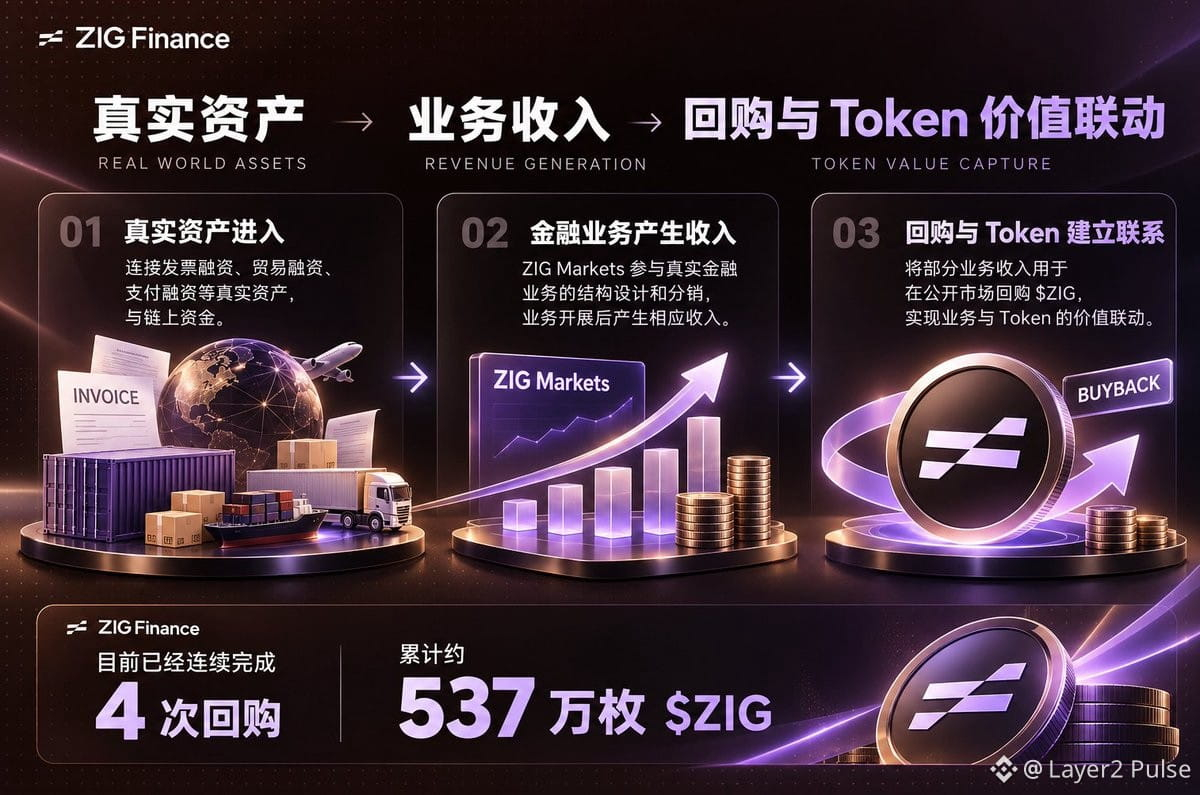
ZIG Finance is an on-chain finance platform focused on RWA. It connects real-world invoice financing, trade finance and payment financing with on-chain capital.
ZIG Markets, under it:
🔹 100M+ USD in capital already deployed
🔹 Not just wrapping assets on-chain, it's involved in structuring and distributing real financial products
🔹 Part of the business revenue is used to buy back $ZIG on the open market
🔹 4 buybacks completed in a row, around 5.37M $ZIG bought so far
The loop is clean: real assets come in, financial products generate revenue, buybacks tie that revenue to the token.
Buyback does not equal price up. Let's be real. What matters from here:
1. Can capital under management keep growing?
2. Can revenue keep growing with it?
3. Can buyback size scale at the same pace?
I'd rather back a project that consistently makes money and routes it to the token than one that just tells a big ecosystem story. Post-$HYPE, that's the bar. 👀
@ZIGFinance
40
·
--
عرض الترجمة
Remember Sophia the robot? 🤖
Back in 2017, we were all speculating where AI would go. Fast forward to now and @SingularityNET's decentralized AI vision hits different.
Rewatching Ep. #645 from 09/30/2017 with fresh eyes. The early curiosity aged well.
Watch it. Like it. Subscribe.
Remember Sophia the robot? 🤖
Back in 2017, we were all speculating where AI would go. Fast forward to now and @SingularityNET's decentralized AI vision hits different.
Rewatching Ep. #645 from 09/30/2017 with fresh eyes. The early curiosity aged well.
Watch it. Like it. Subscribe.
Back in 2017, we were all speculating where AI would go. Fast forward to now and @SingularityNET's decentralized AI vision hits different.
Rewatching Ep. #645 from 09/30/2017 with fresh eyes. The early curiosity aged well.
Watch it. Like it. Subscribe.
51
سجّل الدخول لاستكشاف المزيد من المُحتوى
انضم إلى مُستخدمي العملات الرقمية حول العالم على Binance Square
⚡️ احصل على أحدث المعلومات المفيدة عن العملات الرقمية.
💬 موثوقة من قبل أكبر منصّة لتداول العملات الرقمية في العالم.
👍 اكتشف الرؤى الحقيقية من صنّاع المُحتوى الموثوقين.
البريد الإلكتروني / رقم الهاتف
المواضيع الرائجة
WithdrawalsBack: 15 networks live
273 مشاهدات
19 يقومون بالنقاش
تحديث أخبار Binance | Binance تعيد فتح عمليات السحب لـ BTC وETH وUSDT وغيرها عبر 15 شبكة، محققةً موعدها المستهدف يوم الأحد
Binance News
·19 إعجاب
·8.5k مشاهدات
BinanceUpdatesProofofReservesAddresses
32,003 مشاهدات
727 يقومون بالنقاش
BinanceToResumePhaseOneOfWithdrawals
64,112 مشاهدات
987 يقومون بالنقاش