
1. Introduction: When Token Creation Becomes a Financial Weapon
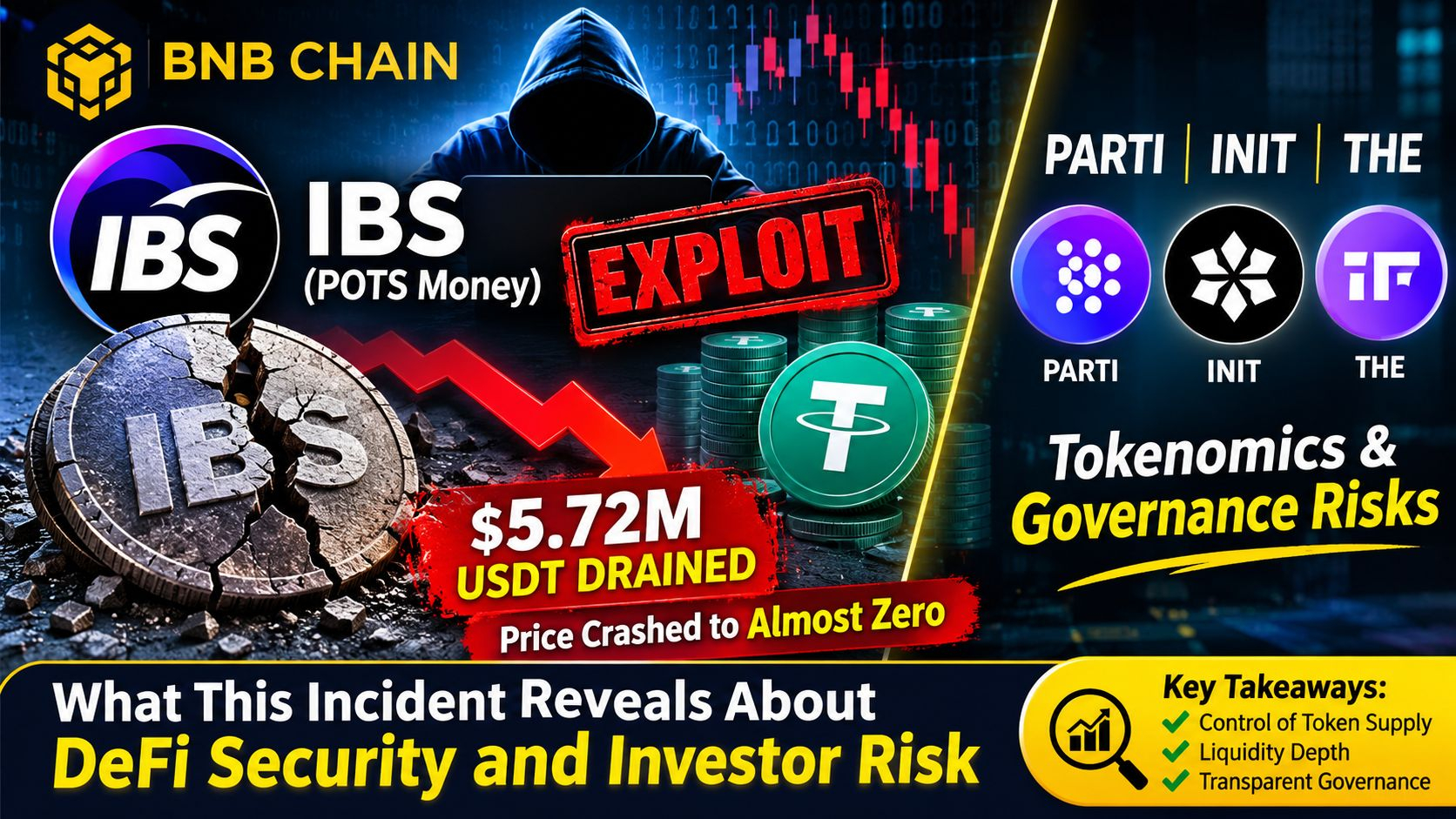
On November 29, 2026, approximately $5.72 million in USDT was drained from the IBS/USDT liquidity pool of POTS Money on BNB Chain. The incident exposed a fundamental weakness in decentralized finance: a protocol may distribute financial activities through smart contracts while retaining extraordinary economic power in a single privileged account.
According to security-monitoring firm Blockaid and subsequent on-chain reporting, an account with elevated governance permissions minted approximately 1 billion IBS tokens and exchanged them for USDT. A second operation minted roughly 100 billion additional IBS. The two transactions extracted approximately 5,724,519 USDT from the liquidity pool. IBS subsequently collapsed from around $4.40 to almost zero.
The central question is not simply how an attacker exploited a smart contract. It is why a financial system designed to operate without traditional intermediaries allowed one privileged account to create an enormous amount of monetary supply and convert it into existing market liquidity.
This incident deserves examination through monetary economics, institutional governance and market microstructure.
2. Economic Framework: Supply Expansion Without Credible Constraints
In conventional monetary economics, an increase in money supply does not automatically create economic value. Its consequences depend on demand, circulation, productive activity and confidence in the issuing institution.
The IBS incident illustrates what happens when supply creation becomes disconnected from those constraints.
Under normal conditions, token issuance should follow transparent rules. New tokens may be distributed through staking, collateral deposits, ecosystem incentives or predefined monetary policies. These mechanisms establish a relationship between supply expansion and economic activity.
However, unrestricted minting breaks that relationship.
The problem can be explained through the concept of Moral Hazard. When an account possesses exceptional control over token issuance, while the financial consequences are borne primarily by liquidity providers and token holders, the incentives become asymmetric. The controller has the power to create supply, but other participants absorb the resulting losses.
Asymmetric Information makes the situation worse. Ordinary investors may understand the token's published monetary policy without knowing whether an administrator can override it.
This creates a gap between perceived decentralization and actual economic control.
3. Blockchain Mechanics: How the Liquidity Pool Was Drained
Automated Market Makers (AMMs), including PancakeSwap, generally use a constant-product pricing model:
x × y = k
Here, x and y represent the reserves of two assets, while k represents their product, subject to trading fees and protocol-specific adjustments.
In an IBS/USDT pool, IBS represents one reserve and USDT the other.
When an account creates an enormous quantity of IBS and sells it into the pool, the AMM transfers USDT to the seller while accumulating additional IBS.
The process has two consequences:
- The USDT reserve declines sharply.
- The IBS reserve expands, pushing its implied market price downward.
The first transaction reportedly extracted 5,710,306 USDT. The second removed approximately 14,213 USDT, leaving roughly 76 USDT in the pool immediately afterward.
This was not evidence of a failure in BNB Chain's consensus mechanism. The reported weakness concerned privileged permissions within the protocol's economic architecture.
The distinction matters. Blockchain consensus can correctly validate every transaction while the application executing those transactions remains economically unsafe.
4. Comparative Tokenomics: $PARTI , $INIT and $THE
The IBS incident provides a useful framework for evaluating other crypto assets. However, different projects must be assessed according to their actual supply mechanisms rather than grouped together simply because they operate in the same market.
PARTI — Particle Network
PARTI has a fixed maximum supply of 1 billion tokens. Its documented functions include governance, staking, network gas and universal liquidity settlement. Its economic model connects token demand to the development and usage of Particle Network's infrastructure.
For investors, the critical variables are actual network adoption, circulating supply, vesting schedules and the concentration of governance authority. A fixed maximum supply does not eliminate dilution-related market pressure from scheduled unlocks.
INIT — Initia
INIT also has a maximum supply of 1 billion tokens. It supports transaction fees, staking, governance and ecosystem incentives across Initia's Layer 1 and associated rollups.
Its distribution includes staking and liquidity incentives, VIP rewards, protocol investors, developers and foundation allocations.
The important economic question is whether ecosystem activity can generate sustainable demand faster than scheduled token distribution expands the tradable supply.
THE — THENA
THE represents a different model. Its token economy uses a vote-escrow mechanism, allowing holders to lock tokens into veTHE and influence liquidity incentives across trading pools.
This structure attempts to connect governance participation, liquidity provision and protocol-generated fees.
However, emissions remain an important consideration. Incentivized liquidity is not necessarily permanent liquidity. Investors must distinguish between organically generated trading demand and capital attracted primarily by token rewards.
These three examples demonstrate why tokenomics cannot be evaluated through maximum supply alone. Issuance authority, distribution schedules, governance rights and real economic demand must be examined together.
5. Historical Lessons and Market Microstructure
Traditional financial markets have long recognised the danger of concentrated institutional control. Central banks operate under legal mandates, commercial banks face capital requirements, and securities markets maintain surveillance and disclosure obligations.
These safeguards are imperfect, but they establish accountability.
DeFi introduces a different challenge: code can enforce transactions without independently verifying whether the underlying economic decision is legitimate.
AMM liquidity also creates a specific vulnerability. Unlike deep order-book markets, a relatively small number of transactions can dramatically alter the reserve composition of a shallow pool.
The IBS incident therefore demonstrates how privileged issuance and concentrated liquidity can interact to produce extreme losses.
For serious investors, liquidity depth, slippage, ownership concentration, mint permissions and administrator-controlled functions are essential research variables.
6. Critical Assessment: What Investors Should Actually Measure
Not every privileged function is malicious. Protocols sometimes require emergency controls, upgrade mechanisms and monetary-policy adjustments.
The problem emerges when these powers lack transparent limits, independent approval and verifiable accountability.
A stronger architecture would combine multisignature governance, timelocked execution, minting ceilings, independent monitoring and clearly defined emergency procedures.
Audits can identify vulnerabilities, but an audit does not guarantee that privileged permissions will never be abused or compromised.
Investors evaluating PARTI, INIT, THE or other DeFi-related assets should therefore investigate who can mint tokens, modify contracts, pause transactions and redirect protocol funds.
They should also examine whether governance decisions are genuinely distributed or merely presented as decentralized.
7. Conclusion: Decentralization Must Include Monetary Discipline
The IBS incident exposes a deeper economic principle: decentralizing transaction execution is not equivalent to decentralizing financial authority.
A protocol can operate transparently on a public blockchain while retaining concentrated control over its most important monetary functions.
The long-term credibility of DeFi will depend on whether projects can establish enforceable limits on token issuance, protect liquidity providers and align governance incentives with the interests of their users.
For investors, the most important question is no longer simply how many tokens exist or how attractive a project's technology appears.
It is who controls the supply, who benefits from that control, and who bears the losses when the system fails.
Which matters more when evaluating a crypto project: its technology, its tokenomics, or the actual distribution of power behind its smart contracts?



#IBSGovAccountMints1BTokensDrains5.71M #CryptoAnalysis #altcoins #crypto #TokenBurning