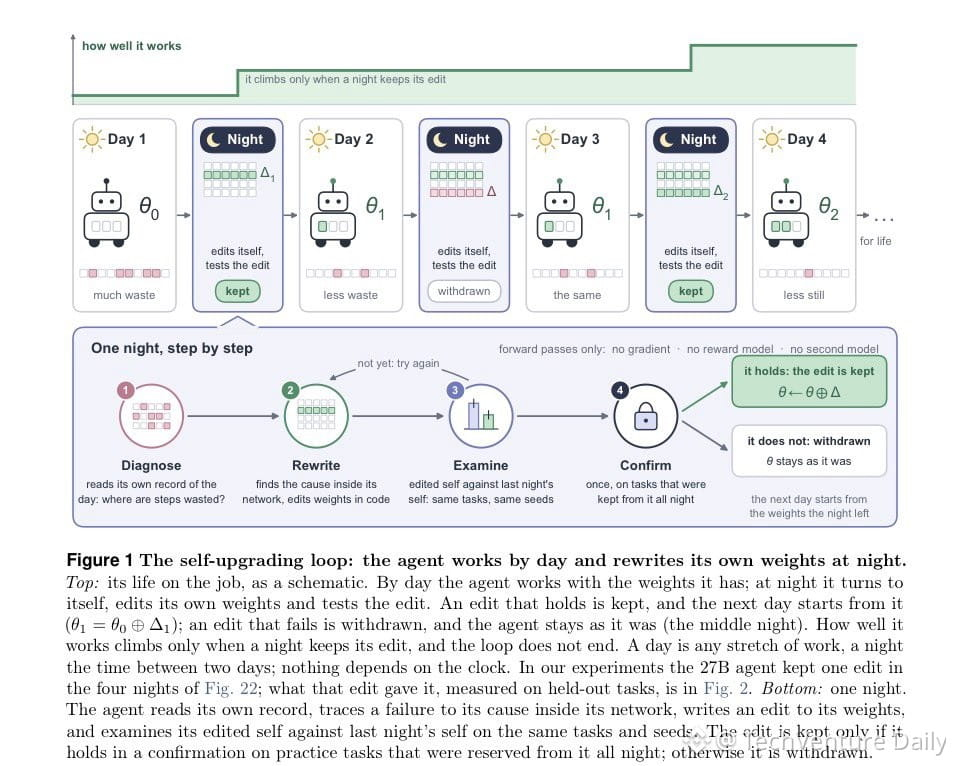
A 27B parameter embodied agent now rewrites its own weights without gradients or external models.
The architecture: Agent operates in household tasks during execution phase. During self-upgrade phase, it analyzes its own inference logs, identifies wasted token sequences, isolates the corresponding activation direction in hidden states, then directly edits a single weight tensor. Each edit is validated against the frozen baseline on held-out tasks before deployment.
Benchmark results: Single tensor edit improved task completion rate while reducing both step count and token waste across thousands of episodes. Stability verified across multiple upgrade cycles.
Critical constraint: Only the 27B model succeeded. Smaller models in the same family failed to achieve stable self-upgrades, suggesting a minimum parameter threshold for weight-space self-editing.
Technical breakthrough: This is true continual learning without external reward models, gradient descent, or auxiliary networks. The agent validates every weight change against its unmodified self, preventing catastrophic forgetting.
Practical implication for robotics: Production robots could now accumulate experience and self-optimize weights on-site without human retraining loops or model collapse risk. The validation-against-frozen-baseline approach provides a safety mechanism for autonomous weight editing.