


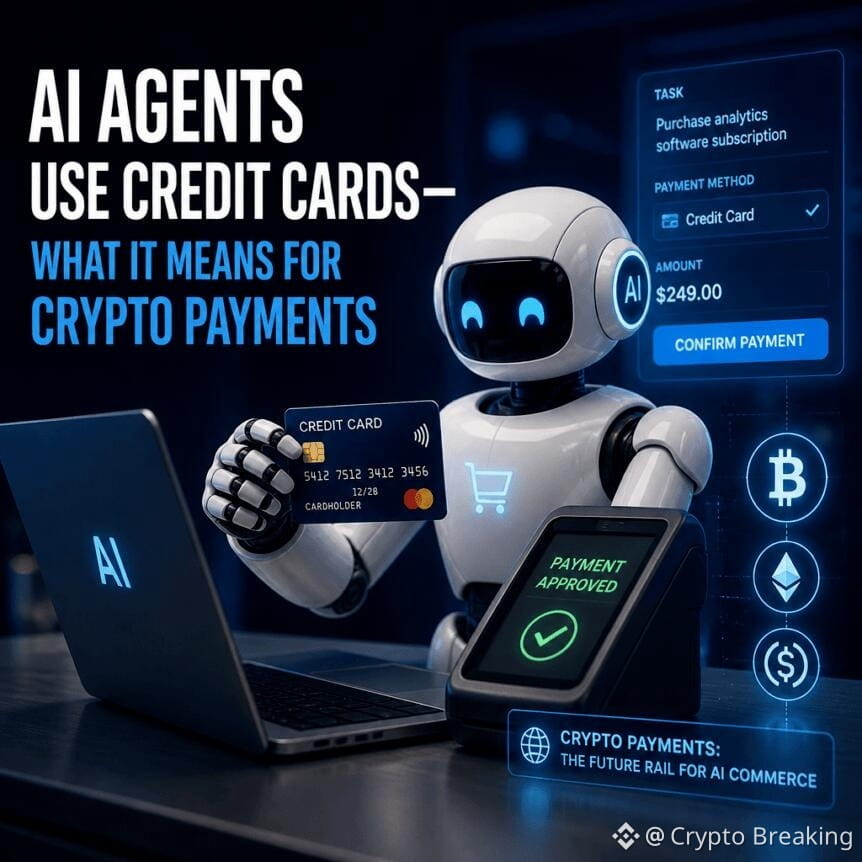
AI agents are increasingly moving from demos to daily commerce—booking travel, reordering household items, and potentially paying for data or computing services on behalf of users. A central question is what payment rails will power this “agentic” economy. While many within crypto have argued that decentralized payments are the inevitable path forward, recent reporting and expert commentary suggest the answer is more nuanced: cards still dominate many human-like transactions, and stablecoins may better fit high-frequency, low-value machine-to-machine activity.
Earlier this month, the Wall Street Journal reported that AI bots are already using credit cards to make purchases on consumers’ behalf, with banks and payment providers scrambling to accommodate this shift. The story echoes a broader industry debate—whether crypto’s onchain infrastructure can become the default method for agent payments, or whether traditional providers will adapt and keep control of the customer relationship.
Key takeaways
Credit cards may remain the default when agents buy goods or services that merchants already accept via card rails—especially where chargebacks and consumer protections matter.
Stablecoins are argued to be better suited to micropayments and high-frequency transactions typical of machine-to-machine requests for data or compute.
Beyond technology, “liability and dispute” frameworks for agent mistakes appear to be a major differentiator for traditional finance.
Crypto’s role may shift toward payment plumbing—onchain settlement behind the scenes—rather than capturing the front-end market for agent payments.
Even when stablecoins are used, costs and frictions around liquidity, conversion, and custody can limit the simplicity of an all-crypto future.
Why credit cards still fit many agent purchases
Card payments are the default for most web commerce, so it’s not surprising that agent workflows are gravitating to the rails merchants already support. An agent booking a flight or reserving a hotel room is effectively performing a transaction similar to one a human would complete—often at a merchant that already accepts cards and offers familiar dispute mechanisms.
Lewis Nurcombe, chief revenue officer at WalletConnect, highlighted why this matters: when agents operate “for a person” at merchants that handle card payments, consumer protections such as chargebacks can remain in place. Visa’s research on agentic commerce also points to ways payment providers can extend card ecosystems without exposing the underlying cardholder payment details. Tokenization and spending controls can, in principle, allow agents to transact within defined boundaries.
In other words, for many mainstream use cases, the path of least resistance is not a brand-new payment layer—it’s incremental adaptation within existing card networks and merchant processing.
Stablecoins for micropayments: where card economics break
Multiple experts argue that the economics change sharply once agents begin paying other machines. In a machine-to-machine scenario, the value of each transaction can be tiny—fractions of a cent for an API call, a data query, or a single unit of compute. Those payments may also be frequent enough that fixed processing and transaction fees become disproportionately expensive on traditional card rails.
David Krause, a professor emeritus of finance at Marquette University, framed the problem as a mismatch between card rail design and agent payment granularity. He noted that card systems were built for situations where a human chooses to pay for an amount large enough to absorb fixed fees. When an agent spends amounts around “$0.005 for an API call,” those fixed fees can outweigh the transaction itself by a wide margin.
In those conditions, Krause said stablecoins can make more sense because they align with micropayment patterns. Nurcombe similarly suggested stablecoins are most useful “wherever the transaction is too small, too frequent or too global for cards to make sense.”
One technical example discussed in the reporting is x402, described as an open, neutral standard for internet-native payments that lets services request payment as part of an interaction. That approach focuses on paying for access to a specific resource, rather than following a traditional checkout flow.
Nevermined’s chief executive, Aitor Argomaniz, provided a comparative illustration: the company reportedly priced 100 API calls at 10 cents each and argued that conventional card infrastructure (via Stripe) would not work for charges under $0.50 due to network constraints. Using stablecoins through Coinbase’s x402 facilitator on Base, Nevermined estimated the total cost for those 100 payments would be around 10 cents.
However, the article also underscores that stablecoins are not “free” from friction. Even if onchain settlement reduces some overhead, stablecoin transactions can still involve infrastructure and operational costs—plus expenses tied to conversion, custody, and liquidity. The Bank for International Settlements has also found that stablecoin transfers may incur trading, conversion, and withdrawal fees, and that limited liquidity between stablecoins and local currencies can add further hurdles.
Disputes, identity, and who is responsible for agent mistakes
While payment rail selection is important, the more fundamental challenge for agentic finance may be accountability. If an AI agent books the wrong item, sends a payment to the wrong destination, or is manipulated into an unauthorized purchase, who is responsible—and how will disputes be resolved?
Krause emphasized that the decisive question isn’t simply “crypto or cards,” but how society will handle agent identity and liability attribution. He argued that dispute resolution for agent mistakes is a competency the crypto industry hasn’t fully built, noting that the first time an agent successfully makes an erroneous purchase, someone has to own the dispute outcome.
One partial mitigation is to limit what agents can access by granting them a separate wallet funded with a controlled amount. WalletConnect is reportedly developing ways for users to let agents operate with dedicated wallets while retaining control over the rest of their funds. Nurcombe’s point was straightforward: an agent should only be able to spend what the person authorizes.
But the limits of spending caps are clear—they can reduce damage, yet they do not automatically solve the problem of who should be accountable for unauthorized actions, wrong purchases, or losses caused by exploitation. Traditional payment systems, Krause suggested, already have established relationships among customers, merchants, and regulators, along with mature dispute processes.
From this view, the competitive advantage of traditional finance may not be only the breadth of merchants, but also the legal and operational machinery that turns payments into trust.
“Plumbing” versus market ownership: crypto may settle in the background
Crypto advocates arguing for onchain rails can still find traction in at least one scenario: even if cards continue to be the user-facing standard, payment networks could incorporate stablecoin settlement under the hood. The reporting suggests a likely outcome where blockchain infrastructure improves efficiency for payments without forcing consumers to hold or interact with crypto directly.
That vision reframes the crypto value capture problem. Instead of owning the agent payment customer relationship, crypto could serve as infrastructure that established networks leverage.
The article points to Mastercard’s acquisition of stablecoin infrastructure provider BVNK, completed in August. The deal was announced at up to $1.8 billion, giving Mastercard infrastructure to connect fiat and onchain payments. The implication is not that cards disappear, but that traditional rails may gain the ability to route and settle transactions with blockchain technologies when it helps—potentially including some agent-to-agent or agent-to-service use cases.
If this path accelerates, agents could transact through familiar interfaces while networks handle settlement more flexibly behind the scenes.
For readers watching what comes next, the key uncertainty is whether agent payment systems will converge on one rail for all transactions—or split by use case, with cards for human-aligned commerce and stablecoins for machine-driven micropayments. Either way, the timeline for adoption may be shaped as much by liability frameworks and dispute readiness as by technical capability.
This article was originally published as AI Agents Use Credit Cards—What It Means for Crypto Payments on Crypto Breaking News – your trusted source for crypto news, Bitcoin news, and blockchain updates.