
One project is preparing to double its network capacity. The other is turning trading revenue into continuous buying pressure for its own token. But which strategy could deliver more value to investors in 2027?
Solana and Hyperliquid are giving crypto traders two very different reasons to pay attention.
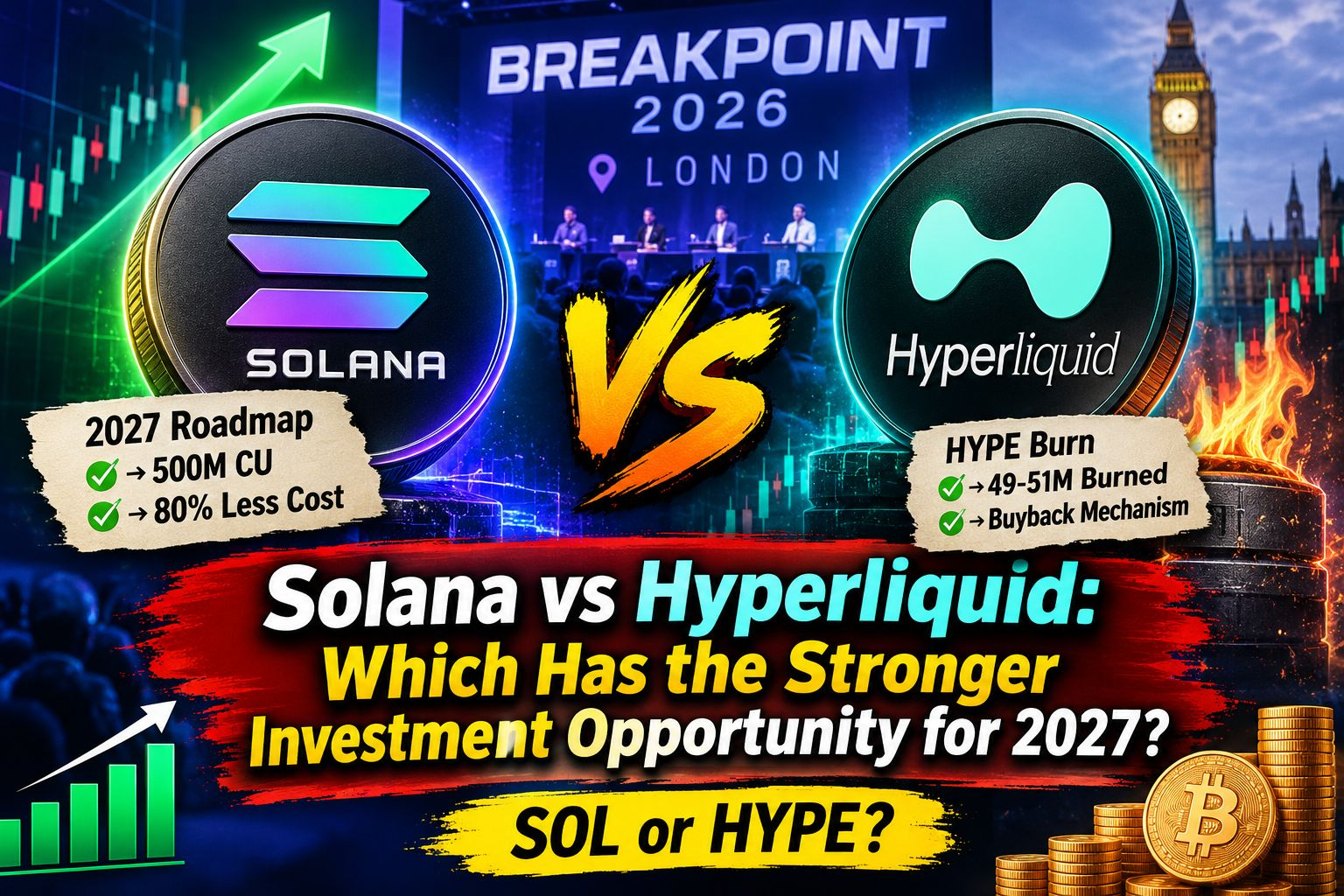
At Breakpoint 2026 in London, Anza revealed an ambitious roadmap for Solana, targeting a major increase in network capacity by the end of 2027. Meanwhile, Hyperliquid is attracting attention through its revenue-backed HYPE purchases and token-burning mechanism.
Both developments have investment potential. But as a trader, I would not buy either token just because the headlines look bullish.
The real question is whether these developments can translate into sustained demand, stronger fundamentals and long-term value.
1. $SOL : Can the Network Really Double Its Capacity?
Anza, the team behind Solana's main validator software, has set an ambitious target: increase network capacity from approximately 250 million to 500 million compute units per second by the end of 2027.
The roadmap also aims to reduce the compute resources required for token transfers by around 80%.
Think of Solana as a highway. More capacity means more room for transactions, while more efficient processing means the network can handle activity using fewer resources.
That could be important for DeFi, payments, on-chain trading and applications that require fast transaction processing.
But there is one detail investors should not ignore: more capacity does not automatically mean more demand.
Solana already increased its block compute limit from 60 million to 100 million units in July 2026. According to the Solana Foundation, only around 11.2% of blocks in the preceding year came close to the previous limit.
In other words, Solana already had room to grow. The challenge is attracting enough economic activity to use that capacity.
What could drive SOL's growth?
- Lower resource requirements could make token transfers more efficient.
- Greater capacity could support more demanding DeFi and trading applications.
- Better infrastructure could attract developers and institutional participants.
- Improved transaction processing could strengthen Solana's position in payments and on-chain finance.
The roadmap also includes planned improvements such as Rotor and Constellation, alongside native vector processing.
These upgrades could make Solana more attractive for advanced computational workloads, including potential AI-related applications.
However, the 500-million-CU target is a 2027 objective, not an upgrade that has already been delivered. Investors should watch implementation progress rather than price the entire roadmap into SOL today.
2. Hyperliquid: Why $HYPE 's Buyback and Burn Mechanism Matters
Solana is betting on infrastructure growth. Hyperliquid offers a different investment story: connecting trading activity directly to demand for its native token.
Its Assistance Fund receives 99% of protocol fees and uses the revenue to purchase HYPE from the open market.
HYPE acquired through this mechanism can subsequently be burned, permanently removing those tokens from circulation.
This creates an interesting economic cycle:
- More trading activity can generate higher protocol fees.
- Higher fees can support more HYPE purchases.
- Token burns can gradually reduce circulating supply.
- If demand remains strong, reduced supply could support the token's long-term valuation.
On-chain trackers have reported approximately 49–51 million HYPE tokens burned by November 22, 2026, depending on the counting methodology.
That is worth monitoring, but I would focus on the mechanism behind the numbers rather than the burn figure alone.
A token burn is not a guaranteed price catalyst.
If trading volume falls, protocol revenue weakens or investors sell aggressively, HYPE can still decline despite ongoing purchases and burns.
For me, the most important metric is whether Hyperliquid can consistently generate enough revenue to support meaningful HYPE demand.
3. SOL vs $HYPE : Which Has the Stronger Investment Case?
These two assets should not be evaluated using the same strategy.
SOL represents exposure to a broader blockchain ecosystem. Its growth depends on developers, users, liquidity, applications and real network activity.
HYPE is more directly connected to a trading-focused ecosystem. Its investment case depends heavily on derivatives activity, protocol revenue and the Assistance Fund's purchasing mechanism.
Here is how I see the difference:
Factor| Solana (SOL)| Hyperliquid (HYPE)
Main catalyst| 2027 network upgrades| Revenue-backed purchases and burns
Growth driver| Ecosystem adoption| Trading activity
Key metric| Network utilization| Protocol fee generation
Main risk| Capacity without demand| Falling trading revenue
Investment focus| Infrastructure growth| Token economics
There is also a timing difference.
Solana's major capacity target is still ahead. Hyperliquid's fee-funded purchasing mechanism is already operating.
That gives HYPE a more immediate revenue-linked catalyst, while SOL offers exposure to potential infrastructure and ecosystem growth over a longer period.
Neither is automatically the better investment. It depends on execution, valuation and market conditions.
4. Trading Strategy: What Would I Watch Before Buying?
I would not chase a sudden rally in either token simply because investors are excited about the latest announcement.
Crypto markets often price expectations before the actual results arrive. Sometimes, by the time the news becomes widely discussed, much of the upside has already been priced in.
For SOL, I would monitor:
- Progress toward the 500-million-CU target.
- Actual network utilization and transaction demand.
- Growth in DeFi, stablecoin transfers and on-chain trading.
- Daily and weekly support and resistance levels.
- Whether breakouts are supported by rising trading volume.
For HYPE, I would pay closer attention to:
- Daily and weekly protocol fee generation.
- Assistance Fund purchases and verified burn activity.
- Changes in circulating supply.
- Open interest and funding rates.
- Whether spot buying supports price increases.
My trading approach
I prefer buying a confirmed breakout after a successful retest rather than chasing an extended green candle.
For spot investors, entering in stages around confirmed support zones can help manage entry risk.
Futures traders need to be more careful. Rising open interest and aggressive funding rates can signal crowded positions. When too many traders take the same side, even a small reversal can trigger liquidations.
I would rather miss part of a rally than enter a trade without a clear invalidation level.
Protecting capital matters more than catching every move.
5. Bullish vs Bearish: What Could Happen Next?
The bullish case
If Solana delivers its planned upgrades and attracts more users, applications and transaction volume, SOL could benefit from stronger ecosystem demand.
For Hyperliquid, sustained derivatives activity and growing protocol revenue could support continued HYPE purchases and burns.
If both projects execute successfully, they could attract different types of investors looking for exposure to blockchain infrastructure and revenue-generating crypto platforms.
The bearish case
Solana could double its capacity without seeing a comparable increase in network activity.
If the additional capacity remains underused, investors may eventually question how much economic value the upgrades actually create.
Hyperliquid faces a different risk. Lower trading volumes could reduce protocol fees and weaken the buying pressure behind HYPE.
There is also the broader market risk. A Bitcoin correction, declining liquidity or excessive leverage could push both tokens lower regardless of their individual fundamentals.
That is why I would never treat either development as a guaranteed price catalyst.
My Take: Follow Real Demand, Not Promises
I see two different investment opportunities.
Solana is preparing its infrastructure for future growth. If the network can turn higher capacity and better efficiency into real adoption, SOL could benefit over the long term.
Hyperliquid has a more direct connection between platform revenue and token demand. Its Assistance Fund creates an interesting supply-side mechanism, but its strength ultimately depends on sustained trading activity.
If I were building a watchlist for 2027, I would keep both on it.
For SOL, I would track network growth and actual utilization. For HYPE, I would follow protocol revenue, open-market purchases and verified burns.
Announcements can create excitement, but measurable results are what sustain an investment thesis.
Now I want to hear your view:
Which has the stronger potential for 2027 — SOL, with its expanding infrastructure, or HYPE, with its revenue-backed buybacks and token burns? And which one would you rather hold for the long term?
Share your analysis in the comments


#SolanaSets2027RoadmapToDoubleComputeCapacity #hype #CryptoAnalysis #altcoins #LondonSummit