
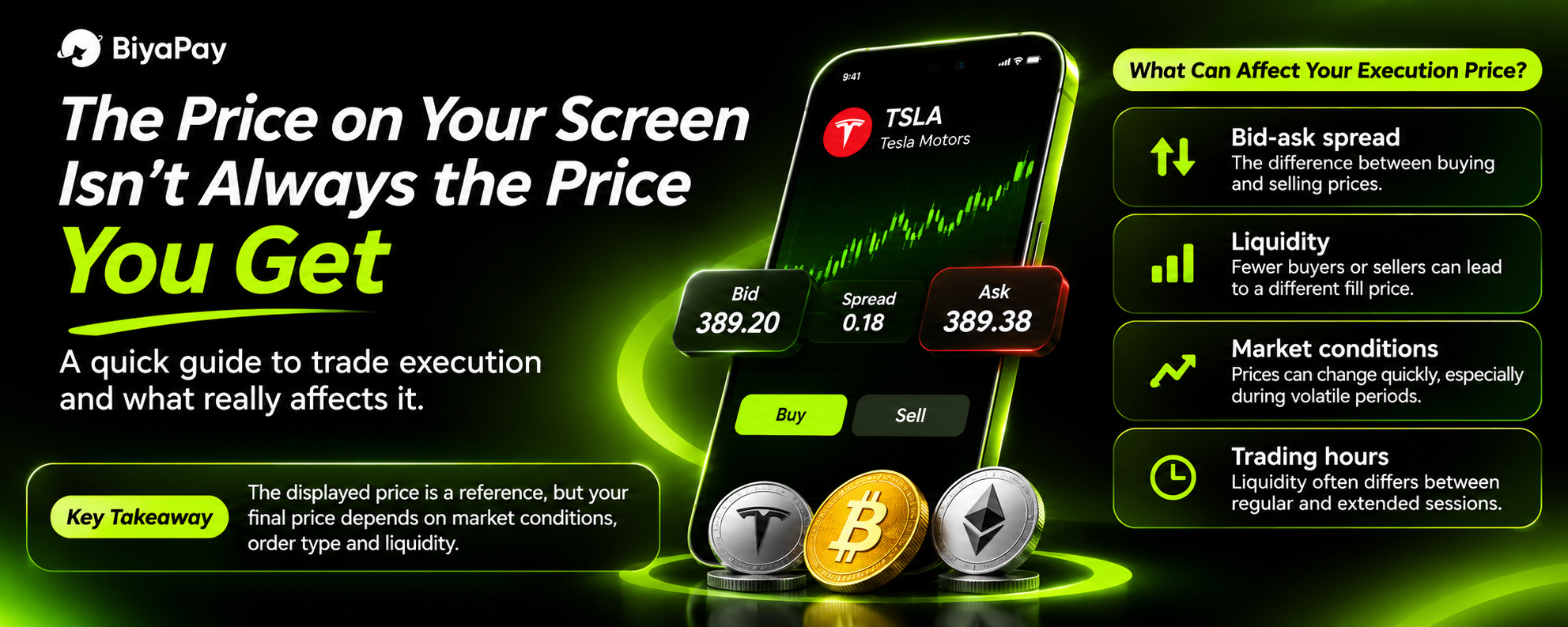

You spot a stock trading at $150. You decide it's a good entry point, open your trading app and place an order. A moment later, the execution confirmation shows $150.18.
That difference may look insignificant. But if it happens repeatedly, especially when trading larger amounts or entering and exiting positions frequently, it can affect your overall results.
This is one part of trading that deserves more attention: execution price.
Many traders spend hours studying charts, identifying support and resistance, and deciding when to enter a position. Yet they sometimes overlook what happens between pressing the buy or sell button and the order actually being completed.
The displayed price is only part of the picture
A market price displayed on a trading screen usually reflects recent market activity or a current quote. It doesn't necessarily mean every order can be executed at that exact price.
There are several reasons for this.
The buying and selling prices are different. The gap between them is called the bid-ask spread. When the spread is wider, the cost of entering and exiting a position can become more noticeable.
Liquidity also matters. A highly traded asset generally has more buyers and sellers available. In a less liquid market, a large order may need to match with several available prices, producing a different average execution price.
Market conditions can change quickly, too. A stock reacting to earnings or a cryptocurrency experiencing a sudden price movement may move before an order is completed.
Two orders can produce different outcomes
Consider two common order types.
Market order: This prioritises executing the trade at the best available prices. It can be useful when execution speed matters, but the final price isn't guaranteed.
Limit order: This allows you to specify the maximum price you're willing to pay when buying or the minimum price you're willing to accept when selling. The trade may remain unfilled if the market doesn't reach your chosen price.
Neither option is perfect for every situation. A market order can execute at a less favourable price during volatile conditions, while a limit order can miss an opportunity entirely.
Understanding that difference is part of managing a trade properly.
Why trading hours can change the experience
Liquidity isn't constant throughout the day.
For U.S. stocks, regular trading hours generally attract substantial market participation, while pre-market and after-hours sessions can have lower liquidity and wider spreads.
This matters to international investors who may monitor U.S. markets from different time zones. A price movement outside regular hours may look attractive, but the available buyers and sellers can be limited.
The same general principle applies to cryptocurrency markets during periods of sudden volatility. Being able to trade around the clock doesn't mean liquidity and execution conditions remain identical at every moment.
Looking beyond the chart
This is particularly relevant when using a platform that provides access to different financial markets.
BiyaPay brings U.S. stocks, Hong Kong stocks and cryptocurrency trading together, alongside other supported financial products. That means users can follow different markets within the same platform, but each market still has its own trading conditions.
For example, buying a U.S. stock and trading a BTC/USDT pair involve different instruments, market structures and risks. The execution conditions of one should not be assumed to apply to the other.
BiyaPay also lists zero commission for U.S. stock trading. However, commission is only one part of the overall trading cost. Platform fees, external charges, spreads, currency conversion and other applicable costs can still affect the final amount.
That's why looking at the order details and actual execution record matters more than relying on a headline fee alone.
A better habit before placing an order
Before entering a position, I would pay attention to the following:
Compare the displayed bid and ask prices instead of looking only at the last traded price.
Check whether the market is operating during regular hours or an extended session.
Consider the liquidity of the asset and the size of your order.
Understand how your chosen order type works.
Review the estimated costs and confirm the final execution details.
These checks won't eliminate slippage or guarantee a better entry. They can, however, help you understand what you're paying and why your executed price may differ from the one you initially saw.
The point many traders overlook
A trading strategy can identify a good opportunity and still produce a disappointing result if execution costs are ignored.
The difference between the price you expect and the price you receive is part of the trading decision itself. It's worth paying attention to before entering a position, not only after reviewing your trade history.
As markets become more accessible across digital and traditional financial platforms, understanding execution becomes an increasingly useful skill.
Disclaimer: This article is for educational purposes only and does not constitute investment or financial advice. Trading involves risk, and prices can change rapidly. Order execution, spreads, liquidity, fees and product availability vary by market and account eligibility. Always review the relevant trading conditions before placing an order.