


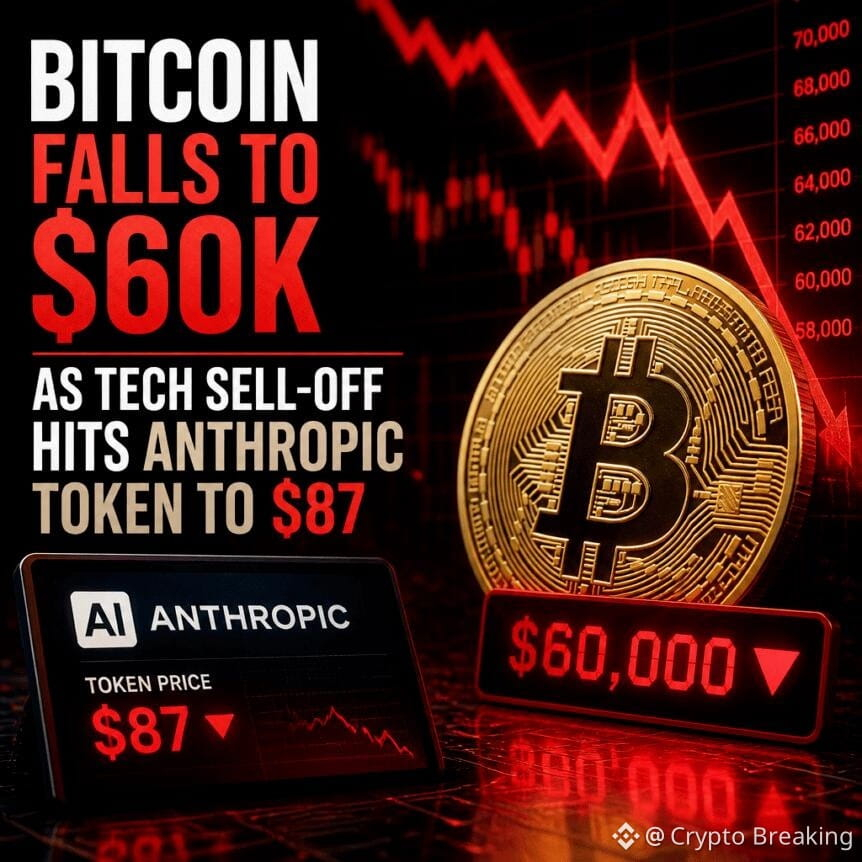
Bitcoin slipped to around $60,000 after the U.S. market open on Friday, extending its slide to its lowest level in roughly 20 weeks. The move came as fresh weakness in tech stocks spread into broader risk sentiment, pulling crypto liquidity and momentum lower at the same time.
While attention focused on markets that celebrate high-growth AI themes—such as Anthropic’s Nasdaq debut—traders appeared unwilling to treat the IPO as a catalyst. At the same time, expectations for tighter Federal Reserve policy kept pressure on risk assets, leaving Bitcoin stuck near the same key downside area.
Key takeaways
Bitcoin failed to bounce back after trading at new 20-week lows near $60,000 as the tech selloff accelerated.
Anthropic’s stock momentum faded quickly after its record IPO, with shares falling to about $87.27 at the time of writing.
The Nasdaq Composite opened about 1.2% lower and reached a seven-month low, reinforcing the “risk-off” tone across markets.
U.S. bond yields eased, but hawkish signals still mattered—QCP argued Bitcoin upside may remain limited if the Fed stays focused on tightening.
Bitcoin tracks a renewed tech-stock rout
According to TradingView data referenced by Cointelegraph, Bitcoin hovered around $60,000—its lowest level in about 20 weeks. The price weakness aligned with a broader deterioration in U.S. equities after Thursday’s reversal, with tech stocks driving much of the downside.
Anthropic’s debut on the Nasdaq did not stabilize the tone. The stock reportedly ran as high as $115 before giving back gains and dropping below $100, reaching lows around $87.27 at the time of writing. The failure of an AI-linked “headline” listing to trigger a sustained risk rebound highlighted the fragility of market confidence.
That backdrop was also visible in index data. The Nasdaq Composite opened roughly 1.2% lower and fell to about 23,517 points, the lowest level since mid-April—an important reminder that crypto traders often react not only to crypto-specific signals, but to equity volatility and liquidity conditions.
Why QCP says the AI narrative is shifting
In an analysis published by QCP Capital on the day, the firm argued that even a high-profile IPO was not enough to restore appetite for AI valuations. QCP pointed to a pattern in how the market is digesting AI exposure: shares reportedly opened about 34% above the offer price, yet closed up only around 17%, suggesting investors were hesitant to “chase” growth multiples.
QCP also emphasized that the AI story is increasingly tied to financial conditions rather than pure equity optimism. In its view, financing concerns have lingered through 2026, and markets remain highly sensitive to how AI-linked investment is funded.
QCP said AI is becoming “more than an equity growth story,” warning that it is increasingly a credit and liquidity story. It added that if infrastructure spending leans more heavily on debt financing, weaker investor appetite could raise borrowing costs, tighten financial conditions, and contribute to broader deleveraging.
For Bitcoin holders and traders, the implication is straightforward: when risk assets come under pressure due to credit and liquidity tightening, BTC may struggle to sustain rallies—even if individual tech or AI headlines momentarily grab attention.
Hawkish Fed expectations still weigh on upside
As investors leaned toward safety, U.S. stocks pushed lower and bond yields fell. Cointelegraph cited TradingView data showing the 10-year Treasury yield dropped as low as 4.96% on Friday, the weakest level since Nov. 10.
However, the decline in yields did not translate into a clean shift in policy expectations. A Federal Reserve speech by Christopher Waller reportedly offered no new signals on future action, and yields reversed as traders refocused on existing hawkish cues. Earlier in the week, Waller had suggested a 50-basis-point rate hike in December could be necessary, versus the market’s current expectation of 25 basis points.
Economist Mohamed El-Erian later commented on the move in rates. In a blog post highlighted by Cointelegraph, El-Erian noted that the 10-year Treasury yield had pulled back to around 4.97% after a sharp fall in stocks, including a potential seventh straight day of S&P 500 losses. Still, he said the size of the yield move was “less typical” given the equity selloff.
El-Erian wrote that while the direction of yields broadly matched conventional correlations, the magnitude of the week’s drop was relatively modest.
QCP’s take connected these dots to crypto performance. The firm suggested Bitcoin’s ability to rebound depended on multiple cross-asset factors: stabilization in tech, lower rate volatility, and a return of institutional capital. Without those conditions, it argued, short-covering rallies might struggle to evolve into sustained upside if the Fed maintains a tightening stance.
What to watch next
Going forward, traders will likely focus on whether the tech selloff and bond-market dynamics continue to ease—or whether hawkish rate expectations reassert themselves. For Bitcoin, the key question is whether risk conditions improve enough to support sustained demand, or whether BTC remains confined to downside as liquidity tightens across traditional markets.
This article was originally published as Bitcoin Falls to $60K as Tech Sell-Off Hits Anthropic Token to $87 on Crypto Breaking News – your trusted source for crypto news, Bitcoin news, and blockchain updates.