
One bad futures trade can wipe out weeks of profits. The difference between a trader who survives and one who gets liquidated is rarely market prediction alone. It comes down to leverage, liquidity and risk management.
The recent movements in $NAORIS and Terra Classic (LUNC) offer two important lessons for futures traders.
NAORIS highlights why short sellers should wait for proper confirmation before entering a position. Meanwhile, $LUNC 's sharp rally shows how quickly market sentiment can change—and how rising leverage can turn a bullish move into a liquidation risk.
If you want to stay in the market for the long run, protecting your capital should always come before chasing profits.
1. NAORIS: A Short Setup Needs Confirmation
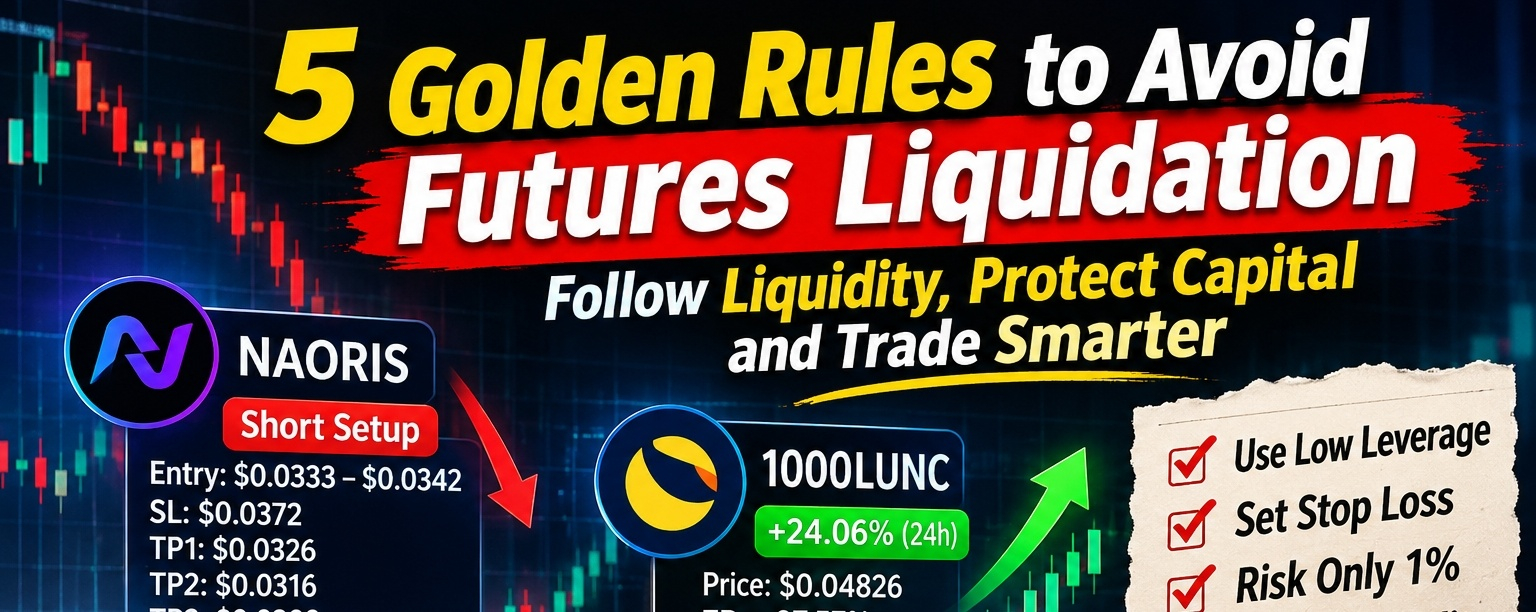
Here is the proposed NAORIS short setup:
Parameter| Price
Short Entry| $0.0333–$0.0342
Stop Loss| $0.0372
TP1| $0.0326
TP2| $0.0316
TP3| $0.0309
However, there is an important detail traders should not ignore.
The available November 19 market snapshot showed NAORIS trading around $0.0235, well below the proposed entry zone. That means this setup should not be treated as an active short signal at the current price.
My approach would be to wait for a potential recovery toward the proposed resistance zone and then look for:
- Strong selling pressure near resistance.
- A bearish rejection candle.
- Formation of a lower high.
- Increasing selling volume and weakening buying momentum.
Without these signals, I would rather stay out than force a trade.
A good short entry is not simply about expecting a price drop. It is about entering at the right level with a clear invalidation point.
2. LUNC: Strong Rally, But Is the Momentum Sustainable?
Terra Classic has recently attracted attention after a sharp move in the $1000LUNC /USDT market.
The reported market snapshot showed:
- Price: $0.04826
- 24-hour change: +24.06%
- 24-hour high: $0.04985
- 24-hour low: $0.03814
- 7-day performance: +27.57%
Later market data showed the price around $0.04553, with the 24-hour gain still at approximately 17.07%.
That is a meaningful rally, but the pullback also reminds traders that momentum can change quickly.
What does derivatives activity tell us?
The reported futures data showed:
- Open Interest: Approximately $8.54 million.
- 24-hour Open Interest growth: 44.40%.
- Futures Volume: Approximately $77.01 million.
- Spot Volume: Approximately $9.02 million.
Futures trading volume was roughly 8.5 times spot volume.
This deserves attention.
Rising Open Interest alongside a price increase suggests that new leveraged positions are entering the market. But it does not automatically mean fresh spot demand is driving the rally.
If too many leveraged traders crowd into Long positions, even a relatively small correction can trigger forced liquidations.
Key LUNC price levels to watch
- $0.04985: Recent resistance and potential breakout level.
- $0.04800–$0.04600: Near-term reaction zone.
- $0.04400: Important area to monitor if selling pressure increases.
A sustained breakout above resistance, supported by strong volume, could open the door to further upside.
On the other hand, rejection near resistance could encourage profit-taking.
I would not chase a green candle, and I would not open a Short simply because the price has already rallied.
Confirmation matters more than excitement.
3. Stablecoins, Liquidity and Capital Flow: Follow the Money
Price charts tell only part of the story. To understand where the crypto market may be heading, traders should also monitor stablecoin liquidity and capital rotation.
USDT and USDC are widely used across spot markets, derivatives platforms and DeFi.
But an increase in stablecoin supply does not guarantee that money will flow directly into Bitcoin or altcoins.
The important question is where that liquidity is going.
Three indicators deserve regular attention:
1. Exchange Stablecoin Reserves
Rising USDT and USDC balances on exchanges may indicate greater potential buying power. However, actual buying activity needs to be confirmed through spot volume and order flow.
2. Stablecoin Supply
New stablecoin issuance can expand the pool of available dollar-denominated liquidity. A decline in supply may indicate weaker liquidity expansion.
3. Capital Rotation
Money often moves between Bitcoin, Ethereum and altcoins as market conditions change. Tracking this rotation can help traders identify which sectors are attracting fresh interest.
According to a November 2026 Federal Reserve financial stability report, stablecoin market capitalization was around $310 billion. A separate November report based on Glassnode data indicated that major stablecoin supply had declined by approximately $14.2 billion over 30 days.
These figures suggest that stablecoin liquidity deserves close attention, rather than assuming that every altcoin rally is supported by fresh capital.
4. Five Golden Rules to Avoid Futures Liquidation
In my experience, one of the biggest mistakes beginners make is calculating potential profit before calculating potential loss.
Here are five rules I would never ignore.
Rule 1: Keep Leverage Low
High leverage can make small price movements dangerous.
Using 20x, 50x or 100x leverage may look attractive when the market moves in your favor, but the same leverage can quickly destroy your margin when the trade goes against you.
My preferred approach:
- Start with 2x–3x leverage if you are still learning.
- Avoid increasing leverage just to recover previous losses.
- Consider Isolated Margin to limit the margin allocated to an individual position.
Remember, high leverage does not make a trading strategy better. It simply increases the consequences of being wrong.
Rule 2: Never Trade Futures Without a Stop Loss
A stop loss is not optional.
Suppose you open a Short position on LUNC, expecting a pullback. Instead, the price breaks above resistance and continues higher.
Holding the position and hoping for a reversal can turn a manageable loss into a liquidation.
Before entering any trade:
- Identify your invalidation level.
- Set your stop loss in advance.
- Never move your stop further away just to avoid taking a loss.
- Do not use your liquidation price as your stop loss.
A small planned loss is better than losing control of your entire position.
Rule 3: Risk Only 1% of Your Trading Capital Per Trade
Let's take a practical example.
Suppose your futures trading account has $1,000.
If you risk 1% per trade, your maximum planned loss is $10.
Consider this setup:
- Account capital: $1,000
- Maximum risk: $10
- Entry price: $0.048
- Stop loss: $0.049
- Price difference: $0.001
Your position size would be 10,000 tokens, excluding fees and slippage.
This is how professional risk management works.
Determine your stop loss first, then calculate your position size. Never do it the other way around.
Rule 4: Monitor Open Interest, Funding Rates and Liquidity
Price alone does not tell you whether a market is healthy.
Watch these indicators before opening a leveraged position:
- Open Interest: Is leverage entering the market too quickly?
- Funding Rate: Are Long or Short traders becoming overcrowded?
- Long/Short Ratio: Is positioning becoming heavily one-sided?
- Order Book: Are significant liquidity walls forming?
- Liquidation Heatmap: Where are large clusters of leveraged positions located?
The recent increase in LUNC Open Interest is a useful reminder of why derivatives data matters.
A crowded market can move violently when one side is forced to close its positions.
Rule 5: Control Your Emotions and Avoid FOMO
Chasing a coin after a 20%–30% rally is one of the easiest ways to enter at the wrong time.
The opposite mistake is opening a Short just because a coin looks overbought.
Before every trade, ask yourself:
1. Where is my ideal entry?
2. At what price is my trading idea invalidated?
3. Is the potential reward worth the risk?
Look for a Risk/Reward ratio of at least 1:2 when the market structure supports it.
If you experience two or three consecutive losses, take a break. Do not enter revenge trades to recover your money.
Sometimes, staying out of the market is the best trade.
5. My Trading Strategy: NAORIS vs. LUNC
I would approach these two assets differently.
NAORIS — Short Watchlist
- The proposed $0.0333–$0.0342 entry zone is not an immediate opportunity at the reported current price.
- Wait for a recovery toward resistance.
- Look for bearish rejection and a lower-high structure.
- Recalculate position size and stop loss before entering.
1000LUNC — Momentum Watchlist
- Watch the $0.04985 resistance closely.
- A convincing breakout with strong volume could support further upside.
- Wait for a successful retest rather than chasing the initial breakout.
- If price gets rejected, monitor the reaction around $0.04800–$0.04600.
- Reduce exposure if Open Interest and funding become excessively elevated.
My priority is not to trade every market movement. It is to wait for setups where the potential reward justifies the risk.
Final Thoughts: Protect Your Capital Before Chasing Profits
The crypto market will always offer another opportunity. But you cannot take advantage of it if poor risk management has already wiped out your trading capital.
NAORIS reminds us that a short setup needs confirmation. LUNC shows how quickly a powerful rally can attract leveraged traders and increase liquidation risk.
For me, three things matter most:
- Protect Capital: Keep losses small and manageable.
- Follow Liquidity: Understand where money is flowing.
- Control Leverage: Never let one trade threaten your entire account.
You do not need to win every trade to become a successful trader. You need a strategy that allows you to survive the losing trades and take advantage of the next good opportunity.
Now I want to hear your view: Would you rather wait for a confirmed NAORIS short entry, or stay bullish on LUNC and look for another breakout? And what leverage do you normally use—3x, 5x or 10x?
Share your strategy in the comments.




#CapitalGroupAdds1264500StrategyShares #LUNC #CryptoAnalysis #CryptoTrading. #altcoins