

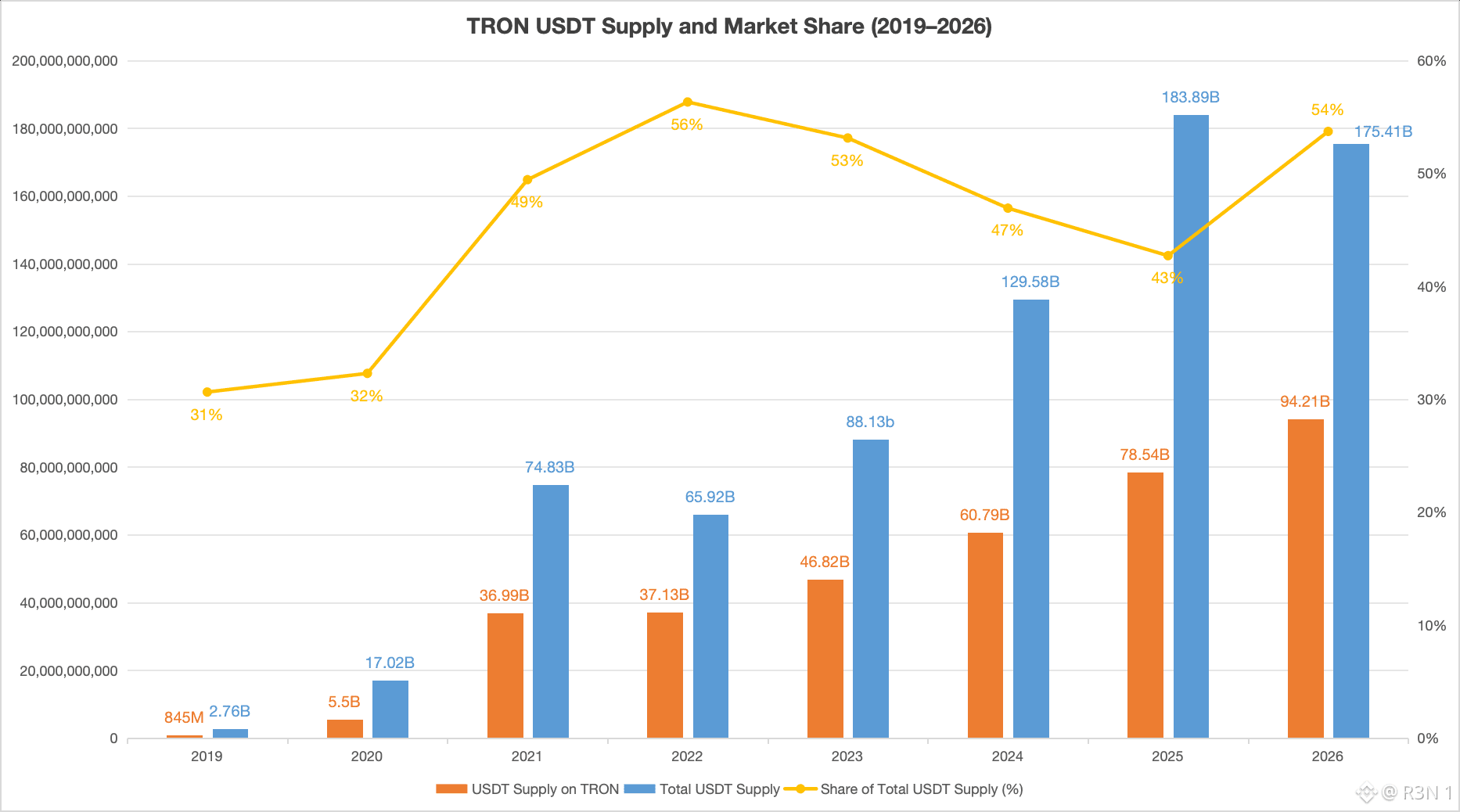
USDT supply on TRON has reached $94.21B, about 54% of all USDT, according to the figures in your post. That’s up from $75B in May 2025, roughly 26% growth in about 18 months (my math). TRON passed Ethereum’s USDT supply during 2025 and has kept widening the gap. One clarification matters. TRON leads in USDT, but Ethereum is still the largest chain by total stablecoin supply. That’s why the two “54%” figures we’ve seen this month aren’t in conflict: one counts USDT only, the other counts every stablecoin. The usage explains the growth. In July, TRON averaged about $23.8B in daily USDT transfers and 12.7 million daily transactions. Its profile skews toward mid-sized payments, remittances, and exchange transfers, not speculation. DeFi is a different story. Messari data showed TRON’s DeFi total value locked at $4.4B in the second quarter, with daily DEX volume down 21.7%. One outlet also notes TRX’s price hasn’t tracked the network’s growth. Heavy usage doesn’t automatically become token value. That’s the gap products like the new Aave savings app, which accepts TRON USDT in early access, are trying to fill: giving idle payment dollars a yield. The risks are concentration and compliance. One issuer controls the supply, and the same rails that move everyday payments also move sanctioned flows, as in the Canadian OTC case we covered. The supportive case is that sticky, real-world usage doesn’t depend on market mood. The most successful crypto product isn’t a token. It’s a dollar that moves cheaply. $TRX #BTC Price Analysis# #What is your Bitcoin Price Prediction?# $BTC
انضم إلى مُستخدمي العملات الرقمية حول العالم على Binance Square
⚡️ احصل على أحدث المعلومات المفيدة عن العملات الرقمية.
💬 موثوقة من قبل أكبر منصّة لتداول العملات الرقمية في العالم.
👍 اكتشف الرؤى الحقيقية من صنّاع المُحتوى الموثوقين.
البريد الإلكتروني / رقم الهاتف