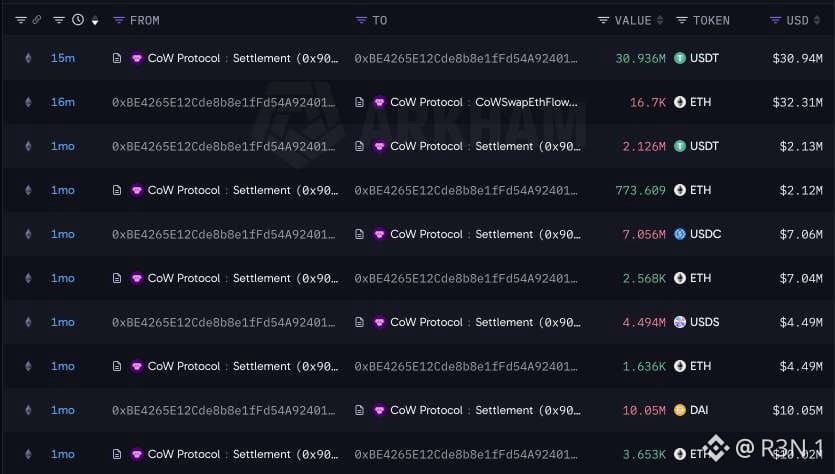
whale sold ETH at a loss. "Buy high, sell low" is only half the story.
According to Arkham data shared on X, a whale sold 16,700 ETH ($31M) in a single trade at $1,852.45. A month earlier, the same wallet reportedly bought 8,631 ETH ($23.7M) at $2,749.
The math on that earlier purchase is stark. A drop of about $897 per ETH implies a loss near $7.7M, roughly 33% (my math). But the sale was nearly twice the size of the buy, so the wallet held other ETH too. We can't see its full cost basis, so we can't tell whether the whole position lost money. "Buy high, sell low" is true for the tranche we can see.
The "why" is also invisible. Trackers can't tell what drove a sale. It could be a stop-loss, a loan repayment, tax planning, or a rotation into something else. Even the "FOMO" label is a guess from timing.
The market context fits. ETH has been the weakest large asset, with Ethereum ETFs losing $363M over seven days as of the Nov. 9 update, and traders have been betting on Bitcoin outperforming it.
A large holder cutting losses in that setup reads as capitulation to some and risk management to others.
Capitulation sales near lows are sometimes read as exhaustion, but that's not reliable. They can also be the first of several.
The risk is more holders hitting their pain points together. The supportive case is that forced or emotional sellers leaving can clear the way for steadier price action.
Whale losses work like a mirror. Everyone sees their own entry in them.
$BTC #BTC Price Analysis# #Altcoin Season# $ETH