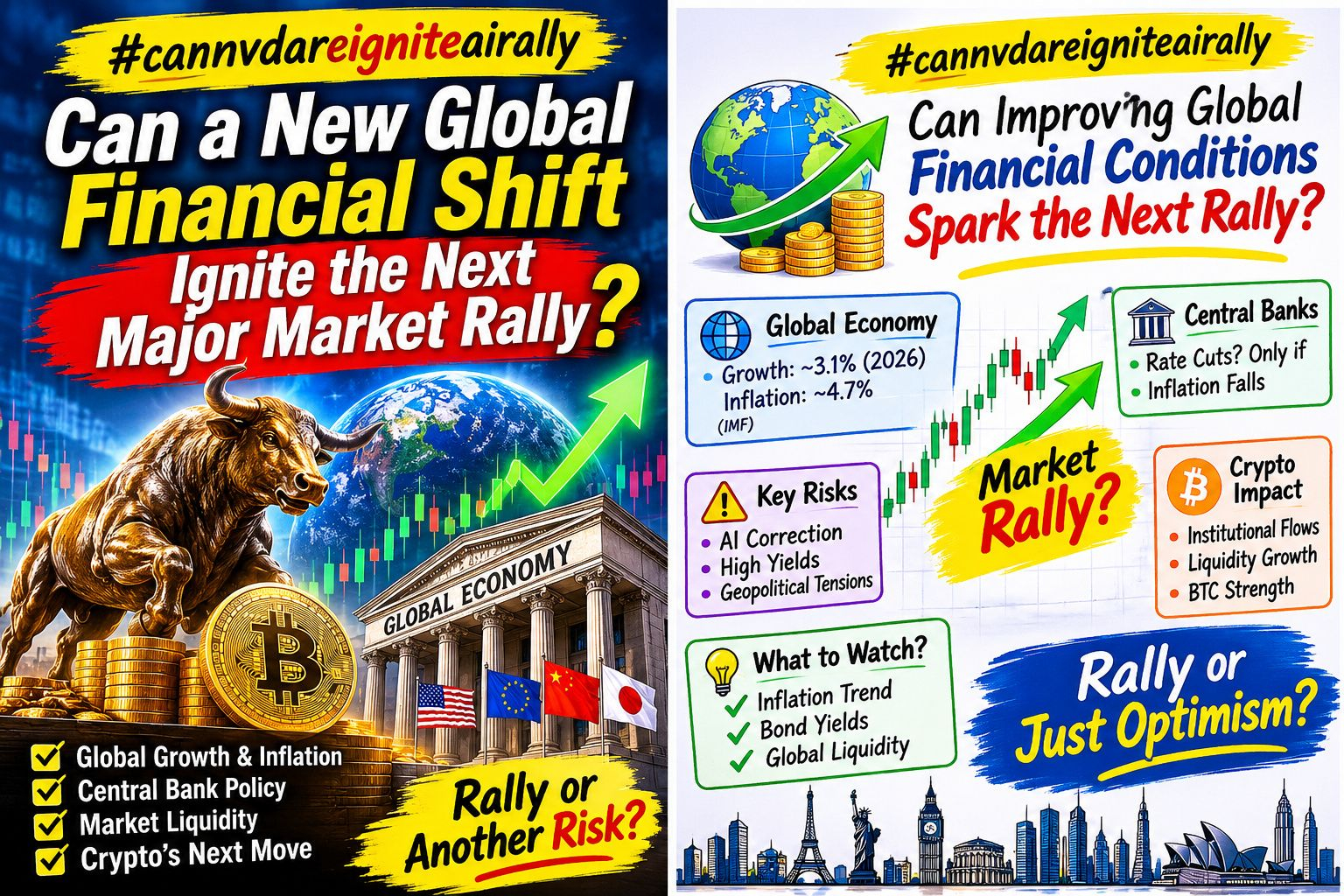

Understanding the connection between the world economy, institutional capital, and crypto markets
I have been looking at the global financial picture, and one thing stands out: financial markets are showing resilience, but the economic foundation supporting that optimism is facing serious challenges.
The question I keep coming back to is whether the next major market rally will be driven by genuine economic improvement or simply by investors taking on more risk.
1. The global economy: Growth is slowing, but not collapsing
According to the IMF's October 2026 World Economic Outlook, global economic growth is projected at 3.1% for 2026, with a recovery to 3.4% in 2027. However, global inflation is projected at 4.7% in 2026.
The OECD presents a slightly more cautious picture, projecting global growth of 2.9% in 2026 and 3.0% in 2027.
These figures suggest that the global economy is still expanding, but inflation, energy costs and geopolitical uncertainty are limiting the room for aggressive monetary easing.
2. What are international financial experts warning about?
The IMF's October 2026 Global Financial Stability Report highlights three important risks:
- An AI-related market correction if expected profits fail to materialise.
- Rising government bond yields driven by inflation and fiscal pressures.
- Cyber incidents that could disrupt financial infrastructure and investor confidence.
Athanasios Vamvakidis of the IMF has emphasised an important distinction: financial markets have remained resilient, but resilience does not mean the absence of risk.
This is particularly important because strong equity valuations can sometimes hide underlying financial vulnerabilities.
3. Interest rates and liquidity: The real drivers of a potential rally
Central-bank decisions remain among the most important factors for global markets.
When interest rates remain high, borrowing becomes expensive, businesses face higher financing costs, and investors become more selective about risky assets.
On the other hand, a sustainable decline in inflation could create room for monetary easing. That could improve liquidity conditions, support institutional investment and increase demand for equities, commodities and digital assets.
But there is a difference between lower interest rates and genuine financial liquidity. A rally needs sustainable capital flows, not just optimistic expectations.
4. How could global financial conditions affect cryptocurrency?
Crypto is increasingly connected to the wider financial system.
Bitcoin and other digital assets can benefit when institutional investors become more comfortable taking risks. However, they are also vulnerable when bond yields rise, the US dollar strengthens, or investors reduce exposure to speculative assets.
Three developments deserve close attention:
- Institutional capital flows into Bitcoin ETFs and digital assets.
- US Treasury yields and Federal Reserve policy expectations.
- Global liquidity, stablecoin supply and cryptocurrency market positioning.
A temporary increase in Bitcoin's price does not necessarily confirm a new bull market. Sustained demand, stronger spot volume and improving liquidity would provide more convincing evidence.
5. The biggest risk: A global economic shock
Energy-market disruptions, geopolitical tensions, growing government debt and expensive borrowing could create another wave of uncertainty.
The OECD warns that higher energy prices can reduce household purchasing power, while rising long-term bond yields increase government financing costs and put pressure on equity valuations.
Emerging economies may face additional pressure through currency depreciation, imported inflation and more expensive foreign borrowing.
For countries with limited financial reserves, these developments can have a particularly serious impact.
My personal market perspective
I do not think investors should assume that every improvement in market sentiment means a sustainable recovery is beginning.
The next major rally will need confirmation from several directions: inflation moving lower, bond yields stabilising, central-bank policy becoming less restrictive, institutional capital returning and corporate earnings remaining strong.
I would particularly watch Bitcoin's reaction to US bond yields and changes in global liquidity. These indicators can help explain whether capital is genuinely returning to risk assets or whether the market is experiencing another temporary recovery.
Final question: Are we approaching the beginning of a new global financial rally, or are markets simply enjoying temporary optimism before another economic challenge?