
Choosing a crypto exchange becomes more complicated when you live outside the major financial markets. A platform may have millions of users, strong security credentials, and substantial reserves, but that does not automatically mean every product or protection is available in your country.
For international users, the decision should go beyond brand reputation. You need to know whether an exchange can demonstrate that customer assets are backed, whether its security practices have been independently assessed, how it responds to incidents, and whether you can legally access the services you intend to use.
Four major platforms frequently considered by international traders are Binance, Coinbase, Kraken, and OKX. Each has different strengths in reserve transparency, security, user protection, and geographic availability.
This comparison examines their publicly documented features and explains how to verify the claims yourself.
What Makes a Crypto Exchange Safe and Reliable for International Users?
A reliable exchange should demonstrate strength across several areas rather than relying on one impressive security feature.
1. Transparent reserves
An exchange should provide evidence that it holds sufficient assets to cover the customer balances it reports.
Proof of Reserves (PoR) is one way to provide this evidence. Depending on the methodology, users may be able to inspect on-chain wallets, review reserve ratios, and cryptographically verify that their account balances were included in a published snapshot.
However, reserve transparency is not the same as a complete financial audit. Users should check the assets covered, the snapshot date, the liabilities included, and whether an independent party reviewed the methodology.
2. Independent security assessments
Look for recognized cybersecurity certifications, independent assessments, penetration testing, bug bounty programs, and documented security controls.
These measures help establish whether an exchange has formal processes for protecting its infrastructure and customer information.
Importantly, a security certification does not guarantee that an exchange can never be compromised. It provides evidence about particular controls and systems within the assessment's scope.
3. User protection and incident response
A reliable exchange should have clear procedures for handling unauthorized transactions, suspicious account activity, security breaches, and operational disruptions.
Some platforms maintain emergency protection funds or insurance arrangements. Others rely on corporate resources, custodial arrangements, or specific contractual protections.
Read the terms carefully. A protection fund is not necessarily insurance, and neither automatically covers every type of customer loss.
4. Operational reliability
Security is not only about preventing hackers from accessing wallets. It is also about maintaining dependable services.
International users should consider:
Whether deposits and withdrawals operate consistently.
How clearly maintenance and service interruptions are communicated.
Whether customer support is accessible.
Whether the platform has a history of transparent incident reporting.
Whether customers can access the relevant products in their country.
5. Regulatory status
An exchange's regulatory position can differ significantly across jurisdictions.
Check which legal entity provides the service, which regulator supervises it, and whether its authorization covers the specific products you intend to use.
An exchange may be regulated in Europe, for example, without having the same authorization or protections in an African or Asian market.
Binance vs. Coinbase vs. Kraken vs. OKX: Security and Reliability Compared
All four platforms publish information about their security practices, but they do not use identical transparency mechanisms.
The following comparison focuses on publicly documented evidence rather than claiming that one platform is universally safer.
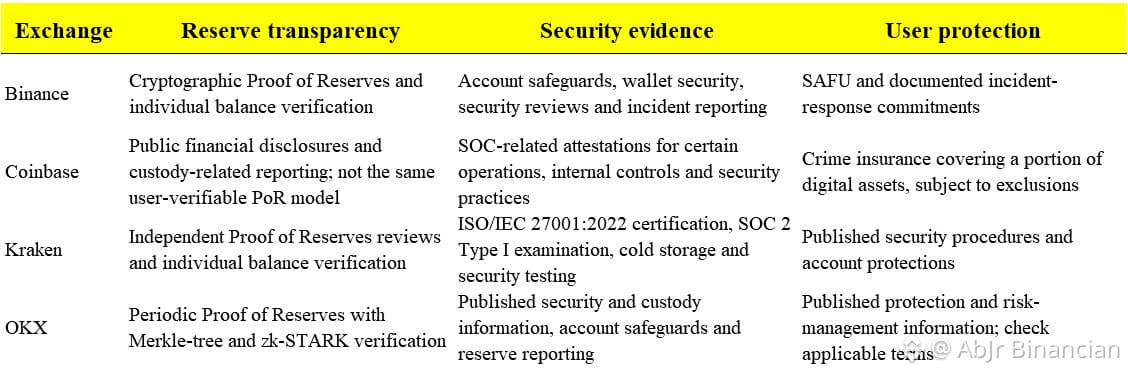
Note: These mechanisms have different scopes and are not directly interchangeable. Certifications, reserve reports, insurance, and emergency funds address different risks.
Binance: Reserve verification, SAFU, and incident accountability
Binance has developed a public Proof of Reserves system that allows users to examine whether their included account balances are backed by corresponding reserves.
Its approach uses Merkle Trees and zero-knowledge proofs to support individual balance verification without publicly exposing customers' private financial information.
You can examine the Binance Proof of Reserves page.
Another important protection is the Secure Asset Fund for Users (SAFU), an emergency reserve established in 2018 to help protect users in extreme circumstances.
The fund has publicly identifiable blockchain wallets, including its Bitcoin SAFU wallet.
The October 29, 2026 security incident provides an important test of Binance's response.
The incident affected approximately $6.34 billion in digital assets. Binance announced that it would absorb the financial impact rather than pass the losses to users.
Its October 31 recovery announcement explained that replenishment would involve a combination of SAFU, a portion of the Futures Insurance Fund, and Binance's corporate treasury.
The subsequent recovery updates provide measurable progress:
October 31: Approximately 90% of affected assets had been replenished.
November 2: Binance reported approximately 95% replenishment and said users could independently verify the relevant October 31 Proof of Reserves snapshot for ten covered tokens.
November 4: Approximately 98% had been replenished, and Binance announced a new Proof of Reserves snapshot covering 44 tokens, compared with ten in the previous snapshot.
Binance also stated that it had set aside more than 100% of the funds required to cover the affected assets from its own resources. The remaining 2% consisted of less-liquid tokens that would take longer to acquire through market and over-the-counter channels.
The November 4 snapshot was available on its PoR page, although Binance estimated that generating the complete zero-knowledge proof would take another 50–60 hours. Users should distinguish between the publication of a snapshot and completion of the cryptographic verification process.
These actions matter because accountability is demonstrated through more than promises. Replenishing affected assets, publishing progress reports, restoring services in phases, and expanding reserve coverage provide evidence users can examine.
Binance also described security improvements, including strengthening affected wallet systems, reviewing access controls, and engaging independent cybersecurity specialists to examine the incident and recommend further safeguards.
The incident should not be presented as proof that Binance is immune to future attacks. It is evidence of how the exchange responded to a serious security failure, while the full independent review and subsequent improvements remain important to evaluating its long-term reliability.
Read the official updates:
Coinbase: Public financial reporting and custody protections
Coinbase takes a somewhat different approach to transparency.
As a publicly listed company in the United States, Coinbase publishes financial statements and regulatory disclosures. These provide information about its financial position and business operations.
It also describes internal audits and independent third-party SOC 1 Type II attestations for certain Coinbase Prime operations.
Coinbase publishes information about its crime insurance, which covers a portion of digital assets held across its storage systems against certain theft-related losses, including cybersecurity breaches.
However, this coverage has important limitations. It does not cover every customer loss, including losses resulting from unauthorized access to personal accounts caused by compromised customer credentials.
Coinbase also explicitly explains that cryptocurrency holdings are not protected by FDIC or SIPC insurance.
Coinbase's public financial reporting and custody controls are useful evidence, but they should not be mistaken for a user-verifiable, account-level Proof of Reserves system like those offered by Binance and Kraken.
Kraken: Independent reserve reviews and security certifications
Kraken has a particularly clear reserve-verification framework.
Its Proof of Reserves process involves an independent third-party accountant, anonymized customer balances, Merkle Trees, and verification of on-chain assets.
Users can check whether their individual account balances were included in a particular review.
Kraken's published security credentials also include ISO/IEC 27001:2022 certification and a SOC 2 Type I examination.
It describes its use of cold storage, controlled access, security testing, and a bug bounty program.
Its official Proof of Reserves page displayed a June 30, 2026 snapshot with reserve ratios for several supported assets, including BTC, ETH, SOL, XRP, USDC, and USDT.
Kraken also openly discusses limitations of its reserve-verification process, including the fact that a snapshot cannot prove that funds have not been borrowed or encumbered.
That willingness to explain limitations is itself useful when evaluating transparency.
OKX: Regular Proof of Reserves and cryptographic verification
OKX also places considerable emphasis on reserve transparency.
Its Proof of Reserves system uses Merkle Trees and zk-STARK technology to support verification of customer balances against published reserves.
The official page displayed its 49th Proof of Reserves report in November 2026, covering 21 assets and reporting approximately $33.87 billion in reserves.
Users can access the published reports and check the verification information associated with their accounts.
OKX's repeated reserve reporting makes it another platform worth considering for users who prioritize independently checkable reserve information.
So, which exchange comes out ahead?
There is no honest universal winner across every security category.
Binance offers a combination of user-verifiable reserves, SAFU, broad platform services, and a publicly documented response to a major security incident.
Coinbase offers public-company financial reporting, custody-related controls, and a defined crime-insurance arrangement with important exclusions.
Kraken stands out for its independent Proof of Reserves methodology and published security certifications.
OKX provides recurring cryptographic reserve reports and account-level verification.
For an international user, the best choice depends on which services are available locally, the applicable legal protections, and the type of evidence that matters most.
How Can You Verify an Exchange's Security Claims?
Do not rely exclusively on exchange advertisements, social-media posts, or third-party rankings. Visit the platform's official documentation and examine the evidence yourself.
Here are five practical checks.
1. Verify your individual account balance
A reserve report is more useful when you can check whether your own account was included.
Binance provides an account-level verification process.
Users can follow the official How to Verify Your Account Balance guide.
The process allows you to access the relevant verification information and check your balance against the published cryptographic proof.
Kraken and OKX also provide account-level reserve-verification mechanisms.
2. Check the date and scope of the reserve report
A report from several months ago may not reflect an exchange's current position.
Check:
When the snapshot was taken.
Which cryptocurrencies are covered.
Whether customer liabilities are included.
Whether the methodology was independently assessed.
Whether the verification process is available to individual users.
A reserve ratio above 100% for a particular asset is useful information, but it should not be interpreted as proof of complete financial solvency.
3. Examine security credentials
Look for the actual certification or assessment rather than a general statement that a platform is secure.
Check the scope, issuing organization, validity period, and systems covered.
For example, Kraken publishes its ISO/IEC 27001:2022 certification and SOC 2 Type I examination information. Coinbase publishes information about its independent SOC-related attestations for particular operations.
Remember that an assessment of one business operation does not automatically cover every exchange product or global subsidiary.
4. Read the protection and insurance terms
If an exchange advertises an emergency fund, insurance, or compensation program, ask:
Which incidents qualify?
Which assets and accounts are covered?
Are personal account compromises excluded?
Who decides whether compensation is payable?
Is there a claim deadline?
Can the fund be independently inspected?
For Binance, start with the SAFU FAQ and inspect the public SAFU Bitcoin wallet.
5. Verify country-specific availability and regulatory status
This is particularly important for international users.
Before depositing funds, confirm:
Your country of residence is supported.
The exchange accepts your identity documents.
The specific legal entity serving your country is identifiable.
The services you intend to use are available.
Your deposit and withdrawal methods are supported.
Any applicable local licensing or regulatory requirements are satisfied.
For example, Coinbase's services vary by country, and its MiCA authorization through Coinbase Luxembourg applies to its European Economic Area operations. Coinbase International Exchange also has separate eligibility requirements and is not a universally available retail product.
OKX instructs users to select their actual country of residence during registration rather than using another country to bypass restrictions.
Kraken similarly publishes different legal terms for different regions.
For Binance, check the local version of the platform, applicable terms, and product availability rather than assuming that every global service is available in every market.
For users in Ethiopia and other emerging markets: Check local regulations as well as exchange availability. An account that can be registered or accessed does not necessarily mean every crypto-related transaction or payment method is legally permitted in your jurisdiction.
Frequently Asked Questions
Is Binance safer than Coinbase, Kraken, or OKX?
There is no universally accepted ranking that establishes one of these exchanges as the safest in every category.
Binance offers extensive reserve-verification tools and SAFU, while Kraken provides independent reserve reviews and published security certifications. Coinbase has public financial reporting and custody-related controls, while OKX offers recurring cryptographic reserve reports.
The recent Binance incident also provides evidence of its financial response and recovery efforts. However, a successful recovery does not erase the original security failure or guarantee that similar incidents cannot happen again.
Compare the evidence, applicable protections, and local regulatory position before deciding.
Which exchanges let users independently verify their balances?
Binance, Kraken, and OKX offer Proof of Reserves systems with mechanisms for individual account verification.
Coinbase provides public financial disclosures and other custody-related reporting, but these should not be confused with the same type of individual, cryptographic PoR verification.
The verification process and covered assets differ between platforms.
How does Binance let users verify their balance?
Binance publishes reserve information and provides a dedicated verification guide.
Users can:
Log in to their Binance account.
Navigate to the Proof of Reserves or wallet verification section.
Select an available reserve snapshot.
Access their account verification information.
Follow the instructions to check their balance against the cryptographic proof.
Start here: How to Verify Your Account Balance on Binance.
What should international users check before depositing funds?
Confirm country eligibility, identity-verification requirements, local regulatory status, deposit and withdrawal options, and the legal entity responsible for providing the service.
Also check the platform's reserve transparency, security assessments, user-protection terms, and customer-support procedures.
Do not deposit substantial funds simply because an exchange is popular or because its app is accessible from your country.
Does Proof of Reserves mean an exchange cannot lose customer funds?
No. Proof of Reserves provides evidence about specified assets and liabilities at a particular point in time.
It does not guarantee protection against future hacks, operational failures, hidden liabilities, or every possible financial problem.
It is one important part of a broader security and transparency framework.
Final Thoughts
For international crypto users, choosing an exchange is ultimately a decision about evidence, accessibility, and accountability.
Binance, Coinbase, Kraken, and OKX each offer different forms of security and transparency. Binance's SAFU and its recent asset-replenishment response demonstrate one approach to user protection. Kraken's independent reserve reviews and security certifications offer another. Coinbase's public financial disclosures and custody-related controls provide a different type of evidence, while OKX's recurring cryptographic reserve reports make its assets more transparent to users.
The strongest decision is not necessarily choosing the exchange with the biggest name or the highest trading volume. It is choosing a platform whose claims you can verify, whose services are legally available where you live, and whose response to problems is clear and accountable.
Disclaimer: This article is for educational purposes only and does not constitute financial, investment, or legal advice. Security features, insurance arrangements, reserve reports, regulatory permissions, and product availability may change. Always consult the latest official documentation and applicable local regulations before depositing funds.
#CryptoSecurity #Binance #ProofOfReserves #safu #cryptoeducation