

Disclosure: This article is part of a partnership with the BiyaPay Content Creator Program. All opinions are my own and this is not financial advice.
Most crypto people in Indonesia who look at stocks think of the US first. That makes sense: big tech names, long overnight sessions, lots of news. But for a WIB timezone, Hong Kong is arguably the more convenient market on the clock. It trades during our morning and early afternoon, not at midnight.
This article is not a trading diary. I am not describing orders I placed. It is my reading of BiyaPay's Hong Kong stock FAQ, plus the questions I think are worth answering before anyone treats HK stocks as "just like US stocks, but earlier."
Why the clock is friendlier
Hong Kong Time is UTC+8. WIB is UTC+7. Neither observes daylight saving time, so the gap stays at one hour all year. That is a nice contrast with the US, where the WIB mapping shifts twice a year.
According to BiyaPay Help Center, HK stock trading hours are:
Morning session: 09:30–12:00 HKT, which is 08:30–11:00 WIB
Lunch break: 12:00–13:00 HKT, which is 11:00–12:00 WIB
Afternoon session: 13:00–16:00 HKT, which is 12:00–15:00 WIB
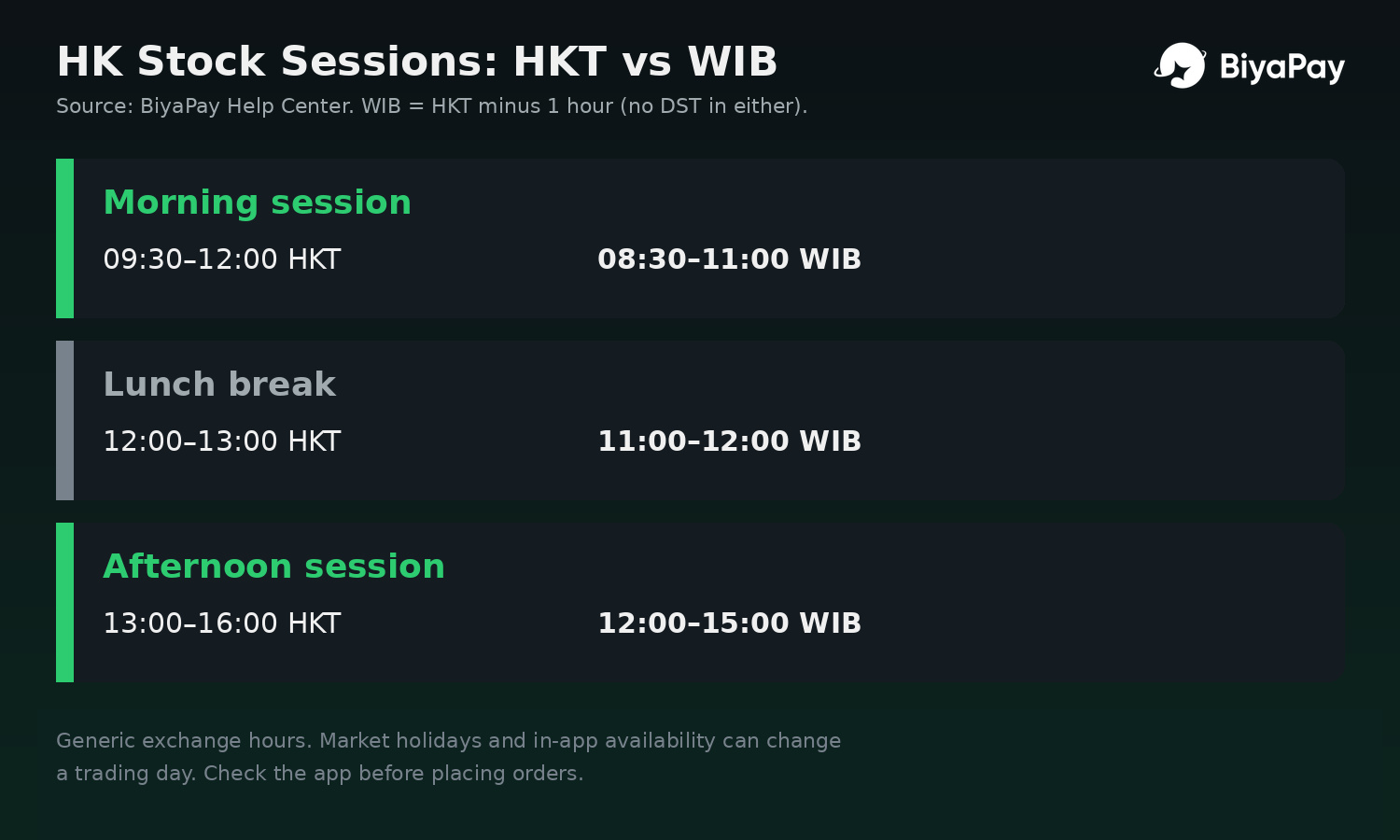
In my opinion, the lunch break is the detail that surprises people coming from US stocks, where the regular session runs continuously. An order plan made at 10:55 WIB may not behave the way someone expects if they forget the market pauses for an hour.
These are generic exchange hours. Market holidays exist, and what is available in the app on a given day is the final reference.
The board lot rule
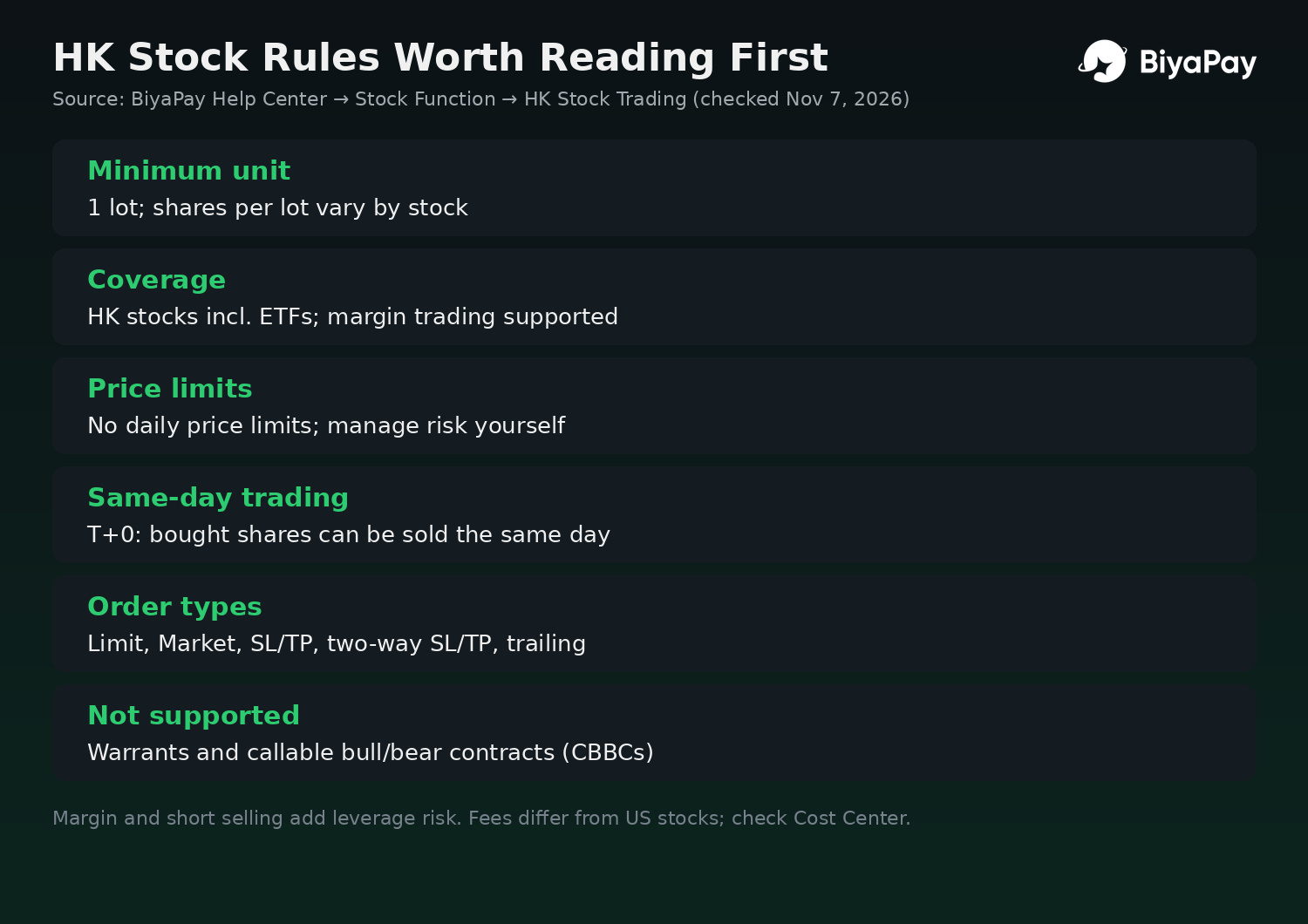
This is the one I would read twice. BiyaPay's FAQ says the minimum trading unit for HK stocks is 1 lot, and the number of shares per lot varies by stock.
In practice that means:
The smallest order is not "1 share" like many people assume from US-stock habits
Two stocks with similar share prices can need very different minimum amounts, because their lot sizes differ
Before sizing anything, it makes sense to check the lot size shown for that specific stock
For small budgets, I think this matters more than the share price itself. A cheap-looking stock can still require a meaningful amount per lot.
What BiyaPay says is supported
From the same Help Center section:
All Hong Kong stocks, including ETFs, can be traded, along with margin trading
Short selling for HK stocks is supported
Trading is T+0, so shares bought today can be sold the same day
There are no daily price limits in the HK market, and the FAQ itself notes that investors need to manage risks
And what is not supported:
Warrants
Callable bull/bear contracts (CBBCs)
I like that the FAQ states the exclusions directly. Warrants and CBBCs are a big part of Hong Kong market chatter, so knowing they are out of scope avoids a wasted search.
Order types
BiyaPay lists five order types for HK stocks: limit order, market order, stop-loss/take-profit, two-way stop-loss/take-profit, and trailing stop-loss/take-profit.
My personal view on them is cautious:
A limit order is the clearest way to state the price you are willing to accept
A market order prioritizes execution, not price
Stop and take-profit orders are triggers, not promises of an exact exit price, especially when a stock moves quickly with no daily limit to slow it down
Margin and short selling: opinion first
The FAQ says margin trading and short selling are supported for HK stocks. Supported does not mean suitable. Leverage amplifies losses as well as gains, and short positions can lose more than the starting amount if a price keeps rising. Combined with no daily price limits, I would treat both features as advanced tools, not a starting point.
Fees are their own topic
Hong Kong fee structures are different from US stock fees. BiyaPay's own blog makes the same point: do not apply one market's fee rules to another product. Instead of guessing, I would open the Cost Center and the order page for the exact HK stock before deciding anything. The fee details shown on the order page should be the final reference.
Funding and withdrawals
According to the FAQ, funds can be withdrawn after closing HK stock positions, and if USDT is used for deposits and withdrawals, funds can arrive within minutes. I read "can" carefully here. Network choice, verification status and platform processing can all affect timing, so I would not plan around a best-case number.
My intended checklist before a first HK order
Convert the session times to WIB and remember the 11:00–12:00 WIB lunch break.
Check the lot size of the specific stock and calculate the minimum amount per lot.
Confirm the product is a regular stock or ETF, not a warrant or CBBC.
Choose an order type I can explain in one sentence, defaulting to limit when unsure.
Skip margin and short selling unless I fully understand the downside.
Check the Cost Center and the order page for HK fees.
Check for market holidays and in-app availability on the day.
Final thoughts
For someone in WIB, Hong Kong may be the most time-friendly major stock market: one fixed hour of difference, morning trading, and no seasonal clock shift. But the rules are genuinely different from the US. Board lots, a lunch break, no daily limits and a separate fee structure all deserve attention before anything else.
That is my reading of the official FAQ, not a recommendation to buy any Hong Kong stock. Read the rules, check the app, and decide at your own pace.