

Are Institutional Shorts Fuel for a Rally — or Part of a Market-Neutral Strategy?
BitChoice | Satya — Derivatives & Market Structure Intelligence
November 4, 2026
The $2.2 Billion Question
Bitcoin is navigating a volatile market environment, and attention has shifted toward a potentially significant concentration of short exposure in CME futures.
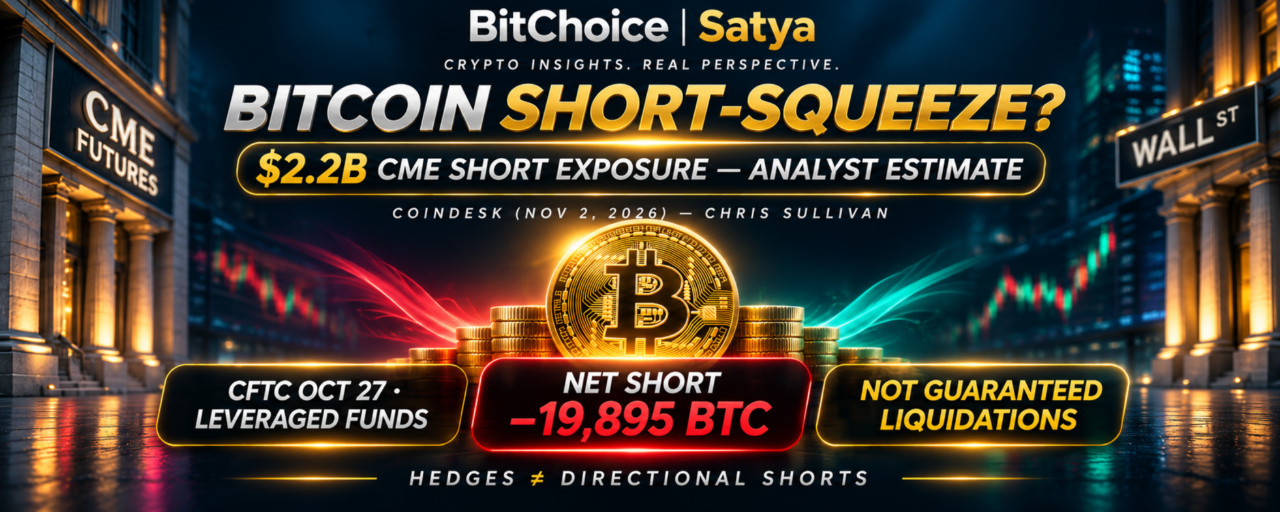
On November 2, CoinDesk reported that Chris Sullivan, founder and CEO of Hyperion Decimus, had highlighted an estimated 29,220 BTC-equivalent in CME short positioning, valued at approximately $2.2 billion.
The suggestion is tempting.
If Bitcoin rallies sharply, could short sellers rush to close their positions and accelerate the move?
Possibly.
But the headline figure does not answer the most important questions.
Who holds these short positions? Why are they short? And what would actually force them to buy?
Without those distinctions, a large short-position estimate can easily become a misleading market narrative.
1. What the Official CFTC Data Actually Shows
The latest available CFTC Commitments of Traders report covers positions as of October 27, 2026.
For standard CME Bitcoin futures, each contract represents five BTC.
Leveraged funds held:
9,866 short contracts
5,887 long contracts
Net short: 3,979 contracts
BTC equivalent: approximately 19,895 BTC net short
Open interest across the reported market stood at 20,791 contracts.
But another detail is especially important.
On October 20, leveraged funds were net short 4,942 contracts.
By October 27, that net short had narrowed to 3,979 contracts.
The net short position decreased by 963 contracts, equivalent to 4,815 BTC.
This indicates a reduction in net bearish futures exposure within that reporting category.
It does not prove that every hedge fund became bullish, nor does it explain the entire market.
But it challenges the simplistic claim that institutional short exposure must be expanding.
2. Why $2.2B and 19,895 BTC Are Not the Same Measurement
The $2.2 billion estimate and CFTC's 19,895 BTC net short should not be compared as if they measured identical positions.
They differ in methodology and observation date.
The analyst estimate reflects a particular interpretation of CME short exposure reported on November 2.
The CFTC figure represents the difference between long and short positions held by leveraged funds on October 27.
One is a reported estimate of short-side exposure.
The other is an official net-position measurement for a defined trader category.
There is also a critical difference between gross shorts and net shorts.
A fund with both long and short futures positions may have substantial gross short exposure but a much smaller net directional position.
And no position-size statistic, by itself, reveals exactly when the holder would close the trade.
Notional exposure is not a liquidation forecast.
3. The Hidden Basis Trade
One reason institutional CME shorts can be misleading is the futures basis trade.
A simplified example:
An institution buys Bitcoin through a spot instrument while simultaneously selling Bitcoin futures.
The objective may be to capture the difference between the futures price and the spot price, rather than profit from Bitcoin falling.
The resulting portfolio can be substantially hedged against directional price changes, although basis movements, execution and financing still create risks.
This matters during a short squeeze.
If an institution closes a market-neutral basis position, it may:
Buy back its short futures position while selling the corresponding long Bitcoin exposure.
The futures purchase can create upward pressure in that contract.
But the simultaneous reduction in long exposure can offset some of the broader directional effect.
That is very different from an unhedged bearish trader urgently buying futures to limit losses.
A CME futures short does not automatically represent an outright bearish Bitcoin bet.
4. What Actually Creates a Short Squeeze?
A genuine short squeeze is a feedback process.
First, prices rise.
Then, short sellers facing mounting losses or tighter risk limits begin buying back positions.
That buying may push prices higher, forcing additional shorts to close.
The effect can become particularly intense when market liquidity is thin.
Three conditions are especially relevant.
Strong Spot Demand
The initial rally needs meaningful buying pressure rather than relying entirely on derivatives transactions.
Position Reduction
Evidence should indicate that shorts are actually being covered, not merely that open interest is high.
Limited Executable Liquidity
When order books are thin, aggressive buying can create a larger price impact.
These factors can reinforce one another.
But a high nominal value of shorts is not sufficient evidence that such a process has begun.
5. The Opposite Risk: Long Liquidations
Bitcoin's recent volatility also demonstrates why traders should not focus exclusively on the short side.
When leveraged long positions become vulnerable, falling prices may trigger forced selling.
That selling can accelerate declines, producing a long-liquidation cascade.
Both types of liquidation can create self-reinforcing market moves.
The direction depends on actual positioning, collateral conditions, liquidity and price behavior.
A market can contain substantial institutional short exposure and still decline sharply.
Crowded positioning does not protect traders from moves in the opposite direction.
6. CME Futures Are Not the Same as Offshore Perpetuals
Another important distinction concerns market structure.
CME Bitcoin futures and perpetual contracts on crypto exchanges operate under different arrangements.
CME futures are standardized, dated contracts cleared through regulated futures-market infrastructure.
Crypto perpetuals typically have no fixed expiration date and use funding mechanisms designed to keep their prices aligned with the underlying market.
Their margin requirements, settlement structures and liquidation mechanics differ.
This matters because a short position on CME should not automatically be included in the same liquidation estimate as a highly leveraged perpetual position on a crypto exchange.
A trader's decision to close a CME hedge may be driven by basis economics, portfolio exposure or risk limits rather than an exchange-style liquidation price.
Different derivatives markets require different risk models.
7. Why Open Interest Alone Is Not Enough
Open interest measures outstanding derivatives contracts.
It does not indicate whether the market is about to rise or fall.
For every outstanding futures contract, there is a long and a short side.
High open interest can reflect speculation, hedging, market making or relative-value trading.
To understand changing risk, analysts should examine open interest alongside price, volume and positioning.
For example:
Price rising, open interest falling
This may be consistent with position closing, including short covering, but does not prove it without additional information.
Price rising, open interest rising
New positions may be entering the market.
Price falling, open interest falling
Positions may be closing amid declining prices, including long liquidations.
These are analytical interpretations, not deterministic signals.
The surrounding market data determines how useful they are.
8. Why ETF Flows Also Matter
US spot Bitcoin ETFs provide another important channel for institutional exposure.
On October 30 and November 2, the funds recorded approximately $1.04 billion in combined net outflows.
That indicates meaningful redemptions through this particular investment channel.
But ETF fund flows do not measure total global Bitcoin demand.
Nor can they automatically be matched against CME short positions to calculate a single market-wide directional bet.
Some institutions may combine ETF holdings with futures shorts.
Others may hold ETFs without any derivatives hedge.
Different participants may use entirely different strategies.
The relationship between spot exposure and derivatives positioning is precisely why the aggregate data requires careful interpretation.
ETF redemptions and futures shorts are separate measurements, even when some portfolios connect them.
9. Election Week Adds More Uncertainty
The short-squeeze discussion has emerged during a major US macroeconomic week.
The November 3 congressional elections and the November 4 Treasury refunding announcement are important events for financial-market expectations.
Changes in bond yields, dollar strength and equity-market risk appetite may influence Bitcoin.
However, the existence of these events does not establish which direction Bitcoin will move.
A rally could encourage short covering.
A decline could place leveraged longs under pressure.
Conflicting signals could produce sharp reversals.
The important task is to evaluate how markets actually respond, rather than assuming that political or macroeconomic headlines guarantee a trading outcome.
10. Five Indicators That Could Confirm a Real Squeeze
Instead of focusing exclusively on a dramatic $2.2 billion figure, serious market analysis should monitor five indicators.
1. Spot buying pressure
Is there sustained demand in executable spot markets?
2. CME positioning changes
Are leveraged funds reducing their net short exposure further?
3. Open interest and trading volume
Do price changes coincide with evidence of position reduction and increased trading activity?
4. Futures basis and funding
Are relative-value opportunities changing in a way that encourages hedge unwinds?
5. Market depth and liquidation activity
Are aggressive orders encountering thin liquidity, and are forced position closures actually occurring?
Each indicator provides only part of the picture.
Together, they can distinguish a genuine short-covering episode from ordinary market volatility.
11. Three Possible Market Scenarios
Scenario A — Genuine Short Covering
Spot demand strengthens, Bitcoin rises and some short positions are closed aggressively.
Price movement accelerates as futures buying interacts with limited liquidity.
This could produce a short squeeze.
Scenario B — Hedge Unwinding Without a Major Rally
Institutions reduce basis trades by closing futures shorts and associated long positions.
Gross derivatives exposure falls, but the broader directional price impact remains limited.
Short covering occurs without a dramatic market-wide squeeze.
Scenario C — Downside Liquidity Cascade
Spot selling remains strong or macroeconomic conditions deteriorate.
Leveraged long positions come under pressure.
Forced selling amplifies downside volatility despite the existence of substantial short exposure elsewhere.
All three scenarios are economically possible.
None can be established from the $2.2 billion estimate alone.
Final Perspective: Understand the Position Before Predicting the Move
The market's fascination with large institutional short positions is understandable.
A potential short squeeze offers a dramatic narrative.
But financial markets are more complicated than a single long-versus-short scoreboard.
The latest available CFTC data shows that leveraged funds were still net short CME Bitcoin futures as of October 27.
It also shows that their net short position had narrowed compared with the previous week.
Meanwhile, the $2.2 billion figure remains a separate analyst estimate with a different measurement basis.
Neither number proves an imminent squeeze.
The more useful question is how much of the exposure represents genuine directional speculation, how much belongs to hedged strategies and what market conditions would cause those positions to unwind.
The size of a short position tells us how much exposure exists. Its structure tells us far more about what could happen next.
Discussion
Could Bitcoin experience a genuine short squeeze, or is the market overestimating the bullish impact of institutional basis-trade unwinding?
Sources
CoinDesk — Bitcoin Traders Eye Post-Election Rally as Exchange Outflows Point to Supply Squeeze, November 2, 2026.
CFTC — Commitments of Traders, Traders in Financial Futures, CME Bitcoin futures positions as of October 27, 2026.
CME Group — Bitcoin Futures contract specifications and market structure.
Data disclosure: The $2.2 billion figure is a dated analyst estimate, not a real-time liquidation measurement. CFTC positioning is a historical weekly snapshot, not current intraday exposure. Scenarios are conditional, not price predictions.
Educational and informational content only. Not financial or investment advice.
#Bitcoin #ShortSqueeze #BitcoinFutures #MarketStructure #CryptoDerivatives $BTC $ETH

