
AI in crypto is moving beyond answering questions and summarizing market news. We are starting to see AI tools that can monitor markets, organize information, build workflows, and even carry out actions under permissions set by the user.
But here is where things can get confusing. Not every AI tool is designed to do the same job, and not every user needs the same level of automation.
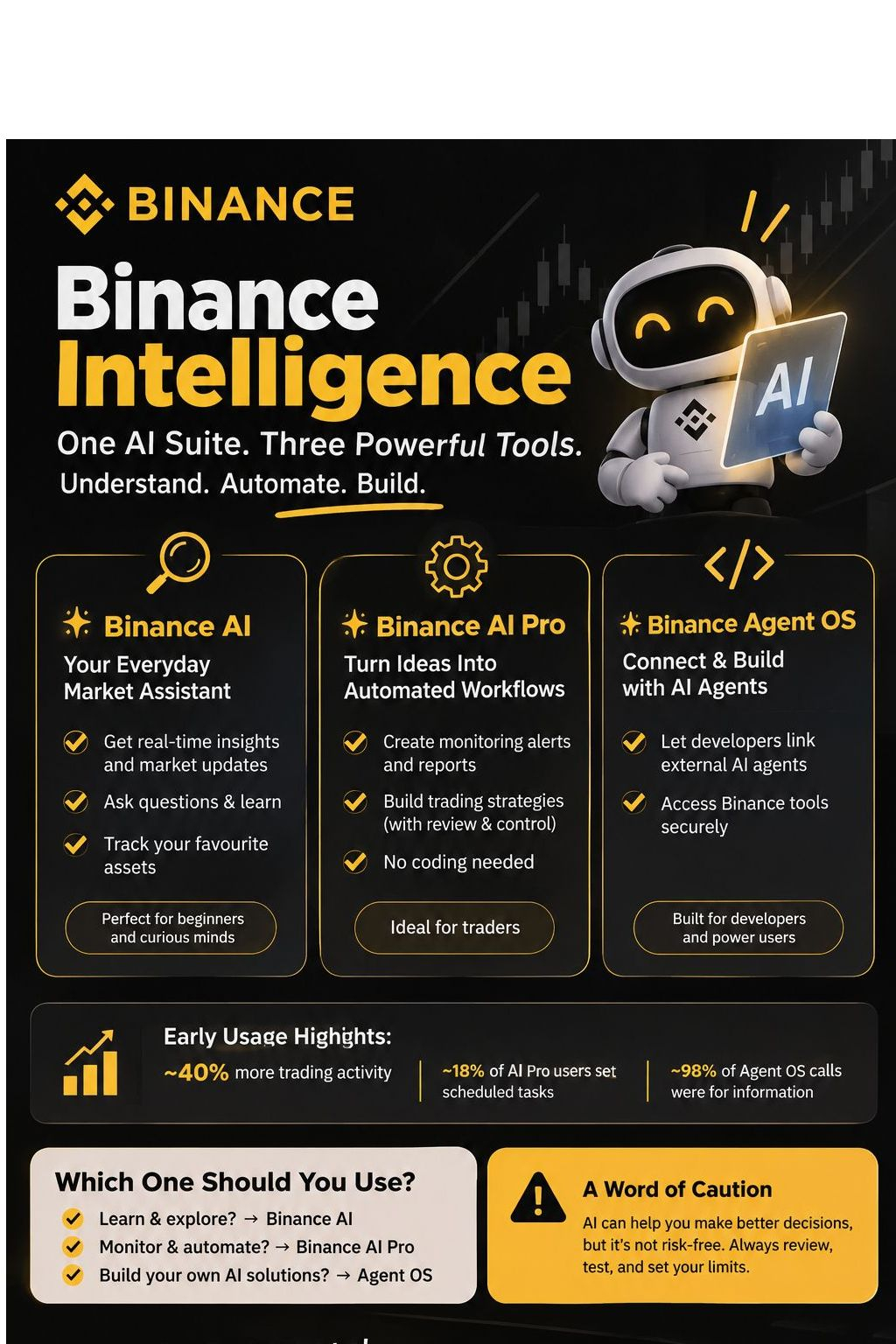
That is exactly what makes Binance Intelligence interesting. Instead of offering one AI product and expecting everyone to use it the same way, Binance has brought three products together under one ecosystem: Binance AI, Binance AI Pro, and Binance Agent OS. They serve different purposes, from helping someone understand what is happening in the market to allowing developers to connect their own AI agents to Binance capabilities.
Let's break down what each one actually does, who it is designed for, and how you could use them in real situations.
What Is Binance Intelligence?
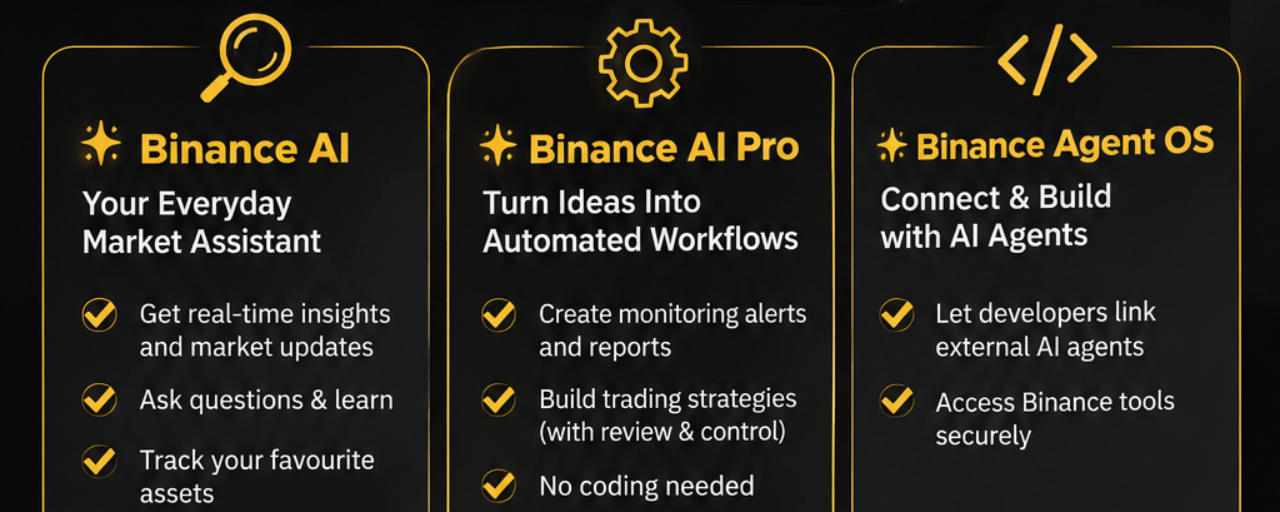
Think of Binance Intelligence as an AI layer across the Binance ecosystem, rather than a single application. Its three products cover three different levels of interaction with the market.
Binance AI helps you understand what is happening. Binance AI Pro helps you turn an idea into a workflow that can monitor markets or execute a strategy after your approval. Agent OS gives developers the infrastructure to connect external AI agents to supported Binance services.
In simple terms, one helps you understand, another helps you automate, and the third lets you build and connect.
1. Binance AI: Your Everyday Market Assistant
You do not need to be a professional trader to benefit from AI. Sometimes, you simply want to understand why Bitcoin is moving, what is happening with a particular sector, or whether something important has changed in the market.
That is where Binance AI comes in. Integrated into the Binance app, it provides personalized market information and assistance based on your interests, holdings, favourites, and experience. Instead of navigating through multiple pages and trying to connect every piece of information yourself, you can get a more relevant overview in one place.
Some of its features include Market Brief, which provides market updates in text or audio; Smart Tracker and Smart Alerts, which help monitor your favourite assets; and Ask Binance AI, which lets you ask follow-up questions. You can also explore market insights covering crypto and traditional financial markets, including stocks and ETFs.
For example, imagine you hold BTC, BNB, and ETH. Instead of opening three different charts every morning, you could use Binance AI to get a broader overview of what is happening with those assets, check relevant market developments, and understand which factors may be influencing their movements.
You can also use it to learn. If you are new to trading and come across a term such as funding rates, market capitalization, or open interest, you can ask for an explanation without having to leave the app.
One important distinction: Binance AI is designed to inform, not trade on your behalf. It helps organize information and provide context, but the investment decision remains yours.
2. Binance AI Pro: From an Idea to an Automated Workflow
Now, let's move one step further. What if you already have a trading idea but do not know how to turn it into a working strategy? Or what if you want to monitor the market continuously without having to check it manually every few minutes?
This is where Binance AI Pro becomes particularly interesting. Unlike a regular AI assistant, AI Pro allows you to describe what you want in everyday language and helps turn that idea into a structured workflow. You do not need to write code or build the entire system yourself.
For example, imagine you want to monitor Bitcoin and receive an alert whenever its price moves by 3% within a specific period. You could describe that requirement in a prompt, clarify the conditions, and let AI Pro help build the workflow.
Or imagine you want a daily report covering BNB, BTC, and ETH, including price movements, market developments, and important indicators. You can describe the report you want and create a workflow that generates it automatically.
And yes, it can go beyond research and monitoring. You can also describe a trading strategy, define its parameters and risk limits, test it using paper trading, review the workflow, and decide whether to approve live deployment.
This is an important part of the process. AI Pro does not simply receive a vague instruction and immediately start trading with your funds. You review the proposed logic, test it, and explicitly approve going live. Each live strategy operates through a dedicated AI Strategy Account, separate from your main account. You can also pause, adjust, or revoke a workflow.
For someone who has never written a line of code, this opens up a different way to approach automation. You can focus on the strategy you want to build rather than spending hours figuring out the technical implementation.
AI Pro also offers different plans. Its Standard plan includes a monthly credit allowance, while Premium provides a larger allowance and access to additional models, subject to availability. Always check the current product terms and pricing in Binance before choosing a plan.
3. Binance Agent OS: For Developers and Advanced AI Users
This is where things become more technical. Binance Agent OS is designed for developers who want to connect external AI agents to Binance's financial infrastructure. Rather than using only an assistant built inside the Binance app, developers can connect compatible agents to supported Binance tools and capabilities.
One of the key components is the Binance MCP Server. MCP stands for Model Context Protocol, an open standard that allows AI applications to discover and interact with external tools through a standardized connection.
In practical terms, this means a compatible AI agent can access supported Binance functions once the user authorizes the required permissions.
For example, a developer could build an agent that monitors market data, checks account information, and interacts with supported trading functions according to the permissions granted. Other integrations within Agent OS also support capabilities related to wallets, payments, and on-chain activity.
But there is an important security distinction here. Permissions are user-controlled, and access is not automatically unlimited. Agent OS uses dedicated Agentic sub-accounts for agent activity, and users decide which permissions to grant. The Binance MCP integration does not provide an external withdrawal permission.
Think of Agent OS as the infrastructure layer. It is not simply another chatbot; it gives developers the tools to create more specialized AI experiences that can interact with Binance.
So, Which One Should You Use?
The easiest way to understand the difference is to think about what you want to accomplish.
If you are a beginner who wants to understand market movements, learn new concepts, and keep up with your favourite assets, Binance AI is a natural starting point.
If you are a trader who wants to create monitoring systems, receive scheduled reports, test strategies, or automate specific tasks without coding, Binance AI Pro is worth exploring.
And if you are a developer building your own AI-powered financial application or agent, Agent OS provides the infrastructure to connect that experience to supported Binance capabilities.
You do not necessarily have to choose only one. You could use Binance AI to understand the market, AI Pro to monitor a particular strategy, and Agent OS if you eventually decide to build your own external agent.
What Are the Early Usage Numbers Telling Us?
One of the most interesting parts of Binance Research's October 2026 analysis is not simply the number of people experimenting with AI. It is how they are actually using it.
According to Binance Research, Binance AI beta users were around 40% more likely than a holdout group to trade on the day they opened the app. This is an observed difference between groups, not proof that AI itself caused users to trade more.
The Agent OS data also offers an interesting perspective. Active accounts had recovered to around 95% of hackathon levels, with activity up 39%. More importantly, approximately 98% of the most-used Agent OS calls were related to reading information rather than executing trades.
AI Pro shows a similar pattern. Around 18% of early beta users had at least one scheduled monitoring or alert task, and these tasks accounted for approximately 21% of the system's output. Users with scheduled tasks received around ten unprompted updates per day on average.
Another detail worth noting is that approximately 55%–60% of AI Pro users interacted in languages other than English, across more than 30 languages. And around 69% of questions arrived outside US market hours.
What does this tell us? People are not necessarily rushing to hand over their trading decisions to AI. A significant part of the early demand is about monitoring, research, alerts, and getting information when it matters. That is a more practical starting point for AI in finance than assuming everyone wants a fully automated trading system.
AI Can Help You Make Decisions, But It Cannot Make Them Risk-Free
There is one thing I always want to emphasize when discussing AI and trading: automation does not eliminate risk.
An AI-generated strategy can contain flawed assumptions. A workflow can execute exactly as instructed and still lose money. A successful functionality check only confirms that the workflow can run without errors; it does not guarantee that the strategy is profitable.
That is why testing, reviewing the logic, setting realistic limits, and understanding what permissions you are granting are essential. AI-generated information can also be incomplete, outdated, or inaccurate, so it should never replace your own research and judgment.
The real value of these tools is not that they promise to predict every market move. It is that they can help reduce the amount of manual work involved in understanding, monitoring, and interacting with financial markets.
Final Thoughts
I see Binance Intelligence as an interesting step in how people may interact with financial platforms in the coming years. We are moving from asking AI questions to building workflows around our needs, and eventually connecting specialized agents to financial infrastructure.
But the most important thing is understanding the difference between these products before using them. You do not need to be a developer to explore AI, and you certainly do not need to automate your trades just because the technology allows it.
Start with what you actually need. Learn how the tools work, test their capabilities, understand their limitations, and only grant permissions you are comfortable with.
Because the smartest use of AI in trading is not letting it think for you. It is using it to think better.
My Experience: I Started With Binance AI, Then Went Further
My experience with these tools has been a gradual progression, and I think that is what makes the evolution interesting. I started with Binance AI, using it as a way to explore market information, ask questions, and get a clearer picture of what was happening without jumping between different sources. When Binance AI Pro came along, I wanted to see whether it could do more than simply answer questions, so I started testing it with actual trading ideas. One thing that stood out to me was that it did not simply encourage me to enter a trade; in one situation, its assessment suggested that staying out was the better decision. And honestly, I appreciated that more than an AI that would just agree with whatever I asked. Then I took things a step further with Binance Agent OS. I tested it by asking it to analyze the BNB/USDC 15-minute chart and open a 15x leveraged futures position using 10 USDC. It actually executed the position. That was the moment the difference became very real to me: I had moved from asking AI for information, to building strategies with it, to connecting an agent that could interact with Binance and execute an action. Of course, I also learned that execution is not magic. I encountered an issue with stop-loss and take-profit handling, which reminded me that connectivity and execution delays still matter. AI can be the brain behind a workflow, but the reliability of the connection and the rules you set remain just as important.